
Elie Mystal Bad Law Ten Popular Laws That Are Ruining America The New Press, March 2025.
Thank you, NetGalley, for providing me with this uncorrected proof for review.
Elie Mystal does not disappoint in this fiercely passionate, but so cleverly analytical, exposure of the inherent inequality espoused in the ten laws he addresses in this volume. Some of Mystal’s language, as for the first of his books I read, Allow Me to Retort: A Black Guy’s Guide to the Constitution could possibly offend. But, how on earth can his language be more offensive than the laws he opens to scrutiny? Let us try to be fair at least in this small contribution to fairness amongst the appalling unfairness Mystal exposes and read with as open a mind as possible. There is plenty to offend, and it is certainly not Mystal and his arguments. He asserts that the facts he presents are correct – he has no problem with having a fact checker! He also acknowledges that this being so, that a reader who disagrees is doing so because of the conclusions he draws from the facts. Although this statement is made in the acknowledgements, I believe it is imperative that it forms part of this review and underpins the reading of this book. See Books: Reviews for the complete review.
Following articles: Louisa Anne Meredith; American Politics – The Daily -humorous quote, Raw Story articles -Jack Smith Report, Washington Post cartoon; The Danger of Miseducation, Jess Piper.
Hidden women of history: the Australian children’s author who captured the bush – before May Gibbs’ Australiana empire
Republished here under –
 We believe in the free flow of information
Republish our articles for free, online or in print, under Creative Commons licence.
Published: January 7, 2025 6.03am AEDT
Authors
- Lauren A. Weber Lecturer in Literature, Language and Literacy, University of Wollongong
- Sara Fernandes Lecturer in English and Theatre Studies, The University of Melbourne
Disclosure statement
The authors do not work for, consult, own shares in or receive funding from any company or organisation that would benefit from this article, and have disclosed no relevant affiliations beyond their academic appointment.
Partners: University of Melbourne provides funding as a founding partner of The Conversation AU; University of Wollongong provides funding as a member of The Conversation AU.
May Gibbs is a household name in Australia. Her most famous book, Tales of Snugglepot and Cuddlepie, published in 1918, has never been out of print. Chances are you have read her work, or had it read to you. You’ll almost certainly have seen her personified native flora illustrations, which these days adorn everything from tea towels to pyjamas.

But have you heard of her predecessor, Louisa Anne Meredith? Like Gibbs, who began to publish in the decades following Meredith’s death in 1895, she drew her literary inspiration from the Australian landscape and crafted her own “brand” in its image.
Unlike Gibbs, though, Meredith’s illustrations were naturalistic. She rendered native Australian flora and fauna as characters for children’s literature, arguably beginning this tradition. But she didn’t “cutesify” them, or give them human features.
As researchers, we believe Meredith’s work for children should be recognised today for its innovations in genre: blending science writing, travel writing, poetry, and fairy tale. It is also anchored in a desire to shape the Australian child into the ideal young colonialist, by framing the land as unoccupied and in need of European care and management.

Dedicated to her craft
Louisa Anne Meredith (born Twamley in 1812) was an author and illustrator, born to a precariously middle-class family in Birmingham. Her father, Thomas Twamley, was a hard-working corn miller and dealer. Louisa’s mother (who shares her name) married him much to the dismay of her prominent family, the Merediths. They were descended from Welsh nobility.
At 22, Twamley’s first collection, Poems (1835), was positively received. English critic Leigh Hunt sang her praises in his 1837 poem, Blue-Stocking Revels, or The Feast of the Violets:
Then came young Twamley,
Nice sensitive thing,
Whose pen and whose pencil
give promise like spring.
By her mid-20s, Twamley had a handful of books in print under her maiden name, as well as a series of prints, sketches, paintings, colour plates and miniatures. She was entirely dedicated to her craft. Her fresh style of publishing original poems alongside accomplished naturalistic illustrations was something new.
Tasmanian life, for English readers
Twamley’s accomplishments were numerous by the time she married her maternal cousin, Charles Meredith. The couple emigrated to Australia in 1839. Meredith’s first book published from the colony, Notes and Sketches of New South Wales (1844), offered readers a “small fund of information on common every-day topics relating to these antipodean climes”. Louisa’s prose was accompanied by her original illustrations of colonial life.
By 1840, she settled in Tasmania and made the island her chief literary concern. She published a series of books depicting Tasmanian life, intended for readers there and back in England. In addition to her writing, Louisa was an active conservationist, as a member of the Society for the Prevention of Cruelty to Animals.
While Meredith is largely remembered for her botanical illustrations and travel writing, she was prolific as a children’s writer. She published a range of books for children set in Tasmania, created from her colonial perspective. Public knowledge of her contributions to Australian children’s literary history is scarce outside Tasmania.
Meredith’s writing for children includes Loved and Lost! The True Story of a Short Life (1860), Grandmamma’s Verse Book for Young Australia (1878), Tasmanian Friends and Foes, Feathered, Furred, and Finned (1880), and Waratah Rhymes for Young Australia (1891).

Her work found young readers in both Australia and England. Her writing often dramatises this connection. Waratah Rhymes, for example, features a dedication in which she signs off from London in 1891 “to the young Colonists of to-day”, inviting their “warm welcome”.
Meredith’s contribution to the history of Australian children’s literature rests in her desire to write an account of “island life” for the white Australian colonial child. On the one hand, she reconfigured familiar European genres, such as the adventure novel (she was a fan of Gulliver’s Travels) and fairy tale. On the other, her aesthetic was distinctively colonial, expressed through Tasmanian fauna and flora.
In these books, the settler child is positioned as inquisitor and mini colonialist. Their discovery of the landscape through fictional encounters positions them to craft the nation in their image.
They reflect the “recurring narratives of nation-building” identified by Goorie and Koori critic and poet, Evelyn Araluen, as typical of Australian children’s literature. Araluen actively dismantles those narratives in her Stella prize-winning collection, Dropbear.
‘Cutesifying the bush’ vs naturalism

There is a striking resemblance between the works and interests of Meredith and Gibbs, who was also a member of the Society for the Prevention of Cruelty to Animals. Yet there are also significant differences.
Meredith was interested in science. She wanted to render scientific concepts legible for young readers by, as she explained in Our Wild Flowers (1839), giving “a little pleasant information, without any difficult terms, or unexplained names”.
While Gibbs had her own successful career as a botanical illustrator, in her writing for children she concocted a magic formula for cutesifying the bush. Her style exemplifies what Araluen calls “intricate forms of kitsch”. Where Meredith’s illustrations for children take inspiration from naturalists such as John Gould, Gibbs puts bums on gumnuts and reins on seahorses.
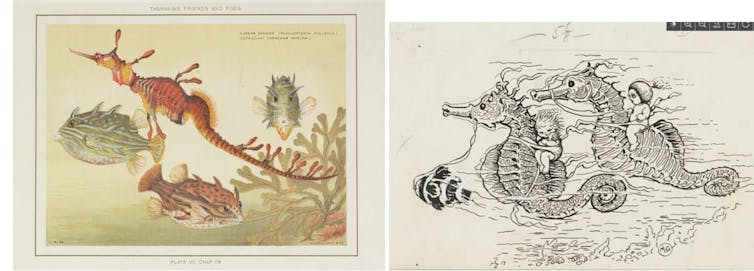
While their aesthetics are very different, the work of both Meredith and Gibbs reflects a settler-colonial view of the environment that aims to domesticate the bush and manage land.

Meredith does this by importing the British-colonial apparatus of taxonomy, scientific vocabulary and botanical illustration, to order and explain a landscape perceived as being both wild and ripe for cultivation.
Many scholars, including Araluen, have argued Gibbs’ work embodies some of the worst aspects of colonisation. Her imagery and narrative, argues childhood researcher Joanne Faulkner, “reimagined the bush as a ‘home’ for colonizers, essentially ‘indigenising’ them in the image of white gumnut babies”.
These national emblems, embraced by many non-Indigenous Australians, were crafted on stolen land.
Exporting Australia’s children’s stories
In 1884, the Tasmanian government awarded Meredith a pension of £100 (the equivalent of around A$17,000 today) for “distinguished literary and artistic services” to the island.
Since Meredith, Australian children’s books and media have become lucrative exports. Typically, they sell an optimistic image of the sun-drenched “lucky country” to local and international audiences.
Meredith was cannily attuned to the importance of trading a desirable image of her colonial setting. She referenced Australia’s “sunny clime” and “fertile hill[s] and glade” in Waratah Rhymes.

Both Meredith and Gibbs were successful in the business of their writing, explicitly considering their work’s marketability. Meredith had her own monogram branding. She advertised the availability of Grandmama’s Verse Book for international distribution.
Gibbs commissioned a set of Gumnut Babies postcards, anticipating what would become a merchandising empire (the royalties support the works of The Northcott Society and Cerebral Palsy Alliance). It now includes crockery, bedspreads, plushies, pyjamas, stationery and more.
Last year, the Royal Society of Tasmania established the Louisa Anne Meredith Medal to be awarded every four years to a “person who excels in the field of arts or humanities, or both, with outstanding contributions evidenced by creative outputs”.
The Australian children’s literary market is just as internationally saleable as it was in Meredith’s time. Today, the global phenomenon of Bluey continues her legacy of charming children (and adults) around the world through personified Australian animals.
American Politics
From: The Daily
Republicans in Congress want guidance from Trump, but that is like asking your socks where your shoes are.
From: The Raw Story
David Badash, The New Civil Rights Movement
January 7, 2025 11:51AM ET
Special Counsel Jack Smith, set to leave his office before Donald Trump is sworn in as President in less than two weeks, has indicated that he will deliver his report to Attorney General Merrick Garland Tuesday afternoon. The two-volume report details the findings of his investigations into the now-President-elect, which resulted in felony charges against Trump. These charges stem from his alleged efforts to overturn the 2020 election, including his role in the January 6 insurrection, as well as the alleged unlawful removal and retention of highly classified documents from the White House.
By law, Special Counsels are required to send a report of their findings to the Attorney General. Even Trump Attorney General Bill Barr released a highly redacted version of the Mueller Report, although he did so after mischaracterizing the findings in a letter he published ahead of the release. (A federal judge later said the letter was a “distorted” and “misleading” account of Mueller’s report.)
Critics, including legal experts, are demanding Attorney General Garland release Smith’s report to the public.
“Follow the law, release the reports,” urged conservative Bill Kristol of The Bulwark. “Just as AG Garland released special counsel Hur’s report on Biden’s handling of classified documents, the AG should now release Weiss’s report on Hunter Biden and Smith’s report on Trump and Jan. 6, and Trump and classified documents.”
But Trump is in court attempting to block its release. Trump’s attorneys were allowed to review the draft report, and reportedly spent three days in Jack Smith’s office doing so, Politico reported.
How the groveling Washington Post got it so terribly wrong
January 5, 2025 11:10PM ET
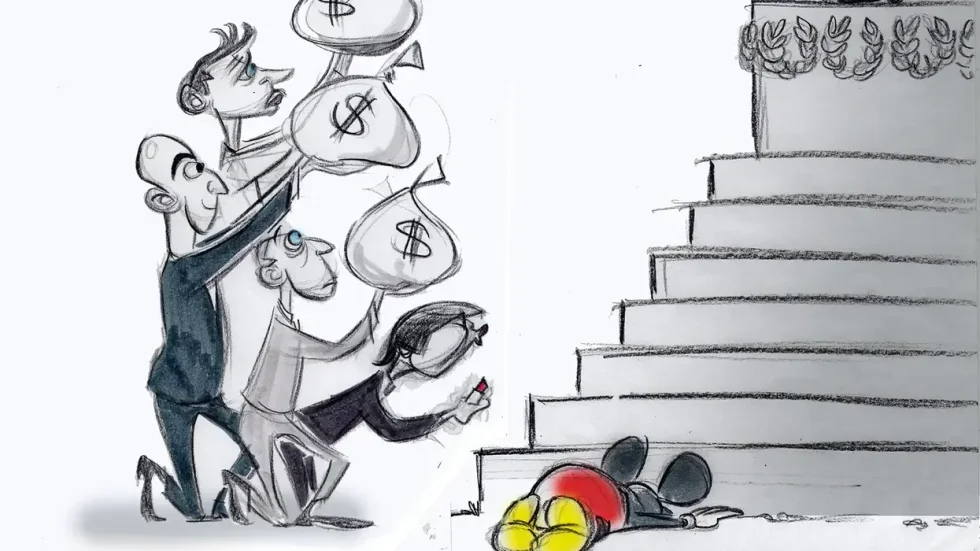
Rough of Ann Telnaes’ cartoon killed by the Washington Post
On Thursday, October 25, 2024, I pronounced The Washington Post to be dead.
That was the day their wormy, billionaire owner, Jeff Bezos, crashed through the wall separating news from business — fact from fiction — and had his henchman in the newsroom pull an editorial that was set to run that weekend endorsing the person who didn’t lead an attempted coup, Kamala Harris, for president of the United States of America.
As I said in my piece:
Their failure to make this endorsement goes beyond a catastrophic lack of judgment, because we know they know that what they are doing is nothing but a gutless attempt to appease a would-be dictator, Trump.
On Friday, WaPo was at it again, and this time it cost them the services of Ann Telnaes, the newspaper’s Pulitzer Prize-winning editorial cartoonist, who said she was leaving the newspaper because it killed her cartoon (above) depicting Bezos of doing what he does best these days: falling at the fat, little feet of the despicable Trump.
Here’s how Telnaes put it on her Substack piece Friday night:
I’ve worked for the Washington Post since 2008 as an editorial cartoonist. I have had editorial feedback and productive conversations—and some differences—about cartoons I have submitted for publication, but in all that time I’ve never had a cartoon killed because of who or what I chose to aim my pen at. Until now.
The cartoon that was killed criticizes the billionaire tech and media chief executives who have been doing their best to curry favor with incoming President-elect Trump. There have been multiple articles recently about these men with lucrative government contracts and an interest in eliminating regulations making their way to Mar-a-lago. The group in the cartoon included Mark Zuckerberg/Facebook & Meta founder and CEO, Sam Altman/AI CEO, Patrick Soon-Shiong/LA Times publisher, the Walt Disney Company/ABC News, and Jeff Bezos/Washington Post owner.
While it isn’t uncommon for editorial page editors to object to visual metaphors within a cartoon if it strikes that editor as unclear or isn’t correctly conveying the message intended by the cartoonist, such editorial criticism was not the case regarding this cartoon. To be clear, there have been instances where sketches have been rejected or revisions requested, but never because of the point of view inherent in the cartoon’s commentary. That’s a game changer…and dangerous for a free press.
The Danger of Miseducation
Dylann Roof and January 6th

Jan 08, 2025
In 2015, Dylann Roof murdered nine Black congregants at the Emanuel African Methodist Episcopal Church, in Charleston, South Carolina. Roof has never expressed remorse for the murders. He remains on death row in Terre Haute Federal Prison in Indiana.
Our nation asked the question then and now…why?
Here is an explanation from Ethan Kytle and Blain Roberts, the authors of Denmark Vesey’s Garden:
“Americans soon learned Roof’s flawed understanding of slavery, among other factors, fueled his racial hatred and attack. In his online manifesto, Roof claimed that ‘historical lies, exaggerations, and myths’ about how poorly African Americans had been treated under slavery are today being used to justify a black takeover of the United States.”
This is the radicalizing effect of misremembering history. Of disinformation. The terror and hate and death dealt by a young man turned conspiracy theorist turned white supremacist turned murderer.
I understand miseducation — I received one myself.
I grew up learning that the Civil War was fought because of “northern aggression.” It was the Lost Cause. Slavery was just a peculiar institution.
I don’t remember learning Black History in high school, but if it were taught, I imagine it a side note when we studied the Civil War. History was dominated by white men and I grew up hearing excuses for slavery.
Black folks were enslaved but don’t forget about white indentured servants.
The enslaved were taken care of by benevolent masters.
Black folks were content with their lot in life and happy to be in America.
I learned these things from the textbooks I studied.
We know some former slaveholders and their descendants worked to construct a romanticized memory of the antebellum South…they started writing their revisionist histories almost as soon as the ink was dry on the papers at Appomattox.
A major player in the whitewash movement was the United Daughters of the Confederacy. This group of Rebel apologists put up monuments to the Confederacy and wrote poisonous curriculum for public school children.
This is an actual description of the “benevolent Master” from a Georgia textbook from the 1950s:
As a rule the slaves were comfortably clothed, given an abundance of wholesome food, and kindly treated. Occasionally some hard-hearted master or bad-tempered mistress made the lot of their slaves a hard one, but such cases were not common.
Cruel masters and cruel mistresses were scorned then just as men and women who treat animals cruelly are now scorned. These slaves were brought into the colonies fresh from a savage life in Africa and in two or three generations were changed into respectable men and women. This fact shows, better than any words can, how prudently and how wisely slaves were managed.
Ah, the civilizing effects of brutality. Of manacles. Of beatings. Of family separation.
And did this textbook entry compare enslaved men and women and children to animals? Of course it did. The word “chattel” is defined as “moveable property” and shares a common origin with the word “cattle.”
Years ago, I worked in a building with a History teacher who taught students that slavery was just a part of the many causes of the Civil War.
This teacher talked about economics.
Yes, the Southern economics of free labor in the form of slavery.
This teacher talked about territorial expansion.
Yes, whether slavery would be expanded West.
This teacher talked about the election of Abraham Lincoln.
Yes, the election signaled the end of Southern rule and the beginning of secession in order to hold onto slavery.
Slavery. The Civil War was principally fought over slavery and watering it down, whitewashing the cause of the Civil War, has had devastating effects on students. That miseducation matters. Pseudohistory is dangerous.
And, it continues.
Yesterday was the four-year anniversary of the insurrection. The riot turned mob that stormed the US Capitol.
Most of us watched it live. Traitors pushed back the police line and beat officers with our flag and entered our Capitol to block our peaceful transfer of power.
Some of the insurrectionists broke into the Capitol with the intent of murdering lawmakers. They built gallows on our Capitol lawn.
I watched my own Senator raise a closed fist in solidarity with the mob.
We all watched it unfold. We have seen irrefutable evidence for years. We saw the worst of the offenders sent to prison and hundreds given probation.
We saw it happen. We know what happened. We can’t deny what happened.
And yet the January 6th apologists have already started to revise history. They started just days after the attack. Just like the United Daughters of the Confederacy. They need to revise history — it is a common theme among right-wing Christian nationalists. A common theme among traitors.
On #ThisDayInHistory in 2021, thousands of peaceful grandmothers gathered in Washington, D.C., to take a self-guided, albeit unauthorized, tour of the U.S. Capitol building. Earlier that day, President Trump held a rally, where supporters walked to the Capitol to peacefully protest the certification of the 2020 election. During this time, some individuals entered the Capitol, took photos, and explored the building before leaving. ~Mike Collins, (R, Georgia)
That is a bold-faced lie and Collins has repeated it often.
I was teaching on January 6, 2021. I couldn’t keep up with the attack minute by minute, but I checked the news during passing period. When the bell for 7th hour rang, my Department Chair walked down and said, “Turn on the news.”
I was horrified to see the smoke and people scaling the walls and the mob attacking the Capitol. I turned my computer off and taught the next 50 minutes trying to hold it together. I told my students that our Capitol was under attack and it looked like Americans were responsible.
That night, every teacher in my district received an email from our Superintendent. She instructed us not to talk about the insurrection the next day. I was enraged…were we just going to remain mute on an attack on democracy?
And here is something worse — the revisionists are already on school boards. A Kansas school board recently refused to adopt a teacher-created social studies curriculum because some on the board viewed the curriculum as biased and “anti-Trump.”
My god…
I find the similarities in revisionist history stunning. The same Confederate flag was carried by Dylann Roof and some of the insurrectionists on January 6th. It even feels like the same sort of people who revised history for the Civil War are revising the history of the insurrection.
Confederates turned MAGA.
Though it is very recent history, the insurrection revisionists are already seeing the fruits of their labor.
I have family members who claim the FBI and Antifa were responsible for the attack — that the friendly grandmas on a tourist visit had nothing to do with the mob. That January 6, 2021 was set up. That it was rigged to make Republicans and Trump look bad.
Dylann Roof pointed his angry miseducation at Black folks. He murdered the innocent in part because of his miseducation.
The next angry person will likely target Democrats. The revisionists on Capitol Hill are inspiring acts of violence against an entire party.
We are in the early days of the revisions. We still have time to stop the sane washing. The whitewashing. The lies.
The miseducation of a nation.
~Jess
The Emanuel Nine. May they rest in peace.
Clementa C. Pinckney
Cynthia Graham Hurd
Susie Jackson
Ethel Lee Lance
Depayne Middleton-Doctor
Tywanza Sanders
Daniel L. Simmons
Sharonda Coleman-Singleton
Myra Thompson
My name is Jess and I was a high school Literature teacher for 16 years until I decided to run as a Democrat in a rural, red district in Missouri. I bring you news and politics from Missouri and beyond from a rural progressive point of view.

 Robin's Room