
Katrina Lockwood The Mystery of Isabella and the String of Beads A Woman Doctor In World War 1 Loke Press, 2017.
I originally reviewed this book on the Women’s History Network blog, in 2017. A long time ago, but the approach to writing history as well as the content deserves another airing.
The back-cover blurb tells us:
‘It was the inscription that made the antique scalpels so tantalising: ‘Isabella Stenhouse’. A woman doctor? A woman doctor who was rumoured to have served in the First World War? Could Isabella have treated wounded men with these very implements? And had a grateful German prisoner of war really given her the strange string of beads that tangled round her stethoscope? Coaxing clues from archives across Europe, Katrina Kirkwood traces Isabella’s route from medical school to the Western Front, Malta and Egypt, discovering as she travels that Dr Stenhouse was not only one of the first women doctors who worked with the British Army – she was also a woman carrying a tragic secret, torn between ambition and loyalty to her family.’
Katrina Kirkwood’s The Mystery of Isabella and the String of Beads: A Woman doctor in WW1 is an utter joy to read.
Kirkwood has written an intriguing, historically adept account stemming from investigation of her great grandmother’s beads. As historians, we are always trying to fill in the gaps: pages or even just a page missing from a diary can slant events; sometimes events are unrecorded – we do not know all the thoughts and everyday occurrences that contribute to decisions and momentous events; there are multiple sources of evidence, some conflicting. Writers of historical fiction, if their work is well researched, come up with some plausible solutions to add to historical knowledge. Some historians speculate; others limit their work to that which can be ‘proven’. Indeed, the latter is what was called history before the 1970s expansion of history into social history. Then, recording facts ceased to be the only way in which history was written. See Books: Reviews for the complete review.

Dr Christopher Herbert Jane Austen’s Favourite Brother, Henry Pen & Sword | Pen & Sword History, May 2025.*
Thank you, NetGalley, for providing me with this uncorrected proof for review.
Christoher Herbert’s history employs one of the most useful strategies when dealing with a subject for whom the material is sparse. In this case, there is an abundance of material about Jane Austen who has been the subject of so many biographies. However, Herbert does not rely solely on this and has adroitly using his independent research, bolstering it with material that sets the context for events that are not recorded. He also uses the more conventional way of contributing to research when dealing with a writer – studying the author’s work for clues. In this case, both Jane and Henry Austen’s writing. This is a work of substance, accessible writing, a broad history of the time and social mores, and an intriguing insight into Henry and his family, including Jane for whom it becomes clear, Henry was indeed her favourite brother.
There are wonderfully comic passages – the discussion of studying at Oxford and Cambridge in the period was delightful. Less attractive is the recognition of the family’s slavery connections. However, these topics and a multitude of others, including reference to Austen’s novels, provide a picture of the father of these two affectionate siblings. Valuable information about the way in which the siblings were raised and educated and the ideas that permeated their lives, is also afforded though reference to Cassandra Leigh’s background. A Thomas Gainsborough painting also provides information about the society in which the siblings were raised – a society in which Jethro Tull’s invention was a part, for example. Although wider changes in society may not feature in Austen’s novels, Herbert provides a picture that demonstrates her choice of background was one of many available to her. See Books: Reviews for the complete review.
*See article below ‘For Jane Austen and her heroines, walking was more than a pastime – it was a form of resistance’, copied under Creative Commons from The Conversation.
Australian classic My Brilliant Career gets a Netflix remake*
Abe Maddison
Jun 22, 2025, updated Jun 23, 2025

The the new production of the classic story stars Philippa Northeast and Christopher Chung. Photo: Netflix
Netflix has started production on a series based on Miles Franklin’s classic novel My Brilliant Career, creating hundreds of jobs and injecting a record $17 million into a state economy.
The streaming giant is partnering with Jungle Entertainment on the fresh take on the 1901 coming-of-age tale, which resonated deeply with a generation of young Australian women who longed for the freedom to shape their own destinies.
South Australian Arts Minister Andrea Michaels said the production, which has started filming in Adelaide and across SA, will create 450 local jobs across key creatives, crew and extras and engage 260 small businesses.
It represented the largest local expenditure of any TV series made in the state, she said on Wednesday.
Netflix has not revealed the budget for the series, which will stream globally, but the SA government said the projected economic return to the state was $17 million.
The book’s original 1979 movie adaptation – directed by Gillian Armstrong, and starring Judy Davis, Sam Neill, and Wendy Hughes – won significant critical acclaim, receiving nominations for the Academy Award for best costume design, and the Golden Globe for best foreign film.
The story follows a young woman in rural, late-19th-century Australia whose aspirations to become a writer are impeded by her social circumstances and a budding romance.
Netflix vice president Minyoung Kim said it was a “timeless Australian story with themes as relevant today as when it was originally published”.
“We’re excited to be partnering with some of Australia’s best creatives and talent to bring this story to a whole new generation on Netflix, and with its stunning locations, there’s no better home for this production than South Australia,” she said.
Writer and executive producer Liz Doran said it was “a privilege to work with so many incredible creatives on this reimagining of Miles Franklin’s rollicking tale of a young woman’s quest to determine her own life”.
Locations across the state are being transformed for the period production, with filming in the SA Film Corporation’s Adelaide Studios and across the city, the Barossa region and the South-East.
The cast includes Philippa Northeast (Territory) as Sybylla and Christopher Chung (Slow Horses) as Harry, as well as Anna Chancellor (My Lady Jane), Genevieve O’Reilly (Andor), Kate Mulvany (Hunters), Jake Dunn (What It Feels Like For a Girl), Alexander England (Black Snow), Sherry-Lee Watson (Thou Shalt Not Steal) and Miah Madden (Paper Dolls).
My Brilliant Career is the second major Netflix series to be made in SA in as many years following Outback drama Territory, which premiered in 2024.

The SAFC and Netflix have partnered to create four training roles to work on My Brilliant Career including a production design assistant, costume assistant, costume maker/machinist attachment and safety attachment.
*See Blog 11th June 2025 for a review of Miles Franklin Undercover.
-AAP
American Politics

The Week Ahead
Joyce Vance from Civil Discourse <joycevance@substack.com> Unsubscribe
Forwarded this email? Subscribe here for more
Where do we go from here?
The Supreme Court dropped a bombshell on Friday. It was not unexpected, but that did not make it any less dramatic.
You’ve likely already seen that decision in Trump v. Casa, the birthright citizenship case. In a 6-3 decision, the Supreme Court held that “universal” injunctions (nationwide injunctions) exceed the power of the federal courts. The decision rejects the nationwide injunctions entered by federal district judges in three different districts that halted Trump’s efforts to end birthright citizenship. Justice Amy Coney Barrett’s majority opinion granted the government’s request to stay those nationwide injunctions, but only partially. What “partially” means here is that they remain in effect to the extent necessary to provide “complete relief” to the existing plaintiffs.
The cases themselves—this appeal involved only the question of whether the courts can order nationwide injunctions—now go back to the lower courts for further proceedings. As we’ve noted, the government cannily maneuvered to avoid bringing the substantive issue at the heart of the case, the president’s ability to do away with birthright citizenship, into the appeal. Although there were whispers about it around the edges, it wasn’t the issue. That’s up next. So it’s helpful to look at the exact relief the Court ordered. Here it is, as set forth by Justice Barrett: The Government’s applications to partially stay the preliminary injunctions are granted, but only to the extent that the injunctions are broader than necessary to provide complete relief to each plaintiff with standing to sue.
The lower courts shall move expeditiously to ensure that, with respect to each plaintiff, the injunctions comport with this rule and otherwise comply with principles of equity.
The injunctions are also stayed to the extent that they prohibit executive agencies from developing and issuing public guidance about the Executive’s plans to implement the Executive Order.
Consistent with the Solicitor General’s representation, §2 of the Executive Order shall not take effect until 30 days after the date of this opinion.
Now, we get to the part of the decision that makes it appropriate as the topic of “The Week Ahead” column. The impact of the ruling in Trump v. Casa extends beyond this case. It applies to all cases where nationwide injunctions are currently in place. It also means litigants will lose this tool as a way of countering some of the most egregious, unconstitutional steps taken by this administration. Few things that happen quickly in a courtroom. Although lawyers will still be able to obtain temporary or preliminary injunctions on an emergency basis, they will only be applicable to individuals who are identified victims and have access to a lawyer. The decision signals the loss of one of the best tools lawyers have had in their arsenal for dealing with this administration’s constitutional excesses. It is not the only tool, but it was a significant one.
Under the decision, district judges may only enter injunctive relief for the parties in front of them, or perhaps in some limited cases to larger groups where it is essential to giving the plaintiffs before the court “full relief” (stick a pin in that; what constitutes “full relief” is a question the lower courts are going to get to fairly quickly). That means individual lawsuits can be filed, districtwide injunctions may still be on the table, and some lawyers have already converted or are in the process of converting their cases to class actions.
Class actions are authorized by the Federal Rules of Civil Procedure. They allow one or more plaintiffs to file a case and then ask the judge for permission to proceed on behalf of a larger “class” of people who are similarly situated, have the same claims, and will be made whole by the same relief. If you’ve ever received a notice in the mail advising you of court proceedings if you had a certain kind of car or certain kind of phone, etc., during a certain period of time, you get the idea. There are different kinds of class actions, but what is envisioned here are proceedings under Rule 23(b)(2), which allows a district judge to certify a class where “the party opposing the class has acted or refused to act on grounds that apply generally to the class, so that final injunctive relief or corresponding declaratory relief is appropriate respecting the class as a whole.” In our scenario, the “party opposing the class” is the United States of America, as Donald Trump seems to systematically strip out basic constitutional and legal protections.
The class mechanism is good insofar as it goes, but it takes time, sometimes months, to certify a class. It’s a cumbersome mechanism compared to the nimble temporary restraining order. It remains to be seen whether judges will attempt to move them more quickly under these circumstances, but by their nature, they’re going to take more time. It is possible to certify a nationwide class, although, as with nationwide injunctions, there is some criticism of these devices. At the end of a class action, the outcome applies to all members of the class and binds the defendants.
To be fair, it’s not just Republicans who have questioned nationwide injunctions. Democrats looked askance as a Texas judge purported to limit access to medicated abortion. When nationwide injunctions are used to prevent the president from taking certain steps, the opposition to the decision is usually animated by politics. Justice Barrett’s criticism was grounded in our history: “Because the universal injunction lacks a historical pedigree, it falls outside the bounds of a federal court’s equitable authority under the Judiciary Act.”
The Court held that since nothing like nationwide injunctions existed at the time of the founding, the courts didn’t have the power to use them now. (In footnote 10, something else we’ll put a marker on for the future, Justice Barrett noted that “Nothing we say today resolves the distinct question whether the Administrative Procedure Act authorizes federal courts to vacate federal agency action”—this could mean there is a carve out that allows nationwide injunctions against an executive branch agency where a challenge under the APA is involved, but we’ll take that complicated subject up another day.) We can rail against her reasoning, but that is now the law. This is one of those decisions where even those who disagree with it will find a legal basis underlying it. It’s not an abrupt departure from stare decisis, or precedent, like Dobbs, the abortion decision, was.
The plaintiffs argued that “the universal injunction ‘give[s] the Judiciary a powerful tool to check the Executive Branch.’” Justice Barrett’s response was that “federal courts do not exercise general oversight of the Executive Branch; they resolve cases and controversies consistent with the authority Congress has given them.” She concluded that “When a court concludes that the Executive Branch has acted unlawfully, the answer is not for the court to exceed its power, too.”
The concern here extends beyond the ruling itself. It’s that it happened in this particular case. The Supreme Court has discretion over which cases to hear. It has had numerous opportunities over time to address the constitutionality of nationwide injunctions. The fact that it chose to hear it and issue this rule in this particular case is what is most concerning. What does it foreshadow?
The law regarding birthright citizenship is clear and well-established. Nor can Presidents rewrite amendments to the Constitution with a stroke of a pen. So why, in this particular case, where the injunctions prevent the administration from doing something that is so clearly wrong and will be so harmful—depriving newborns of citizenship—would the Court decide it’s the right time to take the step of pushing aside the injunctions? It’s hard to believe there was a sudden upswell of concern about protecting the defenseless presidency from overreach by the courts. This case will have real impacts on real people’s lives 30 days from now, and when, or rather if (because there are concerns the solicitor general will posture to keep the substantive birthright citizenship issue out of the sights of the Court) the Court decides that Trump was wrong a couple of years down the road, many people will have been damaged in ways that will be hard to undo. Not all of them will have the resources to find a lawyer and file a lawsuit of their own.
Dismissing the nationwide injunctions makes Trump’s executive order ending birthright citizenship the law of the land in 30 days, unless something else happens. And if you’re feeling some deja vu, so am I. It reminds me of when Texas passed its vigilante justice law that allowed private citizens and government officials alike to pursue women who’d had abortions in the courts, and the Supreme Court, instead of letting a decision enjoining it stay in place, told Texas, “Naw, go ahead.” That was when we saw the writing on the wall for Roe v. Wade and knew it was only a matter of time.
It’s hard to believe that could be the case here, that the Court would really sign off on a president’s ability to change the law with a wave of his newly minted magic wand (presidents didn’t have one of those at the time of the founding, but oh well). However, for those of us who didn’t believe a president was entitled to immunity from prosecution if he used SEAL Team Six to execute a political rival, well, the Supreme Court had news when it decided the presidential immunity case. Nothing is as certain as it used to be.The concern here is, of course, about more than just the ruling in Casa, it’s about what comes next. We will begin to find that out pretty quickly. Lawyers will be back in court this week, and we will watch the proceedings closely to see how district judges react to the Supreme Court’s ruling. In some ways, this is the Supreme Court putting the lower courts in their place and telling them to stay there. Justice Barrett wrote that the lower courts shouldn’t exceed their authority, even when a president does. “When a court concludes that the Executive Branch has acted unlawfully, the answer is not for the court to exceed its power, too.” That’s tantamount to saying there’s little that can be done about a president who runs amuck, except in a piecemeal fashion.
The dissents to the opinion are brilliant and sad at the same time and have been widely quoted, but I’d encourage you to read them for yourself. Sometimes, the story of a case and an understanding of the rule of law it imposes are best understood through the dissents. I find that to be the case here. Justice Ginsburg used to say that dissents are written for the future. One hopes that is the case here and there will come a time when we will listen to the Justices who wrote in dissent.
Justice Sotomayor exposes the government’s devious strategy—attacking the nationwide injunction mechanism in hopes that it can, as it now will be able to, exploit a ruling that cuts across more cases than just this one and allows it to continue dismantling democracy.
She explains:
The Government does not ask for complete stays of the injunctions, as it ordinarily does before this Court. Why? The answer is obvious: To get such relief, the Government would have to show that the Order is likely constitutional, an impossible task in light of the Constitution’s text, history, this Court’s precedents, federal law, and Executive Branch practice. So the Government instead tries its hand at a different game. It asks this Court to hold that, no matter how illegal a law or policy, courts can never simply tell the Executive to stop enforcing it against anyone. Instead, the Government says, it should be able to apply the Citizenship Order (whose legality it does not defend) to everyone except the plaintiffs who filed this lawsuit.The gamesmanship in this request is apparent and the Government makes no attempt to hide it. Yet, shamefully, this Court plays along. A majority of this Court decides that these applications, of all cases, provide the appropriate occasion to resolve the question of universal injunctions and end the centuries-old practice once and for all.…No right is safe in the new legal regime the Court creates. Today, the threat is to birthright citizenship. Tomorrow, a different administration may try to seize firearms from law-abiding citizens or prevent people of certain faiths from gathering to worship. The majority holds that, absent cumbersome class-action litigation, courts cannot completely enjoin even such plainly unlawful policies unless doing so is necessary to afford the formal parties complete relief. That holding renders constitutional guarantees meaningful in name only for any individuals who are not parties to a lawsuit. Because I will not be complicit in so grave an attack on our system of law, I dissent.”
Justice Jackson writes: “I lament that the majority is so caught up in minutiae of the Government’s self-serving, finger-pointing arguments that it misses the plot. The majority forgets (or ignores) that ‘[w]ith all its defects, delays and inconveniences, men have discovered no technique for long preserving free government except that the Executive be under the law, and that the law be made by parliamentary deliberations.’ … Tragically, the majority also shuns this prescient warning: Even if ‘[s]uch institutions may be destined to pass away,’ ‘it is the duty of the Court to be last, not first, to give them up.’”
There is no denying our democracy is in a difficult place. But do not be hopeless, and do not give up. That is, quite literally, what this administration wants us to do. If anything, this decision makes it even more important for us to continue our citizen-led democracy movement. Keep protesting, stay informed, and prepare for the midterm elections. “A Republic if you can keep it,” is now.
We’re in this together,
Joyce
P.S.: If you value fact-based legal analysis from a former United States Attorney with 25 years of experience at DOJ, I hope you’ll consider subscribing to Civil Discourse. Cut through the noise. Understand what’s really happening—and why it matters.
The Stepford Supporters: Inside MAGA’s scripted response to literally everything | Opinion
Opinion by J. Basil Dannebohm
In most cults, having an independent opinion is discouraged and even punished. Group leaders often suppress critical thinking and skepticism, viewing them as a threat to the movement’s unity and control. Members who express doubts or disagree are often viewed as “traitors” and a threat. Finding themselves forbidden from drifting off script, they are forced to parrot talking points handed down to them by the cult lieutenants.
Bertrand Rusell once observed, “As soon as we abandon our own reason and are content to rely upon authority there is no end to our troubles.”
When the TACO gestapo descended on Los Angeles to conduct ICE raids, three MAGA “influencers” – Charlie Kirk, Jack Posobiec, and Matt Walsh – all posted the same message to X within a few hours of each other:
“It’s time to ban third world immigration, legal or illegal. We’ve reached our limit and we have a huge cultural, educational, housing, financial, and essential services problem to fix now because of it. We need a net-zero immigration moratorium with a ban on all third worlders.”
It wasn’t long before MAGA armchair soldiers started posting the same message, verbatim, in comment threads across multiple platforms.
Granted, the rhetoric was far more articulate than what had been peddled by the cult leader himself. Regarding the first “50501” rallies that took place in the spring, Harris Faulkner of Fox News asked Mr. Trump, “What do you think they [protestors] need, right now, from you?”
“Protesters for different reasons. You’re protesting also because, you know, they just didn’t know. I’ve watch – I watched very closely. Why are you here? They really weren’t able to say, but they were there for a reason, perhaps,” the 47th President of the United States replied. “But a lot of them really were there because they’re following the crowd. A lot of them were there because what we witnessed was a terrible thing. What we saw was a terrible thing. And we’ve seen it over the years. We haven’t, you know, this was one horrible example, but you’ve seen other terrible examples. You know that better than anybody who would know it. And I know it. I’ve seen it, too. I’ve seen it before I was president. I’ve seen it. I think it’s a shame. I think it’s a disgrace. And it’s got to stop.”
When the second round of rallies, known as the “No Kings” protests, made headlines, it was obvious the lieutenants handed out the official response. Once again, cult member upon brainwashed cult member took to comment threads offering the same line: “If a king were in power, you wouldn’t have the right to protest.”
The French Revolution was, in part, a protest against King Louis XVI. It stemmed from widespread discontent with the monarchy’s absolute power as well as social inequalities and economic hardships faced by the common people.
It’s mildly ironic that on June 11th, just days before the protests, Mr. Trump attended a performance of Les Misérables, a musical about the French Revolution. It’s downright humorous that some patrons paid $2 million to sit in a performance box, attend a VIP reception with the President, and take a photo with him; while others paid no less than $100,000 to attend the performance, a reception and receive a photo of the demagogue.
A week or so later, following the unprovoked strike on Iran, the official response posted by the Proud Boys, Gravy Seals, and Meal Team Six read: “If you’re no longer MAGA because Trump wiped out Iran’s nuclear sites, you were never MAGA to begin with.”
Henry David Thoreau wrote, “Think for yourself, or others will think for you without thinking of you.”
Ezra Klein seems to agree.
“Trump is acting like a king because he’s too weak to govern like a president. He is trying to substitute perception for reality. He is hoping that perception becomes reality. That can only happen if we believe him,” the New York Times columnist observed.
The MAGA movement, on the other hand, believes and says what they’re told, when they’re told. Theirs is a Stepford approach. To observe this, one only needs to revisit the faces, void of emotion, that sparsely lined Constitution Avenue for Trump’s military parade-charade.
Attempting any form of dialogue with a member of MAGA is often like trying to communicate with a brainwashed clone. Whether out of fear or ignorance, they’ll rarely drift from the assigned talking points. Hence, most efforts to foster understanding are futile.
J. Basil Dannebohm is a writer, speaker, consultant, former Kansas legislator and intelligencer. His website is www.dannebohm.com. Mr. Dannebohm is a member of the Virginia Press Association and the National Society of Newspaper Columnists. He writes from the Washington DC metro in the Commonwealth of Virginia.
Secret London
The Smallest Town In England Is Less Than An Hour From London – And It’s Home To Lots Of Lovely Independent Coffee Shops And Its Own Mini Beach
Perched on the banks of the River Stour, just an hour from the capital city, is a teeny-tiny town that’s small by oh-so mighty.
Katie Forge – Staff Writer • 24 June, 2025

Credit: Chris Heaton via Wikimedia Commons / CC BY-SA 2.0
If good things come in small packages; this teeny-tiny town must be pretty bloody brilliant. Spanning just 47 acres, Manningtree in Essex is the smallest town in England. Well, the smallest by size, that is. The smallest town by population is down in Kent – but that’s an article for another day, I suppose.
Manningtree is a charming riverside town, sat on the banks of the River Stour. Perched proudly on the edge of the Dedham Vale Area of Outstanding Natural Beauty; this small-but-mighty spot is cute, charming and steeped in history. A trio of traits that make for a pretty great day-trip destination, don’t you think?
Things to do in Manningtree
What Manningtree lacks in size, it makes for with things to do in spades. With its beautiful Georgian streets that boast an abundance of local coffee shops, cafes, and pubs; Manningtree has a vibrant community and thriving independent business scene. You could easily spend an entire day hopping from eatery to drinkery. If, however, you like to spend your days doing more than just stuffing your face (can’t relate, but fine); you need not worry.
There’s something historic, interesting, or utterly gorgeous to gawp at with every turn. There’s North House Gallery for the culture-vultures, Manningtree Emporium for the antique-fiends, Manningtree Library for the literature-lovers, and the nearby Wrabness Nature Reserve for those of you who fancy inhaling some actual fresh air and partaking in a spot of bird-watching. Manningtree also boasts its very own mini man-made beach; a small patch of sand on the banks of the river that makes for a rather popular summery swimming spot at high-tide.
Getting to Manningtree from London
Manningtree is within pretty easy reach from London, with direct and fairly regular trains from Liverpool Street taking around 55 minutes. The drive is slightly longer, taking approximately an hour and a half. But once you get to Manningtree, there’s plenty of pay-and-display parking available.
London’s Closest Sandy Beach Is On The Piccadilly Line – And It’s Hidden In A Forest Twice The Size Of Hyde Park
This vast green space, twice the size of Hyde Park, provides a stunning natural backdrop for the Lido’s sandy beach, a rare sight in the capital.
Vaishnavi Pandey – Staff Writer • 26 June, 2025
When you think of sandy beaches near London, your mind probably drifts to the coast – Brighton, Bournemouth, or maybe even further afield. But what if we told you that the closest sandy beach to London is actually nestled deep within a sprawling 700-acre ancient woodland, just a short journey on the Piccadilly Line?
Welcome to Ruislip Lido, a hidden gem offering a unique blend of forest tranquility and seaside fun, all within Greater London’s boundaries!
Ruislip Lido is a 60-acre reservoir located on the edge of Ruislip Woods National Nature Reserve, one of the largest areas of ancient woodland in London. This vast green space, twice the size of Hyde Park, provides a stunning natural backdrop for the Lido’s sandy beach, a rare sight in the capital. The beach itself was created in the 1950s by importing sand, transforming part of the reservoir’s shoreline into a genuine sandy spot where families can relax, build sandcastles, and enjoy the feel of the seaside without leaving London.
Ruislip Lido is more than just a beach. It’s a full family spot with plenty to keep everyone entertained. Kids will love the pirate ship-themed play area complete with climbing frames and swings, as well as the splash pad for cooling off on warm days. For adults, there’s an outdoor gym to keep active, and plenty of grassy spaces for picnics or lounging.
One of the Lido’s standout attractions is Britain’s longest 12-inch gauge miniature railway. This charming little train takes visitors on a scenic loop around the lake and through the surrounding woods, offering a delightful way to explore the area without tiring little legs.
Surrounding the lido, Ruislip Woods offers peaceful woodland walks where you can immerse yourself in nature. The area is rich with wildlife and features educational planet-themed signs along the way, adding an unexpected twist to your stroll. Birdwatchers and nature lovers will find plenty to admire in this serene environment.
While the beach invites you to play and relax, swimming and boating are not permitted in the reservoir due to safety concerns such as cold water shock and underwater hazards. Fishing is allowed seasonally with a licence, but check local guidelines before planning your trip.
How to access London’s closest beach
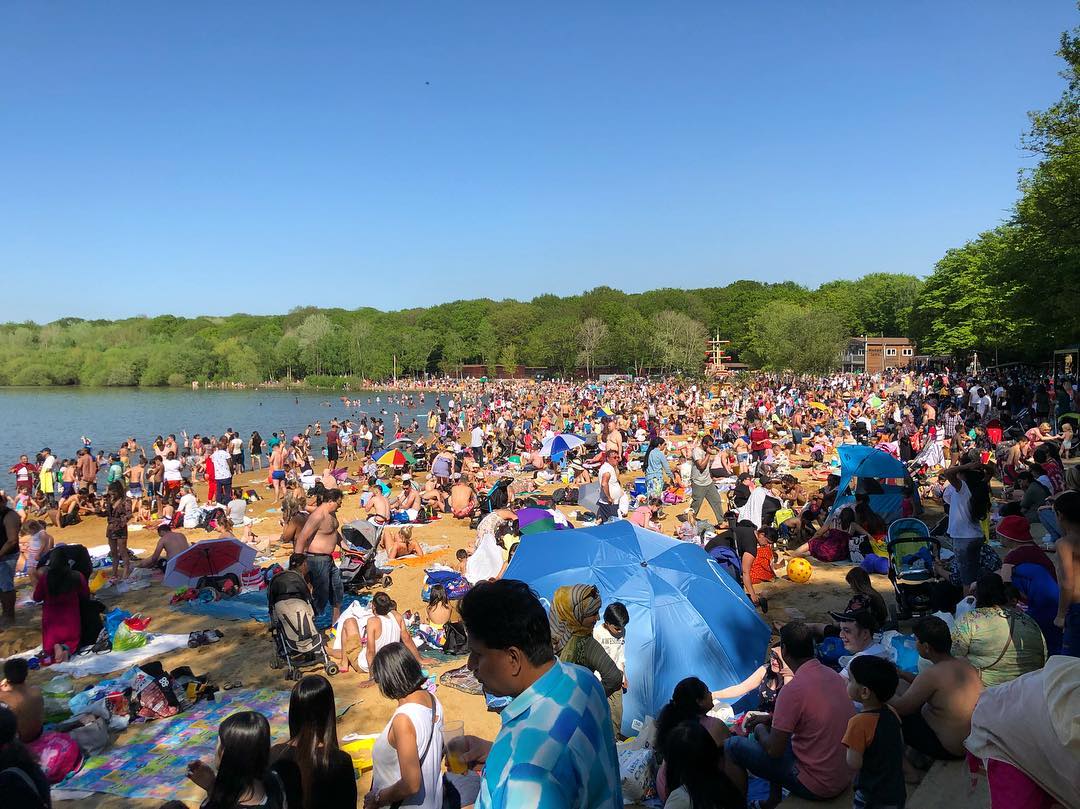
Getting to this hidden beach is surprisingly simple. Take the Piccadilly Line to Ruislip Station, then hop on one of the local buses (H13 or 331) that whisk you directly to the Lido. The entire journey from central London takes about an hour, making it an ideal day trip for city dwellers craving a bit of sun and sand without the hassle of long travel.
Parking is available but limited, so public transport is recommended. There are also cafes and restaurants nearby where you can grab refreshments and recharge after a day of outdoor fun.
Ruislip Lido offers a rare chance to enjoy a sandy beach experience without leaving London’s borders, all set against the backdrop of an expansive ancient forest. Whether you’re building sandcastles, riding the miniature railway, or simply soaking up the peaceful woodland atmosphere, it’s a perfect spot for families, nature lovers, and anyone seeking a refreshing break from city life.
So next time the sun shines and you crave the beach, remember: London’s closest sandy shore is just an hour away on the Piccadilly Line, waiting to be discovered in the heart of a 700-acre forest.
Cindy Lou eats at My Rainbow Dreams
It is years since I ate at My Rainbow Dreams, but it certainly will not be years before I eat there again. I had forgotten the freshness of the salads and the flavoursome meals. It was also wonderful to reacquaint myself with the friendliness and efficiency of the staff. I had a lentil burger – the right amount of spice in the burger and an excellent satay sauce which did not overwhelm the freshness of the salad. My friend had a haloumi burger which was reasonably successful, with a delicious sauce and tabouli accompanying the haloumi. Unfortunately, that was a little leathery, but certainly not inedible. The drinks were delicious.




The Conversation *
June 26, 2025
Author Nada Saadaoui PhD Candidate in English Literature, University of Cumbria
Nada Saadaoui does not work for, consult, own shares in or receive funding from any company or organisation that would benefit from this article, and has disclosed no relevant affiliations beyond their academic appointment.
For Jane Austen and her heroines, walking was more than a pastime – it was a form of resistance
In Pride and Prejudice (1813), when heroine Elizabeth Bennet arrives at Netherfield Park with “her petticoat six inches deep in mud”, she walks not only through the fields of Hertfordshire, but into one of literature’s most memorable images of women’s independence.
Her decision to walk alone, “above her ankles in dirt”, is met with horror. “What could she mean by it?” sneers Miss Bingley. “It seems to me to show an abominable sort of conceited independence.” And yet, in that walk – unaccompanied, unfashionable, unbothered – Elizabeth reveals more about her spirit and autonomy than any parlour conversation could.
For Austen’s heroines, independence – however “abominable” – often begins on foot. Elizabeth may be the most iconic of Austen’s pedestrians, but she is far from alone. Across Austen’s novels, women are constantly in motion: walking through country lanes, walled gardens, shrubberies, city streets and seaside resorts.
These are not idle excursions. They are socially legible acts, shaped by class, decorum, and gender – yet often quietly resistant to them.

This article is part of a series commemorating the 250th anniversary of Jane Austen’s birth. Despite having published only six books, she is one of the best-known authors in history. These articles explore the legacy and life of this incredible writer.
Fanny Price, the often underestimated heroine of Mansfield Park (1814), is typically seen as timid and passive. Yet beneath her reserved exterior lies a quiet but determined spirit.
“She takes her own independent walk whenever she can”, remarks Mrs Norris disapprovingly. “She certainly has a little spirit of secrecy, and independence, and nonsense about her.” Austen’s choice of “nonsense” here is revealing: Fanny’s desire for solitude and self-direction is not revolutionary, but it is gently subversive. In a world offering women little room for self-assertion, her steps become acts of resistance.
When Jane Fairfax, constrained by class and circumstance in Emma (1815), declines a carriage ride, she asserts: “I would rather walk … quick walking will refresh me.” It’s a seemingly modest decision, but one layered with significance. To walk is to control your own movement, to maintain autonomy and resist the genteel suffocation of being constantly observed or helped.
In Persuasion (1817), Anne Elliot’s story shows walking as a path to renewal. Reserved and long burdened by regret, Anne finds restoration in the coastal air of Lyme Regis. As she walks along the Cobb, Austen notes that “she was looking remarkably well … having the bloom and freshness of youth restored by the fine wind … and by the animation of eye which it had also produced”.
Her emotional reawakening is framed as a physical one. Walking becomes not only therapeutic but transformative – a way back to herself.
Not all of Austen’s walks are reflective or restorative. Some are decidedly social. Lydia and Kitty Bennet’s frequent walks to Meryton in Pride and Prejudice, for example, are driven as much by shopping as by the hope of romantic encounters.
Austen notes the “most convenient distance” of the village, where “their eyes were immediately wandering up in the street in quest of the officers”. These girls were more interested in uniforms than in bonnets.
Yet even this behaviour hints at something subtler. For young, unmarried women, shopping and social errands were among the few socially sanctioned reasons to move independently through public space. These excursions offered moments of visibility, mobility, and the possibility of courtship – however frivolously pursued.Kitty and Lydia walk to Meryton in order to encounter the officers.
Catherine Morland of Northanger Abbey (1817), a devoted reader of gothic fiction, fuses her walks with imagination. As she strolls along the Avon River with the Tilneys, she muses: “It always puts me in mind of the country that Emily and her father travelled through in The Mysteries of Udolpho.” Walking becomes an act of imaginative projection, where the boundaries between fiction and reality blur in the mind of a heroine learning to navigate both the world and herself.
Jane Austen the walker
Austen’s fiction draws much of its vitality from her own experiences. She was, by her own admission, a “desperate walker”, rarely deterred by weather, terrain or propriety.

Her letters, written from Bath, Steventon, Chawton and elsewhere, capture the physicality and pleasure of walking in vivid, often playful detail. These glimpses into her daily life reveal not only her attachment to movement but also the quiet autonomy it afforded her.
In 1805, Austen writes from Bath: “Yesterday was a busy day with me, or at least with my feet & my stockings; I was walking almost all day long.” Several years later, in 1813, she reports with unmistakable relief: “I walked to Alton, & dirt excepted, found it delightful … before I set out we were visited by several callers, all of whom my mother was glad to see, & I very glad to escape.”
Perhaps most revealing is an earlier letter from December 1798, in which Austen describes a rare solitary excursion: “I enjoyed the hard black frosts of last week very much, & one day while they lasted walked to Deane by myself. I do not know that I ever did such a thing in my life before.” The comment registers the novelty and boldness of a woman walking alone.
In an age where walking is once again praised for its physical and mental benefits, Austen’s fiction reminds us that these virtues are not new. Her characters have been walking for centuries – through mud, across class boundaries and against expectation.
They walk in pursuit of clarity, connection, escape and self-hood. Their steps – measured or impulsive, solitary or social – mark turning points in their lives. And in a world designed to keep them stationary, their walking remains a radical act.
This article features references to books that have been included for editorial reasons, and may contain links to bookshop.org. If you click on one of the links and go on to buy something from this website, The Conversation UK may earn a commission.
*Republished under Creative Commons License
2025 Canberra Writers Festival Schools Day!
The program for the inaugural 2025 Canberra Writers Festival Schools Day is now live, and bookings are open.
Featuring bestselling and award-winning YA authors Jack Heath, Tegan Bennett Daylight, Lili Wilkinson, and Lisa Fuller. The day will be filled with storytelling, critical thinking, and creative exploration.
When: Thursday 23 October 2025
Where: National Library of Australia
Who: Years 9-12 students
Cost: $20 per student | 1 free teacher per 25 students | $15 optional writing workshop
View the Schools Day Program here.
We can’t wait to welcome students to this exciting new program!
And we’re on the countdown to launch the full festival program in the coming months – stay tuned!
 |
| Interested in Volunteering at CWF? |
| Volunteers play an integral role in the coordination of the Festival and are an important part of the team. Canberra Writers Festival values the skills and the time generously contributed by our volunteers each year. You’ll get the chance to meet new people, make friends and learn new skills in a creative, fun environment. The Canberra Writers Festival seeks enthusiastic and motivated individuals to volunteer at the festival. The festival could not take place without the generosity of our strong team of volunteers whose invaluable commitment allows us to deliver a spectacular event. Volunteer opportunities before and during the festival are available across a range of areas: – Artist Services and Program – Development and Administration – Front of House – Marketing and Sales – Production and Venue Management |

 Robin's Room

Thank you for this! Skimmed the beads one – really interesting and a great way to get into history! also the joyce vance stuff is excellent – really good brain!
LikeLike