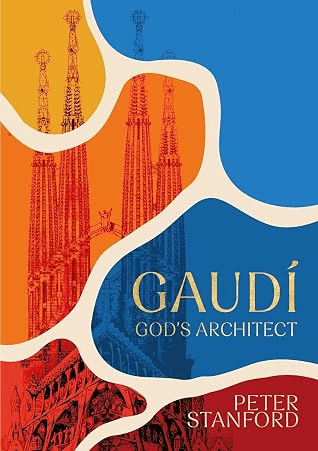
Peter Stanford Gaudi God’s Architect John Murray Press US | Hodder & Stoughton, June 2026.
Thank you, NetGalley, for providing me with this uncorrected proof for review.
This biography is, like the world it encompasses, a work of art. It begins by imagining Gaudi’s walk toward the tram that was destined to injure him, and describing the clothes that he wore, which were destined to have him designated as a tramp and less worthy of medical care than would have been given the famous architect. Further, Peter Stanford takes the reader past Gaudi’s architectural triumphs, imbuing them with a sense of the architect as well as locating them as part of Gaudi’s daily environment. His possible birthplaces are treated similarly, as is the house in which he lived as a child. Each facet of Gaudi’s life are steps taken by Stanford through the places in which Gaudi lived, worked, and ruminated on nature and the religious faith which inspired his work.
Gaudi is also placed in his social, political, and economic environment, with reference to the impact of the industrial revolution on his parents’ lives, and thus his. On the personal level, Gaudi’s health problems are described, adding to the picture of the artist at the same time as his art. Contrasting with his artistic genius, Gaudi’s academic endeavours are recorded as poor. Such personal challenges were replicated in Gaudi’s art, and the saga of La Sagrada Familia flows through the story, a tribute to Gaudi’s inspiration and aspiration. Barcelona is brought to life through Standford’s voyage through Gaudi’s architecture, its streets, and people. But essentially, this is the story of Gaudi, his architecture, and his life, and Standford deftly weaves his way through the city and biographical detail.

This is an inspiring book. For those who have visited Barcelona, walked through its streets, taking in Gaudi’s work, and joining the long queue to see the interior of the unfinished basilica it provides a wonderful recall of the immensity of the experience. Those who have not seen Gaudi’s architecture in person, can imagine and embrace the feelings though this creation. Standford provides a descriptive insight into his sources and included are photographs and index. However, what really illuminates this absorbing work is his honest and perceptive appreciation of Gaudi, for both his faith and monumental artistic achievements.

Arthur Jasper The Complete Baby Boomer Trivia Quiz Book, 1950s to 1990s, Quiz Yourself on American Music, Entertainment, History and Daily Life, 1950s to 1990s Arthur Jasper Books, November 2026.
Thank you, NetGalley, for providing me with this uncorrected proof for review.
This book is such fun to read, and for those who enjoy playing trivia whether it be a small or large group, the information is excellent. It also provides many hours of enjoyment for those who like to deliberate over past events, celebrities, and popular culture. If devising a trivia evening Jasper’s book provides a winning example of how to achieve a successful event.
The material is organised by decade, from the fifties to the nineties, with questions followed by the answers. Seven question rounds covering multiple-choice; true or false; who/what am I?; fill in the blank; matching items; guessing a song with lyrics rather than sound; and a round with wonderful graphics to decipher and name. There is a memory timeline, and eight topics – music, entertainment, history, sports, food and culture, science and tech, politics, and daily life. Questions are categorised as easy, medium, and hard.
Arthur Jasper suggests that the book does not need to be read cover to cover. However, once started the temptation to do more than dip in and out is difficult to avoid. This book is not only a great read, but answering the questions, or trying to do so whether alone, as a couple or a group is also very entertaining.
American Politics
It’s Official In Mississippi*
Joyce Vance from Civil Discourse <joycevance@substack.com>

Colom’s two young daughters recited the Pledge of Allegiance before he spoke at Tougaloo, a historically Black college in Jackson, Mississippi, and the cradle of the Civil Rights Movement in Mississippi. The college, founded in 1869 on a former plantation, became a safe place for Civil Rights leaders to meet and organize during the movement, including Dr. Martin Luther King, Jr., Medgar Evers, and Fannie Lou Hamer.
In 1961, a group of Tougaloo students staged a series of sit-in protests at segregated public institutions. One of them was the public library in Jackson, Mississippi. The students, who became known as “The Tougaloo Nine,” were arrested when they refused to leave the library. In response, the American Library Association released a statement affirming that libraries must welcome everyone, regardless of race. Mississippi, along with Alabama, Georgia, and Louisiana, withdrew from the Association.
Last night, when Colom spoke to a full house as Mississippi’s newest senator—the first Black person the state has sent to the Senate since Reconstruction—everyone was listening, including people in Georgia, where similar progress has been made, and Alabama and Louisiana, which have fallen short but where fresh inspiration from Colom’s win is already being put into action for future elections.
One of the Tougaloo Nine, Ethel Adolphe, speaking many years later, talked about being hauled into court to face charges of public disturbance. She did not have adequate counsel and did not know what she was supposed to say to the judge when he asked how she pled. Fortunately, another defendant spoke up before it was her turn, and she learned that the answer was “not guilty,” but her explanation of what she was thinking in that moment has always stayed with me. She said she was thinking, “not in a defiant way but in a try-to-understand way,” about what the charges against her meant and “that if my presence in this white library disturbs you, then I’m guilty.”
Those words have echoes in an era where all of us who love democracy have been accused of disturbing the people who populate Donald Trump’s great “white library”—forgive me for turning Ms. Adolphe’s sentiments about what it was like to be Black in Mississippi in the 1950s and 1960s into a metaphor for what so many of us are feeling today, but Civil Rights leaders have always been a source of inspiration in the fight against Trumpism. If we are of the wrong religion, the wrong national origin or skin color, the wrong immigration status; if we love the wrong person, believe government corruption is wrong, are concerned about climate change, and on and on and on, we are disturbing the people who are the only ones who matter in Donald Trump and his allies’ view. Trump’s America is not about all of us, just a privileged few. This election signifies that Americans have had enough, and Mr. Colom’s election, his competence (his prosecutorial experience at telling a good story shows), his commitment, and the grit it took to win a race in Mississippi, of all places, make this such a moment of hope.
Colom’s Father spoke on CNN. You can see where his son gets it from: In victory you want to not be critical of other people. Cindy Hyde-Smith is a person who’s been in service many years, and she’s our competitor, but she’s not our enemy. Scott’s going to be her senator and her neighbor’s senator, and he’s not going to offer any criticism of her….Our competitor, but not our enemy.
Wilbur Colom is an attorney like his son, a former Republican who served on Ronald Reagan’s transition team. His mother, Dorothy, is a retired state court judge, the first Black person elected to serve on Mississippi’s Chancery Court in her part of the state. We owe them so much—not just Mississippi, but all of us. Colom’s election is a moment of hope, and we need to hold onto hope because we all understand how much lies ahead of us, between us and the restoration of our democracy, before we can revitalize the American experiment and put this dark chapter behind us.If you read Civil Discourse regularly, you already know that I take the law and politics seriously, and try to separate what matters from the noise. Almost all of my posts are available to everyone. I want to keep it that way, and paid subscribers help make that possible. So if Civil Discourse is important to you and you’ve been meaning to become a paid subscriber, now is a good time.
We’re in this together, Joyce
*And, now, in Alaska where Mary Peltola’s (D) win has been declared.

Heather Cox Richardson from Letters from an American <heathercoxrichardson@substack.com> Unsubscribe November 12, 2026
Mississippi has a new U.S. senator-elect.
Last night, the Associated Press called the race for Democrat Scott Colom, district attorney for the 16th Judicial District of Mississippi. Shortly afterward, Republican incumbent Cindy Hyde-Smith conceded the race, saying she respected the decision of the Mississippi voters. She congratulated Colom and wished him well.
Colom thus becomes the third Black senator from the state of Mississippi and the first ever elected by the people, as his two predecessors became senators in the years immediately after the Civil War, when state legislatures, rather than the people, still chose U.S. senators.
In 1870 the Mississippi legislature chose Hiram R. Revels, a minister who had been born free in North Carolina to free people of color, to finish the term of a Senate seat left empty in 1861 when the man who held it left with the state upon Mississippi’s secession from the United States. Over the opposition of Democrats, who were then the party of the Confederates, Revels became the nation’s first Black senator, serving for a little over a year, from February 25, 1870, to March 3, 1871.
The second Black senator from Mississippi was Blanche K. Bruce, who was born into slavery in Virginia and in 1868 moved to Mississippi, where he became a large landholder and was active in the Republican Party. The legislature elected him senator in 1874, and he served from March 1875 to March 1881, working closely with New York’s machine politician Roscoe Conkling, for whom he named his son. During his tenure, he presided over the Senate for a day, becoming the first Black person to preside over the Senate and the only formerly enslaved person to do so.
The backlash against Black political power was ferocious in Mississippi, where Black people outnumbered white people in 39 of the state’s 75 counties. In 1889, when Republicans began to talk about federal protection for Black voters in the South, lynching, which had been declining, rose again dramatically.
The next year, a convention rewrote the state constitution to enforce white supremacy by making it virtually impossible for Black people to vote. They required voters to pay a poll tax of $2 and to be able to show receipts for the two previous elections and to be able to interpret a section from the complicated state constitution chosen by a polling registrar. Because jurors were drawn from voting lists, being purged from them meant Black Americans couldn’t sit on juries, either.
Northerners, worried about the political power of new immigrants, cheered on Mississippi’s educational qualifications for voting, and by 1903 every southern state and many northern ones had rewritten their constitutions to adopt similar limits to suffrage.
Mississippi became the center of voter suppression in the United States, making it the state on which voting rights activists focused in the years after World War II, especially after the lynching of 14-year-old Emmett TIll in the state in 1955 in the wake of the 1954 Brown v. Board of Education decision requiring the desegregation of public schools.
Medgar Evers, a World War II veteran and the Mississippi field officer for the National Association for the Advancement of Colored People (NAACP), urged the national organization to get involved in calling for justice for the child. As part of his civil rights work to combat segregation, Evers led voter registration drives in the face of growing white resistance. On June 12, 1963, Byron De La Beckwith, a member of a white supremacist Citizen Council, shot Evers in the back.
In one of the most powerful ads of the campaign, Colom told the story.“
There’s a house in Jackson every Mississippian ought to walk through once,” Colom says, as he stands in front of Medgar Evers’s home. “It looks like every other house on the street, except for it isn’t. It has no front door. You come in through the carport, where the walls give you some cover. The children slept on the floor, below the windows. Their father taught them that if they ever heard gunfire, they should crawl to the bathroom. He made it a game.”
“I’ve been a prosecutor for ten years,” Colom said. “Unfortunately, I’ve stood in a lot of houses where something terrible happened. This isn’t any house. This isn’t any tragedy. This is where Medgar Evers died. He fought for this country at Normandy. He came home to Mississippi, and they wouldn’t let him vote.“
So he organized, helping other people register. Just after midnight on June 12, 1963, he pulled into here with an arm full of T-shirts that said, “Jim Crow Must Go.” A man hiding across the street shot him in the back. Two juries let that man walk. His wife, Myrlie, never stopped. It took 31 years, then a Mississippi prosecutor reopened the case, and a Mississippi jury, both Black and white, convicted him.“
In Mississippi, no one is above the law, and no one should be outside its protection. He was killed for helping Mississippians vote. On Tuesday, use your vote, and honor everyone who died for that right.”
Mississippians heard Colom. They went to the polls and made him the first Black candidate elected to the United States Senate from Mississippi.
In his victory speech, Colom reached back to minister Hiram Revels to anchor his journey to the Senate in the faith that he called a Mississippi tradition. “For me, this journey started with a prayer,” he said, “and in Mississippi, our prayers have often changed the course of history.” He called out Medgar Evers and voting rights activist Fannie Lou Hamer for their faith in Mississippi, but added that “in Mississippi, it’s local people that make the difference. Not just the names that are recorded in history, but people that do the work without any expectation of recognition.”
He continued: “I’ll tell you, it’s local people that had faith that Mississippi can make progress, and it’s local people like the people out here who had faith that we can win this election. So God bless you. But as my mom would always tell me, faith without work is dead, and we worked this election, y’all. We worked. God didn’t want us to get it the easy way, he wanted us to get it the Mississippi way.”
“For months and months, I’ve been telling everybody, everywhere I go, that we’re going to win this election,” Colom said. “I was saying that eight or nine months ago, and recently, I’ve been saying it on the news. But every time I said it, I pointed out that people were going to give me too much credit for it, because it’s not something that I did; it’s something that we did.”
“All I did was have the courage to imagine a night like this,” Colom said. “I had the courage to believe in Mississippi. I had the courage to understand that we could show the country that Mississippi matters.”
—Notes:https://apnews.com/article/mississippi-senate-colom-hydesmith-midterm-7f098b8834f598c923ba73572ea2223fhttps://mississippiencyclopedia.org/entries/constitution-of-1890/https://www.pbs.org/wgbh/americanexperience/features/emmett-impact-emmett-tills-murder/https://naacp.org/find-resources/history-explained/civil-rights-leaders/medgar-eversBluesky:sahilkapur.bsky.social/post/3n235m4zwe22gYouTube:watch?v=ny3jT9yDUuEwatch?v=C7jOeSZbozU
Some interesting aspects of the US mid-term election results
Bob McMullan
American pundits will analyze many aspects of the amazing US mid-term election results.
Some aspects of the result are obvious:
The result is a major repudiation of President Trump
The President will have almost no capacity to legislate or get significant hardline judges or officials approved by the Senate.
The Democrats won every seat possible in the Senate should they win Alaska which I think they will.
Further questions
However, a preliminary statistical analysis raises two further questions.
How did the polling and predictive sites perform?
And which candidates performed the best?
My fear that the polls were underestimating the support for Republicans was based on the considerable history of under estimation of Republican vote performance over the last ten years. But this time was different. In every hotly contested Senate race the Democrats outperformed the polls. There was no sign of “silent trump supporters”!
This time the polling failure was in the opposite direction. The gap between polling averages and outcomes was disguised by the fact that RCP averages got the right result in every state except South Carolina. But this hides some big misses.
The five Senate candidates who out performed polling expectations by an amount significantly greater than the margin of error were James Talarico (who got 9.7% more than the RCP average), Jon Ossoff (9.4%), Roy Cooper (8.6%), Annie Andrews (7%) and Chris Pappas (6.7%).
There is a similar picture in the Governor’s races.
In every case recorded in RCP averages the result for Democrats was better than the polling suggested. In most cases the error was within the margin of error, and the polling predicted the winner correctly.
The interesting exception is Gina Hinojosa in Texas. RCP forecast Abbott, the Republican incumbent to win by 2.3% but Hinojosa won comfortably by more than 7%. The interesting question really is why did the polls consistently underestimate the result for Democrats?
There is an odd theory based on a suspicion that many voters lied about their previous vote because they didn’t want to admit they had voted for Trump in the past. I am not convinced by this argument. It will take more analysis of American exit polls etc to come to firm conclusions.
The most plausible argument seems to lie in the data about the very large proportion of independent voters who ultimately went for Democrat candidates. It is probable that such voters were amongst those latest to make up their minds or to tell pollsters of their intentions.
Whatever the explanation, the argument that polls always underestimate Republican support is dead and buried.
Another interesting aspect of the mid-term result is the relative performance of candidates. In an election in which so many candidates were competing for the support of exactly the same voters as they each pursued statewide office it is possible to make some assessment of relative performance.
First, I have looked at the performance of candidates for Governor compared to Senate candidates in states where both positions were contested. Second, I have examined candidate performance relative to Kamala Harris’ results in 2024.
Senate candidates compared to Governor candidates
In the eleven key states in which both positions were contested the Senate candidates in order of relative performance were:
- Chris Pappas New Hampshire +10.7*
- Jon Ossoff Georgia +9.4
- James Talarico Texas +5.0
- Adam Hamilton Kansas +4.4
- Angie Nixon Florida -1.6
- Peggy Flanagan Minnesota -2.8
- Sherrod Brown Ohio -3.1*
- Abdul El Sayed Michigan -3.8
- Josh Turek Iowa -6.9
- Troy Jackson Maine -10.7
- Mary Peltola Alaska -19.6*
The *refers to the impact of very strong or very weak Republican gubernatorial candidates as was the case in New Hampshire and Ohio respectively. Nothing can overcome the challenge of making
comparisons with the Alaska “ranked Choice” voting system. Proper evaluation of Alaska will have to wait for the final votes and the preference distribution.
Ranking of Senate candidates’ performance compared to Kamala Harris’ results gives a better basis for assessment:
1. Talarico 25.7% higher
2. Colom 23.2
3.Cooper 22.9
4.Andrews 22.2
5.Hamilton 21.2
6.Ossoff 20.2
7.Turek 17.3
8.Brown 16.1
9.Peltola 13.4*
10.Pappas 10.9*
11.Nixon 10.2*
12.El Sayed 8.4*
13.Flanagan 5.9*
14.Jackson -0.6*
NB1Those marked* are all below the average of 15.5%
NB2 These figures are taken from CNN website. They appear to me to be accurate, but I have not checked them all.
What do these various numbers suggest, subject to further and better analysis?
The idea thar Trump had transformed the map permanently was always a myth. (Worth remembering this also means the Democrats have not transformed the map permanently).
Ken Paxton was a dreadful candidate, and he helped take others down with him.
Jon Ossoff and Roy Cooper were brilliant candidates.
The south is open to Democrat transformation, but it will not be easy.
There is a serious risk that in the states where candidates’ results were below par in states Kamala Harris won, New Hampshire, Michigan, Minnesota and Maine the Democratic party organisation and elected members will congratulate themselves on their success rather than study why the result was below par.
Overall, it was a sensationally successful election result for Democrats and for democracy.
Cindy Lou eats in Braddon again
It is wonderful to walk a short distance to a variety of eating venues, almost like being able to walk to Praed Street in London and eat at interesting cafes and restaurants – that idea shows the value of having a good imagination!
Grease Monkey
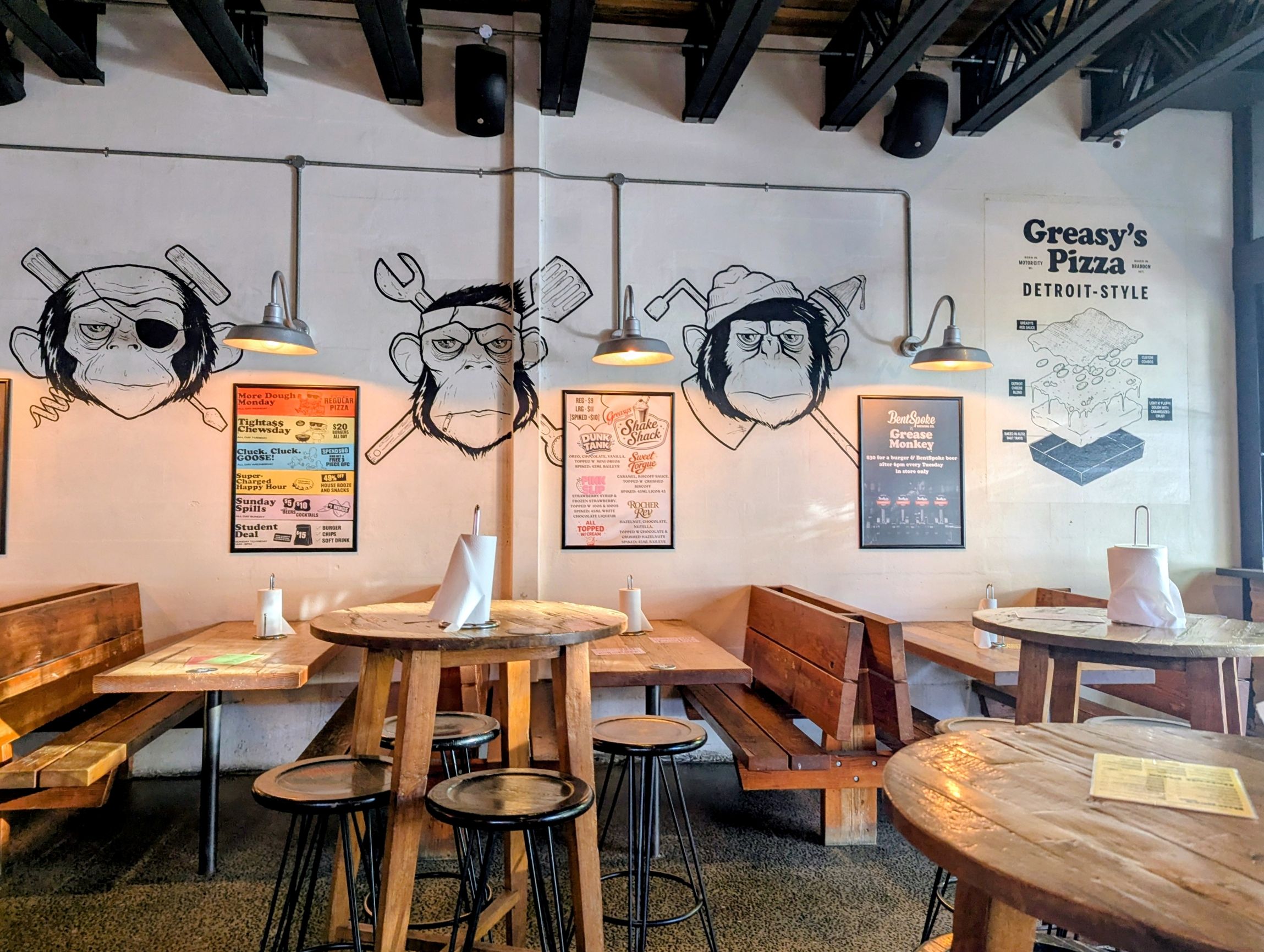
This venue featured in a list of the best eating places in Braddon, so I was keen to join others to try it. Mmmmm…No, in my opinion. It looks great fun, the kitchen roll serviette and rustic appearance of the venue (previously a garage for car repairs) adding to the ambience. But for me that was the full attraction. I had the vegetarian pizza, but the spinach was scarce amongst the copious tomato topping, cheese and thick base and small dabs of ricotta. The burgers were pronounced a success by my companions. However, one wisely asked for the mayonnaise on the side.





86
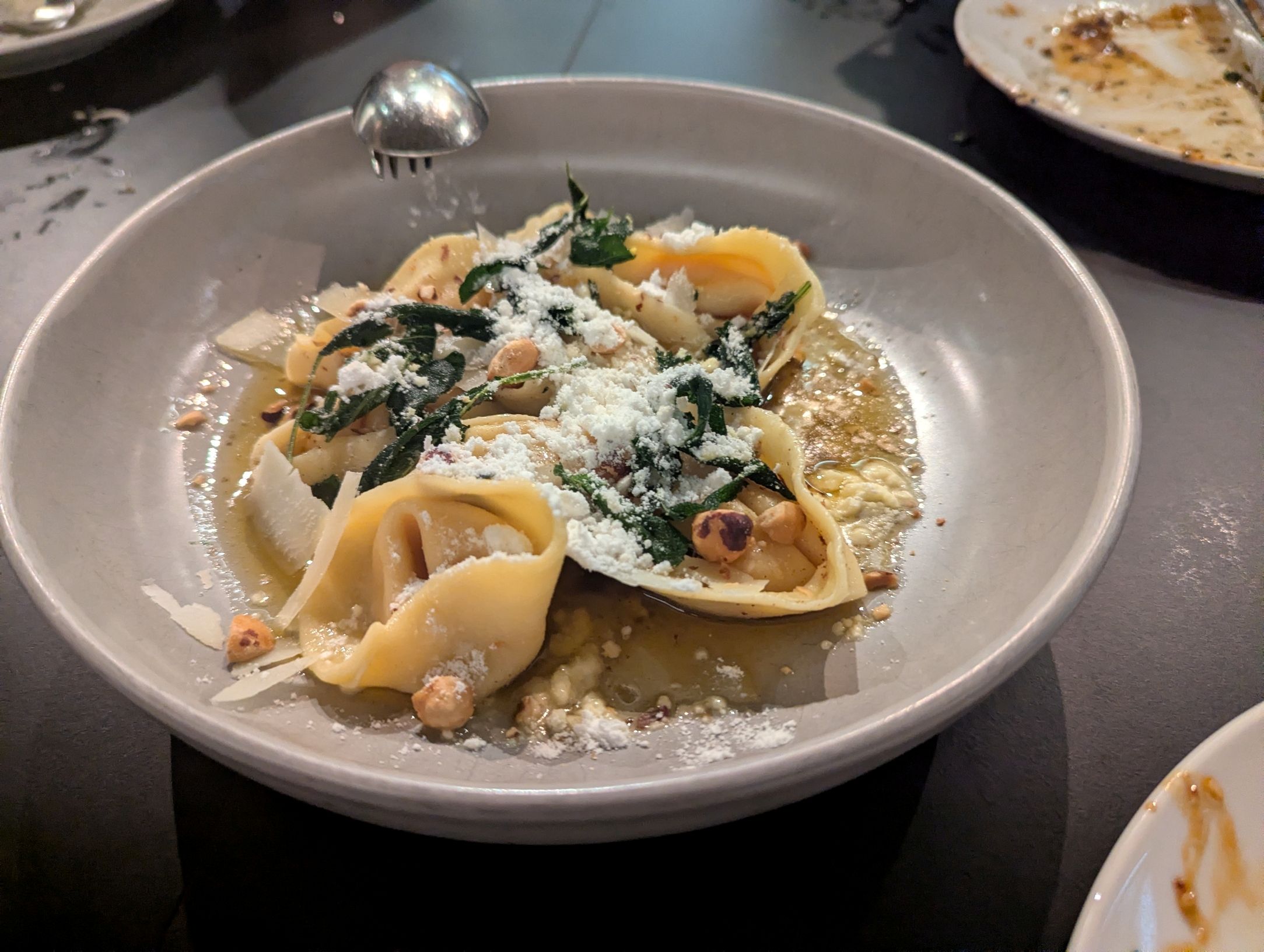
The dishes here are so attractive I often forget to photograph them before ladling large amounts onto my plate. On this occasion we had the potato scallops as well as the favourite corn cobs. Each choice was pronounced worth having again. The eggplant and tortellini were as delicious as usual. However, the charred broccoli was not. We also had the tomato salad which was a great success.





A beginner’s guide to falling in love with Russian literature
Cultural historian and translator Rosamund Bartlett explains how to tame the narrative bear.
by Tim Brinkhof* November 13, 2026

Key Takeaways
- Russian literature has a reputation for being difficult and depressing, but it can also be funny and profound.
- Shaped by Russia’s turbulent history, the country’s greatest writers have grappled with questions about existence, morality, and society.
- For newcomers, Chekhov’s short stories offer an ideal introduction before moving on to Tolstoy and Dostoevsky.
 A literature column to feed your curiosity. Get our free newsletter on Substack
Few literary canons inspire as much reverence, and fear, as Russia’s. The sheer size and complexity of novels like Leo Tolstoy’s War and Peace (1867) and Fyodor Dostoevsky’s The Brothers Karamazov (1880) have created two groups of readers: Those who have read them, and those who say they will read them — one day.
For one reason or another, that day never seems to come. Allow us to make the case for why it should. Reading Russian literature is not only worth the effort, but is also far less arduous than many of us have been led to believe.
For this guide, Big Think reached out to Rosamund Bartlett, a cultural historian, translator, and author of many books, among them Tolstoy: A Russian Life (2011) and Chekhov: Scenes from a Life (2004). An honorary research fellow at Oxford, she discusses what makes Russian literature so special and shares her personal reading recommendations.
Art, life, and death
Like mountaineering or bug collecting, Russian literature usually isn’t something people get into casually. More often than not, what starts as an ordinary curiosity inevitably develops into a passion that stays with you for life. For Bartlett, the question of where and how that passion first originated prompts not one but several answers.
“Like so many readers,” she tells Big Think, “I was drawn to Russian writers by their unabashed interest in existential questions. Because of the oppressive political realities — Tsarist and then Soviet — their literary achievements were hard-won. After growing up in London, it was exhilarating to inhabit a world in which the arts, and literary works in particular, were of life-and-death importance.”
Her appreciation for Russian literature grew stronger through visits to Moscow and St. Petersburg, back when the latter was still called by its Communist name: Leningrad.
“In Soviet times,” she recalls, “both were highly atmospheric, unmodernized cities which largely preserved their 19th-century character and physiognomy.” Walking through streets where Tolstoy, Dostoevsky, [Alexander] Pushkin, and more had walked before, she had “the dizzying sense” that one could “almost touch the past.”
Popular misconceptions
One of the biggest misconceptions about Russian literature — one joked about in TV shows like Cheers, Seinfeld, and Family Guy — is that it is needlessly tedious. This is not true — at least, not always.
“Tolstoy wrote his chapters like individual short stories,” Bartlett says. “It is hard not to be gripped by the immediacy of his narration. As Vladimir Nabokov, author of Lolita (1955), once memorably wrote: ‘When you read [Ivan] Turgenev, you know you are reading Turgenev; when you read Tolstoy, you read just because you cannot stop.”
Likewise, Russian literature is often thought to be uniformly dry and depressing, yet this too is greatly misleading. Though Russian writers can certainly make you deeply sad, many will also make you laugh out loud.
“A lot of it is serious, but you only need to read [Nikolai] Gogol’s surreal short story ‘The Nose’ or his novel Dead Souls (1842) to enjoy the richness of his satirical humor. Pushkin’s wit is apparent everywhere, and in [Ivan] Goncharov’s 1859 novel Oblomov, the comic hero takes several chapters just to get out of bed,” Bartlett points out.
A final misconception about Russian literature is that it is like an island: disconnected from and counter to the literary traditions of European countries. While many writers may like to think that, Russian literature is, in fact, irrevocably connected to the West.
“Until Peter the Great founded St. Petersburg in 1703,” Bartlett explains, “there were no secular cultural traditions in Russia to speak of. The 18th century was therefore a period of intense assimilation of language, art, music, and literature from all over Europe, principally France, Italy, and Germany.”
Revolutionary telegrams
That’s not to say Russian literature doesn’t possess unique qualities. On the contrary, its preoccupation with European civilization, in many ways, served as the foundation of its originality.
“All the great 19th-century novels,” Bartlett says, “were preoccupied with matters of Russia’s national destiny and challenged Western convention when it came to genre. Russian writers arrived at the party late and variously struggled with an inferiority complex vis-à-vis the weight of European tradition. [They] ultimately infused foreign forms with a creativity that made them utterly distinctive.”
Part of this distinctiveness is its aforementioned air of life-and-death importance: A quality rooted in both subject and style. “The critic John Bayley put it well when he described Western literature as being so ‘swaddled in the inertia of its accomplishment, the complacency of its prolongation,’ that even at its ‘most urgent’ it still sounds literary; by contrast, the critical dicta of the Russians seem like telegrams exchanged by revolutionaries after a coup d’état has begun, but before it is known whether it will succeed.’”
Because of a lack of political participation, literature in Russia was not just an art but a primary outlet for public discourse. As such, understanding the country’s history will help you understand its literary scene, and vice versa.
“It’s no coincidence that Tolstoy, Dostoevsky, and Turgenev were all active and produced their best work around the same time,” Bartlett says. “Following the bleak and repressive years of Nicholas I, the spirit of optimism engendered by the Great Reforms introduced in the early years of Alexander II’s reign in the 1860s — including the abolition of serfdom — unleashed an unprecedented creative energy.”
Writers wrote not simply to entertain, but to diagnose societal problems and imagine possible futures: Endeavors that arguably reached their climax in the revolutions of 1917, when Russia transformed from a monarchy into a parliamentary republic and, subsequently, a communist dictatorship.
Golden Age?
When people speak of the Golden Age of Russian literature, they typically refer to a period stretching from the rise of Pushkin in the 1820s up to the deaths of Anton Chekhov and Tolstoy, who passed away in 1904 and 1910, respectively. It’s an alluring label and not entirely exaggerated given the enduring quality of the literary works produced in that period. But it’s also limiting and a little misleading.
For one, “Golden Age” suggests a homogeneity that does not accurately reflect how much the form and content of literary production in Russia changed from one decade to the next.
“After the deaths of Dostoevsky and Turgenev,” says Bartlett, “Tolstoy abandoned his vocation as a professional novelist to dedicate himself to religious and moral causes. Tsar Alexander III reacted to the violent circumstances of his reformatory father’s assassination with repressive measures, increasing censorship.” And while often grouped alongside the authors listed above, “Chekhov was from a younger generation and forged his career with short stories, befitting the era of so-called ‘small deeds’ rather than expansive novels.”
Moreover, the label steals the spotlight from other periods of Russian literary production that deserve our attention, too. “In the 1930s,” Bartlett notes, ”critics began referring to the fin-de-siècle revival of lyric poetry — the Symbolists and Acmeists — as the Silver Age. But were these poets really less valuable than those of the Golden Age?”
Unsung women authors
The international reputations of Tolstoy, Dostoevsky, and other male authors have also overshadowed the legacy of numerous women authors, whose work is now increasingly available in translation. “There’s Karolina Pavlova, author of A Double Life (1848), and the three Khvoshchinskaya sisters — the so-called Russian Brontës.” She also points to Aleksandr Alexandrov, author of The Cavalry Maiden (1836). Born female with the birth name Nadezhda Durova, he fought as a man in the Napoleonic Wars and is acknowledged as transgender by several contemporary scholars.
The plights and personalities of Russian women emerge to varying degrees through the writing of male authors. “The under-described female heroines in early to mid-19th century works by Pushkin, Gogol, Goncharov, [Mikhail] Lermontov, and others are often idealized and two-dimensional, while Tolstoy rejected philosopher John Stuart Mill’s call for equality between the sexes and wrote Anna Karenina (1878) partly to prove a woman’s place was in the home.”
Elsewhere, socialist writer Nikolay Chernyshevsky’s novel What Is to Be Done? (1863) was a huge influence on subsequent generations of revolutionaries, including Vladimir Lenin. The story featured an active female protagonist who fiercely advocated gender equality. Later, the Soviet Union uplifted some women writers while silencing others.
“Anna Akhmatova, who became the undisputed queen of bohemian artistic circles of St. Petersburg in the years leading up to the 1917 Revolution, went on to lead a life of great courage and artistic integrity in the difficult Stalinist years, to which she bore triumphant witness in her celebrated Requiem (1965), a long narrative poem about the purges conceived while queueing outside a prison in Leningrad to hear news of her arrested son. She died in 1966, but Requiem could not be published in Russia until 1989, at the height of Gorbachev’s perestroika and glasnost.”

Bartlett’s reading recommendations
To guide you into the vast, not always well-illuminated world of Russian literature, Bartlett recommends the following three books. While we encourage you to follow your own interests, we also present them by level of accessibility. Read them in order and at your comfort level, and you will be ready to keep exploring on your own.
Beginner: Chekhov’s short stories
“I’d suggest a volume of classic Chekhov short stories for their brevity, modern and simple language, and their mixture of humor with lightly worn meditations on the nature of existence. It is not for nothing that a range of authors, from Katherine Mansfield to Alice Munro, have viewed him as the greatest short story writer who has ever lived. Aided by his training as a doctor, Chekhov had superior powers in diagnosing the absurdity and tragedy of the human condition with extraordinary compassion, and understated stories such as ‘The Lady with the Little Dog’ continue to enjoy worldwide appeal because of the universality and timelessness of their subject matter.
“As Raymond Carver once wrote, ‘Chekhov’s stories are as wonderful (and necessary) now as when they first appeared. It is not only the immense number of stories he wrote — for few, if any, writers have ever done more — it is the awesome frequency with which he produced masterpieces, stories that shrive us as well as delight and move us, that lay bare our emotions in ways only true art can accomplish.’”
Intermediary: Tolstoy’s Anna Karenina
“Tolstoy’s Anna Karenina is a rich tapestry of a novel, which — like War and Peace — can and should be read several times at different stages of one’s life. If one is carried away by the passion of Anna and Vronsky’s illicit relationship during a first reading, the next time we might find ourselves thinking about the differences between romance and love, or becoming engrossed in Levin’s search for the meaning of life and his journey to self-knowledge.
“A deeper acquaintance with Anna Karenina might also stimulate us to think about how Tolstoy’s dissection of marital breakdown can be construed as a metaphor for the disintegration of Russian society as a whole post-Emancipation, leading to revolution. Alternatively, [it may] encourage us to ponder Tolstoy’s views on the impact of modern European technology, such as trains and modern agricultural equipment, on traditional Russian ways of life, or how the novel is, at another level, a profound examination of Russia’s vexed relationship with the West.”

Advanced: Dostoevsky’s The Brothers Karamazov
“Dostoevsky’s lengthy last novel, The Brothers Karamazov, is perhaps not for the faint-hearted, which is reason enough to recommend it last. It represents the culmination of his remarkable journey as both writer and thinker, so it is best read after his other principal novels, and also his frequently overlooked Writer’s Diary (1873), which served as his creative laboratory. Completed during his last decade, this was a unique journalistic enterprise incorporating art and politics, non-fiction and fiction, in which Dostoevsky performed the roles of sole writer, editor, and publisher, and spoke directly to his readers about issues which preoccupied him.
“The overriding impression we gain from a first reading of The Brothers Karamazov is one of chaos and dissonance, but its complex, polyphonic text is richly rewarding and reveals an intricately organized structure. On the novel’s surface is the murder of a father and the struggles of his four sons. At its heart is a quest to affirm faith in God, reached through a succession of what Anatoly Lunacharsky termed ‘brilliantly staged dialogues.’ Are there some sins for which one cannot be redeemed? Can one subscribe to a faith which allows the suffering of children? These are some of the novel’s central questions.”
*Tim Brinkhof

Tim Brinkhof is a Dutch-born, New York-based journalist reporting on art, history, and literature. He studied early Netherlandish painting and Slavic literature at New York University, worked as an editorial assistant for Film Comment magazine, and has written for Esquire, Film & History, History Today, and History News Network.
A literature column to feed your curiosity. Get our free newsletter on Substack