
Kate Stephenson The Book Lover’s Guide to Edinburgh Pen & Sword | White Owl, January 2026.
Thank you, NetGalley and Pen & Sword, for providing me with this uncorrected proof for review.
Kate Stephenson’s Guide is not only a notable practical resource, but a pleasure to read. Well designed and clearly explained walks become literary explorations as the Guide dips into the literary sources related to the people it discusses. The introduction provides an historical context for the literary walks which, in the second section, cover the monuments and excerpts from the work of well-known literary figures: Robert Burns, Robert Louis Stevenson, Sir Walter Scott, JK Rowling and Diana Gabaldon. Less well-known figures are also featured in the next section, in less detail but their appearance is nevertheless engaging. So too, is the last section which features festivals, museums, and bookshops. See Books: Reviews for the complete review.

Eileen G’Sell Lipstick Bloomsbury Academic, February 2026.
Thank you, NetGalley and Bloomsbury Academic, for this uncorrected proof for review.
Lipstick is another publication in the fascinating Object Lessons series. Each book focusses on an everyday item, approaching it from a personal and historic view, combining these in a well-researched, substantial but eminently accessible, account. I have enjoyed each of these books I have read and reviewed so far, and regret having come late to the series. Eileen G’Sell’s narrative about lipstick, from personal, feminist, and historical aspects is another engaging read. It is also one of the most enlightening and thoughtful works I have so far encountered in the series.
Undeniably controversial, the debate about feminism and attitudes towards cosmetics is a tremendous read. G’Sell approaches feminist icons fearlessly in arguing her own case for wearing lipstick. At the same time, she acknowledges the way in which such adornment has been used to undermine women’s status. Where research shows that cosmetics have been used for both adornment to attract and adornment to defy, or to designate a particular moral stance G’Sell cogently describes and explains each argument. Often, she personalises the issues with women’s stories. See Books: Reviews for the complete review.

Kathleen Dixon Donnelly Virginia Woolf and the Bloomsbury Group in the Literary 1920s Pen & Sword | Pen & Sword History, January 2026.
Thank you, NetGalley and Pen & Sword, for providing me with this uncorrected proof for review.
There is a copious amount of information about the group around Virginia Woolf, the latter serving as the focus for only some of the text, while other actors appear, take their place at the centre, and move on. The information is dispensed in a linear manner, and while this enhances accessibility, it also contributes to a somewhat static enunciation of the narrative. Pen & Sword texts are usually livelier, and I missed this in Kathleen Dixon Donnelly’s work.
However, the literary and artistic lives of this fascinating group are deftly woven around their personal lives, so that although the sense of entitlement is almost overwhelming, their courage to live beyond the social mores and enduring contribution to literature is undiminished. See Books: Reviews for the complete review.
In my blog, January 21, 2026, I reviewed Tana French’s third novel in her Cal Hooper series. I expressed my disappointment with the novel overall, although there were features I admired. The article below makes an interesting read as it explains Tana French’s reasoning behind writing the third novel.
Outsiders: A Guest Post by Tana French
By Tana French / April 3, 2026 at 12:01 am
Tana French crafts a masterful conclusion to the Cal Hooper series. This time, Hooper uncovers a dangerous scheme that threatens his entire community. Read on for an exclusive essay from Tana on writing The Keeper.

The Keeper: A Novel By Tana French
From the iconic crime writer who “inspires cultic devotion in readers” (The New Yorker) and has been called “incandescent” by Stephen King, comes the third and final book in the million-copy-bestselling Cal Hooper trilogy.
I wasn’t planning to write a third book about Cal Hooper, the Chicago detective who takes early retirement and moves to a remote Irish village looking for peace (and of course not finding it). After The Searcher and The Keeper, I thought I was done. But here Cal is, trying to figure out why a young woman drowned in the river on a cold November night, and risking his relationship with his fiancée when he gets more involved than she wants him to.
One reason why I ended up with a third book was the characters’ relationship with the townland of Ardnakelty. These are books about outsiderhood and insiderhood, and that theme has always fascinated me – probably because I’m a mix of several different cultures and grew up moving around the world, so I’m an outsider everywhere. In The Searcher, Cal is an outsider, navigating generations-old codes and relationships that he can’t begin to understand. The Hunter is about characters who live in the liminal space between outsider and insider, and the complex forms of both danger and power that come with that position. It felt like I needed to complete that arc with a book about what it means to be an insider. In The Keeper, Cal, Lena, and Trey are all coming to terms with the fact that they’re part of Ardnakelty now – with the demands that makes, and what it offers in exchange.
The other reason had to do with these books being, sort of, Westerns. They came out of the realisation that Western settings and tropes have a lot in common with the West of Ireland, and with Irish writing: the harsh land that demands physical and mental toughness, the small towns with their private power structures, the stranger who becomes a catalyst for change, the complicated relationship with authority and law… So these three books are mystery software running on Western hardware. And so many Western series have a book about the death of the West.
That’s a theme that resonates deeply with rural Ireland nowadays. Farmers are finding it harder and harder to make a living. Young people are emigrating to countries where a home of their own isn’t a crazy fantasy. Big corporations buying up land are pricing individual farmers out of the market. School after school is closing because there aren’t enough children. A way of life is under threat, and I felt like it would be dishonest to write about that way of life for two books and then head off somewhere else without ever engaging with that threat. So what Cal uncovers, while he’s trying to find out how a young woman died, is something big enough to endanger the whole of Ardnakelty.
And if I’m honest, there’s a third reason: I wasn’t ready to leave the characters and the place. I wanted to see Cal and Trey and Lena get their relationships with each other and Ardnakelty on a more stable footing, before I left them behind. By the end of The Keeper they’ve found, if not peace, at least some kind of equilibrium in the place that’s become their home.
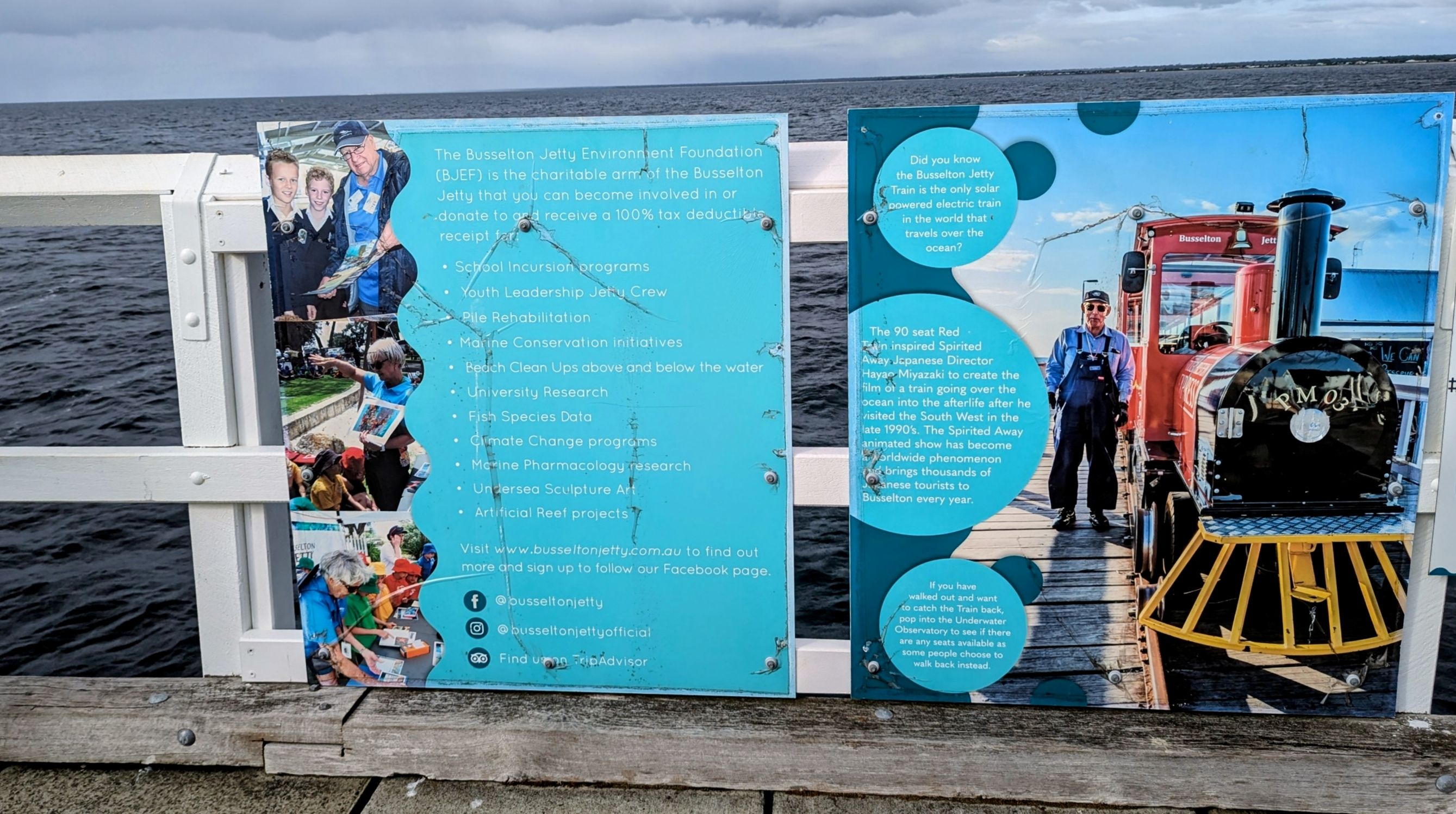
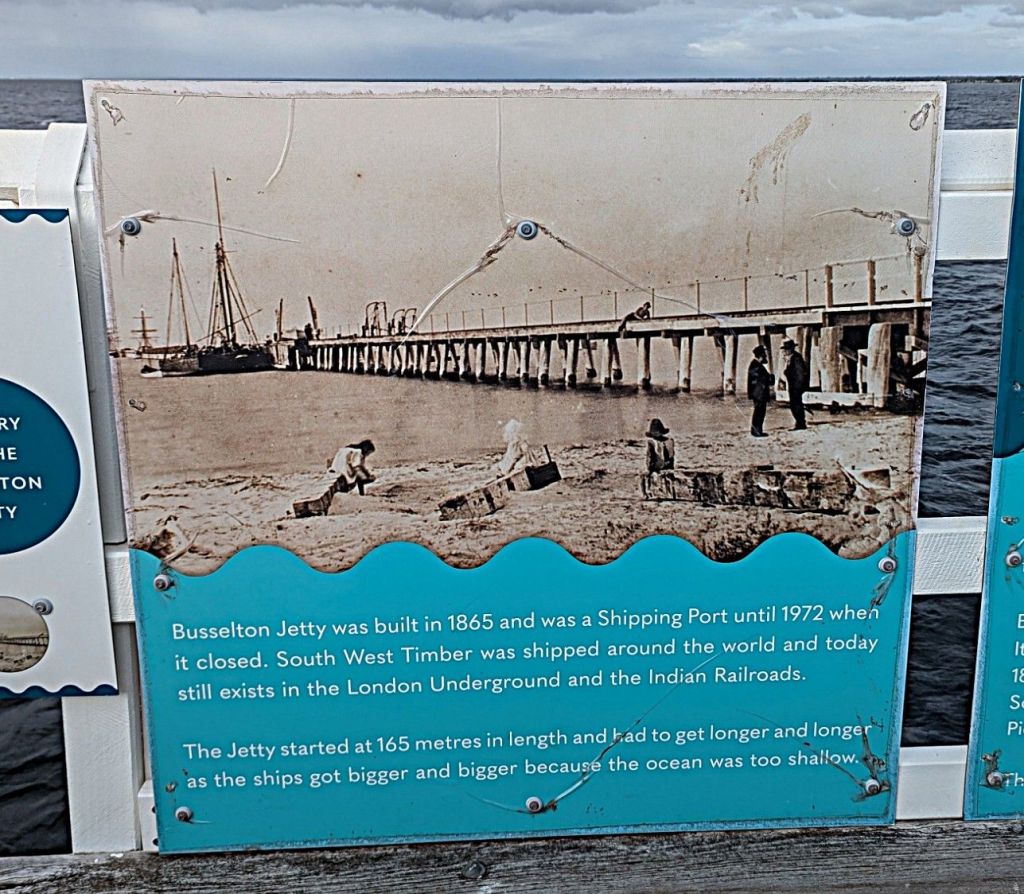
Busselton Jetty train
Walking halfway along the jetty was fun, but to get to the end was a ‘Lands End’ experience. To do this we took the solar powered train ride – a bumpy and slow progress, past information about the jetty and the train, people fishing, and others, more intrepid than us, walking to the end.


Looking towards the shore – the hotel at which we stayed and at the end of the jetty a distinctive signpost. I am now searching flights to London.



Cindy Lou enjoys her last meal in Busselton
Kyst is another reason to return to this casual, friendly seaside town. This time we both had the soup which is excellent. My prawns with fried parsley, and a sumac and walnut accompaniment were delicious. The beef skewers were also successful.




Art Gallery of New South Wales
Mike Hewson: The Key’s Under the Mat
4 October 2025 – 23 August 2026 Naala Badu building Lower level 4, Nelson Packer Tank
Australia’s most dramatic exhibition space is completely transformed, as artist Mike Hewson brings his unique and boundary-testing brand of social sculpture to the Nelson Packer Tank.
Renowned for award-winning public projects that are at once artworks, play areas, and places to be, Hewson has reimagined the Tank as a combined park, playground, construction site, and commons – an anarchic and generous sculptural neighbourhood where visitors can meet, dwell, play, make, perform, explore and more.










Free to all and made for all ages, this one-of-a-kind project was developed in the artist’s dynamic Sydney workshop and constructed from thousands of salvaged objects and materials. Hewson’s project is an experiment in participation, a spirited act of reclamation and regeneration, a radical rework of the legacies of modern sculpture, and a provocation about what a truly welcoming art museum might look like.
For Hewson, whose sculptural practice was catalysed by the experience of the Christchurch earthquakes, the artist is a host who welcomes guests to use the artwork as their own – ‘the key’s under the mat, make yourself at home’.
Art Gallery of Western Australia
The Sculpture walk is at the top of the art gallery, affording city views beyond the sculptures, which include the work of Barbara Hepworth, Gerhard Marcks and Henry Moore.




Gerhard Marcks The Caller



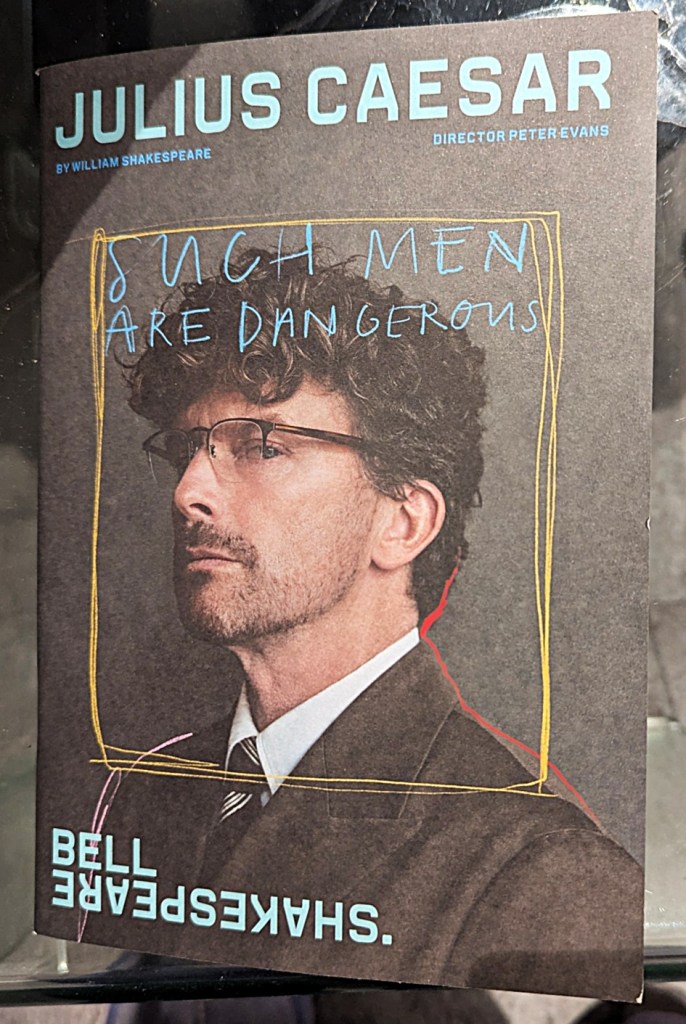
Julius Caesar Bell Shakespeare Canberra Theatre
It has been a long time since I went to a Bell Shakespeare production – they used to be a staple of our theatre life. John Bell has been long retired, and it was interesting to see a production under the new (for us) Board, and a play directed by Peter Evans, rather than John bell. Bell Shakespeare remains a company of innovation, with such innovation being a seamless part of Shakespeare’s intention and work. Julius Caesar is described by the Executive Director, Jams Evans as:
…set in a time far removed from our own. And yet, like all Shakespeare’s plays, it speaks urgently to the present day. It is a sharp examination of leadership ab politics, but also of the power of words – to inspire, to incite, and to transform our world. Words, whether shouted in a crowd or whispered to a loved one, have incredible potency. This play is a timely reminder to choose them carefully’… Program, Julius Caesar.



American Politics
Why the Cassidy Hutchinson Investigation Should Make Us Very Uncomfortable
Joyce Vance from Civil Discourse <joycevance@substack.com> Inbox
Forwarded this email? Subscribe here for more
Why the Cassidy Hutchinson Investigation Should Make Us Very UncomfortableJoyce Vance
Apr 11 READ IN APP
I don’t know Cassidy Hutchinson, the former deputy to Trump Chief of Staff Mark Meadows, who flipped and became a star witness during the January 6 Committee hearings and who is now reportedly under investigation. I don’t have an independent basis for knowing whether she was completely truthful when she testified. Certainly, then-Congresswoman Liz Cheney and committee staff thought she was on the up and up, or they wouldn’t have offered her testimony.
But my view is that if prosecutors have a reasonable suspicion that a crime was committed, they should investigate. They may either clear the subject’s name or move on to more serious investigation and even prosecution if the facts and the law warrant it. That’s how the system works. Regardless of who the person is.The problem these days is that my view is based on the old rules, where we could assume the Justice Department operated on time-honored ethical principles. This one doesn’t. So until we hear that there is evidence that substantiates the claim being bandied about, I have concerns about how this investigation is proceeding.
First off, DOJ doesn’t typically announce that it has opened a criminal investigation. Maybe that didn’t happen here. But The New York Times ran a story on Tuesday that it had, “according to four people familiar with the matter.” It’s possible, but unlikely, that all four of those people were Hutchinson’s lawyers. For one thing, it doesn’t benefit her to have her name dragged through the mud, one of the reasons DOJ doesn’t announce it’s investigating an individual. And it seems unlikely that all four sources would be her lawyers. We don’t know for certain that DOJ or someone else in government leaked the investigation, but the circumstances raise the first red flag.
That takes us to the second red flag. This is reportedly an investigation into perjury, a core crime prosecutors in U.S. Attorneys’ offices look into. A perjury case that occurred in the District of Columbia would normally be investigated by the U.S. Attorney’s office for the District of Columbia. That office has prosecuted other cases involving testimony before Congress, like the one against Peter Navarro for obstruction. The now-failed perjury before Congress case against former FBI Director Jim Comey was brought by a U.S. Attorney’s office.
It’s possible that lawyers in Main Justice might be asked to help out if a case is particularly complicated. That would likely involve the Public Integrity Section, which can help U.S. Attorney’s offices handle prosecutions of political figures anywhere in the country. Or at least, it used to.Last June, the White House gutted the Public Integrity Section. The office is down to 5 lawyers, instead of the 30 experienced prosecutors who were there until Washington directed the then-U.S. Attorney in the Southern District of New York to close the prosecution of New York Mayor Eric Adams, so they could recruit him as an ally for Trump’s mass deportation policy. She declined, triggering resignations and firings in both her office and in the Public Integrity Section. That means an investigation like this should be conducted by the U.S. Attorney in D.C.But that’s not where the Hutchinson investigation sits. Instead, it’s being conducted by the Civil Rights Division. We discussed the current Assistant Attorney General in charge of the Division, Harmeet Dhillon, here. I spent 25 years at DOJ, and I’ve handled a variety of civil rights matters. I’m unfamiliar with any authority that gives the Civil Rights Division the ability to handle a perjury investigation that has nothing to do with a civil rights matter.
Although the Civil Rights Division’s org chart (and its website!) have undergone considerable change in the past year under Trump, the laws it has the authority to enforce haven’t changed. There is both a civil side to the Division that brings lawsuits to enforce laws like the Civil Rights Act of 1964 and the Americans with Disabilities Act and a criminal side that prosecutes civil rights conspiracies, police excessive force, hate crimes, and other civil rights violations.
Nowhere is there authority to investigate a former White House staffer for perjury, based on a referral by a member of Congress.That brings us to a third red flag, and one that makes it imperative to scrutinize the legitimacy of this announced investigation: this Justice Department’s long line of failed Trump revenge prosecutions, from Jim Comey to New York Attorney General Letitia James, to six members of Congress who reminded the military not to follow illegal orders, to Jerome Powell, head of the Fed. There’s also the ongoing grand jury investigation in Miami looking into people, including former CIA Director John Brennan, which reportedly involves testimony Brennan gave before Congress. (It’s hard to figure out how prosecutors in Miami have jurisdiction over that one; perhaps something about Trump’s residence in Mar-a-Lago, and Judge Aileen Cannon is there.)
An investigation into Hutchinson can’t be viewed without considering this context. DOJ has undertaken a revenge agenda for the boss, and Pam Bondi, who reportedly authorized opening this matter while she was fighting to save her job, knew she was under fire for colossal failures to deliver results in that regard. Absent actual evidence against Hutchinson, it’s hard to accept that this matter is legitimate. And the time for that proof would have been when a grand jury indictment was obtained and announced—not during the preliminary stages in an investigation that may or may not pan out.You don’t have to be a former prosecutor for this situation to give you pause. If competent prosecutors have credible reason to suspect misconduct by Hutchinson, then investigation is warranted. But there are a lot of ifs there.
DOJ has a serious job to do. The Civil Rights Division has a serious job to do. Pacifying a petulant president who wants to take revenge against his perceived enemies shouldn’t be a part of it. But here we are. Again. There is no longer a presumption of regularity for this Justice Department—either in court or in the court of public opinion. Skepticism is now the order of business.
Thanks for being here with me at Civil Discourse. Your support makes the newsletter possible!
We’re in this together, Joyce
3 of 36,296
The Week Ahead
Joyce Vance from Civil Discourse <joycevance@substack.nbox
Last Sunday, in “The Week Ahead,” we discussed Hungarian strongman Viktor Orbán’s election problem. He and his Christian nationalist far-right political party, Fidesz, were seriously behind in polling just a week ahead of the election… But today, Orbán lost that election. He was forced to concede defeat because of the staggeringly large margin of victory by which his opponent, Péter Magyar, won. With 99% of the vote counted tonight, the opposition looks like it will take 2/3 of the seats in parliament. The BBC characterized it as “the type of landslide victory that means they will be able to make sweeping changes to the country.”
There is an obvious lesson for us here. Turnout matters; it may be the only thing that matters, both this year and in 2028. It becomes increasingly difficult for Trump and MAGA to contest races that are lost, not just by 11,779 votes (looking at you, 2020 Georgia), but by the kind of substantial margins turnout for the most recent No Kings Day march suggests Americans may be preparing to deliver. It’s hard to dispute an election that is won by 10 points or more, and much easier for courts to dispense with the inevitable challenges Trump’s party will bring nonetheless.So, lesson learned: Whether you bring one or two friends along with you to the polls or work on a major get-out-the-vote effort in your state, for the rest of the time before the midterm elections, the work we do is going to matter. Find the best thing you can do and give it all of your effort. Politicians can’t blame an enormous margin of victory like the one in Hungary on fraud, non-citizen voting, or any of Trump’s other crazy election conspiracy theories. Some margins are too big to deny. Let’s go!..
The loss was especially bad news for JD Vance, who spent time in Hungary last week in an unprecedented move for an American leader, openly campaigning for the Putin-aligned Orbán. The Republican Party, of course, remained silent about that. Hopefully, Vance will campaign across the U.S. ahead of the midterm elections.
Swalwell Out of the Governor’s Race California Congressman Eric Swalwell announced earlier this evening that he is withdrawing from the Governor’s race in that state. In a prepared statement, he wrote: “To my family, staff, friends, and supporters, I am deeply sorry for mistakes in judgment I’ve made in my past.” But he continues to deny allegations of sexual assault. He said he’d continue to fight to clear his name, but “that’s my fight, not a campaign’s.” A former staffer told the San Francisco Chronicle that Swalwell sexually assaulted her. CNN reported that four women “described sexual misconduct” by Swalwell, including one who alleged he had raped her. Democratic strategist Ally Sammarco came forward with allegations that in 2021, when she was first trying to find a place on Capitol Hill, Swalwell responded to a DM asking for his advice and ended up inappropriately sexting her. She said she came forward to support other women because she thought she was the only one before she saw the “recent reports online that some women were about to accuse the longtime congressman of sexual misconduct.” …For far too long, our culture was one that didn’t believe women. Swalwell, who maintains his misconduct is between him and his wife and that he did nothing criminal, is entitled to the same due process as anyone else accused of a crime—the Manhattan DA’s office has reportedly opened an investigation into an alleged assault in New York City. But it matters that these allegations are taken seriously. It’s incredibly difficult for victims to come forward. They may think they are the only ones and won’t be believed. They may be concerned that people will think it was their fault. As E. Jean Carroll testified during her defamation case against Donald Trump, she didn’t report his assault at the time because close friends advised her that her career and ability to make a living would be ruined.But not all of the consequences in a situation like this involve criminal prosecution. The Washington Post reported: “In a video late Friday denying the allegations of sexual assault, Swalwell said he had ‘certainly made mistakes in judgment in my past’ that were ‘between me and my wife.’” Then it continued, “In a social media post, [Congressman Jared] Huffman, a fellow California Democrat, said Swalwell had all but admitted ‘a per se abuse of power’ under House ethics rules, which prohibit House members from having sexual relationships with subordinates.” Huffman is one of a number of Democrats calling for Swalwell’s expulsion from the House.
Swalwell has alleged that the timing of the allegations is political. They will undoubtedly create chaos in the California Governor’s race. The situation also has echoes of Al Franken’s resignation from the Senate, and the fact that Democrats take allegations of sexual misconduct seriously, while Republicans don’t. We’re still waiting on the truth about Trump and the Epstein files.There is also Texas Republican Tony Gonzales. He’s being investigated in the House over allegations he had an affair with a staff member who later set herself on fire and died. A week ago, two staffers came forward with allegations that he sent them sexually explicit texts, including repeatedly asking for sex. While top Democrats withdrew support for Swalwell’s gubernatorial ambitions as allegations against him surfaced from multiple women and members of his own party say they will vote for his expulsion from the House if he doesn’t resign, there wasn’t a similar widespread outcry when the allegations about Gonzales first surfaced. Not believing women, not taking their allegations seriously when they have the courage to come forward, can lead to a society where this behavior is tolerated and women don’t feel safe about reporting it, and aren’t safe in the workplace.
Victims deserve justice. The idea that only one political party cares about them is discouraging, and worse, it can feel like Republicans gain political advantage from ignoring or even dismissing allegations of sexual misconduct, like what they’ve done with Trump.
Having an inappropriate sexual relationship with a staffer can be a violation of ethics rules for members of Congress, even when the sex involved isn’t criminal per se, like assault or rape would be. Members can be called upon to resign or expelled from Congress for violating ethics rules. But because of the power differential between accuser and accused, allegations can be easily sidelined, and historically, have been for years before anything happens, even if it eventually does. It’s important to believe women who come forward with credible allegations of sexual misconduct and investigate those allegations, instead of allowing them to be swept under the rug while more victims are harmed.
If an inquiry into a member of Congress progresses into a criminal investigation, the member, like anyone else accused of a crime, is entitled to due process in the criminal justice system. They are innocent of a crime and cannot be punished until they are found guilty beyond a reasonable doubt. But it’s important that allegations are investigated, not shelved, and that means listening to women who come forward. Doing the right thing has to matter more than tribal politics. But it can feel frustratingly like only Democrats see it that way much of the time.
Bondi Isn’t Testifying Pam Bondi won’t be showing up to testify before Congress about Jeffrey Epstein, the silver lining to being fired. The House Oversight Committee released a statement last week, saying it would schedule a new date for her to appear. This should be easy: the subpoena was to Bondi, not to the office of the Attorney General. But if the Committee wants to maintain that it was for the AG, then Todd Blanche is available…Trump has been successful in pushing the Epstein Files off the front burner with his war in Iran. It remains to be seen whether that bipartisan coalition will hold with the issues receiving far less attention…
Trump The President continues to show signs of decline. Last week, Josh Dawsey at the Wall Street Journal reported that Trump “has repeatedly promised his top administration officials pardons before he leaves office.” How, one wonders, does something like that come up? Is it in the context of a “don’t worry, just do this and it will be okay because…” conversation? Dawsey writes that Trump said in a recent meeting, “I’ll pardon everyone who has come within 200 feet of the Oval.” He goes on to report, “That radius appears to be expanding as the president repeats the line. Another person who met with Trump earlier this year said the president quipped about pardoning anyone who had come within 10 feet.”…
He’s ending his day attacking the Pope, whom he refers to as “Leo,” on Truth Social.Pope Leo is WEAK on Crime, and terrible for Foreign Policy. He talks about “fear” of the Trump Administration, but doesn’t mention the FEAR that the Catholic Church, and all other Christian Organizations, had during COVID when they were arresting priests, ministers, and everybody else, for holding Church Services, even when going outside, and being ten and even twenty feet apart. I like his brother Louis much better than I like him, because Louis is all MAGA. He gets it, and Leo doesn’t! I don’t want a Pope who thinks it’s OK for Iran to have a Nuclear Weapon. I don’t want a Pope who thinks it’s terrible that America attacked Venezuela, a Country that was sending massive amounts of Drugs into the United States and, even worse, emptying their prisons, including murderers, drug dealers, and killers, into our Country. And I don’t want a Pope who criticizes the President of the United States because I’m doing exactly what I was elected, IN A LANDSLIDE, to do, setting Record Low Numbers in Crime, and creating the Greatest Stock Market in History. Leo should be thankful because, as everyone knows, he was a shocking surprise. He wasn’t on any list to be Pope, and was only put there by the Church because he was an American, and they thought that would be the best way to deal with President Donald J. Trump. If I wasn’t in the White House, Leo wouldn’t be in the Vatican. Unfortunately, Leo’s Weak on Crime, Weak on Nuclear Weapons, does not sit well with me, nor does the fact that he meets with Obama Sympathizers like David Axelrod, a LOSER from the Left, who is one of those who wanted churchgoers and clerics to be arrested. Leo should get his act together as Pope, use Common Sense, stop catering to the Radical Left, and focus on being a Great Pope, not a Politician. It’s hurting him very badly and, more importantly, it’s hurting the Catholic Church! President DONALD J. TRUMP
But that’s not all. Trump closed out the day by posting two images on Truth Social. One portraying Trump Tower on the Moon (presumably).
And the other depicts Trump as a god-like healer.The president is not well.
We’re in this together, Joyce
Letters from an American
April 13, 2026 Heather Cox Richardson
On April 12, the day of Hungary’s parliamentary elections, the Conservative Political Action Conference (CPAC) posted on social media that it was closely watching the election and stood firmly behind Prime Minister Viktor Orbán.
As a major networking event and ideological trendsetter for the radical right in the United States, CPAC has been instrumental in celebrating Orbán’s Hungary as the center of the effort to destroy the liberal democracy of the United States and Europe in order to replace it with what Orbán called “illiberal democracy,” or “Christian democracy.” His system replaced the multiculturalism at the heart of democracy with Christian culture, stopped the immigration that he believes undermines Hungarian culture, and rejected “adaptable family models” in favor of “the Christian family model.”
Today Péter Magyar, the man who will replace Orban after winning the election in a blowout, revealed that Orbán was using government money to finance CPAC. Orbán has clearly been working for the benefit of Russia’s president Vladimir Putin, and just days before the election, news broke that last October, Orbán told Putin, “In any matter where I can be of assistance, I am at your service.”
So it appears that CPAC was funded by a foreign government that was working closely with Vladimir Putin. In a speech today, Magyar told reporters that the outgoing foreign minister, who has been accused of working closely with Russian foreign minister Sergey Lavrov, was shredding confidential documents.
The influence of Orbán on the U.S. right wing marked a change in Republican politics.
Before Trump won the presidency in 2016, the modern-day Republican Party was well on its way to endorsing oligarchy. It had followed the usual U.S. historical pattern to that point. In the 1850s, 1890s, 1920s, and then again in the modern era, wealthy people had come around to the idea that society worked best if a few wealthy men ran everything.
Although those people had been represented by the Democrats in the 1850s and the Republicans in the 1890s, 1920s, and 2000s, they had gotten there in the same way: first a popular movement had demanded that the government protect equality of opportunity and equal justice before the law for those who had previously not had either, and that popular pressure had significantly expanded rights.
Then, in reaction, wealthier Americans began to argue that the expansion of rights threatened to take away their liberty to run their enterprises as they wished. To tamp down the expansion of rights, they appealed to the racism of the poorer white male voters whose votes they needed to maintain control of the government, telling them that legislation to protect equal rights was a plan to turn the government over to Black or Brown Americans, or immigrants from southern Europe or Asia, who would use their voting power to redistribute wealth.
The idea that poor men of color voting meant socialism resonated with white voters, who turned against the government’s protecting equal rights and instead supported a government that favored men of property. As wealth moved upward, popular culture championed economic leaders as true heroes, and lawmakers suppressed voting in order to “redeem” American society from “socialists” who wanted to redistribute wealth. Capital moved upward until a very few people controlled most of it, and then, usually after an economic crash made ordinary Americans turn against the system that favored the wealthy, the cycle began again.
When Trump was elected, the U.S. was at the place where wealth had concentrated among the top 1%, Republican politicians denigrated their opponents as un-American “takers” and celebrated economic leaders as “makers,” and the process of skewing the vote through gerrymandering and voter suppression was well underway. Republican leaders wanted a small government that kept taxes low and left business to do what it wished, but they still valued the rule of law and the rules-based international order.
It’s impossible to run a successful business without a level legal playing field, as businessmen realized after the 1929 Great Crash made it clear that insider trading had meant that winners and losers were determined not by the market but by cronyism. And it’s impossible to do business without freedom of the seas and the stability of international rules.
But when Orbán took office for the second time in 2010, he courted the right wing with promises not to get the government out of their way, as right-wing politicians in the U.S. had done since the 1980s, but to use the government to impose their cultural values on the country at large. He established control over the media, cracking down on those critical of his party and rewarding those who toed the party line. In 2012 his supporters rewrote Hungary’s constitution to strengthen his hand, and extreme gerrymandering gave his party more power while changes to election rules benefited his campaigns.
Increasingly, Orbán used the power of the state to concentrate wealth among his cronies, and he reworked the country’s judicial system and civil service system to stack it with his loyalists. By 2026, Hungary still had elections, but state control of the media and the apparatus of voting made it very difficult for Orbán’s opponents to take power.
That model proved irresistible for right-wing leaders in the U.S. who courted radical white evangelicals and who recognized that their ideology was unpopular enough that the only way to make it the law of the land was to impose it through the power of the state. In Florida, Governor Ron DeSantis, who took office in 2019, followed Orbán’s model right down to the laws prohibiting discussion of LGBTQ+ issues and DeSantis’s attempt to strip Disney of its governance structure when it refused to adhere to the “Don’t Say Gay” law.
Orbán’s idea that the power of the state must be used to overturn democracy in order to enable a small group of leaders to restore virtue to a nation inspired the far-right figures that took charge of the Republican Party under Trump. As Heritage Foundation president Kevin Roberts put it: “Modern Hungary is not just a model for conservative statecraft but the model.”
Calling for “institutionalizing Trumpism,” Roberts pulled together dozens of right-wing institutions behind the Heritage Foundation’s Project 2025 to create a blueprint for a second Trump term that uses the power of the government to impose right-wing religious values on the U.S. In his foreword for a 2024 book by Roberts, then-senator and vice presidential candidate J.D. Vance made it clear he saw himself and Roberts as working together to create “a fundamentally Christian view of culture and economics.”
Since taking power, Trump and Vance have followed Orbán’s model both at home and internationally. Instead of working with our traditional allies, they have attacked Europe and aligned the U.S. with Hungary and Russia.
Establishment Republicans who wanted a smaller government liked Trump’s tax cuts and deregulation, but they did not like the threat of government intervention in their business decisions to force them to adhere to right-wing moral values. They are also not keen on Trump’s rejection of Europe and destruction of the rules-based international order under pressure from Putin. That order facilitates international trade.
In an op-ed in Fox News online today, Senator Mitch McConnell (R-KY), the old leader of the establishment Republicans, tried to sideline the MAGA Republicans when he wrote: “Watching this from Kentucky, it is hard to understand how some on the American right thought that staking U.S. influence on the outcome of a parliamentary election in a small, central European country was putting America’s interests first. To the extent that what happens in Hungary matters to America, it is a question of whether its actions on the world stage—not its social policies—align with America’s strategic interests.” By that, he tried to recall the Republican Party to his faction rather than that of the MAGA Republicans by pointing out that Magyar’s government seems more likely to resist America’s adversaries and work with America’s allies than Orbán was.
But the model that Hungarian voters’ dramatic rejection of Orbán offers to the U.S. is a more sweeping rejection of the whole radical right than McConnell suggests. Rather than centering an elite as lawmakers, as right-wing ideology does, it centers the people. Those who know Hungarian politics say that Magyar’s party won because voters recognized that Orbán’s vow to purify Hungarian society turned out to be a cover for extraordinary corruption of party leaders and cronies, while the destruction of the economy hurt everyday people.
Magyar and his party reminded Hungarians of the good in their country and reawakened their national pride. They promised voters a democratic state with the rule of law under a government that worked for the people.
Just as there is a blueprint for destroying democracy, there is also one for rebuilding it. “Let us now and here highly resolve to resume the country’s interrupted march along the path of real progress, of real justice, of real equality for all of our citizens, great and small,” New York governor Franklin Delano Roosevelt said to the delegates at the Democratic National Convention in 1932 as American democracy struggled to resist fascism.
“Out of every crisis, every tribulation, every disaster, mankind rises with some share of greater knowledge, of higher decency, of purer purpose,” FDR said. “Today we shall have come through a period of loose thinking, descending morals, an era of selfishness, among individual men and women and among Nations…. Let us be frank in acknowledgment of the truth that many amongst us have made obeisance to Mammon, that the profits of speculation, the easy road without toil, have lured us from the old barricades. To return to higher standards we must abandon the false prophets and seek new leaders of our own choosing.”
“I pledge you, I pledge myself, to a new deal for the American people,” FDR concluded. “Let us all here assembled constitute ourselves prophets of a new order of competence and of courage. This is more than a political campaign; it is a call to arms. Give me your help, not to win votes alone, but to win in this crusade to restore America to its own people.”
—
Mitch McConnell, “Hungary’s voters offer a lesson for those on the right drawn to Orban,” Fox News, April 13, 2026.
X:
CPAC/status/2043383249204899872
splendid_pete/status/2043693756033941811
zackbeauchamp/status/2043472019027587354
BogataTimar/status/2043787197313139178
British Politics
Finn McRedmond <saturdayread+the-saturday-read-feature@substack.com> Unsubscribe
Meet the new generation of radical feministsApr 15 READ IN APP Good morning. This is Finn McRedmond, staff writer at the New Statesman and editor of the Saturday Read.
By now, we are used to hearing about the radicalisation of young men – that unfortunate cohort, captured by the manosphere, enchanted by men’s rights activists, veering to the populist right.
But what about the young women? If we want to understand why the political gender gap is widening, we need to look to those moving sharply to the left. To do so, Emily Lawford, the New Statesman’s online editor, has spent months in the femosphere – at The Feminist Library, deep in their TikTok feeds, at university feminist societies and Palestinian solidarity marches.
With exclusive polling from Scarlett Maguire, the director and founder of Merlin Strategy, our cover this week asks: Who are these radical young women? What do they believe? And how will their feelings of disenfranchisement and isolation manifest at the polls?
You can read an extract of Emily’s piece down below:
It was a Wednesday night and seven members of the University of Leeds’ feminist society had invited me to join their book swap. We were in a classroom in the healthcare wing, and there was a pile of books on the table: Margaret Atwood’s The Penelopiad, Audre Lorde’s Zami: A New Spelling of My Name. Someone had brought Heather Morris’s The Tattooist of Auschwitz. We’d debated whether Harry Potter gets more respect than The Hunger Games because the main character is male, the racial politics of Wuthering Heights, the sexual politics of Sally Rooney.
The literary conversation was winding down. I asked the table how they felt about the young men they knew. “I don’t care for them,” said a girl called Ruby imperiously. She had red hair and lots of silver jewellery. “They’re not bad people, but they refuse to call out their friends who make other girls uncomfortable. They’ll laugh at jokes that are sexist, racist, homophobic, they don’t care about political issues… I don’t think they like women a lot.” If a man is attracted to you, she said, he might talk about things like toxic misogyny…
These women weren’t outliers. According to the New Statesman’s polling, young women are twice as likely to not want children as young men. All the Leeds women told me they feared a Reform government pressuring them to have babies. One woman mentioned Suella Braverman’s pledge to scrap the Equality Act and repeal other human rights laws. “It just feels… out of control.”
It all felt impossibly bleak. Most of the women I met were educated, engaging, bright and charismatic. But they weren’t excited about their futures.
Australian Politics
First woman to lead the army, navy chief now new head of Defence Force*

Prime Minister Anthony Albanese has announced the new heads of Defence, Army and Navy with the first woman to hold the role of Chief of Army…
Susan Coyle, the current head of joint capabilities, will become army chief, replacing Simon Stuart following his retirement.
Defence Minister Richard Marles said Coyle’s appointment was “a deeply historic moment, one that should be noted”.
“As Susan said to me, ‘You cannot be what you cannot see’,” Marles said.
“And Susan’s achievement will be deeply significant to women who are serving in the Australian Defence Force today and women who are thinking about serving in the Australian Defence Force in the future.”

Coyle, 55, who joined the Army Reserve as a soldier in 1987 before holding a series of senior roles, is the first woman to lead a branch of the Defence Force – army, navy or air force.
Prime Minister Anthony Albanese said Hammond had enjoyed a distinguished career, including 40 years in the navy, including as a submarine commander…
Parker, a former naval officer, noted that Hammond [new Defence Force Chief] of had strong connections within the US military system, putting him in a strong position to drive AUKUS forward.
As for the appointment of Coyle as the nation’s first female service chief, she said the move “had been a long time coming and is well overdue”.
She noted that Coyle had experience in space and cyber capabilities, as well as traditional army platforms, making her well-placed to learn lessons from modern conflict, including in Ukraine…
*edited