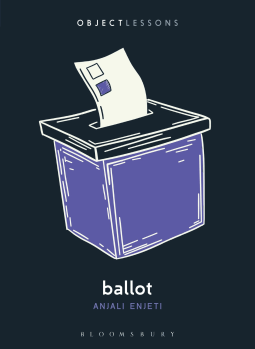
Anjali Enjeti Ballot Bloomsbury Academic, February 2026.
Thank you, NetGalley and Bloomsbury Academic, for providing me with this uncorrected proof for review.
Ballot makes an enlightened and enlightening contribution to the Object Lessons series. It is passionate, without being didactic, politically astute in its descriptions of voting practices and advice on how these have impacted the democratic nature of voting in America, and provides hope in a clouded political environment. This is a book that is so accessible, with the only difficulty in reading it coming to grips with the egregious nature of some political activity associated with voting in America. As well as being a thoughtful account of voting practices, Ballot provides an abundance of practical information about the way in which voting has been undertaken, and this historical approach is as engaging as the more charged political account.
Anjali Enjeti begins her book with two examples of students voting in their classroom, choosing between the candidates in current elections. This provides a brief insight into the role of the education system in extending knowledge and some understanding of the political process. I would have liked this to be built upon with information about students’ studying any additional aspects of the political process, whether such practice has endured, and in which states.
However, there can be no criticism of the detailed information that is made available clearly, with insight and political acumen. The changes in voting practices, from the early vocal voting in public, the use of various types of mechanical processes, paper ballots, and online voting make interesting history – the flaws and advantages are laid out, including those associated with the counting of the ballots and those staff who do this work. This last matter highlights the egregious treatment of some staff who counted ballots in the 2020 election – and their vindication. This is just one example of the intelligent political commentary that sits comfortably beside the information in this book. See Books: Reviews for the complete review.
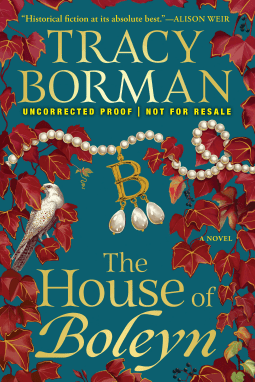
Tracy Borman The House of Boleyn A Novel Grove Atlantic | Atlantic Monthly Press, August 2026.
Thank you, NetGalley, for providing me with this uncorrected proof for review.
Tracy Borman’s novel is a broader reflection on Anne Boleyn’s attitude to her relationship with Henry V111 than usual. This has its pitfalls, as secondary characters whose vital roles were unrecorded must be partially fictionalised; it also has its advantages in that Borman is able to speculate about characters, often suggesting possibilities that question the way in they have been depicted in other historical fiction and non-fiction. The introduction, with Thomas Boleyn returning to Hever Castle, mourning the loss of his two children is an indication of where this novel might lead. It is intriguing, as not only does it provide Thomas Boleyn with a more positive image, it also questions the way in which fathers related to daughters in the period. Their role as unrelenting searchers for self-advantage through their female relatives is undermined by his self-reflection throughout the novel. See Books: Reviews for the complete review.
British Politics
The AI Layoff Trap: firms are firing their customers
Tom Watson <tomwatsonofficial@substack.com> Unsubscribe
Forwarded this email? Subscribe here for more
The AI Layoff Trap: firms are firing their customersA smart new paper says firms can see the cliff, understand the cliff and race each other off it anyway. Apr 17 READ IN APP
For years we were told that AI would do the dull work, spare us the drudgery and freemanity for higher things like poetry, social care and better coffee. Instead, one of the more plausible outcomes is that firms automate away large numbers of workers, wreck a slice of the consumer demand on which they themselves depend and then stare at the shrinking economy blaming everyone else.That, in essence, is the argument of a striking new paper, The AI Layoff Trap, by Brett Hemenway Falk and Gerry Tsoukalas. It says rational firms, looking clearly at the rocky road ahead, can still put their foot on the accelerator.That is what makes the paper so good. It does not depend on executives being venal, drug-addled, untrustworthy, fanatical or stupid, though one would not want to rule out the current field evidence. It depends on something more durable than madness and ketamine: incentives.The point is simple. When a firm replaces workers with AI, it pockets the saving itself. That is the private benefit. But when those workers lose wages, they also lose spending power. They buy less of everything, from trainers to takeaways to streaming subscriptions. That lost spending does not just hit the firm that sacked them. It spreads across the economy. So each company gets the private benefit of automation while carrying only part of the social cost.That social cost matters because workers are not only workers. They are also customers. If enough firms replace enough people quickly enough, they do not merely cut labour costs. They start to eat their own demand base. The paper’s point is that this can happen even when everyone can see it happening.Put crudely, the AI revolution may be building an economy in which firms proudly replace their customers.
Picture the PowerPoint to Sam Altman. Headcount down. Margins up. Efficiency enhanced. Then, somewhere around slide 38, a minor deterioration in the continued existence of people with wages.The paper goes further. It argues that more competition can make this worse, not better. A monopolist at least swallows more of the damage it causes. In a crowded market, each firm is more tempted to grab the saving and let the demand fall splash around the rest of the sector. That is how you get an automation arms race among people who think of themselves as hard-headed realists.
I’m sending this paper, with a whiff of alarm, to the Chancellor, in the hope it reaches the pointy heads in the Treasury and Peter Kyle. The paper deserves attention well beyond economics departments because it identifies the problem at the point of decision, not merely in the wreckage afterwards. It warns that the market contains no reliable brake.
In the paper’s frictionless case, the logic hardens into a Prisoner’s Dilemma. Every firm automates. Every firm ends up worse off than under collective restraint. No firm can escape by behaving nobly on its own.
I can see Mark Zuckerberg now, in the wood-panelled boardroom of his missile-proof super yacht, squinting into a Zoom with Elon Musk calling in from his space base, both men nodding gravely as they agree to automate the final solvent customer out of the economy. It is a marvellous image for our age, a virtual room full of very clever men congratulating themselves on their strategic brilliance while quietly setting fire to themselves.That is why the paper is politically important. Too much of the AI debate treats the problem as something that happens later. People lose work, then government tidies up. Falk and Tsoukalas say the problem starts earlier. The real issue is not only what happens after displacement. It is the competitive incentive to cause the displacement in the first place.That is awkward for nearly everyone.It is awkward for the AI evangelists who talk as if labour were somebody else’s problem. The laissez faire right still hopes the market will sort itself out with more innovation.For the pro-growth centre-left, this is a nasty complication. Competition, the usual corrective, is part of the problem here. The broader left is in no better shape. Our instinct is often to clear up after the market has done the damage: tax profits, strengthen labour, retrain workers, spread ownership and top up incomes. The paper’s argument is tougher than that. Those measures may soften the blow, but they do not remove the incentive to automate too far, because each firm still pockets the saving and pushes part of the wider demand damage onto everyone else. The left, in other words, cannot rely on a bigger ambulance alone. It also needs brakes.
The paper tests a whole shelf of remedies. Wage adjustment does not solve it. Free entry does not solve it. Upskilling narrows the problem but does not remove it. UBI does not solve it. Capital taxes do not solve it. Worker equity participation does not solve it. Coasian bargaining does not solve it. The authors’ conclusion is that only a “Pigouvian automation tax” can fully correct the distortion.
In plain English it means this: if companies do not naturally pay the full cost of the damage they impose on everyone else, government puts a price on that damage so the private calculation matches the real one. We do it, in principle, with pollution. The factory owner may enjoy the profit from dumping muck into the river, but the public pays for the filth downstream. A Pigouvian tax says, fine, you can do the thing, but you must also pay for the harm you were previously offloading onto the rest of us. Pollution tax.Applied here, the idea is simple enough to explain. If a firm automates a job and pockets the saving, but the lost wages reduce demand across the economy, then some tax should claw back that unpriced damage. Not to ban useful technology, but to stop firms acting as if the only relevant line in the ledger is their own. The human version is simpler: if you insist on firing your customers, do not expect the rest of us to subsidise the experiment.
There is a darker cultural joke in all this. We have spent years sending bright young people to university so they can learn how to write crisply, present neatly, code competently, summarise fast and absorb institutional wisdom. Then one morning a board decides that Anthropic’s Claude can automate every polished quarterly task they used to go to university for, and suddenly the ladder into professional life is hauled up with an email about agility.
This does not make the paper anti-AI. Many firms are building tools that will improve public services, accelerate research and unlock scientific and medical advances that would have seemed miraculous a generation ago. Used well, AI will help us run the state better, discover faster and solve problems that have resisted human effort for years. The warning in the paper is not against innovation. It is against a market logic that can take a transformative technology and drive it towards a destructive outcome.A technology that saves labour by deleting labour income may look brilliant on the spreadsheet and ruinous in society. Capitalism, in a fit of locally rational enthusiasm, may use the machines to wound itself.It is enough to bring Len McCluskey back from retirement just to say, “I told you so.” Trotskyists, after all, have been predicting the fall of capitalism since, well, shortly after Trotsky stopped being available for comment.And that is the really modern touch. We can model the trap, publish the paper, nod gravely at the findings and still march towards the cliff in excellent order, congratulating ourselves on our agility.The question is not whether AI can help humanity do extraordinary things. It plainly can. The question is whether politics can shape the incentives before the market optimises itself into folly.
PS I did take a serious look at this dystopian possibility several years ago!Are you worried about our robot overlords ending civilisation as we know it? Why not share this newsletter with your friends and scare them too.
American Politics
Harvard Yard and Home
Jess Piper from The View from Rural Missouri <jesspiper@substack.com> UnsubscribeInbox
Forwarded this email? Subscribe here for more
Harvard Yard and HomeJess Piper Apr 17 READ IN APP
I am just back from four days in Cambridge, and I loved it so much that I feel like I left a piece of myself in that town. It turns out I just left my wallet on the plane, which promptly departed for Boston after I deplaned in Kansas City.
If someone is planning to steal my identity, I hope they can raise my credit score…The Harry Elkins Widener Memorial Library is the largest library at Harvard University.
I was invited to visit Harvard by a friend who is a fellow in the Harvard Advanced Leadership Initiative. Her resume is long and distinguished, as are the resumes of the folks who make up the Initiative. I was delighted to be invited to speak to them on rural organizing and rural politics.
The entire time I was in Cambridge, I was overwhelmed with academia. It exudes from every library and book store and coffee shop. Literacy and intelligence drip from the spring blooms in Harvard Yard. Socratic Circles and debates happen naturally with students gathering on lawns to talk and reflect and discuss. I felt like I was in a movie. It didn’t feel real.I was in my element…Except I wasn’t. I felt like a fraud. An imposter. I have not had access to that level of academia, and it shows.I am jealous of those who have access to such good schools, and I’m not just talking about Harvard. I am talking about an educational system set up from pre-K to guide students through learning experiences that kids from my region usually don’t have access to.Maybe jealous is not the right word. Maybe the word is irate.Why can’t all the kids have all of the education?
Because we’ve starved their schools of the teachers and resources that open doors. A big part of my talk on rural organizing is about rural schools and schools in red states in general. You’ve likely heard me quote these stats, but Missouri ranks dead last in the nation in teacher pay. We are near last in the nation for educational funding.
The lack of funding and investment in public education shows up in tests. Recent NAEP reports show roughly 27% of Missouri 4th graders scored proficient or above in reading.I dislike standardized tests as much as the next person, but there is information gleaned in the process that can be used to improve teaching and learning.
A standardized test does not always accurately measure a student’s work and learning, but tests are part of how we assess students’ growth and education in America. It is a snapshot in time at the abilities of a group of kids in a particular school or state. It is not the be all and end all, but it is a benchmark nonetheless.
So, who is to blame for what is happening in Missouri? And why the drop in student performance over the last few decades? In my opinion, it’s devaluing of teachers and the profession and disinvestment in public schools and education.A cult leader once said, “I love the poorly educated.”It’s the old bait and switch. Defund the system, wait for cracks to emerge, tell folks the system never worked, and then privatize the system.Rinse. Repeat.
A few years back, we had some pretty bad scores for reading and math after COVID, and Missouri GOP lawmakers couldn’t find a microphone fast enough to proclaim Missouri’s “failing” public schools and teachers.Their solution? Vouchers and school choice.My response to these lawmakers: who has been in charge of public education in the state for over two decades? Who defunded the schools? Who cut teacher prep and lowered the bar for teacher certification? Who paid teachers the lowest wage in the country? Who forced schools into four-day school weeks?
The GOP has had a supermajority in the legislature for over two decades. If they want to assign blame, they should look in a mirror. Share
The school voucher scheme is only making it worse.In 2021, Missouri Republicans started a voucher system that diverted public school funds. Missouri taxpayers could receive a dollar-for-dollar tax credit that paid for private school vouchers. It worked for a year or two, and then there were not enough private donors to fill the coffers of religious schools. GOP lawmakers then passed legislation to pay for private religious school vouchers outright from Missouri’s general funds.
That is against the Missouri Constitution.
Missouri Constitution. IX Section 8. Prohibition of public aid for religious purposes and institutions. — Neither the general assembly, nor any county, city, town, township, school district or other municipal corporation, shall ever make an appropriation or pay from any public fund whatever, anything in aid of any religious creed, church or sectarian purpose, or to help to support or sustain any private or public school, academy, seminary, college, university, or other institution of learning controlled by any religious creed, church or sectarian denomination whatever;
But a judge just ruled on Tuesday that taxpayer funds can keep floating the $50 million in voucher funds in a lawsuit brought by the Missouri National Education Association.
From the Missouri Independent:In a 57-page ruling, Judge Brian Stumpe wrote that lawmakers could directly appropriate funds to the (voucher) program because state law does not “expressly prohibit” it.Judge Stumpe went on to say, “The General Assembly’s choice to spend money on a scholarship program does not inflict harm on public schools when the legislature has not diverted funds from public schools to cover the scholarship program.”
He is wrong. Legislators did just that — funds are pulled from the general budget and diverted from public schools to cover the voucher scheme.
And Wednesday night, in the middle of the night, Missouri Republicans voted to replace the income tax with an expanded sales tax. A regressive tax.The same Republicans who eliminated the capital gains tax this year, are the ones planning to eliminate the income tax — the income tax supports two-thirds of Missouri’s budget.Rural schools are going to be the hardest hit in all of this mess, and I’m so tired. It’s already a fight to get an education in this state, and now the legislature diverts what little we have for public schools to private religious schools.
You know, while in Cambridge, I looked up the stats for rural students who end up in a place like Harvard…they make up 9% of the students enrolled. Did you know that rural people make up around 40% of Armed Forces recruits?Think about that.We can and should do better for our kids. That starts and ends with education. I shouldn’t have to publish a hundred essays on this topic to get through to my lawmakers, but they always give me something to write about.Missouri invented Kindergarten. Missouri was once a haven for great public schools. Missouri wasn’t always this way. What if we reclaimed that legacy?
~Jess
Why Bullies Always Fail — as Trump Is Failing
Robert Reich <robertreich@substack.comnbox
Forwarded this email? Subscribe here for more
Trump’s might-makes-right lawlessness will be his downfall. If we’re not careful, it will be America’s as well. Robert Reich Apr 22
Trump’s domestic and foreign policies — ranging from his attempted coup against the United States in January 2021, to his ICE and Border Patrol excesses (including murders in Minnesota), to his incursion into Venezuela and abduction of its president, to his attack on Iran, and his threats against Cuba, Colombia, and Greenland — all undermine the rule of law, domestically and internationally.But that’s not all. They threaten what we mean by civilization.
The moral purpose of civilized society is to prevent the stronger from attacking and exploiting the weaker. Otherwise, we’d be permanently immersed in a brutish war in which only the fittest and most powerful could survive.
Trump believes that might makes right — that the stronger are entitled to attack and exploit the weaker. Violence against those who are or appear weaker is a hallmark of his presidency and his outlook in general.He is profoundly and dangerously wrong.In January, he called the unilateral military intervention that ended in the kidnapping of Venezuelan leader Nicolás Maduro an example of the “iron laws that have always determined global power.”What “iron laws” is he referring to? “Might makes right” is not an iron law. It marks the destruction of the rule of law.When challenged about the Maduro operation, White House senior policy adviser Stephen Miller mocked Jake Tapper on CNN for his apparent naïveté about “international niceties” like the United Nations charter. “We live in a world, in the real world, Jake, that is governed by strength, that is governed by force, that is governed by power,” said Miller.
Sorry, Stephen. Strength, force, and power do not “govern” anything. They’re the exact opposite of governing. They’re survival of the fittest — the law of the jungle.
On April 7, Trump told the Iranian regime to surrender to American might or “a whole civilization will die tonight.” That kind of talk doesn’t enlarge American power. It delegitimizes American power.In reality, Trump is destroying any remaining faith that the United States can be trusted to exercise power responsibly. He is also, not incidentally, erasing any distinction between the exercise of American might and Russian conduct in Ukraine and Chinese behavior in the South China Sea or (potentially) over Taiwan.If the United States stays on this course, it will find itself bereft of allies and friends, a lonely superpower in a lawless international system it has helped to create.
The genius of America’s post-1945 foreign policy was to embed America’s power in international institutions and laws, including the UN charter, emphasizing multilateralism, democracy, human rights, and the rule of law.
America didn’t always live up to these ideals, of course. But all nations, regardless of their size or power, had a stake in them. They not only helped legitimize American power but maintained international stability and avoided another world war.
The same moral underpinning provides the foundation for a good society. To be morally legitimate, any system of laws must be premised on preventing the stronger from attacking and exploiting the weaker. If a system is to be broadly accepted and obeyed, the entire public must believe that it is in their interest to support it.
But this aspiration is easily violated by those who abuse their wealth and power. Maintaining it requires that the powerful have enough integrity to abstain from seeking short-term wins, and that the rest of us hold them accountable if they don’t.
Yet we now inhabit a society grown vastly more unequal. Political and economic power are more concentrated and less constrained than at any time since the first Gilded Age. This invites the powerful to exploit the weaker because the powerful feel omnipotent.
The wealth of Elon Musk, Jeff Bezos, Mark Zuckerberg, Larry Ellison, Charles Koch, and a handful of others is almost beyond comprehension. The influence of Big Tech, Big Oil, and the largest aerospace and defense corporations extends over much of America and the globe. AI is likely to centralize wealth and power even more.
Meanwhile, Trump — enabled by cowardly congressional Republicans and a pliant majority on the Supreme Court — has turned the U.S. presidency into the most powerful and unaccountable agent of American government in history, arrayed on the side of the powerful, domestically and internationally.
A direct line connects Trump’s attempted coup in 2020 and January 2021 to his capture of Maduro to his attack on Iran without congressional authority to his blatant corruption. All are lawless. All are premised on the hubris of omnipotence.
You see much the same in Putin’s war on Ukraine. In Xi’s threats against Taiwan. In global depredation and monopolization by Big Tech and Big Oil. In Russian, Chinese, and American oligarchs who have fused public power with their personal wealth.But unfettered might does not make right. It makes for instability, upheaval, depravity, and war.
History shows that laws and norms designed to constrain the powerful also protect them. Without such constraints, their insatiable demands for more power and wealth eventually bring them down — along with their corporations, nations, and empires. And threaten world war.
Trump’s blatant lawlessness is already bringing him down. It will haunt America and the world for years to come.
Australian Politics
 BREAKING NEWS: Anthony Albanese has just been honored by TIME magazine, named among the 100 most influential figures in the world — a recognition that celebrates his transformative leadership and global impact as Prime Minister.
For decades, Anthony Albanese has redefined what it means to be a modern global leader — blending working-class advocacy, progressive social reform, and a fearless political voice into a mission that continues to reshape Australia’s role on the world stage. From his early years as a champion for public housing to his historic rise as Australia’s 31st Prime Minister, his influence has transcended the worlds of infrastructure, national policy, and international governance.
He is not only one of the most recognized figures in the Indo-Pacific region but also a visionary force who uses his platform to champion climate action, social equity, and multilateral cooperation. His strategies have become benchmarks for regional stability, and his commitment to a “Fair Go” for all remains a defining pillar of his contemporary political legacy.

Australian Media Oral History Group
Cinema Reborn ·
Australian director Mary Callaghan’s debut film Greetings from Wollongong is one of five by women directors screening in Cinema Reborn 2026. Per Bill Mousoulis’s program note on the Cinema Reborn website “Mary Callaghan (1955-2016) is a somewhat neglected figure in Australian cinema. Born in Wollongong, NSW, she took to filmmaking at a young age, working with Super-8 in high school, before completing Victoria’s Swinburne Film & Television School film course in the mid-1970s. Returning to her hometown of Wollongong in the late ‘70s, she felt compelled to document the social issues she observed in the city, which resulted in her social realist mini-feature film, Greetings from Wollongong, in 1982…”
Callaghan passed away in 2016, in her early sixties.
Carla Kaplan wins Goldsmith Award for Troublemaker
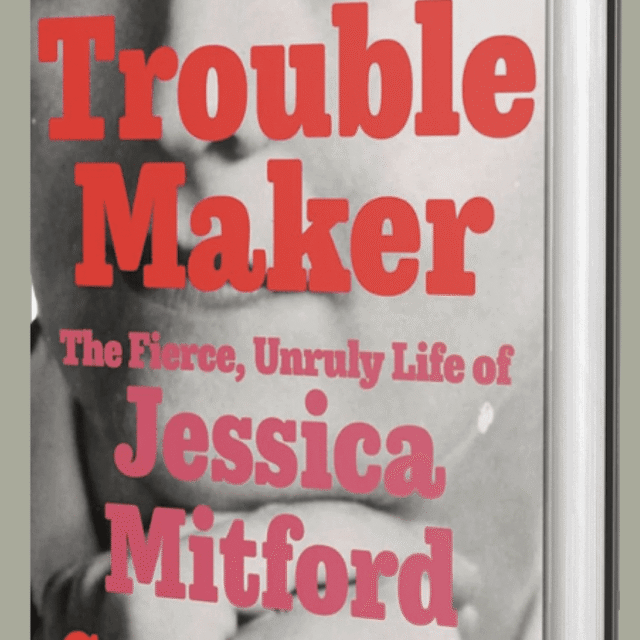
Professor Carla Kaplan, Davis Distinguished Professor of American Literature and professor of English, African-American, and Women’s, Gender, and Sexuality Studies, won the Goldsmith Award from the Shorenstein Center for her book Troublemaker: The Fierce, Unruly Life of Jessica Mitford.
Founded in 1991, the Goldsmith Awards encourage more insightful and spirited public debate about government, politics and the press. The Goldsmith Book Prize is awarded to both trade and academic books that best fulfill said objective, improving democratic governance through an examination of the intersection between the media, politics and public policy. Read more about the Goldsmith Book Prize here.
Troublemaker, Kaplan’s biography, tells the story of Jessica Mitford’s extraordinary life, a British-aristocrat turned American-communist. In the second half of the twentieth century, Mitford’s journalism exposed abuse in prisons, hospitals, correspondence schools, prosecutors’ offices, and more. It was Mitford’s unapologetic activism, fierce humor, and trailblazing fearlessness that drew Kaplan to studying her life.
Troublemaker was also a Finalist for both the PEN American and National Book Critics Circle Awards in biography.
Secret London
You can watch a Shakespeare play in a gorgeous hidden garden in London this summer – but the venue changes every night
Shakespeare in the Squares is officially returning to London this sunny season, ready to put their unique summery spin on another Shakespeare classic.

Katie Forge – Staff Writer · 9 April, 2026
7 Places To Watch The Circus In London That Will Blow Your Mind
As I’m sure you’re aware, the sun in London doesn’t tend to keep its hat on for long. And so the very moment that the weather decides to cooperate, you can bet your bottom dollar that we Londoners will be making the most of it. If we’re hungry, you’ll find us tucking into a spread of picky bits in the park. If we fancy a drink, we’ll be plonking ourselves down in a sun-soaked beer garden. And if we’re in need of a bit of entertainment? Well, Shakespeare in the Squares have got us covered in that department.
Shakespeare in the Squares
A summer staple in London’s cultural calendar; Shakespeare in the Squares is returning to the capital city soon, ready for another season of al-fresco entertainment. Now in its 10th year, the not-for-profit touring theatre company puts an imaginative spin on a Shakespeare classic each year, and performs it in various gardens and green spaces across London. The venue changes (almost) every night, providing a unique and intimate experience for each and every audience member.
This summer’s play of choice is Love’s Labour’s Lost, and the ‘sparkling comedy of flirtation, foolishness and the irresistible pull of love’ will be playing a total of 35 performances across 32 stunning London locations – many of which are very rarely open to the public.
The company tailors every single performance to seamlessly suit the surroundings, and work closely with garden committees and local organisations to ensure the perfect atmosphere is created for each audience and community. This year’s tour will kick off on June 3 in Leinster Square and take its final bow on July 12 in Fortune Green.
The magically musical production of Love’s Labour’s Lost will be performing inside the leafy likes of Crystal Palace Park, Connaught Square, Kensington Gardens Square and Chiswick House & Gardens. The casting is yet to be announced but the play will be – yet again – directed by Toby Gordon, who is certainly no stranger to a bit of The Bard, having been involved in many of Shakespeare in the Squares’ previous productions,
Find out more and book your tickets to Shakespeare in the Square’s production of Love’s Labour’s Lost here.