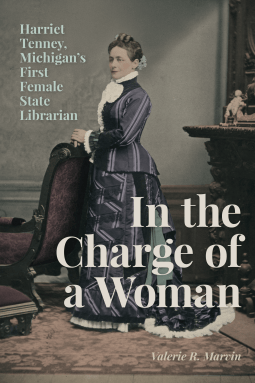
Valerie R. Marvin In the Charge of a Woman Harriet Tenney, Michigan’s First Female State Librarian Michigan State University Press, January 2027.
Thank you, NetGalley, for providing me with this uncorrected proof for review.
I found this a compelling history, not only because it introduced me to the remarkable Harriet Tenney, but because of the way in which Valerie R. Marvin has combined Tenney’s achievements, the world in which she accomplished these, and the way in which her successes impacted the progress of women in the future. To begin with a state librarian, expand the narrative to encompass librarians who followed her, and to broaden the account to include current successes such as Governor Gretchen Witmer is an accomplishment of research and vision. A biographical history that portrays the environment in which the largely unknown subject worked but also provides an insight into how her accomplishments changed that environment and its impact on eminent women in public positions today is a valuable resource. It accomplishes Marvin’s aim to place women in their rightful position, that is, as having held important government positions for a long time. In this instance, it is also an engaging read.
Harriet Tenney was Michigan’s first woman State Librarian, appointed in 1869. Marvin points to her accomplishments in the position, but importantly also signifies how her successes demonstrated women’s potential as good employees in such occupations. The way in which Marvin returns to this theme is an important part of the pleasure in reading this book. She consistently recognises that women have a long history of achieving against sex based discriminatory practices. She also adeptly brings past and present together, for example, in describing Harriet’s role in establishing Michigan’s first State Museum and the Lansing Women’s Club, both of which remain flourishing institutions. At the same time, Harriet Tenney’s personal story is developed so that both her personal and public lives become an absorbing weaving together of one woman’s accomplishments and a range of successes that built on her foundation.
The notes include those that develop the themes and story further, as well as those that establish the authenticity and breadth of the work that underpins this work. There is a bibliography and index. This combination of academic rigour with the engaging story of one woman’s accomplishments forging links between the past and present is an absorbing read.
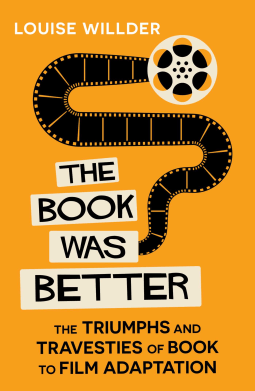
Can a screen adaptation ever live up to a beloved book?*
Herald – The Booklist <updates@newsletter.smh.com.au> Unsubscribe October 23, 2026
The Booklist
Good Evening Readers!
Even as we head into the final months of the year, the literary film and TV adaptations continue; 2026 has been quite the banner year for big and small-screen reimaginings of everything from literary classics to sci-fi and BookTok favourites.
One of the first big adaptations this year was the much-anticipated (or much discussed for the naysayers) adaptation of Wuthering Heights from filmmaker Emerald Fennell, starring Australians Jacob Elordi as Heathcliff and Margot Robbie as Catherine. The film was met with mixed reviews, with purists the most outraged − by everything from Elordi being too white, to Cathy being too old and the way in which the film made the story into a sexed-up bodice-ripper that side-stepped Emily Bronte’s core themes of class, race and social standing.
Not every adaptation this year − among them The Odyssey, The Bride!, East of Eden and Stephen King’s Carrie− has been quite as polarising as Wuthering Heights, but can a screen adaptation ever live up to a much loved book?
While some adaptations are worse than others − I’m looking directly at the producers of the 2023 adaptation of Anthony Doerr’s Pulitzer-winning 2014 novel All the Light We Cannot See− you’ve got to admire the bravery of the filmmakers taking on much-loved classics. Reading is a deeply personal experience and everything from the character’s physicality and voices to pacing and location will never match what we’ve envisaged in our own private versions. And then there’s the fact that books rely so heavily on the thoughts and internal monologues of the characters, which can be a struggle to replicate in a visual medium. And the trend for modernising all or certain aspects of classic texts only infuriates rabid fans even further, in most cases.
This month’s film version of Sense and Sensibility, starring Daisy Edgar Jones and Esmé Creed-Miles, has already had mixed reviews, with some critics dismayed by the filmmaker’s focus on romance over class struggles, and things such as anachronistic dance movements. In early December we can no doubt expect similar comments about Dolly Alderton’s Pride and Prejudice reimagining.
Homer, Austen and Bronte will never know that their protagonists have era-incorrect muscles or 1990s dance moves, but for the living author, it’s obviously a different matter. I’ve interviewed many authors over the years who have politely sidestepped questions about adaptations of their work, or offered neutral opinions, and who can blame them? Especially if a film version of their work brings in new readers, which can often be the case.
Even if I was opposed to someone adapting a novel I’d written (getting slightly ahead of myself with this thought process, I know), I suspect I wouldn’t be able to help myself when it came to watching it. A couple of weeks ago I spoke to bestselling author Audrey Niffenegger, who has just released the much-anticipated sequel to her 2003 novel The Time Traveler’s Wife, which was adapted into a 2009 film starring Rachel McAdams and Eric Bana. In my research ahead of our interview, I read that when the film was released she said she wouldn’t be watching it. But I was shocked when she told me that even now, 17 years later, she’s not once been tempted to watch it. I asked if she was even a little curious? “No,” she told me. “I’m happy to just let it be out there.”
Perhaps it’s just we readers who get so worked up …

*See review of The Book Was Better in my blog Week beginning 26 August 2026.
Cindy Lou at Super Sweet again
Blue skies, bright leaves and blossoms – and great food. We enjoyed shakshuka, Japanese curry with prawns, and zucchini fritters





That was who she was, and what she did – Anita Brookner
Celebrated biographer Hermione Lee reassesses the unfairly stereotyped novelist Anita Brookner
Patrick Mullins Books 23 October

Anita Brookner in London in November 1985. Peter Jordan/Popperfoto via Getty Images
When Anita Brookner’s Hotel Du Lac (1984) was announced as the winner of that year’s Booker Prize, the reaction was ugly. Private Eye made jibes about “Hotel du Lac of Interest” and “A Stroke du Luck” and in the room itself, on the night, people were flagrantly offensive. J.G. Ballard, shortlisted for Empire of the Sun, told Brookner that she had stolen his prize. Germaine Greer, discussing the shortlist as part of a panel, derided Hotel du Lac as the latest in a tradition of “books about lonely ladies in European pensions,” and one juror proudly and drunkenly announced to all that the jury had not chosen a “Proust or a Joyce.”
The prize for Hotel du Lac remains Anita Brookner’s chief claim to fame and, as was portended on the night, it was both blessing and curse. The book sold more than 70,000 copies and was translated into more than twenty languages. The prize gave publishers reason to order bigger print runs for Brookner’s backlist and future novels, and to pay higher advances for them, too. But it also marked the start of a misogynist stereotyping and dismissal of Brookner and her work, one that saw her lampooned as a sad, lonely woman in a grey cardigan who wrote only about sad, lonely women in grey cardigans.
According to Hermione Lee, doyenne of English literary biography and author of lives of Virginia Woolf, Edith Wharton, Penelope Fitzgerald and Tom Stoppard, this won’t do. “Put the caricature up against Anita Brookner’s lifelong dandyish, witty, controlled, stylish performance, in life and art,” she writes, “and it looks misleading.” More important, in Lee’s view, are Brookner’s twenty-five novels, far more varied and interesting than any quick summary can suggest. They are preoccupied by the costs of passion, by the possibilities and difficulties of changing one’s life. They are full of visual motifs, mix intense moral preoccupations with high-minded references, and contain no small amount of astringent humour. Consider the opening line of Brookner’s first novel, A Start in Life (1981): “Dr Weiss, at forty, knew that her life had been ruined by literature.” How does anyone not laugh at that?
To be sure, there is repetition. Brookner’s protagonists wear a lot of cardigans and they do like to ruminate while looking out a window. Most live in London, have classic middle-class jobs, and have been thwarted in some way. But repetition is hardly unusual among novelists, and isn’t necessarily a flaw. Moreover, the seriousness of Brookner’s preoccupations and the tautness of her prose offer a refreshingly worldly break from the more melodramatic work of contemporary novelists.
Brookner’s work is ripe for rediscovery. Ten years after her death, and more than a decade and a half after the publication of her last novel, Lee’s biography, Anita Brookner: Art and Life is explicitly an act of retrieval, an attempt to encourage people to read and reread Brookner, to change their minds about her, to draw attention to a truer version than the stereotype: a “life-changing writer, nonpareil stylist, courageous thinker, extraordinary human being.”
Lee acknowledges that Brookner would not have wanted this book. Like many writers, she was an avid reader and avowed critic of biography. She wrote with approval of those who resisted the impertinent clarity biographers try to offer. “The dead, perhaps even more than the living, have a right to their mysteries,” she wrote, in Incidents in the Rue Laugier (1995), which Lee adopts as an epigraph.
Having forestalled would-be-biographers while she was alive, Brookner also did her best to stop any pursuing her in death. She threw away childhood photographs, disposed of private papers, maintained iron control during interactions with the media, and rigorously compartmentalised friends so that none would see more than a single facet of her. “I shall leave no trace,” she told one interviewer. “That’s the ideal.”
Like most ideals, this was an impossible one to fulfil. Whether our acts are historic or the kind that leave us to rest in unvisited tombs, we all leave a trail. Birth and death certificates, property titles, school records, family albums — to say nothing of the reminiscences of friends and colleagues — make it impossible to disappear entirely. And Lee is fastidious about finding what remains and building her portrait from it.
Brookner was born in London in 1928 to a family of Polish Jews. Her mother was a singer who had given up her failing and unhappy career upon marrying and soon became an invalid; her father was a Polish émigré and failed tobacco salesman whose marriage to his boss’s daughter saw him conscripted and assimilated into a domineering family that both patronised him and ground him down. Under their influence, he changed his name from Bruckner to Brookner — “Like calling yourself Batehoven,” his daughter would say — and affected English manners and interests.
Anita was an intelligent and observant only child who turned to reading as an escape from the claustrophobic, anxious familial atmosphere. She forswore Hebrew, read Dickens at her father’s urging, but was most bowled over by the French: Zola, Balzac, and Stendhal, in particular.
Art, however, became her foremost passion. London’s galleries and museums provided her with what she termed “a better world” while she was finishing school. With Oxford and Cambridge precluded by her obligation to care for her mother, she studied art history at King’s College, London. Then she found her way to the Courtauld Institute, the first place in England to offer undergraduate and postgraduate degrees in art history and dominated from the 1940s until the 1970s by Anthony Blunt — better known today as “the fourth man” in the Cambridge Five spy ring.
Though she ultimately became aghast at Blunt’s deceptions — especially when he enmeshed her in his lies — Brookner had a high regard for the seriousness with which he treated art history and the bracing dedication he inspired among students. Inspired, she began her MA on the painter Jean-Baptiste Greuze at Blunt’s suggestion, upgraded it to a PhD and in 1950 received a scholarship that had Blunt’s fingerprints all over it. The scholarship gave Brookner the opportunity to go to do her research among the materials she needed, and afforded — crucially, and formatively — an escape from her family and their demands.
Paris then was cheap, gloomy, shabby, cold and dark. “An embittered city,” Brookner wrote, “by no means at ease with itself… There were drastic shortages, poor lighting and heating, not much in the way of joie de vivre.” It was lonely, in a way not unusual for expatriates, yet it was also tremendously freeing. “It always came as something of a surprise when, emerging into the evening confusion of the rue de Richelieu, one discovered how many things one was allowed to do. One was allowed to drink coffee, smoke a cigarette, buy an evening paper and consult one’s horoscope, talk out loud…”
What happened beyond this — love affairs, friendships, social encounters, politics — is a mystery. Brookner kept much in the shadows. Lee scours what little she put on the record and paces the arrondissements for clues, but ultimately she turns to Brookner’s fiction for suggestions, finding much in her many ageing protagonists and their recollections of carefree days in the city. The prospect of returning and reclaiming those happy days is always in sight but too often out of reach. One exception is the narrator of Altered States (1996), who swiftly realises his error and his folly: “I should have been young, or younger than I actually was.”
Called home by her family after a year to care for her mother, Brookner reluctantly departed Paris and thereafter lived wholly in London, never to change. Always spindle thin and elegantly dressed, she held people at a distance, happy to be an object of mystery if it meant she was beholden to no one. Once her thesis was finished, in 1952, she established herself as a scholar with sharp insight and diamond-polished prose. The publications she churned out in the decade until her appointment as a fulltime Courtauld staff member, in 1964, are in the clippings, but this period is otherwise a black hole for the biographer: “The most hidden, the least witnessed and the hardest to describe,” as Lee calls it.
It’s also the period when Brookner appears to have given up on marriage, children and the desire to live elsewhere. In later years, she said she would have liked to have married and had children but that the wrong person had asked her, that she had ignored her choices, that she had fallen in love with the wrong people. Lee grants this some credit but perceives how Brookner’s past and her habits all guided her away from marriage and children: “What she doesn’t say, at least to start with, is that she couldn’t bear the thought of sharing her well-organised, self-sufficient existence with anyone else. Or that her parents’ wretched example gave her a horror of married life. Or that she didn’t want to replicate their mistakes. Or that her childhood and youth, crowded with noisy and interfering relations, made her relish solitude and independence, with loneliness as the necessary cost.”
If this feels rather tragic in its sense of repression and harsh self-discipline, Lee is keen to note that Brookner’s self-containment didn’t stop her enjoying the affections of her students. Her lectures were wonderful performances. She would rail against jargon-dense, unimaginative, and turgid art history by reading comically egregious examples — only to finish by announcing, with a smile, that the examples were from her own work. She would push her students to new understanding and provoke them: “Art doesn’t love you and cannot console you,” she told them. But she also cared: Lee tells of PhD candidates awaiting their vivas who were offered tranquilisers for their nerves.
And while Brookner could be fixed, even dogmatic in her attitudes — she had no time for Marxist readings, and shifting orthodoxies in art history saw Brookner’s psychologically influenced readings attacked as subjective — her passion for art and a life of writing about art was undiminished. Asked in 2011 what her career at the Courtauld had given her, Brookner replied: “A whole life, really.”
Brookner’s upbringing and academic life constitutes the first half of Lee’s biography. For those awaiting the argument for the significance of Brookner’s fiction, this might be hard going. But it all coheres, suddenly and brilliantly, in the summer of 1980, during the university holidays, when Brookner, aged fifty-two, set down that wonderful first line: “Dr Weiss, at forty, knew that her life had been ruined by literature.”
Three months later, A Start in Life — the title borrowed from Balzac — was finished. Emerging in a period where Brookner was depressed and bored and intensely preoccupied by how she had arrived at her present station, the novel had deep roots in her own life. But it was not, she said repeatedly, autobiographical — even if the protagonist was an academic with a love for Balzac who escapes to Paris for a year on a scholarship only to return when familial duty calls.
And so began a dance of self-revelation and self-disguise. As did a routine. From then on, Brookner would write her novels in the summer break, by hand, from start to finish. There would be little redrafting: she worked out plots and sentences ahead of time, usually during her walks around London. There might be minor revisions to final chapters, as she later told the Paris Review, but only because she would be tiring during the initial sprint and rush to finish them.
Her turn to fiction was frighteningly assured. There were no short stories or half-drafted apprentice novels — or at least none Lee can find — and the quality was there from the beginning. Published in 1981 by Jonathan Cape, with a print run of 1500 and a £750 advance, A Start in Life was warmly received and shortlisted in the debut and fiction categories of the Whitbread Prize. By the time it had come out, moreover, Brookner had already written her second novel, Providence (1982). As Hilary Mantel was to say, in her professionalism as much as her craft, Brookner “seemed to have been perfectly formed, as if she had hatched from a marble egg.”
In years to come, that professionalism seemed to count against her. Some colleagues at the Courtauld resented Brookner carrying on two careers at once and, after she won the Booker, made a concerted effort to force her out. Brookner’s publishers, too, were rendered apathetic by her regular deliveries. The sales director at Penguin would introduce her novels at conferences by saying: “Oh God, another Anita, that’s all you need to know.”
It wasn’t. As Lee details — in thoughtful and lengthy expositions that are sometimes a little too generous — Brookner’s novels, especially after Hotel du Lac, have profoundly different textures and emotional palettes. Lewis Percy (1989) is about a timid man with a deep and frustrated desire to be a hero, in love with books but gradually oppressed by them, to the point that he starts in horror at the idea of being “an officious midwife to small thoughts about great masterpieces.”
Then there’s Incidents in the Rue Laugier, which Lee judges one of Brookner’s most dramatic and absorbing, in which a daughter uses her mother’s notebook to reconstruct her parents’ lives and marriage. There is no shortage of sharp observations: the narrator’s mother, Maud, “read a lot, sighed a lot, and went to bed early.” The plot’s relentlessness has a cruel force: even though she no feelings for him, Maud accepts an offer of marriage from the kindly but bland Edward Harrison; she remains in love with his caddish friend, David Tyler, even though he has impregnated and abandoned her; she miscarries and despite everything marries Edward anyway, sentencing them both to unhappy days. And there’s the bitter humour. Why didn’t her mother stop her running off with David, Maud asks, at one point. “We were at dinner, if you recall,” comes the reply. “Nobody argues at the dinner table.”
Lee agrees that Brookner’s consistent output caused critics to grow weary of her novels, and that her preoccupations seemed immovable: “This was who she was, and this was what she did.” And she offers much to suggest that Brookner’s life was equally immutable. The self-containment was amazing: Brookner would arrive at a party through a front door, make a beeline to the back of the venue, and then walk back out again, having achieved visibility and presence in a matter of minutes. She would arrive at a wedding fifteen minutes early and leave as other guests were arriving; would arrive at a friend’s home for dinner with a taxi pre-booked for her departure. She was also profoundly uninterested in the circuit of writer’s festivals, bookshop readings, interviews and glad-handing that were increasingly becoming the norm for writers. Asked to appear at Hay-on-Wye, Brookner’s answer was wonderfully succinct: “I don’t think so.”
Her friendships were many — notably including Carmen Callil, Rosamund Lehmann, and Julian Barnes — and her routines with them were unchanging. As Barnes found, a restaurant lunch with Brookner was ritualistic. They would sit at the same table, Brookner eating the same meal (fish) and smoking two or three cigarettes while they talked about art, books, the literary world and France. She would be assured; he would be nervous: “I even found myself punctuating my own conversation — putting in semi-colons, for God’s sake!” She would drink an espresso, then leave after an hour and a quarter precisely, the bill paid and a tip left.
Anita Brookner: Art and Life is full of such details. Astute and elegant, it is moving in its respect for Brookner, her work, and the terms on which she engaged with the world. Above all, it is a fond and generous retrieval of a subject who, though aghast at any prospect of a biography, might well have approved of Lee’s rigour and persistence in explaining the woman behind the image. As Brookner wrote in Incidents in the Rue Laugier, right after suggesting the dead have a right to their mysteries: “And who knows? We, the survivors, may be called upon to explain them, if only to ourselves.” •
Anita Brookner: Art and Life
By Hermione Lee | Chatto & Windus | $59.99 | 544 pages
Henry Oliver from The Common Reader <commonreader@substack.com> Thu 22 Oct, 13:07
A brief reply to Ed West about reading
Forwarded this email? Subscribe here
In his critique of Marriott’s book, Henry Oliver made the point that ‘it is my suspicion that what a lot of people who agree with The New Dark Ages’ description of modern culture really regret is not the death of print but the winnowing of upper-middlebrow culture: BBC documentaries, intellectuals on talk shows, Kenneth Clark, Melvyn Bragg, that sort of thing.’
In my case that is absolutely true, but one might also argue that the two things are linked: that the high-minded documentary making of the 1970s was written, produced and commissioned by people who had grown up in a print culture, and this is not true of the generations that followed. As print declined, so television came to serve a population that had adopted a more oral culture, lacking the ability to follow content with the same depth. The decline of reading, and the decline of high-minded, quality television – what Oliver calls the ‘passive high-brow’ – are part of the same trend.
That is from Ed West today. I quite agree about the print-television link and the subsequent decline of television, but if you want it back you have to care first and foremost about books. One way of putting this point is that if the people who think the decline of reading is a civilizational crisis are serious, they ought to get a lot more old fogeyish about reading. Turn off Kenneth Clark and pick up C.S. Lewis! Stop talking about the decline of reading (and television) and start reading a hundred pages every evening and blogging about it! It really is time to start memorizing Shakespeare in public. (Much to his credit, this is exactly what James Marriott is currently doing.) Follow Matthew Yglesias’ lead and read all of George Eliot’s novels. Or do what Helen Lewis does and publish a monthly reading diary. (None of this is meant to be “against Ed”—for all I know, he is a reliable reader.)
What people like Ed really ought to care about, it seems to me, is whether children are made to memorize poems, how well the elites know their Shakespeare, that sort of thing. Worrying about democracy, culture, and attention spans seems quite speculative and too far down the chain. I recently spoke to a young waitress in a small town in Pennsylvania who listens to one book a month, spends a lot of time on TikTok, doesn’t know who Jane Austen was (seriously), and who gave the impression of being utterly smart and sensible. She is relatively apolitical but is taking an interest in the midterms so she can vote for the first time. Democracy is quite as safe with her as it was with my grandmother. I don’t think she lacks the ability to follow content at all. Naturally, I would love her to read Jane Austen, but we shouldn’t be too pessimistic about what will happen if she doesn’t. My grandparents never did, and it didn’t stop them contributing to the war effort and living as the sort of solid citizens Ed and James are worried we are now losing. Not everyone is a reader.
Australian Politics
MPs fearing for their safety and wellbeing could change our democracy
As the nation recoiled this week at the brutality of the physical attack on independent MP Helen Haines, a small but terrible poignancy pulsed beyond public view.
For the past year, Haines has been a key Australian advocate of a groundbreaking project to map the physical and mental health risks to which public representatives are exposed in their line of work.
The study — understood to be the largest ever undertaken into Australian MPs’ mental health and apprehensions around physical safety — canvassed the experiences of 288 current and five former representatives from federal, state and local government over the past year.
Conducted by the Berlin-based Better Politics Foundation, the report titled Fit To Lead is still in draft form, due for release next month.
But the sentiment coursing through the survey responses is powerfully encapsulated by a single anonymous MP’s quote in the report’s introduction, penned by the foundation’s Australian-born co-CEO, Kimberly McArthur.
“We don’t want to make politics comfortable, but we do want it to be safe,” the MP says.
“You shouldn’t have to wear a flak jacket, physical or emotional, to do the job.”
These words belong to Helen Haines. Her office this week authorised the ABC to attribute them to her, hoping that the critically injured MP’s own words could be heard among the tumult this week.
Female MPs fear for safety
McArthur, who now lives in Berlin, and colleagues were horrified to hear of the attack on Haines. She is a listed “champion” of and key collaborator on the study.
“What happened to Helen is shocking,” McArthur says.
“But I am sorry to say that those of us who work with politicians in Australia have feared an attack like this was coming for some time.”
McArthur says half of the study’s female respondents reported fears for the safety of “self or family or team” had a significant or substantial effect on their wellbeing.
“When the job becomes this dangerous, the harm does not stay with the individual,” she says.
“Nearly 40 per cent told us their own wellbeing had at some point stopped them speaking out on issues they believe are important. It drives good people out of public life, and it quietly tells the next generation of leaders not to bother putting up their hand. That is not just unfair to them. It is a problem for all of us.”
The Fit To Lead study will be released in Australia next month by Alastair Campbell, the high-profile British podcaster, author and former adviser to Tony Blair who has written extensively on mental health and politics.
On Wednesday, Campbell spoke about Haines on his podcast The Rest Is Politics. Campbell said Australia had always enjoyed a reputation as a safe place to be a public figure, but this was changing.
The Fit To Lead report established Australian politicians now experience “more depression and anxiety than people who work in the emergency services”, he said.
Life is changing for MPs
The late Bob Hawke, interviewed on the ABC’s Kitchen Cabinet in 2014, recalled with delight an occasion when — waiting with a high-level delegation of American visitors outside the MCG for a bus to take them back to their accommodation — he was greeted by a carload of young men who rolled down the windows and yelled: “G’day Hawkie! Hawkie! You’re the best!”
“And I sad, ‘Well if I’m that good, how about giving me a lift to town?'” the former prime minister recalled.
“And they said ‘sure’ so I just piled into their car,” he said. The journey was unremarkable. Hawke was delivered to the hotel unscathed, having spent the trip chatting with his fans and calling their mums.
“The Americans couldn’t believe it,” Hawke said.
“It does distinguish our country. I mean, that could never happen — certainly in the United States where you’re just surrounded by security and so on. One of the great marks of this country [is] you can do that and people would have a laugh, but it wouldn’t be regarded as unsafe.”
But life is changing for Australian MPs.
Nearly a decade after that Hawke interview, a six-episode season of Kitchen Cabinet featured two guests who were unable to film in their own homes because of serious threats on their lives.
Threats up fourfold before Helen Haines attack
The attack on Helen Haines comes amid a rise in threats of political violence.
Both were female. Both were Indigenous — then cabinet minister Linda Burney and the independent senator Lidia Thorpe, who has faced consistent and alarming threats over her time in the parliament and has spent periods being unable to live in her own home.
In the past five years, the annual rate of threats against high office holders and federal MPs recorded by the Australian Federal Police has increased from 300 to more than 1,000.
Online and social media threats are a significant driver; one senior Coalition figure estimated this week that she referred a dozen threats a week to the Australian Federal Police.
Threat level hasn’t dissipated
The shocking attack on Haines, for which police are yet to advance a motive although a man has been charged, has been described variously as a “wake-up call” and as a “turning point” for the Australian polity.
“Helen is a non-combatant,” says one parliamentary veteran, a political opponent. “She’s Switzerland. For her to be attacked in this way is just unthinkable.”
But in the days since Haines sustained her terrible injuries, the threat level for public figures has not markedly dissipated.
Small Business Minister Anne Aly, who earlier this month disclosed that she received 19 death threats in one week after an opposition MP told parliament she and Prime Minister Anthony Albanese should be “stoned in the marketplace”, says the temperature of online debate had — if anything — intensified since Haines was attacked.
“Intuitively you’d assume that the terrible thing that happened to Helen would have calmed things down,” she says.
“What’s immediately happened is people jumping to conclusions — which is never a sensible thing to do — to lay blame, to identify the perpetrator: is he one of us, or one of them?”
On Thursday, Aly’s electorate office received a letter declaring a bullet would be “too good” for her. It was accompanied by a package of Bibles, in what Aly and staff interpreted as a statement about her faith (Aly is the first Muslim woman to serve in federal parliament).
On Wednesday, a man was arrested in Perth for behaving in a threatening manner at the electorate office of state Labor MP Hannah Beazley, while allegedly carrying nunchucks.
In Brisbane on the same day, Communications Minister Anika Wells was obliged to close her electorate office after a woman carrying a replica firearm threatened the woman staffing the reception desk.
Wells is one of the many MPs who have grappled with death threats and online abuse; a Bankstown man was last year charged and fined for stalking the Brisbane MP.
Aly, who was an internationally renowned authority on terrorism and radicalisation before entering parliament, is no stranger to heightened threat environments.
But her experience as a parliamentarian has thrown into sharp relief the research she’s done on radicalisation, and the trajectory that can push an individual from seeking information online to “lurking” among extremists to taking active and violent steps.
But she says it’s not as simple as blaming social media.
“We’re missing pieces of the conversation here,” she says. “There’s a substantial mental health factor. Particularly with men in their 40s and 50s.”
Several years ago, Aly was in her office when a man entered, armed with a knife. Aly and a staff member remained in the office to try to talk the man down, directing others to lock the door and summon police.
“That case involved mental health issues,” she says.
Another threat — in which a correspondent advised Aly “would be shot” at a specific car park she regularly used — made it to court.
Deputy Nationals leader Darren Chester, who has held the regional Victorian seat of Gippsland for nearly 20 years, suspects the rate of online threats against MPs is under-reported.
“We evaluate them ourselves as to whether they’re worth forwarding to the AFP, and of course we’re not really qualified to do that,” he says.
“It’s much easier now for people with a grievance to get in touch with an MP. And you can do it 24 hours — you can fire off an email with three scotches under your belt where once you might have had to wait until morning to write a letter and maybe think again.”
Chester is also listed as a champion of the Better Politics study. He cautions against a knee-jerk response to the Haines tragedy.
“You don’t formulate drought policy when you’re in the middle of a drought, and if you’re making decisions about security in the middle of a crisis you run the risk of making bad decisions,” he says.
“If you change your behaviour to the point where you’re travelling around in motorcades, then you become aloof from your community, and the scumbags have won, and our democracy suffers.”
When online abuse gets physical
Chester says the face-to-face interactions with his constituents are vastly different from online ones.
“Nobody has ever said to my face the kinds of things that are said on social media,” he says.
McArthur agrees social media is a significant driver of fear and apprehension among elected representatives.
“Traditional and social media personalities have an enormous role to play in holding power to account —which democracy needs — and in curbing the kind of pile-on and rhetoric that strips people of their basic safety and dignity,” she says.
“The police have a role in taking threats against elected officials seriously, because harassment does not always stay online. And the public, that is all of us, has a role too. Before the next angry message is sent, it is worth remembering that these are human beings doing a frighteningly hard job on our behalf.”
The tipping point between online abuse and physical aggression is hard to predict or judge, but ASIO director general Mike Burgess has warned repeatedly over the course of his term that extreme rhetoric and supercharged debate increases the chance of real-world violence.
And while the attack on Haines has widely been described as a “wake-up call”, the terror attack at Bondi last year already stands as a shocking demonstration of the way ideology can burst into violence.
For serving MPs, who are obliged to be visible in their electorates as part of their jobs, protective measures can involve restricting advance notice of where they are planning to appear, posting photographs only after they’ve left a location.
But for local government candidates, disclosing private contact details can be part of the deal.
In states like NSW, WA and Tasmania, local government candidates are obliged by law to authorise campaign materials with their personal addresses. In other states including Queensland and Victoria, PO boxes can be used as an address, but a recent NSW branch conference of the Australian Local Government Women’s Association heard the requirement to publicise a personal street address was a major disincentive for female candidates.
Delegates shared stories of receiving abusive calls late at night, aggrieved constituents coming to their homes and family members experiencing harassment.
A recent study of NSW women in local government, titled Not On My Council and authored by academic and Cumberland City councillor Diane Colman, found 61 per cent of women councillors experienced bullying, harassment or intimidation.
Despite the grim statistics at every government level, McArthur says the representatives surveyed are far from giving up.
“The overwhelming majority told us they would still encourage others to run for office,” she says.
“The least we can do is make it a job worth standing for.”
American Politics
Bob McMullan
Final thoughts on the 2026 US mid-term elections
Approximately 25 million Americans have already voted in the mid-term elections which will conclude on Tuesday 3rd November (Wednesday Australian time).
This is significant for a number of reasons.
First, because it means much of the late campaigning is less than fully effective as so many voters have already decided how to vote.
Second, as an indicator of enthusiasm. Analysts suggest more people are voting early this time. This may suggest there will be a bigger turn-out than usual for mid-term elections.
Third, it seems that the indications from voter registration analysis suggest more registered Democrats than registered Republicans are turning out, and the margin is greater than usual. The demographic profile of the early voters also suggests a good turn-out from Democrats.
But this is all informed speculation. We will all know the result soon.
The state by state analysis of the prospects for a Democrat majority remains very tight, and possibly tightening further.
There are some states which observers like CNN classify as “seats to watch” which are only outside chances for the Democrats but are interesting enough to warrant a glance on election night.
None of these will be the tipping point seat. By the time the Democrats are winning states like these they will already have a majority.
Mississippi
I would not have taken this seat seriously, but James Carville urged the Democrats to take a serious look at it. The polling suggests that Hyde-Smith is clearly ahead but not by much. Probably 4-5% on average. Probably a step too far, but it is interesting that it is even being considered.
Montana
This would have been a possible Independent pick-up but for the incomprehensible refusal of the Democrat candidate to withdraw. On every poll there is a majority prepared to vote against the incumbent Republican, but the vote is hopelessly split. I can’t imagine why Ms Bankhead wants to go down in history as the person who gave the Republicans a seat and possibly control of the Senate overall. I hope we don’t all regret her decision.
South Carolina
The Cook Political report has recently changed its rating from Solid Republican to Leans Republican based on candidate quality. This seems right to me. The Republican incumbent has turned this into a genuine contest, but she should still win.
Nebraska
The fact that Trump has been campaigning in heartland Nebraska tells me that the Republicans must be worried about the campaign by Independent, Dan Osborn. The polls and predictive websites don’t suggest he is likely to win but it will certainly be one to watch on the night.
The states which will determine the outcome remain the same.
North Carolina and Georgia.
Roy Cooper and Jon Ossoff will win.
New Hampshire
I am increasingly confident about the chances of Chris Pappas.
Minnesota
It is hard to believe Peggy Flanagan won’t win in this political climate.
CNN has ranked the remaining close contests in the following order:
Ohio
Although the polling remains tight Sherrod Brown is one of the few whose lead continues to increase. At the moment he is just more than 3% in front.
Alaska
I am worried about this one. The polling gap between Mary Peltola and Dan Sullivan is shrinking, it was down to 1.2% in the latest RCP polling average and ranked choice voting creates further uncertainty. However, the predictive websites have her a clear favourite with a better than 60% chance of winning.
Maine
This is a very tight contest. Jackson leads by just over 1% on the averages and has led consistently.
He should win, but people have said that before and Susan Collins has got up against better candidates than Troy Jackson.
Texas
Nate Silver considers this will be the tipping point state, that is whoever wins this should win a majority. I hope he is right because I expect James Talarico to win.
Michigan.
Abdul El Sayed’s lead has slipped to 2%. Turn-out will be the key in a state the Democrats should win but in which El Sayed is struggling.
Iowa
In the most recent polls Hinson, the Republican has taken the lead. This one looks to be too hard.
Kansas
This one will be exciting to watch. The trend has been to Hamilton, but the Republicans have pulled out all stops to save their candidate. I suspect they may have left it too late, and they have a weak candidate,
Tuesday the 3rd will be a good day for the Democrats. They will win control of the House. They will gain some key Governor’s positions, including Iowa, but will they win control of the Senate?
Nate Silver suggests they have a better than 70% chance of doing so, but it is tightening slightly.
On balance, I think he is right.
FceBook post – MS NOW{News Junkies}
Occupy Democrats
BREAKING: Grand jury REFUSES TO INDICT Cassidy Hutchinson, handing Trump’s DOJ another HUMILIATING DEFEAT in its revenge campaign.
Donald Trump’s Justice Department spent years being pushed to punish the woman who told America what happened with Trump on January 6. Then it walked into a D.C. grand jury room and walked out empty-handed, as grand jurors in the nation’s capital continue to reject the DOJ’s attempts to prosecute the people whom the vindictive president considers his enemies.
According to The Washington Post, a federal grand jury in Washington rejected the Justice Department’s attempt to indict former White House aide Cassidy Hutchinson over her 2022 testimony to the House January 6 committee. In a brief court appearance Tuesday, a Justice Department lawyer told a magistrate judge that the grand jury “had not concurred” on a proposed indictment. Two people familiar with the matter told the Post he was referring to Hutchinson.
Here’s why that’s a big deal. Grand juries almost never say no. Prosecutors only need to convince a majority of jurors that there’s probable cause a crime was committed, a famously low bar. As the old saying goes, a prosecutor could indict a ham sandwich without a hell of a lot of trouble.
Speaking of sandwiches: D.C. grand jurors also refused to indict the man who threw a Subway sandwich at a National Guardsman. In February, another D.C. grand jury refused to indict six Democratic lawmakers over a video reminding troops they must refuse illegal orders. Now Hutchinson joins the list of the embarrassing failures by Trump’s DOJ, which keeps losing to ordinary citizens who can see exactly what’s going on.
And this one was strange from the start. The case was presented by the Justice Department’s Civil Rights Division, an unusual choice for a false-statements investigation, the Post reports. It followed a referral from two of Trump’s loudest allies in Congress, Reps. Jim Jordan and Barry Loudermilk, who claimed her testimony was false.
Hutchinson was just 25 when she testified in 2022, and 13 million people watched. She said Trump urged supporters to march on the Capitol knowing they were armed. She also relayed what another aide told her: that Trump grabbed at the steering wheel of his SUV and lunged at the head of his security detail when told he couldn’t go to the Capitol.
That limo story is the part Republicans have attacked for years. The Secret Service agent who drove the vehicle later disputed it, and no other witness corroborated it, though several said Trump was visibly angry. But Hutchinson always said she was recounting what she was told, and a grand jury evidently didn’t see a crime in that.
The Justice Department didn’t respond to the Post’s request for comment.
The message from D.C. jurors couldn’t be clearer: testifying to Congress about the president is not a crime, no matter how much he hates what you said.
Trump wanted a prosecution. He got another rejection slip.

Former New Zealand prime minister Jacinda Ardern joins The University of Sydney [slightly edited]
Jacinda Ardern, who was New Zealand prime minister for seven years, has landed a hot new role at one of Australia’s most respected universities.
Alexandra Feiam

Former New Zealand prime minister Jacinda Ardern is joining The University of Sydney, working alongside students and researchers on leadership, public health, civic trust and global challenges.
Dame Jacinda served as prime minister from 2017 to 2023 and was at helm during the Christchurch terrorist attacks, Covid-19 and the Whakaari volcanic eruption.
Now she’s coming Down Under to work at The University of Sydney as a professor of practice.
Dame Jacinda said she welcomed the opportunity to “share experiences, explore and develop ways to better serve our communities”.
“I’m delighted to be joining The University of Sydney,” she said.
“I’ve found myself especially focused on the question of leadership since leaving office – and how we can better support and encourage the kind of leadership needed to tackle our many global challenges.”
The university’s vice-chancellor and president Mark Scott said Dame Jacinda led NZ through “events of profound consequence and her leadership demonstrated that empathy and resolve do not compete with one another; each can strengthen the other”.
The University of Sydney vice-chancellor Mark Scott said Dame Jacinda was a great leader She will begin the role in October. Picture: Stefanie Zingsheim
Dame Jacinda said she welcomed the opportunity to “share experiences, explore and develop ways to better serve our communities”.
“I’m delighted to be joining The University of Sydney,” she said.
“I’ve found myself especially focused on the question of leadership since leaving office – and how we can better support and encourage the kind of leadership needed to tackle our many global challenges.”
The university’s vice-chancellor and president Mark Scott said Dame Jacinda led NZ through “events of profound consequence and her leadership demonstrated that empathy and resolve do not compete with one another; each can strengthen the other”.
“For our students, the opportunity to learn from Dame Jacinda is exceptional. They will meet not only a former prime minister but a thoughtful teacher with a great deal to share about public leadership and service,” Professor Scott said.
“Her contribution will enrich our work in public health, public policy and across the university. We are proud Dame Jacinda has chosen to join the university, and I know our entire community will extend her the warmest of welcomes.”
She will begin the role in October. Picture: Stefanie Zingsheim
Throughout her tenure as prime minister, Dame Jacinda championed policies on housing, child poverty and climate change.
She left the role in 2023, holding fellowships at Harvard University and Oxford University’s Blavatnik School of Government.
Joining The University of Sydney in October, Dame Jacinda will work at the School of Public Health in the Faculty of Medicine and Health.
And while it is not a full-time teaching role, she will work closely with the Sydney Policy Lab and the vice-chancellor’s office on initiatives at the university, including guest lectures, masterclasses and mentoring.