
Michelle Salter Murder in Westminster Abbey Boldwood Books, December 2026.
Thank you, NetGalley and Boldwood Books, for providing me with this uncorrected proof for review.
Michelle Salter has found an intriguing device to preserve the image of the stumbling police officer, but in her version, maintaining his integrity and competence. Rather than featuring the predictable incompetence of the police officer in widower DI Guy Flynn, she introduces a political difference between him and his civilian counterpart, the widowed Mrs Coral Fairbanks, which at times thwarts, and always complicates, the investigation.
Sometimes that political conflict includes the possibility that Coral Fairbanks pushes the bounds of legality. However, Suffragist and DI are also companions in solving the crime Salter designs, while at odds over her political work, and radical suffragette friends. This creates tension between the two and their burgeoning romance, as well as advancing Coral’s secrecy and Flynn’s occasional biased approach. Flynn has the added dilemma of his daughter’s suffragist sympathies and desire to join the suffrage movement in fighting for women’s equality, an aim about which Flynn is conflicted.
The strength of this novel lies in way Salter dexterously weaves together the suffragist and suffragette causes and the colourful protagonists, the romantic liaisons between the police and actresses, social and family attitudes toward the two callings, and the role of two reporters as sympathetic characters, with a murder mystery that has a resolution that satisfies.
Australian Politics

Australians will be able to sue big tech platforms for online harm under digital duty of care law
Published: November 24, 2026 4.00pm AEDT
The Australian government has secured an agreement with the Greens to guarantee passage of its long-awaited digital duty of care bill.
The bill puts the onus on big-tech companies to address foreseeable online harms. Announced on Tuesday, the deal includes a number of measures to strengthen the bill, including bigger fines for platforms (to as much as 5% of global revenue) and a private right for people to sue the companies that breach their duty of care.
Federal Minister for Communications Anika Wells acknowledged that it’s impossible to “cure” the internet of its ills. But she emphasised the digital duty of care bill provides basic safety standards that have to date been lacking.
She described the package as “seismic reform”.
What exactly is a ‘digital duty of care’?
At its core, the bill requires the person responsible for an online service to ensure – as much as is reasonably practicable – a safe online environment.
That phrase is borrowed from workplace health and safety law, and the logic is similar: rather than waiting for harmful content to be reported and taken down, platforms must identify the risks their services create and act to reduce them.
The duty replaces the existing industry codes – which Wells described as “drafted by big tech for big tech” – as well as the eSafety Commissioner’s Basic Online Safety Expectations.
Under the new bill, platforms would have to complete annual written risk assessments, keep them for six years and produce them to the eSafety Commissioner on request.
The legislation has been years in the making. A statutory review of the Online Safety Act, delivered in October 2024, made 67 recommendations to strengthen the law. Its central one was a single, overarching “duty of care”, which the government committed to.
After nearly two years, the government released an exposure draft in September, the headline feature of which was an “off switch” for personalised, algorithm-driven feeds for users.
The bill was introduced to parliament on October 15. A Senate committee then reviewed the bill, receiving 182 submissions. Last week, it released its recommendations, which included a civil right of action and an exemption for low-risk services, such as small business websites. It backed passage of the bill, subject to its recommendations.
What are the new changes?
Wells outlined seven new changes to the bill as part of the government’s deal with the Greens:
- a private right of action, allowing individuals and groups to sue platforms that breach the duty
- stronger privacy protections
- expanded powers for eSafety to remove nudify services
- the naming of addictive platform design features as a specific risk that platforms must assess
- a clarified definition of “hostile attitudes to women”, which Wells said targets content promoting hatred, violence and threats, not disagreement with feminism
- a rule-making power to create an external dispute resolution pathway
- higher fines for violations of the law.
The penalty change is the headline amendment. The bill already carried a maximum penalty of about A$109 million for companies found to have breached the obligation. The amendment adds an alternative penalty of up to 5% of global revenue. Among jurisdictions with similar laws, this would place Australia between Canada at 3% and the European Union at 6%. The Greens had sought 10%.
The dispute resolution pathway is what the Greens call a pathway to an independent ombudsman for big tech. It creates a three-tiered option for social media users to bring complaints of harms against tech companies.
First, they can turn to the platforms’ internal complaint process. If that fails, they can complain to a yet-to-be established tech platform ombudsman. Then if that fails, they can use the private right of action to go to court.
The duty of care law would go into force after a 12-month transition. The government has confirmed low-risk, small businesses will be exempted from the law through rules, rather than in the bill itself.
A significant shift
There are several reasons why the changes to the bill are significant.
First, the private right of action changes who enforces the law.
Until now, online safety regulation in Australia has depended almost entirely on the eSafety Commissioner’s resources and priorities. A statutory duty that individuals and groups of people can use to sue means platforms face litigation risk, as well as regulatory risk.
That matters because suing platforms has been difficult. For example, Australian mining magnate Andrew Forrest’s case against Meta over scam advertisements had to be pursued in a US court.
Wells argued that Australians have previously had to attach claims to existing laws in order to sue. The new law would create a cause of action that does not currently exist.
However, she said she expects it to be used rarely. Much will depend on how the courts approach causation in these types of cases, and on whether those financially backing litigation see class actions against platforms as viable.
Second, the revenue-based fine raises the stakes with Washington. Wells said she met the US ambassador on Tuesday morning and acknowledged “points of difference” on this clause. She noted that courts elsewhere have rarely imposed maximum penalties against companies. The 5% figure is a ceiling, not a starting point.
Third, the politics have changed. The Coalition opposes the bill, and Wells noted it will be the first online safety law to pass without bipartisan support. Online safety has been a rare area of consensus in Australia in the past.
If the Coalition votes against the law, it is more exposed to being unwound, or simply under-resourced, after a change of government.
Much of the detail is still to come. The dispute resolution scheme, the small business exemption and the treatment of addictive design all depend on rules yet to be written and on eSafety’s judgement.
Regardless, with the passage of the bill now secured, the duty of care will shift responsibility to the companies that build these services.
American Politics

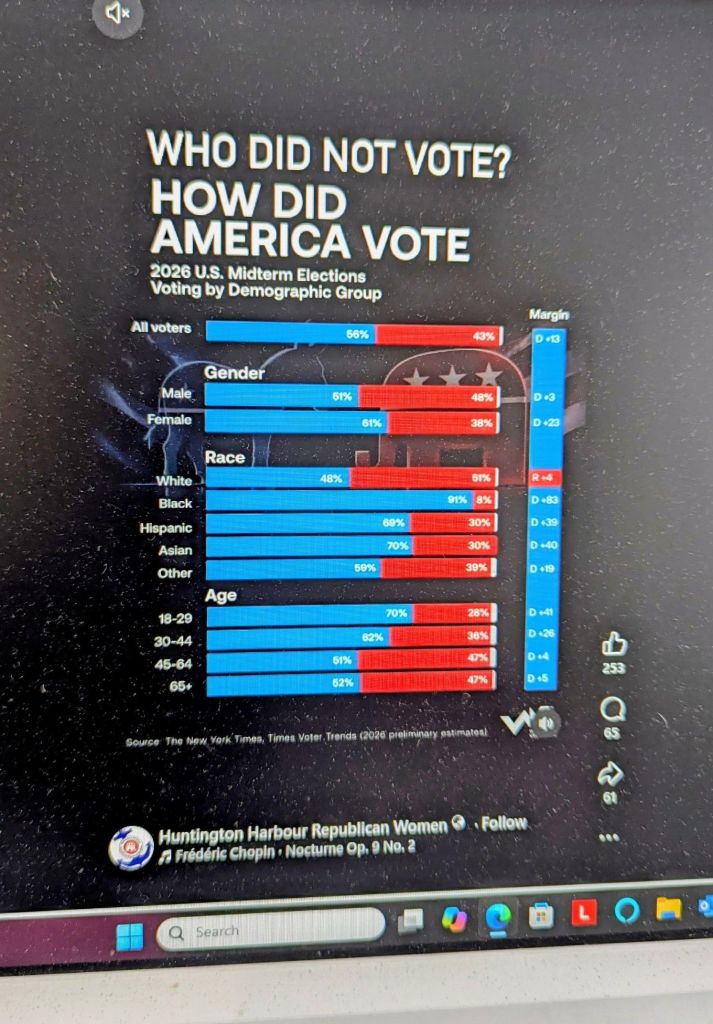
An interesting perspective from Robert Reich:
Democrats: Don’t Overpromise
Robert Reich <robertreich@substack.com> Inbox Subscribe here for more
This is the seed time for a new Democratic agenda. Plant those seeds.
Friends,
The final tallies are coming in, and the result is extraordinary. As of Sunday, Democrats have won the largest House majority in a national election for either party in three decades. Their Senate majority is the largest since 1992. They’ve even seized control of a majority of statehouses across the country.
All the more remarkable because they had to overcome gerrymandering by Republican-led state legislatures, ICE arrests, and Trump threats.
Hakeem Jeffries, who will be Speaker of the House, said on Sunday:
“The people of our great country delivered House Democrats a historic majority with a mandate to fight for an Affordable America. Together, we will work hard to deliver the dramatic change in direction the American people are demanding.”
I don’t want to rain on Jeffries’ parade, but I don’t think this is what Democrats ought to be saying now.
Voters who have elected Democrats may think Democrats will be able to deliver “dramatic change,” but I don’t see how Dems can deliver dramatic change with Trump still in the White House holding a veto pen — and surrounded by belligerent fanatics like Stephen Miller, JD Vance, Pete Hegseth, RFK Jr., and Todd Blanche. And when, behind them, the American oligarchy still has the reins of power.
Democrats have won by big margins, but not big enough to override Trump’s vetos or the oligarchs’ preferences.
I’m concerned about the presidential election of 2028 when — after not getting anything done for two years and being blamed by Trump, Miller, Vance, et al. for everything that goes wrong in America — Democrats have to convince voters that they’re still the party of change that voters opted for in the 2026 midterms.
I speak from experience. The last time one party prevailed to this degree in a national election was in 1992. I was there, and I accompanied Clinton to Washington. The economy was shite. Expectations were sky-high for a sudden recovery, along with fundamental reform of healthcare, education, and much else.
Then, when Clinton and the Democrats didn’t get done what they promised — because they promised too much and tried to move in too many directions, because Wall Street balked, and because it’s extremely difficult to create lots of good jobs — voters were furious, leading to the wipeout of the 1996 midterms.
So my advice to Democrats is not to say, “We’ll deliver dramatic changes” when you can’t. Sure, tell the American people what you want to do, but remind them that Trump is still in the White House and you don’t have enough votes to override his veto.
By all means try for dramatic change. Focus on passing a few big things — say, Medicare for All (worth trying for even if you have to call it “TrumpCare” to get the support of the narcissist-in-chief), a tax on billionaire wealth, and campaign finance reform.
Use oversight hearings on the corruption of the Trump regime to make a case for why billionaire wealth needs to be taxed and why we need campaign finance reform.
Use hearings by the budget and health committees to make the case for why we need a single-payer health system, Medicare for All.
Then, when Trump vetoes these big things, say you will enact them when a progressive Democrat is elected president in 2028.
In other words, use the next two years to lay the foundation for 2028.
Several Senate Democrats and a few House Democrats will be running for president during this time and can emphasize and elaborate upon these central ideas.
This is the seed time for a new progressive era. Plant those seeds, Democrats!
In defence of popular fiction writers’ support of feminism
Dorothy Chansky, who chaired Pathways to Print and Critical Receptions at the Inaugural International Women’s Writing Association Conference at Falmouth University in June, sent me the following article.

“The Best of Everything,” by Rona Jaffe Fiction, 1958
A publishing sensation years before writers like Lambert and Jacqueline Susann came along, “The Best of Everything” might be the Rosetta Stone of sex-and-the-single-girl fiction. Jaffe’s capacious portrait of several young women who come to New York City with stars in their eyes and girdles in their carry-ons became a proto-feminist hit in part because of its frankness about sexuality, friendship and female ambition.
The main players are Caroline, a cool Ivy League beauty still recovering from a broken engagement; the dewy Colorado transplant April; and Gregg, a sweet-tempered aspiring actress from Dallas. They land together at the fictional Fabian Publications, where jobs for women are generally confined to the typing pool and other secretarial-level work, though a few glamorous elders have forged more substantive careers as editors.
But Fabian — and its ranks of wolfish, hard-drinking male executives — mainly serves as a backdrop and catalyst for the pursuit of love and liberation. Virginities are lost, never to be found again, and uncountable cocktails consumed in dimly lit bars and at glittering parties. Hearts are broken and reassembled and babe-in-the-woods innocence yields, inevitably, to the flintier reserves of veterans who have fought timeless wars against dull blind dates and handsy managers.
“Everything” unfolds with the neat story beats and romantic intrigues of a classic melodrama, but Jaffe has some sharp arrows in her bow; one minor character’s rotund husband resembles “a shaved teddy bear.” At nearly 450 pages, this is the kind of big, satisfying novel you should read in a bubble bath or a hammock or maybe on a bench in Grand Central while career girls — though hardly anyone calls them that anymore, of course — of a more recent vintage go by.
The article reflects some of my views in the talk I gave in the session chaired by Dorothy Chansky.

I presented a paper about women’s popular literature. Rona Jaffe featured as one of the women writers in my paper, The Adventurous Four: Popular Fiction and Women Behaving Badly. Susan Faludi’s Afterword to Marilyn French’s The Women’s Room, suggested that women’s fiction had not kept pace with the surge in non-fiction that gave women prominent and strong roles.
However, Faludi ignored a raft of writers and the characters they created. What I believe contributed to that view was the lack of academic acceptance of populist women writers whose characters were pushing the boundaries. In my view, women were being depicted as prepared to adventure into different realms from their depiction as relying on cleaning and Valium. Or, if they did, they certainly did not end there…
I began the paper with Rona Jaffe’s books written in the late1970s/early 1980s but depicting life for girls growing up in the 1950s, Rona Jaffe wrote Class Reunion and After the Reunion. They feature four women who studied at Radcliffe during the 1950s, did as they were taught to do – that is, put men first in their lives, returned to their class reunion, and left determined upon change. They set the scene for my thinking about the way in which women’s popular fiction, often derided and rarely considered feminist, gave us strong women characters characters. Hobbled by a myriad of demands from society, family and themselves, nevertheless, they rebelled… They are middle class women, but old money or new, these women did not want for much – just equality with men who also had those financial advantages… See the complete paper in Further Commentary and Articles arising from Books* and continued longer articles as noted in the blog.