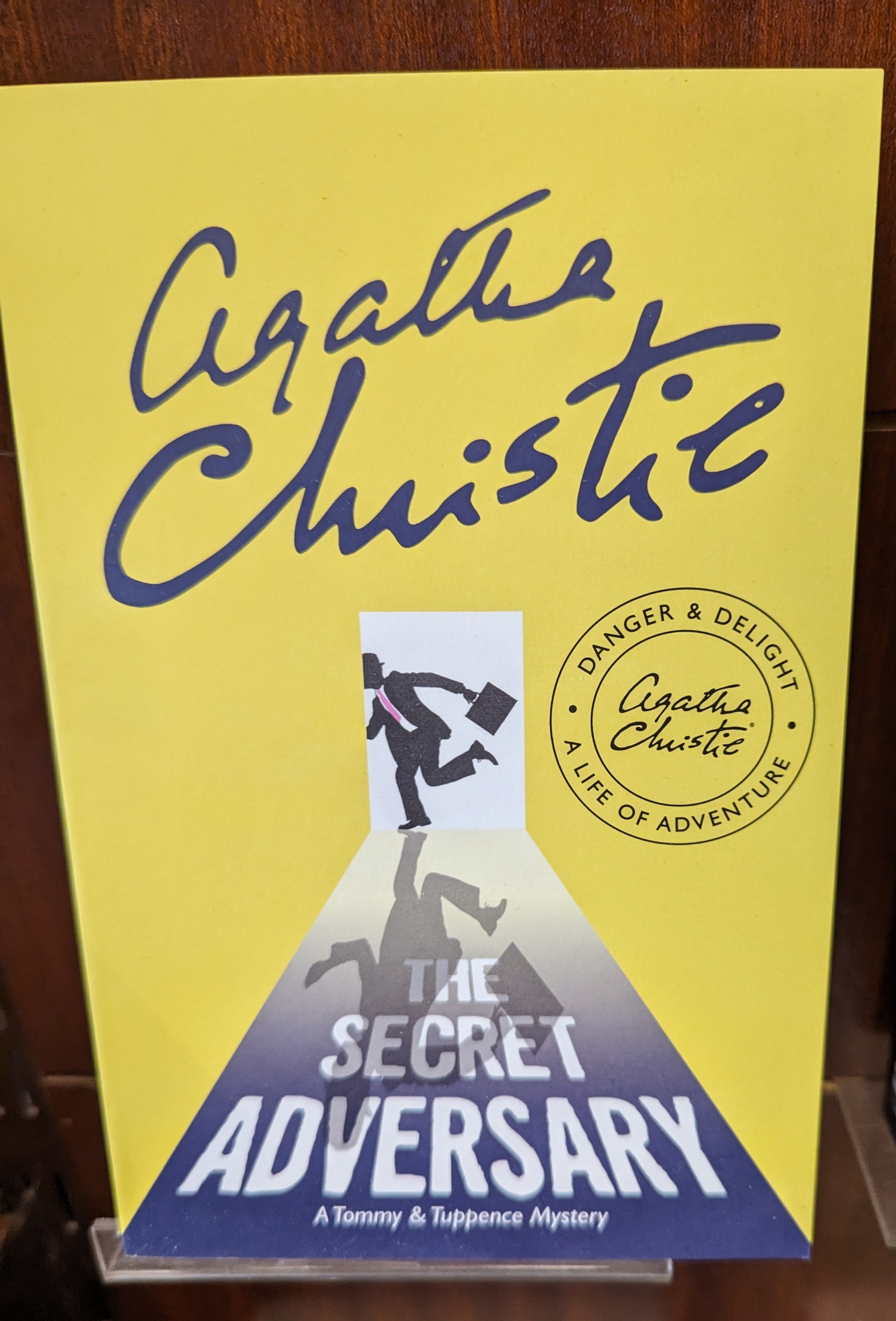
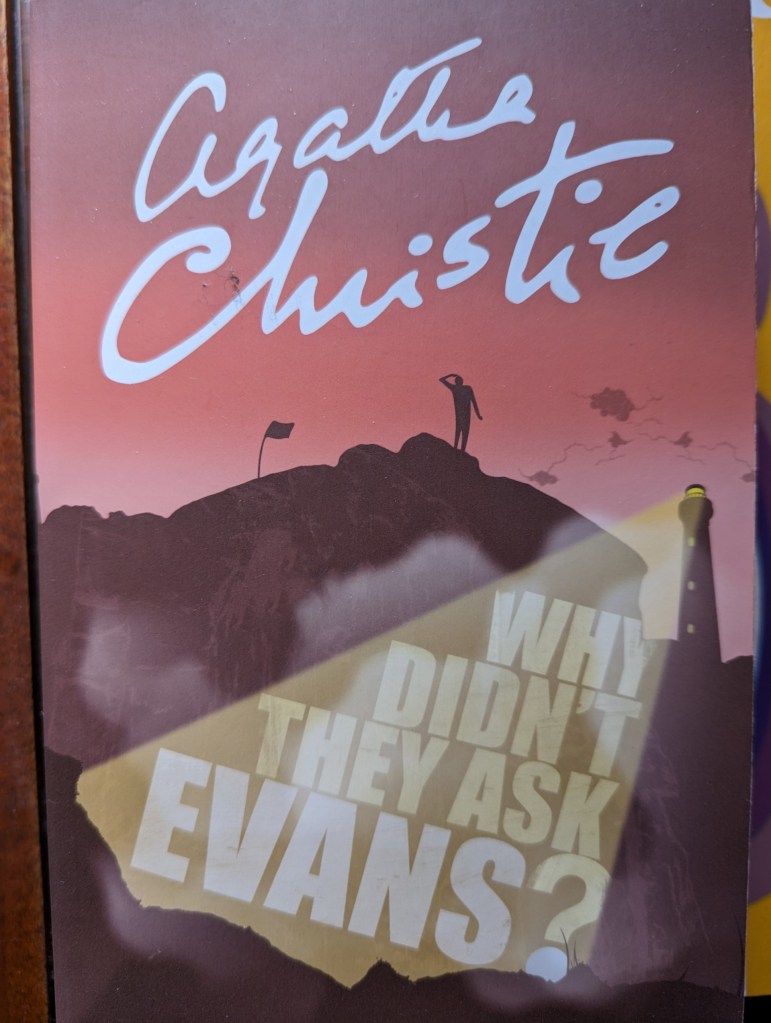
Week beginning 15 November 2023

Kim Hong Nguyen, Mean Girl Feminism How White Feminists Gaslight, Gatekeep, and Girlboss, University of Illionois Press, Jan 2024.

Thank you, NetGalley, for this uncorrected proof for review.  

I was drawn to this book because I have always been aware of the shortcomings of feminism in action because of its strong relationship to white, middle-class women, historically and even now. As Kim Hong Nguyen has pointed out, women who are part of our feminist history have been racist and classist: we recognise that. However, these shortcomings are not everything about them. Hong Nguyen is also critical of modern feminist theorists and theory, seeking to redress the lack of interest in intersectional issues (most importantly race) that she believes has been endemic in feminist behaviour and theory. Wedded as I am to the need to thoughtfully  analyse  the faults of the past and present with a view to finding answers to where we have failed I read with interest.

The arguments that feminism has not done enough, and has often been destructive rather than supportive, particularly as it applies to race are made in a detailed Introduction, five chapters and conclusion  –  Feminist Civility and the Right to Be Mean; Bitch Feminism and Blackfaced Girlboss in Feminist Performative/Performativity Politics; Mean Girl Feminism : Gatekeeping as Illegible Rage; Power Couple Feminism: Gaslighting and Re-Empowering Hetronormative Aggression; Global Mother Feminism: Gatekeeping Biopower and Sovereignty; and  Abolishing Mean Girl Feminism.  As can be seen from these titles Hong Nguyen’s approach is academic, employs language that may not be universally understood and covers negative aspects of political practice, that are familiar, such as gaslighting and gatekeeping. See Books: Reviews for the complete review.

After the Covid update: Mean girls at the London Theatre; 10 Important Lessons learned from Mean Girls; Whitechapel Gallery exhibition; Bob McMullan – The real possibility of a return for Trump; eating near Liverpool Station.

Covid update for Canberra
Australia no longer tracks COVID cases, but news outlets say: Covid-19 cases are spiking across Australia – ABC; Covid-19 cases are spiking by 23.6 per cent across Australia-Olivia Day For Daily Mail Australia.

Canberra new cases on November 3 numbered 482, with 15 hospitalised. Chief Minister Andrew Barr has no plans to reintroduce Covid restrictions. ACT Health has found no evidence that the rise in cases is linked to more severe disease.

Mean Girls at the London Theatre

Mean Girls, the play, is to be shown at the London Theatre. Unfortunately, I shall not be there to see it. However, I shall endeavour to follow up the reviews when it opens. Perhaps some critics will adopt Hong Nguyen’s concerns, and this will continue this valuable discussion of one approach to the depiction of feminism.
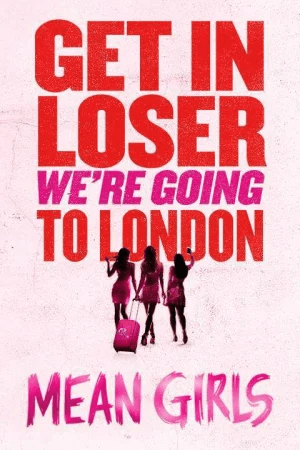
That’s so fetch! See the UK premiere of Mean Girls at the Savoy Theatre. Book Mean Girls the musical on London Theatre today.

Watch as Cady Heron steps into the chaotic jungle of North Shore High, ruled by the legendary Plastics. As she navigates the treacherous terrain of teen queen bees and burn books, Cady gets tangled in a web of secrets, gossip, and some seriously “fetch” fashion.

With the help of her new friends Janis and Damian, Cady embarks on a mission to infiltrate the Plastics and bring them down from within. But as she goes undercover, Cady starts losing herself to the dark side of popularity. Will Cady take down the Plastics, or will she become one of them? Find out in this toe-tapping, pink-wearing, laugh-out-loud show that proves, in high school, survival of the fittest isn’t just for the animal kingdom!

The 2004 hit movie, written by Tina Fey, starred Lindsay Lohan, Rachel McAdams, and Amanda Seyfried and was adapted into a musical debuting on Broadway in 2018. Mean Girls is now set to be adapted back into film as the musical, starring Reneé Rapp as Regina George, reprising her role from Broadway.

The stage adaptation, led by an award-winning team, includes director Casey Nicholaw (Aladdin, The Book of Mormon), composer Jeff Richmond (30 Rock, Unbreakable Kimmy Schmidt), lyricist Nell Benjamin (Legally Blonde), and book writer Tina Fey (30 Rock, Bossypants).

An early response to the concept of mean girls as a feminist issue is made by Hazel Cills. She promoted a rather different aspect and understanding of Mean Girls as a feminist concept in 2014.

10 Important Feminist Lessons We Learned From ‘Mean Girls’

BY HAZEL CILLS FEB. 11, 2014

It’s been 10 years since the classic teen movie Mean Girls hit the silver screen and a generation of young women started quoting the movie’s dialogue line-by-line. The film has become iconic for its golden comedic screenplay, written by the talented Tina Fey, and its realistic take on high school drama. From backstabbing popular girls to the art-nerd revenge, Mean Girls‘ characters taught female movie-watchers more serious life lessons about high school, Girl World and womanhood than might immediately meet the eye.

1. Obsessing over your “flaws” is unhealthy.

“I used to think there was just fat and skinny,” Cady Heron says, “But apparently there’s lots of things that can be wrong on your body.” In a world where we girls are constantly scrutinized for our bodies, it makes sense that we can get down on ourselves for the shape they’re in. But, there’s a between difference between airing out one’s insecurities and obsessing over them. Cady’s confusion over the Plastics bemoaning their physical state in the mirror shined a light on how ridiculous and overblown self-scrutiny can become, especially when its about how “weird” your hairline is.

2. Never pretend to be less intelligent than a boy just to get his attention.

Cady’s con artist math-class act with Aaron Samuels taught girls that they definitely should not pretend to be less intelligent than boys just to get attention. Boys out number girls four to one in scientific fields, and the last thing the world needs are girls who feel afraid to be in these fields because of that. If men are intimidated by women who dominate where they’re used to ruling, that’s their problem.

3. Girls need to stop calling each other “whores.”

One of the most brilliant quotes from Mean Girls, and the most applicable to real Girl World, is Ms. Norbury’s insistence the girls quit the slut and whore talk. Girls have it hard enough in a world where men shame them for their sexuality, so why add to the girl hate? When girls make their peers feel bad for having sex, boys will take note and think its okay to do the same. 

4. Everyone feels like a victim sometimes.

No matter what you’ve been through, somebody else has been through it too. Whether it’s bullying in the high school halls or a more permanent life-altering event, you share more experiences with your fellow women than you may realize. 

5. Don’t let your friends control your life.

Friendship is based on trust and compromise, but sometimes controlling people masquerade as “friends” when they really want to boss people around for their own personal gain. One look at Mean Girls tells us that power structures can fall at the drop of a prom queen’s crown. So no matter how powerful someone may seem, especially in high school, if that person is taking advantage of you or making you feel weird for simply being yourself, kick her to the curb. 

6. Feeling beautiful isn’t something to be ashamed of.

It’s OK if your answer to the question, “So, you think you’re really pretty?” is a “Yes!” Society does not like women who are confident in their looks. These days, women get called narcissists and ridiculed for just posting selfies. But there’s absolutely nothing wrong with loving the way you look. 

7. Do you, and stop comparing yourself to other people.

Whether you wish you had someone’s job, clothes, life, whatever, don’t let those desires distract you and make you jealous. Telling yourself a person is “less than” you in any regard doesn’t make you a bigger or better person. When you stop comparing yourself to other people, you can start focusing on you and your goals.

8. A friend who doesn’t respect you isn’t a friend at all.

True friends don’t verbally abuse each other, call one another stupid or bitches. It can be hard to make friends, but don’t get stuck with “friends” who don’t talk to you like a true friend should. 

9. Your sex life is your business.

Whether it’s your disturbingly incompetent health class gym teacher, or your over-bearing helicopter “cool” mom, or your nosey friends, your sex life is your business. And if you want to share your sex life with the world, that’s cool, and if you don’t, that’s cool too! But don’t let people invade your personal space and make you feel uncomfortable for your sex life or your body. 

10. Girl World should be a place of support, not fighting.

Girls are taught to hate each other. They’re taught to be competitive with one another and to constantly compare their bodies, their clothes and their intelligence. Typical girl compliments include, “she isn’t like the other girls” or “she’s one of the boys” because young women often don’t want to align themselves with how the media may portrays them: catty, self-centered, spoiled. But if Mean Girls taught us girls one thing, it’s that we need each other’s support more than anything. (Oh, and maybe a cake filled with rainbows and smiles wouldn’t hurt either!)

Whitechapel Gallery

Explore thread as a method and metaphor for connection, collaboration and conversation in this exhibition by ten students on the MA degree in Curating Art and Public Programmes jointly run by Whitechapel Gallery and London South Bank University.

In the aftermath of the global pandemic and successive collective anxieties, there is an evident need for new forms of communication and embodiment. Digital fatigue and radical changes to pace of life have led many artists to seek more tactile, slow and mindful ways of working. Focusing on thread as material and method, this exhibition reflects the collective desire for comfort, embodiment and connection both in process and in content.

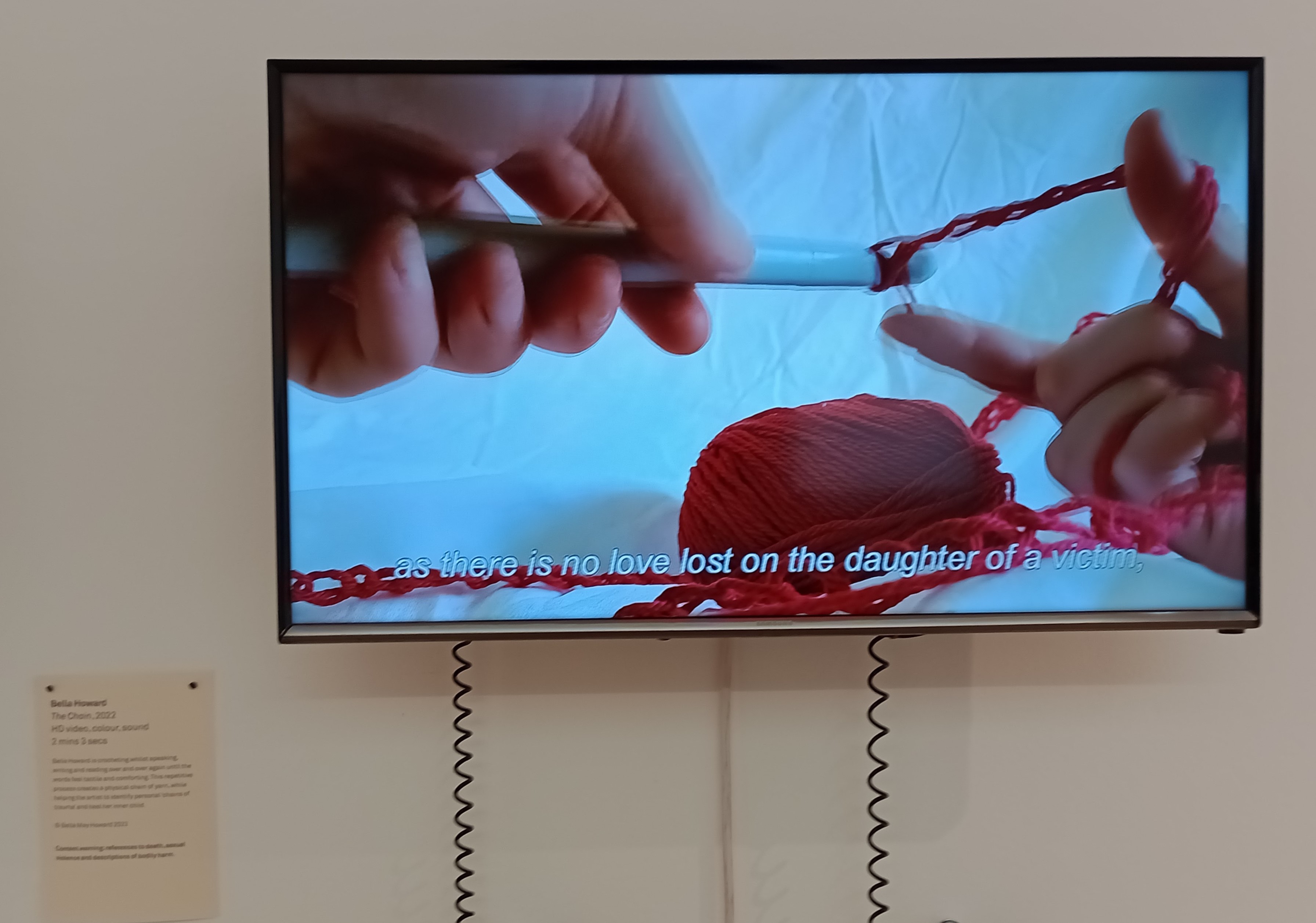
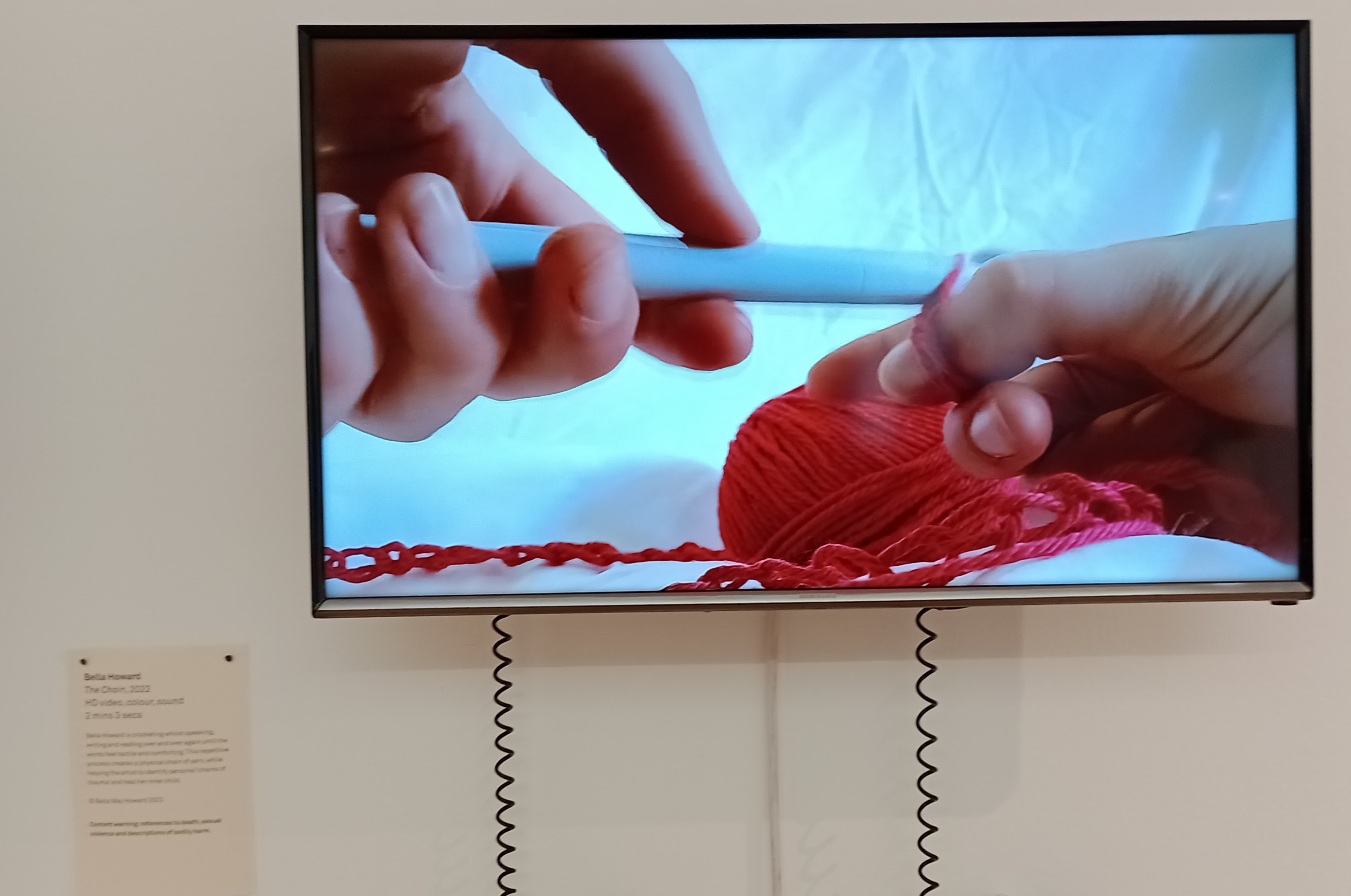
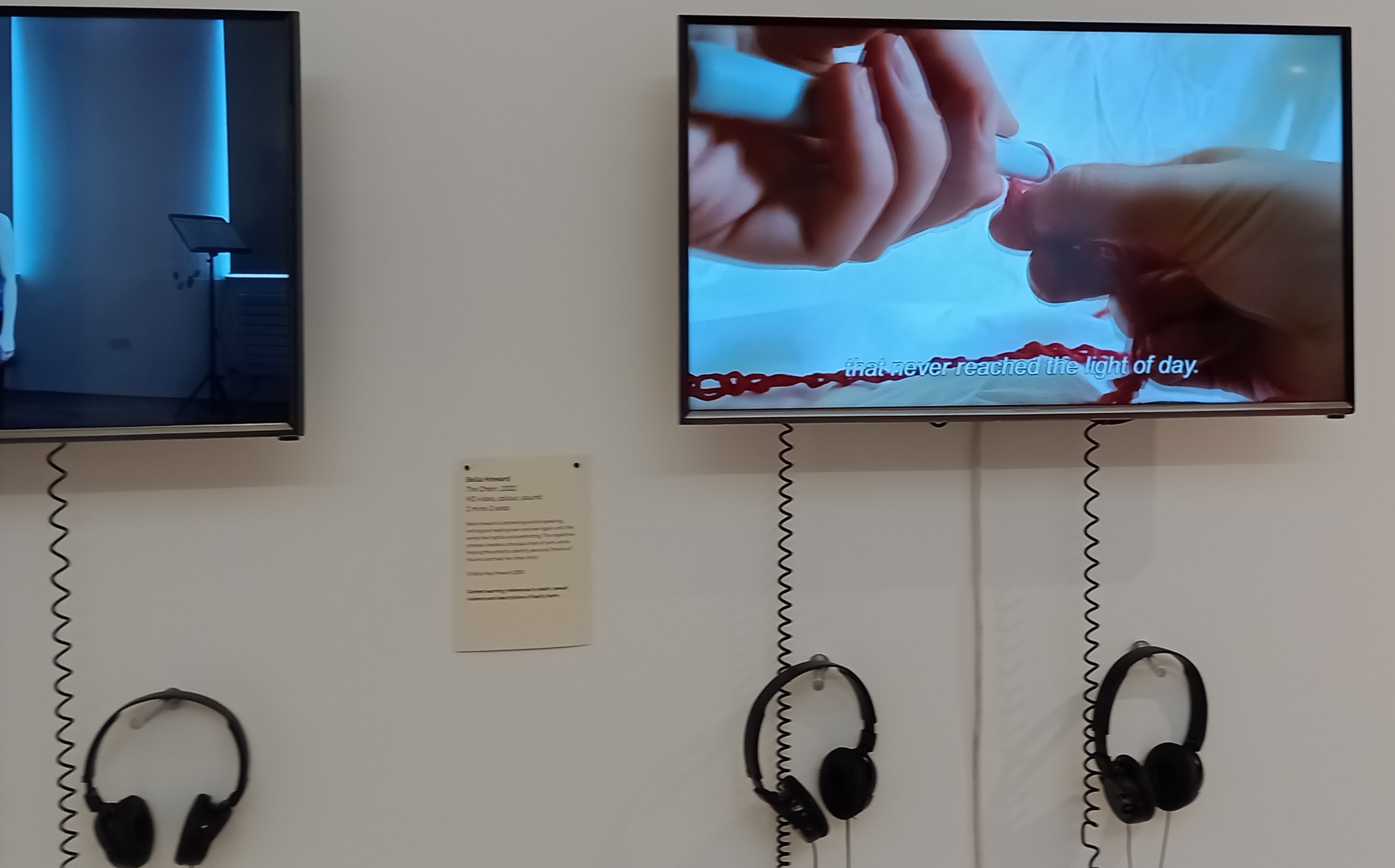
Selected works by emerging artists weave together the personal and collective, exploring themes around social fabric, repair and togetherness. Raisa Kabir’s House Made of Tin (a socially distanced weaving performance) (2020) is created, by, for, and from BIPOC, disabled, and queer participants. The produced weaving is a sculptural visualisation of interrelationships and an allegory for support networks. Fikayo Adebajo’s String Figures (2022) explores issues of reparative justice, and what repair can look like at the institutional level. Bella Howard’s The Chain (2022) is a tender conversation with the artist’s inner child, a private moment of healing. Additional artworks on display include Julia Dèng Hànzú’s Con-Current: Tuning Intervals (2022), Katarzyna Perlak’s Bated Breaths (2020 – ongoing), Tilda Scarlett’s The Weaving Room (2022) and Lu Williams’ curated zine library.

It All Starts With a Thread centres collaboration and process. In addition to the listed works on display are the products of several workshops held over the summer. Breakfast, Lunch and Dinner Collective held a session of collaborative knitting for wellbeing; starting with a single shape, the group knitted outwards, creating a work titled Safety Blanket. Gut Feeling ran a writer’s workshop, producing a quilt as an alternative take on a ‘publication.’

Visitors to the exhibition are invited to rest and relax in an open and accessible space, spend time reading zines from an artist-curated library, finger knitting with companions, explore the artworks through audio interpretation and pick up an interactive activity sheet to delve deeper into the subject matter of the show.

The Chain by Bella Howard 2022
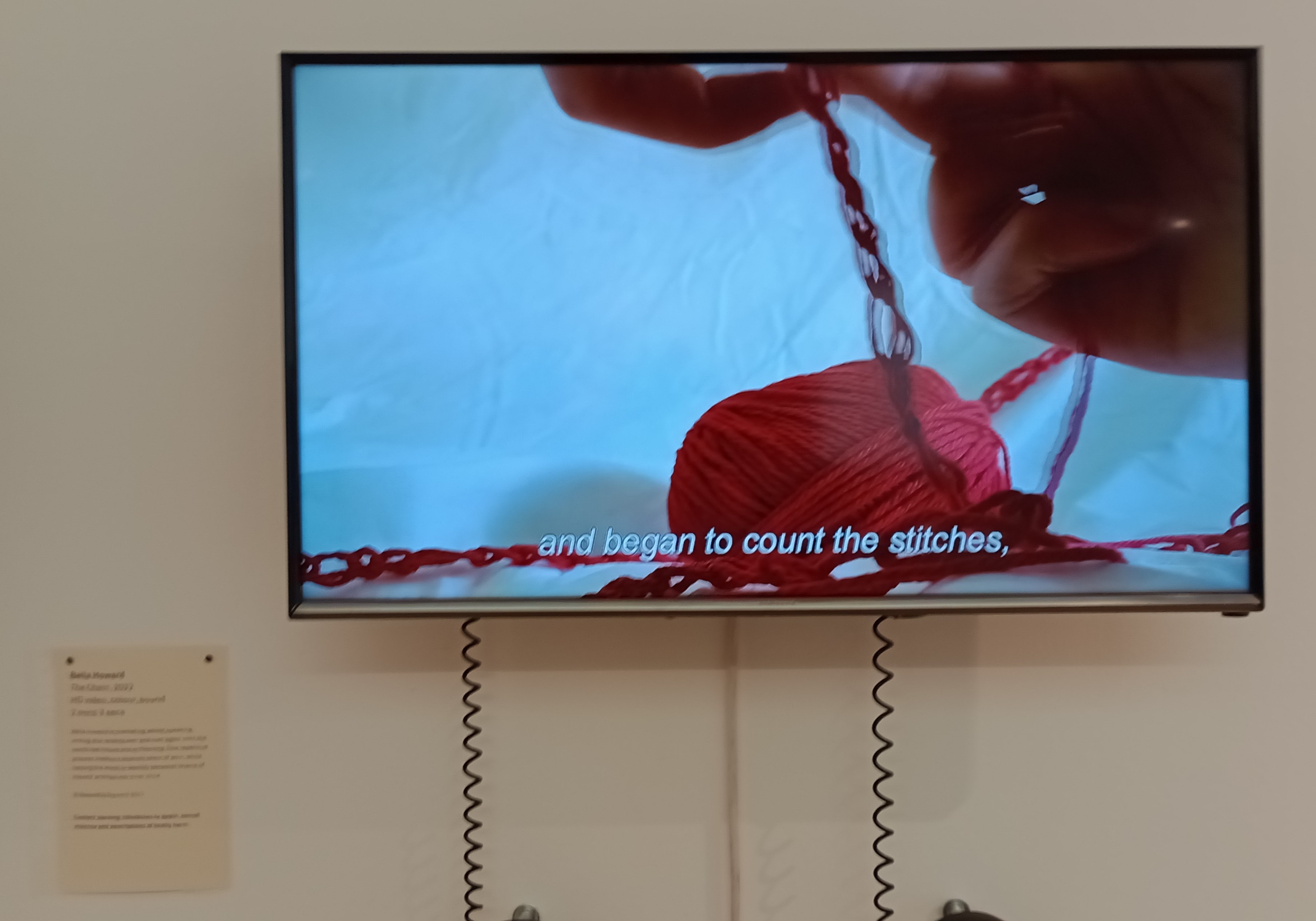
The following phrases appear on some of the graphics, while others are without any words:

…that girl that wrote those words …who is designed herself to be luckless in the hands of a man…I think she understood that while therapy is good and all that, … and began to count the stitches …that never reached the light of day…as there is no love lost on the daughter of a victim…the kindling of a life struck with the flame of departure…

Bob McMullan

The real possibility of a return for Trump


In twelve months time Americans will go to the polls to elect the next President.


It is almost impossible to imagine a second election victory for such a manifestly unsuitable candidate for President of the United States as Donald Trump.


I still think, on the balance of probabilities that it won’t happen. But it is a possibility which it is becoming impossible to ignore. Too much of the polling gives Trump a lead over Biden or shows him trailing very narrowly despite
Trump’s legal and policy challenges for the prospect of him winning to be considered impossible.


Trump is the overwhelming leader in the Republican primaries. He leads by at least 30 points nationally and in the early voting states of Iowa, New Hampshire and South Carolina. At the moment it is hard to see how he will not become the Republican nominee. Optimists keep expecting the bubble to burst. But so far it shows no sign of doing so.


In my assessment the person seen as the main challenger, Ron de Santis, has no chance of beating Trump. He cannot decide if he is a younger, more polished Trump or a challenger. He is almost certain to fall between those two stools.
Should a number of the candidates with no chance of winning, of whom there are many, withdraw such a consolidation of the opposition to Trump within the Republican Party would give Nikki Haley a chance of beating Trump. But there are too many ifs, buts and maybes in the way of that possibility for it to be other than a long-shot. Therefore, at the moment, it is reasonable to assume that Trump will be the Republican nominee.

The question then becomes: “How will he go against Biden?”, because there is no doubt that Biden will be the Democratic Party candidate unless some health issue intervenes. Current Real Clear Politics polling averages have Trump ahead of Biden by 0.5%. This is so close as to be a virtual tie. However, the vagaries of the Electoral College system of electing the President mean
that a Democrat candidate needs a substantial overall national lead to win. After all, Trump lost the national vote against Hillary Clinton in 2016 but won the Electoral College easily.

Polling in the various states suggest a similarly tight picture. The data is not as comprehensive at a state level, but what there is suggests that Biden has reasonable prospects of all the states he won in 2020 except Arizona and Georgia. Such a result would leave the electoral College at Biden 276 and
Trump 262.


Balancing this is the fact that across various jurisdictions, history tells us that incumbents tend to improve their position during an election campaign.
For instance, Barack Obama led by only 0.2% in May 2012 but went on to win in November by 3.9%. Although there is no guarantee that this will occur again it is the most likely trend over the next twelve months.

It seems unlikely that the flurry of court cases against Donald Trump over the next twelve months will incline any uncommitted voter to swing towards Trump.

Eating near Liverpool Street Station

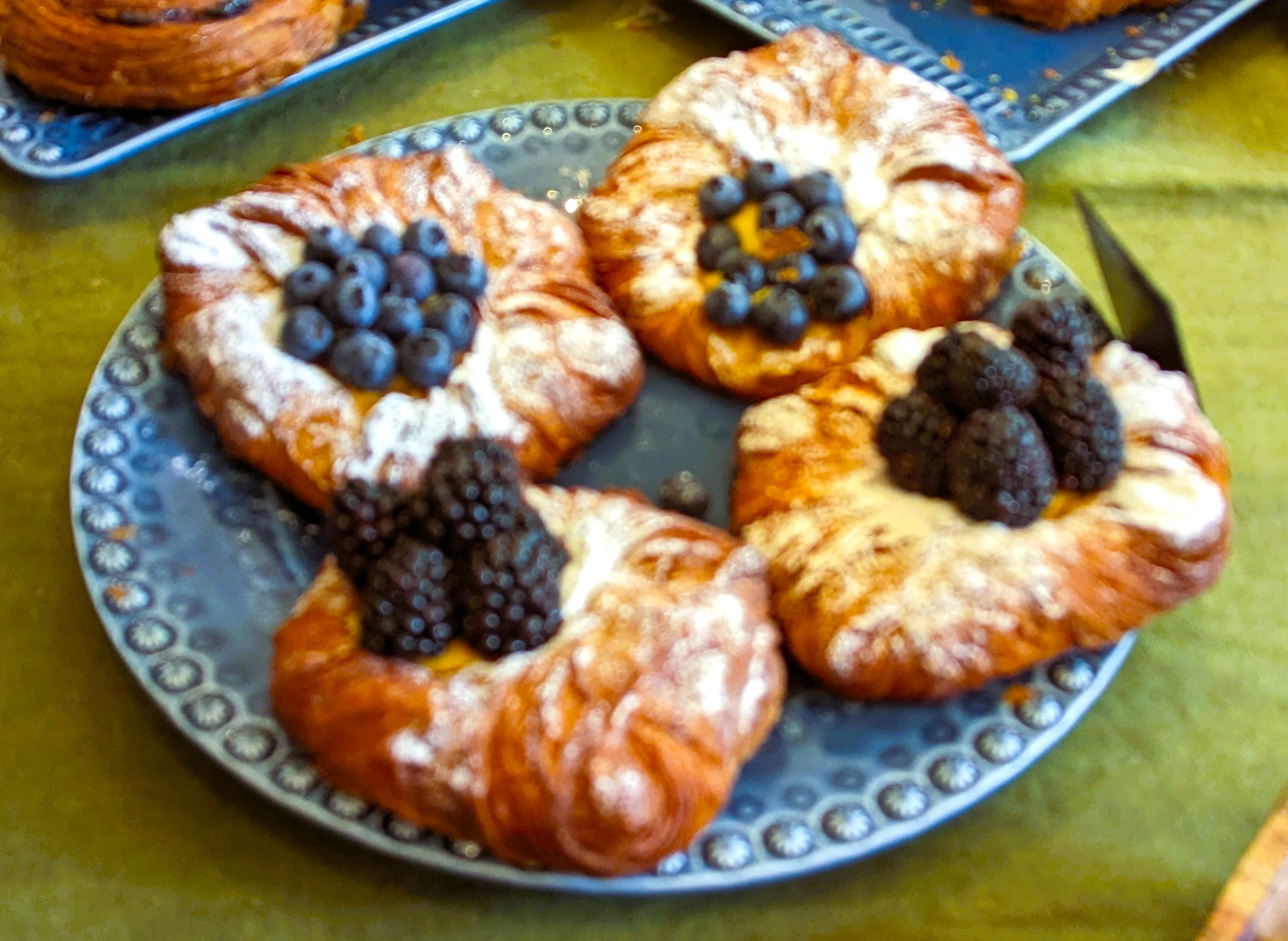
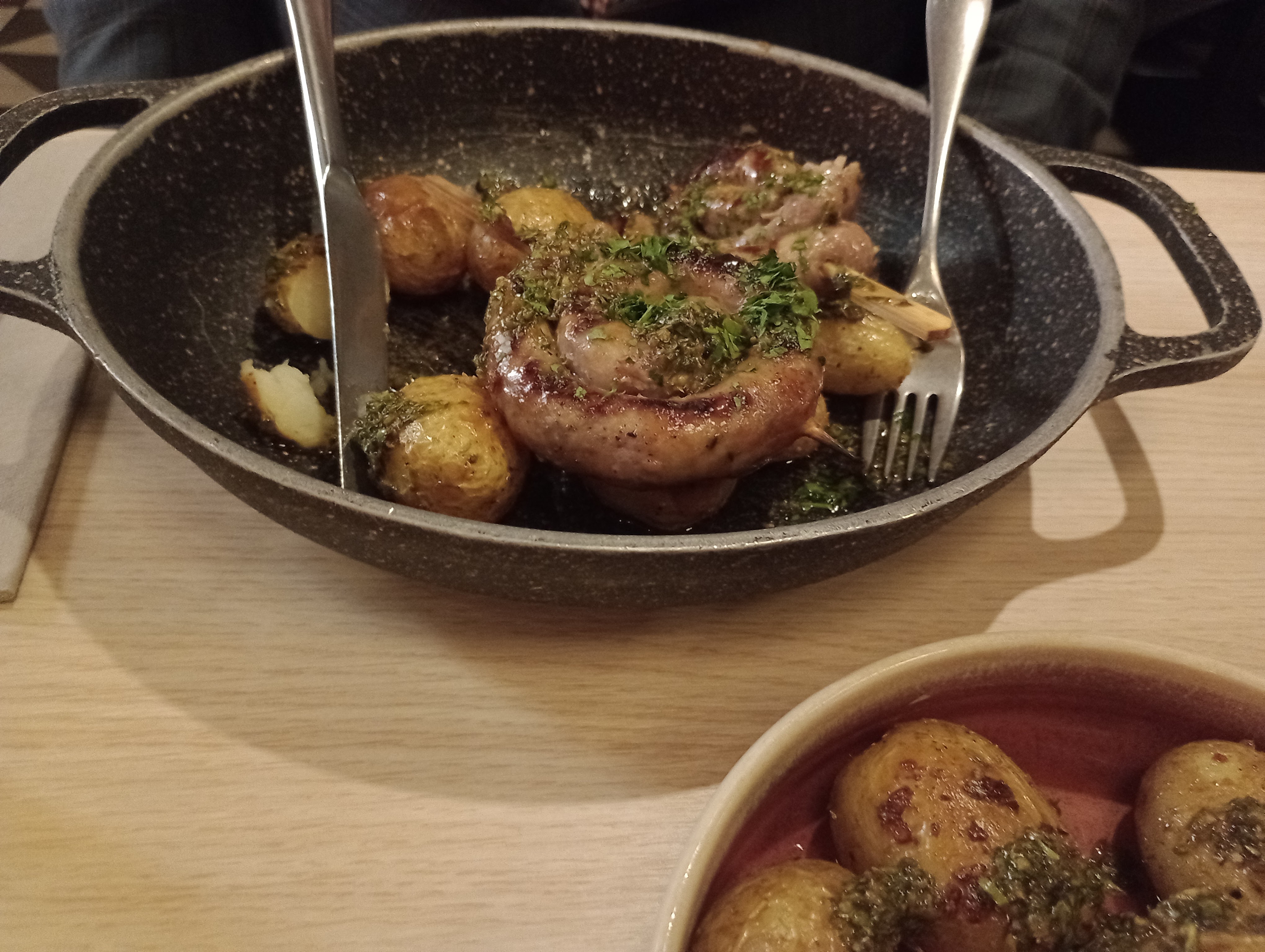
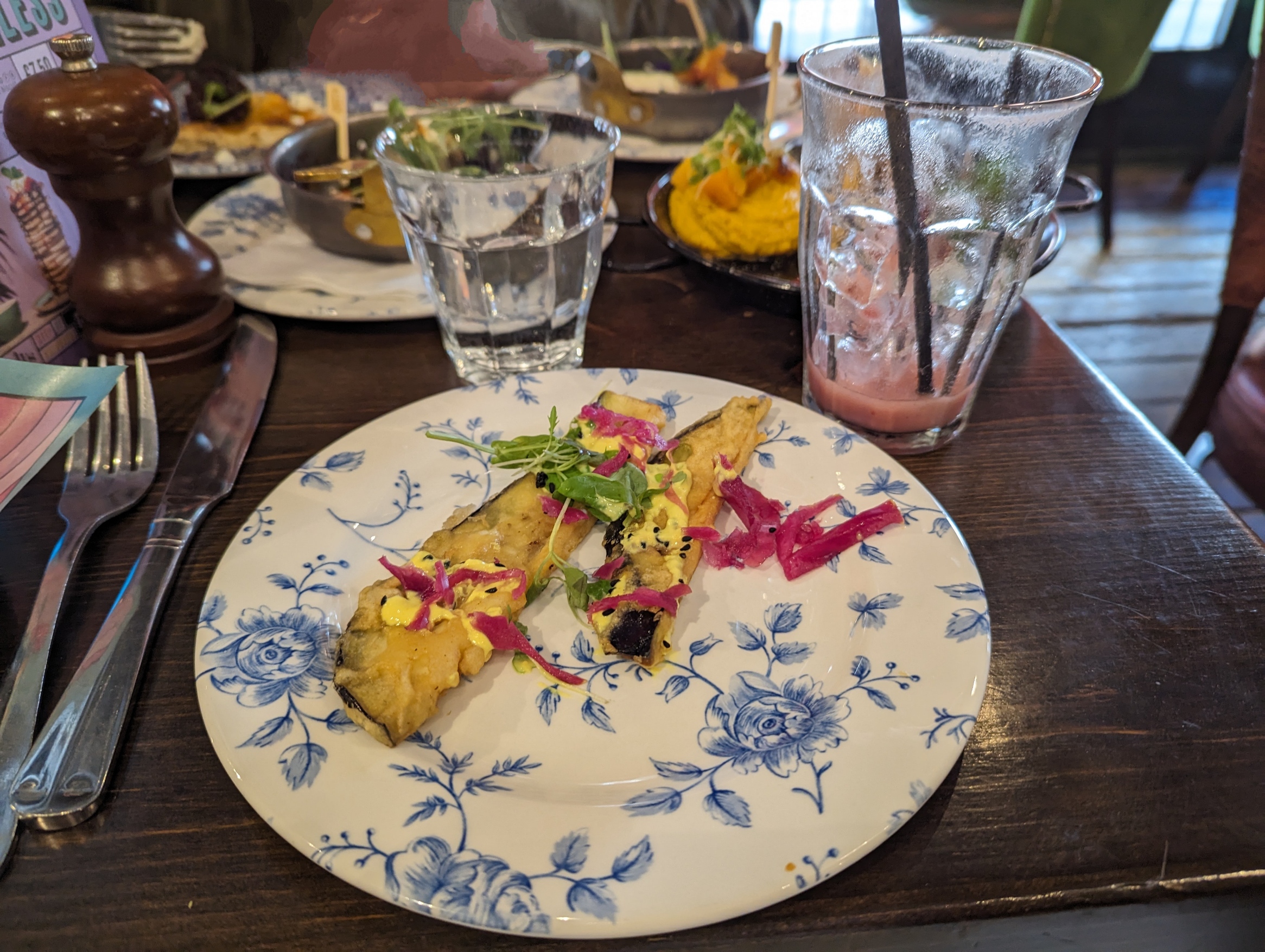
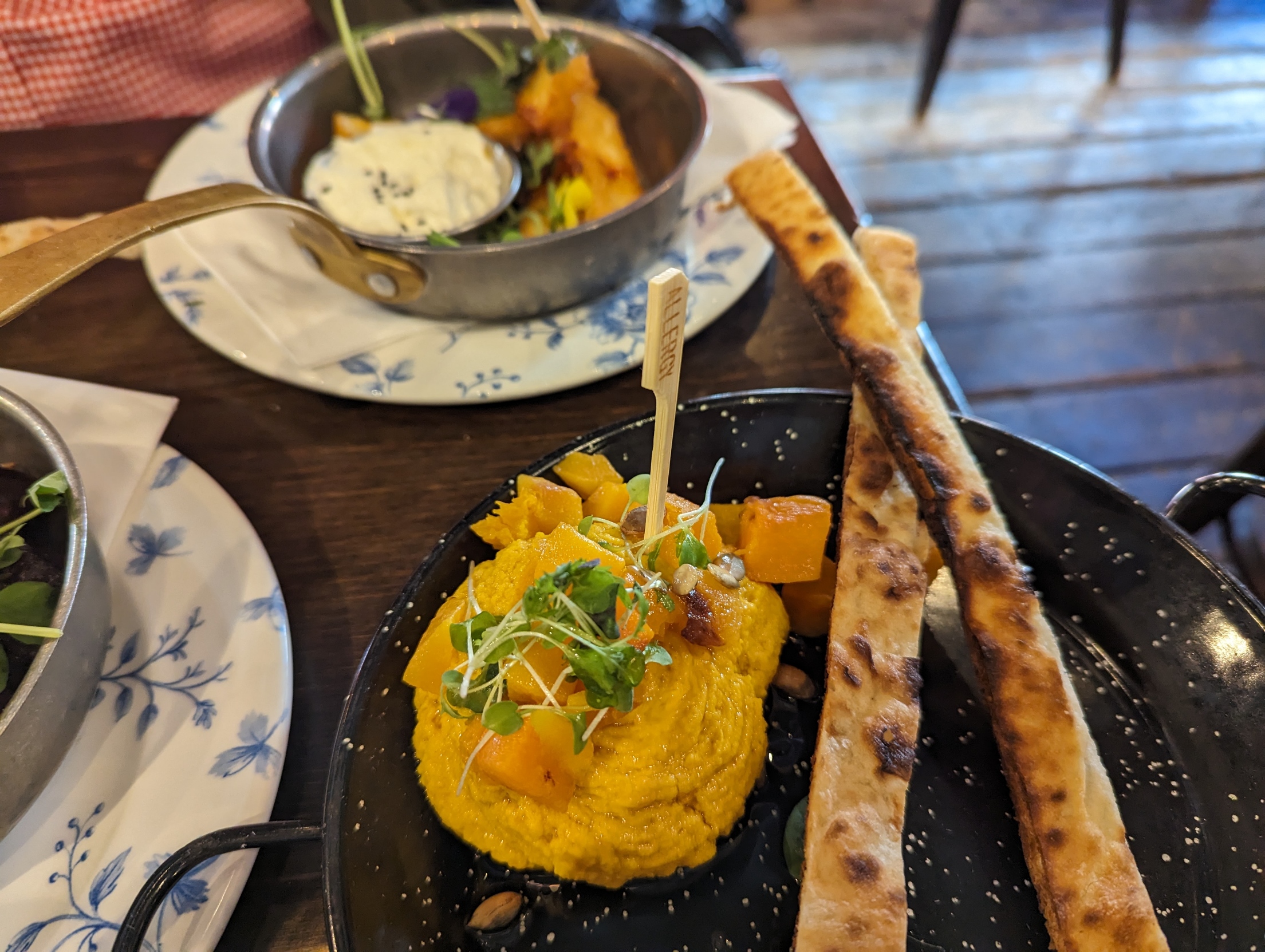
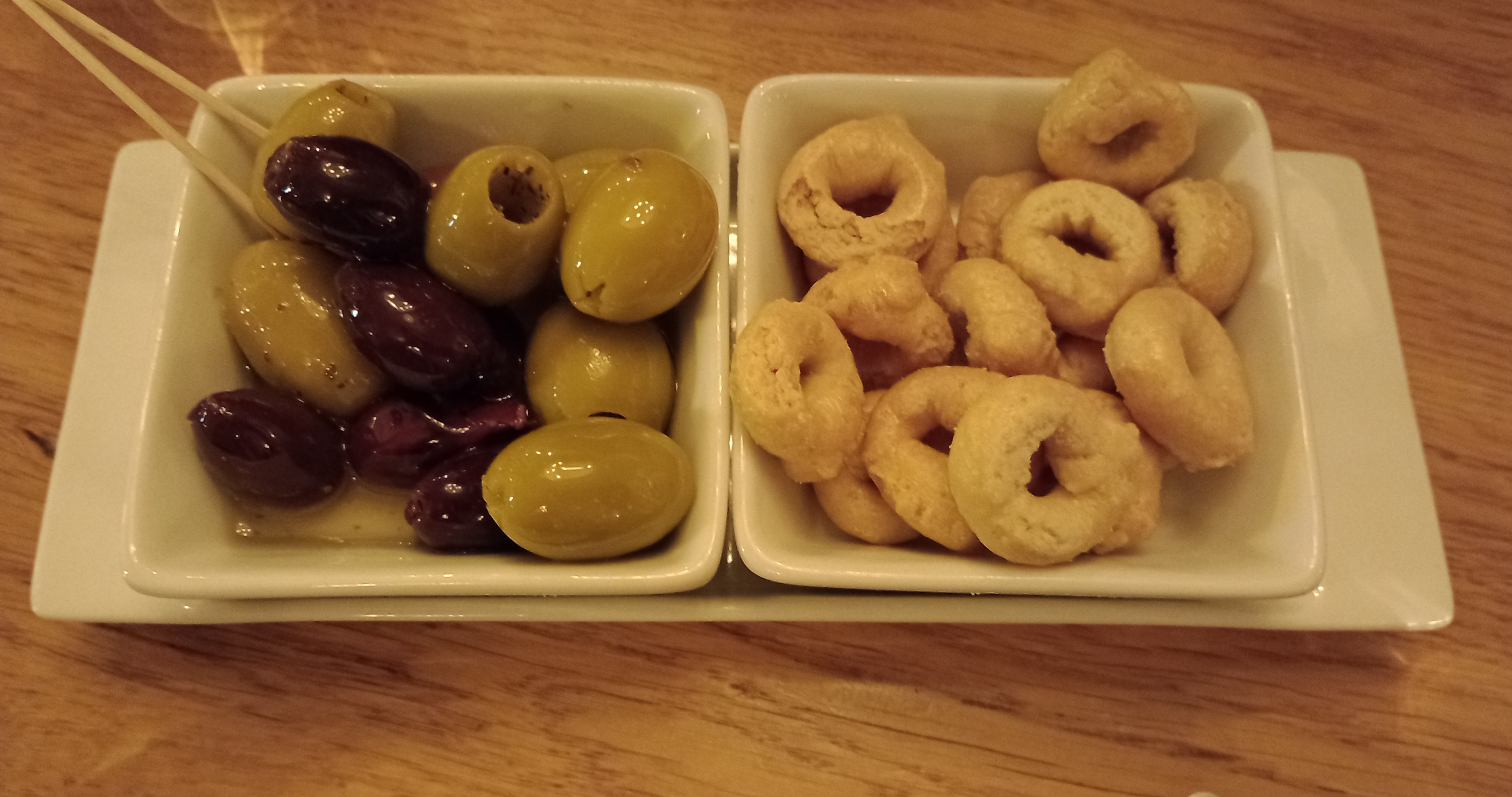
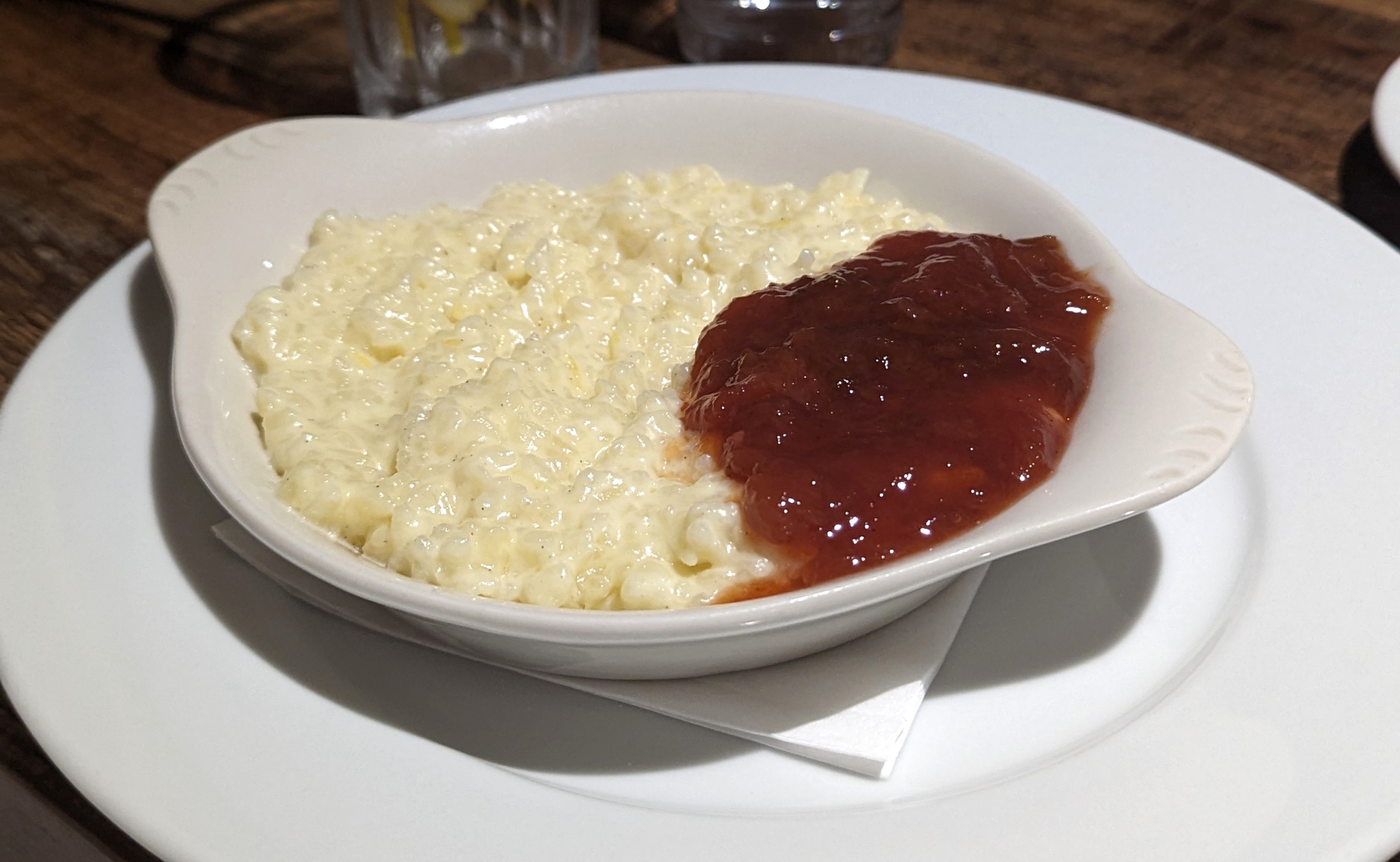
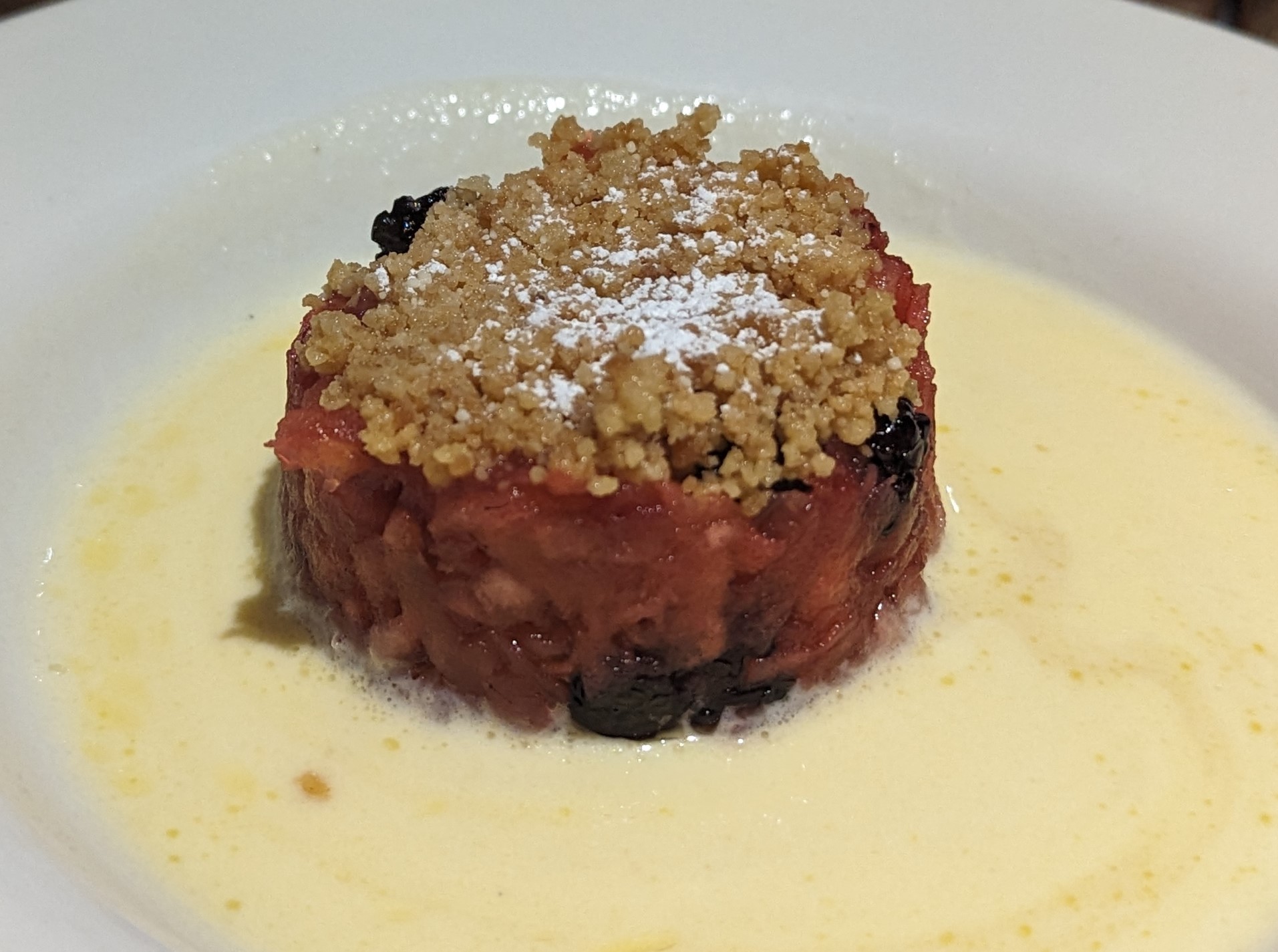
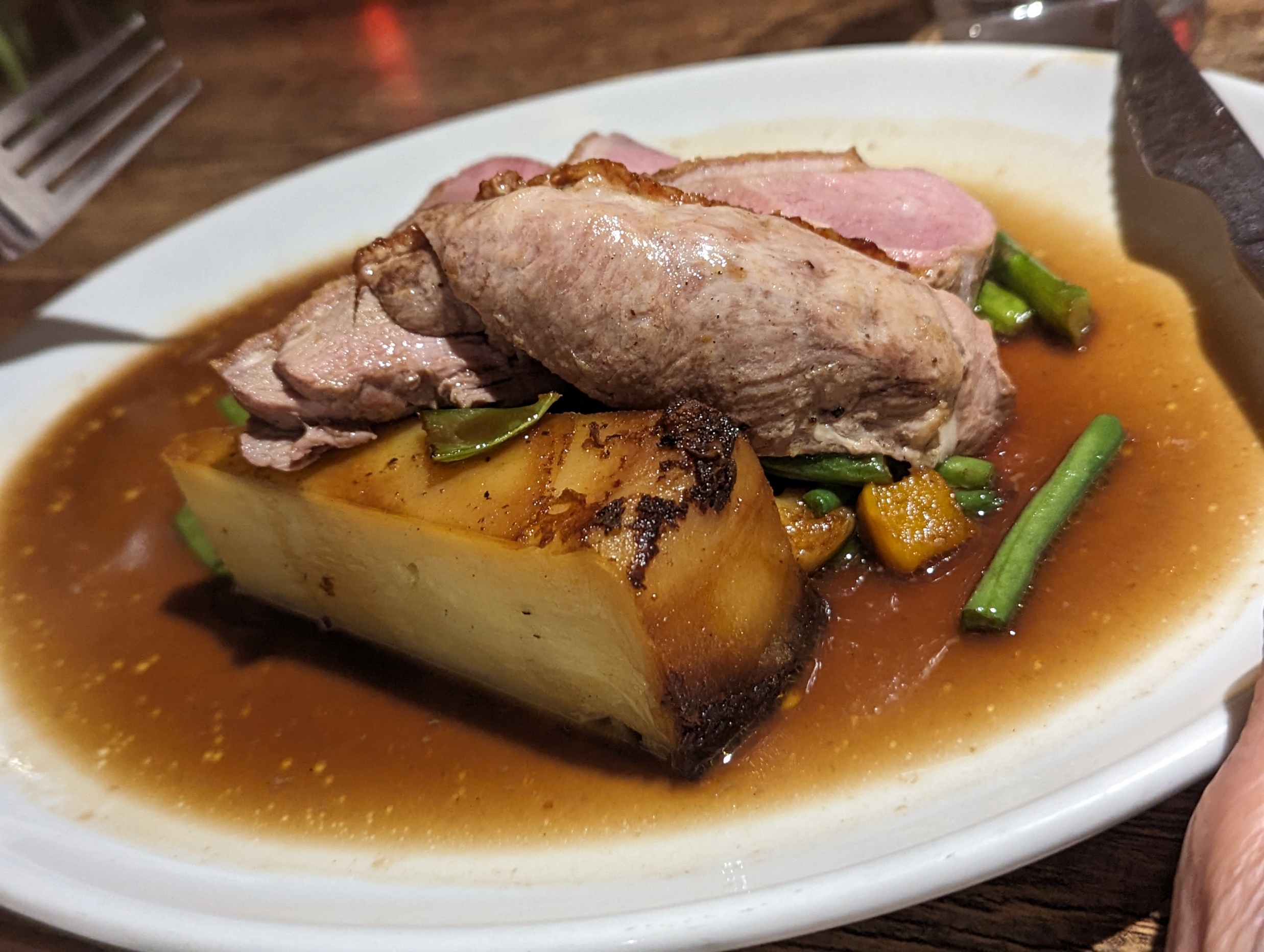
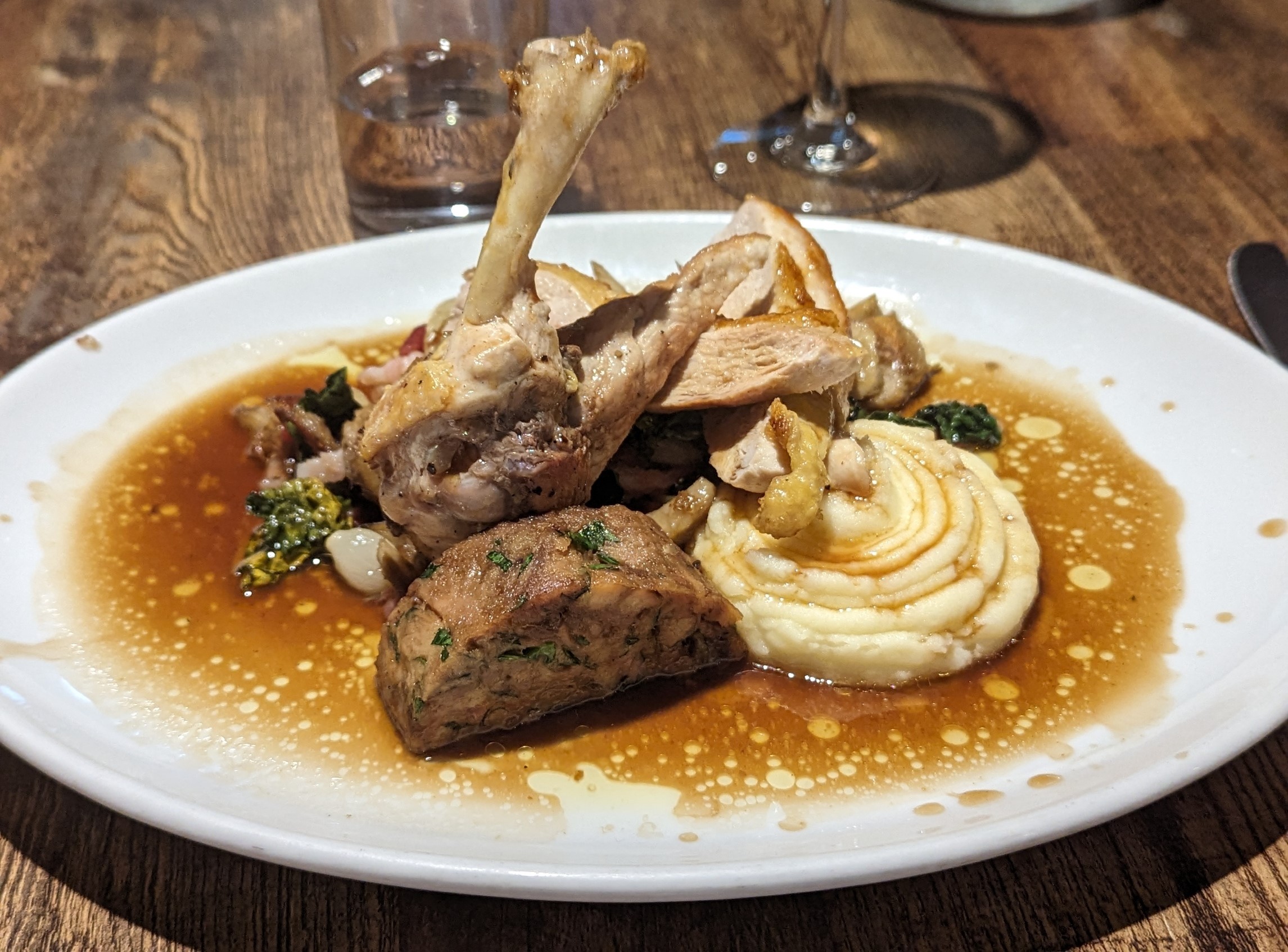
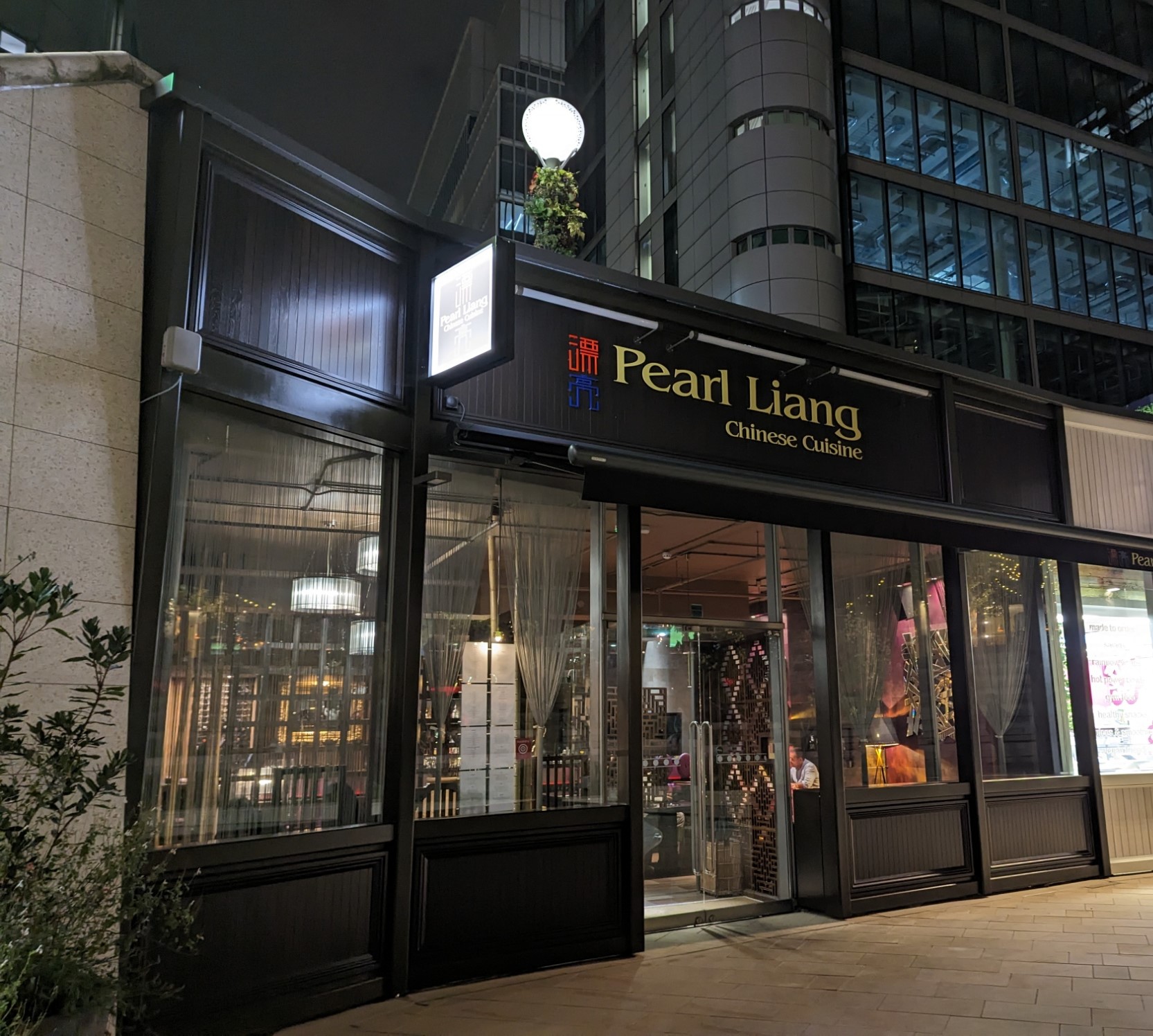
There is an elegant restaurant, Andass, close to the station, and we have been there in the past. This time we were after something cheap and cheerful, and we found two options, both of which we tried while we were staying in Whitechapel – a short tube or bus ride away.

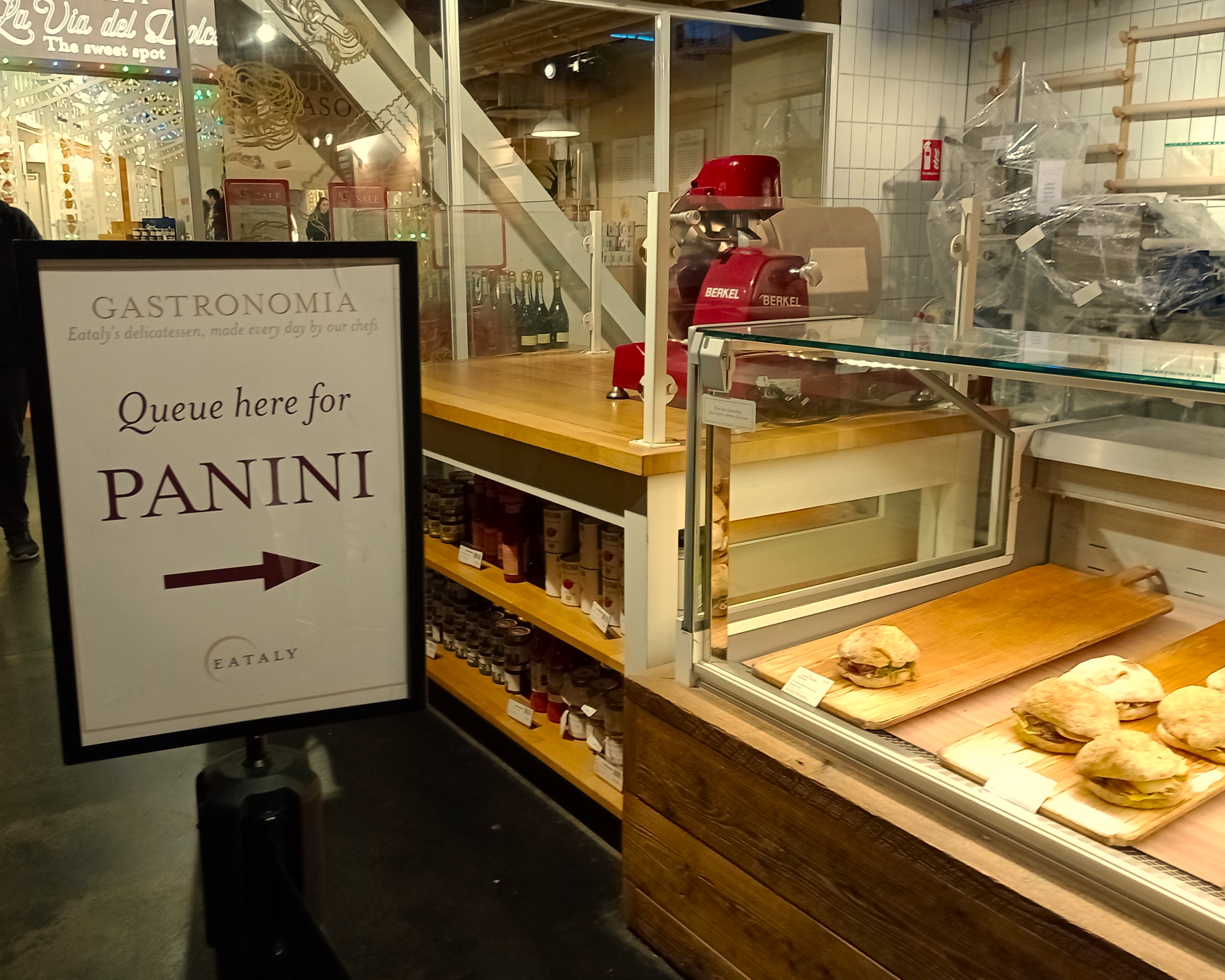
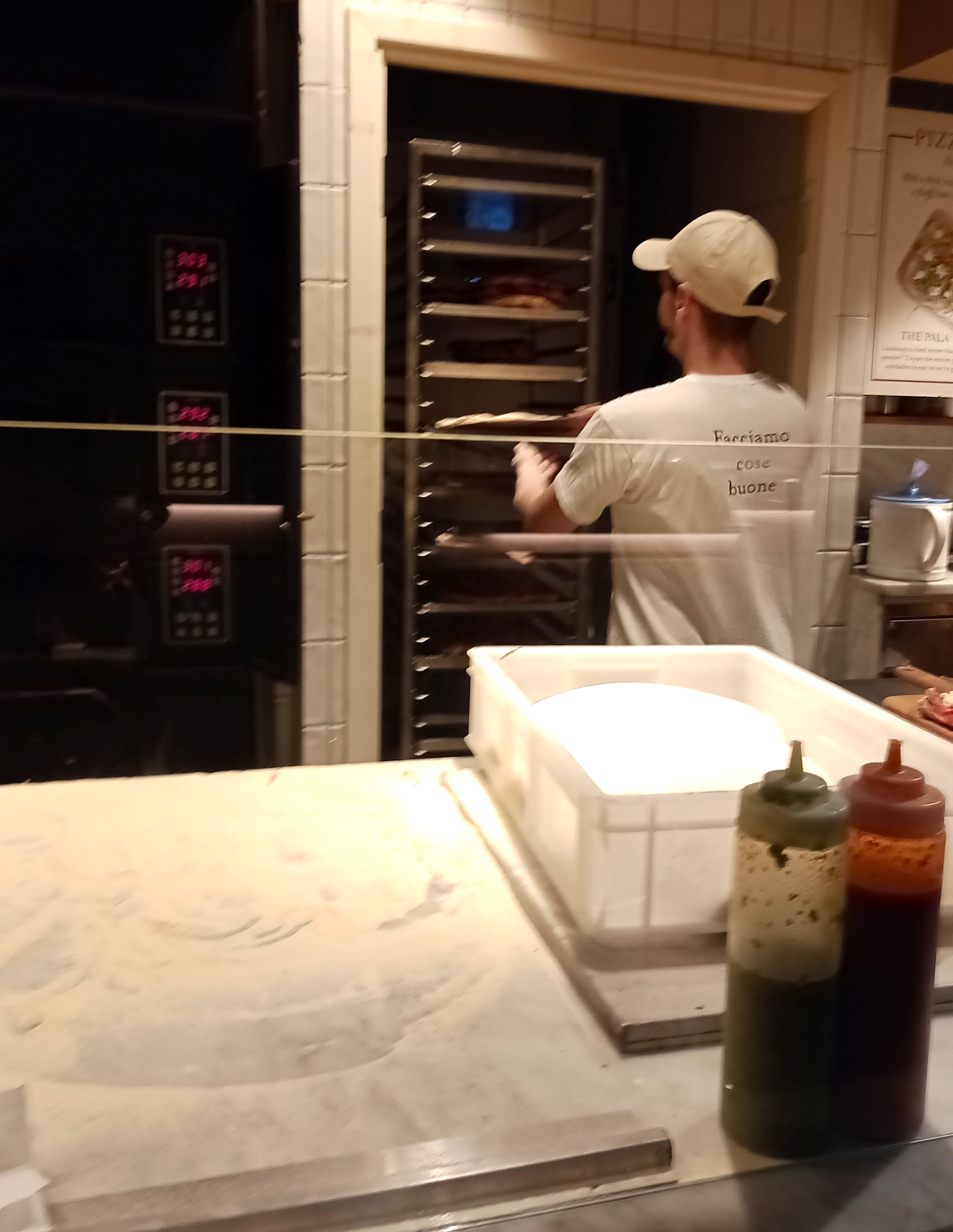
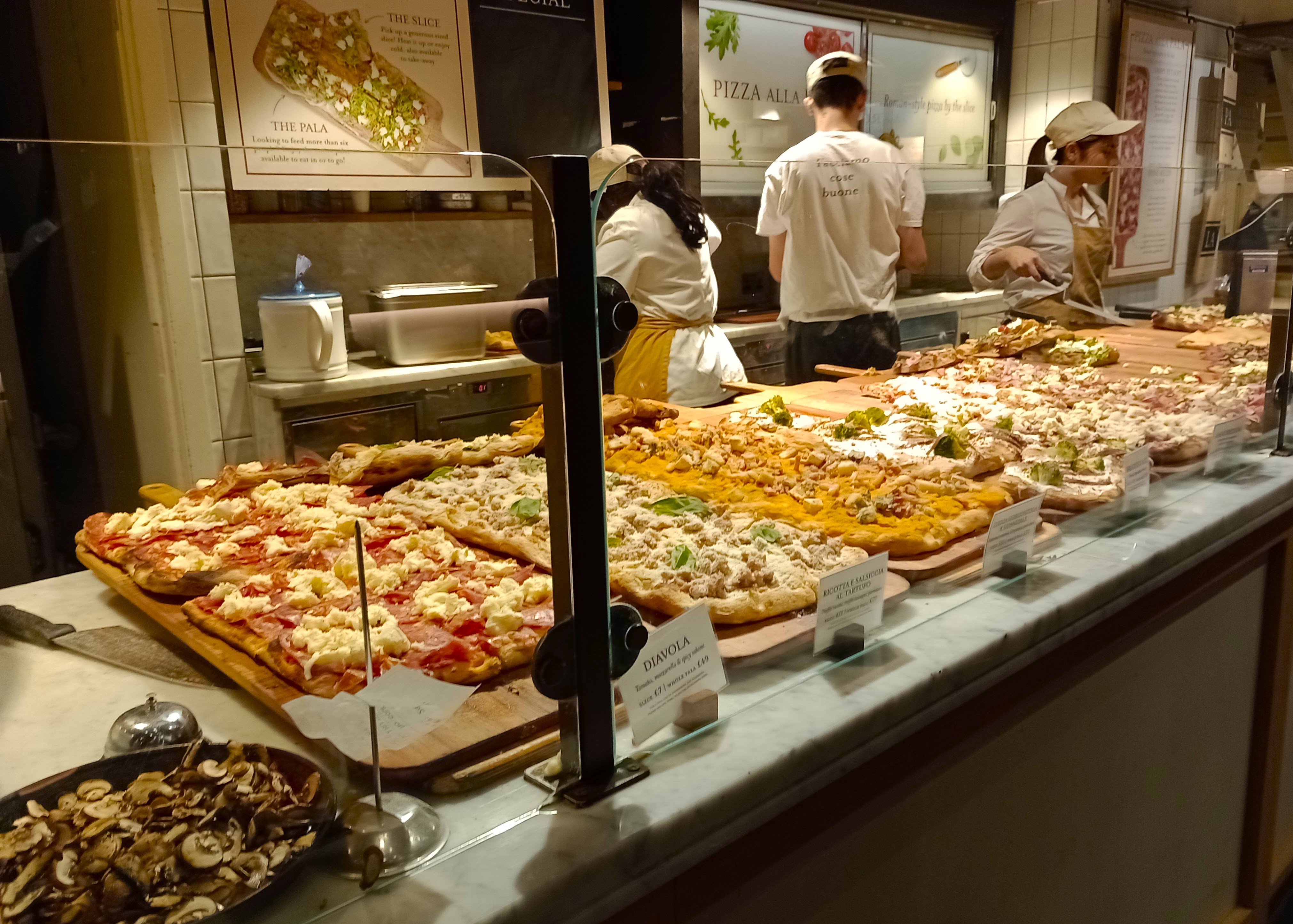
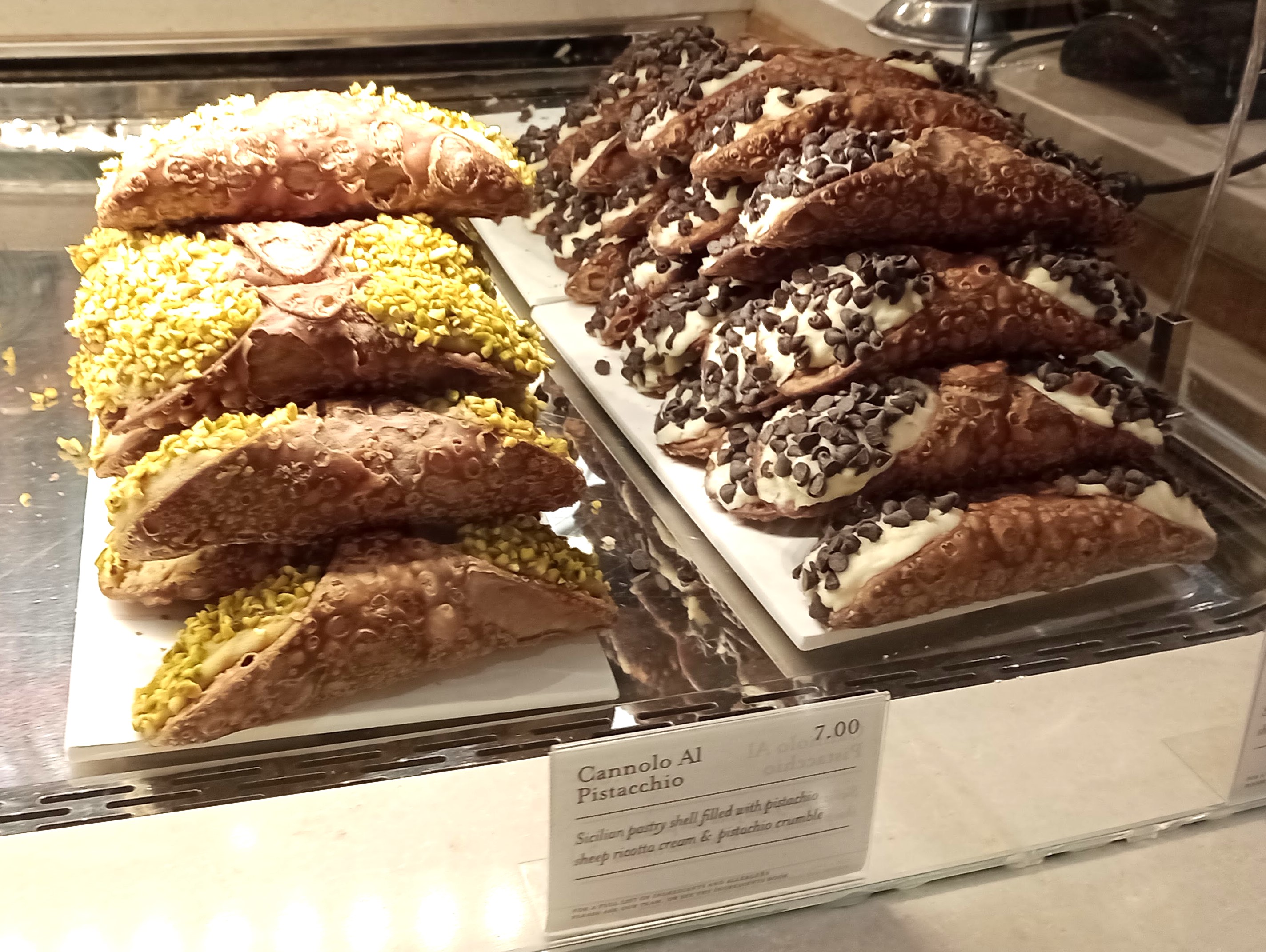
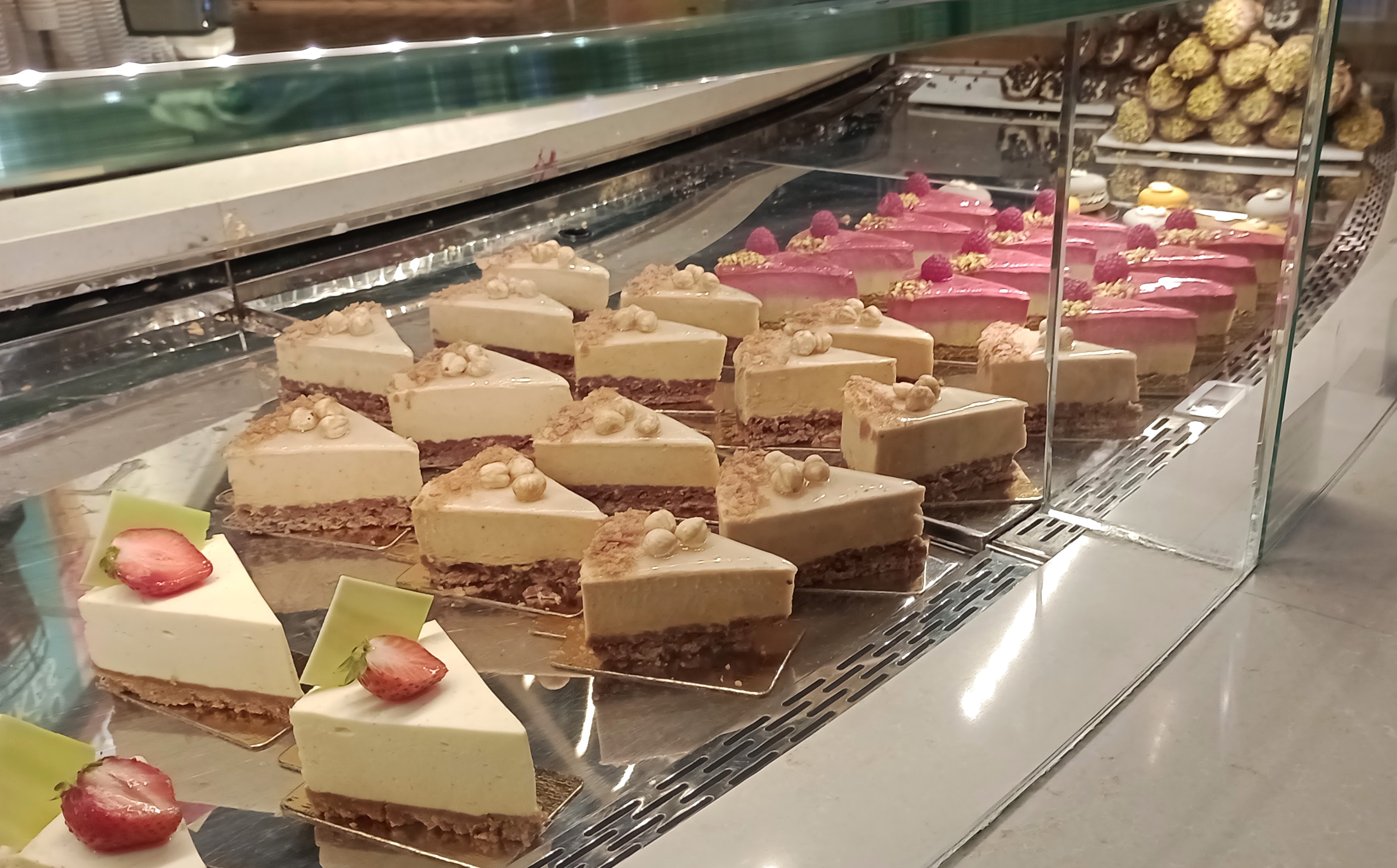
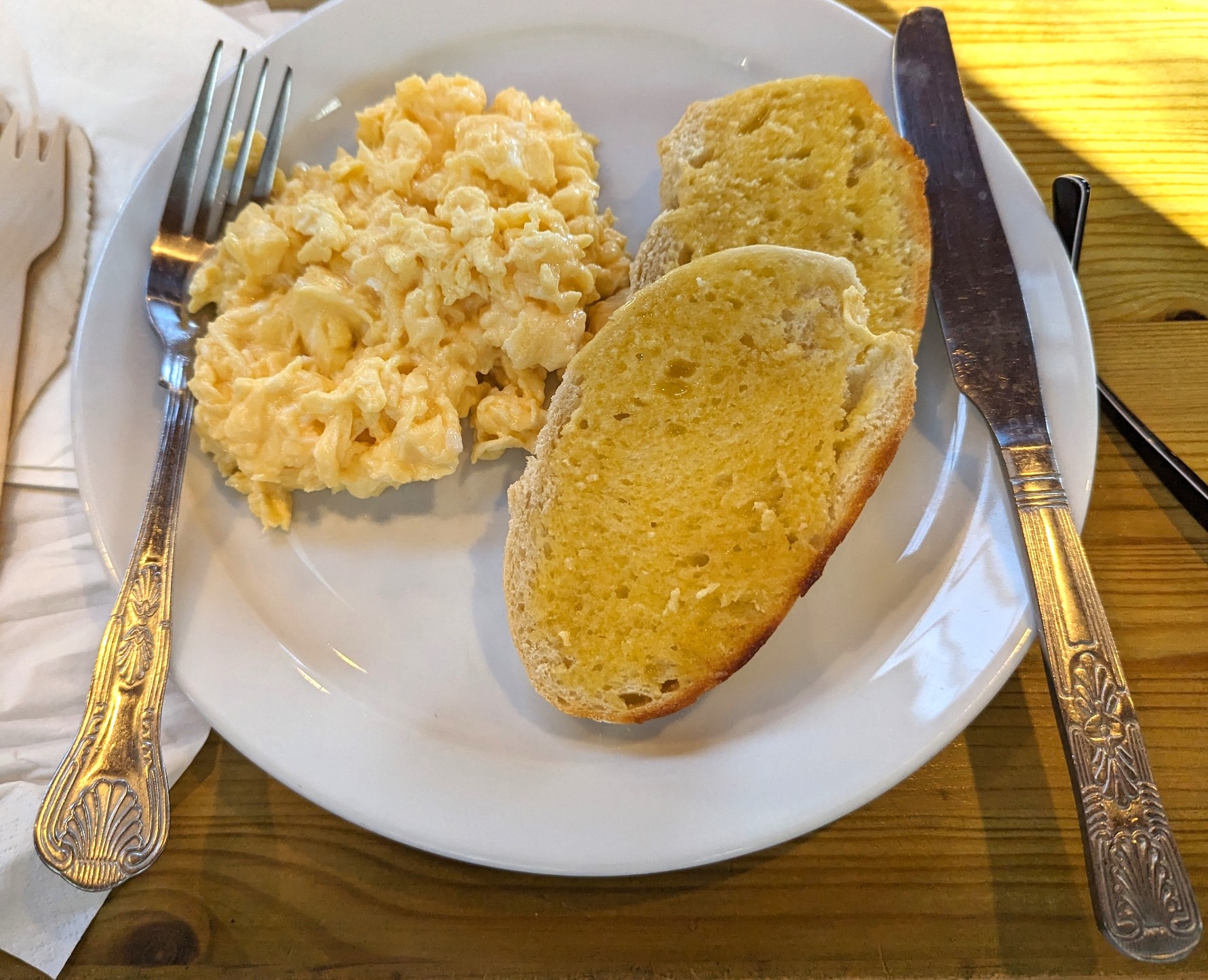
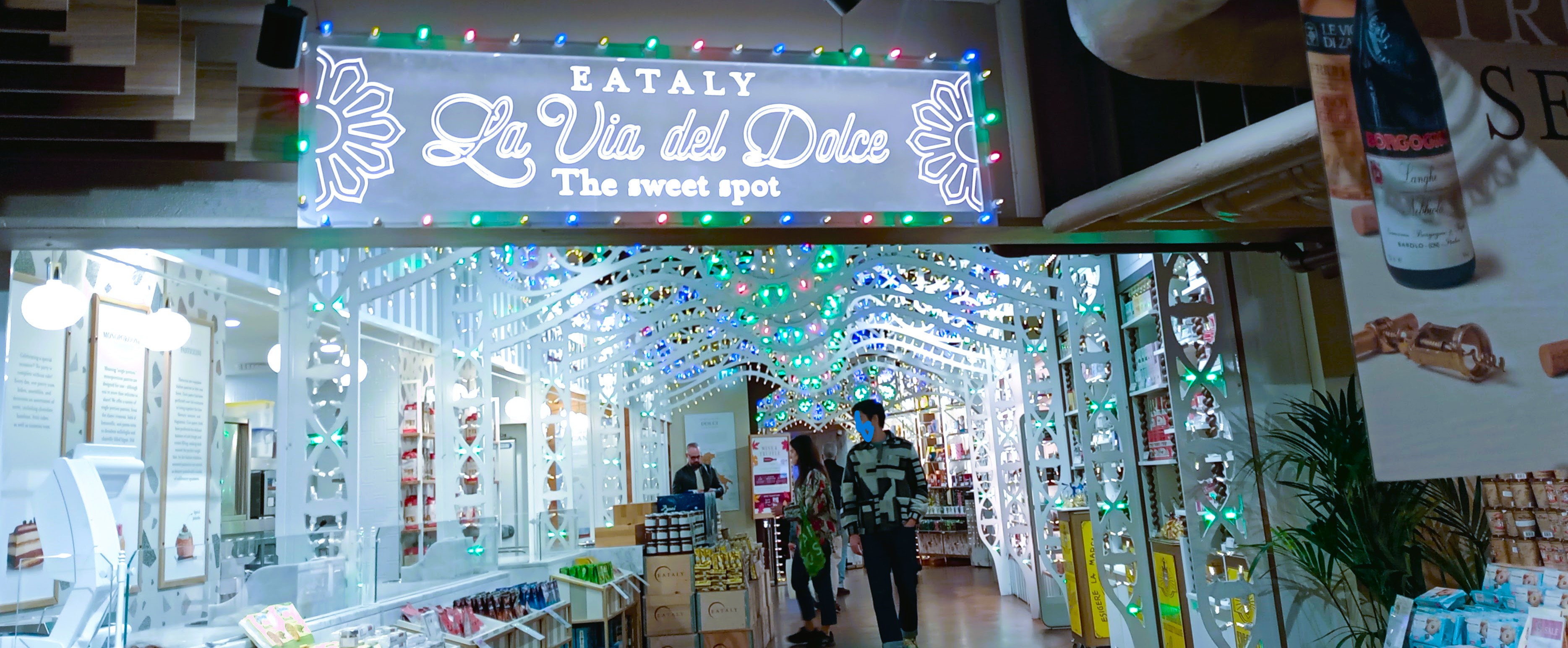
Eataly is a large building opposite the station, with cheap eats on the ground floor and restaurants on the upper level. On the ground level is a huge, sweet pastry area, serving pastries and coffees; a pizza place where large pizzas are cooked and cut in slices for serving; a panini area, and various shops serving specialist grocery items. It is a fun place, where people in groups eat heartily and noisily, and others who munch slowly while working on their laptops. We did the latter while perusing our phones and chatting.
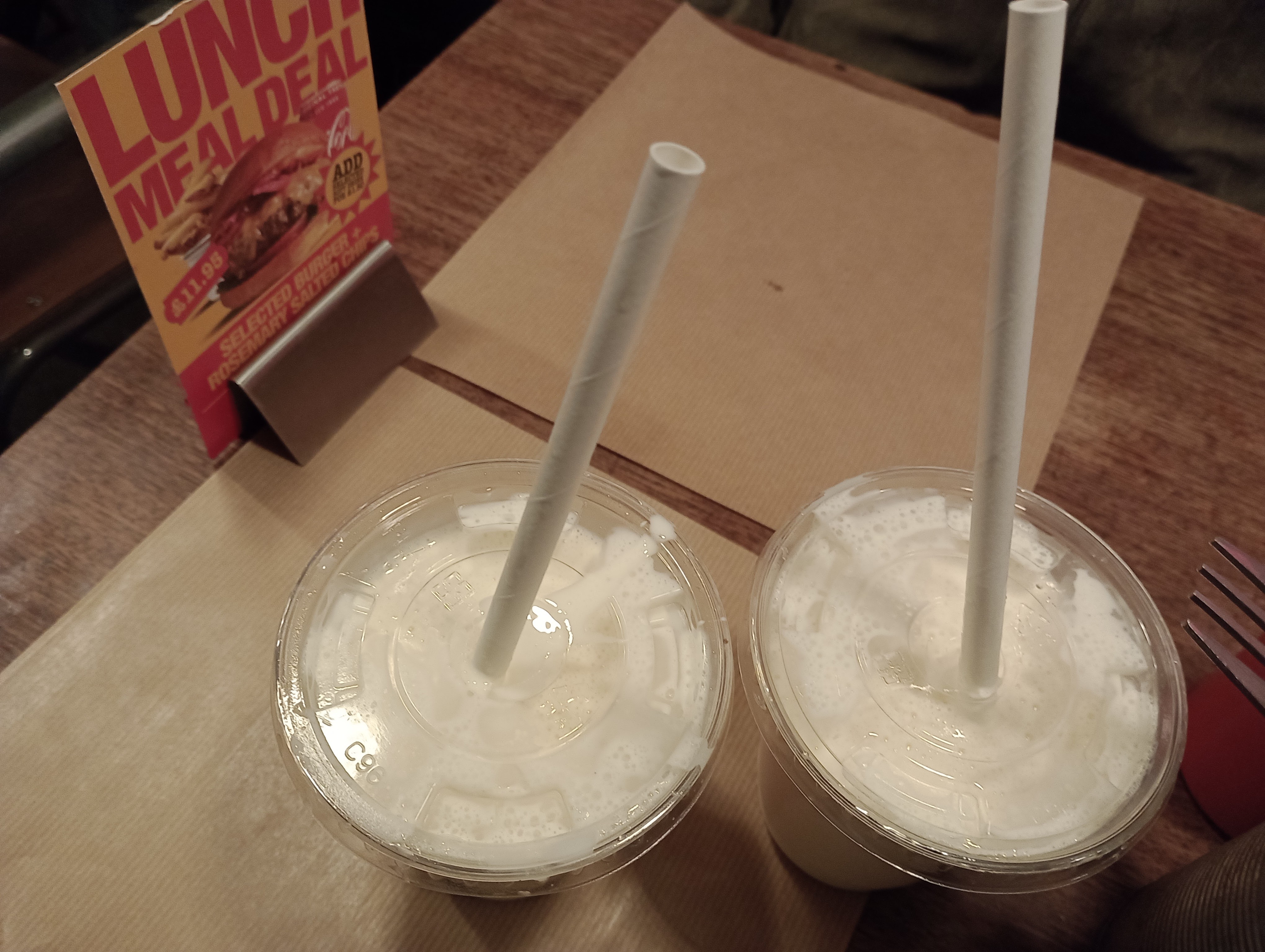
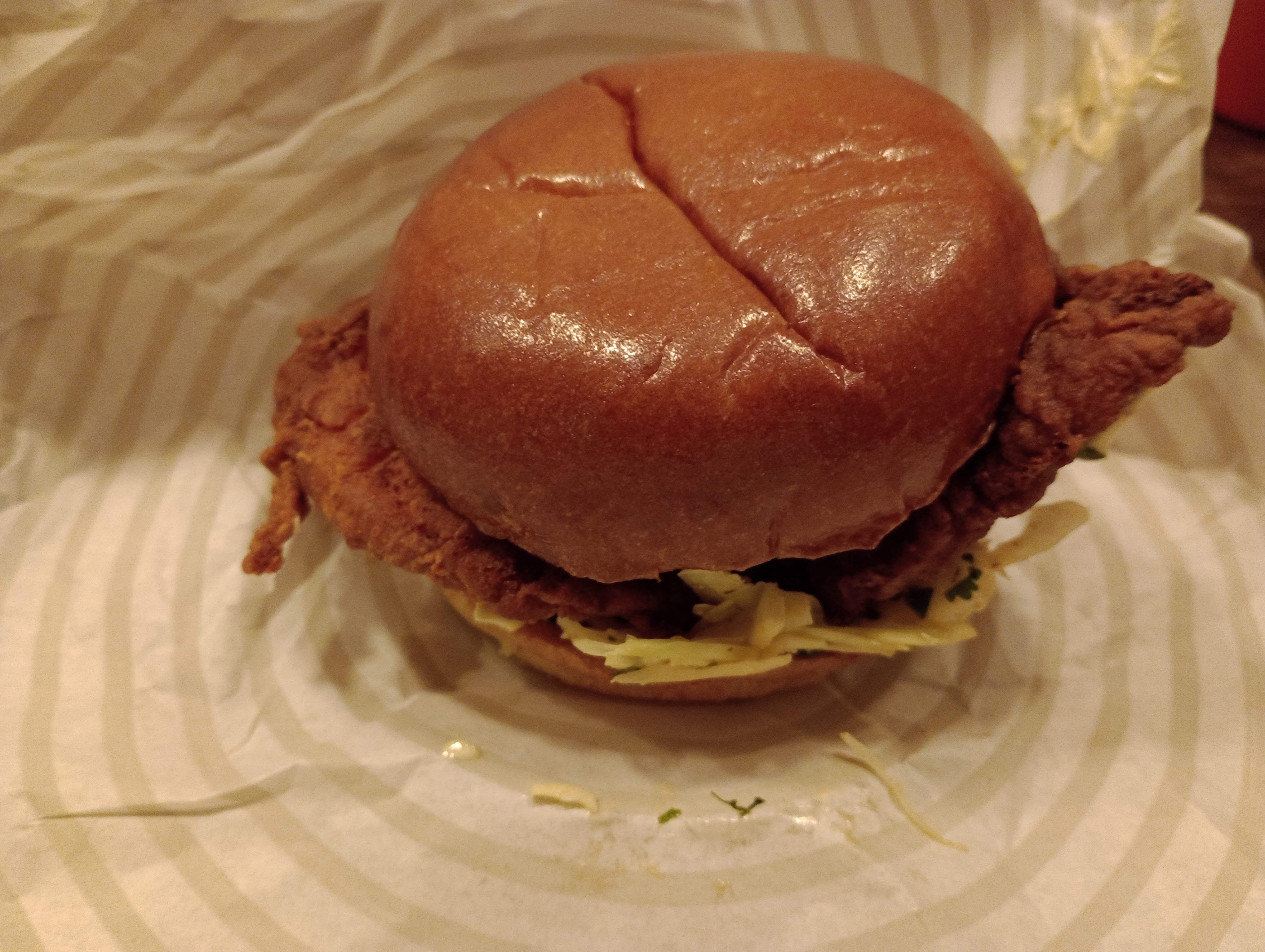
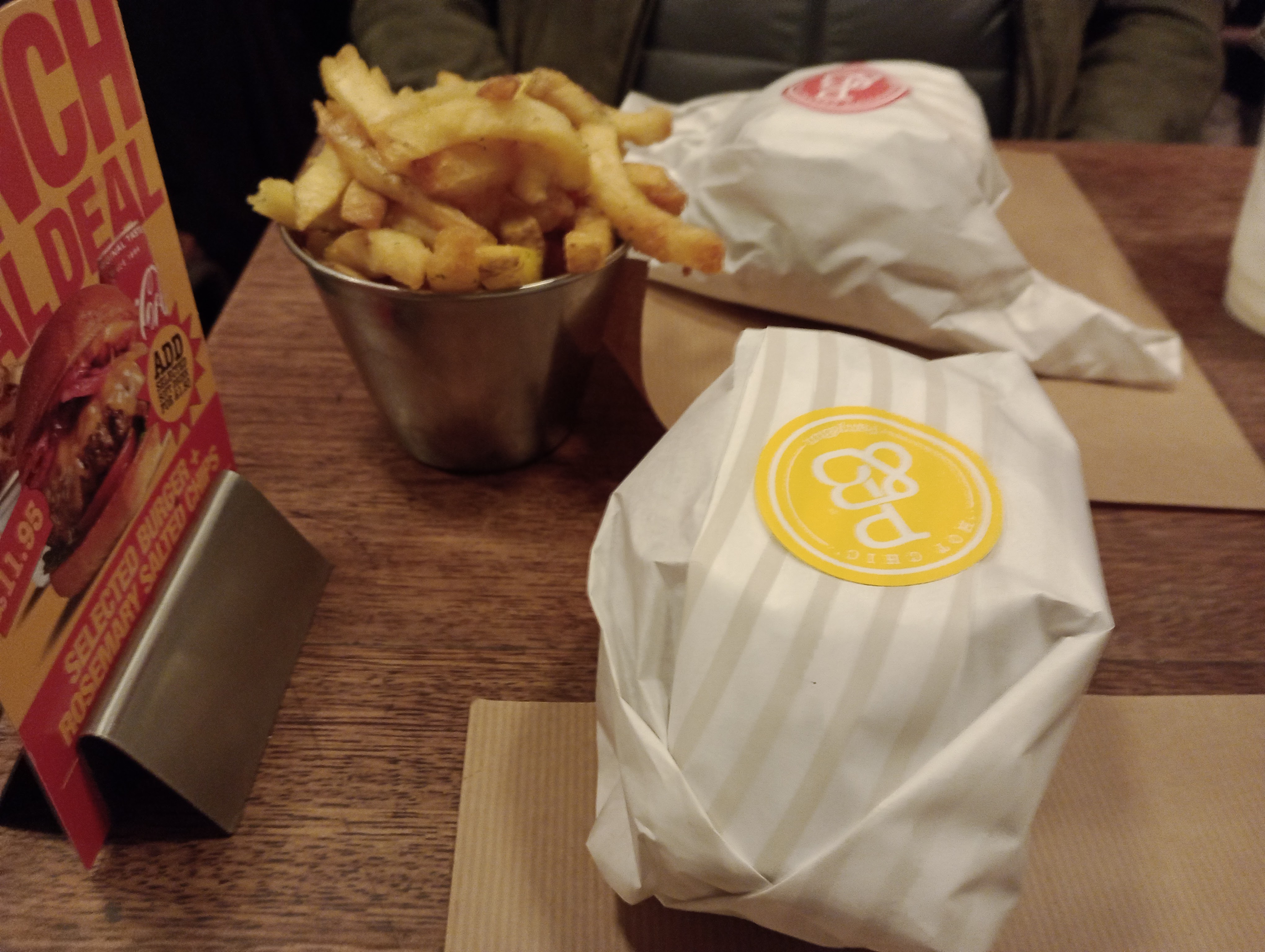
Patty & Bun is also fun place to eat – ultra casual, with friendly staff, and delicious malt milk shakes. The patties and buns are also fine, without being special. They arrive with cutlery, but most people ate from the paper wrapping. Patty & Bun was a lively, well patronised place to eat.

Week beginning 8 November 2023

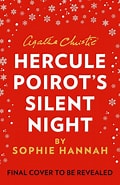
Sophie Hannah Hercule Poirot’s Silent Night The New Hercule Poirot Mystery Harper Collins UK, Harper Fiction 26 October 2023.

Thank you, NetGalley, for providing me with this uncorrected proof for review.

This is the second of Sophie Hannah’s Hercule Poirot mysteries that I have read, and I came to it hoping that I would not be disappointed. I have read Sophie Hannah’s other novels with enthusiasm, and some dread, at times. Despite their often bizarre and unpleasant themes they are immensely readable, almost addictive, and some of my favourite in their genre. I cannot say the same of The Monogram Murders, the first of Hannah’s Hercule Poirot mysteries I tried. Hercule Poirot’s Silent Night is a distinct improvement.

In this novel Hannah replicates Agatha Christie’s lack of interest in making Hastings a permanent character in her Hercule Poirot novels. Poirot’s companion, Edward Catchpool is a former police inspector, the son of one of the other characters, and, while advancing the narrative with the potential and then actual crime at its focus, also develops as a distinct character.  Although he follows Hastings in being unaware of the clues that Poirot so brilliantly perceives, maintaining the familiar relationship between the two, he has his own character which adds to the novel. Unlike Hastings who had to be married off in Christie’s second Poirot novel, Murder on the Links, to avoid including him in every work featuring Poirot, Catchpool’s character has some interesting elements. His relationship with his mother, a clearly negative character, and his police background gives him professional possibilities. He is not reminiscent of any of Christie’s police characters (Japp, Slack, for example) and makes a positive contribution to the solution, although as Poirot suggests, not a brilliant as his own. This is a clever use of some of Christie’s tactics while providing a plausible alternative to the known Christie characters.Books: Reviews

After the Covid update: Holland Park and the Japanese Garden; Tbilisi Bakery; Whitechapel Gallery; Agatha Christie interpretations; Heather Cox Richardson.

Covid update for Canberra

On 3 November it was reported that there were 428 new cases of Covid in Canberra, with 15 people in hospital, one of whom is in ICU. One life was lost this week, bringing the total to 282 lives lost to Covid since March 2020. Cases of influenza and RSV are now being reported. Masks are no longer required at my general practice, although they are available at the reception area. Some staff wear masks, others do not. They are no longer encouraged on public transport, although some commuters do wear them.

.

Holland Park and the Japanese Garden

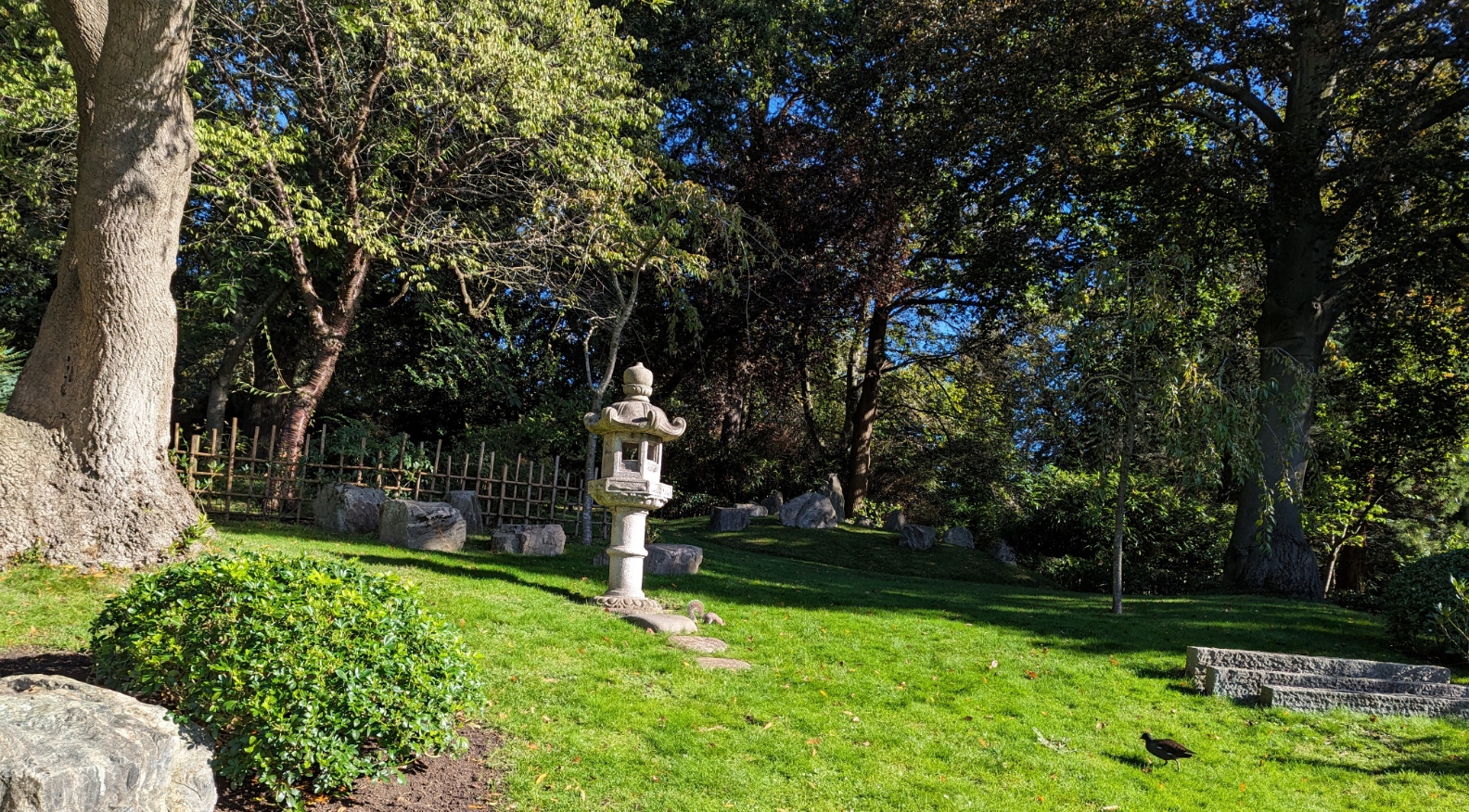
Secret London is a valuable source of information about London sites that are not necessarily well known. One of these is the Japanese Garden in Holland Park. Also, of interest is the Sustainable drainage scheme. Of course, Holland Park is a beautiful spot, the Japanese Garden just adding another element to an afternoon spent there.

Tbilisi Bakery

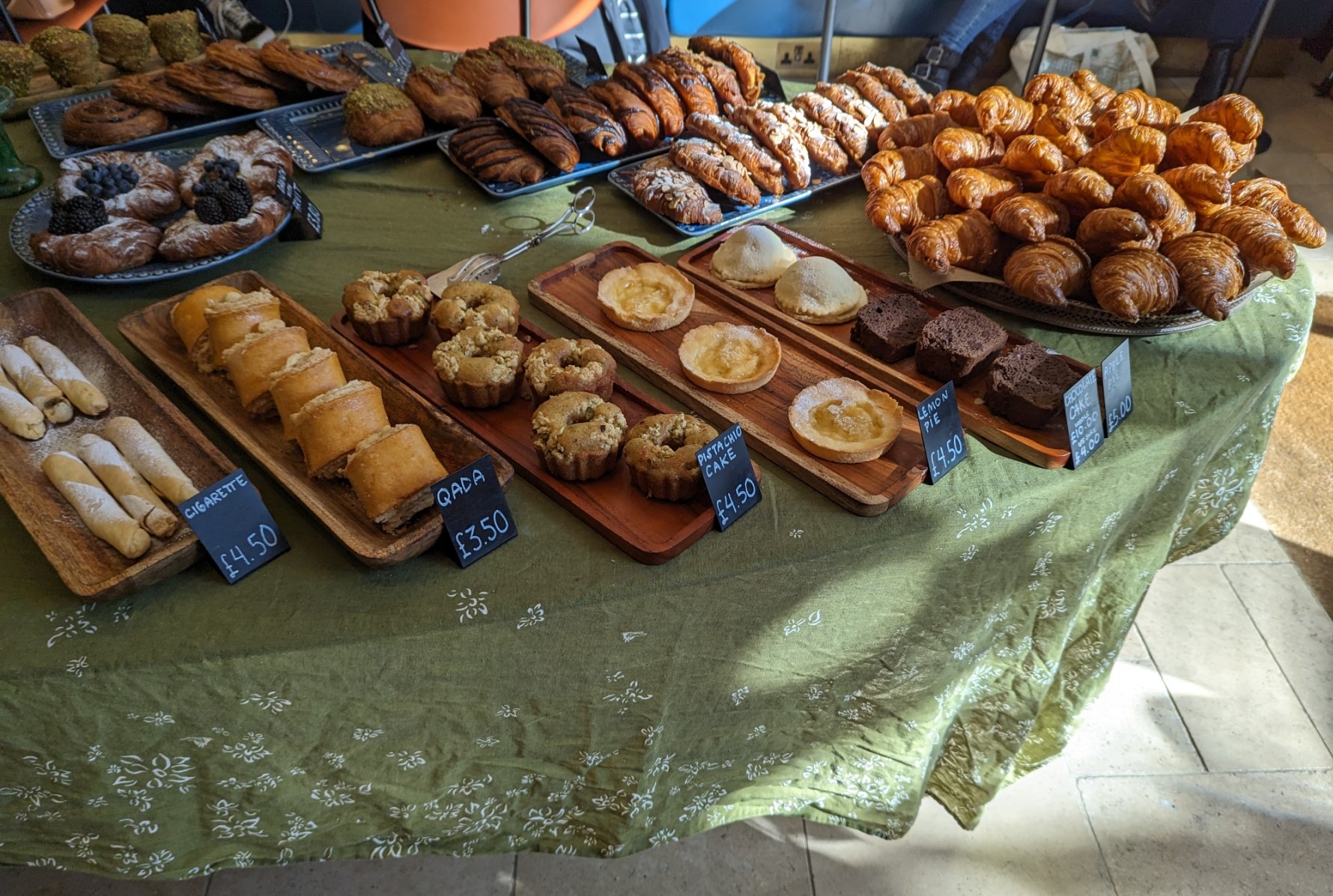
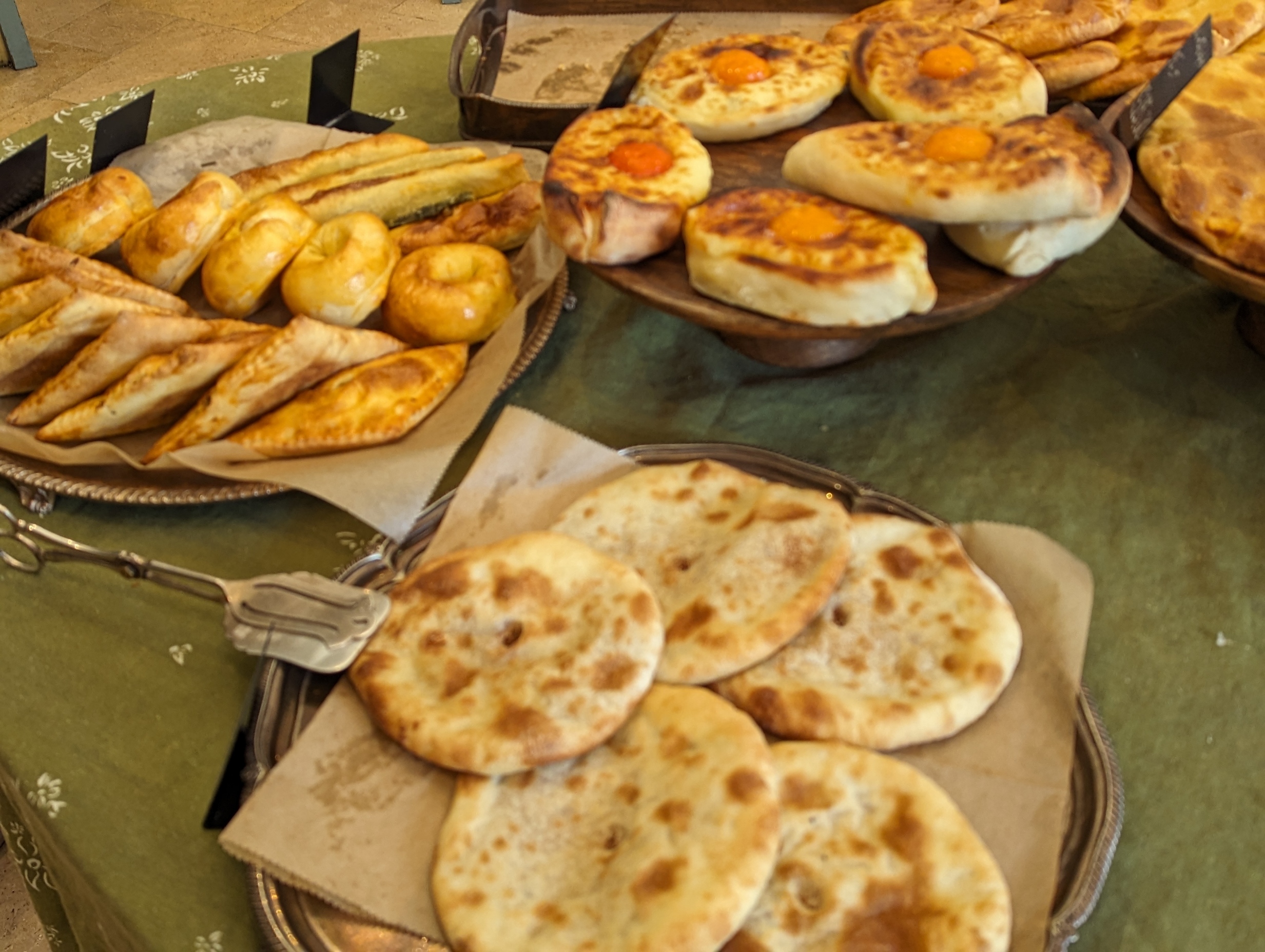
When we saw the Tbilisi Bakery after our walk around Holland Park we could not resist going in to see what was being served. Tbilisi was the last country we visited before returning to Australia after living in London for nearly five years. The cafe did not disappoint.

Whitechapel Gallery

One of the benefits of our London hotel was its proximity to the Whitechapel Gallery. It always has exciting exhibitions and is really worth a visit. It is close to the East Aldgate tube station, and on several bus routes. We only had to walk a short distance to enjoy the exhibitions on this occasion.

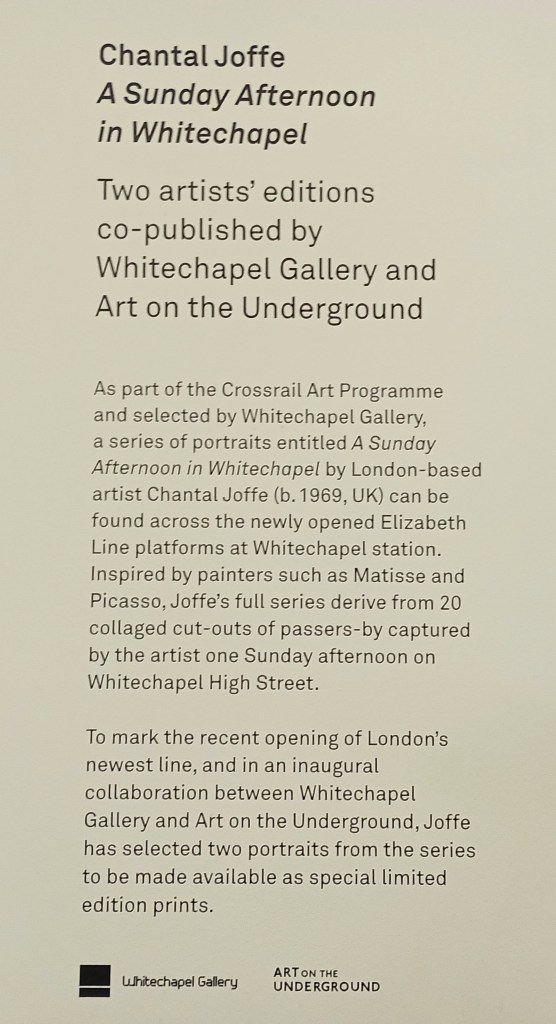
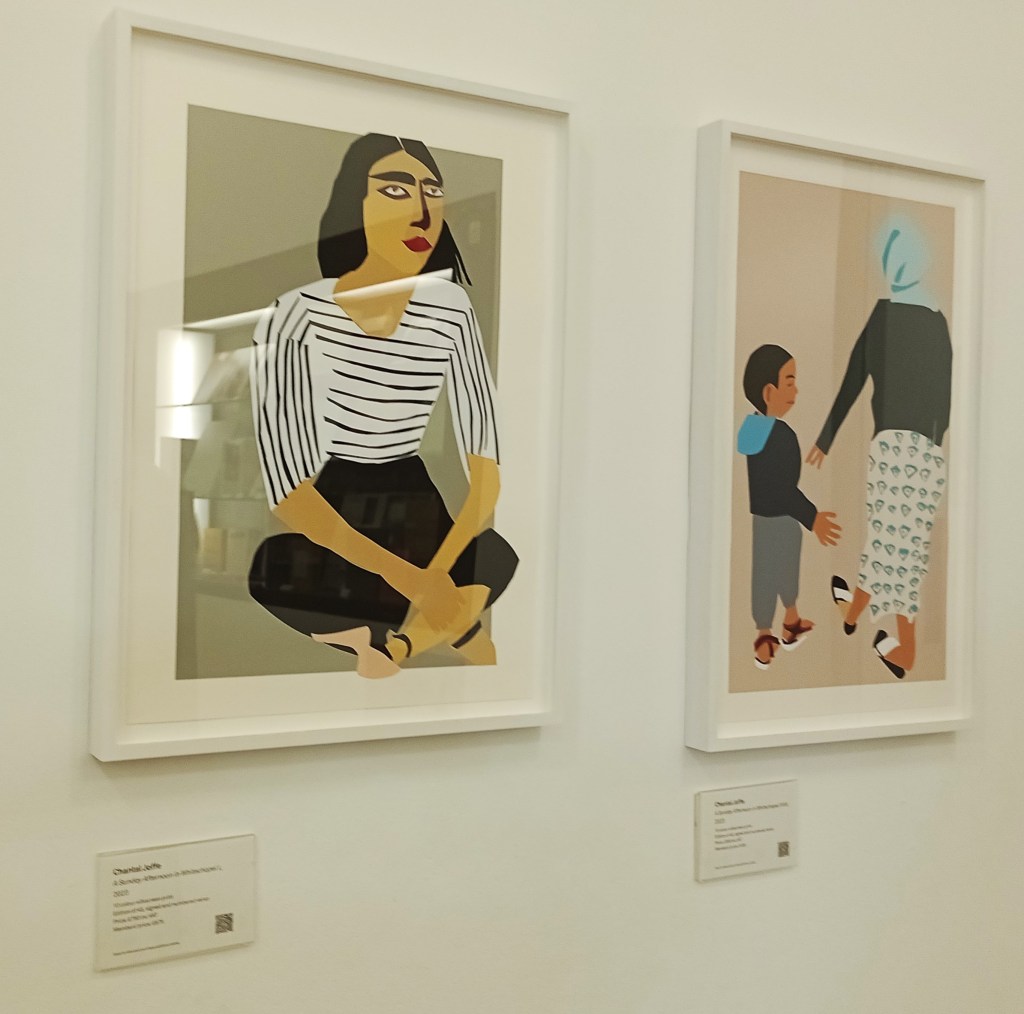
Whitechapel Gallery connects with contemporary issues. Crossrail, now the Elizabeth line, was being built while we lived in Paddington. This is a great outcome of the noise, lights and activity during the night.

Joffe portraits

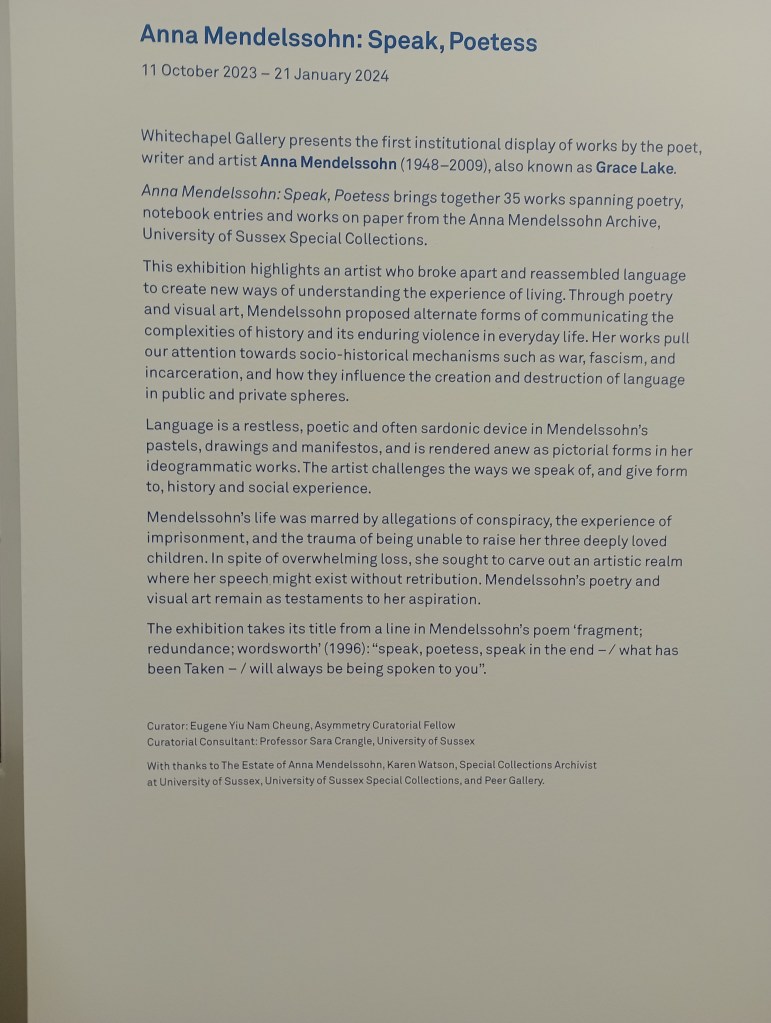
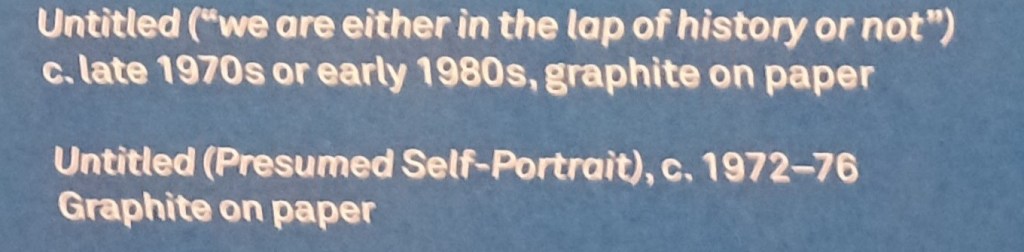
Anna Mendelssohn’s exhibited art included:

Anna Mendelssohn (b. 1948—d. 2009) authored poetry, fiction, drama, and life writing; she was also a visual artist, musician and translator. From 1971 to 1977 she served time at Holloway Prison in London due to her involvement in extreme leftist activism. From the early 1980s, Mendelssohn composed fifteen poetry collections and published in journals receptive to her experimental, charged lyrics, among them, ParataxisCritical Quarterly, and Jacket. Her work appeared in seminal anthologies including Denise Riley’s Poets on Writing (1992), Iain Sinclair’s Conductors of Chaos (1996), and Rod Mengham and John Kinsella’s Vanishing Points: New Modernist Poems (2004). Often situated within the British Poetry Revival, Mendelssohn retained a marginal, if constant, presence in the poetry community in Cambridge, England, where she lived from 1983 until her death. In 2010, her vast archive of writings and drawings was generously donated by her three children to Special Collections at the University of Sussex.

Agatha Christie – interpretations

Following up Agatha Christie’s Poirot and plotting as perceived by Sophie Hannah, and last week’s criticism of the filming of Halloween Murder as A Haunting in Venice I am interested in how Murder is Easy will be interpreted in the two episode program coming to BBC One, iPlayer and BritBox.

The Agatha Christie Newsletter <generalenquiries@agathachristie.com is an excellent source of information about Agatha Christie, her novels and new works associated with those.

David Jonsson as Fitzwilliam in Murder is Easy

First Look

We’re excited to reveal these first look images of Murder is Easy, a new two-part thriller based on Agatha Christie’s 1938 novel. The show, from producers Mammoth Screen and Agatha Christie Limited, will be coming soon to BBC One and iPlayer and on BritBox International’s streaming services. Filmed in Scotland over the summer of 2023, it is directed by Meenu Gaur with the screenplay by Siân Ejiwunmi-Le Berre.

These brand new pictures feature David Jonsson (IndustryRye Lane) as Fitzwilliam, alongside Morfydd Clark (Lord of the RingsSaint Maud) as Bridget; Penelope Wilton (Downton AbbeyAfter Life) as Miss Pinkerton, Tom Riley (The NeversIll Behaviour) as Lord Whitfield, Douglas Henshall (ShetlandIn Plain Sight) as Major Horton, Mathew Baynton (GhostsWonka) as Dr Thomas and Mark Bonnar (World on FireGuilt) as Reverend Humbleby.

Murder is Easy
 will also star Sinead Matthews (HullraisersThe Crown) as Miss Waynflete, Nimra Bucha (Polite SocietyMs Marvel) as Mrs Humbleby, Tamzin Outhwaite (The TowerRidley Road) as Mrs Pierce, Kathryn Howden (River CitySix Four) as Mrs Carter, Jon Pointing (Big BoysPlebs) as Rivers, Demmy Ladipo (Dreaming Whilst BlackThe Last Tree) as Jimmy Amaike, Gloria Obianyo (Good OmensMission Impossible) as Ngozi Ude, and Phoebe Licorish making her screen debut as Rose.

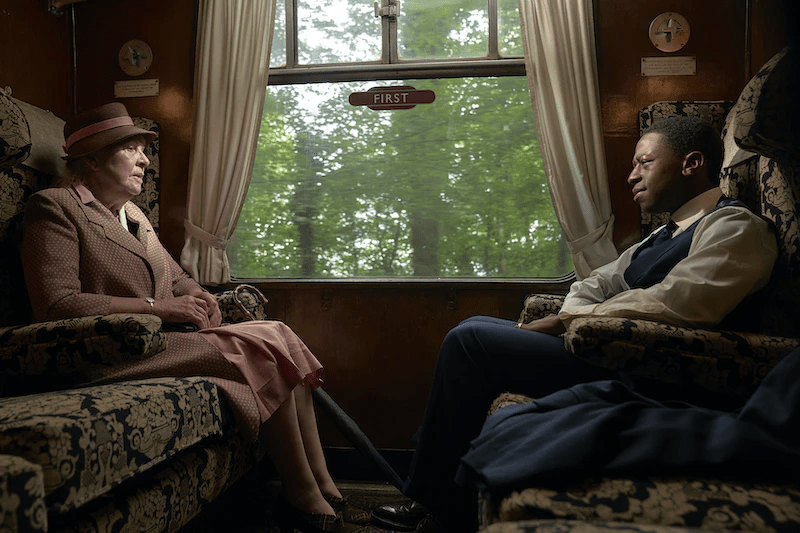
Penelope Wilton as Miss Pinkerton and David Jonsson as Fitzwilliam in Murder is Easy

About the Plot

England, 1954. On a train to London, Fitzwilliam (David Jonsson) meets Miss Pinkerton (Penelope Wilton), who tells him that a killer is on the loose in the sleepy English village of Wychwood under Ashe.

The villagers believe the deaths are mere accidents, but Miss Pinkerton knows otherwise – and when she’s later found dead on her way to Scotland Yard, Fitzwilliam feels he must find the killer before they can strike again. Because for a certain kind of person, murder is easy…

Douglas Henshall as Major Horton in Murder is Easy

Morfydd Clark as Bridget and Tom Riley as Lord Whitfield in Murder is Easy

In a quiet English village, a killer is about to strike. Again and again.

Officer Luke Fitzwilliam is on a train to London when he meets a strange woman. She claims there is a serial killer in the quiet village of Wychwood. He has already taken the lives of three people and is about claim his fourth victim.

Fitzwilliam dismisses this as the ramblings of an old woman. But within hours she is found dead. Crushed by a passing car.

And then the fourth victim is found.

Each death looks like an accident. But in Wychwood nothing is as it appears….

Heather Cox Richardson – Letter from America, November 3, 2023

Palestinian resettlement in America; new House Speaker; Mark Meadows’ book; lawyers in Trump’s future plans for the Presidency; Trump education plans; voter suppression.

Today, Representative Ryan Zinke (R-MT), who was former president Trump’s Interior Secretary until he left under accusations of misconduct, introduced a bill to ban Palestinians from the United States and to revoke any visas issued to Palestinians since October 1 of this year. Although the U.S. has resettled only about 2,000 Palestinians in the last 20 years, ten other far-right members of the House signed onto Zinke’s bill, which draws no distinction between Hamas and Palestinian civilians.

This blanket attack on a vulnerable population echoes Trump’s travel ban of January 27, 2017, just a week after he took office. Executive Order 13769 stopped travel from primarily Muslim countries—Iran, Iraq, Libya, Somalia, Sudan, Syria, and Yemen—for ninety days. The list of countries appeared random—Saudi Arabia, Pakistan, and Afghanistan, countries from which terrorists have sometimes come directly to the U.S., weren’t on the list—and appeared to fulfill a campaign promise and assert a new view of executive power.

Insisting that immigrants endanger the country is a key tactic of authoritarians. Excluding them is a central principle of those eager to tear down democracy: they insist that immigration destroys a nation’s traditions and undermines native-born Americans. With tensions in the nation mounting over the crisis in the Middle East, this measure, introduced now with inflammatory language, seems designed to whip up violence. 

Representative Greg Landsman (D-OH) called out his Republican colleagues on social media. “Un-American and definitely NOT in the Bible, [Speaker Johnson],” he wrote. “You going to tell them to pull this bill?”

But, far from trying to work across the aisle, Johnson has been throwing red meat to his base. In the last two days, for example, the House has voted to slash 39% of the budget of the Environmental Protection Agency (EPA) and 13% of the budget of the National Park Service. It voted to require the Biden administration to advance oil drilling off the Alaska coast. It has voted on reducing the salary of the EPA administrator, the director of the Bureau of Land Management, and the Secretary of the Interior to $1 each.

Yesterday, Johnson told reporters he considers extremists Marjorie Taylor Greene (R-GA) and Thomas Massie (R-KY) close friends and said “I don’t disagree with them on many issues and principles.”

To direct his communications team, Johnson has tapped Raj Shah, a former executive from the Fox News Corporation, who was a key player in promoting the lie that Trump won the 2020 presidential election. As the head of the “Brand Protection Unit,” Shah demanded that the Fox News Channel continue to lie to viewers who would leave the station if it told the truth. Johnson has hired Shah to be his deputy chief of staff for communications and, according to Alex Isenstadt of Politico, “help run messaging for House Republicans.” 

The extremists are doubling down on Trump and his election lies even as his allies are admitting in court that they are, indeed, lies. Trump’s former chief of staff Mark Meadows is in trouble with the publisher of his memoir after admitting that under oath that the election had been fair. The publisher is suing him for millions in damages for basing his book on the idea that the election had been stolen and representing that “all statements contained in the Work are true.” 

The publisher says it has pulled the book off the market. 

House extremists continue to back Trump even as he is openly calling for an authoritarian second term. In September, former chair of the Joint Chiefs of Staff Mark Milley had to take “appropriate measures” for his own security after Trump accused him of disloyalty to him, personally, and suggested that in the past, such “treason” would have been punished with death. 

On Wednesday, Jonathan Swan, Charlie Savage, and Maggie Haberman of the New York Times reported that Trump was frustrated in his first term by lawyers who refused to go along with his wishes, trying to stay within the law, so Trump’s allies are making lists of lawyers they believe would be “more aggressive” on issues of immigration, taking over the Department of Justice, and overturning elections. 

They are looking, they say, for “a different type of lawyer” than those supported by the right-wing Federalist Society, one “willing to endure the personal and professional risks of association with Mr. Trump” and “to use theories that more establishment lawyers would reject to advance his cause.” 

John Mitnick, who served in Trump’s first term, told the reporters that “no qualified attorneys with integrity will have any desire to serve as political appointees” in a second Trump term. Instead, the lawyers in a second term would be “opportunists who will rubber-stamp whatever Trump and his senior White House staff want to do.” 

Trump has also made it clear he and his allies want to gut the nonpartisan civil service and fill tens of thousands of government positions with his own loyalists. Led by Russell Vought, who served as Trump’s director of the Office of Management and Budget, Trump’s allies believe that agencies like the Federal Communications Commission, the Federal Trade Commission, and the Securities and Exchange Commission should not be independent but should push the president’s agenda. 

This week, Trump vowed to take over higher education too. In a campaign video, he promised to tax private universities with large endowments to fund a new institution called “American Academy.” The school, which would be online only, would award free degrees and funnel students into jobs with the U.S. government and federal contractors.

“We spend more money on higher education than any other country, and yet they’re turning our students into communists and terrorists and sympathizers of many, many different dimensions,” Trump said. “We can’t let this happen.” In his university, “wokeness or jihadism” would not be allowed, he said.

In admirable understatement, Politico’s Meridith McGraw and Michael Stratford noted: “Using the federal government to create an entirely new educational institution aimed at competing with the thousands of existing schools would drastically reshape American higher education.”

Trump has made no secret of his future plans for the United States of America. 

Meanwhile, Republicans appear determined to push their agenda over the wishes of voters. In Ohio, where voters on Tuesday will decide whether to amend the state constitution to make it a constitutional right to “make and carry out one’s own reproductive decisions,” Republicans first tried to make it harder to amend the state constitution, and then, when voters rejected that attempt, the Republican-dominated state senate began to use an official government website to spread narratives about the constitutional amendment that legal and medical experts called false or misleading. 

Adding reproductive health protections to the state constitution is popular, but In an unusual move, the Republican secretary of state, Frank LaRose, quietly purged more than 26,000 voters from the rolls in late September. LaRose is a staunch opponent of the constitutional amendment and is himself running for a seat in the U.S. Senate. 

In Virginia, where Republicans are hoping to take control of the state legislature to pass new abortion restrictions as well as the rest of Republican governor Glenn Youngkin’s agenda, a study by the Democratic Party of Virginia shows that officials are flagging the mail-in ballots of non-white voters for rejection much more frequently than those of white voters. As of today, 4.82% of ballots cast by Black voters have gotten flagged, while only 2.79% of the ballots of white voters have been flagged.

In Richmond, The Guardian’s Sam Levine reported, city officials flagged more than 11% of ballots returned by Black voters but only about 5.5% of ballots cast by white voters. After the ballots are fixed, or cured, the rate of rejection for Black voters remains more than twice as high as that of white voters. 

Virginia officials also reported last week that they had accidentally removed more than 3,400 eligible voters from the rolls.

Week beginning 1 November 2023

With my return to London, to a hotel in the east end, * I thought it appropriate to review (The) Queens of London (the proof title includes ‘The’) by Heather Webb, set in the past in the city streets of London. In a few weeks I shall be looking at another book also set in London, Quartet in Autumn by Barbara Pym, as it also resonated with some of the features of the area in which the hotel was located- very different ones, though! Returning to (The) Queens of London, the uncorrected proof was sent to me by NetGalley for review.

Heather Webb (The) Queens of London Sourcebooks Landmark 2024.

Heather Webb’s (The) Queens of London is a fictional account of the woman gang known as The Forty Elephants whose heyday was in the 1920s. Her research shows that all the gangs she refers to in the novel were in existence, that Alice Diamond, leader of The Forty Elephants (also known as The Forty Thieves) was a real  person with an empire covering London, Brighton and Bristol and she had a real romance with another gang leader, Bert McDonald. Webb provides  Alice with another romance, based on a mention of ‘Simon’ in her research which may or may not be fictionalised. However, true, too , is the depiction Lilian Wyles, one of the first female police officers in the Criminal Investigations Department, and one of the first woman chief inspectors. Her role in the capture of Alice is fictional, but an important adjunct to the story of women making their way, although rather differently, in the hierarchies of law and crime in 1920s England.  The Queens of London makes a tremendous read, with its commitment to women’s cause, recognition of their failures and reasons for these, and sensitive approach to racism in the period – again with women at the centre of the story.

Two other woman characters are fictional – Hira and Dorothy McBride. Hira lives in splendour with her uncle, her governess and servants; Dorothy is a salesperson at Marshall & Snelgrove – the store that Alice and her gang have just divested of silk lingerie, jewellery and furs amongst the many luxury items stuffed into the gang’s clothing and reticules as Dorothy has served Alice, a seemingly legitimate customer. Hira and Alice are to meet as Hira leaves home upon learning she is to be set to boarding school. Hira becomes a waif on the streets and is taken into the gang. Hira and Dorothy also meet under unhappy circumstances also, as Hira becomes embroiled in the gang’s activities. Complexity is added to their stories as Dorothy is pursued by the store’s owner and dreams of marriage and Hera’s parentage becomes apparent. She is the child of an officer in India and his Indian wife. See Books: Reviews for the complete review.

*The Hyatt Place, Whitechapel was a very pleasant place to stay. Its proximity to the tube and the Whitechapel Station and thus the Elizabeth line to Heathrow made it extremely practical. On the food side, as seems to be a constant theme in my blog, the hotel is a short walk to Brick Lane, the home to so many best/winning/top rated/better than anyone else curry restaurants; is in the midst of excellent coffee and pastry cafes (one with lamingtons!); and close to a Turkish restaurant. It also has its own Sicilian Restaurant which serves very good food and has wonderful staff.

    After Covid update: Exeter; Bristol; Hamnet; Wigmore Hall; Barbara Pym; Zoe Fairbairns.

    Canberra Covid update

    On October 27 there were 370 new cases with 1 person hospitalised in the ICU. There was 1 death from Covid.

    Exeter

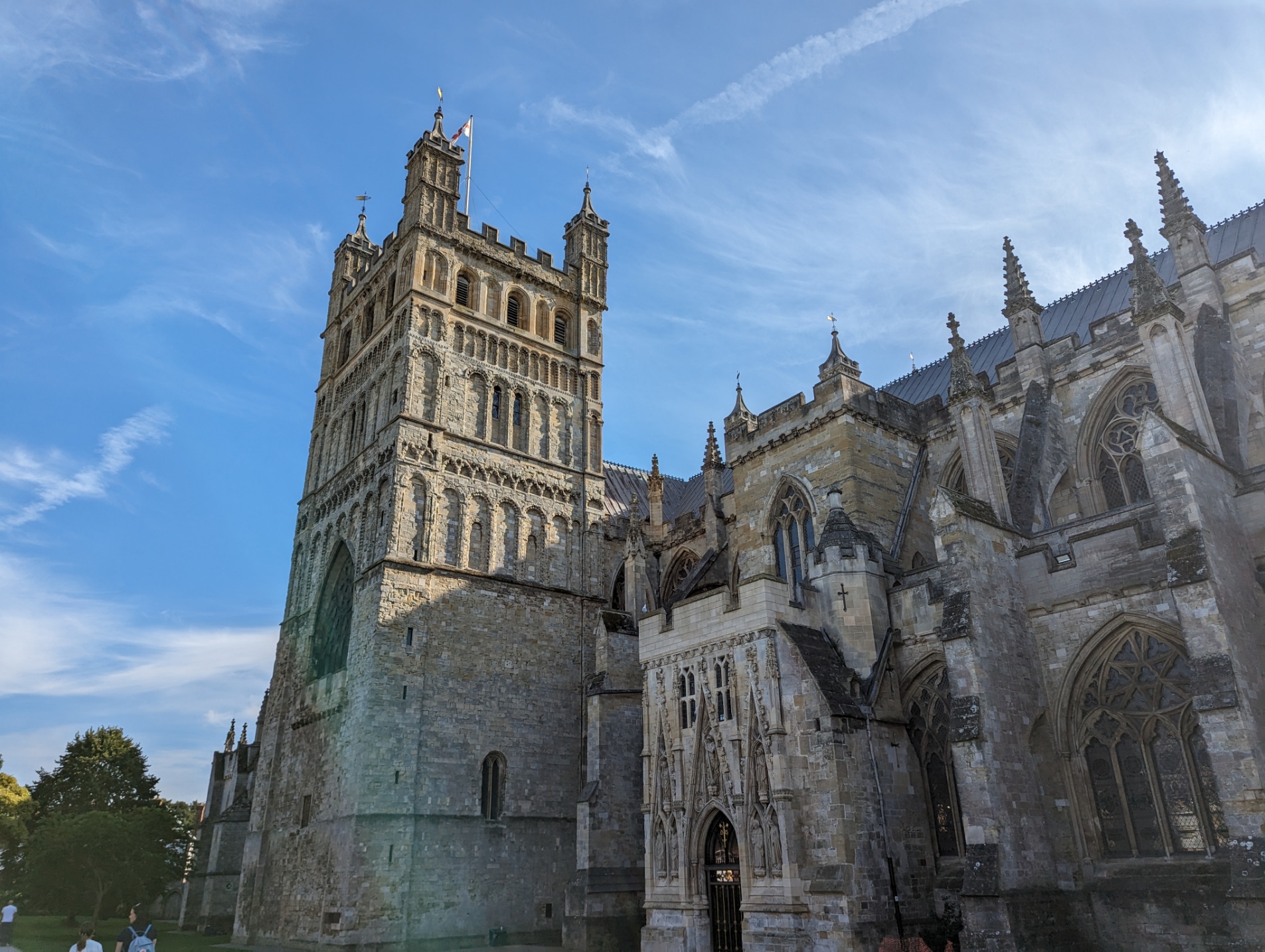
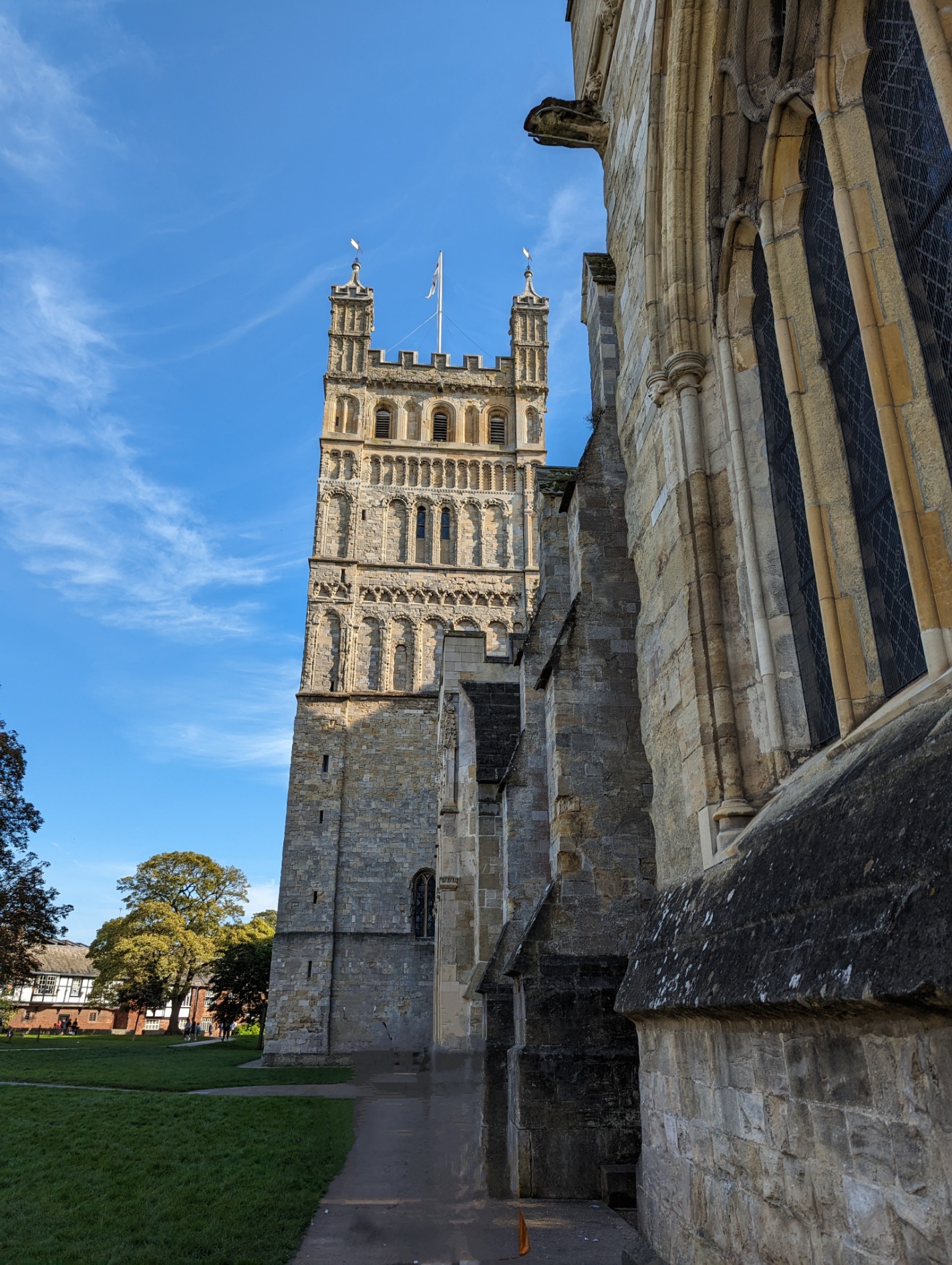
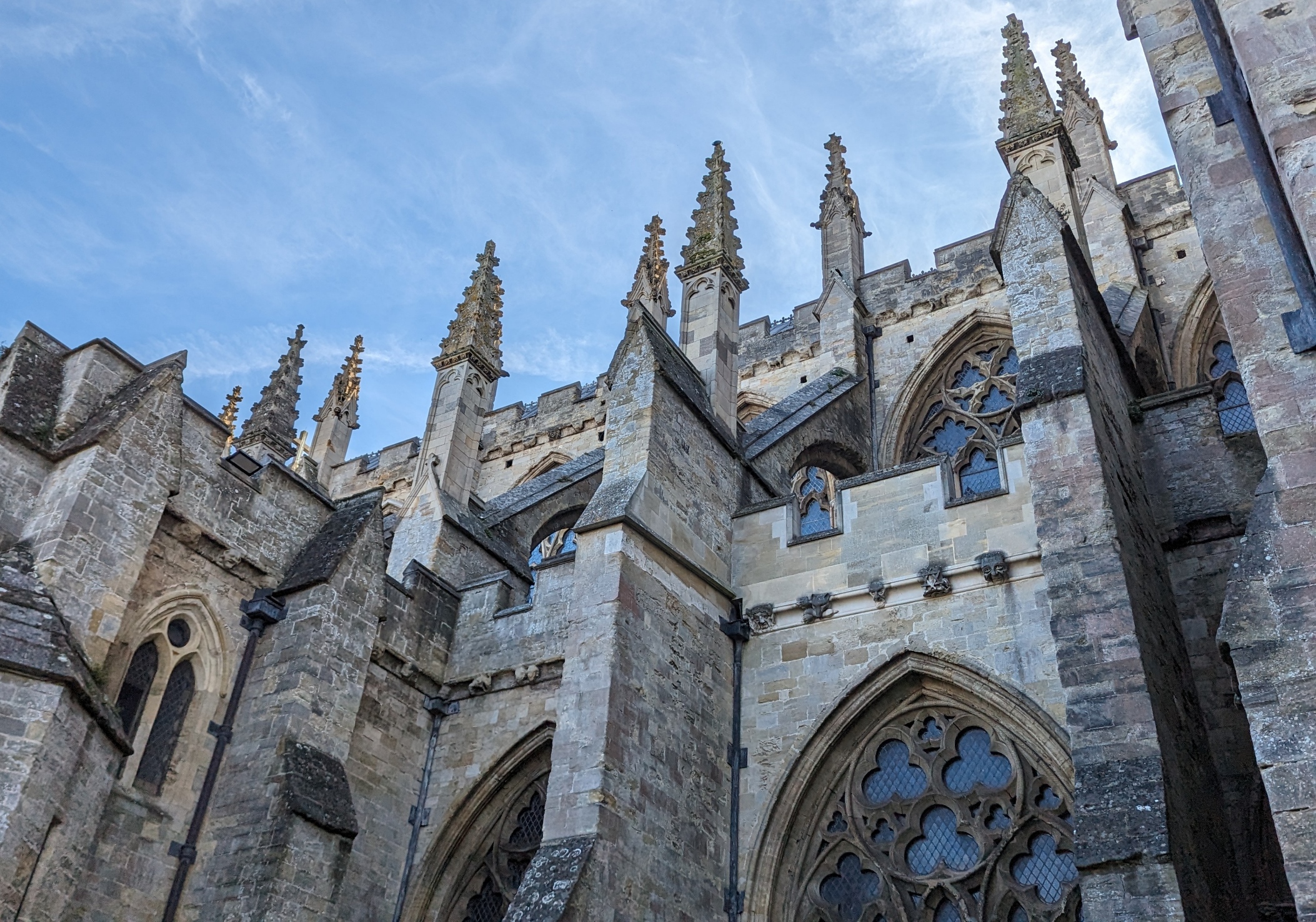
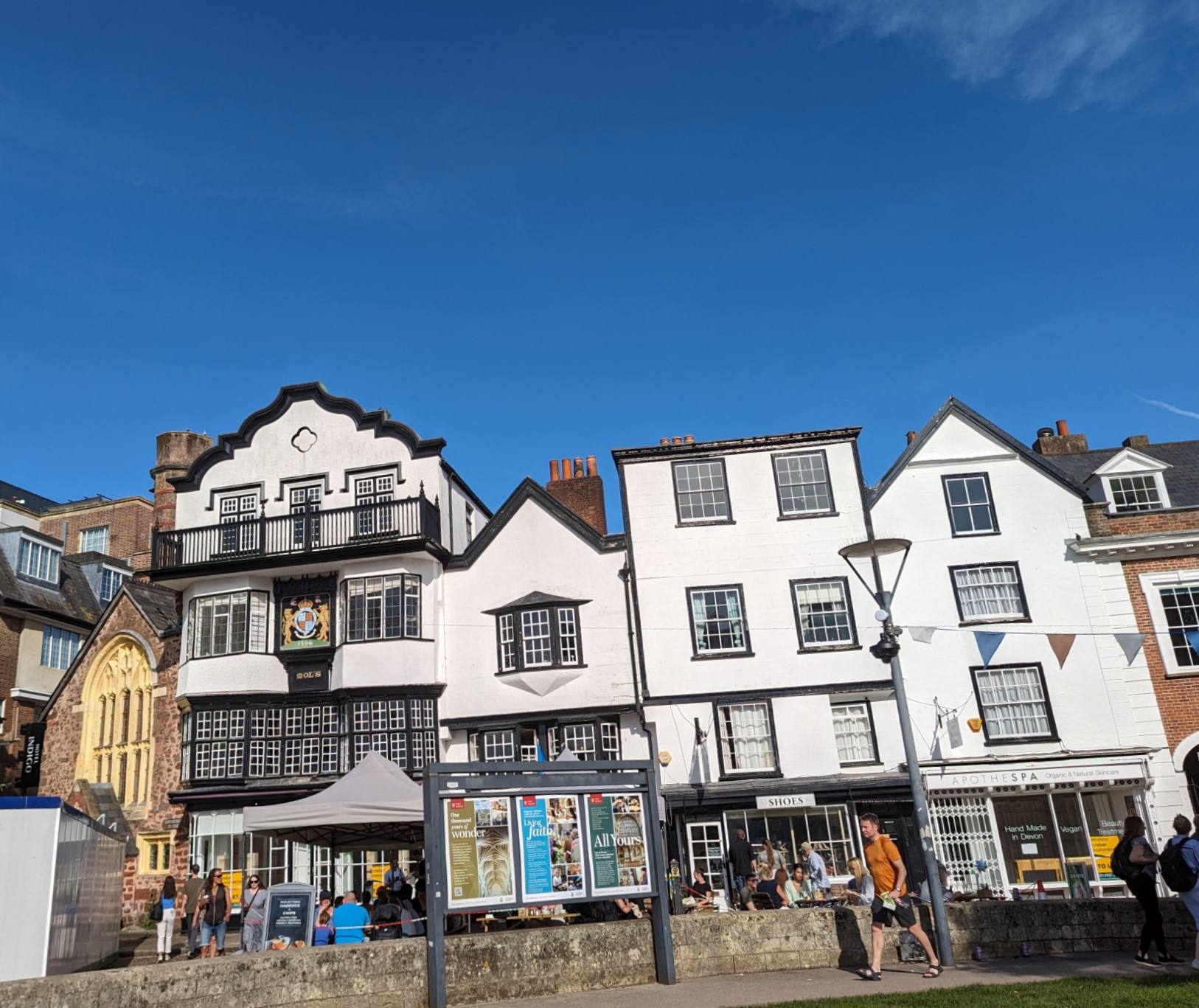
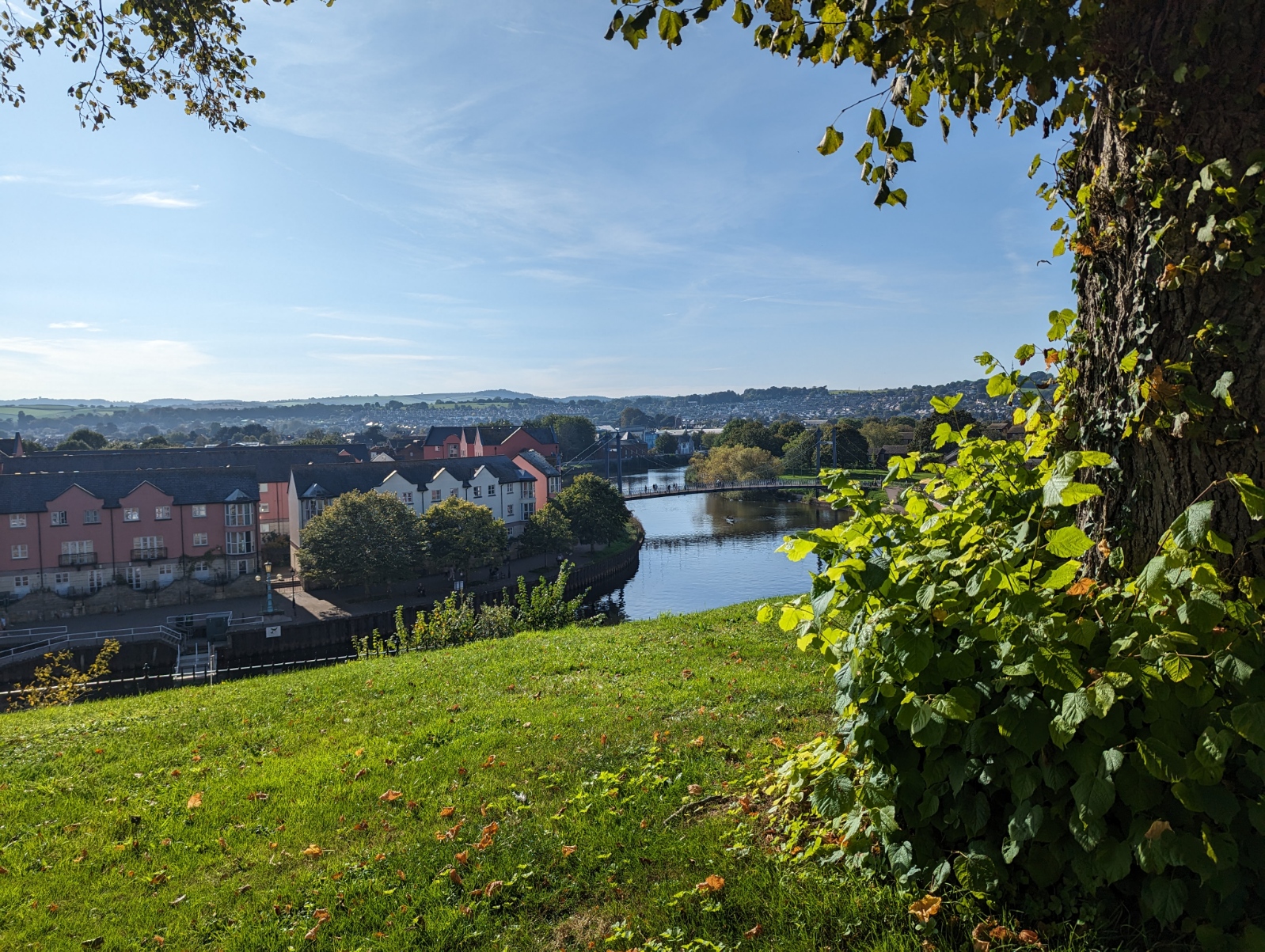
    The Red Coat Guided tour from the cathedral to the quay was an excellent way to spend a couple of hours. Although we were unable to enter the cathedral on the tour, the exterior was well worth seeing in detail.

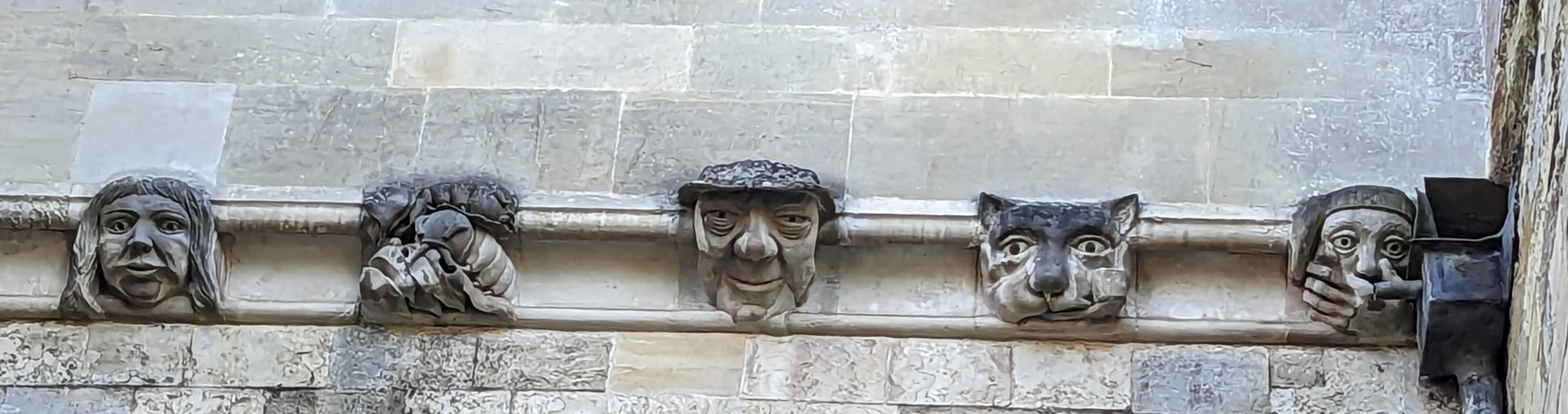
    The figure with hands over the mouth at the end of the photo below is said to be that of a garrulous woman. Perhaps she just wanted to make a contribution but the stone mason saw fit to silence her?

    Walk from the Cathedral to the Quay

    The white surrounds to the doors pictured below are the invention of Eleanor Coade. She created it around 1770 when she ran Coade’s Artificial Stone Manufactory, Coade and Sealy, and Coade in Lambeth, London, from 1769 until her death in 1821.

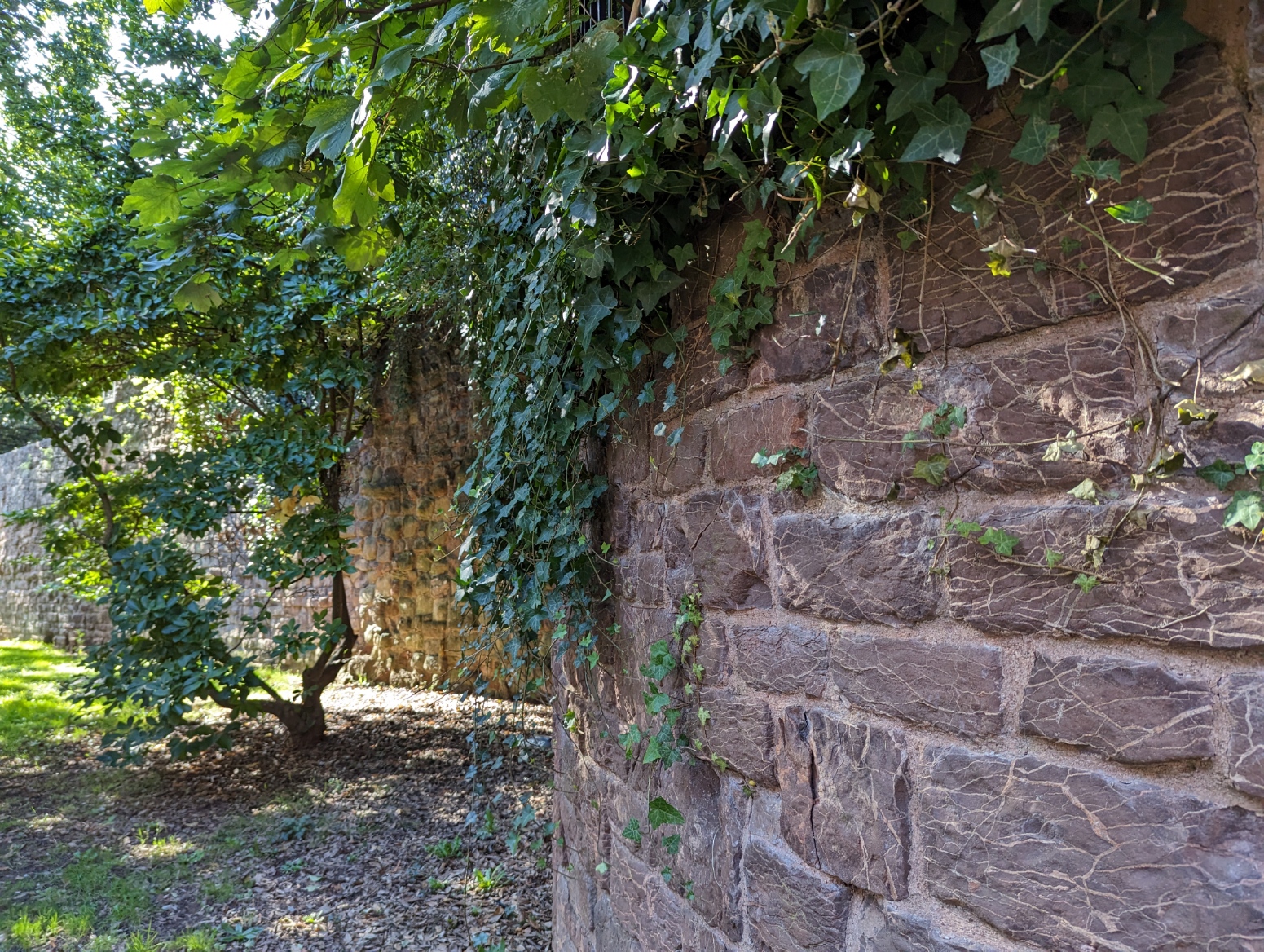
    Exeter Wall

    The wall has been changed over time to suit new building and needs, so that in some places houses have been attached to the walls. It has been repaired with any available material as parts have been destroyed.

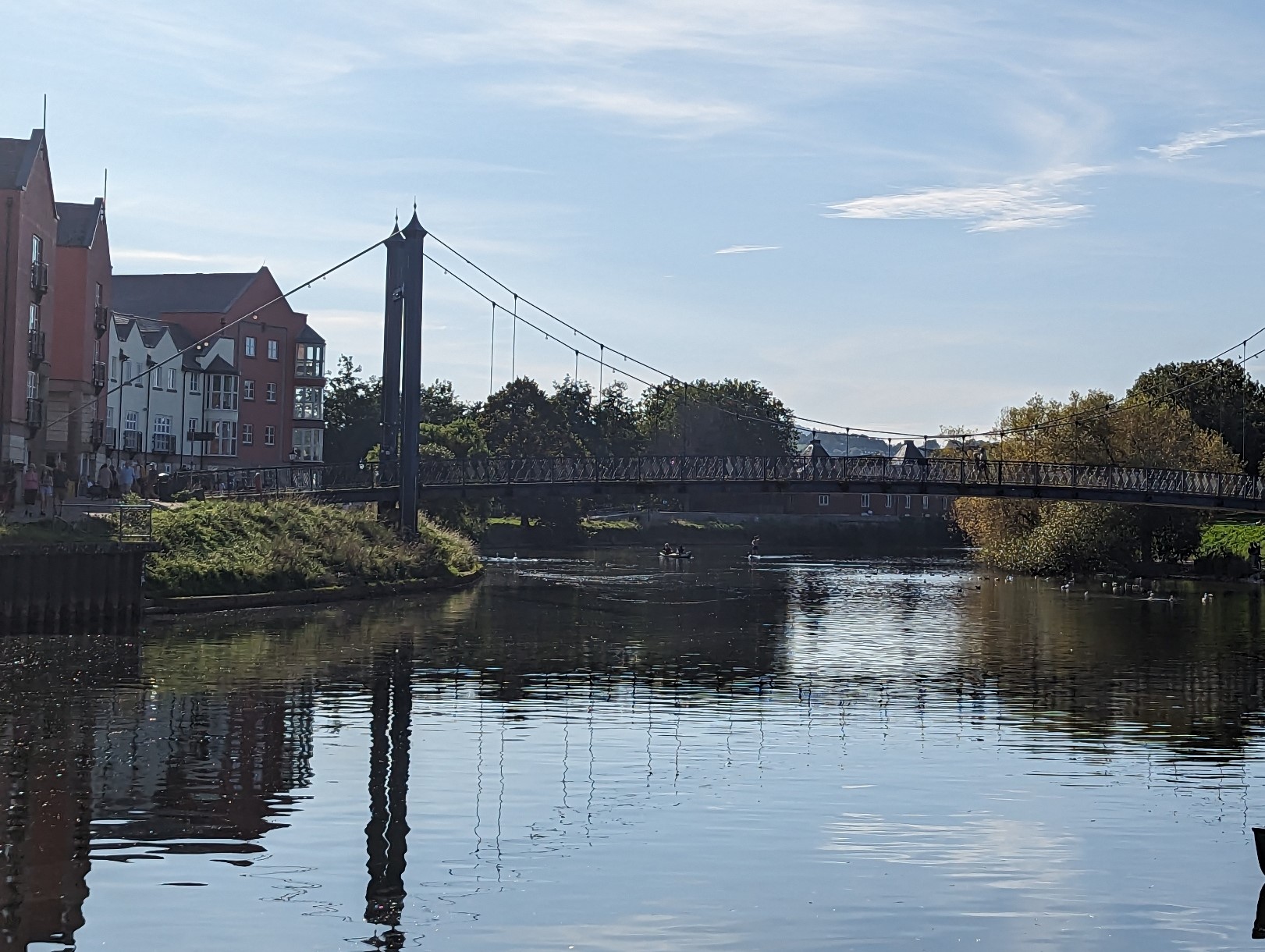
    Walking over the bridge and down the hill to the River Exe

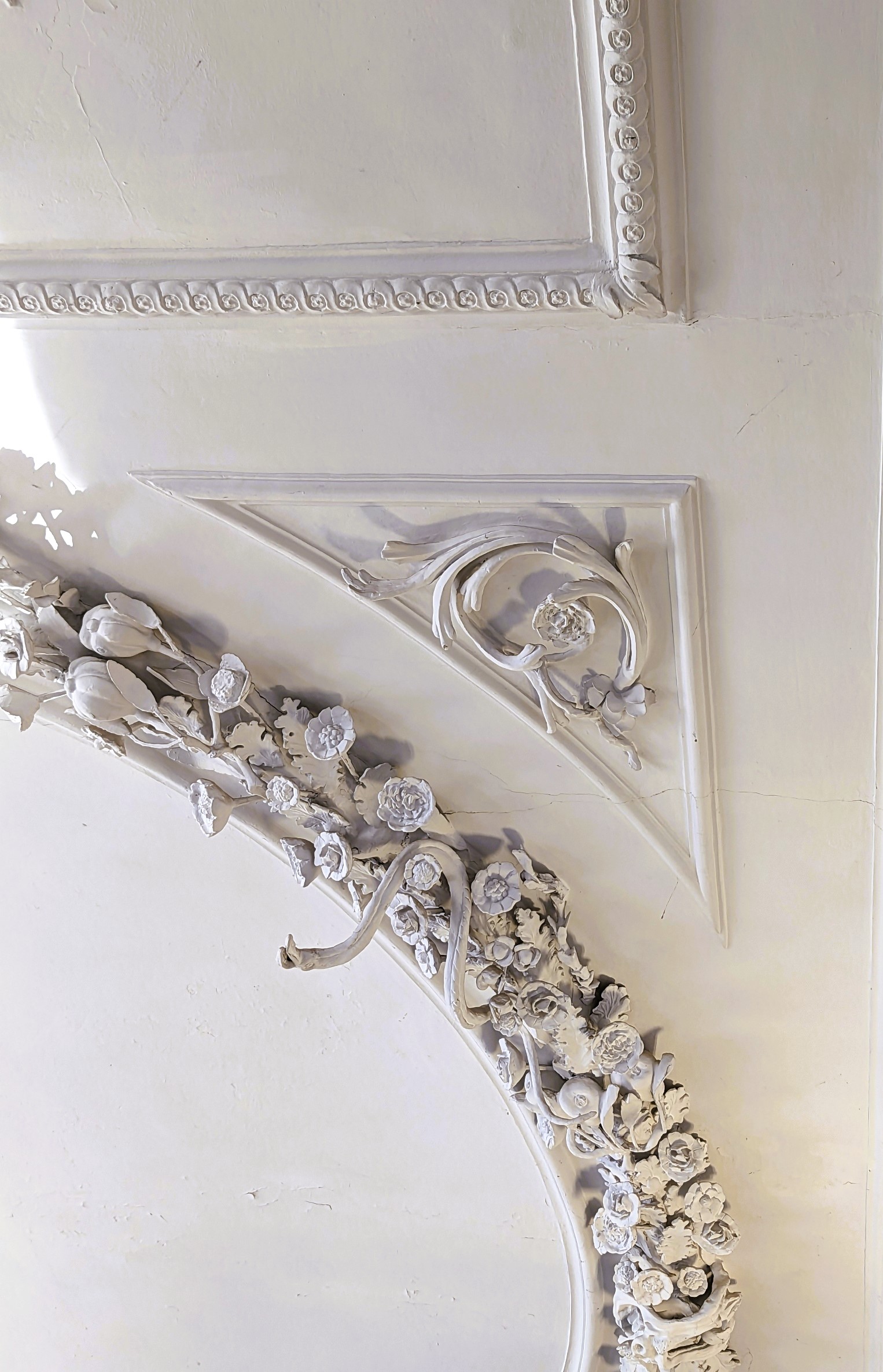
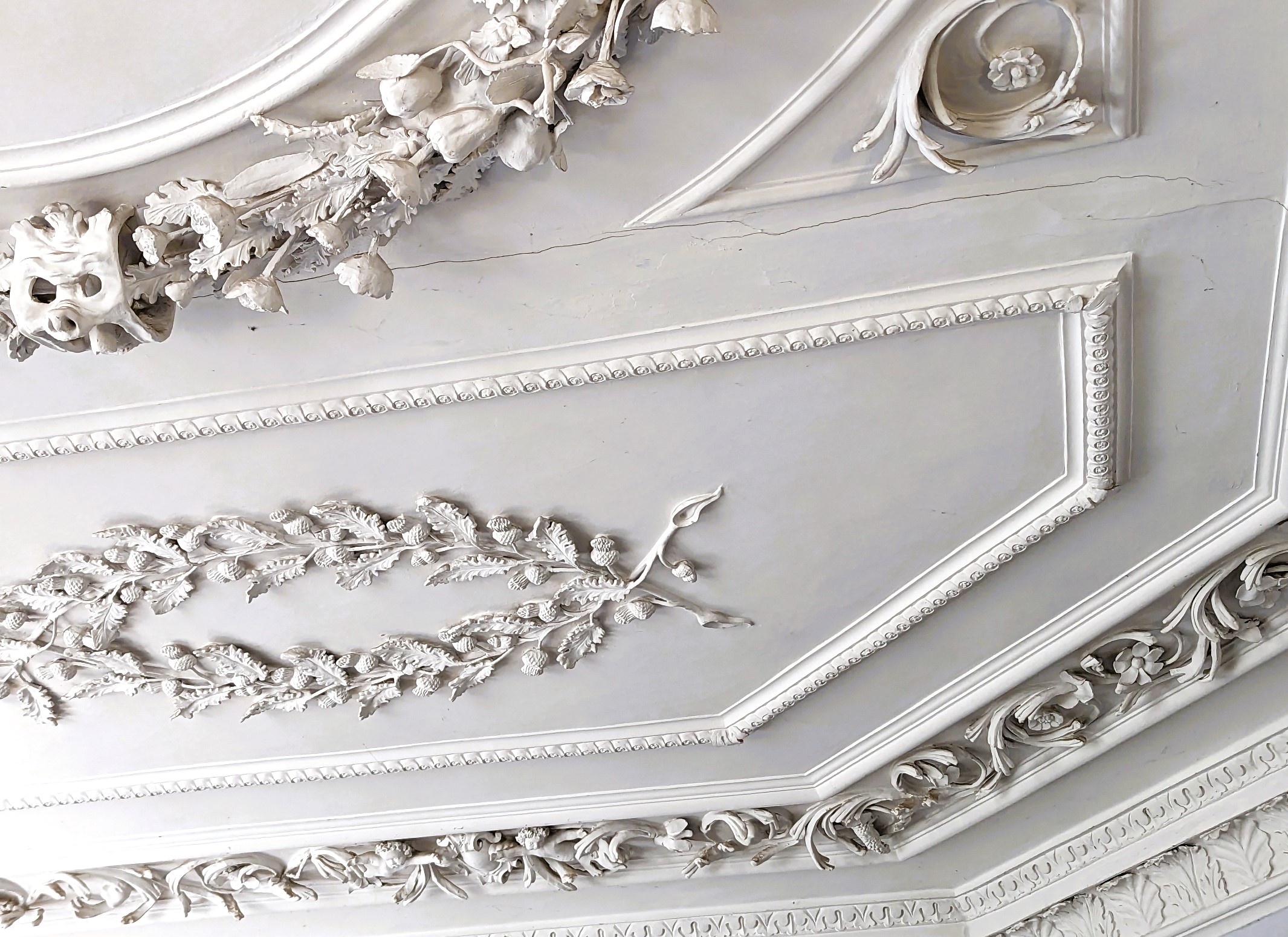
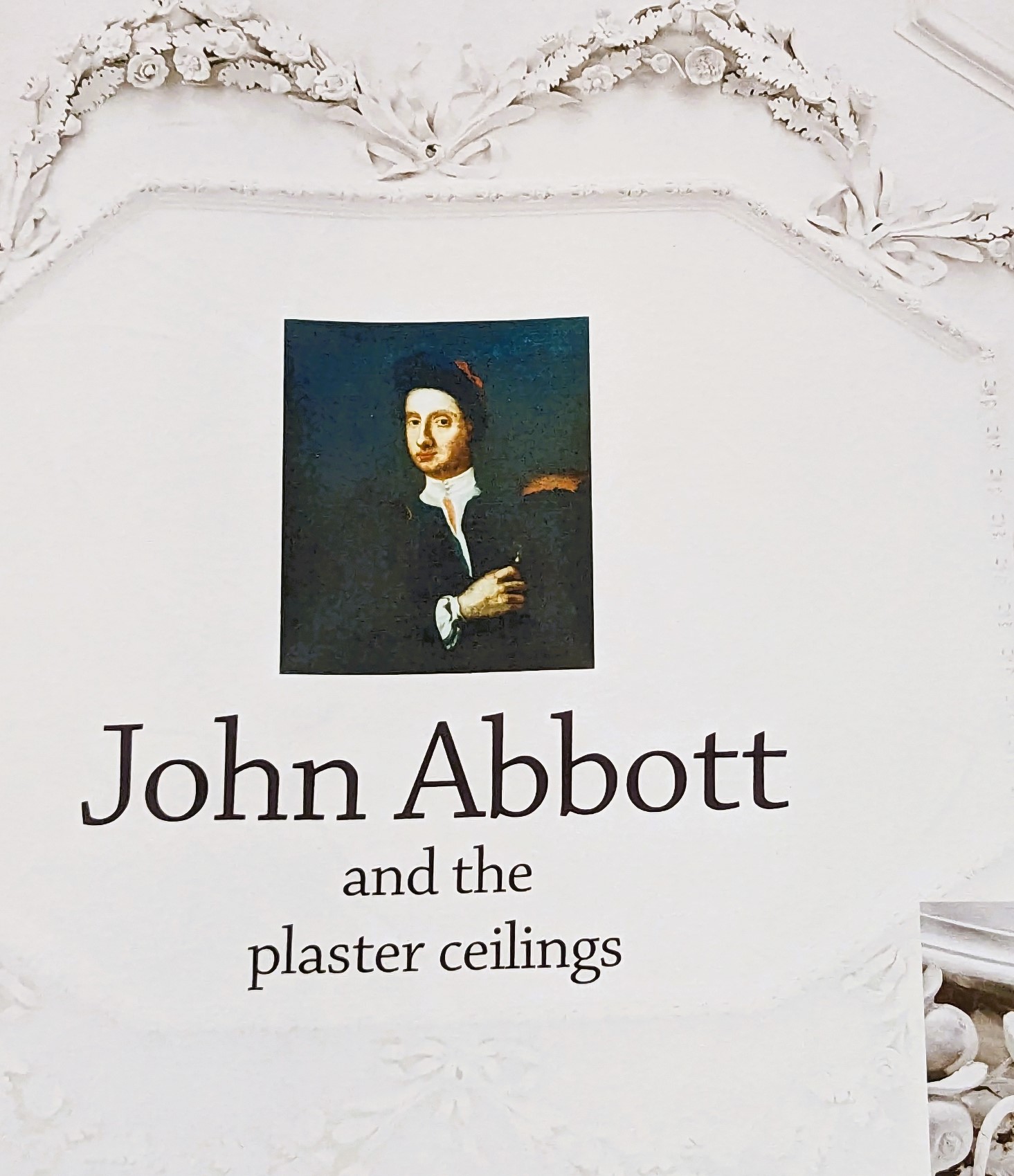
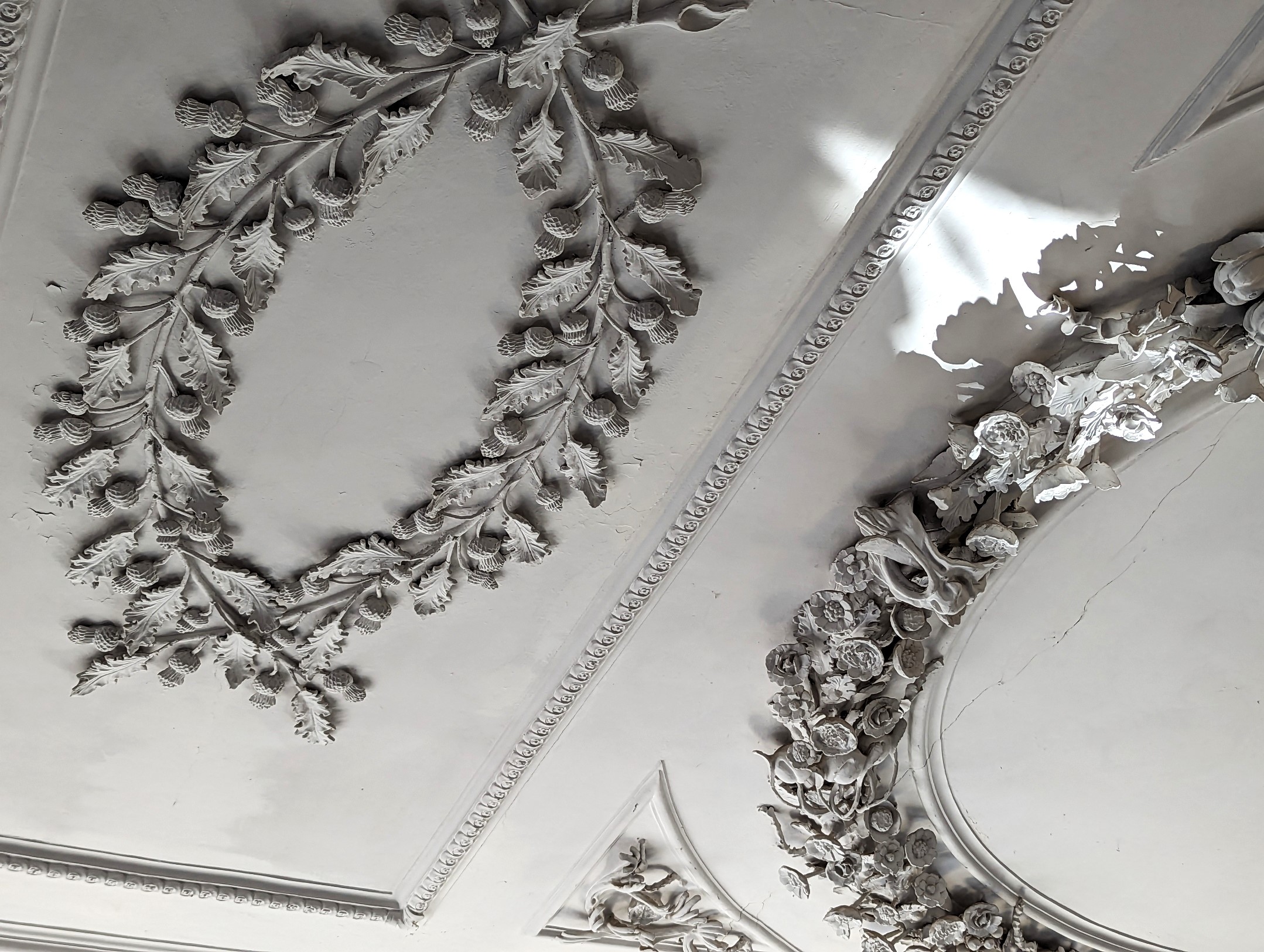
    The Customs House was the end of the tour. The building interior is renowned for the decorative ceilings under which clerks worked.

    Bristol

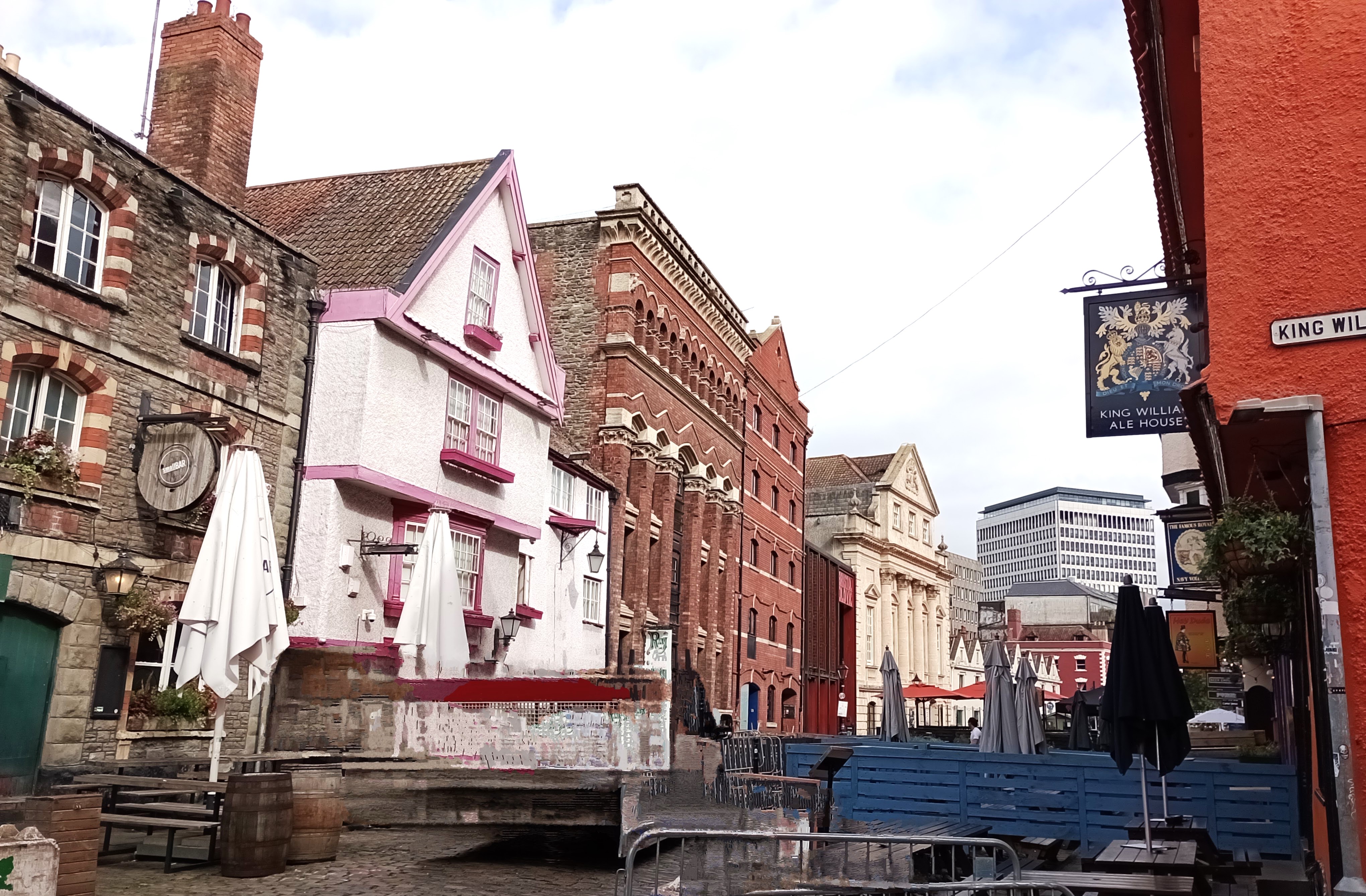
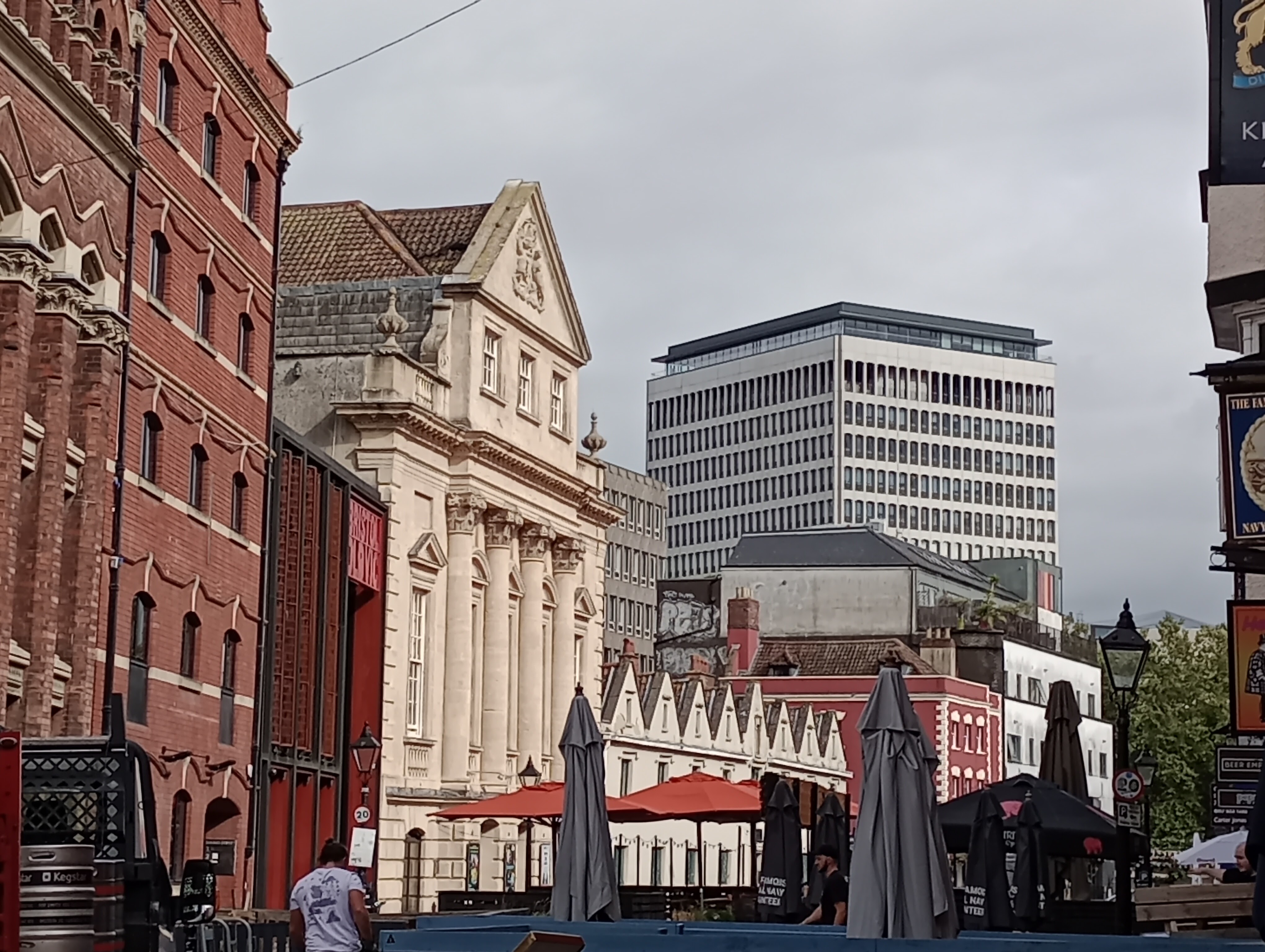
    We visited Bristol for three nights, not a good choice. The city seems quite disorganised and it was difficult to plan our stay. On my previous visit it was marvelous to see some of the features, such as the mausoleum, that Barbara Pym included in her novel, A Few Green Leaves, and the Clifton suspension bridge. Barbara Pym worked in censorship, which was located in Bristol, during WW2, making this a city of interest to me.

    Wandering around the city – referred to the old town in some written material but meaning little to long term inhabitants of Bristol! Anyway …

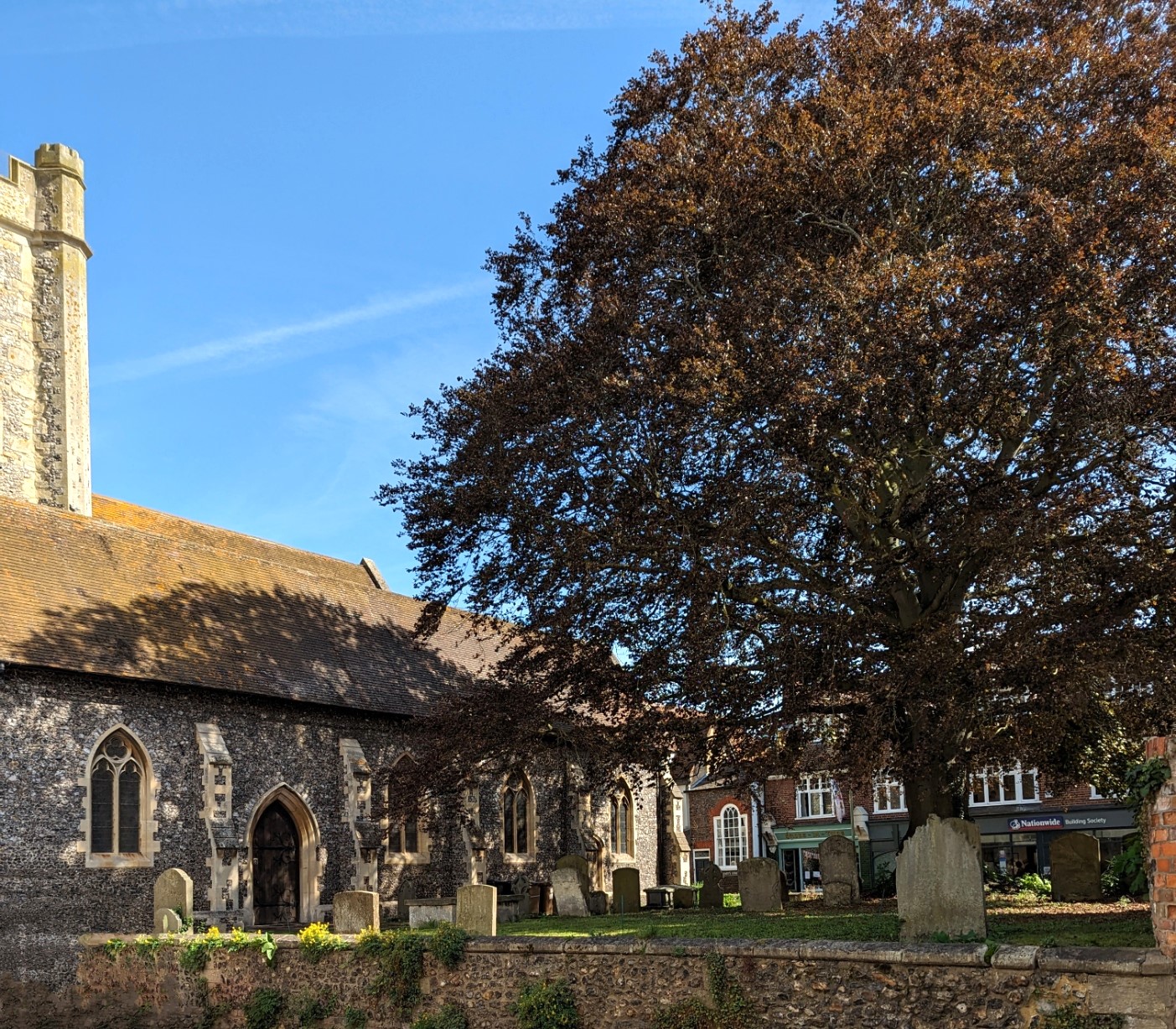
    St Mary’s Church was a magnificent sight on our walk from the hotel into the city.

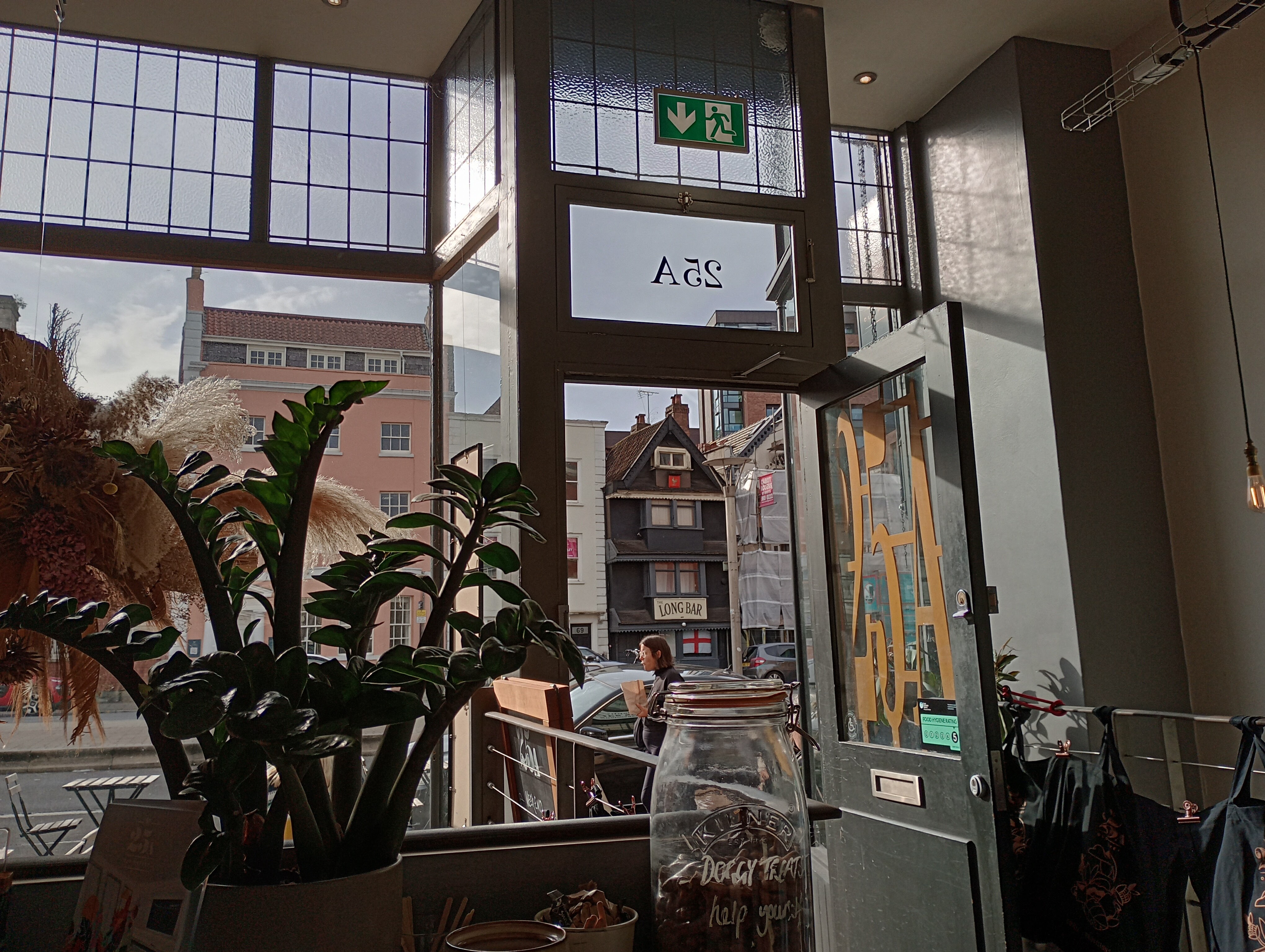
    We also found a lovely bohemian coffee shop nearby – evidently to those who know in a very insalubrious street, but it was a very attractive site during our morning walk.

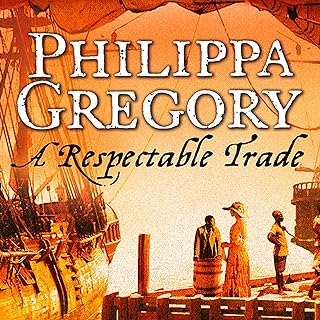
    However, even thoughts of Treasure Island and the Hispaniola with Jim Hawkins and Long John Silver leaving Bristol for the island are not enough to encourage me to visit again. And of course, Philippa Gregory’s A Respectable Trade with its horrendous story of slavery depicts another aspect of Bristol.

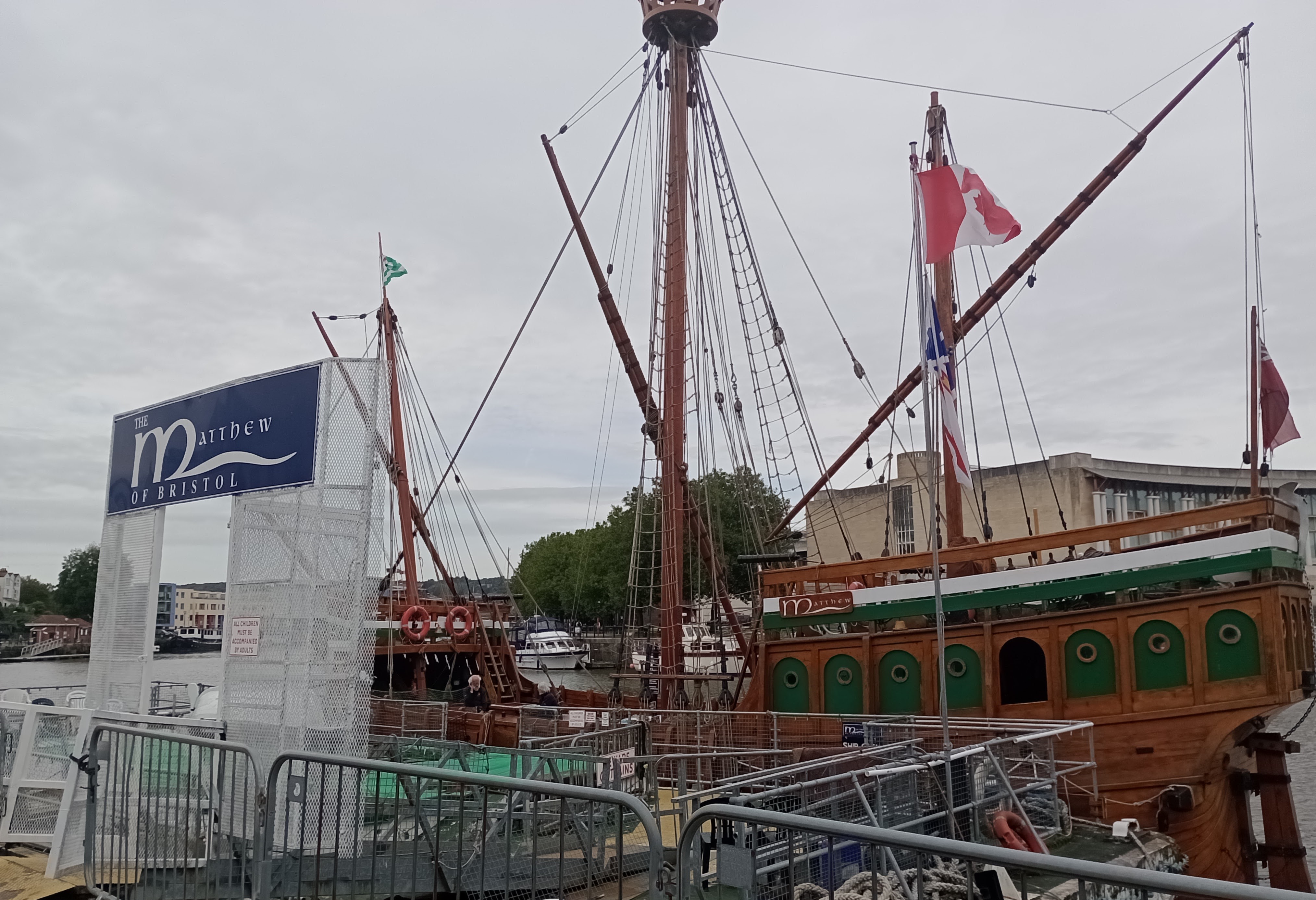
    The positive part of our visit was meeting up with a Barbara Pym friend and discussing the BP conference I attended at the start of my UK visit. We met at the arts centre, enjoying its good bookshop and a coffee before a walk along the quay. Here we saw a statue of John Cabot who sailed with eighteen men from Bristol in 1497 to America in the Matthew – also pictured below.

    London

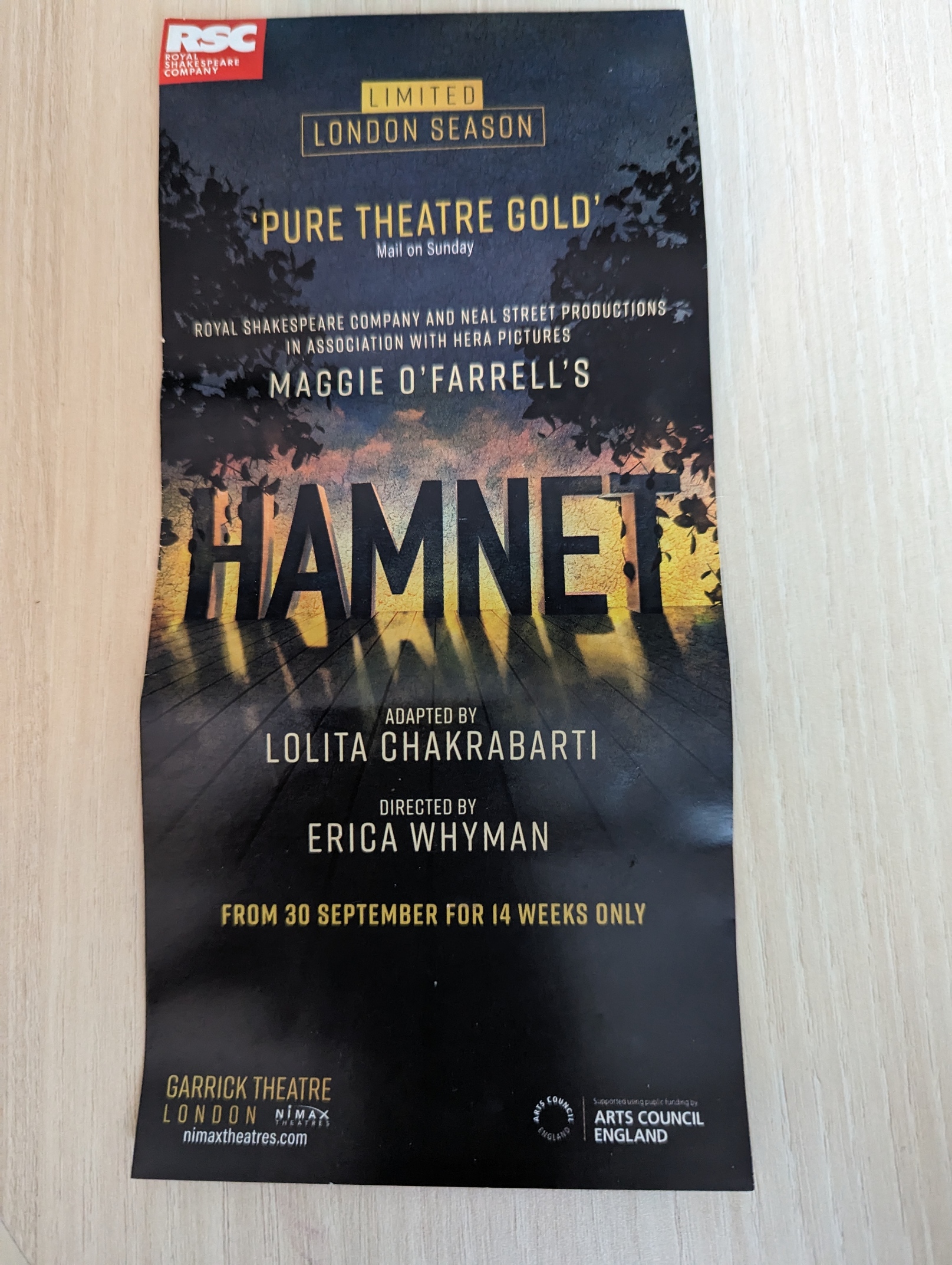
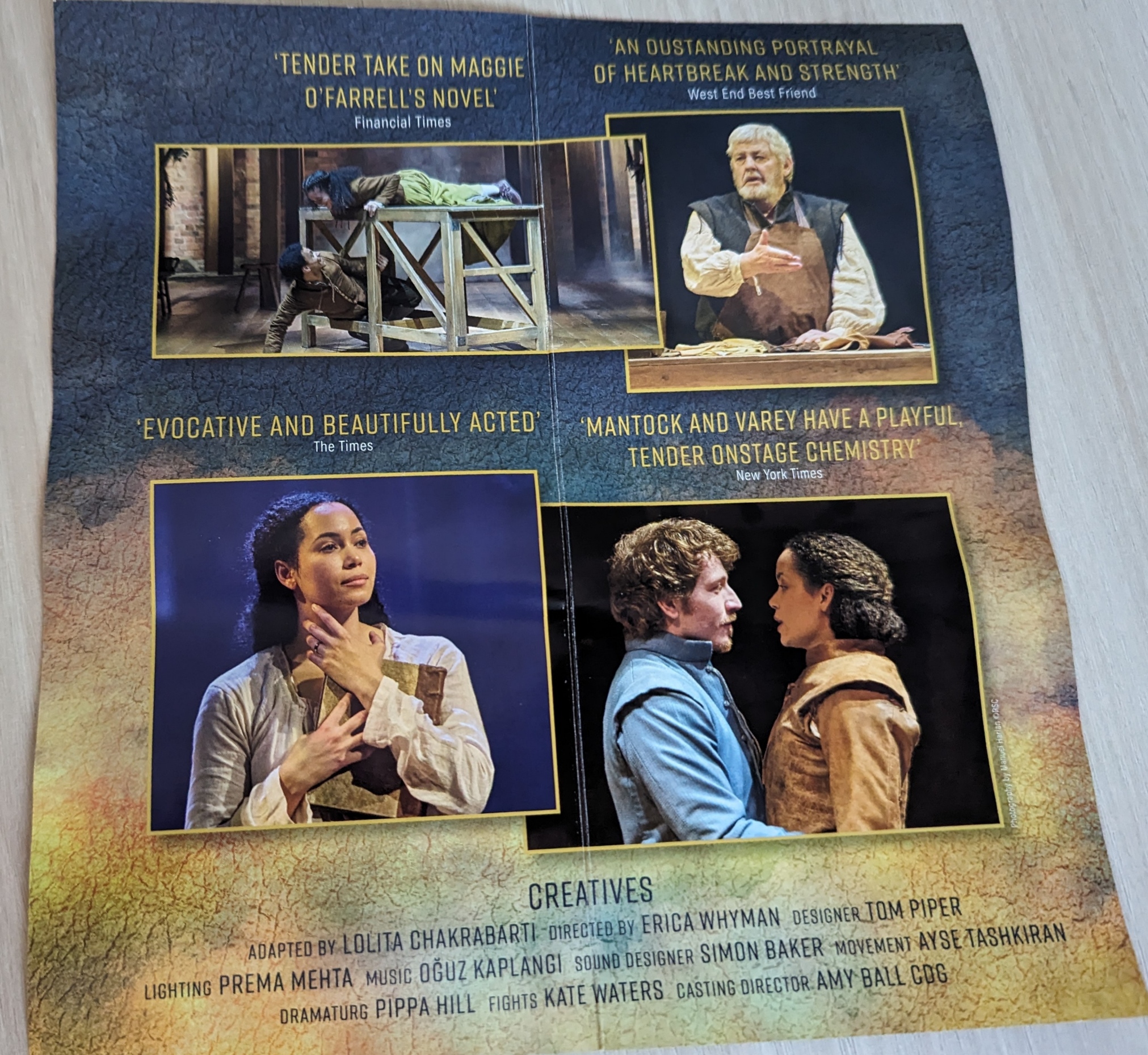
    We were pleased to be able to see Hamnet, a play based on Maggie O’Farrell’s book of the same name. This was a splendid rendition of the book and its themes. O’Farrell has looked at the way in which the Shakespeare parents dealt with Hamnet’s death, their strengths and weaknesses, apparent throughout Act 1, highlighted with the death of their beloved son. The role of creativity and the strength needed in both childbirth and writing are featured, each partner’s inability to see the value and importance of the other’s creation until they are forced to do so. The end of Act 2 brings together this realisation as Anne (Agnes) watches Shakespeare’s Hamlet.

    As usual, we went to a Sunday Recital at Wigmore Hall. Wigmore Hall is a short walk from Paddington where we were staying in between forays into Cambridge and then our trip around the south. The Sunday Recital is an hour, followed by sherry. And for us, a walk into Oxford Street or nearby for lunch.

    I was also pleased to have lunch with an author I have long admired, Zoe Fairbairns. Her novels, Benefits, Stand We at Last, Daddy’s Girls, Here Today, Closing and Other Names are excellent reads from a feminist writer. I met Zoe when I interviewed her for my work on Barbara Pym. We meet every time I visit London, enjoying our lunch at Sicily, an Italian restaurant near Victoria Station. The first time I met Zoe was to interview her, for my book, The Reality behind Barbara Pym’s Excellent Women: The Troublesome Woman Revealed, published in February this year. My lunch discussion was not as intense but ranged over feminist issues as well as some comfortable domestic chat.

    Excerpt from The Reality behind Barbara Pym’s Excellent Women: The Troublesome Woman Revealed

    My interview with the feminist writer Zoë Fairbairns led into a discussion of the use of the term troublesome woman. Her concerns are that with a structure such as patriarchy, which is deliberately designed to disadvantage women, men’s capacity to take advantage of women is troublesome to women. She says ‘there is a limit to the extent to which I want to [place] men as the mainstream and women fighting against it. Sometimes it’s just about women wanting reasonable human rights and men, quite rightly, seeing that as a threat.[i]

    Fairbairns’ statement illuminates the difficulties in addressing women’s refusal to conform and negative interpretations of their behaviour. Fairbairns correctly suggests that patriarchy disadvantages women and their reaction to the conventions it upholds is understandable. It is also difficult to deny that patriarchy relies on the understanding that men and the conventions that support them are the mainstream. Their cause is valid but women’s challenge to convention draws them necessarily into a fight against the mainstream as dictated by patriarchy. Women’s refusal to accept patriarchal constraints on their freedom in their efforts to develop their world to their liking is not a particularly dramatic or violent demand. Pym’s women’s behaviour is also neither dramatic nor violent. Nevertheless, they are troublesome women who raise difficult questions about sexual inequality and its consequences. They are troublesome in a patriarchal society in which inequality is not only acceptable but also reinforced by institutions that are considered a bulwark. Men’s status relies on women accepting a subservient role in institutions such as marriage, professions, and the church – the institutions that Pym’s central women characters question. Feminist writers, in giving a voice to women’s rebellion, validate their demands and concerns. Pym’s treatment of spinsters is particularly important in assessing the feminist nature of her writing. She creates spinsters and women in conventional occupations and roles, writing them into the mainstream while questioning its values. Rather than a reality, it is the perceived threat experienced by men, and women who believe that patriarchy serves them well, that creates an impression of women’s rebellion as troublesome.

    The trouble that arises when women’s traditional roles are questioned provides a valuable framework for examining Pym’s work because, wherever women move outside the boundaries considered appropriate in the historical context in which they operate, they are seen as troublesome. One of the boundaries challenged by Pym’s women characters is marriage, which like trouble, is a constant in women’s lives. Whether they are seeking it, avoiding it, involved in it or deprived of it, marriage is used as a way to define women’s status. [i] Zoë Fairbairns, Interview, Joyce, London, 2001.


    Edited reference in Goodreads: Stand We at Last Zoë Fairbairns. Follows the fortunes and quests for independence from Victorian England to 1960s America and England, of five generations of women, beginning with the courageous struggles of sisters Helena and Sarah. Genres: Historical Fiction, Fiction, Feminism. First published January 1, 1983.

    Week beginning 26 October 2023

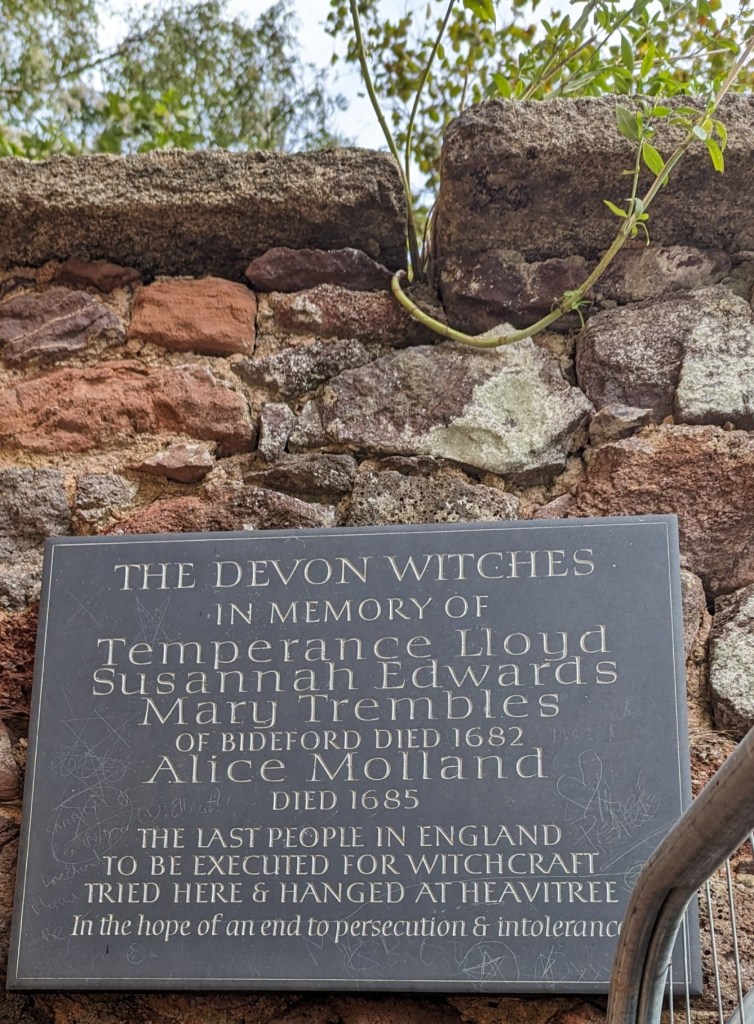
    The plaque dedicated to the Devon Witches is placed on the wall of the castle in the Rougemont Gardens, Exeter. Unfortunately, the plaque has been partially obscured by a fencing around buildings associated with work taking place at the gardens. When I saw the plaque (taking the photo required scrambling around a large truck and the fencing) I recalled the book by John Callow, The Last Witches of England A Tragedy of Sorcery and Superstition, that I reviewed early in this blog. The first paragraphs are repeated here.

    John Callow The Last Witches of England A Tragedy of Sorcery and Superstition Bloomsbury Academic 2022

    See the source image

    Thank you, NetGalley, for this uncorrected proof in exchange for an honest review.

    This is a well-designed narrative, following the steps by which the last witches in England became the victims of poverty, changing social and religious ideas, and their impact on the development of superstition in Bideford, England. Each chapter adds a detailed and engrossing ‘block’ to the result, an adept building of events that lead to the acceptance that three women, Temperance Lloyd, Susanna Edwards and Mary Trembles were witches, and the punishment meted out. Although I did not find the strong feminist account that I had expected, and my reason for requesting this book, I was impressed by the enterprise with its sheer avalanche of detail of the lives and events following ‘The magpie at the window’ prologue. In relation to my expecting a feminist approach, Callow has reservations, and criticisms of 1970s and 1980s feminist accounts.  Nevertheless, I found this an engrossing alternative view, with some understanding of women’s position, worth reading alongside more orthodox feminist readings of the events. Certainly, women’s involvement in the persecution of witches, recounted by Callow, is a good start to any debate. However, it is also imperative to remember that it was powerful men who managed the cases against the accused women.  Again, Callow also draws attention to the way in which the various cases against the women were conducted, with a range and outcomes for those involved. I would like to reiterate – a debate, of which this book is a worthy part.

    First appeared on Books: Reviews on December 15, 2021.

    After the Covid update: Bath visit continued; Exeter visit; YES Referendum lost; Lousia May Alcott.

    Covid update ACT

    There were 298 new cases this week, with 18 people hospitalised with Covid. No cases are in ICU or ventilated. There have been no lives lost to Covid this week.

    Hand sanitisers remain available in many stores and shopping centres. Few people are wearing masks in the ACT. In London a few people are wearing masks on the tube. I saw a couple of people with notices on their clothing stating that they have comprised immunity and requesting others to maintain social distancing.

    Bath visit continued

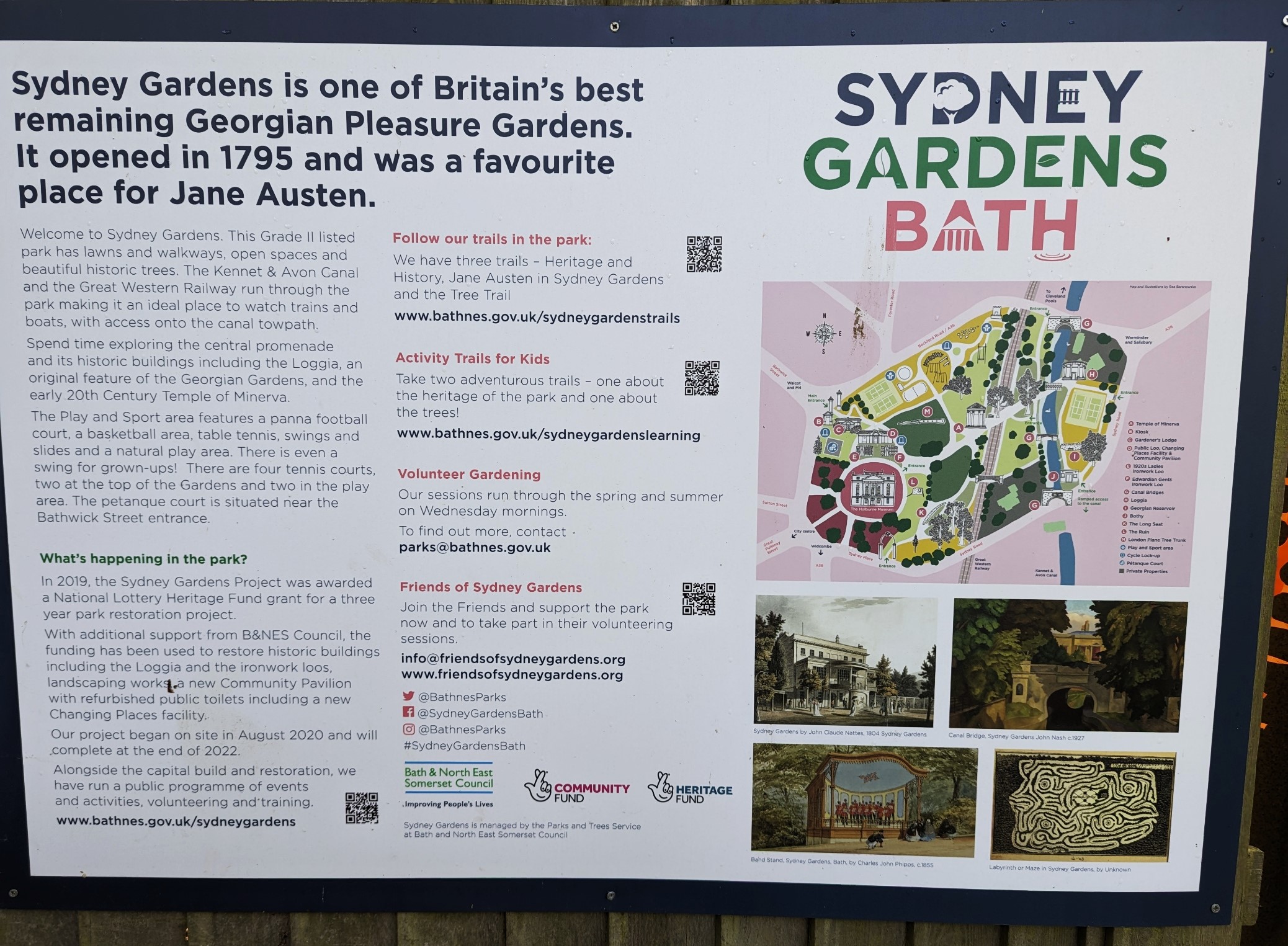
    Our accommodation in Bath was at the Apex Hotel, a short walk from the cinema, shop and restaurants as well as the tourist sites associate with Jane Austen and her novels, and the baths.

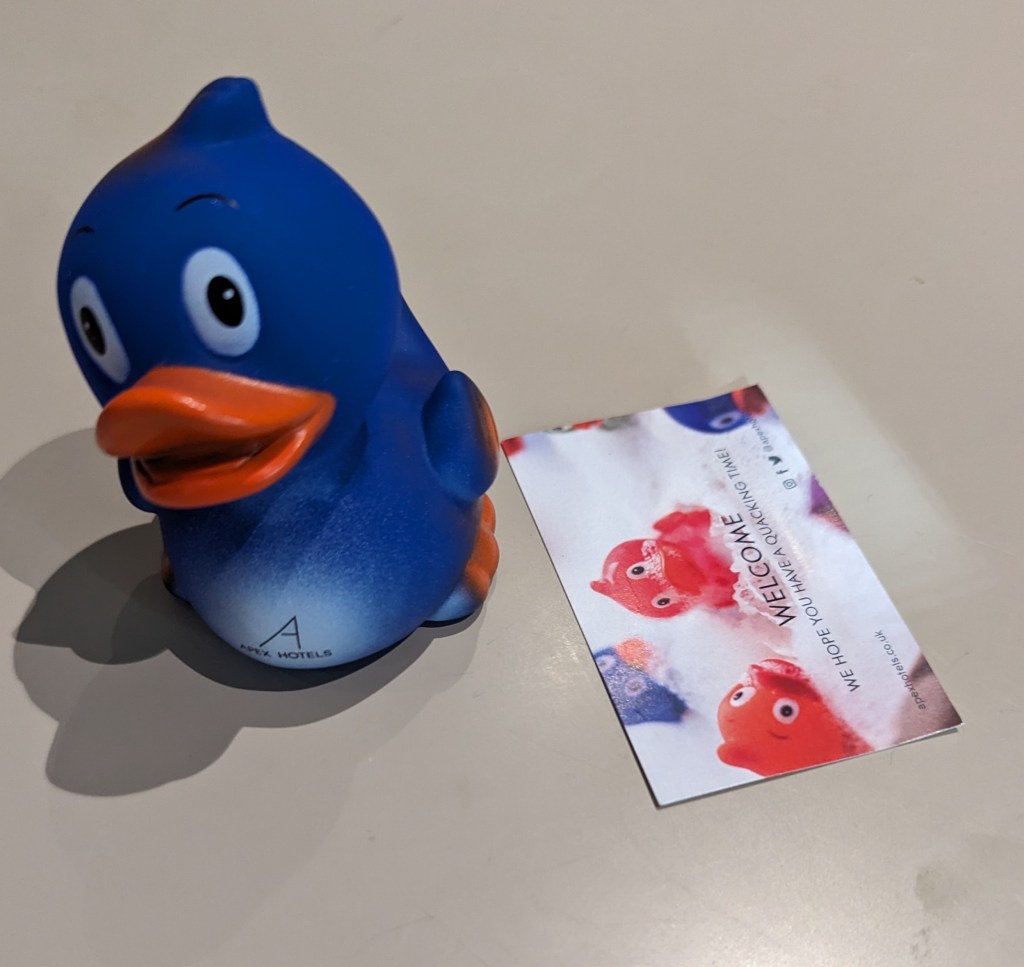
    Associated with the hotel in Bath is its range of ducks. One is left on the bed with the towels and is to be taken to advertise the hotel chain. Its QR code actually worked so I know that its name is Oliver, and about the other locations. So, I’ll advertise. Although we were unable to check in as early as planned, the remainder of the stay was very good indeed.

    We chose to walk around some of the sites that we have not visited before, so no Jane Austen house or baths.

    The tiny Pultney Bridge Coffee (the building is extremely narrow, located on the river side) provided us with morning tea and Bill’s with a more exotic evening meal.

    Very unlikely to be associated with Jane Austen (see Books: Reviews, Sue Wilkes, 24 February 2020: Jane Austen’s England) is the recycling service in one street in Bath. such small receptacles suggest that collections take place fairly frequently.

    Exeter visit

    Exeter provided a wonderful three days’ activities. Although the hotel was a walk from the city centre, in a location that did not inspire confidence, and small things went wrong, the staff was excellent.

    We had a wonderful afternoon in the Rougemont gardens – the castle can only be peered at through a heavy gate, and after all, there are so many castles why concern ourselves with this one?

    In fact, we concerned ourselves with none, although we’ve particularly enjoyed Leeds Castle in the past.

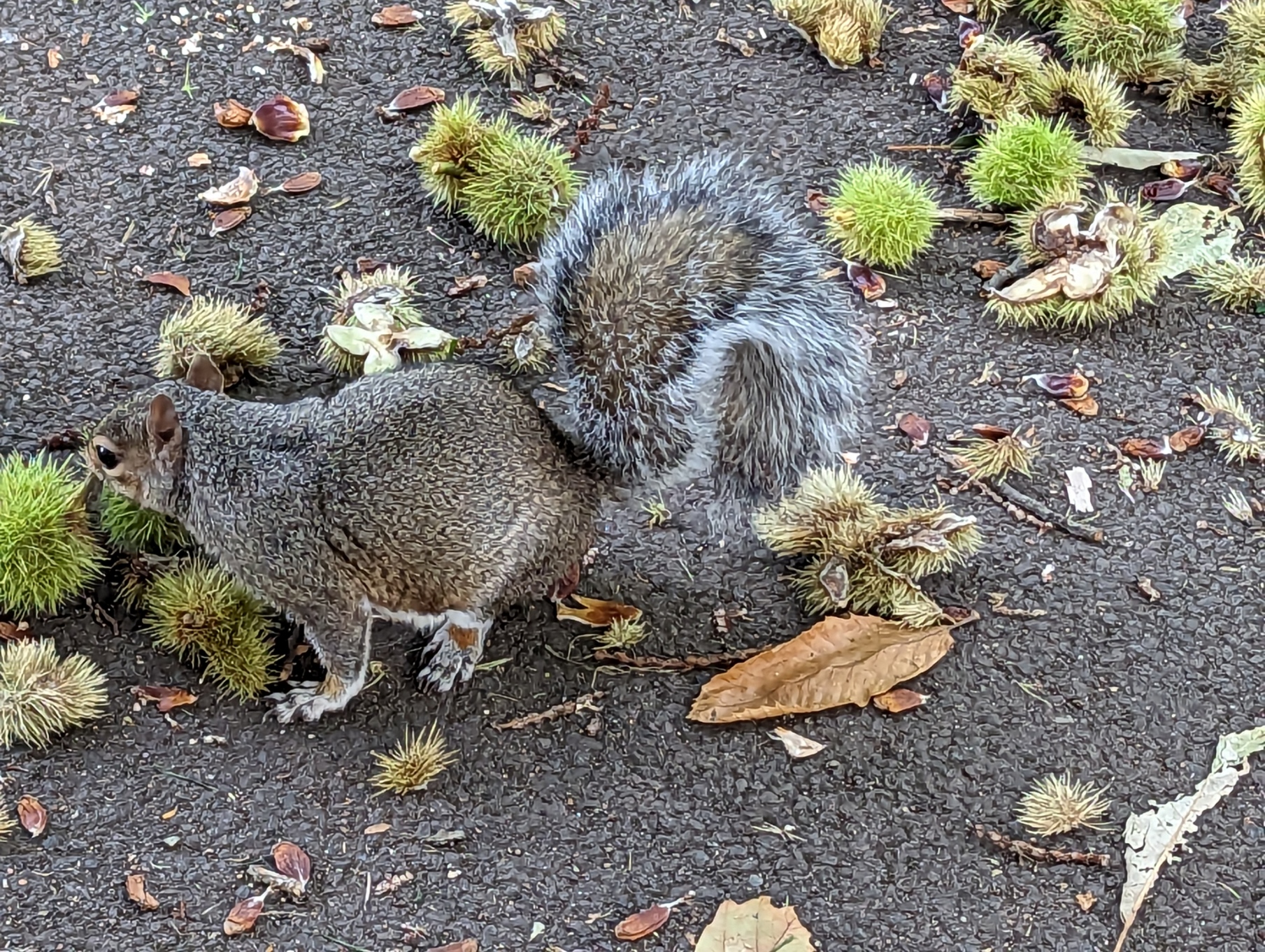
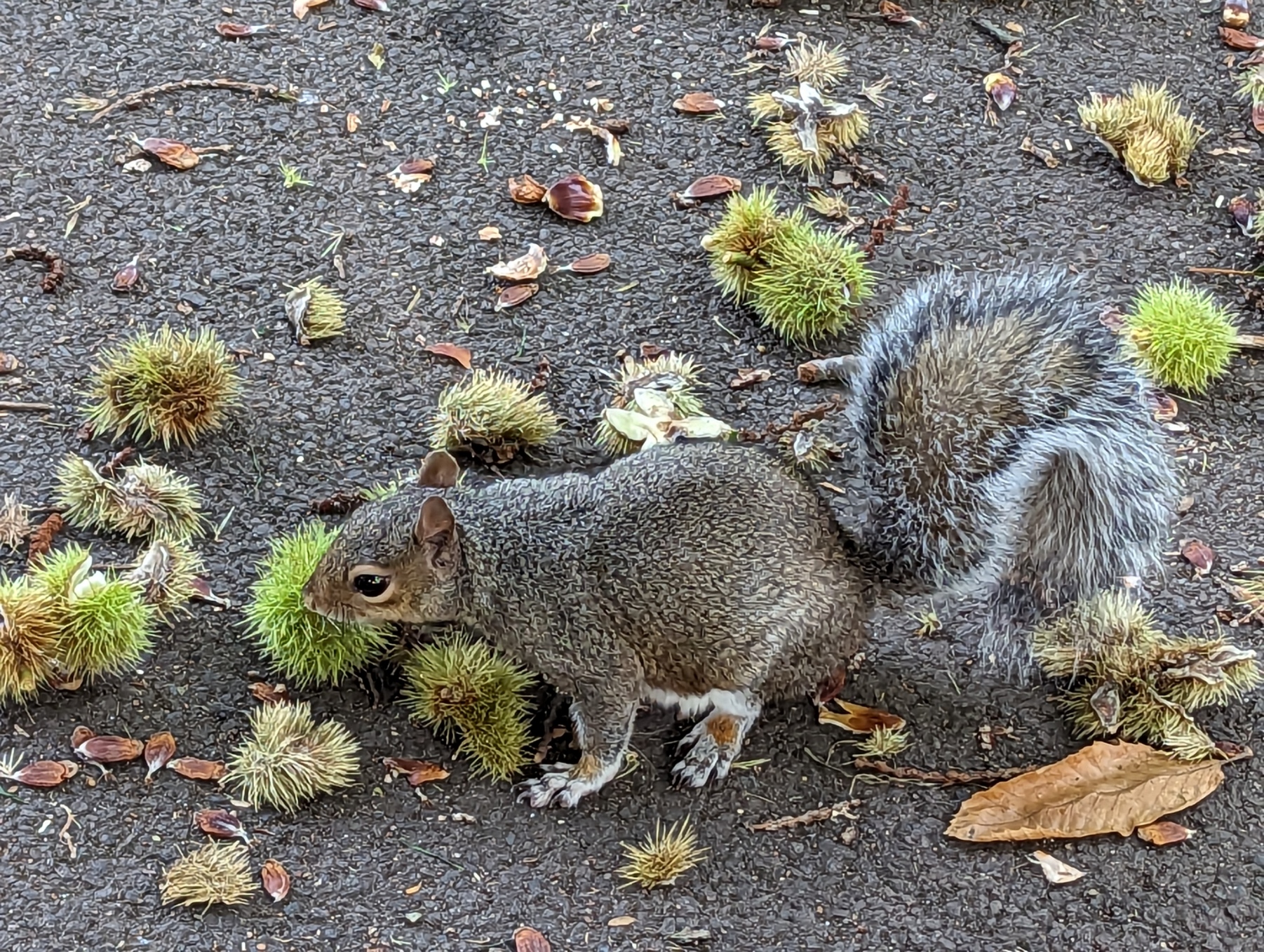
    More picturesque than the Apex duck is the squirrel prancing around in the Rougemont gardens in Exeter, totally unfazed by our proximity as it chewed open the chestnuts from the trees in part of the gardens.

    More on Exeter next week, and comment on our short trip to Bristol – then, return to London for ten days before flying home.

    Excerpts from ABC coverage early in the night: The Voice to Parliament referendum was defeated.

    The referendum was defeated — a result that was declared quite early in the evening.

    ABC analysts Antony Green and Casey Briggs called the result at 7:25pm AEDT — a little more than an hour after polls closed in most of the eastern states. 

    Australia has voted No to enshrining an Indigenous Voice to Parliament in the constitution, with all six states projected to have rejected the proposal along with the total national vote.

    But the vote hasn’t been uniform across states and cities. A small number of electorates, mainly in inner cities, are projected to have voted Yes.

    ABC maps show those differences, revealing how disparate communities feel about this referendum question. See: What was the result in your state or electorate in the Voice referendum? Here are the results from each region, By Casey Briggs, Posted Sat 14 Oct 2023 at 8:23pmSaturday 14 Oct 2023 at 8:23pm, updated Sun 15 Oct 2023 at 1:22am

    Little Women

    Louisa May Alcott’s Little Women was on my mind as I began watching the film on the flight home from London. The film was directed by Greta Gerwig, and starred Saoirse Ronan, Emma Watson, Florence Pugh and Meryl Streep. It is described as ‘Jo March reflects back and forth on her life, telling the beloved story of the March sisters – four young women, each determined to live life on her own terms.’ The following article, from Literary Hub, therefore caught my attention this week.

    Nonfiction That Rivals Little Women: The Forgotten Essays of Louisa May Alcott

    Liz Rosenberg on the Literary Marvels of Alcott’s Memoirs

    By Liz Rosenberg October 24, 2023


    Louisa May Alcott is best known for Little Women, of course, her classic American novel for young readers—but she earned her first taste of celebrity as an essayist. That should surprise no one. Her writing genius defied genre. In many ways, her finest essays are even more brilliant—more consistently brilliant—than her novels and stories. Three of her non-fiction pieces alone—”Going Out to Service”; “Transcendental Wild Oats”; and “Hospital Sketches”—are, as they used to say in Charles II’s day, worth the price of admission to all the rest. Anyone who has read and loved her novels will recognize her characteristic style, energy and wit.

    Louisa May Alcott was born to a family of high idealists—lovers of equality, ideas, and books. Her first playthings as a toddler were her father’s volumes from his private library. She learned to express herself and share her observations of the world in the childhood journals her parents required her to write. These provided a habit of writing, and also fodder for novels, stories and non-fiction to follow in time.

    In her earliest writings  she identifies and scorns hypocrisy—especially when it harms the poor, the helpless, and the young. By her teens, she exercises the eagle eye of a reporter. For instance, she describes the highly-respected Julia Ward Howe, author of the American anthem, “Battle Hymn of the Republic” as a “straw colored supercilious lady with pale eyes & a green gown in which she looked like a faded lettuce.” Her Boston relations would have been appalled had they read her notes.

    Louisa sharpened her literary tools in those diaries and letters—and by the time she was writing essays she’d begun to truly hone her craft. One of her literary idols was Charles Dickens. She modeled the family “newspaper” on his Pickwick Papers, shared his empathy for the downtrodden, and learned from him to pay close attention to and bring readers to love even her most minor characters.

    Alcott played a supporting role in her own family, shaped in the shadow of her eccentric philosopher father. Bronson Alcott stood tall among the founders of American Transcendentalism and Louisa’s first teachers and adult friends included great figures like Ralph Waldo Emerson, Henry David Thoreau, Margaret Fuller, and Nathaniel Hawthorne. No one could have had a more exalted education. Emerson loaned her books from his library and Thoreau became her first natural science teacher, escorting the four Alcott sisters on walks and canoe rides, pointing out the flora and fauna (and more fancifully, the fairies) of New England.

    Alcott began to write seriously in early childhood. She composed her first poem, “To the First  Robin” when she was eight. By the time she was fourteen, she was given the great gift of her own room and desk. As a teenager she wrote anything and everything—stories, romances, news articles for the family paper, comedies, melodramas, poetry and plays.In many ways, her finest essays are even more brilliant—more consistently brilliant—than her novels and stories.

    Her earliest “real book,” as she called it, was Flower Fables published in December, 1854; a collection of fairy tales written for her pupil Ellen Emerson, the daughter of Ralph Waldo Emerson. Inscribing the very first copy to her mother, Louisa made an apology and a promise: “I hope to pass in time from flowers and fables to men and realities.” One of the ways she kept her promise  was by writing autobiographical essays about even the grittiest “realities.”

    In one of her earliest essays, “Going Out to Service,” Alcott records her labors as a young, naïve and  over-worked domestic servant. When Alcott was about fifteen, her mother began an informal employment agency geared to help the poor. Louisa became one of her early “clients,” going out to keep house for a miserly lawyer in Dedham. Alcott’s sympathies always lay with under-appreciated and underpaid female workers, and the roots of her sympathy may have begun with her own difficult  experiences “in service,” shoveling snow, cooking, cleaning, hauling water and chopping wood. There is nothing glamorous about her character in the piece. Most authors would hesitate to show themselves in such a humble and humbled light.

    Yet the piece is as deft as anything she ever wrote. Alcott’s  sanctimonious minister-employer  proves to be a liar, glutton,  and predator with designs on the poor young author. “[H]e presented me with an overblown rose, which fell to pieces before I got out of the room, pressed my hand, and dismissed me with a fervent “God bless you, child. Don’t forget the dropped eggs for breakfast.” Part of the tragicomedy is that the innocent narrator doesn’t see his misbehavior coming—but the reader does.

    The narrator seems to leap right out of a Jane Austen novel. She sees but does not understand  what lies ahead. “He possessed an impressive nose, a fine flow of language, and a pair of large hands, encased in black kid gloves.” Those large hands “encased” in black kid gloves are also the stuff of gothic horror—at which Alcott also excelled.

    An aspiring, unknown Louisa Alcott presented “Going Out to Service” in 1861  to Boston’s most distinguished publisher, James Field of newly-created Atlantic Monthly.  He glanced through the piece and  dismissed her with a condescending “Stick to your teaching, Miss Alcott. You can’t write.” To add insult to injury, her offered her forty dollars as a loan to start her own school. Luckily for us all, a quiet young editor named Thomas Niles sat beside Fields during this interview, listening in. Years later, he commissioned, edited, and published her novel Little Women.

    Her first taste of significant success came from a book-length memoir about her time as a Union war nurse. Alcott’s autobiographical “Hospital Sketches” captured  the attention of a reading public hungry for news of the American Civil War. But it was not written with an eye toward fame. Culled from letters home and journal notes, Alcott thought it a hodge-podge of sketches, unlikely to interest anyone.

    She was more shocked than anyone when it became a popular sensation. First published  in serial form and later  as a book, (1863) “Hospital Sketches” provided rare on-the-ground reportage of the long, bloody conflict from a war nurse’s perspective—a thing  unheard of at the time. Her non-fiction was sometimes severe, and always strived to be real—even when she included elements obviously invented.

    “Hospital Sketches,” this longest and most memorable work of non-fiction, features a Civil War narrator named “Nurse Periwinkle.” Nearly everything else in it derives from her actual personal history: Louisa did nurse sick and dying Union soldiers; she witnessed their arrival from the catastrophic battle at Fredericksburg. She served as head of the night ward after only two weeks on the job. In the Hurly Burly House hospital (again, only the name is changed) she came down with typhoid pneumonia that nearly killed her, and was heavily dosed with the wonder drug calomel, the mercury poison that likely did.

    Grateful nineteenth century readers found in “Hospital Sketches” their first real-life account of the solders’ experiences of the Civil War. Hers was new journalism before the phrase was ever invented—and readers embraced it. War news traveled northward slowly and unreliably. “Hospital Sketches” filled the gap for anxious Yankee families and friends. But Louisa expressed amazement at the book’s success. “I cannot see why people like a few extracts from topsey turvey letters written on inverted tea kettles,” she marveled. Only later did she admit that these autobiographical and realistic essays “pointed the way” toward her true writing material and style.

    Among her best essays, one of the last written  is Alcott’s autobiographical piece on her unhappy early childhood experience at a communal farm. Written in 1873, “Transcendental Wild Oats” alternates broad comedy with tragedy. It records in detail the near-dissolution of the Alcott family. They nearly froze, nearly starved. The commune even at its most populous was too small to succeed, and it housed eccentrics and bonafide lunatics equally. The utopian experiment was a dismal failure, for the commune and for the Alcotts personally, and at the end of it all Bronson suffered a breakdown.

    Surely these events were traumatic for a ten year old child, and this may partly explain why she waited so long to write about it, but in “Transcendental Wild Oats Alcott” never lingers on the psychological devastation. Instead of dwelling in the self-reflection more typical of memoir, she focuses on the characters around her and records the homely details of daily life—”unleavened bread, porridge, and water for breakfast; bread, vegetables, and water for dinner; bread, fruit, and water for supper”—leaving little room for disbelief.

    It must all be true, because it sounds true. Indeed that is part of her genius as an essayist and memoirist. She is as succinct as a newspaper reporter. Her prose canters along. She covers great distances in the fewest words.  There is no dilly-dallying. Alcott once advised an aspiring writer, “The strongest, simplest words are best.”Grateful nineteenth century readers found in “Hospital Sketches” their first real-life account of the solders’ experiences of the Civil War. Hers was new journalism before the phrase was ever invented—and readers embraced it.

    On more than one occasion she halted publication of her nonfiction because she felt it was not true, not deep enough. This happened with a linked series of European travel essays, written for a projected book called Shawl-Straps. Instead, the pieces appeared later in miscellaneous books like Aunt Jo’s Scrap-Bag, where the spare parts could find a place. The popularity of her “Hospital Sketches” had led to invitations for similar works of nonfiction. One collection intended as a travelogue of American places she cut short close to its start, fearing that writing superficially might become a bad habit. She refused to become an imitation of herself.

    Nor was she ever willing (or perhaps even able)  in her nonfiction to keep a straight face throughout, no matter how somber the subject matter. In her lighter tone—her tone, throughout all of her essays, is flexible—she captures, for example, the comic anxiety of the amateur traveler desperate not to lose important papers: “put my tickets in every conceivable place…and finish by losing them entirely. Suffer agonies till a compassionate neighbour pokes them out of a crack with his pen-knife.”

    Her essays are rich with unerasable moments, and as in her greatest works of fiction, they strike the intersecting point between tragedy and comedy. If she tugs on heart-strings in her essays—and most assuredly she does—she also demonstrates a clear awareness of the funny side of life.

    Alcott understood that habitual use of humor and exaggeration might incline readers to doubt the veracity of her non-fiction.  At the end of Hospital Sketches she urges the reader to believe what is only partly true: “such a being as Nurse Periwinkle does exist, that she really did go to Washington, and…these Sketches are not romance.” Her fiction found its roots in real-life experiences and her non-fiction always contained kernels of invention.  She largely shrugged off strict distinctions between fact and fiction.

    In her non-fiction Alcott spoke her mind, politically and otherwise, and incorporated into her writing her beliefs in abolition, suffrage and equal rights. She also wrote dozens of civic-minded minded letters, both privately and publicly, on issues important to her day. Newspapers provided a handy platform. One of her shortest pieces, “Happy Women,” published in a “Column of Advice to Young Women” on—of all days—Valentine’s Day, defends women’s inalienable right to remain single.

    Alcott herself, though she later became an adoptive mother to a niece and a nephew, never married. Her mother Abigail May Alcott had labored in Boston’s worst slums, campaigning tirelessly for healthier, safer working conditions for women, fair pay, equal opportunity. Louisa was an outspoken defender of the rights of women to vote, early and late. (She was also the first woman ever to cast a vote in her home town of Concord, Ma.) She shared her mother’s dedication to feminist causes and social justice.

    In her fiction for young readers she had become known as “The Children’s Friend.” Such accolades were both enriching (financially and otherwise) and limiting. Essay writing allowed her to say openly what her children’s stories could only suggest.  She had tried bringing her social conscience and philosophical beliefs into her adult fiction, only to find herself roundly condemned for thinking as she did—perhaps indeed for thinking at all.

    Fortunately for her future young readers, her “serious” literary fiction—which she’d believed was her destined format—was a commercial failure, coming into print only on the heels of the far more successful Hospital Sketches. That essay’s success was the main reason her literary novels were published at all.  Suddenly, Alcott became a viable commodity. Her first serious novel, Moods, published in 1864, earned tepid reviews at best and poor sales; her second, Work, published nine years later, fared no better.

    Even her more daring, gothic novels appeared only under a series of pseudonyms. Had any of these fully succeeded, we might never have had Little Women, nor any of its successors. As it was,  Alcott tumbled into children’s literature—or was pushed into it, by Thomas Niles, the young editorial assistant who had seen her early essay “Going Out to Service” rejected out of hand.

    In the 1860s and 70s a new pseudonymous “Oliver Optic” series of books for boys flooded a new market and Niles wanted to test the publishing waters for girls, believing there was a vacuum waiting to be filled. He used a blend of charm, encouragement and family pressure to persuade Louisa to try her hand at a girl’s novel. Privately she noted in her journal, “I plod away, though I don’t enjoy this sort of thing. Never liked girls or knew many, except my sisters; but our queer plays and experiences may prove interesting, though I doubt it.” The one saving grace, she believed,  was the story’s reality: “we lived it.”

    Autobiographical essays such as “How I Went Out to Service,” “Hospital Sketches” and “Transcendental Wild Oats” are closer in tone, style, voice and subject matter to Little Women than any of her early fiction, including her many gothic romances and the two serious novels. If one wants to see the author of the March family chronicles in the making, one need look no further than into those three exceptional essays. The published thrillers such as A Long Fatal Love Chase sound nothing like the author beloved in young people’s books like Little WomenLittle Men, and Jo’s Boys.Autobiographical essays such as “How I Went Out to Service,” “Hospital Sketches” and “Transcendental Wild Oats” are closer in tone, style, voice and subject matter to Little Women than any of her early fiction, including her many gothic romances and the two serious novels.

    But the essays certainly do. Even if they were not the literary jewels they are, they would be worthy of attention. It’s not often that we get to see a great author coming into her own before our eyes. The essays also give further proof of her indefatigable energy. Nothing but death and dying could slow her down.

    As a young woman Alcott wrote for ten and twelve hours a day, in addition to her other labors. Later, after her stint as a war nurse,  she wrote with an aching arm, or painfully swollen leg propped up on a stool. Mercury poisoning from the “miracle cure”  calomel she’d been given, slow and insidious, had begun to take effect. The writing “machine,” as she called herself, labored to keep producing. She published not only to express herself, but to earn money to keep “The Pathetic Family,” (her private name for the Alcotts) afloat. She could not afford to sentimentalize or write lengthy and rambling descriptions; or to hold forth like  her father. She knew she must “please the public or starve.”

    As a woman and as an author, Alcott was a force of nature. She worked incredibly long hours for years—scrubbed and sewed through the night, cleaned and cooked, taught school, walked miles to get where she needed to go—while also writing her own material in every possible genre  hours a day. None of non-fiction was ever intended to be her “real” work—that ambition she reserved for her unsuccessful literary adult novels.

    But the warm reception of her essay “Hospital Sketches” gave her confidence to trust her own voice and material. Without that “hint,” as she called it,  she never could have written Little Women.  It proved to her that people love truth as well as invention. Under the most challenging circumstances, she kept on writing, celebrating the good and calling out the bad. She rejected sentimentality and self-pity in an era that encouraged both, especially for women who were expected to faint away at the first obstacle. That was not Louisa’s way. “I was there to work, not to wonder or weep….”

    ______________________________

    A Strange Life: Selected Essays of Louisa May Alcott - Alcott, Louisa May

    A Strange Life: Selected Essays of Louisa May Alcott is available via Notting Hill Editions.

    A Long Fatal Love ChaseA Strange Life: Selected Essays of Louisa May AlcottAunt Jo’s Scrap-BagCharles DickensCivil WarEllen EmersonessaysFlower FablesjournalismJulia Ward HoweLittle WomenLiz RosenbergLouisa May AlcottMoodsNotting Hill EditionsPickwick PapersRalph Waldo Emersonwork

    Liz Rosenberg
    Liz Rosenberg

    Liz Rosenberg is the author of two biographies on women authors: House of Dreams: A Biography of L. M. Montgomery and Sorrows, Scribbles and Russet Leather Boots: A Biography of Louisa May Alcott. She is a Chancellor Award-winning professor of English at the State University of New York at Binghamton, and the author of numerous prize-winning books of fiction, poetry, and works for young readers. She lives in Binghamton, New York.


    Week beginning 19th October 2023

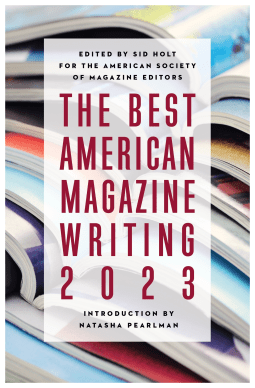
    This week I review American Magazine Writing which I mentioned briefly in the previous blog. The collection was sent to me by NetGalley for review.

    Sidney Holt (ed.) American Magazine Writing Columbia University Press 2023.

    The introduction is written by Natasha Perlman, executive director, Glamour but does not appear in this uncorrected proof. The list of contents provides an overview of the topics that are covered, as well as the magazines which offered the prizes around which this collection focusses: ‘The Battle for Baby L.’ Rozina Ali (New York Times Magazine); ‘She Never Hurt Her Kids. So Why Is a Mother Serving More Time Than the Man Who Abused Her Daughter?’ Samantha Michaels, Mother Jones; ‘Aristocrat Inc.’ Natalie So, The Believer; ‘Monuments to the Unthinkable’ Clint Smith, The Atlantic; ‘The Landlord and the Tenant’, Raquel Rutledge and Ken Armstrong, Pro-Republica and Milwaukee Journal; ‘Death Sentence’, Nicholas Florko Stat, Public Interest; ‘The Time to Pass Paid Leave Is Now’ Natasha Pearlman, Glamour; ‘A PostRoe Threat and the PostRoe Era and Is Abortion Sacred?’ Jia Tolentino, New Yorker; ‘We Need to Take Away Children’, Caitlin Dickerson, The Atlantic; ‘The Militiamen, the Governor, and the Kidnapping That Wasn’t, Chris Heath, Esquire; ‘The Year of the Nepo Baby Nate Jones, New York; ‘Acid Church, Courtney Desiree Morris, Stranger’s Guide; ‘Tinder hearted’, Allison P. Davis, New York; ‘”She’s Capital”‘, Namwali Serpell, New York Review of Books; ‘Viola Davis, Inside Out’, Jazmine Hughes, New York Times Magazine; ‘Light and Shadow’, Raffi Katchadourian, New Yorker; ‘Winter term’ Michelle de Kretser, Paris Review; and ‘Untold’, Tom Junrod and Paula Lavigne, ESPN Digital. See Books: Reviews.

    Further travel around England

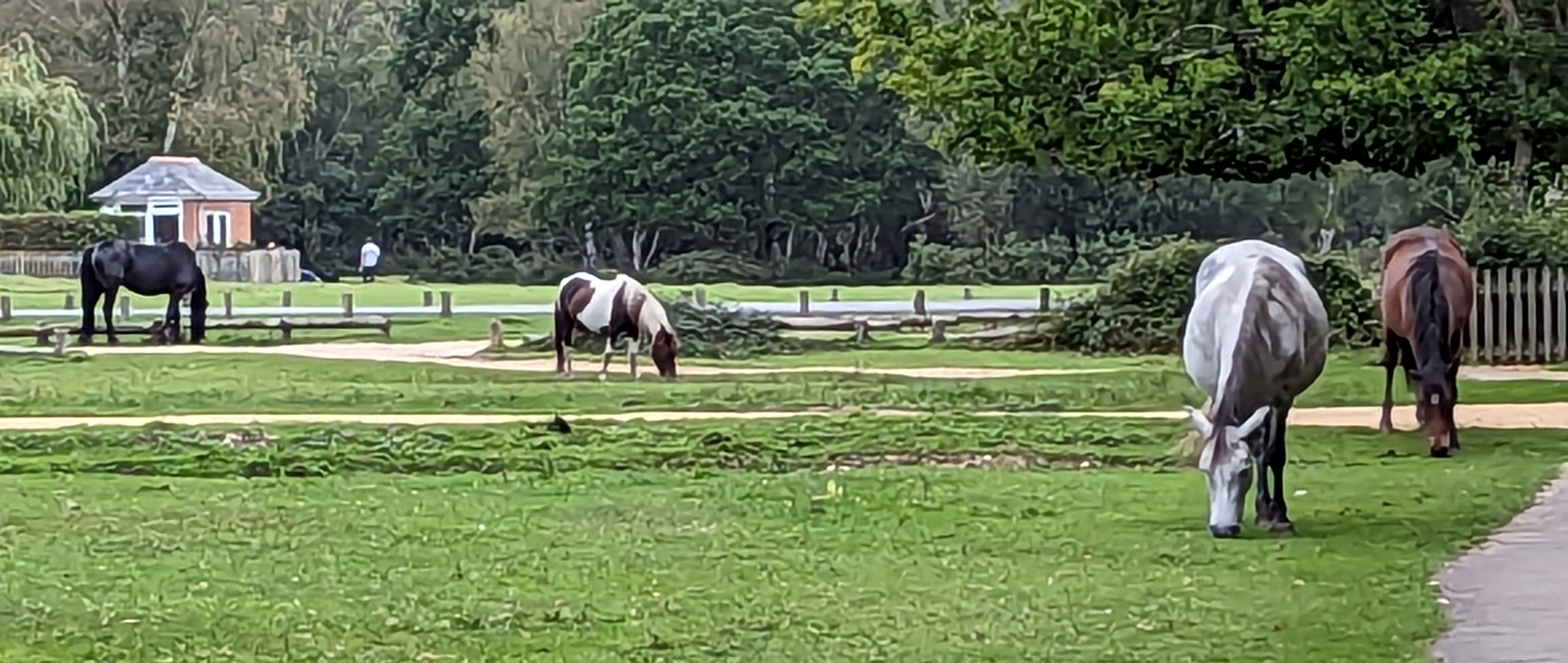
    Brockenhurst is a short train trip from Southampton, the next town we visited in this trip around a few towns in the south. Train strikes were part of the planning, and on this occasion, we would have had to find a local bus to take us – fares for both of us would have been almost as much as the taxi fare offered by the very smart taxi driver waiting at the station so we arrived at the hotel in Southampton in style. This was not replicated on our departure as all the taxis had been booked and we had to walk to the station for our trip to Bath. This was not particularly onerous, nor was the replacement bus service we had to use for the trip to Bath.

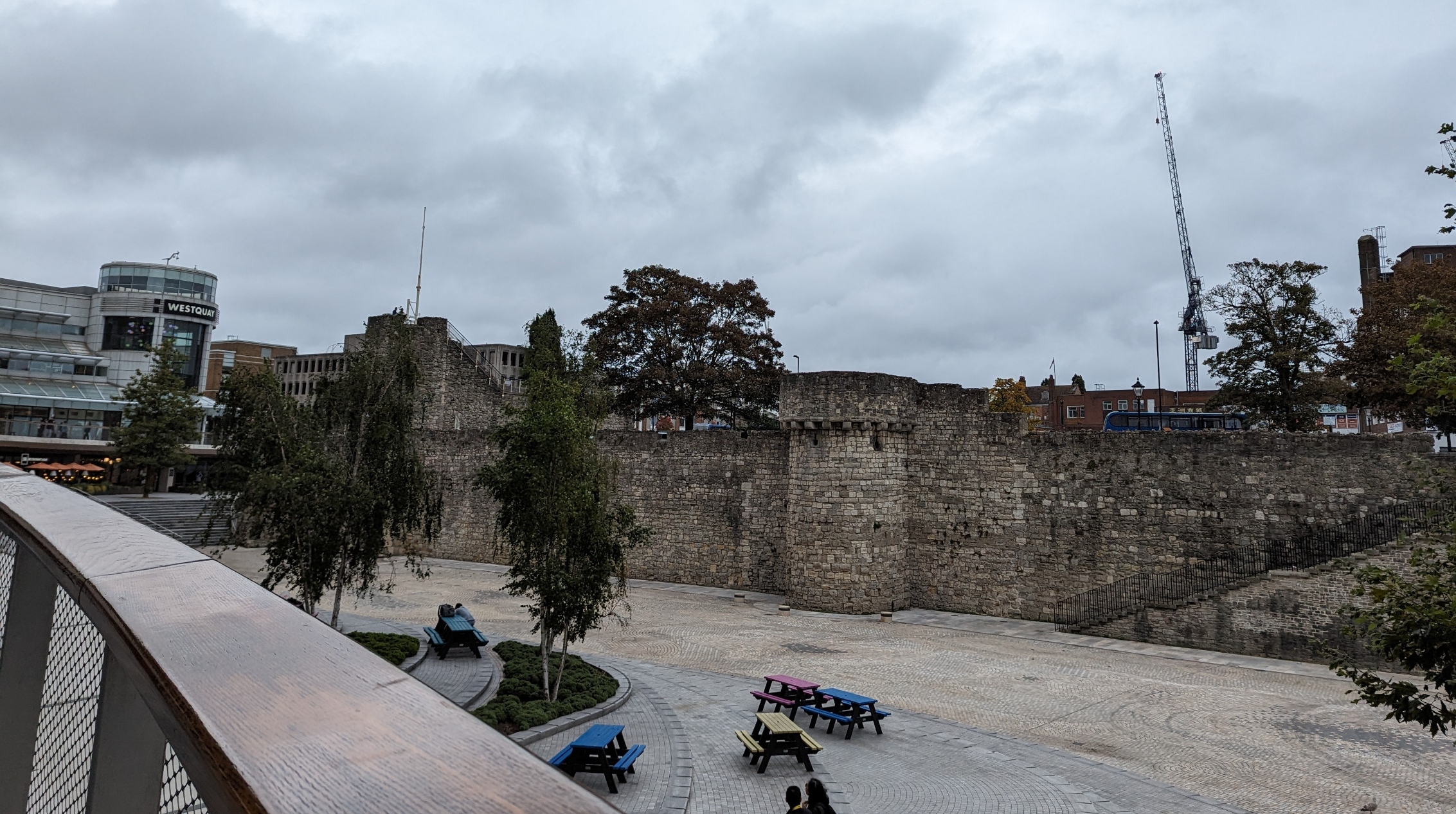
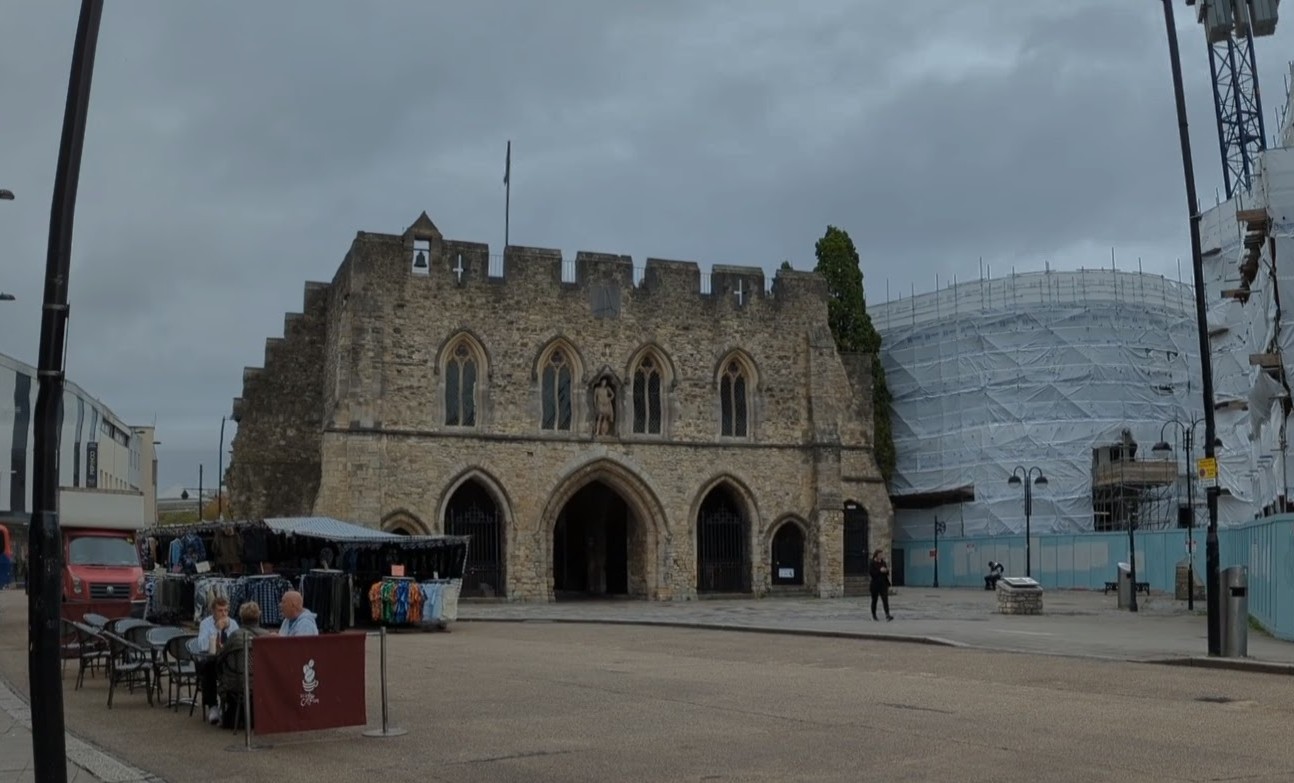
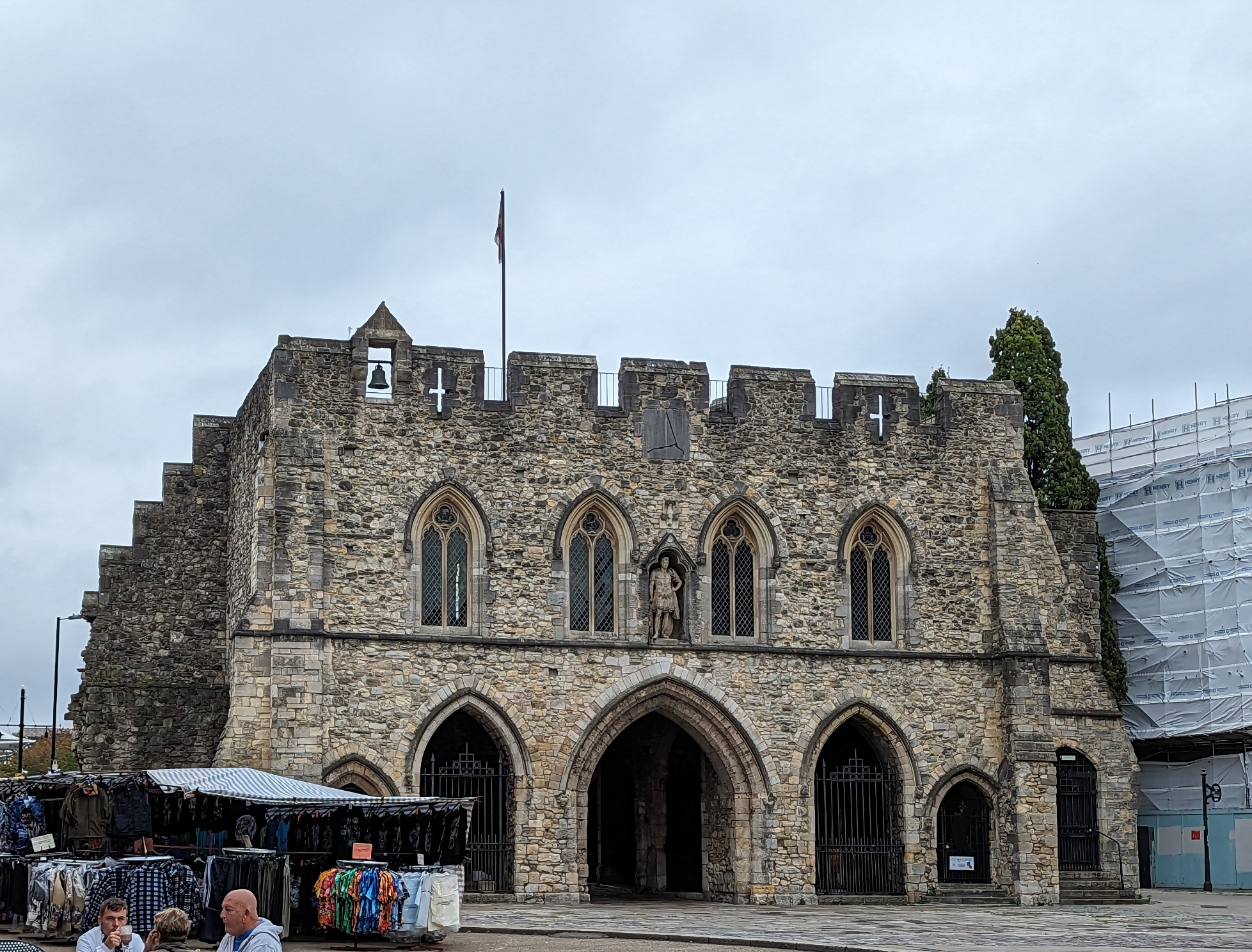
    Southampton was a comfortable place to visit, although the walk from the hotel to the city was complicated. The university in the city was a pleasant feature and friendly staff at the hotel, and later, at a cafe associated with the Maritime Museum made this an easy stay. The remains of Southampton Castle are in the main thoroughfare, and easy to see and visit.

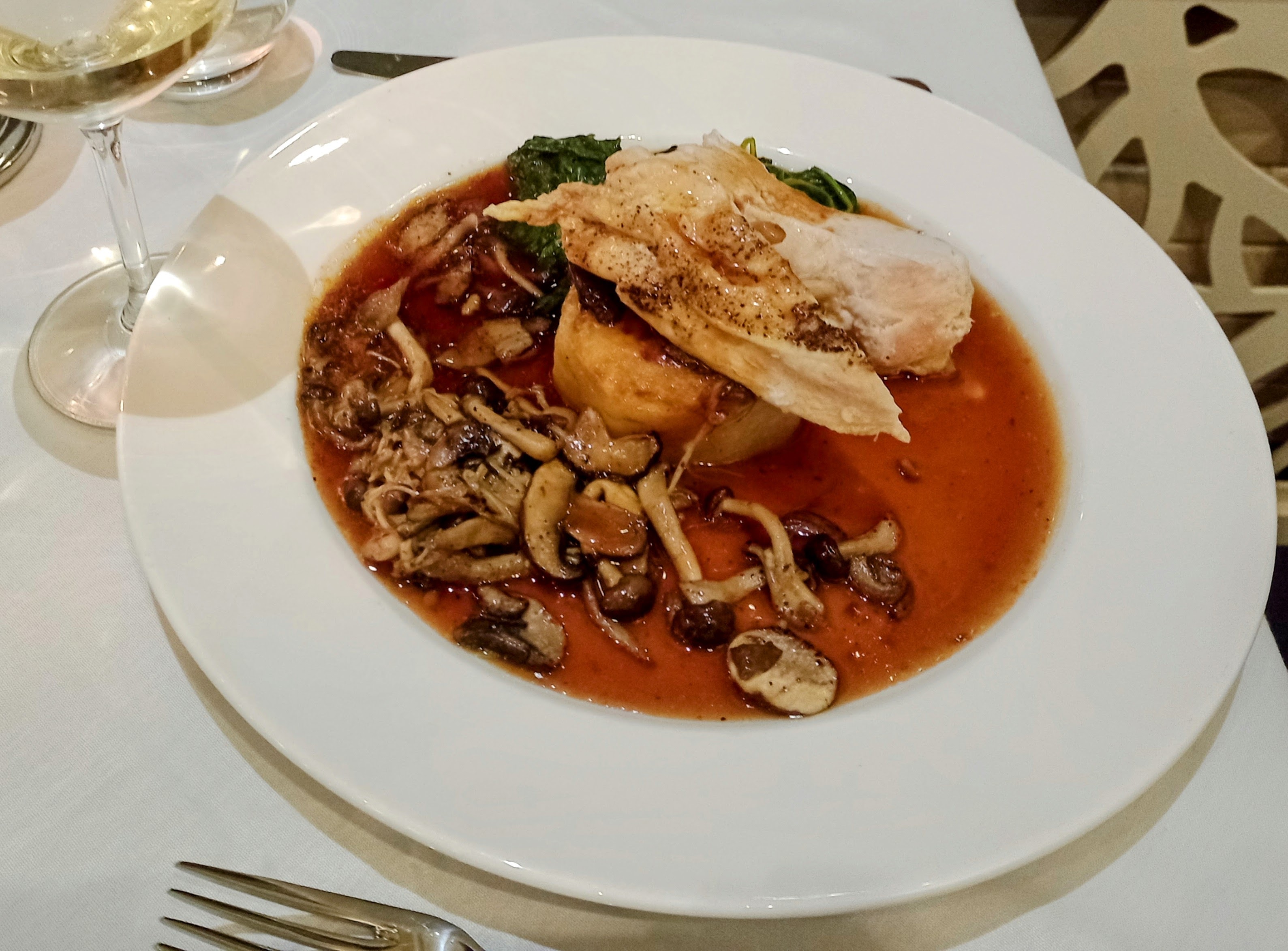
    The restaurant at the hotel was a Marco Pierre White franchise and lived up to its reputation, with its attractive surrounds, good service and interesting but familiar menu. The starters we chose were delightfully old fashioned – a prawn cocktail and a scotch egg. Both were flavorsome, and the prawn cocktail was a great leap forward as far as prawn cocktails go, while maintaining the familiar elements of luscious prawns and a cocktail sauce.

    In the morning the restaurant became the busy breakfast spot with an excellent breakfast which was part of the package with Great Breaks.

    We visited the small but impressive art gallery. The attention given to children’s art and their artistic interests in overseas and interstate galleries is always a reminder to me of the poor effort made in recent years in the Australian National Gallery. In the past there has been a real effort to involve children in the galley, but it has become spasmodic and recently the permanent effort is quite unimaginative.

    The gallery also has an artist at work series, with one of the artists painting on the day we visited.

    As well as the excellent art gallery, street art added to the pleasure of being in this city, although we spent only a short time there.

    The replacement bus service from Southampton to Bath was easy to locate and had the benefit of being able to put the luggage underneath instead of maneuvering it into luggage racks as happens on the train. The downside was that at the end of the journey one of us had to clamber into the compartment to get an errant bag.

    Bath

    Of course, Jane Austen, her work, and works about her, were in my mind as we enjoyed a few days in this eminently easy place to visit. I have reviewed several books about Jane Austen which may be of interest. October 5, 2022 – Michael Greaney – An A-Z of Jane Austen; Alice McVeigh, November 10, 2021: Susan, A Jane Austen Prequel; Sue Wilkes, 24 February 2020: Jane Austen’s England.

    Although not associated with Bath, at least not until we saw A Haunting in Venice, is Agatha Christie. The association is not good. Having some spare moments and choosing between a film and a restaurant we chose the film, not wisely.

    I kept thinking that some important links would be made between the gloom, doom, water and lightning of the storm surrounding a mansion in Venice in the present with war in the past. After all, many of the characters linked their present with their past experiences in World War 2. The concentration on images, which did not resonate strongly enough with the experience of war was not enough. The link with Halloween Party, Christie’s novel was tenuous, and patently made only to give Poirot another outing. Here was the only saving grace of the film, and it adds more to Christie’s reputation than Kenneth Branagh’s direction (although it enhances his reputation as an actor). Branagh was Poirot, demonstrating that Christie’s character is more than an egg-shaped head and moustaches.

    A little more light for contrast, after all there was a romance that was pivotal to the plot would have improved the film. Unfortunately, it was unremittingly dark and wet.

    We had to compensate ourselves by going to the restaurant as well. Amarone was delightful. Although one of the most popular restaurants in Bath we were able to get in, with a nice table and excellent service. The food was lovely, and we felt that despite the disappointment of the film we’d had an excellent first evening in Bath.

    More on Bath next week. Hopefully I will have finished a Sophie Hannah ‘Poirot’ novel for review so shall have something positive to say about another person’s interpretation of her work.

    Week beginning 11 October 2023

    I was pleased to see that a collection of papers, American Magazine Writing was available on NetGalley for review, and next week I’ll write about my responses to the articles deemed good enough to have won prizes and be included in the published collection. The Atlantic came to my attention through interviews with some of its writers on various political programs on MSNBC. and I was pleased to see one of their articles included. However, I was disappointed to find that one of the women who writes for The Atlantic and whose contribution to debate I admire, Anne Applebaum, does not appear.

    Anne Applebaum is a staff writer at The Atlantic. She is also a senior fellow at the Agora Institute at Johns Hopkins University, where she co-leads a project on 21st-century disinformation. Her books include Red Famine: Stalin’s War on UkraineIron Curtain: The Crushing of Eastern Europe 1944–1956; and Gulag: A History, which won the 2004 Pulitzer Prize for General Nonfiction. Her most recent book is the New York Times best seller Twilight of Democracy, an essay on democracy and authoritarianism. She was a Washington Post columnist for 15 years and a member of the editorial board. She has also been the deputy editor of The Spectator and a columnist for several British newspapers. Her writing has appeared in The New York Review of BooksThe New RepublicThe Wall Street JournalForeign Affairs, and Foreign Policy, among many other publications.

    Interviews with her and her contributions to political debate have always been well reasoned, thoughtful and, in my view, valuable. So, I finished the collection less inspired than I thought I would be. But more of that next week.

    This week I returned to London after ten days visiting cities in the south of England – Brockenhurst (some information below), Southampton, Bath, Bristol and Exeter. I’ll follow those up next week.

    Voting Yes in the Voice to Parliament Referendum

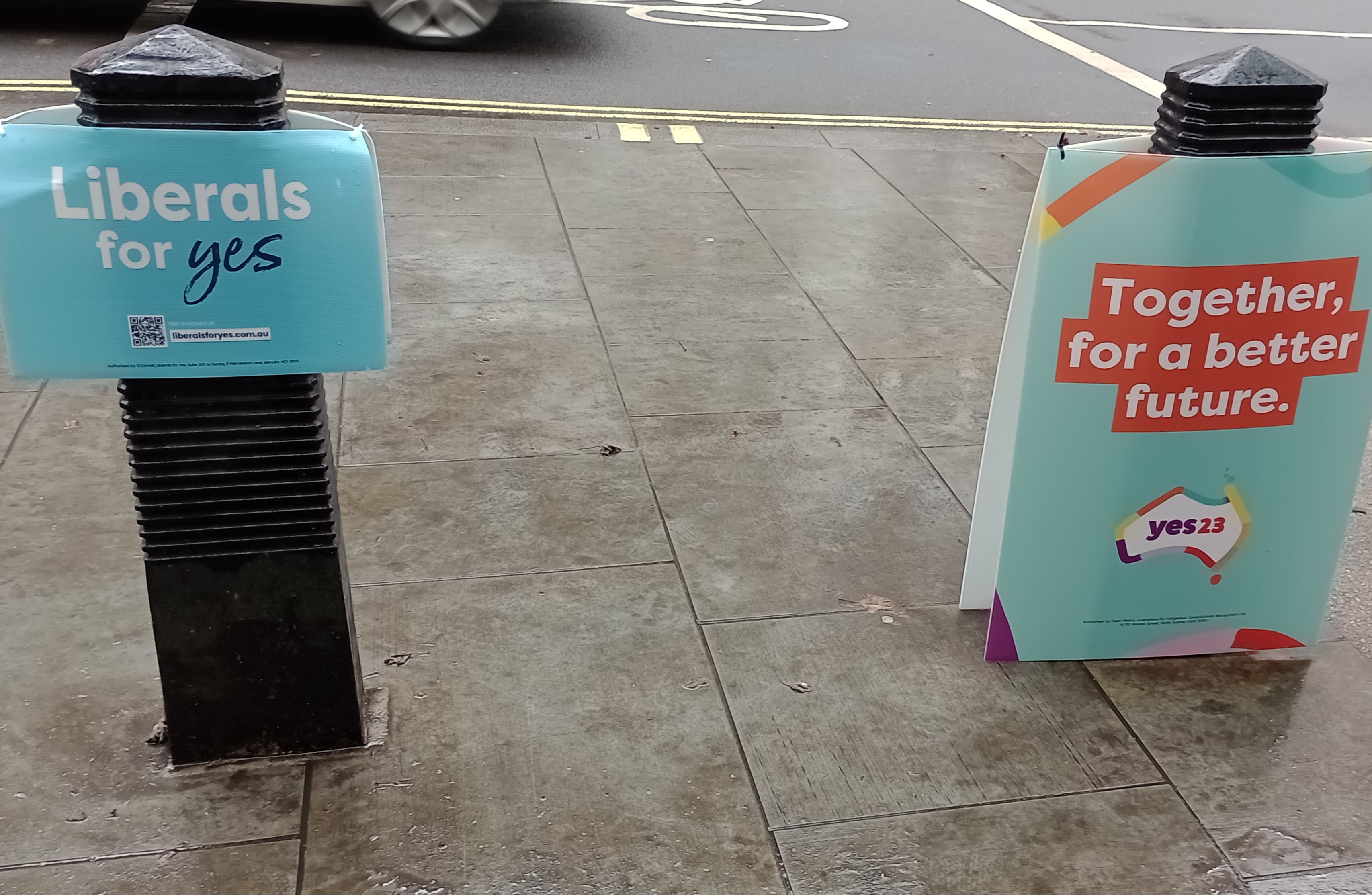
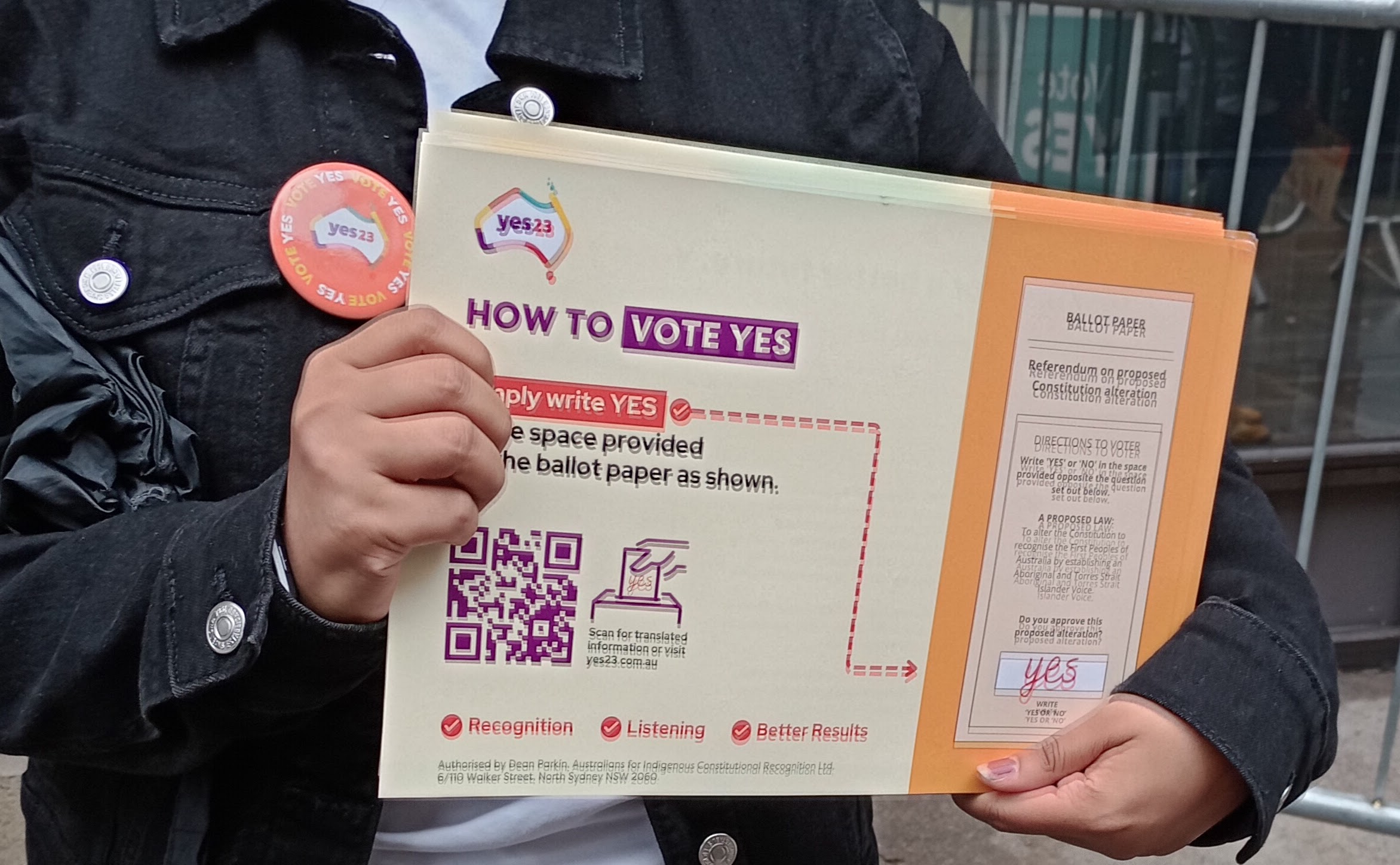
    One of the most important things I had to do on my return was to go to Australia house to vote Yes for the Voice in the referendum. It was a wet day, but there was quite a crowd, most of whom had yes pamphlets which was a comfort as we edged forward to make this most important vote.

    Back to my travels with some lovely memories of Brockenhurst.

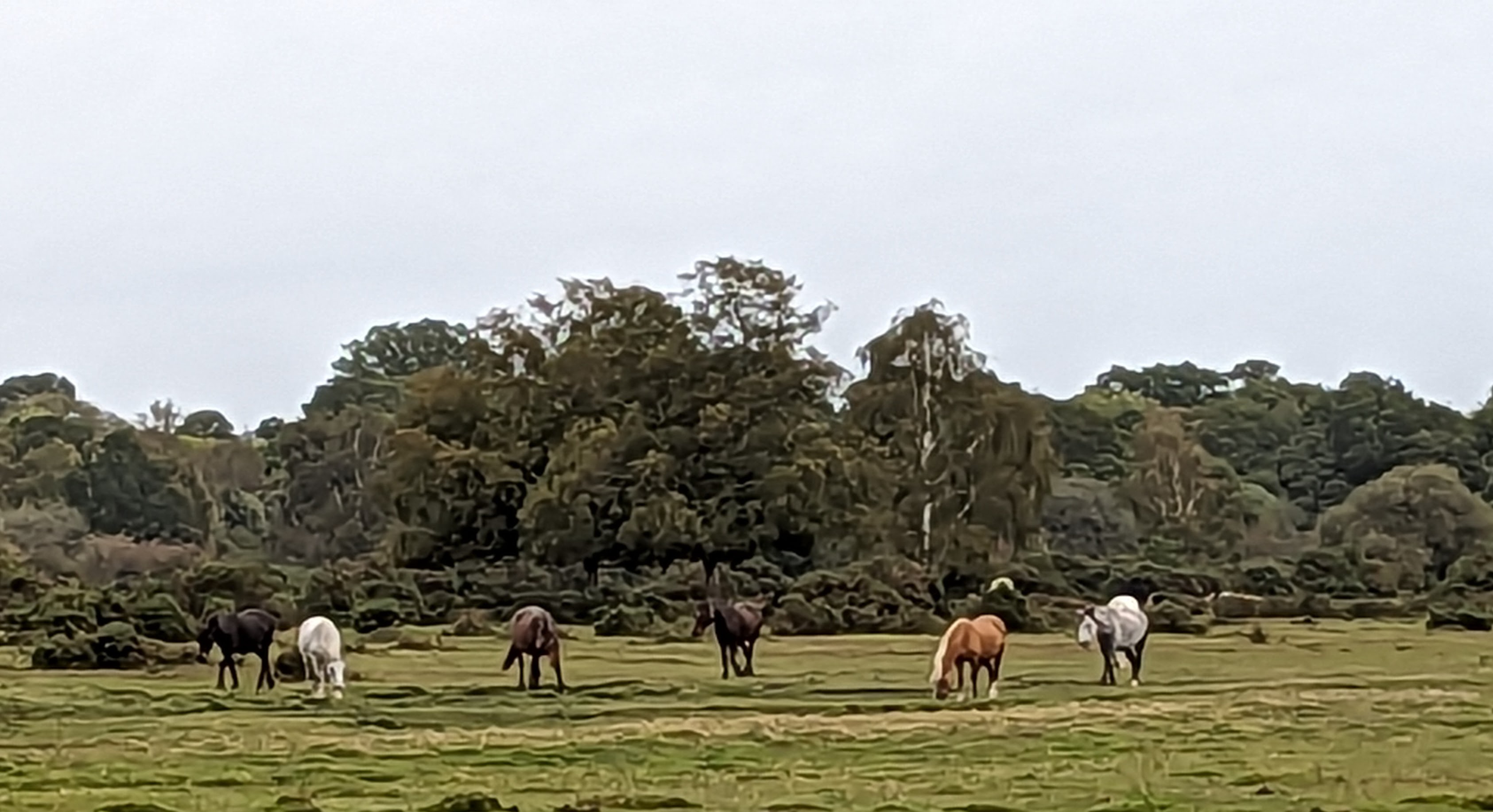
    The New Forest

    The village we chose to stay in for our first visit to this area was Brockenhurst, and it really was ideal. It was thrilling to see the way in which the horses are part of this warm and friendly community. The forest we could see from the train recalled Enid Blyton’s Faraway Tree books, although she glossed over the accompaniment to the forest, the horses and ponies who wander the streets of the village. Their visits overnight are all too apparent in the manure which has to be sidestepped (not a problem for Jo, Bessie and Fanny in their excursions!) when pottering through the village. Another delightful feature showing the intermingling of animals, domestic and wild, and people is the ponderance of dogs in the streets (and cafes – their owners do not have to sit in the cold as we do in Canberra if we want a coffee on our dog walk). Dogs were gamboling in the forest, clearly accustomed to sharing it with the horses with no negative outcome for either. During the summer a hop-on-hop-off bus takes people through the forest, and there are numerous walks marked out. We did nothing organised, just wandered, coming into close range of horses and enjoying the forest. The blackberry bushes were not so kind. Gates on the pathways into the housing areas are a little complicated, but a person slowed to tell us how to get one open – adding to the friendly nature of the whole experience.

    There was no Enid Blyton ginger beer, chocolate and surprises from lands over the faraway tree, but a terrific Italian restaurant, Enzee, and delicious cheese scones at The Buttery. Enzee featured a singer who added to the ambience of warmth, something different, and excellent food. The restaurant was a short walk from our accommodation at The Thatched Cottage. Breakfast was served at the Cottage – it was plentiful and included fruit, fruit juice, a variety cooked items, cereals and yoghurt. There is outdoor seating for the summer months, and cream teas are served in the afternoons.

    Week beginning 4th October 2023

    The book I review this week is by Virginia Pye, a writer I have not read before. Net Galley sent me the uncorrected proof of The Literary Undoing of Victoria Swann for review.

    The novel is inspired by a woman writer who wrote under the pen name, Gail Hamilton. She was exploited by her Boston publisher who paid her far less than her male counterparts. She was unsuccessful in her court case against her publisher and Virginia Pye began thinking about the impact on women writers in a similar position. Their fiction was not considered ‘high’ literature, whereas the men with whom they competed for recognition, were deemed to write meritorious works. Victoria Swann was the fictional outcome of Pye’s concerns on this issue, and she paints her as a writer whose books earned the company profits which allowed them to pay more highly respected writers (who did not sell so well) more favourable royalties than those paid to the woman writer who kept them in profit. Victoria Swann’s books were romances, ‘women’s novels’, and not to be revered or considered of any value – except in that they earned the publisher huge dividends in comparison with those works that were revered. The novel takes up arguments in which I am particularly interested, so to read this fictional account was thoroughly engaging.

    Virginia Pye, The Literary Undoing of Victoria Swann, Regal House Publishing, 2023.

    Virginia Pye has woven an insightful and engrossing story from a news story about a woman writer who, exploited by her publishers, took them to court. Victoria Swann’s narrative is the outcome, combining debate about the value of women’s and men’s writing, the way in which romantic novels are described to compare them badly with fictional work that has no romantic narrative, the feminist arguments for women’s right to equal payment and, alongside this, their right to property and how they might be seen as respondents or plaintiffs in a court. Victoria Swann, and in her later iteration, when she returns to her own name, Victoria Meeks is a wonderful vehicle for conveying these arguments. She is a captivating character, with a background that raises even more issues about women’s role, and a warm but strong presence.

    Victoria Swann is introduced weathering the remains of winter in the slush and mud of Boston. She carries a carpet bag, which continues to feature as part of her apparel, although her beautiful clothing and smart boots give way to simple country clothing when she returns home, and later, to clothing that reflects her changed circumstances. The change is not only financial, but an indication of the way in which she begins to see herself as an author and purveyor of women’s concerns and demands for equality.  Here, when she first appears, she is going to her publisher where she expects to be feted, provided with comfortable seating, delicious pastries of her choosing and tea. She is about to undermine the seemingly favourable circumstances she enjoys as a cosseted writer of bestselling novels, an advice column and shorter, but ever popular ‘penny dreadfuls’. See Books: Reviews for the complete review.

    Porto Food Tour (cont.)

    The photos from the Porto Food Tour reappeared – how I do not know. They really belong with last week’s blog; however, they could be of interest. Included are additional photos of the port wine cellars (old cellar, entrance, port that was offered for tasting); the food that was offered during the tour (Franceschina saucing, the fish alternative to the traditional Franceschina, a display of the pastries we discovered and the demolished sausages) and traditional buildings, including the swallows that appear on walls, internal and external with the friendly meaning of ‘welcome and please return’.

    Walking between cafes

    Van Gogh Museum

    Van Gogh used a tea towel (see accompanying information) for his first painting of Daubigny’s Garden as he did not have a canvas!

    The Hague

    We took a short train trip to The Hague, visiting the Peace Palace (closed, but an impressive building) and admiring the combination of old and new architecture.

    Peace Palace

    Eurostar Amsterdam to St Pancras, London via Brussels

    The Eurostar trip between Amsterdam and London passed through some tulip gardens and the photos below give a small insight into the travel by this really comfortable means. Although there has been a long queue each time I have travelled Eurostar, it is a great alternative to air travel for the short distance. This time we had one change, at Brussels, but this was easily accomplished because the signage is so clear.

    Sunflowers for Ukraine – singers on the River Douro

    Week beginning 29th September 2023

    This week’s blog is mainly about travelling in Porto and Amsterdam. However, I have been indulging myself with some novels bought for fun rather than NetGalley reviews. Two have men as their main protagonists, which is an interesting change for me. One, The Trophy Wife by Valerie Keogh I have not finished.

    It is a psychological thriller, following novels such as The Lawyer, The Librarian and The Housewife – all of which feature a woman as the main protagonist. Good reads for the beach, or as has been the case at the moment, a train or plane. The Clare Chambers that I finished recently joins other of her work that I found really worthwhile reads. Back Trouble combines an autobiography by Phillip written while he is incapacitated with a back injury, with his present life. This is the aftermath of the failure of the publishing business he and his friends established and his current relationships with his parents and brother and various others. Although not as poignant as Small Pleasures this is worth reading.

    Small Pleasures was a wonderful, although distressing read. However, there are certainly differences of opinion – a friend who read it as part of her reading group list found it unfinished and unsatisfying; another was in tears she was so engrossed and at one with the characters. The Other Mothers by Katherine Faulkner was a disappointment after her first novel, Greenwich Park.

    Lisbon to Porto and Food Tour

    We travelled from Lisbon to Porto by train, and after a short taxi ride arrived at our hotel. It was close to a train station, San Bento, which was a good start to our first day’s activity which was a food tour, a short train ride away over the Douro River in Gaia. Having experienced a similar tour in Amsterdam I had high hopes of this one – some of which were fulfilled. It is an ideal tour for people fascinated by the Portwine industry and keen to taste some of its products. The food suffered by comparison, and this makes the tour a bit of a disappointment for those more interested in the Portuguese culinary experience. There was some discussion of historical features as we walked – or rather, climbed up slopes of cobbles.

    Unfortunately, some of the photos from the food tour disappeared. Here, the vats in which the wine is stored are shown – alas, the old wine cellar complete with bottles encrusted in cobwebs is in the ether somewhere. The placemat shows the wines that we tasted at the end of the tour. Lastly, my dish that replaced the meat sausages that were the typical Portuguese meal provided to the meat eaters. They came unaccompanied, so I hastily piled my chips onto the sausage platters. They disappeared more quickly than the sausages. My white fish was a dry fish in a light batter. The last photo is a Franceschina, the traditional bread, meat and sauce meal that is advertised everywhere -and eaten at any time it seems. The sauces (mild and hot) are poured on at the table. My alternative was a fish dish, replete with a crumbed topping instead of the toasted bread that is part of the traditional Franceschina.

    As we walked through the streets, we were told about the value given to the introduction of Trash Art, as well as the attempts to retrieve the tiled walls that were originally destroyed. Trash art adorned one wall – but the traditional patterned walls seem far more attractive.

    Bus and boat tour

    After the long walk around Giai, the next day a peaceful bus and boat tour seemed an excellent antidote.

    The bus took us through Porto’s streets, to the beach, and then to the river where we met the cruise boat. Porto’s hills and cobbles are quite a challenge, so the bus was an attractive option. It also took us further than we’d have been able to travel using public transport in the time available. The Casa de Musica is the last photo.

    The last photo shows the hill we had to climb to leave the Gaia area to catch the train back to Porto. The bridge in the photo is the one the train travels over the river. We started somewhere near the bottom and had to climb to the tower, on cobbles. A very healthy walk after the food on the tour! And before eating at 29 Marina, below.

    Eating in Porto by the river

    There are numerous places to eat by the River Douro, and musicians appear at many of them. The lively woman singer replaced a man singing from our era, which had been really lovely. However, her loud and impassioned singing certainly brought people to their feet dancing.

    The food at 29 Marina was delicious, the service friendly, and the drinks rather marvellous.

    Amsterdam

    Once again, we are staying in the Museum Quarter, a part of Amsterdam we enjoyed immensely last time we were here. One of the best features of this district (apart from the museums of course) is Zaza’s, a restaurant we ate at last time. We were able to get a table as we were happy to begin our meal early and leave by 7.45. Having just arrived by KLM from Porto, train from the airport to Central Station and then a taxi we were more than happy to do this. Speaking of KLM – what an excellent service! The check in was seamless, the boarding no more onerous than on other occasions, and the food and beverages served free for a two-and-a-half-hour flight were excellent. This compared markedly with the British Airways flight from Heathrow to Lisbon. Also, there was an interesting environmental effort displayed before we boarded.

    Zaza’s

    Zaza’s has an inventive menu, the chef magics up the most delicious concoctions, the service is friendly and efficient, and the ambience is delightful. Warm bread with a garlicky and light humous was served, then a small, delicious treat (eaten before I took a photo, and although special I recall only the goat’s cheese and poppy seed cracker) was followed by an appetiser – we chose the goats caramelised onion cheese tart topped with fig and rosemary – and a between course delight. Mine was a carrot and ginger soup, and my friend’s a champagne and lemon sorbet. These were served with panache – the champagne bubbling and fizzing and the soup being poured into a delicious accompaniment.

    The main dishes were also successful – the problem being that the temptation to eat everything on the plate is insurmountable. Once again, we left Zaza’s without trying the dessert menu. The veal was served with parsnip puree, tarte tartine, sauces and greens. The prawns were served with a delicious risotto, a delicious sauce and peas.

    Senor Moustache

    Our next evening meal was very different, but also really great. Again, it was a return to an old haunt from our previous stay in Amsterdam. The meals we chose were a chicken taco salad and a beef taco salad. The taco provided a very light crisp bowl for a luscious salad. This comprised lettuce, carrot, beans, rice, radishes, onion, sauces and coriander.

    Another small environment care effort

    The NH Hotel in Amsterdam also has the ‘give up having your room cleaned and get a free drink ‘ as part of their contribution to doing something about the environment. I have some concerns as I am not sure how these measures impact on the staff. However, I am also taking advantage of the offer – tonight we had our free glasses of Sauvignon Blanc and our shared pizza before leaving for London on the Eurostar.

    Van Gogh Museum

    We made sure not to miss out on this experience by booking tickets in advance after having found that the museum was unable to cater for people arriving on the day. Although our time was set for 10.45, we were allowed in upon arrival and made the most of our time there. This was one of the most well curated exhibitions I have seen, with excellent signage and explanations in English as well as Dutch, all at easy eye level and clear. There will be more of this next week. But a good start is some of the many and varied self-portraits Van Gogh painted throughout his lifetime.

    Week beginning 20 September 2023

    Hillary Rodham Clinton is the subject of this week’s review. Do All the Good You Can, How Faith Shaped Hillary Rodham Clinton’s Politics by Gary Scott Smith, University of Illinois Press, 2023 will be published in October.

    Gary Scott Smith provides a rather different perspective on Hillary Rodham Clinton, or so it seems to me. My response may not be significant, after all, I am not an American political commentator, voter, or resident.  However, I was strongly interested in the 2016 American election, and of all the many aspects of Hillary Rodham Clinton that became apparent throughout that period, advertisements, speeches, commentary and the debates, religion and Clinton’s commitment were not some. Scott Smith writes movingly of the role of religion in Hillary’s life and suggests that, if her campaign had addressed her commitment, it is possible that the 2016 run for President might have had a different result. Although I am not always impressed with his case for this, the discussion of religion in Clinton’s life makes valuable reading, showing as it does, the role of religion in American politics which is so different from that in Australian politics, and as Scott Smith demonstrates, from many other countries.

    The book makes thorough use of quotes from Hillary Rodham Clinton’s speeches, the bible, and religious sources admired and referred to by Clinton. The chapter headings follow this pattern, with titles such as “Stay in Love with God”; “I Felt My Heart Strangely Warmed”: Clinton’s Spiritual Roots; “Let your Light Shine to All”: From Wellesley to the White House; “Be Rigorous in Judging Ourselves and Gracious in Judging Others”: New York Senator and 2008 Presidential Candidate; “I look Upon All the World as My Parish”: Secretary of State and Seeking the Oval office; “Be Not Weary of Well Doing”: The 2016 Presidential Campaign; and “God Grant That I May Never Live to Be Useless!”.

    Scott Smith’s addition of the quotes to the basic information about the progress of Hillary Rodham Clinton’s life through childhood, Wellesley, First Lady, Senator, Presidential Candidate 2008 and Secretary of State, and during the 2016 Presidential Campaign and its aftermath highlight the flavour of this biography. It is aimed at being markedly different from others in giving Clinton’s religious commitment an enduring and empowering role. Scott Smith argues comprehensively for a woman known for a host of other virtues (and shortcomings) to be known for her sincerity and commitment to her religion, and its essential role in her life. In taking up the cudgels for the possibility that a greater public commitment to religious thought and teachings by Clinton during the 2016 Presidential Campaign may have achieved a different result he also moves into different ground. See Books: Reviews for the complete review (to be finished).

    After the Covid update: Cindy Lou reviews; trip to Portugal; Heather cox Richardson.

    Covid update Australian figures on 15 September 2023.

    The latest COVID-19 news and case numbers from around the states and territories

    Posted Fri 15 Sep 2023 at 3:38pm ABC

    Australian Capital Territory

    There were 169 new COVID-19 cases in the ACT last week. The territory has four people in hospital with COVID-19, and none in intensive care. There were three new deaths recorded. Source: ACT Health

    New South Wales

    The state has recorded 2,020 new COVID-19 cases, up from last week’s total of 1,919. There are 606 cases in hospital with the virus, 10 of those in intensive care. There were 20 new deaths recorded. Source: NSW Health

    Northern Territory

    The territory updates its COVID-19 data fortnightly, there have been 130 new cases between September 1 and September 15. The Northern Territory currently has four patients in hospital. No new deaths were recorded. Source: NT Health

    Queensland

    Queensland’s new COVID-19 reporting process now works on a seven-day rolling average system, as per the federal government’s national reporting site. The state recorded 64 average daily cases as of September 13, down from an average of 91 the previous week. There is a seven-day rolling average of one death as of September 12, with 949 patients in hospital with the virus, and 25 in intensive care. Source: Federal Department of Health and Aged Care

    South Australia

    The state has recorded 625 new COVID-19 cases the past week, as of September 13. South Australia currently has 41 patients in hospital and none in intensive care, as of September 12. There were no new deaths recorded. Source: SA Health

    Tasmania

    We are still waiting on an update from the state’s health department. Please check back for the statistics or scroll down to find the national data.

    Victoria

    Victoria recorded 746 cases in the week from September 8 to September 14, a 28 per cent increase from the week before. There were three deaths on average each day over the week. The state also recorded a seven-day rolling average of 133 patients in hospital with the virus, and nine people in intensive care. Source: Victoria Department of Health

    Western Australia

    We are still waiting on an update from the state’s health department. Please check back for the statistics or scroll down to find the national data.

    Cindy Lou eats out in Checkendon near Wallingford

    Dogs allowed inside – a delightful welcome to The Highwayman Inn. Another dog appeared later and in the course of conversation her owners described their links to Australian cities, Melbourne and Brisbane where close relatives live.

    The Highway man has a good menu, with gluten free options. However, it was odd not to be offered a wine list. Fortunately, the wait person recalled that there was a Marlborough Sauvignon Blanc by the glass. Although not as stunning in appearance as the gin and two tonics, the Kakako was pleasant.

    Desserts were an apple and rhubarb crumble with custard, pronounced a good crumble; a luscious rice pudding with a plum compote; and two scoops of Purbeck ice-cream – honey comb and raspberry ripple from a fine range of flavours. Purbeck ice-cream from Dorset is indeed special, and I shall look for it on other English menus.

    From the delicious range of mains, birds won the evening with duck and guinea fowl chosen. Master Chef would probably have agreed that the duck was cooked well, and I enjoyed the guinea fowl.

    Apart from the wine menu not being brought to the table, the service was pleasant and reasonably efficient. Perhaps the first course could have come a little more quickly, but the atmosphere was comfortable and the dinner table discussion excellent.

    Breakfast on the Waterside Cafe narrow boat on the Regents Canal

    This is an all-time favourite – a visit to Paddington usually includes a meal at the Waterside Cafe with its cream teas, omelettes and paninis. All of the latter have generous and interesting fillings and are served with salad or crusty bread. The bread needs to be mentioned, as so often it is not crusty, but thin white sliced. The latter is not a usual feature of Australian breakfasts in my experience. The scrambled eggs served with generously buttered crusty loaf made a lovely breakfast in the glorious setting.

    Drinks at the 146 Bar The Hilton, Paddington

    This is a pleasant bar, with friendly and competent service, a good drinks list, and attractive accompaniments served with the drinks.

    Pearl Liang Sheldon Square Paddington

    Pearl Liang is a really appealing Chinese restaurant that we have been going to for years. On several New Years Eves, a concert at Wigmore Hall was followed by a splendid meal at Pearl Liang, before watching the fireworks in Hyde Park from the windows of our flat. Returning, even without the concert, is always fun. This time we had old favourites and the wait person was keen to have us try something different on the next occasion.
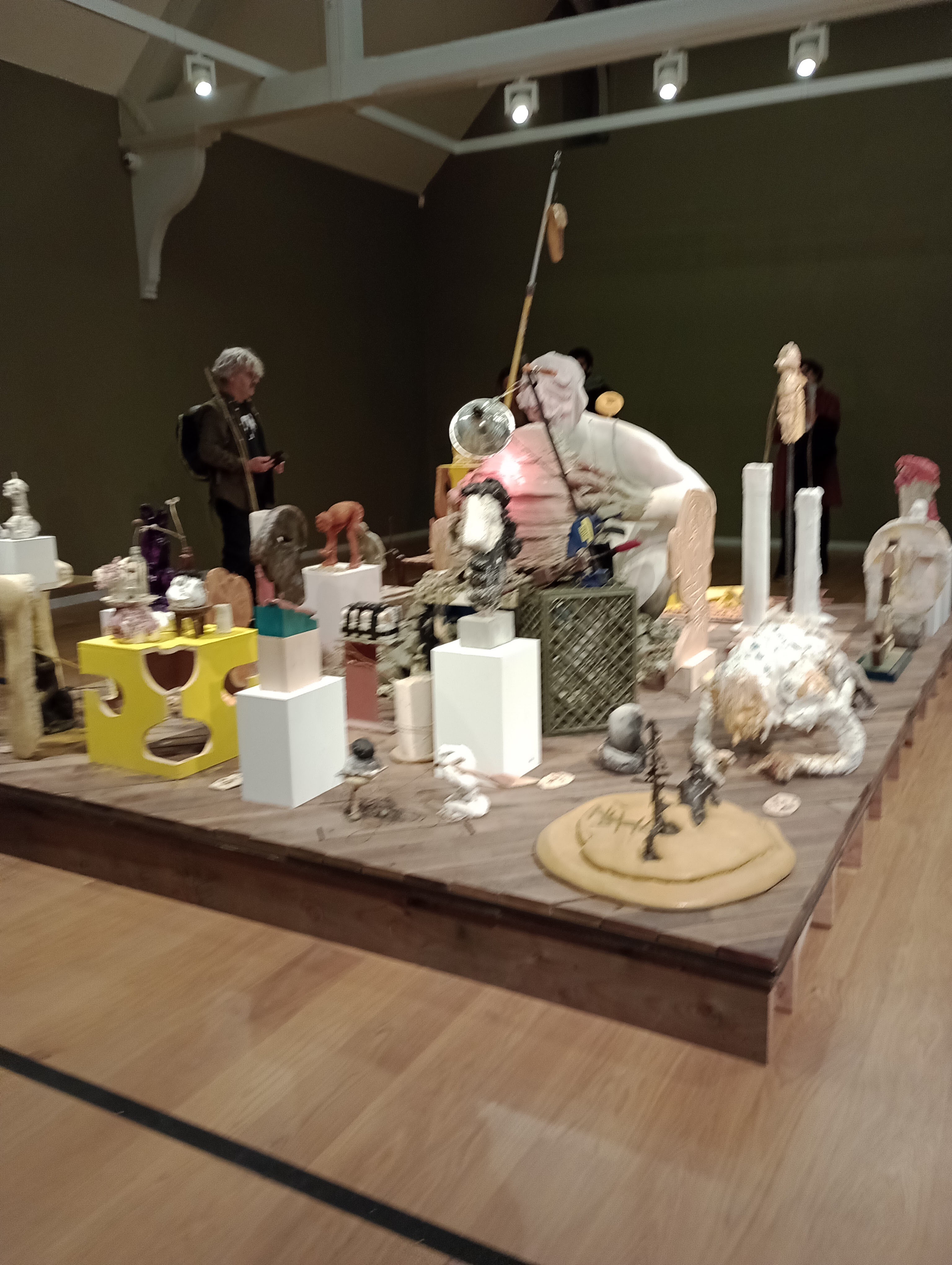
    Sheldon Square, in which the restaurant is located, has been beautified, with water and plants replacing the concrete tiers.

    Trip to Portugal

    After a successful trip to Lisbon several years ago we were interested in returning. This time, instead of booking a hotel in the city centre I chose a Secret Escapes offer of a hotel in the historic district, Alfama, close to the Castile de S. Jorge. Secret Escapes provided us with a different experience – a marvellous breakfast, port in the bedroom, and free entrance to several cultural exhibitions. We enjoyed the breakfast, had a glass of port, and decided to wander around the area, with a quick trip into the city centre to reprise our past experience. No cultural visits this time. But the bus ride into the city centre provided plenty of colour as the driver deftly avoided pedestrians, buildings and other vehicles on the steep narrow streets down the hill – and up again on return.

    The hotel, Solar Do Costelo, was delightful. Although there were some stairs to climb it was probably just as well, as the breakfast was tempting and copious. The ocean could be viewed from one window, and a small section of the castle wall from the other.

    The hot selection included broccoli one morning, which created some confusion to some guests. However, I found it a wonderful accompaniment to my smoked salmon. There was a variety of cakes as well, and these remained throughout the day together with tea and coffee for guest to have when they chose. For the healthier guests a large basket of apples was also available at reception.

    After two nights in Lisbon, we boarded the train to Porto. This was easy to do without booking in advance. We had allocated seats, alas on the slower train, but as we boarded at S. Apolonia where the train started there was little difficulty in storing luggage and finding our seats. When the train filled up, at subsequent stations it appeared to be more difficult but somehow everyone found a seat and a place for their luggage. Most of the journey was uneventful, but some of the stations were highly decorative, we passed olive trees and some beautiful homes, interspersed with the usual downbeat sights familiar along most rail routes.

    We ate in a street cafe familiar from our last visit in Lisbon city centre, and at a cafe near the hotel. The latter was wonderful, with its friendly staff, cooking seemingly accomplished in various buildings in the vicinity, and laundry hanging above (a familiar sight in all the streets). The Portuguese food will feature next week.

    Flowering tree outside the Castile De S. Jorge

    Heather Cox Richardson letter from America

    18 September 2023.

    Headlines this morning said that “Congress” is in crisis. But that construction obscures the true story: the Republicans are in crisis, and they are taking the country down with them.

    The most immediate issue is that funding for the government ends on September 30. The Senate, controlled by Democrats, is moving forward on a strongly bipartisan basis with 12 appropriations bills that reflect the deal President Biden hammered out with Speaker Kevin McCarthy in May to get House Republicans to agree not to default on the United States debt. That deal, the Washington Post editorial board pointed out today, was a comprehensive compromise that should have been a blueprint for the budget.
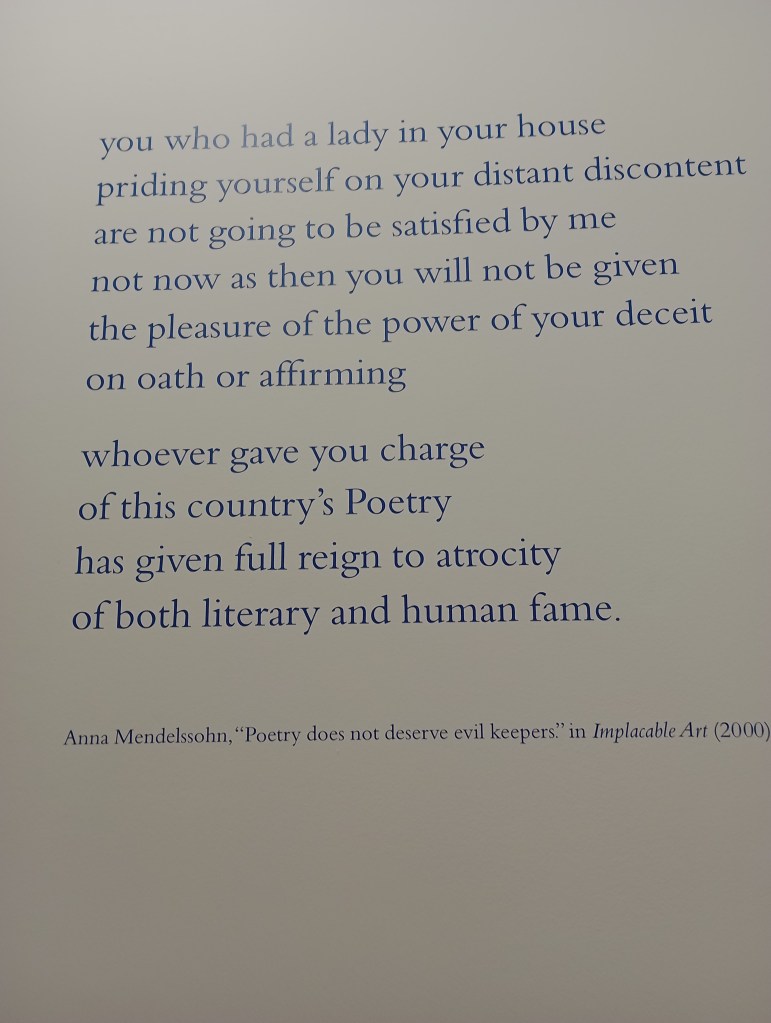
    But extremist House Republicans reject it, and there is no sign that House Republicans can even agree among themselves on a replacement, let alone on one that can make it through the Senate and past the president’s desk. Extremists in the Freedom Caucus insist they will not agree to any budget that accepts the deal McCarthy cut with Biden. In addition, although appropriations bills are traditionally kept clean of volatile issues, the extremists have loaded up this year’s appropriations bills with so-called poison pills: rules that advance their attempt to impose their ideology on the country but are unacceptable to Democrats. McCarthy had to pull back the Pentagon spending bill on Thursday before the House went home for the weekend, leaving without any plan in place for funding the government.

    Over the weekend, six Republicans from five different party factions offered a plan for a short-term continuing resolution to fund the government and avoid a shutdown. Designed to appeal to the extremists, the plan goes back on the deal McCarthy struck with Biden. It proposes a 1% cut to the federal budget, but that 1% is not applied evenly: the defense budget and the budget for the Department of Veterans Affairs would not take any cuts—Republicans have learned how voters react to hurting veterans—requiring an 8% cut to everything else. It includes the border measures the extremists want, and provides no money either for Ukraine or for disaster assistance. 

    It’s not clear that Republican House members will vote for the bill, and if they do, the bill is unlikely, encumbered as it is, to make it through the Senate. 

    What the House Republicans have managed to do recently is to try to appease the extremists by launching an impeachment inquiry into President Biden, claiming that he enriched himself through his son Hunter’s business dealings when he was vice president. McCarthy had to open the inquiry himself, without a House vote, because lacking any evidence, he didn’t have the votes to set such an inquiry in motion. On the Fox News Channel on Sunday, Representative Michael McCaul (R-TX) said McCarthy has given him the role of assisting in the inquiry, but admitted: “We don’t have the evidence now, but we may find it later.”

    To try to get at the president, the Republicans have hammered at his son Hunter, who has begun to push back, today filing a lawsuit against the Internal Revenue Service for failing to keep his tax information private as the law requires. He is referring to the two men who testified before House committees trying to find dirt on Hunter Biden and who made the rounds of reporters with their allegations that the IRS did not adequately pursue charges against him. 

    Meanwhile, video has emerged of the conditions under which extremist Representative Lauren Boebert (R-CO) was kicked out of a kid-friendly Beetlejuice concert last weekend. Boebert has repeatedly accused those protecting LGBTQ civil rights of “grooming” children for sexual activity. Not only was she vaping, she and her date were groping each other quite intensely. Boebert is in the process of getting a divorce, and her date, it turns out, is co-owner of a gay-friendly bar that has hosted drag shows. 

    Things are not all ducky with Republicans in the Senate, either. Senator Tommy Tuberville (R-AL) refuses to lift his hold on more than 300 military promotions until the Pentagon changes its policy of allowing service members leave time and travel expenses to obtain abortion care. While he insists he is doing no damage to the military, actual military officers, as well as members of his own party, disagree. They say the holds are hollowing out our military leadership and that the damage will take years to repair, since the promotion holds also stop junior officers from moving up. Those holds mean lower pay and retirement, tempting junior officers to move out of the military to higher-paying private sector jobs. 

    The Veterans of Foreign Wars (VFW) today wrote a public letter to Tuberville asking him to remove his hold and warning that “harming American service members as leverage in Washington political battles” set a “very dangerous precedent.” They also noted that in a survey of VFW members, including those in Alabama, “VFW members strongly conveyed that politicians should not be able to harm the troops over political disputes and that political decisions that harm the troops would affect the way they would vote in upcoming elections.”

    And now Trump, who leads the extremists, has suddenly changed course on abortion, the leading issue for most of his base, in order to weaken his rival for the 2024 Republican presidential nomination, Florida governor Ron DeSantis. After packing the Supreme Court with three extremists who helped to overturn the 1973 Roe v. Wade decision by which the Supreme Court recognized the constitutional right to an abortion, Trump yesterday said the six-week abortion ban DeSantis signed, which would ban abortion before most women know they’re pregnant, was “a terrible thing and a terrible mistake,” although he also appeared to endorse abortion bans in general. Trump’s vice president Mike Pence, in contrast, is calling for a federal ban on abortion.  

    Republicans have finally recognized that about 63% of Americans think abortion should be legal in “all or most circumstances,” according to a new poll by 19th News jand SurveyMonkey. But only 9% believe it should be illegal in all cases, although 14 states have enacted such extensive bans. The survey also found that support for abortion rights has increased since the June 2022 Dobbs v. Jackson Women’s Health Organization decision that overturned Roe v. Wade. [These figures are interesting in relation to one of the arguments made by Gary Scott Smith – see book review above].

    Trump has suddenly also become more problematic for the Republicans. On Sunday night,  Trump doubled down on his past antisemitism by sharing a Rosh Hashanah message that celebrated the Jewish New Year by accusing “liberal Jews” of voting to “destroy” America and Israel. 

    Then, ​​today, Katherine Faulders, Mike Levine, and Alexander Mallin of ABC News reported that long-time Trump assistant Molly Michael told agents investigating Trump’s mishandling of classified documents that he wrote to-do lists for her on the back of documents with classified markings. 

    Meanwhile, the administration continues to go about the daily work of governance. 

    On Sunday, U.S. national security advisor Jake Sullivan met in Malta with China’s top diplomat to keep communications between the two countries open. Today, Secretary of State Antony Blinken met with Vice President Han Zheng of China on the sidelines of the United Nations General Assembly in New York. “The world expects us to responsibly manage our relationship,” Blinken said. “The United States is committed to doing just that.” 

    Also on the sidelines of the U.N. General Assembly today, 32 coastal Atlantic countries from Africa, Europe, North America, South America, and the Caribbean launched the Partnership for Atlantic Cooperation. This new multilateral forum echoes regional organizations the administration has backed elsewhere and seeks to establish a mechanism for implementing “a set of shared principles for the Atlantic region, such as a commitment to an open Atlantic free from interference, coercion, or aggressive action,” as well as coordinated plans for addressing issues including climate change. 

    Finally, five Americans who have been imprisoned in Iran are home tonight, along with two of their spouses. In exchange, the U.S. freed five Iranian citizens who were imprisoned or were about to stand trial, although three of them declined to return to Iran (two have chosen to stay in the U.S., and another went to a third country). The Republic of Korea has released $6 billion of Iran’s money to Qatar for use for humanitarian aid to Iranian citizens suffering under the sanctions that prevent medicines and food from coming into the country. 

    Brett McGurk, the National Security Council’s coordinator for the Middle East and North Africa, told the Washington Post’s Jason Rezaian that the funds had not previously been frozen; they were held up in South Korea because of that country’s own regulations. Under Trump, Iran spent heavily from similar accounts in China, Turkey, and India. Now that they are released, the funds will have more legal restrictions than they did when they were in South Korea. 

    The Biden administration has prioritized bringing home wrongfully detained Americans. Today’s events bring the number of those the administration has brought home to 35.

    Environmental effort

    Week beginning 13 September 2023

    This week I have recovered my earlier review of The Agatha Christie Collection as I am renewing my acquaintance with her work during my visit to Wallingford where Agatha Christie is being commemorated.

    Agatha Christie, The Agatha Christie Collection (Kindle Edition)

    The Agatha Christie Collection is a great ‘starter’ collection for readers new to Christie. It comprises an excellent overview of her work, including four novels and a short story collection. I have some criticism of the way in which the works are sequenced, but not with the variety: two Poirot and Hastings detections; a Tommy and Tuppence; and an independent story that featured none of Christie’s usual sleuths.

    I wonder why The Mysterious Affair at Styles, the first Poirot case, was not placed at the beginning of the collection. To get the flavour of the Poirot /Hastings relationship I suggest reading it, and The Murder on the Links in sequence. In The Mysterious Affair at Styles we have the beginning of the important relationship between Poirot and Hastings, its development through the first case where both are relatively young. In The Murder on the Links Hasting’s departure from London upon his marriage takes place, preparing the reader for his more spasmodic involvement with the cases after this. Although the collection does not include any of the future partnerships Poirot enjoys, Hasting’s departure leaves the way open to those between Poirot and Ariadne Oliver, for example.

    The Tommy and Tuppence story, The Secret Adversary, relates to their first case, an exciting amalgam of the lives of a post WW1 young couple who had made their mark during the war but are now finding it difficult to find employment. They are drawn into an adventure that includes spies, Americans, important British officials and romance. Including this novel shows Christie’s ability to not only produce her popular Belgian sleuth detective stories which revolve around a small group, Poirot’s unique detection of clues and red herrings, but a fresh young couple whose pace contrasts vividly with Poirot’s.

    The independent story, The Man in the Brown Suit, does not rely on a major sleuth. Rather, the characters speak for themselves, with a range of comedy, romance and exciting locales.

    Short stories are not my favourite, but Christie turns her mastery of clues and red herrings to effect in this collection. 

    I have posted the complete review here this time. However, there is more material about Agatha Christie, her books and books about her at Further Commentary and Articles about Authors and Books*

    After the review: Agatha Christie statue in Wallingford; celebration of Agatha Christie in Wallingford; The Guardian coverage of the Agatha Christie statue; recycling initiatives; innovative play area in Cambridge; Secret London – 17 bookshops in London.

    Agatha Christie Statue

    I seem to be following writers on my travels around England. Last week I was at the Barbara Pym Conference at St Hilda’s. Now I am in Wallingford where Agatha Christie lived in nearby Winterbrook at the house that was to become known through its portrayal in The Mysterious Affair at Styles. Christie was not fond of the house, with its memories of Christie and her unhappy first marriage.

    However, Wallingford is remembering Agatha Christie with the erection of a statue to her celebrated status. It is on the edge of the Kinecroft, a large expanse at which the annual Bunkfest is held. What Christie will think next year, as she sits quietly with her book on the sidelines, with loud music, 2000 visitors drifting around eating and enjoying the surrounds and their favourite bands I do not know. Sophie Hannah, who has written some new ‘Agatha Christie’ novels, might even find material for a new one in this environment.

    The bookshop is also celebrating Agatha Christie, with new publications of her books, and books about her and her writing.

    A local restaurant has used the title of one of Christie’s books, Five Little Pigs.

    Despite Agatha Christie’s Five Little Pigs being associated with the poisoning of a larger-than-life artist, his mistress whom his painting, and his wife who is found guilty of his murder, the restaurant appears to be a lunch time favourite.

    Walligford is a market town a bus ride from Oxford and is also the location for the filming of some of Midsomer Murders. It looks rather too for any of that quiet on my morning walk.

    The interest in Agatha Christie is replicated by this article in The Guardian.

    The Guardian

    Agatha Christie statue takes seat on bench in Oxfordshire town

    Memorial by Ben Twiston-Davies is sited in Wallingford, where the mystery writer lived for more than 40 years

    Ella Creamer Mon 11 Sep 2023 12.45 BST

    A life-sized bronze statue of Agatha Christie has been unveiled in the Oxfordshire town of Wallingford, near where the detective novelist resided for more than 40 years.

    The statue depicts the writer holding a book and seated on a bench overlooking the Kinecroft, an area of open grassland. Sculptor Ben Twiston-Davies – who also designed the Agatha Christie memorial in London – said in a YouTube video about the statue that it shows her “looking out as if she’s seen a clue for one of her stories”.

    Christie bought Winterbrook House, located on the banks of the River Thames near Wallingford, in 1934. Many of her books were written at the house, and it remained her primary residence until she died there in 1976. She is buried in the churchyard of St Mary’s Church, Cholsey, just south of Wallingford.

    Agatha Christie.

    Christie’s grandson, Mathew Prichard, unveiled the statue on Saturday. “This is a real honour and I am thrilled to be here. The family lived here for decades and at the time Agatha would not have welcomed this as she was very private,” he said, according to an ITV report. “But today I am sure she is looking down on all of us and delighted at this tribute. The local council and the artists have done an incredible job. It is a great day.”

    Hundreds turned out to the weekend event, ITV reported. The statue is positioned near Wallingford Museum, which houses a permanent exhibition, At Home with the Queen of Crime, displaying photos and letters from the time the writer spent living in the area.

    Being commissioned by Wallingford town council to create the statue was “music to my ears”, said Twiston-Davies. Making the figure was about “a year’s work”.

    The sculptor added that statues should represent an “idea that we all cherish” and that the new Christie figure is “a little monument to the importance of imagination”.

    New publications are displayed in the Wallingford Bookshop

    The BBC played a dramatised version, in three episodes of Why Didn’t They Ask Evans? recently. A friend who is an astute reader and television audience member deemed it a worthwhile program, so I look forward to seeing it on Australian television in the future.

    Two recycling initiatives

    Seen in the Grand Plaza Cambridge – a child friendly initiative.

    During shopping hours this play area is filled with children and carers comfortably ensconced in the deck chairs. I was there early so was able to take this photo – before I scurried away to have my morning coffee and read a book.

    Secret London

    17 Charming London Bookshops That Are Perfect For Literature Lovers

    All wisdom can be found in a book – which makes these London bookshops pretty valuable places… Find your next thrilling read at one of these brilliant spots.

     ALEX LANDON – EDITOR • 27 JANUARY, 2023

    Bookshops

    The creak of wooden floors. The hushed reverence of people browsing the shelves. The unmistakable scent of new books. There honestly is nothing like a good bookshop to while away the hours, losing yourself in the finest literature known to humanity. And you better believe that London has some winners – in fact, we’ve found a whole host of London bookshops that will satisfy anyone with a love for the written word. So, what better way to spend World Book Day than pottering around one of these beauties and picking up your next paperback.

    17 of the best bookshops in London

    1. Libreria

    Bookshops
    Photo: @lauren_farmer

    Where better to start than with a bookshop inspired by literature? Libreria was shaped by Jorge Luis Borges’ ‘The Library of Babel’, a short story about a library which holds all books. Mirrored walls and ceilings make this place seem huge, and the books are arranged in idiosyncratic categories such as ‘mothers, madonnas, and whores’. Leave the phone behind though, because this is a tech-free space. Find out more here.

    65 Hanbury Street, E1 5JP

    2. Walden Books

    Bookshops
    Photo: @irinaski

    This little book shop near Camden High Street is perfectly hidden away from the hustle and bustle. In springtime, expect this bookshop to be adorned in flowers (making it all the more harder to find, just FYI) and offering up a wide selection of used and rare books. Prices range from 50p to £50, so you can pick up bargains or go for the pricey stuff if you’re flush with cash (you lucky thing you).

    38 Harmood Street, NW1 8DP

    3. Lutyens & Rubinstein

    Bookshops
    Photo: @landrbookshop

    Bookshops and Notting Hill are a dream team, so we’re big fans of this spot. Charming, and stuffed to the rafters with an epic selection of literature, it’s a brilliant spot to while away the hours. You can head along for their regular talks and Q&As with authors, but for our money, your best bet is to find the right book and head up the road to Biscuiteers, to lounge around reading and munching biccies.

    21 Kensington Park Road, W11 2EU

    4. Books for Cooks

    Bookshops
    Photo: @dewisoeharto

    Staying in notoriously foodie Notting Hill, you’ll find a bookshop and intimate eatery all in one. As the name suggests, Books for Cooks focuses on the wonderful world of food, with floor to ceiling shelves filled with cookbooks. Even better, they regularly trial recipes in their on-site test kitchen, meaning you’ll leave with both inspiration and a full stomach.

    4 Blenheim Crescent, W11 1NN

    5. John Sandoe Books

    Bookshops
    Photo: @johnsandoebooks

    An endlessly charming, Dickensian-looking spot just off the Kings Road, John Sandoe Books has been fiercely independent for over sixty years. With over 30,000 titles in stock, you’d have to be insanely picky to leave here empty-handed – the stock is so large, there are even books stacked up the stairs!

    10 Blacklands Terrace, Chelsea, SW3 2SR

    6. Foster Books

    Bookshops
    Photo: @diaryofalondoness

    Lying behind the highly ‘grammable green facade is a gem of a bookshop. Foster Books boasts a charming bow window, along with a stunning range of rare books. The shop regularly leads lifestyle bloggers on a pilgrimage to Chiswick, but they’d do well to stick around and browse once the posing’s done.

    183 Chiswick High Road, W4 2DR

    7. Daunt Books

    Bookshops
    Photo: @u_ra_0121

    There are multiple branches, but you all know the one we’re talking about. The original Marylebone branch of this bookshop chain features heavily on Instagram – hey, we’ve all done it – with the Edwardian features making for a picture-perfect bookshop. Books are arranged depending on their country (no matter what the genre), and will surely stir up a sense of wanderlust in the casual visitor. Find out more here.

    83 Marylebone High Street, W1U 4QW

    8. Word on the Water

    Bookshops
    Photo: @annaliinajulia

    This one barges aside other competitors in the race for London’s best bookshop. Floating on Regent’s Canal, Word on the Water is easily the most buoyant of London bookshops. Whilst the novelty of browsing on a barge is a big draw, the boat’s range of talks, poetry readings, and musical performances make it one to visit. Read all about it.

    Regent’s Canal Towpath, Kings Cross, N1C 4LW

    9. Hurlingham Books

    Bookshops
    Photo: @sanik

    Owner Ray Cole opened Hurlingham Books back in 1968, and is still running things a half-century later. It isn’t the kind of place for window-shopping, purely because the windows are usually blocked by stacks and stacks of books. Between the shop and the nearby warehouse, this bookshop boasts over one million books – so if you can’t find something here, you’re no friend of books.

    91 Fulham High Street, Fulham, SW6 3JS

    10. Gay’s the Word

    Bookshops
    Photo: @georgiatheday

    The UK’s oldest LGBTQ+ bookshop, Gay’s the Word has been a London institution since the 1970s. In the intervening years, they’ve faced down homophobia, Customs raids, and the rise of online booksellers to sell fiction and non-fiction to the good people of London, as well as acting as the headquarters of several gay rights movements. Long may they continue. Read more here.

    66 Marchmont Street, Kings Cross, WC1N 1AB

    11. Hatchards

    Bookshops
    Photo: @georgianlondon

    For both longevity and prestige, Hatchards remains unsurpassed amongst London bookshops. They’ve been flogging fiction since 1797, making it the oldest bookshop in the UK – and one of the most trusted, too, with no fewer than three royal warrants to its name. In recent years, they opened up a St Pancras branch, but nothing matches the original for old-world charm. See more here.

    187 Piccadilly, St. James’s, W1J 9LE

    12. Alice Through The Looking Glass

    Photo: @the_lois_edit

    Tucked away in charming literary haven Cecil Court, this is the most specialist of specialist bookshops. Alice Through The Looking Glass is (unsurprisingly) dedicated to all things Wonderland, a treasure trove full of gifts, memorabilia and rare editions of Lewis Carroll’s stories. There’s artworks! First edition books! Clothing! Stationery! Basically anything and everything Alice related. There’s also a mini museum featuring some extra special items that, unfortunately, aren’t for sale, but they do have a white rabbit called Harley as more-than-adequate compensation. You can read all about it here.

    14 Cecil Court, WC2N 4HE

    13. London Review Bookshop

    Bookshops
    Photo: @rosenreads

    The bricks and mortar shop of the London Review of Books sits a stone’s throw away from the British Museum. It’s a place to find everything you knew you needed, plus a load of books you definitely didn’t need but secretly coveted. Their coffee and cake shop is rather nifty, and it’s a frequent stop for writers publicising their newest work.

    14-16 Bury Place, Bloomsbury, WC1A 2JL

    14. Any Amount of Books

    Bookshops
    Photo: @thecitystorylondon

    The name gives it away: buy as much or as little as you’d like from this bookshop. From their perch on Charing Cross Road, they’ve sold secondhand books to passersby of a literary bent – particularly those in the market for rare or hard to find treasures. It’s a sweet spot for a lovely bit of bargain hunting.

    56 Charing Cross Road, WC2H 0QA

    15. Primrose Hill Books

    Is there a prettier London neighbourhood than Primrose Hill? Once you’ve drunk in those magnificent views over the city, you can mosey on over to Primrose Hill Books for your next literary indulgence. The bookshop, which is run by a lovely husband and wife team, have got new and second hand books aplenty, so you’re not going to be leaving empty-handed.

    134 Regent’s Park Road, NW1 8XL

    16. Nomad Books

    The London literati are a frequent fixture at this lovely little bookshop on Fulham Road, with author Michael Morpurgo and former New Zealand Prime Minister Helen Clark amongst the recent visitors. A beloved fixture in the community since 1990, the bookshop caters to all, and boasts a well-stocked children’s section that’ll make it a hit with the little folk in your life.

    781 Fulham Road, SW6 5HA

    17. Artwords Bookshop

    Tucked into a little corner of Broadway Market, this east London bookshop is a palace of pleasure for all sorts of alternative titles that you might not find in many other places. Plus, if the books aren’t quite doing it for you at the moment, you can dive into their section of glossy magazines that should scratch an itch. Egg-cellent.

    Once all you literary fiends have exhausted the bookshops, why not check out London’s most incredible libraries?


    Also published on Medium.

    Thank you, Secret London, for sending me these fascinating stories about London sights. I shall be visiting some of them soon.