Week beginning 3 May 2023

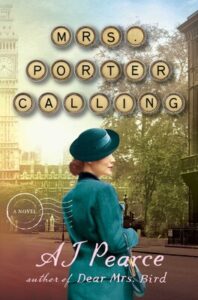
Kerry Wilkinson The One Who Fell (A Whitecliff Bay Mystery Book 1) Bookouture, April 2023.

Thank you, Net Galley, for providing me with this uncorrected proof for review.

The One Who Fell, the first in a series, is thoroughly enjoyable. The novels that follow are further evidence that I have found a new series to value. In The One Who Fell Kerry Wilkinson brings together an appealing group of characters, some gentle but effective social commentary, a mystery to be solved and an interesting location.  The first chapter is a delight – an introduction that has its comic moments, but then draws the reader into the serious nature of an interchange that impacts the main character’s life. Cheese has its moments, serious and funny along with its consumer, throughout the series. But here, it is while pursuing a choice amongst the many varieties that Millie Westlake is accosted with the question, ‘Did you kill your mum and dad?’ Books: Reviews – see for complete review.

After the Covid update: 10 Extraordinary Places around London; Tasmanian wilderness and film locations; Cindy Lou at Courgette.

Covid Update

On 28 April there were 626 new cases, with 37 people with Covid hospitalised, and 4 in ICU. There were 2 deaths due to Covid.

10 Extraordinary Places That You Won’t Believe Are In London* +

London is full of surprises, but nothing will shock you quite as much as the fact that these places are actually within the boundaries of the M25.

 GEORGIE HOOLE • 10 MARCH, 2023

a woman in a pink dress standing in front of BAPS Shri Swaminarayan Mandir temple in Neasden
Photo: @madamelena_

Our city isn’t all concrete and chaos. Believe it or not, we also have castles, caves and calm. Here are ten places that, rather astonishingly, are actually in London (featured image by @madamelena_). What a wonderful world.

10 places you won’t believe are in London

1. Kyoto Garden, Kensington
The lovely Kyoto Garden in Holland Park – a great spot for a first date in London
Photo: @shutterstock

The beautiful Kyoto Garden is an oasis of calm in the heart of Kensington’s Holland Park. Originally built to celebrate the 1992 Japan Festival in London, this garden is a thing of pure beauty. Who needs a plane ticket to Japan when this is so damn convincing?

You’ll get so lost in the pretty trees and Japanese features that you’ll forget you’re just a stone’s throw away from High Street KensingtonMore info here.

2. BAPS Shri Swaminarayan Mandir, Neasden
a view of the neasden temple on a sunny day from underneath the arch
Credit: BAPS

Sure, most people wouldn’t put Neasden on their London bucket list — but that’s where they’d be wrong. This north-west neighbourhood is actually home to one of the most breathtaking buildings in the city.

Shri Swaminarayan Mandir is a beautiful, traditional Hindu temple carved entirely out of stone. For a time, when it was first completed in the mid-90s, it was the largest Hindu temple outside of India. Read all about it here.

3. Eel Pie Island, Twickenham
eel pie island
Photo: @littlelollytravels

Eel Pie Island is a private island accessible only via footbridge, and it has many stories to tell. It was once a hub for jazz, blues and rock ‘n’ roll and many famous artists played within the ballroom at the legendary Eel Pie Island Hotel, including Pink FloydEric Clapton and The Who. In 1963, there was a period where you could come and see The Rolling Stones play at the Eel Pie Island Hotel every week. Read all about it here.

4. Painshill Park, Cobham
Crystal Grotto London
Photo: @buckyrockz

Painshill Park is a gorgeous, landscaped garden that dates back to the 1730s. It was in fact the life’s work of Charles Hamilton; a well-to-do member of the Irish aristocracy.

Inspired by his travels around Europe, Hamilton filled his garden with eccentric follies, Renaissance architecture and a beautiful grotto that you’d never guess was so close to the city. The grounds are well worth a visit, but note that the Crystal Grotto is only open at weekends. More info here.

5. Highgate Cemetery, Highgate
Photo: Nick Garrod

Highgate Cemetery is the resting place of 170,000 people, and that number is continuously growing. But the graveyard, somewhat surprisingly, is full of some impressive sights! In the West Cemetery, Victorian fascination with the Egyptians resulted in the stunning Egyptian Avenue, as well as numerous impressive tombs.

Meanwhile, the equally impressive Lebanon Circle has appeared in many a ‘gram over the years. Less beautiful, but a lot more spooky, are the subterranean Terrace Catacombs; enter if you dare. More info here.

6. St Dunstan-in-the-East, the City of London

First built nearly a thousand years ago, St-Dunstan-in-the-East is now a lovely, secret garden situated amongst the ruins of the former Church of St Dunstan. The church is a Grade I listed building that was severely damaged in the Blitz of 1941 but, instead of being rebuilt, the remains are now open to the public. More info here.

7. Hampstead Heath Pergola & Hill Gardens, Hampstead
Photo: @georgiehoole

Hampstead Pergola is the outcome of a very rich man’s dream to host extravagant summer parties. That man is Lord Leverhulme, who made his fortune selling soap. However, after his death, the Pergola suffered.

And, when the City of London took it under their wing in 1989, the place was nearly falling apart. They’re still in the process of resurrecting it, but it remains a beautiful spot for a wander. More info here.

8. Strawberry Hill House & Garden, Twickenham
strawberry hill house
@julies_explorations

I told you we had castles! (Don’t be fooled by ‘House’). This majestic building dates back to 1747 when Horace Walpole decided to purchase the empty Thames-side land and build his very own fairytale castle. As you would if you could, Walpole created a Gothic masterpiece, complete with battlements, towers and all. More info here.

9. Leighton House Museum, Kensington
Leighton House in Kensington
Image: Will Pryce

Deep in the heart of Kensington, you’ll find the incredible Leighton House Museum.

From the outside, you would never suspect that it’s actually a magnificent palace filled with breathtaking art. Lo and behold, the museum is crammed with brilliant paintings, sculptures and beautifully tiled rooms. More info here.

10. Crossness Pumping Station, Abbey Wood
the colourful Crossness Pumping Station in Abbey Wood
Photo: Peter Scrimshaw

Okay, I’m going to be honest here: this is a Victorian sewage system. But it’s not all sh*t. Known as the ‘Cathedral of Sewage’, Crossness Pumping Station first opened after The Great Stink of 1858, and it’s really rather beautiful. More info here.

* I have visited only two of these, despite living in London for over four years, and making many trips as a tourist. I visited Leighton House early in my stay in London and feel very ready to visit again. It was sumptuous, easily navigated (as long as you do not mind the stairs) and featured dark mysterious rooms as well as the well-lit entrance seen above. Strawberry Hill House and Garden, from recall, was at the end of a tube and bus ride – and well worth the effort. The featured gardens at Holland Park and Hampstead Heath are possibly not well signed as I have been to both Holland Park and Hampstead Heath and seen neither. They present a great option for my future visits to London. My review Victorian Obsession at Leighton House Leighton House Reviewed 26 February 2015 “Leighton house is always worth a visit and even more so with this sumptuous exhibition. At the same time as enjoying the exhibition I again delighted in the decorative rooms with elegant tiling, glorious fabrics and interesting furnishings. I now receive newsletters advising me of special exhibitions or night time viewings and have found it really worthwhile being on the mailing list.”

+ This is a wonderful site for information about London. However, I am not sure that the audience of this blog wants to know about the pubs that are open after 2am in London – another article in the series.

Tasmanian wilderness beckons filmmakers beyond the beaten track

The IF Team· Screen Tasmaniasponsored-content-1 ·April 26, 2023

The view approaching Horsetail Falls, set amongst the mountainous outskirts of Queenstown. Credit: Jess Bonde

Rugged beauty; a wild nature; a captivating coastline; a rich and storied history. Tasmania’s west coast presents as a remote and mostly untouched wilderness dotted with film-worthy towns and welcoming communities.

The road into Queenstown is bordered by rocky mountainscapes that are mostly devoid of vegetation.
Credit: Jason Charles Hill

Stretching from Arthur River in the north, south to Strahan and inland to the foot of Cradle Mountain, Tasmania’s west coast lends itself brilliantly to diverse film projects that seek an “off the beaten track” element.

Aptly dubbed Tasmania’s “western wilds”, this enchanting wilderness is within a few hours’ drive of Australia’s southernmost capital city of Hobart and offers all the essentials for on-location filming.

Bay of Fires filming in Zeehan’s main street.
Credit: Brook Rushton

With its ability to conjure a sense of isolation and remoteness, despite its accessibility to a capital city, the west coast offered the ideal setting for ITV Studios Australia’s reality series Alone Australia, which recently premiered on SBS Television.

But it’s the diversity of locations and the collaborative and welcoming attitude that makes Tasmania’s west coast a truly special filming destination. Other major production credits include reality program The Bridge Australia, drama series The Tailings, and the highly anticipated upcoming Archipelago Productions/FremantleMedia drama series Bay of Fires.

Bay of Fires filming on the Henty River, between Strahan and Zeehan.
Credit: Brook Rushton

The jewel in the west coast’s crown is Strahan, situated on the banks of Macquarie Harbour. The often-mirrored waters offer an idyllic lakeside setting, contrasting with the diverse landscapes that lay at the town’s doorstep.

Mirrored waterways can often be found along the Gordon River, which leads into Macquarie Harbour and the town of Strahan.
Credit: Tourism Australia

For a location shoot, Strahan offers a comfortable and convenient base, with ample accommodation and easy access to film-friendly location options ranging from the starkness of the Henty Sand Dunes that stand up to 30 metres above the beach at the mouth of the Henty River, to the deep greens of the mossy rainforests with spectacular towering waterfalls.

The Henty Sand Dunes, located just outside of Strahan, tower 30 metres above the beach.
Credit: Ollie Khedun and West Coast Council

Less than an hour’s drive inland from Strahan is Queenstown – a former mining town where Australian Rules footballers are “so hardcore they play on gravel”, as noted by Cate Blanchett on an episode of the Jimmy Kimmel Show earlier this year.

Queenstown has retained many links to its brutal yet fascinating history. Heritage buildings – including the Empire Hotel with its National Trust-listed Tasmanian blackwood staircase – line the main street of a town that was built solely for the purpose of mining the surrounding hillsides. The rugged slopes are predominantly stripped of vegetation as a result of this mining past, instead offering an other-worldly display of colours in a unique “moonscape” terrain with deep gullies and occasionally snow-capped peaks.

Queenstown has retained many links to its mining history.
Credit: Flow Mountain Bike

The emergence of Queenstown as an arts hub in more recent years has brought new life and a contrasting element to the town, with murals adorning shop walls and the presence of a renewed energy that is primed to inspire any filmmaker.

Australian drama series Bay of Fires, due to air on ABC later this year, filmed much of its content in Queenstown and Strahan, as well as the small historical mining town of Zeehan and in Hobart.

Marta Dusseldorp as Stella in Bay of Fires
Credit: Brook Rushton

Bay of Fires co-creator, actor and producer Marta Dusseldorp said her first sighting of the tiny town of Zeehan made a lasting impression.

“I was writing the series and I didn’t have the location yet. I knew I wanted a remote place that looked out of the way but I was warned not to go too remote because of the costs involved,” Dusseldorp said. “I heard about Zeehan and we went for a drive and hit the main street and we saw the place that was in my imagination. I thought ‘I can’t believe a place like this exists’.”

“We went to Queenstown, which I’d always been fascinated by, and it’s the most magical place; the cultural impact of the artists that are living there now. 

“I asked the council if I could base a series there and they asked what they could do to help. We were talking about bringing 100-150 cast and crew for 16 weeks in the dead of winter. There was this camaraderie (in the community), with people who just wanted to unlock the doors to this wonderful place.

“Then we went out to Strahan to get that other look that’s not landlocked. Even though we were there in the dead of winter, it was just so beautiful. Everything is close together and easy to get to. I can’t imagine (filming the series) in any other place – our lead character in our series is the west coast. Our show is basically a love letter to Tasmania.”

Bay of Fires utilised Queentown’s airstrip.
Credit: Brook Rushton

For screenwriter Caitlin Richardson, Tasmania’s west coast provided the perfect inspiration when penning the storyline for her 2021 SBS drama series The Tailings.

“The West Coast as the setting for The Tailings came about because it was where my parents started their careers as teachers,” Richardson explained. “They met in the tiny mining town of Savage River and went on to work in Queenstown and later Burnie. They have such fond memories of their years living and working on the west coast, primarily because of the strong sense of community there.

“I think, for this reason, I have always associated the West Coast with formative, coming of age experiences. Exploring a couple of transformational moments in the lives of two young women was a central focus in The Tailings, so I was interested in setting our story on the West Coast.”

Both Strahan and Queenstown are served by airports that allow for small fixed-wing aircraft and helicopter access. Hobart’s major commercial airport is located 260 kilometres from Queenstown.

A steam engine operates on the West Coast Wilderness Railway, giving a small glimpse into the region’s mining past.
Credit: Ollie Khedun and West Coast Council

The two primary townships of the West Coast are connected by a railway line through the dense temperate rainforest. Now existing only as a tourist attraction – with a scenic steam train journey operating daily – the railway was constructed in 1897 to transport minerals such as gold and copper to Strahan for export.

Mayor of West Coast Council Shane Pitt said the region had become popular with filmmakers seeking something a little different from their location choices.

“The West Coast has been busy, especially this past year, with many different filming projects being undertaken,” Mayor Pitt said. “The remoteness and uniqueness of this beautiful place we call home makes itself ideal for TV shows like the first ever Australian Alone and The Bridge.

Queenstown’s streetscape set against a mountain backdrop.
Credit: Rob Mulally

“Our spectacular roads are a match made in heaven for Subaru WRX ads and the gravel oval for AFL ads and photo shoots by some of the best in the sports photography business, such as Steve Waugh Photography. The diverse landscape lends itself to just about anything you can think of.

“Being involved in so many different filming projects has been a fantastic way to showcase our region, and West Coast Council is proud to work alongside production crews who are brave enough to travel just outside their comfort zone.”

The Tailings Tegan Stimson (Jas) with Director Stevie Cruz-Martin filming at Mountain Heights High School in Queenstown.
Credit: SBS/Good Lark Pty Ltd

Screen Tasmania is happy to connect interstate and international production teams with experienced local creatives and crew, and has programs in place to support film development and production within the state. For more information contact Screen Tasmania on 03 6165 5070 or email info@screen.tas.gov.au or visit www.screen.tas.gov.au.

Cindy Lou at Courgette

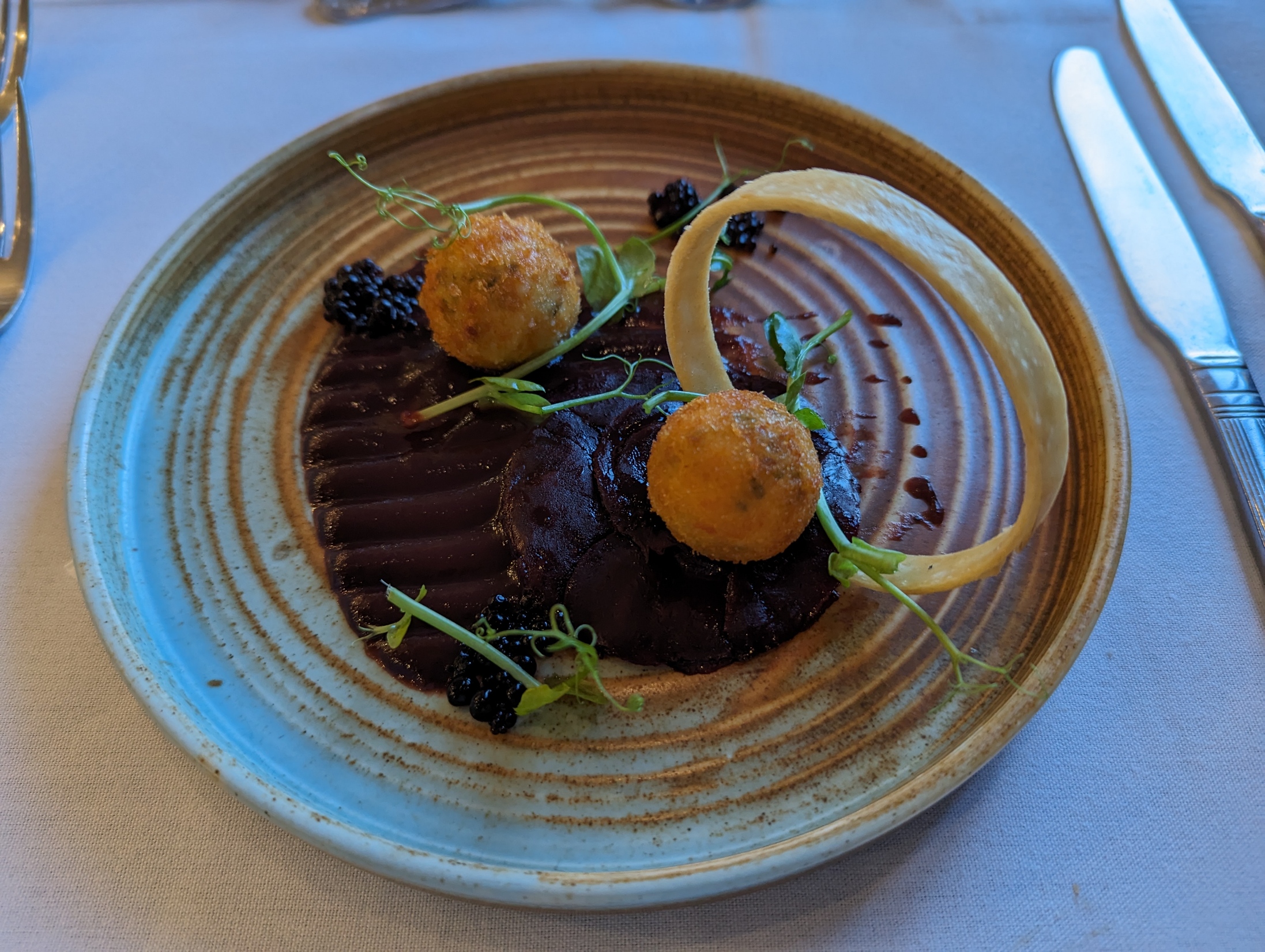
Courgette has gone into voluntary administration but is continuing to trade as usual and is encouraging customers to keep their reservations. Cindy Lou thought she would join other Canberrans in trying to keep this restaurant going – it would be a terrible loss. After all, if Cindy Lou cannot get to Aria in Sydney Courgette currently provides a Canberra alternative.

The restaurant was full by 7.00 pm except for one three-person table, so it seems that other Canberrans feel that the restaurant should be supported.

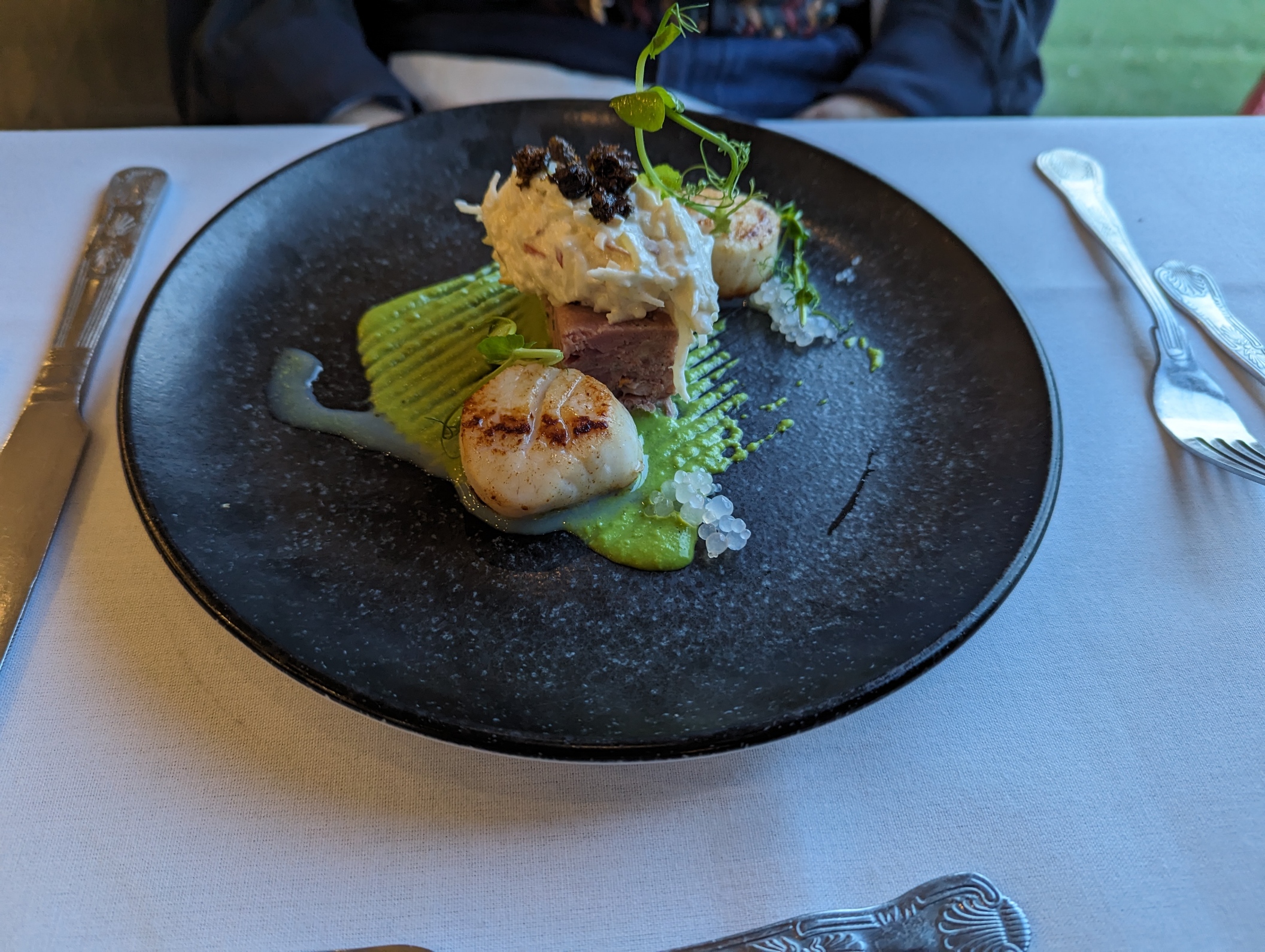
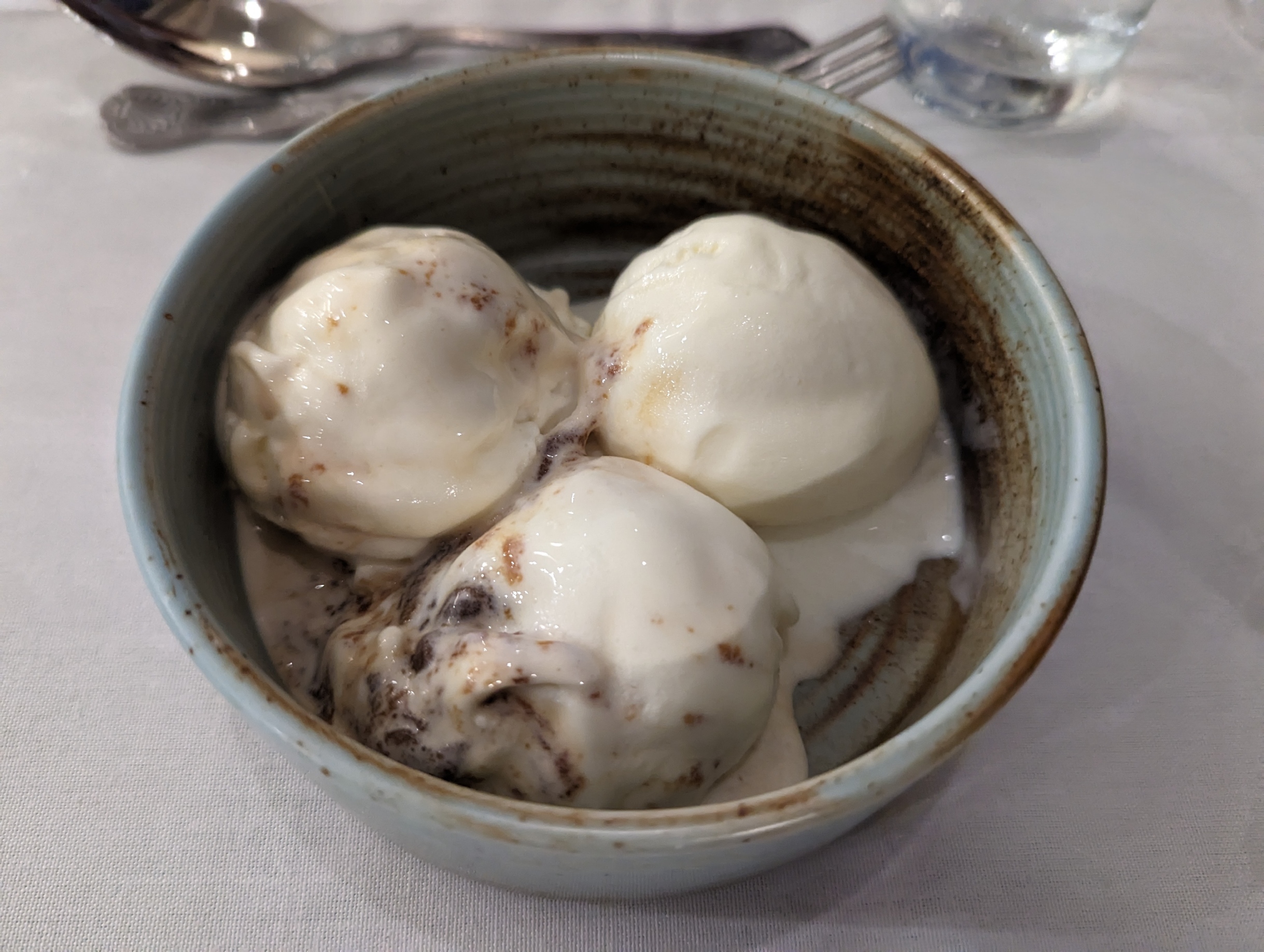
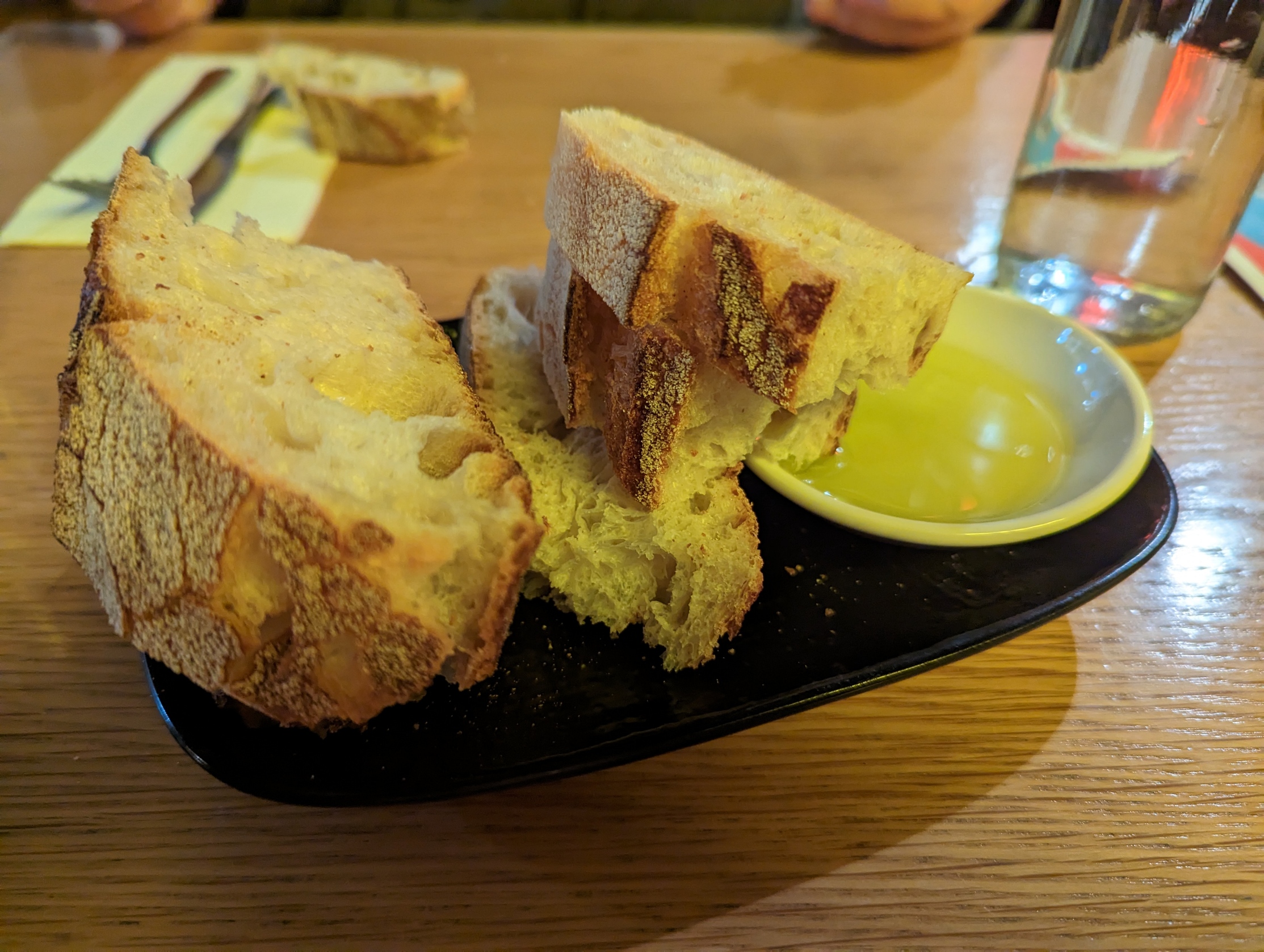
As usual, the food was delicious and the service pleasant and attentive. It seems that the wonderful ash butter is no longer available, and this is a huge disappointment. However, the whipped butter was successful with the warmed rolls (but I wish the ash butter would return!) The three-course menu for a set price ($95) is inventive and comprises meat, fish and vegetarian dishes- and three choices of dessert as well as a cheese platter.

The dishes below are the chicken breast, the beef, fish, and two different desserts.

Kingsolver, O’Farrell among Women’s Prize fiction finalists

By JILL LAWLESS April 26, 2023 GMT

LONDON (AP) — An Appalachian update on Charles Dickens and a tale told by a dolphin are among the six finalists announced Wednesday for the prestigious Women’s Prize for Fiction.

American writer Barbara Kingsolver’s “Demon Copperhead,” a reworking of “David Copperfield” set in modern-day Virginia, and U.K. novelist Laline Paull’s deep-sea drama “Pod” are among the contenders for the 30,000 pound ($37,000) award.

Kingsolver previously won the Women’s Prize in 2010 for “The Lacuna.” Britain’s Maggie O’Farrell, who won in 2020 for “Hamnet,” is a finalist again for Italian Renaissance tale “The Marriage Portrait.”

The finalists also include three debut novels: “Trespasses,” a love story by Irish writer Louise Kennedy that is set during Northern Ireland’s years of violence; “Fire Rush,” a dub reggae-drenched coming-of-age tale by Britain’s Jacqueline Crooks; and Sarajevo-set war saga “Black Butterflies” by Britain’s Priscilla Morris.

Broadcast journalist Louise Minchin, who is chairing the panel of judges, said the six finalists had an “amazing” imaginative scope.

“You’ve got 16th-century Florence, you’ve got the Indian Ocean told from the point of view of the creatures that live in it,” she said.

Minchin said that by giving personal voices to the opioid crisis in America, the siege of Sarajevo, late-1970s London riots and Northern Ireland’s conflict, other books on the list take readers behind the headlines in a way that is “very insightful and very moving.”

Founded in 1996, the prize is open to female English-language writers from any country. Previous winners include Zadie Smith, Tayari Jones and Susanna Clarke. Last year’s prize went to Canadian-American novelist Ruth Ozeki for “The Book of Form and Emptiness.”

The winner of the 2023 Women’s Prize will be unveiled June 14 at a ceremony in London.

Oh Dear… so I got it wrong?

See my review of Demon Copperhead in Books: Reviews December 7 2022.

Week beginning 26 April 2023

Publishing

I have begun this week’s blog with a great story about publishing from a Western Australian author, Gordon d’Venables. I referred to his new book, Hunted, last week. Star of the South, which, from what I recall of our discussion in January 2021 in Perth, is rather different from the earlier publications, will be published in 2024.

Writing & Publishing experience in brief

For a couple of years I had an idea circling in my head. I have always enjoyed writers who use words as their vehicle to convey a message. A subtext to the main plot. Understated, but artfully conveyed to the reader. That is what I hoped to achieve with my first book, The Medusa Image.

For me, fashioning those ideas into a book outline is an evolving process. Initially I simply wrote without preparing a format. Most importantly, I knew how I wanted to finish. When an idea flashed into my head, even unrelated to the current draft stage, I committed it to paper. Hunted was more structured. I wrote a lengthy synopsis and would often read it to keep on track.

It is a commonly held view that one must finish a draft before editing. I don’t subscribe to that notion. It’s a matter of preference. I edit each day. When I finish writing for the day I print my work and after a few hours to clear the mind, use the hard copy to hone or strengthen the scene. Before commencing the following day, I make the changes and re-read the work, usually out loud. It’s a slow process but for me it is easier to maintain the flow of the story.

When The Medusa Image manuscript was completed to my satisfaction my wife grabbed the red biro. She did a wonderful job at proofreading and gave excellent editorial advice. I received frank feedback: “What is this paragraph doing in this particular chapter? It’s out of place and doesn’t read well.” “What are you trying to achieve here?” “This sentence doesn’t make sense.” I’m challenged and appreciate that.

After completing another draft I had a trusted friend read the manuscript. Her feedback was also valuable.

I didn’t write The Medusa Image expecting it to be published. I simply wanted my thoughts to be committed to paper for family to read in the fullness of time. After the feedback I received I sent the manuscript to two publishers in England (where the story ended). As instructed, I submitted a synopsis and the first few chapters of the manuscript. The response came thus, “You are invited to submit your full manuscript for further consideration.” It wasn’t a commitment to publish. That came three months later with an apology for the length of time the process had taken. “We receive hundreds of new submissions every month and after considering every book’s literary merit and commercial viability we take a small percentage to the final review stage.”

To my surprise, both publishers offered a contract. My legal background caused me to examine the fine detail of the contracts. I preferred the offer from Pegasus Publishers on the basis I was only required to give them first right of refusal for my next two pieces of work as opposed to the other agreement demanding everything I write.

In the following twelve months I received two sets of proofs with ‘track changes’ activated for my consideration. I was provided with a Publication Guide, asked to submit photographs, complete a questionnaire about my background, and provide my thoughts on a cover design. Pegasus also provided bookmarks and flyers.

Fifteen months after providing the manuscript for consideration the book was released. Promotional information was added to the data base of Nielsen, Gardners, Ingram, Amazon, Legal deposit libraries and others. The Marketing Department sent press releases to national newspapers, radio stations, and magazines, hoping to gain an article or a review.

Acceptance of both Hunted (to be published on 27 April) and Star of the South (to be published early in 2024) only took a few weeks. For Hunted, the preparation for ultimate publication has taken about fifteen months. Editorial feedback from Pegasus has been embarrassingly positive. Good for the ego I suppose.

Gordon d’Venables

Kathy George Estella Harlequin Australia, HQ (Fiction),  2023.

Thank you, NetGalley and Harlequin Fiction, for providing me with this uncorrected proof for review.

Estella is yet another novel in which an author takes a secondary, or even the main character, from a classic and weaves a new story. As is so often the case, the female character has previously been posed against a male character who takes centre stage. In Estella, the female character takes that place, and we see her relationships with her adopted mother, a lawyer, the various men who attract her attention, and whose attention she attracts, from her perspective. In addition, Estella has some interests that are hers alone rather than associated with a love interest. At the same time, Estella is a romantic novel, both in its attention to Estella’s romantic interests, its resolution and its depiction of the landscape in which Estella grows to maturity…

…I have some reservations about the novel as, although it is well written, I did not find it exceptionally engaging.  See Books: Reviews for the complete review.

Weekly COVID-19 update as at 1:28pm AEDT, 21 Apr 2023 (from the ACT Report)

236,248 Total cases since March 2020.

581 New cases this week; 128 New PCR cases this week; 453 New RAT cases this week.

38 In hospital; 1 In ICU; 0 Ventilated; 1 Life lost this week.

231 Total lives lost since March 2020

Sadly, ACT Health has been notified of one COVID-19 related death during this reporting period; a man in his 80’s. ACT Health extends its sincere condolences to his family and friends at this difficult time.

Note: for the latest COVID-19 vaccination data in Australia and ACT, visit Department of Health – Vaccination numbers and statistics. View detailed report. Routine reporting provides an overview of the COVID-19 situation in the ACT.

Cindy Lou brunches in Canberra

Trevs at Dickson

Trevs at Dickson has an extensive breakfast /brunch menu, and I was glad to return to this pleasant eating spot on a sunny Canberra morning. The outdoor seating is benches and tables, four at a reasonable distance from each other. This was important as the dogs at three of the tables were far enough away from each other to offer only glances and superior looks as their owners gave them treats (or not). It was sunny so there was no need for heating – and it seems that this will not be offered later on, so it is worth taking advantage of the current pleasant weather to eat out at Trevs.

We chose the $25 option – three choices from seventeen delicious small meals and a small juice. Water is provided, and this and the menus arrived promptly. Each meal was excellent, and certainly the three were quite enough. The photos are probably self-explanatory, but here is the list|: granola, fruit and yoghurt; bocconcini and tomatoes on bruschetta; BELT slider; avocado and dukka; potato pancake with smoked salmon; and a corn fritter.

Bookplate at the National Library of Australia

A marvellous school holiday activity, Make your Own Boardgame, brought me to the National Library. I reviewed a book about making board games, Jesse Terrance Daniels’ Make Your Own Board Game in the blog, 26 May 2021, so was interested in the school holiday workshop. Attendance was impressive with a wide age range. Some parents and grandparents stayed, others ate at Bookplate, and others waited in a comfortable sitting area. According to one participant the presenters were fairly hands off. This fostered independent activities so that the board games that were produced were quite different. The presenters were diligent with handing out materials, fostering even greater creativity. Participants were able to return home with their board game, a dice and figures for playing their game. At the workshop they had notepads, protractors and rulers, a compass, a range of drawing implements -pencils, crayons and textas, and coloured paper.

The website provided access to relevant products so that participants could follow up with further board games.

Bookplate has a good menu, as well as a variety of sandwiches and cakes. The coffee was excellent, and the service pleasant and efficient. There is indoor and outdoor seating, both of which have special features. The Leonard French panels in Bookplate are wonderful, and outside Lake Burley Griffin makes a colourful panorama with the High Court of Australia and National Gallery of Australia in the distance.

President Joe Biden announces that he will run again

Announced on Morning Joe Tuesday morning with a video. It is worthwhile watching: the diversity is uplifting; Vice President, Kamala Harris, has a prominent role: and important themes are the fight for democracy, liberties and rights. He said “Let’s Finish The Job”.

Week beginning 19 April 2023

NetGalley provided me with the following uncorrected proofs for review. The first, The Women Who Wouldn’t Leave, is a good read. Unfortunately, the other two books are extremely disappointing. Miranda Rijks’ The Other Mother follows others I have read by this author. They have been fairly good beach reads, and for GoodReads I have rated them 3*. This time I was unable to do that, and this book is amongst the few I have allocated 2*. Valerie Keogh’s The Librarian has a very concerning section related to the rape of the main character. It sits badly with the efforts, herculean at times, that have been made to give women’s accounts credibility. So many novels deal with issues such as this astutely, it is disappointing to read what seems like a throwback to the past. People who have read my articles on Agatha Christie, in particular the ideas about rape in Nemesis, will be aware of the problems with such material in past novels.

Victoria Scott The Women Who Wouldn’t Leave Aria & Aries, 2023.

Once again Victoria Scott deftly combines sympathetic and appealing  characters, some heart-warming conclusions, and social commentary. Such a combination provides an enjoyable read, while raising questions that are worth pondering. The Women Who Wouldn’t Leave is a book that, while raising such questions, does not lose sight of the need to develop characters who are attractive at the same time as identifying their failures, and story lines that are absorbing.

The ‘women who wouldn’t leave’ are tenants on a council estate. Their homes become the focus of a fight between residents and the local council. A decision is to be made on whether the land should be sold to a real estate company which will demolish the council houses and substitute expensive housing. The women and their neighbours determine to bring the council to account, by ensuring that their arguments against the changes become part of the debate. At the same time as this political venture takes place, the personal changes that need to be made to ensure success, are pursued.  At the heart of both processes, the political endeavour and the personal, are Constance and Matilda. Both women have suffered, made egregious mistakes, and as a consequence are wounded. Their damaged lives impact on the people around them. See Books: Reviews for the complete review.

Miranda Rijks The Other Mother Inkubator Books, 2023.

The Other Mother is an awkward read, predominantly because while a child has been abducted, there is little sense of urgency about solving the crime. Rijks tells several women’s stories, including that of the mother of the missing child.  While these stories revolve around four year old Florrie and interactions with her parents, the police and friends, at times they detract from the enormity of the kidnap.

The two main characters are Nala, Florrie’s mother, and Jane, her friend and the woman who should have collected Florrie. In her interactions with her friends, husband and the police Nala’s feelings seem relatively unengaged with the horror of Florrie’s disappearance for several days. Jane, who has been impersonated by the kidnapper when she is late to collect Florrie, while  distressed, is also engrossed by her other responsibilities. Other characters’ stories are woven throughout and seem to vie with the main narrative for precedence. See Books: Reviews for the complete review.

Valerie Keogh The Librarian Boldwood Books 2023.

The librarian, Ava Warrington, works at the fictional Tate Modern Library, has a pleasant home with an alarm system, in the suburbs, loving parents in the country, a sister for whom she babysits, and a good friend Poppy, whom she met at university.  She also has a past that haunts her, and as the anniversary of that event nears, her fragile state of satisfaction with herself and her life, teeters. Her distress is augmented by sounds in her home, a dead bird on her back patio, meeting an overbearing man at a nearby bistro, and a disaster at work.

These are the elements of a psychological drama, and Keogh manages at times to achieve this. Ava is a people pleaser and makes efforts to deal with her inability to say no; she rebuffs the overbearing  man with determination; and she finds the courage to take on the detective role when her friend’s enthusiasm for yet another ‘love of her life’ leads to her possible disappearance.  See Books: Reviews for the complete review.

After the Covid update: Barbie – the film, some comments, Feminist films, London Library Bars, Cindy Lou, Publishing, featuring a new release – Hunted by Gordon d’Venables.

Covid Update, ACT to 14 April

There were 558 new cases, with 46 people with covid in hospital. One person is in ICU. There were no deaths recorded.

Barbie – the film, some comments

Also see the review of Doll in Week Beginning November 30, 2022, or on Good Reads.

The New Daily 10:00pm, Apr 14, 2023 Updated: , Louise Talbot , Entertainment Reporter.

Margot Robbie’s teasing quip about her Barbie movie inspires some unreal theories

On the surface, actress and screenwriter Greta Gerwig’s highly anticipated Barbie movie looks like a peaches-and-cream, pro-feminist, good vibe flick marketed to woke teenagers.

Dig a little deeper and discover the Hollywood mantra – that nothing is as it seems – or so Australian actress Margot Robbie teased in a recent interview ahead of the July 30 premiere.

“The first time I read the Barbie script, my reaction was, ‘Ah! This is so good. What a shame it will never see the light of day … because they are never going to let us make this movie’,” she told BAFTA (via Indiewire).

‘Can’t tell ya’

Grinning from ear to ear, she smugly says: “But they did!”

Then she made a ‘my lips are sealed’ gesture when asked to elaborate.

“Can’t tell ya,” Robbie said.

So if the script was so “good”, why did Gerwig’s live-action storyline get green-lit and what’s it about?

The doll was created by US businesswoman Ruth Handler and released by Mattel, Inc. in 1959, with the wholesome brand making billions of dollars over the decades with merchandise.

Barbie has appeared in 40 computer-animated films since 2001, “integrated into fairy tales, literary favourites, original stories, royal kingdoms, high-school classrooms, and … New York City”.

“These films, despite variances in animation quality that range from very good to near-uncanny CGI, have been wildly popular,” writes Collider, adding that a live-action has been in the works since 2009 with various writers and big-name stars.

Gerwig (White Noise, Little Women) is not giving anything away, except a few vague comments on a recent episode of Dua Lipa’s At Your Service podcast.

See Television and Film: Comments for the complete article.

Feminist films

As is usually the case with lists such as the one below there will be different films that people believe should be included – and that some should be excluded. See Books: Reviews 9 June 2022 for a review of Erin Brockovich’s book, Superman’s Not Coming, for further information about the content of Erin Brockovich.

The new classics: 10 of the best feminist films you need to watch in your lifetime

WORDS Elyssa Kostopoulos    PHOTOGRAPHY Pinterest    PUBLISHED Sun, 27 Jun 2021 – 9:14 am

best feminist films

There are simply some films out there that are undisputedly necessary watching. While our heart still hurts for the classics, we’ve begun working through a new watchlist that is equally as important. Following on from International Women’s Day earlier this week, we’re taking a moment to celebrate the momentous success and lives of real women whose tales have made it to the big screen. And for good reason. Below, we’ve rounded up 10 of the best feminist films you definitely have to watch.

On the Basis of Sex, 2018
best feminist films

Image credit: Pinterest

The formidable Ruth Bader Ginsburg is a major icon for team RUSSH. Naturally, the 2018 film On the Basis of Sex, which follows RBG in her early life and career is at the top of our list for best feminist films. The film follows the late Supreme Court Justice through the landmark case that would set a precedent for sex discrimination; confirming Ginsburg’s place as one of the most prolific gender rights lawyers of her generation.

Set throughout the 50s, 60s and 70s, Felicity Jones takes on the role of RBG; portraying a fiercely determined lawyer who with her husband, Marty, take on Moritz v. Commissioner, the first federal case to declare discrimination on the basis of sex unconstitutional.

See Television and Film: Comments for the complete article featuring Frida, Erin Brockavich, Suffragette, Hidden Figures, A Private War, Lady Sings the Blues, The Glorias, North Country and Confirmation.

London Library Bars

Some wonderful places to visit in London. I have been in the library at The Cinnamon Club where dessert was served to our group after a delicious meal.

9 Lovely Library Bars In London For Perfectly Cosy Drinks

London’s library bars make for a classy and cosy night. Here are some of the best literary-focused places for a drink or two.  SECRET LONDON • 22 MARCH, 2023

the interior of the scarfes library bar, showing a roaring fire in between bookshelves, with gorgeously opulent armchairs and sofas in front
Credit: Scarfe’s

Nothing screams sophistication like tucking into a good book with a dram in hand – so we’ve rounded up the best of London’s library bars for a classy and cosy night out. (Going out can now be classed as educational – you’re welcome).

1. Scarfes Bar, Holborn
the bar at scarfe's, which is dark and sexy with the library corner visible at the far end
Credit: Scarfe’s

Named after British caricaturist, Gerald Scarfe, this bar is filled with Scarfe’s own collection of amusing paintings – making it an educational trip for art fans. Cocktail names draw from contemporary events and pop culture figures, and bring the namesake artist’s caricatures off the wall and into your glass. You can be sure that you’re in good hands, too, given that their Arturo Burzio was recently crowned the ‘elit Vodka Martini Master 2022‘. Oh, and there’s books. Lots of them. To fill the shelves, an antique dealer from Portobello Market hand-selected over 1,000 antique tomes. Be still my beating heart!

Keep an eye out for their all-new menu, coming soon, to celebrate ten years of Scarfe’s!

2. Library Bar at The Lanesborough, Hyde Park Corner

The outstanding mixology, “liquid museum” of spirits, and warm, vibrant atmosphere make The Library Bar at The Lanesborough a popular choice with Knightsbridge and Belgravia’s locals, as well as hotel guests. While bartenders often hesitate to tamper with classic cocktails, the team at this library bar have re-imagined some old favourites with fantastic results. They also have their own house gin, The Lanesborough London Dry Gin, and an absolute plethora of spirits.

Throughout March they’re running a special pop-up in collaboration with “the world’s leading publisher of the highest quality illustrated books”, Rizzoli. They’ll be displaying their titles throughout the bar, with the chance to sip on special Rizzoli cocktails and even meet some of the featured authors! Find out more here.

3. Library Bar at The Ned, Bank
The Ned's champagne and martini library bar, with lush seating and one person working hard behind the bar
Credit: The Ned

This intimate library bar bills itself as a champagne and martini bar. Now that’s the kind of specialisation that can get behind! Hidden behind a jacquard curtain, the venue boasts a menu of thirty different Champagnes, a martini trolley, signature and vintage cocktails, and a healthy selection of vermouth. Create your own Martini using your choice of spirit and garnishes, and get cosy on a velvet sofa – you’ll feel oh-so suave.

4. Swans Bar at Maison Assouline, Piccadilly Circus

 196A Piccadilly, W1J 9EY. Closest station: Piccadilly Circus.

In the heart of Piccadilly and housed in the landmark building that was once a former bank, it would be rude not to have a drink or a spot of afternoon tea in what is considered to be one of the world’s most beautiful book stores. Have a sip, have a browse, and maybe even learn more about the drink in your hand.

 196A Piccadilly, W1J 9EY. Closest station: Piccadilly Circus.

5. The Cinnamon Club, Westminster
the interior of the Cinnamon Club, with an impressive wall of books circling the dining room
Credit: The Cinnamon Club

Once the reading room of the old Westminster Library, this Grade II listed building is now home to contemporary Indian restaurantThe Cinnamon Club. The beautiful restaurant has, however, honoured its history and retained its literary spirit in the book-filled walls. All food is complemented with carefully sourced wines, and their gin trolley offers an exceptionally curated collection of gins. A cocktail menu in both bars promises an exploration of tastes with signature famous cocktails. Eat, drink, and admire the history of literacy!

 30-32 Great Smith Street, SW1P 3BU. Closest station: St James’s Park or Westminster.

6. The Fable, Holborn
the book table at the fable, where piles of books ring the sofa around the table
Credit: The Fable

Inspired by the fantasy world of fairy tales and Aesop’s fables, The Fable (looking out onto Holborn Viaduct) offers tranquil calm in the heart of the city. From the leather bound books to the vintage typewriter, every detail tells a story. Whether you’re just popping in for a drink or sitting down for an evening meal, you’ll quickly spot the venue’s enchanting quirks. This (pictured ) is, of course, the best seat in the house.

 52 Holborn Viaduct, EC1A 2FD. Closest station: Farringdon or City Thameslink.

7. Electric House, Notting Hill
a look into the library area at electric house, with books behind the bar and plush armchairs and sofas dotted around
Credit: Electric House

Now, look, you are going to need to be a member to get in to the library at Electric House. But ask around, you’re sure to be have a friend who has a cousin who knows someone that can get you in. And given how gorgeous the space is, it’s worth the effort. The library also plays host to live music, complementing the library of not just books, but also vinyl records.

 191 Portobello Road, W11 2ED. Closest station: Ladbroke Grove

8. The Phene, Chelsea
the library room at the Phene with a small roaring fire and cosy sofas
Credit: The Phene

This iconic Chelsea pub dates its heritage back to the 1800s, and the three-floor clubhouse-style venue hides a whole host of rooms. It’s equally welcoming throughout the year, with a sunny beer garden for the summer and warm cosy rooms for the cooler months. They also boast “the comfiest chairs in all of Chelsea.” A bold claim. Care to put it to the test? Grab one of the antique books from the shelves (carefully, now!) and settle in.

9. Library Bar at the Bush Theatre, Shepherd’s Bush
people milling around in the Bush Theatre Library bar, enjoying drinks in the early evening
Credit: Philip Vile

During the day, the Bush Theatre’s Library Bar is a relaxing workspace and coffee hub. But by night, it serves up craft beers, bespoke cocktails and great wines. Whenever you choose to visit, there are always plentyyyyy of playtexts in the library, if you’re after a bit of inspiration. To read, or not to read — that is the question!

 7 Uxbridge Road, Shepherd’s Bush, W12 8LJ. Closest station: Shepherd’s Bush Market.

A far more simple venue than those in London as described above was visited by Cindy Lou recently.

Breakfast at Divine Cafe and Bar

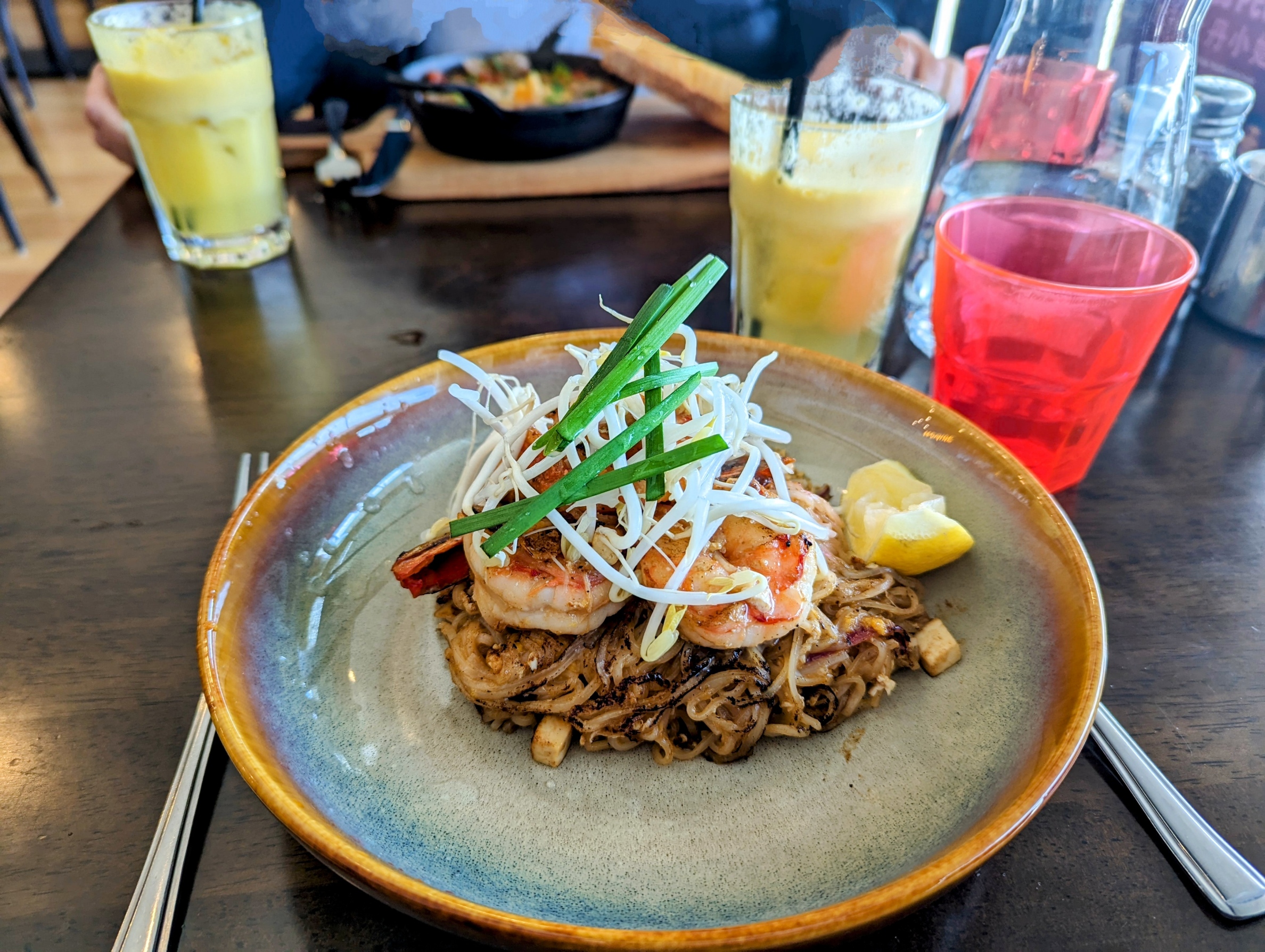
Divine has an interesting menu, and one of the highlights is breakfast. With its indoor and outdoor seating, pleasant and efficient service and delicious meals, Divine Cafe and Bar is an excellent addition to the Jamieson Shopping Centre. The scrambled egg with grilled tomatoes is generous; the eggplant, red onion, olives and sundried tomatoes on toast is more exotic and as generous.

Publishing

This time my contribution to articles on publishing is small, but important. Gordon d’Venables has written his second book. Some readers will recall that I wrote about Gordon’s first book, in the blog some time ago. At that time, the second was in his mind, if not on the page. It was interesting to see how the publication of a first novel made him even more keen to get onto the next. I found this very instructive, as my reaction to completing a huge writing task was to try to find smaller ones that took much less effort. I wonder what other writers’ response is to finishing a book, major paper or thesis? To read more about Gordon’s first publication see Gordon d’Venables, Medusa Image, post for 20 January, 2021. Gordon will write about his publishing experience for the blog.

New Release – Hunted by Gordon d’Venables

Hunted will be released in a fortnight. More about it then.

Week beginning

Janet Malcolm Still Pictures On Photography and Memory Farrar, Straus and Giroux, 2023 


I appreciate NetGalley having provided this uncorrected proof for me to read and review. I am so glad that they approved my request.

Years ago Barbara Pym said of her novels:

I might use Christopher Isherwood’s phrase ‘I am a camera’ to describe the process by which the novelist records his impression of life. But the novelist’s camera is a selective one, picking and choosing, recording some things clearly, rejecting others altogether. And it is obvious that the camera of one novelist may record quite different things from that of another.

Janet Malcolm acknowledges that the same process has influenced her autobiography, that of a nonfiction writer, combining photographs and text. In both cases the reader is left with an exciting journey – that of the information on the page, and that of interpretation. Malcolm’s work is introduced by Ian Frazier, a friend of twelve years, who spoke with her shortly before she died. Anne Malcolm, her daughter, wrote the afterword. Both make important contributions to the text, without undermining Janet Malcolm’s own interpretation of her life, in this book, through photographs. These are a mixture of beautifully rendered pieces; reproductions which while poor, still tell a story; depictions of facets of Malcolm’s life; and photographs of others’ lives through which their story and glimpses of Malcolm’s, are woven. A short note about the author provides one story of this captivating author; Malcolm’s own text and choice of photographs tells another; yet another can be glimpsed at times through interpreting the photos; and most importantly, Malcolm abandoned her attempt to write a formal autobiography which she found unrewarding, and has used photos of events and people, from which she emerges in glimpses as well as with a full story. The whole is an engrossing read in short pieces associated with a photograph. See Books: Reviews for the complete review.

After the Covid update: The Voice (2 articles); Cindy Lou; Food on the Nullabor; Publishing – women writers’ popularity.

Covid Report to April 7 2023

Cases on 7 April 2023, in total is 235,113 with 550 new cases in the week to 7 April. People in hospital number 49, with 3 in ICU and 1 ventilated.

The Saturday Paper

Editorial
Plastic spiders

Peter Dutton knew before he called his colleagues to Canberra that he would oppose the Voice. The party room meeting was a stunt, like almost everything else in his career. Dutton is the ugly person who makes true the old joke about politics and show business.

There is nothing honest in Dutton’s concerns about the Voice. His argument folds over on itself like a napkin: the Voice will be ineffectual and it will do too much. It doesn’t matter that these positions are contradictory. His objection is not about logic. It is born of the simple fact that it is easier to throw a referendum than win an election. His success is the country’s loss.

Dutton lives on the fringe. He talks about cities with scepticism and contempt. The real Australia is somewhere further inland. Presumably the men out there wear big hats and say what they think, if they speak at all. Dutton calls these “our seats”. There are too few of them to win office but just enough to spoil progress.

In describing the Voice, Dutton continually refers to “city-based academics”. He claims they would hijack decision-making. The dog whistle has peculiar harmonics: it suggests that education makes an Indigenous leader less Black and reprises the false division of “urban Aboriginals”. The line also ignores the representative structure of the Voice: two members from each state, territory and the Torres Strait Islands; five more from remote communities; an additional member to represent Torres Strait Islanders on the mainland.

Of course, Dutton knows this but doesn’t care. His cynicism is boundless. He pretends he is worried about dividing the country and finds that his only solution is to divide the country.

Dutton doesn’t have the numbers – not yet – and so he pretends the numbers he does have count more. Steve from down the pub is more right because nobody asked him yet. This is how Dutton sustains his politics: he invents a miserable constituency and then pretends he is their champion.

Dutton is not a serious person. He doesn’t have policies or eyebrows. His term in parliament has produced enough shame for six lifetimes, but this latest decision will grant him the balance for a seventh.

Noel Pearson describes him as an undertaker. He says he has betrayed the country. He says he will have to dig a very big hole to bury Uluru.

Hopefully Pearson is right. Hopefully the country is wise to Dutton’s ghoul politics, to the creaking doors and plastic spiders of his rhetoric on the Voice. Hopefully it is plain to everyone that his small, fumbling objections are about only one thing: his hold on power in the cemetery of a once mighty party.

This article was first published in the print edition of The Saturday Paper on April 8, 2023 as “Plastic spiders”.

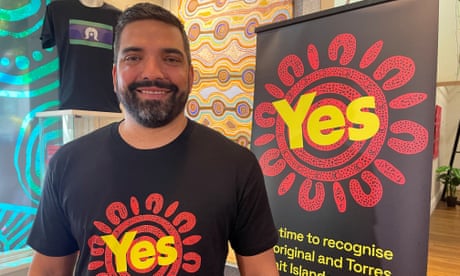
Leader of Young Liberals will consider supporting Indigenous Voice to Parliament, despite party stance

By Paul Johnson

Posted Yesterday at 12:49am, updated Yesterday at 6:12am

A woman in a black dress clutches her hands to her chest.
Anne Pattel-Gray gave an impassioned pro-Voice stance on Q+A.

Anne Pattel-Grey, the head of the School of Indigenous Studies at the University of Divinity, has told Q+A that the referendum on the Voice to Parliament is not political but rather a question that goes to the integrity of all Australians.

Key points:

  • The leader of the Young Liberals said he was open to voting ‘yes’ on the Indigenous Voice to Parliament
  • An Indigenous academic framed the Voice as a vote about the integrity of Australians
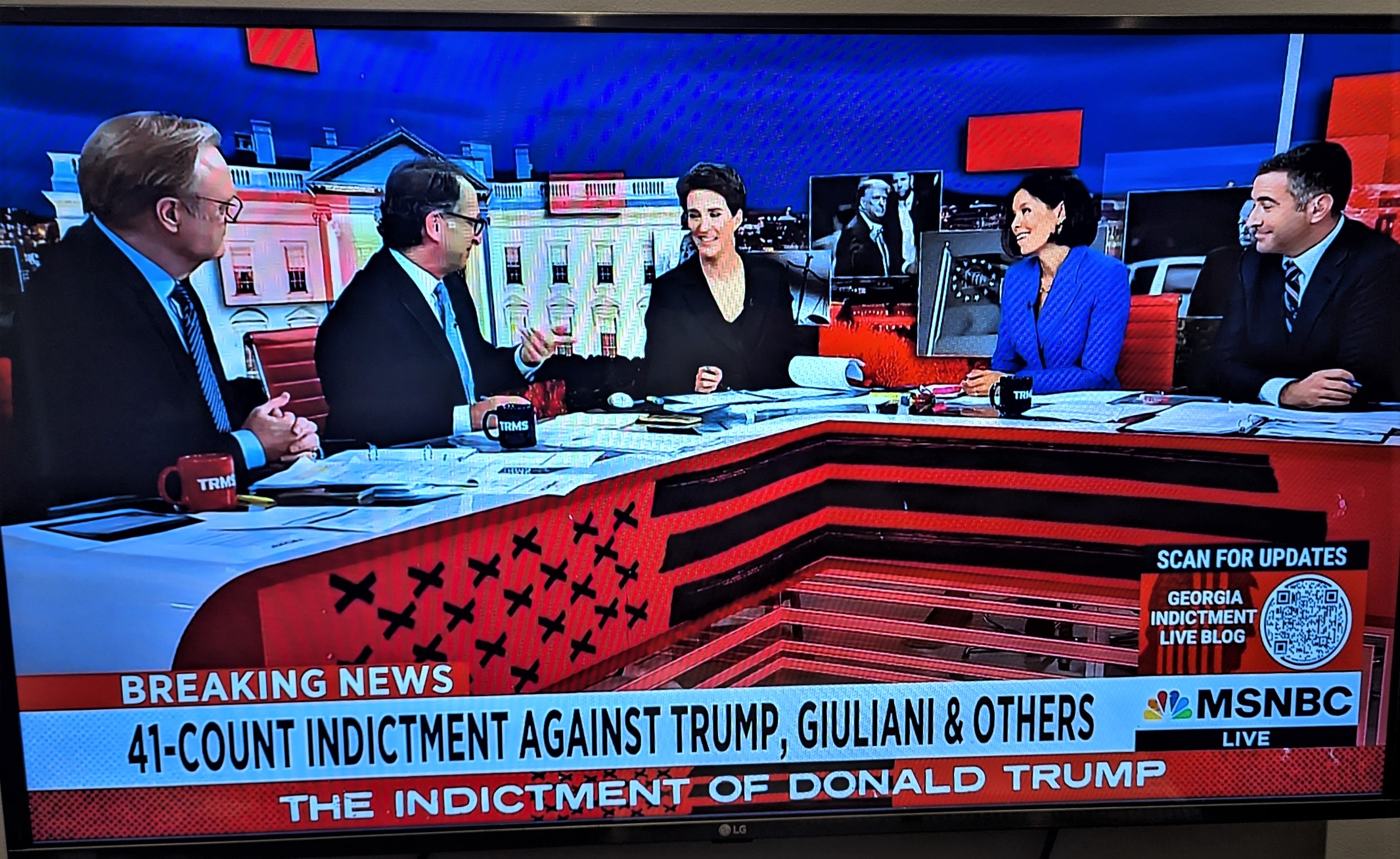
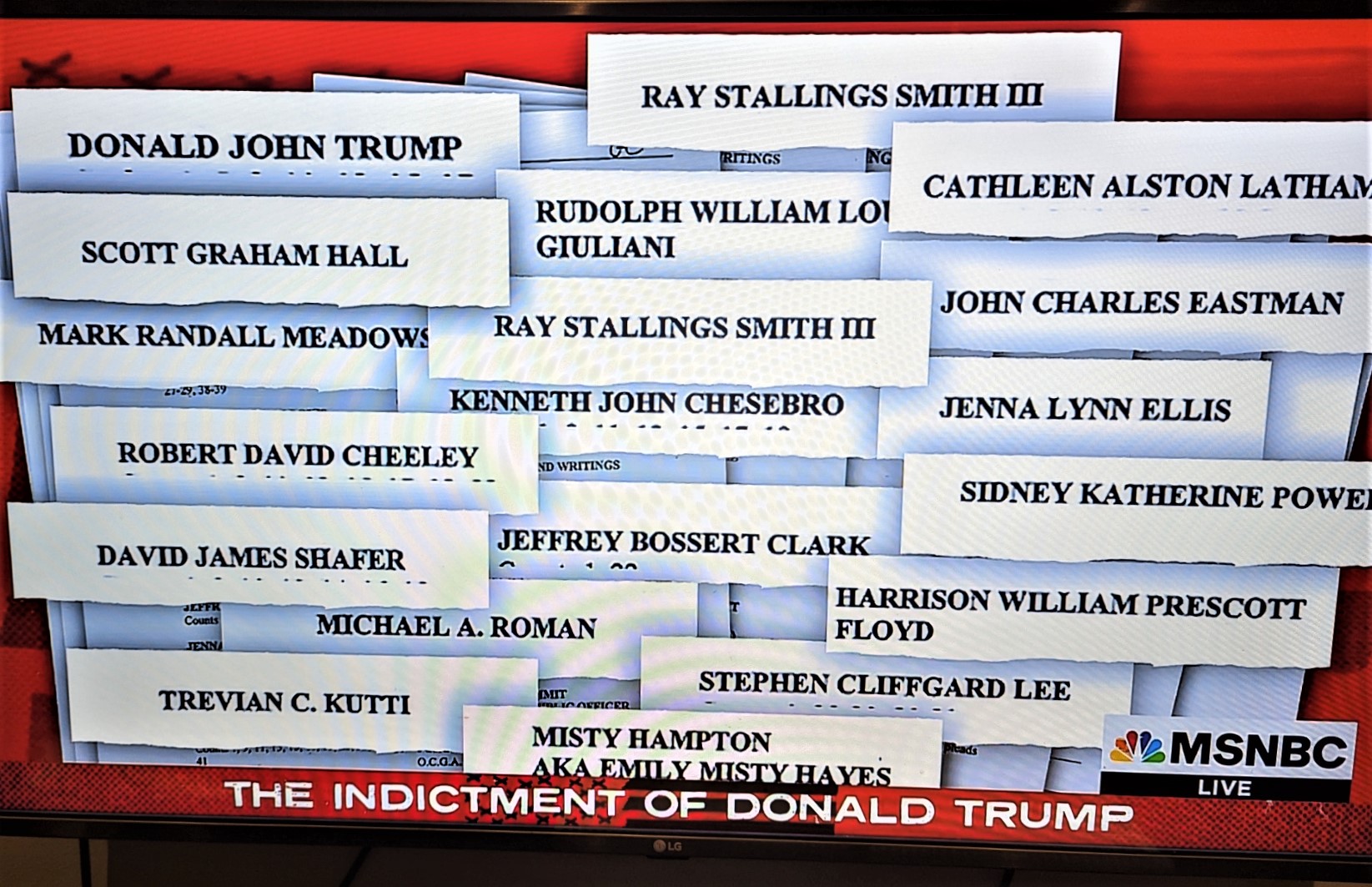
  • The panel also discussed the charges Donald Trump faces, and whether they will only embolden the former US president

Professor Pattel-Grey was responding to a question from Q+A host Stan Grant about what the referendum may bring.

“What Australia needs to be conscious of is that this is not a political agenda, this is a moral and ethical agenda and this will determine the integrity of Australia, because individually every person has a role to play,” Professor Pattel-Gray said.

“Whether they vote yes or whether they vote no is going to be to the individual’s question of integrity.”

Professor Pattel-Grey then called on Australians to look within as she painted a bleak picture for Indigenous Australians if the yes vote did not win.

“The Statement from the Heart is a statement from the heart,” she said.

“Our people laid their soul bare to you and made themselves vulnerable in extending the hand to this nation and asking you to recognise us and to give us a voice.

“This country has criminalised our children, they are highly incarcerated, we are even locking up 10-year-olds.

“What a shame to this country.

“And yet what you decide is going to determine our future.

“We shared with you our pain, but we also shared our hope, and if we don’t have that hope recognised, you are then damning us to hell, and you are going to kill a nation of people.”

The comments drew a strong response from federal president of the Young Liberals Dimitry Chugg-Palmer.

Mr Chugg-Palmer said he would consider voting for the Voice, despite the official position of the Liberal Party being to oppose the federal government’s model for an Indigenous Voice to Parliament.

“I really want to support the Voice,” Mr Chugg-Palmer said, before adding that he wanted to see more details made public.

“I think it is so important that we do have a respectful debate on this topic and we do work through the very important details that we need to see.

“We still haven’t seen legislation for what exactly the Voice is going to be.

“Raising those questions and raising those doubts is not a way of trying to frustrate or stop it, it is about being honest and so that we know what it is we are voting for when we walk into the ballot box.

“I want to see us reconcile with First Australians.

“I think it is the right thing to give them a say on decisions that affect them, that is a fundamentally Liberal principle.

“That’s why there are plenty of Liberals out there that will be supporting the referendum.”

Additional Liberal Party responses to Leader Peter Dutton’s support for the No Case:

Julian Leeson, formerly shadow attorney general, has resigned from the Coalition front bench because of the Liberal Party policy to support the Indigenous Voice to Parliament. Simon Birmingham, a Liberal front bencher, says he will not campaign against the Indigenous Voice to Parliament. Former Indigenous Australians Minister Ken Wyatt has resigned from the Liberal Party because of its policy on the Voice.

Cindy Lou enjoys a family lunch at Easter

The spread was amazing, but nothing beat these magnificent concoctions by my friend Carol. Usually, we enjoy our delicious meals at Black Fire. Their desserts are great fun, and delicious. Desserts at other restaurants Cindy Lou frequents also meet her exacting standard. But these? More please, Carol (and oh why did I eat so much of the brilliant spread provided in the first course?)

Food has changed on the Nullabor

Photos – special correspondent

I was impressed with the culinary changes that have taken place for people traversing the Nullabor. My own recent trip was on the Indian Pacific where three course meals were provided for lunch and dinner, after a substantial innovative breakfast menu. However, even the roadside cafes are now serving food such as chicken wraps and tacos for those who drive across from Perth to the East.

Breakfast at Kopiku

This is one of Cindy Lou’s favourite coffee haunts. The owners took over the cafe during Covid. They are a wonderful success story of a period that could have spelt disaster for them – perhaps their pleasant demeanour, efficient service, and all-round friendliness and willingness to please the customer have something to do with this. When this family took over the business all the former customers returned – commenting on how nice it was to see friendly faces behind the counter, whisking luscious meals to tables, and clearing up promptly when people left.

This morning, breakfast seemed a great idea. So, coffees and two egg meals – Smashed avocado with poached eggs, greens and toast and poached eggs on toast. The meals were generous, the toast well buttered and the eggs poached nicely. And, as usual, the coffees were just right.

There is indoor and outdoor seating. Associated with this venue is a pavement library where books can be donated or taken. I am gradually giving up some of my books – but this is a long drawn-out process, it is hard to see them go.

More on publishing

Women now dominate the book business. Why there and not other creative industries?

Greg Rosalsky, photographed for NPR, 2 August 2022, in New York, NY. Photo by Mamadi Doumbouya for NPR.

April 4, 20236:31 AM ET Greg Rosalsky
Mohamed Hassan/Pixabay

The Female Authorship Boom

Ever since she was a little girl, Jessie Gaynor has had a passion for books. Whether classic literature or YA fiction, she spent her youth devouring novels. She wouldn’t just read them. She would reread them, sometimes the same book over and over again.

“My mom used to say that my rereading of books worried her because she thought I wasn’t expanding my horizons enough,” Gaynor says. “And, later, in retrospect, she decided that what I was doing was learning the language of the books.”

In the sixth grade, Gaynor read Angela’s Ashes. She loved the book so much, she actually looked up the author in the phone book and called him to talk about it. She got his answering machine and didn’t talk to him, but she self-mockingly tells the story as an early example of her literary enthusiasm.

Gaynor carried this enthusiasm for books into adulthood. She’s now a Senior Editor at Literary Hub, an online publication that focuses on literary fiction and nonfiction. And, just recently, she’s become an author herself.

This June, publishing powerhouse Penguin Random House is set to publish Gaynor’s first novel, The Glow. It’s a dark comedy that centers on a struggling publicist named Jane Dorner who, in a desperate effort to save her job, tries to land a lucrative client: an enchanting wellness guru. “Jane decides that she will try to aggressively monetize this woman’s shtick,” Gaynor says.

Gaynor is part of a sea change in book publishing that has seen women surge ahead of men in almost every part of the industry in recent years. Once upon a time, women authored less than 10 percent of the new books published in the US each year. They now publish more than 50 percent of them. Not only that, the average female author sells more books than the average male author. In all this, the book market is an outlier when compared to many other creative realms, which continue to be overwhelmingly dominated by men.

These findings and others come from a new study by Joel Waldfogel, an economist at the University of Minnesota’s Carlson School of Management. Waldfogel crunches the numbers on the book market’s female revolution. And, in a recent interview, the economist helps us think through potential reasons why women trail men in many creative industries, but have had spectacular success in achieving — in fact, surpassing — parity with men in the US publishing business.

Author Jessie Gaynor

Ebru Yildiz/Jessie Gaynor

Female Authors Leap Ahead

Waldfogel got interested in studying female representation in creative industries after spending part of last year at the U.S. Copyright Office as a visiting scholar. The federal agency, which is part of the Library of Congress, is tasked with keeping records on copyrighted materials.

One of the first projects the Copyright Office had Waldfogel work on was a data analysis of the evolution of women in copyright authorship. Looking at the numbers, Waldfogel’s eyes opened wide when he realized that women have seen incredible progress in book authorship but continue to lag in other creative realms.

For example, while they have made inroads in recent years, women still accounted for less than 20 percent of movie directors and less than 10 percent of cinematographers in the top 250 films made in 2022. Likewise, when looking at the data on patents for new inventions, women make up only between 10 to 15 percent of inventors in the US in a typical year.

For a long time, the book market saw a similar disparity between men and women. Sure, some rockstar female authors come to mind from back in the day: Jane Austen, Mary Shelley, Emily Dickinson, Agatha Christie, Zora Neale Hurston — to name just a few prominent ones. But, Waldfogel says, between roughly 1800 and 1900, the share of female authors hovered around only 10 percent each year.

In the 20th century, female authorship began to slowly pick up. By the late 1960s, the annual percentage of female authors had grown to almost 20 percent.

Then, around 1970, female authorship really began to explode. “There was a sea change after 1970,” Waldfogel says.

The boom in female authorship

Joel Waldfogel/NBER

By 2020, Waldfogel finds, women were writing the majority of all new books, fiction and nonfiction, each year in the United States. And women weren’t just becoming more prolific than men by this point: they were also becoming more successful. Waldfogel analyzes data from a whole range of sources to come to this conclusion, including the Library of Congress, the U.S. Copyright Office, Amazon, and Goodreads. Waldfogel finds that the average female-authored book now sees greater sales, readership, and other metrics of engagement than the average book penned by a male author.

Why 1970?

The progress women have made in the book market can be seen as one small part of the broader feminist movement. Picking a single year as a clear turning point for any social movement can get pretty arbitrary. Dramatic social changes often proceed incrementally, not in one fell swoop. That said, if you were to pick one single year as an inflection point, 1970 is a pretty good one for the women’s movement, not just in book publishing, but in a whole range of social and economic pursuits.

Female participation in the overall US labor market seems to have really picked up steam after 1970 (although, to our point, you can clearly see the antecedents for this progress beforehand). Economists have offered various theories and evidence for why, after centuries of playing second fiddle in the labor market, American women made significant advances. The lasting effects of women entering the labor force as men fought overseas during WW2, the feminist movement, cultural change, and declining discrimination surely played important roles.

So did the increasing diffusion of labor and time-saving technologies, like electricity, plumbing, dishwashers, washing machines, vacuum cleaners, and microwaves, which changed the economic calculus for many families. Before households adopted widespread use of these technologies, domestic work was much more burdensome than it is now, requiring hours and hours of labor per day. The bulk of that work was done by women. As new technologies decreased that workload, various economic studies suggest, women were increasingly freed to pursue careers — including careers in publishing.

The birth control pill, which exploded in use during the 1960s, and increased abortion access in the 1970s, also helped free women to enter domains traditionally dominated by men, by giving more women greater choice over if or when to have children, and how many.

Intimately related to the pursuit of writing books, women began investing more and more in education around 1970. “If you look at the share of women who are going to college, it looks very similar to book publishing,” Waldfogel says.

It’s probably no coincidence that, by 2020, women weren’t only the majority of book authors, they had also become the majority of college graduates in the United States. Women also now represent around 70 percent of high school valedictorians every year.

But why has the book market seen so much more progress than other industries?

Despite progress over the last half century, however, women continue to lag behind men in many parts of the labor market, including many creative industries. Why are books different?

The answer matters not just for women, but for society at large. With women continuing to represent less than 15 percent of inventors in the US, to give one glaring example, Waldfogel worries that there are likely a whole bunch of “Lost Marie Curies” out there who could be helping us find cures for diseases or creating innovative, new technologies. But something seems to be holding them back. The reason why the book market has seen so much more progress might help us figure out how to replicate the success there in other domains.

However, lacking hard evidence, Waldfogel’s new study offers no rigorous explanation for why the book market revolutionized while others saw limited progress.

Waldfogel says his best guess for why women have seen so much progress in book publishing in the US, as opposed to other creative domains, has to do with the reality that the process of book-writing is typically a solo endeavor, in which the author has more power to choose when and how to do the work.

Maybe the fact that book writing is done mostly alone means there is less discrimination and fewer female-disadvantaging biases and social dynamics in the industry. Industries like movie production and scientific and technological inventing are dominated by gigantic corporate bureaucracies, which are intensely hierarchical. They also are more capital intensive. Maybe that opens the door to more sexism and a resistance to investing in historically underrepresented creators like women.

But American publishing, while seeing huge growth in self-publishing in recent years, also continues to be dominated by large corporations, like NewsCorp and Amazon. There is a twist, however, which is that individual publishing houses in the US — unlike film, TV and other creative production organizations — are largely dominated by women. In 2015, the publisher Lee & Low Books surveyed the staff at 34 US-based publishers and 8 review journals. They found that, while the industry is disproportionately white, it’s also disproportionately female. About 78 percent of staffers at all levels and 59 percent of executives in the publishing industry identified as women in the survey.

In her process of writing The Glow and getting to know the book publishing industry through her work at Literary Hub, Gaynor says, she’s seen this herself. “In my work, I encounter a lot more women who work in publishing, and I think it makes sense that women editors and women publicists are very happy to read books by other women and buy them,” she says.

The demand for books in the US is also disproportionately driven by women. Surveys over at least the last couple decades have consistently found that American women are more likely to read books than American men, especially when it comes to fiction.

Gaynor says some of the most famous channels in which books gain popularity in the US are run by women. She points to Oprah’s Book Club and Reese’s Book Club (which is helmed by Reese Witherspoon). “Even TikTok, with the popular BookTok videos, my sense is it’s mostly women — and BookTok is driving sales hugely right now,” Gaynor says.

Beyond the demographics of book readers and publishers, the social dynamics of the book writing business could be more favorable for women than other creative industries. For example, it is a generally solitary affair that lacks the office politics, practices and hierarchies that can still all too often leave women at a disadvantage.

“We hear a lot about women being socialized to not take the lead, not make a fuss,” Gaynor says. Other creative pursuits — like movie directing, for example — may reward self-confidence and assertiveness, traits that research suggests is more associated with men, on average. “I have a personality that is — I don’t know if I can blame this on my gender socialization — but I don’t like to feel like I’m bothering people. One of the great things about publishing a book is that you get an agent who bothers people on your behalf. Also, the solo part of writing a book is also very appealing because you just get to write the book and then put it in someone else’s hands. You have to advocate for yourself to a certain extent, but the work is not about being loud, which I know for some women, at least like me, that can be an uncomfortable thing.”

growing body of research in economics points to something more than personality traits and interests that separate men and women in the labor market. The Harvard economist Claudia Goldin has published influential research that suggests one central culprit behind gender inequality in the labor market: the reality that women continue to bear the overwhelming burden of caregiving responsibilities in many couples. As a result, Goldin finds, women, on average, show greater demand for “temporal flexibility.” That is, they put a greater premium on jobs that offer flexibility in their work schedule. These jobs tend to offer smaller paychecks, but they also allow more time and flexibility to spend on unpaid domestic work at home.

Gaynor is quick to point out that, for most authors — and for fiction authors, in particular — writing a book is a “really low-paying field.” That may dissuade more men, on average, from aspiring to pursue a writing career. “I know women are driven by a number of market forces, but I do feel like it seems possible that more women would be more willing to work in a low-paying field at first.”

At the same time, book writing, for the most part, offers the ultimate in temporal flexibility, to use Claudia Goldin’s terminology. You can write a book whenever — morning, afternoon, or night. That may be particularly attractive to some women, who are more likely to be saddled with domestic work. And it might put men and women on a more equal footing in the industry. Unlike being a corporate lawyer or executive or inventor, writing doesn’t place a large premium on being available to work at all hours, which entails a greater sacrifice of your family life.

Gaynor says she mostly wrote her book before having her kids, waking up early to write before starting work at her day job. After having her first child, she says, she did have to spend a significant amount of time addressing edits from her editor and finalizing her book. But, she says, her editing process “was facilitated by my husband doing more of the childcare in the mornings.”

Whatever the reasons for the boom in female authorship, Waldfogel says that readers of all kinds, not just women, are clearly benefiting from it. And so are we, with new books like The Glow, which will be on bookshelves on June 20.

Week beginning 5 April 2023

Suzanne Ferriss Lost in Translation Bloomsbury Academic, 2023.

Thank you NetGalley and Bloomsbury Academic for providing me with this uncorrected proof for review.

Lost in Translation is a BFI Film Classics publication aimed at ‘introd[ucing]. Interpret[ing] and celebrat[ing] landmarks of world cinema’. Suzanne Ferris has fulfilled this task in an engaging and through manner, the detailed information  she assembles giving the reader a valuable analysis of the film.

I particularly relished the attention given to the screen shots and have made it a mission to return to the film with this additional information at hand. Although the film can be appreciated without it, what a wealth of  understanding this analysis brings to a film that does not give the audience the ‘grander, fiercer – danger’ demanded by critic David Denby, but dares differently. Ferriss does not ignore another source of criticism, the treatment of Japan and Japanese people and culture – there is a comprehensive consideration of this feature in the last chapter which covers reception of the film.  This chapter was another which I found immensely worthwhile reflecting upon. See the complete review at Books: Reviews

After the Covid update: Historical by-election result in Aston; Bob McMullan – Election reflections; publishing – The Reality behind Barbara Pym’s Excellent Women The Troublesome Woman Revealed and other publishing possibilities; Wisconsin result; defendant Trump; funding for National Institutions; The Voice and the Liberal Party.

Covid update

To the 31st march there have been 526 new cases recorded. There are 21 people in hospital, with none in ICU, and none ventilated. There has been one life lost in this period. The total number of lives lost since March 2020 is 230.
Historical Result in Aston, Victoria

Labor win Aston by-election in historic upset

By AAP Newswire

Apr 1, 2023

Labor has declared its historic by-election win a ringing endorsement of the Albanese government, while federal Liberal leader Peter Dutton has promised to rebuild following the shock result for his party.

The ABC’s Antony Green called the election for the ALP’s Mary Doyle over the Liberals’ Roshena Campbell, with the win the first time in a century that a government has won a seat from the opposition in a by-election…

Aston by-election – complete with the sausage sizzle, the ‘democracy sausage’ and ‘crucial test’ television coverage.

Bob McMullan

ELECTION REFLECTIONS

There are some important lessons for the Liberal Party to learn from their recent series of election losses. There is no necessary law of political gravity which means that a party which has entered a losing sequence needs or will continue to do so. But if you keep making the same mistakes it is most likely that you will keep getting the same result.

In seeking to draw lessons from the recent results it is important to realise that while the NSW state election was not quite as bad as it appeared on the night the Aston by-election was even worse than the “extraordinary” reports on the night. Commentators, and particularly Liberal commentators including Peter Dutton, have claimed the loss of Alan Tudge’s personal vote as a mitigating factor in their disastrous loss. However, the data shows that Alan Tudge actually underperformed compared to the Liberal performance in adjacent seats by as much as 3%. Therefore, there was a soft 3% that should have been easy for the Liberals to pick up at a by-election and yet they went backwards by more than 6%.

Much analysis will follow about appropriate Liberal responses to their current electoral plight. Some of these are policy matters and others are organizational. It is not appropriate for a life-long Labor man to offer opinions on such matters.

But there is one lesson I believe it would be in the Liberals interests and the national interest for the Liberals to learn.

They need to break out of the coalition with the Nationals!

I noticed Nikki Savva’s recent article in which she raised the possibility of the NSW Liberals dissolving the coalition in opposition. She also says the NSW Liberals believe the federal Liberals should do the same.

This would not be unique, it happens in WA, but it would be unusual. But it would also be very smart.

Anyone who takes a clear-eyed view of the political problems the Liberals face with young professional voters in urban areas, particularly young women, must accept that this problem is going to be impossible to solve while the Liberals are tied to the Nationals.

How will the Liberal candidate attempting to win back Warringah from the Teals, Brisbane from the Greens or Higgins from Labor be able to mount a credible case with Barnaby Joyce and Matt Canavan with their views about climate change and other issues as a potential part of any government those candidates would be seeking support to form.

This might not be the case in a decentralized state like Queensland, although I think it probably is, but in NSW, Victoria and federally it is a reality which has to be faced.

The coalition is a one-way street. All the benefits flow to the Nationals.

If the Nationals were a party to the right of the Liberals as the Greens are a party to the left of labor some form of political equilibrium might be established to the benefit of the liberals.

What are the Nationals going to do in response? Support the Labor Party? I don’t think so.

The recent NSW and federal elections saw the Nationals crowing that they held all their seats (although in fact in NSW they did not do so). This illustrates their priority, building up massive majorities and fighting off Independents in their safe seats, but showing no interest in helping the Liberals win their urban marginals.

For example, recent polling shows that young voters in WA support the Voice referendum 71/29 and yet the Nationals were quick out of the blocks to oppose the proposal, and it looks like they might lead the Liberals by the nose to do the same.

Furthermore, the Nationals are a declining force. As Australian population continues to grow in the major cities and sea-change trends weaken the Nationals’ hold on coastal seats their influence on electoral outcomes will inevitably continue to decline.

In addition, there is real political mileage for the Labor governments at all levels to pursue the question of the secret agreements between the Liberals and the Nationals in forming a coalition. This secrecy cannot survive in the 21st century and any attempt to do so will only weaken the Liberals further.

The idea of ditching the coalition in opposition makes good sense. If the Liberals have the courage to do it, they may find that it will be easier to ditch the “Skynews after dark” crowd and resist the religious fundamentalists infiltration of their party.

And then they may find that they don’t need a coalition to form a government in future. Confidence and Supply agreements with the Nationals would be enough.

It may seem strange that I am giving advice to the Liberals. I could say that as a democrat I want to see a stronger opposition.

The reality is I feel safe in providing this advice because I am so confident that the contemporary Liberal party is not capable of acting on such advice.

Celebrating a birthday and publication of my book about Barbara Pym: The Reality behind Barbara Pym’s Excellent Women The Troublesome Woman Revealed

Publishing this book has been a positive experience, although one entered with much trepidation. I was the happy recipient of an invitation to publish with Cambridge Scholars Publishing and the result was the book pictured above. I shall write about the experience in future blogs. It is one experience with publication, and I have nothing but praise and appreciation for the support I received, and, of course, the brilliant outcome.

However, while I was living in London, I attended a Guardian Seminar on the various types of publishing available to writers seeking publication. One talk was by Joanna Penn whose story was a great incentive to move beyond the trade publishers; another was by the representative of a trade publisher.

Joanna Penn

Joanna Penn spoke about her experience publishing through a trade publisher which resulted in a garage full of unsold books. She then turned to her experience publishing with Amazon Publishing which she found a more positive experience. She now teaches writing, publishing and marketing through presentations and published works.

She says, ” I’m an award-nominated, New York Times and USA Today bestselling author with 35+ books, with almost a million sold across 169 countries and 5 languages”.

But she also acknowledges mistakes which she discusses on her website, blog, and in pod casts as well as publications.

At the seminar we were presented with her Author Blueprint. The update is available through her site.

https://www.thecreativepenn.com

Wisconsin voters are deciding control of state Supreme Court in most consequential election of 2023

Congratulations Wisconsin voters – Judge Janet Protasiewicz won!

Story by Eric Bradner • 

“The race between Democratic-backed Milwaukee County Circuit Court Judge Janet Protasiewicz and Republican-backed former state Supreme Court Justice Daniel Kelly could both break a decadelong era of Republican dominance in one of the nation’s most important swing states and prove pivotal in the fight over the future of abortion access. It’s the most expensive state judicial race ever.”

Defendant Trump

Other American political news – Former President Trump was arraigned in the Manhattan Criminal Courthouse on 34 felony counts of falsifying business records. Legal experts on MSNBC have contributed to excellent debate on the charges and reactions to them. Republicans have supported the former president – as they did before the charges became clear.

Some excellent news on the Australian cultural scene

Funding lifeline thrown to cultural institutions

$535m has been allocated to arrest decline in infrastructure and service provision, but efficiency dividend to remain.

by Jason Blake on 5 April, 2023

Limelight

Nine major cultural and historical institutions in Australia will receive an extra $535.3m in federal government funding over the next four years.

The Australian National Maritime Museum, Bundanon Trust, Museum of Australian Democracy (Old Parliament House), National Archives of Australia, National Film and Sound Archive, National Gallery of Australia, National Library of Australia, National Museum of Australia and National Portrait Gallery of Australia will all benefit from this funding boost, according to the announcement ahead of next month’s budget.

The funding package includes a previously announced $33 million earmarked for the National Library’s digital archive Trove.

Museum of Australian Democracy, Old Parliament House, Canberra. Photo Flickr.

The government has flagged that the institutions will receive indexed funding beyond the four years, allowing institutions to meet their current financial obligations and invest for the future.

The government has pledged to establish “a clear line of sight” over future capital works and improvements to ensure the institutions do not fall into disrepair in the future. The efficiency dividend requirement, which was first imposed under the Hawke government in 1987 and requires Commonwealth entities to reduces budgets each year in anticipation of efficiencies being found, will remain.

Arts Minister Tony Burke criticised the former government for allowing major cultural institutions to fall into “a shocking state of disrepair”, adding that the extra funding would help them “back to where they should be – where the government delivers strong core funding and philanthropists take them to the next level.”

The Voice to Parliament

The Voice to parliament was a key recommendation of the Uluru Statement from the Heart, which was a 12-paragraph document written and endorsed by Aboriginal and Torres Strait Islander leaders in 2017 to change the Constitution to improve the representation of Indigenous Australians.

Liberal Party has decided not to support The Indigenous Voice to Parliament.

Week beginning 29 March 2023

Beverley Adams Ada Lovelace The World’s First Computer Programmer Pen & Sword History 2023.

This is the second of Beverly Adams’ biographies that I have read. Once again I am  impressed with the way in which Adams has assembled her material to advance an enlightening and plausible account of a woman for whom there is a meagre amount of material. The narrative provides a thorough insight into Ada Lovelace’s childhood as the daughter of Lord Byron and his disaffected wife, Arabella Milbanke; her marriage and friendships; and the historical context in which Ada lived, studied and formulated the first computer algorithm. The emphasis on Byron could be considered problematic. However, to find a new way into Byron and his work and troubles through his marriage and daughter is  a benefit rather than a shortcoming. At no time does Adams lose sight of her focus on Ada  – her parents’ and their response to each other is essential to her story. This is one of genius, sadness and at times, some surprising levity and foolishness. The Ada Lovelace conjured up by Adams gives us a rounded figure that resonates. See Books: Reviews for the complete review.

Covid update Canberra

The ACT has recorded 395 new cases this week and there are 6 active cases in hospital. One person is in ICU. No patient is ventilated. There has been no loss of life this week.

New South Wales state election

Handing out How to Vote cards in the state seat of Monaro – pouring with rain, soggy paper (very often rejected!), diligent polling booth representatives from the two candidates, and people determined to cast their votes. No sausage sizzle at this small booth, but all the accoutrements (dogs, sausages [the democracy sausage as it is known] and cake stalls) at larger ones.

Labor won the election and Steve Whan received 57% of the vote, great wins.

An excellent result – two great representatives in the state and federal seats. And the Prime Minister of course.

I found the red results exciting. However, for many others the results below were far more interesting!

Young Adult Literature

I do not review young adult literature so thought this a worthwhile article to add to this week’s blog.

Teen Librarian Toolbox

Teen Librarian Toolbox (TLT) is a professional development website for teen librarians, created by Karen Jensen and collecting the experience of four MLS librarians and over 50 collective years of library work. Our mission is to help libraries serving teens (and anyone who cares about teens) and to foster a community of professional development and resource sharing by providing quality information, discussions, book reviews and more.  We welcome guest posts and our book review policy can be found here.  We are available for presentations, seminars, and consulting on a limited basis. Contact us for more information.

Historical Women in Young Adult Literature, a guest post by author Kip Wilson

 March 8, 2023 by Karen Jensen, MLS   Leave a Comment

This Women’s History Month, I wanted to celebrate some recent young adult books that feature women from history, because that’s my absolute favorite thing to read (and write). I especially wanted to highlight titles that weren’t best sellers or big award winners, because these sorts of books tend to fly under the radar—though the women featured in them certainly did not!

Over on the adult side, both nonfiction and fiction about historical women tend to get all kinds of buzz. A couple of titles among those that I really loved include All the Frequent Troubles of Our Days by Rebecca Donner (a biography about Mildred Harnack, one of the leaders of a resistance group against the Nazis in World War II) and The Paris Bookseller (biographical fiction about the fabulous Sylvia Beach) by Kerri Maher.

But books specifically for the teen audience about women in history can be harder to find, so I’m here to thrust some of my most recent favorites on YA readers. All of these books were published in the last couple of years, and they are all kinds of fabulous, so I hope they’ll end up in more libraries, classrooms, and in the hands of teen readers.

YA Biographies

Some of my favorite young adult biographies highlight women I didn’t know before, and these picks definitely fell into that category for me. I’m so glad I read each of them!

Hidden Powers: Lise Meitner’s Call to Science by Jeannine Atkins is a biography in verse that managed to get a ton of facts and anecdotes about this brilliant scientist on the page while immersing readers in the emotion of Lise’s story. Stories set in Austria and Germany are most definitely my jam, and Lise is a woman I would have loved to share a coffee with.

Augusta Savage: The Shape of a Sculptor’s Life by Marilyn Nelson likewise captured my heart with beautiful verses that flow as naturally as Augusta’s artwork—and as a bonus, photographs of her sculptures and many concrete poems are included throughout the book, so it felt like such a visual representation of her life and work. Another fabulous woman from history!

Close up on War: The Story of Pioneering Photojournalist Catherine Leroy in Vietnam by Mary Cronk Farrell was the perfect book for me to read last year while I was putting the finishing touches on One Last Shot, my own verse novel about photojournalist Gerda Taro. I really loved the way Catherine’s hopes and dreams came to life on the page—this kind of characterization really makes historical women resonate with teen readers. All the photographs (both of and by Catherine) and letters really made me feel like I was there.

YA Biographical Fiction

Biographical fiction is arguably less common in YA, but one format that really lends itself to stories about women in history is verse. (In full disclosure, I might be biased, because this is also what I like best to write, but I really enjoyed these titles in this category.)

Beauty Mark: A Verse Novel of Marilyn Monroe by Carole Boston Weatherford did an incredible job of covering Norma Jeane’s full life—a bit rare in YA fiction, which tends to focus on shorter time spans. But if anyone can do this, Carole Boston Weatherford can, and I came away from the book with more of a sense of Norma Jeane, the person—so much more than a movie star.

Ethel’s Song: Ethel Rosenberg’s Life in Poems by Barbara Krasner was particularly fascinating to me because I’d long been curious about the Rosenbergs and what really happened. Ethel’s thoughts and emotions in the poems here really brought her tragic story to life for me.

YA Historical Fiction

Perhaps more common in young adult literature are books that feature imagined young women based on a very real historical backdrop. My own verse novel, The Most Dazzling Girl in Berlin, falls under this category, as do several other recent favorites. 

Rima’s Rebellion by Margarita Engle is based on documented history of women fighting for suffrage rights in Cuba. Through Rima’s eyes, this history springs to life in beautiful verse that sings.

Nothing Sung and Nothing Spoken by Nita Tyndall is a story of friendship and love between young women battling the oppression of Nazi Germany during World War II in Berlin. Yes, I’m a sucker for books set in Germany, but these girls really captured my heart.

Luck of the Titanic by Stacey Lee is impeccably researched and beautifully written. Like Stacey’s other YA historicals, it stars a strong young woman facing all kinds of trouble. Valora Luck hooked me from the first page and didn’t let go even as the doomed ship met its end.

Angel of Greenwood by Randi Pink is set during the Tulsa Race Massacre of 1921. The horror of the historical backdrop coupled with the Angel’s absolutely lovely romance with Isaiah really brought this terrifying event to life.

I hope this list has you running to your local bookstore or library! And I hope more people will use Women’s History Month as a great excuse to help these titles reach more readers and get teens interested in the roles women have played throughout history.

Geena Davis and Australian creatives call for action on gender representation and diversity

by The IF Team March 23, 2023

Geena Davis in ‘A League of Their Own’, 1992. (©Columbia Pictures/courtesy Everett Collection)

For filmmaker and journalist Santilla Chingaipe, it’s time for the Australian screen industry to move beyond conversations about gender representation and diversity, and start taking action.

Chingaipe, whose SBS documentary Our African Roots won a MIPCOM Diversify TV Award last year, is passionate about building below-the-line pathways for people from backgrounds that have been historically excluded from the sector.

To this end, she started capability building program Behind the Screens in Victoria five years ago with support from VicScreen and Footscray Community Arts.

“We need more than just writers and producers reflecting modern Australia in our stories; this has to also be reflected across every area of the industry – from development, to production, to post and beyond.

“From the gatekeepers commissioning content, to the critics reviewing projects. The industry has to create tangible pathways for career progression for people from marginalised backgrounds and work towards equity.”

Chingaipe will be one of a number of leading Australian creatives to share the stage with dual Academy Award winner Geena Davis at ACMI’s upcoming conference, Being Seen on Screen: The Importance of Representation.

To be held April 5, the one-day event is presented in partnership with the Geena Davis Institute on Gender in Media (GDI), a world leader in research and advocacy for representation of women on screen, with further support from the US Consulate and Matchbox Pictures.

With a special focus on Australian content, the conference will bring together actors, writers, directors, producers, heads of departments and academics to tackle issues of women’s representation, including body image, ageing and authentic diversity, on screen and off.

Chingaipe is looking forward to hearing from other local creatives like #Matched and Salma’s Season director Kauthar Abdulalim, who she praises for centring diversity and inclusion in her work and on set.

“I’m keen to hear from people that are actively working to change things. It’s an important time to be having these conversations, because as we know, stories can have a profound impact on how we see ourselves,” she says.

Davis will deliver a keynote address on the day and also appear in conversation with Dr Emma Fulu, founder and executive director of The Equality Institute.

Alongside actors Pallavi Sharda and Elaine Crombie, Abdulalim will discuss authentic representation and the diversity of women on Australian screens.

Ageing will be the focus of a session with GDI President and CEO Madeline Di Nonno, with panellists actor and artistic director Rachel Maza OAM, director, writer and producer Sophie Hyde, actor Sigrid Thornton and casting director Anousha Zarkesh. They’ll discuss how ‘older’ is defined on screen and whether current roles for older women accurately reflect contemporary society and experience. 

Further, award-winning writer, speaker and appearance activist Carly Findlay OAM will unpack a range of issues with the dominant Australian female screen body: often young, white, able and slim. Panellists will include Australian of the year and body image activist Taryn Brumfitt, filmmaker and disability advocate Amy Marks and performer, model, queer and radical body acceptance advocate and activist Milo Hartill.

‘Thelma and Louise’, 1991, L-R Susan Sarandon, Geena Davis. (© MGM. Image courtesy of Moviestore Collection Ltd / Alamy Stock Photo)

Being Seen on Screen is a complementary event to ACMI’s broader Goddess: Power, Glamour, Rebellion exhibition, designed to celebrate women who blazed a trail in the screen industry and fought the system that tried to exploit them.

Highlights include never-before-seen costumes, original sketches, interactive experiences, large-scale projections, and cinematic screenings.

When Bethan Johnson, the curator of Goddess, was conducting research for the exhibition, she was reminded of the GDI; Davis features prominently throughout via Thelma & Louise.

At the time, the public programs team was also in the early stages of planning a talks program that would facilitate meaningful conversations between women across the screen industry. Together, ACMI head of visitor experience Britt Romstad says they realised it was a natural fit to ask GDI, who has delivered real-world change in the industry around representation of gender, to come on board as a presenting partner.

“This is a rich connection that grounds the exhibition in current debate,” Romstad says.

The hope for Being Seen on Screen is to generate “honest and inspiring conversations that point to future action and continued advocacy.”

“The conference will point to what the industry should be doing and how we can keep it accountable,” says Romstad.

Some Black Fire entrees enjoyed by Cindy Lou and friends recently.

As usual, Cindy Lou had the crab stuffed peppers. The other choices were the mushrooms, octopus, arancini balls, and pork belly. The main courses and sides were also delicious, although the steak was not up to its usual standard.

Australia’s most iconic artists on show in Bendigo

Near the entrance of Bendigo Art Gallery art lovers will be greeted by a large, melted Bubble O’Bill stuck to the wall. Photo: Bendigo Tourism

The humble Bubble O’Bill ice-cream has found its way on to the walls of Australia’s art galleries, but not as you might expect.

Near the entrance of Bendigo Art Gallery art lovers will be greeted by a large, melted Bubble O’Bill stuck to the wall. The artwork is a super-sized version of the artwork entitled ‘Melted Bubble’O’ by Melbourne-based artist Kenny Pittock.

It’s a taste of things to come inside with the Australiana: Designing a Nation exhibition.

The works of Australia’s most iconic artists – from Tom Roberts to Vincent Namatjira – are on display in this three-month exhibition that probes the question of Australian identity.

More than 200 diverse items are on show, including photos, fashion, jewellery, moving image and furniture.

Instantly recognisable art works, such as the bright colours of Ken Done paintings and the black and white photos taken by Rennie Ellis, will be sure to transport viewers to different eras in Australia’s history.

Ken Done's Sydney Sunday
Ken Done’s Sydney Sunday.  Photo: Bendigo Tourism

One of the most historic pieces is the 1890 painting Shearing the Rams by Tom Roberts. Depicting the shearing of sheep in a timber shed, the painting is also one of Australia’s most well-known and loved artworks.

Then there’s the Blinky jumper by fashion designer Jenny Kee. The oversized knit, created in 1979, was made world-famous when it was worn by Princess Diana in 1982. Sent as a wedding gift to the princess, who was photographed wearing it while pregnant with Prince William.

Art lovers will also enjoy works by Sidney Nolan, Tony Albert, Paul McCann, Hilda Rix Nicholas and fashion label Romance Was Born.

Created in partnership with the NGV, the exhibition is a collection of pieces from both galleries as well as the Australiana Fund, which adorns the walls of the houses of the governor-general and the prime minister.

By showing the vast array of art over the past 200 years, the exhibition aims to examine the changing notions of Australian identity and style. Each work represents a time, a place and a culture, allowing viewers to reflect on how we saw ourselves in the past and how we see ourselves in the present.

Australiana: Designing a Nation can be found at the Bendigo Art Gallery until June 25, 2023.

To celebrate the exhibition, the Bendigo Tourism industry has created a program called ‘Fair Dinkum Bendigo – A Taste of Culture’ with over 60 inspired events, experiences and products’ for people to enjoy while they are here.

Week beginning 22 March 2023

Carolyn Purnell Blue Jeans Bloomsbury Academic, 2023.

Thank you, NetGalley and Bloomsbury Press, for providing me with this uncorrected proof for review.

Blue Jeans is another wonderful addition to the Object Lessons series. Carolyn Purnell brings the reader into a world that comprises the horrors of indigo production for the beloved blue jeans, the political ramifications of wearing blue jeans and the changing fashion of this durable and enduring garment. The harrowing nature of the way the blue was obtained for those early jeans is hard to dismiss, and wearing blue jeans might not ever be the same for some readers.  But what a wealth of historical content is made available through blue jeans – and how deftly Purnell weaves solid historical content with a story that keeps moving along. This is an engaging read, and an educational one. I found Blue Jeans a most informative and thoroughly researched publication.

I began the book with recall of my beloved 1970s Amco jeans and women busily adding beads and embroidery to jeans while they listened to political debate at a university politics camp. I would never have treated my Amcos thus, but Purnell talks of embroidery while the Amco (an Australian brand) does not make it past the more well-known Levis etc. But to be fair, the Levis have a grander story: Purnell weaves her understanding of Levi Strauss binary  theory  cleverly into the politics of blue jeans. It is the ability to draw upon a host of ideas to tell her story that really stands out in this volume.

See Books: Reviews for the complete review.

After the Covid update: Heather Cox Richardson’s Letter from and American; Cindy Lou eats in Maleny; Conondale foliage; Sunshine Coast accommodation.

Covid update

There were 395 new cases recorded this week with 6 active cases in hospital. One person is in ICU.

While there are no longer any restrictions in place, Canberrans are strongly encouraged to follow COVID Smart behaviours; and report their positive RAT on line.

Some people continue to wear masks on public transport and busy shopping centres.

Vaccinations, including a further booster, continue.

Heather Cox Richardson

Letters from an American

18 March 2023

Rumors that he is about to be indicted in New York in connection with the $130,000 hush-money payment to adult film star Stormy Daniels have prompted former president Donald Trump to pepper his alternative social media site with requests for money and to double down on the idea that any attack on him is an attack on the United States.

The picture of America in his posts reflects the extreme version of the virtual reality the Republicans have created since the 1980s. The United States is “THIRD WORLD & DYING,” he wrote. “THE AMERICAN DREAM IS DEAD.” He went on to describe a country held captive by “CRIMINALS & LEFTIST THUGS,” in which immigrants are “FLOODING THROUGH OUR OPEN BOARDERS [sic], MANY FROM PRISONS & MENTAL INSTITUTIONS,” and where the president is “SURROUNDED BY EVIL & SINISTER PEOPLE.” He told his supporters to “SAVE AMERICA” by protesting the arrest he—but no one else—says is coming on Tuesday.

Trump’s false and dystopian portrait of the nation takes to its logical conclusion the narrative Republicans have pushed since the 1980s. Since the days of Reagan, Republicans have argued that people who believe that the government should regulate business, provide a basic social safety net, protect civil rights, and promote infrastructure are destroying the country by trying to redistribute wealth from hardworking white Americans to undeserving minorities and women. Now Trump has taken that argument to its logical conclusion: the country has been destroyed by women, Black Americans, Indigenous people, and people of color, who have taken it over and are persecuting people like him.

This old Republican narrative created a false image of the nation and of its politics, an image pushed to a generation of Americans by right-wing media, a vision that MAGA Republicans have now absorbed as part of their identity. It reflects a manipulation of politics that Russian political theorists called “political technology.”

Russian “political technologists” developed a series of techniques to pervert democracy by creating a virtual political reality through modern media. They blackmailed opponents, abused state power to help favored candidates, sponsored “double” candidates with names similar to those of opponents in order to split their voters and thus open the way for their own candidates, created false parties to create opposition, and, finally, created a false narrative around an election or other event that enabled them to control public debate.

Essentially, they perverted democracy, turning it from the concept of voters choosing their leaders into the concept of voters rubber-stamping the leaders they had been manipulated into backing.

This system made sense in former Soviet republics, where it enabled leaders to avoid the censorship that voters would recoil from by instead creating a firehose of news until people became overwhelmed by the task of trying to figure out what was real and simply tuned out.

But it also fit nicely into American politics, where there is a long history of manipulating voters far beyond the usual political spin. As far back as 1972, Nixon’s operatives engaged in what they called “ratf*cking,” dirty tricks that amounted to political sabotage of their opponents. The different elements of that system became a fundamental part of Republican operations in the 1990s, especially the use of a false narrative spread through talk radio and right-wing television.

More recently, we have seen blackmail (former representative Madison Cawthorn [R-NC] blamed his own party for the release of compromising photos); the use of state power to help candidates (through investigations, for example); double candidates (a Florida Republican won a seat in the state legislature in 2020 after a sham candidate with the same name as the Democratic candidate siphoned voters); and the deliberate creation of a false political reality.

Indeed, David Klepper at AP News reported just yesterday that Russian social media accounts are up to their old tricks in the U.S., pushing the idea that federal authorities have been lying about the true impact of the East Palestine, Ohio, train derailment because they want to divert U.S. money from problems at home to Ukraine. “Biden offers food, water, medicine, shelter, payouts of pension and social services to Ukraine! Ohio first! Offer and deliver to Ohio!” one of those accounts posted.

So the United States has had its own version of political technology that overlaps with the Russian version, and it has led to the grim picture Trump is portraying in his attempt to rile up his supporters to protect him.

But here’s what I wonder: What happens when people who have embraced a virtual world begin to figure out it’s fake?

Russians are having to come to grips with their failing economy, world isolation, and rising death rates as President Vladimir Putin throws Russian soldiers into the maw of battle without training or equipment. Now they have to deal with the fact that the International Criminal Court has indicted their president for war crimes. Will they rally around their leader, slide away, or turn against him?

In the United States, MAGA Republicans have been faced with evidence released in the Dominion Voting Systems defamation case against the Fox News Corporation that shows Fox News Channel personalities lied to them. Now those who have cleaved to Trump have to face that he is asking them to risk their freedom to oppose his arrest for paying $130,000 to an adult film actress to keep quiet about their sexual encounter, hardly a noble cause. And the last time he asked people to defend him, more than 1,000 of them—so far—faced arrest and conviction, while he went back to playing golf and asking people for money.

Tonight, Erica Orden of Politico reported that Manhattan district attorney Alvin Bragg emailed his employees to say “we do not tolerate attempts to intimidate our office or threaten the rule of law in New York.” He told them: “Our law enforcement partners will ensure that any specific or credible threats against the office will be fully investigated and that the proper safeguards are in place so all 1,600 of us have a secure work environment.” He also noted, without mentioning specific cases, that his office has been coordinating with the New York Police Department and with the New York court system during certain ongoing investigations.

Some of Trump’s radical supporters have taken to social media to make a plan for surrounding Mar-a-Lago and protecting Trump with firearms, but others appear to be more eager for someone else to show up than to do so themselves.

Ali Alexander, who helped to organize “Stop the Steal” rallies to try to overturn the 2020 presidential election, wrote to his supporters today: “Previously, I had said if Trump was arrested or under the threat of a perp walk, 100,000 patriots should shut down all routes to Mar-a-Lago…. Now I’m retired. I’ll pray for him though!”

Notes:

I’m not going to link to Trump’s Truth Social postings. But that’s where they are if you want to seek them out. 

https://www.esquire.com/news-politics/politics/a25090/donald-segretti-ratfking-100413/

https://apnews.com/article/florida-5343b101e96d5c7f42d1ee54da7cc0ce

https://apnews.com/article/trump-arrested-indicted-hush-money-manhattan-prosecutor-a48428984cf99d23f46b4157b34160ae

https://apnews.com/article/ohio-train-derailment-russia-disinformation-twitter-musk-49af27699727d6f4157a5d6d5f35819b

Cindy Lou eats out in Maleny, on the Sunshine Coast

The Maleny Pub was a wonderful air-conditioned oasis in the middle of the humidity and heat. The pub meals were generous and flavoursome. It was great to see Squealing Pig, a Marlborough Sauvignon Blanc, on the wine list. The dessert was quite an experience, vying only with the similarly large and varied dessert we tried at Mr Walker in South Perth. This one was green for St Patrick’s Day – a lime cheesecake, two huge scoops of ice-cream and a large mound of cream studded with raspberries and blackberries – chef Kim’s exotic contribution to the celebration. The service was efficient and cheerful, the atmosphere pleasant and casual, and the overall experience great fun.

These beautiful Queensland flowering trees were in the pub garden and in gardens through the streets of Maleny.

This sign greeted us – but fortunately we did not have to care. Sandals were acceptable.

The lunch in Maleny was at the end of a wonderful catch up with a friend in Conondale. Although the previous chat was many years ago it was as if no time had passed at all. The conversation began again …and continued…and continued.

This holiday gave us the opportunity to try two rather different types of accommodation. The first was a tiny house up a rather steep and rutted incline – but what was at the top was worth the drive up. And as we became used to the drive, it certainly became familiar and easier. The tiny house comprised a bathroom, kitchen and living area downstairs and an excellent bed upstairs. From here the starry sky could be seen at night, and in the morning the misty hills and paddocks. Eating breakfast on the balcony was delightful. Even better was the chocolate basket, chocolate dipped strawberries and chocolates.

It was also pleasant to spend a night in Maroochydore before catching a flight home. The Holiday Inn Express was far better than its counterpart in Bletchley a few years ago. The lobby was open and light, complete with several sitting areas, a bar, and the reception. The room was also of a good standard, with a comfortable bed, a table and chair, space for two laptops, and an array of power points.

Maroochydore walk.

Seen on a walk in Canberra streets.

Week beginning 15 March 2023

This week I review Before Mrs Beeton Elizabeth Raffald by Neil Buttery.

Neil Buttery, Before Mrs Beeton Elizabeth Raffald, England’s Most Influential Housekeeper, Pen & Sword, Pen & Sword History 2023.

Thank you, NetGalley and Pen & Sword for providing me with this uncorrected proof for review.

Before Mrs Beeton Elizabeth Raffald is another of Pen & Sword’s enticing stories about a fascinating time and character written in the familiar accessible style of the Pen & Sword author. Because the style is accessible do not feel that perhaps the information lacks verisimilitude. Easy to read the narrative may be, but there is such a host of information that we are fortunate that the style gives us the best opportunity to understand and relish the story that unfolds. See Books: Reviews for the complete review.

After the Covid update: Mrs Beeton; cookbooks; Why do we still buy cookbooks? Ottolenghi Food Tour; Anna Ben Yehuda Rahmanan quote; Blake McMullan’s YouTube cookery site; From the domestic to the public- a feminist fiction approach; information about a new find – Homework: The Secret History (and Future) of Home Economics by Danielle Dreilinger; Jess Ho says our food industry is Eurocentric; cookery as a fundraiser.

Covid update

This week has been prepared in advance as I am on holiday. So, I am using the ABC Covid update for Australia wide figures at 3 March 2023.

NSW: 7,163 new cases with 800 in hospital, 19 in intensive care and 29 deaths. Victoria: 3,016 new cases with 104 people in hospital and 4 in intensive care. There were 23 deaths this week. Northern Territory: 90 new cases with 3 in hospital. Queensland: 4,028 new cases with 278 in hospital and 6 in intensive care. There have been 23 new deaths. South Australia: 1,700 new cases, 35 in hospital with 1 in intensive care. Deaths recorded this week number 13. Western Australia: there are 2,390 new cases with 69 people in hospital and 8 new deaths this week. Tasmania: there are 622 new cases with 17 in hospital and 1 intensive care, and one new death reported. The ACT will be a repeat from a previous blog, but worth recording here in the Australia wide records. This week there were 491 new cases with 8 cases in hospital and 4 deaths.

Mrs Beeton

When talking about cookery Mrs Beeton cannot be entirely forgotten. A battered copy of her cookery book was a secondhand bookshop find. Unfortunately, it is undated. It was published in London and Melbourne by Ward, Lock & Co., Limited. Mrs. Beeton’s Handy Reference books – cake making, jam making, puddings and pies, cold sweets, sauces and soups, hors doevres and savouries, poultry and game, and fish cookery are advertised inside the front cover with the admonishment ‘Keep to the “Beeton” track’.

There is a newspaper advertisement inside the book for Rabbit Vegetable Hot Pot, signed off on by Betty King. But…Betty King, Home Economist, of World Brands Pty Ltd was one of the leading ladies of Australian cookery…the Margaret Fulton of her day. Unfortunately, she didn’t exist. Betty King, ‘leading home economist’, first appeared in Australian women’s magazines in 1950 promoting Mello Chocolate Dessert.

An advertisement for shredded beef suet to make cooking easy is a reminder of my grandmother’s suet pastry – cooking with suet was a topic on Facebook recently, which suggests old style unhealthy cookery touches a nostalgic nerve.

There are recipes for hares, but they do not have to be caught by this time – just skinned.

Cookbooks

The review led to my finding additional information about cookbooks, cooking programs and their appeal, and joining the discussion on Facebook about cookery books from the past. Mine were The Golden Wattle, a school cookbook that I still use on occasion, and the CWA Cookbook that was my mother’s. That includes some lovely comments from her to me, about following on from her preparations of a recipe and, more excitingly a correction from sexist language to gender neutral language. A recipe was called Poor Man’s Pie, and she renamed it Poor Person’s Pie! The 1950s was not entirely bereft of its feminist input in the kitchen. A Facebook discussion of well-thumbed and happily remembered cookbooks came up with these examples. The Golden Wattle (not olden, as in the photo) was a Western Australian cookbook for high school students studying, as it was called, Domestic Science. The CWA Cookery Book and Household hints was also a Western Australian stand by in the kitchen. What some of the faming housewives thought of a recipe called Devil’s Food Chocolate Cake I do not know, but that was a title of a delicious rich chocolate cake. The Commonsense Cookery Book was a New South Wales publication, used in schools.

The Golden Wattle includes a short section on Food Values and the best Use of Food, with references to calories, vitamins and the characteristics of a good diet. As from recall we were more interested in making scones, small cakes and sponges I suspect this section was largely unread. The section on Kitchen Economics includes information on how to use sour milk and stale cakes and scones; how to freshen stale bread; and drying herbs. We are also told about measurements and given advice on the terms used for cookery. Do you know the difference between croutons and sippets? They were most important information in the 1950s. The Christmas cake recipe is excellent, but one needs to be more generous with the fruit and nuts.

Why do we still buy cookbooks?

Radio National Posted 22 Jul 2016 22 Jul 2016, updated 27 Oct 20 22 27 Oct 2022

Australians are still tied to the enduring physicality of traditional cookbooks.(Jeremy Story Carter/ABC RN)

When a recipe can be nabbed from a blog in seconds, why are Australians still so committed to buying up cookbooks each year? A publisher and a food blogger try to explain the enduring appeal of recipes on paper.

There are enough recipes on the internet to keep a person well-fed every day for several thousand lifetimes.

There’s this odd thing happening which is that the very high bestselling books as selling more than they ever have.

So why, in an age of instant and typically free online food blogs, do Australians still buy cookbooks? And we don’t just buy them occasionally: for more than a decade, cookbooks have dominated Australian non-fiction book sales.

In 2015, Nielsen BookScan reported that food and drink publications remained well above biography sales in the non-fiction category.

‘They are faring well,’ says Sue Hines, publishing director at Allen and Unwin. ‘There’s this odd thing happening which is that the very high bestselling books as selling more than they ever have.’

She says cookbooks are still seen as being more reliable than internet recipe sites.

‘There’s possibly more authority in a cookbook. ‘It’s solid and has a substantial presence in your home.’

A row of some of the big-selling international cookbooks.(Flickr/Foam/CC-by-sa/2.0)

Food blogger Allie Gaunt says there was a marked difference between posting recipes on her blog and collating them for a cookbook.

‘When it came to writing the book, there was definitely a lot more that went into it,’ she says. ‘There was quite a lot of work and recipe testing. It was very thorough.’

Where online recipe sites can maintain a dialogue with their readers and quickly make amendments where necessary, mistakes in cookbooks are a different beast.

‘It’s terrible,’ says Hines, on the subject of finding mistakes in published cookbooks. ‘People ring you up and abuse you and say nasty things online. It’s never good to have an error.’

She references a cookbook that listed ‘ground finger’ instead of ground ginger in the ingredients as among the worst mistakes she’s seen.

Even if Australians don’t readily turn to their cookbooks for their daily meals, the enduring, physical appeal of having them visible in the kitchen means they’re unlikely to go out of fashion anytime soon.

‘They’re durable, affordable and work as great gifts,’ says Hines. ‘People just like them as objects.’

ANNA BEN YEHUDA RAHMANAN

“There is something rather nostalgic about cookbooks. Usually accompanied by an introduction filled with personal tales, they are totems of specific time periods in the chefs’ own lives, epilogues to days and nights spent crafting endless recipes. Wistful in a way that only the combination of food, words, and images can be, the collections become more than mere anthologies of recipes and instructions: they form the stories about the folks who write them and provide a glimpse of the time during which they were written.”

Chefs’ popularity does not rest with television programmes and cookbooks. Yotam Ottolengi has just had a successful tour in Australia.

Yotam Ottolenghi’s speaking tour in Australia is yet another public image of cookery, cooks, chefs and recipes.

I did not go to the presentation in Canberra but did have the fun of going to Yotam Ottolenghi’s restaurant in Islington in 2014. Another booking had to be cancelled a few years later as Covid intervened, and I could not travel. It is not hard to recall the enjoyment of the successful occasion, from the easy tube journey from Paddington to Islington, the pleasant walk from the station to the joyful atmosphere we encountered in the restaurant.

Although much of the seating is along narrow tables adding to the communal atmosphere, we had one of the tables for two people, which suited us. We chose from the kitchen and the display menus, both of which offer an abundance of delicious choices. I cannot recall our choices at the time, but salads from the counter which are on the current menu we might have chosen include the roasted aubergine with yoghurt, burnt aubergine pickle, flaked almonds and pomegranate; and the grilled radicchio with burrata, glazed figs and toasted almonds. The kitchen offers warm meals, and we would have avoided the meat and fish dishes (as delicious as they looked to one or other of us) and chosen vegetarian. Roasted celeriac with coconut and cashew cream and spicy cashew sounds good, as does the charred leeks, chili and hazelnut romescu and sultana. I cannot imagine forgoing dessert, but cannot recall anything in particular at the moment. Time for another visit!

From recall this was not my favourite London restaurant. However, it was a fun experience and one that I would reprise.

Blake McMullan’s cookery YouTube site

Marshmallows for a family function – yummmmmm!

Another way of learning to cook a particuar recipe is to go to You Tube cookery sites. Blake McMullan has a great site, with a huge range of cookery styles and recipes, from simple to complex. What I particularly enjoy is the calm way in which Blake tells the audience what is happening, and proceeds to show us. There is no ridiculous hype and long-winded discussion that I find really annoying on other sites dedicated to cooking – or perhaps they are only dedicated to the would-be chef? Blake is dedicated to bringing interesting recipes to his audience without any glib asides.

Asian delicacies for a family function – again, yummmm!

Below is an example of what you will hear. Go to Blake’s site for more: https://www.instagram.com/blake_mcmullan Twitter – https://twitter.com/blake_mcmullan

How to Make Three Easy Udon Recipes [ASMR Recipe]

Today we’re making curry udon with katsu chicken, shoyu udon with miso pork and yaki udon with beef.

Curry Udon [0:00] Ingredients (2 serves): – 2 serves of frozen udon (~500 grams) – 2 onions – 1 tbsp tomato paste – 1 tbsp garlic – 1 tbsp ginger – 1 tbsp honey – 1 1/2 tbsp curry powder – 1 shin dashi packet (~10 grams) – 2 cups water – 2 tbsp soy sauce – 1 tbsp corn starch – 1 chicken breast (~400 grams) – 1/2 cup flour – 1 egg – 1/2 cup panko bread crumbs

Method – Slice or dice onions (whichever you prefer) – Add to pan and caramelize, adding water whenever pan gets dry – Butterfly chicken and cut into 2 to 3 pieces – Flatten chicken until thin and even – Salt both sides of chicken – Prepare a 3 bowls, one with flour, one with egg, and with bread crumbs – Coat chicken in flour, then egg, then breadcrumbs – Add oil to pan (You can either shallow fry or deep fry, shallow frying is easier but can lead to uneven colour) – Once oil is up to temperature add in your chicken and cook until cooked through and browned on the outside – Once onions are caramelized add in tomato paste, garlic, ginger, honey, and curry powder – Saute for a minute – Mix dashi and water then add to pan – Add soy sauce to taste – Make corn starch slurry and add to curry to thicken – Slice chicken and serve.

Shoyu Udon Soup [7:43] Ingredients (2 serves): – 2 serves of frozen udon (~500 grams) – 1 tbsp garlic – 1 tbsp ginger – 2 spring onions whites – 500g pork – 2 tbsp miso – 1 tbsp mirin – 1L water – 1 shin dashi packet (~10 grams) – 2 tbsp soy sauce – 1 tbsp mirin – salt to taste Serving (optional): – nori sheet – soft boiled egg – spring onion greens – sweet corn – black fungi – narutomaki

Method: – Fill pot and bring to boil – Chop spring onions, keeping greens and whites separate – Once water has come to a boil, add your udon and cook until defrosted and chewy – Add garlic, ginger, and spring onion whites to a pan and cook until fragrant – Add pork and cook until done – Turn off heat, mix miso and mirin in bowl, then add to pan and stir through – Add water to pot and bring to boil – Add shin dashi, soy sauce and mirin – Salt to taste (If you wanted to make it a little fancier, steep aromatics like ginger and garlic in the soup) – Add udon and pork to a bowl, then add your soup, and your toppings of choice.

Yaki Udon [10:46] Ingredients (2 serves): – 2 serves of frozen udon (~500 grams) – 1 tbsp garlic – 1 tbsp ginger – 2 spring onions – 2 onions – 500g beef – 2 tbsp soy sauce – 2 tbsp oyster sauce – 1 tbsp mirin – 1 tsp rice wine vinegar – 1/4 cup brown sugar – salt to taste

Method: Prep [0:00] – Fill pot and bring to boil – Chop spring onions, keeping greens and whites separate – Once water has come to a boil, add your udon and cook until defrosted and chewy – Mix soy sauce, oyster sauce, mirin, rice wine vinegar, and brown sugar in a bowl – Add garlic, ginger, spring onion whites, and onion to a pan and cook until fragrant and softened – Add beef and cook until done – Add udon and sauce mix to pan and stir until sauce has thickened – Add salt to taste #japanesefood#udon#easyrecipe

From the domestic to the public – a feature of feminist fiction

Most recently I wrote about this feature of feminist literature in a work that included anthropologists and the qualities they adopt in pursuing their profession. One of these was observation. In Barbara Pym’s Less Than Angels (first published in 1955) professionals are linked with domestic observers. The women who observe are treated as equals, forging the image of women’s domestic interests and skills equating with paid work.

In Rona Jaffe’s novel, After the Reunion one of the protagonists uses her domestic baking skills as the impetus for her profession. Her domestic skills, together with her unrealised presentational and business abilities launch her into a career.

In the thesis, Women as Adventurers I noted:

…Emily’s career places her in the feminist four mode as she uses her domestic abilities to achieve… ‘She had invented the recipe, and the packaging…the slogan’ (Jaffe, 1985:159) …Her domestic ability is to provide her with public success in a direct turnaround of the Radcliffe dream in the which the public image the women were expected to portray was aimed at promoting their successful domestic life. I found a review I wrote for Goodreads and include it here:

Class Reunion and After the Reunion Rona Jaffe

Rona Jaffe’s Class Reunion and After the Reunion, published in the 1980s, are a precursor to the more strongly realised feminist novels that have become an important part of the fiction landscape of the 1990s and, now, 2000s. They use a comfortable premise to draw the reader into thinking about the ways in which women in the 1950s were settled into a familiar lifestyle, in which it was demanded they flourish. Some did. Many did not. Betty Friedan wrote about the latter, the women who knew that something was missing in their lives, and, because of the women’s movement, eventually realised that their feelings were valid and reciprocated by many other women. Books: Reviews

In stark contrast with feminist writers promoting women’s domestic skills as professional, career making and valuable in the public world, commentary on Mrs Beeton promoted her as a domestic icon. The Short Life & Long Times of Mrs Beeton by Kathryn Hughes is an excellent biography, recognising as it does the sexist way in which Mrs Beeton has been treated by her son and then publicists after her portrait appeared in the National Portrait Gallery.

I shall write a full review at a later date.

I have just found this reference to yet another aspect of cookery while researching the journalist who represented the Boston Globe at a Barbara Pym conference held in Cambridge, USA in 2011. It looks as though it will be a terrific read. I have signed up to Danielle Dreilinger’s blog, so hopefully I shall have more to report on the book.

Homework: The Secret History (and Future) of Home Economics

Danielle Dreilinger

This article has been copied from Danielle Dreilinger’s newsletter and edited to remove out of date information. However, the details of topics covered in bookstore presentations remains.

Home Work: My book is here!

at last at last at last

Danielle Dreilinger

May 4, 2021

Just a brief note because … it’s May 4. Happy Teacher Appreciation Day! And happy pub date for The Secret History of Home Economics!

I am so thrilled by the amazing press it’s received so far, and so excited for you all to read the book at last. Such unexpectedly fortuitous timing to kick up a conversation about home etc…

We’ll cover such hot topics as why it’s fine that you let your early-pandemic sourdough starter die and the ever-boggling practice baby, plus whatever questions you submit. We’re also raffling off cross-stitch kits, designed by me and assembled by publicist Erin. Yes, while procrastinating on the book, I made several cheeky (and totally unproductive) home ec–themed cross-stitch patterns.

Some of you have asked about getting a signed copy. The fastest way is to order a book through one of these stores, or the stores hosting my events in June. Or if you can wait a while, I am happily fully vaccinated and will soon be opening my calendar for in-person fall speaking engagements.

Before I forget, I’d love it if you would recommend that your library buy a copy, either physical or digital.

Happy reading!

The Secret History of Home Economics

How Trailblazing Women Harnessed the Power of Home and Changed the Way We Live


by Danielle Dreilinger (Author)


The surprising, often fiercely feminist, always fascinating, yet barely known, history of home economics.

The term “home economics” may conjure traumatic memories of lopsided hand-sewn pillows or sunken muffins. But common conception obscures the story of the revolutionary science of better living. The field exploded opportunities for women in the twentieth century by reducing domestic work and providing jobs as professors, engineers, chemists, and …Read More

I found the following rather limited. After all, where would Australians begun to enjoy Chinese food without the Chop Suey of the late 1960s, which has morphed happily into a broader and more splendid array of authentic Chinese food? And do we really have to give up TexMex if that is what we enjoy? It certainly didn’t prevent me enjoying the Mexican food I wrote about last week. And fusion – a little more explanation of the criticism that it is colonialist would be appreciated. What about Mere in London where the Samoan and New Zealand cuisines (from the owner’s background) make an excellent menu? At the end of the article is a section in bold – this I could identify with, in itself and in its link to the value of food in providing a broad social function. Any comments?

Jess Ho says our food industry is Eurocentric, but engagement with diverse foods is getting better

ABC RN

By Anna Kelsey-Sugg and Joanna Crothers for Sunday Extra

Posted Yesterday at 6:00am

Three people wearing aprons and white shirts stand behind large, steaming pots, smiling widely.
Staff from Tamil Feasts, a social enterprise where not just food, but also stories, have been shared over dining.(Image: Rachel May Photography)

Jess Ho, food and wine writer and former chef, is sharp as a knife when it comes to expressing what they don’t like about the food and hospitality industry.

One example: the restaurateur of “false confidence” who pops over to Indonesia on a cheap flight and returns to Australia to offer an expensive “elevated take on Balinese food”.

“Fusion” food is another.

It comes from “a place of a lack of education and the ego of a particular person going, ‘if I do this with this cuisine, and fuse it with another cuisine, I will make it better’,” Ho tells ABC RN’s Sunday Extra.

“For me, I think fusion is quite lazy, and a very colonialist idea.”

Black and white image of Jess Ho, facing sideways, standing against plain wall, with neutral expression.
Ho worked for more than a decade in the hospitality industry, before leaving to write about it instead.(Supplied)

Ho isn’t the only one to call out issues surrounding some of the ways food from diverse cultures is consumed and presented in Australia.

From the lazy to blatantly racist, to respectfully sharing culture, here’s how these experts say dining can get it right — and really wrong.

When food engagement is ‘superficial’

University of New South Wales food and media expert Sukhmani Khorana has a long-standing academic interest in the cultural politics of food.

She says there’s a risk, when dining, of superficially engaging with a culture other than your own.

“I’m not saying that engagements, [for example] with migrant communities, through food are wrong or misplaced,” Dr Khorana says.

Rather, she argues that in Australia people who consume cultural cuisines other than their own can do so “unthinkingly” or “superficially”.

They might assume, for example, “that they’re not racist because they go to Chinatown” to eat.

Or they might seek to “demonstrate solidarity with the local, multicultural community by going to a Lebanese kebab shop”.

Truly sharing with and connecting with cultures other than your own doesn’t come so easily, Dr Khorana says.

“I think it just needs to be a deeper engagement.”

‘There are people calling it out’

Dr Khorana describes the food establishment in Australia as “Eurocentric”.

Sukhmani Khorana, with shoulder-length brown hair, glasses and cream jacket, sits smiling in an office before full bookshelves.
Dr Khorana says there’s much to be gained from deeply engaging with different cultures over food.(Supplied)

For example, she recently saw a post in a popular online publication referring to a samosa as “a new party snack”.

Someone from a South Asian community in Australia immediately called it out online, with the correction that the food has existed in their culture for centuries.

“Discovering something from another cuisine and saying, this is something we can incorporate — it does remain a problem, but at least there are people calling it out,” she says.

At the other end of the spectrum, she says there are great examples of food experiences that are genuine in their presentation of food from different cultures.
One is the Melbourne social enterprise Tamil Feasts, where asylum seekers who are cooks from the Tamil community share their cuisine and some of their backstory with diners.
“It was only when they got really comfortable with the customers, and a whole range of customers, [that] they started sharing their stories, so it was very gradual … It was kind of an organic way of doing it,” Dr Khorana says.
She also points to Sydney’s Parliament On King, also a social enterprise run by asylum seekers, and Knafeh Bakery food truck, offering Jerusalem street food, which she considers “instance[s] of a deeper engagement” for food and culture.
All are wildly popular with diners and are signs of improvement in the diverse food landscape, she says.

“I think the days of just catering to the white consumers and not really trying to represent the wide variety that exists in a particular cultural cuisine [are not] completely gone.

“But I think it’s not as bad as it used to be.”

When restaurants get it right

Ho, who has written about their experience in hospitality in the memoir Raised By Wolves, also argues that European dining structures constrict our sense of what food should be.

French food and dining are still considered “the pinnacle”, they say.

Ho recalls studying to qualify as a chef and being taught about various knives required for the preparation of different foods.

“And I’m like, hang on a second. My father and my uncle are incredible Cantonese chefs, and they only use a cleaver for everything. You know, what’s to say that they’re doing it incorrectly?”

Ho says racism manifests in the industry, both as subtle microaggressions and more blatantly.

It might be “a simple fetishisation of food without understanding it”, or the wild popularity of a new restaurant that hasn’t involved anyone from the culture represented on the menu.

It’s here that Dr Khorana says the most successful restaurants distinguish themselves.

They emerge from a “dialogic process”, she says; that is, after thought and discussion about the “very conceptualisation of the restaurant”, the menu design, and who the chefs will be and their relationship to the cuisine.

The best restaurants ensure they aren’t “dumbing things down too much”, perhaps by giving a dish its traditional name on a menu, or by sharing information or history about the food on offer.

“I appreciate when a restaurant is putting you in a position where you have to learn more, even if it’s just about a certain dish,” she says.

Dr Khorana says we shouldn’t assume that only someone born into a particular culture can cook its food. It can “fix cultures or essentialise cultures” by suggesting a certain food has always and should always taste one particular way,” she says.

“You can be really good at a cuisine and spend decades doing that and be really consultative about it. So that’s really important. But I think you have to … acknowledge who it belongs to and not just profit from it.

“There are ways to do it delicately. There are ways to involve people from that culture. There are ways to acknowledge the origins of the cuisine that you’re cooking. But it has to be done really delicately and respectfully.”

And now look at how food from all cuisines can be used, not to make a point, but to provide a service:

Cookery as a fundraiser

I was interested in this article too, where cooking becomes a focus of fundraising. Of course, we are all accustomed to the school fetes and cake stalls as fundraisers. At Australian election time, sensibly voting takes place on a Saturday, and people have the time to support the cake stalls and sausage sizzles fundraisers which are a regular feature.

The domestic production of fundraising items is replicated in the fundraising work of the professionals in the story below. I shall make sure that I visit at least one of these bakeries when I go to London later this year. It will be too late for the fundraiser but will support the supporters.

BakeForUkraine: Ottolenghi, BAO and more to take part in charity bake sale

More than 15 bakeries will bring their sweet treats to the event this weekend.

By Jochan Embley David Ellis @dvh_ellis29 March 2022

A team of London’s top bakeries will unite this weekend to raise funds for the humanitarian effort in Ukraine.

Ottolenghi, Flor and BAO are among those getting involved in the charity bake sale, which is taking place as part of the wider #CookForUkraine and #BakeForUkraine efforts — a scheme that has so far generated almost £650,000 for Unicef UK, split between £350,000 in donations to the scheme’s Just Giving page and a further £300,000 raised from the #CookForUkraine fundraising events across the capital. Donations from London restaurants supporting the scheme are yet to be counted, but the charity drive is hopeful of reaching its £1million target. Some details of what restaurants are doing to help can be found here.

Hosted by Toklas Restaurant on Surrey Street, in collaboration with #CookForUkraine co-founder and influencer Clerkenwell Boy, the sale is set to run from 10am to 1pm on Saturday April 2. As well as the bakery goods, the restaurant will lay on soft drinks and beer, while Dima’s Vodka — the award-winning Ukrainian brand — will be on sale as well.

The full line-up was: Assembly Coffee; Bakers Against Racism; BAO; The Boy Who Bakes; BRAT; Flor Bakery; The Good Egg; Happy Endings; Lily Vanilli; Meringue Girls’; Ottolenghi; Pump Street Bakery; The QCH Shop; Santa Nata; Toklas Bakery; Violet Cakes; Yurii Kovryzhenko; Toklas.

UNICEF Australia

It has been a year of violence, trauma, loss, destruction and displacement for the children of Ukraine. It’s also been a year of children demonstrating incredible strength, courage, support and love.

Help spread that love and celebrate Ukrainian culture with #CookForUkraine, while raising funds to support children affected by the war.

Click the link to learn more.

Join #CookForUkraine!

By hosting a #CookForUkraine lunch, dinner, morning tea or bake sale, you’ll be helping children and their families in Ukraine. It just takes a few steps…
1. Sign up to #CookForUkraine
It takes less than two minutes! Just click here.
2. Invite friends and family to a yummy meal.
Whether you fancy hosting a dinner at home, brunch at work or teaming up with friends for a ‘pot-luck’ meal – this is your perfect chance to get together over food, drink and a good cause.
3. Ask for donations
The best way to get people to donate, is to ask! Suggest they contribute what they would normally spend on a night out or a special occasion. If it’s a bake sale, ask people to pay what they think it’s worth – their generosity will surprise you!
4. Share your event on social media
Share pictures on social media to connect with the community and raise awareness! Don’t forget to tag #CookForUkraine and @unicefaustralia so we can see them!

Sign upDonate

Week beginning 8 March 2023

International Women’s Day

International Women’s Day

March 8 is an appropriate time to review How to Think Like a Woman Four Women Philosophers Who Taught Me How to Love the Life of the Mind, a book that recognises the way in which her own and her subjects’ domestic lives impacted on acceptance of their role as philosophers.

International Women’s Day (IWD) is a global day celebrating the social, economic, cultural and political achievements of women. The day also marks a call to action for accelerating gender parity. Significant activity is witnessed worldwide as groups come together to celebrate women’s achievements or rally for women’s equality.

Regan Penaluna How to Think Like a Woman Four Women Philosophers Who Taught Me How to Love the Life of the Mind  Grove Atlantic, Grove Press 2023.

What a clever and engaging style Regan Penaluna has used to present her chosen women philosophers! She weaves her story as a woman philosopher into that of the four who are the focus of her work: Mary Astell, Damaris Masham, Mary Wollstonecraft and Catherine Cockburn.  The reader is encouraged at every step to think like a woman, as, while the main narrative delivers the detailed stories of the four, Penaluna’s story gives them immediacy. Her story provides the understanding that is essential to thinking about women’s lives as a reference for past and present. Penaluna’s presentation gives us an insight into a present that links to the past. See Books: Reviews for the complete review.

After Covid update: Celebrate Women Artists; NGA Touring Exhibitions; National Gallery of Victoria Asian Exhibition; CMAG Exhibition, Blanche Tilden; Federal Labor Women; Unveiling of two women federal parliamentarians’ statues; American politics – Heather Cox Richardson; John Lewis review reminder; The 9th edition of the World Women’s Studies. Conference

Covid update

There are 491 new cases this week, with 8 people in hospital, none in ICU or ventilated. However, 4 Covid related lives were lost his week.

Articles after Covid update: Celebrate Women Artists; NGA Touring Program; National Gallery of Victoria Asian Collection; Blanche Tilden Exhibition at CMAG; Voting restrictions US – Heather Cox Richardson; World Women’s Studies Conference.

CELEBRATE WOMEN ARTISTS 

CELEBRATE WOMEN ARTISTS 
The National Gallery’s initiative, Know My Name is a national program of exhibitions, commissions, education programs, partnerships and creative collaborations that celebrates the diversity and creativity of Australian women artists throughout history and to the present day.

RATE WOMEN ARTISTS 

2023 Touring Program

From Alice Springs to Auckland, the National Gallery’s Touring Program will take the national collection to regional, suburban and overseas venues this year.The Gallery’s touring program is set to expand further over the coming years with the July launch of the sharing the national collection initiative. Funded under the Australian Government’s new National Cultural Policy ‘Revive’, this will see more highlights from the collection on long-term loan to galleries across Australia.The breadth and diversity of First Nations art will be seen in the regions and abroad with Ever Present: First Peoples Art of Australia continuing its international tour to Auckland Art Gallery Toi o Tāmaki, New Zealand this July. Locally, the 4th National Indigenous Art Triennial: Ceremony will continue its tour of the country through Victoria, Northern Territory and South Australia.The Gallery continues driving a national dialogue on gender equity within the visual arts through the national tour of Know My Name: Australian Women Artists and dedicated exhibitions Spowers & Syme, The Balnaves Contemporary Series exhibitions: Skywhales: Every heart singsJess Johnson and Simon Ward: Terminus and Judy Watson & Helen Johnson: the red thread of history, loose ends.Explore highlights from the National Gallery’s 2023 touring program below.

4TH NATIONAL INDIGENOUS ART TRIENNIAL: CEREMONY
Araluen Arts Centre, NT
25 Mar – 12 Jun Samstag Museum of Art, SA
29 Sep – 8 Dec MORE

YAYOI KUSAMA: THE SPIRITS OF THE PUMPKINS DESCENDED INTO THE HEAVENS

Art Gallery of South Australia, SA
Until 2 Apr

MORE

 SPOWERS & SYME Queensland University of Technology Art Museum, QLD
10 Mar – 4 Jun MORE

RAUSCHENBERG & JOHNS: SIGNIFICANT OTHERS

Araluen Arts Centre, NT 
11 Mar – 14 May
Ipswich Art Gallery, QLD 
3 Jun – 30 Jul Cairns Art Gallery, QLD 
9 Sep – 19 Nov Museum of Art and Culture Lake Macquarie, NSW 
9 Dec 23 – 4 Feb 24 MORE

 PATRICIA PICCININI: SKYWHALES: EVERY HEART SINGS Tamworth Regional Gallery, NSW
6 May MORE

More national and international content to come.

National Gallery of Victoria – A small selection from the Asian Collection

Note the reference below to the woman equestrian.

A delightful camel and an interesting animal image – unfortunately unnamed as the photograph of the signage seems to have disappeared.

Weary of flying a couple of geese from the south stay by each other , Ding Yangong

CMAG Exhibition

This exhibition was shown in the gallery adjacent to Tom Moore’s works featured in last week’s blog. The two exhibitions demonstrate the diversity that epitomises the work that can be seen in the Canberra Museum and Gallery. The exhibitions are very different, but each has its own charm.

The Albanese Labor Government is the first ever majority woman Australian Government, and we are proud of it.

The New Daily, March 8, 2023

Statues of Australia’s two first federal female politicians were unveiled at Old Parliament House on Wednesday, marking a milestone for Canberra’s parliamentary zone.

The statues of Dame Dorothy Tangney and Dame Enid Lyons are the first of women to appear in the zone.

They are close to the Women’s Suffrage Commemorative Fountain in the adjacent rose gardens. Sculptor Lis Johnson said honoured the trailblazing women in a social media post on Wednesday.

“Dames are in! Yay! Big relief,” she wrote on Instagram.

In an earlier statement, she said the twin works “put the spotlight on the two dames as high-achieving women who did a lot of important work to improve education and public health”.

“I think it is befitting that the sculptures of Dame Dorothy Tangney and Dame Enid Lyons will be unveiled at a time when there are now many women making a mark in Parliament,” Johnson said.

Territories Minister Kristy McBain – the first woman to represent the NSW seat of Eden-Monaro – unveiled the twin statues early on International Women’s Day in a ceremony attended by people from both sides of politics.

“To be the person unveiling the statue of the first women who entered federal parliament and really paved the way for women after them to stand up for women’s issues at a national level, [and who were] also advocates of social justice, issues for education, and for peace, is going to be something really special for me,” she said.

“It’s going to be very special because that old saying, ‘You can’t be what you can’t see,’ is true. And these two women really laid down the pathway that many of us have followed.”

Dame Enid Lyons was the wife of PM Joseph “Honest Joe” Lyons, who died in office in 1939. She was elected to the Tasmanian seat of Darwin in 1943, becoming the first female member of the House of Representatives.

At the same election, Dame Dorothy Tangney was elected to the Senate.

Dame Enid went on to be sworn in as vice-president of the executive council in 1949, becoming the first female member of federal cabinet.

She later complained that it was “a toothless position”, doubting that the then PM Sir Robert Menzies wanted her in cabinet at all because “they only wanted me to pour the tea”.

Dame Enid resigned from cabinet in 1951 and did not contest the next election.https://instagram.com/p/Cpgls7PhTiD/embed/

Earlier on Wednesday, the Lyons’ granddaughter, Professor Rosemary Ainslie presented the Bible on which Australia’s most prominent political couple swore their oaths of office to Speaker Milton Dick.

Mr Dick said not only was it a family treasure, but it carried a “rich history during the first century of Australian democracy”.

Professor Ainslie said it had been hard to hand over the Bible after so many years in the family’s care.

She said she initially considered handing it over to the Australian embassy in Washington DC, which has a room dedicated to Ms Lyons.

“But upon reflection I thought no, it is Australia’s history, it should stay in Australia,” Professor Ainslie said.

“It is a tangible connection to both my grandparents.

“It is a symbol of two people who made a significant and selfless contribution to the country that they love.”

-with AAP

American politics

Heather Cox Richardson writes about President Biden’s visit and speech at in Selma, Alabama.

President Joe Biden spoke this afternoon in Selma, Alabama, to commemorate the 58th anniversary of Bloody Sunday, when law enforcement officers tried to beat into silence Black Americans marching for their right to have a say in the government under which they lived. Standing at the Edmund Pettus Bridge, which had been named for a Confederate brigadier general, Grand Dragon of the Alabama Ku Klux Klan, and U.S. senator who stood against Black rights, Biden said: “On this bridge, blood was given to help ‘redeem the soul of America.’”

The story of March 7, 1965, commemorated today in Selma, is the story of Americans determined to bring to life the principle articulated in the Declaration of Independence that a government’s claim to authority comes from the consent of the governed. It is also a story of how hard local authorities, entrenched in power and backed by angry white voters, worked to make the hurdles of that process insurmountable.

In the 1960s, despite the fact Black Americans outnumbered white Americans among the 29,500 people who lived in Selma, Alabama, the city’s voting rolls were 99% white. So, in 1963, local Black organizers launched a voter registration drive.

It was hard going. White Selma residents had no intention of permitting their Black neighbors to have a say in their government. Indeed, white southerners in general were taking a stand against the equal right of Black Americans to vote. During the 1964 Freedom Summer voter registration drive in neighboring Mississippi, Ku Klux Klan members worked with local law enforcement officers to murder three voting rights organizers and dispose of their bodies.

To try to hold back the white supremacists, Congress passed the 1964 Civil Rights Act, designed in part to make it possible for Black Americans to register to vote. In Selma, a judge stopped voter registration meetings by prohibiting public gatherings of more than two people.

To call attention to the crisis in her city, voting rights activist Amelia Boynton traveled to Birmingham to invite the Reverend Dr. Martin Luther King, Jr., to the city. King had become a household name after the 1963 March on Washington where he delivered the “I Have a Dream” speech, and his presence would bring national attention to Selma’s struggle.

King and other prominent Black leaders arrived in January 1965, and for seven weeks, Black residents made a new push to register to vote. County Sheriff James Clark arrested almost 2,000 of them on a variety of charges, including contempt of court and parading without a permit. A federal court ordered Clark not to interfere with orderly registration, so he forced Black applicants to stand in line for hours before taking a “literacy” test. Not a single person passed. 

Then, on February 18, white police officers, including local police, sheriff’s deputies, and Alabama state troopers, beat and shot an unarmed man, 26-year-old Jimmie Lee Jackson, who was marching for voting rights at a demonstration in his hometown of Marion, Alabama, about 25 miles northwest of Selma. Jackson had run into a restaurant for shelter along with his mother when the police started rioting, but they chased him and shot him in the restaurant’s kitchen.

Jackson died eight days later, on February 26. Black leaders in Selma decided to defuse the community’s anger by planning a long march—54 miles—from Selma to the state capitol at Montgomery to draw attention to the murder and voter suppression.

On March 7, 1965, the marchers set out. As they crossed the Edmund Pettus Bridge, state troopers and other law enforcement officers met the unarmed marchers with billy clubs, bullwhips, and tear gas. They fractured the skull of young activist John Lewis and beat Amelia Boynton unconscious. A newspaper photograph of the 54-year-old Boynton, seemingly dead in the arms of another marcher, illustrated the depravity of those determined to stop Black voting.

Images of “Bloody Sunday” on the national news mesmerized the nation, and supporters began to converge on Selma. King, who had been in Atlanta when the marchers first set off, returned to the fray.

Two days later, the marchers set out again. Once again, the troopers and police met them at the end of the Edmund Pettus Bridge, but this time, King led the marchers in prayer and then took them back to Selma. That night, a white mob beat to death a Unitarian Universalist minister, James Reeb, who had come from Massachusetts to join the marchers.

On March 15, President Lyndon B. Johnson addressed a nationally televised joint session of Congress to ask for the passage of a national voting rights act. “Their cause must be our cause too,” he said. “[A]ll of us…must overcome the crippling legacy of bigotry and injustice. And we shall overcome.” Two days later, he submitted to Congress proposed voting rights legislation.

The marchers were determined to complete their trip to Montgomery, and when Alabama’s governor, George Wallace, refused to protect them, President Johnson stepped in. When the marchers set off for a third time on March 21, 1,900 members of the nationalized Alabama National Guard, FBI agents, and federal marshals protected them. Covering about ten miles a day, they camped in the yards of well-wishers until they arrived at the Alabama state capitol on March 25. Their ranks had grown as they walked until they numbered about 25,000 people.

On the steps of the capitol, speaking under a Confederate flag, Dr. King said: “The end we seek is a society at peace with itself, a society that can live with its conscience. And that will be a day not of the white man, not of the black man. That will be the day of man as man.”

That night, Viola Liuzzo, a 39-year-old mother of five who had arrived from Michigan to help after Bloody Sunday, was murdered by four Ku Klux Klan members who tailed her as she ferried demonstrators out of the city.

On August 6, Dr. King and Mrs. Boynton were guests of honor as President Johnson signed the Voting Rights Act of 1965. Johnson recalled “the outrage of Selma” when he said, “This right to vote is the basic right without which all others are meaningless. It gives people, people as individuals, control over their own destinies.”

The Voting Rights Act authorized federal supervision of voter registration in districts where African Americans were historically underrepresented. Johnson promised that the government would strike down “regulations, or laws, or tests to deny the right to vote.” He called the right to vote “the most powerful instrument ever devised by man for breaking down injustice and destroying the terrible walls which imprison men because they are different from other men,” and pledged that “we will not delay, or we will not hesitate, or we will not turn aside until Americans of every race and color and origin in this country have the same right as all others to share in the process of democracy.”

But less than 50 years later, in 2013, the Supreme Court gutted the Voting Rights Act. The Shelby County v. Holder decision opened the door, once again, for voter suppression. Since then, states have made it harder to vote. In the wake of the 2020 election, in which voters handed control of the government to Democrats, Republican-dominated legislatures in at least 19 states passed 34 laws restrict­ing access to voting. In July 2021, in the Brnovich v. Democratic National Committee decision, the Supreme Court ruled that election laws that disproportionately affected minority voters were not unconstitutional so long as they were not intended to be racially discriminatory. 

When the Democrats took power in 2021, they vowed to strengthen voting rights. They immediately introduced the For the People Act, which expanded voting rights, limited the influence of money in politics, banned partisan gerrymandering, and created new ethics rules for federal officeholders. Republicans in the Senate blocked the measure with a filibuster. Democrats then introduced the John R. Lewis Voting Rights Advancement Act, which would have restored portions of the Voting Rights Act, and the Freedom to Vote Act, a lighter version of the For the People Act. Republicans blocked both of those acts, too. 

And so, in 2023, the right to vote is increasingly precarious.

As Biden told marchers today, “The right to vote—the right to vote and to have your vote counted is the threshold of democracy and liberty. With it, anything is possible. Without it—without that right, nothing is possible. And this fundamental right remains under assault.”

A book relevant to this article, by John Lewis featured in a previous blog. See: November 17, 2021 – John Lewis: The Last Interview and Other Conversations Melville House, 2021.

The 9th edition of the World Women’s Studies Conference is calling for papers on the theme: “Gender Justice and the Power of Feminisms: Dismantling Patriarchy, Building Equity”. The conference aims to deepen knowledge of global feminisms along with the theoretical, policy, and personal dimensions of Women’s Studies scholar-activism worldwide. 
Submissions close 14 March 2023.

» Details

Week beginning March 1, 2023

This week I review a heartbreaking novel by Liz Nugent – an author I have not previously read. I also alert readers to the two-part novel by Rob Wills that I shall review at a later date.

Liz Nugent Strange Sally Diamond Penguin General UK – Fig Tree, Hamish Hamilton, Viking, Penguin Life, Penguin Business, Sandycove, 2023

Thank you NetGalley for providing me with this uncorrected proof for review.

Liz Nugent’s Strange Sally Diamond has introduced me to a writer that I shall want to read again. This novel is a wonderful, but heartbreaking, amalgam of social commentary, detailed and perceptive character development and an intriguing story line. The bizarre beginning —Sally attempts to cremate her father in the household rubbish after his death—  becomes a feature in the news that precipitates a narrative that gradually unfolds the past that has led her to this, to her, normal procedure.

A world in which a person responds literally to information and advice is uncomfortable, for both the perpetrator and her community. The reason for Sally’s response to the community, friendships, challenges and distressing events is a difficult read, and a journey that some readers might not want to try. It is not an easy journey, but Nugent has written a novel that in many ways demands to be read. Crucial to understanding Sally and her community is recognising the way in which even the seemingly best of acts can be questioned, and in which even the warmest of friendships can be doled out. There are provisos to which Sally cannot relate and is tragically unaware. Even the reader can be bewildered before realising that Sally really is on probation – in the community, to her friends, and hauntingly, to the family who fostered her. See Books: Reviews for the complete review.

After the Covid report: Rob Wills’ Plague Searchers; Cindy Lou eats out in Melbourne – on numerous occasions; Heather Cox Richardson’s Letter from America and the Dominion Case in which Rupert Murdoch is testifying; Sir Walter Murdoch – an excerpt.

Covid Update

There will be new testing procedures for Canberrans from the 1st of March. These will make Covid arrangements more closely aligned with the treatment of other infectious diseases. Free RATS will be available from several locations. Most cases will be managed at home. There are 525 new Covid cases this week. Nine people are in hospital. None are in ICU or ventilated. No lives were lost this week.

Rob Wills’ Plague Searchers – a connection with Covid

Plague Searchers by Rob Wills was sent to me for review and even at the first glimpse looks like an excellent read. This is despite this kindle lover having to read it in hard copy! The cover is enticing, the feel of the book is really comfortable and the first few paragraphs, read immediately I had untangled the books from their wrapping, are extremely promising.

Rob says that he began the book in 2018 and he had reached chapter 16 when the Covid pandemic arrived: ‘…as the pandemic progressed it became clear that there are many similarities – and not so many differences – between two plagues raging 350 years apart’. Rob Wills, Author’s Note, 2022.

The blurb begins: ‘It is 1665 and London faces two deadly threats – the devastating plague, and dangerous rumblings of a rebellion against the King, Charles 11…’

So, you will need to wait for the review, but reading the book is a treat you might want immediately.

Plague Searchers is published by Arcadia, Australian Scholarly Publishing. The contact is: enquiry@scholarly.info / Web: http://www.scholarly.info

Cindy Lou eats out in Melbourne

Lui.Boss Brunswick

Lui.Boss is amongst a group of casual restaurants on Sydney Road Brunswick. The service was pleasant, although I had a bit of a wait for my chicken dish. The hotpot is served more elegantly than the photo below – the egg is placed delicately on top of a mound of fresh ingredients, vegetables and meat. My companions chose a pork, and a beef. Chicken was also available. Instead of choosing wisely, I was attracted to the chicken dish with noodles, rice and kimchi. This dish was very spicy, and although delicious, a little hot for me. The atmosphere was friendly, and everyone seemed to be enjoying their generous meals. I shall have the chicken hot pot next time. Although there is chili with it, the heat is not as pervasive as in the meal I chose this time.

Mamasita

Mamasita is in Collins Street, and a wonderful find. If you do not want to sit at high table on stools, I think that might be accomplished by booking well in advance and stipulating booth or table seating. We were on stools, but seemed to be amongst the last to leave at lunchtime – everyone else might have been hurrying back to work, but it does suggest the seating was not too uncomfortable. Of course, the conversation was scintillating which had an impact.

The menu is interesting, not overwhelming, and detailed. We chose the sweet potato tacos, a salad with mandarin pieces, and a wonderful pumpkin dish. The latter was half served before I thought to photograph it. This is a restaurant which will be on my list to return to any time I visit Melbourne.

240 Lygon Street

There are so many restaurants here that making a good choice is more a matter of luck, I think. This one boasted a Trip Advisor rating, and an outside table was available. I have yet to find pasta in Australia of the silkiness of that in the Bagni de Lucca restaurant where I at long last realised what pasta experts were describing. The closest I have found, alas, was not in an Italian restaurant! However, the meals were pleasant enough, plentiful and flavoursome. We were served quickly, and there was a good atmosphere.

Maverick Little Collins Street

This is a pleasant coffee shop, with pastries, and breakfast and lunch menus. The coffee is very good, and the meals generous. The folded eggs were served with dill and black pepper. They needed the pepper, and I shall try another of the offerings on the menu next time. The service was friendly and efficient. On a warmer morning the outside seating would have been terrific. However, inside was not too noisy and the seating is comfortable. I would return to this coffee shop on another occasion.

il Solito Posto

il Solito Posto is in a basement at 113 Collins Street. with an entrance a short way down a lane. It is a lively friendly trattoria, and somewhere I like to visit when I go to Melbourne. The atmosphere is one of its nest features, but it also has a good menu, efficient and friendly staff, and is not too noisy. The prawns were advertised as flash prawns, and I was unaware that this meant that they weould not be the large succulent ones I envisaged. However, they were light and crunchy and the accompanying aeloi was very good. The calamari was nicely cooked and the accompanying rocket crisp. The mushroom risotto and the meatballs, although larger than expected, were flavoursome. A good start to the meal was the generous serve of herbed garlic bread.

The Salon in Myer

This coffee shop and bar is a small but attractive venue in the middle of the women’s fashion in Myer. It serves alcohol as well as tea and coffee, a large selection of cakes and sandwiches, and small hot meals. It is a pleasant place to meet a friend, or just collapse after shopping.

Recommended at Flinders Street Station

Kitchen on Collins

Eating here is a delight. I recall a magnificent breakfast last time, and this meal late at night after a fruitless search for something simple, was really enjoyable. The something simple was fulfilled by the chips – served with tomato sauce! The succulent prawns I had been hoping for on an earlier occasion eventuated here. Served with a crisp salad with just the right amount of dressing, they were delicious. Sausages with chickpeas completed the savoury part of the meal. The drinks and desserts were excellent.

Heather Cox Richardson – February 27 2023

Heather Cox Richardson from Letters from an American <heathercoxrichardson@substack.com>

Another filing today in the defamation lawsuit of Dominion Voting Systems against the Fox News Network has revealed more of the machinations behind the construction of the Big Lie that former president Trump won the 2020 presidential election.

A previous filing showed that Fox News Channel hosts knew full well that Biden had won and that Trump loyalists saying the election was fraudulent had no evidence. Personalities like Tucker Carlson continued to push the Big Lie, though, apparently out of fear that they would lose their audience to Newsmax and other right-wing outlets that continued to parrot the idea that Trump had won the election.

Today’s filing shows that executives at the highest levels of the Fox Corporation and the Fox News Network knowingly permitted Fox News Channel personalities to spread false conspiracy theories about the election in order to protect their profits. It includes testimony from Rupert Murdoch, the chair of the Fox Corporation, showing that Murdoch and his son Lachlan Murdoch, the executive chair and chief executive officer of the Fox Corporation, as well as Suzanne Scott, the chief executive officer of Fox News Media, were all deeply involved in the question of how to deal with Trump’s lies and with the personalities who were echoing those lies, without losing viewership.

Rupert Murdoch spoke with Scott frequently, and testified: “I’m a journalist at heart. I like to be involved in these things.” Lachlan Murdoch, as well, was in the loop with his father and Scott. Ultimately, although they knew that claims of massive election fraud were unfounded, they decided to give the lies airtime anyway to stop their audience from abandoning them for other channels. Fox board member and former House speaker Paul D. Ryan (R-WI) warned them “that Fox News should not be spreading conspiracy theories,” but they ignored him.

Murdoch also revealed FNC’s role as a wing of the Republican Party when he testified that he “provided Trump’s son-in-law and senior advisor, Jared Kushner, with Fox confidential information about Biden’s ads, along with debate strategy… (providing Kushner a preview of Biden’s ads before they were public).”

Political writer Rick Wilson summed it up: “They knew Trump lost. They knew there was not then (nor is there now) a scintilla of fraud. They knew, and lied. Over, and over, and over. They chose guests they knew were lying. They allowed story meetings promoting a massive, dangerous lie that reduced faith and belief in the American system. The entire top level of Fox management knew their lies were leading to danger for this nation…. They knew the lies were lies. They fed and fed the beast.”

The Big Lie has become central to the worldview of far-right Republicans. On February 23, in Arizona, newly elected Republican, conspiracy theorist, and election denier Liz Harris hijacked a hearing of the House and Senate election committees to feature a speaker who talked of election fraud and made wild and unsubstantiated accusations that state lawmakers and judges are taking bribes from a Mexican drug cartel.

When another election denier, state senator Wendy Rogers, said the hearing was “not the appropriate venue” to talk about potential criminal activity, one of her own supporters accused her of being “compromised,” and another said that revolution was now “inevitable.”…

…After House speaker Kevin McCarthy (R-CA) gave exclusive access to 41,000 hours of video from the U.S. Capitol to Tucker Carlson of the Fox News Channel, news organizations CBS News, CNN, Politico, ProPublica ABC, Axios, Advance, Scripps, the Los Angeles Times, and Gannett have asked the speaker for equal access to the material.

“Without full public access to the complete historical record,” attorney Charles Tobin wrote, “there is concern that an ideologically-based narrative of an already polarizing event will take hold in the public consciousness, with destabilizing risks to the legitimacy of Congress, the Capitol Police, and the various federal investigations and prosecutions of January 6 crimes.”

The following material related to Sir Walter Murdoch is from Wikipedia.

The published works of another Murdoch are infinitely more edifying and rewarding:
  • Loose Leaves (1910)
  • The Struggle for Freedom (6th edition) (1911): A history of British and Australian democracy, for schools.
  • Alfred Deakin: A sketch (1923)
  • The Oxford Book of Australasian Verse (editor) (1923)
  • Speaking Personally (1930)
  • Saturday Mornings (1931)
  • Moreover (1932)
  • The Wild Planet (1934)
  • Lucid Intervals (1936)
  • The Spur of the Moment (1939)
  • Steadfast: a commentary (1941)
  • The Collected Essays of Walter Murdoch (1945)
  • Australian Short Stories (editor) (1951)
  • Answers (1953)
  • Selected Essays (1956)
  • 72 Essays: A Selection (1947)
  • On Rabbits, Morality, etc.: Selected writings of Walter Murdoch (edited by Imre Salusinszky, foreword by Rupert Murdoch) (2011)

Sir Walter Logie Forbes MurdochKCMG (17 September 1874 – 30 July 1970) was a prominent Australian academic and essayist famous for his intelligence and wit. He was a founding professor of English and former Chancellor of the University of Western Australia (UWA) in Perth, Western Australia.

A member of the prominent Australian Murdoch family, he was the father of Catherine, later prominent as Dr Catherine King MBE (1904–2000), a radio broadcaster in Western Australia; the uncle of both Sir Keith, a journalist and newspaper executive, and Ivon, a soldier in the Australian Army; and the great uncle of international media proprietor Rupert Murdoch.

Murdoch University is named in Sir Walter’s honour; as is Murdoch, the suburb surrounding its main campus, located in Perth, Western Australia.

Political involvement

In addition to his academic teaching and the benefits which the young university obtained from his extramural activities, Murdoch was to remain a member of its governing body after he resigned from his chair in 1939. Chancellor in 1943–48, he was appointed a Commander of the Order of St Michael and St George (CMG) in 1939 and raised to Knight Commander of the Order (KCMG) in 1964. The university awarded him an honorary D.Litt. in 1948. He had been president of the local League of Nations Union from its foundation in the early 1920s until 1936, was president of the Kindergarten Union in 1933–36, and supported movements for women’s rights.

A depression at the time did not stop his actively opposing the idea of secession from the Commonwealth as a solution to Western Australia’s economic ills. Much later, in 1950–51, he vehemently and stalwartly opposed the attempt to outlaw the Communist Party of Australia (CPA). His prominent essay, “I am going to vote No”, rebuked Robert Menzies‘ attempt to eliminate the CPA in the 1951 referendum on that issue. Murdoch wrote that his opposition rested on one principle:[3]

The Government is asking the citizens of Australia to give it powers which I do not believe that any government ought to possess….The question turns on a very simple question. Have we the right to punish a person for his opinions? If we punish anyone for breaking the law of the land, or for conspiring with others to break the law, that is justice; if we punish anyone for holding opinions with which we disagree, that is persecution.

— Walter Murdoch, I am going to vote “No”