Week beginning 18 January 2023

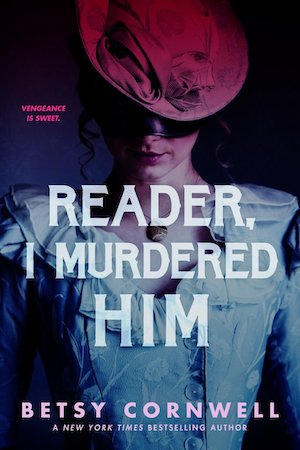
This week I review Fearless Women by Elizabeth Cobbs.

Elizabeth Cobbs Fearless Women Feminist Patriots from Abigail Adams to Beyoncé Harvard University Press, Belknap Press, March 2023.

Thank you, NetGalley, for providing me with this uncorrected proof for review.

Elizabeth Cobbs expands the way in which feminism is used to investigate women who call themselves feminists, and some who do not, worked to improve ‘their country’.  This, as Cobbs acknowledges, is a broad definition, and one that I do not endorse, although I do acknowledge that society (and therefore country) would be improved if women’s lives were improved – the work that I think of feminists performing. However, rather than let the broadness of Cobb’s view limit the way in which this book is read, I found it an energising read, with a lot with which I could identify, some that left me questioning (Phyllis Schlafly a feminist?), engrossing stories of marvellous women, horrendous stories of the treatment of women and the beliefs that underlie such treatment, and a veritable wellspring of information. In short, Fearless Women is a worthwhile read, a contribution to debate about feminism, and a history of women’s endeavour.

Cobbs adopts an interesting approach – two women feature as the major figures in each chapter, each contributing to the theme of the chapter, usually in markedly different ways. The chapter headings provide useful information, ranging from the first, ‘The right to Learn’ featuring Abigail Adams and Abigail Bailey; through ‘The right to Speak’ with Angelina Grimke and Harriet Jacobs; to Frances Perkins and Ann Marie Riebe taking up ‘The Right to Earn’, and ending with Beyoncé Knowles-Carter and the Women of Me Too providing a face to ‘The right to Physical Safety’. ‘The Right to Compete’ features Phyllis Schlafly and Muriel Siebert (the first woman to have a seat on the New York Stock Exchange). Familiar themes such as ‘The right to Lobby’, ‘The Right to Vote’ and ‘The right to Equal Treatment’ feature the following partnerships: Susan. B. Anthony and Elizabeth Packard; Mary Church Terrell and Rosa Cavallari; and Martha Cotera and Yvonne Swan.  A prologue and epilogue, notes and illustrations, are valuable and complete the book. See Books: Reviews for the complete review.

After the Canberra Covid update: Heather Cox Richardson updates American politics since the Republicans won the House and compares the insurrection in Brazil with that at the US Capitol; Women hidden from history and the story of an excellent apple; Cindy Lou at 86 and Blackfire.

Update on Covid in Canberra

Canberra has recorded 1,012 new cases of Covid this week. There are 59 cases in hospital, but fortunately no one is on a ventilator or in ICU. There were 6 lives lost to Covid this week over an age range from 40 years of age to two people in their 90s.

Heather Cox Richardson

January 10, 2023 (Tuesday)

National security scholar Maria W. Norris of Coventry University, who is covering events in Brazil, reports that today, President Luiz Inácio Lula da Silva gathered around him the president of the supreme court and the governors or vice-governors of each state, the senators, the attorney general, and congressional representatives, all of whom condemned the coup. Many had been staunch supporters of former president Jair Bolsonaro, but since the coup failed, they have thrown their lot behind Lula. After they declared their support, Lula led them through the vandalized buildings, symbolically reclaiming them.

Lula and his administration say that police worked with the rioters, and a judge has approved warrants for the arrest of two key law enforcement officials close to Bolsonaro: Anderson Torres and Colonel Fábio Augusto Vieira. Police have also searched Torres’s home. Pro-Bolsonaro groups have been camped near military posts and buildings since the election; it appears the insurrectionists’ plan was to induce the military to join them.

In the wake of the unsuccessful attempt to overthrow the government, Bolsonaro supporters are claiming that the attack was by leftists who infiltrated a peaceful protest. Police have so far arrested about 1500 participants.

Bolsonaro left Brazil for Florida before Lula took office, while he was still president. That status apparently enabled him to enter the U.S. on an A-1 visa, reserved for heads of state. That visa is normally canceled when the person holding it leaves office, but since he is already in this country, it is not clear what its status is. Normally, anyone on an A-1 visa who is no longer on official business must leave the country within 30 days, but if Brazil tries to extradite him, the process could stretch on, putting the Biden administration in an awkward position.

In contrast to the Bolsonaro supporters running from the coup, from his perch in the U.S., former Trump advisor Steve Bannon, who insisted all along—without evidence—that the election in Brazil was fraudulent, remained adamant that Lula must be replaced. “I’m not backing off one inch on this thing,” he said to Politico. Bannon is close to Bolsonaro’s son, who has been seen hobnobbing with Trump-affiliated people, including Trump’s daughter Ivanka.

Observers have noted the many similarities between the attack on the Brazilian government on January 8 and the attack on the U.S. government almost exactly two years earlier. But there are differences, too, and one of the big differences is that power had already changed hands in Brazil, and President Lula has compelled other leaders into a show of support even as the government is arresting rioters.

In the U.S., Trump was still in office when his supporters tried to overthrow the government, and there was neither a house cleaning nor a demand for lawmakers to declare their support for the duly elected government.

Many of those who supported Trump in the events of January 6, 2021, are still in Congress. At least six Republican congress members asked Trump for a preemptive pardon, and four of them are still in office. They make up the core of the far-right Republicans House speaker Kevin McCarthy had to bargain with to win the speakership: Representatives Scott Perry (R-PA), Andy Biggs (R-AZ), Matt Gaetz (R-FL), and Marjorie Taylor Greene (R-GA). Representative Jim Jordan (R-OH) was also part of the group that pressured McCarthy, and he, too, appears to have been deeply involved in the events of January 6: just days afterward, Trump awarded Jordan the Presidential Medal of Freedom with a somewhat generic citation that raised questions about why Trump was really giving Jordan the award.

Today the House voted on the rules package McCarthy promised to the far-right Republicans. As expected, it contained a threat to McCarthy: any single member can force a vote to toss out the House speaker. This rule was in place in 2015, when then-representative Mark Meadows (R-NC) invoked it against Speaker John Boehner (R-OH), who resigned rather than face a vote.

The deal cut with the far-right group gives them plum committee assignments, including a number of seats on the House Rules Committee. The deal required McCarthy to permit a number of symbolic votes on things important to that far-right group, and it appears to have promised to cap government funding at 2022 levels, worrying both those who want more defense spending and those who want to protect Social Security and Medicare. It also appears that McCarthy said he would not agree to raising the debt limit—that is, honoring the debts the country has already incurred—without “fiscal reforms.” That promise seems to hold the threat of a showdown over a national default.

And there are rumors of a secret agreement that has not been disclosed, an unfortunate start for the Republican majority, which promised to be transparent. Even some Republicans are demanding more information.

One of the things McCarthy did agree to was the creation of a select subcommittee in the Judiciary Committee to investigate the “weaponization of the federal government.” By a party line vote, the House today approved that committee to investigate what Republicans insist is an anti-Republican bias in the FBI and the Department of Justice. Jim Jordan will chair the committee, which theoretically can review ongoing criminal investigations, pretty clearly to protect Republicans in trouble. Former federal prosecutor Joyce Vance points out that the Department of Justice will never allow such a thing but dealing with the committee will waste time and resources. The Democrats will not boycott the select committee as the Republicans did the January 6 committee, suggesting that Jordan will not reign unchallenged.

Republicans clearly intend the committee to spread a narrative that will undermine the one established so powerfully by the Mueller investigation, the Trump impeachment committees, and the January 6 committee. The modern Republicans have always been closely tied to right-wing media, and nothing made that clearer than Fox News Channel personality Sean Hannity’s broadcast tonight. He did his show from the Rayburn Reception Room of the House of Representatives, “interviewing” Republican congress members so they could repeat talking points.

Yesterday, news broke that in November, President Joe Biden’s lawyers found “a small number” of classified documents from his vice-presidential years in a locked closet in Biden’s former office at Penn Biden Center for Diplomacy and Global Engagement. They immediately contacted the National Archives and Records Administration, which retrieved the documents the same day. Biden said that he did not know the documents were there and that his lawyers “did what they should have done” when they called NARA. Attorney General Merrick Garland assigned a Trump-appointed U.S. attorney, John R. Lausch Jr., to see if he should appoint a special counsel.

Trump and his supporters immediately tried to suggest Biden was getting better treatment than he did, but journalist Matthew Miller notes that classified documents often get taken from government facilities by accident. Those errors are reported, the documents recovered, and a damage assessment made to determine whether further action needs to be taken.

In Trump’s case, NARA repeatedly asked him simply to return the documents it knew he had. He refused for a year, then let them recover 15 boxes that included classified documents, withholding others. After a subpoena, his lawyers turned over more documents and signed an affidavit saying that was all of them. But of course it wasn’t: the FBI’s August search of Mar-a-Lago recovered still more classified documents. Trump is being investigated now for obstruction and violations of the Espionage Act, which makes it a crime to withhold documents from a government official authorized to take them.

Today, New York State Supreme Court Justice Juan Merchan sentenced former Trump Organization chief financial officer Allen Weisselberg to five months in jail at New York’s Rikers Island complex and five years probation after he pleaded guilty to 15 felonies in a scheme to provide Trump Organization employees direct benefits to avoid paying taxes. Weisselberg was the key witness in the trial last fall of the Trump Corporation and the Trump Payroll Corporation for tax fraud and falsifying records. A jury found the entities guilty of all charges, meaning the Trump Organization has been found guilty of criminal conduct, likely impacting its ability to do business and hurting Trump’s defense in other cases.

Hidden women of history: how ‘Lady’ Williams founded a great Australian apple

Published: January 18, 2023 6.02am AEDT

On Boronia Farm, just outside Donnybrook in Western Australia, stands an 80-something-year-old apple tree (Malus domestica) that’s at the heart of a global industry.

This tree produced an apple no one had seen or tasted before, now called the Lady Williams. Without the Lady Williams, there could be no Sundowner®, no Pink Lady®, no Bravo® – apple varieties that, along with the Lady Williams, have made a enormous contribution to the global apple industry.

Boronia Farm’s apple tree is now listed in the register of the National Trust, but the woman behind the Lady Williams is not well known. Yet, as her son Bob remembered, Maud Williams was crucial to the story of this tree and the apple it produced.

A remarkable chance seedling

From the 1930s, Maud, her husband Arthur and their two boys Bob and Ron worked their 12 acres of orchard, with its apples and stone fruit, and 40 cows.

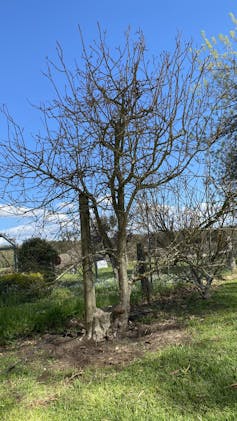
The original Lady Williams apple tree at Boronia Farm, Donnybrook, State Library of Western Australia, slwa_b6831120_8.

Maud collected ideas for plants to grow, from catalogues and women’s magazines, experimenting with her taste for the unusual, remembers her son Ron. Not content with roses and petunias, Maud was instead growing feijoas and hydrangeas.

With her eye for horticultural novelty, it was perhaps not surprising that she identified the very special qualities of the tree with the bright red apples that had sprung up unexpectedly next to the tank stand beside the house.

The fruit was firm and crisp and showed great suitability for long storage, ideal for Australia’s export market. The Williams family gathered a good price for their cases of apples grown from this tree and over time, the family propagated new trees from the original one.

This tree was a chance seedling, a spontaneous creation whose likely parent cultivars were Granny Smith and Rokewood.

Some of our most common apple varieties began as chance seedlings. But chance seedlings do not reach our supermarkets as a matter of course.

Lady Williams apples would not have become a popular variety without Maud Williams’ keen eye for the unusual. Nadiatalent/Wikimedia CommonsCC BY

Apples frequently produce chance seedlings. But for a chance seedling to be put into production and become known as a variety, many factors are involved, not least people who recognise distinctive apples that will have value in their contemporary context.

Only a select few chance seedlings are ever turned into varieties with impact in the orchard industry. For that to happen, there need to be people who make the necessary investment of care, time or funding – just as Maud did.

In its inconvenient location, the unfamiliar apple tree was almost cut down many a time, but it survived thanks to Maud’s protection and care. On one occasion when he almost destroyed it, Bob recalled getting a severe telling-off from his mum, who “stood it up again, bandaged it up and it took off again”.

Reflecting Maud’s importance in the creation of this new variety, the apple was given the name Lady Williams. This was the name that the little girl, Lynette Green, who lived on a neighbouring farm, used for Maud.

Maud’s recognition of the qualities of the fruit from this tree, and her initiatives to protect it, were about to enable a remarkable new phase of the Australian apple industry.


Lady Williams, parent of the Pink Lady

Lady Williams apples were introduced commercially in 1968, the same year Maud died. By the early 1970s, the Lady Williams was the subject of attention at the WA Department of Agriculture and its new apple-breeding program. There, a team led by the horticulturalist John Cripps was experimenting with combinations of Lady Williams and Golden Delicious.

In an interview conducted as part of the Apples and Pears Oral History Project in 2010, Cripps reflected that the cross-breeding process involved intensive manual labour, high degrees of dexterity and immense patience, a set of qualities Cripps identified in women technicians.

In 1984, one of the over 100,000 experimental seedlings produced an attractive fruit; it was bright pink, crisp, flavoursome and long-storing. Cripps had a hand in both its names: the Cripps Pink, and its commercial name, Pink Lady®. It was the first apple variety ever to be trademarked.

apples on an apple tree
The Pink Lady apple, a variant of the Lady Williams, was the first apple variety to be trademarked. Kerry Raymond/Wikimedia CommonsCC BY

From the same breeding program emerged the Sundowner® and more recently, in 1992, the Bravo®.

All the world’s Lady Williams, Pink Lady®, Sundowner® and Bravo® trees share DNA with the original tree Maud Williams had nurtured many years before.


Writing women’s agricultural contributions

Women’s contributions to the agricultural sector have often occurred, just as Maud’s did, outside of professional roles. They do not always fit easily in conventional profiles for innovation and entrepreneurship in agriculture, nor into standard narratives of Australia’s agricultural development.

Documenting Australian women’s activities in agricultural innovation faces considerable challenges. Remarkably, only 30 years ago, women were not able to be recognised as farmers in their own right on Australian census forms.

Making women’s activities and innovation visible in this domain is key to providing role models for the future. It will also increase the diversity of participation in Australia’s future decision-making about the lands we live and work on.

We may have to look and listen in different places for the histories of these women. What we know so far of Maud’s role has been gathered from interviews with her family and members of the local community of which she was part. We can also consider how our histories could become more inclusive by thinking about what constitutes participation and contribution to agricultural innovation more expansively.

There are many women working in the south-west orchard industry today: running the farm businesses, packing apples, testing for new varieties, leading the industry’s peak body. They are the inheritors of a dynamic industry that Maud Williams helped to create.

Image credits: State Library of Western Australia.

new podcast for the State Library of Western Australia delves into women’s roles in the Western Australian apple industry.

We believe in the free flow of information
Republish our articles for free, online or in print, under Creative Commons licence.

Republish this article

Before you go …

The Conversation serves society by making knowledge accessible to everyone, not just a select few. Our only agenda is a better informed public. If you care about what we do please make a donation now and help secure our future.

Donate now

Misha Ketchell

Editor

Cindy Lou at a favourite restaurant, 86 – again

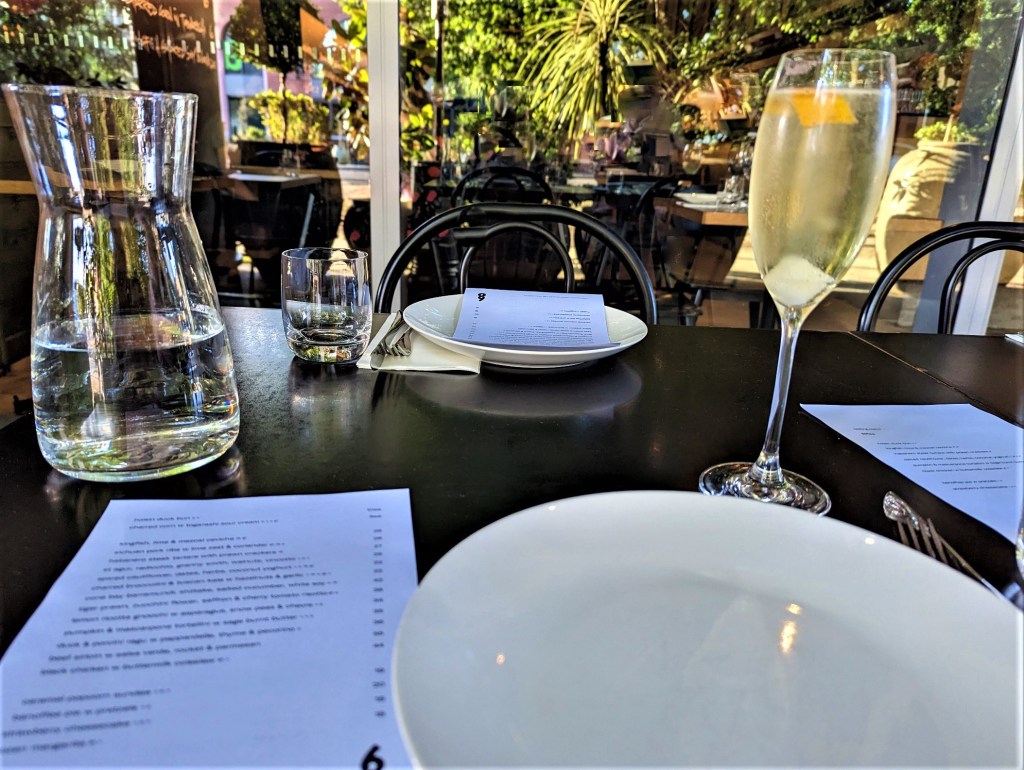
I was pleased to be able to book 86 for four people at an outside table on Tuesday night. We had a pleasant table, with foliage almost hiding the road, comfortable seating, and not too crowded. Unlike the inside seating in an atmosphere that is often noisy, we were able to talk peacefully (but animatedly) for over three hours.

We were able to try two new dishes, along with the always popular corn cobs in a delicious sauce, with parmesan and cilantro. Yes, these require a napkin around the neck, giving up on looking sophisticated, and a firm intention to enjoy them whatever the consequences to face and image. They are worth it. The new dishes we tried were the tuna ceviche and the black chicken with buttermilk slaw. And for dessert, we shared the child’s favourite (mine), Carmel Popcorn Sundae with the sophisticated Frozen Margarita. They were a winning combination.

Some familiar favourites – broccolini, and cauliflower. The pumpkin and mascarpone pasta vanished before I remembered to take a photo – I was the chief culprit as it is an excellent dish.

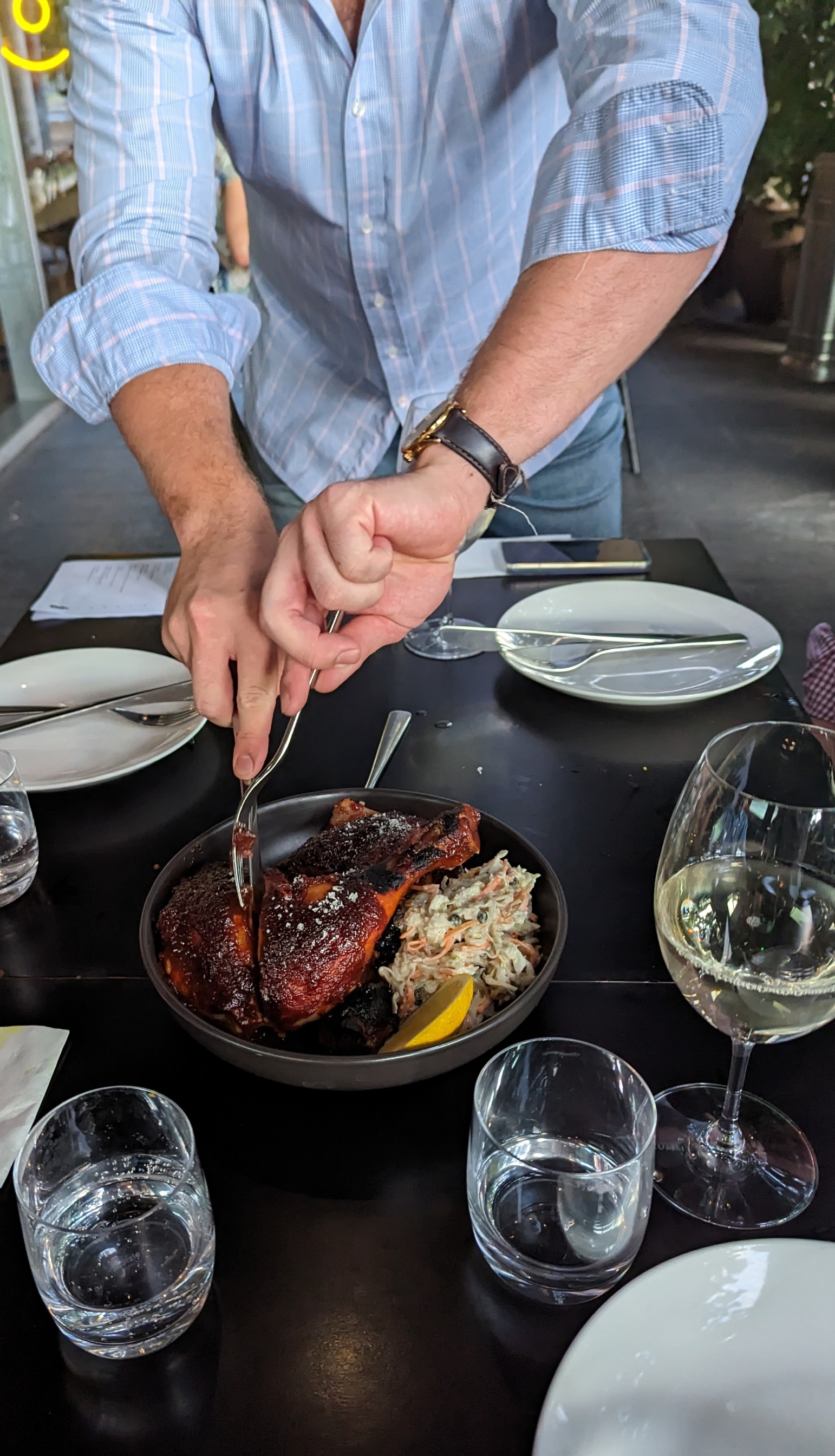
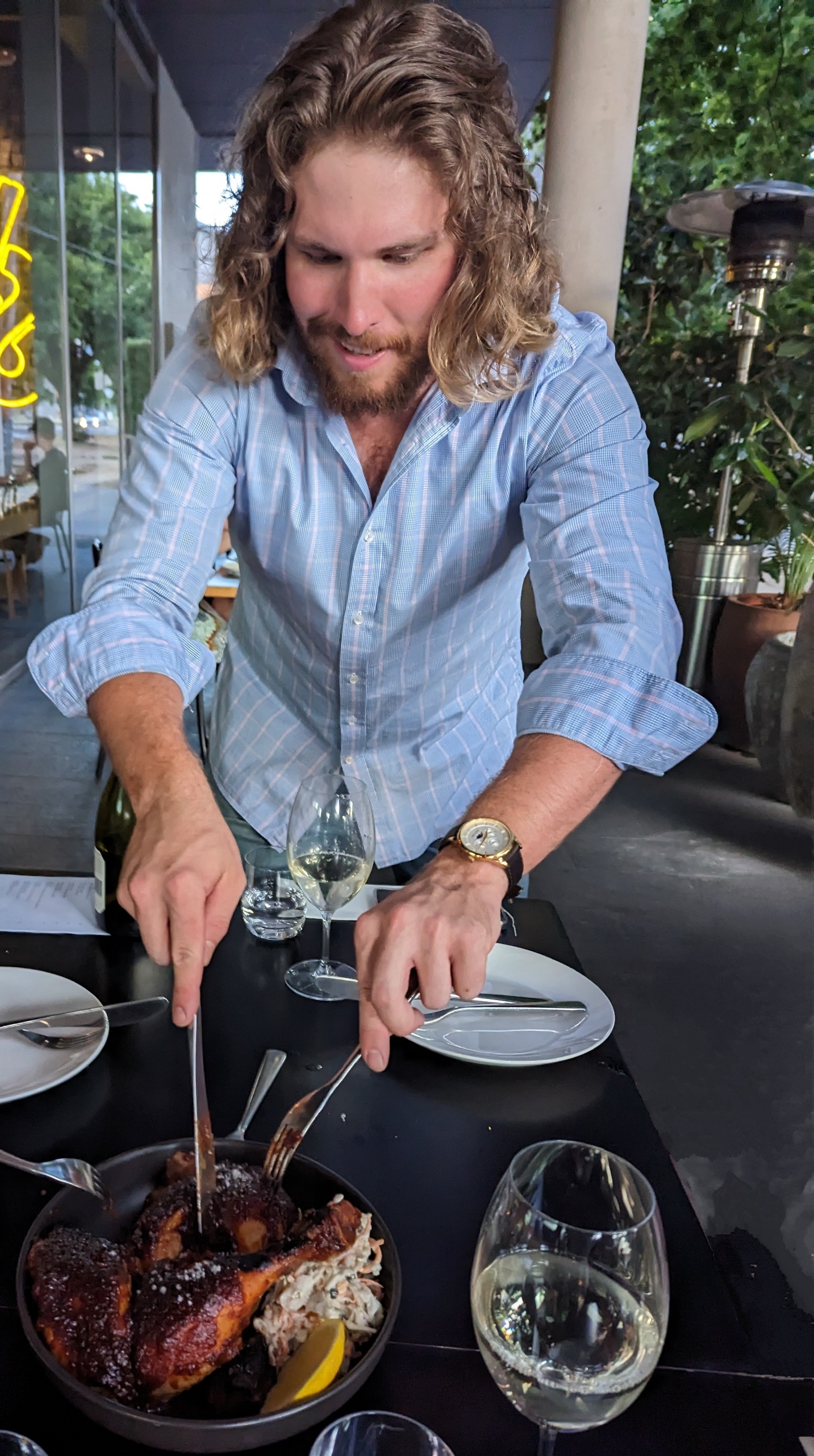
New dishes – tuna ceviche, and the splendid chicken dish

Deftly cutting up the chicken – not our forte!

Dessert but a bit of a disappointment that there were no teas other than English Breakfast. Peppermint would be a nice addition.

Back to Blackfire and some different menu choices

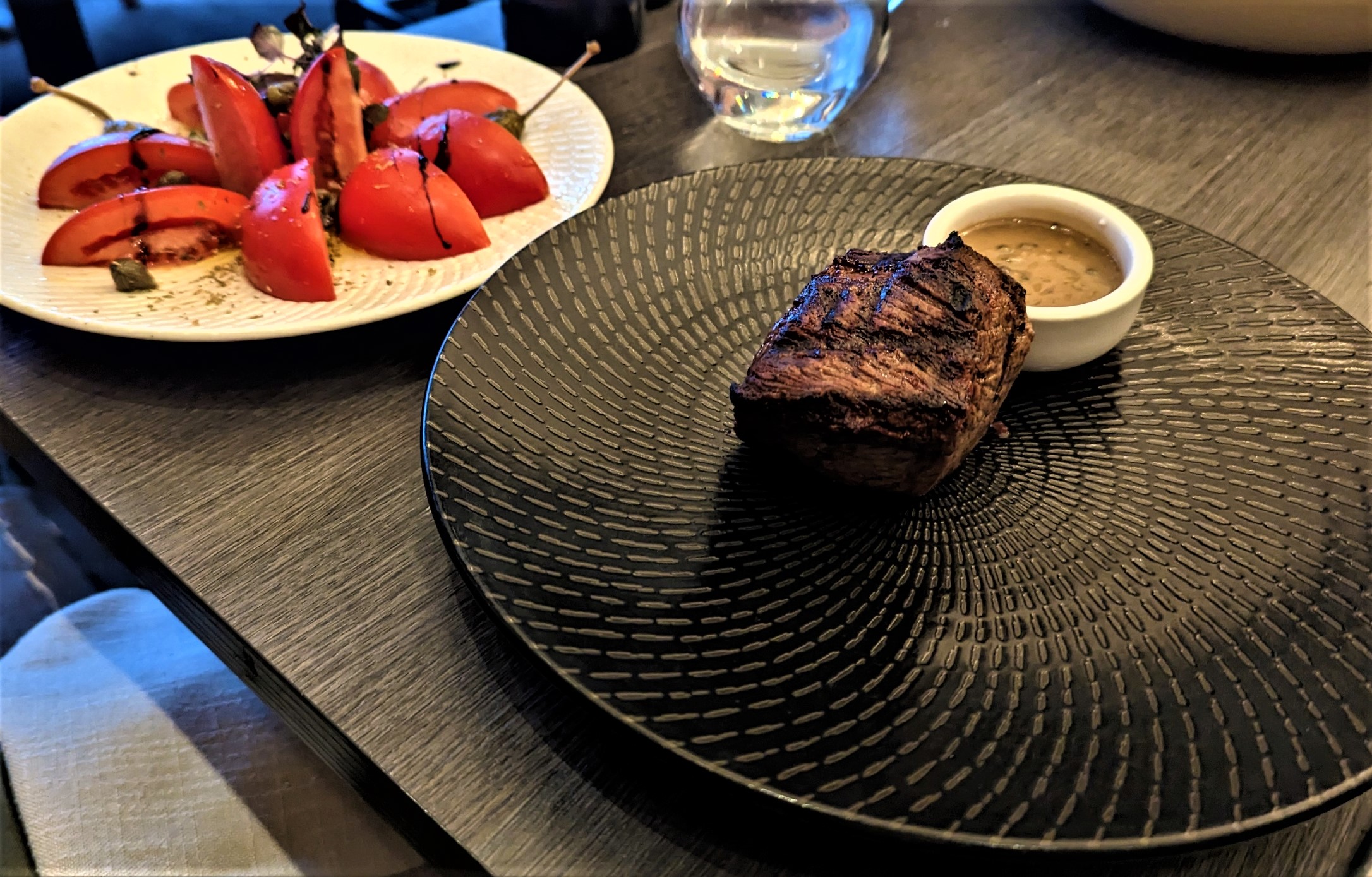
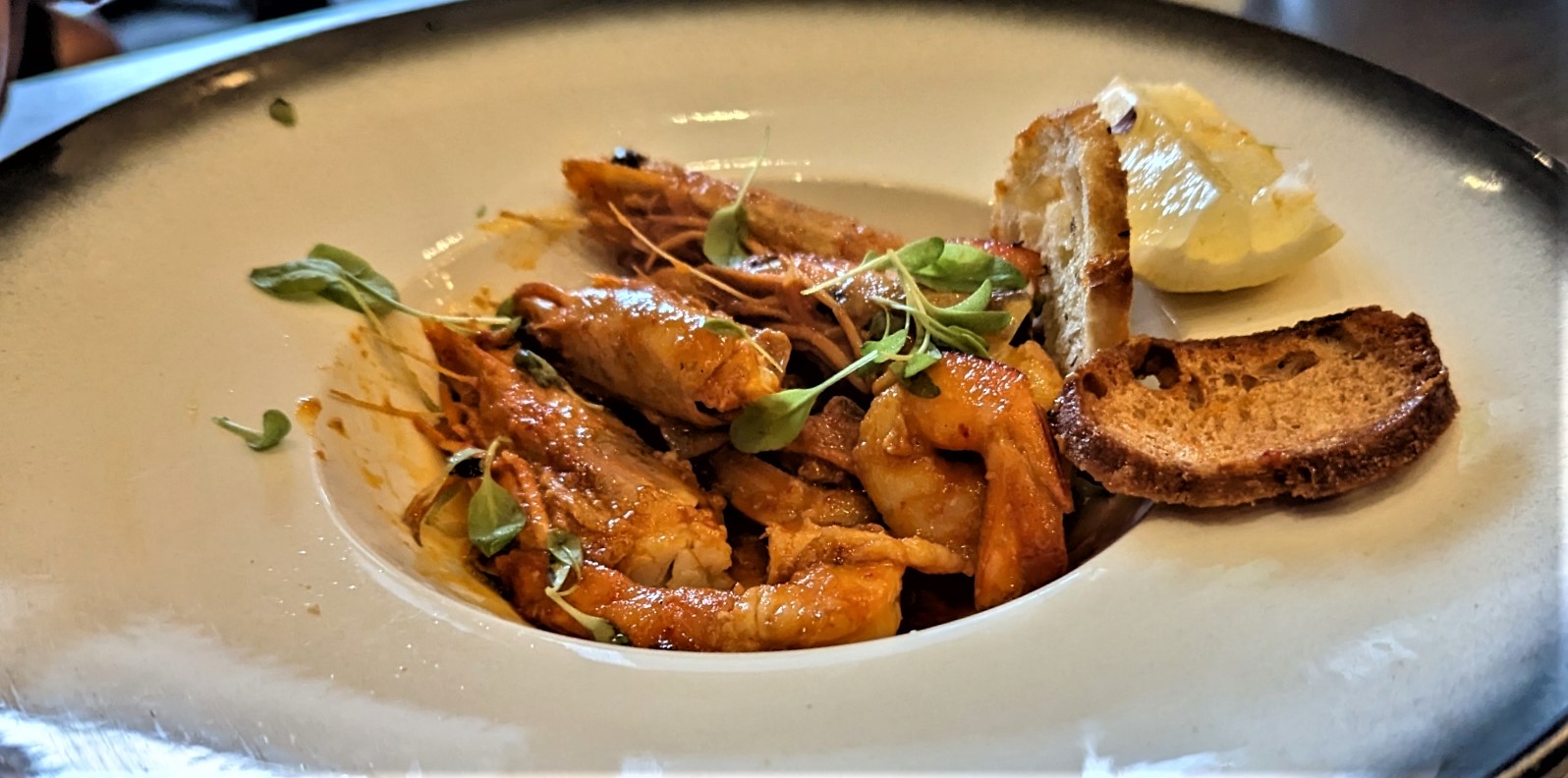
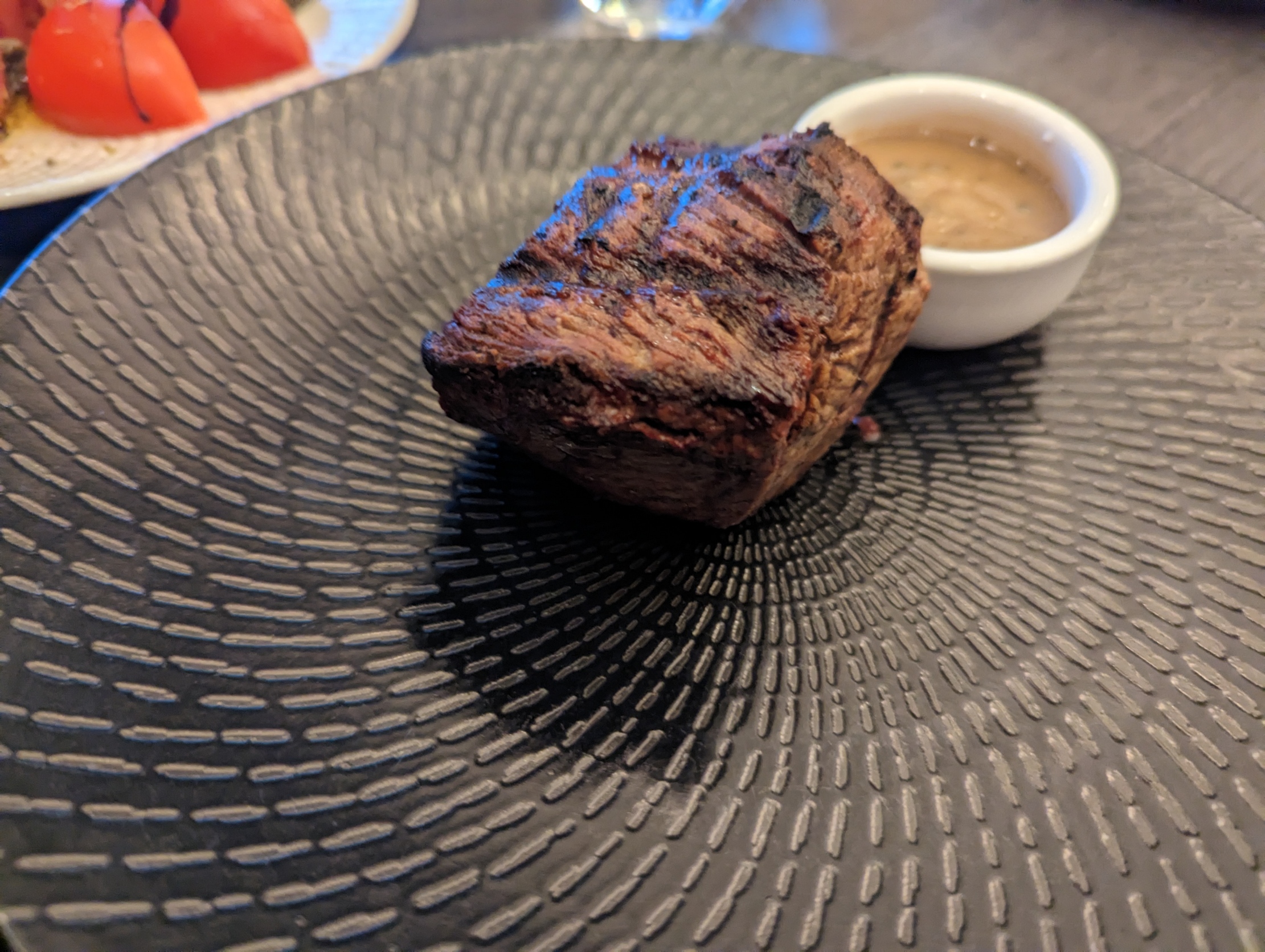
It’s always pleasant to try something different, and this time I did not have my crab filled red peppers followed by the chili prawns. There were four of us and we began with Spanish olives, which were accompanied by crisp slices of toasted crusty bread, and anchovies; and the delicious Pan Tumca – bread with a fresh tomato topping. A mushroom dish, the goats cheese churros and prawns made light entrees. The puttanesca pasta was nice, but not as silky as I would like, although the sauce was very good. Another pasta, a hearty Maltagliati, made a delicious meal. Butifarra Blanco is a Spanish sausage dish, served with a generous portion of mushrooms. The steak was cooked to order and served with a side of choice – on this occasion a fresh tomato dish with capers.

Week beginning January 11 2023

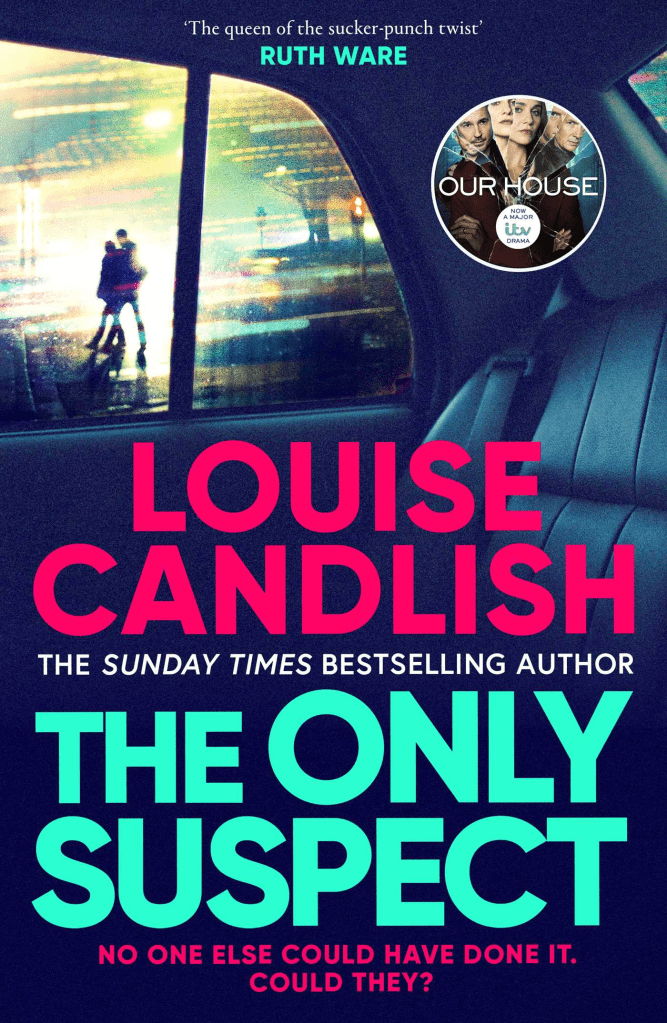
Louise Candlish The Only Suspect Simon & Schuster (Australia), Simon & Schuster UK 08 Mar 2023 

Thank you, NetGalley, for providing me with this uncorrected proof for review.

The Only Suspect is another success for Louise Candlish. Once again she has devised a novel that has all the intrigue, twists and turns to keep a reader engrossed. None of these is the all too familiar contrived clumsy attempt to fulfill the current requirement that a twist be included in a psychological thriller. Instead, Candlish is almost fiendishly clever in developing the characters and plot to ensure that any twist makes sense – which is why the narrative moves forward smoothly and the reader is left wondering why they didn’t see the clues to the mystery. Even where I had suspicions, I was not disappointed with the reveal. Books: Reviews

After the Covid report: Changes in publishing; Bob McMullan – Global Political Trends for 2022; Barbara Walters and today’s women in Televison; Joan Sydney (Matron Sloane from A Country Practice); Cindy Lou eats out in Canberra; Jocelynne Scutt’s Brilliant and Bold zoom meeting to be held on January 15th and streamed on Facebook.

Covid in Canberra after Lockdown ends

New cases numbers are 1,436 and 73 people are hospitalised with Covid. Seven of these are in ICU and 2 are ventilated. There were 4 lives lost this week, bringing the total number of lives lost since March 2020 to 142.

Current restrictions: people testing positive must stay at home until their symptoms have gone or they are feeling much better; they must wear a mask in indoor public places or using public transport; they must not enter a high-risk setting, disability setting or residential care setting for 7 days after the date of a positive test unless granted approval by the facility.

Those testing positive must minimise movements in the community where possible and check their workplace policies related to Covid 19.

Changes In Publishing With Jane Friedman

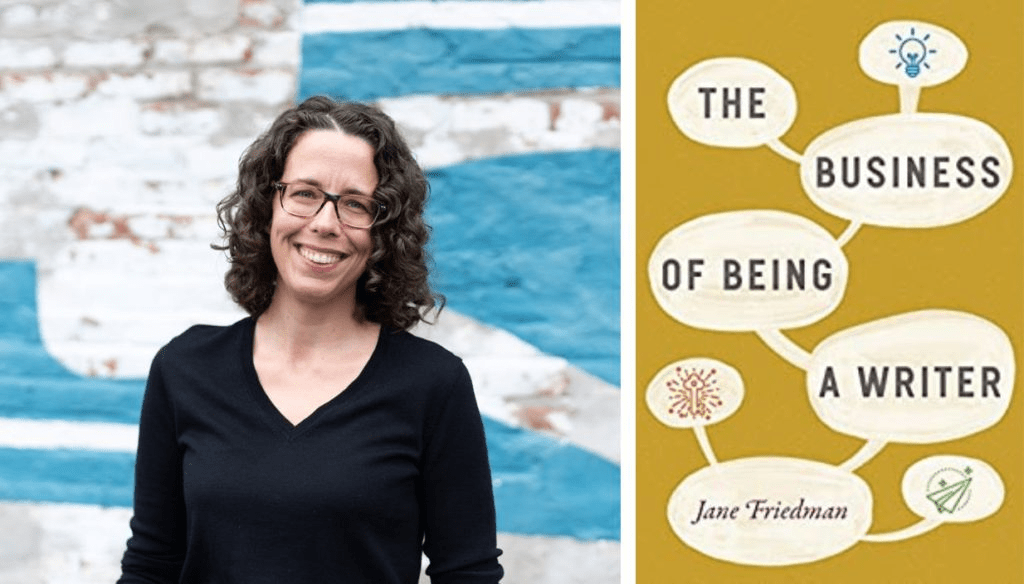
Joanna Penn was a speaker at a Guardian workshop I attended several years ago in London. She is an ‘indie’ writer and spoke about this, comparing her experience with that of writers published by the trade publishers. She recently interviewed Jane Friedman author of The Business of Being a Writer.

The topic was : What has changed in the publishing industry over the last few years? What can authors learn from the DOJ vs PRH court case? How can mid-list authors thrive in uncertain times?

Click here to listen or read

A few of those fabulous women

Vale to Joan Sydney

“Sydney was known for her Logie-winning role playing Matron Maggie Sloane in A County Practice between 1983 and 1990.

However, her screen debut occurred when she was just 18, in the 1957 film version of English play When We Are Married.

She joined the Neighbours cast in 2002 playing Valda Sheergold on a semi-regular basis, before becoming a permanent cast member between 2007 and 2008.” Oral History Group https://www.facebook.com/groups/AMOHG/

Neighbours, A Country Practice star Joan Sydney dies peacefully at home aged 83

Global Political trends from 2022

Bob McMullan

I noticed George Megalogenis’ recent article about the possibility of a “progressive wave” in the Anglosphere and other commentary suggesting a global trend towards parties of the Left.

While this is a legitimate point if you are content to look at just the UK and USA or selected others, the global picture is much more complex.

Some of the elections of 2022 are difficult to classify across a progressive/conservative continuum. For example, Papua New Guinea’s recent election and some of the elections in the Balkans don’t lend themselves to analysis within such a framework. Similarly, the recent contest between former PM Bainimarama and Sitiveni Rabuka in Fiji cuts across conventional western interpretation. What was significant in Fiji was the peaceful transfer of power after the incumbent lost the election, something the US found very difficult in 2020. A similar peaceful transfer of power occurred in Kenya after a hotly contested and very close presidential election.

However, most of the elections during 2022 can be broadly classified across the conventional framework.

It is true that progressive parties have had some good results. In Europe, progressive parties in Albania, Portugal, Malta and Denmark did well and in France the Right was once again beaten in the Presidential election by the most electable non-right candidate, although Macron should probably be classified as a centrist.

In Latin America the Left did well, exemplified by Lula’s election as President of Brazil. However, it must be acknowledged that an attempt to establish a new and progressive constitution in Chile was a disastrous failure.

Elsewhere, the Right and in particular the extreme Right did disconcertingly well in a number of countries. In South Korea the conservative presidential candidate won narrowly. In Israel the most right-wing government ever was elected and in Hungary Victor Orban’s party won a crushing victory. In traditionally progressive Sweden the ultra-right wing party, the Sweden Democrats, made big gains and helped establish a centre right government.

The outstanding example of right-wing victories was in Italy. Here, the Brothers of Italy Party, with links to the Fascist past in Italy, led a right-wing coalition to government. This may presage a significant change in Italian politics or may prove to be a brief flirtation with extremists. However, the result has very worrying potential which should give us all food for thought.

It is not possible to discern a sweeping global pattern to either end of the political spectrum.

What is notable is the failure of centre-right parties overall. Where they gained government, it was principally as a result of improved performance of the ultra-right at the expense of the centre-left.

This may suggest a pattern similar to that emerging in Australia in which the parties of the centre-right are losing support among younger voters. Polling suggests that they are seen as have nothing to offer on the issues of most concern to young people. Younger voters appear to be judging the mainstream conservative parties as having nothing positive to say about issues like climate change and the environment or their housing concerns. It may be that a long-term change is under way, but it is too soon to be definitive.

 Following this complex pattern of results in 2022 the coming year will certainly see some interesting elections.

In Africa the big one is the Nigerian Presidential election, in which the incumbent is term-limited and a maverick outsider has a serious chance. In Latin America the key election will be in Argentina where the left of centre President has very low approval ratings but it does not appear that any consensus alternative candidate has emerged.

 In Asia I think the most important election will be in Thailand, where democracy is struggling to revive. In Europe there are major elections in Greece, Spain, Poland and possibly the UK.

The Presidential election in Turkey will be important as challengers to Erdogan struggle to get a hearing .

Of course, in our part of the world there are scheduled elections due in New Zealand as well as the NSW state election and the very important Voice to Parliament referendum.

I don’t expect a sweeping global pattern to emerge, local factors tend to be too strong, but it will be interesting to see whether any of the centre-right parties can buck the 2022 trend.

Cindy Lou eats out at casual cafes in Canberra

Divine Cafe and Bar

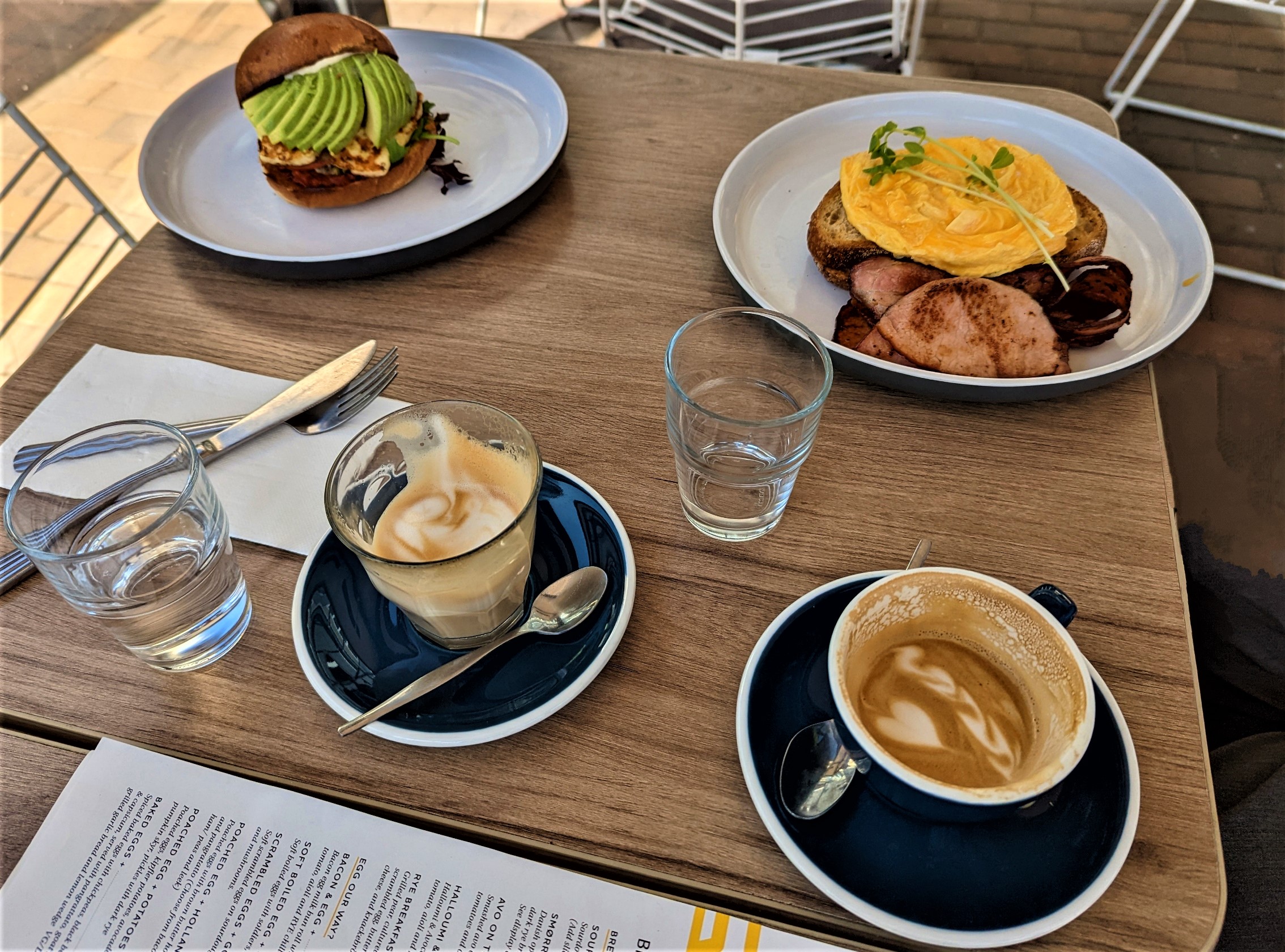
Although our favourite Tinker, Tailor at Jameson was open, it is clearly so many others’ favourite too. It was so busy we returned to our new find in the same shopping centre. There was one table in the sun, and we quickly sat down. This cafe provides table service, which is rather pleasant, so we were provided with a breakfast menu and water and glasses immediately. One meal was delicious scrambled eggs, toast (2 pieces) and a generous serve of tomatoes with a coffee. The other, a panini with haloumi, mushrooms and an egg, again with good coffee, was so large that some had to remain on the plate.

With its table service (very efficient and pleasant) and some outside tables that are in the sun, Divine Cafe, together with Tinker, Tailor, with its good undercover outdoor seating for people with dogs when it is raining, offer excellent breakfast, lunch and coffee and cake options at Jameson.

Praga Cafe

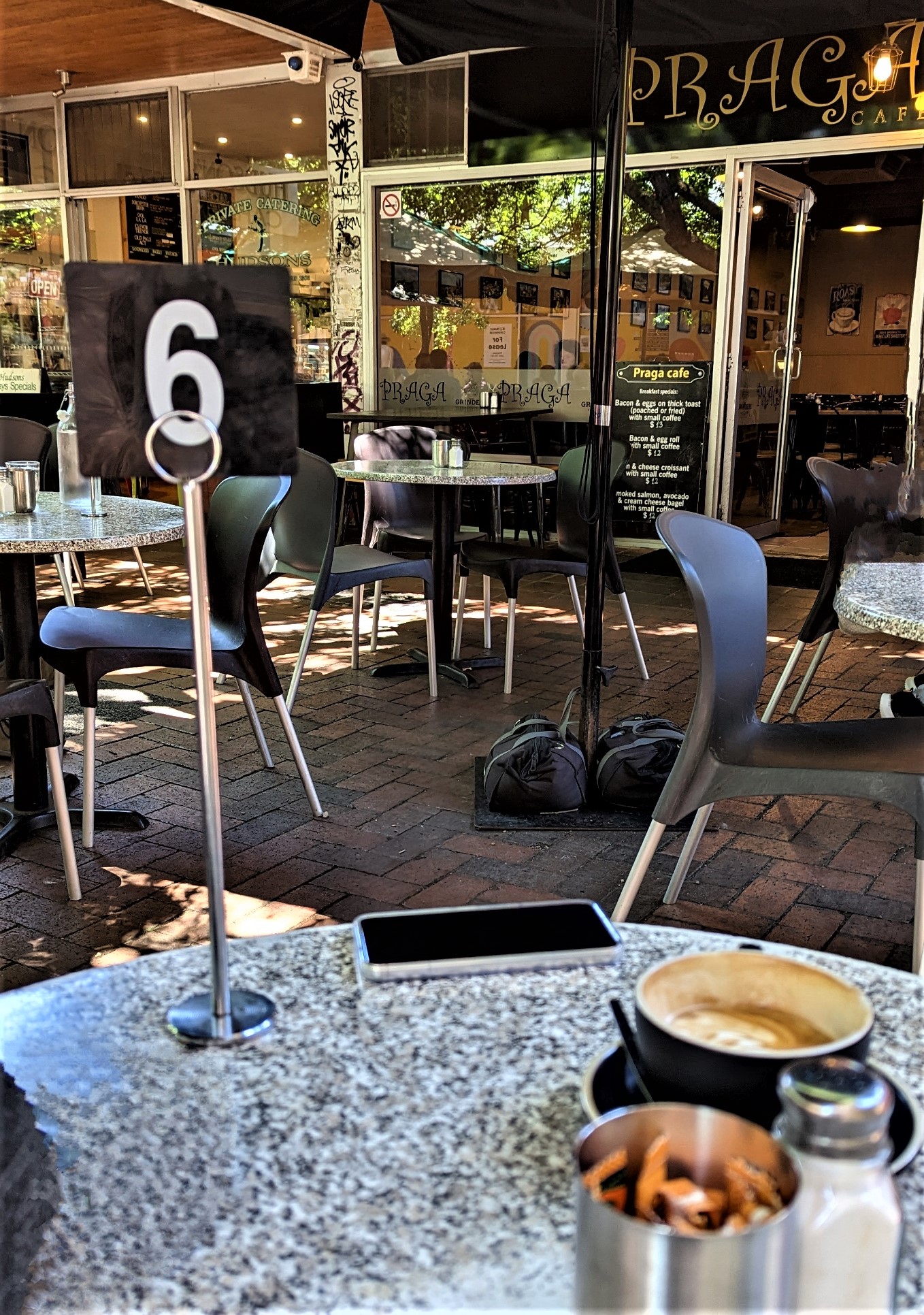
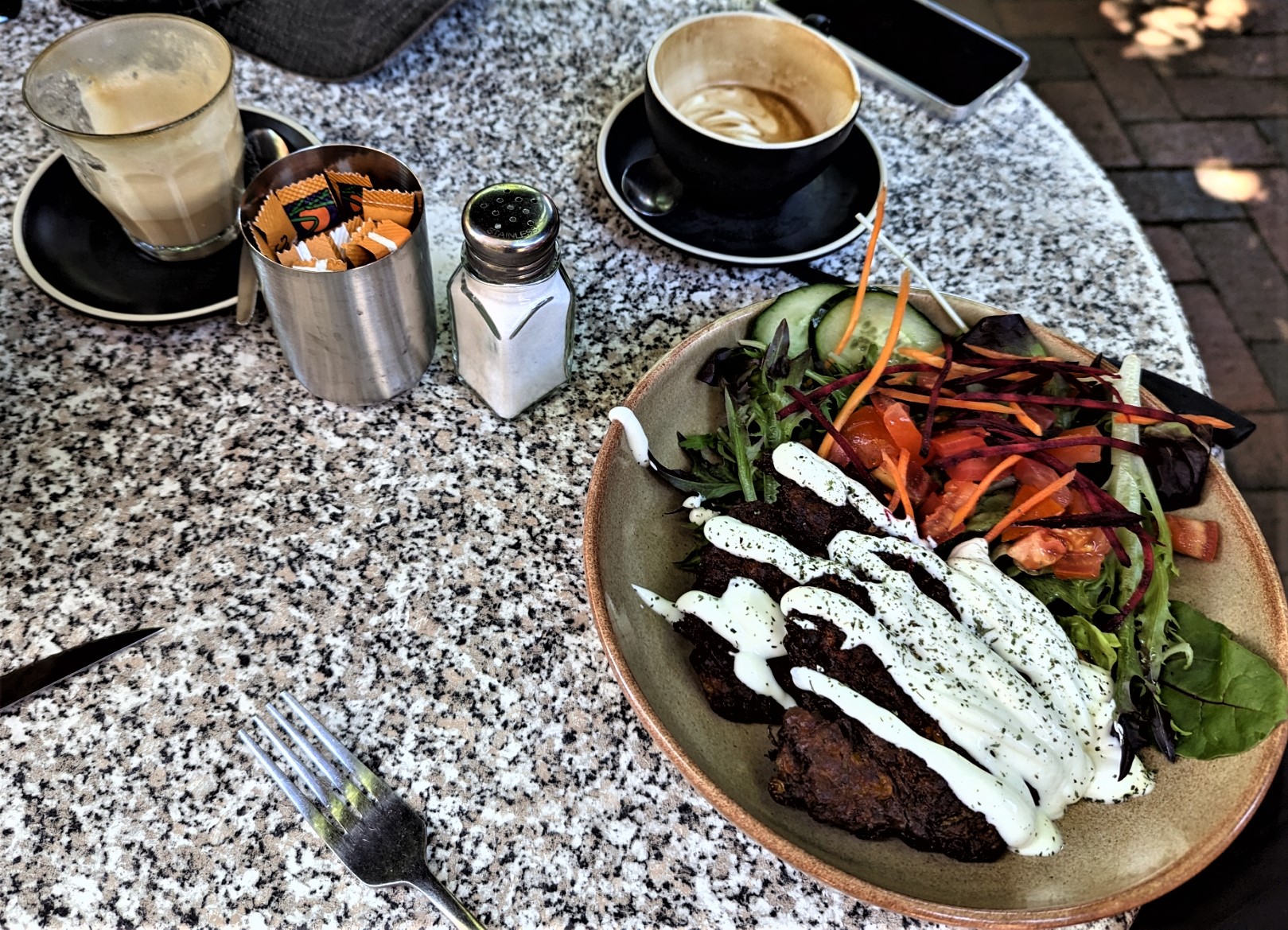
Praga is a new find for Cindy Lou, providing an excellent specials menu for breakfast and lunch, really friendly and efficient service, and a leafy respite in a pleasant environment at the Dickson shopping centre. The breakfast a few weeks ago was marginally more successful than today’s lunch. However, both are good options for a casual meal out.

Calamari and salad, and zucchini fritters and salad with coffees were light meals suitable for lunch time on a sunny day in Canberra.

Brilliant and Bold meeting hosted by Dr Jocelynne Scutt on Sunday January 15th, 2023.

The meeting will be live on Facebook. The meeting begins 11.00am UK time, and can be watched from 10.00 pm EST. Comments are welcome.

Week beginning 4 January 2023

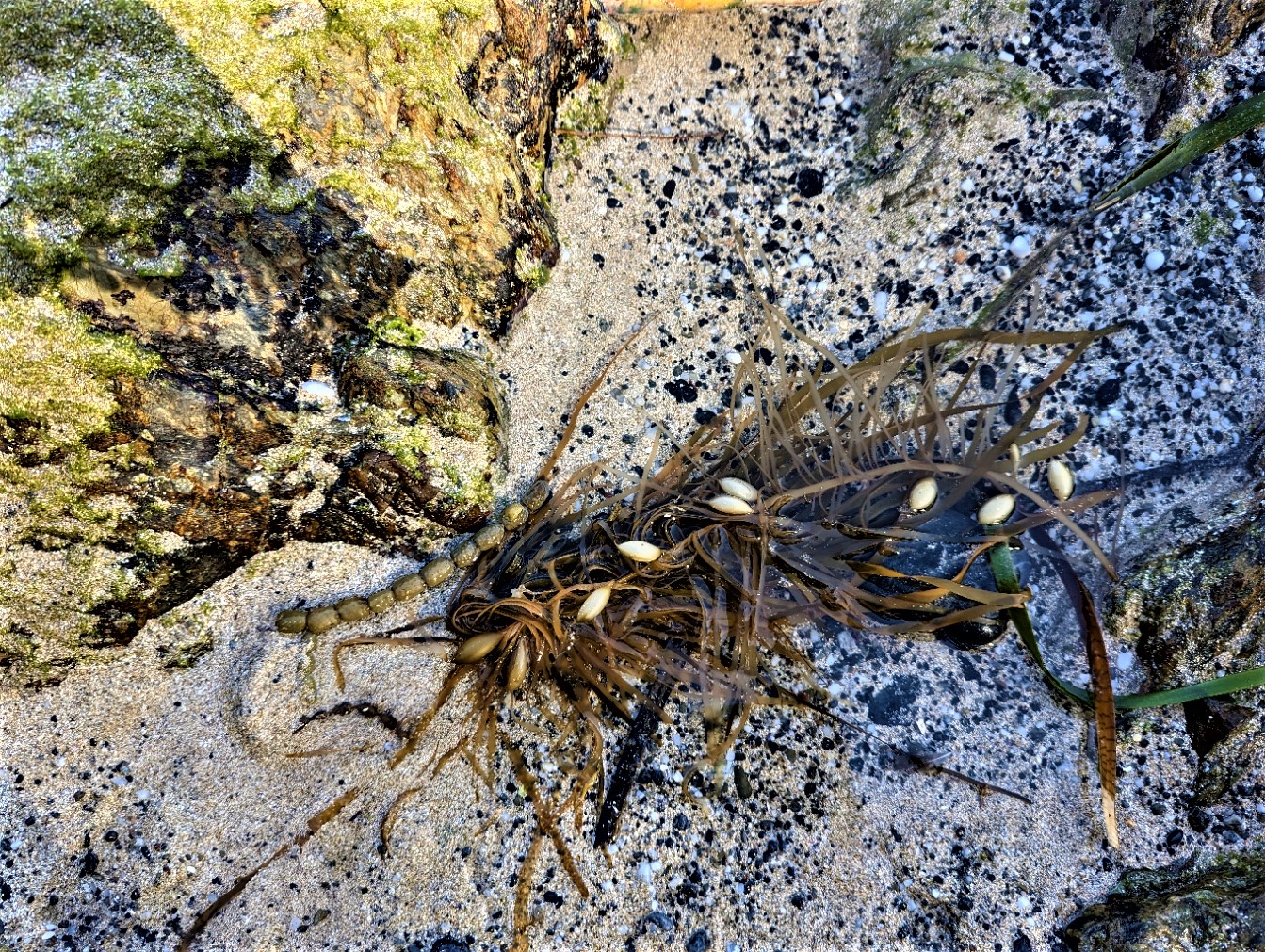
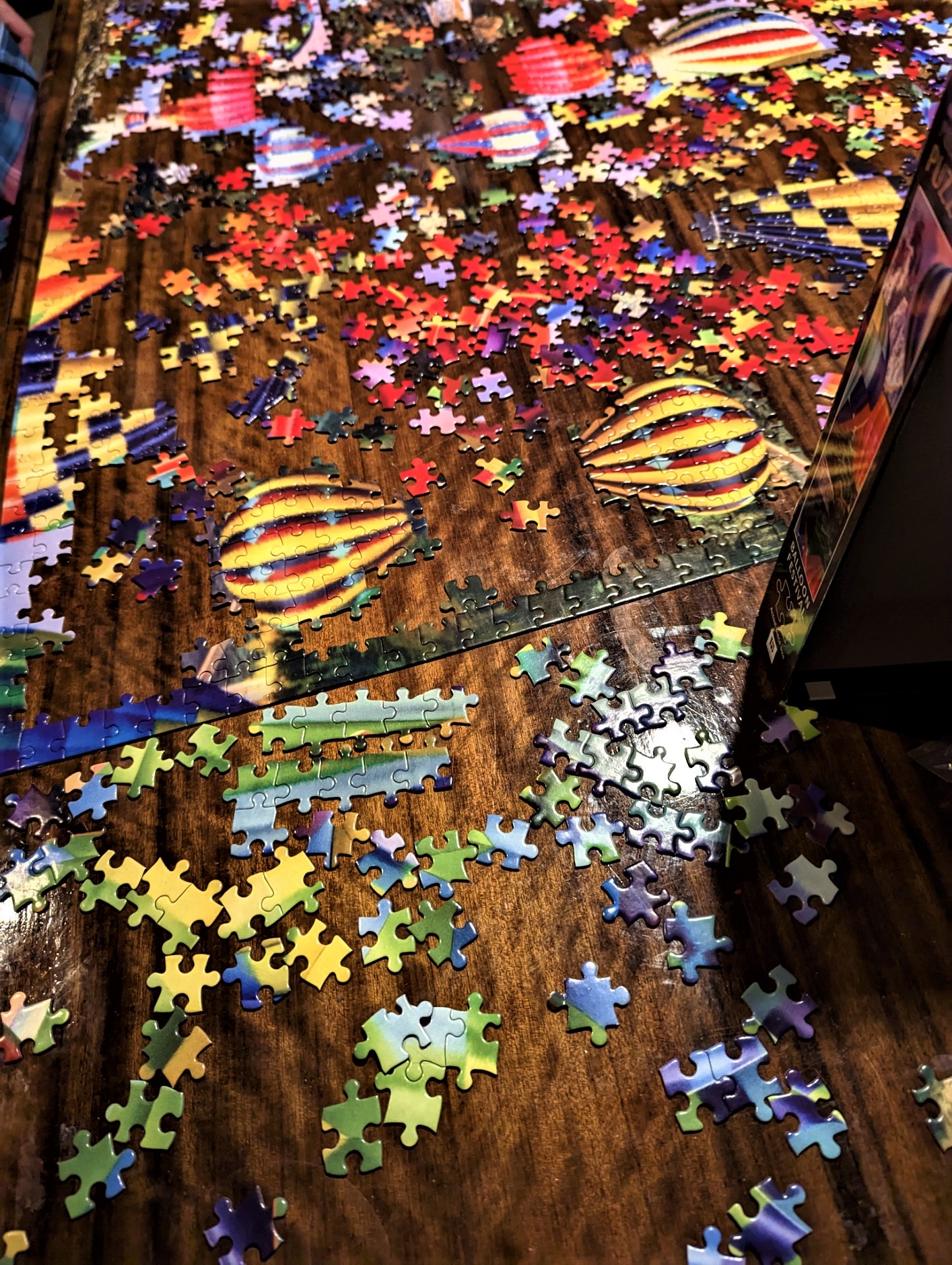
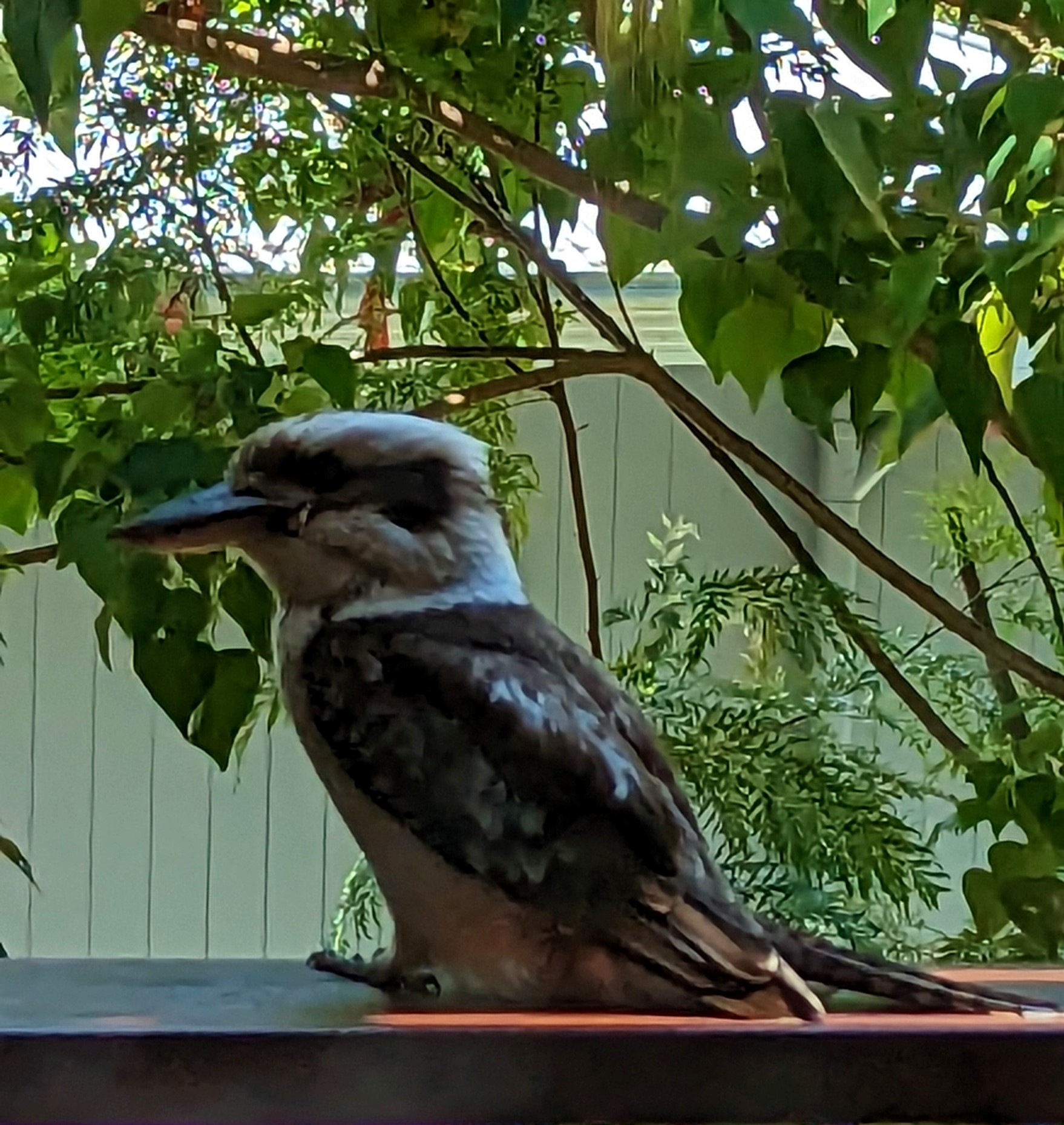
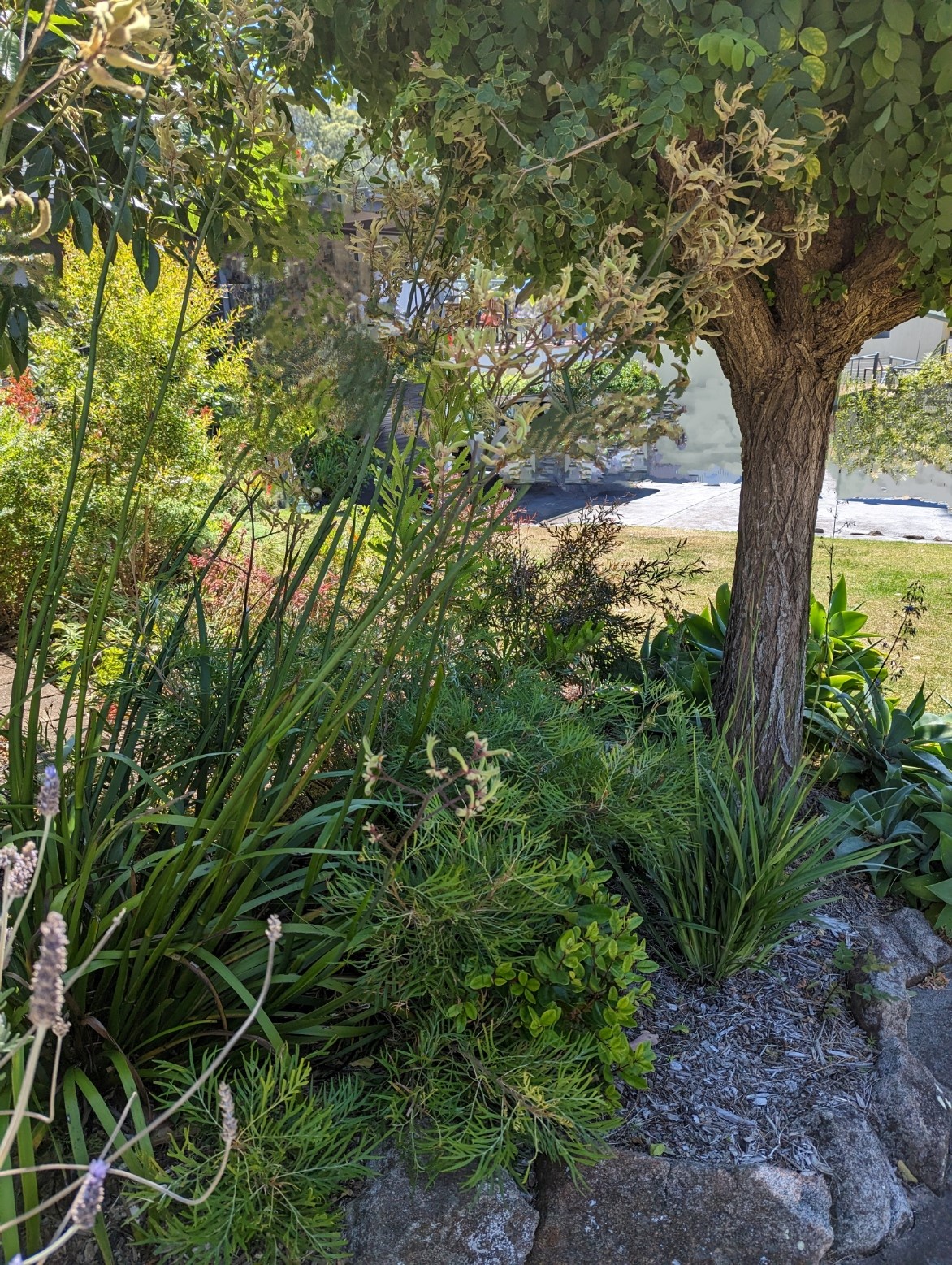
This week I review K.L. Slater’s The Narrator after a week’s break from the blog. I begin the new year with some photos of the lovely beach that was an important part of my holiday away from the computer, fun with an onerous 2000-piece jigsaw, a delightful visitor and some scenery from the many walks we enjoyed.

The Kookaburra’s generous posing was appreciated but it was also lovely to see that when tiring of the adulation it felt that independence should be established!

K.L. Slater The Narrator Bookoutur 2023.

Thank you NetGalley for providing me with this uncorrected proof for review.

K.L. Slater has combined domestic drama and some interesting perspectives on creating and maintaining a popular series of novels; authors’ obligations and struggles; the process of writing, narrating and dealing with publicity; and fans. The plotting works well, with short chapters relating the story from the past and present, told from the perspectives of the main characters, Phillipa Roberts (author), Eve (narrator); and Chad (a super fan) interspersed with scenes from a dank basement and its alternative, a clean room with writing facilities. Books: Reviews

Covid in Canberra since lockdown ended

The most recent update for covid in Canberra is for the week ending December 23, 2023. The new cases numbered 1,283, with 69 active cases in hospital, 3 in ICU and 1 ventilated.

CELEBRATING FILM FOR 30 YEARS
BFI Film Classics

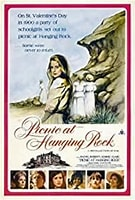
Picnic at Hanging Rock – this looks interesting. BFI Film Classics, published by Bloomsbury Film and Media Studies has published this ‘study of an Australian classic… The first ever singular study of one of Australia’s most iconic films’.


The haunting and allusive Picnic at Hanging Rock is widely hailed as a classic of new Australian cinema, seen as exemplary of a peculiarly Australian style of heritage filmmaking.

In her study, Anna Backman Rogers applies a feminist, psychoanalytic and decolonial lens to this classic film, exploring its setting in a colonised Australian bushland. Richly illustrated, with over 50 colour images from the film, the book delves into the film’s production history, addressing director Peter Weir’s influences and preoccupations at the time of its making, its reception and its lasting impact on visual culture more broadly.

Rogers suggests that there is more to the film than one first realises. Through its exquisite and captivating production, the film purposefully obscures a more sinister reality: one of violence done to young girls on the cusp of womanhood, the denial and disenfranchisement of Aboriginal people and their land, and the folly and arrogance of white, colonial, European settler culture.
READ AN EXTRACT

Cindy Lou enjoyed some simple meals this week – a sandwich on the way to the coast, and breakfast at one of the few coffee places open in Canberra before the new year.

The Pie Shop Bungendore

The Pie Shop was fantastic during the period when Covid rules applied, so I like to return when on my way to the coast. They have wonderful rock cakes as well as a range of pies with succulent fillings, toasted sandwiches, a nice choice of cakes for afternoon tea, good coffee, a cool drink cabinet and ice-creams.

Divine Cafe & Bar

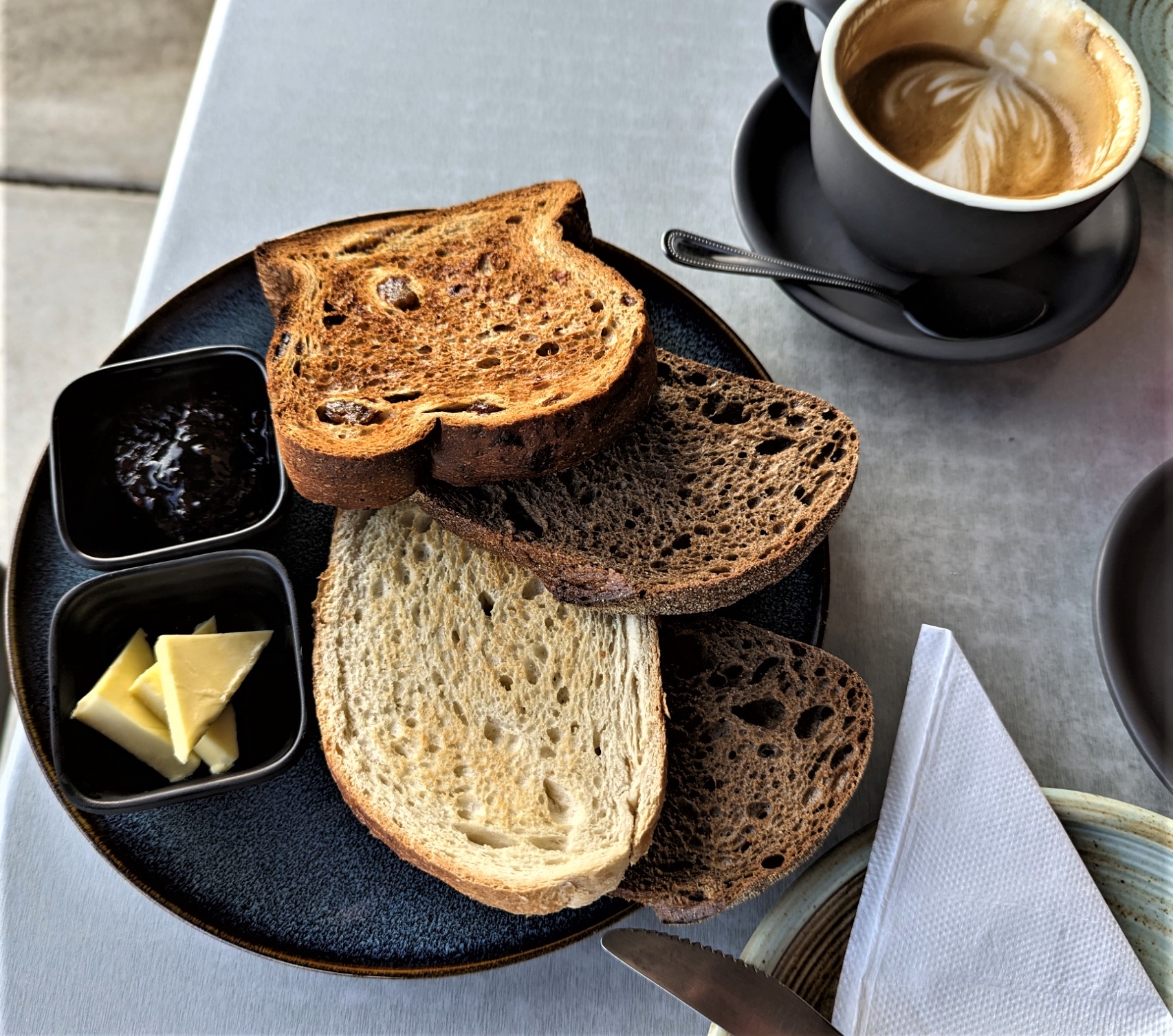
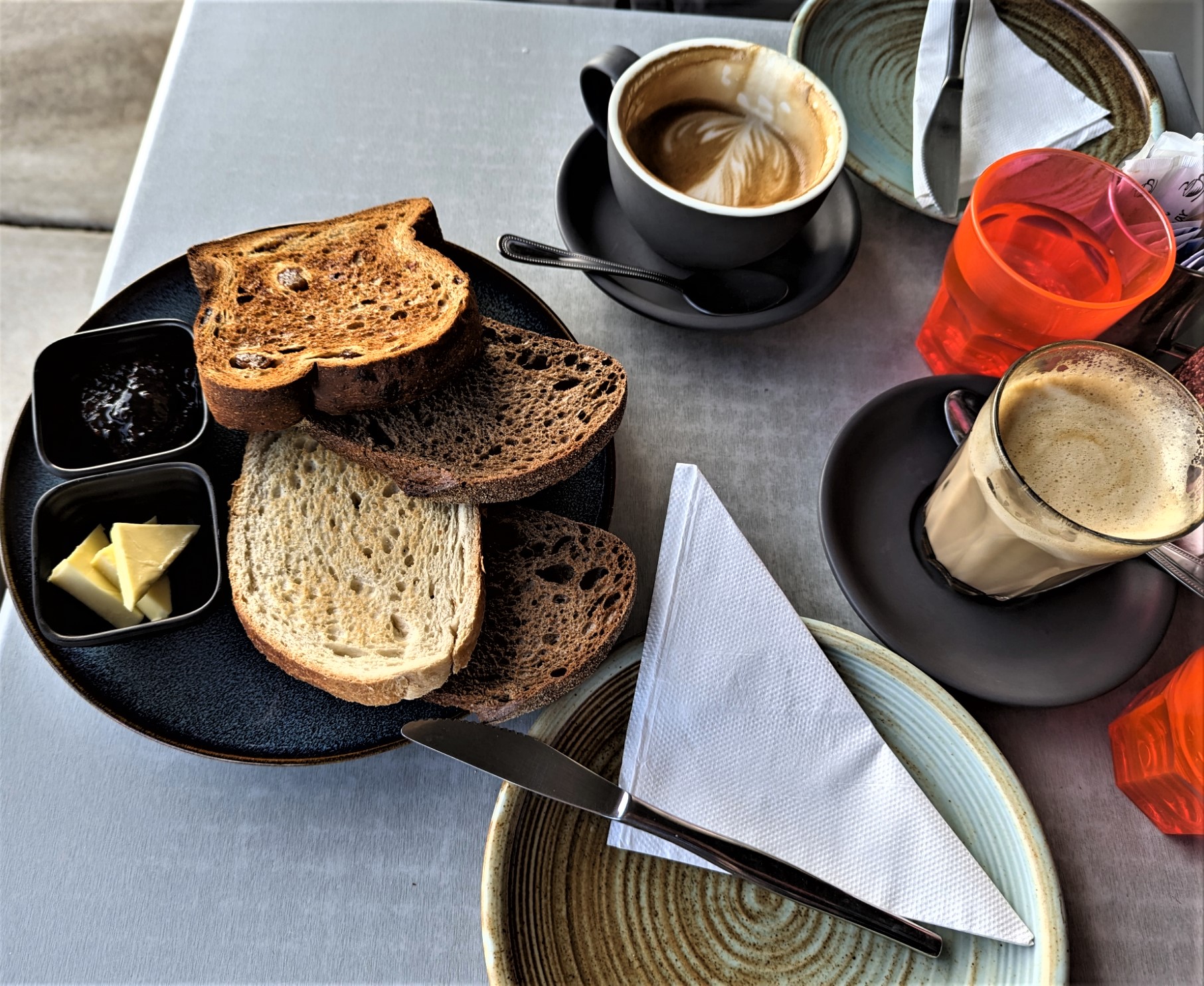
This coffee shop has newly opened in the Jamieson Centre and was a welcome sight when my favourite coffee place was closed. The service was friendly and efficient, and as usual when it includes a water bowl for dogs I was won over before the food arrived. The ‘breadbasket’ was generous, with fruit loaf, rye, and white well toasted offerings. There could have been more butter – but that is a failing with so many places offering toast, I find.

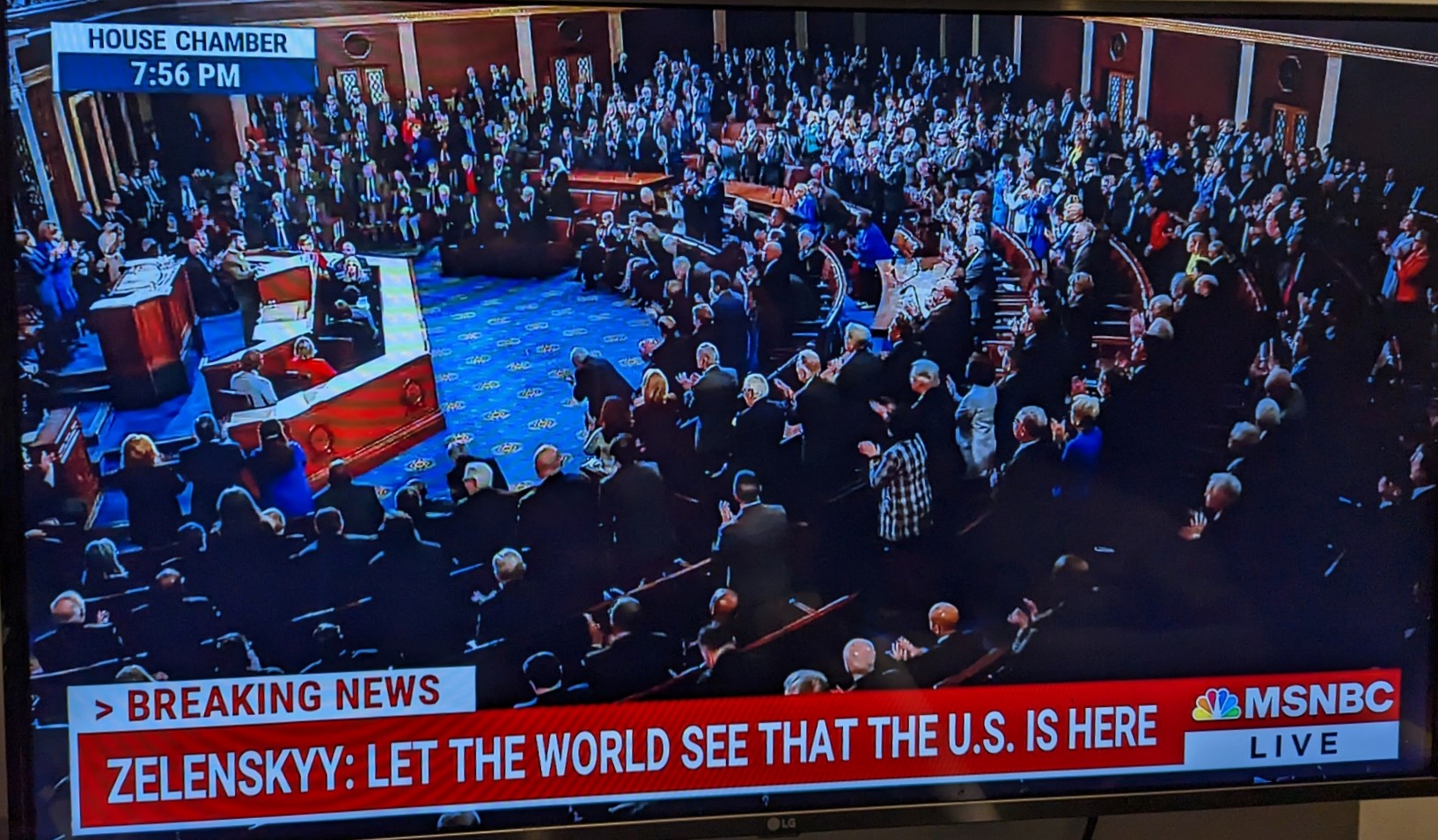
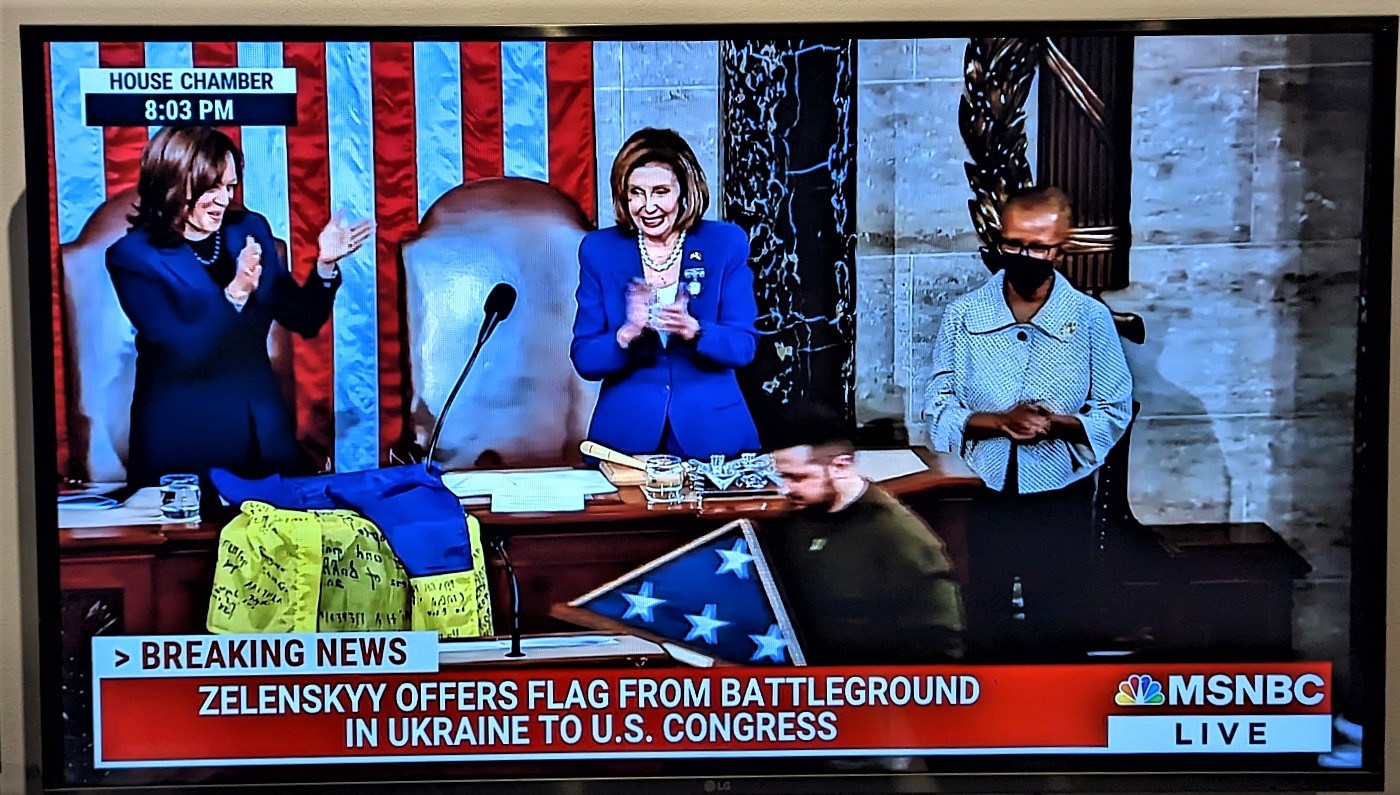
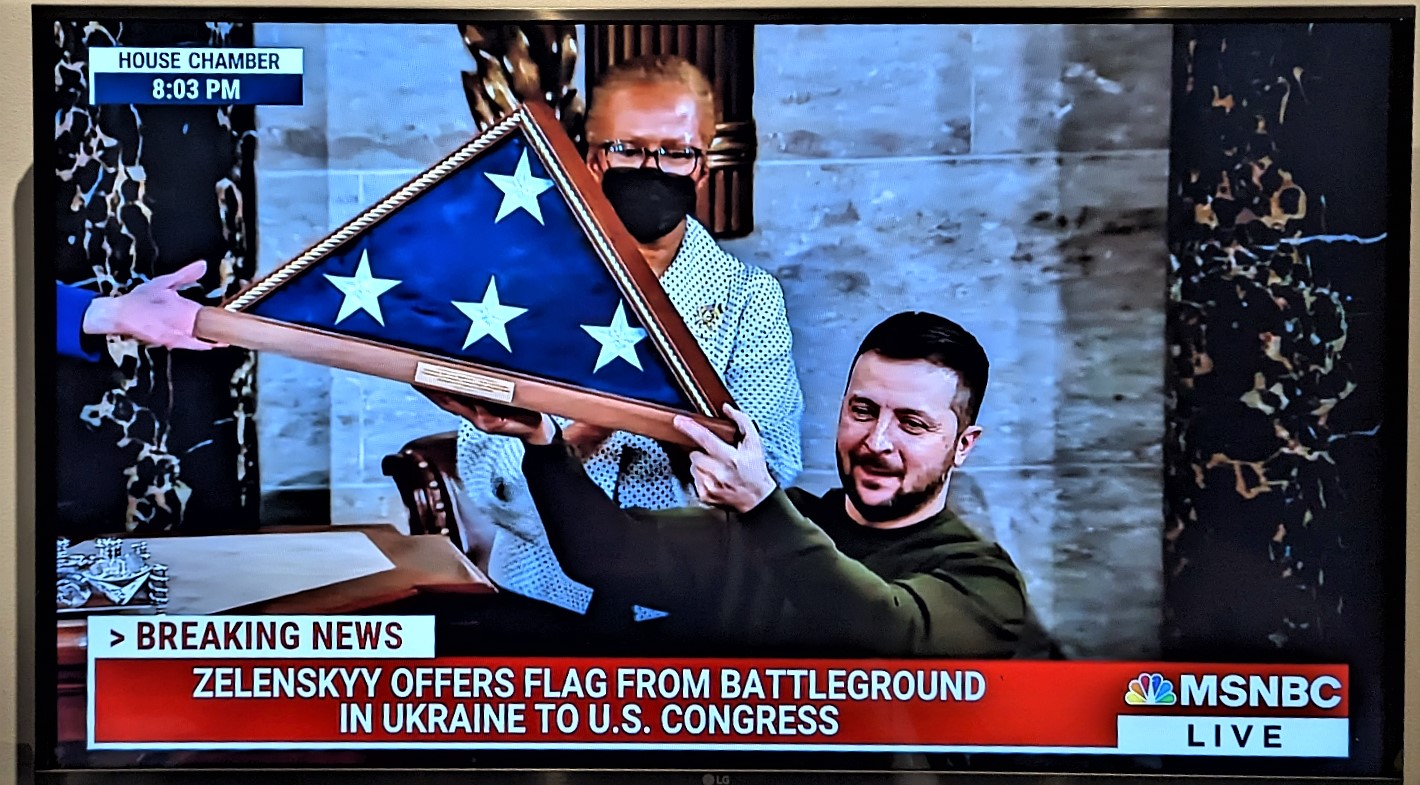
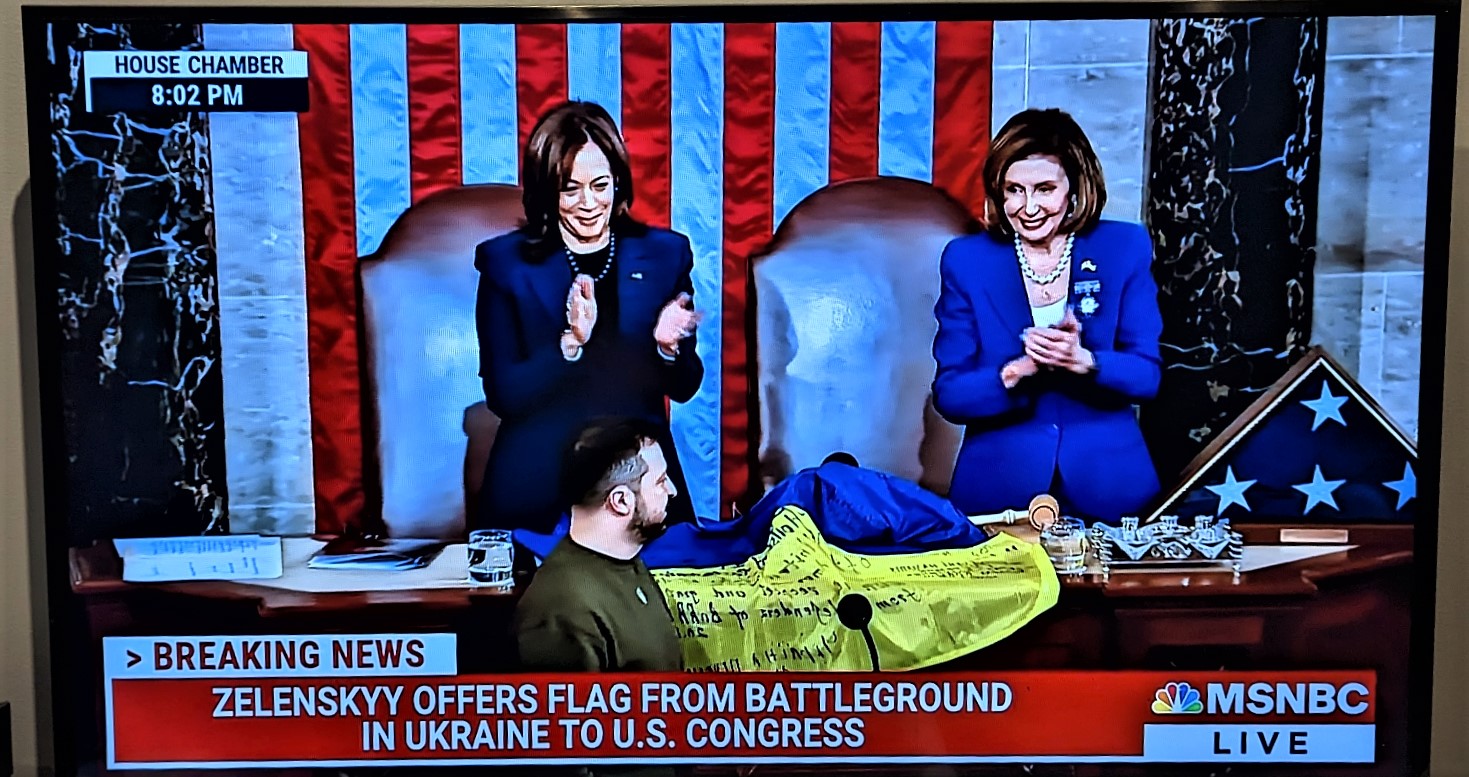
Biden and Zelensky Press Conference and Zelensky Speech to Congress

Week beginning 21 December 2022

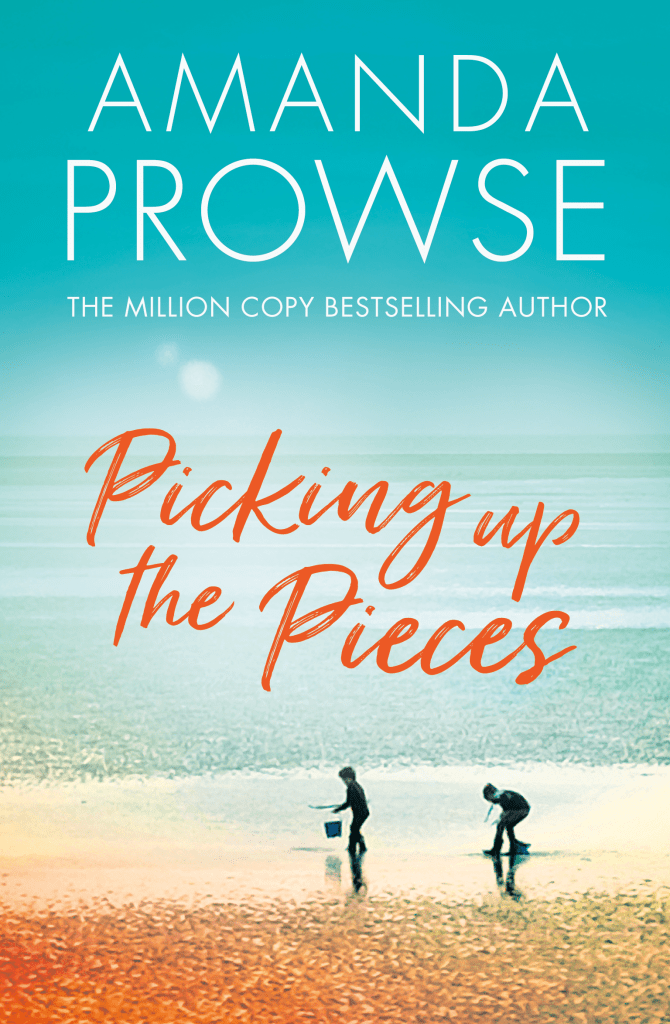
Amanda Prowse Picking up the Pieces Amazon Publishing UK, Lake Union Publishing 2023.

Thank you NetGalley for providing me with this uncorrected proof for review.

Amanda Prowse writes novels that are readable, have some engaging characters, and often include some social commentary. Generally, I am happy to read them, providing as they do a pleasant whiling away of an afternoon or two. However, Picking up the Pieces provides quite a lot more than usual. Every plot line is charged with issues that demand thinking though, each character has something new to say as the narrative progresses, and the satisfying ending is woven so well from what has come before that it provides a genuine outcome for the characters. Rather than being predictable and contrived to achieve a happy ending based on wishful thinking the narrative remains realistic and thoughtful to its conclusion. Books: Reviews

There are two articles after the Covid in Canberra report. Bob McMullan writes about the Greens’ performance in the recent Victorian Assembly elections – what was its true character? The biography of Shirley Hazzard reviewed by Gail Jones makes interesting reading in an article from The Conversation.

New Covid cases in Canberra this week number 3,018, with 81 people in hospital. One life was lost.

Bob McMullan

Greens’ performance in the recent Victorian assembly election

It is worthwhile to assess the true character of the performance of the Greens in the recent Victorian Legislative assembly election.

On election night there was too much spin about “greenslides” and failure to acknowledge the extent of the impact of the Liberals’ decision to preference the Greens ahead of Labor.

This is not to say that there were not some definite positives for the Greens about the result. Just that a balanced view would show some strengths and weaknesses and some opportunities and challenges going forward.

Overall, the Greens achieved a modest 0.8% swing towards them across the 88 Assembly seats. This is not great, but better than any of the other major parties, and in an election where minor parties and Independents were eating into the vote of all three major parties in the metropolitan area this was a solid if unspectacular result.

The 11.5% which the Greens received in the Legislative Assembly election is not as good as the 13.7% they received in the recent federal election. This should not be a cause for great concern, but the party leadership should critically analyse the reasons for the decline.

When looked at on a seat-by-seat basis the results are definitely mixed. In some seats they obviously did very well, in others their relatively poor performance was disguised by the flow of Liberal Party preferences.

Two seats which the Greens already held showed really strong performances. In Brunswick, the sitting member received more than 43% of the primary vote and with minor party preferences would have won comfortably irrespective of Liberal Party preferences. In Prahran, the contest between the three major parties is always interesting, but on this occasion the Green candidate led clearly on the primary vote and the Labor candidate came third, so the Green incumbent won decisively.

It is hard to see how the Labor Party could threaten these two seats so long as the party is in power unless some extraordinary local or candidate factors intervene.

However, the outcome in the other seats which the Greens appeared to target is more complex.

In Melbourne, a seat which the Greens retained with a significant majority, the margin is almost entirely due to Liberal preferences. If the Liberals had preferenced Labor, as they are likely to do next time, the result would have been on a knife edge, with a serious risk the Greens could have lost the seat.

The seat the Greens gained from Labor, Richmond, is a similar story. The Greens polled 34.7% while the ALP polled 32.8%. If the Liberals had directed their preferences to Labor, the majority of their 18.8% would have flowed accordingly, resulting in a clear Labor win.

The new incumbent in Richmond may establish her position in a manner similar to Brunswick, or they may face a distinct challenge, as is likely to also confront the member for Melbourne.

It is hard to believe that the Liberals will follow the same strategy as last election with their preferences. If they do not both these Green-held seats will be at risk.

In all the other seats under consideration as Green targets in 2022, the Greens were only competitive on the basis of the Liberal Party’s preference decision. In Footscray, Pascoe Vale, and Preston the Labor Party two-party preferred vote would have been over 60% if the Labor candidates had received Liberal Party preferences. In Albert Park, the new candidate won with more than 60% of the two-party-preferred vote and the Green candidate received only 20% of the primary vote.

It is possible that the Liberal party will direct preferences to the Greens again in 2026. It is too far away to predict confidently. However, if their strategy is aimed at winning the middle-ground I would expect them to preference Labor. If they do then only two Greens seats are likely to be safe, two will be likely to face a strong challenge and all their other targets seem out of reach.

This article was first published in Pearls and Irritations.

The Conversation

Shirley Hazzard Biography

Article republished under Creative Commons licence.

From dysfunction and provincialism to an elegant literary life: Gail Jones reviews the ‘brilliant’ first biography of Shirley Hazzard

Professor, Writing and Society Research Centre, Western Sydney UniversityProfileArticlesActivity

Gail Jones is Professor of Writing at Western Sydney University and author of two books of short stories and eight novels, the. most recent of which is Our Shadows (Text 2020) She has lived and worked in India, Italy, China, USA, France and Germany and her works have been widely translated.

Published: December 14, 2022 6.02am AEDT

When Shirley Hazzard received the National Book Award in 2003 for The Great Fire in the Marriot Ballroom in Times Square, the other guest of honour was Stephen King, who was there to receive a Medal for Distinguished Contribution to American Letters. The contrast of acclamations and models of value could not have been more profound. King took the opportunity to speak of popularity and populism as the marks of literary success; Hazzard feistily defended reading across time, the nuanced experiences literature affords, and the private and complex pleasures that are irreducible to sales, fame or notoriety.


Shirley Hazzard: A Writing Life – Brigitta Olubas (Hachette).


Hazzard’s stance serves as an exemplar of literary integrity. Her life itself defends the right to be unfashionable, the value of learning and heterodox opinion, and the wish to preserve, in the space of the “literary”, erudition, complexity, and what might be called the private mystery of any reading encounter.

As the opening of an extraordinarily rich and detailed biography, the anecdote also signals a kind of structural intelligence in the construction of a life story: the biographer working, as a novelist might, to recognise those odd moments in which the self shows its plenitude. This story begins with the centrality of symbolic others to the construction of “character” and the social moments in which personal value is called upon bravely to declare itself.

Brigitta Olubas’s Shirley Hazzard: A Writing Life is a brilliant achievement. In her fastidiously detailed account, Olubas exceeds “mere” detail for an aesthetic which honours time’s rearrangement through obsession, projection and a livelier narrative understanding.

Her style reads at times like a Hazzard echo. There are moments in which the syntax and cadence, in particular, are so like that of her subject that Olubas is asserting another biographical dimension: amplification through the elective affinity of style. This is particularly the case in the novel’s closing chapter, an affecting elegy crafted beautifully in the silence of memorialisation.


Discord and sorrow

Born in Sydney in 1931, Shirley Hazzard was a willing and relieved exile from the age of 16, but she was also dogged by both the opportunity and the misery of her putative Australianness.

In part, this was because her early family life was one of discord and dysfunction. Her father was a philandering alcoholic, her mother “manic depressive”, and her nation provincialissimo (to use her own description from an interview with Paris Review in 2005). Her only sibling, sister Valerie, was radically estranged. The shared circumstance of an unhappy childhood did not overcome their opposing temperaments, nor Hazzard’s powerful need to renounce her disappointing family.

Without judgment, Olubas tracks the ghastly business of a lifetime of family sorrow through a massive archive of saved letters and diary fragments. Hazzard’s dealings with her “troublesome” mother are compounded, self-protective, and at times cruelly dismissive. At one stage, her mother’s care was entirely in the hands of Elizabeth Harrower, a fellow novelist, who took on the role with a selfless love of which Hazzard seemed incapable. Olubas retains throughout a poise of devotion to the complications and contradictions of her subject, and to what must have been Hazzard’s vexed, if repressed, knowledge of failure in her filial role.

In 1947, Hazzard’s father Rex took a job in Hong Kong, journeying with his family by way of Kure in Japan. A single brief tour by army jeep of Hiroshima, then a fixated attachment to Alexis Vedeniapine, a 32-year-old British army officer in Hong Kong, provided Hazzard with an image repertoire and an arc of longing and that would last until her death in 2016.

Vedeniapine was a Russian raised in Shanghai, who longed for his mother and sister. After traumatic wartime experiences and his own dislocations, he wanted to be a farmer and cultivate his own garden. He left for rural England; Hazzard’s family returned temporarily to Australia, after Valerie contracted tuberculosis. Still a teenager, Hazzard gave herself over to an inner drama of romantic torment, which she replayed throughout her life. The excruciating abjection of the future novelist makes for difficult reading. She pleads, accuses, displays her own misery in histrionic appeals.

Though affianced, a marriage does not eventuate. “Alec” maintains his distance and Hazzard repeatedly cancels her promised journey to join him. She moves instead to New York, where she works in a secretarial role at the United Nations, and then, in an existential coup de foudre, to Naples for a year’s commission in an office whose purpose was to supply UN peacekeeping forces in the Suez.

At 25, Hazzard feels at last an adult. In her view of Vesuvius, the Bay of Naples and post-war Neapolitan ruins, she discovers an emotional objective-correlative and a confirmation that grandeur, even ruined, is found in modes of life that contest, rather than confirm, the conventions of her origin nation (or indeed, of any nation).

Olubas’s detailed account of the early rhapsody of Italy, its challenge, its recalibration, its enticing high-cultural poetry and layered antiquity, establishes how attachments to place ground the literary imagination, and how the attention demanded by other places might generate stylistic innovation. The sections on Italy are among the best in the book.

Olubas’s readings of Hazzard’s Italian novels, The Evening of the Holiday (1966) and The Bay of Noon (1970), also move deftly to consider how literary knowledge is continuous with located sensibility, and how intricately personalised such knowledge might be. For readers who may have disregarded the early novellas as practice pieces or, worse, affectations of a yet-to-be-realised novelistic skill, Olubas establishes their delicacy, insight, and fit-for-purpose completion. Each of these small texts is preoccupied with time and the role of art in transfiguring the shreds of a life.

A rich intellectual companionship

At the same time, Olubas is aware of iterations and reiterations. The pattern of torment, distance, and falling for older, inaccessible (often married) men culminated in 1963, when Hazzard met Francis Steegmuller at a party in New York hosted by her friend Muriel Spark.

Steegmuller was 25 years her senior, depressive, grieving, a wealthy widower and art collector, who very likely preferred men. A literary éminence grise in New York, he had already authored 14 books, including acclaimed biographies of Flaubert and Maupassant. He was a prodigious critic, translator and scholarly Francophile. The highly-strung and immensely gifted Hazzard, still largely unpublished, met in this man the prospect of an elegant literary life. When they married, after her entreaties and his initial vacillation and resistance, they established, over time, a rich intellectual companionship. An entire world of connections and friendships was opened by Steegmuller’s reputation and Hazzard’s social energies.

This meant almost constant travel, shuttling between Manhattan and Europe, especially Italy and France, and enjoying a writing life that did not have the burden of needing to work for an income. Steegmuller owned a gold-coloured Rolls Royce, which he garaged in Switzerland, and employed loyal Italian drivers to take the couple as required to various destinations, especially Capri.

Penguin Group/AAP

The marriage offered, in short, conditions that enabled Hazzard to flourish as a writer. Even towards the end of Steegmuller’s life (he died at 88 in 1994), they were travelling three to four times a year between New York and Capri, staying in luxurious hotels, taking their meals in restaurants, living in a manner unknown to all but a privileged few. Their circle of close friends included a who’s who of the New York scene, as well as European connections that consolidated and affirmed their literary lives. Most touching among these, perhaps, was the link with Bill Maxwell, the distinguished editor, whose eloquent and fond letters of support for Hazzard and her writing are quoted throughout the book.

Hazzard was also emboldened to criticise her former employer, the UN. She played a role in exposing the Nazi affiliations of Secretary-General Waldheim and the demoralisation of its staff after the Secretariat removed its support for an Amnesty International conference on torture. The title of one of her essays, The Patron Saint of the UN is Pontius Pilate, makes clear her tough critique. She was not an apolitical aesthete, as her critics like to suppose, but someone engaged in civic prosecution, conscientious and difficult, on an international scale.


The major novels

Hazzard is most cherished for the distinctive achievement of her two major novels, The Transit of Venus (1980) and The Great Fire (2003). The Transit of Venus won the National Book Critics Circle Award in the United States and instant fame for its author.

Two adult Australian sisters, Caroline (Caro) and Grace Bell, arrive in England burdened with a vicious and maddening guardian, Dora, whom Hazzard memorably stated was a version of her mother: “a destroyer who sees herself as a perpetual victim”. The novel follows both sisters, but concentrates on Caro and the theme of doomed love.

Declaring The Transit of Venus “undeniably a masterpiece”, Olubas then uses the word melodrama (or melodramatic), five times in the next two paragraphs. Hazzard’s allegiance to a register and a set of devices generally regarded as counter to high-literary fiction has been the casual weapon of the novel’s critics. Yet there is a wonderful argument here about how such devices, like prolepsis, might serve a moral project.

Olubas considers the narrative acts by which chance and fatedness are taken seriously as components of love, and the apparent paradox of a flexible, alert and often astonishing style in tension with a “drama” of structural concealments and misrecognitions. The text’s verbal wit and affective power work with what she calls “dramatic reversals and contradictions, themselves generated by ignorance, the costs of not knowing”.

This is scrupulous even-handedness. It yields a cleverly compressed and original reading of what a lesser critic might take as aesthetic error. Olubas’s scholarship is marked by her willingness to concede and assiduously contextualise the range of criticisms the novel received. She draws attention to the bewilderment of Australian critics: their apparent anxiety that ornate style and transnational themes might have a role in Australian literature, that our revered plain-speaking and nationalist provincialism might be somehow under threat from expatriate intelligence and forensic skill.

The Great Fire was also widely celebrated, even as it was initially regarded with suspicion in Australia. The story of Helen Driscoll, a 16-year-old-girl, falling for Leith, a 32-year-old war hero and son of a much-acclaimed writer, it recapitulates Hazzard’s own story, but in an elevated tone and with a redemptive conclusion.

Just as Caro, the heroine of The Transit of Venus, is relieved of her loneliness and secretarial penury by a millionaire Manhattanite, so in The Great Fire there is a powerful drive to avow that romance is the paradigmatic meaning within plot, and that exceptional women, like Hazzard herself, will find justification for their existence in love. This is always a form of romantic love; families, children, animals and places (with the exception of Italy) figure less in Hazzard’s reckoning.

But there is another element here: literature itself as a love-object and a means to further romance. It might be argued that the difficulty of The Great Fire is not its implausibly idealised romance, but the relegation of historical suffering to a Turneresque backdrop. Olubas implies that the Hong Kong section of the novel, with its anguished but particularised colonial impediments, is more impressive than the vague sighs and hand touching of the Hiroshima section.

With both novels, Olubas traces how memories of an Australian childhood operate at the level of trope and obsession. Hazzard sees the long prospect (even within a single life) as the basis of epic ambition and understanding – not nostalgia, exactly, but a backwards view that requires artistic reconstruction and reparation.

One of the most fascinating aspects of this immersive biography is the way it attends to Hazzard’s literary constitution: her love of Auden and Hardy, her reverence for Leopardi and Virgil (it was no accident that she lived close to the tombs of both in Italy), her ability to charm others by recitation and the ornamentation of a shared moment with a bon mot or a line of verse.

Proud of her recitations, a voluble speaker (“not a listener”, as one friend complained), Hazzard had classicist and in some ways anachronistic tastes. She disdained the contemporary for the canonical reassurance of Byron, Pope and Flaubert. She read The Odyssey and Shakespeare aloud to Steegmuller as his life waned. Such details lend private dignity and tenderness to a marriage so much in the social whirl. When Hazzard describes her husband’s fall on an escalator in terms of the abyss facing Hector before his encounter with Achilles, there is a sense of how this scale of reference ennobles and fortifies her deepest feelings.

In The Transit of Venus, when Caro sees New York skyscrapers obstructing the sun “as the mountains of the Taygetus bring early dark down to Sparta”, her reference recalls what Hazzard considered the “timeless” scale of literary sensibility. This is an idiosyncratic classicism, internalised as a refutation of the shabby modernity of the everyday. It is also one deserving of respect and due regard to the demands a very singular and exceptionally talented writer. In this task, Olubas’s biography pays worthy tribute.

    Week beginning 14 December 2022

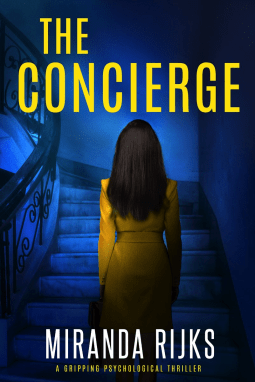
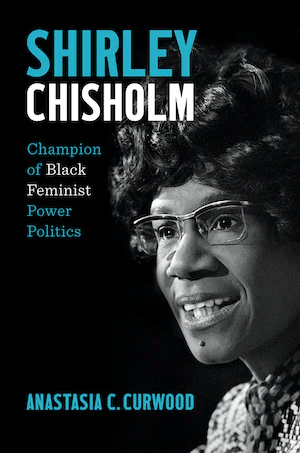
    This week I review two uncorrected proofs sent to me by NetGalley, one fiction (The Concierge) and the other non-fiction (Shirley Chisholm Champion of Black Feminist Power Politics).

    Miranda Rijks The Concierge Inkubator Books Dec 2022 

    The pace of the story overcomes the implausibility of some of the earlier plotting which is quite absorbing. Ally, an aspiring actress, is killed in a car crash, leaving behind her grieving husband, four-year-old daughter and older sister, Simone. The sisters’ parents are dead, and Simone has taken much of the responsibility for Ally; she now feels that she must do the same for her niece. However, uppermost in her mind are questions about her sister’s death: why was she in her employer’s car? Why did the autopsy reveal that Ally had taken drugs? Are her employers, the film producer and director, Goldie and Braun Delucci, implicated in Ally’s death? Books: Reviews

    Anastasia C. Curwood Shirley Chisholm Champion of Black Feminist Power Politics University of North Carolina Press  Jan 2023

    Anastasia C. Curwood’s biography of Shirley Chisholm is extremely dense.  It is replete with immense background detail of the American context, the performance and intricacies of the Democratic Party, and gives similarly detailed attention to the way in which Black political movements impinged on Chisholm’s life, political and personal behaviour, and contribution to American, Democratic Party and Black movement politics. This comprehensive attention to the wider context has its positive features. However, it also presents a challenge to presenting a personable and accessible biography of a woman of such enormous significance in personal as well as political terms.  

    Is it worth the endeavour to find Shirley Chisholm? Or is the wealth of contextual material essential to understanding the woman, the times and the politics? I think that the answer to these are questions is probably different depending on the reader, and important to consider when approaching this biography. I found that I needed to intersperse reading this biography with other reading, but found this approach gave me the impetus to really come to grips with the way in which general detail seemed at times to overcome the Shirley Chisholm’s story. Books: Reviews

    New Covid cases this week number 2,610. Firty eight people with Covid are in hospital and 3 are in ICU. Five lives were lost, bringing the total since March 2022 to 135. Some restaurant staff are still wearing masks, and some social distancing between tables remains. However, this is not the dominant feature in the hospitality industry. Also, as masks are no longer mandatory on public transport very few people are wearing them.

    Alan Kohler: Why the Voice is an economic as well as moral issue. The New Daily.

    Indigenous Voice

    Some of the most egregious inequality in the world exists within Australia, writes Alan Kohler.

    OPINION Alan Kohler

    The first attempt at an Indigenous voice to Parliament was in 1934 – the Australian Aborigines League unsuccessfully petitioned King George V, with 1814 signatures, for the ‘Representation of Aboriginal people in Federal Parliament’. No dice.

    Four years earlier, in 1930, John Maynard Keynes published an essay in which he forecast that in 100 years from then we’d all be rich and working three days a week, wondering what to do with ourselves.
    But in October, Australia’s 13.6 million employed people worked an average of 4.6 days a week, including part-timers.

    What happened? How did Keynes get that forecast of plenty so wrong? After all, he was talking about 2 per cent average economic growth a year, and we’ve actually averaged 3.4 per cent.

    The great economist didn’t account for distribution. The assumption that wealth and leisure would be evenly spread was wildly wrong.

    As Thomas Piketty showed in Capital in the 21st Century, income inequality actually did decline for a while – mainly as a result of Keynes’ own ideas.

    But after 1980, when his ideas were abandoned in favour of neoliberalism, inequality went back to where it had been pre-Keynes.

    I think it is no coincidence that it took 50 years after the Great Depression for that to happen, because that’s how long it took for those who were adults and late teenagers in 1930 to die, and stop running the world.

    The political elites of the 1980s had no direct memory of the Depression, or FDR’s New Deal for that matter, and did not have JM Keynes providing the dominant intellectual framework for economics, so when the voices of the rich insisted that taxes should be cut, they were.

    Note that word – Voice.

    Some of the most egregious inequality in the world exists within Australia, between the descendants of those who were here first and those who started arriving from England in 1788.

    Now, 234 years later, the average income of Aboriginal households is $1200 per week and for everybody else it’s $2329 – almost twice as much.

    The reasons for this disparity are complex and challenging, and it would be wrong to put it down simply to a difference in the loudness of voice.

    But as the Uluru Statement from the Heart put it: “(The) dimensions of our crisis tell plainly the structural nature of our problem. This is the torment of our powerlessness.”

    The torment of their powerlessness.

    National Party leader David Littleproud says a constitutional voice to Parliament “won’t shift the dial in closing the gap”, but that’s both wrong and misses the point.

    It’s no wonder Indigenous Australians are silent and powerless: They weren’t entitled to enrol to vote until 1962, weren’t counted until the referendum of 1967, weren’t subject to compulsory voting like the rest of us until 1983 and to cap it off, the idea of terra nullius – that Australia had been “nobody’s land” – persisted until Mabo in 1992.

    It is not just the English invasion in 1788 that the First Nation’s Voice to Parliament is needed to balance, but the habit of not giving the original Australians whose land it was any kind of voice at all for the subsequent 200 years.

    It is fundamentally a moral question and a symbol of recognition, but it is also economic and political.

    The politics were nicely expressed by Noel Pearson in his first Boyer lecture this year: “A large part of the conflagration in these past 50 years since racism became unacceptable in the 1960s, is the fight between progressive and conservative Australians over race and Aboriginal people. Aboriginal people are the subjects of this fight, but they are not its prime protagonists.”

    Australia’s Aboriginal problem, he said, is about white Australians in a cultural and political struggle with other white Australians. The National Party’s decision to oppose the Voice to Parliament is a manifestation of that.

    The economics are a festering sore at Australia’s heart – unacceptable disadvantage and poverty in a rich country.

    Mr Pearson’s point is that the lack of recognition was vital for the original takeover of the land and dispossession of its inhabitants, and that “the Australian colonial project needed this denial and was underpinned by its vehemence until well after the frontiers fell silent”.

    And as discussed, the lack of recognition, the lack of a voice, didn’t end there – it became a careless habit that has manifested in grotesque economic inequality.

    The Voice to Parliament just might raise the volume of the voices of the dispossessed sufficiently to start to counter the louder voices of those whose household income is twice theirs and whose long habit has been to disregard that fact, and them.

    As Noel Pearson said: “We are a much unloved people. We are perhaps the ethnic group Australians feel least connected to. We are not popular and we are not personally known to many Australians.”

    In the past decade or so that lack of connection has started to shift at ground level as a result of the Acknowledgement of Country becoming a new habit at the start of events, often along with a Welcome to Country from a local elder.

    This has been a wonderful, spontaneous development that has begun to subvert the white-on-white culture war that Noel Pearson spoke about.

    But there are still plenty of conservative extremists who won’t have a bar of that either. For example, Pauline Hanson stormed out of the Senate in July during the Acknowledgement of Country, saying words to the effect that Australia belongs as much to her as to the Indigenous community.

    And that’s precisely the point.

    Alan Kohler writes twice a week for The New Daily. He is also founder of Eureka Report and finance presenter on ABC news.

    Cindy Lou visits two more old favourites – The Italian Place and Blackfire

    The Italian Place

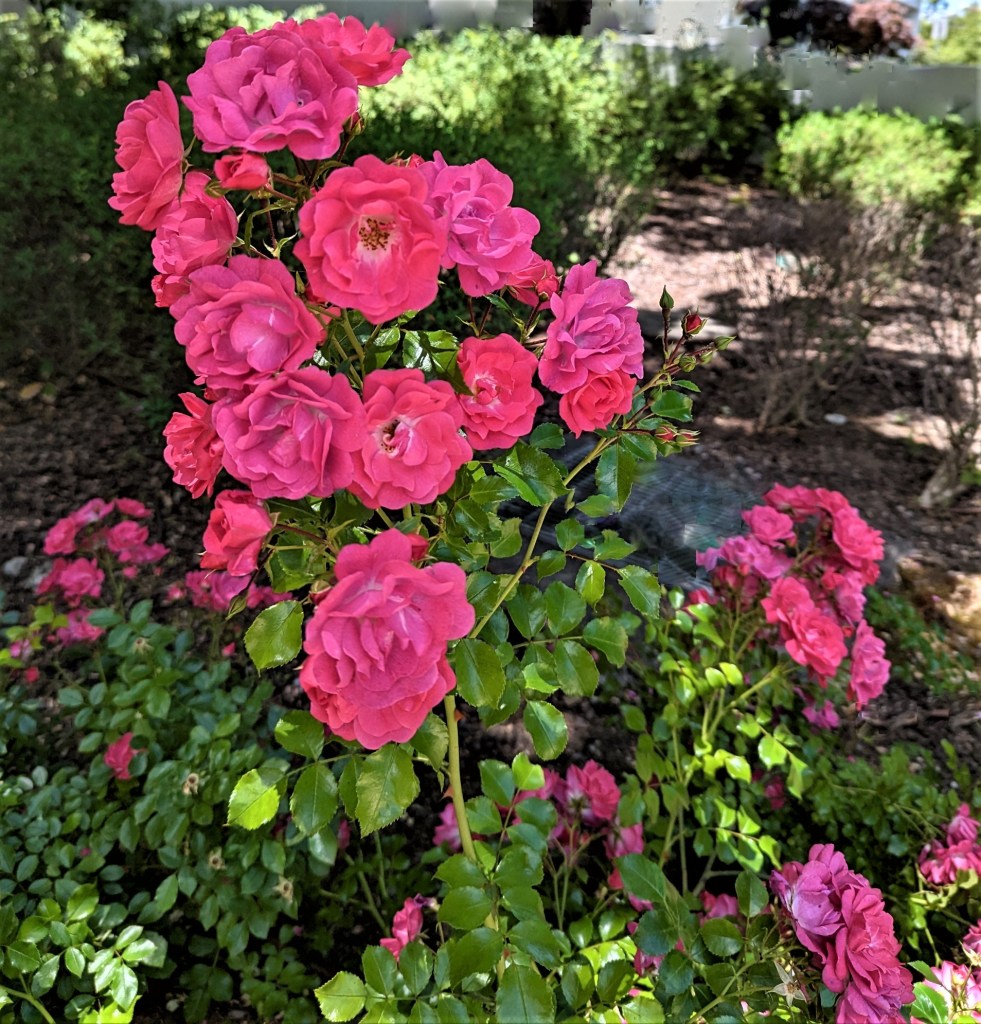
    My friend brought me this beautiful rose from her garden. Although it was far more attractive – after all, this one had a perfume – it reminded me of my meal in London at another Italian restaurant. Another reminder was the mixture of positive and less positive features of both. The Italian Place has an excellent outside area, which we enjoyed on this occasion. The main waitperson was lovely – informative and friendly. Another found it hard to read the specials in a voice loud enough for us all to hear – possibly she was new.

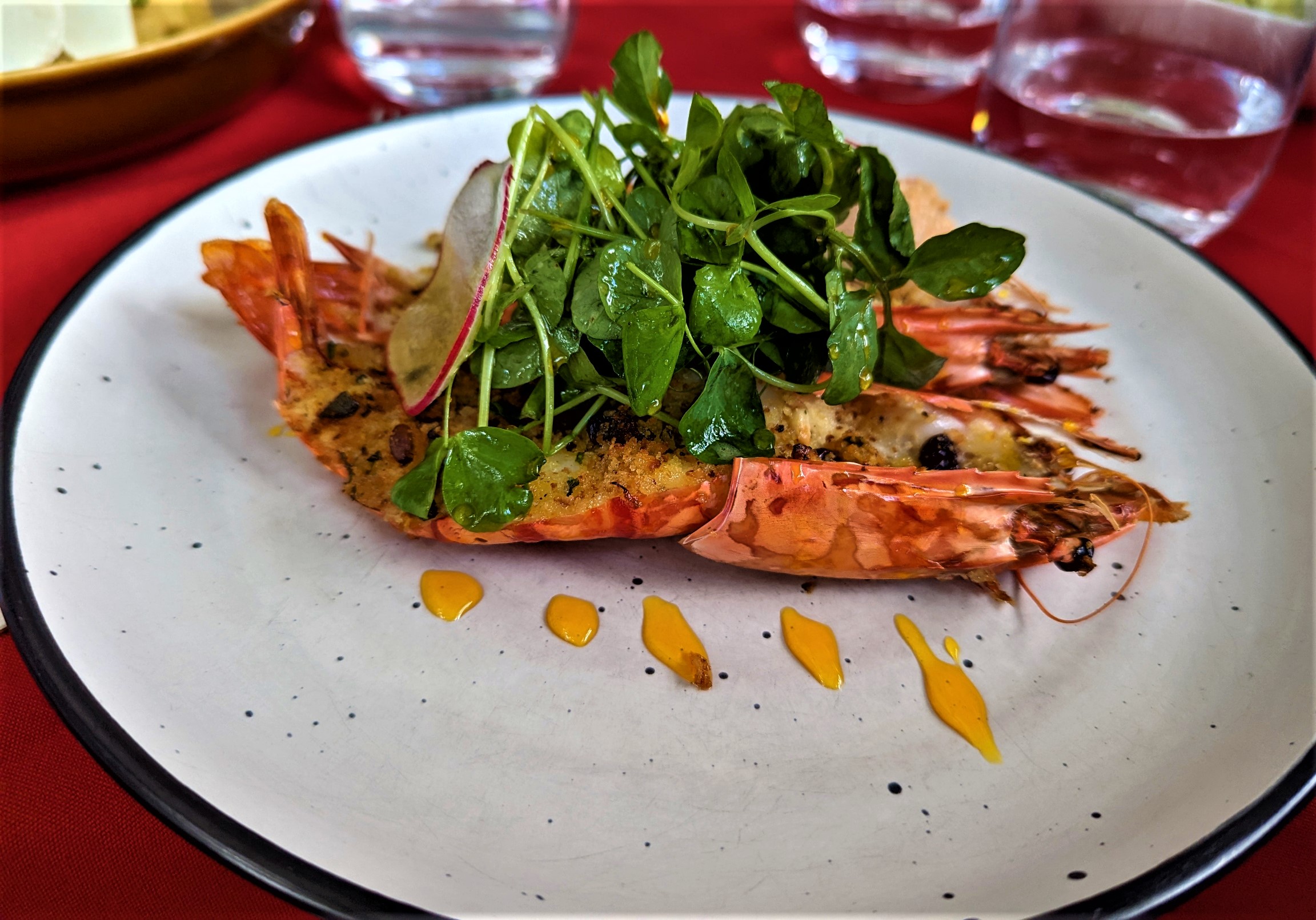
    The food was a mixed pleasure. It is always nice to be served warm rolls and oil, and this is a pleasant feature of The Italian Place. I enjoyed my prawns, although I found them a little over cooked. One friend found the pasta dish with sausage was flavoursome, although the sausage was hard to find at first – it is generously smothered with a delicious sauce. The octopus was good, but the salad underneath disappointing for another friend. The stuffed zucchini flowers needed to be far better. The nectarine salad was excellent, although unfortunately I do not have a photo of it – perhaps we all leapt to demolish it before I remembered to take the photo! Coffee was very good indeed.

    Black Fire

    I went to Black Fire twice this week, for Sunday lunch, and then to an early dinner on Wednesday. Sunday lunch was excellent, although not worth my taking photos, two of us had our regular crab stuffed bell peppers and then the delicious prawn dish, and the another had a pasta dish familiar from my previous reviews. The marvelous seafood combination of prawns, mussels, fish and scallops in a generous sauce deserved to be photographed, and I shall do that next time if I can resist my regulars.

    On the second occasion there was a little more variety. Everyone enjoyed their meals without reservation, and the complimentary sherries at the end were a lovely touch. The coffee was good, the mint tea served elegantly, and the chef’s taste of four desserts (we had one between two people) were a delicious and light end to an excellent meal. The halloumi salad, lamb croquettes and pork dishes were new to us and appear with the familiar stuffed peppers below. Another excellent tapas is the semolina rolls, not pictured this time.

    Rye Cafe

    I also tried a new cafe, with very good results. The service was efficient and pleasant, the meals generous and delicious, and the coffee really good.

    Duxton

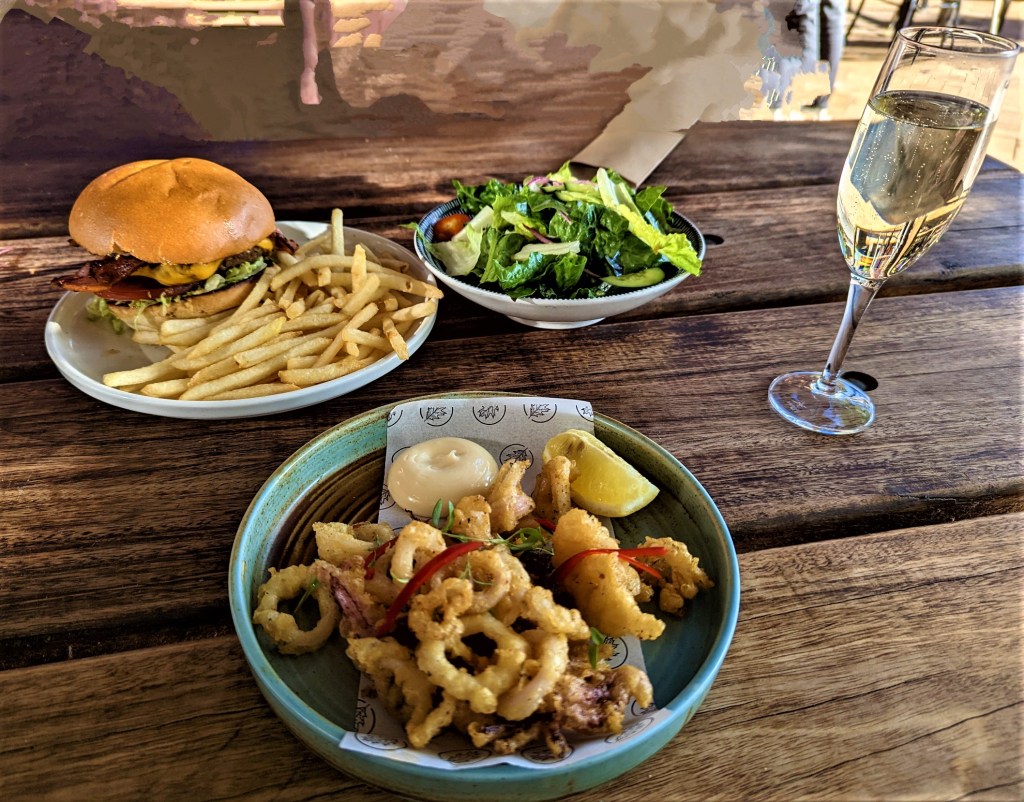
    The Duxton serves a variety of meals, and I have found that I prefer the snacks to the main courses. The Calamari is succulent, lightly battered, and not a smidgin of old tyre about it! The dish is reasonably generous, served with a portion of lemon, and aioli. The green salad I ordered with it, is resplendent with crisp lettuce, cucumber, tomatoes and thinly sliced red opinion with a very light dressing. The cheeseburger enjoyed by my companion is served with chips and is generous with plenty of salad. There is also a large portion of bacon, some of which went under the table for the dog. With a Sav. Blanc for one, and prosecco for the other, this was an enjoyable light meal on a warm Saturday evening in Canberra.

    An elegant finish to this meal was enjoyed at home with part of a birthday gift. The wine, another gift, will be opened on another occasion.

    Bold and Brilliant!

    Zoom Meeting Hosted by Dr Jocelynne Scutt

    Each month Jocelynne Scutt hosts a meeting for participants who want to talk about feminist issues and listen to some engrossing talks by women.

    On Sunday 11th December the speaker was Cynthia Umezulike, a lawyer and former fashion prize winner who established a fashion institute. She was a speaker at the Women’s Parliament held in Cambridge recently. She spoke eloquently about maneuvering the patriarchy. The discussion was lively with everyone contributing. Important in the enthusiasm to participate was the question that Cynthia is constantly asked – why the shallowness of fashion when she is a lawyer? Discussion arising from that talk ventured into the area of women wearing make-up and what it means, then on to the wearing of the burqa and hijab. What is the role of the patriarchy? Women refusing to be dictated to – so wear them – and don’t wear them, also on this basis.

    Participants introduced themselves with reference to the work that they are doing. Kath Mazzella’s discussion on Gynecological Health and the importance of using the correct language is particularly important, and well worth listening to on the video.

    I was able to refer to one of my favourite writers, Barbara Pym, who wore red lipstick at Oxford and was thrilled at the resulting horror of her tutors. She then wrote the wearing of a bright lipstick into a novel, Excellent Women, to convey the independence of Mildred Lathbury who bought Hawaiian Fire lipstick with thorough satisfaction!

    A recording of the zoom meeting is available on Facebook.

    Week Beginning 7 December 2022

    This week’s review is Barbara Kingsolver Demon Copperhead Faber and Faber 2022.

    Barbara Kingsolver has been one of my favourite authors since reading The Poisonwood Bible. However, this has not been consistent – some of her books I have really enjoyed; others I have admired; and yet others have disappointed. I came to Demon Copperhead with this history so was prepared for any of my three reactions. I am left wondering, perhaps the most honest I can be is that my reaction is a mixture of the three.

    The story is a poignant opening up of the life led by a person born into neglect and poverty, where love is often misunderstood, or not even recognised, leading to confusion, intemperate behaviour and drug dependence. While understanding Demon Copperhead’s reasons for his behaviour the reader is also given the imprimatur to sympathise with those he in turn abuses. At the same time, there is no forgiveness expected for a social welfare system that utterly fails this young person in need. Books: Reviews

    After Covid Report: Cindy Lou review; Labor Government end of year sitting passes legislation; Bob McMullan -Should we increase the size of Parliament? Lucy Worsley talks about Agatha Christie; Joanna Joy and Generations of Men (Judith Wright); Tom Watson on Matt Hancock and ‘I’m A Celebrity..’; Gough Whitlam wins for Federal Labor in 1972; Warnock wins again in Georgia runoff.

    New Covid cases this week 2,239 with 33 active cases in hospital. There are no Covid patients in ICU or on Ventilation. One life was lost this week.

    Masks are now only encouraged on public transport, and most people are choosing not to be encouraged. I am.

    Cindy Lou at Eighty Six – again!

    It was lovely to return to Eighty Six after quite a while eating elsewhere – most markedly in Italy, London, Amsterdam, Oxford and Cambridge. Only Mere in London was better, oh, perhaps ZaZa in Amsterdam. But Eighty Six is well worth a visit. It was noisy as usual, but the liveliness and efficiency of the staff and happy fellow diners makes it worthwhile. I do admit that I was pleased to finish before a large table of diners arrived to be seated close to us. Outside looked like an excellent option, and I think I’ll chose that next time.

    All of the dishes were delicious – the charred corn is a scrumptious starter, although a bit messy to eat. But it is worth it. Next, we were served the fried chicken which comes with two sauces- one a pleasant aioli, and the other a sauce with a fiery bite. The cauliflower is a Moroccan dish, and again, an excellent choice. As usual, we had the pumpkin ravioli with burnt butter sage sauce – and as usual, the only pasta better is that served in Bagni di Lucca on my holiday there. No dessert! No coffee! And a relatively brisk (no dog to potter) walk home.

    Labor Government Ends the Year with Important Legislation

    For the last 25 years, Canberrans have been second-class citizens.

    Alicia Payne in the house of Representatives introduced a bill (co-sponsored by NT colleague Luke Gosling) to end discriminatory laws in relation to assisted dying.

    After 25 years, the discriminatory laws which prohibited the ACT and NT from legislating on voluntary assisted dying are now a thing of the past.

    In past parliaments, debate on this issue was not even allowed in the lower house, making this important reform impossible. 
     
    Due to the support of the new Labor Government and Prime Minister Albanese, that reality has changed. 
     
    Today, Canberrans are no longer discriminated against because of their postcode. 
     
    After a long fight, we’ve finally got it done as it has now passed in the Senate.
     

    The Albanese Labor Government made a commitment to Australians that we would get wages moving, and that’s exactly what we’re doing.

    Should we increase the size of the federal parliament?

    Bob McMullan

    I was initially unimpressed by the concerns expressed by members and their staff about the increasing pressure they felt in serving their constituents. After all my staff had coped very well with the current staff numbers for many years up to 2010 when I left the parliament.

    However, an examination of enrolment numbers has changed my mind, although I am not sure that giving current members increased staff is the best solution.

    When the current size of the parliament was established in 1984 the average number of electors per member was 84244. Today that number is 115060! This constitutes an increase of more than a third. This raises concerns for staff, but more importantly it must impact on the ability of members to provide the service which their constituents require and deserve.

    Electronic communications could be seen as making the task of providing services to constituents easier. However, it also makes it easier for constituents to raise issues with their MP. This is on balance a good thing, but it increases the workload on staff who must be feeling the pressure of the ever-increasing volume of constituency work.

    Of course, in a rational world we would gradually increase the numbers in the House of Representatives without any need to change the Senate numbers. However, the Australian Constitution’s so-called nexus clause prevents us from doing this.

    s.24 of the Australian Constitution states that the size of the House “shall be as nearly as practicable twice the number of Senators.”

    An attempt was made in 1967 to change this by a referendum. It had bipartisan support but was defeated by a rump of the parliament campaigning on the bizarre grounds that it would increase the number of members of parliament. Of course, the failure of the referendum has had the reverse effect, each time there is the need to change the composition of the House it has required a very large increase. In 1984 the House increased from 125 to 150 and the Senate from 64 to 76.

    Therefore, if we are going to do something now it will need to be something big. The least we can do is increase the size of the Senate to 14 per state (a total of 84), which with the current Territory Senate representation would mean 88 Senators. Double the number of State Senators would mean 168 House members. With the current Territory representation (5) that means173 members approximately in the House. The exact number may vary by 1 or 2 up or down depending on the statistical analysis and distribution of seats within the states.

    Based on the population distribution between the States at the 2020 census the distribution of seats is likely to be something like this:

    NSW                55

    Vic                   46

    Qld                  35

    WA                  18

    SA                    12

    Tas                   5* (entitlement would actually be three, but constitution guarantees 5)

    The territorial entitlement is likely to remain

    ACT                  3

    NT                    2

    How much would all this cost? It would take more resources than I have available to put together a comprehensive costing. However, if we compare the cost with the cost of providing one extra staff member for every current member or senator it should be comparable. One extra staff member per MP and senator would mean 226 extra staff. The increase in the size of the parliament would mean 35 extra members or senators with extra staff of approximately 140. Extra office costs etc should make the costs roughly comparable.

    I am not raising this question to help MPs but to enable proper service to constituents and ease the pressure on hard working electorate office staff.

    This is one of the two primary obligations of members of the House of Representatives. They have two jobs (unless they become Ministers in which case they gain a third), as legislators and as service providers to their constituents. It is this latter function which tends to be ignored in much of the debate about adequacy of representation.

    The other interesting question is: who benefits politically? Even though I am an unashamed lifelong political partisan I don’t think this is the important question. However, it seems to me that the National Party should benefit, because its declining rural base can be stretched more thinly across their existing area of support. The Greens may benefit because smaller metropolitan seats may reduce the diluting impact of the suburbs on their inner-city base in some cities. The Teal and rural Independents may benefit as they should be able to focus on a slightly smaller and more concentrated area. Between Labor and Liberal, it is impossible to say and unwise to speculate. The changing patterns of support in seats like Bennelong and Tangney make such forecasting meaningless over even the short-run.

    Attempting to determine the preferred size of the parliament on the basis of who will benefit in the short-term is a recipe for failure.

    Voting patterns and demographic trends will overwhelm any perceived short-term advantage. At a time when the safest conservative seats in the country are not held by the conservative parties and the most progressive are often held by someone other than the ALP we should acknowledge that it would not only be wrong to try to determine the size of the parliament in the interests of any perceived partisan advantage, it would almost certainly be counter-productive as well.

    However, the interests of constituents in a time of increasing need for representation suggest that it is time to begin a serious debate about the appropriate size of the Australian parliament.

    First published in the Canberra Times.

    How Agatha Christie used her own experiences to shape her murder mysteries

    ABC RN By Taryn Priadko and Sophie Kesteven for Late Night Live

    Posted Thu 1 Dec 2022 at 5:00amThursday 1 Dec 2022 at 5:00am

    Black and white photo of older woman seated at a desk with a typewriter
    English novelist Agatha Christie wrote the world’s longest running play The Mousetrap.(Getty: Popperfoto)

    Agatha Christie is the bestselling novelist of all time. She is said to have sold more than a billion books in English and a billion internationally. Her books are outsold only by Shakespeare’s plays and the Bible.

    The late author wrote more than 80 books throughout her life, mostly crime novels.

    Now historian, broadcaster and author Lucy Worsley’s new biography of the author, A Very Elusive Woman, considers Christie’s life. In particular, it looks at what it was like to be a female author in the early 20th century. For the complete article see Further Commentary and Articles about Authors and Books*

    Filmmaker Joanna Joy and traditional owners bring to life Judith Wright’s Generations of Men

    ABC Capricornia  / By Inga Stünzner Posted Mon 28 Nov 2022 at 9:01amMonday 28 Nov 2022 at 9:01am, updated Tue 29 Nov 2022 at 9:49amTuesday 29 Nov 2022 at 9:49am

    Play Video. Duration: 5 minutes 26 seconds
    A Judith Wright-inspired film unites a central Queensland community.(ABC Capricornia: Inga Stünzner)

    Help keep family & friends informed by sharing this article

    abc.net.au/news/short-film-inspired-by-judith-wright-generations-of-men/101682802COPY LINKSHARE

    When Joanna Joy was 14 years old, her father handed her a copy of Judith Wright’s book Generations of Men.

    Little did she know it was the beginning of a long journey that would bring a community together.

    The story by Wright, a renowned poet and author, is about her own family’s unsuccessful move into central Queensland in the 1850s.

    Ms Joy initially saw it as a tale of the strength of women and the families they raised during colonial times. See Television and Film: Comments for the whole article

    This is an interesting reflection on politics and politicians by Tom Watson, former Deputy Leader of the British Labour Party from the newsletter I receive from him:

    “Tom Watson’s newsletter on Substack.”


    In praise of Matt Hancock (and why I turned down Celebrity Big Brother)

    As an opponent, Matthew Hancock irritated me more than most. He liked the limelight. He knew he was clever and was eager to show it. I remember the day he shelved the second part of the Leveson inquiry into press ethics – the critical bit that looked at the relationship between the cops and the tabloids. I felt that later in life he would regret the decision. It was my first thought when he was turned over by the Sun, too.

    His slightly naive bumbler image is not fake, though. It’s who he is. For someone who is, well, such a Tory, he is peculiarly endearing. I ended up liking him. He won me over with his work ethic, candour and humour – a bit like how he has just won over millions of viewers of I’m a Celebrity Get Me Out of Here. Fair play to him.

    At the height of the phone hacking scandal, I was offered £140,000 to appear on Celebrity Big Brother. I’ve got George Galloway to thank for turning it down, but I’m glad that Matt Hancock took a risk and signed up for I’m a celebrity.

    It was a reputational risk for him, and he took a media beating for appearing on the show. In the binary world of tabloid journalism, he was a gift. Conservative enemies and Labour opponents united in condemning his lack of gravity, dereliction of duty, and faux celebrity status. If they’d thought about it for more than the time it takes to draft a tweet, they would have realised that he’s done them all a favour.

    Matt Hancock has shown that MPs are not one-dimensional cardboard cutouts. He’s helped all politicians, though most will not admit it. We are all flawed in our unique way.

    .

    Thomas Anthony Watson, Baron Watson of Wyre Forest (born 8 January 1967) is a British former politician who served as Deputy Leader of the Labour Party from 2015 to 2019 and Shadow Secretary of State for Digital, Culture, Media and Sport from 2016 to 2019. A member of the Labour Party, he was Member of Parliament (MP) for West Bromwich East from 2001 to 2019. Since 2022 he has been a member of the House of Lords.

    And on a celebratory and serious note from me: Labour won the Chester by-election very comfortably. So, for a Labor/Labour supporter this has been a good couple of weeks- the Victorian Election (and by the way, Paul Mercurio did win Hastings), and the Labour by-election win. Now for the runoff in Georgia – and hopefully a Raphael Warnock win. And, of course, we have Gough Whitlam’s success in 1972 to celebrate, also.

    Late news today: Warnock wins in runoff in Georgia – again, and the numbers keep rising for Warnock to an increased margin from his previous vote in the Mid Terms. Warnock’s winning margin is now nearly 100,000 votes. That is, more than he won by in 2020 runoff.

    Celebrating Labor’s 1972 win on December 3

    Whitlam’s ‘It’s Time’ speech

    Policy Speech for the Australian Labor Party, delivered by Gough Whitlam, at the Blacktown Civic Centre, in Sydney, on November 13, 1972.

    Men and Women of Australia!

    The decision we will make for our country on 2 December is a choice between the past and the future, between the habits and fears of the past, and the demands and opportunities of the future. There are moments in history when the whole fate and future of nations can be decided by a single decision. For Australia, this is such a time. It’s time for a new team, a new program, a new drive for equality of opportunities: it’s time to create new opportunities for Australians, time for a new vision of what we can achieve in this generation for our nation and the region in which we live. It’s time for a new government – a Labor Government.

    My fellow citizens –

    I put these questions to you:

    Do you believe that Australia can afford another three years like the last twenty months? Are you prepared to maintain at the head of your affairs a coalition which has lurched into crisis after crisis, embarrassment piled on embarrassment week after week? Will you accept another three years of waiting for next week’s crisis, next week’s blunder? Will you again entrust the nation’s economy to the men who deliberately, but needlessly, created Australia’s worst unemployment for ten years? Or to the same men who have presided over the worst inflation for twenty years? Can you trust the last-minute promises of men who stood against these very same proposals for twenty-three years? Would you trust your international affairs again to the men who gave you Vietnam? Will you trust your defences to the men who haven’t even yet given you the F-111?

    We have a new chance for our nation. We can recreate this nation. We have a new chance for our region. We can help recreate this region.

    The war of intervention in Vietnam is ending. The great powers are rethinking and remoulding their relationships and their obligations. Australia cannot stand still at such a time. We cannot afford to limp along with men whose attitudes are rooted in the slogans of the 1950s – the slogans of fear and hate. If we made such a mistake, we would make Australia a backwater in our region and a back number in history. The Australian Labor Party – vindicated as we have been on all the great issues of the past – stands ready to take Australia forward to her rightful, proud, secure and independent place in the future of our region.

    And we are determined that the Australian people shall be restored to their rightful place in their own country – as participants and partners in government, as the owners and keepers of the national estate and the nation’s resources, as fair and equal sharers in the wealth and opportunities that this nation should offer in abundance to all its people. We will put Australians back into the business of running Australia and owning Australia. We will revive in this nation the spirit of national cooperation and national self-respect, mutual respect between government and people.

    In 24 hours Mr McMahon will present to you a series of proposals purporting to be the Liberal Party program. But it is not what he will say in 24 hours that counts; it is what could have been done in the past 23 years, what has happened in the last 20 months on which the Liberals must be judged. It is the Liberal Party which asks you to take a leap in the dark – the Liberal Party which dispossessed the elected Prime Minister in mid-term, the Liberal Party which has produced half-baked, uncosted proposals in its death-bed repentance. It is the Liberal Party whose election proposals are those which it has denounced and derided for 23 years.

    By contrast, the Australian Labor Party offers the Australian people the most carefully developed and consistent program ever placed before them. I am proud of our program. I am proud of our team. I am proud to be the leader of this team.

    Our program has three great aims. They are:

    • to promote quality
    • to involve the people of Australia in the decision-making processes of our land
    • and to liberate the talents and uplift the horizons of the Australian people.

    We want to give a new life and a new meaning in this new nation to the touchstone of modern democracy – to liberty, equality, fraternity.

    We propose a new charter for the children of Australia. The real answer to the modern malaise of juvenile crime, drugs and vandalism is not repression and moralising. The answer is to involve the creative energies of our children and our youth in a creative, concerned community.

    We will make pre-school education available to every Australian child. We do this not just because we believe that all Australian children should have the opportunities now available only to children in Canberra, but because pre-school education is the most important single weapon in promoting equality and in overcoming social, economic and language inequalities.

    Under a Labor Government, Commonwealth spending on schools and teacher training will be the fastest expanding sector of Budget expenditure. This must be done, not just because the basic resource of this nation is the skills of its people, but because education is the key to equality of opportunity. Sure – we can have education on the cheap … but our children will be paying for it for the rest of their lives.

    We will abolish fees at universities and colleges of advanced education. We believe that a student’s merit rather than a parent’s wealth should decide who should benefit from the community’s vast financial commitment to tertiary education. And more, it’s time to strike a blow for the ideal that education should be free. Under the Liberals this basic principle has been massively eroded. We will re-assert that principle at the commanding heights of education, at the level of the university itself.

    We intend to raise the basic pension rate to 25% of average weekly earnings. Australia did that in the late ’40’s. Does anyone say we cannot afford it now? The important thing is this: the present method of irregular, uneven and politically inspired pension increases has been a source of needless anxiety, insecurity and indignity to those who depend on pensions for their sole income.

    We will establish a universal health insurance system – not just because the Liberal system is grossly inadequate and inefficient, but because we reject a system by which the more one earns the less one pays, a system by which a person on $20,000 a year pays only half as much as a person on $5,000 a year.

    We will establish a National Compensation Scheme to reduce the hardships imposed by one of the great factors for inequality in society – inequality of luck.

    We will make a massive attack on the problem of land and housing costs. The land is the basic property of the Australian people. It is the people’s land, and we will fight for the right of all Australian people to have access to it at fair prices.

    We will give local government full access to the Loan Council and Grants Commission – not only because the burdens borne by taxpayers as rate-payers must be reduced, but because the inequalities between regions must be attacked by the national government acting with and through local government. Rates are Australia’s fastest growing form of taxation. Only the national government has the resources to retard the growth of this burden on Australian home-owners.

    We will exert our powers against prices. We will establish a Prices Justification Tribunal not only because inflation will be the major economic problem facing Australia over the next three years but because industrial cooperation and good-will is being undermined by the conviction among employees that the price for labour alone is subject to regulation and restraint.

    Under Labor, the national government – itself the largest customer – will move directly and solidly into the field of consumer protection.

    We will change the emphasis in immigration from government recruiting to family reunion and to retaining the migrants already here. The important thing is to stop the drift away from Australia. We believe that the Australian people rather than governments should have the real say in the composition of the population.

    We will issue national development bonds through an expanded Australian Industry Development Corporation – not just because we are determined to reverse the trend towards foreign control of Australian resources, but because we want ordinary Australians to play their part in buying Australia back.

    We will abolish conscription forthwith. It must be done not just because a volunteer army means a better army, but because we profoundly believe that it is intolerable that a free nation at peace and under no threat should cull by lottery the best of its youth to provide defence on the cheap.

    We will legislate to give aborigines land rights – not just because their case is beyond argument, but because all of us as Australians are diminished while the aborigines are denied their rightful place in this nation.

    We will cooperate whole-heartedly with the New Guinea House of Assembly in reaching successfully its timetable for self-government and independence – not just because it is Australia’s obligation to the United Nations, but because we believe it wrong and unnatural that a nation like Australia should continue to run a colony.

    All of us as Australians have to insist that we can do so much better as a nation. We ought to be angry, with a deep determined anger, that a country as rich and skilled as ours should be producing so much inequality, so much poverty, so much that is shoddy and sub-standard. We ought to be angry – with an unrelenting anger – that our aborigines have the world’s highest infant mortality rate. We ought to be angry at the way our so-called leaders have kept us in the dark – Parliament itself as much as the people – to hide their own incapacity and ignorance.

    OPEN GOVERNMENT

    A key channel for communication between the Parliament and the people will be a number of expert commissions making regular reports and recommendations on new spending. We will revive the Inter-State Commission, ordained in the Constitution; we will extend the jurisdiction of the Commonwealth Grants Commission, established by statute in 1933; we will establish a Conservation and Construction Commission, incorporating the Snowy Mountains Engineering Corporation and the River Murray Commission; on the model of the Universities Commission and the Commission on Advanced Education, we will establish a Pre-School Commission, a Schools Commission, a Hospitals Commission and a Fuel and Energy Commission. These bodies will not merely be exercises in more efficient, more expert administration of public affairs. They will be an expression of our determination to keep the public informed and to keep the public involved in the public debate on the great national affairs and the great national decisions.

    If Australia is ever to have decent schools and equal opportunities, if we are ever to have decent hospitals where they are needed, if we are ever to have decent cities and public transport, the national government must be directly involved. For too long the federal system has been used as an alibi. Our national government is less involved in the great national matters than the national government of any other federal system, and yet our national government has a greater share of the national finances and resources than that of any other federal government. In Australia the federal government raises 77% of public revenues, in the United States 64% and in Canada and West Germany 50%. My basic proposition is this: that any basic service or function of our community which can be hitched to the star of the Commonwealth grows in quality and affluence. Any function or activity which is financially limited to the States will grow slowly or even decline. Further, a function will be fairly financed to the extent that the Commonwealth finds the money for it. A function will be unfairly and inadequately financed if the whole burden falls upon the States.

    We want the Australian people to know the facts, to know the needs, to know the choices before them. We want them always to help us as a government to make the decisions and to make the right decisions. Australia has suffered heavily from the demeaning idea that the government always knows best with the unspoken assumption always in the background that only the government knows or should know anything. Vietnam was only the most tragic result of that belief; the idea that the government must always know best permitted the Liberals to lie their way into that war. They could never have got away with it otherwise. Over the whole range of policy at home and abroad this corrupting notion of a government monopoly of knowledge and wisdom has led to bad decisions and bad government. The Australian Labor Party will build into the administration of the affairs of this nation machinery that will prevent any government, Labor or Liberal, from ever again cloaking your affairs under excessive and needless secrecy. Labor will trust the people.

    ECONOMIC PLANNING

    We shall give priority in public cooperation to setting up economic planning machinery with industry and employees’ representatives to restore strong and continuing economic growth. Our program, particularly in education, welfare, hospitals and cities, can only work successfully within a framework of strong uninterrupted growth. Conversely the program will itself be the basis of strong growth. The whole period of the McMahon Government has been marked by the lowest rate of growth experienced in Australia since the 1930s and one of the lowest in the developed world – a paltry 3% a year. The result has been the highest unemployment since 1961 and a needless loss of nearly $1,000 million in lost production in the past year. Even the rate of growth aimed at in the last Budget assumes unemployment of between 150,000 and 200,000 next year. Two years of school-leavers have suffered as a result. This year, 100,000 school-leavers will either be unable to find jobs or be forced into jobs well below their skills, qualifications and expectations. What stage has our country reached when it is regarded as a mark of success for government policies that the population of Australia has fallen for the first time since 1916? Labor’s first priority will be to restore genuine full employment – without qualification, without hedging. This requires that the national government must, by consultation and cooperation with all sections of industry, achieve a growth rate of 6% to 7% in each of the next three years. The leaders of industry, employers and employees alike, are now united in their demands that the national government must plan the broad economic goals and targets for the Australian economy. A Labor Government will establish the machinery for continuing consultation and economic planning to restore and maintain strong growth.

    This is the real answer to the parrot-cry “Where’s the money coming from?”. Even at the present low rate of growth, Commonwealth income has nearly doubled in the past six years. At existing rates of taxation it would increase by $5,000 million in the next three years. It is because of the automatic and inevitable massive growth in Commonwealth revenues that a whole range of Labor proposals denounced and derided by the Liberals for years and years have suddenly become possible and desirable on this election eve.

    TAXATION

    The huge and automatic increase in Commonwealth revenue ensures that rates of taxation need not be increased at any level to implement a Labor Government’s program. The rates for which the wealthier sections of the community including companies are liable are already high enough. The loss which the revenue suffers at this level is not because taxes are too low, but because tax avoidance is too easy. One legal tax avoidance scheme alone cost the revenue at least $30 million last year. A Labor Government will close the loopholes. To do this we will set up a permanent expert committee on taxation to expose the loopholes as fast as lawyers and accountants discover them. We will expand the terms of reference of the Asprey committee on Taxation to include State and local government tax methods.

    The most pressing need in the tax field is to retard the trend by which inflation has forced lower and middle income earners into the high tax brackets. The Liberals have imposed huge, silent tax increases by the simple expedient of leaving the tax schedules basically unchanged since 1954. Inflation has done the rest, so that modest income earners of, say, $6,000 are being taxed at rates appropriate for very high income earners by 1954 standards. Our first step towards revising the tax burdens at the lower and middle levels will be to require the Treasury to produce and publish forthwith the “comprehensive review” which Mr McMahon as Treasurer said in August 1969 would be “urgently acted upon”.

    PRICES

    The key to financing Labor’s program must be strong and continuing economic growth based on sound national planning and national cooperation between government, employers and employees. To obtain that cooperation it is necessary to convince all sections of the community that responsibilities, burdens and opportunities are being shared equally by all sections of the community. Employees as consumers must know that their national government requires equal cooperation from all powerful sections of industry. Labor will protect the consumers. We will establish a Prices Justification Tribunal.

    We will establish a Parliamentary Standing Committee to review prices in key sectors. We will strengthen the laws against restrictive trade practices. A Labor Government will not hesitate to use its powers as a customer, and through tariffs, subsidies and contracts to prevent unjustified price rises. The greatest consumer and most powerful customer in Australia is the Commonwealth itself. We will expand the activities of the Defence Standards Laboratories, the Commonwealth Analyst, and the CSIRO to provide a national consumer standards laboratory to conduct its own testing of foods and other goods of importance to community welfare and well-being. These reports will be published.

    We will allow the Commonwealth Bank to join all other banks in affording hire purchase services.

    EDUCATION

    It is our basic proposition that the people are entitled to know. It is our basic belief that the people will respond to national needs once they know those needs. It is in education – the needs of our schools – that we will give prime expression to that proposition and that belief.

    Schools

    The most rapidly growing sector of public spending under a Labor Government will be education. Education should be the great instrument for the promotion of equality. Under the Liberals it has become a weapon for perpetuating inequality and promoting privilege. For example, the pupils of State and Catholic schools have had less than half as good an opportunity as the pupils of non-Catholic independent schools to gain Commonwealth secondary scholarships, and very much less than half the opportunity of completing their secondary education.

    The Labor Party is determined that every child who embarks on secondary education in 1973 shall, irrespective of school or location, have as good an opportunity as any other child of completing his secondary education and continuing his education further. The Labor Party believes that the Commonwealth should give most assistance to those schools, primary and secondary, whose pupils need most assistance.

    Education is the prime example of a community service which should involve the entire community – not just the Education Departments and the Catholic school authorities and the Headmasters’ Conference, not just parents and teachers, but the taxpayers as a whole. The quality of the community’s response to the needs of the education system will determine the quality of the system. But the community must first know and understand the needs. We reject the proposition that administrative convenience should over-ride the real needs of schools. We reject the argument that well-endowed schools should get as much help from the Commonwealth as the poorest state or parish school, just because it is easier to count heads than to measure needs.

    The Australian Labor Party believes that the Commonwealth should adopt the same methods to assist schools as it has adopted to assist universities and colleges of advanced education – through a Commission. We will establish an Australian Schools Commission to examine and determine the needs of students in Government and non-government primary, secondary and technical schools. I propose to prepare for the statutory Schools Commission as Sir Robert Menzies prepared for the Universities Commission. In December 1956 he wrote to Sir Keith Murray and some other leading educationists to advise him on the immediate needs of universities and their future requirements. They reported to Sir Robert within nine months. I shall write before Christmas to a small group of leading educationists, including representatives of the State and Catholic systems. I shall write in precisely the same terms as Sir Robert, requesting for all schools, as he did for universities, recommendations upon “their financial needs and appropriate means of providing for these needs”. It will not be necessary to delay the appointment of the Commission until legislation has been passed by the new Parliament in 1973. Moreover, their report will be promptly published. In this way the Government and non-Government schools will be able to make their long-terms plans right from the very earliest stages of a Labor Government.

    A Federal Labor Government will:

    • Continue all grants under Commonwealth legislation throughout 1973;
    • Remove the ceiling imposed by Commonwealth legislation on grants in 1974 and subsequent years;
    • Allocate the increased grants for 1974 and subsequent years on the basis of recommendations prepared and published by the expert Schools Commission which will include persons familiar with and representative of the State departments, the Catholic system and the teaching profession.

    Pre-Schools

    The area of greatest inequality in education is pre-school. And it is precisely here that inequality is rivetted on a child for a lifetime. The greatest single aid in removing or modifying the inequalities of background, environment, family income or family nationality (in the case of migrant children) or race (in the case of aborigines) will be the provision of pre-school education. In Canberra, where the Commonwealth cannot escape responsibility, every child enjoys a year at properly equipped and properly staffed pre-school centres. In the States, less than 20% of children do. For an annual cost of $40 million, which would take about six years to attain, we could provide every Australian child with the opportunity – a means of equalising and enriching every child’s life for the rest of his life – now enjoyed fully only by children in Canberra. To administer this program of national enrichment and national equality we will establish a Pre-School Commission. The issue is not only education. It is part of the fundamental issue of equality.

    Child care

    A woman’s choice between making motherhood her sole career and following another career in conjunction with motherhood depends upon the availability of proper child care facilities. The Pre-School Commission will be responsible for developing these facilities in conjunction with pre-school centres, beginning in areas where the need is most acute. So long as public child care facilities remain inadequate, we will allow fees paid to recognised private centres to be tax deductible to a maximum of $260 a year.

    Universities

    The inequality which begins before school has become entrenched and inescapable by the time a student is ready for tertiary education. Fees represent less than 5% of university income but a very large percentage of parents’ or students’ income. From the 1974 academic year, fees will be abolished at universities, colleges of advanced education and technical colleges.

    The Commonwealth will assume full responsibility for financing tertiary education, as all the Labor leaders, Federal and State, agreed five years ago.

    Teachers
    Teachers are the nucleus of any education system. A Labor Government will make the same full range of Commonwealth assistance available for the buildings and equipment, the staff and students at all teachers’ colleges as at all other tertiary institutions.

    HEALTH

    The most notorious single instance of unequal sharing of burdens is the Liberals’ health insurance system.

    I personally find quite unacceptable a system whereby the man who drives my Commonwealth car in Sydney pays twice as much for the same family cover as I have, not despite the fact that my income is 4 or 5 times higher than his, but precisely because of my higher income.

    Health Insurance

    A Federal Labor Government will introduce a universal health insurance scheme. It will be administered by a single Health Fund. Contributions will be paid according to taxable income. An estimated 350,000 Australian families will pay nothing. Four out of five will pay less than their contributions to the existing scheme. Hospital care will be paid for completely by the Fund in whatever ward the patient’s doctor advises. The Fund will pay the full cost of medical treatment if doctors choose to bill the Fund directly, or refund 85% of fees if the patient pays those fees himself.

    Our health insurance scheme has been carefully developed, analysed and costed over a period of nearly six years. It embraces the chief recommendations of the Nimmo Report and the Senate Select Committee on Medical and Hospital Costs. I note that the latest complaint from the Australian Medical Association is that its details have been revised three times in the last five years. At least that’s two fewer than doctors have raised their fees.

    In staffing the Health Insurance Fund, employment preference will be given to the employees of the present private funds, who will enjoy the entitlements, status and conditions and terms of employment accorded to Commonwealth public servants.

    Hospitals

    Health insurance is only one aspect of our health proposals and in fact is not the most important. Health is a community affair. Communities must look beyond the person who is sick in bed or who needs medical attention. Each of us needs continuing health services beginning with birth and lasting throughout our lives. A Labor Government will set up an Australian Hospitals Commission to promote the modernisation and regionalisation of hospitals. The Commission will be concerned with more than just hospital services. Its concern and financial support will extend to the development of community-based health services and the sponsoring of preventive health programs. We will sponsor public nursing homes. We will develop community health clinics. These services will call for the employment of increasing numbers of salaried doctors. Let me emphasise that far from restricting the choice of doctors or patients our proposals will widen them and will in fact provide a new avenue of employment and community service to the members of the great medical profession.

    Dental health

    We will introduce a five-year program to provide free dental services to all Australian school children. The basis of the program will be the training of dental therapists to practise under the supervision of qualified dentists. We will provide grants to the States to enable them to build and staff colleges to train the therapists. The Federal Vice-President of the Australian Dental Association, Dr W D Heffron, has hailed this proposal as a “very important first step in preventative dentistry”.

    SOCIAL WELFARE

    Just as we propose to bring a total community approach to the nation’s health, we will revolutionise the community’s approach to the problems of welfare, particularly the problems of the aged, the sick, the handicapped, the retarded and the migrant. The great weakness in Australian social welfare is that we rely almost wholly on the provision of cash benefits. Australians should no longer tolerate the view that, once governments have decided the level of cash payments, the community has discharged its obligations to those who depend upon the community for their sole or main income and sustenance.

    Welfare services

    We will establish an Australian Assistance Plan with the emphasis on providing social workers to provide advice, counselling and above all the sheer human contact that the under-privileged in our community so desperately need and all too often so desperately lack.

    Australian welfare services are now badly fragmented between different authorities. Australia urgently needs national development and national co-ordination of the services the various agencies provide. It is not only the manifestly poor or handicapped who have welfare needs. Bereavement, temporary incapacity, loss of the bread-winner or the home-maker can strike any family at any time. The Australian Assistance Plan will provide the basis for cost-sharing with local authorities and voluntary agencies over a wide range of welfare services in each locality. The over-riding aim will be to expand and enhance, co-ordinate yet diversify the activities of welfare agencies, both government and voluntary, with the emphasis on the need for human contact, counsel and compassion as an addition to cash payments. Australia needs more social workers, and we will set out to provide them.

    Yet Australia also needs an entirely new approach to the question of cash payments themselves. Labor’s approach is three-fold: we will raise the basic pension rates to a fixed level of average weekly earnings; we will abolish the means test; and we will establish national superannuation.

    Pension Rate

    The basic pension rate will no longer be tied to the financial and political considerations of annual Budgets. All pensions will be immediately raised by $1.50 and thereafter, every Spring and every Autumn, the basic pension rate will be raised by $1.50 until it reaches 25% of average weekly male earnings. It will never be allowed to fall below that level.

    National Superannuation

    National superannuation will be established after a thorough inquiry into overseas examples and Australian proposals for such a scheme. In the dying hours of the last Parliament, Mr McMahon announced the appointment of a committee headed by Sir Leslie Melville to inquire into the possibility of national superannuation. We will appoint a committee to recommend a scheme of national superannuation. The inquiry will have as one of its terms of reference the protection of the entitlements under all existing superannuation schemes to ensure that no-one who is contributing or has contributed to such schemes is disadvantaged by the introduction of a national scheme.

    Means Test

    The means test will be abolished within the life of the next Parliament.

    Overseas Pensions

    All Australian residents who have gained the right to receive any Australian social service will continue to enjoy that right wherever they choose to live. This concerns principally aged, invalid or widowed migrants who choose to return home, but it will apply to all Australians. It will not depend on the negotiation of reciprocal agreements with other countries or a 20 year residence in Australia.

    CITIES

    Even the most enlightened and equal approach to social welfare can only scratch the surface of the basic problem of equality and well-being of most of our citizens. We can double and treble social benefits, but we can never make up through cash payments for what we take away in mental and physical well-being and social cohesion through the break-down of community life and community identity. Whatever benefits employees may secure through negotiation or arbitration will be immediately eroded by the costs of living in their cities; no amount of wealth redistribution through higher wages or lower taxes can really offset the inequalities imposed by the physical nature of the cities. Increasingly, a citizen’s real standard of living, the health of himself and his family, his children’s opportunities for education and self-improvement, his access to employment opportunities, his ability to enjoy the nation’s resources for recreation or culture, his ability to participate in the decisions and actions of the community are determined not by his income, not by the hours he works, but by where he lives. This is why Labor believes that the national government must involve itself directly in cities. Practically every major national problem relates to cities. A national government which cuts itself off from responsibility for the nation’s cities is cutting itself off from the nation’s real life. A national government which has nothing to say about cities has nothing relevant or enduring to say about the nation or the nation’s future. Labor is not a city-based party. It is a people-based party, and the overwhelming majority of our people live in cities and towns across our nation.

    We shall co-operate with the States, local government and semi-government authorities in a major effort to reduce land and housing costs, and to retard rises in rates and local government charges.

    Urban Ministry

    We will establish a new Ministry of Urban Affairs to analyse, research and co-ordinate plans for each city and region and to advise the Federal Government on grants for urban purposes.

    The burdens of home-owners have been increased in four ways – the cost of land, the cost of building, the cost of money and rates. Partly as a result of those growing burdens, under the McMahon Government the percentage of Australians owning their own homes has declined for the first time since the 1930s.

    Land

    The land is the nation’s basic resource. A home is usually the largest investment which a family ever makes; it is an investment which most families have to make. A Labor Government will have two over-riding objectives: to give Australian families access to land and housing at fair prices, and to preserve and enhance the quality of the national estate, of which land is the very foundation.

    We will set up a Commonwealth-State Land Development Commission in each State to buy substantial tracts of land in new areas being opened up for housing and to lease or sell at cost fully serviced housing blocks, as in Canberra until two years ago.

    In Sydney the average cost of land and dwelling at present is between $22,000 and $23,000. While land prices vary from city to city, and State to State, the leap in land prices in Sydney is an indication of what will happen in every Australian city if the national government fails to act. Spiralling land costs are depriving many young people of any opportunity to acquire their own home. There are 90,000 families on Housing Commission waiting lists throughout Australia. Forty thousand families are registered with the New South Wales Housing Commission – 26,000 are in Sydney alone.

    The Commonwealth Government in co-operation with State and local governments will acquire land in the new areas of our capitals, centres and country towns. We will diversify the methods of land tenure to cater for the needs and wishes of all sections and income levels of the community. The model for the land tenure system would be the land policy applied by successive governments in Canberra before January 1971. Before then, land prices in Canberra were the most stable in Australia. With the doctrinaire destruction of that system, Canberra land prices have trebled and quadrupled. Newly acquired land will be allocated according to need, by ballot; the only payment would be an annual land rental. A limited number of sub-divisions will be auctioned for leasehold or freehold.

    The Land Development Commissions will also acquire land for national parks; land on which historic buildings or buildings specially worthy of preservation are sited; land along the coastline where the people’s access to their beaches is endangered; land in other areas needing special protection, such as the Blue Mountains. When possible, land of national importance would be handed over with proper safeguards to State governments, local authorities, the National Trust, conservation groups and other such bodies whose purposes are consistent with the Land Development Commission. We will vigorously campaign for the planting of more trees, nature’s air-conditioners and the cities’ lungs.

    Building costs

    Eight years ago Sir Albert Jennings proved that the cost of building the average house could be reduced by 6% if building and lending authority regulations were unified and the cost of developing the average site could be reduced by 20% if requirements for reticulation of services were standardised. In those eight years the Commonwealth and States have still not enacted the uniform codes. Sir Albert’s calculations are still valid. We will delay no longer.

    Interest rates

    Four methods have been proposed to counter the rising cost of housing loans: to capitalise child endowment; to liberalise home savings grants; to subsidise interest payments; or to make interest tax deductible. The most effective and equitable course in the interests of all those who have suffered from ever rising interest rates is to introduce a graduated form of tax deductions. Loans for War Service Homes, for which the Commonwealth cannot escape responsibility, still carry the pre-Liberal interest rate. Every other institutional lender has, under the Liberals, increased its interest rate by 3% or 3½%. Home-owners now have to pay much more in interest payments than capital repayments. The Liberals have not been willing to act to reduce interest rates when economic conditions would have allowed. Labor will deliberately plan to reduce interest rates wherever practicable. Meantime, we propose that a limited tax deductibility be available for interest payments. This tax concession will be concentrated amongst the groups which bear the greatest burden. All taxpayers whose actual income is $4,000 or below will be entitled to deduct 100% of their interest rate payments. The percentage of total interest payments which is deductible will be reduced by 1% for every $100 of income in excess of $4,000.

    State housing

    Since the Liberals amended the original Commonwealth-State Housing Agreement, the proportion of total housing built per year by State authorities has halved. Over the last year and a half, as escalating land prices forced more young people onto housing authority waiting lists, there has been an alarming decline in State housing activity. The authorities cannot purchase sufficient land at the new prices, particularly in New South Wales. The inability to provide housing for those who need it most threatens to reach crisis proportions.

    A Labor Government will request each State authority to estimate the funds it will require to reduce the waiting period for houses to twelve months.

    We will encourage life assurance funds to re-enter the housing field.

    War Service Homes

    We will enable the Commonwealth Bank and the War Service Homes Division to lend up to 100% of the value of properties against which their advances are made. The War Service Homes Division will establish a revolving fund of housing finance for the use not only of all returned servicemen, but of all servicemen who henceforth earn an honourable discharge. We will remove the Menzies Government’s 1951 and 1961 restrictions on war service homes.

    Rates

    Australians pay some of the world’s highest rates for some of the world’s worst municipal services. The cause is the Commonwealth’s refusal to assist local government and the States’ failure to speak up for their own creations. The result has been steeply increased rates and charges, growing inequalities between regions and growing indebtedness.

    Grants Commission

    We will require the Commonwealth Grants Commission to promote equality between regions, as it has traditionally promoted equality between the States. We will amend the Commonwealth Grants Commission Act to authorise the Commission to inquire into and report upon applications for Commonwealth grants by any semi-government or local government authority or group of authorities, preferably on a regional or district basis. The Commission will determine the amount of Commonwealth help found necessary for that authority or group of authorities by reasonable effort to function at a standard not appreciably below that of other authorities or groups of authorities.

    Sewerage

    A Labor Government will immediately ask the principal water and sewerage authorities what Commonwealth grants in the present financial year would enable them to embark promptly and economically on an uninterrupted program to provide services to all the premises in their areas by 1978. For subsequent financial years, the Commonwealth Grants Commission will investigate and recommend the size of Commonwealth grants required to see the program through.

    Loan Council

    Let there be no mistake about Labor’s determination to make local government a genuine partner in the federal system. At next year’s Constitutional Convention we will make direct representation of local government a condition of the Commonwealth’s participation. In 1927, when the first Financial Agreement between the Commonwealth and States established the Loan Council, semi- and local government debts were a mere fraction of State debts. Now semi- and local government authorities have to find as large sums as the State governments for the repayment of loans and payment of interest. It would be inconceivable, if the Financial Agreement were being drawn up now, for these authorities to be completely ignored. At present on the Loan Council each State has one vote and the Commonwealth has two votes and a casting vote. We propose that at next year’s Convention the Loan Council be restructured to consist of one representative from each State government, one representative of the aldermen and councillors in each State chosen by them and four representatives of the Commonwealth. It will then be possible for the Commonwealth, on request, to raise approved loans on behalf of semi- and local government, thus giving them the advantage of the longer period and lower interest appertaining to the loans raised by the Commonwealth on behalf of the States.

    URBAN TRANSPORT

    After land and housing, there is a third basic element of the city – its transport. Australia must overcome the tyranny of the motor car, or face the destruction of its major cities as decent centres of our culture, our community, our civilisation. The national government must now accept a share of responsibility for the public transport systems of Australian cities.

    We will accept the offers of the New South Wales and Victorian Premiers for a transfer of their State railways systems and accept such an offer from any other State. In no other federal system in the world are railways conducted by State governments or within State compartments. For many years the Commonwealth has provided funds for new railways between the State capitals – it is now receiving repayments of $10 million a year from these outlays – and for years it has made outright grants for freeways within the capitals. Despite the pleas of all State Transport Ministers and the advice of its own Bureau of Transport Economics, the Commonwealth has refused to spend a cent on railways within the State capitals.

    Many of the Sydney and Melbourne suburbs which have grown most rapidly since the war are still serviced by a single track pre-war railway line. The land, earthworks, platforms and stanchions are available to build a second track without delay. The busiest suburban railway lines have to share their tracks with country trains and goods trains. The land is available to lay an additional commuter track to be used by express trains in one direction in the morning peak hour and in the other in the afternoon peak hour. The Commonwealth must now promptly act as the federal governments for years past have acted in the United States, Canada and West Germany to ensure that rolling stock, signals and tracks provide an efficient and economic alternative public transport service in the cities.

    Our urban transport systems are a social asset as well as an economic asset. In planning their use we should consider not only the economic return but the social return. The costly vehicles which are needed for peak hour traffic should not stand idle at other times because economic fares are beyond the pockets of potential passengers. A Labor Government will make grants to urban public transport authorities on condition that they provide free off-peak travel. This subsidy will be paid at the rate of $3 per annum per head of population in the six State capitals and the provincial centres which provide public transport. The return on our outlay – an estimated $26 million a year – will be great in terms not only of accelerated modernisation programs but in terms of the human happiness of those it enables for the first time to visit friends, shops, theatres, museums and other urban resources without the petty worry about fares.

    Inter-State Transport

    The Inter-State Commission was intended to end the centralisation fostered by all the State governments through their railway systems. It should now provide not only for the co-ordination or our six mainland railway systems and our major ports in the period before the Commonwealth, like other federal governments, inevitably takes responsibility for railways and ports; it is also the ideal instrument for co-ordinating our major roads and shipping lines and airlines and pipelines. It is shameful that there is still only a single track railway between Junee and Albury and such a grossly inadequate highway between Canberra and Albury. It is a scandal that Liberal governments have suppressed the reports of the Bureaux of Roads and Transport Economics.

    A Federal Labor Government will promptly restore the machinery the Constitution intended and vest it with the Commonwealth’s full constitutional powers to plan and provide modern means of communications between the States.

    REGIONAL DEVELOPMENT

    We will stand ready to co-operate with the States in supporting the regional development plans they have already announced. Three State Governments – NSW, Victoria and South Australia – have already selected areas for concentrated and accelerated development. Unlike our opponents in Canberra, we acknowledge the foresight and indeed political courage of those governments in naming specific areas and in courting the inevitable disappointment and even resentment of those areas not chosen. We have to face the fact that if all are called, none will be chosen. The greatest enemy of regional development in Australia has been rivalry between the States and jealousy between centres within the States.

    Telephone Charges

    Our first help for State programs will be to implement, for all States, the recommendation of the Victorian Decentralisation Committee that “centres nominated for accelerated development be recognised for telephone charging purposes as extensions of the metropolitan area whereby rentals would be equated and calls between these places and the capital charged as for local calls”.

    In our first term of office, we will concentrate our own initiatives and endeavours on two areas – Albury-Wodonga and Townsville. At Albury-Wodonga the Commonwealth has the constitutional jurisdiction and the administrative options to establish another inland city the size of Canberra. The Commonwealth was responsible for decisions which have determined the growth – and the burdens – of Townsville more than any other Australian city, except Canberra itself.

    Before Christmas, the new Minister for Urban Affairs, Mr Tom Uren, and I will seek a meeting with the Premiers of Victoria and NSW at Albury to initiate a program for the development of the two cities. On the banks of the Murray – for too long a symbol to separate rather than link Australia’s two great States – we will initiate a new era of Commonwealth-State and local government co-operation for the building of new cities throughout Australia.

    I am convinced that our determination to make a success of building a new inland city in Australia will have a tremendous effect on lifting the morale of all our fellow citizens whose families have lived and whose hopes have lain, often for generations, away form the great coastal capitals. And let it be a symbol of a great fact of our national life – the interdependence between city and country.

    PRIMARY INDUSTRIES

    The consistent failure of Liberal-Country Party Governments to provide forward thinking and positive leadership has resulted in politically expedient stop-go decisions which have caused financial hardship and a lack of confidence to major sectors of rural industry throughout Australia.

    The failure of the Government to tackle the mounting problems caused by changes in international trade policies, unfair freight rates imposed by overseas shipping companies and inflation throughout Australia has resulted in a breakdown in the economic viability of many rural areas.

    A Labor Government will ensure the economic viability of primary industry with the emphasis on financial stability, security and confidence in the future.

    Rural Finance

    Fundamental to Labor’s policies on resource development, reconstruction and rehabilitation of rural industries and the rural work-force is the ready availability of long term low interest finance.

    Rural financing will be carried out effectively through the present banking system and by an expansion of the functions of the Development Bank.

    Disasters

    Labor believes that the crippling effects of natural disasters like droughts, floods, fires and cyclones must be minimized. We shall establish a national disaster organisation to handle these crises with speed and efficiency.

    Water

    The conservation of water has always been an integral part of Labor’s development policies as they affect primary industry.

    Australia’s water needs underline the growing interdependence between city and country. The proper use of the Murray-Darling system is as vital to Adelaide as it is to the Riverina and Sunraysia. The Ross River and Burdekin Projects are as vital to Townsville as to Townsville’s hinterland. They will be prime responsibilities of the Conservation and Construction Authority, which will be financed from the $47 million which Victoria and New South Wales will pay each year for the next 50 years for the Snowy Mountains Scheme and which will discharge the full range of Commonwealth responsibilities recommended by the Senate Committee on Water Pollution in 1970.

    Labor’s policy is firmly moulded on the need for a continuing program of soundly based large and small scale water conservation projects.

    Our priorities for water conservation in the rural areas will be concentrated in the proven and established areas where the absence of conserved water is a serious limiting factor to stability and growth. This applies particularly in those areas which are highly susceptible to recurring droughts and where millions of acre feet of water flow wastefully to the sea.

    Wheat

    A Labor Government will authorize a feasibility study for storing the periodic surpluses of wheat in strategically located areas which are periodically devastated by drought.

    At the same time these emergency storages would be used to take advantage of periodic shortages of wheat on world markets.

    Wool

    Labor recognizes the tremendous contribution which wool makes to the national economy. The Wool Corporation will be empowered to acquire and/or market the Australian wool clip.

    Labor’s rural policies are founded on orderly marketing, stabilization and progressive reconstruction. A Labor Government will strive to expand economic stability to every primary industry and rural region.

    Forests

    A Labor Government will accelerate re-afforestation and the development of forest resources with due regard to environmental factors.

    Fishing

    The great fishing resources of Australian coastal waters have been neglected by the Liberal/Country Party Government. We will initiate major resource surveys of fishing potential and will assist in the provision of fishing vessels and processing facilities.

    Wine

    The wine excise tax will be abolished.

    NORTHERN DEVELOPMENT

    Labor’s objective is to develop the vast and valuable resources of Northern Australia for the benefit of the Australian nation and future Australians.

    A Labor Government will establish a Ministry of Northern Development. It is in the North that the great sugar and cattle industries have been established and it is in the North that Australians face the greatest challenge to retain the ownership of the nation’s resources and to base new industries on those resources.

    Pilbara

    We applaud the vision and vigor shown by the Western Australian Labor Government in drawing up plans for the development of the Pilbara region. A Federal Labor Government will co-operate with the Western Australian Government in the project, for it is truly national in scope and significance.

    SHIPPING

    It shall be an objective of a Labor Government that an equitable share of Australia’s trade shall be carried in Australian-owned and Australian-manned ships. Future development of Australian shipping will be through expansion into the overseas trade, especially bulk cargoes. To enable a smooth transition into overseas shipping, a Labor Government will establish a joint shipping venture between the ANL and the private Australian shipowners. The Liberal experiment of making the ANL a minor partner in foreign conferences has cost this country ear. We will ensure that the ANL fulfils its proper role as Tasmania’s and Darwin’s life line.

    To encourage further maritime employment and ship-building activity, a Labor Government will introduce a system of finance for ship construction along the lines of the Japanese Government’s Import-Export Bank operations to enable shipowners to avoid extensive capital outlays before the ship becomes fully earning. To avoid this long-term financing becoming a burden on the Reserve Bank, the private bankers’ own bank, the Australian Resources Development Bank, will be encouraged to fund ship construction under Commonwealth guarantee.

    FOREIGN INVESTMENT

    Rural industries no longer hold the dominating position in Australia’s export trade that they once did. But they have been traditionally and overwhelmingly the industries which Australians have controlled, industries from which Australians – all Australians – have derived the benefit and profit, and industries for which Australians – all Australians – have shared the burden in times of hardship and difficulty.

    Now, the most profitable and significant of Australia’s industries and resources are under foreign control. Sir John McEwen described this process as selling a bit of the farm year by year to pay our way. Mr McMahon, more than any other Liberal, prevented any effort to limit foreign investment in those years. More than any other Australian, Mr McMahon bears the responsibility for Australia “selling the farm”. But in truth, it has not been the “farm” which has been sold – not the industries like wheat or wool or fruit or dairying or gold, the industries which have faced the crisis and hardships of recent years. It is the strongest and richest of our own industries and services which have been bought up from overseas. It’s time to stop the great takeover of Australia. But more important, it’s time to start buying Australia back. A Labor Government will enable Australia and ordinary Australians to take part in the ownership, development and use of Australian industries and resources.

    Takeovers

    The protection of Australian enterprises against foreign takeover can only be achieved by explicit government policy. We will establish a Secretariat to report to the government on all matters concerning the flow of foreign investment and all substantial takeovers and mergers.

    Drugs

    We will strike the fetters off the Commonwealth Serum Laboratory which restrict it to about 2% of the Australian market for ethical drugs – while the cost of 90% of drugs sold in Australia is provided by the Australian taxpayer.

    AIDC

    We will expand the activities of the Australian Industry Development Corporation to enable it to join with Australian and foreign companies in the exploration, development and processing of Australian resources.

    Insurance Funds

    Australian capital will be effectively mobilised through the issue of national development bonds, and by encouraging Australian insurance companies to invest in approved development projects. We will guarantee the insurance companies – Australia’s largest reservoir of private capital – against diminished returns in following approved investment policies.

    A Labor Government will set this fundamental goal for Australian industry: that Australia shall build her basic requirements of rolling stock, pipelines, ships and light and fighter aircraft in Australia.

    Australian development – the ownership of Australian resources – must concern us all as Australians. It is not just a matter for businessmen or directors or investors. It is of direct concern for the overwhelming majority of the Australian work-force – that 90% of the work-force who are employees. Unless Australians re-assert a greater measure of control over their own industries and resources, they will find opportunities within their own country closed to them. And salaried executives will be even more adversely affected than industrial workers, because the upper echelons of management and the most attractive and rewarding opportunities in research, development, decision-making, will be closed to them.

    Australia’s most profitable, important and fast growing industries are already in foreign hands; the companies which control them are, more and more, multi-national corporations – corporations whose resources are as large as those of many national governments and larger than any of our own State Governments. Yet we have had this year the spectacle of an Australian party leader – the Deputy Prime Minister of Australia himself – calling upon these foreign corporations to use their immense muscle-power to resist the claims of their own Australian employees.

    Petrol

    The July petrol strike was the first test of this anti-Australian doctrine, when an Australian Government collaborated with the representatives of some of the largest foreign cartels in the world to prolong a strike in the hope of provoking disruption for the political advantage of the Liberals and the economic advantage of the oil cartel. The conspiracy was thwarted not least because an Australian company would not go along.

    Bearing this salutary experience in mind, a Labor Government will give a lead to maximising Australian ownership and control of this great industry by ensuring that where price, availability and accessibility are as good, the Commonwealth will make its purchases from Australian-owned and controlled companies. Labor will buy Australian.

    INDUSTRIAL RELATIONS

    The strength of the multi-national corporations in the Australian economy requires strong unions, as well as strong governments to deal with them. A Labor Government will facilitate the amalgamation of Australian trade unions. The most enlightened Australian employers welcome amalgamation. So would any prudent and patriotic Australian Government. So would any prudent or patriotic Australian.

    The great aims of Labor’s industrial policy will be:

    • to reduce government interference and intervention in industrial matters;
    • to put conciliation back into arbitration;
    • to abolish penal clauses which make strikes in Australia, alone in the English-speaking world, a criminal offence.

    Retraining

    A great and growing cause of industrial unrest is the sense of insecurity arising from the great technological changes – in white collar employment as much as industrial employment. The economic mismanagement of the McMahon interregnum has highlighted the structural imbalance of industry which is creating a hard-core pool of skilled but unwanted employees.

    A Labor Government, in consultation with the employer and employee organisations, will pursue schemes of training and retraining (including adult apprenticeships) to equip employees whose skills or age would prevent them from obtaining other suitable employment to occupy other positions within the same industry or, in the cases of redundancy, to obtain employment in some other industry. There should be no limitation on appropriate training and retraining.

    We will use our constitutional powers to ensure recognition of overseas trade and professional qualifications.

    Negotiated Agreements

    Mr McMahon has declared against industrial agreements through conciliation and negotiation. In so doing, he has not only declared for a policy of confrontation; he has turned against the section of employees who most depend upon negotiation for their earnings and their conditions – the white collar, the salaried and professional employees. Eighty per cent of all agreements are reached not through the courts, but through negotiations. The more highly qualified an Australian is, the more likely it is that he enjoys a negotiated agreement. For the Liberals to insist that awards must be made solely by courts is a declaration of war, not just on the industrial unions but on the overwhelming majority of professional and salaried employees.

    Commonwealth Public Service

    The largest group of such employees are the Commonwealth’s own employees. It is no coincidence that most industrial unrest occurs amongst government services – because Australian governments are among Australia’s worst employers. It is no coincidence that most industrial unrest occurs among government employees in the three eastern mainland States – where the government in Canberra abets the three Liberal-Country Party governments in their policies of antagonism towards their own employees.

    Australia’s largest employer – the Post Office – will be severed from the control of the Public Service Board.

    For our own employees we will apply the ILO Maternity Protection Conventions going back to 1919 which guarantee women leave with full pay and benefits for 6 weeks before and 6 weeks after confinement.

    We will explore employment opportunities for women who wish to work part-time while their children are at school.

    We will apply the principle of equal pay to our own employees and fully support the equal pay case before the Conciliation and Arbitration Commission.

    All Commonwealth employees will receive four weeks’ annual leave. In the lifetime of the 28th Parliament their week’s working hours will be reduced by 1¼ hours to 35 hours.

    THE QUALITY OF LIFE

    There is no greater social problem facing Australia than the good use of expanding leisure. It is the problem of all modern and wealthy communities. It is, above all, the problem of urban societies and thus, in Australia, the most urbanised nation on earth, a problem more pressing for us than for any other nation on earth. For such a nation as ours, this may very well be the problem of the 1980’s; so we must prepare now; prepare the generation of the ’80s – the children and youth of the ’70s – to be able to enjoy and enrich their growing hours of leisure.

    Community Centres

    One of the major concerns for many families today is the well-being, both physical and mental, of young children. The concern is highest in new areas or where both parents are working, leaving children unattended for long periods after school. Figures on the growing increase in juvenile crime, on drug-taking among youth and on physical fitness show there is real ground for concern.

    Labor will establish within each community a community centre – a focal point for both the young and the old, for children and parents. Appropriately this focal point will be the school.

    We shall make a series of special capital grants for the establishment of large multi-purpose centres at schools. During the day the centres would be used as assembly halls or for other school activities, educational or sporting. In after-school hours the building could be used for adult education or for useful cultural or artistic activities, art, dancing, sport, photography, etc. by all members of the community. Skills which would prove useful in later life could be gained in an atmosphere which was mostly recreational.

    The Commonwealth is presently financing the building of science blocks and libraries because industry demands better trained labour to met modern demands. Labor’s plan will be to improve people for their role not just in industry but in society. The scheme will start with secondary schools but in larger areas it hopefully could, in the future, be extended, wherever necessary, to primary schools.

    The scheme will operate in conjunction with a youth leadership course – as it does successfully in Canada where people with an empathy with youth are carefully chosen to help develop skills of young people in sporting, recreational or cultural activities which would take place at the school in after-school hours.

    Youth leaders, like pre-school teachers, dental therapists and social workers, are scarce. It will take 3 years to commence producing them in sufficient numbers. We will make a start.

    The Labor Party will also develop a cost-sharing formula to develop improved sporting facilities at schools.

    As with the multi-purpose buildings these would be available for community use in after-school hours. Principally the facilities would be playing fields and swimming pools. At present an enormous amount of capital is poured into these facilities in those schools which have them. The facilities, however, are used for only a very small portion of each day, not at all at weekends and, when they are used, they are used by only a very small proportion of the community, ie by those actually attending the school.

    The schools themselves will, of course, have first call on these facilities but the whole community will benefit by their usage outside school hours. The school can become a focal centre for community living. Initially the development of this program will be a joint responsibility of the Department of Urban Affairs, Education and Health and Welfare.

    Tourism

    The quality, accessibility and cheapness of Australian leisure should be incomparable in the world. The tourist industry is one of Australia’s largest sources of overseas income and regional employment. We will make grants, loans, tax concessions and other inducements, as recommended by the Australian Tourist Commission, to ensure that Australian cities and tourist centres are provided with accommodation and amenities of international standard.

    Following the early passage of the Territorial Sea and Continental Shelf Bill, we will declare the Great Barrier Reef a national park. Townsville, the gateway to the Reef, will be made an international airport.

    We will set up a national parks service to administer national parks in the ACT, Jervis Bay and the Northern Territory. We would also work in co-operation with the New South Wales and Victorian Governments for a National Park in the Australian Alps, and with the New South Wales and South Australian Governments to develop a Central Australian wilderness area.

    We will encourage Australia’s airlines to provide as cheap holidays within Australia as Australia’s overseas airline has been able to do for overseas travel.

    We will vest the Australian Tourist Commission with the Commonwealth’s full constitutional powers to engage in business activities appropriate to tourism, such as the licensing of overseas and interstate travel agents.

    ARTS AND MEDIA

    Our objects for Australian art are:

    • to promote a standard of excellence in the arts;
    • to widen access to, and the understanding and application of, the arts in the community generally;
    • to help establish and express an Australian identity through the arts;
    • to promote an awareness of Australian culture abroad.

    We believe that the existing Commonwealth agencies should be brought within a single council set up by statute. The Council will be based on a number of autonomous boards with authority to deal with their own budget allocation and staff.

    The following boards would be established: Theatre arts (opera, ballet, drama); Music; Literary arts; Visual and plastic arts; Crafts; Film and Television; Aboriginal arts. These boards would have substantial independence and authority to make decisions. Indeed, in their own field of responsibility they would be the major sources of initiative in policy and in communication with those involved in the Arts concerned.

    We will pass an act for a public lending right.

    We will review quotas for Australian television, cinema and book production and encourage a greater participation of Australian creative talent in their production.

    Radio and television will be transferred from the Postmaster-General’s Department to a Department for the Media.

    LAW AND ORDER

    In a modern society, the enhancement of a nation’s leisure and culture is an essential ingredient in that pursuit of happiness which the American Founding Fathers were not ashamed to profess as one of man’s inalienable rights. Life and liberty are the other inalienable rights they enshrined in one of mankind’s noblest expressions of human aspirations – the Declaration of Independence. In Australia for the first time in our history the shadow – mercifully still only a shadow – of political violence looms upon us. “Law and order” is an issue in this election – not, as our opponents would have it, the repression of dissent and enforcement of conformity, but the genuine cause of protecting and enhancing the life and liberty of our fellow citizens.

    Many of the fundamental challenges to be met by the new Labor Government lie in the field of law reform. Labor has evolved a practical program to ensure our basic civil rights and freedoms – to reshape our laws to meet the needs and aspirations of the seventies.

    An Ombudsman will be appointed to act as the guardian of the people. He will investigate complaints of unjust treatment by Government departments and agencies, and report directly to the Parliament.

    Restrictions on public servants will be reduced to the minimum necessary for the conduct of the affairs of government. Excessive secrecy in government is directly related to the fact that the Liberals have been in power too long: they have a lot to hide. A Labor Government will introduce a Freedom of Information Act along the lines of the United States legislation. This Act will make mandatory the publication of certain kinds of information and establish the general principle that everything must be released unless it falls within certain clearly defined exemptions. Every Australian citizen will have a statutory right to take legal action to challenge the withholding of public information by the Government or its agencies.

    We will arrange with the British Government for the Judicial Committee of the Privy Council to be constituted by its Australian members sitting in Australia to hear appeals to the Privy Council from State courts. We will proceed with the Commonwealth Superior Court approved by the Menzies government ten years ago; in particular, it will be a court of administrative appeals. We will pass the Death Penalty Abolition Bills which were passed by the Senate in June 1968 and March 1972 but which, in each case, were shelved by the Liberal ministry in the House of Representatives. We will give the vote to men and women at 18 years of age, as is already done in all other federal systems and most English-speaking countries. We will hold referenda to synchronize elections for the House of Representatives and the Senate and to give the Commonwealth Parliament constitutional powers over interest rates and terms and conditions of employment.

    The Commonwealth Police Force will be upgraded with better training, pay, and conditions to meet the growing threat of political terrorism and organised crime. Its facilities will be expanded and its role extended to that of the American FBI. The Commonwealth Police Force will become the key link between Australian law enforcement agencies and Interpol. The fight against international crime and the drug traffic must be primarily a national task.

    Law enforcement which has been fragmented among various Commonwealth departments will be integrated by the Attorney-General, whose officers will investigate breaches of all Commonwealth laws, and initiate prosecutions, especially in the areas such as consumer protection where such action is beyond the resources of the citizen.

    In the area of economic law reform, we will legislate for a nationwide Companies Act; a Securities and Exchange Commission; an effective Restrictive Trade Practices Act and a modern version of the Australian Industries Preservation Act.

    ABORIGINES

    There is one group of Australians who have been denied their basic rights to the pursuit of happiness, to liberty and indeed to life itself for 180 years – since the very time when Europeans in the New World first proclaimed those rights as inalienable for all mankind. In 1967 we, the people of Australia, by an overwhelming majority imposed upon the Commonwealth the constitutional responsibility for aborigines and Torres Strait Islanders. The Commonwealth Parliament has still not passed a single law which it could not have passed before and without that referendum. Mr McMahon has side-stepped Mr Gorton’s solemn undertaking of 1969 to abolish discriminatory legislation against aborigines and Torres Strait Islanders. A Labor Government will over-ride Queensland’s discriminatory laws. To ensure that aborigines are made equal before the law, the Commonwealth will pay all legal costs for aborigines in all proceedings in all courts. We will establish once and for all aborigines’ rights to land and insist that, whatever the law of George III says, a tribe and a race with an identity of centuries – of millennia – is as much entitled to own land as even a proprietary company. There will be a separate Ministry for Aboriginal Affairs; it will have offices in each State to give the Commonwealth a genuine presence in the States.

    Specifically, we will:

    • Legislate to establish for land in Commonwealth territories which is reserved for aboriginal use and benefit a system of aboriginal tenure based on the traditional rights of clans and other tribal groups and, under this legislation, vest such land in aboriginal communities;
    • Invite the Governments of Western Australia and South Australia to join with the Commonwealth in establishing a Central Australian Aboriginal Reserve (including Ayers Rock and Mount Olga) under the control of aboriginal trustees;
    • Establish an Aboriginal Land Fund to purchase or acquire land for significant continuing aboriginal communities and to appropriate $5 million per year to this fund for the next ten years;
    • Legislate to prohibit discrimination on grounds of race, ratify all the relevant United Nations and ILO Conventions for this purpose, and set up conciliation procedures to promote understanding and co-operation between aboriginal and other Australians;
    • Legislate to enable aboriginal communities to be incorporated for their own social and economic purposes.

    INTERNATIONAL AFFAIRS AND DEFENCE

    Let us never forget this: Australia’s real test as far as the rest of the world, and particularly our region, is concerned is the role we create for our own aborigines. In this sense, and it is a very real sense, the aborigines are our true link with our region. More than any foreign aid program, more than any international obligation which we meet or forfeit, more than any part we may play in any treaty or agreement or alliance, Australia’s treatment of her aboriginal people will be the thing upon which the rest of the world will judge Australia and Australians – not just now, but in the greater perspective of history. The world will little note, nor long remember, Australia’s part in the Vietnam intervention. Even the people of the United States will not recall nor care how four successive Australian Prime Ministers from Menzies to McMahon sought to keep their forces bogged down on the mainland of Asia, no matter what the cost of American blood and treasure, no matter how it weakened America abroad and even more at home. The aborigines are a responsibility we cannot escape, cannot share, cannot shuffle off; the world will not let us forget that.

    Vietnam

    We now enter a new and more hopeful era in our region. Let us not foul it up this time. Australia has been given a second chance. The settlement agreed upon by Washington and Hanoi is the settlement easily obtainable in 1954. The settlement now in reach – the settlement that 30,000 Australian troops were sent to prevent, the settlement which Mr McMahon described in November 1967 as treachery – was obtainable on a dozen occasions since 1954. Behind it all, behind those 18 years of bombing, butchering and global blundering, was the Dulles policy of containing China.

    China

    Until barely a year ago, to oppose this policy, even to question it, was being described by Mr McMahon – and even some other people – as treason. If President Nixon had not gone to China nine months after I did, Mr McMahon would still be denouncing me, just as he was on the very eve of President Nixon’s announcement that he would go to Peking. This is the man, this is the party, which expects you to trust them with the conduct of your nation’s international affairs for another three years. A Labor Government will transfer Australia’s China Embassy from Taipei to Peking.

    Neutralisation

    The two Asian mainland nations with which Australia has been most closely associated in defence agreements – Malaysia and Thailand – have both declared for neutralisation of the South-East Asian region. Australia under Labor will support the efforts of those nations and encourage the United States to support them. The Government of Malaysia has noted that “as neutralisation is phased in, the Five-Power arrangements must be phased out”. The Government of Thailand has noted that neutralisation means the effective end of SEATO.

    Five-Power Arrangements

    The Australian Labor Party supports these propositions. Pending neutralisation, we will honor the full terms of the Five-Power Arrangements, under which Australia agrees to provide Malaysia and Singapore with personnel, facilities and courses for training their forces and assistance in operational and technical matters and the supply of equipment. We will be willing to make similar arrangements with Indonesia, Papua New Guinea, New Zealand and Fiji. The Five-Power Arrangements do not require an Australian garrison in Singapore; the battalion and battery there will not be replaced when they complete their tour of duty.

    A nation’s foreign policy depends on striking a wise, proper and prudent balance between commitment and power. Labor will have four commitments commensurate to our power and resources;

    • First – our own national security;
    • Secondly – a secure, united and friendly Papua New Guinea;
    • Thirdly – achieve closer relations with our nearest and largest neighbour, Indonesia;
    • Fourthly – promote the peace and prosperity of our neighbourhood.

    South Pacific

    Our relations with our neighbours in the Pacific and across the Pacific are crucial in achieving each of these objectives. We should be the natural leaders of the South Pacific. A Labor Government will give that leadership on two immediate questions.

    Nuclear Tests

    We will take the question of French nuclear tests to the International Court of Justice to get an injunction against further tests. We shall act in this matter on the same high legal advice which Mr McMahon has received – but failed to act upon.

    We will ratify the Treaty on the Non-Proliferation of Nuclear Weapons.

    Sporting Teams

    We will give no visas to or through Australia to racially selected sporting teams.

    ANZUS

    Australia’s basic relationships in the Pacific and the Indian Oceans rest upon two great associations – ANZUS and the Commonwealth of Nations. The majority membership of the Commonwealth is around the shores of these oceans. Both associations are too valuable to be permitted to die through indifference.

    The Australian Labor Party will foster close and continuing co-operation with the people of the United States and New Zealand and our other Commonwealth partners to make these associations instruments for justice and peace and for political, social and economic advancement throughout our region.

    We now have a new opportunity for sane relations with China, the opportunity for a settlement of the war in Vietnam, the opportunity to institute an era of peace and progress in our region. The time is short. Nothing worthwhile can be done unless we have a government that is willing o break out from and beyond its own path, its own inhibitions, its own failures. Above all, it is a time for a government which will base its foreign policy on Australia’s true national interests and on Australia’s true international obligations, not on the shifts and deceptions of domestic political need. The nation’s security requires balanced, mobile, highly professional and highly flexible armed forces. Labor will maintain such forces, and back them with strong defence industries in Australia. More defence orders will be placed in Australia. Conscription is an impediment to achieving the forces Australia needs. It is an alibi for failing to give proper conditions to regular soldiers. We will abolish conscription forthwith. By abolishing it, Australia will achieve a better army, a better paid army – and a better, united society.

    Conscription

    When a law divides the community and alienates some of its best, as the National Service Act does, the onus of proof for its retention lies entirely with those who support it.

    The Liberals have made no attempt to justify the Act, morally, financially or even militarily. I agree with the Governor of New South Wales, Sir Roden Cutler, VC, that it is difficult to justify in logic or in military terms. I agree with the present Minister for the Army, Mr Katter, that even under the Liberals it would be “dormant” within two years. We, however, will act a little more promptly!

    After Labor takes office there will be no further call-ups. All men imprisoned under the National Service Act will be released, pending prosecutions discontinued and existing convictions expunged. Our Minister for Defence and Attorney-General will take the earliest steps to amend the regulations and instructions under the Act to permit conscripts to be discharged when they wish. Conscripts who choose to complete their service will have the full benefits which Labor will introduce for the volunteer army and other forces.

    We acknowledge wholeheartedly that the abolition of conscription imposes on us a responsibility to redouble the national efforts to raise sufficient volunteers to keep the Army up to strength. The Gates Commission, whose report on ending the American draft next year President Nixon has accepted, pointed out that the Liberals had never really tried. A Labor Government will.

    The defence forces must be shown to be as necessary, and their conditions as attractive, as any other pursuit in the community. The way to attract and retain regular soldiers in peace-time is to guarantee that they and their dependants will be, and after discharge will remain, on a par with civilians of the same age. Defence pay and allowances will be automatically adjusted each year to preserve their purchasing power. The report of the Defence Forces Retirement Benefits Committee, on which our shadow Minister for Defence and Treasurer served, will be adopted without equivocation or delay; those who have greater benefits under existing legislation will retain those benefits. We will pay a $1,000 bonus to any serviceman accepted for re-engagement. Members of the services should be given War Service Homes, repatriation health benefits, civilian rehabilitation training, scholarships for their children and generous retirement and resettlement allowances. These are the methods by which other countries have acquired adequate regular armed forces. They are methods which a Labor Government will employ wholeheartedly in improving and expanding still further Australia’s professional army. They are methods which have never been given a trial by the Liberals.

    My fellow Australians!

    I have tried tonight to give you in the broad and in some detail a program for Australia under a Labor Government, a picture of what I believe Australia can become over the next three years. Will you believe with me that Australia can be changed, should be changed, must be changed, if we are to have for ourselves and our children a better Australia, with a better grip on the realities of living in the modern world, and in our region as it really is? And will you believe with me that a new government, a new program, a new team, is desperately needed to provide that change? I believe it is, and I believe that most Australians in their heart know these things to be true. We just cannot keep going the way we have these past twenty months. We cannot afford the instability of a government which has had sixty ministerial changes in the six years since Sir Robert Menzies.

    We are coming into government after 23 years of opposition. This program is ambitious. I acknowledge that. It has to be so; it should be so, because the backlog is so great. And we cannot expect to clear away that backlog in three months or even three years. Nevertheless, the Australian people are entitled to the clearest possible account of our intentions, our hopes for our nation. As I said before, it is not us but the Liberals who are the truly unknown factor in this election. Before this campaign is out, I shall have completed twenty years as a Member of Parliament. The basic foundations of this speech lie in my very first speeches in the Parliament, because I have never wavered from my fundamental belief that until the national government became involved in great matters like schools and cities, this nation would never fulfil its real capabilities.

    For thirteen years now I have had the honor to fill the second highest and then the highest place my party can bestow. Throughout that time I have striven to make the policies of the Australian Labor Party, its machinery, its membership, more and more representative of the whole Australian people and more and more responsive to the needs and hopes of the whole Australian people. This at least I have tried to do, and will continue to do; and, supporting me, I have the best of colleagues and the best of friends.

    We of the Labor Party have used these crucial last years in Opposition to prepare ourselves for the great business of moving our nation ahead, to uniting our people in a common co-operative endeavour and to making the democratic system work once more. The determination of a few and the dedication of thousands have reconstructed and welded the Australian Labor Party into the most representative political party Australia has yet known. We come to government with malice toward none; we will co-operate wholeheartedly with all sections of this nation in a national endeavour to expand and equalise for all our people.

    We shall need the help and seek the help of the best Australians. We shall rely, of course, on Australia’s great public service; but we shall welcome advice and co-operation from beyond the confines of Canberra.

    But the best team, the best policies, the best advisers are not enough. I need your help. I need the help of the Australian people; and given that, I do not for a moment believe that we should set limits on what we can achieve, together, for our country, our people, our future.

    Authorised by: M J Young, Ainsley Avenue, Canberra, ACT


    And continuing to think of Ukraine.

    Week beginning 30 November 2022

    This week I review Maria Teresa Hart’s Doll, a non-fiction book which encouraged me to look for linking material. Some which raises the impact that ‘appearance on demand’ has on women are: two articles Zoom and Botox, and What’s the connection between cosmetic procedures and mental health? and a book by Jocelynne A. Scutt, Beauty, Women’s Bodies and the Law Performances in Plastic.

    Maria Teresa Hart’s Doll Bloomsbury Academic 2022 

    Thank you, NetGalley, for providing me with this uncorrected proof for review.

    Doll is yet another fascinating title in the Bloomsbury Academic series, Object Lessons. Initially I was disappointed, the large section on Barbie seemed to me to be going over old ground. On the other hand, I must acknowledge that she has had such an impact she could not be ignored. Perhaps a more streamlined account of this phenomenon? My perseverance in reading on was rewarded as Maria Teresa Hart then opened up new aspects of dolls other than Barbie through her detailed information about other dolls – old and new productions, their political implications for girls and women, the waning of direct political aspects associated with various iterations of the same doll and the variety of dolls available in various markets over time, and in different cultural environments.  Books: Reviews

    Commentary after the Covid Report: Zoom and Botox, which was first posted in a very early blog, when working from home and zoom meetings were so important in dealing with the pandemic; the article What’s the connection between cosmetic procedures and mental health? and Jocelynne Scutt’s book, Beauty, Women’s Bodies and the Law Performances in Plastic as well as the article about the increase in people seeking cosmetic enhancements because of the use of zoom etc. during the Covid pandemic. More information will be provided on this enlightening and disturbing book in a future post. Another article relates to American politics and is Mika Brzezinski’s attempt to introduce decency into the Republican Party’s response to Speaker of the House, Nancy Pelosi’s decision to retire from that position. There is a short comment on the election of the Labor Party for its third term in Victoria.

    The news this week is worrying, as not only case numbers have risen, but unlike last week, people are in hospital. One is in ICU and one is ventilated. The new case numbers are 1,757; and 34 people are hospitalised with Covid.

    An active case in hospital is a patient who has teste positive to COVID-19 requiring COOVID-19 specific precautions due to their infectious status.

    Zoom and Botox

    The New Daily reports that ‘Zoom calls have Australians rushing for cosmetic surgery’. Evidently the demand for cosmetic surgery has tripled during Covid lockdown as ‘we are seeing ourselves from a completely different angle for hours a day. As a result more wrinkles, more unattractive angles and perceived flaws are coming to our notice.

    Sales of beauty products have increased. There is more cosmetic work on teeth being investigated by those unhappy with their smiles.

    Oh dear, and here am I informing people about zoom talks, and being involved in them myself. And, yes. I slap on make up at 9.00pm to join the talks. One useful product of seeing myself is that I realise I am touching my face all the time, so am even more committed to sanitising while out and about. Perhaps others take this more pedestrian, and useful, approach too – but the New Daily is probably less interested in this undramatic result of zoom. Originally posted the week beginning October 14 2020.

    Beauty, Women’s Bodies and the Law Performances in Plastic Jocelynne A. Scutt

    1 Introduction—The Body Plastic 1
    1 Brain & Body, Brain vs Body 1
    2 The Body Perfect/Imperfect 5
    3 The Body as Image 11
    4 My Body, Your Opinion 16
    5 The Body as ‘I’ 20
    2 The Body Beneath the Knife 29
    1 The Body in the Beauty Parlour 30
    2 The Body on the Operating Table 42
    3 The Criminal Body and the Body in Crime 58
    4 The Criminal, the Civil and the Role of the Law 66
    3 Above the Shoulder Blades 79
    1 Her Crowning Glory 79
    2 Oh! My Face … a Retroussé Nose & Pinned Ears 88
    3 Around the Eyes & Rounded Eyes … 97
    4 For Bee-Stung Lips, Whiter-Than-White Teeth, Receding
    Chins & Measures Under the Neck 102
    5 Plastic Faces or ‘The New Normal’? 109

    4 All Above the Waist 119
    1 Over and Above the Bosom 120
    2 Bust, Bosom, Breasts … 134
    3 Reclaiming Our Bodies, Our Selves—Beginning
    with Breasts & Chests 150
    5 Below the Belt and Under the Waist … 165
    1 Muffin Top Madness 165
    2 Around the Fatty Abdomen 171
    3 Within the Fatty Abdomen 180
    4 What Lies Beneath … 187
    5 Bad Body Hair … Comes Good? 198
    6 Our Rounded Bits … 211
    1 Rounding Up vs Rounding Down 212
    2 The Bottom as Bustle … 219
    3 Bottoms, Hips, Thighs … 222
    4 Exposing My Midriff or Where Are My Abs? 232
    5 Suction Up, Suction Down 236
    7 Extremities: From the Tips of Her Fingers to the Tips
    of Her Toes 249

    1 The Moons of My Nails, O’er My Elegant Hands … 249
    2 Upon Raising Her Arms to the Sky 257
    3 From My Elbows to the Bush Within My Armpits 262
    4 Legs, Knees, Ankles & Feet … 269
    5 Feet, Ankles, Knees & Legs … 274
    6 To the Tips of Her Toes— 279
    7 Fingers, Hands, Nails, Toes—The Extremities That
    Count 283

    8 Conclusion: Beyond the Body … 297
    1 Recovering the Body … 298
    2 My Body, My Self— 307
    Bibliography 325
    Index

    What’s the connection between cosmetic procedures and mental health?

    Published: November 15, 2022 6.00am AEDT

    Although we cannot be sure of the exact numbers of Australians undergoing cosmetic procedures, as there is no requirement for health professionals to report their statistics, there is a consensus demand is on the rise.

    In 2015, the Cosmetic Physicians College of Australasia found Australians were spending more than $1 billion a year on non-invasive cosmetic procedures like Botox and fillers. This is more than 40% higher, per capita, than in the United States.

    In the US, where procedure statistics are reported, there was a 42% increase in the number of filler procedures and a 40% increase in Botox procedures performed in the last year alone.

    Rates of mental health issues in this group may be higher than the general population, but seemingly not enough is being done to ensure the psychological safety of people requesting cosmetic procedures.


    Body dysmorphic disorder

    Body image concerns are generally the main motivator for seeking cosmetic procedures of all kinds. These concerns are usually focused on the body part where the cosmetic intervention is sought, such as the nose for a rhinoplasty.

    Severe body image concerns are a key feature of several mental health conditions. The most prevalent in people seeking cosmetic procedures is body dysmorphic disorder. In the general community, around 1-3% of people will experience body dysmorphic disorder, but in populations seeking cosmetic surgery, this rises to 16-23%.

    Surgeon holding a breast implant
    Rates of body dysmorphic disorder are much higher in populations seeking cosmetic surgery. philippe spitalier/unsplash, CC BY

    Body dysmorphic disorder involves a preoccupation or obsession with one or more perceived flaws in physical appearance which are not visible or seem minor to other people. In response to the distress regarding the flaw, the person with body dysmorphic disorder will perform repetitive behaviours (such as excessively checking body parts in the mirror) and mental acts (such as comparing their appearance with other people).

    These concerns can have a significant negative impact on the person’s daily life, with some people too distressed to leave their home or even eat dinner with family members out of fear of being seen by others.

    With the distress associated with body dysmorphic disorder seemingly stemming from physical appearance issues, it makes sense someone with body dysmorphic disorder is far more likely to turn up at a cosmetic clinic for treatment than a mental health clinic.

    The problem is, cosmetic intervention usually makes the person with body dysmorphic disorder feel the same or worse after the procedure. They may become even more preoccupied with the perceived flaw and seek further cosmetic procedures.

    Patients with body dysmorphic disorder are also more likely to take legal action against their treating cosmetic practitioner after believing they have not received the result they wanted.

    For these reasons, body dysmorphic disorder is generally considered by health professionals to be a “red flag” or contraindication (a reason not to undergo a medical procedure) for cosmetic procedures.

    However, this is not entirely clear-cut. Some studies have shown people with body dysmorphic disorder can improve their symptoms after cosmetic intervention, but the obsession may just move to another body part and the body dysmorphic disorder diagnosis remain.

    What about other mental health conditions?

    Body dysmorphic disorder is by far the most well-studied disorder in this area, but is not the only mental health condition that may be associated with poorer outcomes from cosmetic procedures.

    Surgeon performing liposuction with cannula in woman's thigh
    Recent studies have found rates of mental illness are higher among cosmetic patients. philippe spitalier/unsplash, CC BY

    According to a recent systematic review, the rates of depression (5-26%), anxiety (11-22%) and personality disorders (0-53%) in people seeking cosmetic surgery may be higher than the general population (which are estimated to be 10%, 16% and 12% respectively).

    However, these rates should be interpreted with some caution as they depend greatly on how the mental health diagnosis was made – clinician-led interview (higher rates) versus mental health questionnaire (lower rates). Some interview approaches can suggest higher rates of mental health issues as they may be quite unstructured and thus have questionable validity compared with highly structured questionnaires.

    Besides body dysmorphic disorder, the research investigating other mental health conditions is limited. This may just be due to the fact body image focus is at the core of body dysmorphic disorder, which makes it a logical focus for cosmetic surgery research compared with other types of psychiatric disorders.


    So what should happen?

    Ideally, all cosmetic surgeons and practitioners should receive sufficient training to enable them to conduct a brief routine assessment of all prospective patients. Those with signs indicating they are unlikely to derive psychological benefit from the procedure should undergo a further assessment by a mental health professional before undergoing the procedure.

    This could include an in-depth clinical interview about motivations for the procedure, and completing a range of standard mental health questionnaires.

    If a person was found to have a mental health issue in the assessment process, it does not necessarily mean the mental health professional would recommend against pursuing the procedure. They may suggest a course of psychological therapy to address the issue of concern and then undergo the cosmetic procedure.

    At the moment, assessments are only recommended rather than mandated for cosmetic surgery (and not at all for injectables like Botox and fillers). The guidelines say evaluation should be undertaken if there are signs the patient has “significant underlying psychological problems”.

    This means we are relying on the cosmetic medical practitioner being capable of detecting such issues when they may have received only basic psychological training at medical school, and when their business may possibly benefit from not attending to such diagnoses.

    An August 2022 independent review by the Australian Health Practitioner Regulation Agency and the Medical Board of Australia recommended the guidelines around mental health assessment should be “strengthened” and emphasised the importance of medical practitioners receiving more training in the detection of psychiatric disorders.

    Ultimately, as cosmetic practitioners are treating patients who are seeking treatment for psychological rather than medical reasons, they must have the wellbeing of the patient front-of-mind, both out of professional integrity and to protect themselves from legal action. Mandatory evaluation of all patients seeking any kind of cosmetic procedure would likely improve patient satisfaction overall.

    If this article has raised issues for you, or if you’re concerned about someone you know, visit the Butterfly Foundation.

    Victoria Election 2022

    From starring in Strictly Ballroom (1992) to winning a seat from the Liberals in 2022 – Paul Mecurio, new Labor Member for Hastings. A thrilling win – well it seemed so on the night, when it and several other seats were called by Anthony Green as won. Unfortunately, he did not account for the huge number of prepoll votes that could impact on those “wins”. Although Paul Mecurio is fighting back in Hastings, some of the other “wins” became losses. Rather a shameful coverage, and out of character for the usually cautious Green. By the end of the night, it was clear that Dan Andrews had won a third term, and that was cause for much celebration.

    Mika Brzezinski Nancy Pelosi steps down from the Speakership

    Morning Joe on MNSBC is an enlightening and robust source of information, commentary and fun. There is also a great deal of discussion about sport, but Mika rolls her eyes on that side of the television set, and I roll mine on my side and look at my phone. Joe Scarborough, former Republican Member of Congress usually takes the floor. But when Mika Brzezinski does on occasion her contribution is as heartfelt.


    Who raised you?’: Kevin McCarthy shamed by MSNBC’s Mika for ‘disgusting’ treatment of Pelosi

    Story by Tom Boggioni • Yesterday 11:41 pm

    On MSNBC’s “Morning Joe” on Friday, co-host Mika Brzezinski harshly criticized current House Minority leader Kevin McCarthy (R-CA) for his treatment of House Speaker Nancy Pelosi (D-CA) on Thursday as she gave a major speech announcing she would be stepping down from the House Democratic leadership.

    The GOP leader was noticeably missing — as were the majority of the House Republicans — when Pelosi gave her emotional speech, with many of them holding their own mini-press conferences to announce their own plans to be a thorn in the side of President Joe Biden’s administration.

    Asked why he didn’t attend the speech, McCarthy offered up, “I had meetings. But normally the others would do it during votes. I wish she could have done that — could have been there.”

    As the MSNBC host noted, Senate Minority Leader Mitch McConnell (R-KY) issued a statement praising Pelosi despite their differences — something McCarthy apparently couldn’t bring himself to do since he is at the mercy of the far-right members of his caucus if he wants to replace his fellow Californian as the new Speaker.

    RELATED: ‘What planet is she on?’ MSNBC’s Mika shreds Marjorie Taylor Greene’s ‘crazy ignorant’ Ukraine remarks

    That led to a diatribe aimed at McCarthy by Brzezinski.

    “First woman to serve as Speaker, an amazing career, a mother of five, and by the way, her husband was just attacked as a result of political violence,” the MSNBC host recited. “This would have been the moment to step up and show some grace.”

    “Who raised you?” she snapped. “Who raised these people? I’m sorry, who raised you? Who raised you, Kevin McCarthy, who raised you, Republicans in the House.”

    “Seriously. Try and imitate somebody with just an ounce of grace, try and make your mother proud for one second,” she continued. “It’s disgusting, it’s disappointing and not to me. You’re the one who has to look in the mirror every day.”

    Week beginning 23 November 2022*

    • Addition – Bob McMullan Victorian Election Prospects

    Steve Baltin Anthems We Love 29 Iconic Artists on the Hit Songs That Shaped Our Lives Harper Horizon 2022.

    Thank you, NetGalley, for providing me with this uncorrected proof for review.

    What a tremendous adventure this book provides, down memory lane, into meeting new (for me) artists and songs and gaining an understanding of the work, the artists, the inspiration for some of the material, the role honouring the originator of such inspiration plays in their progress, and the productions in which some of the songs are used. Steve Baltin includes enlightening interviews with the artists and some of the people who used the songs for productions, as well as commentary of his own. There is a great deal of interesting material about covers of the songs that Baltin has designated as anthems. These discussions are as fascinating as the songs that have been chosen and Baltin’s reasons for his choices. Books: Reviews

    Music and song charts, and the political use of songs has been a focus of stories this week. Below is a list of ‘the best songs ever’, only two of which are featured in Anthems We Love 29 Iconic Artists on the Hit Songs That Shaped Our Lives. Their authors suggest that they are measuring something different. Both come with explanations for the choices. Both acknowledge that an audience might disagree. The other story is political and highlights the way in which individuals and movements commandeer songs to suit their purpose – which may be anathema to the writer of the song. Tom Petty has taken the dreadful election denier and Trump acolyte to task for using his, I Won’t Back Down for her refusal to acknowledge that she lost her fight to be Governor of Arizona – Katy Hobbs’ (Democrat) win was celebrated in last week’s blog.

    After the Covid report – New addition – Victorian Election Prospects, Bob McMullan; The Best Songs Ever Written; political use of a song refused; Nancy Pelosi steps down; Heather Cox Richardson – Biden, Midterms, Russia.

    New covid cases this week number 1,449 – another wave for the ACT with increases in case numbers expected over the next few weeks. No changes to public health restrictions have been imposed at this time. However, there is a mask recommendation in indoor spaces where it is difficult to maintain physical distancing. There are no people with Covid hospitalised.
    Victorian Election Prospects – Bob McMullan

    It is very difficult to get a clear picture of what is likely to happen in the Victorian election on Saturday.

    A poll in the Age taken approximately four weeks ago suggested Labor retained a large lead. The accompanying article in the Conversation by Adrian Beaumont suggested that “the polls continue to indicate a landslide victory for Labor.” Beaumont however did draw attention to an apparent drop in Labor’s primary vote.

    Despite this evidence, a widespread belief that the election will be closer than this recent polling predicts appears to be taking hold.

    There appears to be three sources of this growing uncertainty, the possibility of a wave of Teal independents and Greens, the prospect of other independents winning traditional Labor seats in the outer suburbs and an impression of growing dissatisfaction with the long-serving Premier, Dan Andrews.

    Will the Teal candidates do as well as their federal counterparts? I think not. There are some of the same factors at play but at least one significant difference. There is evidence of disillusionment with the major parties, and integrity issues are re-enforcing this trend. In addition, there is the heightened interest in Independent candidates now that voters have seen that such candidates can have a realistic chance of winning. Success breeds success.

    However, there is one significant driver of votes for the Teals which is missing this time. Scott Morrison! Many Liberal voters found the idea of re-electing him too much to stomach.

    On balance, such Independent candidates have a chance of winning some previously Liberal held seats, but I don’t expect their numbers to be comparable with the federal election.

    It will be difficult for the Labor Party to resist the pressure from the Greens in inner-city electorates. When such voters are confident of a Labor victory there is a tendency to focus on the type of Labor government rather than focusing on being sure Labor has a majority. This is similar to the challenge the Hawke Labor government faced in 1984. It is very difficult to combat.

    Long-term governments tend to face such problems in their otherwise safe seats. This appears to be driving a growing interest in Independent candidates in seats like Melton.

    It is possible that a number of seats will come under pressure from such independent candidates, although it is hard to see very many of them actually winning. However, one or two seats lost like this can be the difference between majority and minority government.

    The basis of the emerging view that Dan Andrews is a drag on the Labor vote is difficult to pin down. Most of the leaked polling data which appears to suggest this is partisan polling and must be considered suspect. However, almost every long-term leader faces dissatisfaction, particularly after the challenges of COVID during this term. And it does seem clear that Andrews is a polarizing figure.

    A recent attempt to tie the possible result to the Kennett loss to Steve Bracks seems a little far-fetched. Dan Andrews may be comparable to Jeff Kennett, although that is open to debate, but Matthew Guy is no Steve Bracks!

    The most recent polling at the time of writing is in the Age of Tuesday. This shows the ALP ahead 53/47 and tied on first preference votes. This is certainly a comedown from the extraordinary lead the ALP had in their last poll and may show a real swing away from Labor, but not apparently to the Liberals.

    This does raise the possibility of a minority labor government. It would take an unusual series of coincidences in inner-city, outer-suburban and regional seats to push Labor into minority with the lead they currently appear to have. After all, 53/47 is the same result as Anastacia Palaszczuk achieved in her comprehensive 2020 win in Queensland.

    It seems some people want to promote controversy to sell newspapers.

    Nevertheless, the tightening in the polls, the rise of various types of Independents and the threat from the Greens will make for an interesting result on Saturday.

    The most likely result is the return of a majority Labor government, with a minority labor government as the second most likely. It is extremely difficult to see a path to victory for the Liberals.

    However, it is all in the voters’ hands now.

    Songs that people say are the best ever written EDUARDO GASKELL 10.07.22

    Ask anyone what the best song is and you’ll probably disagree with them. Discuss it in a group and it will fast become a hot debate. Still, it’s hard to argue when magazines label songs as some of the best of all time.

    1. ‘Gimme Shelter’ — The Rolling Stones

    2. ‘One’ — U2

    3. ‘No Woman, No Cry’ — Bob Marley

    4. ‘You’ve Lost That Lovin’ Feeling’ — The Righteous Brothers

    5. ‘Sympathy For The Devil’ — The Rolling Stones

    6. ‘I Walk The Line’ — Johnny Cash

    7. ‘River Deep, Mountain High’ — Ike and Tina Turner

    8. ‘Help!’ — The Beatles

    9. ‘People Get Ready’ — The Impressions

    10. ‘In My Life’ — The Beatles

    11. ‘Layla’ — Derek And The Dominos

    12. ‘(Sittin’ On) The Dock Of The Bay’ — Otis Redding

    13. ‘Let It Be’ — The Beatles

    14. ‘Baba O’Riley’ — The Who

    15. ‘Be My Baby’ — The Ronettes

    16. ‘Born To Run’ — Bruce Springsteen

    17. ‘Behind Blue Eyes’ — The Who

    18. ‘La Bamba’ — Ritchie Valens

    19. ‘Hound Dog’ — Elvis Presley

    20. ‘Rock Around The Clock’ — Bill Haley And The Comets

    Songs on both lists: 32. ‘Light My Fire’ — The Doors; 40. ‘God Only Knows’ — The Beach Boys.

    Rolling Stone

    Kari Lake Hit With Cease and Desist Over Tom Petty’s ‘I Won’t Back Down’

    Petty’s publisher called Lake’s use of the song “an insult to Tom’s memory, his lyrics and music, and the tens of millions of fans who cherish his legacy”

    BY ETHAN MILLMAN November 18, 2022

    Kari Lake MARIO TAMA/GETTY IMAGES

    WIXEN MUSIC PUBLISHING, the music publisher for Tom Petty, hit Kari Lake with a Cease and Desist letter on Friday over her use of Petty’s hit song “I Won’t Back Down.” The letter, obtained by Rolling Stone, comes after the Republican Arizona gubernatorial candidate who lost to Katie Hobbs this week faced backlash from Petty’s estate for using the track.

    As Lake’s use of Petty’s song suggests, she is currently refusing to concede the governor’s race, instead insinuating that voter fraud cost her the election. Earlier this week, she posted a video featuring the song on her social media accounts, but by Friday, it appeared to be removed on all platforms. Tom Petty’s estate condemned Lake’s use of the song on Thursday, noting it was exploring legal actions to get her to stop.

    By Friday evening, Wixen sent the letter to Lake’s campaign, noting that the use of the song “conveys the false implication that the claimants endorse” her, a notion Wixen called “revolting.”

    “Tom sang ‘I Won’t Back Down’ at the America: A Tribute to Heroes benefit for concert for the victims of 9/11 attack. Not backing down to hatred violence and an attack on our democracy,” Wixen wrote. “The opposite of what you stand for. Using this song to promote your warped values is not only illegal as outlined above, but an insult to Tom’s memory, his lyrics and music, and the tens of millions of fans who cherish his legacy.”

    Meanwhile in America CNN- November 18, 2022  Stephen CollinsonCaitlin Hu and Shelby Rose

    Passing the torch

    November 18, 2022  Stephen CollinsonCaitlin Hu and Shelby

    Nancy Pelosi has done something that is fundamental to a democracy’s capacity to sustain and regenerate itself — she gave up power.

    After two decades at the top of her party, the House speaker announced Thursday that she will not stand for leader when Democrats head into the minority next year, saying it is time for a new generation to take over. Managing a departure can be as hard for politicians as the long climb to the pinnacle of power. Letting go when people think you should stay — neither President Joe Biden nor Senate Majority Leader Chuck Schumer wanted Pelosi to quit — requires a special kind of self-awareness. The veteran Democrat probably could have won the leadership yet again. Given Republican’s slim majority in the House, there’s even a chance she could have spent the next two years plotting a 2024 election win and a third spell as speaker.


    Pelosi is 82, and still dealing with the brutal assault on her husband Paul last month. And while she’s an icon in her party, there have long been grumblings that the aged Democratic House leadership (her lieutenants Reps. Steny Hoyer and James Clyburn are also octogenarians) is holding back younger leaders and harming the party’s efforts to engage younger voters.
    Pelosi’s graceful exit is in the finest tradition of politicians who step away, epitomized in the United States by the first President George Washington’s decision not to seek a third term. It also contrasts sharply with the behavior of Pelosi’s most bitter foe, former President Donald Trump, who incited an insurrection in 2021 because he did not want to leave.


    It will also stir a debate about whether the United States is, or should be, at the end of a political era and the current crop of politicians need to move on. The idea of torches being passed to a new generation has been a powerful motivating force in US politics and helped animate the rise of presidents like John Kennedy, Bill Clinton and Barack Obama. Yet lately, something unusual has happened — responsibility has been passed back to an older generation.

    In the Senate — where lawmakers often go on until they drop and power is rooted in seniority that takes decades to build, youth is a relative concept. Republican minority leader Mitch McConnell, 80, has just defeated an effort by a younger senator, Rick Scott, 69, to topple him. The Senate Democratic Majority Leader Chuck Schumer is meanwhile a mere slip of a lad at 71. 

    On Sunday, America will experience an unprecedented moment — a sitting president turning 80 years old. But Biden is giving every sign that he will run for reelection in two years, especially if his opponent is Trump, 76. If Republican primary voters opt for someone else however — like 44-year-old Florida Gov. Ron DeSantis, the tableau of a president taking on a Republican rival who is effectively half his age could be a politically challenging one for Biden.

    Heather Cox Richardson

    Mid Terms, Russia, Biden

    November 14, 2022 (Monday)

    The contours of last Tuesday’s midterm election continue to come into focus. They are good, indeed, for the Democrats and Democratic president Joe Biden. Foremost is that the Democrats have not lost a Senate seat and could well pick one up after the December 6 runoff election between Georgia senator Rafael Warnock and Republican challenger Herschel Walker.

    Those results are strong. According to Axios senior political correspondent Josh Kraushaar, only in 1934, under Democratic president Franklin D. Roosevelt; 1962, under Democratic president John F. Kennedy; and 2002, under Republican president George W. Bush and just after the 9/11 attacks, has a president’s party not lost a Senate seat in the midterms and lost fewer than 10 House seats. Since World War II, midterms have cost the party in power an average of 28 seats.

    Democrats also did well in state governments, picking up some state governorships—including Arizona’s tonight, as Democrat Katie Hobbs is projected to have beaten Trump-backed Republican election denier Kari Lake—and taking control in some legislative chambers, although again, it’s not clear yet how many. They also denied the Republicans veto-proof supermajorities in others.

    Also crucial was the defeat of election deniers, who backed Trump’s false allegations that he won the 2020 election, in six key elections where those folks would have been in charge of certifying ballots for their states in the future. In Michigan, Arizona, Nevada, and New Mexico, voters rejected election deniers running to become secretary of state. Indiana voters elected as secretary of state election denier Diego Morales, who has been mired in scandal, securing Republican control of the state.

    In Nevada, Republican Jim Marchant was personally recruited by Trump’s people to run for secretary of state, and they asked him to put together a group of those who thought like him across the nation. At a Trump rally in October, Marchant promised voters that “[w]hen my coalition of secretary of state candidates around the country get elected, we’re going to fix the whole country, and President Trump is going to be president again in 2024.”

    Instead, voters chose Democrat Cisco Aguilar, who told Nick Corasaniti of the New York Times: “People are tired of chaos…. They want stability; they want normalcy; they want somebody who’s going to be an adult and make decisions that are fair, transparent, and in the best interest of all Nevadans.”

    While many of us have been focusing on events here at home, the outcome of the election had huge implications for foreign policy. As today’s column by conservative columnist Max Boot of the Washington Post notes, “Republicans lost the election—and so did [Russian president Vladimir] Putin, MBS [Saudi crown prince Mohammed bin Salman], and [former/incoming Israeli prime minister Benjamin] Netanyahu.”

    Autocrats and hard-right leaders liked Trump at the head of the U.S. government, for he was far more inclined to operate transactionally on the basis of financial benefits, while Biden and his secretary of state, Antony Blinken, have advanced a foreign policy based on democratic values. Leaders like MBS have ignored Biden or denigrated him, expecting that a reelected Trump in 2024 would revert to the system they preferred. Now those calculations have hit a snag.

    Indeed, Russia put its bots and trolls back to work before the election to weaken Biden in the hope that a Republican Congress would cut aid to Ukraine, as Republican leaders had suggested they would. The Russian army is in terrible trouble in Ukraine, and its best bet for a lift is for the international coalition the U.S. anchors to fall apart. Russian propagandists suggested that Putin suppressed news that the Russians were withdrawing from the Ukrainian city of Kherson until after the election to avoid giving the Democrats a boost in the polls.

    Today, Secretary of State Blinken announced more sanctions against Russian companies and individuals, in Russia and abroad, “to disrupt Russia’s military supply chains and impose high costs on President Putin’s enablers.” Director of the CIA William Burns met recently in Turkey with his Russian counterpart to convey “a message on the consequences of the use of nuclear weapons” and “the risks of escalation,” but said the U.S. is firmly behind “our fundamental principle: nothing about Ukraine without Ukraine.”

    Also today, the General Assembly of the United Nations approved a resolution saying that Russia’s invasion of Ukraine violated international law and that Russia must pay war reparations. In Germany and Poland, the governments separately announced they were taking over natural gas companies that had been tied to Russia’s huge energy company, Gazprom, in order to guarantee energy supplies to their people.

    On Friday, November 11, Biden spoke at the United Nations climate change conference in Egypt. He was the only leader of a major polluting nation to go to the meeting, and there he stressed U.S. leadership, pointing to the Inflation Reduction Act’s $370 billion investment in the U.S. shift to clean energy and other climate-positive changes. Also on Friday, his administration announced it would use the U.S. government’s buying power to push suppliers toward climate-positive positions. Protesters called attention to how little the U.S. has done for poorer countries harmed by climate change that has been caused by richer countries.

    From Egypt, the president traveled to Cambodia for a meeting of the Association of Southeast Asian Nations (ASEAN), including Brunei, Cambodia, Indonesia, Laos, Malaysia, Myanmar, the Philippines, Singapore, Thailand, and Vietnam. In the past year, the U.S. has announced more than $250 million in new initiatives with ASEAN, investing especially in infrastructure in an apparent attempt to disrupt China’s dominance of the region by supporting counterweights in the region. The U.S. is now elevating the cooperation with ASEAN to a comprehensive strategic partnership to support a rules-based Indo-Pacific region, maritime cooperation, economic and technological cooperation, and sustainable development. “ASEAN is the heart of my administration’s Indo-Pacific strategy, and we continue to strengthen our commitment to work in lockstep with an empowered, unified ASEAN,” Biden said.

    While in Cambodia, Biden also met with Japanese prime minister Kishida Fumio and reinforced the U.S. “ironclad commitment to the defense of Japan” after North Korea’s recent ballistic missile tests. Biden and Kishida reiterated their plan to strengthen and modernize the relationship between the U.S. and Japan to “address threats to the free and open Indo-Pacific.”

    From there, Biden traveled to Bali, Indonesia, for a meeting of the G20, a forum of 19 countries and the European Union comprising countries that make up most of the nation’s largest economies.

    Today the president met for more than three hours with Chinese leader Xi Jinping. The main message from the meeting was that the two countries are communicating, and while each is standing firm on its national sovereignty, each sees room to cooperate on major global issues.

    Biden made it a point to say that U.S. policies toward Taiwan have not changed—a concern that created ripples of uncertainty when House speaker Nancy Pelosi visited the island nation last summer—and both he and Xi agreed that Russia should not use nuclear weapons in Ukraine. In a sign that relations are easing, Biden said that Blinken and other U.S. officials will visit China to begin working on issues of mutual interest..

    Meanwhile, authorities in Iran are cracking down on the protesters there, with news of torture and now of a death sentence for one of the 15,000 protesters who have been arrested. Today, national security advisor Jake Sullivan condemned the human rights abuses inflicted on its citizens by the Iranian government and called for “accountability…through sanctions and other means.”

    In Bali today, the president reminded reporters: “On my first trip overseas last year, I said that America was back—back at home, back at the table, and back to leading the world. In the year and a half that’s followed, we’ve shown exactly what that means. America is keeping its commitments. America is investing in our strength at home. America is working alongside our allies and partners to deliver real, meaningful progress around the world. And at this critical moment, no nation is better positioned to help build the future we want than the United States of America.”

    Heather Cox Richardson is a political historian who uses facts and history to put the news in context.

    Week beginning 16 November 2022

    Amanda DuBois Deliver Them from Evil Girl Friday Books 2022.

    Thank you NetGalley for providing me with this uncorrected proof for review.

    This is the second Camille Delaney Mystery that Amanda DuBois has written, and that I have read. I looked forward to seeing where Camile Delaney would go, after having left her well-paying position in a prestigious legal firm and setting up for herself in far less attractive conditions. In this novel, she remains independent, worrying about her income, and dealing with another medical legal case.

    DuBois’ background as a nurse, and then lawyer brings special qualities to the novel, both of which add to the information that she brings to the case. The reader is also advantaged by this inside look at the medical and legal systems about which DuBois writes. I found this information worthwhile – an excellent addition to the plot, and engagingly written. Where I found the detail somewhat tedious is in the plethora of information about less interesting topics, and where it seemed entirely unnecessary. As I noted in my previous review, I found this an issue in the first novel, making the narrative move too slowly and demonstrating a lack of selectivity about what might contribute to the story. See Books: Reviews for the complete review.

    After the Covid Report: US Mid Term Elections – no serious discussion, I just enjoyed the results; Betsy Cornwall writing about a reaction to Jane Eyre; Agatha Christie’s Artefacts, Dennis Altman; comments on Agatha Christie’s racism and sexism from Further Commentary and Articles about Authors and Books*; Trump announces that he will run for President in 2024.

    There were 1,194 new cases of Covid this week. Fifty-two people with Covid are in hospital, with none in ICU or ventilated. One life was lost this week, bringing the total of lives lost to Covid in the ACT to 129 since March 2022.
    US Mid Term Elections

    Senate control won by Democrats. The Democratic leader, Chuck Schumer learned of this 2022 win while eating out. The restaurant customers cheered. In stark contrast, he learnt of the Georgia runoff win in 2020 on January 6th, while trapped in the Capitol overrun by insurrectionists.

    Oh dear – all GOP Canidates who refused to say whether they would have certified President Biden’s win in 2020 in their state seem to have lost!

    I have always found Jane Eyre a really disturbing and unappealing book – if you have too, the following offers an explanation.

    Why Does Society Insist that Women Forgive Their Male Abusers?

    Betsy Cornwell on writing her Jane Eyre-inspired revenge narrative “Reader, I Murdered Him” in the wake of the Brett Kavanaugh hearings
    Poster for the 1921 film Jane Eyre by Hugo Ballin Productions / W.W. Hodkinson.
    NOV 10, 2022 ELYSE MARTIN

    Betsy Cornwell has made a name for herself in feminist retellings of fairy tales for a YA audience, but during the Brett Kavanaugh hearings in 2018, Cornwell found herself drawn away from her usual high fantasy adventures to an idea she had five years ago: a revenge narrative, centered on Adele, the orphaned French ward of Mr. Rochester in Jane Eyre.

    In her novel Reader, I Murdered Him, Adele becomes a teenaged vigilante roaming the streets of London to keep her friends at boarding school safe, and to take revenge against their abusers. 

    “I really started writing it in the aftermath of experiencing domestic violence in my own marriage,” Cornwell told me, over Zoom. “It was really cathartic for me to have a darker story that was engaging in a visceral way with rejecting violence, and also embracing it through revenge.” 

    I chatted with Cornwell over Zoom about revenge narratives, the societal insistence on female forgiveness of male violence, whisper networks, the resurgence of Gothic novels, and more. 


    Elyse Martin: Let’s get started with revenge narratives. Why apply one to Jane Eyre

    Betsy Cornwell: My mother first read Jane Eyre to me when I was about ten-years-old and I think she chose it for me because she thought I would relate to Jane, but I was most drawn to Bertha, the wife in the attic. It was a terrifying story to me. My father was quite abusive towards me, so I think I recognized a lot of those resonances about dark secrets about women who are being abused and restricted. I have a lot of friends who I love and respect, for whom Mr. Rochester was part of their romantic awakening, but for me, he’s always been a figure of horror. 

    EM: Your typical revenge narratives, like say, The Count of Monte Cristo, usually has a male protagonist at the center rather than a female one. How did having a female antihero at the center change the shape of the revenge narrative? Please Just Let Women Be VillainsFrom “Wicked” to “Cruella,” rehabilitated villainesses rely on outdated ideas of women’s virtueFEB 25 – ELYSE MARTINBOOKS

    BC: I didn’t want my protagonist’s strength to be read as coming from an experience of violence or sexual violence, because when you do see female characters whose arcs are focused on revenge, it is often as response to specific trauma. I think that women—and I see this happening a lot now—we feel this righteous anger, this really deep longing to defend or avenge other women. It was important to me that Adele grows up witnessing a lot of injustice and mistreatment of women, but there isn’t a big crisis event that happens to her personally. It’s just that she’s just growing up in this world in which women are mistreated.

    EM: With revenge narratives, there’s a pretty standard conclusion, a repeated moral, that revenge takes a greater toll on the injured party than the one who caused the original injury. But you subvert this.

    BC: I think that ties into it being a female main character, and I mean, I’m not saying that murder is positive. But this is a fictional story and so we’re working with murder as a metaphor and revenge as a metaphor. I think for women, and especially for young women who have experienced injustice or violence—and speaking for myself as a survivor of sexual abuse and a survivor of domestic violence—there is a real message that any sort of active work to get justice for yourself is selfish. 

    I was thinking a lot about the Stanford sexual assault, and I read Chanel Miller’s wonderful memoir, Know My Name, and how the act of holding people accountable is seen as this nasty vengeful woman trope, even when that’s not what’s going on at all. For young women reading this story who exist in the real world—I’m not trying to tell them to murder anyone, obviously—, but I think that on a metaphorical level, there can be something cathartic about seeking justice, which in this fictional context is equated with seeking vengeance. For me, some of the most empowering moments of my life were when I demanded accountability from my abusers.

    EM: There’s this other truth endemic to our society, which is not just that if you seek justice for an act of violence that is perpetrated against you as a woman that’s selfish, but that it’s a woman’s place to either make light of the violence or forgive a man specifically for the violence committed against her.

    BC: There’s a lot of big talk about forgiveness, especially for women. I have found that the process of telling the truth about what’s happened to me has been the catalyst for being able to find forgiveness. That forgiveness is about me coming to terms with what happened. In order for me to let go of the rage and fear that I felt about the abuses that I’ve experienced, I needed to ask for accountability. I needed to put up boundaries with the people who hurt me, to come to a place where I can start to feel genuine forgiveness about it. I think asking for forgiveness without asking for accountability is completely hollow and putting all the onus on the incorrect party in that situation. I hope that this will be a cathartic reading experience for people who long for some kind of satisfaction. Maybe satisfaction is the wrong word. But I found it cathartic to write a character and a situation where she was very actively demanding that justice be done.

    EM: You do a lot of work with silence, too. When Adele and one of her friends are victims of violence at a ball, the dominant response is just, “We’re not going to talk about it.”

    TAKE A BREAK FROM THE NEWS

    We publish your favorite authors—even the ones you haven’t read yet. Get new fiction, essays, and poetry delivered to your inbox.SUBMIT

    For women who have experienced injustice or violence, there is a real message that any sort of active work to get justice for yourself is selfish.

    BC: As someone who lives in a different country than I grew up in—an experience that I share with Adele—there are different cultural norms about the things that we do and don’t talk about. That was something that I wanted her to be thinking about. 

    And one of the beautiful things about Gothic literature is that it’s an outlet for talking about taboo topics. Jane Eyre is a beautiful example of that, with darker themes about insanity and women’s empowerment and lack thereof and even domestic violence. Adele’s secret identity, and the more overtly violent things that she does are happening in the shadows around this much more proper daytime world that she lives in, of this London finishing school, and that’s a response to what Gothic literature does. If Adele and her peers can’t speak openly about their experiences, what are the ways that their reactions come out? If they could have had an open dialogue about this, maybe they wouldn’t have had to resort to violence.

    EM: Do you think we’re seeing renewed interest in Gothic literature as a genre because we are confronting something that is taboo and unspoken of in our society through #MeToo? 

    BC: Yeah. I think that’s always been a huge part of what’s been so compelling about the Gothic. It really excites me that there’s a resurgence of it. I love working with it, and as someone who’s very squeamish when it comes to straight up horror, I love the Gothic because it addresses these dark themes sideways, so we get to have a subtler language for talking about things. I keep coming back to the word catharsis. I think you can find catharsis through these stories that are addressing themes about dark family secrets that people still struggle to be open about, even in our supposedly enlightened age. Gothic literature is a women’s genre. Some of the canonical texts are by women, like Jane Eyre, and it has been a way for women to speak about the darker aspects of their experience, when for many reasons we’re unable to do so directly.

    EM: You also write a lot about the standard defenses women have against male abuses of power. You show them being something that people rely on, and that people are extending to each other as a gesture of goodwill, like whisper networks, or the power to have a female community to watch your back or bodily insert themselves into moments of danger. 

    BC: That comes from personal experience. My local domestic violence center and a support group of single mothers saved my life during the transition out of my marriage. I am still involved in that group. Having this experience in common and having a protected space where we can speak openly about these things that we might not be able to talk about… it’s risky elsewhere. Even in the court systems. It can be unwise to speak in too much detail about domestic violence when you are a parent because there’s a fear that a judge will consider it trying to alienate your child from your ex-partner if you focus on their abuse of you. 

    There are all these situations in which you’d think that you’d be able to be honest about these things, but there are very practical, survival based reasons, or family based reasons why you might not be able to.

    The week that I sold the book to my editor was the same week as the Brett Kavanaugh hearings were happening. My editor and I are both feeling very angry about it, in the wake of the #MeToo movement, and asking, “What are the ways that women—or that really that anyone—can protect each other, from abusers? When for those very practical, survival-based reasons, we can’t just bring it to light?” I think it’s remarkable the ways in which women have been able to work within these constraints that we have to live in to survive and still try to help keep each other safe.

    EM: Can you tell me more about working on this book in the wake of the Brett Kavanaugh hearings?

    Asking for forgiveness without asking for accountability is completely hollow and putting all the onus on the incorrect party in that situation.

    BC: Like a lot of people, I had a hard time watching them because I just got so angry. I had this immediate visceral recognition. I am from a privileged white background and grew up in a WASPy New England culture and went to private schools, and I knew a lot of young men who had similar reasoning as to why they crossed boundaries with women. 

    The young men in Reader, I Murdered Him who the girls meet are eligible bachelors in English society, who are extremely privileged and extremely entitled and don’t think that much about how the things that they do have huge traumatic impacts on their victims. There’s a truism here in Ireland that “the axe forgets but the tree remembers.” An act of violence, or sexual violence in particular, might not be at all memorable to the perpetrator, if it’s something that they feel entitled to. It might be just a normal day for them, and so they might not remember it in a few decades time. So, what are the things that Mr. Rochester does that he wouldn’t think twice about, but that Adele finds disturbing over a long period of time? 

    EM: I thought that was really interesting, because Rochester is known for going into very elaborate, fantasy-laden monologues. 

    BC: Rochester is always constructing a narrative for himself. That’s something that abusers are really good at, telling a story in which they are the hero. I admire Jane Eyre so much but every time I read it, I’m struck by the degree to which Rochester is narrating his own life and reconstructing it. The ability to construct a particular narrative about your own life and believe it can lead to an intense self-righteousness. The way that Mr. Rochester excuses the things that he does, and makes these very strange choices, like—I was always fascinated by the episode in which he dresses up as a female fortune teller. I was interested in that from a gender perspective, obviously, and an ethnic perspective as well. There’s interesting things going on there with how he chooses to other himself, and that was something I was thinking about when I was working on a love interest for Adele. The love interest that I have for her is an Irish traveler, a marginalized ethnic group at the time, and also someone who she first meets in drag. I wanted that to mirror Jane’s early experience with Rochester and make it something less creepily deceptive.

    EM: Going back a little bit to the hearings— you said that you sold your book during that time. What inspired you to take this idea that you’d had for five years and start writing it around then? 

    BC: A need for catharsis. One of the images that haunts me the most from those hearings is of Brett Kavanaugh standing with his daughters, and using his daughters as a prop to show his own goodness or his own lack of misogyny or something. You see a lot of men do that. 

    EM: The “as a father of daughters” line.

    BC: Yes! Exactly that. Using women who think well of you as a shield against other accusations. I trained as a rape crisis counselor when I was in college and having personally experienced abuse in a couple different instances in my life, I think it’s really important that we acknowledge that abusers are not demons, or two-dimensional villains. 

    One of the images that haunts me is Brett Kavanaugh standing with his daughters, and using them as a prop to show his own goodness or his own lack of misogyny.

    Whenever I write a character who is abusive to someone else, it’s really important that there could be other people in their lives who genuinely experienced them as a force for good. That’s been one of the most disheartening things for me as

    That’s been one of the most disheartening things for me as a survivor: not be believed because my abusers are loved by other people. I’ve never wanted for my abusers to be completely rejected by everyone else. There’s an “all or nothing” rhetoric that crops up a lot when we talk about instances of sexual violence or people getting canceled. It’s important to hold both of those things. Every human being can have been genuinely kind at certain moments in their lives and genuinely cruel at other moments. This dismissal of the possibility that a man could be an abuser, because he’s done good things is so poisonous to me. 

    EM You’ve also been trying to create an arts residency for single parents at the same time as you were planning out this book. Can you tell me about that? 

    BC: For the last year and a half, I’ve been living in an old knitting factory in Connemara in Ireland, and I’m hoping to purchase it and turn it into an arts residency. I’m running a crowdfunding campaign for the Knitting Factory, which I intend to keep going as it exists. Anyone can come to this residency, but it is centered on single parents. My own experience as a working single parent influenced that a lot. I have three other jobs besides writing books, and I need all of them just to survive with my kid. 

    I felt genuinely inspired and excited about this book, but I also had to write it in between all the other demands that were going on for me as a working single parent. I longed to create a space where other single parents can have time to create the art that’s important to them and that sustains them, because I know how hard it is to find the time for that. 

    EM: What exactly is a knitting factory?

    Every human being can have been genuinely kind at certain moments in their lives and genuinely cruel at other moments.

    BC: The Knitting Factory where I live was first built in 1906, by the Congested Districts Board for Ireland, which was a branch of the Conservative Party in the UK, at the same time as they were building a lot of the workhouses and Mother and Baby homes in Ireland, which are infamous for their horrible treatment. In their own words, the goal was to kill home rule with kindness. They were aware of the stirrings of hope for Irish independence, and they wanted to create these charitable facades to convince the Irish people that they needed the UK to provide benefits for them, so that they would not want to be independent. 

    That is something I recognized a lot, as a survivor of abuse. There’s this veneer of kindness that is actually a form of control. An abuser will give you things and be kind to you in order to convince you that you can’t get by without them. That’s something I see Rochester doing in Jane Eyre and that I pushed on in this response to it— that he is providing a lot of things for Adele and for Jane, but that charity is actually control. That’s a lot of patriarchy, especially in the high society context of this book. Women are being provided with a lot of things materially in exchange for a lot of insidious things that are going on under the surface. 

    EM: Forgive me if this is wrong, but what I’m hearing is that the book and the arts residency are both responding to the same idea of patriarchal gift giving as a means of control when—to return to Woolf—what a woman really needs is a space of her own. 

    BC: Yes, absolutely. I wanted to give Adele a happy ending and for me, that’s independence. Part of the beauty of telling coming of age stories is this opening up into independence and maturity. I wanted her to find catharsis from these things that had haunted her through her childhood and her adolescence through this revenge arc of the story, but then after that, for it to be this opening up into something that comes next. I wanted Adele and her love interest to have what I wish I could give to the women at the Knitting Factory, and what I wish I could give to everyone: this opening up into independence. 

    The happy ending for someone who has been abused or controlled is freedom.

    About the Author

    Elyse Martin is a Smith College graduate who lives in Washington, D.C. Her work has appeared in The Toast, Entropy Magazine, The Bias, Perspectives on History, and Smithsonian Magazine.

    Agatha’s artefacts

    Despite her prejudices and shortcomings, something pulls us back to the bestselling crime writer of all

    DENNIS ALTMAN BOOKS 8 NOVEMBER 2022 1426 WORDS

    Fame: Madame Tussauds sculptor Lyn Kramer takes Agatha Christie’s measurements at her home in Berkshire in March 1973. Keystone Press/Alamy

    After the Queen, and possibly Princess Diana, Agatha Christie is arguably the best-known English woman of the last century. Her books continue to be read — I recently spotted a set of new translations in Italian — and filmed, often with disastrous results in the latter case, as when Kenneth Branagh tries to outdo David Suchet as Poirot.

    Like many of my friends I continue to fall back on Christie as solace when I am sick or travel-weary. As W.H. Auden observed, one forgets the story as soon as it’s finished. (And James Baldwin spoke of Christie consoling him in many a lonely hotel room.) Her magic was to create intriguing puzzles around stock characters that depend on the reader’s ability to ignore the sheer improbability of her solutions. Her books are mercifully short and broadly predictable, even though their settings range from English country houses to ancient Egypt to the stranded passage of the Orient Express.

    As detective stories have got longer and more detailed — think of the weighty tomes of Elizabeth George, the American whose pseudo-English snobbery outdoes even Agatha’s — few display the ingenuity that characterises the best of Christie. The narrator as murderer? — done that (Roger Ackroyd). The entire cast as co-killers? — done that (Orient Express). Longest-running play in the West End? — yes, that as well (and The Mousetrap is set to make a belated appearance in Melbourne next year). The play even provides the backdrop to a very confusing film, See How They Run, which is replete with Christie references.

    And Then There Were None, with its careful destruction of an entire group, cut off from the outside world, has given rise to at least seven film adaptations, including a Soviet version. And at least half a dozen lesser-known Christie mysteries are equally ingenious. Much of what she wrote — the heavy-handed spy thrillers, the romances under the name Mary Westmacott, the mysteries solved by that irritating couple, Tommy and Tuppence — are at best superior trash.

    With a number of Christie biographies already in print, why, we might ask, do we need another? Lucy Worsley makes two claims for her entry into the field,  Agatha Christie: A Very Elusive Woman: that she has uncovered new clues about the apparent disappearance of Christie, and that she wants to portray Christie as a feminist icon, although Christie herself would have scorned the term.

    What emerges from her book is a not particularly likeable woman who was a terrible mother if a devoted grandmother. As the poet Dorothy Porter would point out, when we met for coffee and what she called “Aggie” talk, there are few children in her books, and at least one is a murderer.

    Christie’s disappearance in 1926, when she apparently suffered a mental breakdown and booked into a Harrogate hotel under an assumed name, has occasioned vast speculation. Worsley adds very little, though she devotes forty-six pages to chronicling the event. It was a sensational news story in its day, with thousands searching for her, and I am no surer now than before I read this book whether it was a case of genuine amnesia or a clever publicity stunt by a writer who needed attention.

    Worsley claims that Christie “redefined the rules for her social class and gender.” This is a large claim and one she hardly bears out. It could equally be argued that Christie reinforced existing views of class and triumphed as a successful writer in one of the few literary genres where women dominate. She was, after all, part of a group of writers that included Dorothy Sayers and Ngaio Marsh and was succeeded by P.D. James and Ruth Rendell. Rather like the redoubtable women of the royal family, whom she somewhat resembled, Christie failed to challenge existing views of what was possible for women. She was hardly Virginia Woolf.

    In an era that demands we rename Quidditch because of J.K. Rowling’s trans views, it is extraordinary that Christie remains so popular despite her racism, anti-Semitism and general xenophobia. Worsley tries, I think unsuccessfully, to explain if not fully excuse. It is true that Christie echoed the prejudices of conservative middle-class England of the 1920s, but there is a venom in some of her comments that shocked even when they first appeared. As Worsley acknowledges, complaints came from the United States about her anti-Semitism, which endured even after the end of the second world war.

    Worsley wants us to believe Christie is a better and more serious writer than most of us think she is. Her “thrillers,” she writes, “are arch, glamorous, implausible and pacey,” which is a more generous assessment than mine. But if we viewed her as a literary figure then her prejudices, which seem to cover everyone beyond the middle classes of southern England, would weigh more heavily. Yes, “each story is an artefact of its writer’s class and time.” (I was reminded of Gore Vidal’s remark, when accused of racism, that what else could one expect given how he was raised.) But we expect writers to examine those assumptions, not reflect them unthinkingly.

    In an acid review in the New York Review of Books, Frances Wilson says that “Worsley fails to prove that as an iconoclast Christie broke anything very much, other than the world record for bestselling author of all time.” I think this is unnecessarily harsh, but Worsley fails to explain the most interesting facts about Christie, namely her uncanny ability to dream up improbable but captivating plots, and her diligence in writing them. Robert Barnard explains her much better in his A Talent to Deceive. (Barnard’s own mysteries are great fun to read — Death of an Old Goat is based on an unhappy period at the University of New England — but they lack the cunning of Christie’s plots.)

    Christie’s ingenuity is best understood by reading those who have sought to imitate her. It must have seemed a good idea to HarperCollins to invite twelve authors, all women, to write a story featuring Jane Marple. My most generous assessment is that only half of the stories should have been published — and that to place Miss Marple in the United States, as several of the authors do, almost guarantees a lack of authenticity. Nor would Jane Marple ever address her servant as “love.”

    But six out of twelve is not a bad score: I particularly liked the stories by Leigh Bardugo, Kate Mosse and Val McDermid, the best known of the contributors. Surprisingly, none of the stories picks up on Christie’s fondness for butch women and effete men. Worsley, for her part, is indebted to the young English scholar J.C. Bernthal, who has written a book called Queering Agatha Christie — an idea that Dorothy Porter and I discussed at a raucous Sisters in Crime event many years ago.

    Her books frequently make discrete references to homosexual characters. In her early work, The Mysterious Affair at Styles, she describes one character as having “a deep voice, almost manly in its stentorian tones, and… a large sensible square body, with feet to match.” As she grew older, lesbian relationships become overt, as in A Murder Is Announced. Miss Marple might well have been less squeamish in acknowledging same-sex relationships than the authors in this collection appear to be.

    One of the problems for anyone trying to write in Christie’s voice is her consistent racism, and several of the authors try to correct this by introducing sympathetic non-white characters. Sadly this makes their stories ring false. I admired the guts of Naomi Alderman, who allows a character to express the sort of anti-Semitic remark found in so many of Christie’s books. The valiant attempt by Jean Kwok to give Miss Marple an understanding of Chinese culture has Jane even doing tai chi, which I suspect would have horrified Agatha.

    Like P.G. Wodehouse and Enid Blyton, Christie belongs to an England long gone. I have no doubt that she remains popular in those Tory redoubts that supported Liz Truss. But her appeal goes far beyond those readers who inhabit the worlds she writes about. As Worsley demonstrates, many of her stories are based on real events and people in her life. But rather than read 400 pages about her life, I’d go back and reread the dozen or so Aggies that set a standard for ingenuity no one else has matched. •

    Agatha Christie: A Very Elusive Woman
    By Lucy Worsley | Hodder & Stoughton | $34.99 | 432 pages

    Marple: Twelve New Stories
    Various authors | HarperCollins | $32.99 | 384 pages

    See Further Commentary and Articles about Authors and Books* for my articles on Christie’s racism and sexism. A feminist writer as Worsley suggests? Some dreadful sexism, but also depicts a wide range of women in different professions and work.

    Some excerpts from Further Commentary…

    ‘At the same time as Agatha Christie is usually a great read, with a myriad of clues that usually outfox the reader, it cannot be denied that she often endorses questionable themes, usually classist, racist, or sexist.  Most of her work reflects her attitudes towards class, with an emphasis on the positive nature of middle-class values and, often a patronising stance towards servants (to be fair, in her early novels, domestic staff later on) and, at times later negative stereotypes for working class criminals…

    Women characters in Christie’s 1930s novels are less of a ‘type’ than those almost flappers in the 1920s works. The only one that continues the depiction of women similarly to Christie’s 1920s main female characters is Why Didn’t They Ask Evans? (1934), featuring Lady Frances Derwent.

    Setting that novel aside, Christie’s 1930s output was prolific, and so, too, was the variety of women who appeared in the novels ranging from Nick and Freddie of Peril at End House (1932) to the Boynton women (by marriage or as stepdaughters) and those with whom they came in contact, for good or ill in Appointment With Death (1938). Two rather different Janes appear in the 1930s novels: Jane Wilkinson (Lady Edgeware of Lord Edgeware Dies, 1933) and Jane Grey from Death in the Clouds (1935). Other women of note in these novels are Carlotta Adams, a noted impersonator, supporter of a younger sister and ready for a joke which involves making money; Jenny Driver, a sensible and lively business woman; Madame Giselle, a money lender and businesswoman; The Countess of Horbury, and The Hon. Venetia Kerr…’

    Quote from Nemesis

    ‘…Well we all know what rape is nowadays. Mum tells the girl she has to accuse the young man of rape, even if the young man hasn’t had much chance, with the girl at him all the time to come to the house while mum’s away at work, or dad’s gone on holiday. Doesn’t stop badgering him until she’s forced him to sleep with her. Then, as I say, mum tells the girl to call it rape…’

    Mr Broadribb, lawyer, in Nemesis (1971) Agatha Christie

    Week beginning 9 November 2022

    Two books are reviewed this week. Both are non-fiction and the uncorrected proofs were provided to me by NetGalley for review. Harriet A Jane Austen Variation by Alice McVeigh and Stroller by Amanda Parrish Morgan.

    Harriet A Jane Austen Variation Warleigh Press 2022 continues Alice McVeigh’s delightful work on alerting readers to fascinating new interpretations of Jane Austen’s characters. They do not need to be the heroines of Austen’s novels. For example, in this case, Harriet usurps Austen’s Emma. Although Susan: A Jane Austen Prequel, is an interpretation of Austen’s main character in Lady Susan, young Susan’s appearance again usurps Austen’s character of the older woman. Even more importantly than appearance, although the making of her sharp practices is abundantly apparent in the younger version, she is a more sympathetic character. Books: Reviews

    Amanda Parrish Morgan Stroller Bloomsbury Academic 2022. 


    Stoller is another addition to the delightful series, The Object Lessons, published by Bloomsbury Academic. The series takes what appear to be simple items and develops a well-researched story around them. Amanda Parrish Morgan’s Stroller is an excellent contribution to the series, with its accessible language, personal anecdote, research and political observations.

    The book begins with a list of the other publications in this series – a veritable host of objects that make one wonder how they can become the focus of an interesting book – a refrigerator? Office? Password? Rust? Sticker? Like Sticker, (the first in this series I read, enjoyed and reviewed) Stroller makes an impact that is beyond the title. Books: Reviews

    Stroller raises issues around child safety which are reflected in discussion around a new playground in Melbourne. Amanda Parrish Morgan comments her leaving her child in the stroller in a situation where she had to decide between maneuvering two children around the questionable safety of the staircase at her older child’s nursery school or leaving the younger one in the stroller, where other parents and children were arriving at the nursery school. Parrish Morgan’s commentary suggests that she would be interested in the debate around child safety issues associated with the playground. See below.

    After the Covid Report: The ‘Risky’ playground; US Mid Term Elections.

    Covid in Canberra

    The ACT has recorded 910 new cases of Covid. Thirty-seven people with Covid are hospitalised, and one is in ICU. One life was lost this week.
    This new ‘risky’ playground is a work of art – and a place for kids to escape their mollycoddling parents

    Sanné Mestrom

    Senior Lecturer, DECRA Fellow, Sydney College of the Arts, University of Sydney DECRA Fellow for project Art/Play/Risk (http://artplayrisk.com.au)

    ART/PLAY/RISK is an interdisciplinary project providing new creative and scholarly research into public art’s role in the design and planning of intergenerational future-cities.

    Positioning play as a vital tool for learning, social interaction and public engagement, our research explores the potential of public art to contribute to broadened and diversified opportunities for play in the public sphere. With a specific concentration on questions related to ‘risk’, ART/PLAY/RISK combines scholarly, artistic and interdisciplinary research to develop collaborative approaches to designing child-friendly cities.

    Published: November 9, 2022 1.42pm AEDT
    Imagine this: a heap of colourful plastic buckets stacked on top of each other to form a climbable bridge, monolithic bluestone boulders holding up a contorted slide, a pile of concrete demolition debris moonlighting as a resting spot.

    At every point, children can be seen swinging their bodies from warped, dented monkey bars and balancing along rope-webs strung between stones.

    Would you let your kids come here and play?

    This new playground in Melbourne’s Southbank is the work of artist Mike Hewson. The project can be confusing for the public. Is it a playground? A sculpture? Or an unfinished piece of infrastructure?

    Hewson’s playable public art parks in Sydney and Melbourne are known to be “risky” – but risk means different things to different people. And it’s exactly the risks his art takes that makes it so valuable.

    The risk of no risk

    Urban play has long been synonymous with the cultural life of art and the city. In the decades of Europe’s baby boom, new playground concepts emerged with a focus on “free play” (distinct from earlier playgrounds resembling open-air gymnasiums), as one of children’s fundamental needs.

    “Tufsen”, Egon Möller-Nielsen’s unusual sculpture was the first unscripted free play sculpture of its kind, created in 1949, bringing together abstract art and play in a public space.

    This new approach generated a boom in playground sculptures.

    Kids play on a concrete sculpture.
    Egon Möller-Nielsen’s Tufsen in Stockholm was the first free-play sculpture. Sune Sundahl

    In the early 1980s, we saw a significant shift in response to questions of risk, hazards and children’s safety, which resulted in fears and threats of litigation.

    As play-safety standards were introduced in Australia, the United States and the United Kingdom, innovation in the arena of a playable public realm slowed. As soon as the standards began to be referenced in liability cases, playspace designers began to follow them.

    Designs outside the specifications were avoided and playgrounds were standardised into the “boring” versions that still dominate most of our play spaces, where the potential movement of children is scripted: up, across and down.

    This playground seems to be balancing on boulders.
    The new playground at Melbourne’s Southbank doesn’t look like the playgrounds of your childhood. Mike Hewson

    Over the past 30 years, interpretations of these safety standards continue to regularly confuse the meanings of “risk” and “hazard”. A risk is something the child is aware of, forcing them to identify, analyse and overcome the challenge; a hazard puts one in danger because a condition for injury exists the user cannot perceive.

    Conflating these meanings has resulted in a cultural attitude toward play that is highly risk-averse.

    This risk-aversion is in contrast to the mounting research on the benefits of risk for children.

    Risk-aversion can have long-term health implications on adolescence and into adulthood, potentially impacting the development of anxiety, depression, obesity and diabetes.

    This playground seems to be built of plastic buckets.
    Hewson is also behind Pockets Park in Leichhardt, Sydney. Mike Hewson

    In fact, researchers Jonathan Haidt and Pamela Paresky suggest contemporary society “mollycoddles” children. The risk-of-no-risk is a question of resilience – not only physical but also, perhaps more importantly, psychological resilience.

    Psychological resilience is the capacity for adaptation in the face of tragedy, trauma, adversity, threats or significant stress. Put simply, resilience is the ability to “bounce back” from challenging experiences.

    Based on this premise, Hewson’s “risky” sculptural play environments can bolster, fortify and increase psychological resilience among children.

    A kid climbs on a brick wall.
    These playgrounds can bolster psychological resilience. Mike Hewson

    In contrast to the conventional playground where movement is predetermined, Hewson’s projects offer children the opportunity to explore unfamiliar, unscripted, innovative and playable sculptural worlds.

    When given the chance, even very young children show clear abilities to negotiate unfamiliar spaces, manage risks and determine their own limitations.


    Read more: Giant tube slides and broken legs: why the latest playground craze is a serious hazard


    Playable sculpture

    Hewson’s sculptural playgrounds don’t just offer the opportunity for children to take risks. Their very construction appears to be risky: all playable parts appear to be improvised, cobbled together with cardboard and chicken wire, balanced just-so or teetering on the verge of collapse.

    A girl climbs in a cage on a boulder.
    Hewson’s sculptures seem like they’re teetering on the verge of collapse. Mike Hewson

    And yet nothing is quite as it appears. With Hewson’s background in engineering, each playable element has been meticulously designed, structurally engineered and thoughtfully integrated into the urban realm.

    This illusion of danger gives the works a sense of the uncanny, appealing to art-lovers and children alike.

    In the art world, Hewson’s works are important for their bold and cheeky irreverence of the traditions of public art.

    By making these sculptures playable – and seemingly defective – they tip the hierarchy of “art” upside down.

    A kid swings on warped monkey bars.
    This might look broken – but it’s highly engineered. Mike Hewson

    Australia has a long-standing reputation of presenting “plonk art” in public spaces. Plonk art is a pejorative slang term for the large Modernist artworks intended for government plazas, corporate atriums and open parks designed to be looked at but not touched.

    Hewson takes sculpture off its pedestal and integrates it directly into the public domain, while also engaging local communities in the creative development stages of his projects.

    For this experimentation, he receives some backlash from certain sections of the community – but his convictions keep him pushing forward.

    Hewson's packed playground.
    We need to give kids space to take risks. Mike Hewson

    His works advance the role of public art in creating a more culturally rich, intergenerational public domain while also challenging conventions of the ubiquitous de-risked playground.

    The Conversation – produced here under Creative Commons Licence.

    US Mid Term Elections

    At the time of writing results for both the Senate and House are underdetermined. However, the tsunami that was anticipated by the Republicans did not eventuate. Lawrence O’Donnell, possibly a little optimistically, but so poetically described it as a lake lapping around a shore, when commentating on MSNBC tonight.

    A sad result in Georgia – and possibly another runoff for the Senate position which Raphael Warnock won last time in the runoff.

    Abrams after gubernatorial loss: ‘I won’t stop running for a better Georgia’

    BY BRAD DRESS – 11/09/22 3:37 AM ET

    One wonderful result was John Fetterman’s success in Pennsylvania, overcoming the impact of the stroke he suffered, and his problems in the debate with his opponent. It had been seen as a mistake – but perhaps courage is rewarded at times.

    And it’s nice to see Lauren Boebert suffer a little concern over her seat. Let’s hope it becomes a huge concern!