Some novels, published in 2021, but good second hand reads in 2022 are reviewed this week: Louise Candlish The Heights, 2021; Carol Mason, between you and me, 2021 and Jane Isaacs, One Good Lie, 2021. Thank you, Net Galley for the uncorrected proofs for review.
Louise Candlish has had me immersed in her fictional worlds from when I was introduced to her work through Our House. Now I have had the pleasure of engagement in such novels as Those People, The Sudden Departure of the Frasers, and The Other Passenger. Of course, there are more, but one of the pleasurable features of opening yet another Louise Candlish novel is that each has something different to recommend it. Although they are often introduced with comments about the twists and turns, this phrase has become overused. What I want is a twist that is smooth, is logical, and has a background in the information I already have about the plot and characters. In The Heights Louise Candlish has accomplished this once again. Books: Reviews
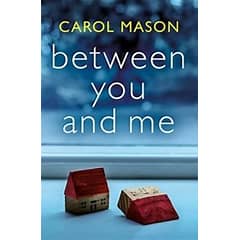
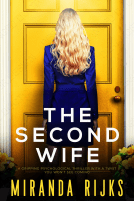
Carol Mason between you and me Lake Union, 2021.
Carol Mason’s novel, woven around the topic of step parenting, combines a sensitive and thoughtful approach, from the perspectives of all the main characters, as well as those that become involved while those relationships develop. At times, Mason’s even handedness toward the characters might annoy, particularly if the reader is committed to one or other of the protagonists. However, while this almost neutrality sometimes seems to slow the story, it works to demonstrate the complexity of the topic. This novel shows the inability of even those with the advantages of professional lives and lack of economic anxieties to deal easily with the complications attendant on developing any new relationship combining first and second families. Books: Reviews
Jane Isaac One Good Lie Canelo, 2021.
A chilling prologue introduces a female victim and her captor – a man who is known to her. Subsequent chapters introduce male and female characters, two of whom must be those featured in the prologue. Who are they? What has caused this event? Will the incidents leading to the capture be worth following to find the answers? What will happen to the victim and her captor? Books: Reviews
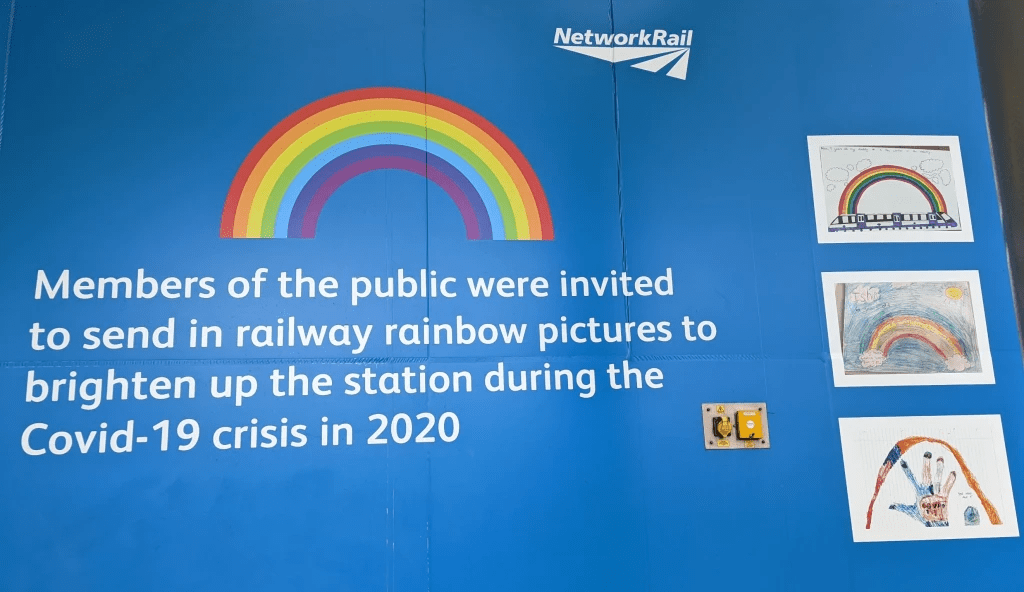
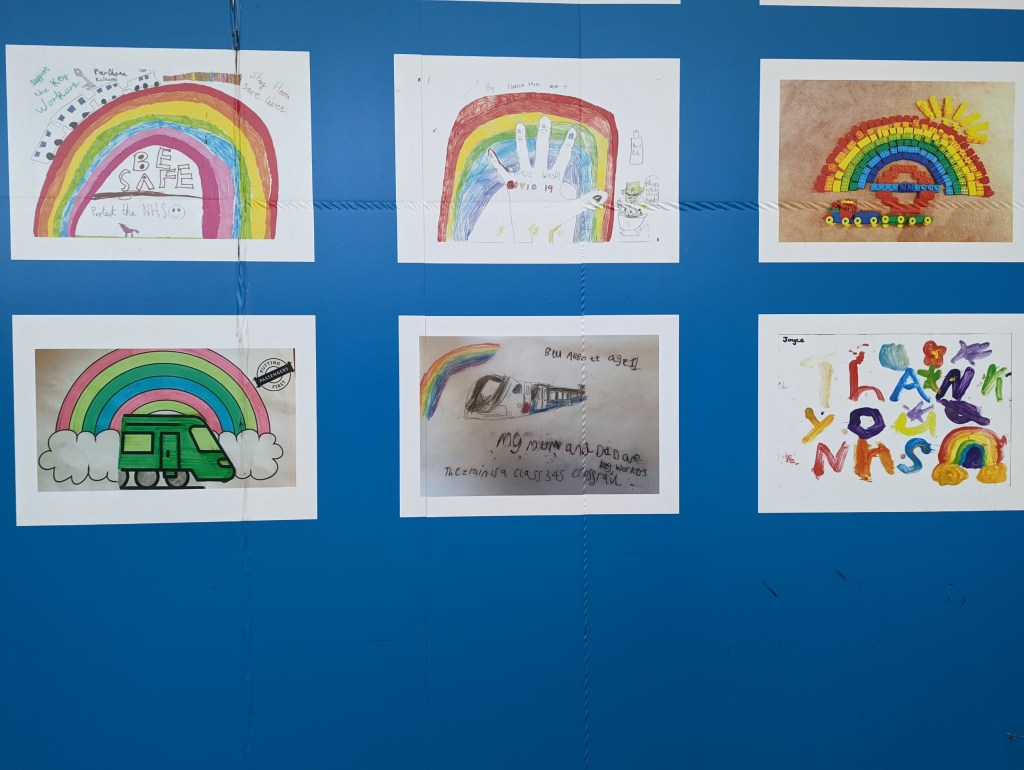
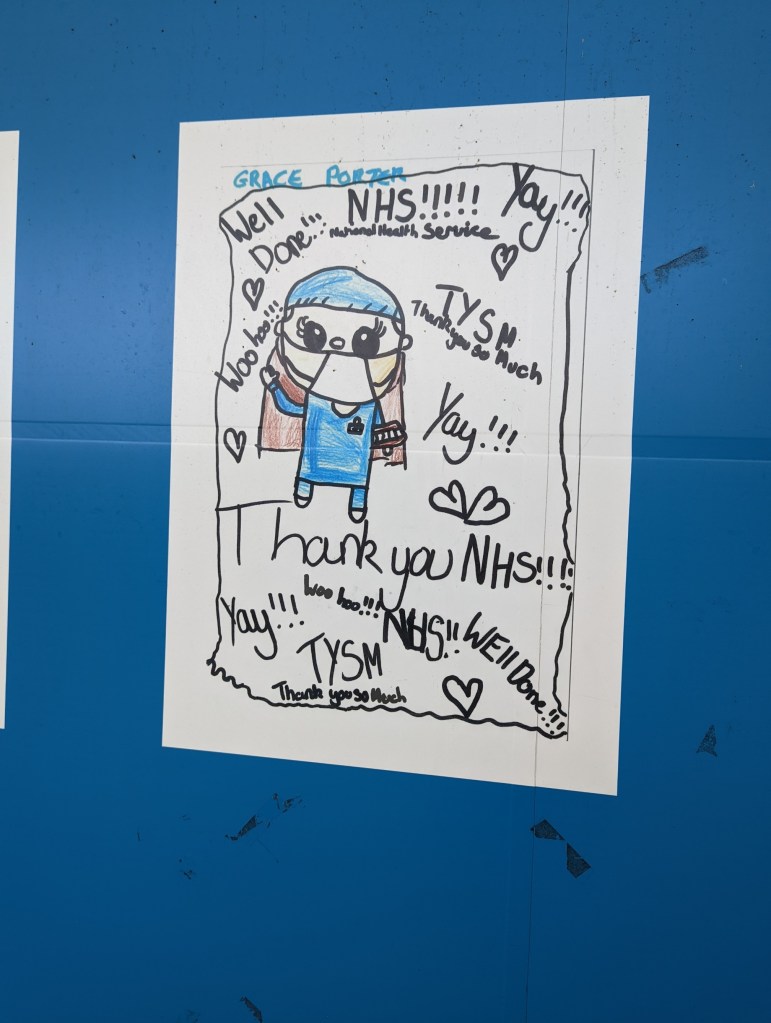
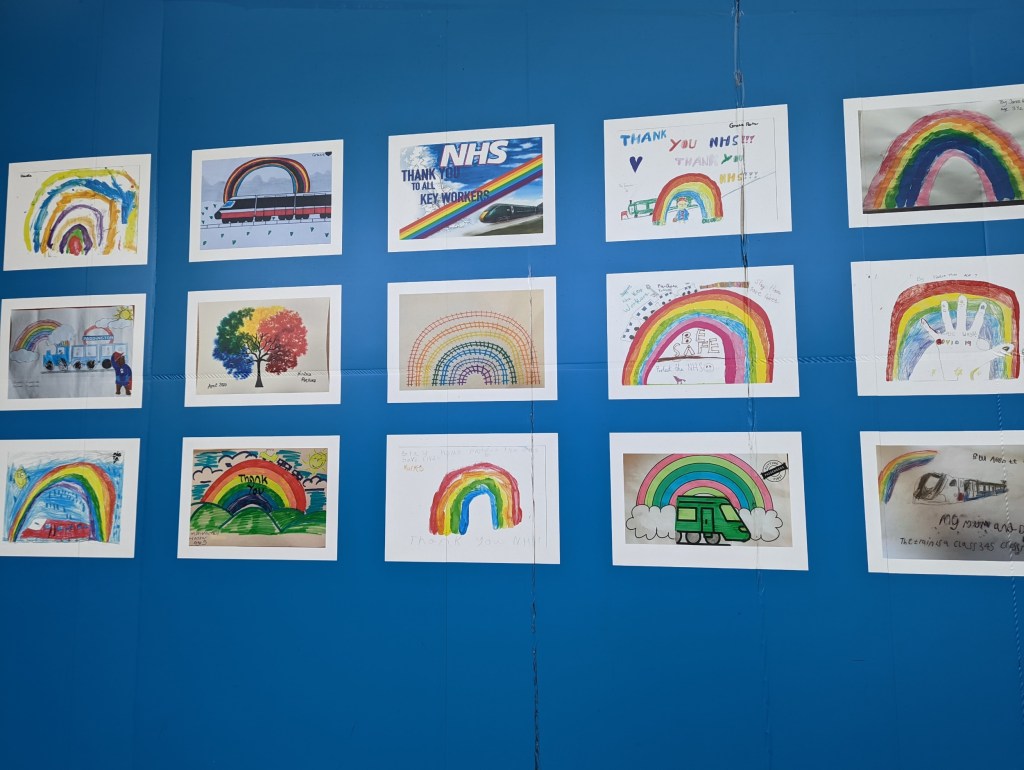
After the Covid report: Last day in London 2022; Cindy Lou eats out in London; signs on Paddington Station; new Ken Burns documentary.
Covid in Canberra moves to weekly updates
It was interesting to see the different mask requirements/encouragements while in the UK and Italy. In the UK there were no mandated mask requirements, although some people wore them at Heathrow, and on the tube. In Bagni Di Lucca masks were required on the bus, and the drivers enforced the rule. People wore masks. Although there was a requirement to wear masks on trains, there was no enforcement, and only some people wore them. Hand sanitiser was available in most venues in both countries, although, as noted in the restaurant reviews, not all.
The weekly report for Canberra: new cases – 791; cases in hospital – 76, with one person in ICU and one ventilated. The number for the total lives lost since March 2020 is 125.
Last Day in London 2022
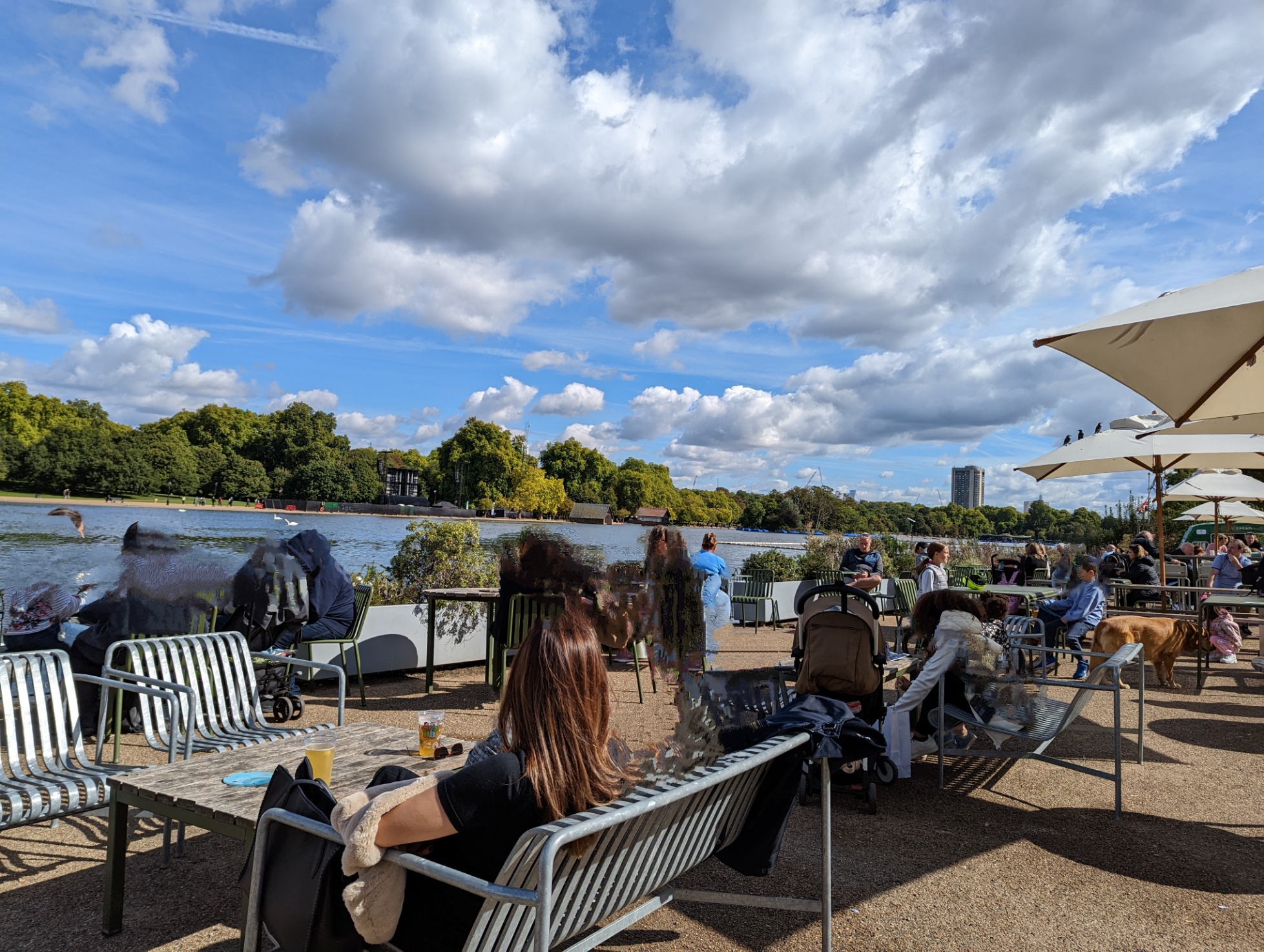
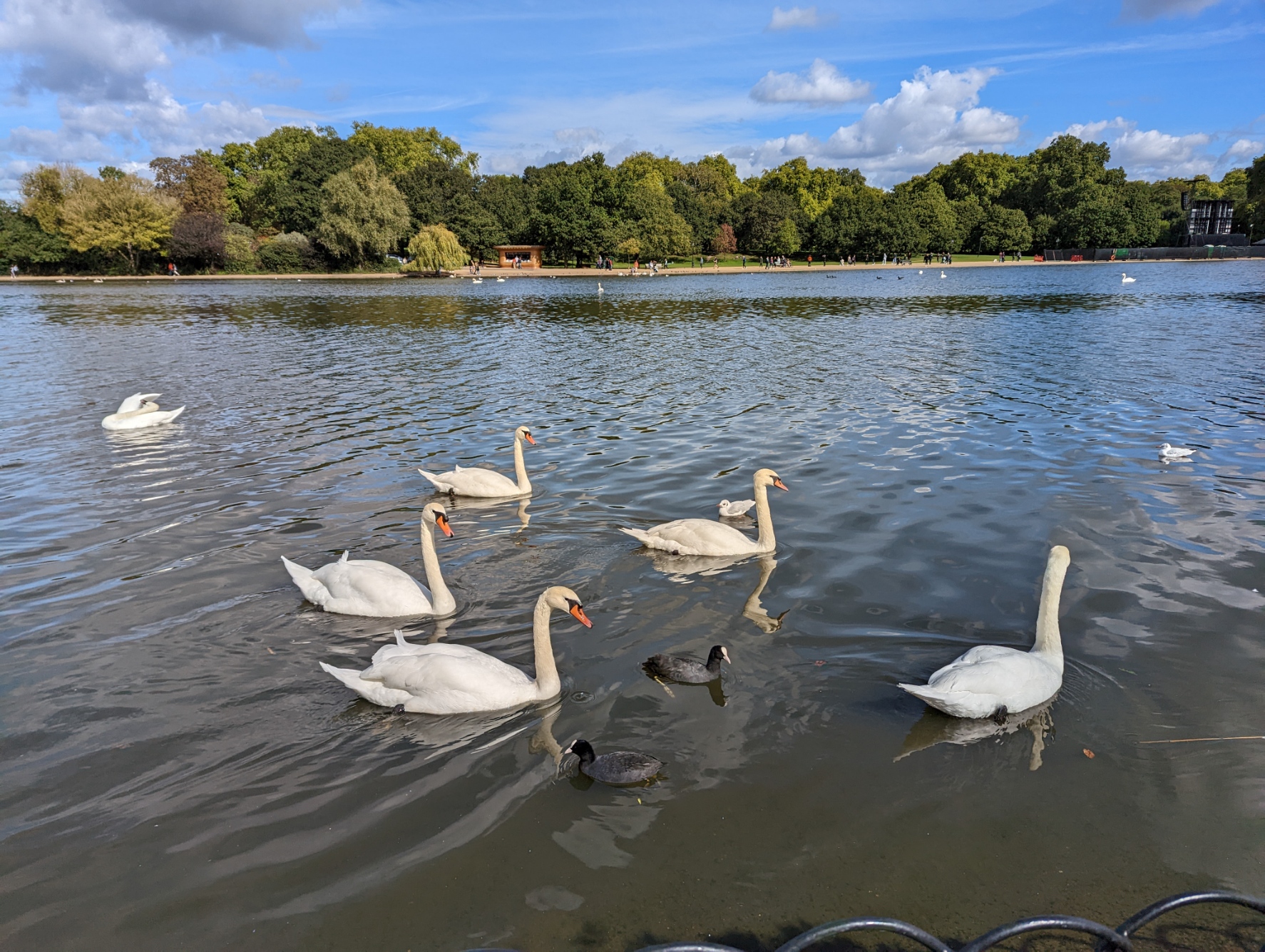
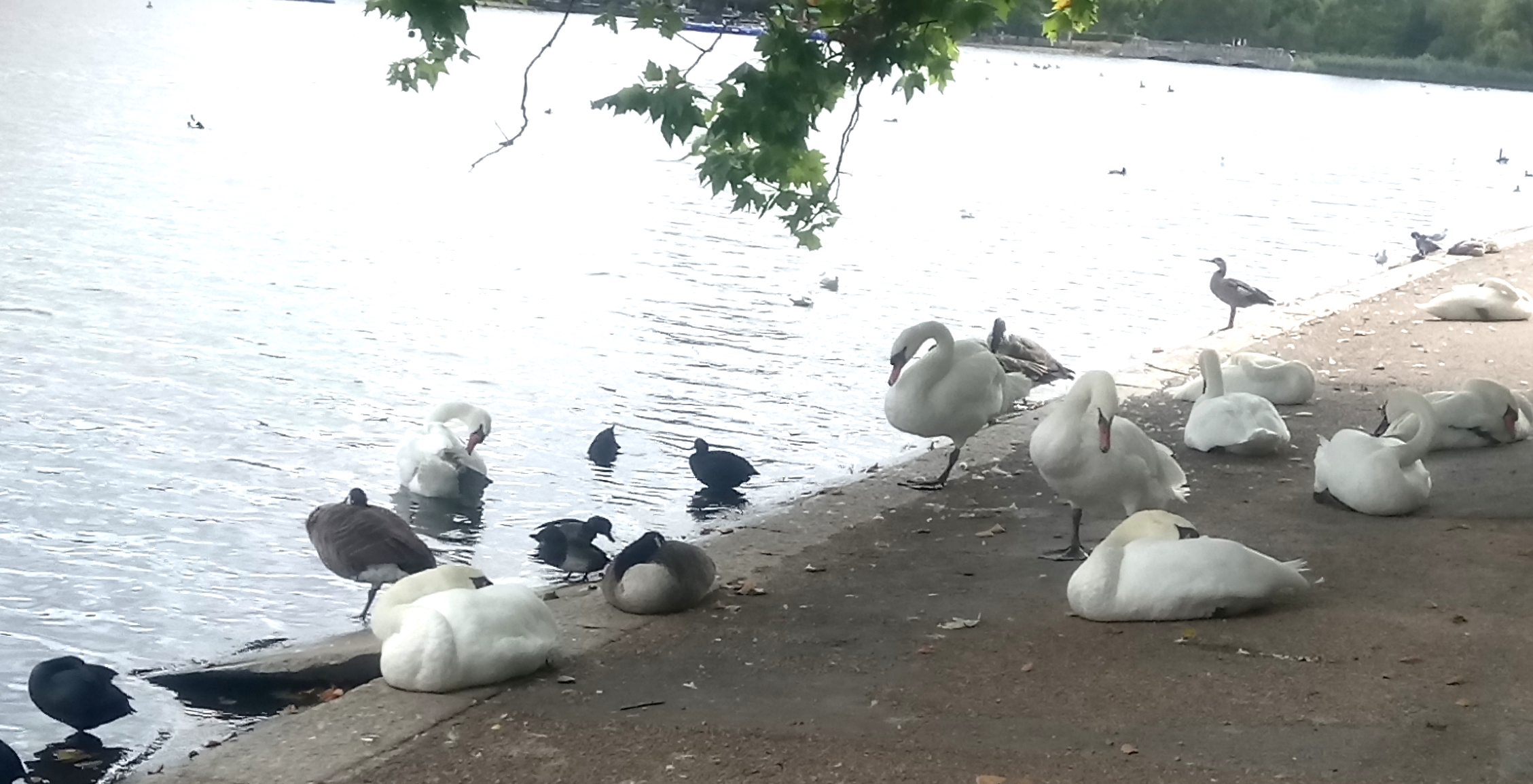
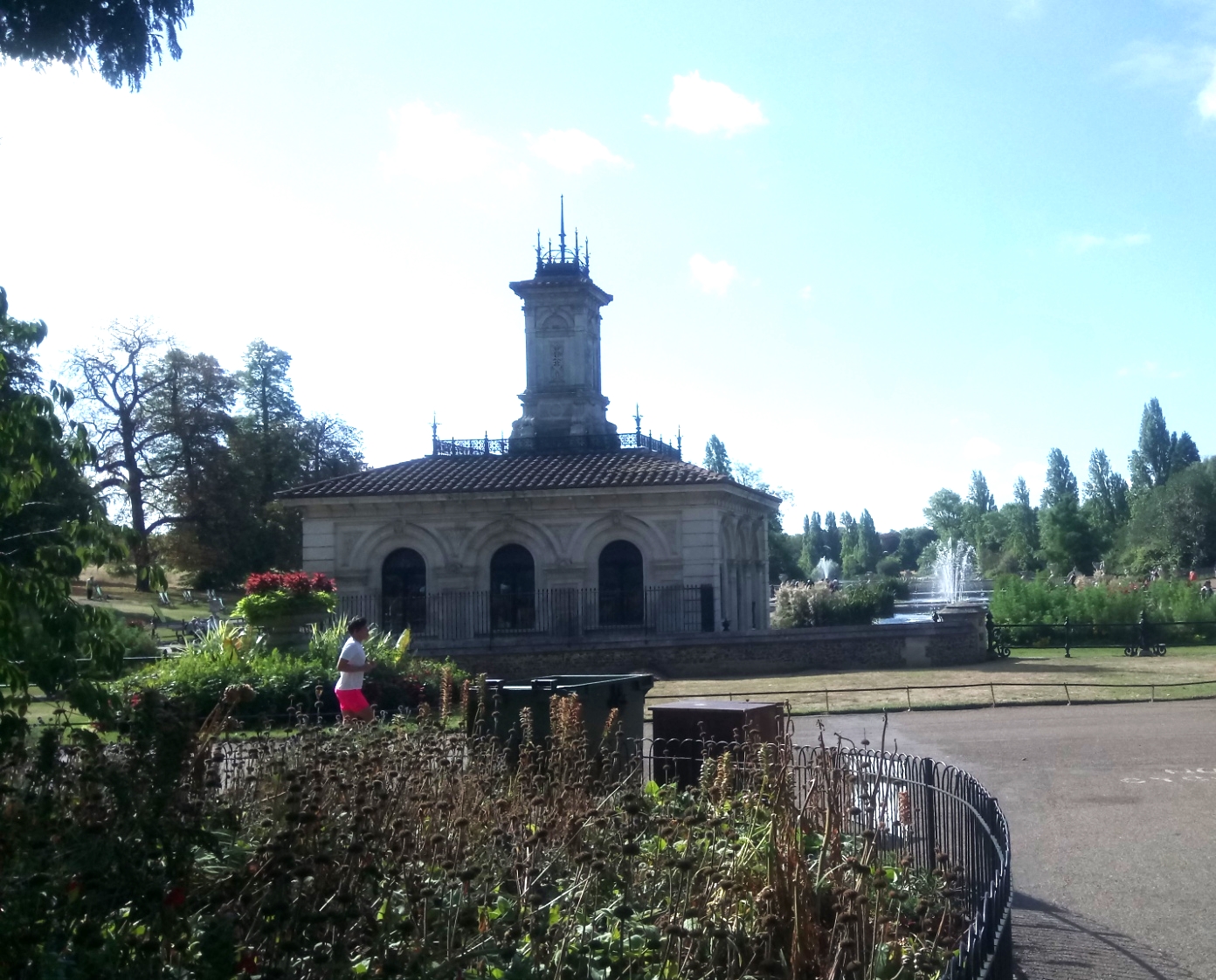
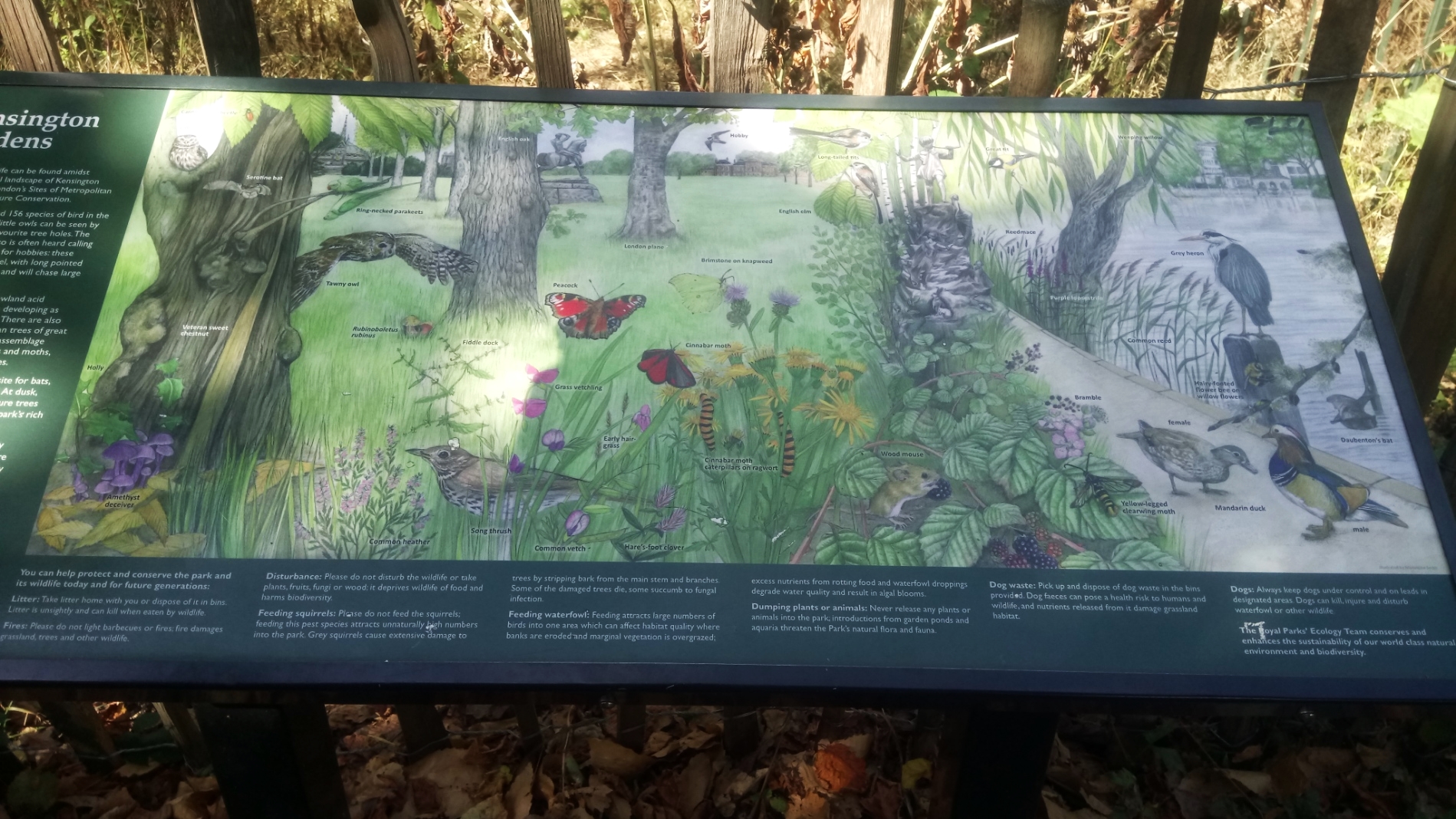
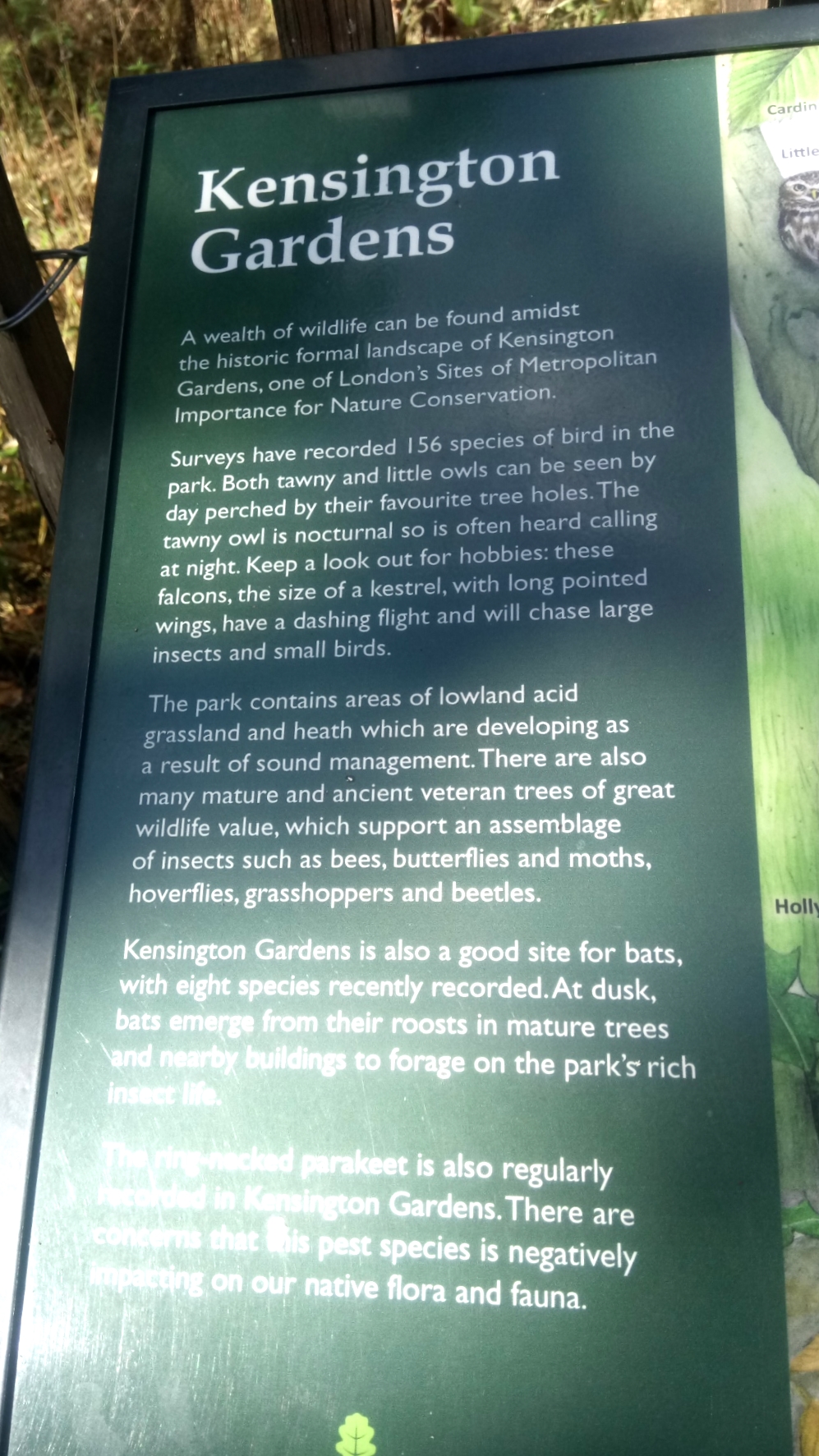
We were fortunate with our timing for departure on Sunday as flights were cancelled on Monday because the funeral of Queen Elizabeth 11 required clear airspace. A walk though Kensington Gardens was a familiar activity from our years in London and seemed a perfect way to end this visit. The Lido is an excellent place to eat, with an abundance of options, hot and cold, large and small. But most attractive is the setting. Walking through the park, past the Italian Gardens, viewing the Albert Memorial in the distance, and of course the many dogs walking and playing in the park is an absolute joy.
Cindy Lou eats out in London
Flavours of India, Paddington
This was a favourite when we were living in Paddington several years ago. As the crowds in Paddington milled around the restaurants on Regent’s Canal, and a lengthy queue snaked around the Italian restaurant we also liked, the rain drove us to Craven Road and Indian food.
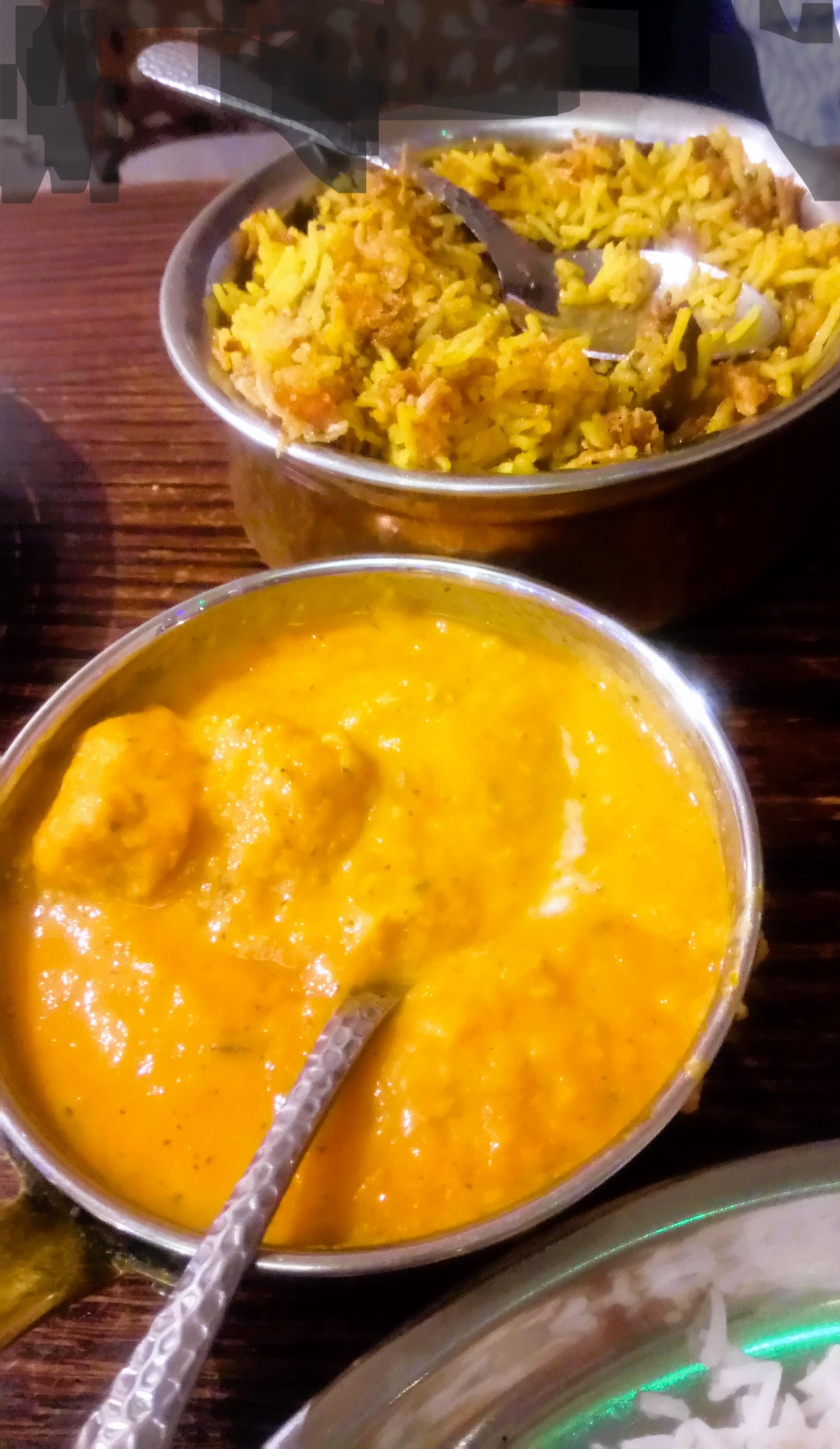
Unfortunately this restaurant has not maintained its high standards of flavoursome food and variety of chutneys and pickle accompaniments. The meal was pleasant , and certainly generous. However, it lacked the special features I recall. The one stand out was the beautifully thin and crisp pappadum, which I have not seen replicated elsewhere. The service was friendly, but the restaurant was very busy, so that was a little disappointing also. The prices are reasonable, so this is worth a visit for an uncomplicated pleasant enough Indian meal.
Tuttons, Covent Garden
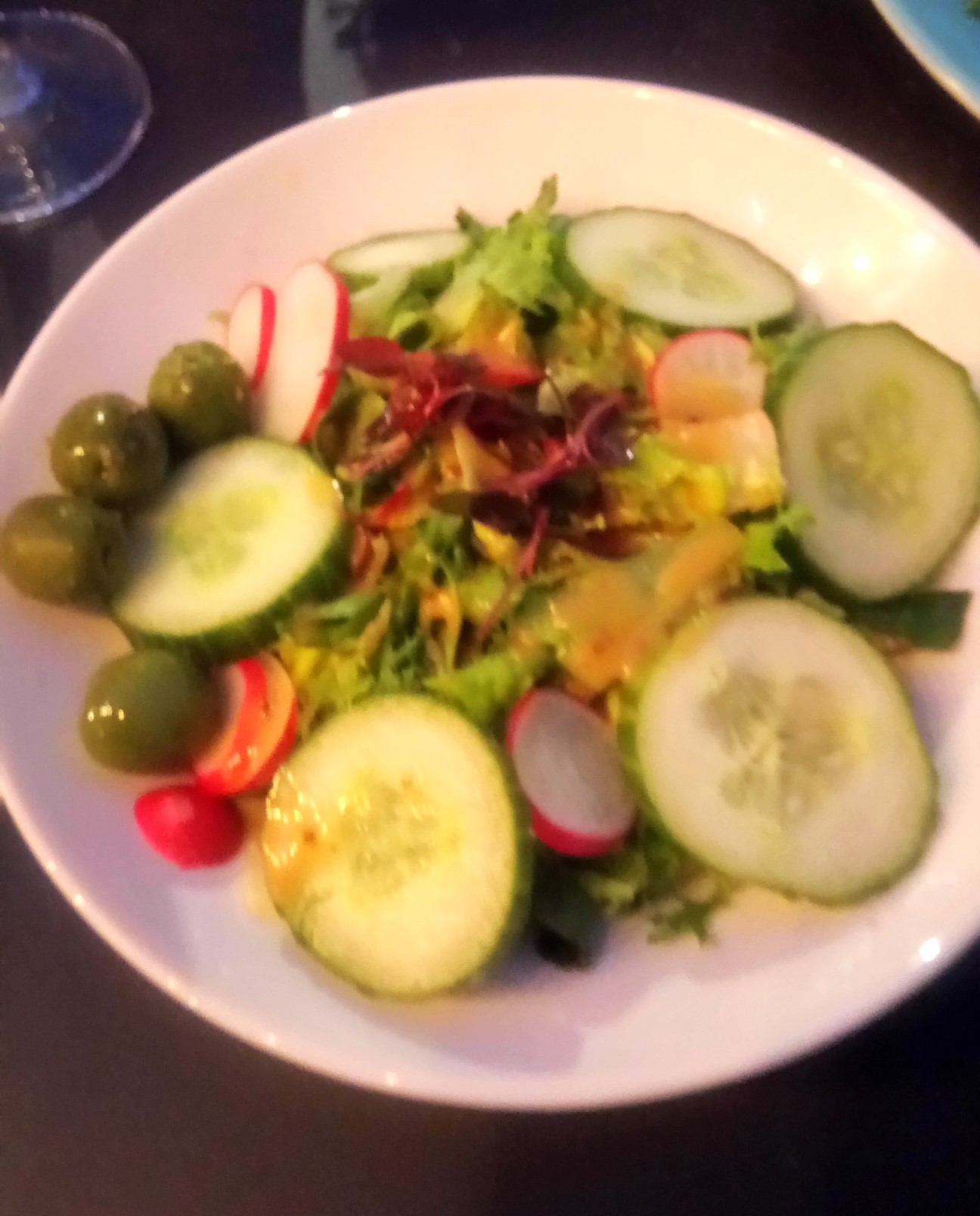
Tuttons was a find a few years ago, and we were pleased enough to return several times. On this occasion we sat outside, a lovely experience as the sun was out, the seating was comfortable, (the inside seating is very nice too) and the activities of Covent Garden swirled around us accompanied by operatic singing (possibly mimed). The mixed olives were luscious, and the bread included dark rye and crusty white. There was enough butter! The main courses were generous. The salmon was not overcooked but had a crispy skin; the salad provided a variety of tastes and textures. Tuttons is worth visiting. However, take your own hand sanitiser as none is available and the lavatories are a long and complicated walk down stairs.
Ask, Paddington
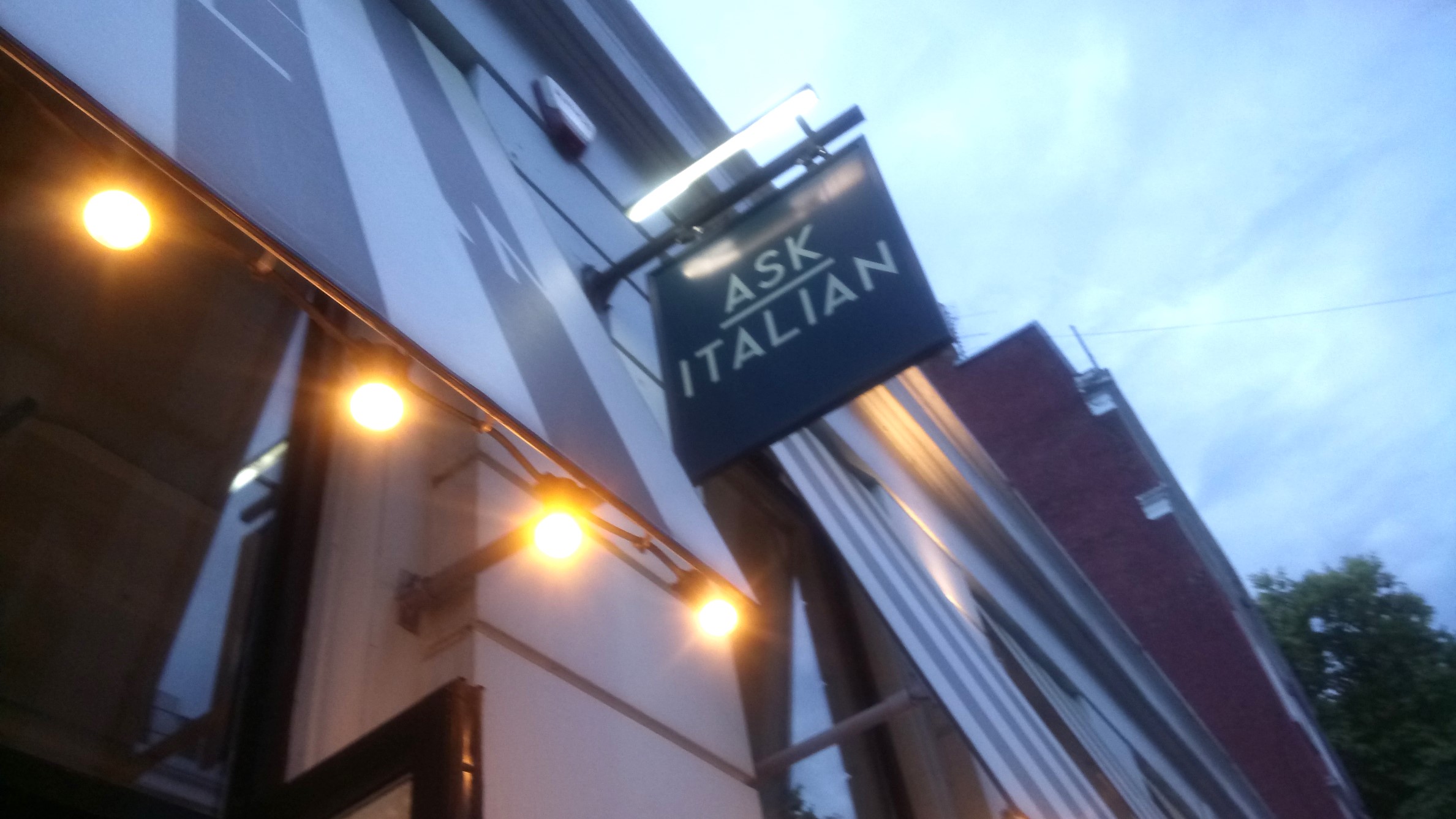
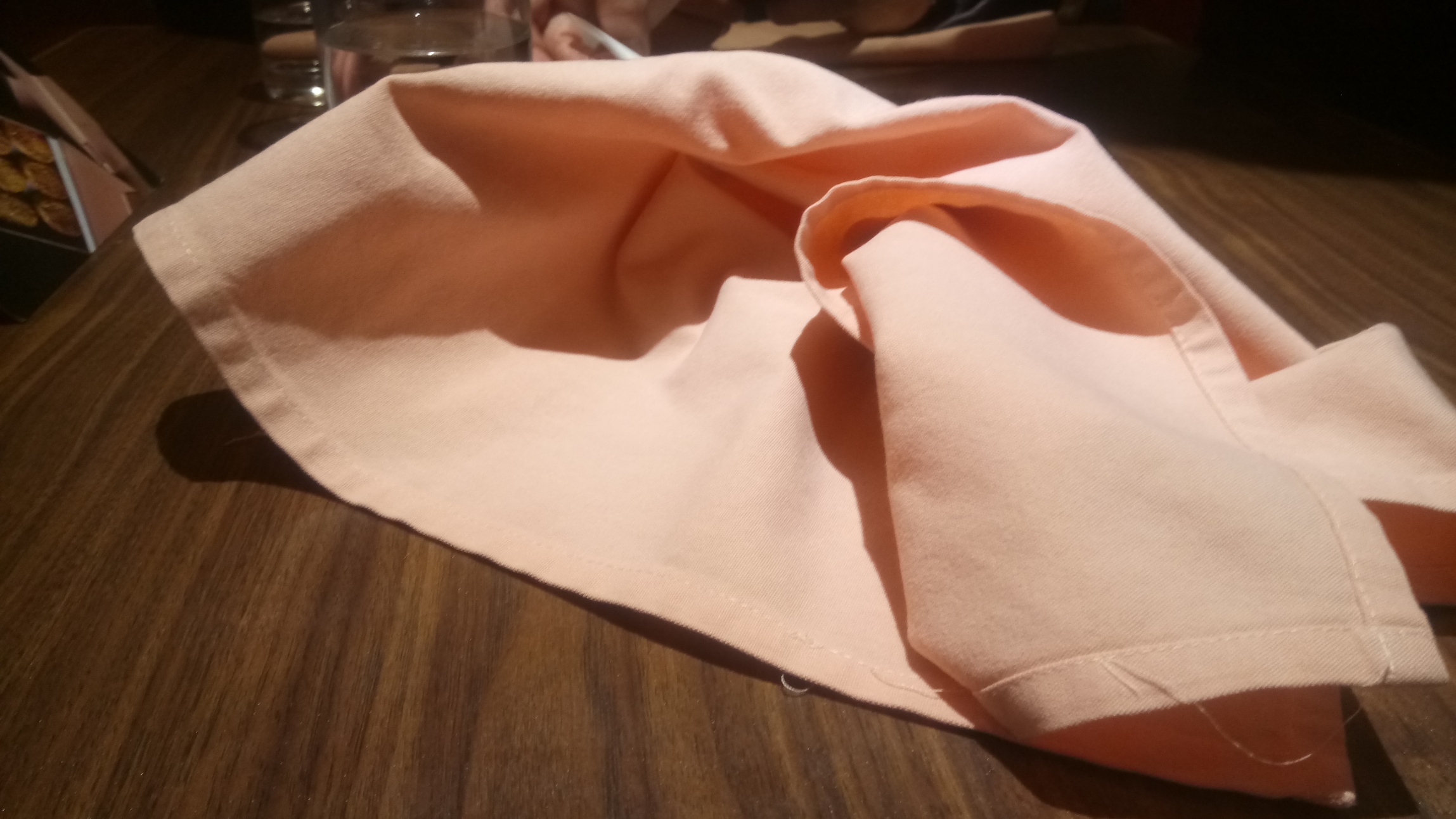
Ask is a chain serving Italian food. It is reasonably priced, the food is good, although not spectacular, and the service on this occasion was very efficient and delightfully friendly. I was pleased to be able to take away a bunch of the cheeky table napkins that I thought my grandchildren would find amusing. They are a great riposte to a person fixed on good manners to the detriment of enjoyment.
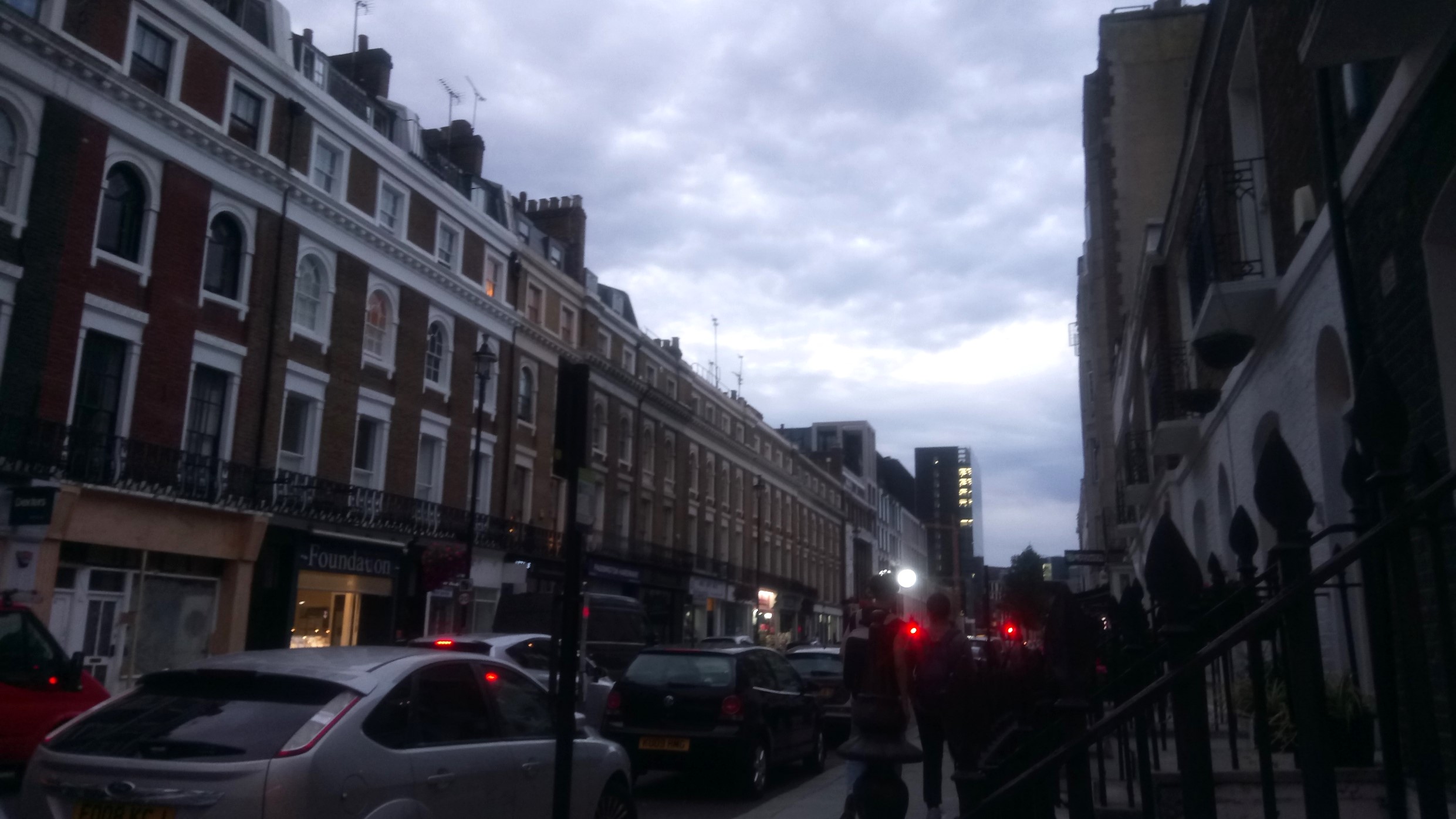
If sitting outside, the traffic is very close. However, the streetscape is pure London, and for me that was a deciding factor – I sat outside.
Bizzarro, Craven Road, Paddington
Bizzarro is a large, busy restaurant, often featuring a long queue waiting for a table. Fortunately, I had booked, arrived early, and was seated immediately. The staff are busy, but polite and friendly. They are also efficient, considering the pace at which this restaurant works. Lest this sound as though you will be hurried – no, one important feature of Bizzarro is that one feels welcome and looked after.
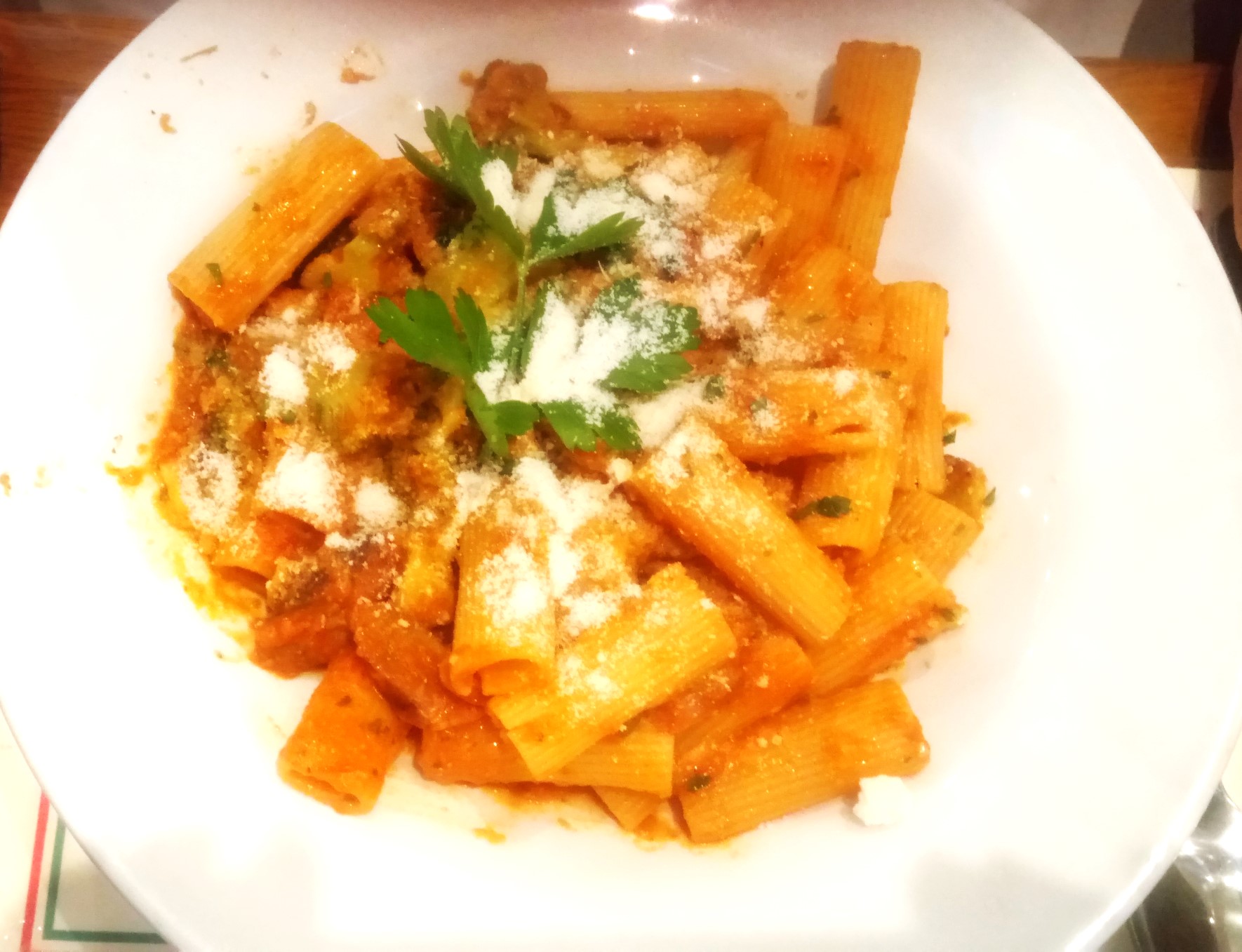
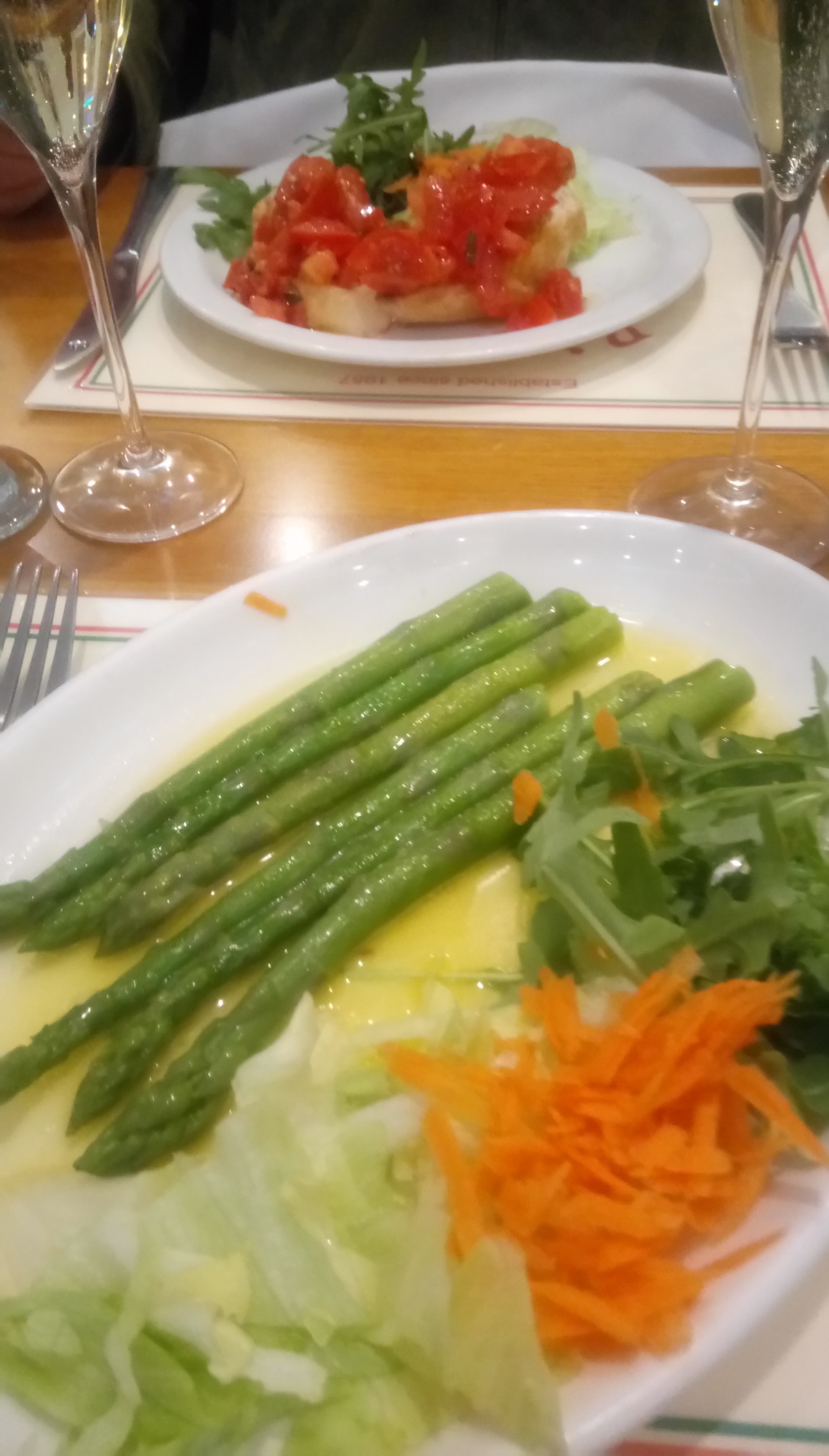
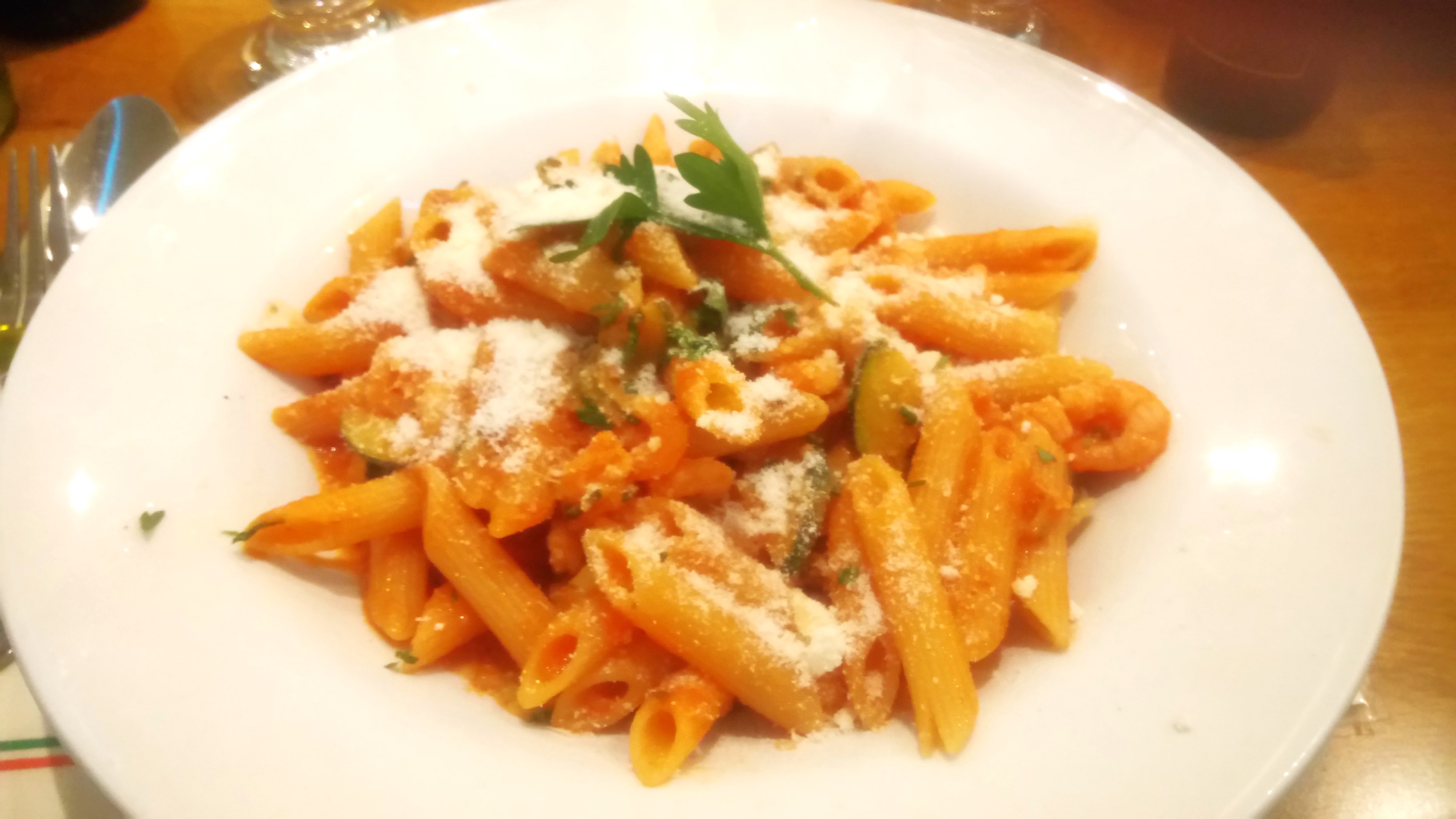
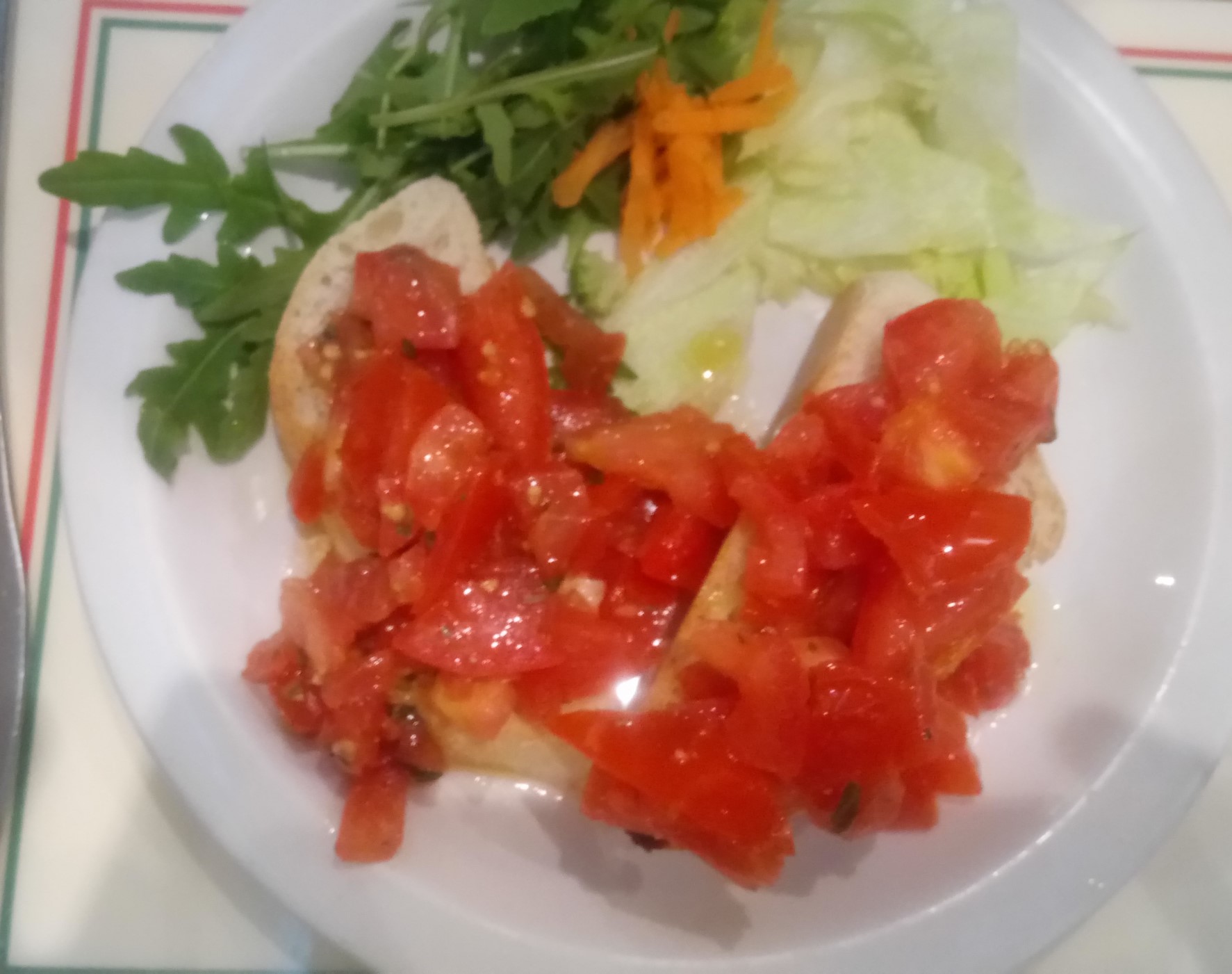
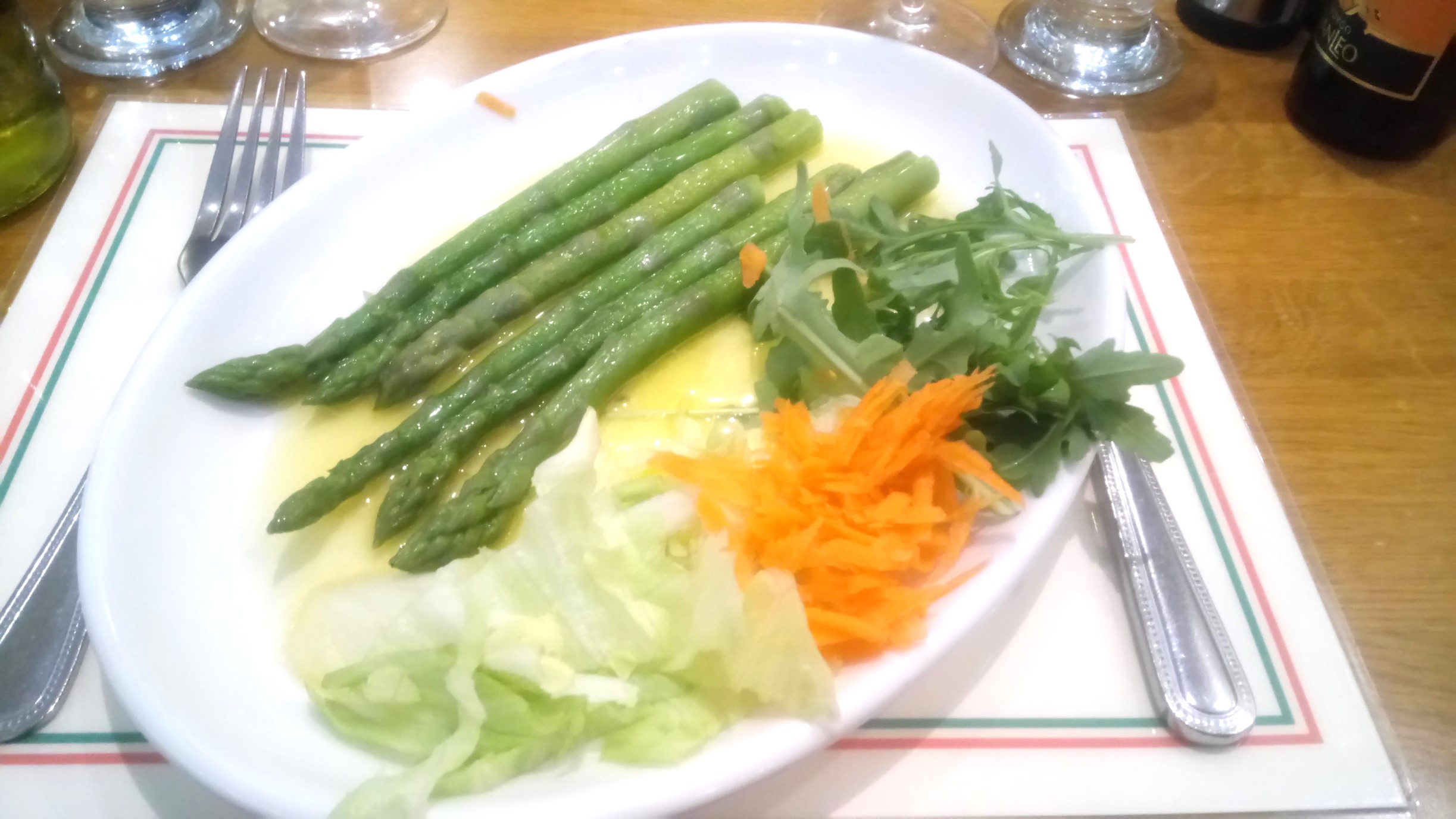
The starters were excellent – bruschetta with piles of fresh tomato and basil, and the most delicious buttered asparagus. The main courses, both pasta, were generous and flavoursome. Mine, with prawns, not large, but numerous, was particularly full of flavour. The green salad was fresh, plentiful, and varied – rocket, iceberg, tomato and cucumber. Balsamic and oil were provided. This was a lovely meal, and although no pasta seems to reach the heights of that I had in Italy, it was nicely cooked.
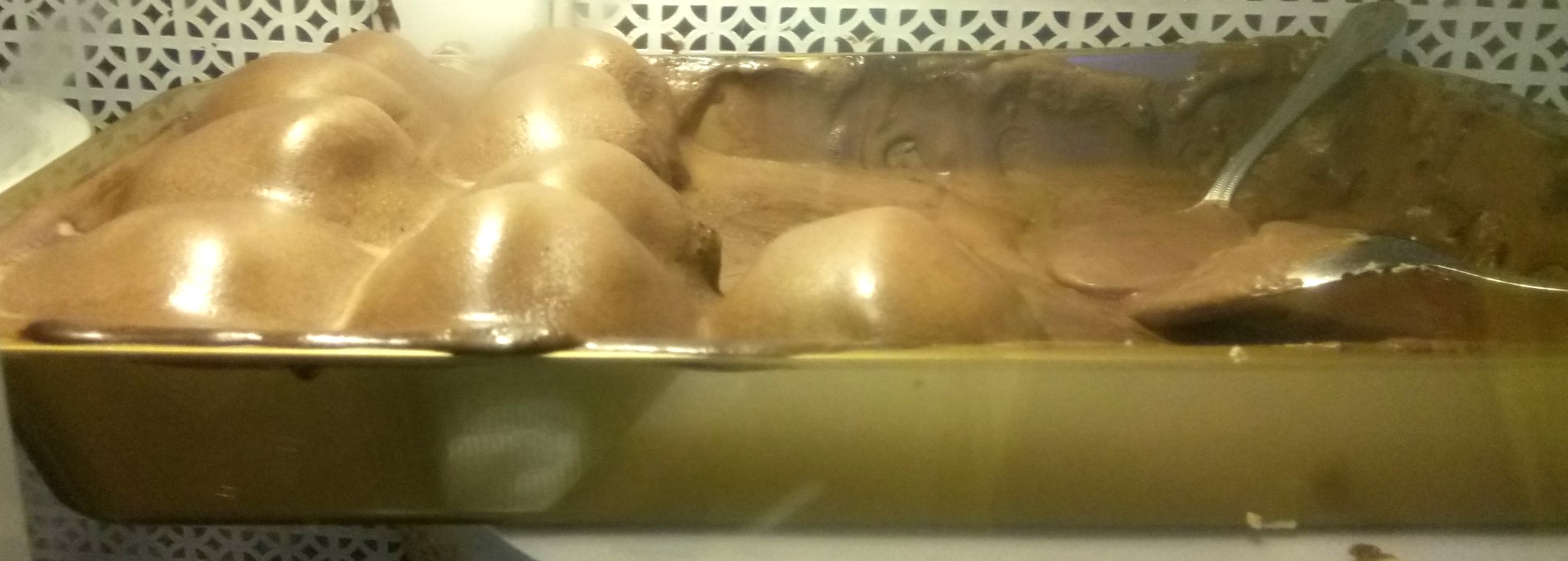
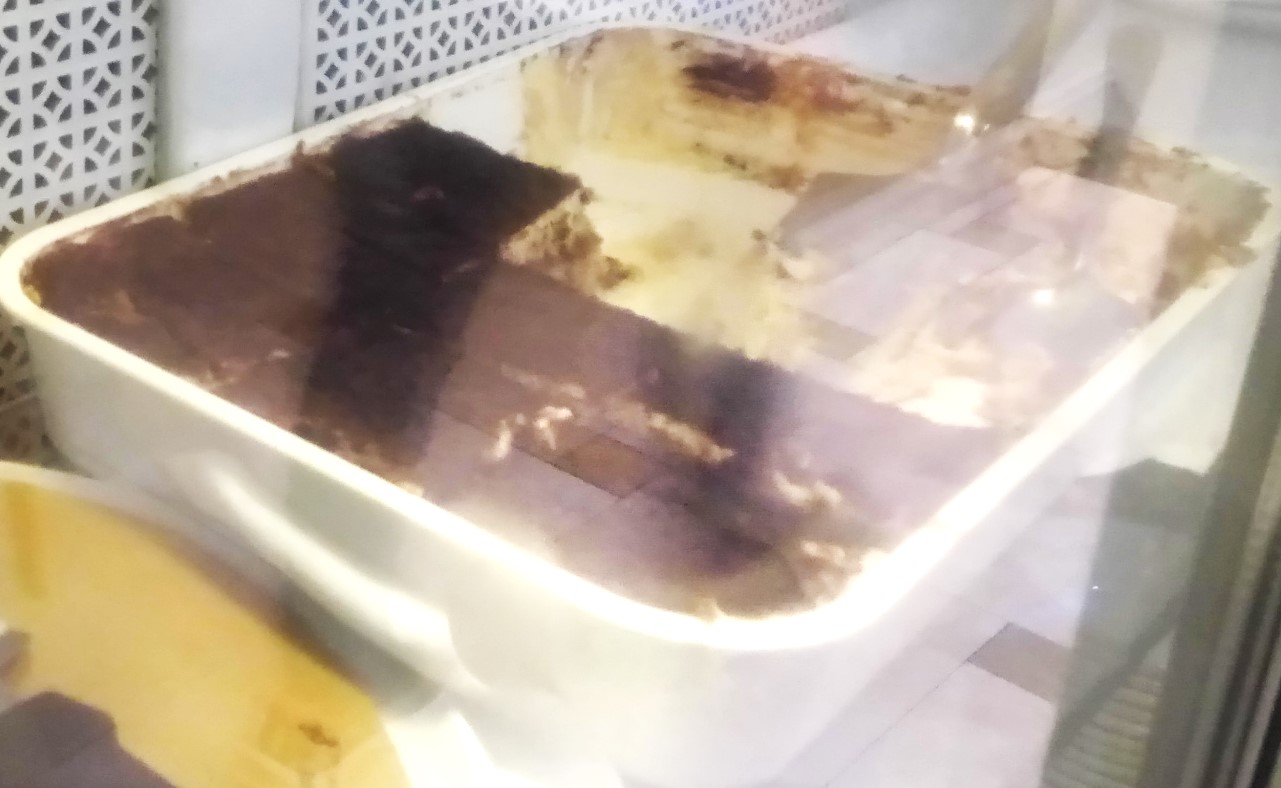
The desserts were in a glass case, and although they looked appealing the meal was pleasant without. After such filling pasta, a brisk walk back to the hotel was a more judicious option.
Trip to Amersham
This town is at the end of the Metropolitan Line, and according to the information is a place worth visiting. We did not find it so, although perhaps more investigation could have unearthed something. Friends who know Amersham were surprised that we had visited, although did say that there are some remarkably historic cottages there. The feature that we found rather different was the combination of a hairdressing salon and coffee shop. I had come across this before in London, where the wonderful Russian hairdresser I used to visit had a thriving coffee shop and salon.
The food was pleasant, the street vista worth a walk, and a longer walk out of the township, although not rewarding for any obvious historical features, was easy.
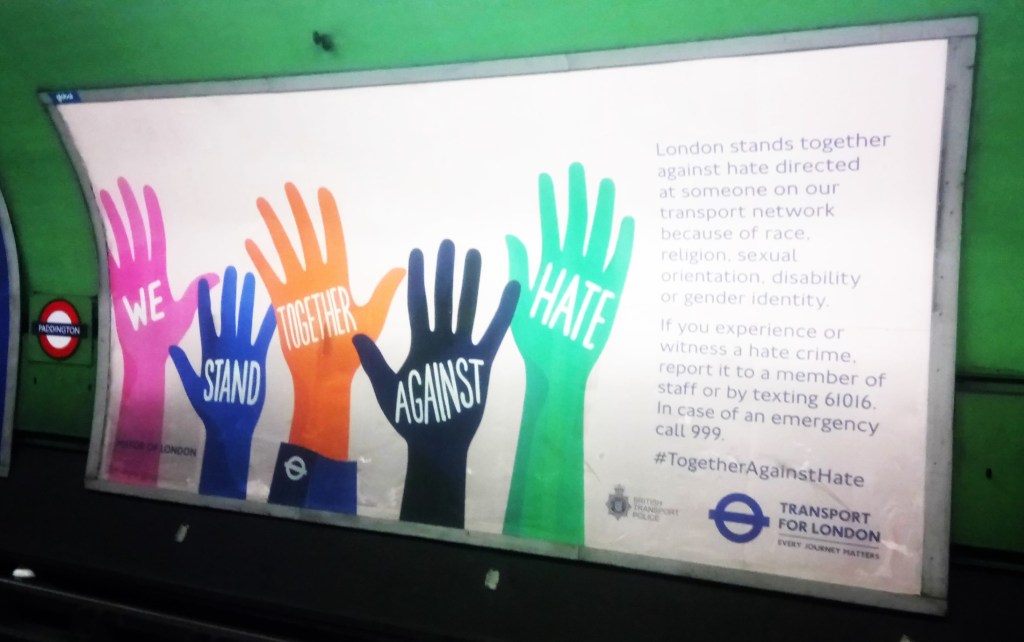
Signs at Paddington Station
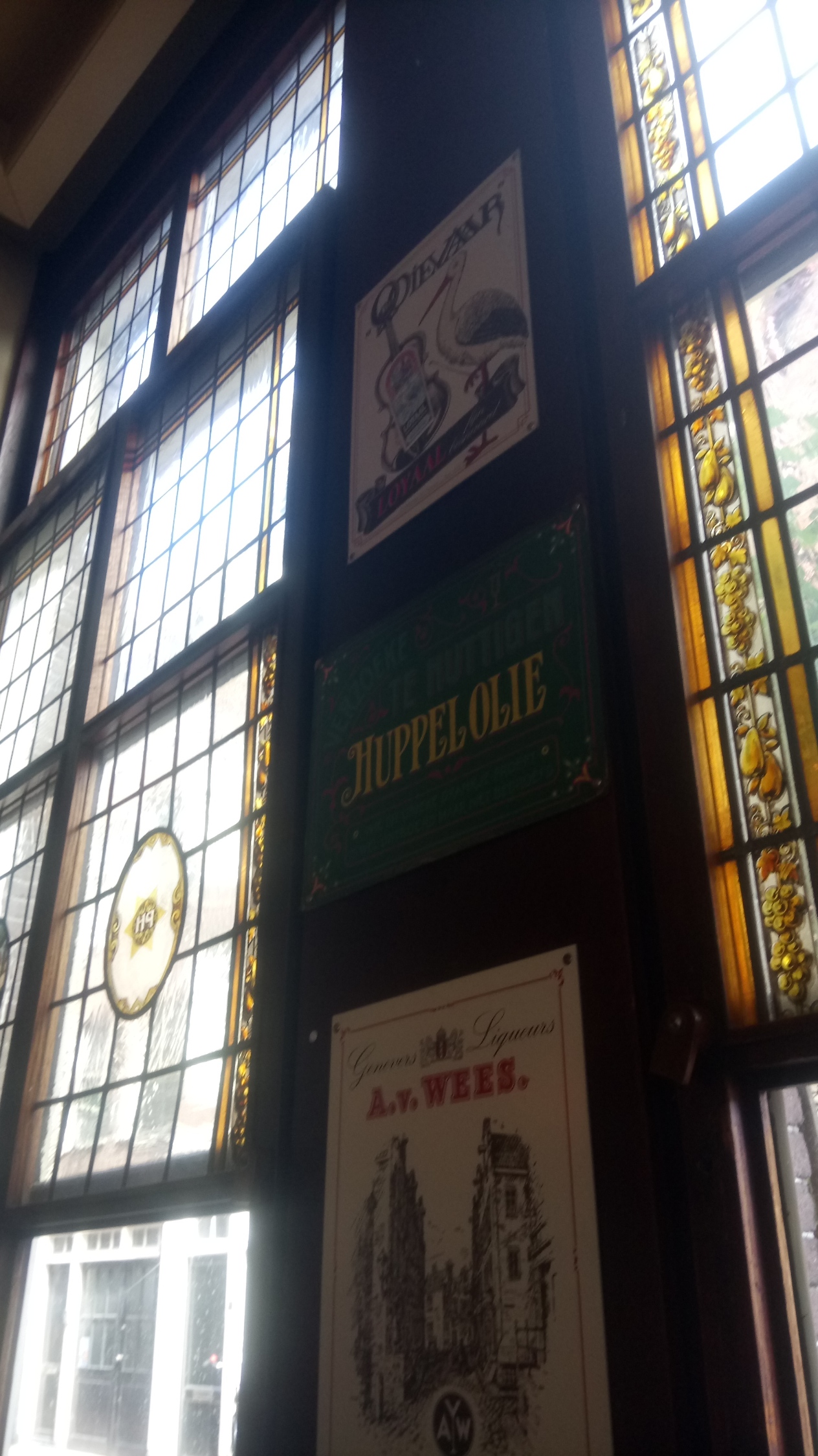
I have seen numerous dogs in the stations, on the tube, and being carried on the escalators. They seem to adapt remarkably well to being regular travellers on public transport.
New Ken Burns Documentary
Ken Burns and Lynn Novick join Morning Joe to discuss the new three-part, six-hour PBS documentary series ‘The U.S. and the Holocaust’.Sept. 21, 2022
This Sunday, PBS premieres, The U.S., and The Holocaust, Ken Burn’s three-part six-hour documentary, produced and directed by Burns, Lynn Novick and and Sarah Botstein.
You might wonder what, if anything, there still is to say about the Holocaust, after so many, many films have been made about it, all over the world. Having watched many of those films, and as the host and curator of an annual Holocaust Film Series at the Holocaust Museum LA, I can tell you that yes, there are many great films, narrative, and documentary about the Shoah, but Ken Burns’ does have something to say, if not completely new, then worth seeing and listening to.
Burns, Novick and Botstein have framed their film as a question of how America responded to the Holocaust, and that the American response is something we should all know about and confront – as part of the ongoing conversation of what sort of country we believe the United States is, and what kind of country it actually is.
The other question that instantly presents itself is: Why now? Why make a film about the American response to the Holocaust right now. I don’t know if when they began the film this was the producer’s intent, but clearly as they were making the film, the events of the last six years in the US – immigration, racism, the rise of right-wing demagogues, and the rise of white supremacists made the issues in “The US and The Holocaust” incredibly relevant.
There are many revelations in the film. Burns, Novick and Botstein explore at length the connections between the American Eugenics movement, American genocidal policies towards Native Americans, and Jim Crow laws and Hitler’s policies and Nazi laws. There is a frightening quote of Hitlers where he says, (and I am paraphrasing from memory) that America’s greatness as a country comes from its willingness to mass murder the Native population. And that America’s rebukes to Nazi policies towards the Jews were rendered hollow when German officials pointed to segregation in the United States.
Prior to this documentary, the received perception about the US and the Holocaust was that Americans didn’t really know what was occurring to the Jews, and the American government didn’t care, and that President Roosevelt knew but did little to help the Jews.
“The US and The Holocaust” makes the case that the American press did cover the Nazi regime and its murderous policies towards the Jews, and journalists such as Dorothy Thompson traveled the country speaking about it. The American public knew, and at first there was tremendous solidarity towards the plight of the Jews in Europe. They also spend time on the efforts of Varian Fry to rescue Jewish refugees in France, and Raoul Wallenberg’s rescues efforts in Budapest (I do fault them for not making the point that Raoul Wallenberg did so hand-in-hand with the Jewish Resistance).
As Botstein told me when we spoke, what struck her was that for so many Jews during the Holocaust, life or death came down to a piece of paper – a visa, transit papers, a false identity.
In Burns’ telling FDR and Rabbi Stephen Wise come off better than they do in other accounts, as wanting to do more but being blocked by the immigration policies of the Congress, and the active Anti-Semitism of the State Department. Novick and Botstein also go to great lengths to explain why FDR made the decision not to bomb the rail tracks to Auschwitz. I did not come away convinced that FDR couldn’t have done more, and I remain steadfast in believing that the Allies should have bombed the tracks (or even the camps themselves) but it is worth hearing the counter-argument.
Burns, Novick and Botstein do introduce John W. Pehle, a Treasury Department lawyer who found a way around the State Department to save many Jewish lives. And they provide damning evidence of Charles Lindbergh’s antisemitism.
To return to one of my original questions: Why now? In the last five minutes of the film, Burns, Novick and Botstein provide a montage of rising white suprematism and antisemitism presently in the US (including the marchers at Charlottesville) that, regrettably make “The US and The Holocaust” all too relevant to today.
Ken Burns’ “The U.S., and The Holocaust” airs on PBS September 18, 19 and 20. Check your local PBS stations for times and showings.
This will be worth watching out for on Australian and British television. The Civil War was a magnificent documentary (shown on SBS in Australia) and encouraged me to watch others of Ken burns’ work – even a documentary about baseball!
The reviews this week, one fiction, and the other non-fiction, are books to which I gave five stars in my reviews for NetGalley and Good Reads. I thoroughly enjoyed both. The first is Lisa Jewell’s Invisible Girl; the non-fiction is Changing Roles Women After the Great War by Dr Vivien Newman. Both books were sent to me by NetGalley as uncorrected proofs for review.
Lisa Jewell, Invisible Girl Random House UK, Cornerstone Century, 2021.
Once Lisa Jewell again presents us with social commentary, a host of characters who ring true, a story line that is feasible, and an engaging style which develops what initially appear to be everyday domestic vignettes into devastating forces with elements of a thriller. Books: Reviews
Dr Vivien Newman Changing Roles Women After the Great War Pen & Sword History, 2021.
How I loved this book.
Dr Vivien Newman incorporates the familiar accessible nature of the Pen & Sword publications with academic thoroughness; where appropriate, a deftly comic touch; and a range of interesting, arresting women whose post WW1 activities make a wonderful read.
The introduction sets the post WW1 scene – a time of claims about the wonders women had performed during the war, and the bitter reality they faced as they were expected to return to their former pursuits. Some of the women who refused to do so changed roles.
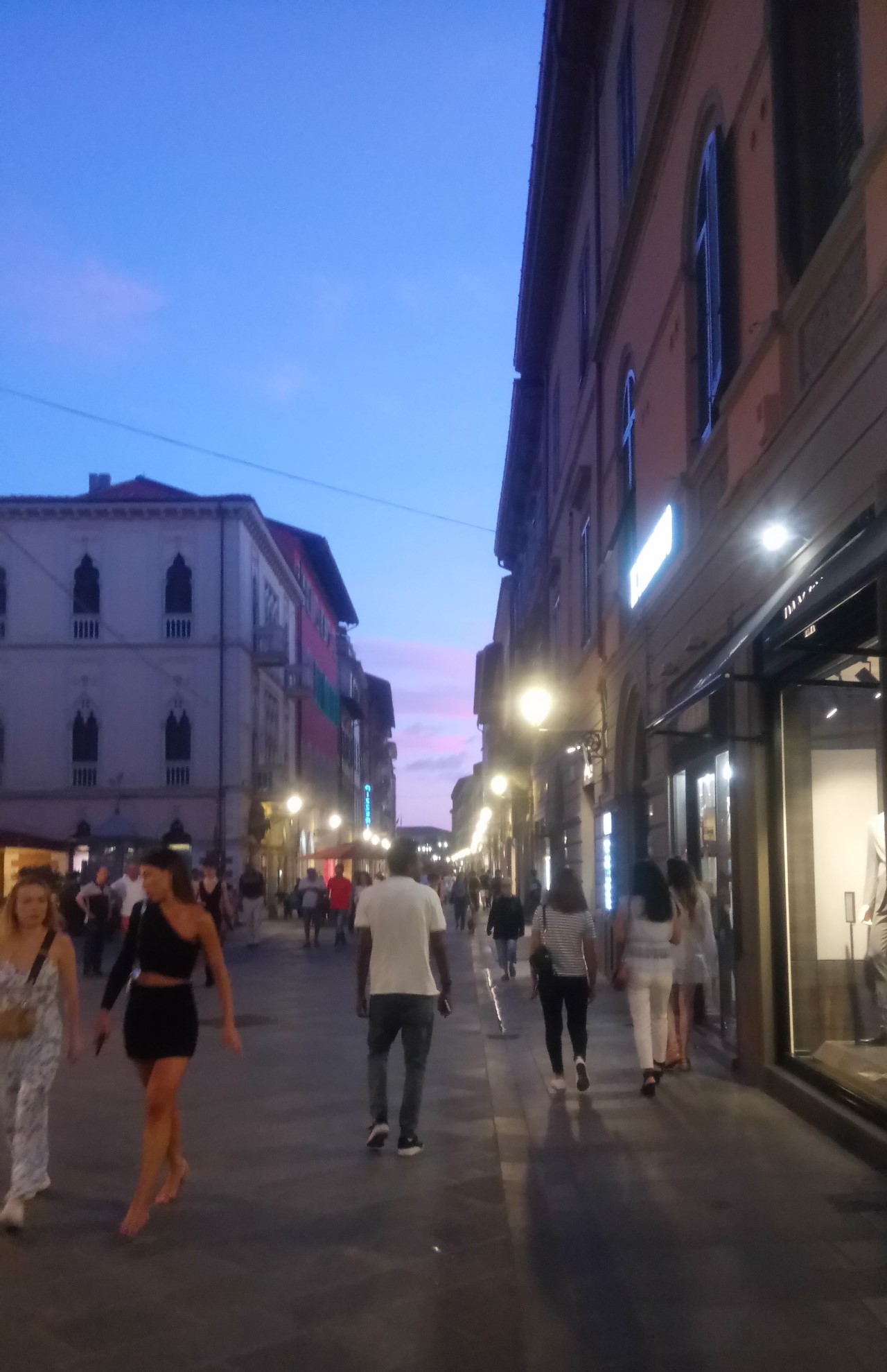
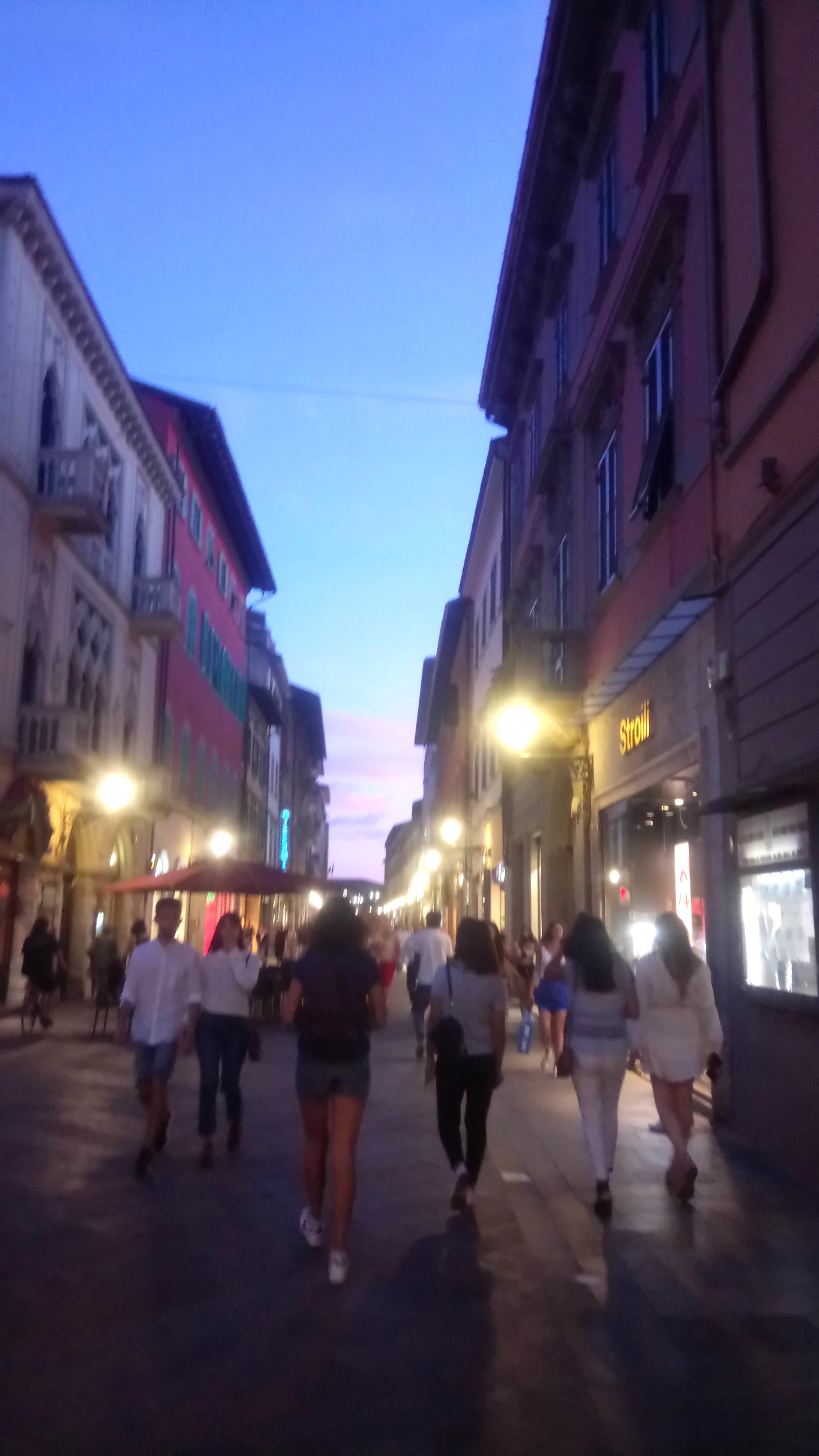
Articles and commentary after the Covid Canberra update – the Obama portraits; Conference in Bagni Di Lucca; Pisa photos at night; hotels in Bagni Di Lucca and Pisa; hotels Bagni Di lucca and Pisa; Winchester Cathedral – Queen Elizabeth Service and flowers.
Canberra Covid Update
Update on September 8th 2022 brought good news. New cases number only 137, with hospital numbers down to 85, and one person in ICU. No lives were lost on this period. The total lives lost since March 2020 number 125.
The Obama Portraits
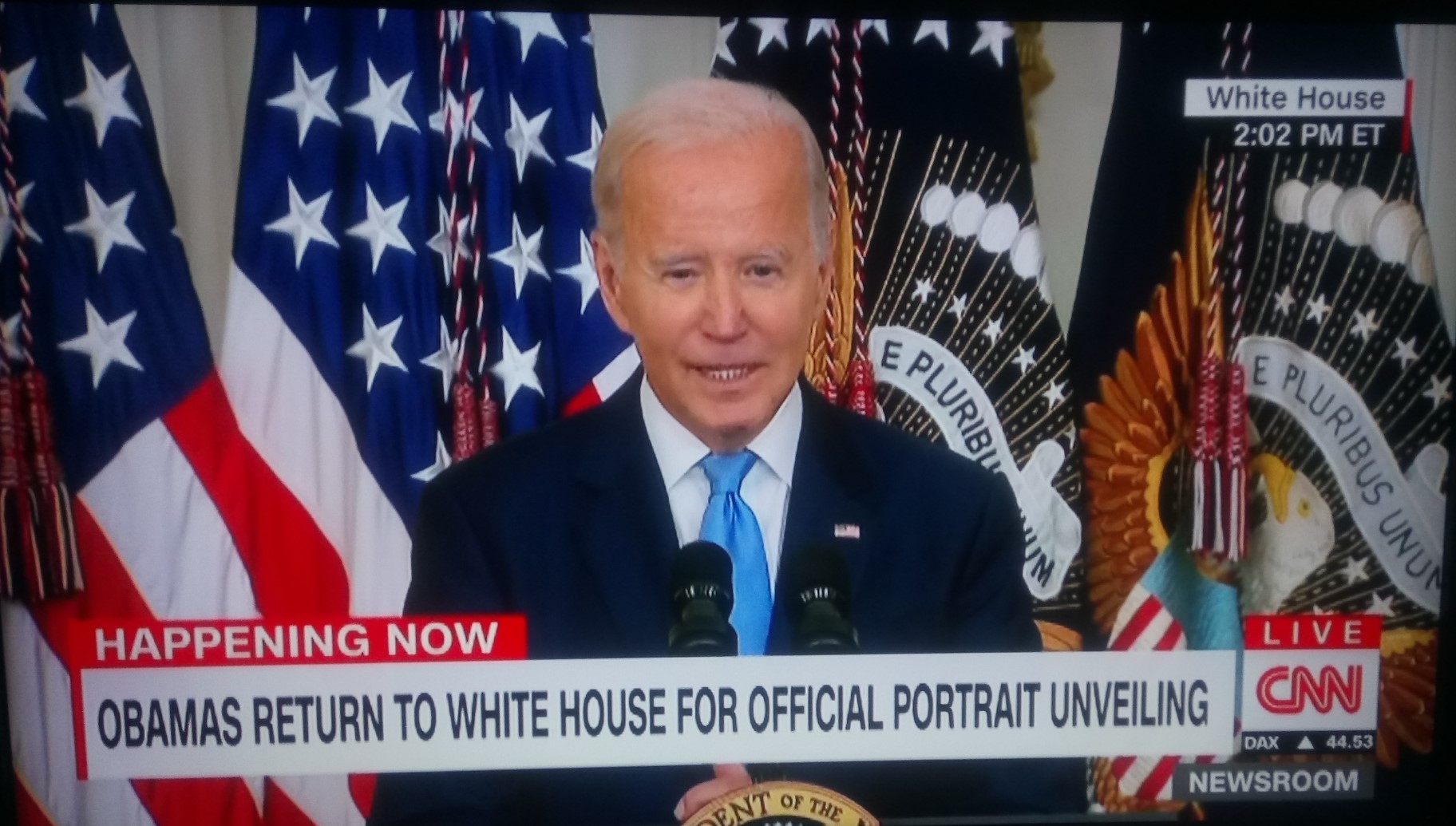
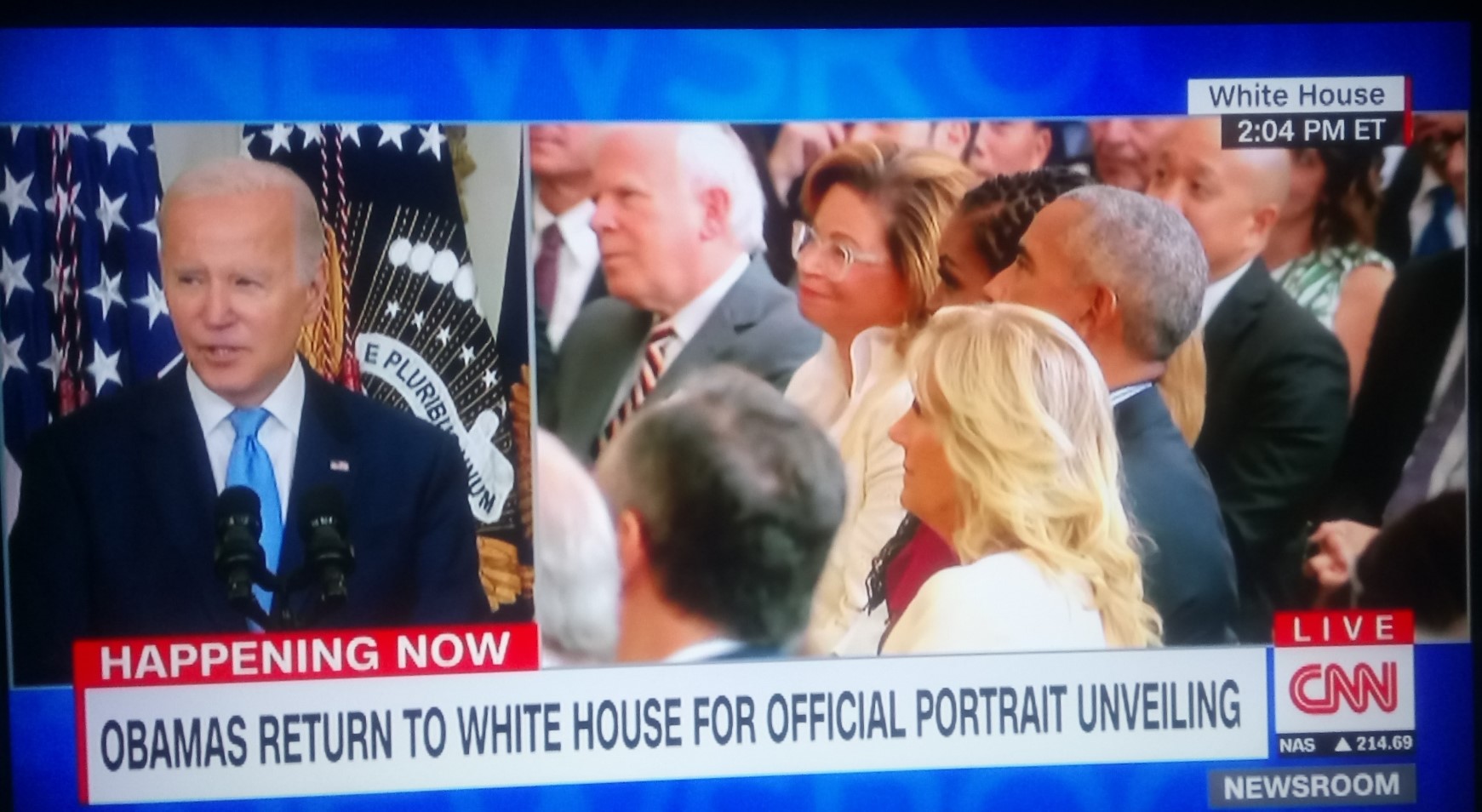
At Heathrow preparing to travel to Pisa in the morning I saw the unveiling of the Michelle and Barack Obama portraits, and listened to the excellent speeches. CNN rather rudely cut into the ceremony as Dr Jill Biden was about to make hers, so I was unable to hear it at this time. Michelle Obama’s speech was wonderfully political. Presidents Biden and Obama gave speeches well worth listening to – their ability easily overriding the four years of former President Trump.
Conference in Bagni Di Lucca
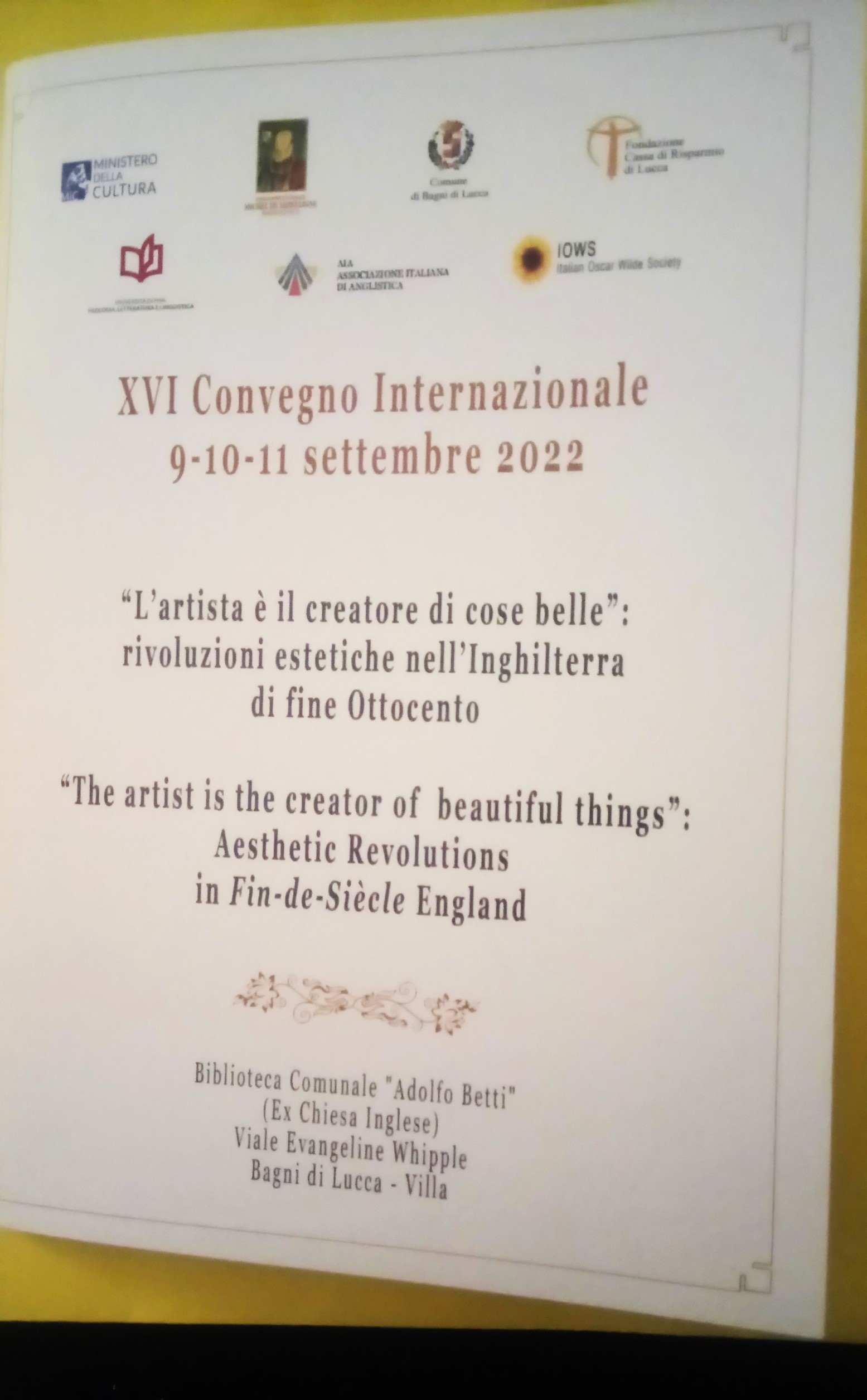
This week I flew to Bagni Di Lucca in Italy. The flight to Pisa was uneventful, luggage appearing as expected at the end of the journey. Heathrow was rather chaotic, I think partly because there is not enough signage about what is expected at each point. For example, it was not until I was dispensing bags into the trays that I was informed that my laptop had to be put in separately, and out of its cover. The emphasis was on liquids, with signs everywhere. Even with this a family was hastily finishing yoghurts and drinks in line! On the other side, all was relatively peaceful, and the flight boarded with no more fuss. Entry to Italy was easy and efficient. A train trip to Lucca, and a winding and attractive bus route brought me to where I was to stay and attend a conference for two days.
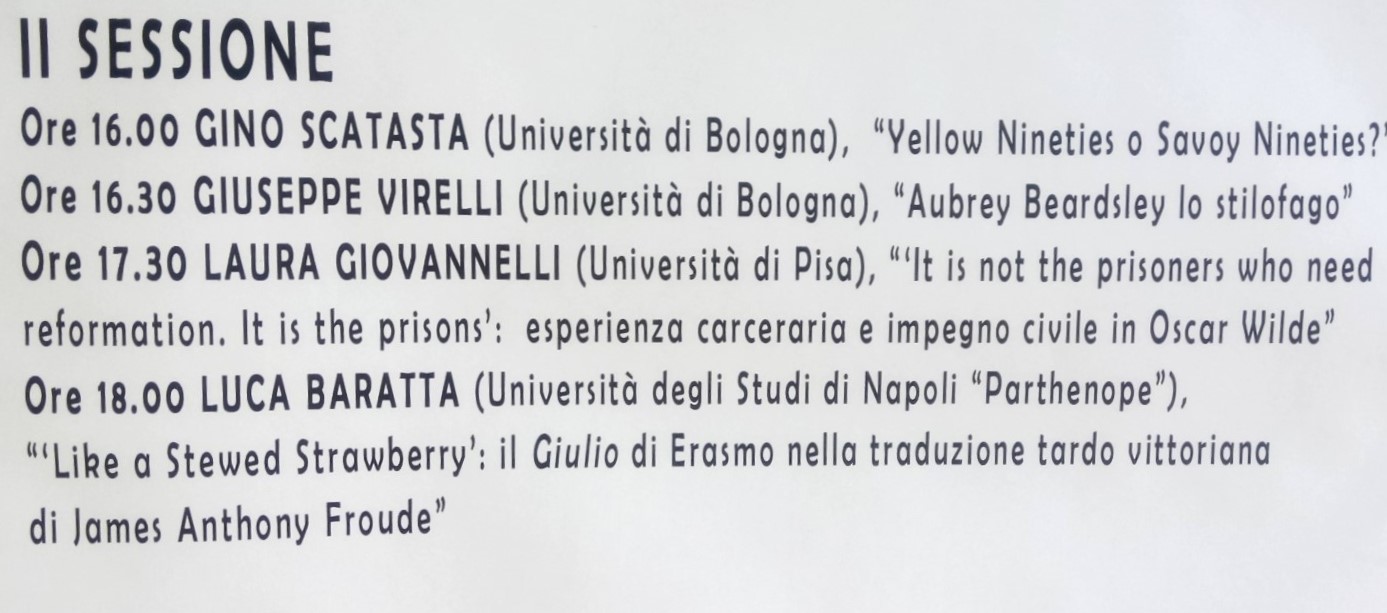
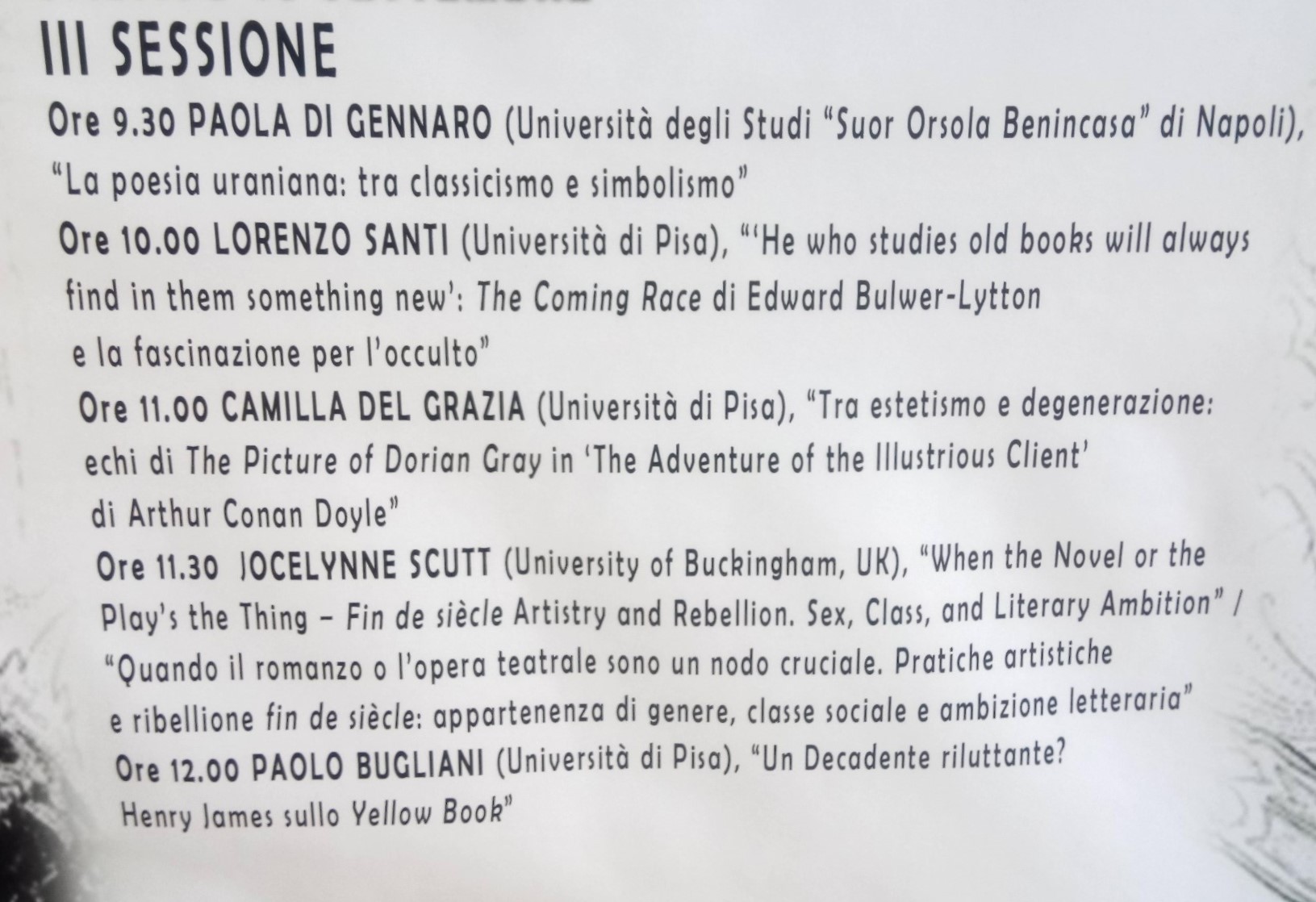
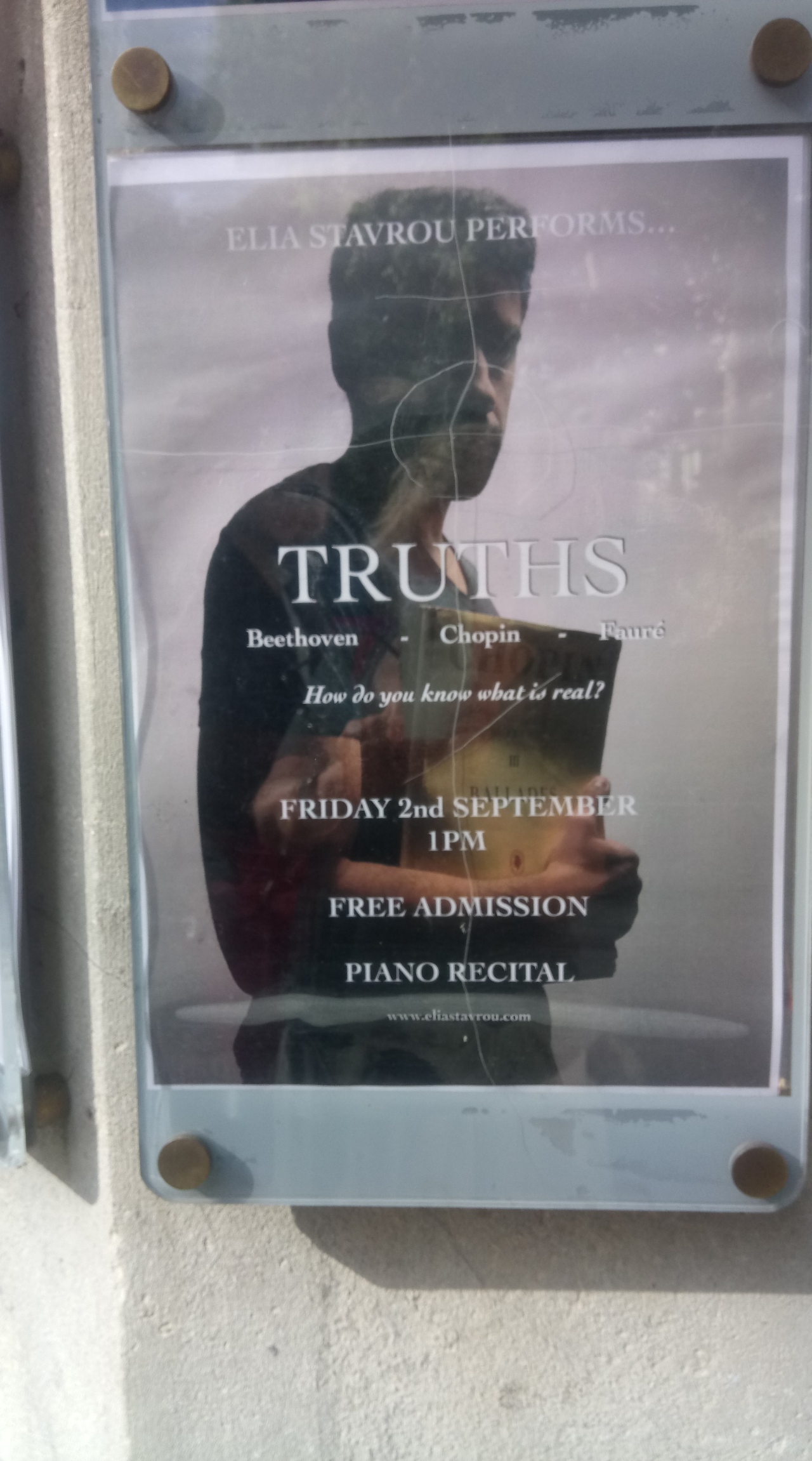
Please note that these excerpts from the poster and program were photographed under poor conditions, and as I am not at home, cannot be improved.
The speakers used Italian in many cases. However, there were several English speakers, and many of the Italian speakers addressed questions from English speakers in English. In addition, some quotes and comments were in English where power point was used, and the program information was in both Italian and English.
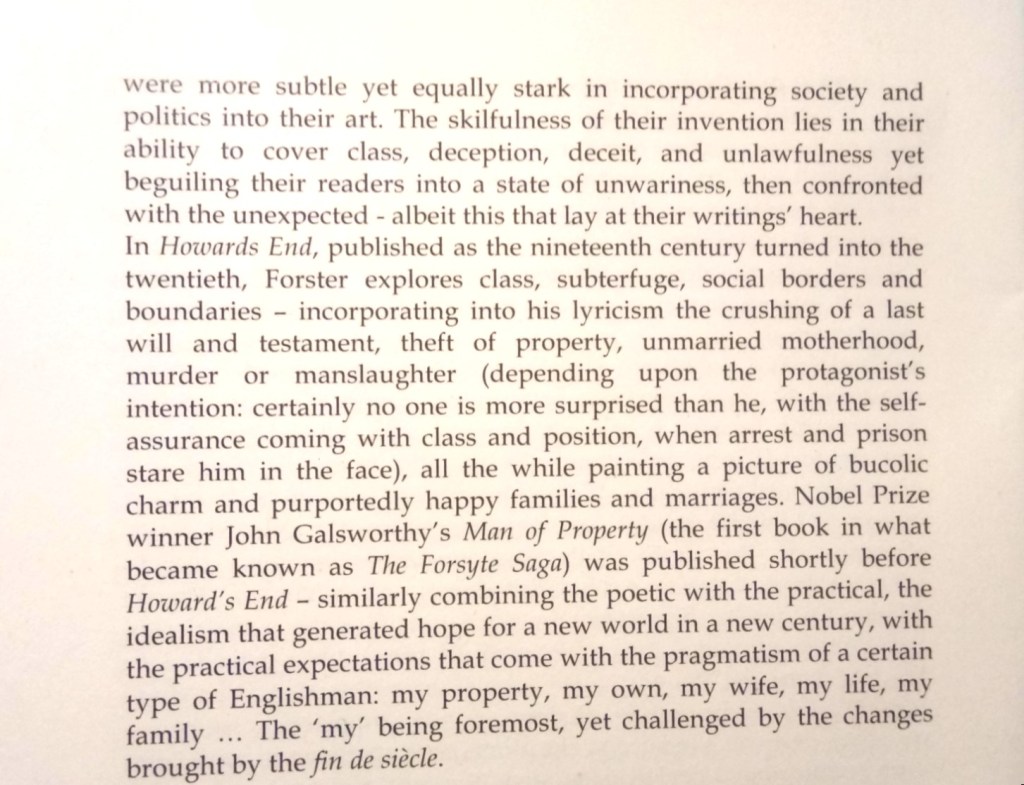
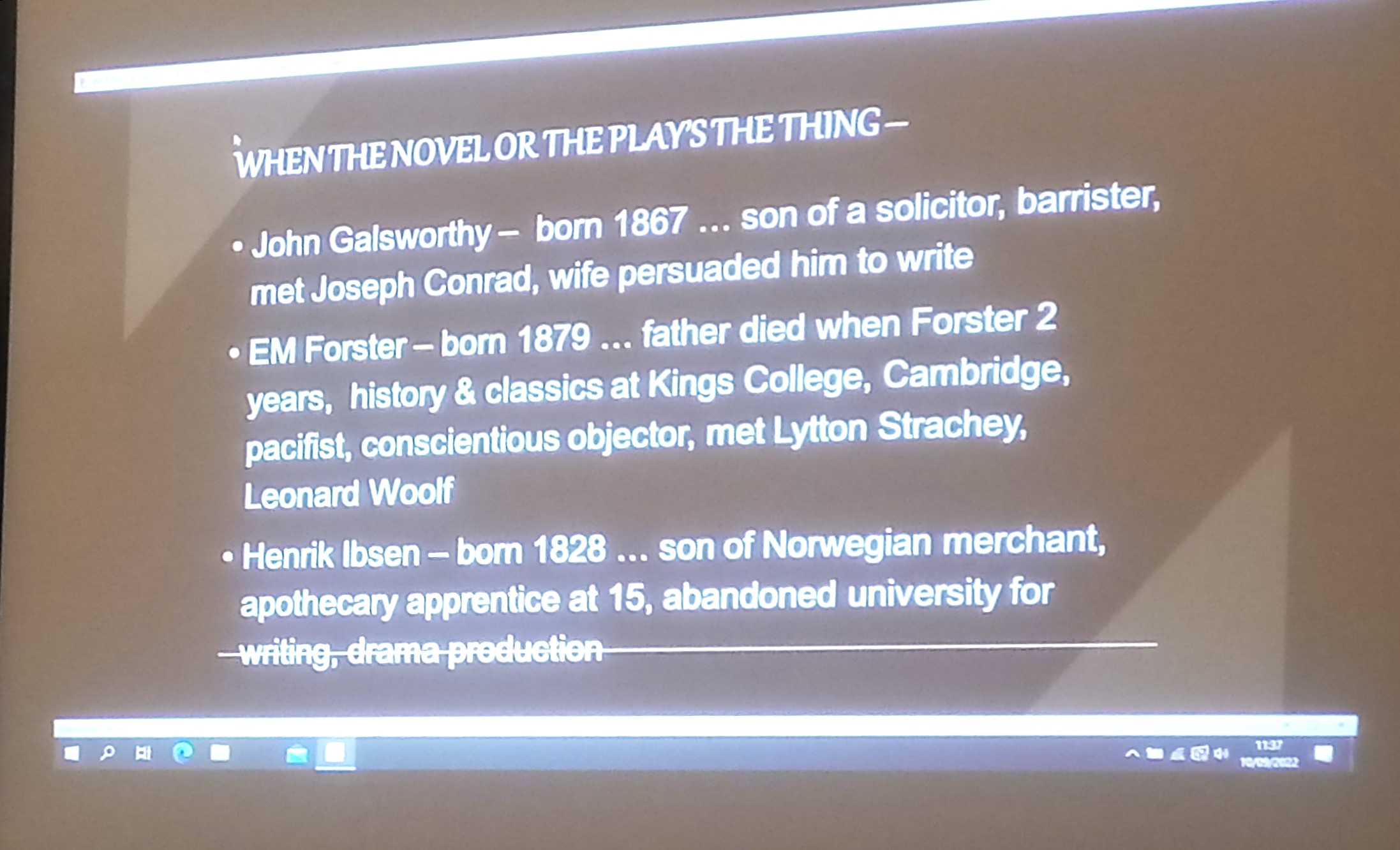
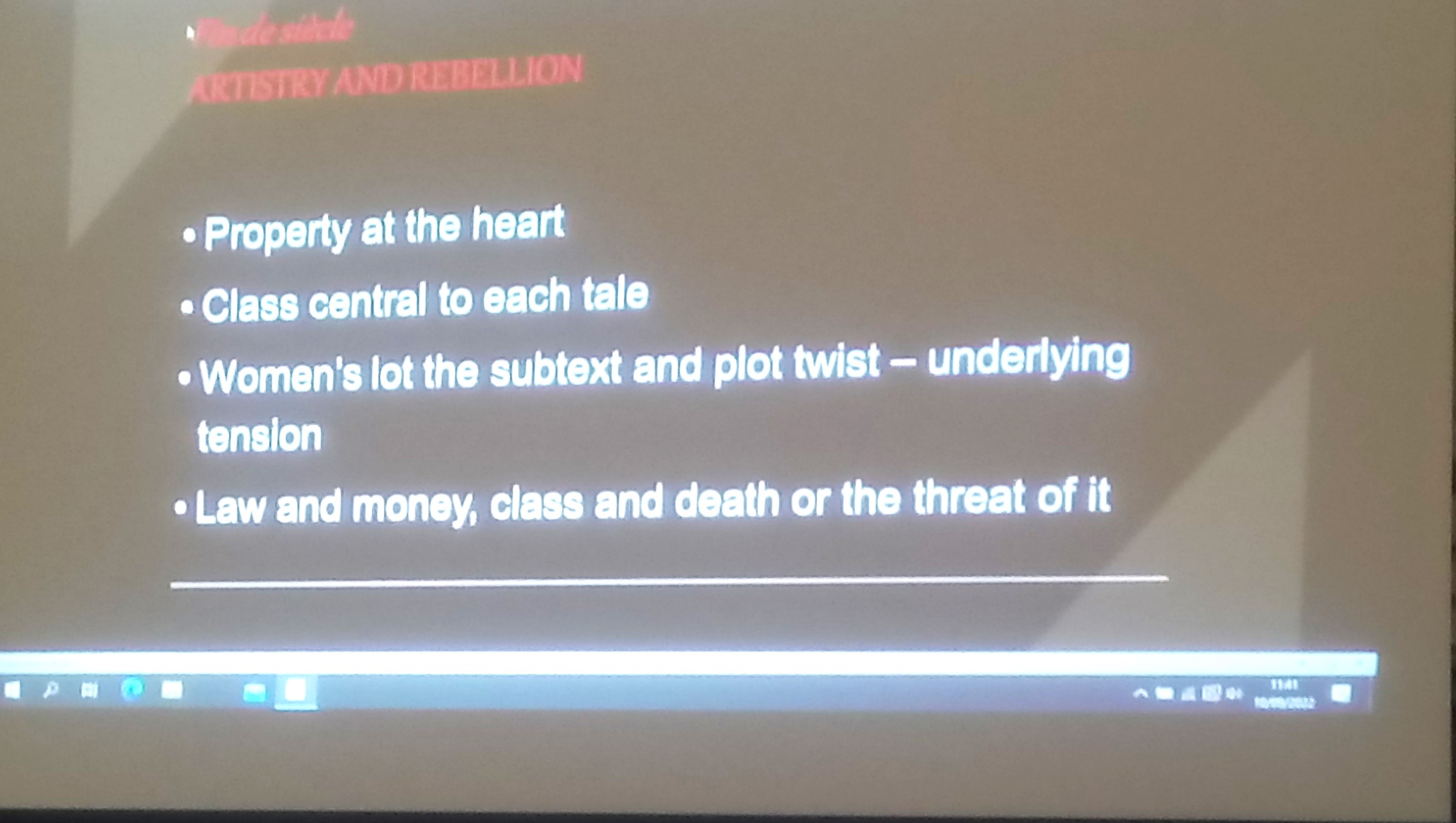
Jocelynne Scutt, Buckingham University, was a speaker on the topic, “When The Novel or the Play’s The Thing – Fin de siècle Artistry and Rebellion. Sex, Class, and Literary Ambition”, using The Forsyte Saga, Howards End and A Doll’s House as references.
From the program notes
We have been mulling over The Forsyte Saga ever since, although the question I asked was about the point Jocelynne made about the pivotal role played in the lives of three daughters of academics of men of indeterminant class in each of the examples. Philip Bossiney the architect in The Forsyte Saga; Leonard Bast, whose umbrella begins the relationship between him and the sisters, Margaret and Helen; and the lawyer, Krogstad, whose actions precipitate Nora’s departure from The Doll’s House.
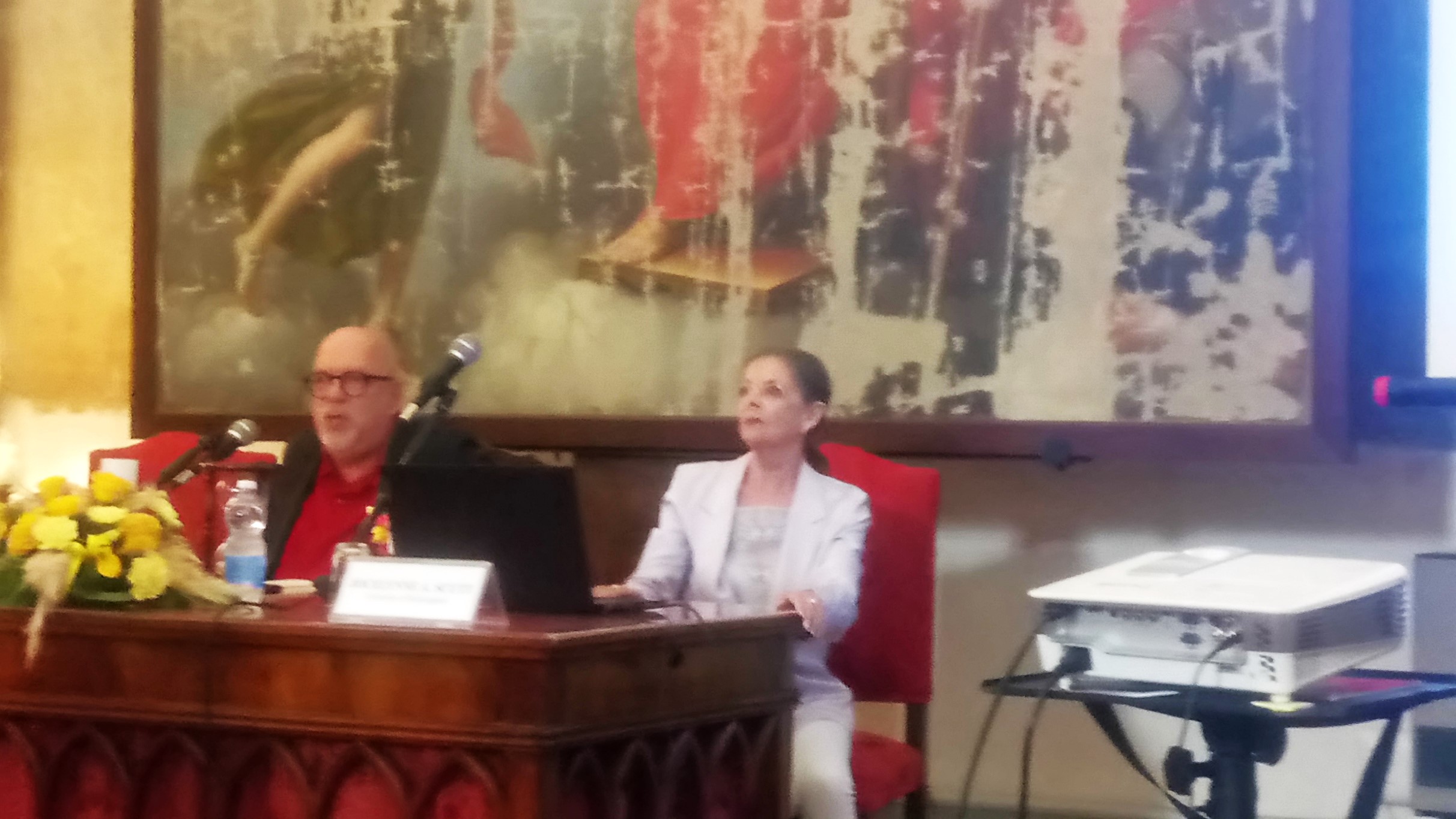
This paper was the source of much discussion, with class dominating as an issue. I cannot draw upon any of the papers at length as papers from the conference are to be published. However, some of the main points appear below, together with Jocelynne’s appearance at the conference.
Another English speaking contributor was Neil Sammells from Bath University. Having recently reviewed Hermione Lee – Tom Stoppard A Life, Books: Reviews, March 2, 2022, I was particularly interested in his having written about Stoppard (1988).
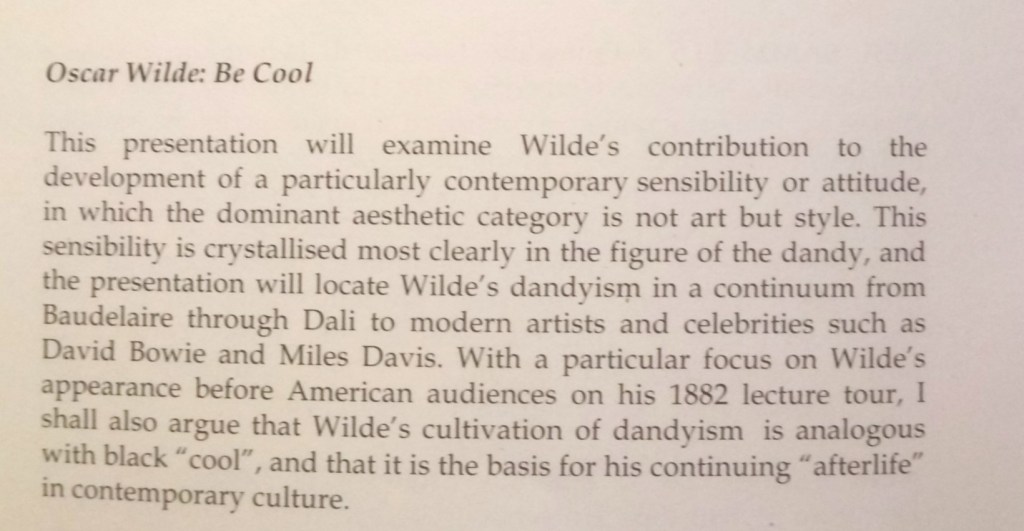
Visual for part of Neil Sammells’ presentation
His topic was “Oscar Wilde: Be Cool”, drawing upon ‘the dandy’ as a motif running from Baudelaire, Wilde, and Dali to modern artists and celebrities such as David Bowie and Miles Davis. His reference to ‘Wilde’s cultivation of dandyism [being] analogous with black “cool” ‘ links to some of the themes in Robert S. McElvaine The Times They Were a-Changin’ 1964, the Year the Sixties Arrived and the Battle Lines of Today Were Drawn, Books: Reviews, August 3, 2022.
From the program notes
Neil’s presentation left a great deal of room for further discussion, and raised some well-informed questions.
Visual for part of Paul Bugliani’s presentation
Paolo Bugliani, University of Pisa, was a great speaker – making me determined to learn more Italian. A Reluctant Decadent? Henry James on “The Yellow Book” was his title. However, his quote in English, associated with David Lodge’s book, Author, Author, encouraged me to ask about the topic in the quote, the role of biographers. According to the quote the role of biographers could be seen as worthy of criticism as trenchant as that aimed at journalists and their ilk. I wondered if Lodge thought the same about autobiographers, who also adapt their material, leave out some, embellish other aspects etc. We had also discussed the pleasure of eating pomodoro versus the crusty bread on which they were served at lunch the day before. All of which makes me interested in reading David Lodge’s book, a favorite of Paolo’s.
From the program notes
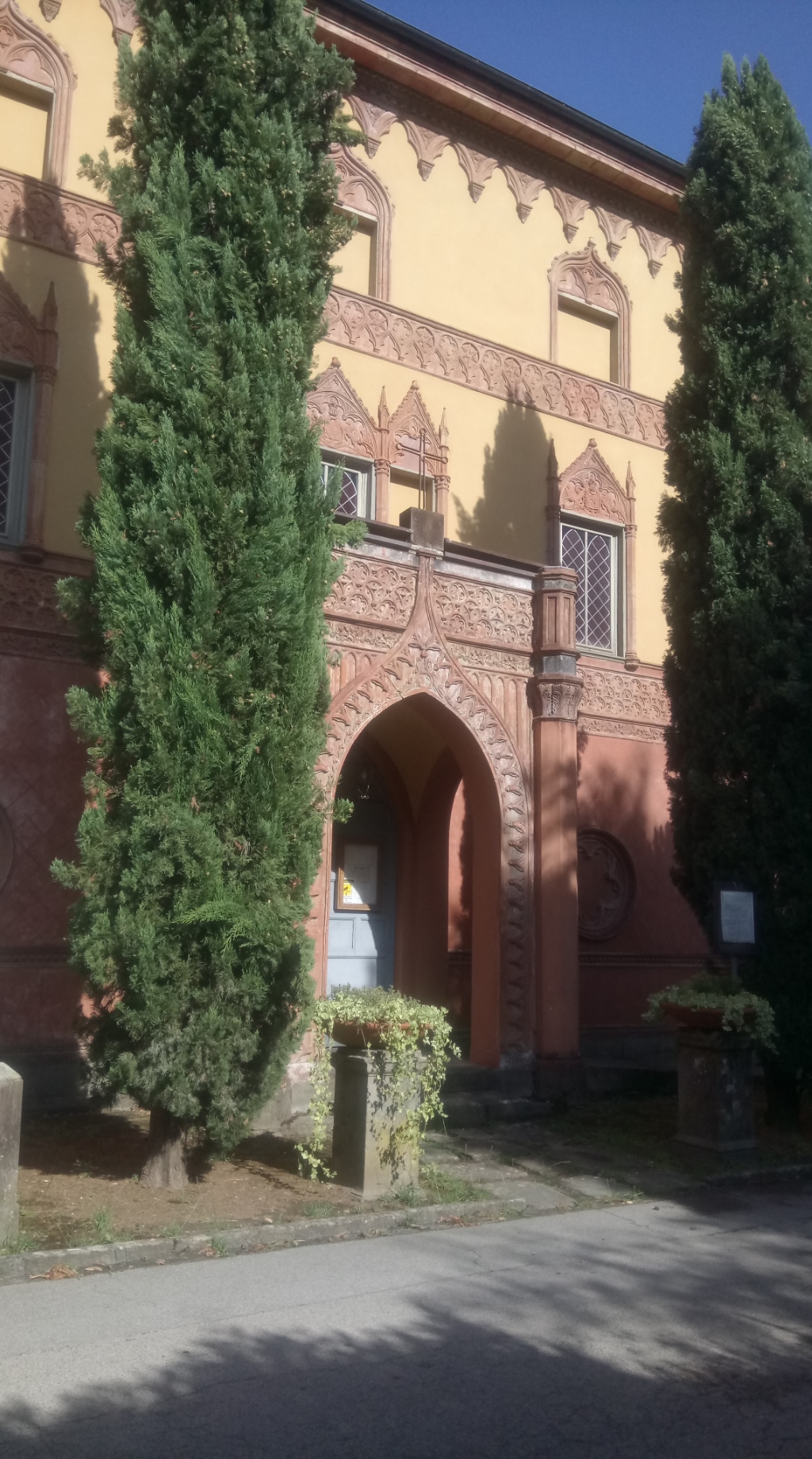
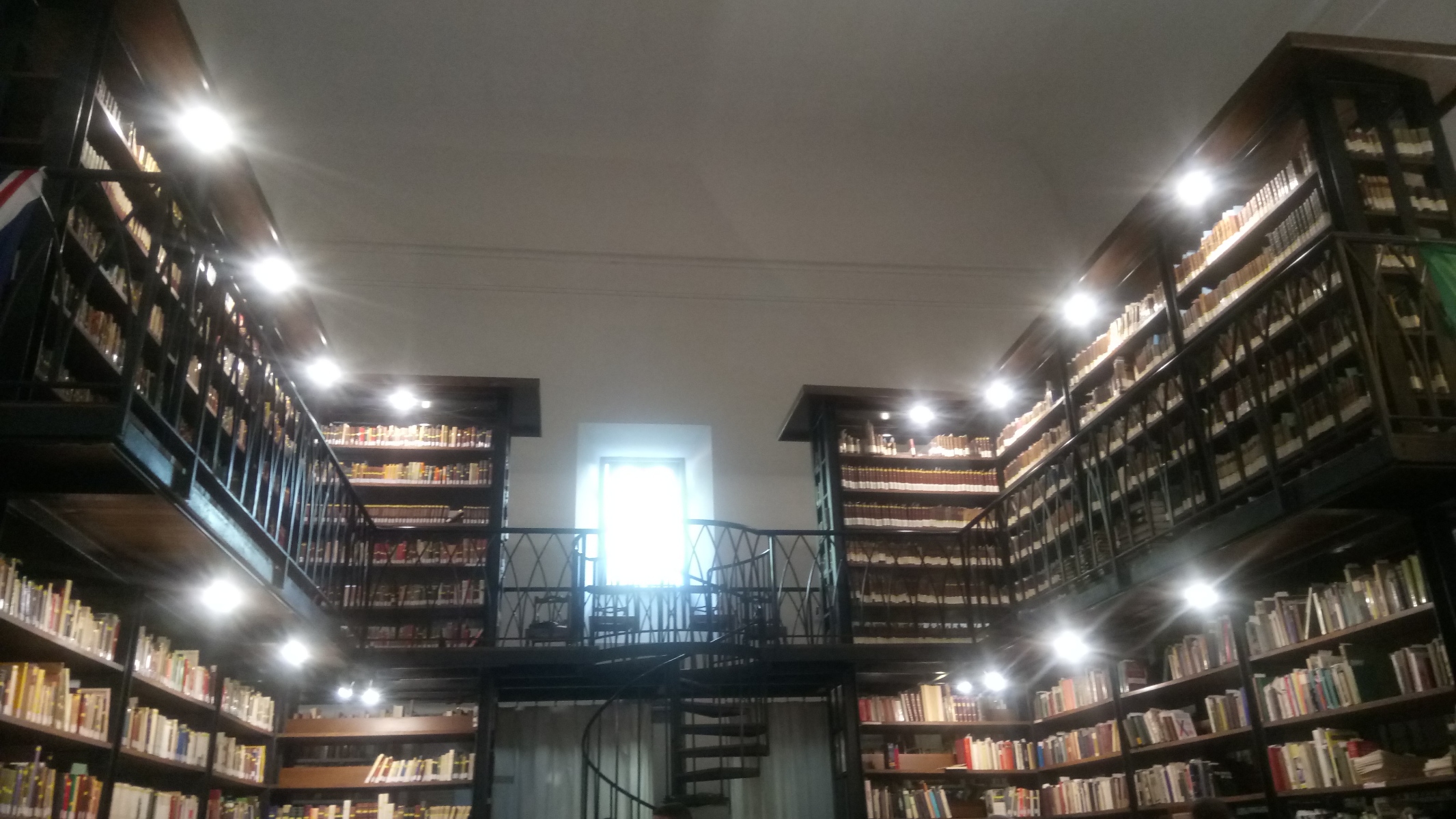
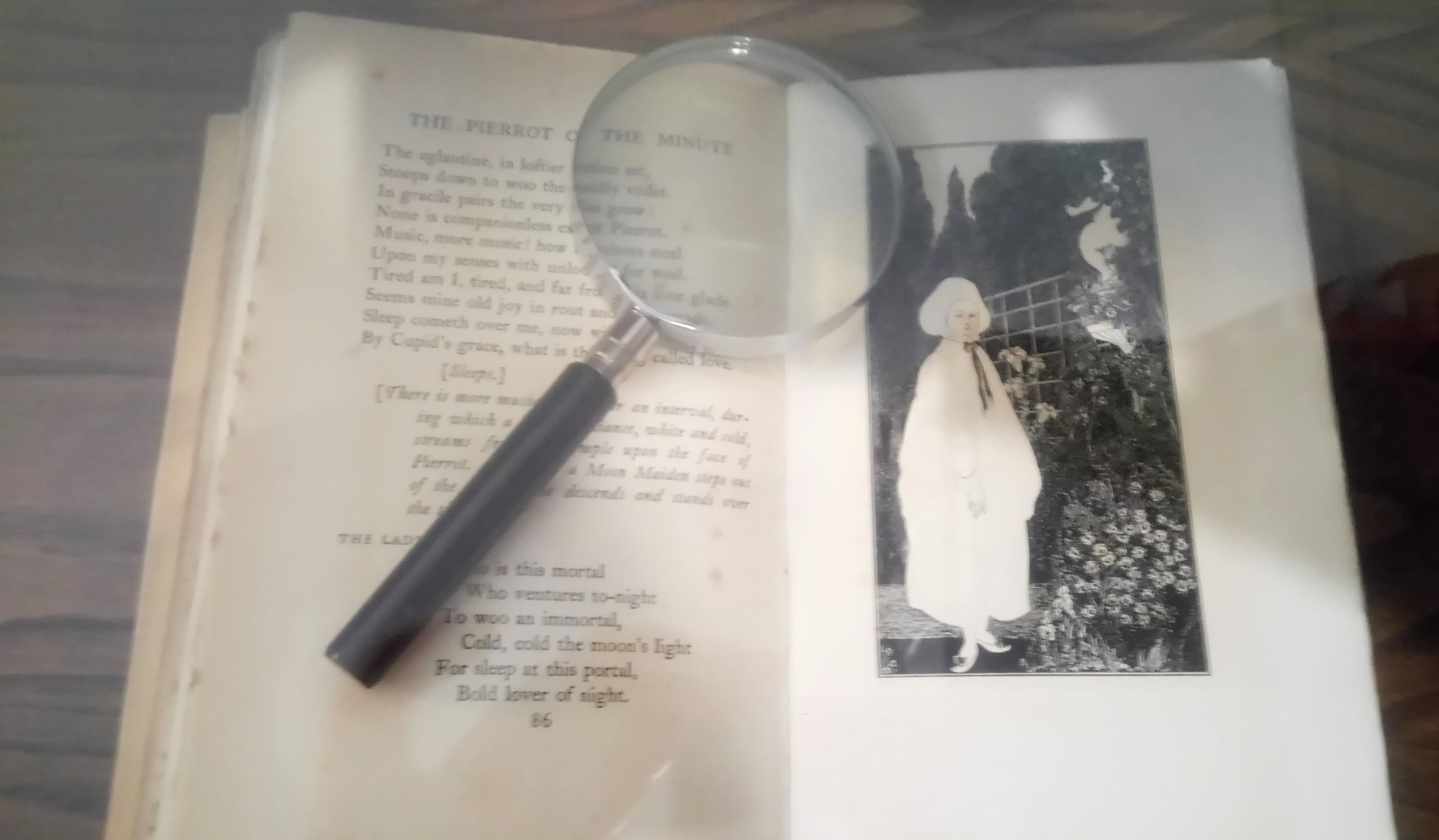
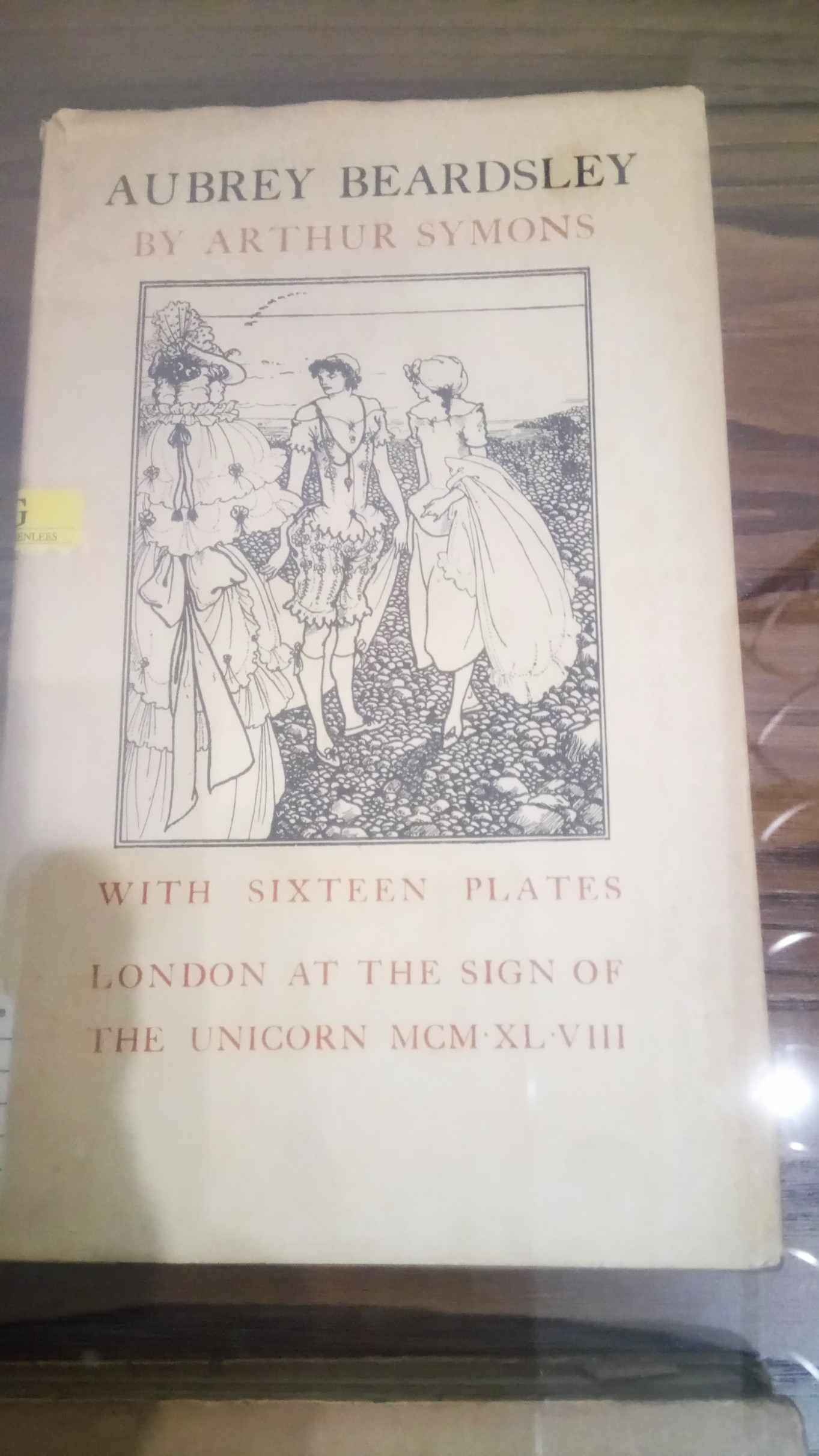
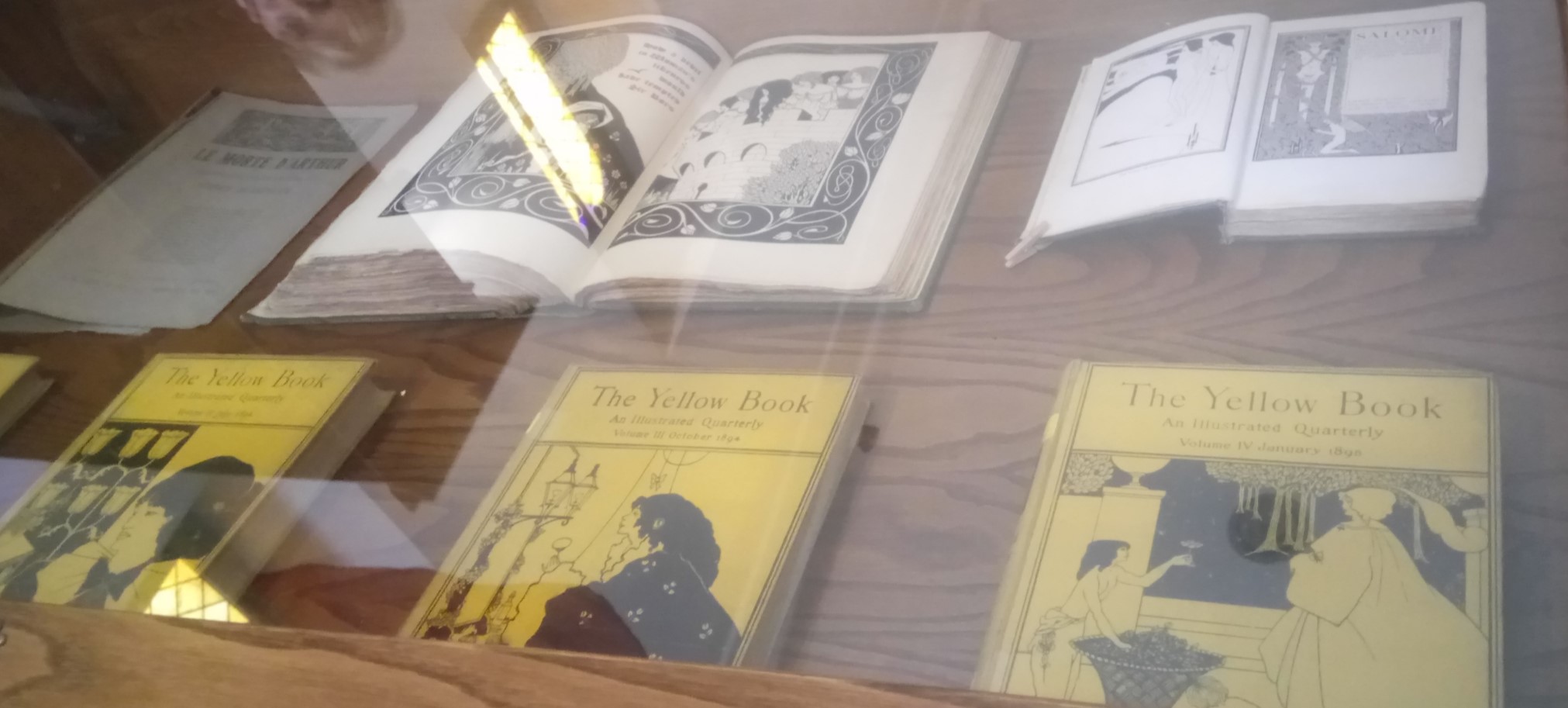
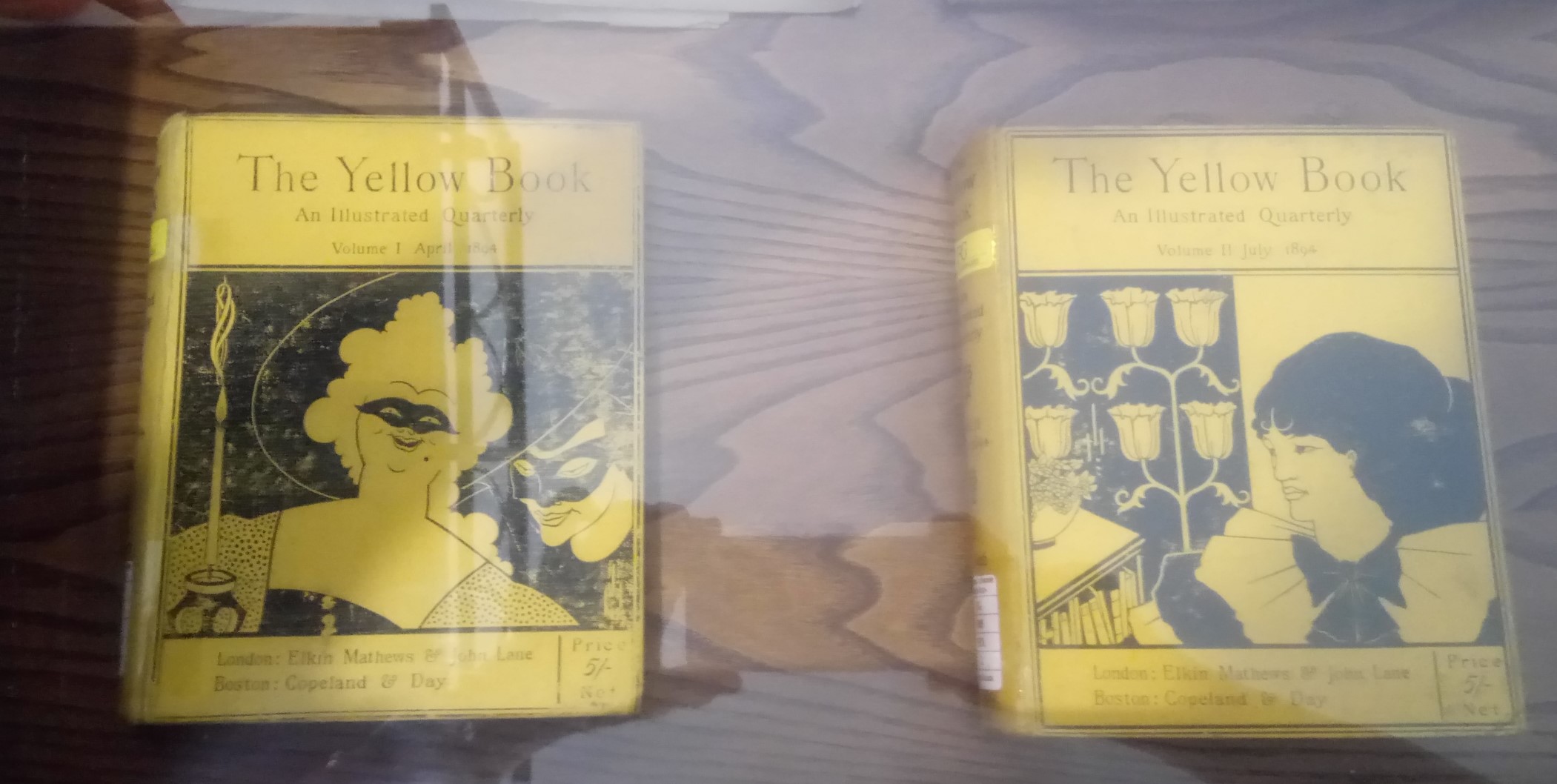
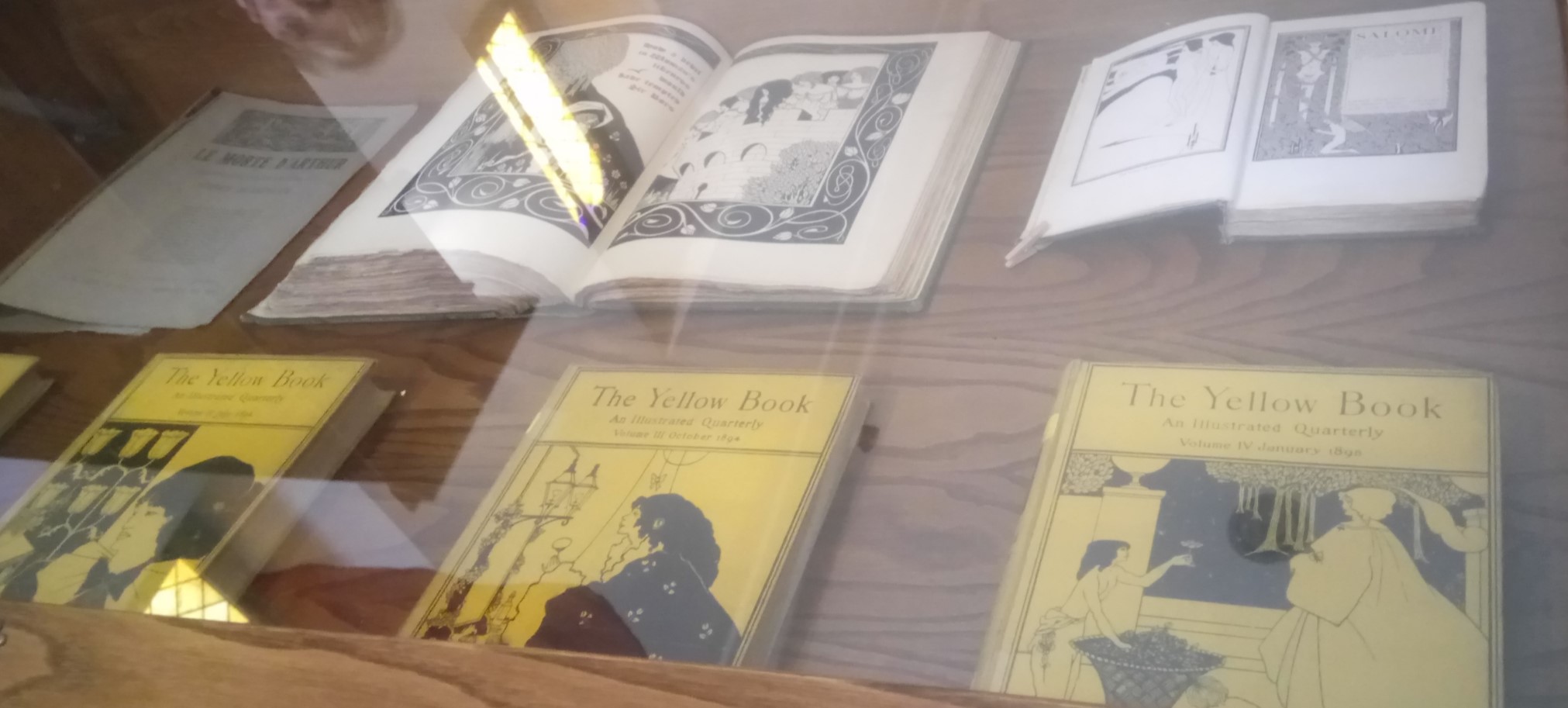
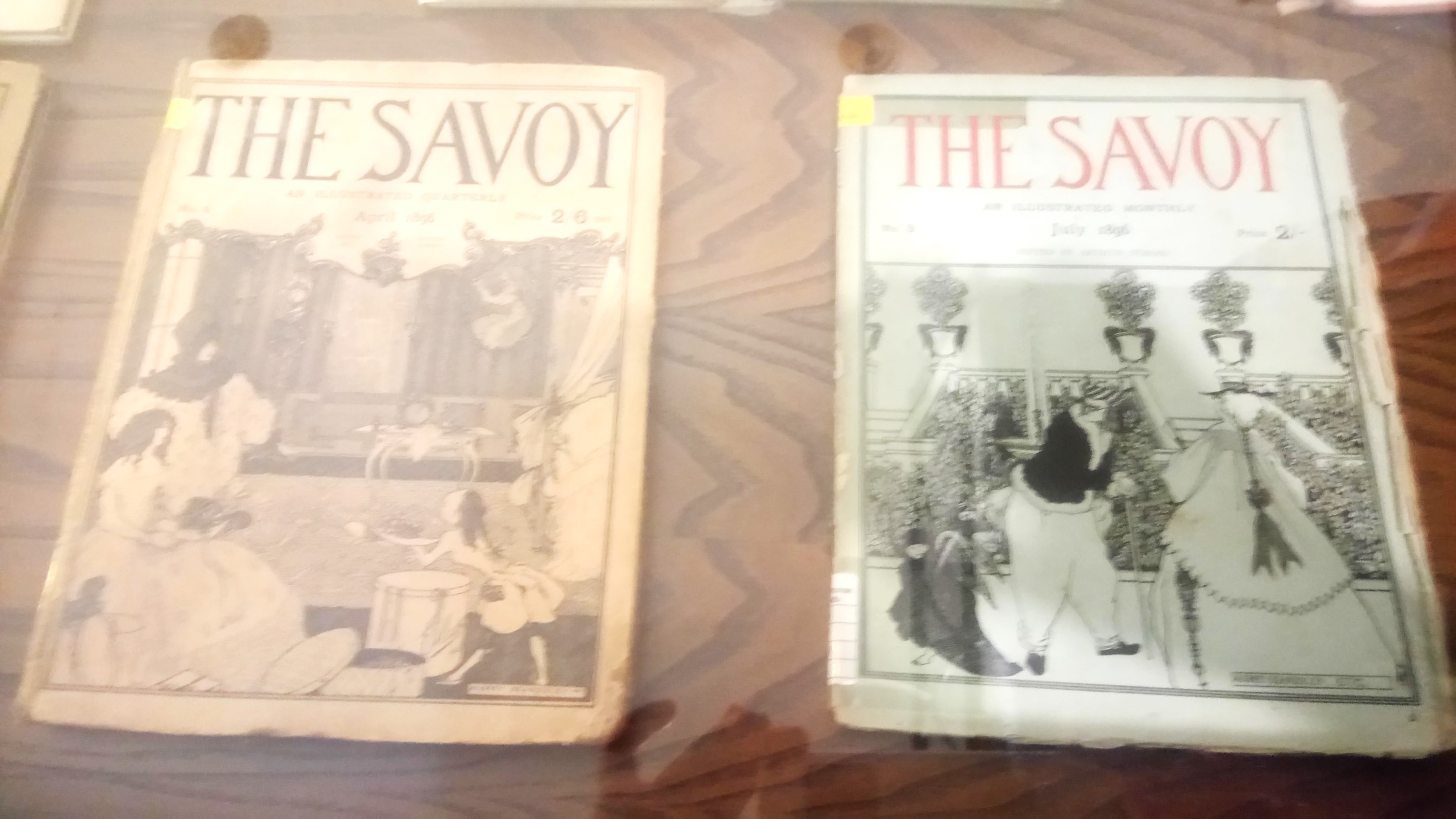
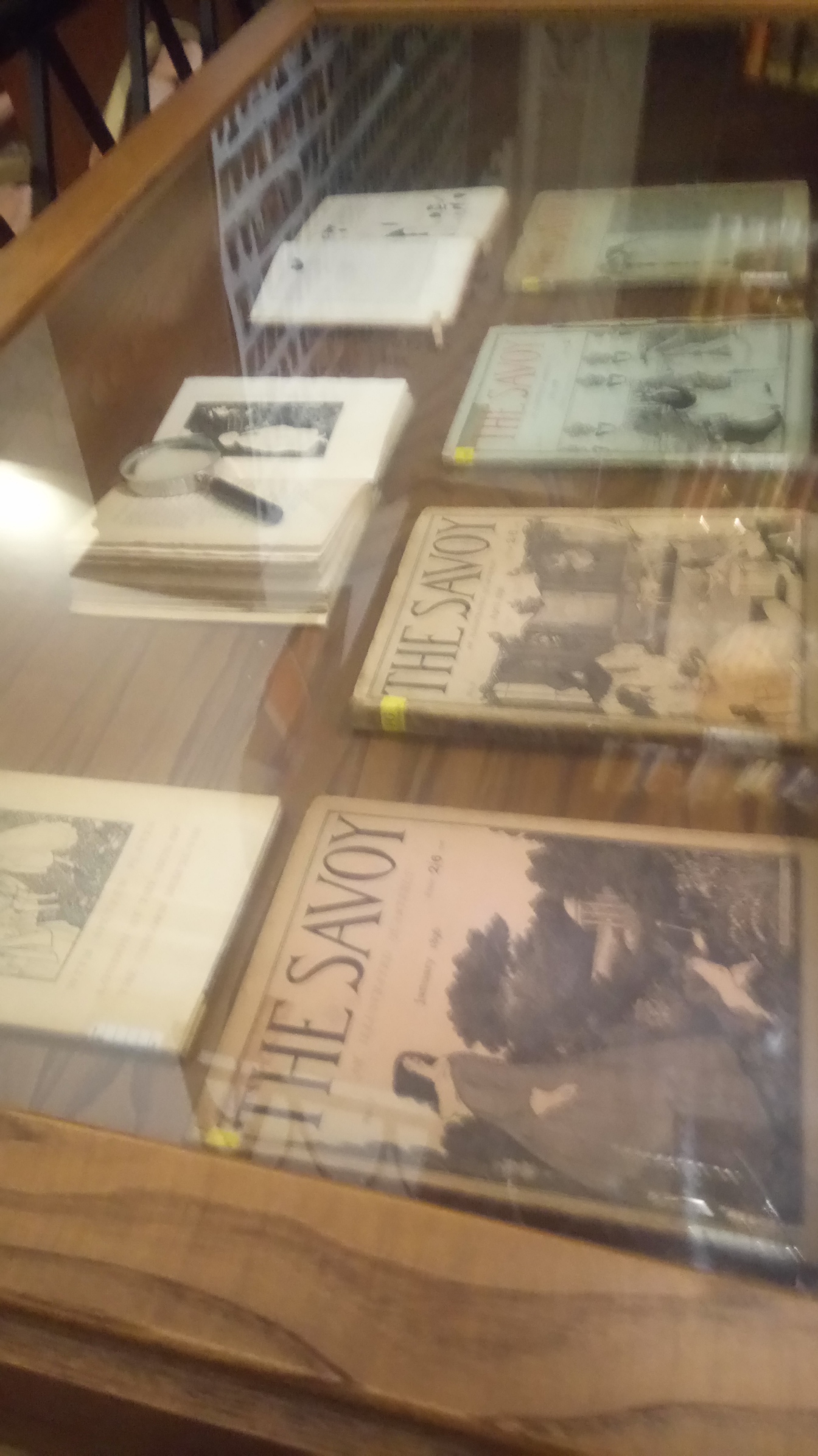
The conference was held at the Bagni Di Lucca Library. Exhibited were examples of The Yellow Book, The Savoy, and Aubrey Beardsley’s work.
Overnight in Pisa
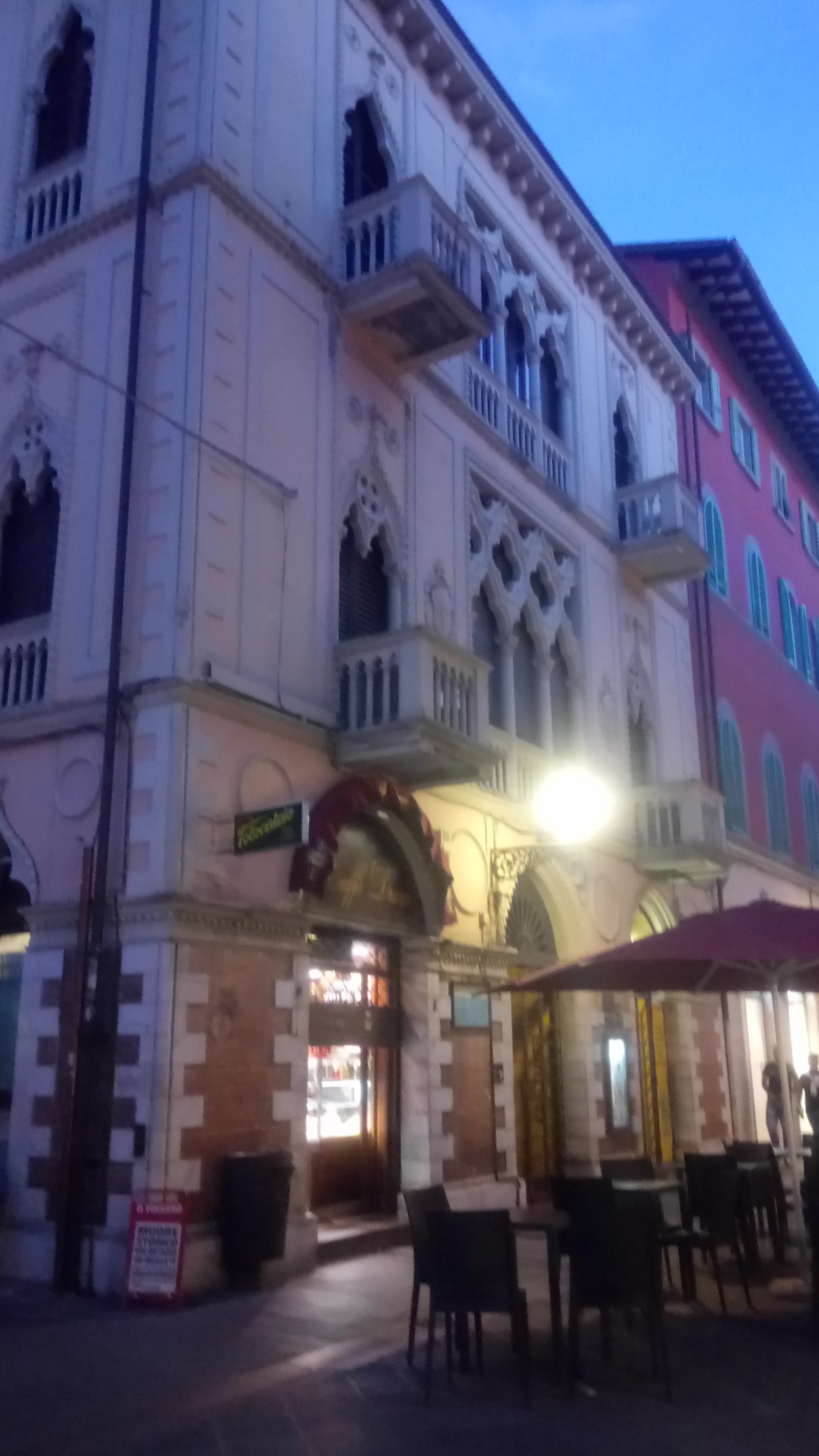
Hotels in Bagni Di Lucca and Pisa
I have stayed at both of these hotels on previous occasions and found them pleasant places to stay at a reasonable price.
The Hotel Regina in Bagni Di Lucca is located on the main road and if you have a front room noise can be an issue. In the summer when the shutters need to be open, this presents a problem for visitors who are disturbed by noise. On the other hand, it could be exciting for others – vicarious singing and happy laughter, and rather wild rides.
On the positive side, the beds are comfortable, the shower works, there are numerous towels, and the rooms are spacious. There is a lift to all floors, and the staircase is wide and well designed for a comfortable walk up and down.
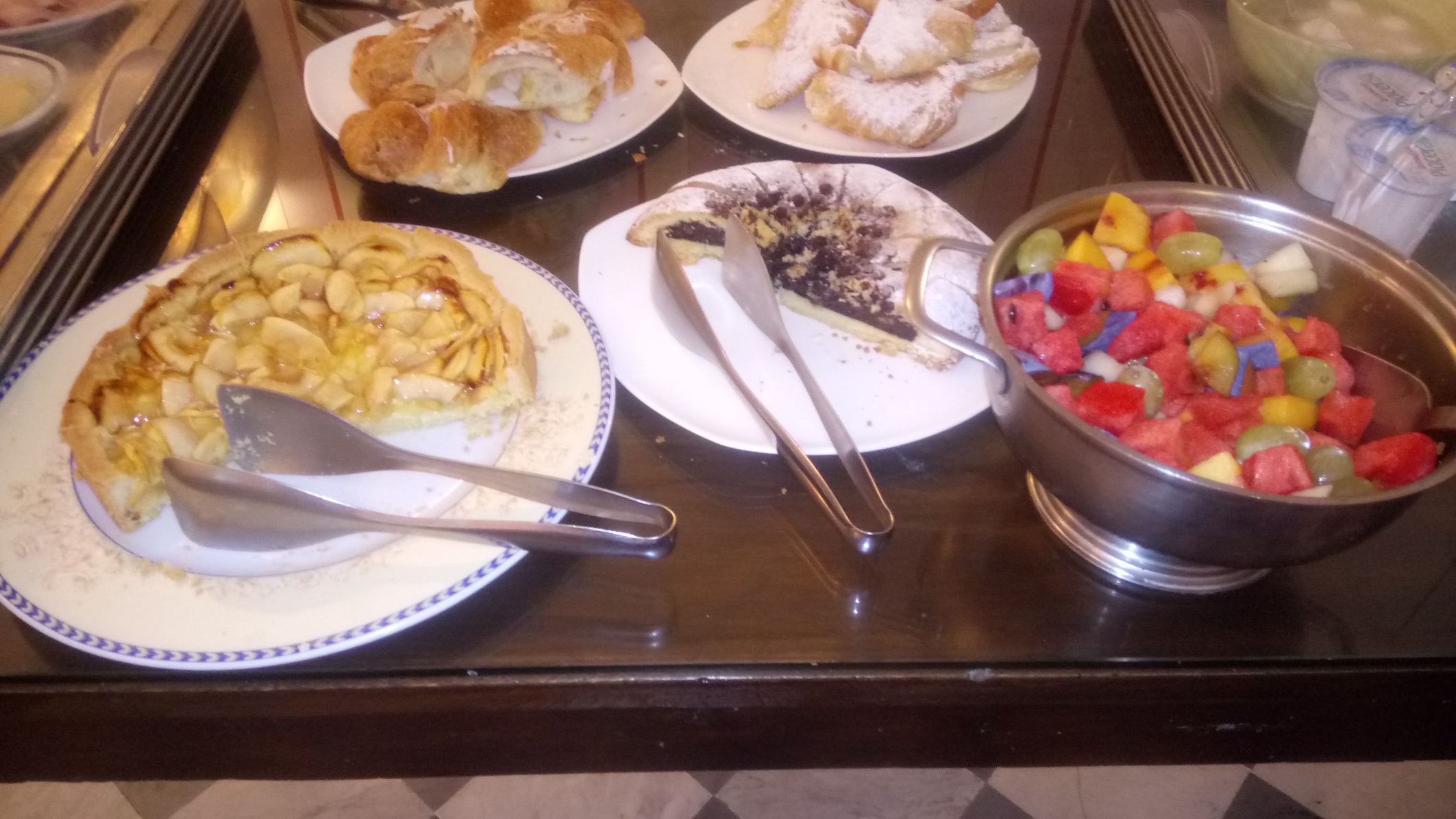
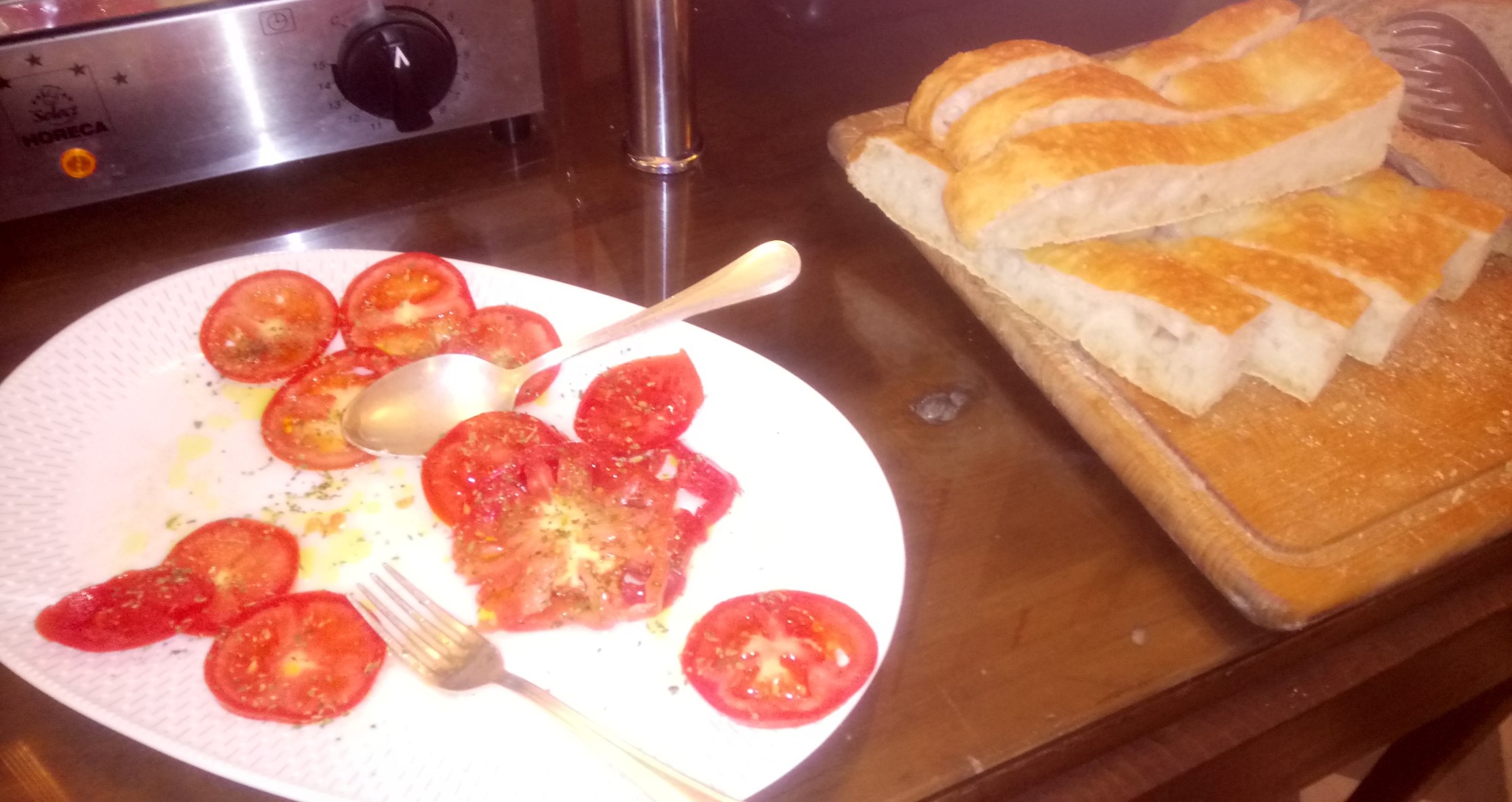
Breakfast is provided as part of the package, and is served in a dining area inside, or on the terrace near the pool. Pomodoro with basil is served with two choices of bread, boiled eggs, meat and cheese complete the savoury offerings. The cake and tart range is generous, and delicious. There is fruit salad and the beverages include fruit juices, and coffee. This is served – no awful machine coffee.
Roberto the proprietor, is friendly and helpful. He speaks English, and tolerates my bad Italian attempts. The prices are very reasonable.
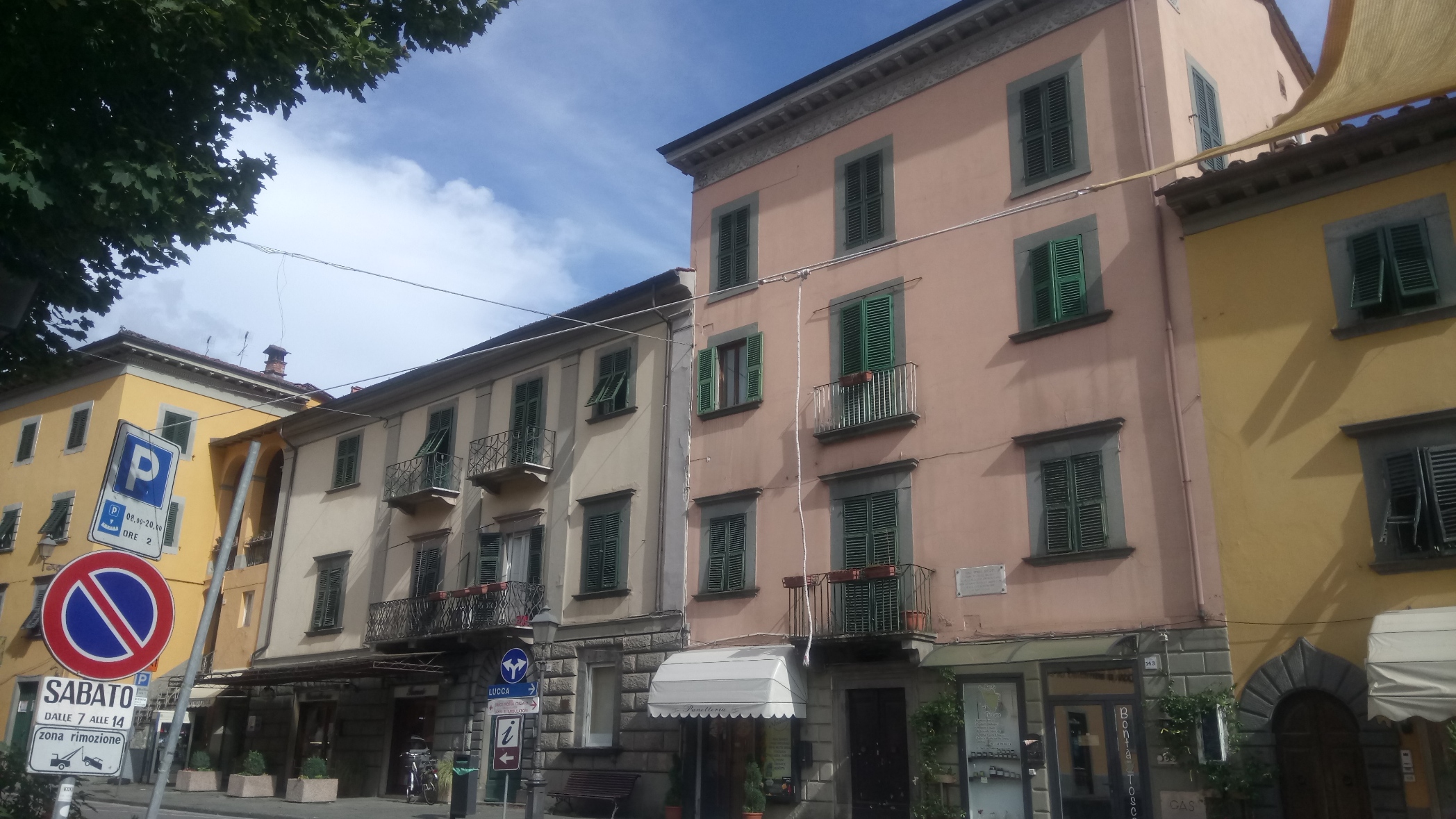
The bus stop is nearby if you take the bus from Lucca to Bagni Di Lucca. The railway station is a taxi drive away. A supermarket is close, and the restaurant next door serves a wide range of pastas, risottos, pizzas and salads. Coffee shops, clothing shops and cafes are nearby, and there is a fruit and vegetable market held weekly in the vicinity
I have enjoyed my several stays here, and intend to return.
Hotel Bologna in Pisa was a find several years ago. The star of the hotel was its magnificent breakfast. However, this has been replaced with something a little more ordinary with a change of ownership. Nevertheless, this remains a very attractive place to stay in Pisa. It is a short and simple walk from the station, the staff are friendly, there is a shuttle bus to the airport for 2 euros and there is an abundance of shops and eating venues in close proximity.
The rooms are large with firm but comfortable beds, with extra pillows and blankets – something missing from many of the hotels I have stayed in recently. The bathroom is decent enough, with good towels and a shower that works well.
There is a lift in part of the building, but be warned that the additional accommodation apart from the main building has no lift and there are rooms several flights up. We struggled up the stairs to one of these on our most recent visit.
Although I was disappointed in the change to what was a very grand breakfast, I would stay here the next time I go to Pisa.
Queen Elizabeth and Winchester Cathedral *
Flowers had been placed around the fences of Winchester Cathedral, and inside, a service for Queen Elizabeth 11 was advertised. This was a quiet and peaceful recognition, unlike the crowds, helicopter and large police presence last night as we walked through the rainy streets of Paddington.
The news coverage in Bagni Di Lucca and Pisa was muted – BBC stories about Queen Elizabeth, the ceremonial processes, the family, and memories, taking their place with other world news. On returning to London, and reading about the coverage in Australia, it appears that this was a kindly aberration. On the other hand, one can always read a book if the television is boring, an experience that has confronted everyone before this event, I imagine.
As we left the Cathedral flowers were being gathered ignominiously into a black garbage bag. A rather sad reflection on a determination to be tidy.
*There will be more coverage of Winchester Cathedral next week.
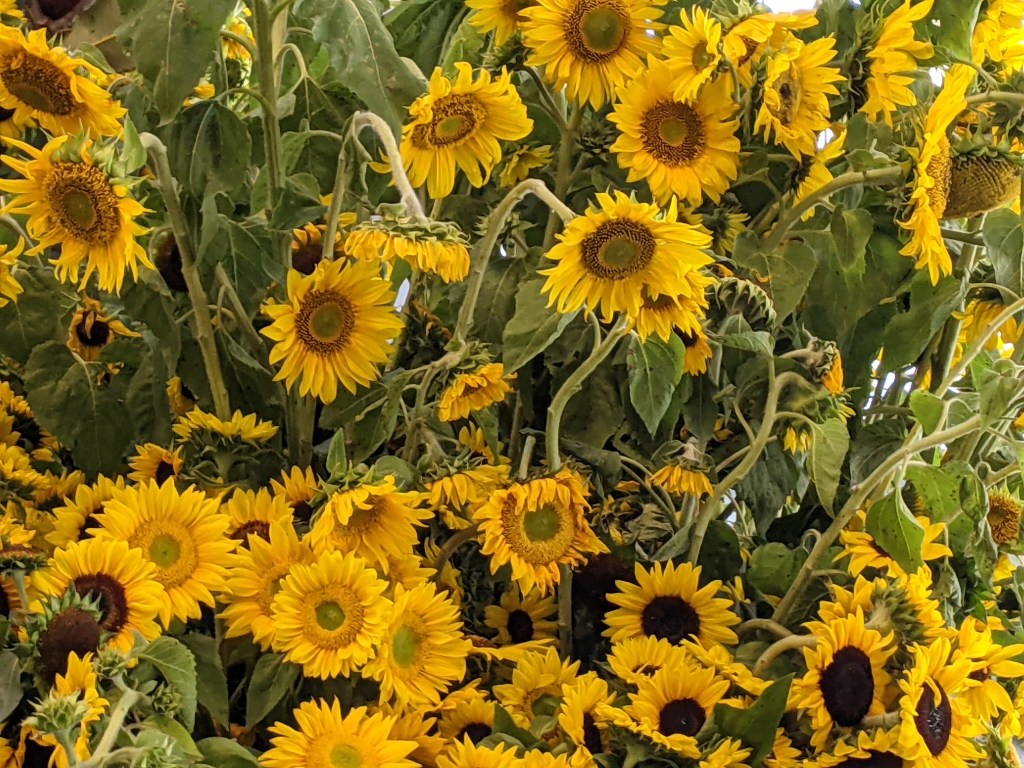
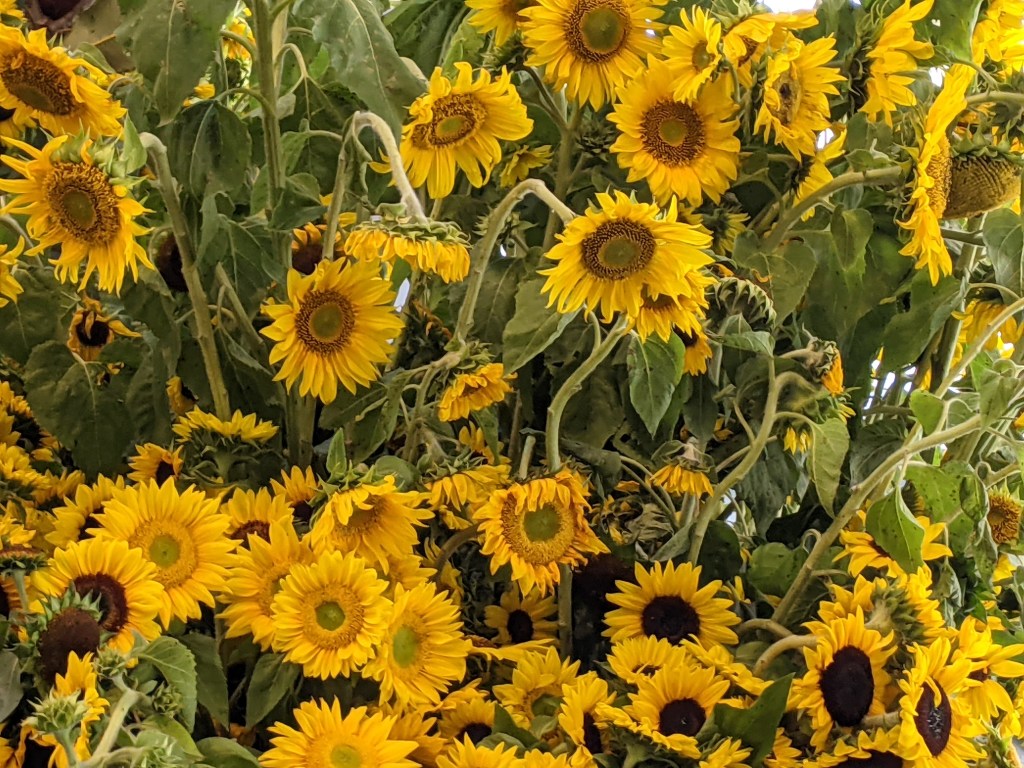
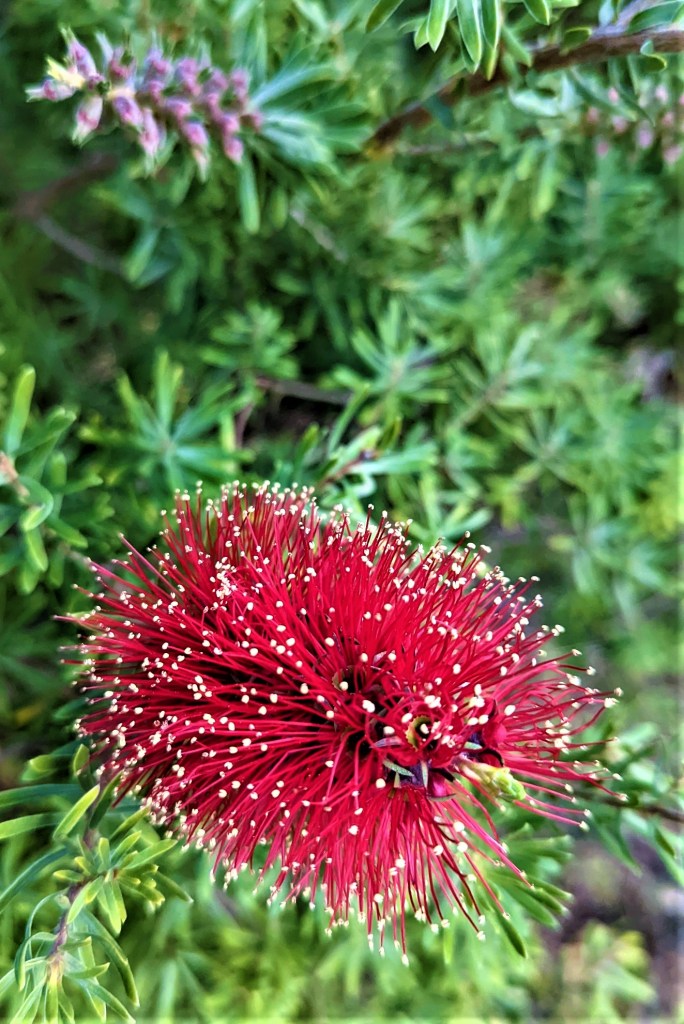
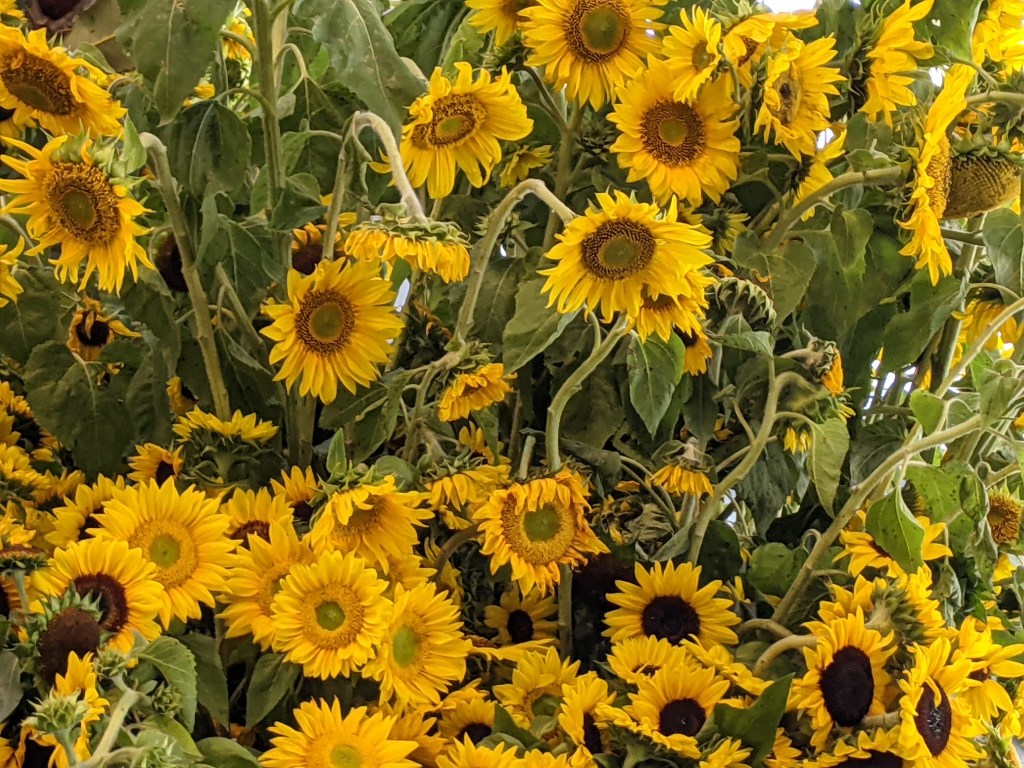
Wattle in Canberra instead of sunflowers this time – may the latter flourish
Thank you, NetGalley, for providing me with this uncorrected proof in exchange for an honest review.
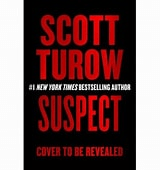
It is a long time since I read Scott Turow’s Presumed Innocent for the first time, and not so long ago that I re-read what I still believe is a very smart novel with an excellent twist. I hesitate to refer to the twist, as that phrase has become so trite with so many novels claimed to have such a feature – or even several – that it is no longer something I find particularly enthralling. Of course, when there really is a twist, when it is placed there for a purpose (as in Presumed Innocent) other than a headline in a review, I am as impressed as anyone. Perhaps my admiration for the smartness of Presumed Innocent spoiled me for Suspect, although thankfully it does not have a confected twist! Rather, this is a straightforward investigation of the possible set up of the Chief Inspector, Lucia Gomez-Barrerra, during mayoral election year in an American community of around 120,000 people. See Books: Reviews for complete review.
Following the Covid update: Cindy Lou eats out in Paddington; Train trip to Deal; Bob McMullan – US Senate election update; visit to Wallingford; feminist sign on Regents Canal.
Covid update Canberra
Cindy Lou eats out in London, with Paddington as her base
Paddington is alive with eating places, with its pubs, chains, and the excellent Pear Liang which is the star of the lower concourse of eating places in Sheldon Square – perhaps of all !
Pearl Liang Sheldon Square
The Pearl Liang is lively, but the level of noise is easy to manage as the tables are placed at a distance, and there is no music. There are three areas of seating so a less busy section could be requested. The dishes are generous, so it is easy to over order.
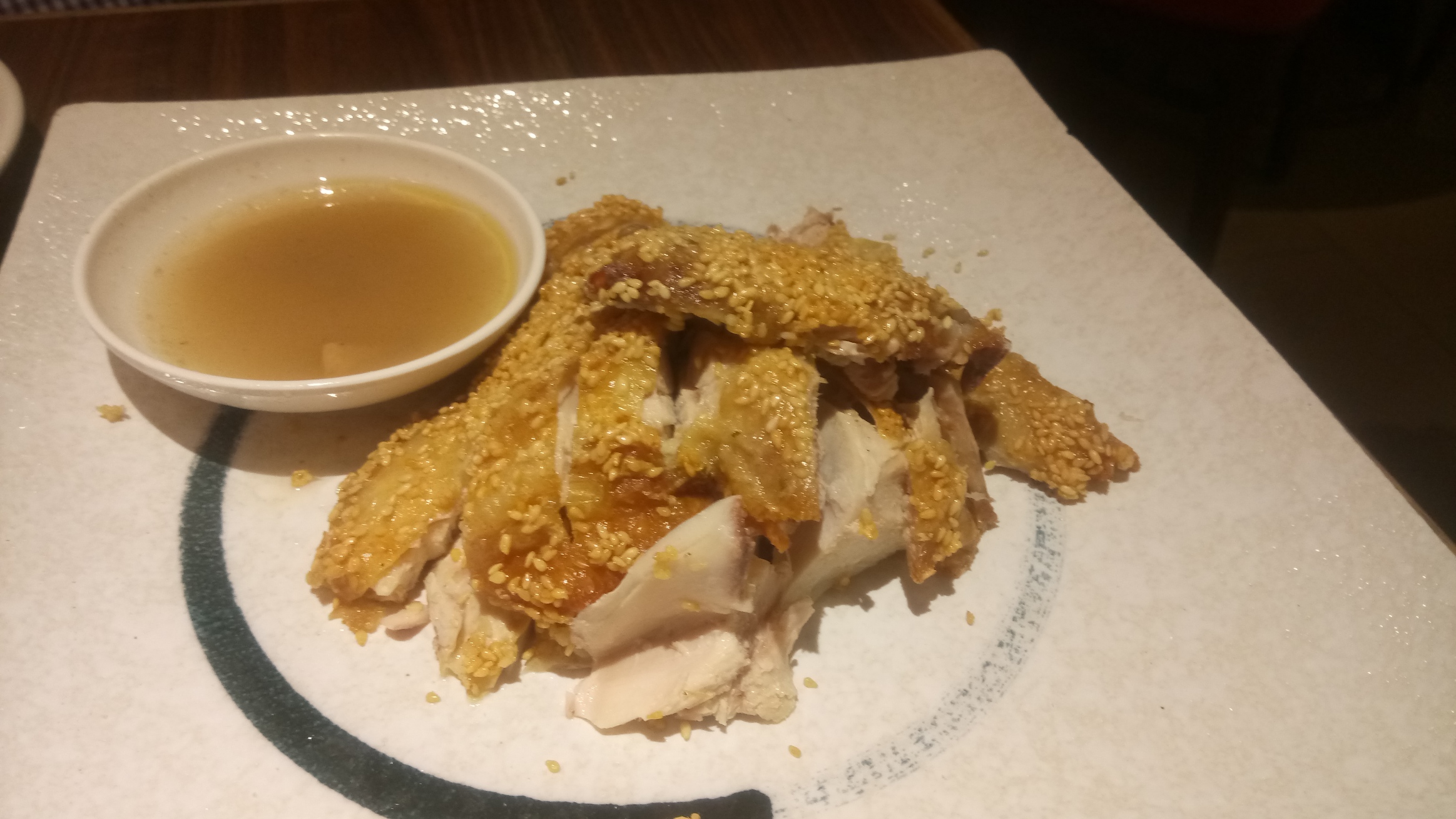
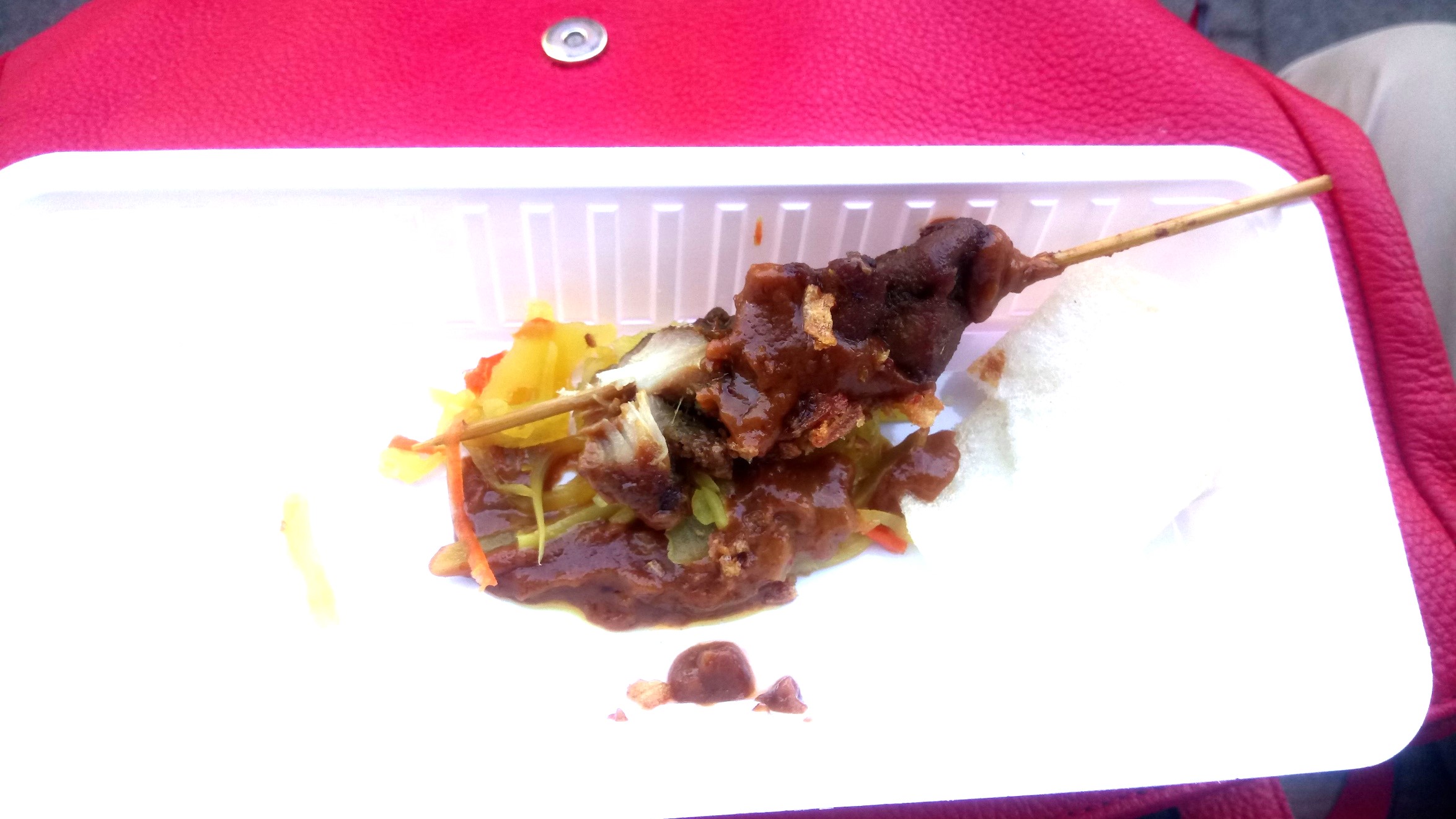
With starters of prawns, and sate chicken, vegetables, and two chicken dishes with rice, this is exactly what happened on this occasion. The prawns were succulent, with light pastry casings -and six of them! It was interesting to see the difference between the sate chicken served here, with its light sauce, and the somewhat heavier version served in Amsterdam’s sate chicken. The sweet and sour chicken was also deliciously lightly sauced, with the sesame chicken being generously coated with sesame seeds. The garlic sauce with this dish was a little disappointing. However, everything else was delicious, and this restaurant remains a favorite.
Wine and fortune cookies
Service is efficient and friendly and seating is comfortable. The restaurant has been well patronised each time we have visited, some patrons ordering the more exotic dishes such as razor clams, which is a fascinating sight for those of us who are not so well versed in Chinese cuisine.
MassisSheldon Square
Massis serves fresh delicious food that can be easily shared. The menu is extensive, and includes salads, chicken, beef and lamb dishes, a range of dips, warm Lebanese bread, and traditional desserts. There is inside and outside seating, the wait staff are friendly, and the seating is comfortable. This is an excellent venue for groups, but as pleasant for couples. The table settings are bright and attractive.
The food below is a tabouli – thick with crisp, fresh parsley and served with a lemon wedge; a Fattoush salad with a generous amount of pomegranate seeds; tender chicken pieces with coleslaw and bread; and succulent haloumi.
Pizza Express is a pizza chain which offers more than pizza. I recall it being referred to as an upmarket pizza restaurant by the Barbara Pym Society, when years ago we all gathered at the Oxford location for a pre-conference meal. On that occasion Pizza Express managed a multitude of orders with panache. When two of us visited the venue in Merchant Square, a lovely partially cobbled walk from Paddington Station it offered the same service.
It was great to sit outside across from the water feature in Merchant Square. Tower blocks of apartments jostle with shopping, making this a vibrant place to eat and contemplate being in London.
We order the slow roasted tomatoes with garlic and oregano (67 calories) and a Leggero Pomodoro pizza, with the hole in the middle resplendent with a green salad (573 calories). This was an excellent sharing menu for a fasting day on the 5:2 diet.
Note the roof gardens on the apartments.
A train trip to Deal
Deal is a town in Kent, England, which lies where the North Sea and the English Channel meet, 8 miles (13 km) north-east of Dover and 8 miles (13 km) south of Ramsgate. It is a former fishing, mining and garrison town whose history is closely linked to the anchorage in the Downs. (Wikipedia)
We were interested in seeing the French coast from the town – possibly the smudge on the horizon was France. The following references to Deal in fiction are possible more likely to be able to be seen. references to Deal
References to Deal in Fiction (edited version from Wikipedia)
Dickens, garrisons Richard Carstone in Deal in Bleak House. Deal is the setting for local novelist George Chittenden’s smuggling saga, which is set in the late 18th century when the town was a haven for criminal gangs smuggling contraband across the English Channel. In Chittenden’s debut The Boy Who Led Them a child rises through the ranks to control the biggest smuggling gang on the Kent coast, fighting wars with rival gangs and revenue men at every turn. Jane Austen refers to Deal in Persuasion. Deal is the setting for Moonraker (Ian Fleming, 1955). Horatio Hornblower , The Commodore by C.S. Forester, departs from Deal on his voyage to the Baltic.
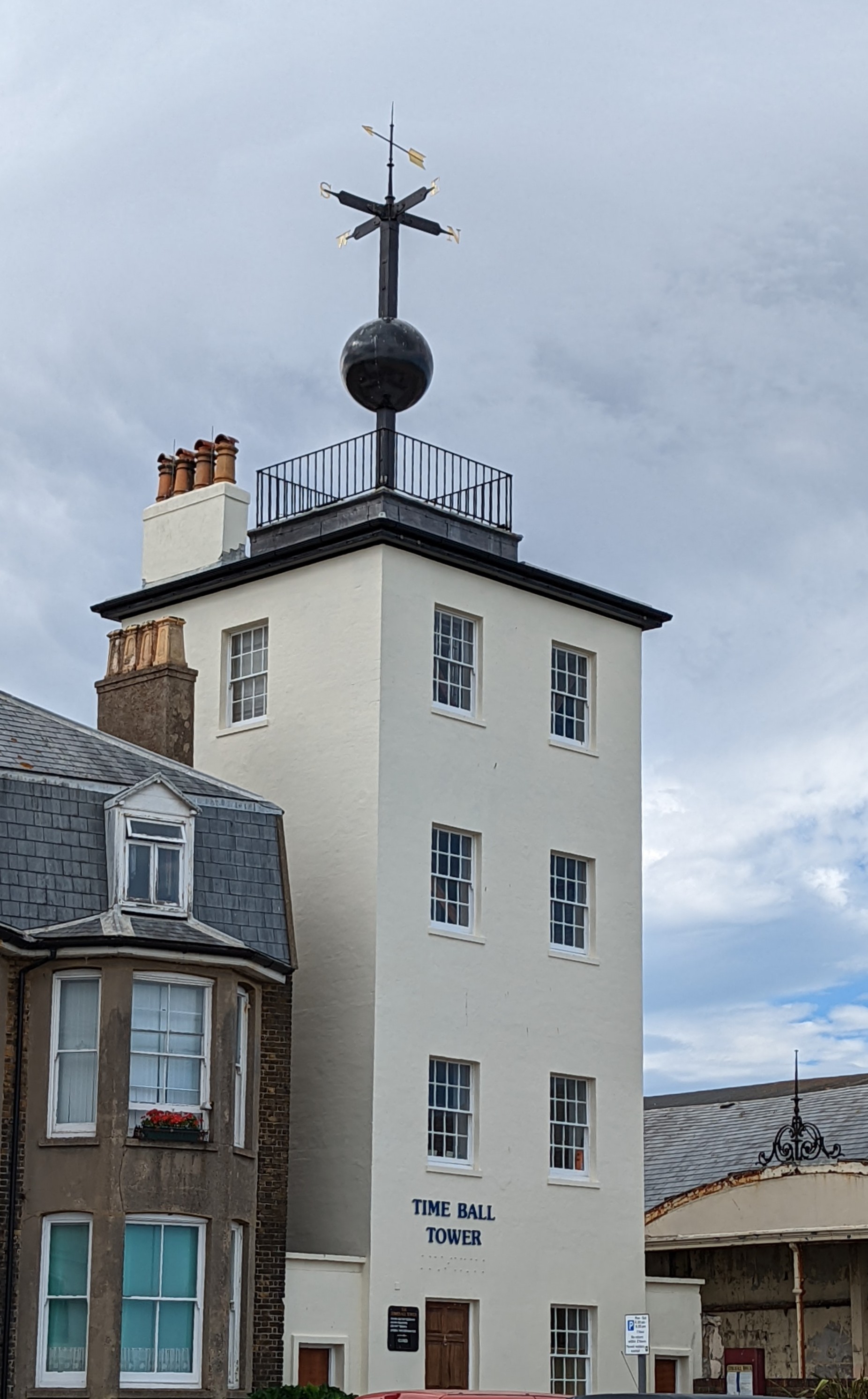
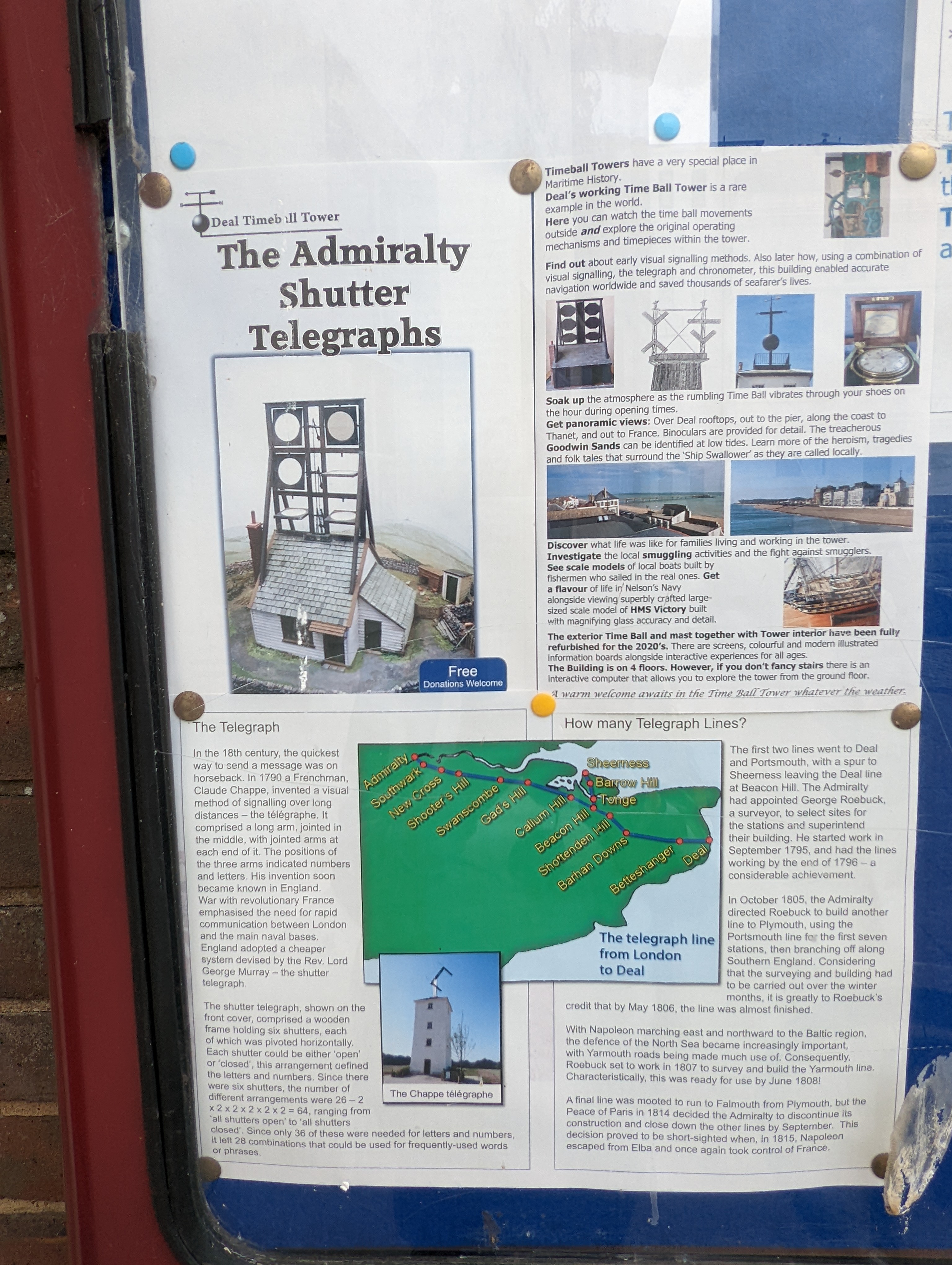
The Timeball Tower was a particularly attractive part of our visit as it reminded us of the great time we had in Greenwich with one of our daughter’s family several years ago. From recall, that was a very cold occasion, while this trip took place on a very hot summers day.
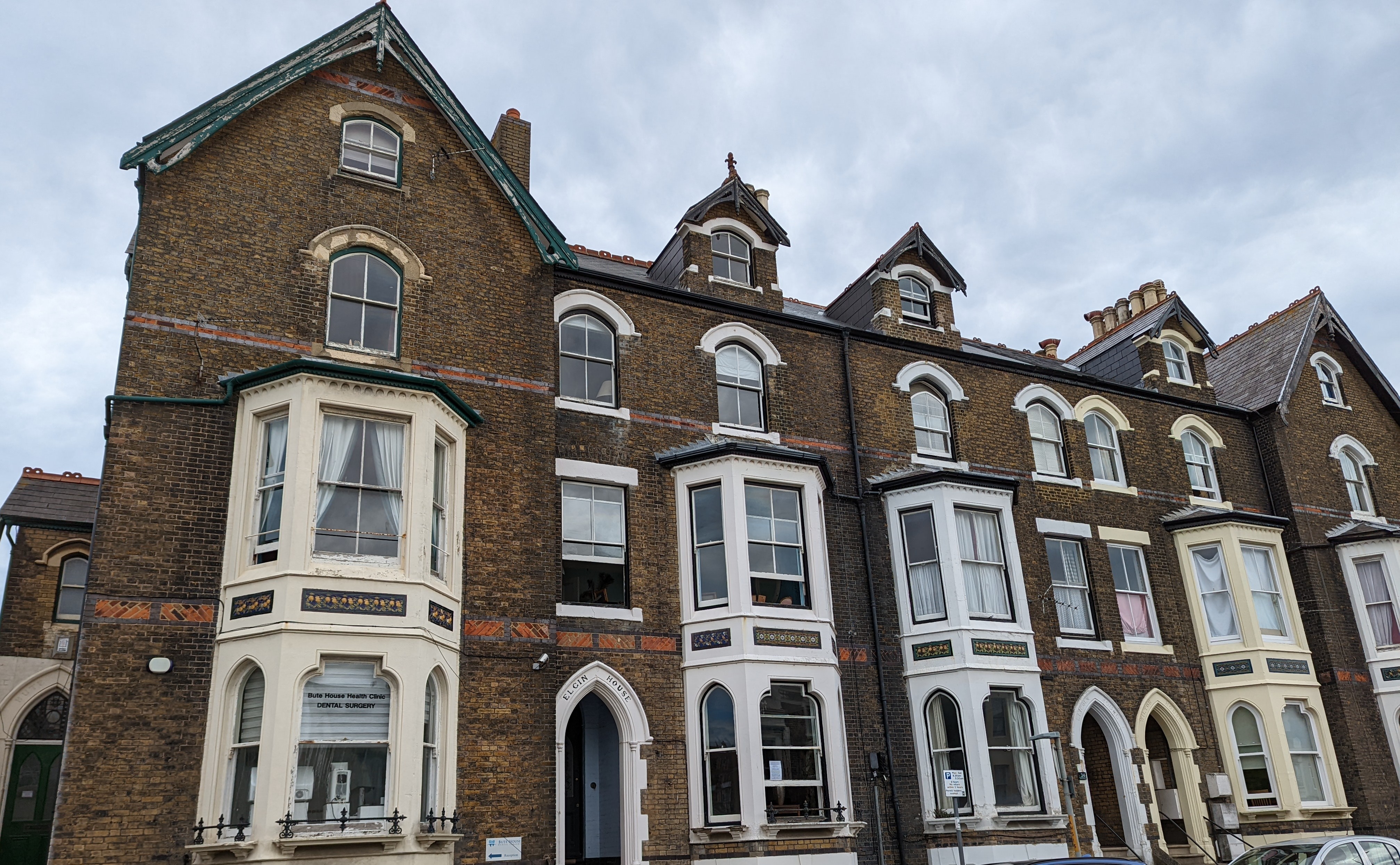
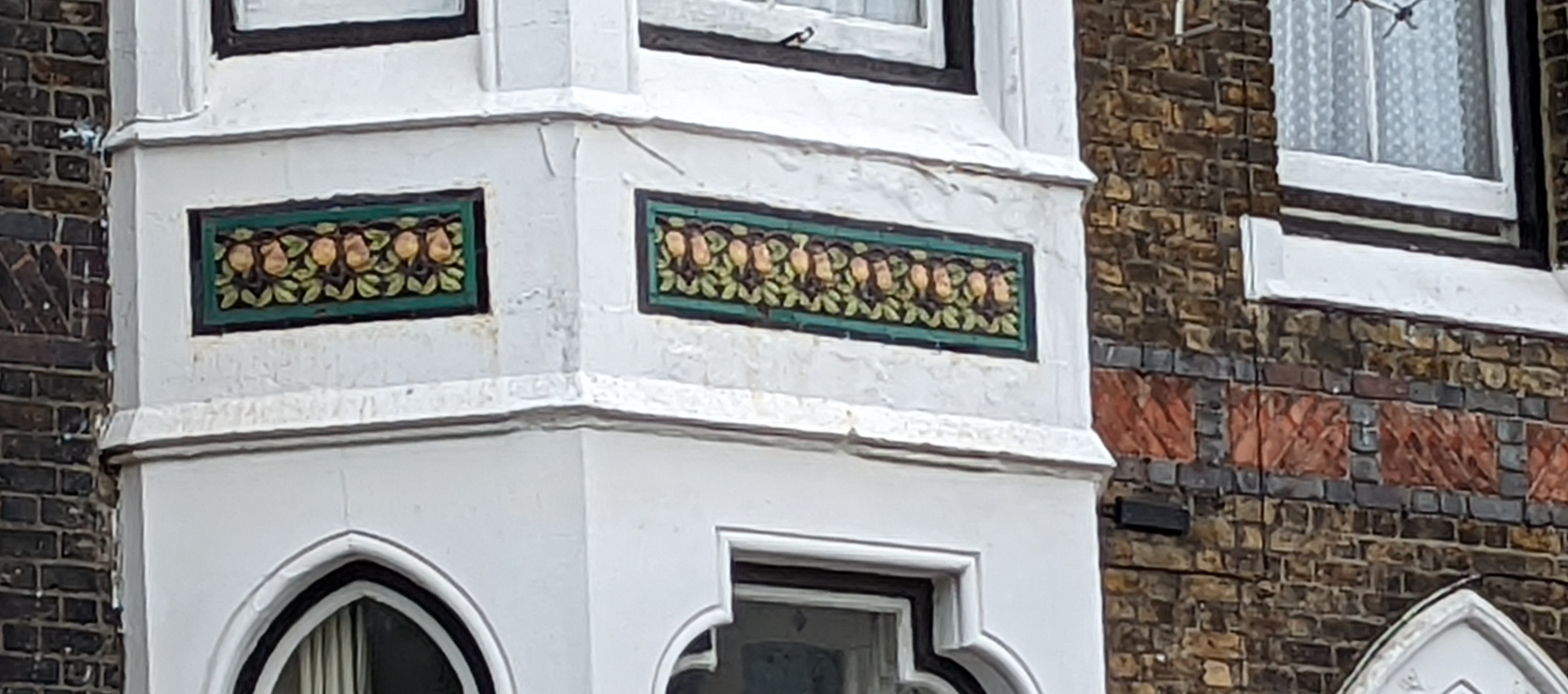
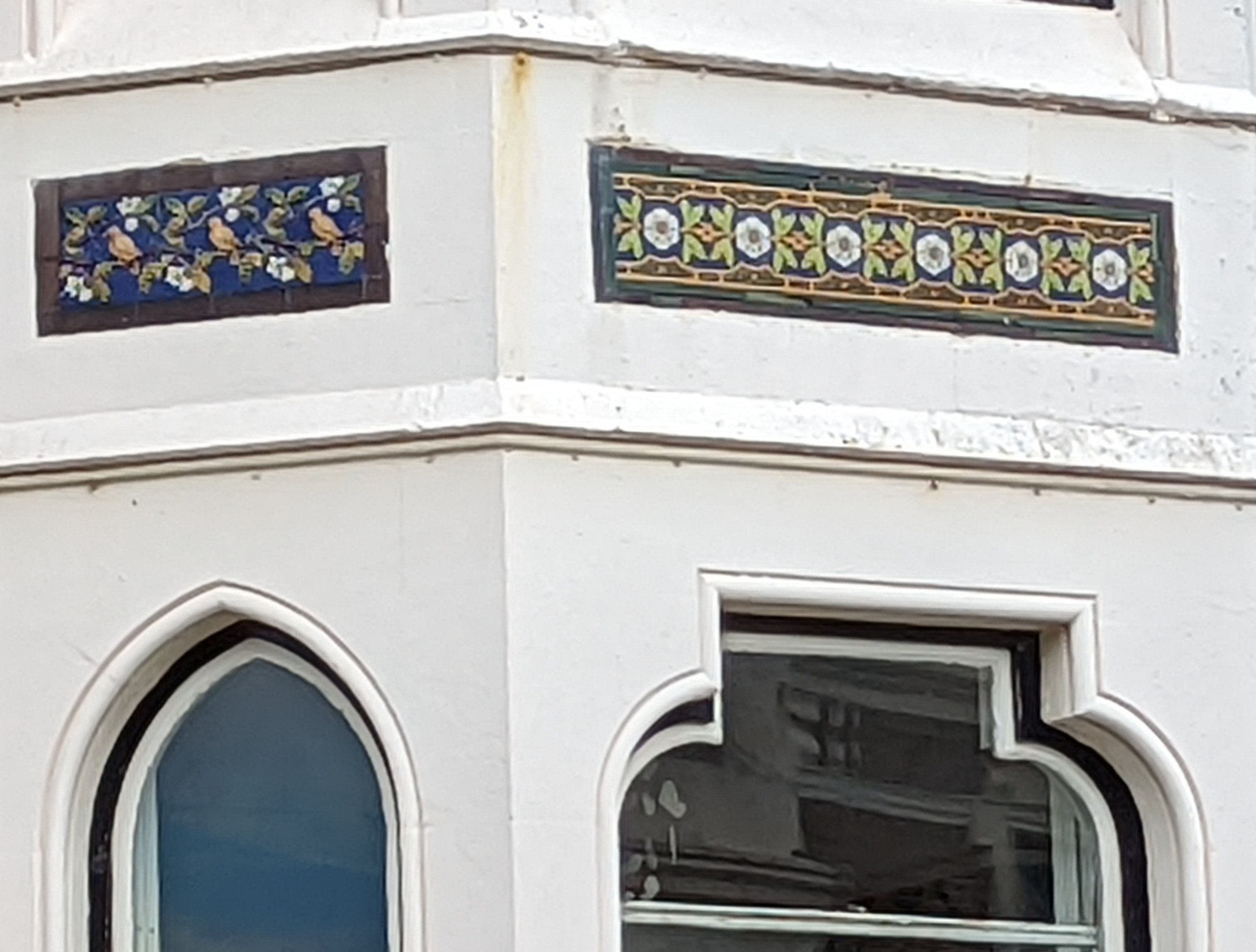
The architecture was another interesting feature, with the decorative tiles adorning the older buildings.
An interesting addition to our knowledge about Deal
Of no cultural or historical relevance what so ever, but irresistible to me when we stopped for a drink.
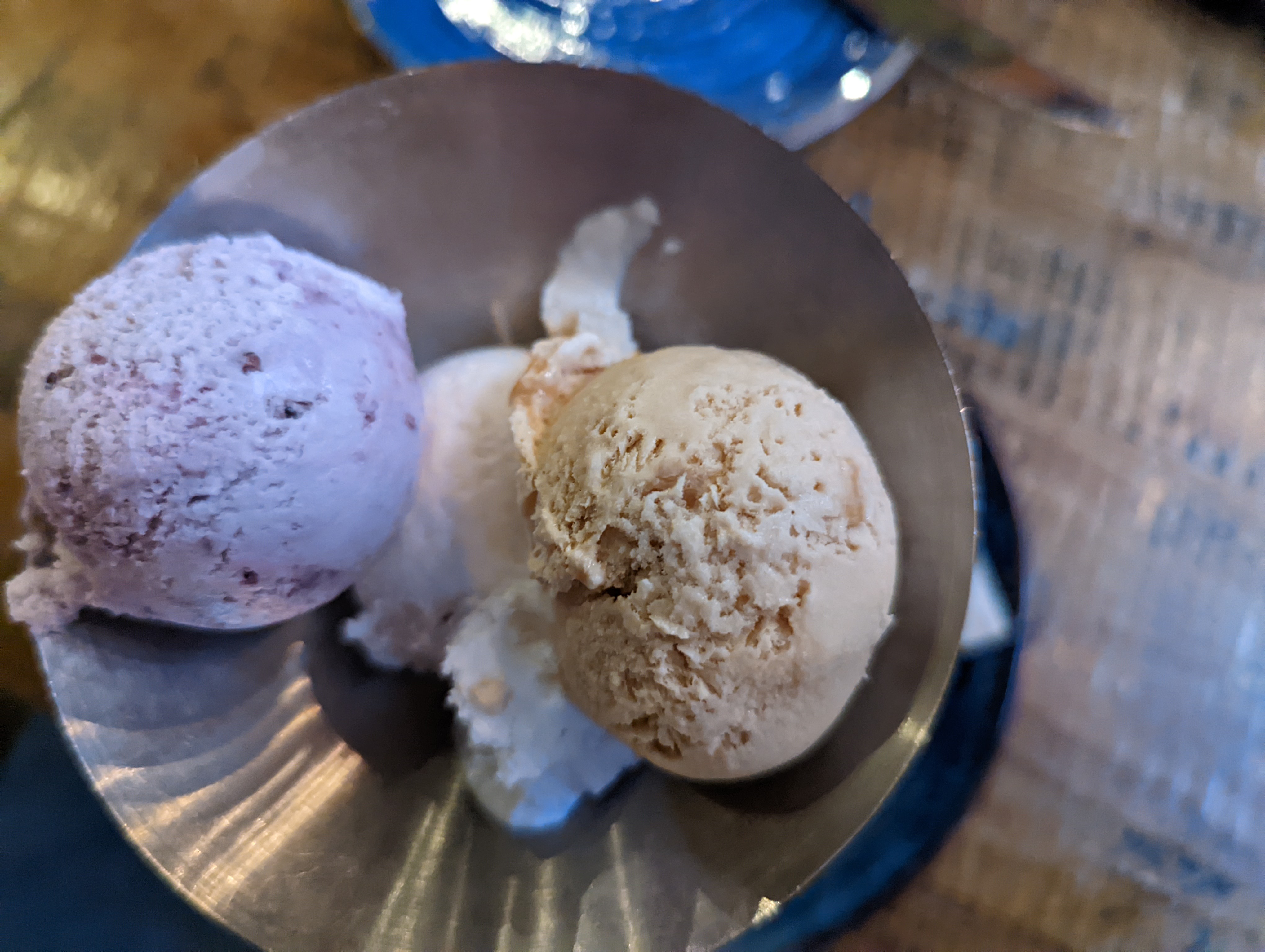
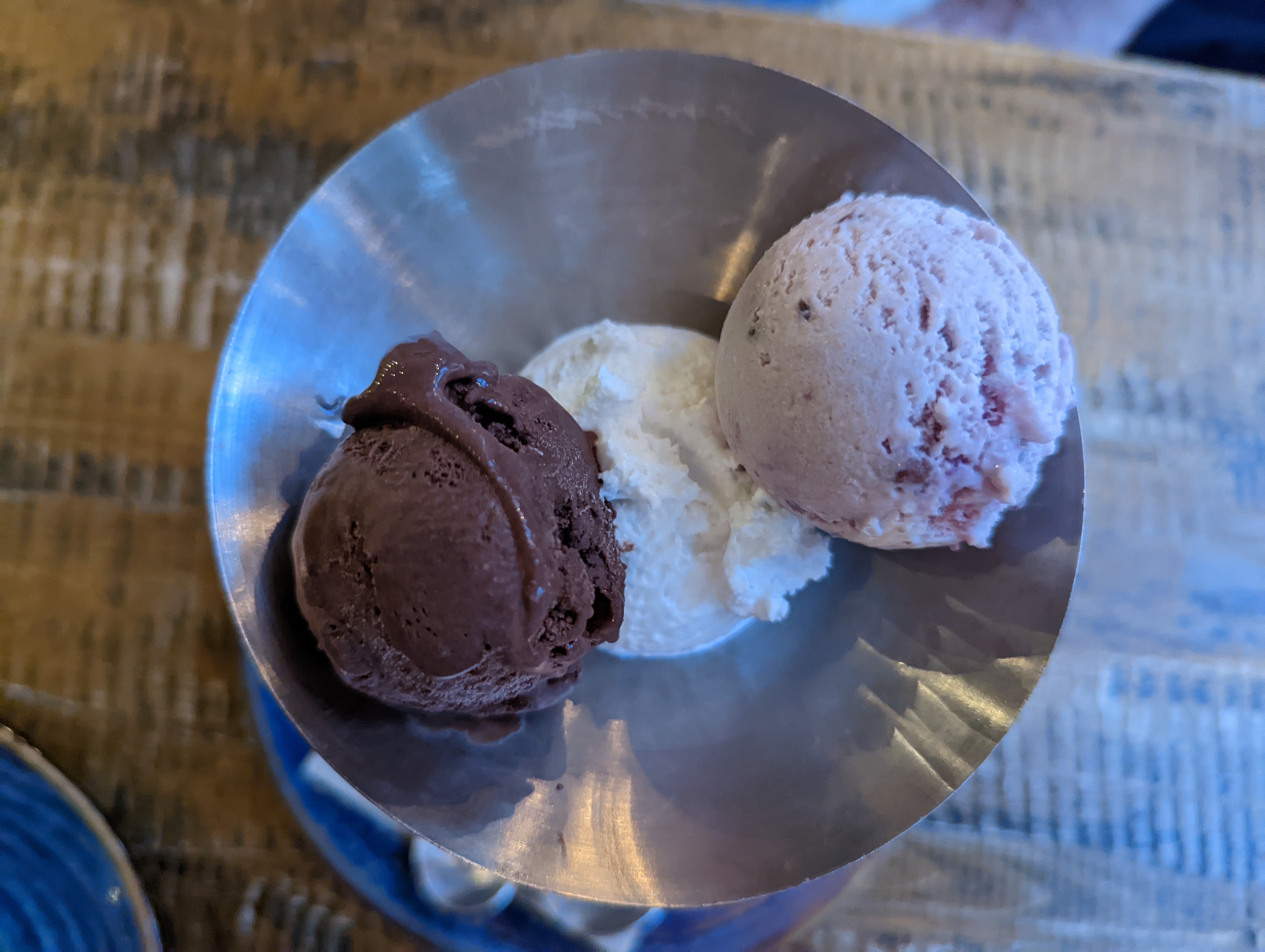
Pebbly the beach might be, but the seawater is just as good for washing hands after an encounter with a very generous two scoops of ice-cream – which was the best ice-cream I have tasted.
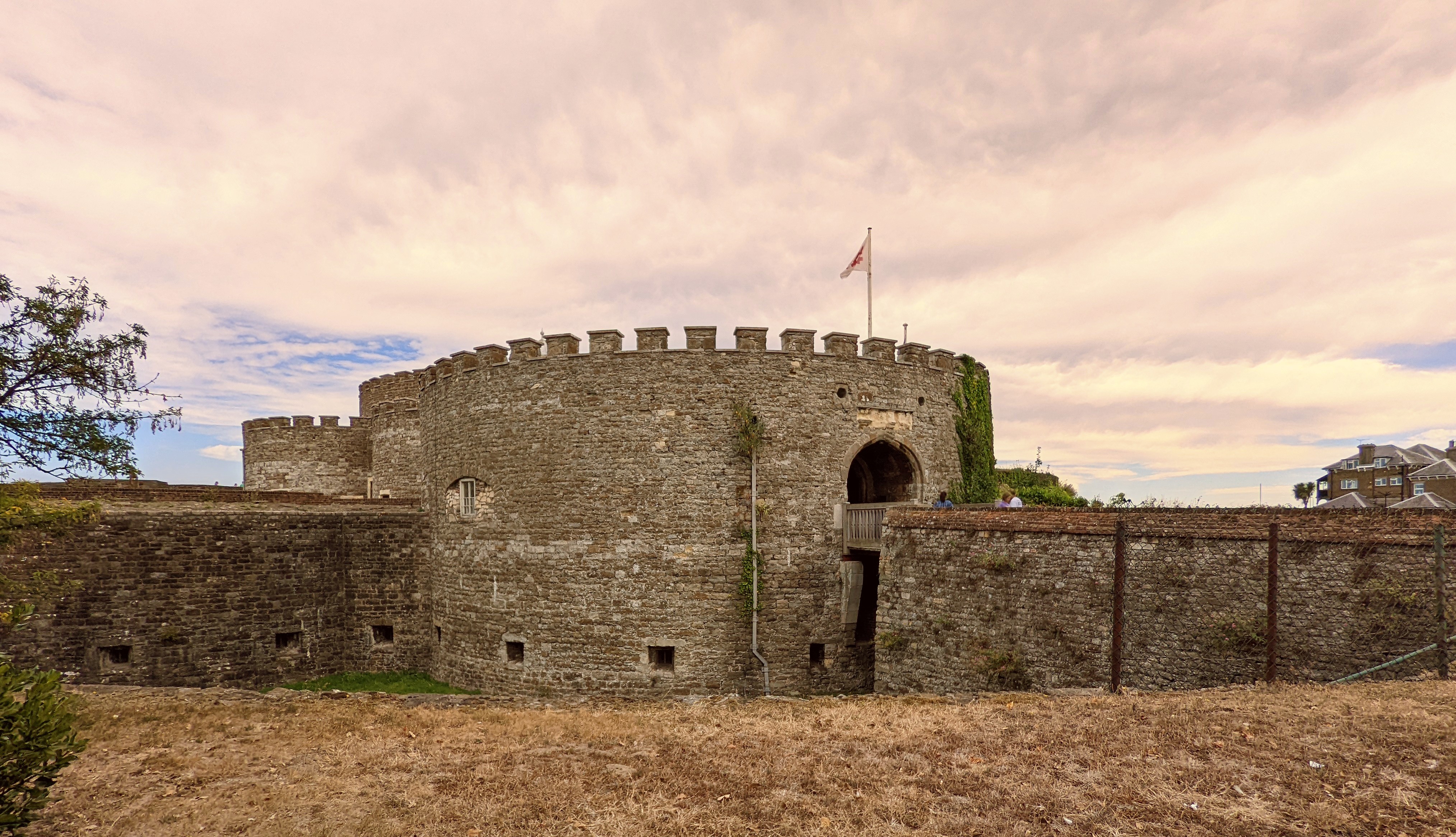
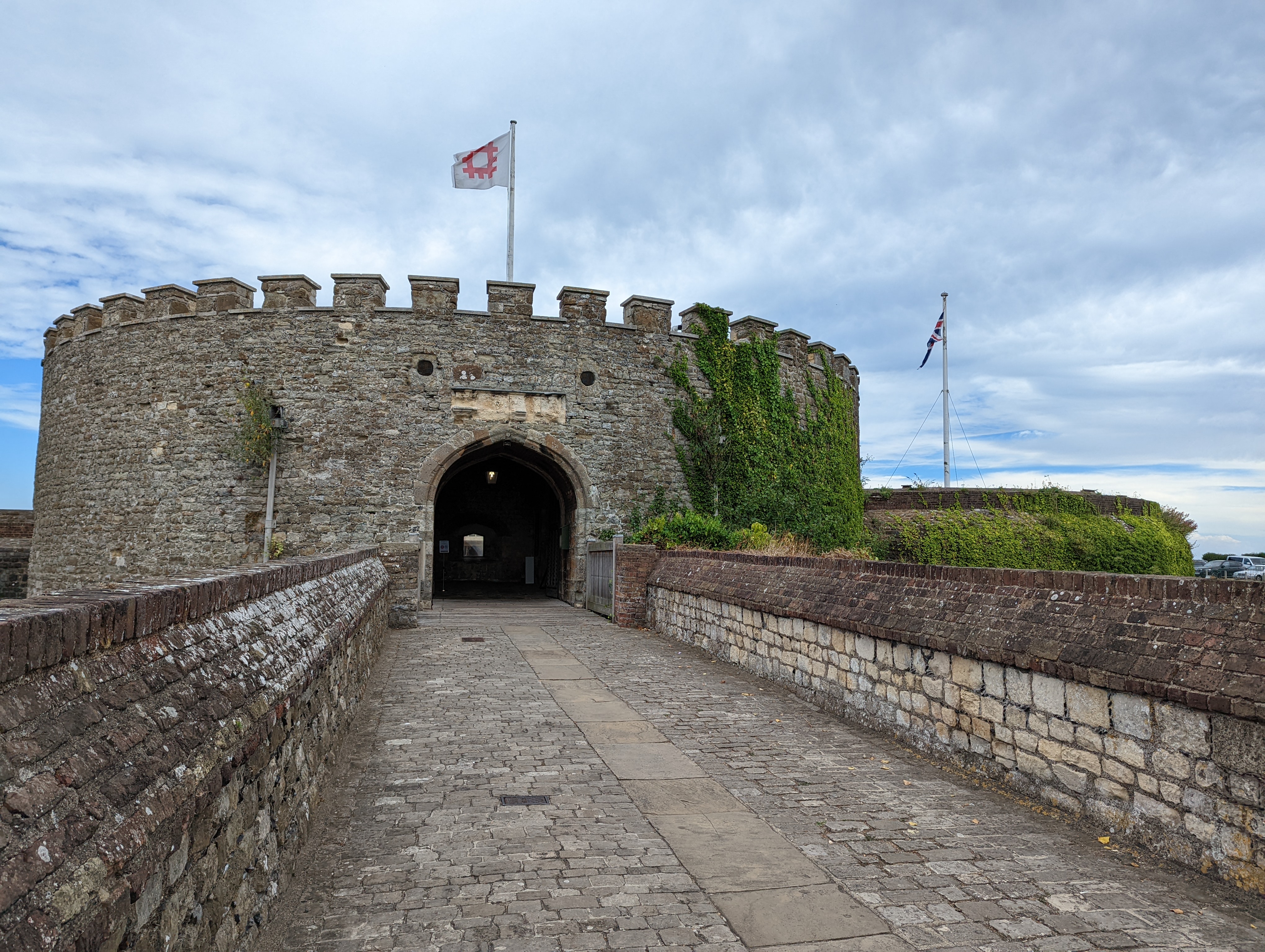
Deal Castle – a formidable building, indeed. We walked to the castle from the station, and around it, but did not venture inside. I now understand that it has a floor of some note. This trip, after three years away, has been one of hits and misses, and encouragement to return with a more well researched agenda.
Bob McMullan
US Senate Elections – Further Thoughts
Further thoughts on the 2022 mid-term Senate election
People whose views I respect have queried why I am writing about the US Senate elections.
I agree that Australian media is too concerned with US and UK politics when other countries deserve more attention than they receive. However, the consequences of Donald Trump’s attempts to undermine or overthrow US democracy are globally important and some lessons can be learned for Australia and other democracies.
US elections also provide a data rich environment which assists with the understanding of the strengths and weaknesses of polling in the digital world. The 2022 mid-term election should also provide a better understanding of the political consequences of attempts to ban abortion or to undermine confidence in elections.
To update my previous contributions about the 2022 US Senate elections it is important first to note that the Democrats have been doing unexpectedly well in all the by-elections since the Supreme Court struck down Roe v Wade.
Most recently the Democrats won the special election in Alaska which followed the death of a Republican incumbent. A countervailing thought is that there are more than two months until the US elections in November and the normal pattern of electoral behaviour in the US would suggest that the Republican position should improve as the elections approach.
On the senate seats in doubt in November, there have been some interesting developments. The preferential, or ranked choice, voting system suggests Lisa Murkowski should win the Alaska Senate contest. Whether she wins as a Republican or an Independent is not clear at this stage, but I assume she will caucus with the Republicans. Missouri, Utah and Iowa look out of reach for the Democrats unless something dramatic happens to change the shape of the election. I will continue to monitor them but only comment if something changes.
With regard to the other hotly contested Senate seats the developments have been mixed.
In Arizona the Democrat incumbent, Mark Kelly, retains a strong lead across most of the polls. However, the averages in both RCP polls and 538 have narrowed, driven by a Trafalgar poll which has him only ahead by3%. Trafalgar is renowned for delivering results more favorable to Republicans, but this does not mean their results can be ignored. It seems to me that if even Trafalgar has Kelly ahead, he looks strong at this stage.
In Colorado, which has been strong for the Democrats recently the Republicans have just announced funding for a major campaign against incumbent Democrat, Michael Bennett. He is not invulnerable, his current lead is around 5%, but the Republican campaign effort there, where they have a mainstream Republican candidate, suggests that they are concerned about the situation in states like Pennsylvania and Wisconsin.
Pennsylvania has been the focus of attention recently with major speeches by Biden and Trump. This focus is undoubtedly driven by a growing realisation on both sides of the aisle that an upset is possible. The retiring Senator is a Republican and in this electoral climate it should be a comfortable win for the Republicans, but all polling suggests that the Democrat, John Fetterman, is ahead of his Trump imposed Republican opponent by from 7-9%. If this doesn’t change soon the Republican strategy of focussing on overturning Democrat incumbents in Colorado, New Hampshire and even Washington state will be reinforced.
Among the other states in serious contest in November the situation is most complex in Ohio. 538 polling average has the Democrat, Ryan, ahead while RCP has the Republican, Vance, ahead.
What is clear is that the Trump imposed candidate is causing problems for the Republicans in a state they would expect to win.
In the other key states the picture is mixed. Democrats are holding a small but steady lead in Nevada, and appear to be doing so in New Hampshire, although the candidates have not been finally chosen yet, In Florida the Democrat challenger, Deemings appears to be closing the gap on the Republican incumbent, Rubio, while the reverse is happening in Georgia with the Republican candidate, Walker, closing the gap on the Democrat incumbent, Warnock.
The interesting new developments are in North Carolina and Wisconsin. In North Carolina the race seems to be a dead-heat after a long period in which the Republican had a small but steady lead. In Wisconsin, now that the candidates have been chosen a range of early polling suggest a 4-6% lead for the Democrat, Mandela Barnes, over the Republican incumbent, Ron Johnson.
This interesting situation, together with recent Democrat successes has led some commentators to forecast a probable Democrat majority in the Senate. I think this is too big a call at the moment, but it appears clear that the continuing prominence and influence of Donald Trump is significantly improving the Democrats chances of success in November.
Trip to Wallingford
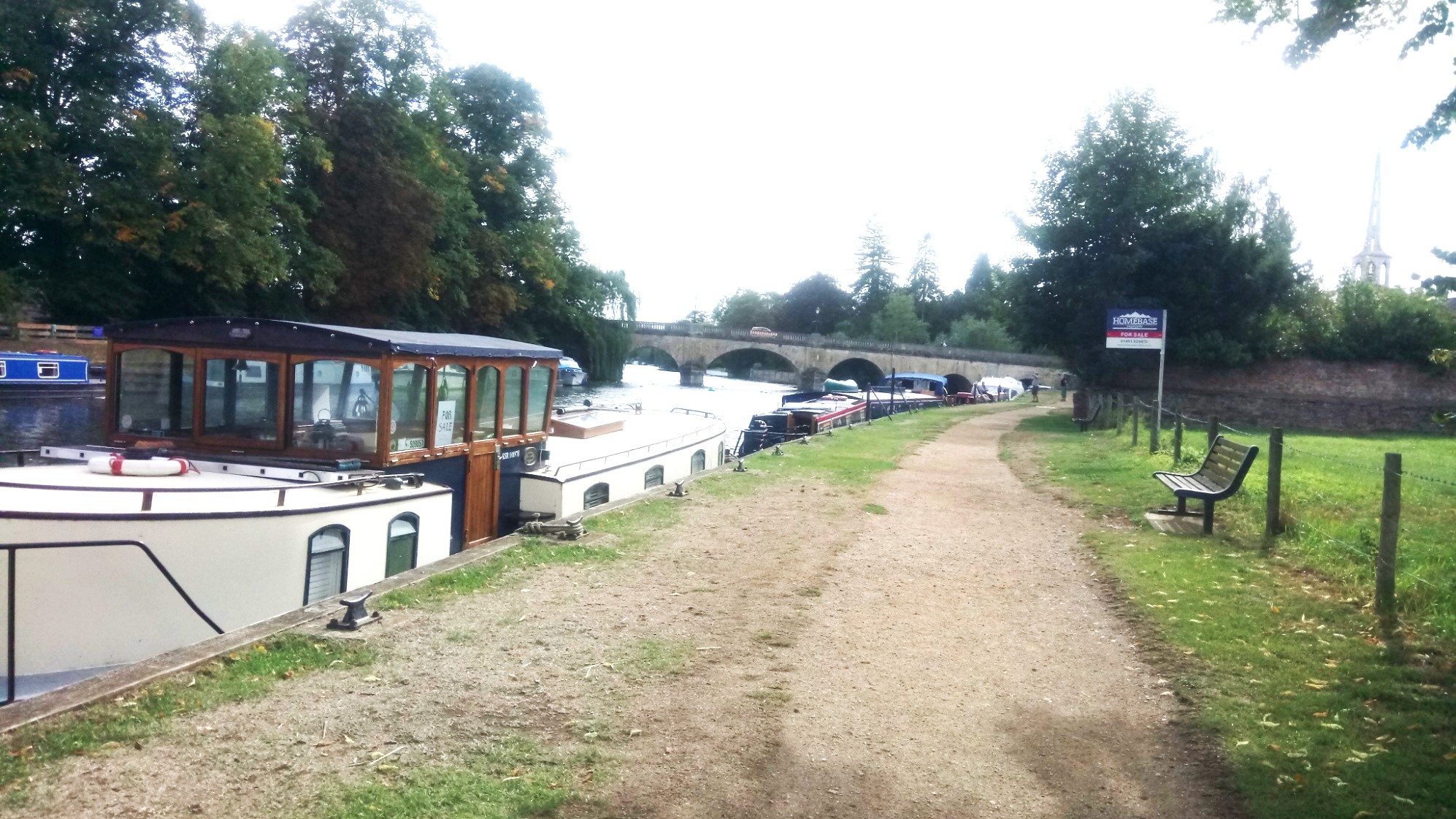
This was a pleasant trip, recalling many happy months I spent staying with Australian, and then English friends while I researched Barbara Pym’s papers in the Bodleian Library in Oxford. Wallingford is the site of a ruined castle of archeological interest, the locale for many episodes of Midsommer Murders, renowned for the annual Bunkfest, and the source of pleasant walks from bridge to bridge along the Thames. It is a rattly bus ride from Oxford or Reading.
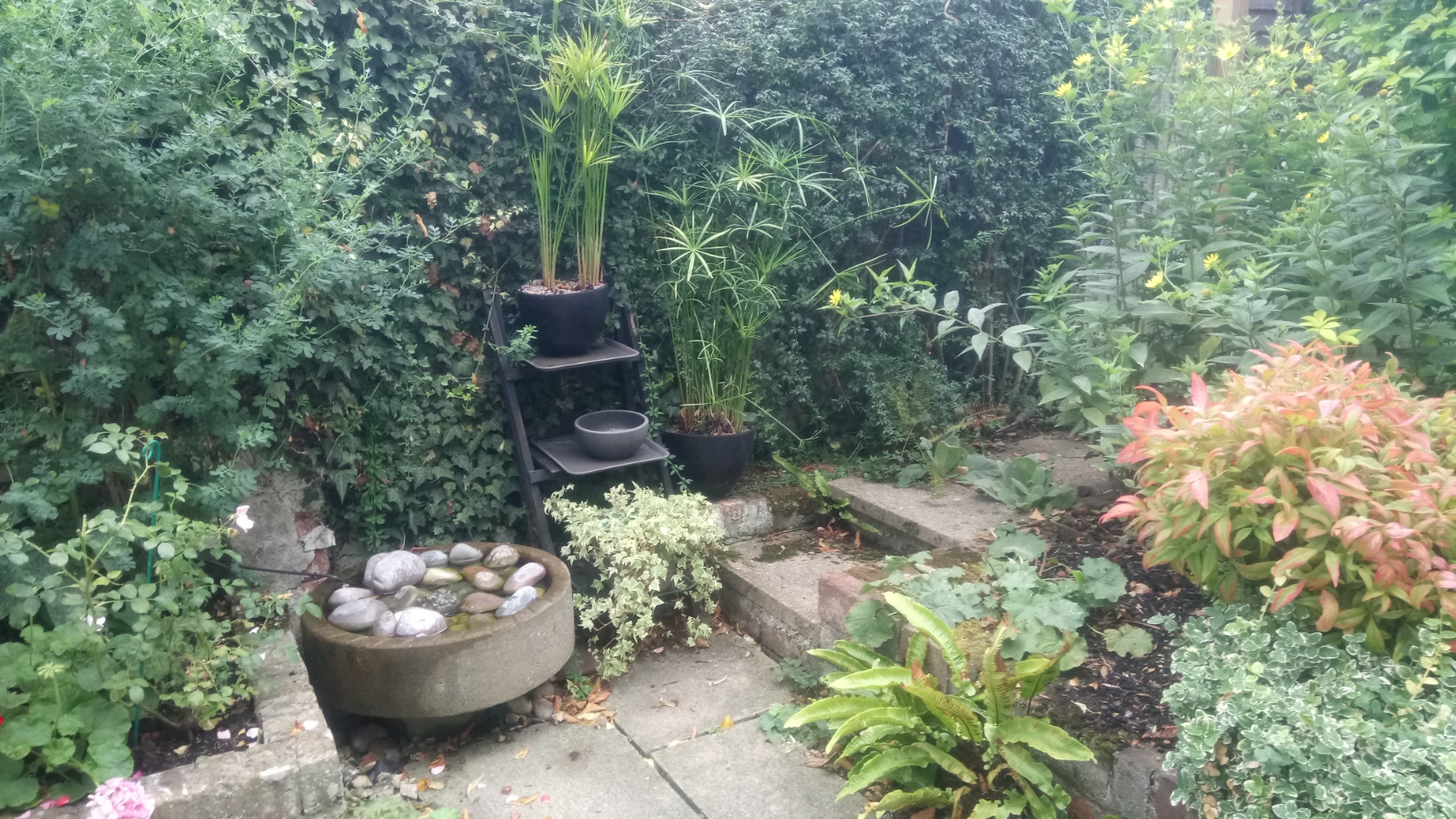
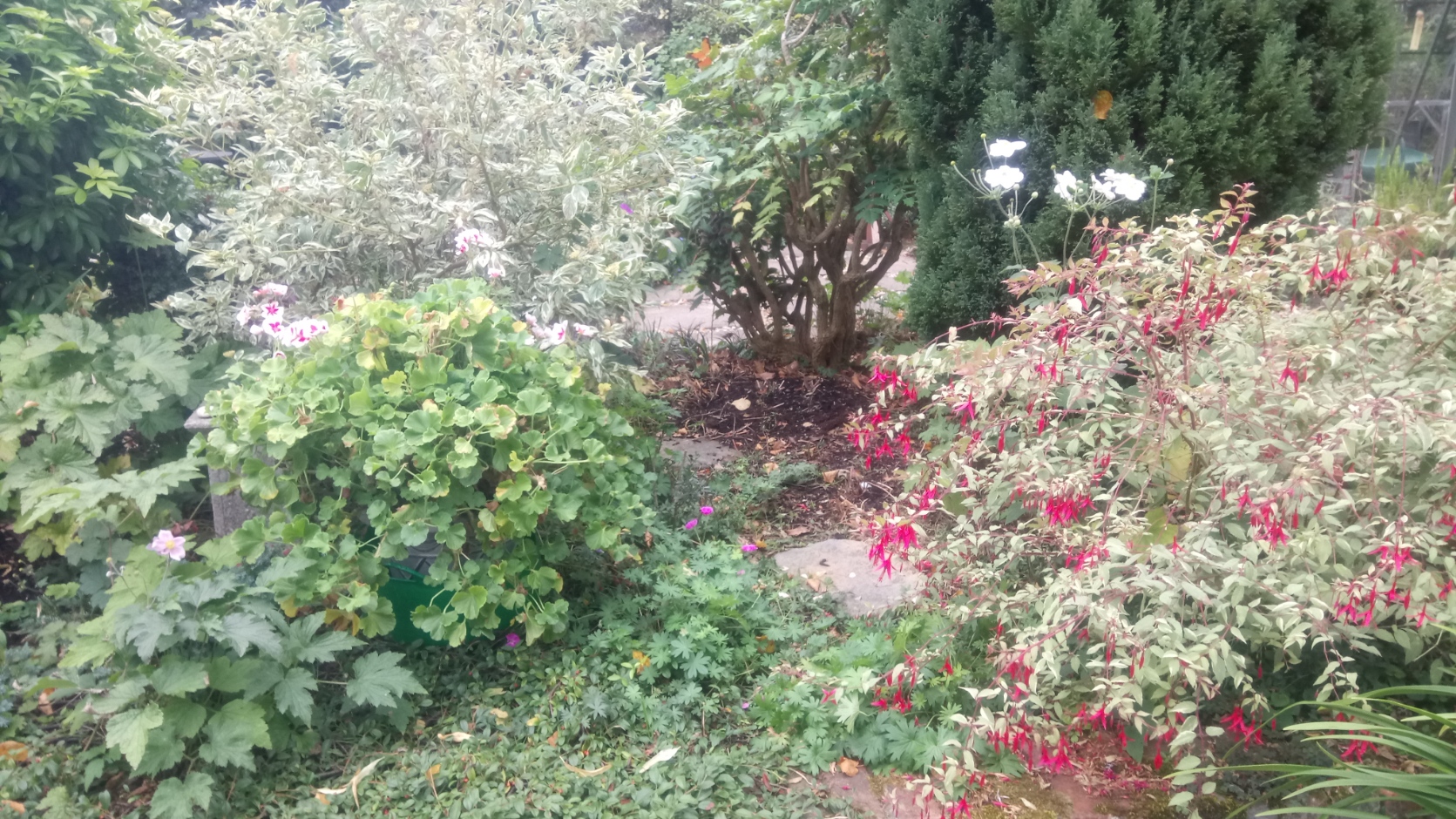
A garden fit for hedgehogs, and a spreading oak on St John’s Green for picnic shade.
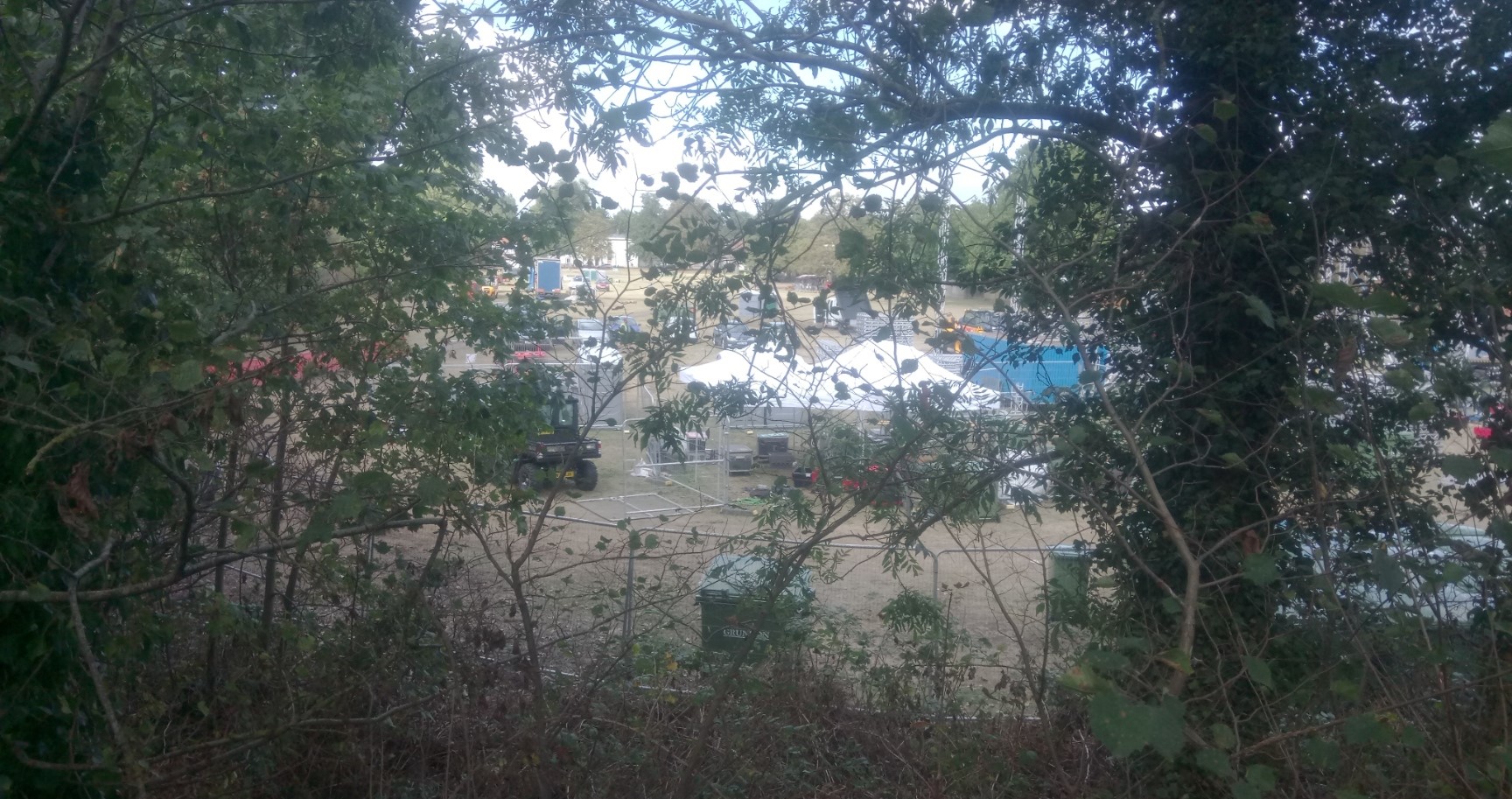
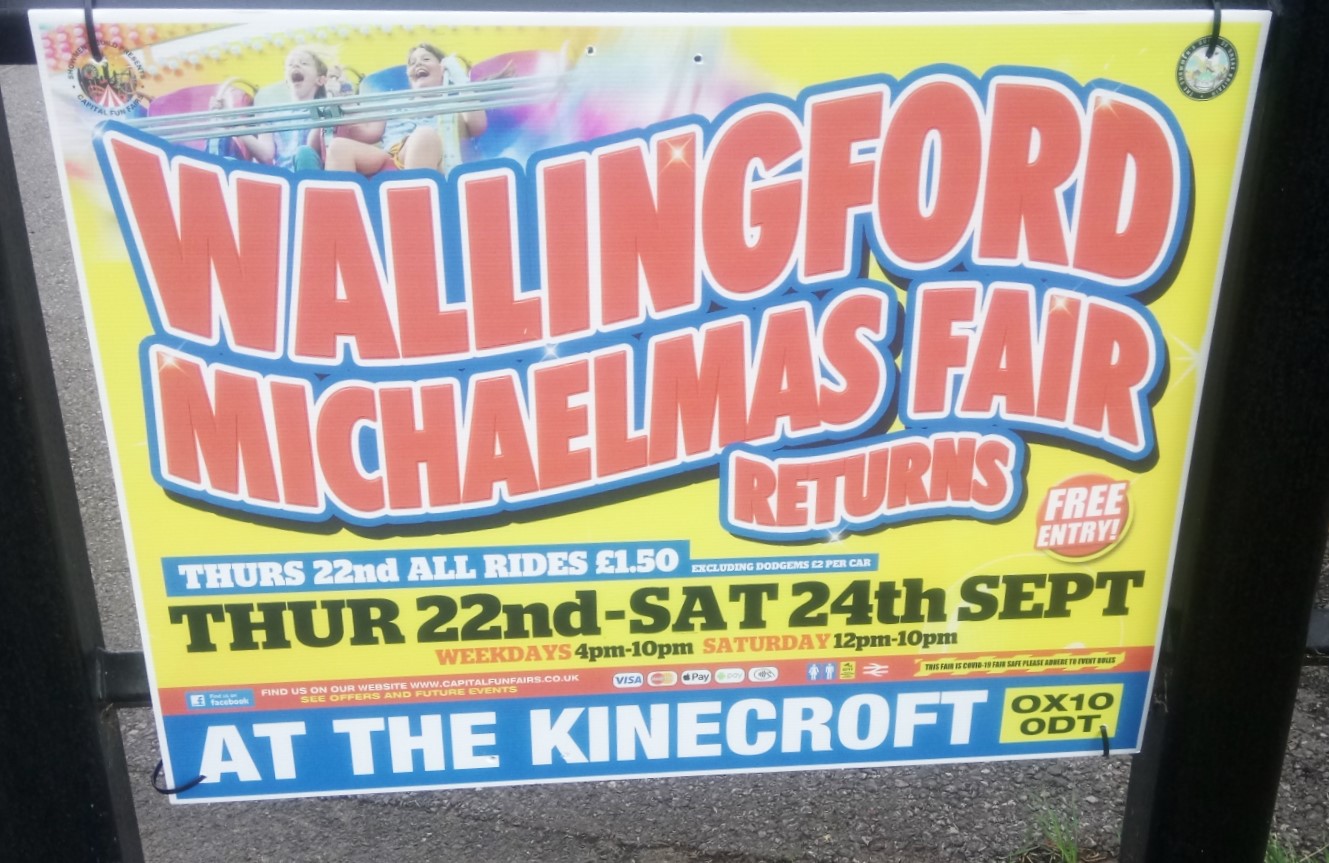
Set up is over, now the Bunkfest paraphernalia is being dismantled – but another festive treat is in store!
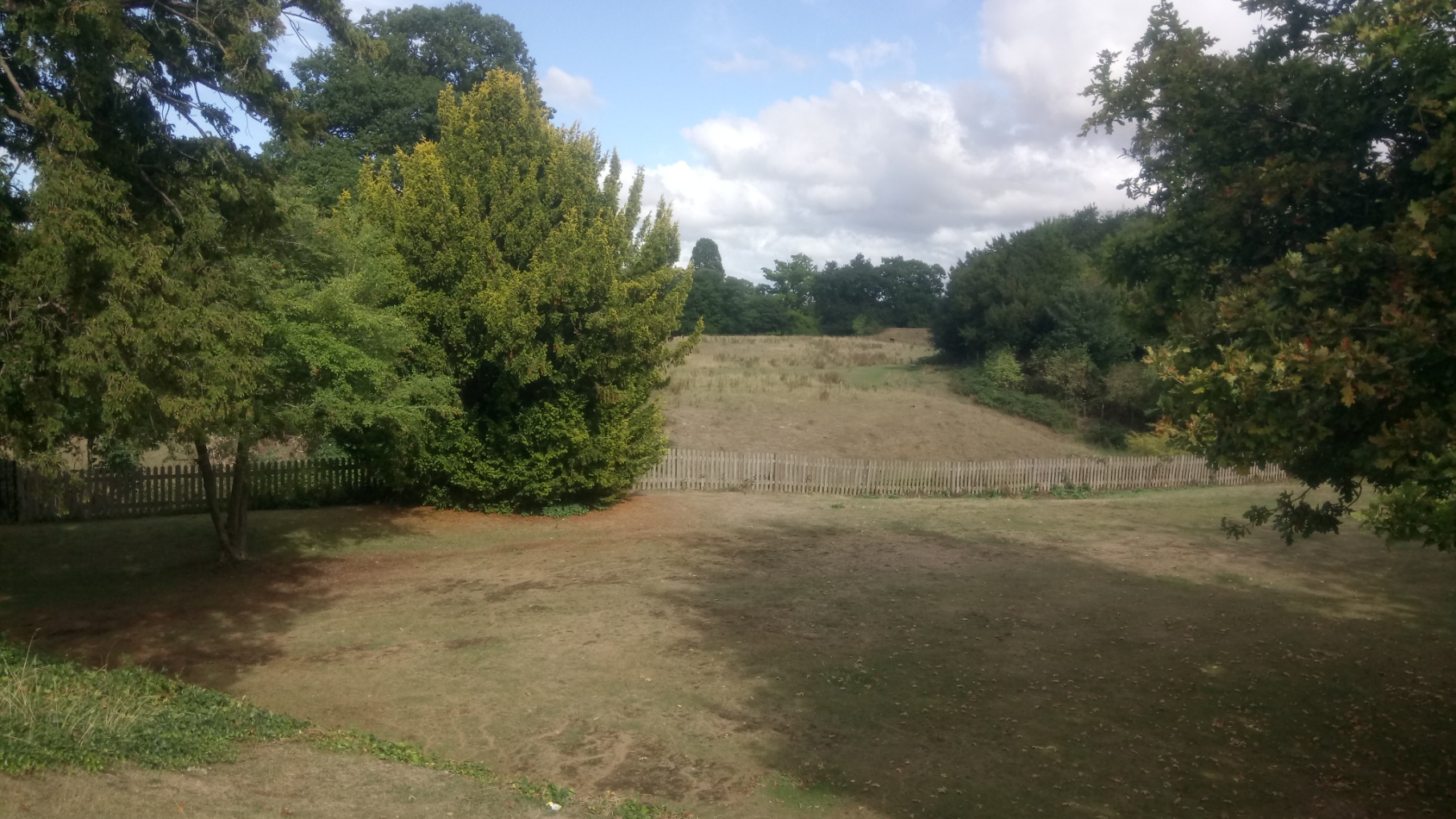
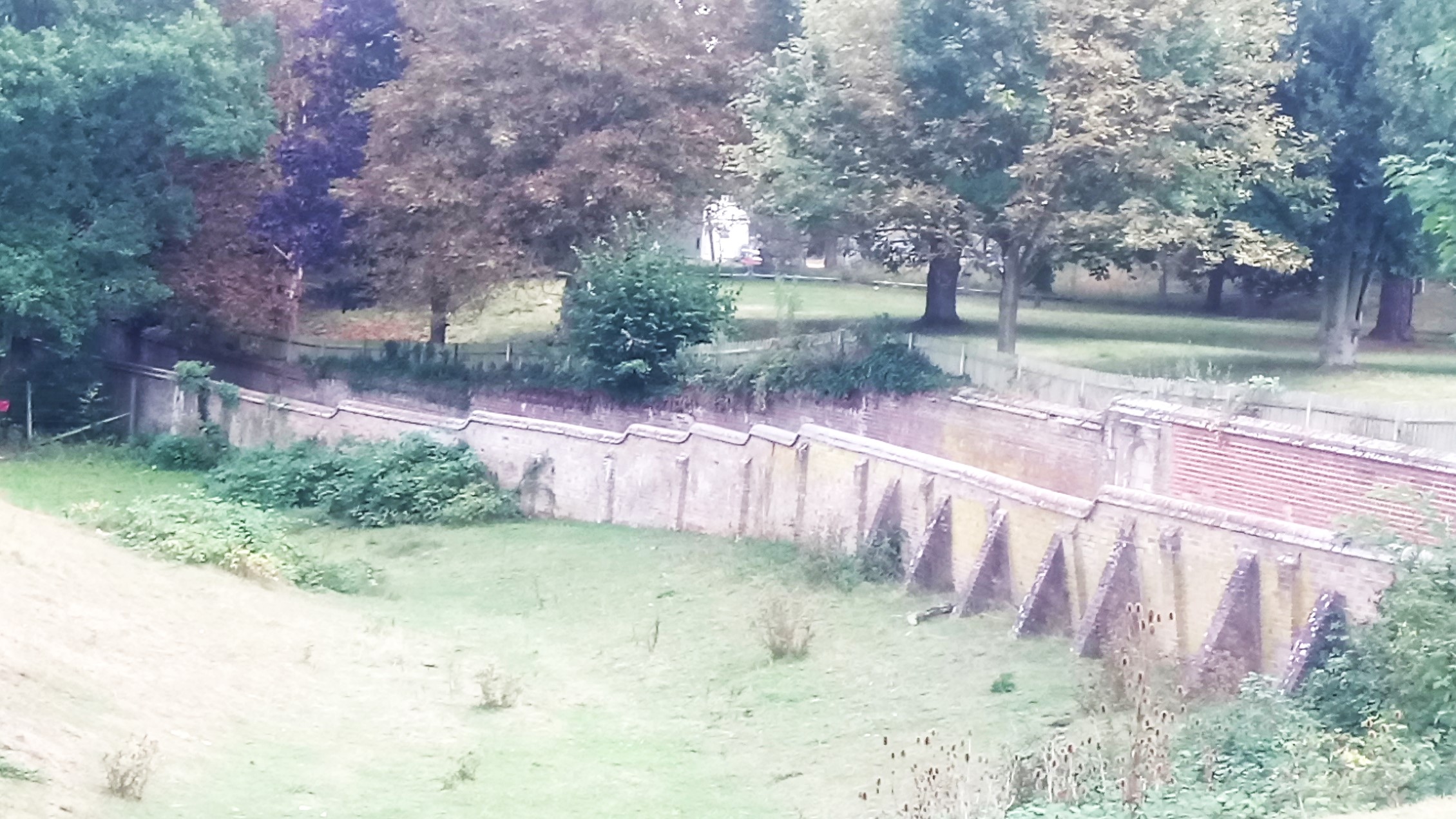
Wallingford Castle has some remains – the moats are apparent, as are the ramparts, and there are some parts of the buildings are intact. However, cows chewing in the fields are more abundant than the building remains.
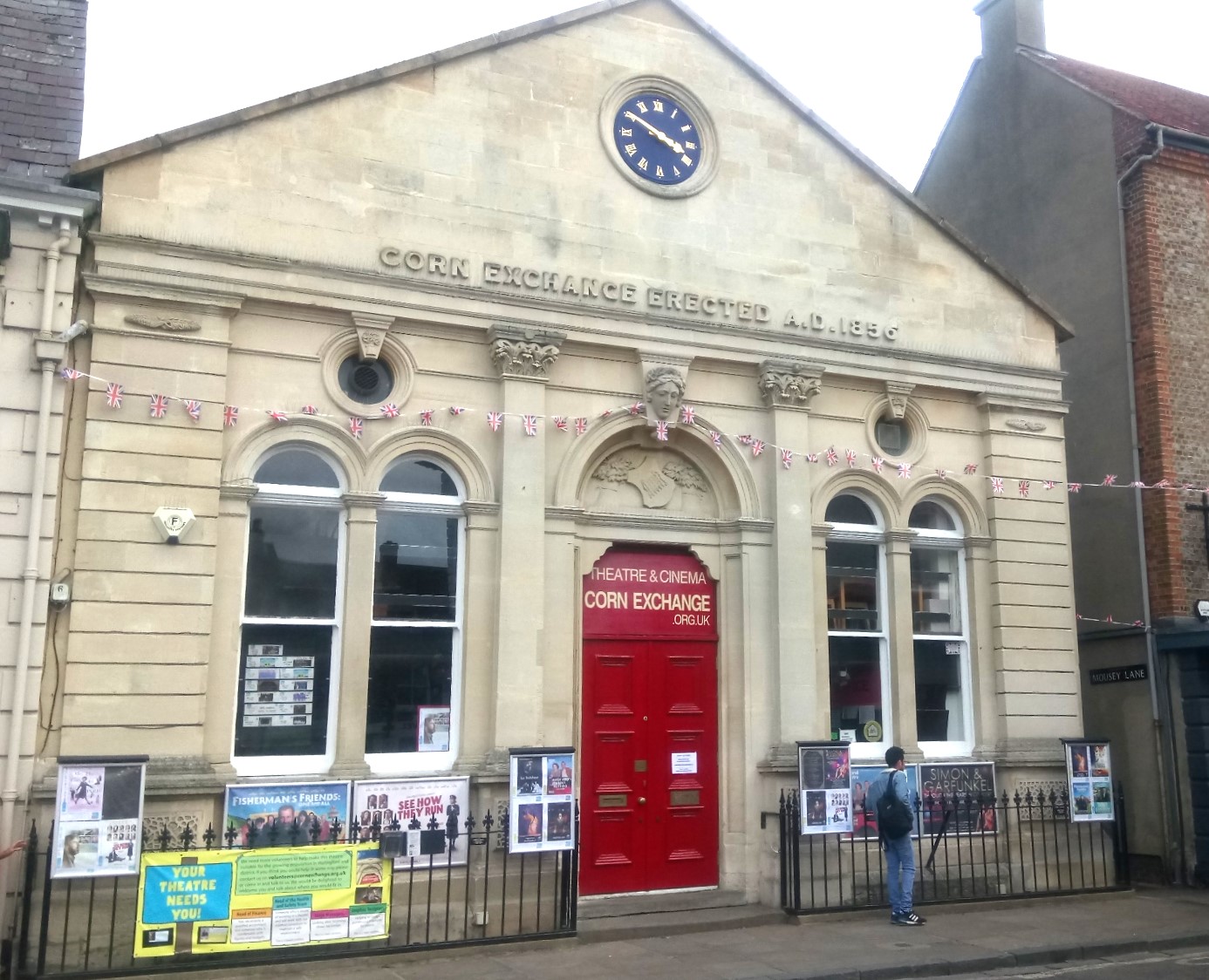
The Corn Exchange features regularly in Midsomer Murders, the Thames is a place for wandering and pontificating by the detectives, and the buildings are bound to be seen somewhere in the series. The Town Hall is worth a visit.
Walking along Regents Canal is always worthwhile. Sighted this morning on our short walk…
An addition to the brickwork beside the Regents Canal
Sun Flowers , Van Gogh, from the exhibition in the NGA
In this week’s blog: Eurostar to Amsterdam; book reviews; Amsterdam – hotel, food tour, Rijksmuseum, Cindy Lou reviews; Maggie O’Farrell; Well behaved women…; brief news from Australia.
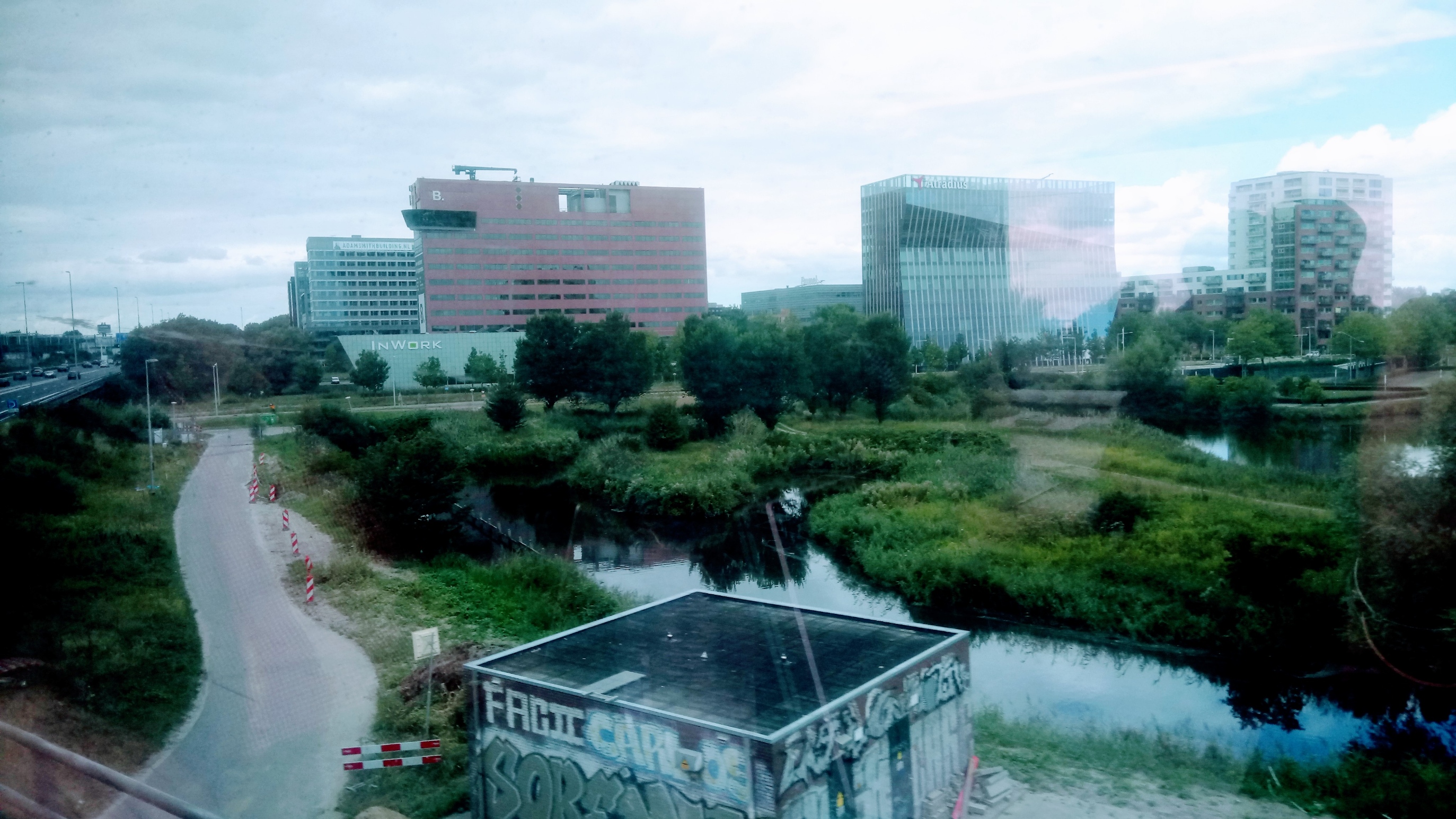
On our way back to London, after a short, but fulfilling visit to Amsterdam.
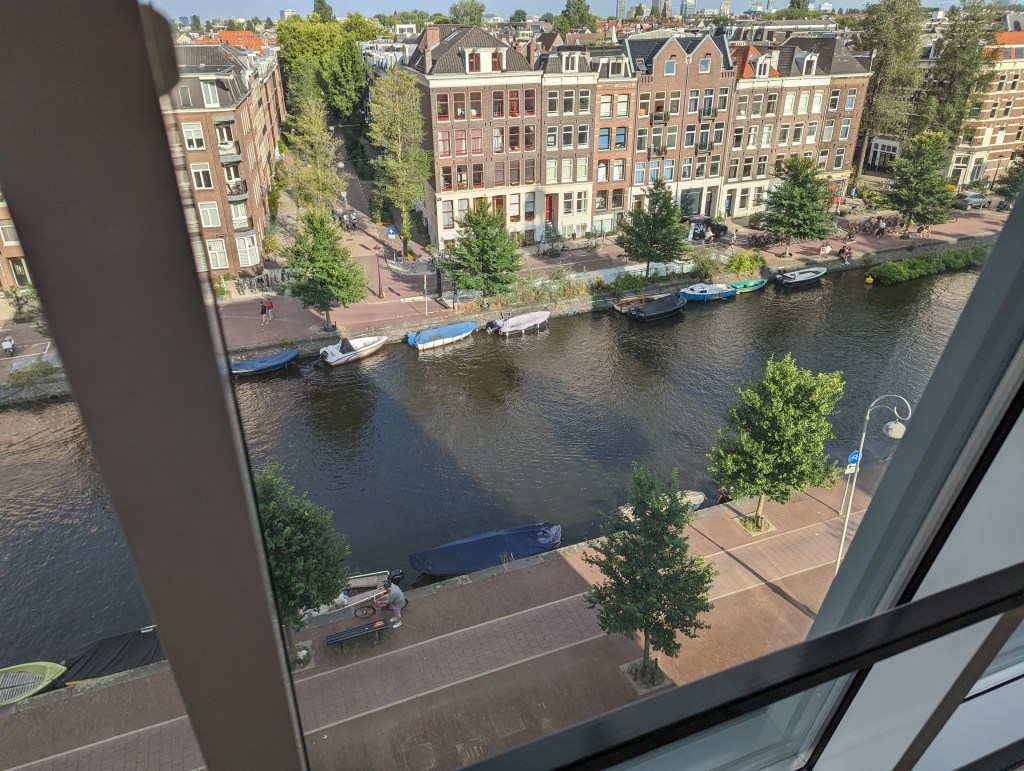
We stayed in the Museum Quarter, which has excellent public transport – trams and train.
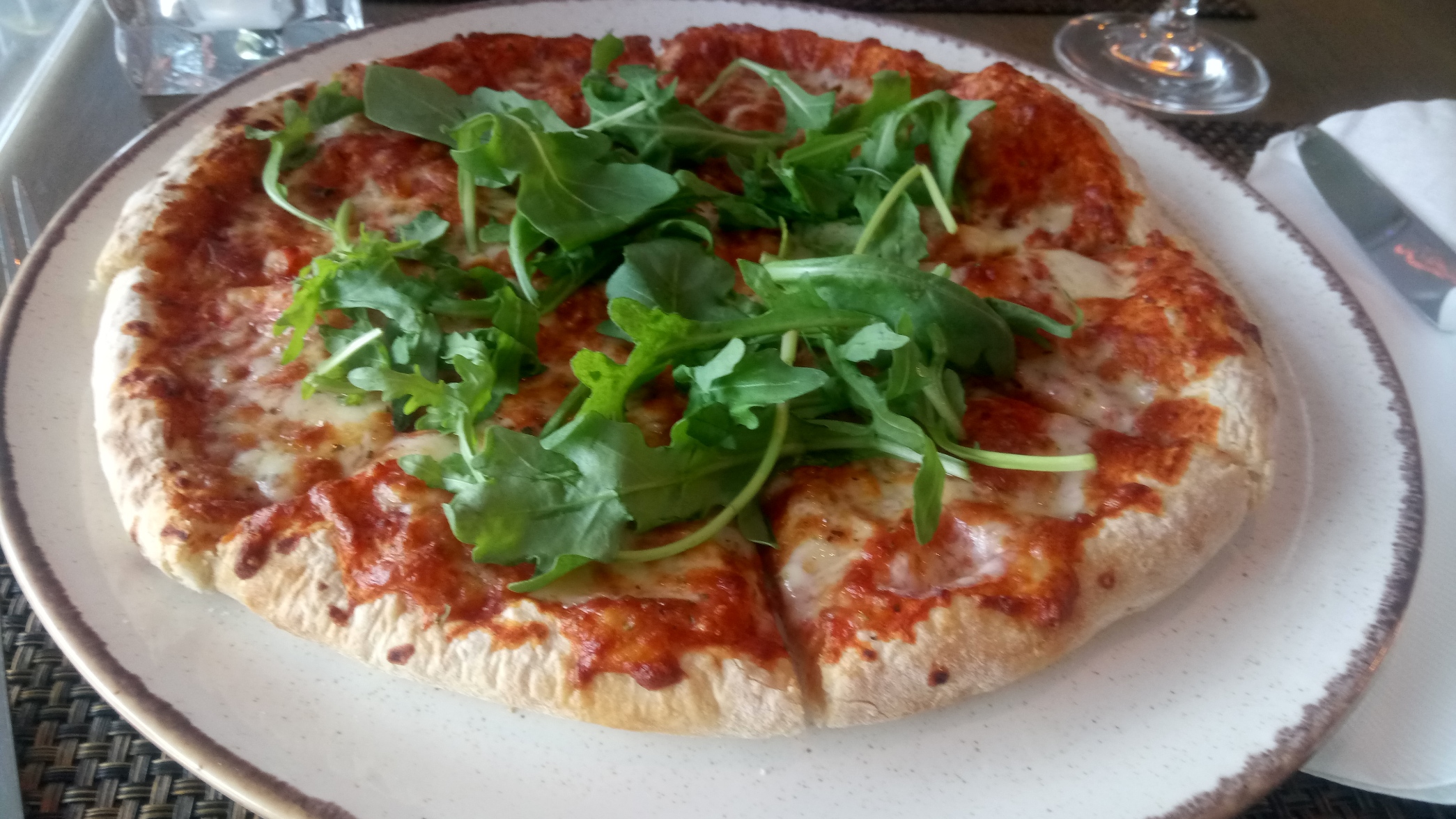
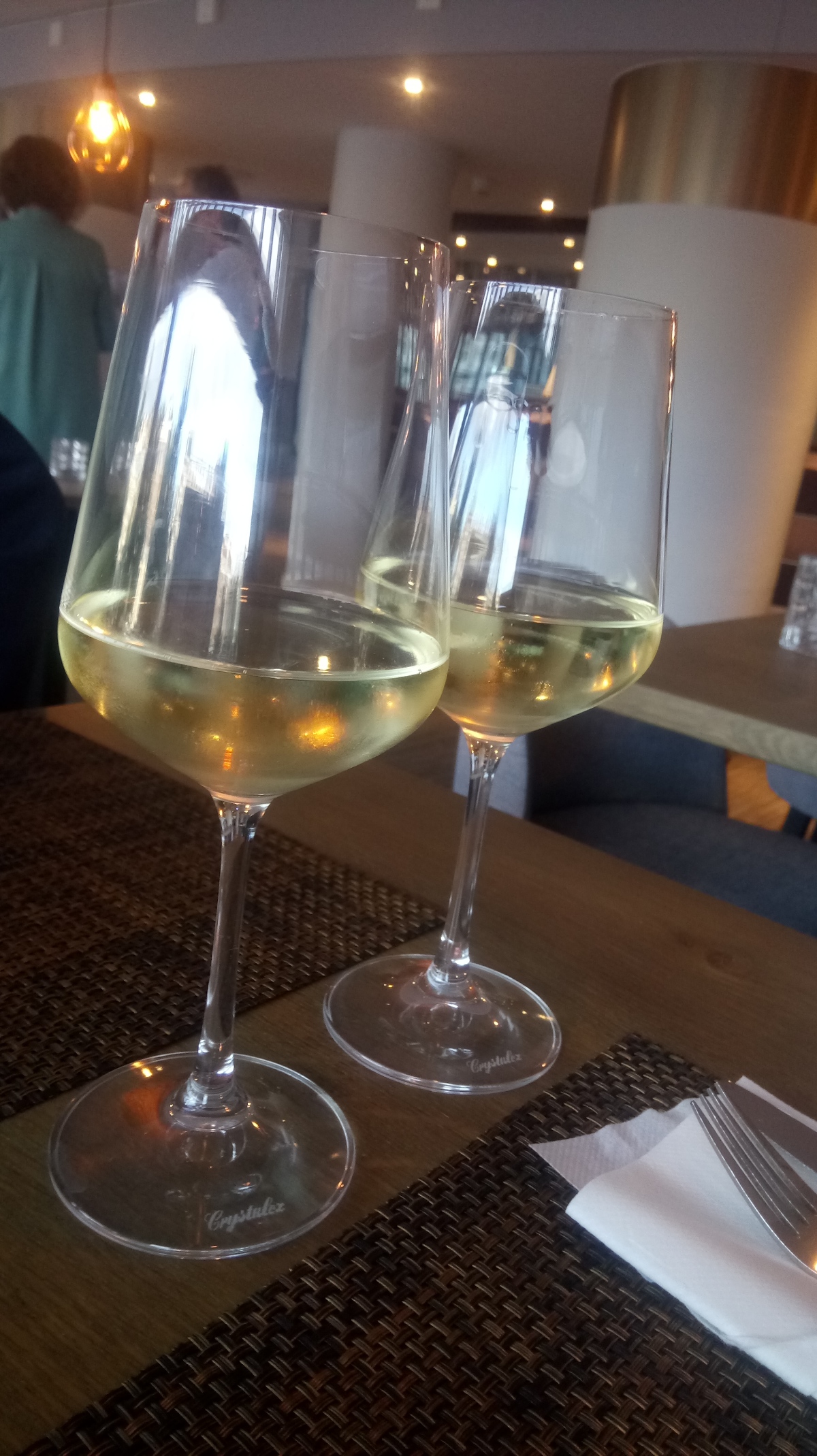
We also found some good restaurants, one excellent, another was fun, and another served a huge lettuce salad which I have missed. The hotel made a pleasant pizza, which we ate on our last night, with the free drinks offered in exchange for foregoing daily housekeeping.
Leaving Amsterdam. Do take a book for this journey!
Book Reviews
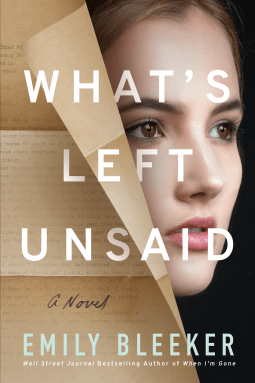
A non-fiction book, Sarah Milne’s The Book Lover’s Guide to London, and What’s Left Unsaid, by Emily Bleeker, a novel, are reviewed this week. Net Galley provided me with the uncorrected proofs for review.
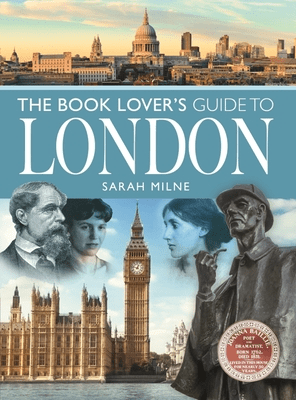
Sarah Milne The Book Lover’s Guide to London White Owl, an Imprint of Pen & Sword Books Ltd.
I was thrilled when my request for this book was granted. Perhaps the height of my expectations made my disappointment sharper. I feel that readers of this review need to take this into consideration as I must admit to being disappointed.
Briefly, taking a positive approach, The Book lover’s Guide to London does provide an extensive list of authors and locations that feature in fiction and characters that would be useful to any person, tourist, or relatively knowledgeable London visitor, in investigating London through literature. However, I felt that there was too much dependence on familiar sources such as Dickens for the more colourful commentary; a greater variety of works and authors given such treatment would have been a welcome addition. See Books: Reviews
Emily Bleeker What’s Left Unsaid Lake Union, 2021.
Hannah Williamson is a journalist who has been forced to leave her prestigious position in the city and accept work with a small-town newspaper. She is caring for her grandmother, Mamaw ‘Mable’; missing (and internet stalking) her former partner, Alex; and recovering from her father’s death. Although a local, Guy Franklin, is helping build an addition to ‘Mable’s’ house for Hannah’s use, she looks forward to her grandmother’s recovery and moving on. While dutifully, but initially unwillingly, sorting files in the basement of the newspaper office Hannah finds some pages signed by Evelyn. They are pages of a story offered to the paper in the past. The letters appear to have been unacknowledged and the story unpublished. Hannah becomes intrigued by Evelyn’s story of a hitherto happy home life destroyed by her mother’s death and father’s remarriage. This, with the addition of a mysterious shooting, encourages Hannah to resume her journalistic doggedness. See Books: Reviews
Eurostar to Amsterdam
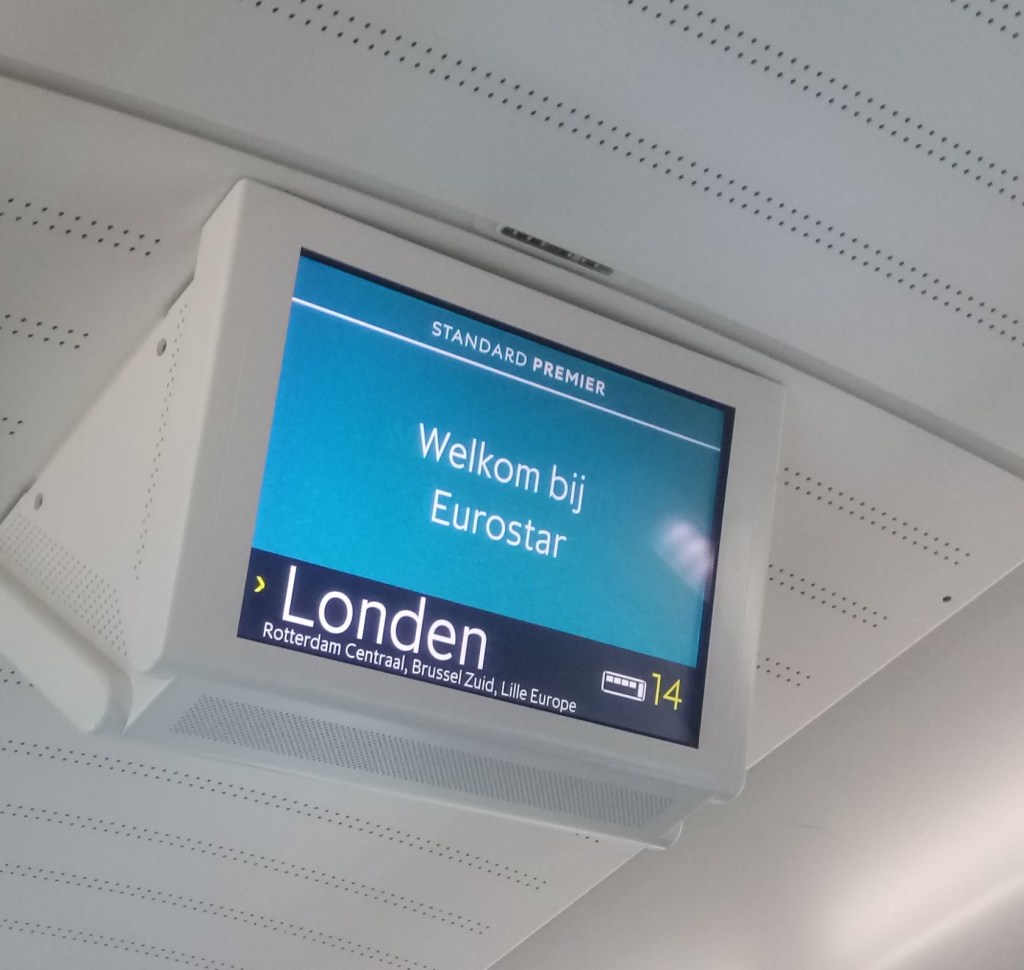
This is a good alternative to flying, and we were pleased to experience the Eurostar again. My previous trip had been to Paris, travelling Standard. This time I chose Standard Premium for the four hour journey. Included is a meal and snacks, and more importantly, far more space in comfortable seating. The WIFI is intermittent, so one cannot rely on using the four hours to undertake any work that might need to be saved. I found it impossible to work safely on this blog. The meal and snacks were simple, but served by pleasant staff, and on the journey to Amsterdam there was a choice. Not so on the homeward leg, but what was available was fine. Upon arrival at Central Station (Centrum) there was no apparent taxi rank. However, trams are plentiful, and the subway is on the spot. A ticket for up to three days can be purchased very easily.
There is a subway station close to the Museum Quarter, and plenty of trams so our stay (although fraught to begin with – where were the taxis? why was google so frustrating?) became very easy .
NH Hotel Museum Quarter
This hotel is so close to the art galleries, it was the prefect place to stay. We has booked it a couple of years ago, but were unable to use it because Covid intervened. The hotel provided credit to be used at this particular venue. I did not have a refundable booking, and was so pleased to have been encouraged to take up the booking on this occasion. The hotel is shabby in some ways, but has so much of the features that, for me, make a stay worthwhile. The rooms are large, the windows are huge and the view across the canal is very attractive. The bed was comfortable, the towels plentiful, and the shower (although one of those mad combinations for hot/cold/bath/shower) worked well. There were dressing gowns, which is a great addition to what was the standard room. Although one of my pet dislikes, soap and shampoo in large bottles attached to the wall, was there, my other dislike (hangers which cannot be taken out of the wardrobe) was not a feature. The hotel had an environmental policy where if one chose not to have daily housekeeping a free drink was [provided. We enjoyed this, with a simple pizza from the bar menu on our last night in Amsterdam.
Visit to the Rijksmuseum Amsterdam
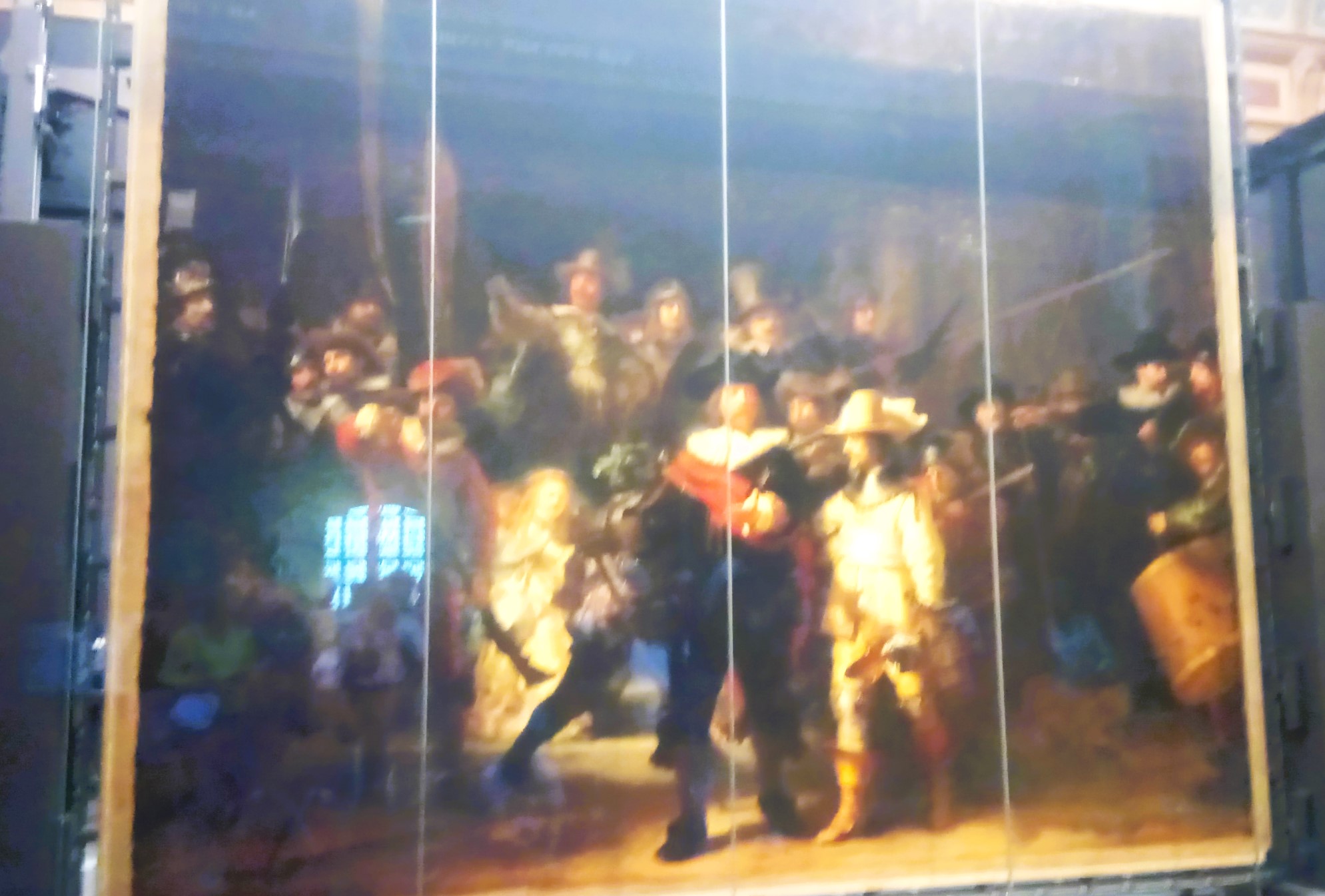
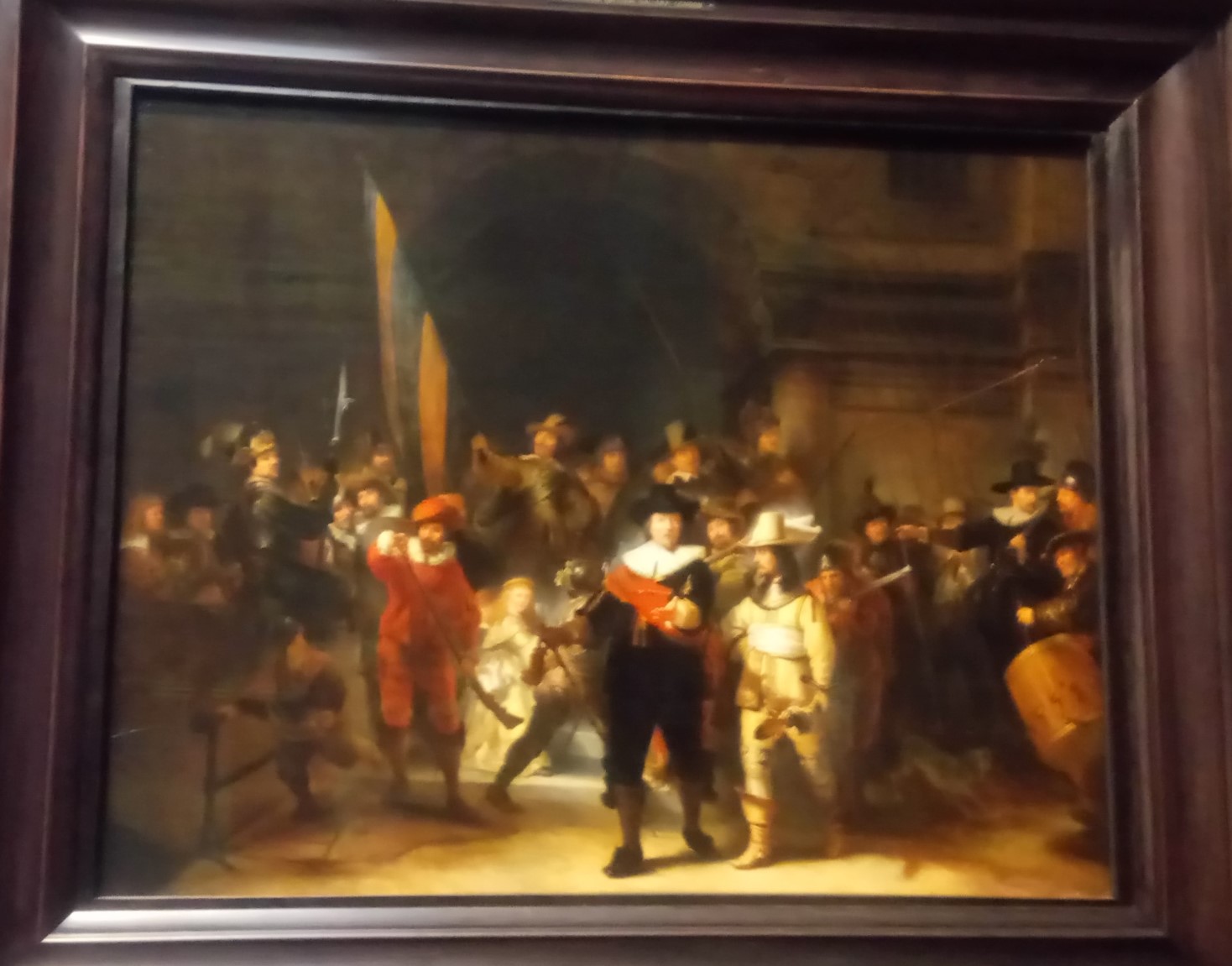
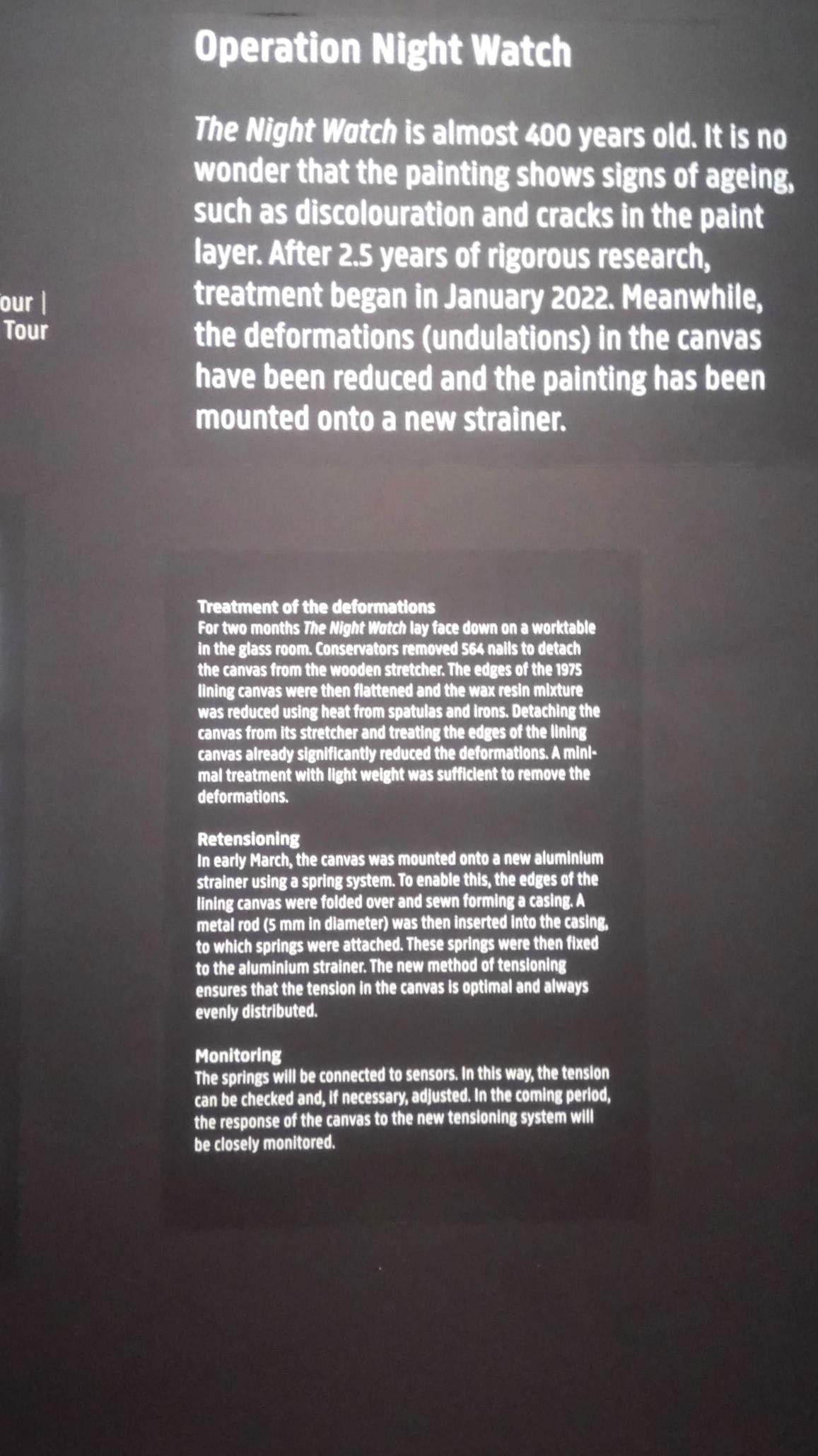
The original is being treated as per the information to the right of the photos of The Night Watch. A copy is also exhibited, and that is the second photo.
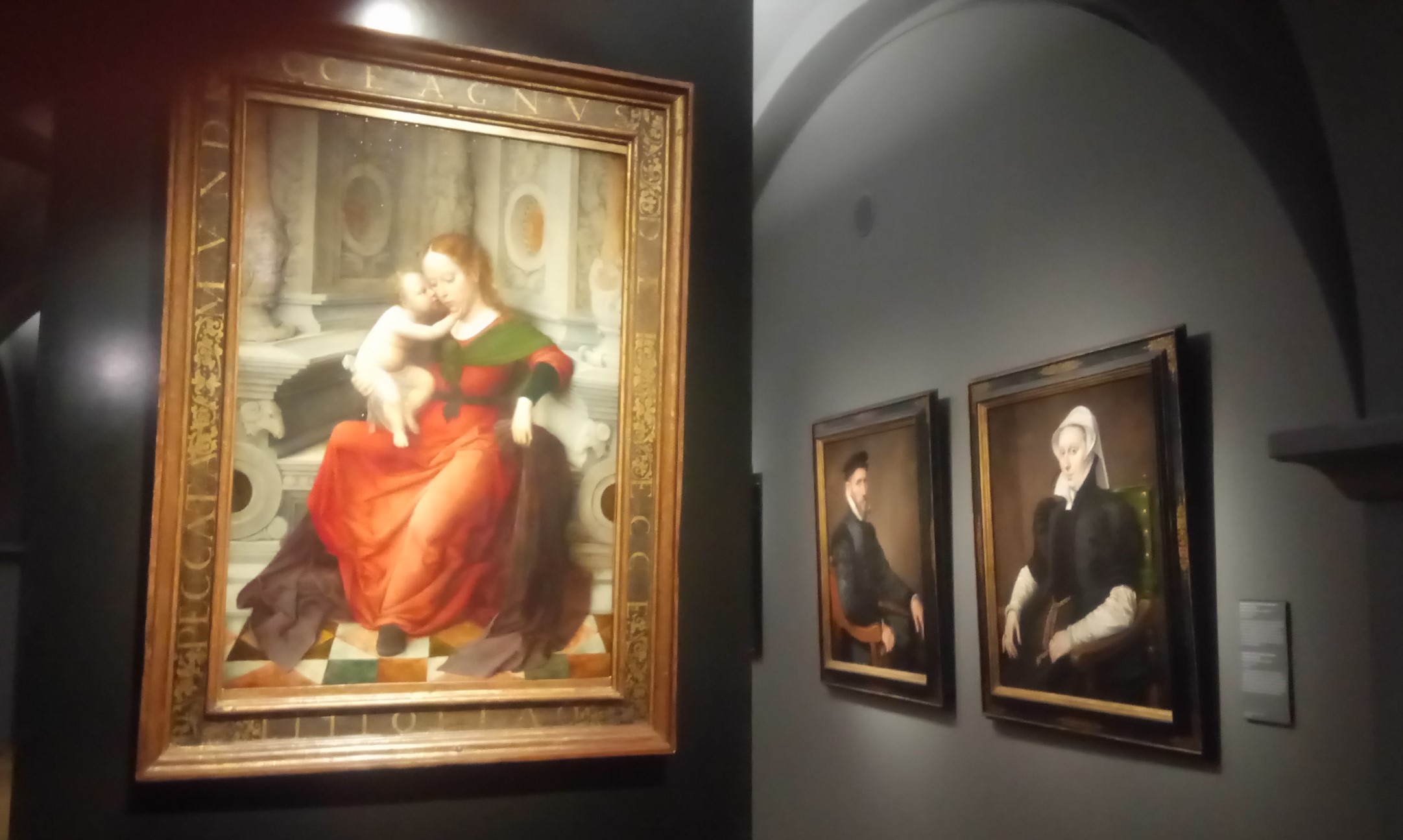
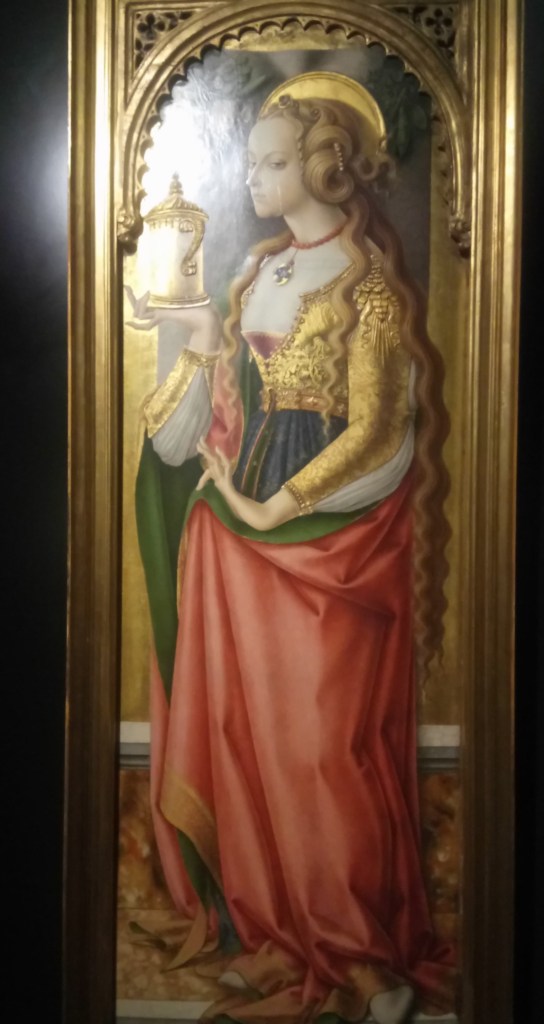
Mary Magdalene, tempura on panel.
Carlo Crivelli (c. 1430- 1495)
The ‘final flowering’ of the ‘International Gothic’ in Italy.
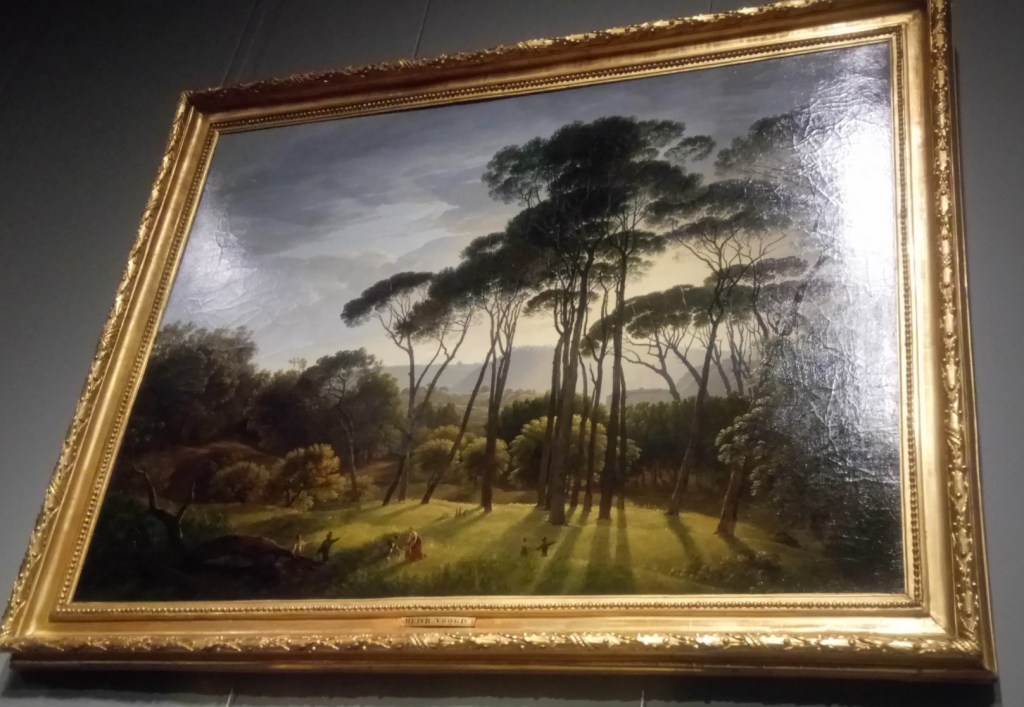
Italian Landscape with Umbrella Pines, Hendrik Voogd, 1807 oil on canvas, h 101.5cm × w 138.5cm More details Voogd was known as the ‘Dutch Claude’, after the French painter Claude Lorrain, who was famous for his history landscapes bathed in golden light. Voogd painted the gardens of the Villa Borghese in Rome in the late afternoon. The sun casts long shadows, and the trees stand out sharply against the sky. Strolling figures are enjoying the magnificent sunset. In the foreground, an artist is seated against a tree and drawing.
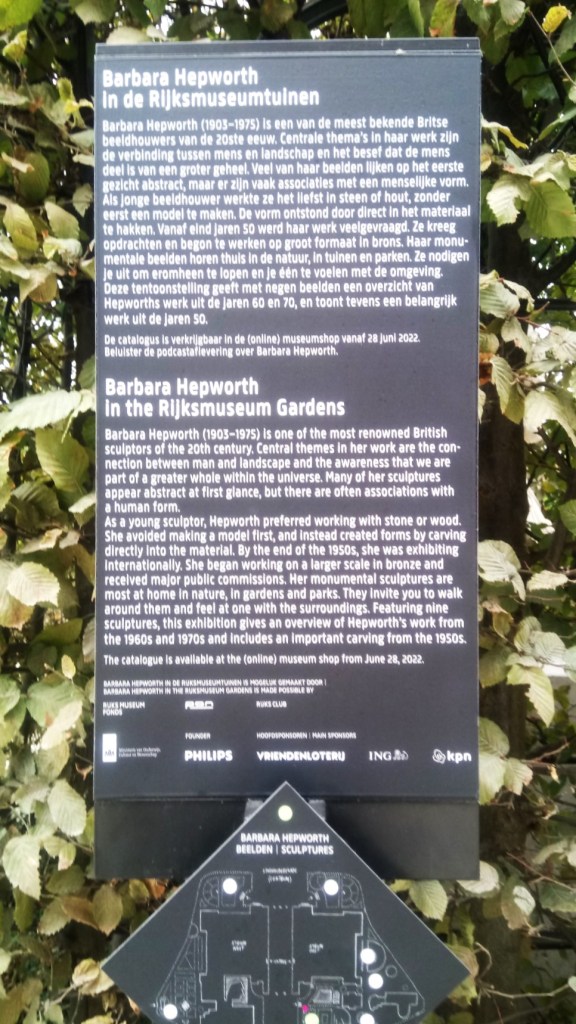
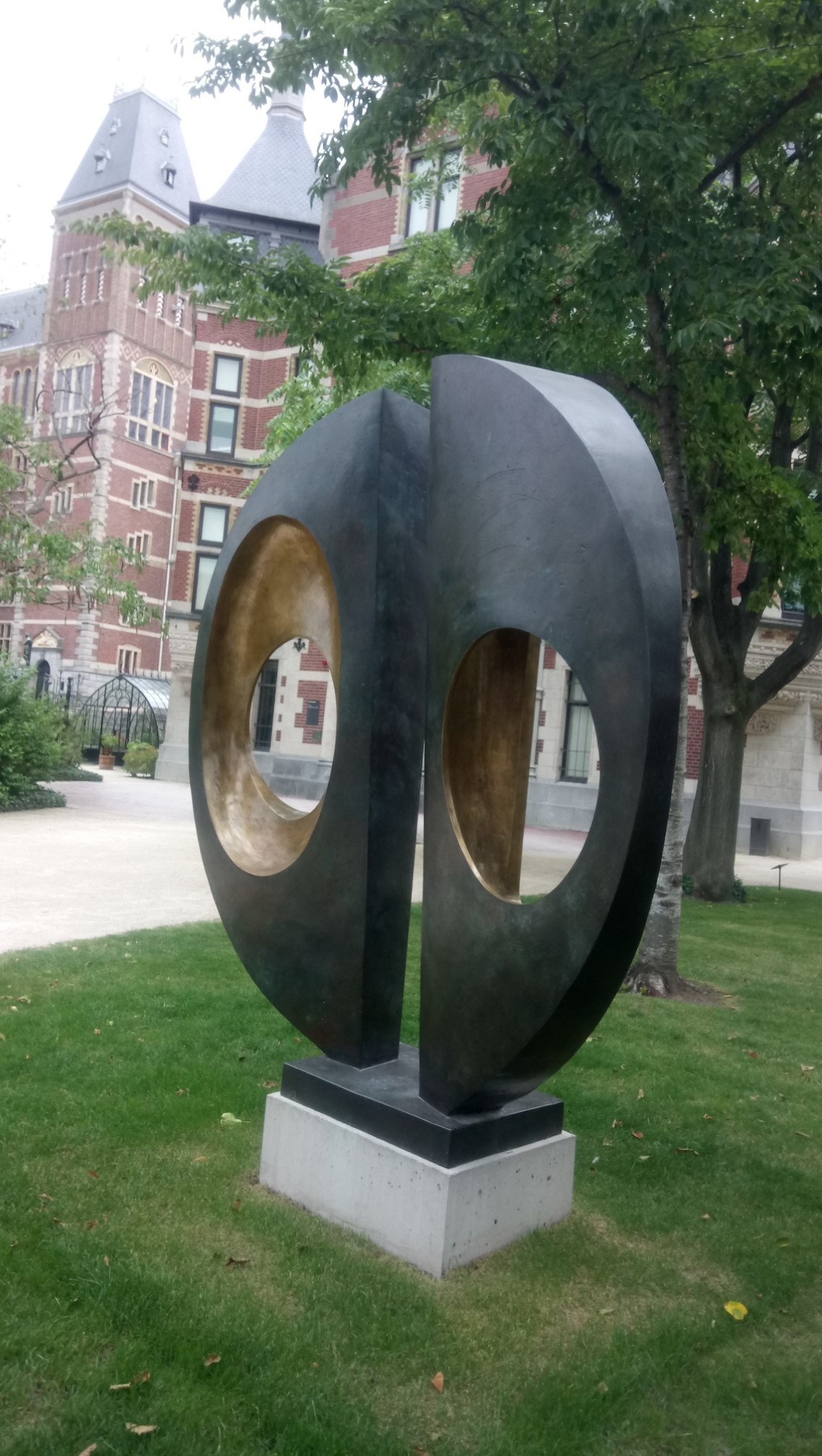
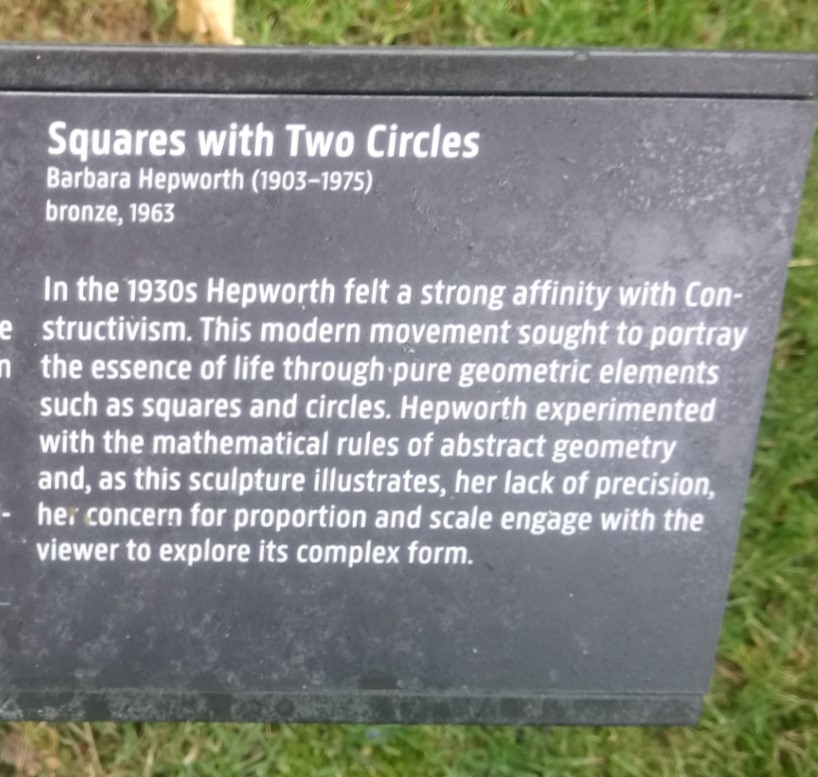
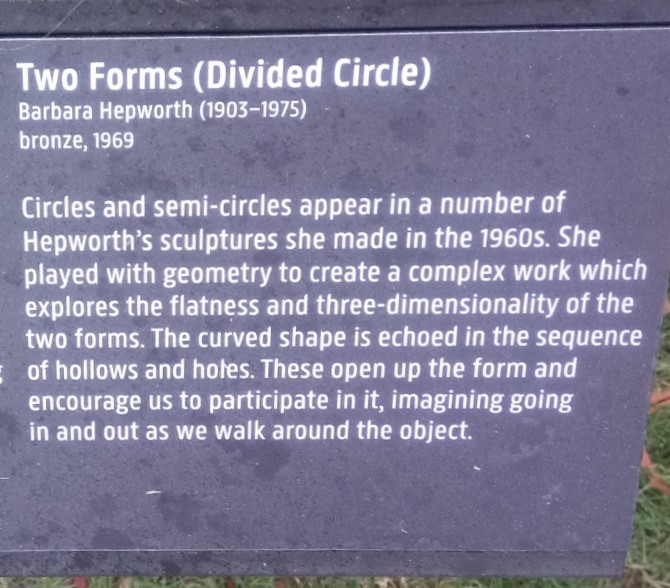
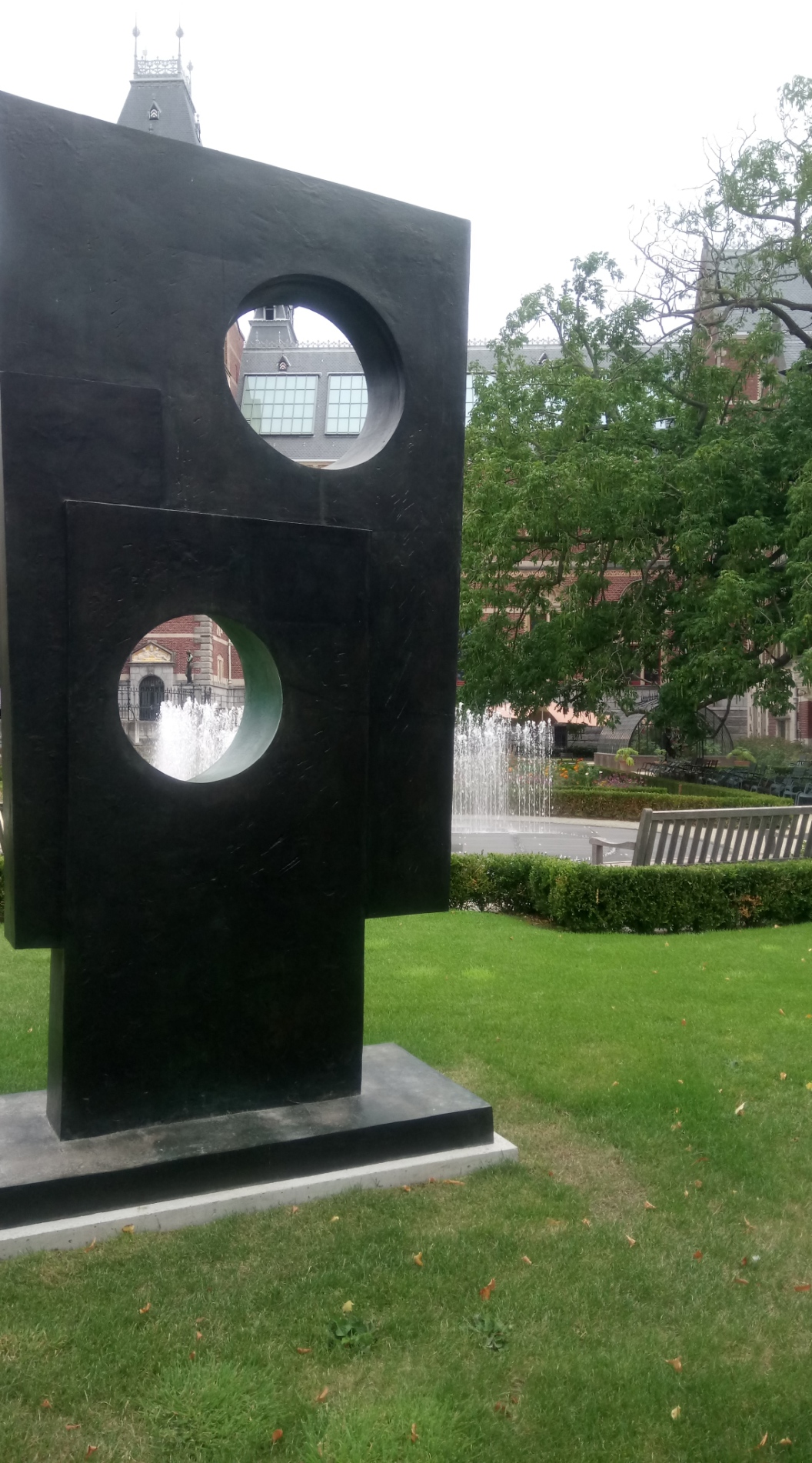
Outside the museum is an impressive exhibition of Barbara Hepworth sculptures .
Jordaan Food tour in Amsterdam
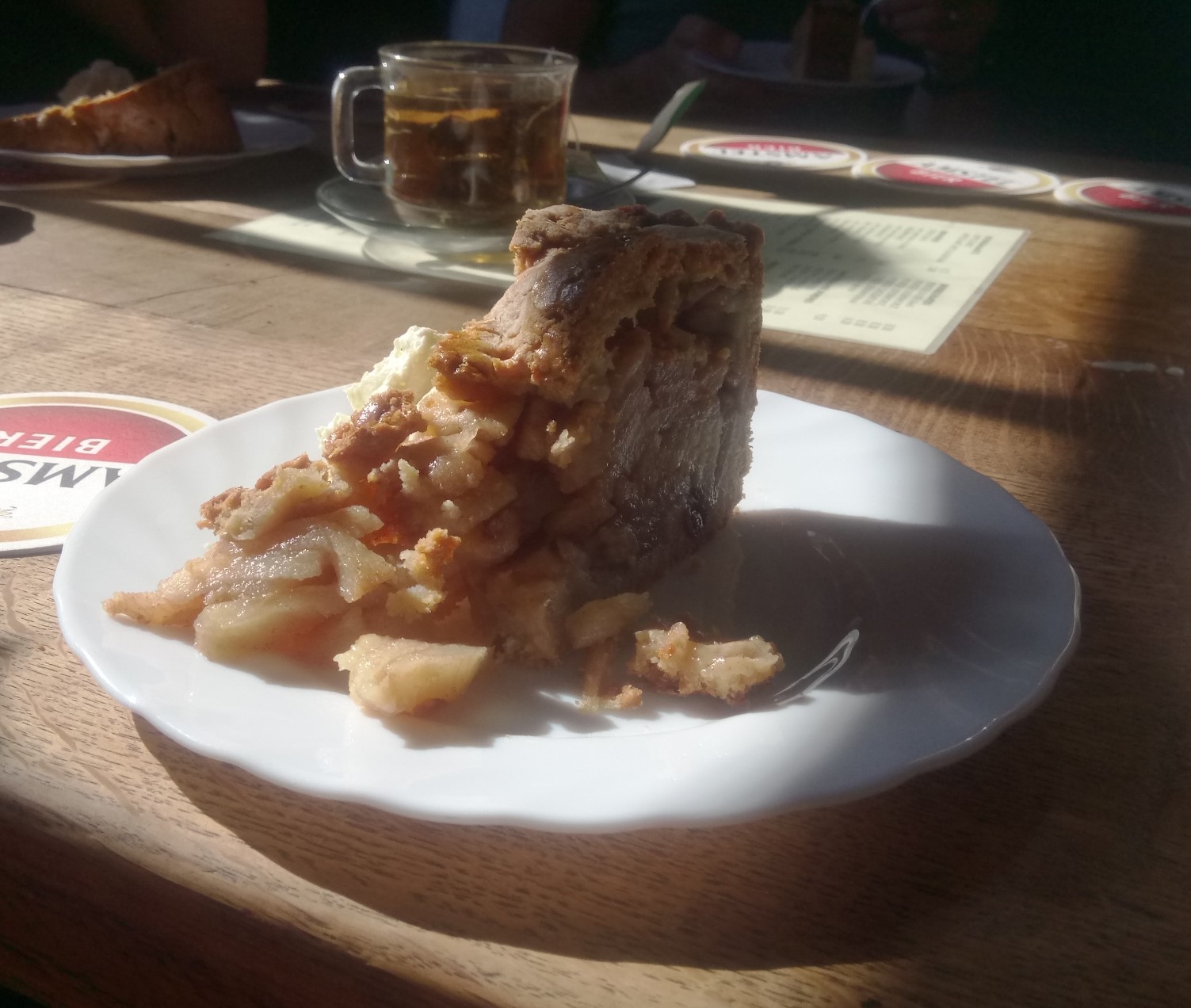
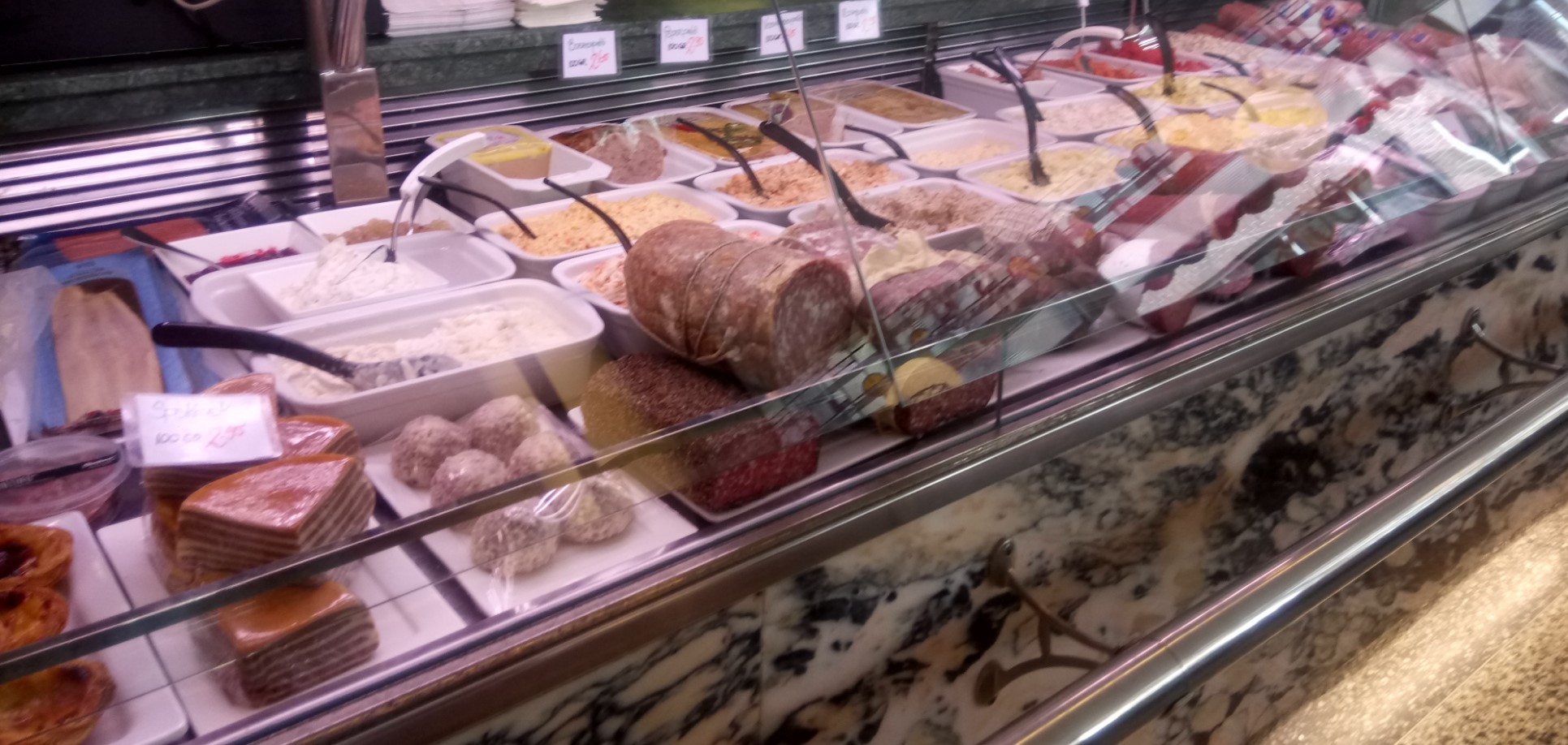
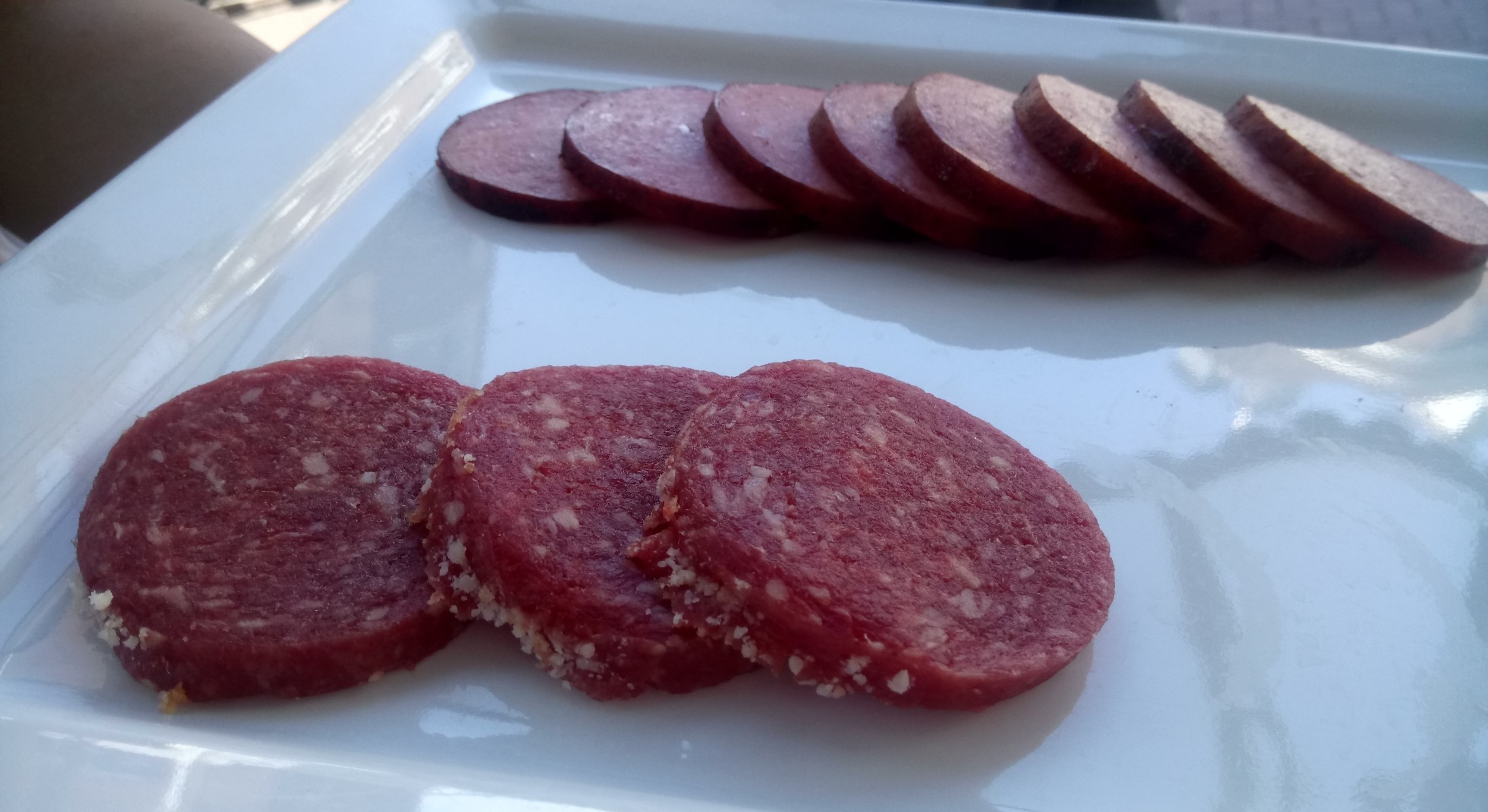
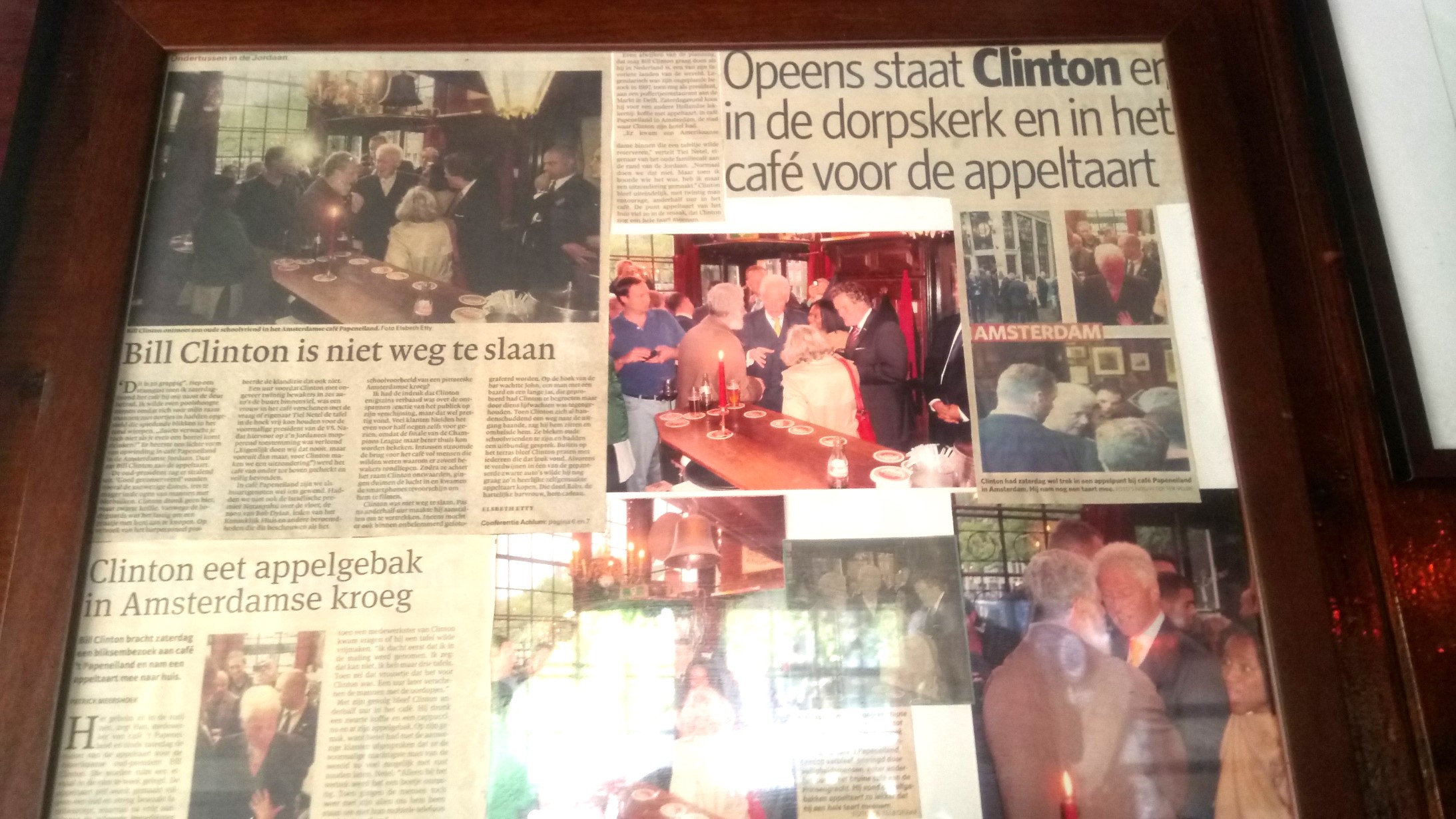
This tour had been planned for the trip to Europe thwarted by Covid. The refund was so prompt – no explanation needed – we thought that the company should be rewarded by booking again. We were pleased to have done so. The walk was interesting, and photos of some of the sights will follow those of the food venues we visited on the tour. The numbers are small (8 on this occasion), the food plentiful, and the venues provided quite a variety of style and food. Where an allergy impacted the planned offering, an alternative as found if possible. Missing one course is not a problem! If anything, there was too much. The walk included apple pie with a drink of choice; fish – cured herring with accompaniments and lightly battered cod; cheese of three vintages; sausage, two varieties; stroopwafels – large caramel filled biscuits; and deep fried gravy balls with mustard.
Cindy Lou reviews restaurants in Amsterdam
Mr Moustache
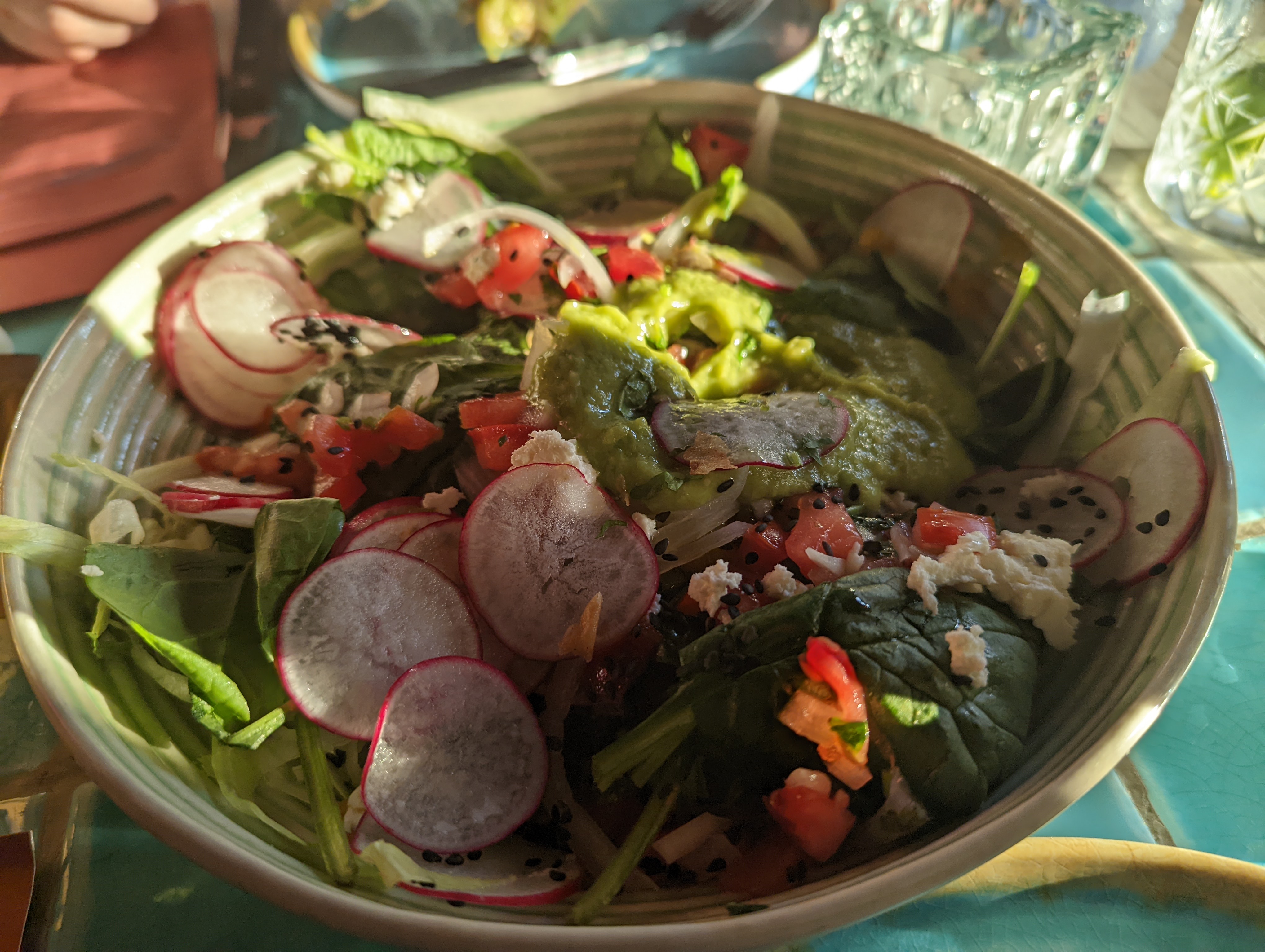
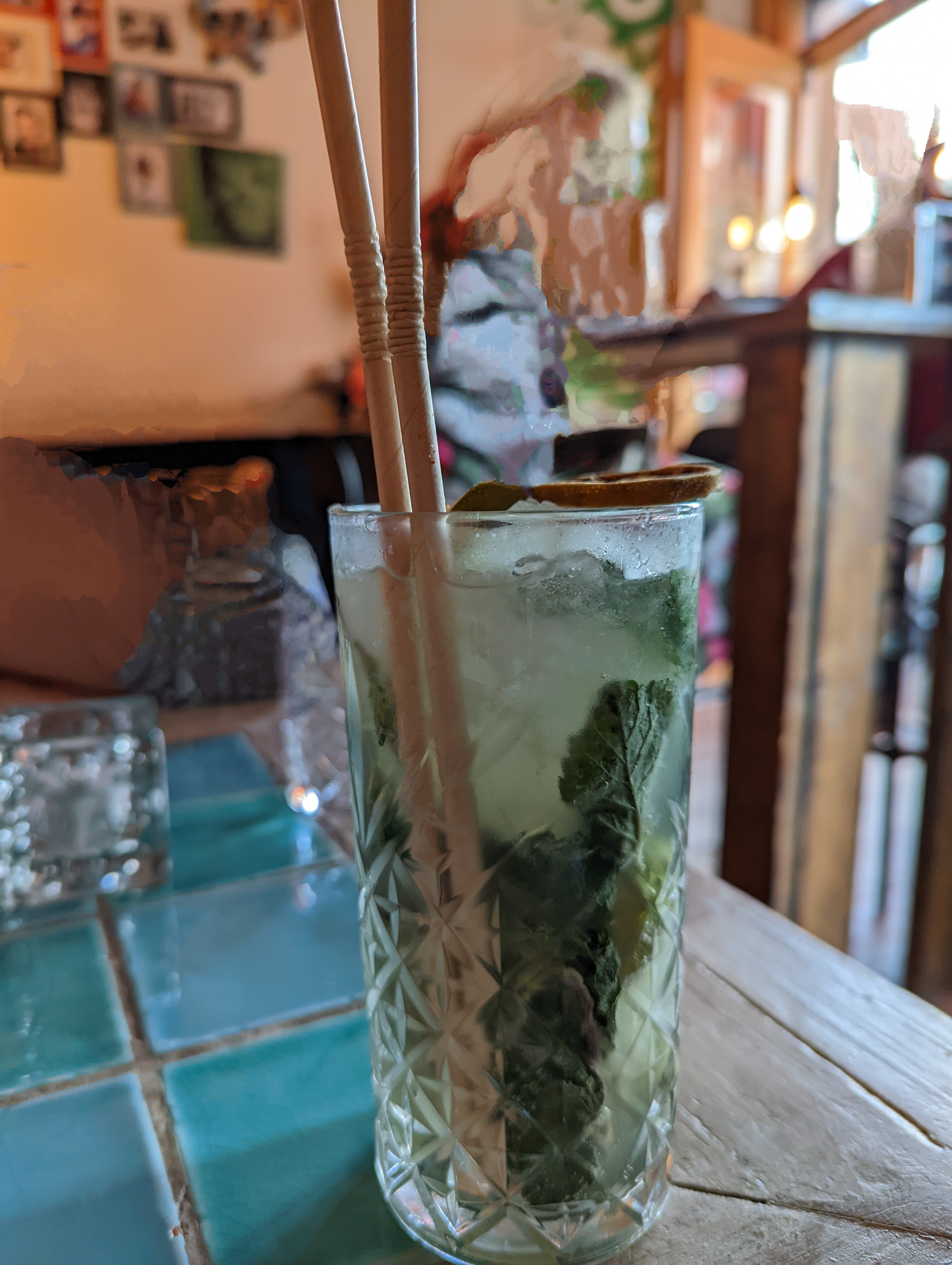
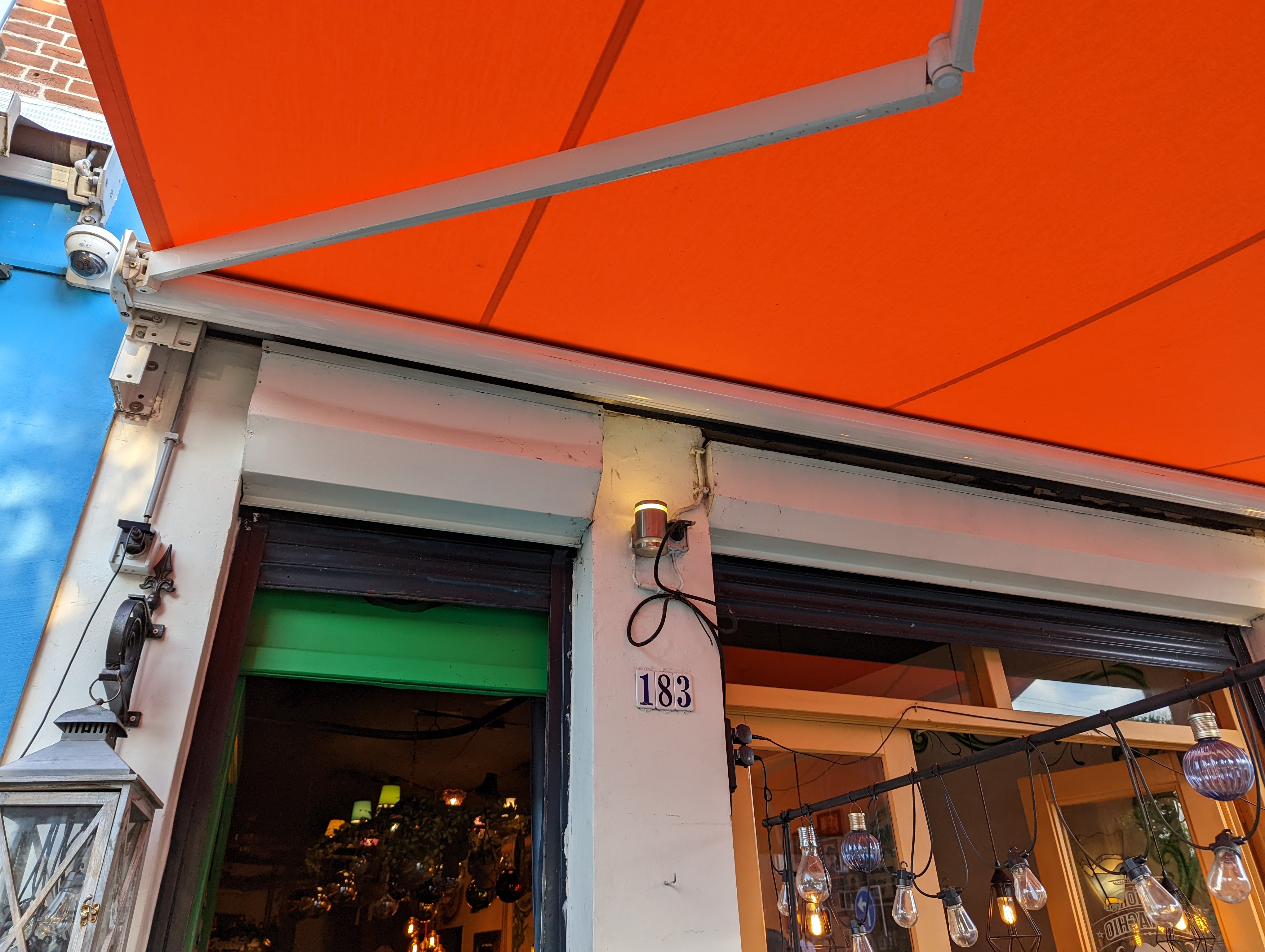
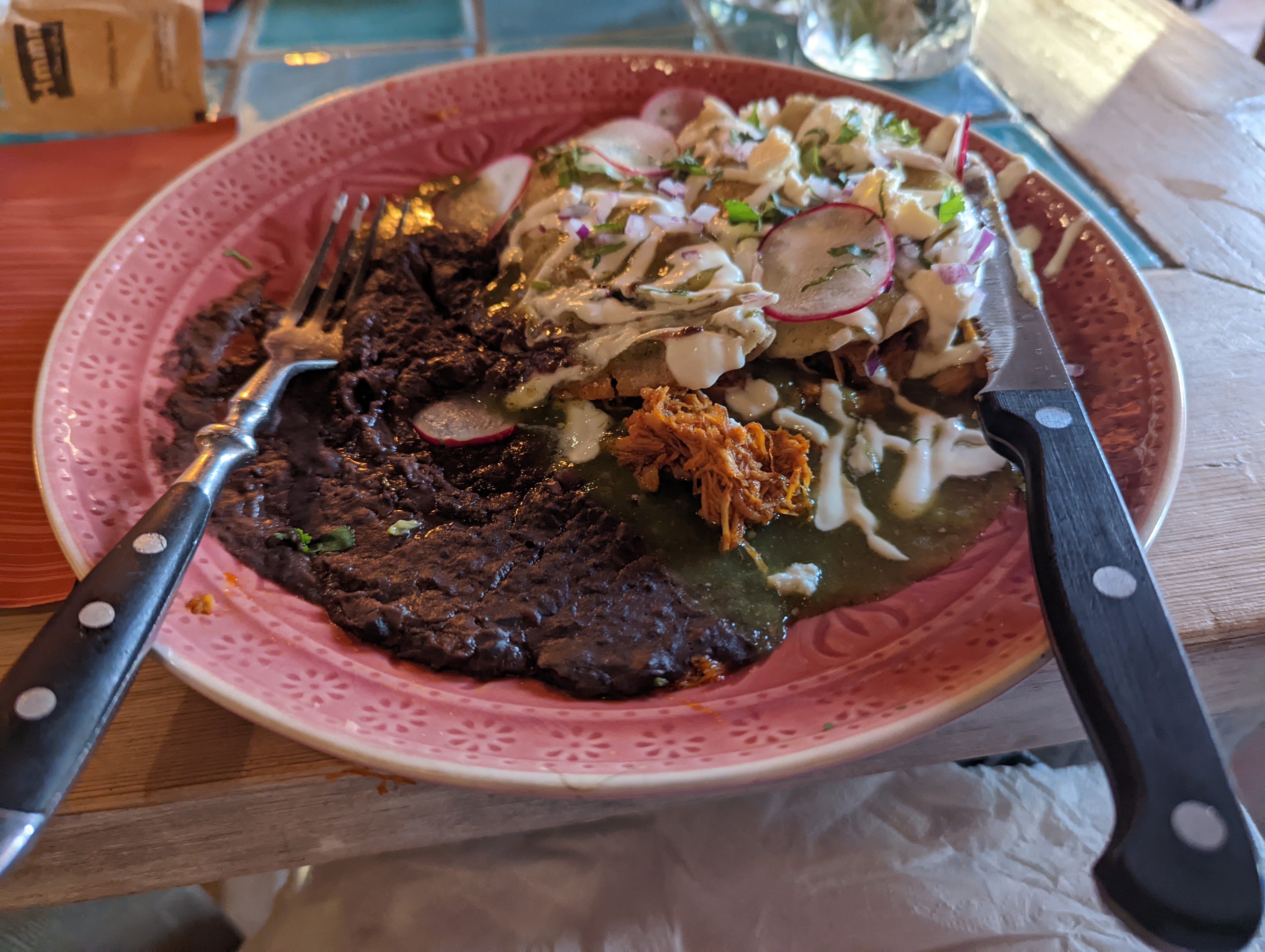
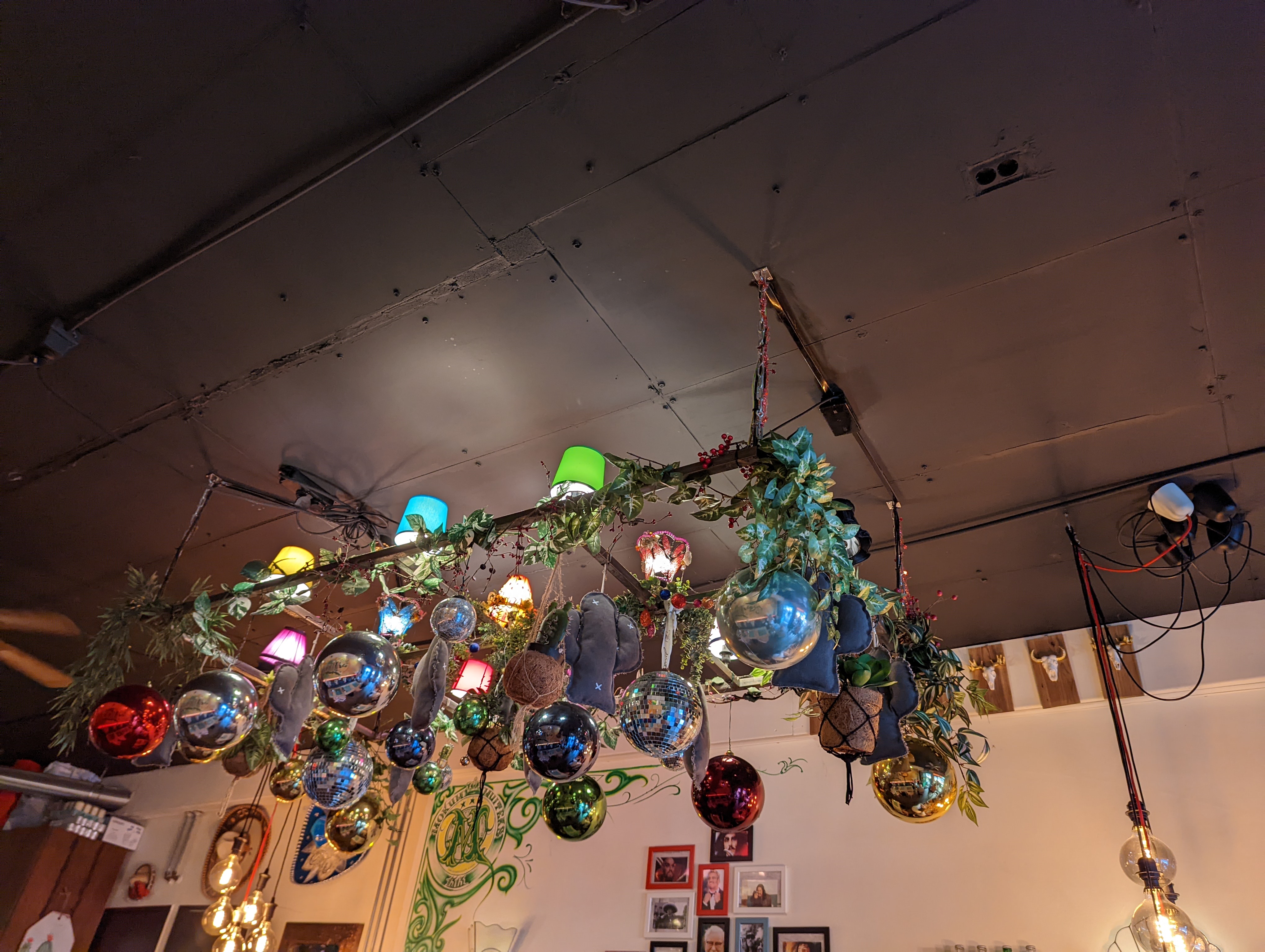
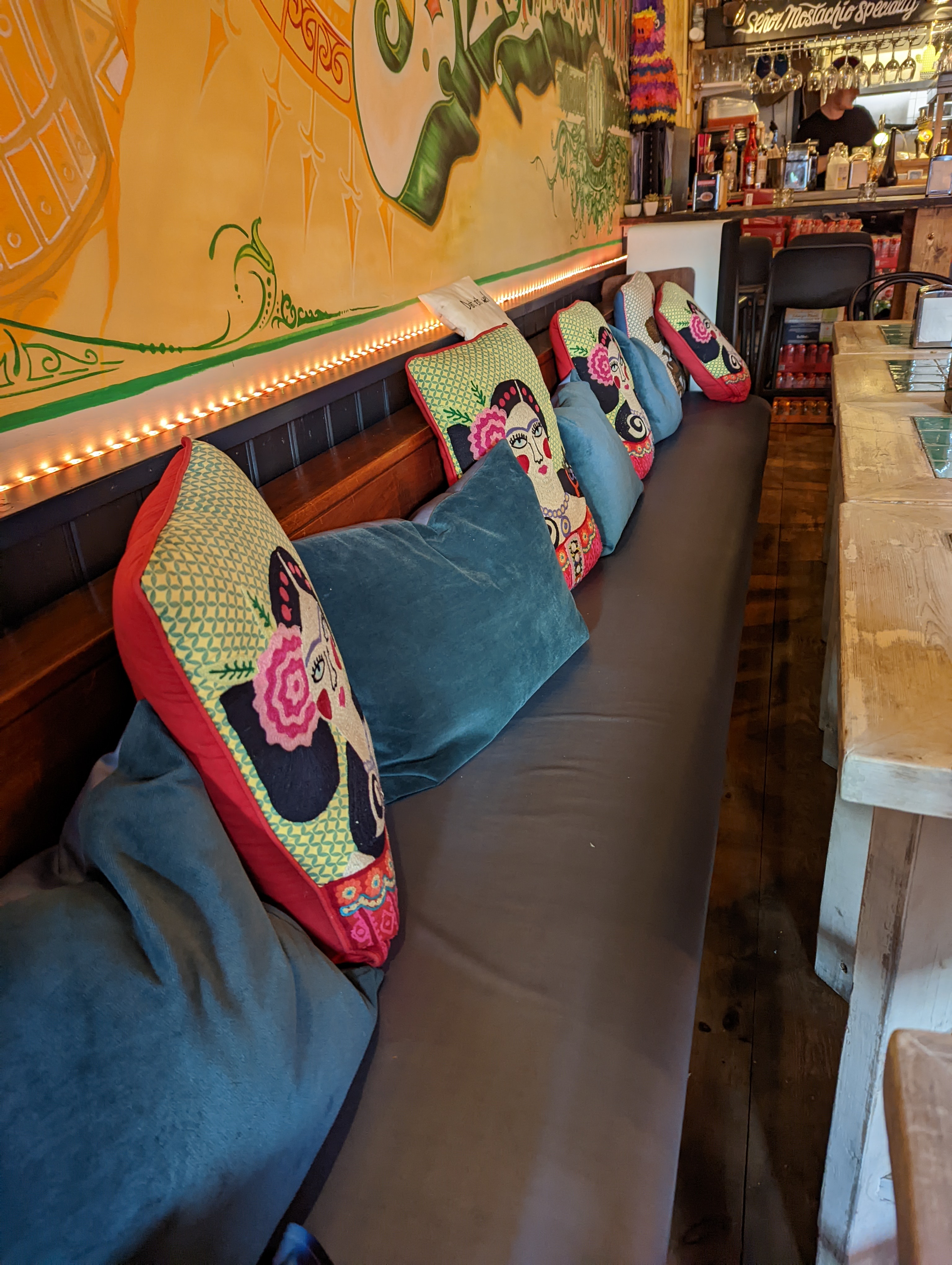
A short walk from our hotel was a Mexican restaurant, which promised a huge salad with the meal. Also – a mojito looked attractive. The setting was colourful, comfortable and friendly. The meals were flavoursome and a good size. We had a very pleasant time – and after a few hours of Dutch food something different was appealing for a change.
Zaza’s
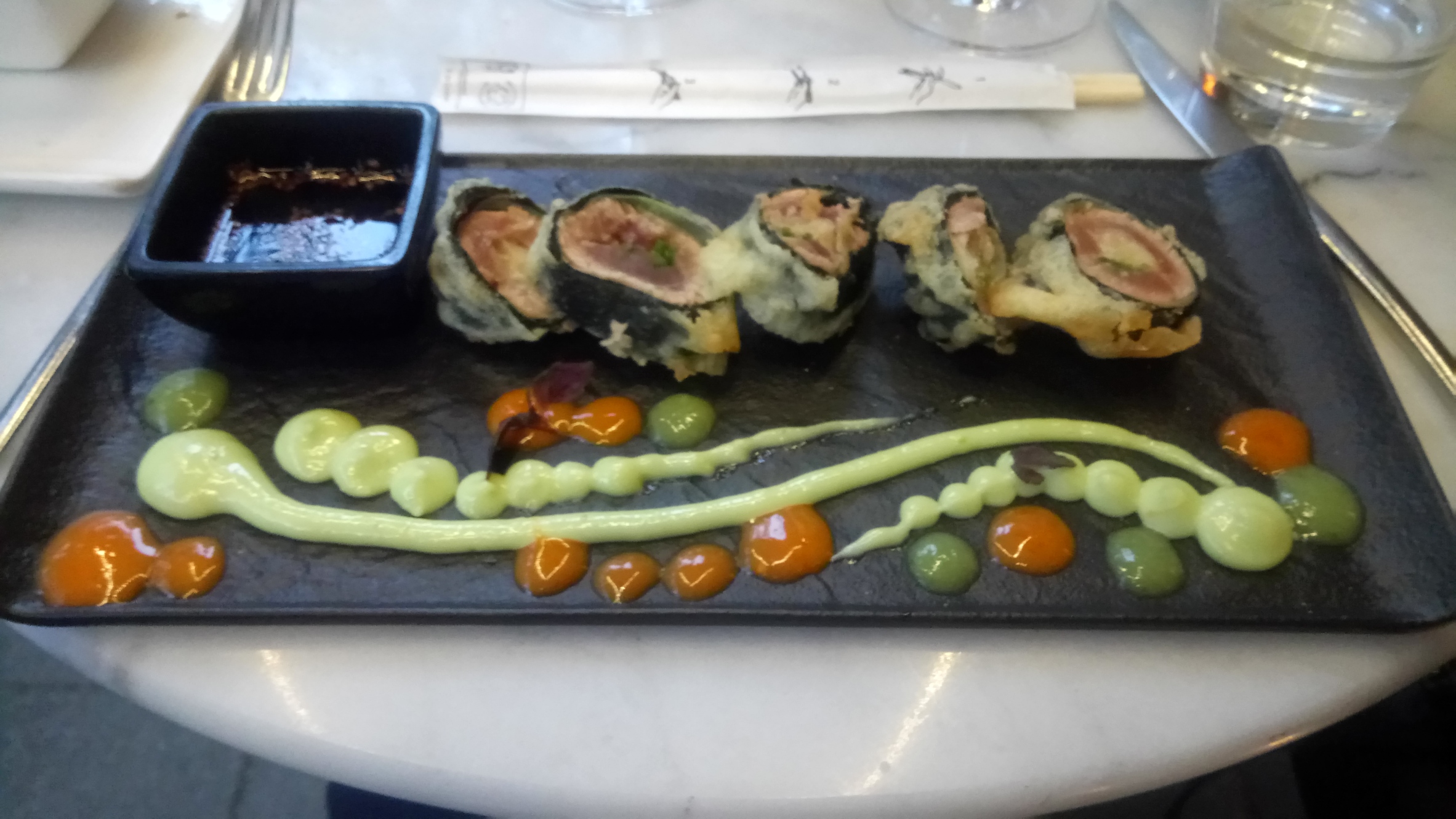
What a wonderful find! With the Van Gogh Museum to visit, and eating at Zaza’s to reprise a wonderful meal, Amsterdam will be on my list for another trip. Zaza’s is really not to be missed. There is indoor and outdoor seating, and outdoor seemed fine on the warm evening on this visit. The service was friendly, efficient and really lovely. The menu is excellent – and the extras that arrived without ordering were accompanied with explanations – no risk of an allergy going unnoticed at this caring restaurant. Unfortunately, the photo of the menu was very poor, so cannot be replicated here. From the online menu I have copied the courses we chose:
Starters
TERRINE OF GOAT’S CHEESE with Apple and Celery served with Marinated Aubergine, Bloody Mary Gel and Rosemary Focaccia
TUNA TEMPURA filled with Cucumber & Marinated Ginger with Wasabi Mayonnaise and Soy & Sesame Dipping Sauce
In Between Courses
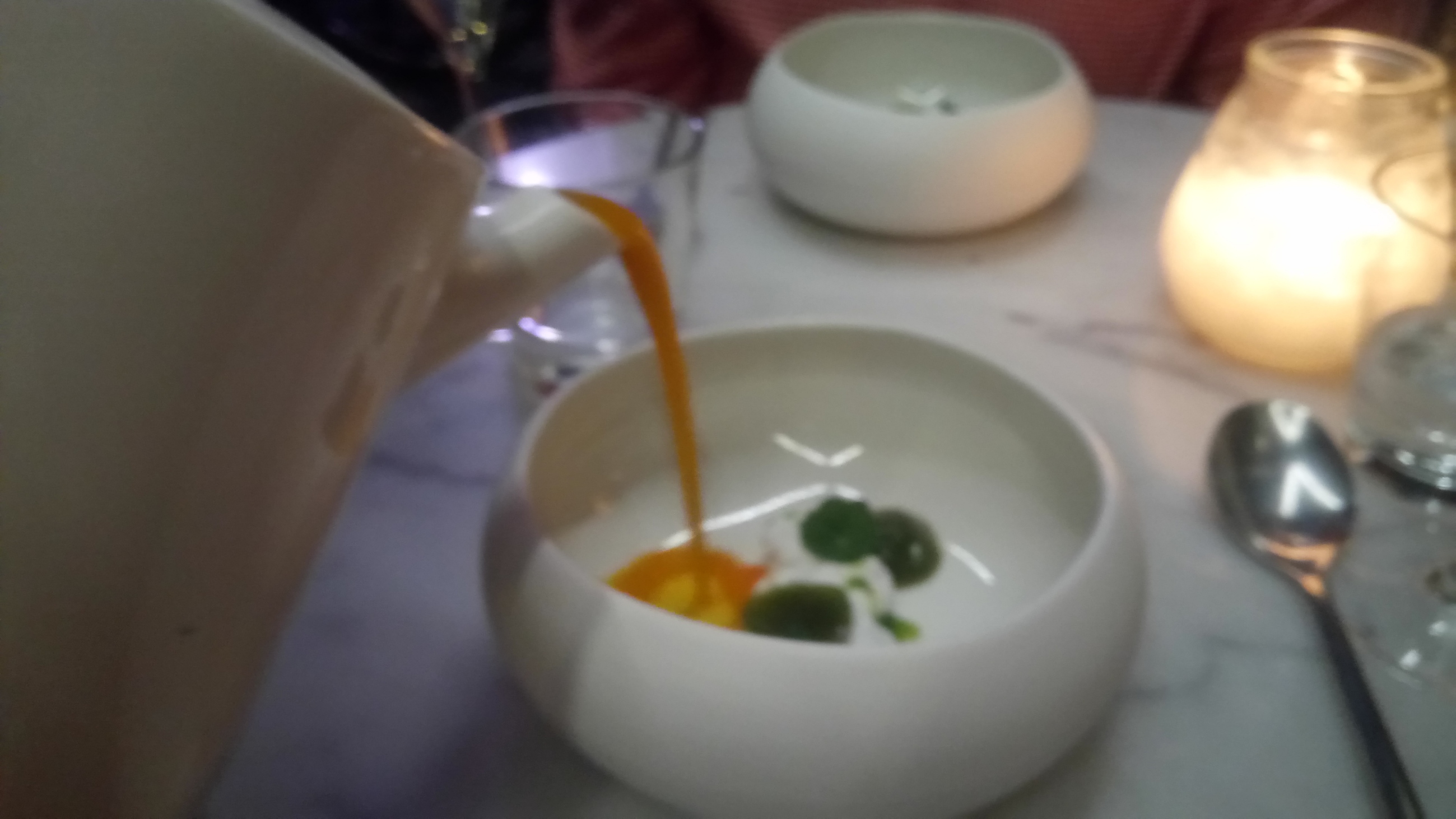
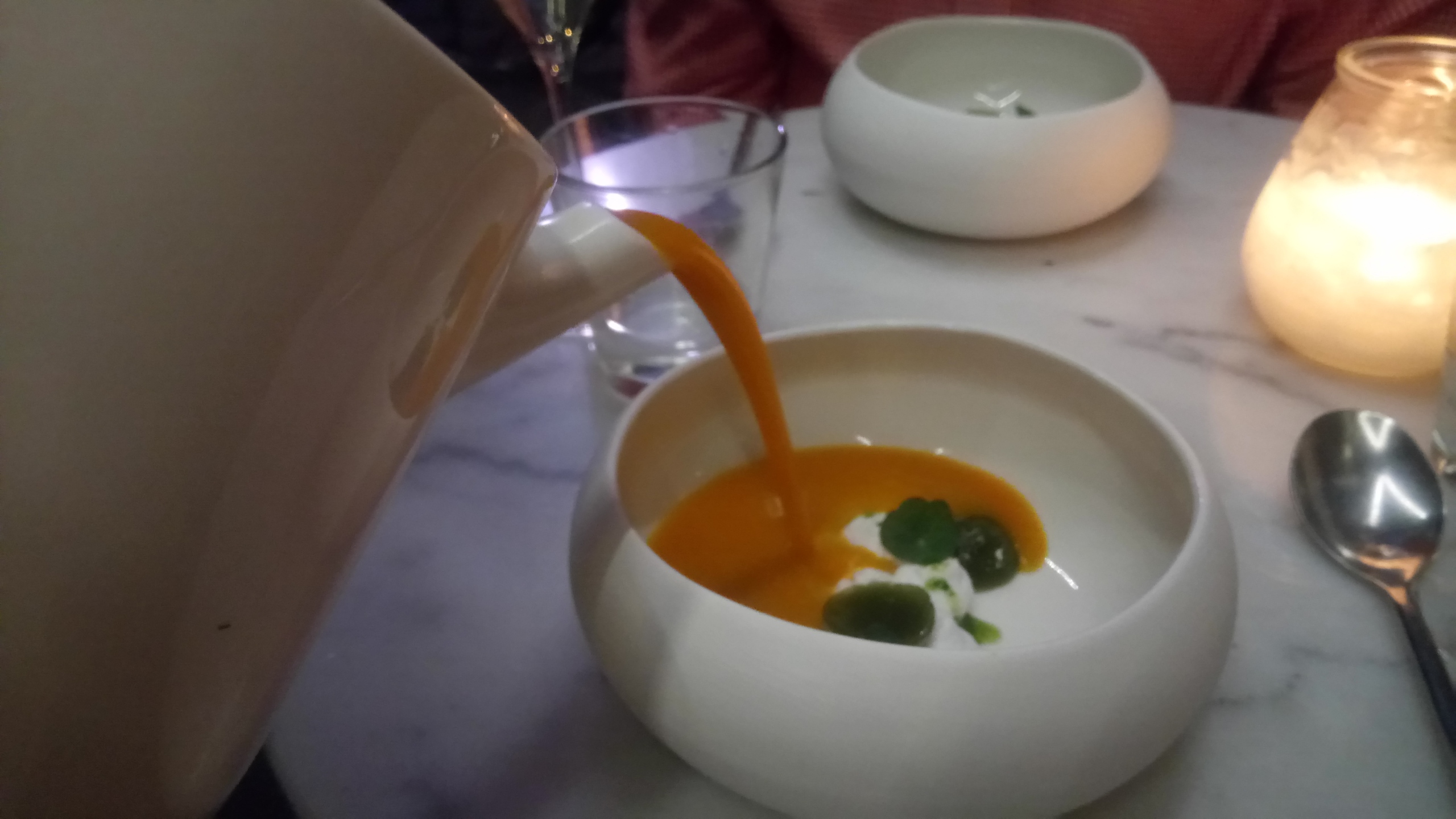
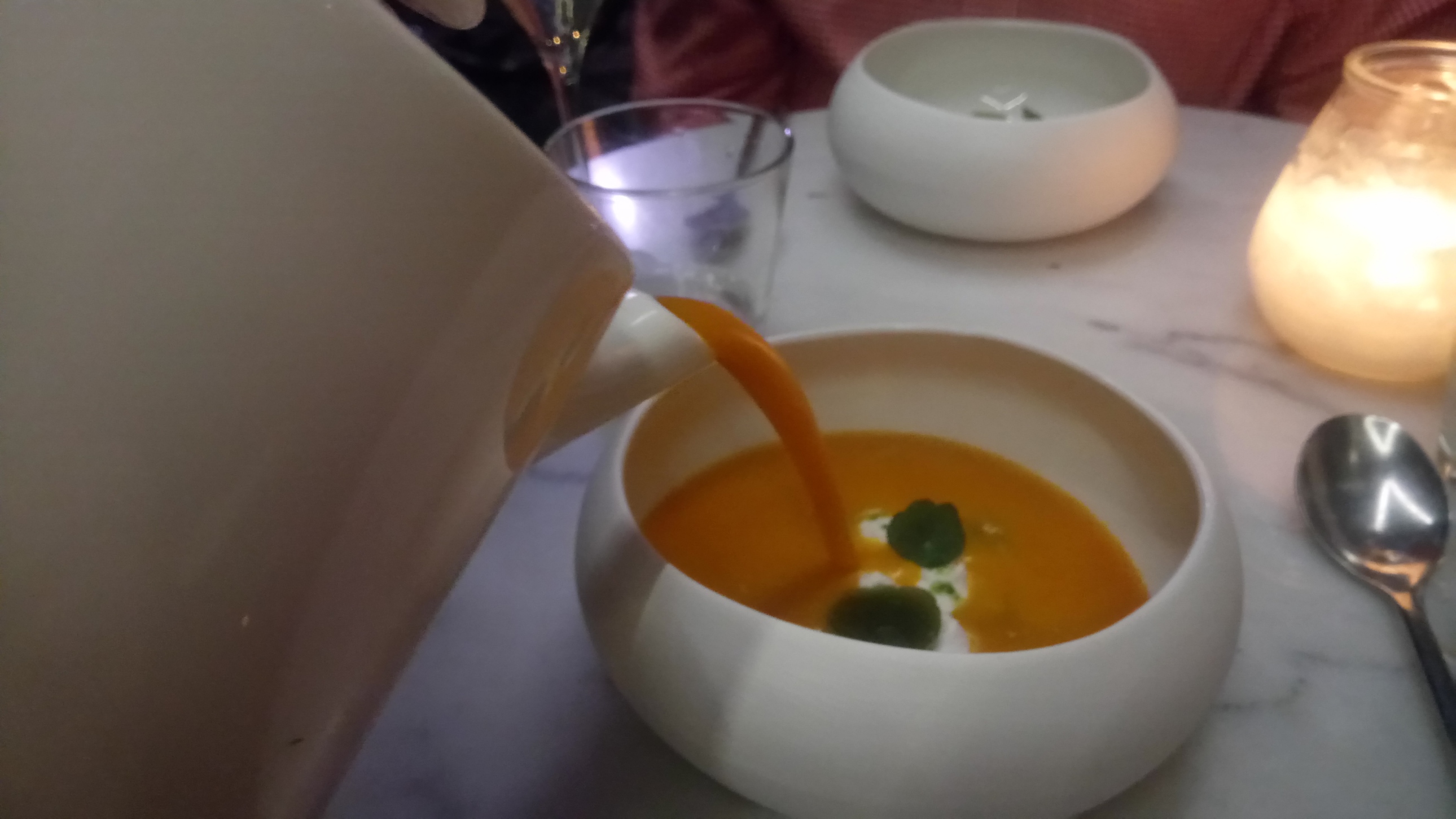
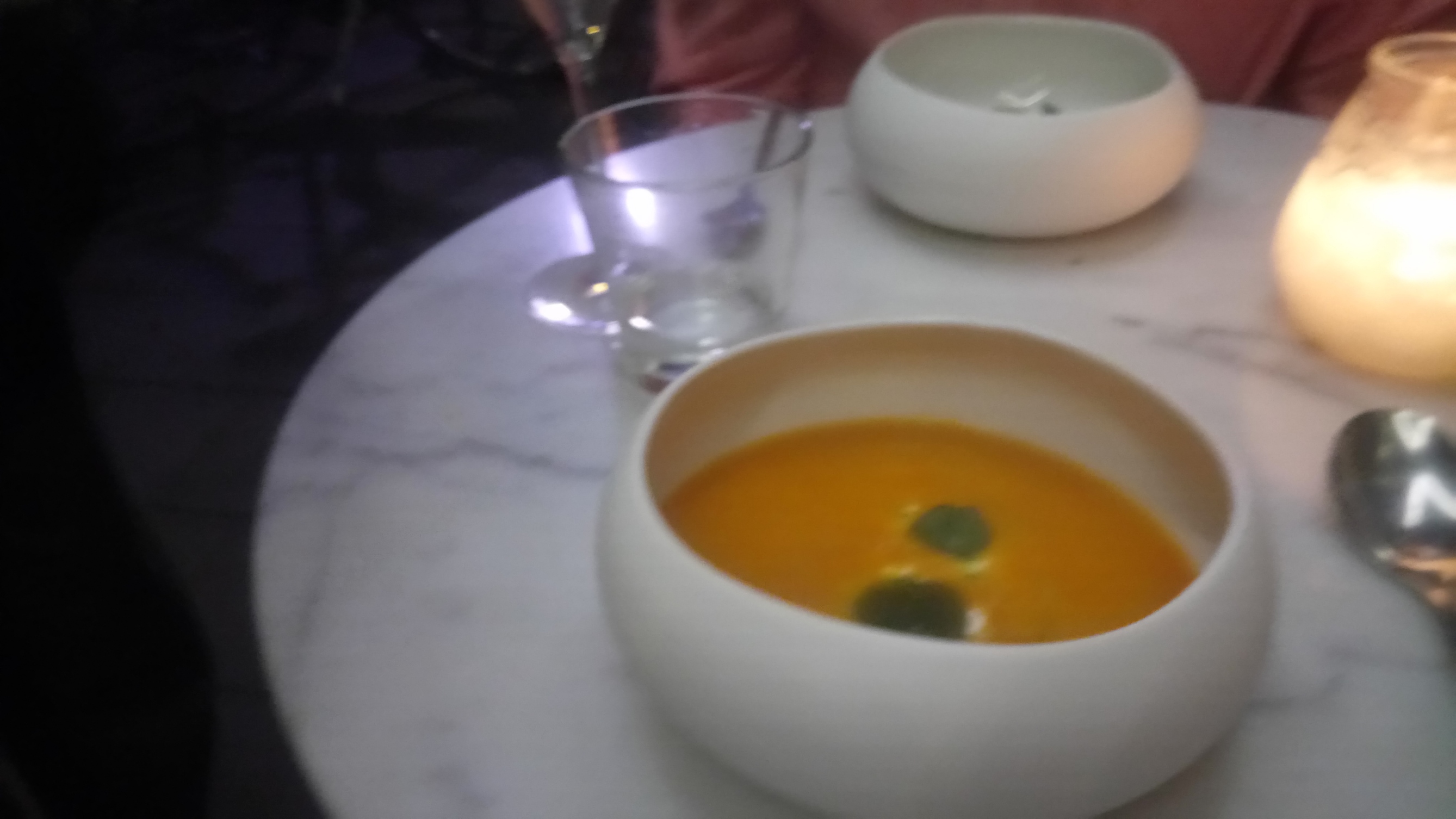
CARROT AND GINGER SOUP with Coconut Cream and Gelée from Coriander
Main Courses
HOMEMADE RAVIOLI filled with Feta, Garden Peas, Thyme and Lemon with Parmesan Foam and Pine Nut Dressing
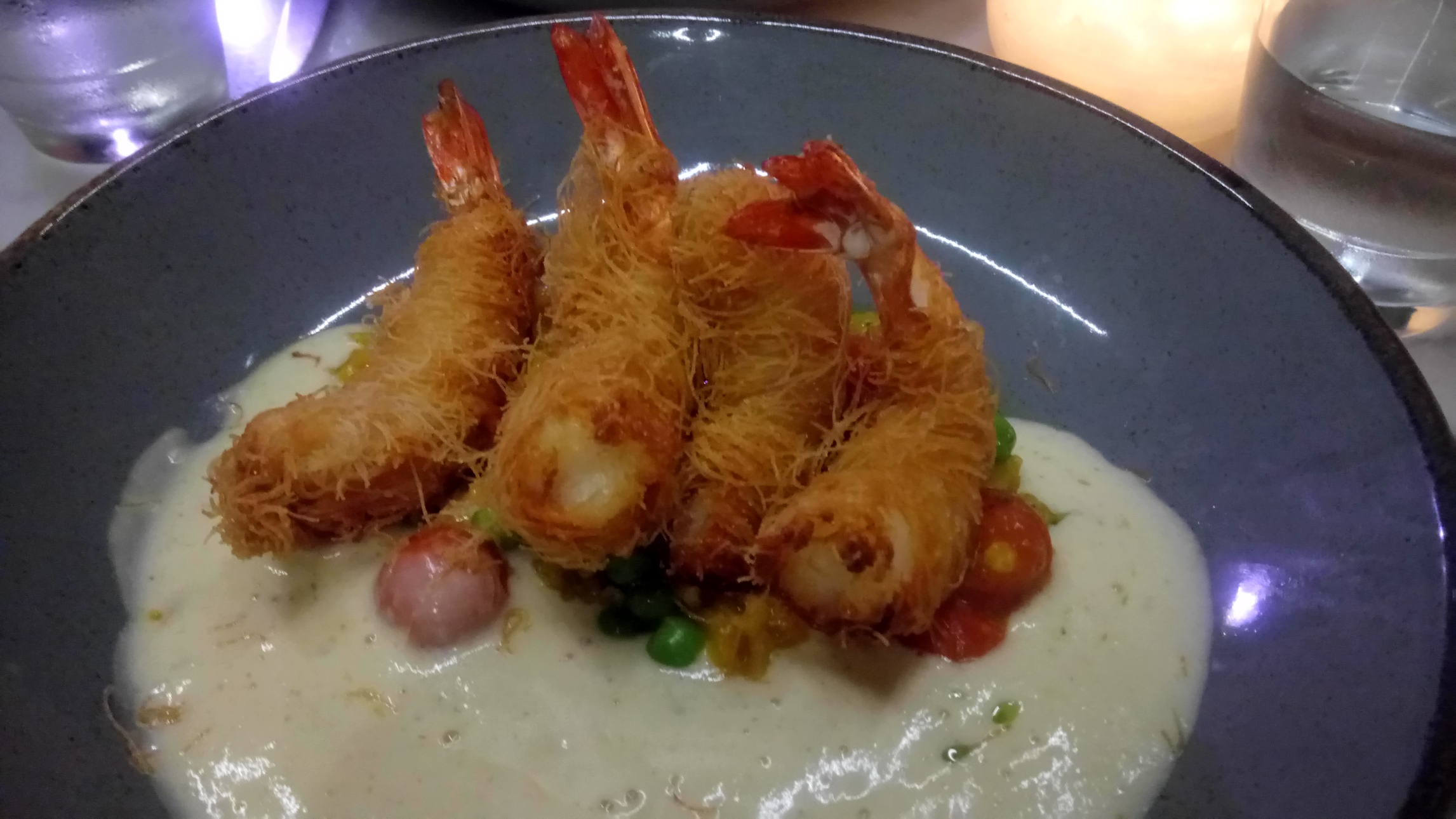
JUMBO PRAWNS IN KATAIFI with Saffron Risotto, Cherry Tomatoes, Petis Pois and Fennel Foam
An amuse bouche appeared as soon as we ordered. After that, the time in between courses was beautifully paced. Despite this, everything was so generous we did not have dessert or coffee, as appealing as the former choices sounded. Turkish bread was served with a beautifully flavoured butter. I wish I had written the details down – I shall next time.
Soup at Zaza’s – a delightful exhibition
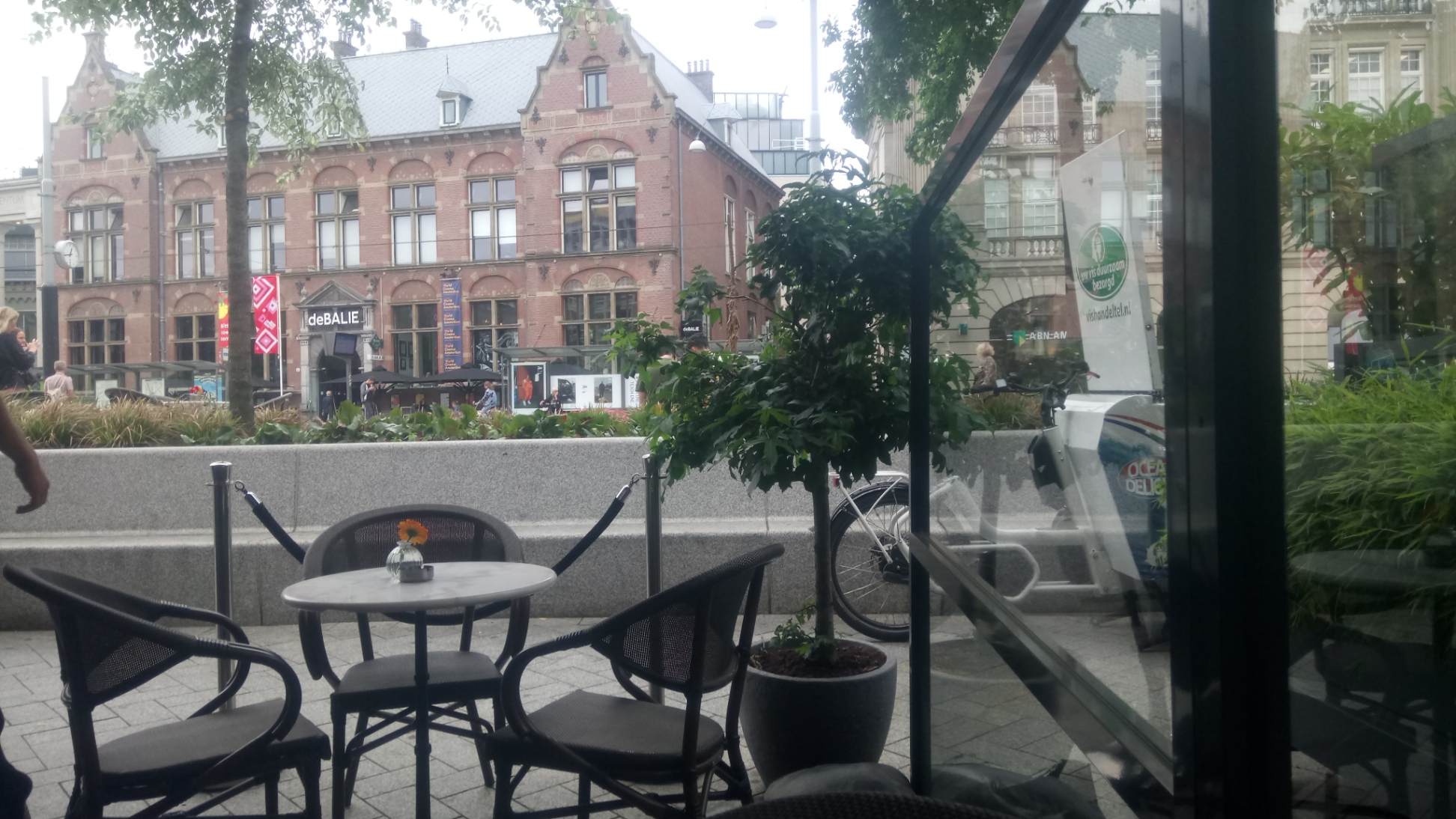
Leidse Restaurant & Bar
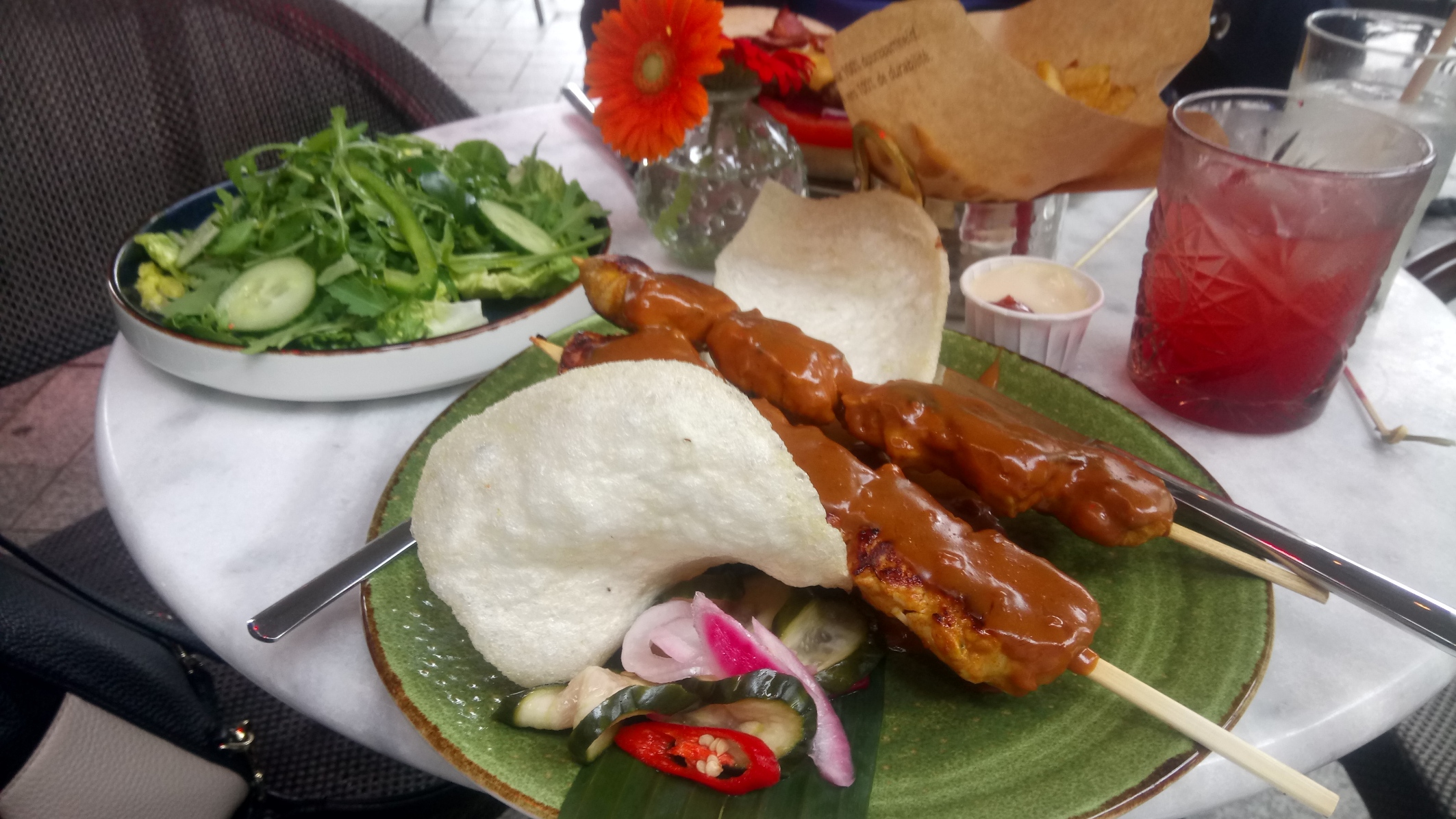
On the way back from the Rijksmuseum we found a restaurant which served the sate chicken I had enjoyed on the food tour. Again, the salad was plentiful and fresh. Service was pleasant, although not fast, and the serves were generous. Sate chicken is served with prawn crackers, or, in this instance, a huge prawn cracker into which the chicken nestled.
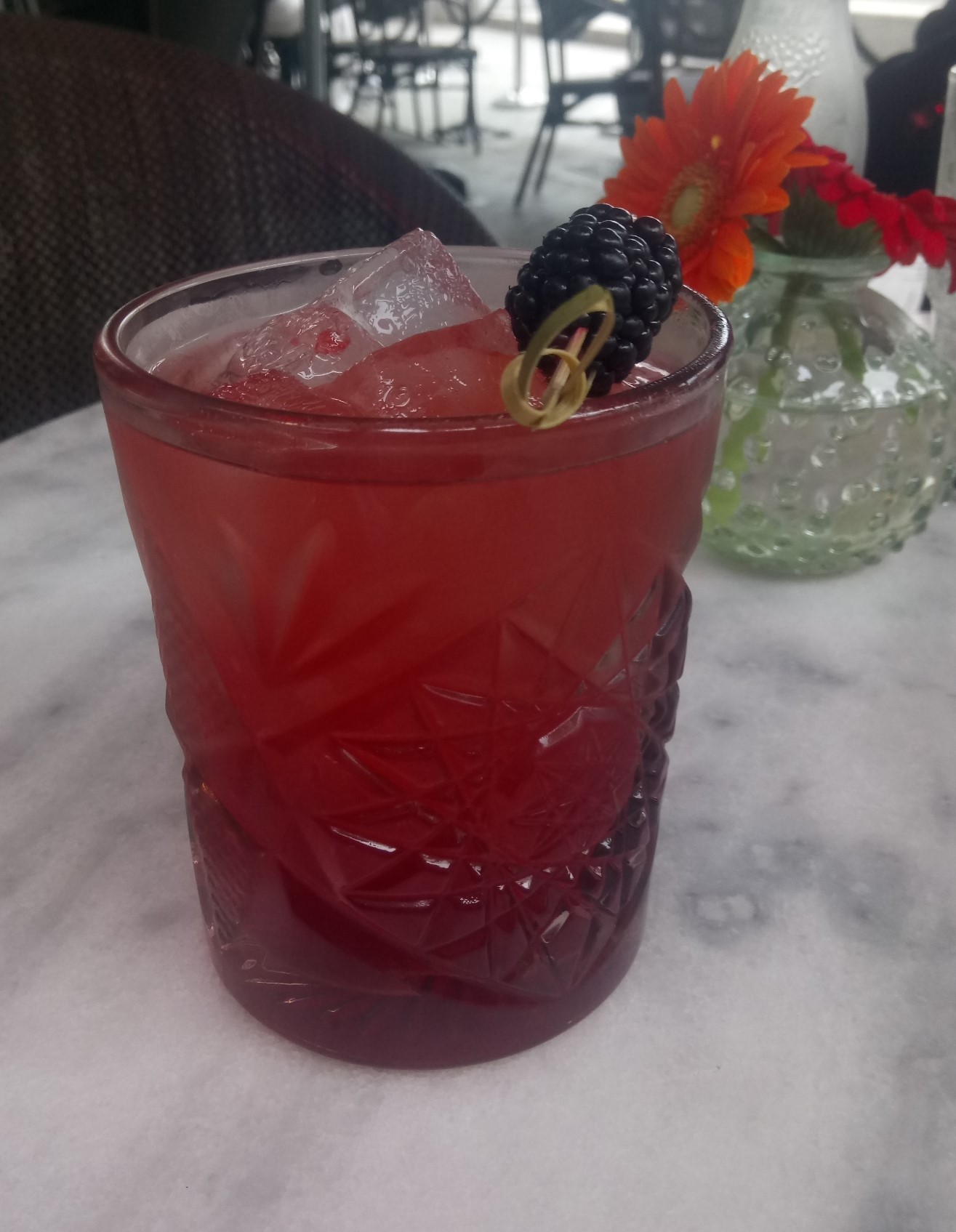
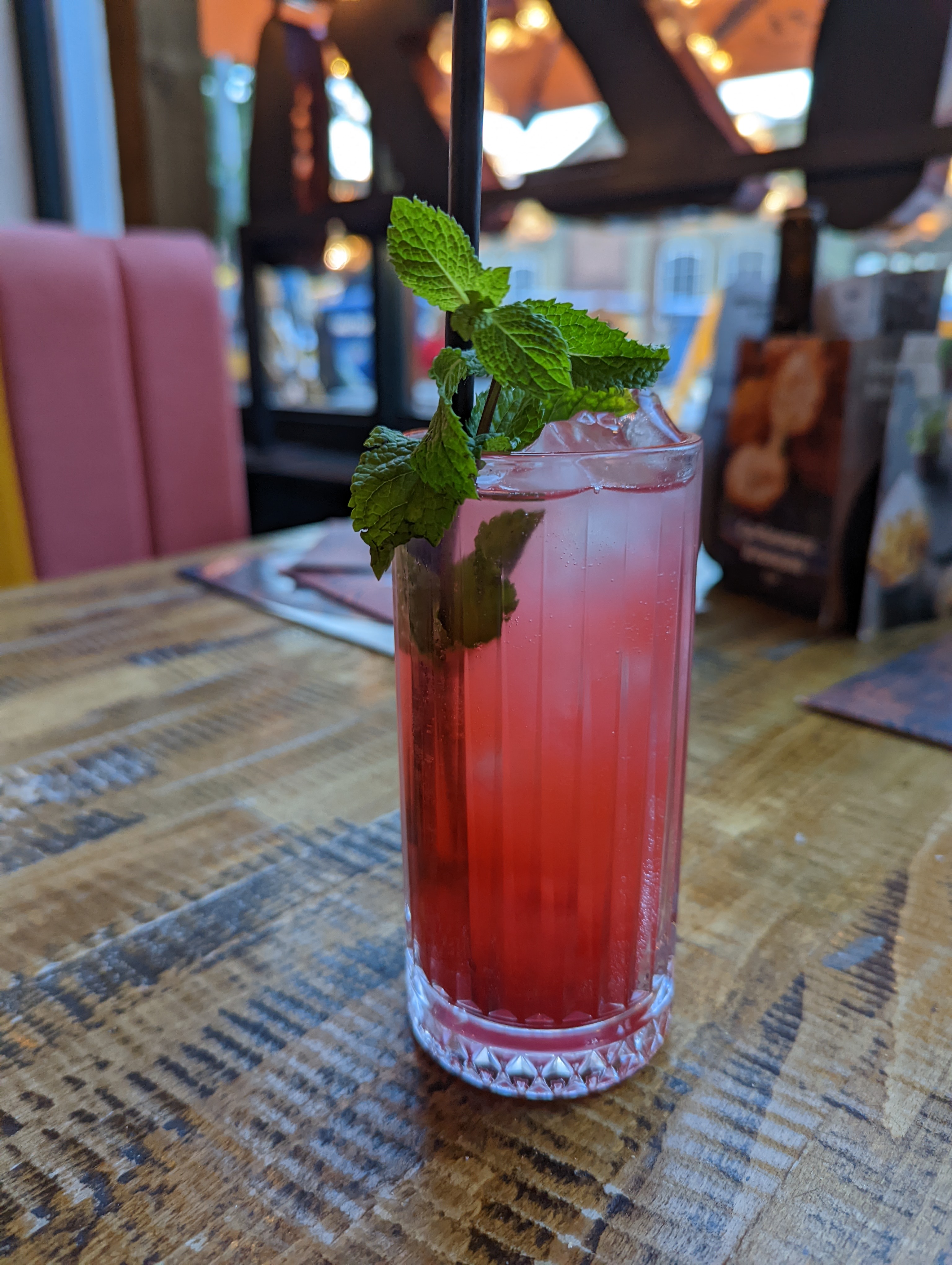
I had a delicious berry drink, complete with what I thought were mulberries but was told were black raspberries.
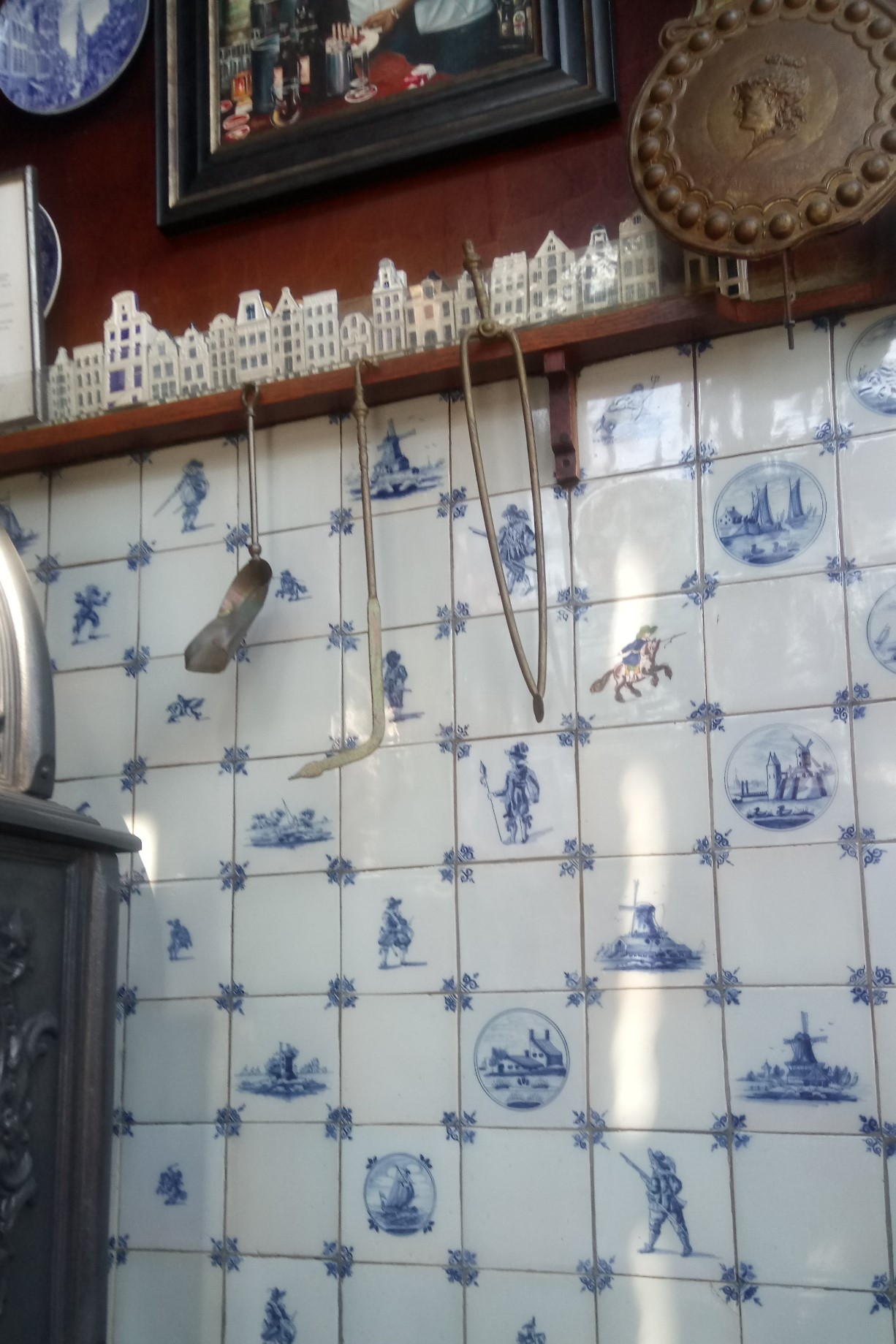
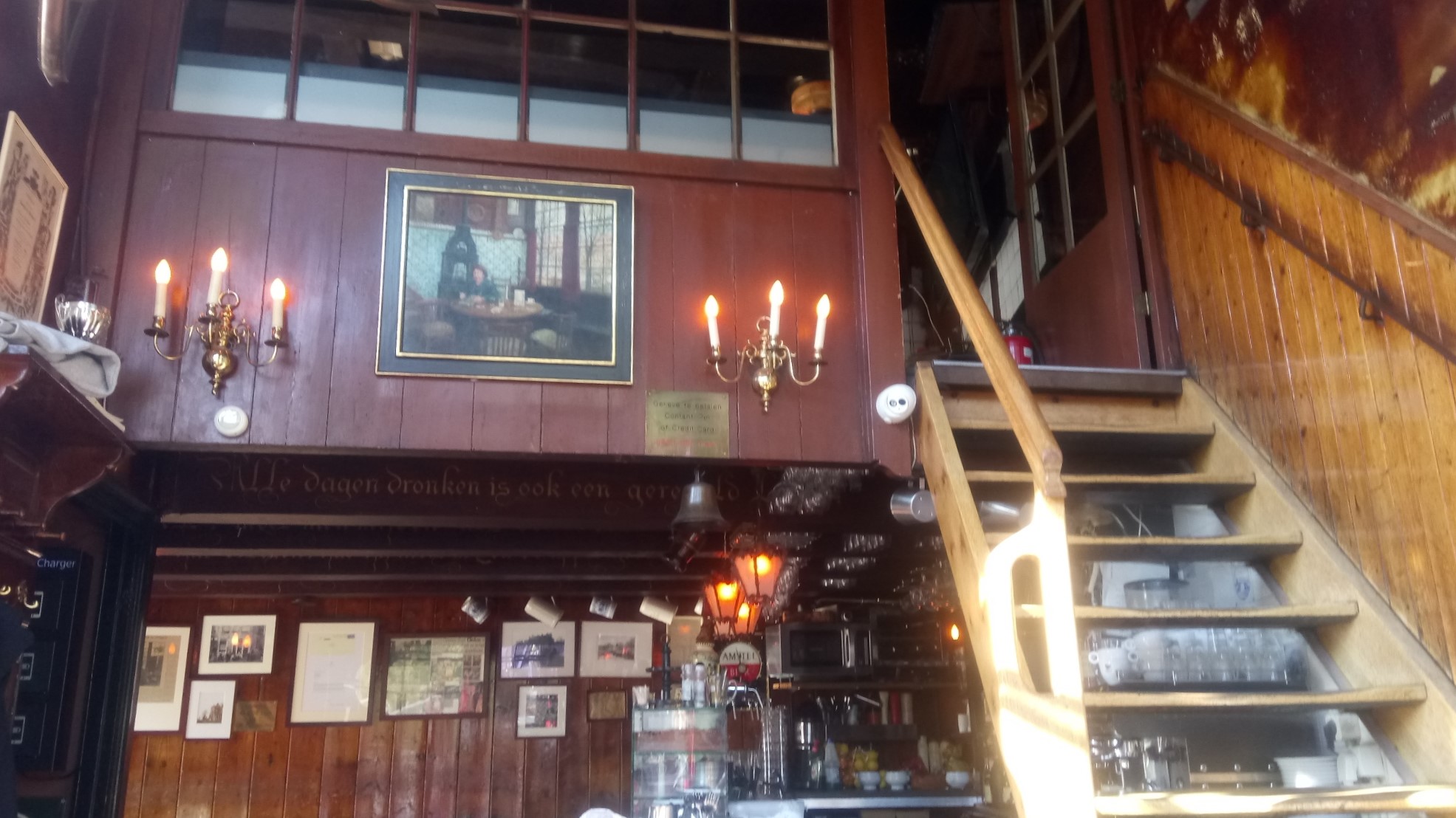
Sights while walking around the Jordaan area on the Food Tour
Maggie O’Farrell: The Marriage Portrait In 2020, Maggie O’Farrell won the Women’s Prize for fiction with Hamnet, a moving fictionalisation of the death of Shakespeare’s son. In her new novel, The Marriage Portrait, she imagines the lost story of another historical figure – Lucrezia de’ Medici, an educated and artistic young woman living in 1560s Florence. Just as Hamnet evoked the world of Shakespeare’s England, The Marriage Portrait brings the world of Renaissance Italy to jewel-bright life.
Join O’Farrell with Guardian writer Claire Armitstead, live in London or via the livestream. She will also be answering your questions.
A terrific image. I have a wonderful bracelet with the caption on it. i have also used the idea in my writing about the troublesome women in Barbara Pym’s novels.
Brief news from Australia
ACT Covid figures 25 August:
Health authorities in Canberra have confirmed another 252 positive COVID cases, bringing the number of known active cases to 1,463.
Two people are in ICU with the virus and 109 are hospitalised in total.
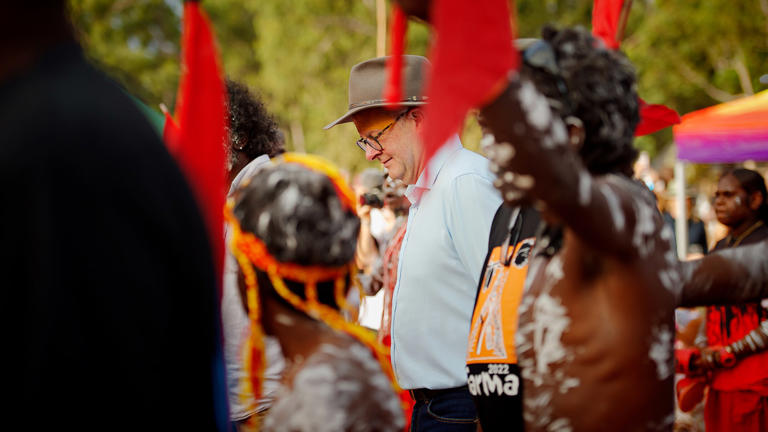
Australian Government : PM Anthony Albanese and the Labor team
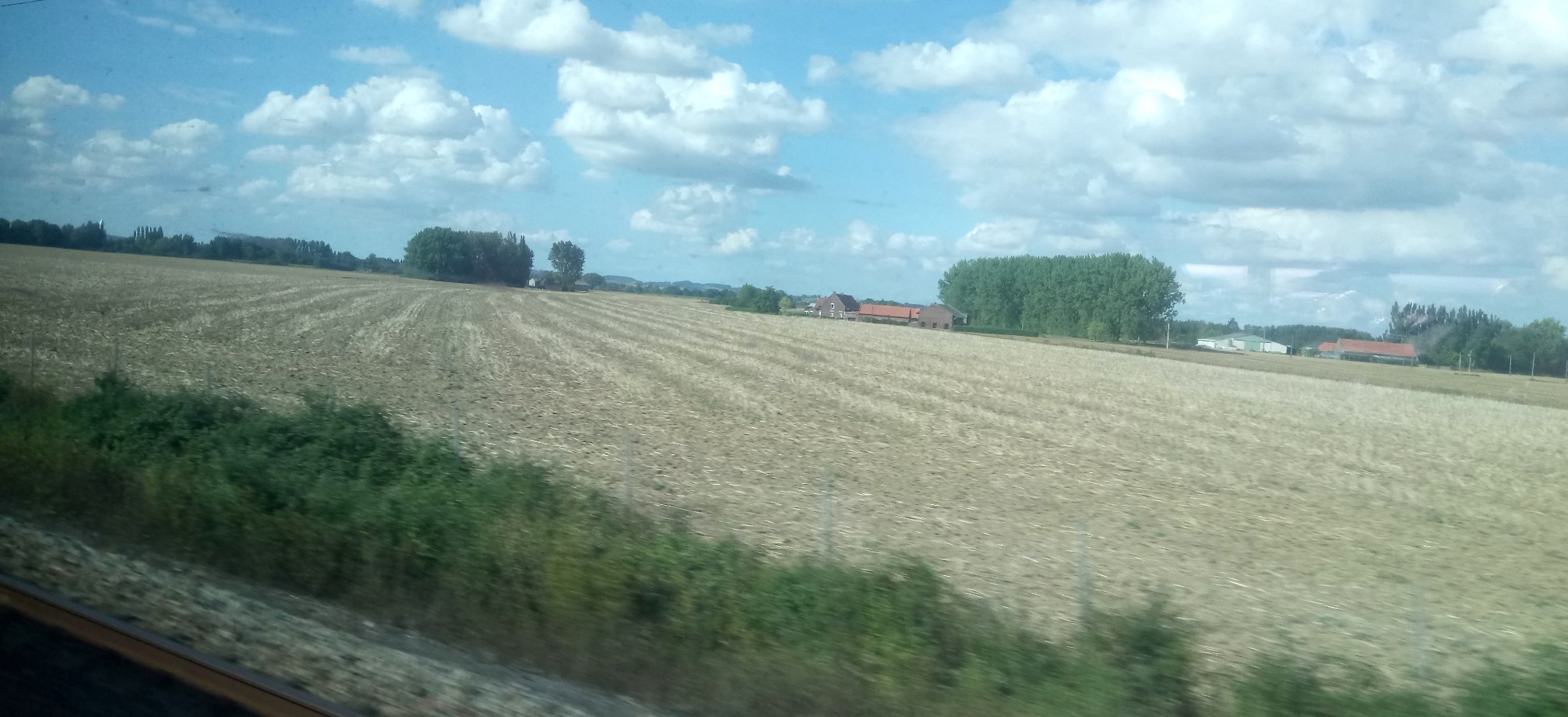
This week is late as the WIFI on the Eurostar was intermittent, and my four hours was less gainfully spent, reading, eating and looking at the fields passingly rapidly by. After an impossible trudge around beautifully signed streets, but with unrecognisable names, in an effort to get to the hotel (there are so few taxis, it is impossible to find one) I could only collapse into the very pleasant room with a canal view. We arrived after a fortuitous meeting with a bicycle drawn carriage driver, who was pleased to deliver us to the door for a fee that did not reflect how miraculous we found his presence as the map became harder to interpret. Today we spent wandering around Amsterdam on a food tour, and now I get to this blog.
The books reviewed this week are another couple of novels which are in my ‘catch up’ pile. I reviewed them several weeks ago, and the reviews have appeared on Goodreads. The Way from Here by Jane Cockram and The Complication by Amanda Du Bois were both sent to me by NetGalley in exchange for reviews.
Jane Cockram The Way From Here HQ Fiction Harlequin Enterprises (Australia), 2022.
Velazquez’s version of the story of Martha and Mary, where Martha is busy in the kitchen and Mary sits at the feet of Jesus listening, and the accompanying adulation of Mary’s attitude in comparison with that of Martha has always struck me as unfair to Martha. So, with this prejudice I come to the story of a thoughtless, lively, living in the moment sister who is compared to her advantage with her organised sister.
I found Susie an almost intolerable character in the early part of this novel. Her assumptions about her attractiveness to men and patronising attitude to Mills (as Camilla is known to her family), her behaviour that brooked little opposition, the letters that she almost demanded Camilla read and act upon in the event of her death made her an uneasy character for me to identify with, have empathy with, to want to get to know better. Camilla’s desire to follow her sister’s instructions, despite financial constraints, and to the detriment of her marriage, her recall of the unease provoked by her at a family Christmas but haste to find her own behaviour wanting, and her continuing loyalty seemed to me worthy attributes. Books: Reviews
Amanda Du Bois The Complication Girl Friday Books, 2022
The Complication is in most ways an impressive first novel, written by someone who clearly has no reservations about including social commentary at the same time as developing a gritty legal and medical drama/mystery. I do have some reservations though, as I think that the narrative moves slowly at times, because of too much explanation and lack of selectivity amongst the ideas and descriptions Du Bois wants to depict. It is hard to dispense with sentences and phrases that have been carefully crafted but I think that this novel would have benefitted from some tougher editing. Books: Reviews
London – at long last
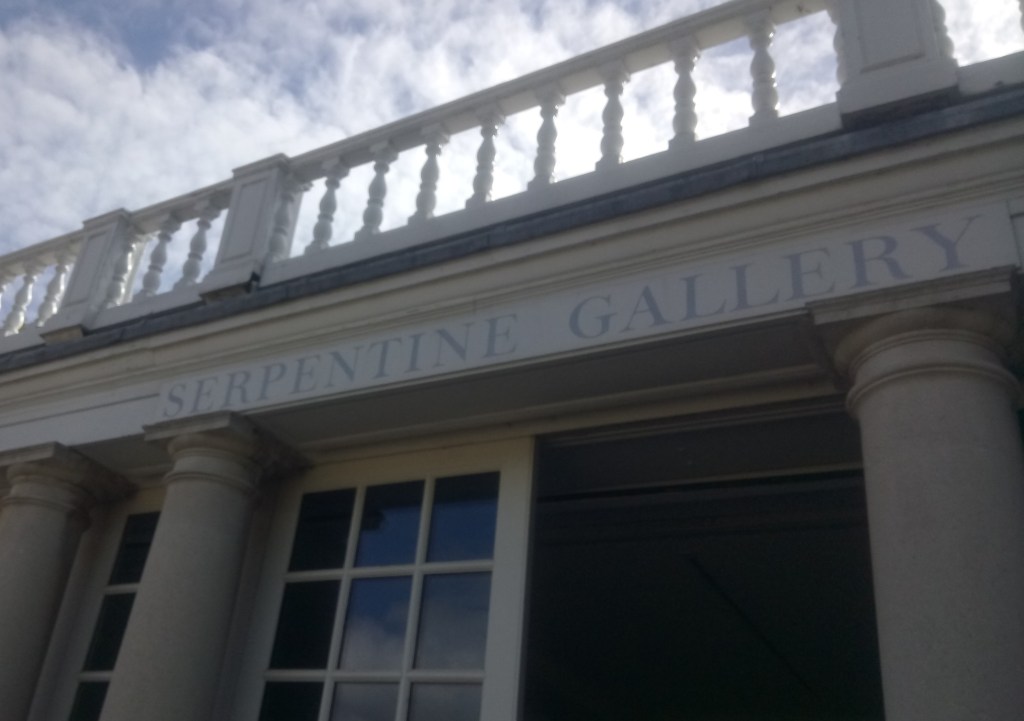
It is thrilling to have at long last begin travelling overseas, and to revisit London. Our first few days have been filled with meeting friends, eating in familiar restaurants, walking in Kensington Gardens, visiting the Serpentine Art Galley in the Gardens, and going to the Harold Pinter Theatre to see a Chekov play (although he might well be bemused at the interpretation we saw). The sun is wonderful, and the long light evenings a reminder of one of the best thing about being in London.
Covid concerns appear to be almost non-existent. Masks are being worn by some people, although not in large numbers, and hand sanitiser is available in some venues. However, social distancing is possible, so we are just hoping for the best – as Londoners must be doing.
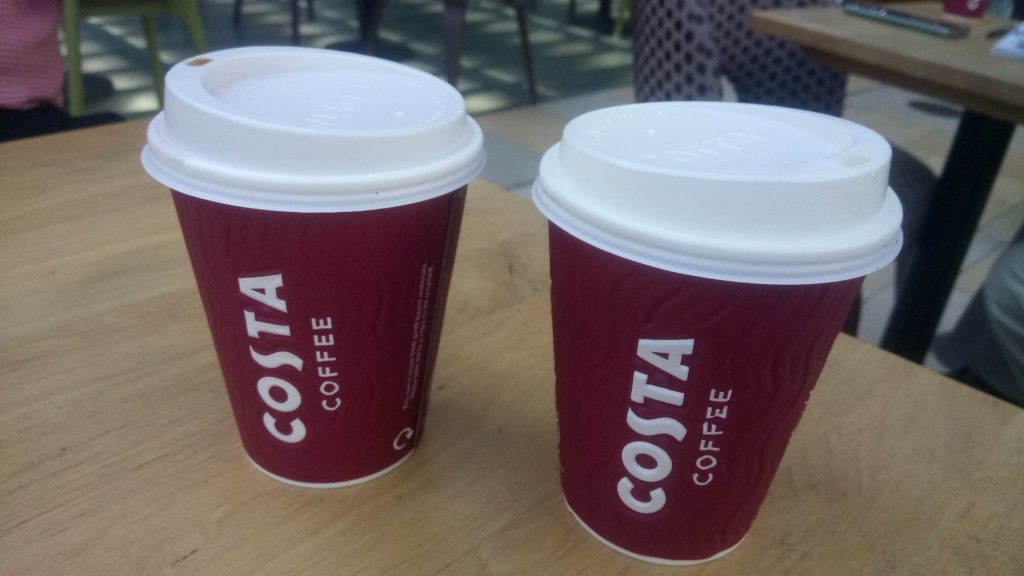
Coffee at Paddington Station – at last a London barista who can make a flat white.
Walking down Westbourne Terrace – a sight that reminded us of our great friends with whom we holidayed in London. One attended this church – to the delight of the excellent women there. They loved their American visitor.
There will be some free concerts here while we are still in London, and we are looking forward to attending.
Walk in Kensington Gardens
Exhibition at the Serpentine Gallery
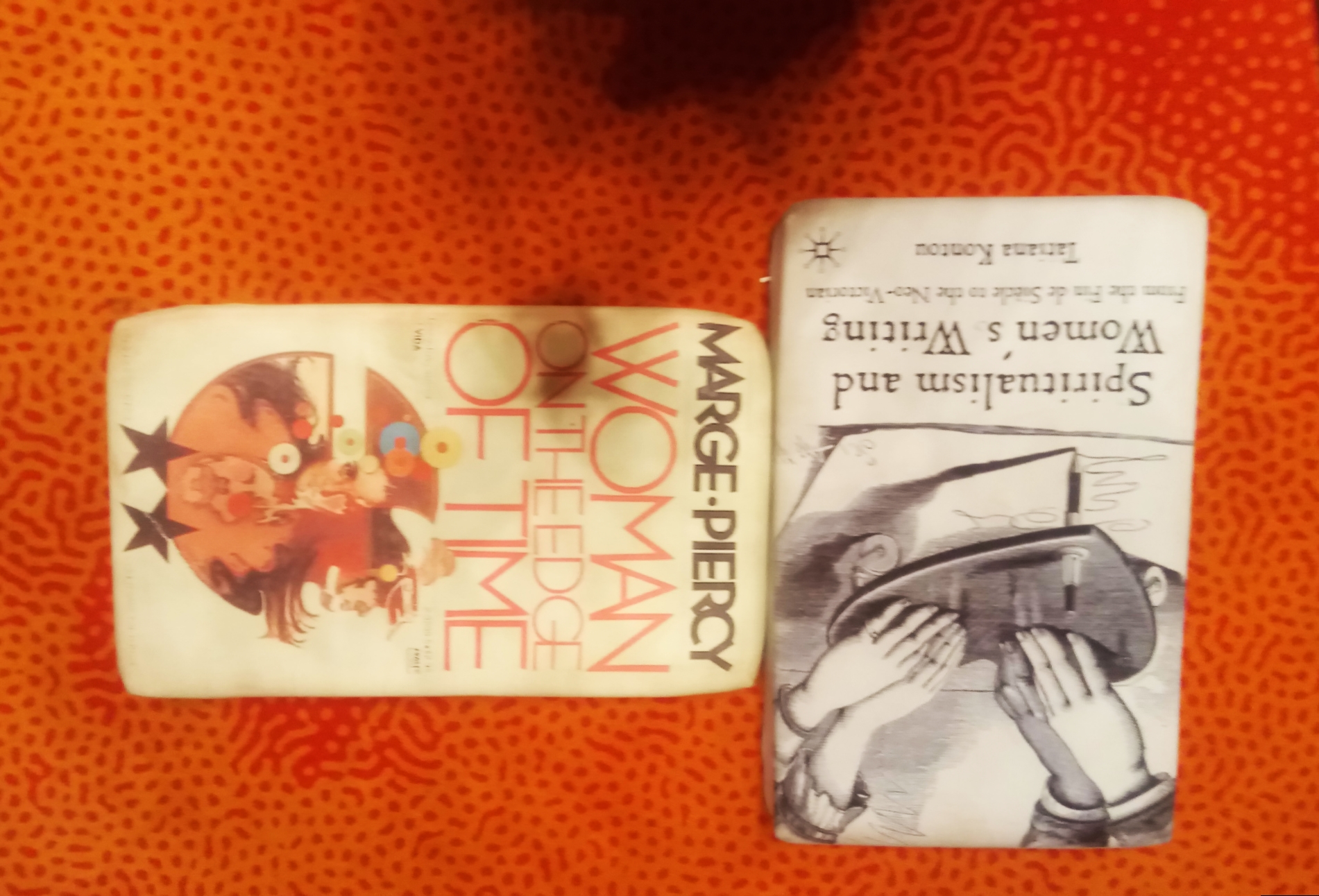
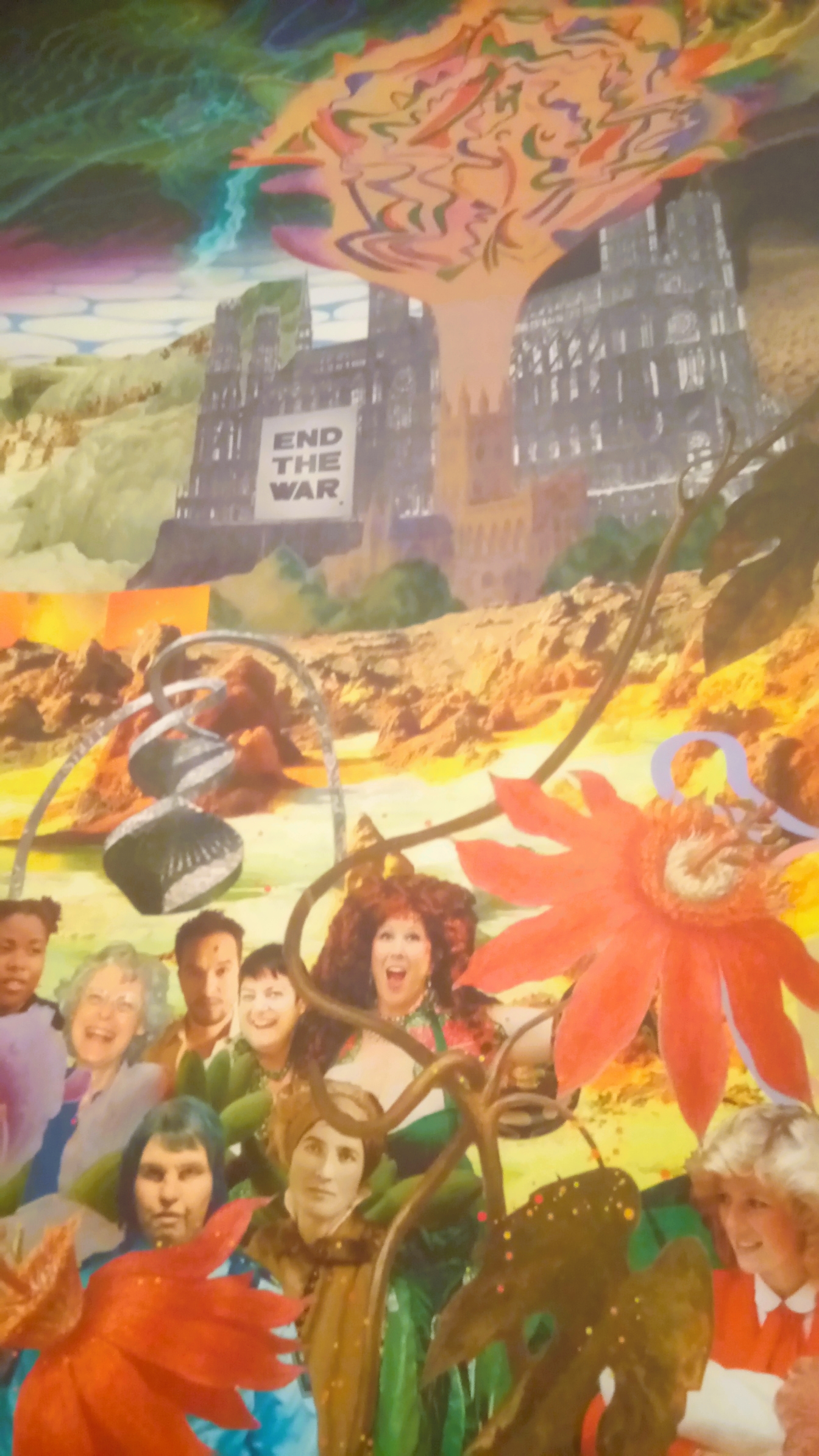
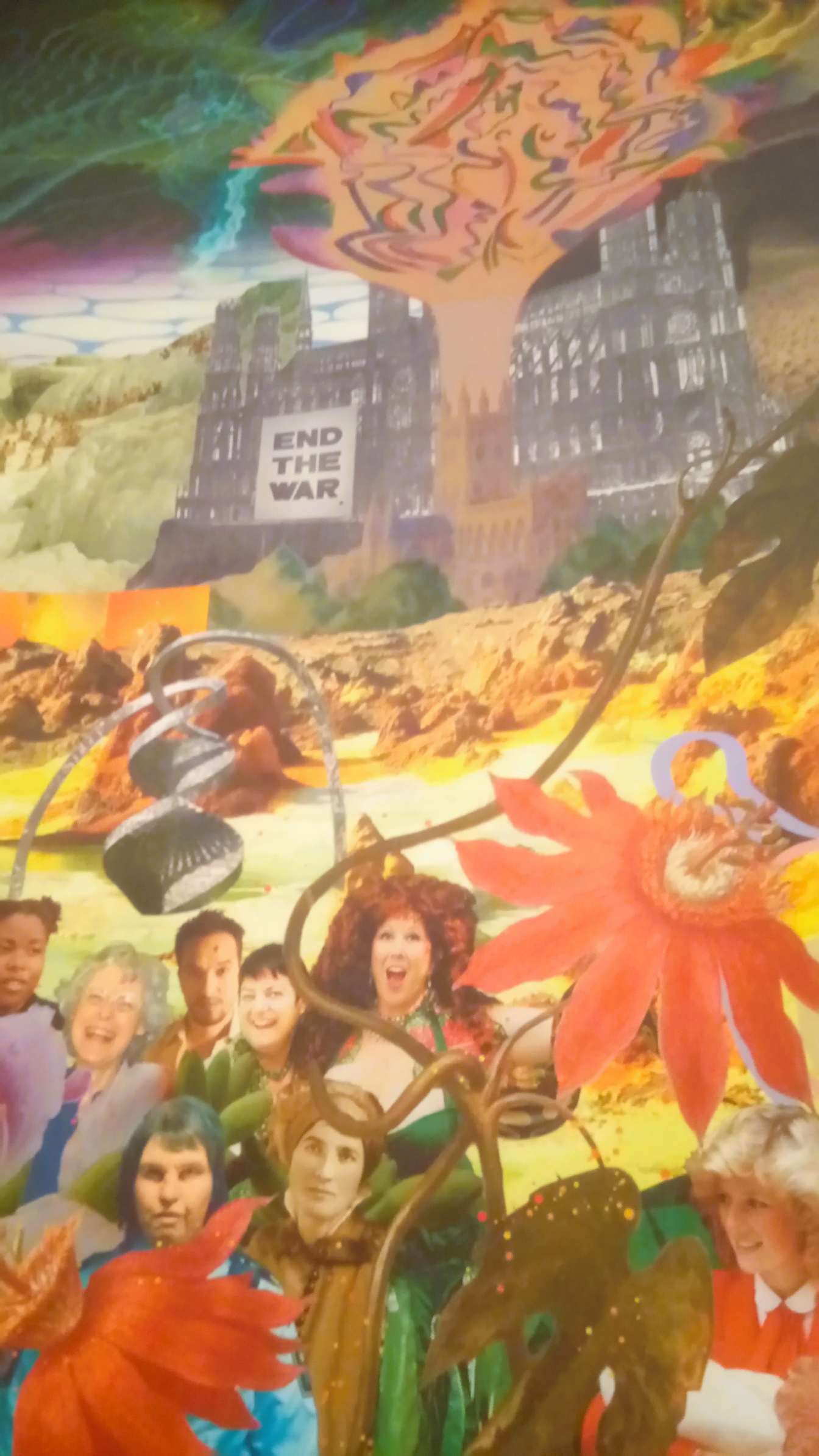
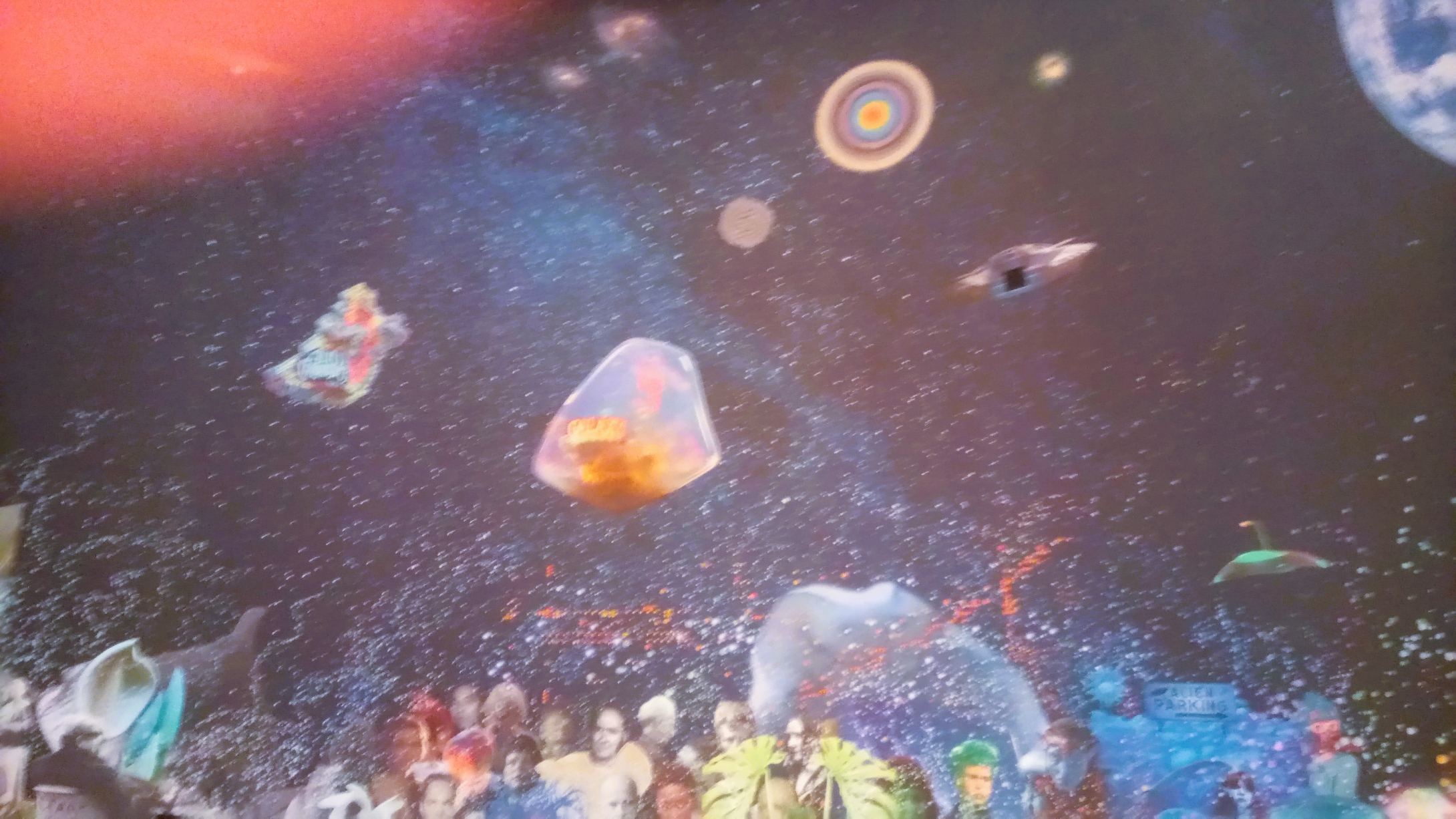
This exhibition, Alienarium 5, by Dominique Gonzalez-Foerster, is ‘a speculative environment that invites us to imagine possible encounters with extra-terrestrials. The exhibition is a culmination of … [her] decades-long interest in science fiction, and her continued research into deep space and alien life’ (free detailed booklet that accompanied the exhibition). Anyone who reads my reviews will know that I do not read science fiction …except, when I looked at the books that were scattered invitingly in the early part of the exhibition, I did recognise two that I have enjoyed – Marge Piercy’s Woman on the Edge of Time, and John Wyndham’s Day of the Triffids. Women writers of science fiction were well represented, and some appear in my photos below!.
The walls of the outer exhibition were covered, as above. The Virtual Reality part of the exhibition was open to five people at a time, and, although not overwhelming, was a distinctly different experience.
We wandered on to Oxford Street, and a short bus ride brought us close to Covent Garden where we looked for a play to see. Last time we were so fortunate, as a queue outside a theatre tempted us, with an excellent result. We saw The Father, a play well worth experiencing. This time we saw musical after musical showing. None was at all tempting, so we scanned the ticket booths at Leicester Square. The Seagull matinee looked interesting so that was our choice.
Konstantin on the stage at the beginning of the play, and at the end. He is gradually joined by the other actors, who sit on plastic chairs while they wait , with Konstantin, for the play to begin. The advertised drawcard was Emilia Clarke from Game of Thrones. This is my one experience with that show, and I am not regretful that I have seen no more. Emilia Clarke was not particularly enticing in the role of Nina. The play was a modern version directed by Jamie Lloyd. Chekov would have found it hard to recognise, but that might be all to the good. I had mixed feelings about it, and propose to reread The Seagull.
After all that culture we spent the evening with pizza and salad watching a most amusing and informative television quiz show related to the latest hits. I say informative, as the only one I recognised was Up Town Girl. It certainly provided rather different end to the day!
Old haunts
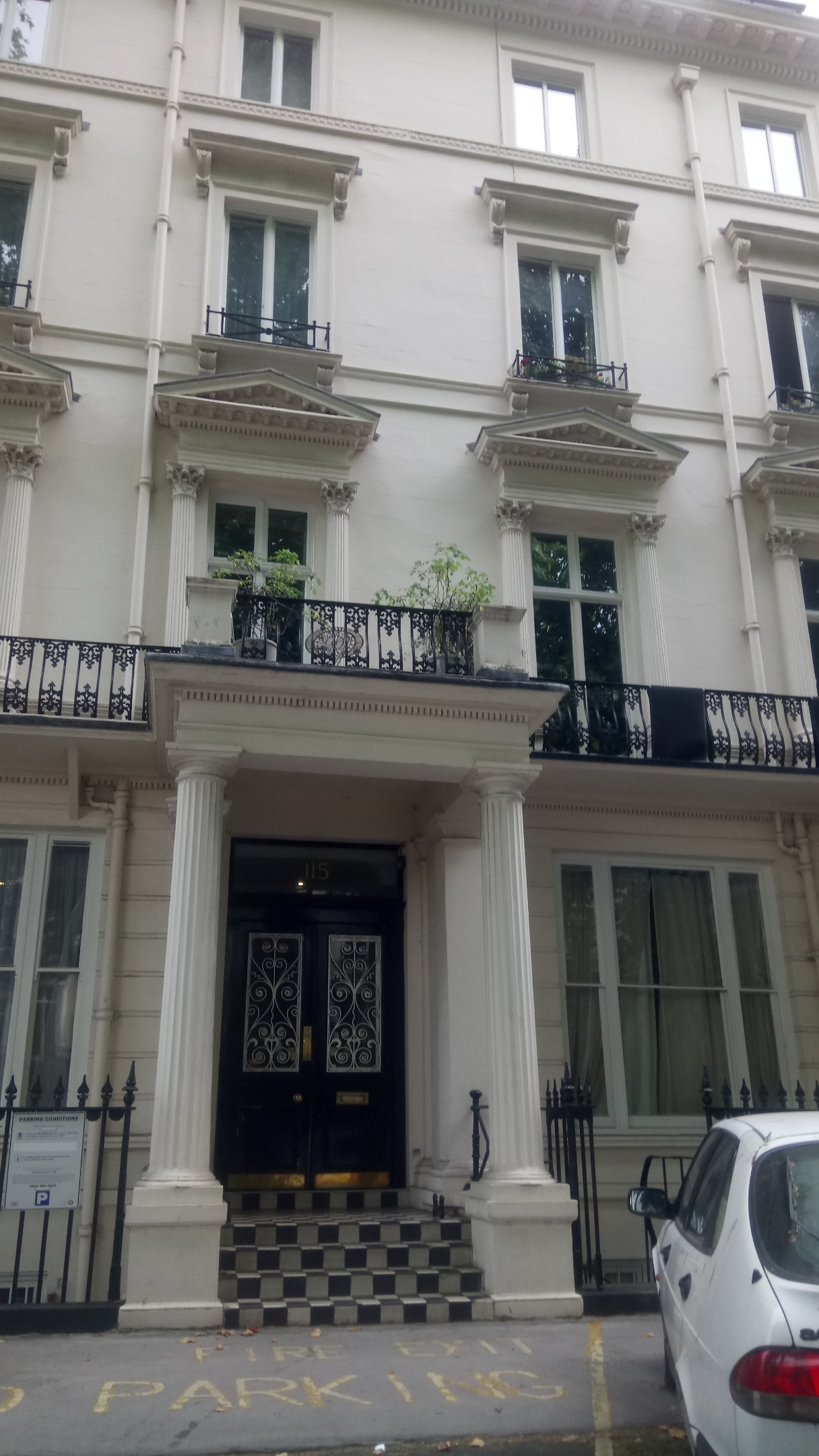
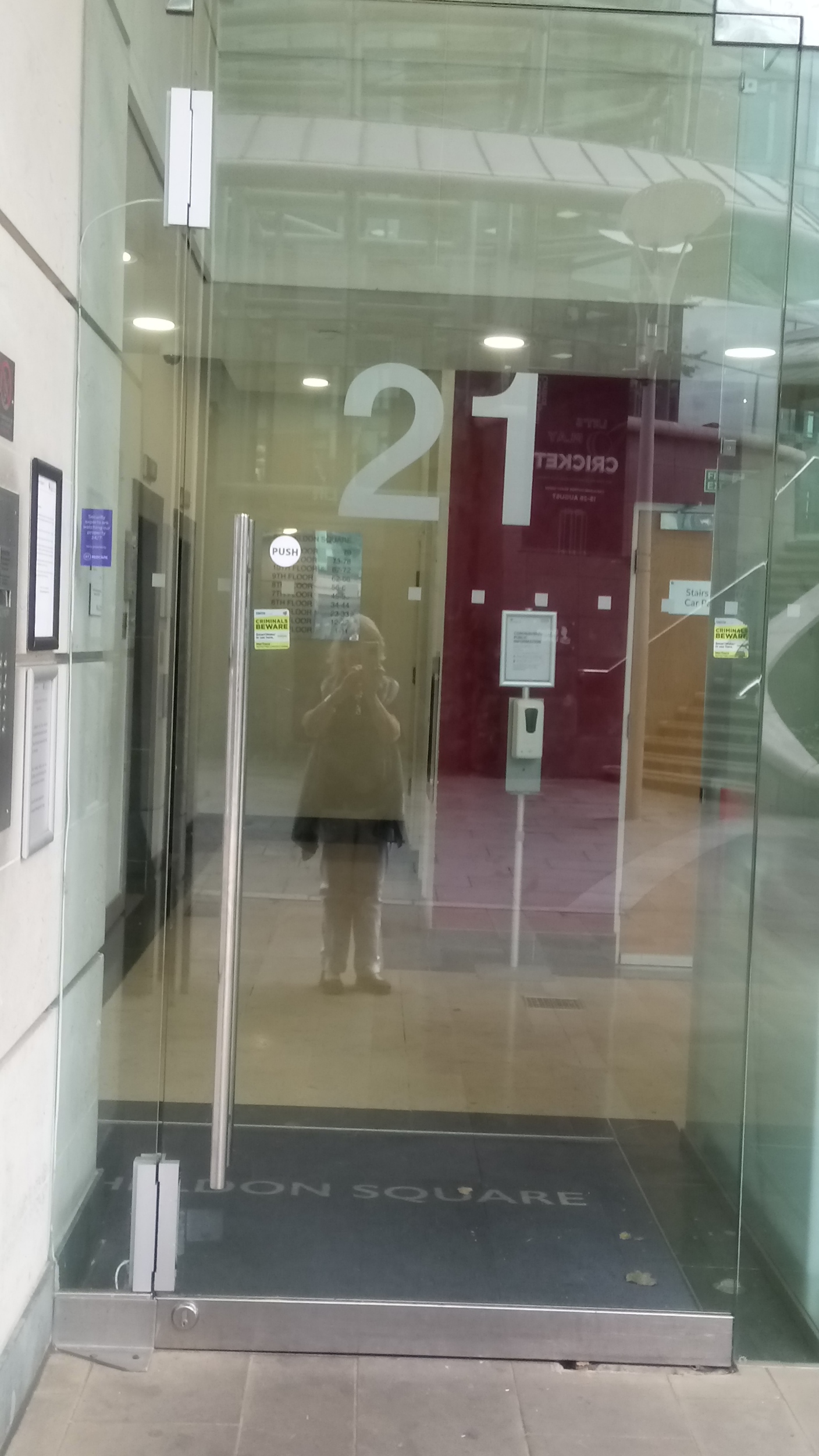
This trip to London was a chance to visit our previous flats in which we enjoyed four years, before a delightful six months in Cambridge. Westbourne Terrace, the first of the photos, provided us with the wrought iron balconies, tall windows and ornamentation that I felt was such authentic London accommodation as seen in films of a particular type. Sheldon Square, below, was 11th floor living in a high rise on Regents Canal, with restaurants, a gym, shopping, and hairdressing on the doorstep.
A walk along Regents Canal was one of our favourite pastimes, although we missed our dachshunds prying in every corner. There are now more narrow boats, many of which are small businesses rather than homes, on the canal. I bought a mint and strawberry tea to see me on my way along the canal. But did not visit the marvellous houseboat restaurant on this occasion.
Cindy Lou eats out in London, at a mixture of venues.
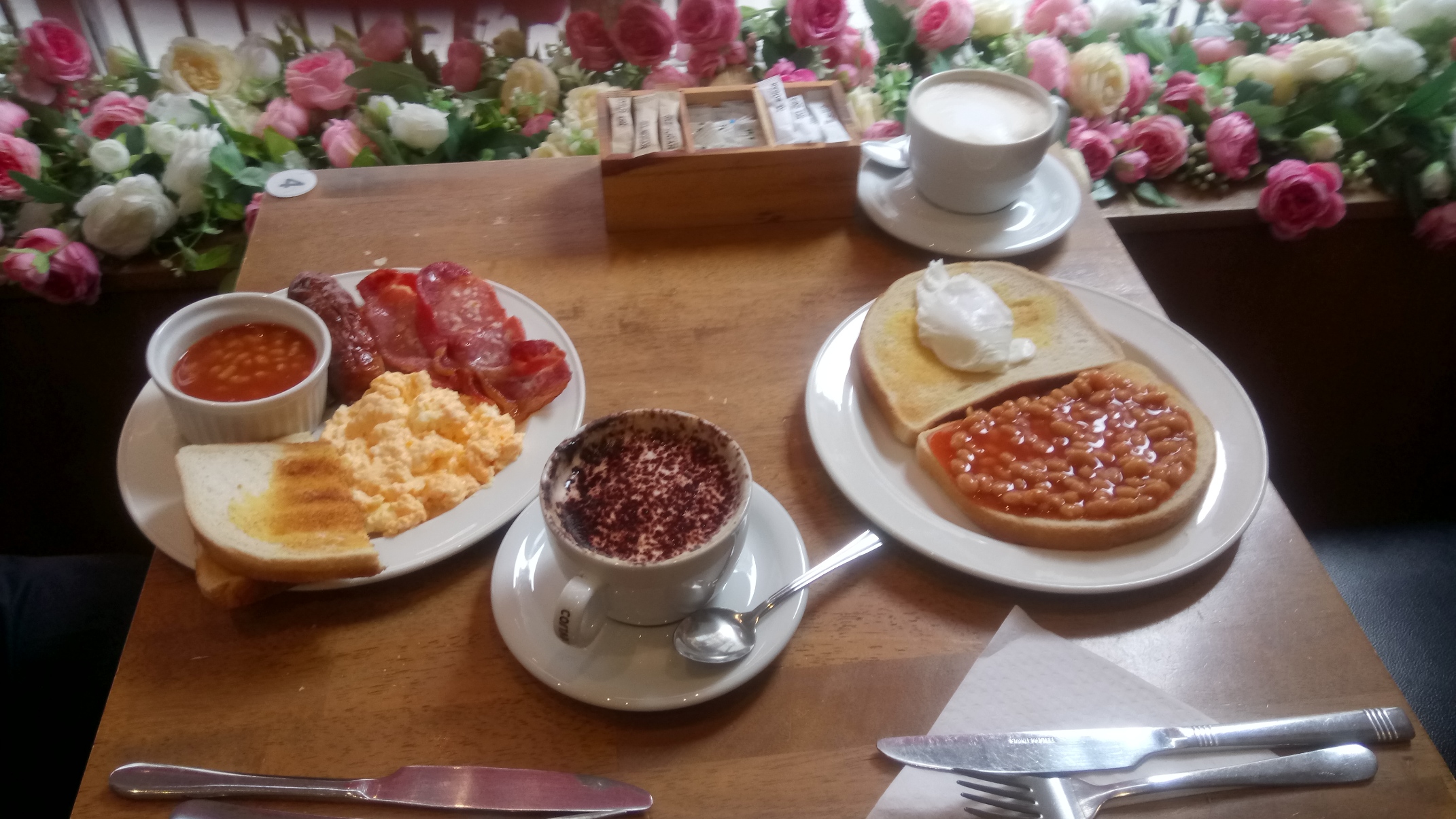
La Meena Café is near Lancaster Gate tube station, so a very practical location to eat breakfast and run. The service is friendly and efficient – with coffees almost on the table as they are ordered. The range of English breakfast with substitutes is very good, and there are fancier breakfasts for those who want them. The pastries are excellent. This is a simple café, with generous servings, served as quickly as possible. I enjoyed it. Although the café has been updated in some ways, it retains the simple charm of a few years ago.
The Mad Bishop and Bear pub, upstairs at Paddington Station, is another casual eating place, with the normal pub menu. Fish and chips and sausages and mash, for example, and of course, the pub pie. The red pepper soup, although rather clumsily placed on the table, was served with a smile. It was very good indeed, although the accompanying bread was rather dreary. The Koftas were served nicely, with yoghurt and flat bread. Chips at this venue are excellent.
Zizzi at Paddington
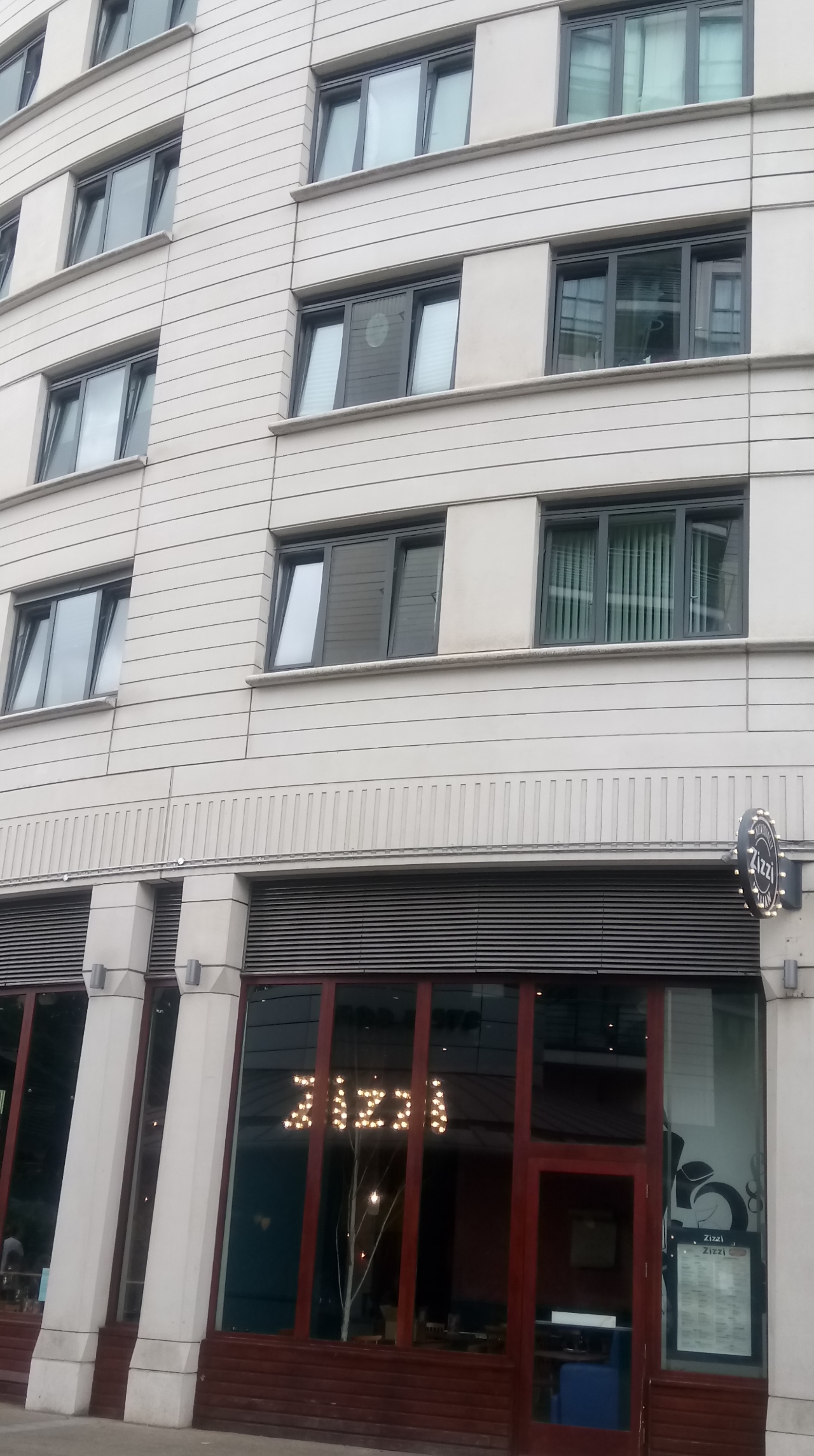
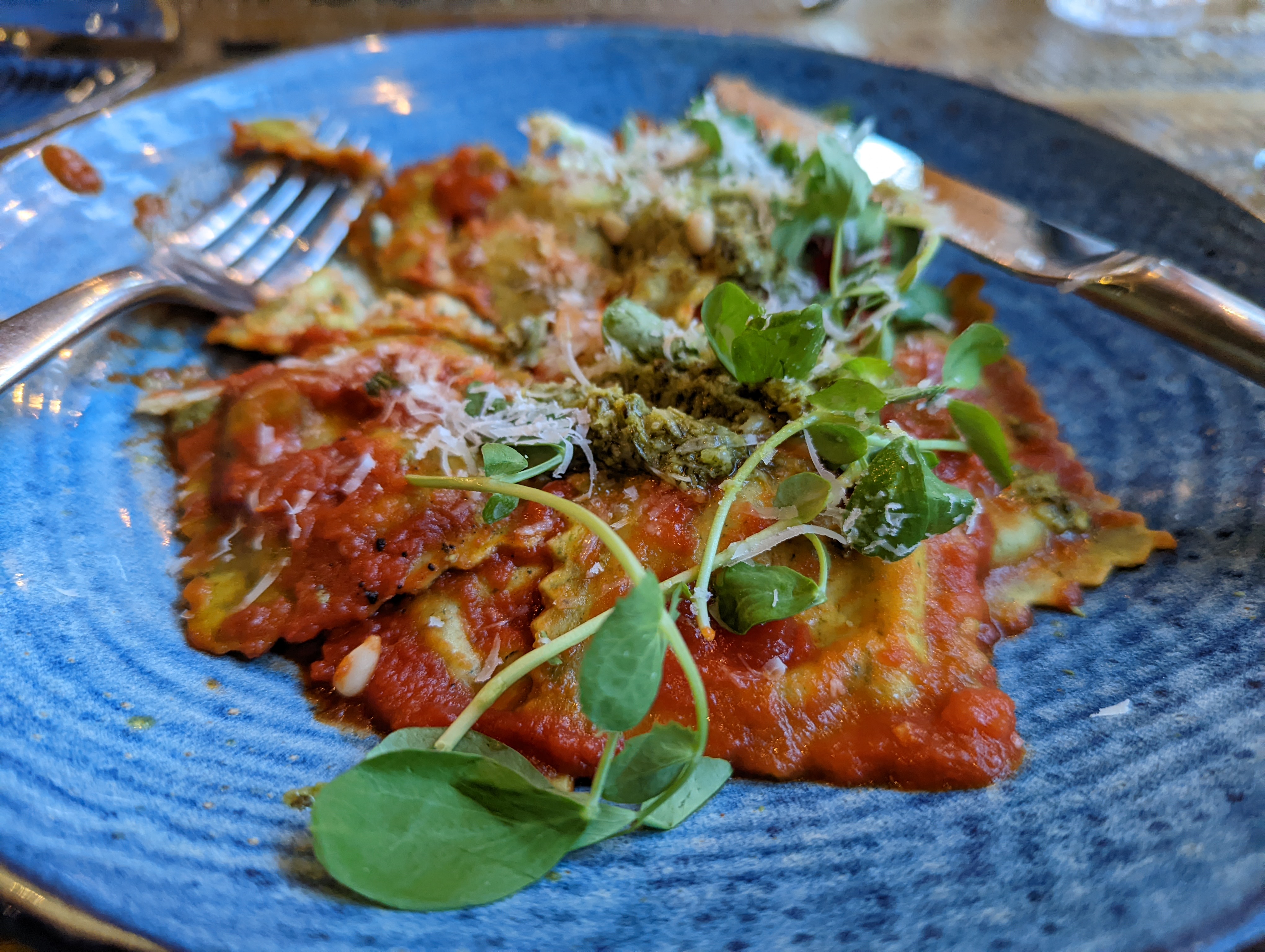
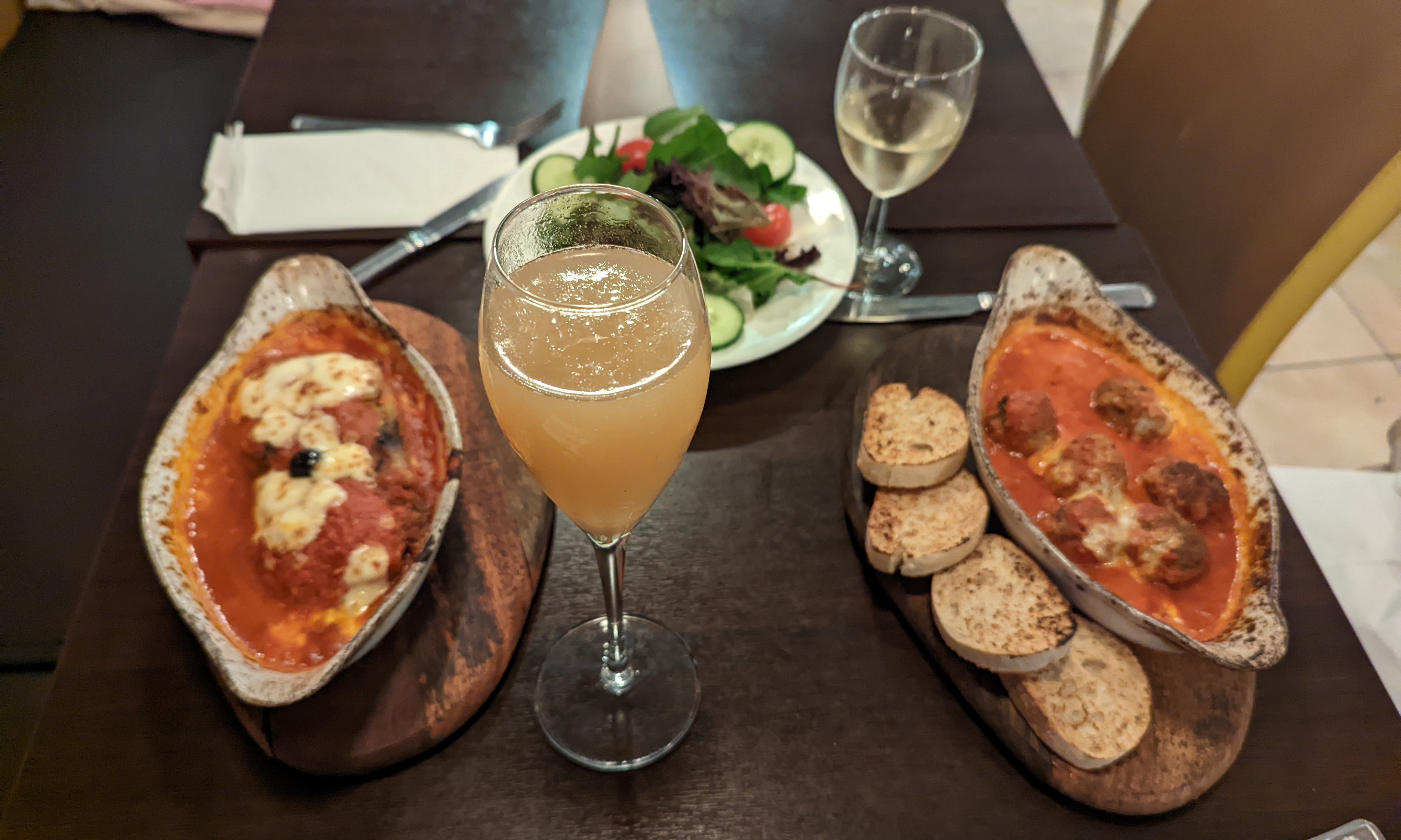
I was fortunate to be with the recipient of a great Father’s Day gift, to be used at Zizzi’s. This restaurant is part of a chain, but the chains in London are mostly very good. This one is. It has many pleasant memories of dining with the daughters who sent the gift. I had my favourite king prawn spiedini, a ravioli with fetta and spinach, and wonderful gelato. The recipient of the gift had meatballs in a delicious sauce, a ragu pasta – and, of course, gelato.
The spiedieni was five large prawns with a flavoursome sauce. The pasta was ordinary – but then, nothing compares with that served in Italy, or in my experience, the pumpkin ravioli at 86 in Canberra. The gelato was wonderful – coconut, caramel, and black currant and mascarpone made a great combination.
Union Pub
This pub is on the canal, and has some exciting features to look at while waiting for the food. The staff are friendly, if not overly efficient, there is music, and it is probably a young people’s haunt rather than mine. However, the welcome was warm, and the food just what I wanted. A share plate with chicken, haloumi, salad, meat balls, pitta bread, beetroot dip and chips.
Breakfast at Bonne Bouche
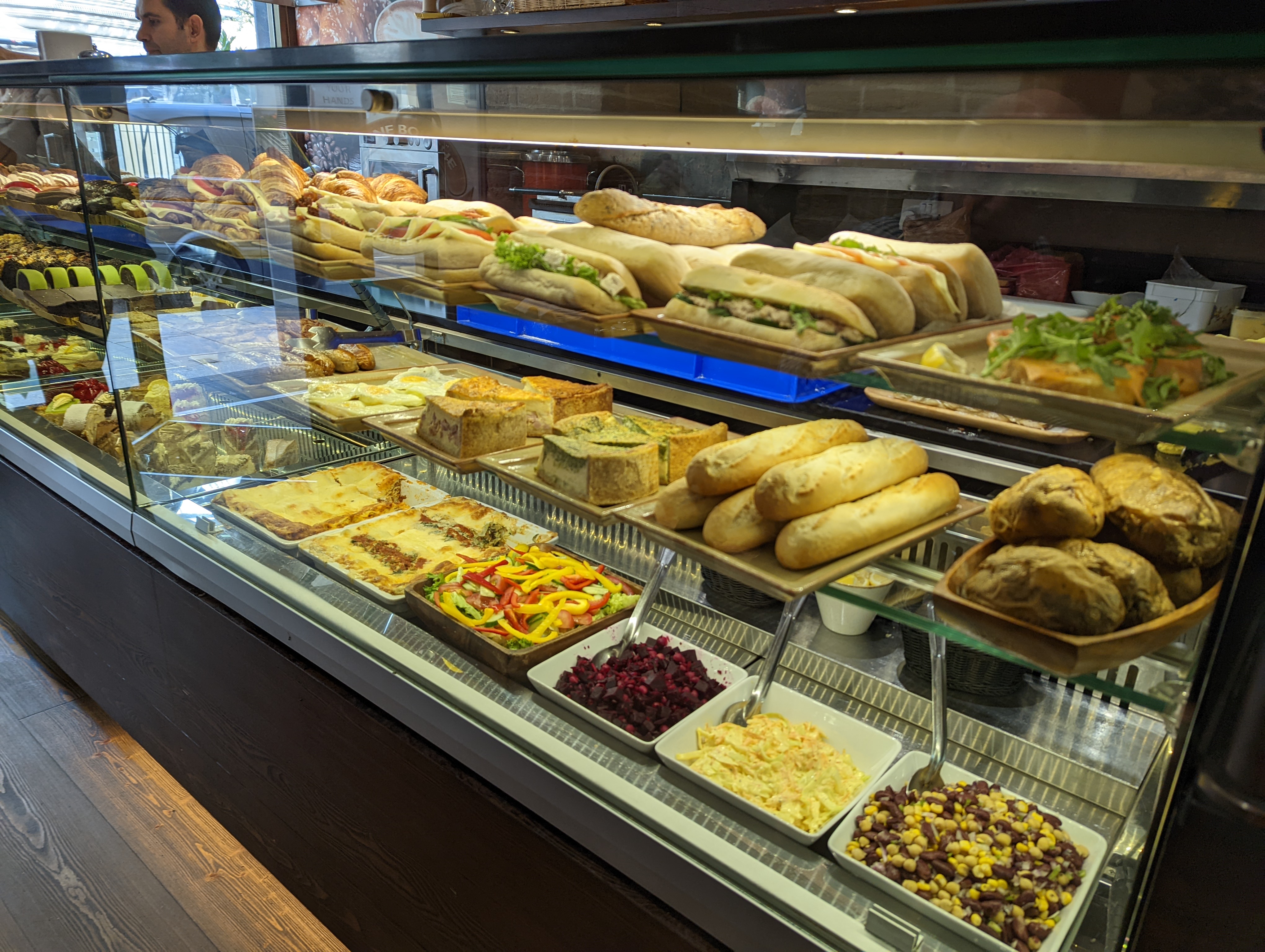
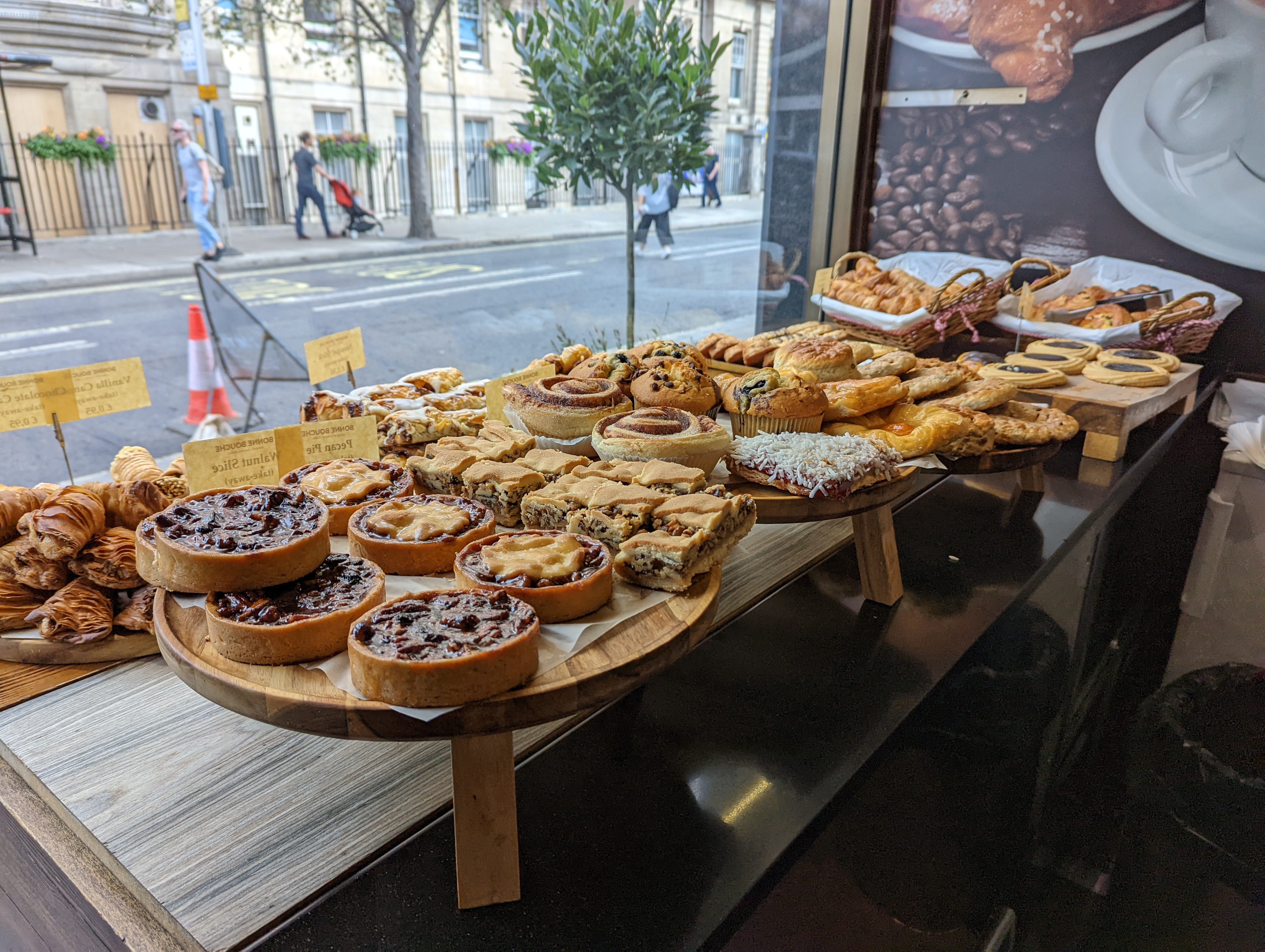
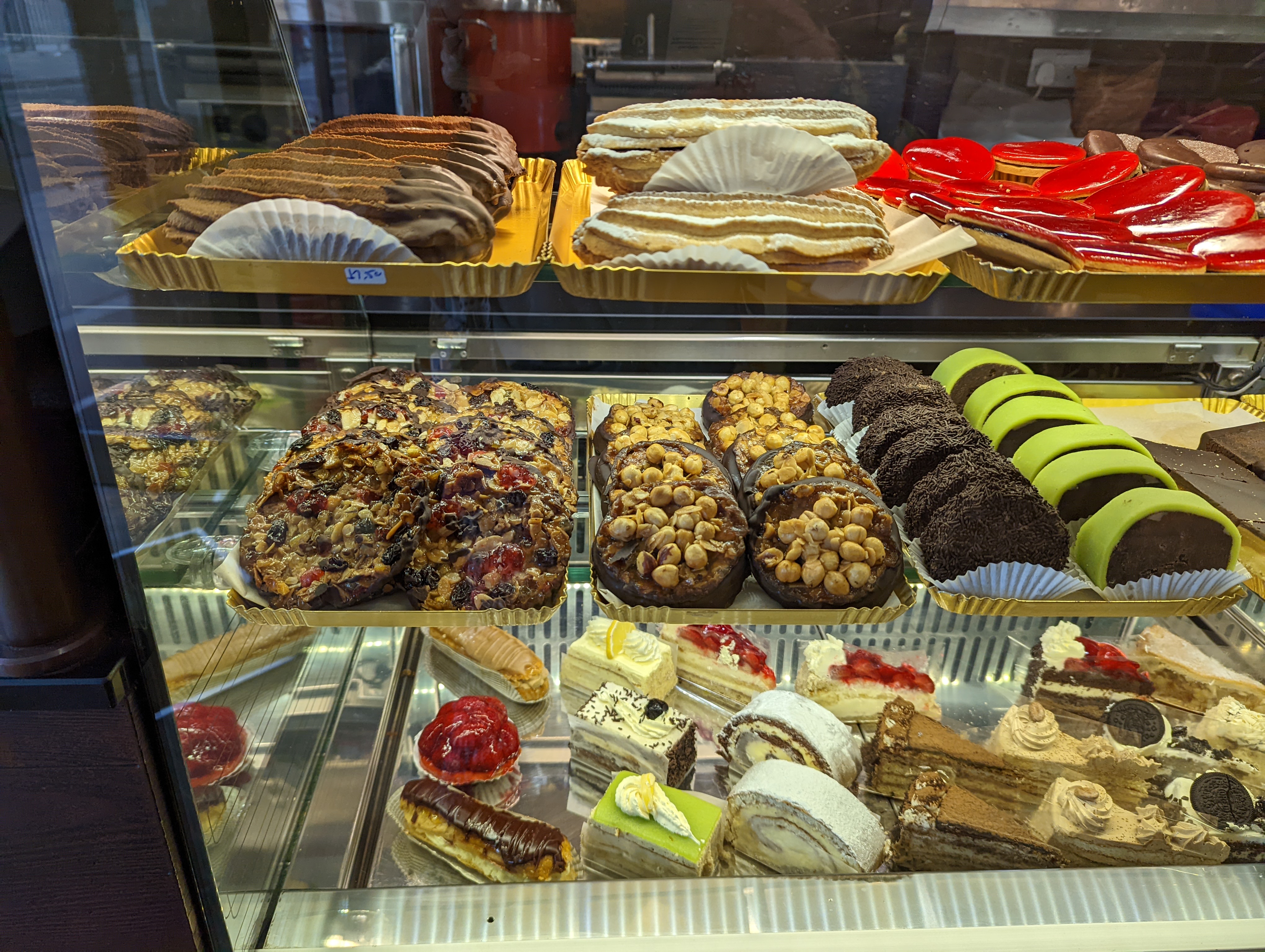
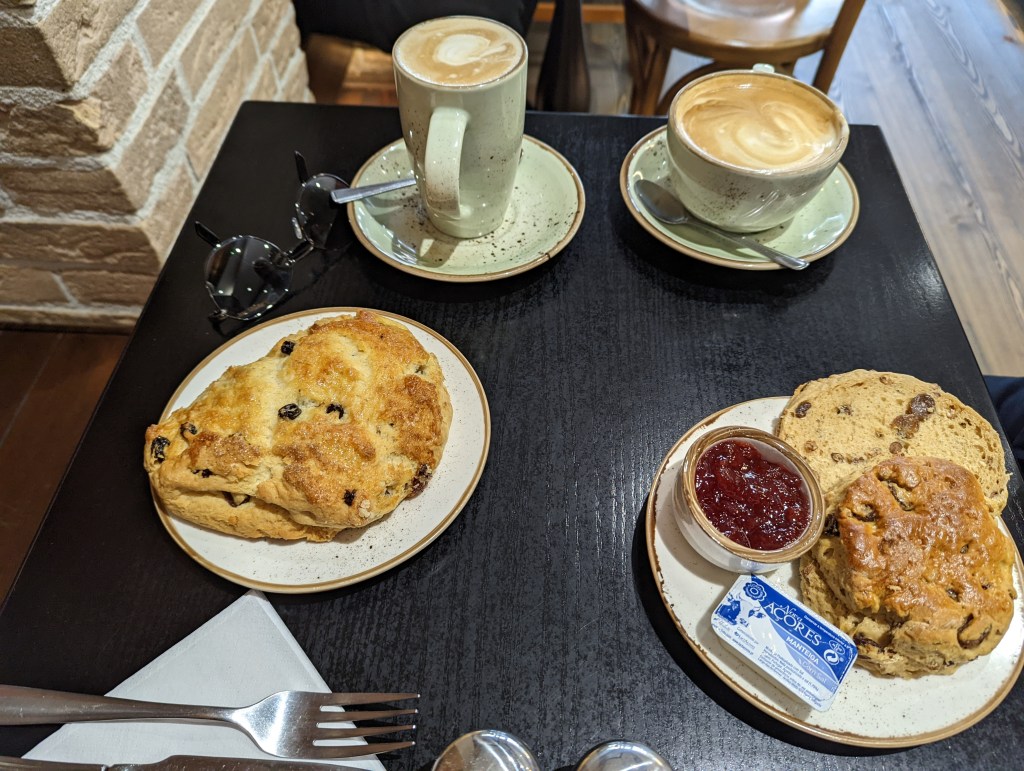
Bonne Bouche is a lovely café in Praed Street, Paddington. The windows and glass cases are full of tempting treats. On this occasion I opted for a rock cake, and my friend for a brown scone with jam. Both were delicious, as was the coffee. It it wonderful to see that this beautiful eatery, with its accompanying bakery has survived. While I am in Paddington I shall assist in that survival very happily. My rock cake was so enormous that the lovely staff placed the remains in a bag for me to ‘take home’.
Ukrainian arrivals at St Pancras
As we walked towards boarding the Eurostar to Amsterdam it was lovely to see the enthusiastic group waiting for Ukrainian arrivals. There are also Ukrainian flags in windows in Amsterdam.
Thank you, NetGalley, for providing me with this uncorrected proof in exchange for an honest review.
This work brings together the beautifully realised Shade and Light, and August, with a new Prologue and Interlude. Short though they are, they deserve their own reviews. However, I reviewed Shade and Light and August in October 2021 and shall use some of that material to review this new edition of the novels. The feature that stood out above all others when I began re-reading was the lyrical nature of the language, with its dive into the ordinary to create a moving picture of events, feelings and characters. See Books: Reviews for the complete review.
Articles and information after the Covid report: New Statesman, The authoritarian interlude; Mslexia – two competitions for fiction writing;
Covid and my travel: Qantas to Heathrow and first day in London
We wore masks in the Canberra airport, and as mandated, on the domestic flight. We also wore them on the bus to the International terminal, and in the terminal. Most people did. The chaos that has been the source of dramatic Facebook and news stories did not eventuate. Lines were long, but the Border Control staff were amazingly efficient and everyone went through very swiftly. The same occurred with the security. Although there was no Express Lane, because of staff shortages (for which there were explanatory and apologetic notices everywhere) security was also efficient and easy. We are now waiting to board the plane in around half an hour.
For the leg from Sydney to Singapore there was a mask requirement. Everyone in my observation observed this. Masks were required in Singapore Airport, but as they are no longer required at Heathrow there was no mask policy on this leg of the journey. At Heathrow we wore mask, as did many others. Oh, the luggage was not lost! The Heathrow Express has risen from 15 pounds to 25 pounds. A cheaper alternative is the Piccadilly line. The Express well patronised, but not full, and everything was smooth.
In London few people are wearing masks. But there are few crowds so social distancing is simple.
So, no chaos, unlike the gloom and doom stories that have frequented the news. How surprising. There will be an update on European travel next week.
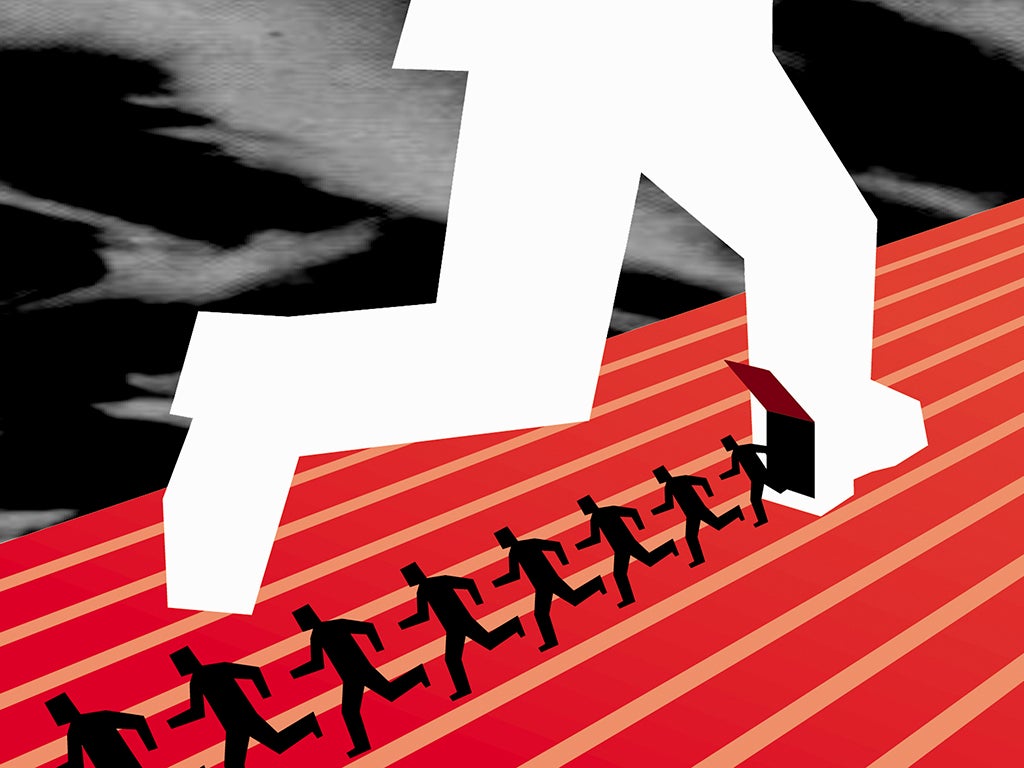
The authoritarian interlude
How can politicians win back voters who have become disillusioned with parliamentary democracy?
On 3 October 2019, as the parliamentary battles over Brexit raged, a new think tank called Onward published The Politics of Belonging. The report attracted attention for its announcement of a pivotal new voter-archetype – “Workington Man” – an older, white, non-graduate Leaver living in the north of England or the Midlands, who saw the country diverging from his economic and cultural views. But it also revealed a more startling finding: 35 per cent of under-35s, interviewed in June 2019, believed “the army would be a good way to run the country”. And almost twice as many said they would back “a strong leader who does not have to bother with parliament”.
Will Tanner, a co-author of the report and a former adviser to Theresa May, told me that he was “blown away” to encounter “such a strong desire for security over freedom”. This was not just a freak result of that strange, febrile summer. The findings corresponded to research published in 2018 by the US-based political scientist Yascha Mounk, in his book Democracy vs The People. In April, a study by YouGov for the think tank Institute for Public Policy Research (IPPR) detected a similar loss of faith in democracy’s ability to serve voters’ interests, especially among 18-24-year-olds.
In June, the pollster Peter Kellner reported results from a Deltapoll survey of more than 10,000 people. This suggested that 30 per cent of adults think “Britain these days needs a strong leader who can take and implement big decisions without having to consult parliament”. Many commentators who fear for democracy’s future see it as a political system to cherish for its own sake, in which each side accepts its electoral and legislative defeats with grace. But Kellner suggests those alienated voters take a much more hard-nosed view. They believe “they are not getting out of the system what they feel they should” – and are concluding that parliamentary democracy has failed.
In response to such findings, there is a tendency to conclude that, after decades of stability, Britain societies now faces a uniquely dangerous moment. But people have turned against democracy before. Might rediscovering those moments have something to tell us about how the rejection of democratic politics can actually play a role in its renewal?
In 1901, the novelist HG Wells prophesied that “the grey confusion that is democracy must pass away inevitably of its own inherent contradictions”. Wells was associated with the National Efficiency movement, which dismissed parliament as a clapped-out talking-shop. Rule by an expert elite would deliver social reform for the working class much more effectively. In 1910, one of National Efficiency’s favoured politicians, the dynamic, commanding David Lloyd George, was mulling the notion of a “businessmen’s government” – an idea he drew on as prime minister six years later. All of this amounted to a challenge to parliamentary government: was it strong enough to modernise Britain without resorting to autocracy?
After 1918, working men returned from the war to find they all had the vote – but not necessarily a job. The spectre of former servicemen turning against democracy’s timid compromises haunted the early 1920s. In Germany, embittered veterans coalesced in the paramilitary, proto-Nazi Freikorps. In Italy, the ex-soldier Benito Mussolini and his new fascist party seized power. In Britain, Stanley Baldwin strove to build an inclusive, one-nation conservatism. The idea of the “property-owning democracy” was coined in 1923 to try and stabilise mass democracy by giving working people a stake in the economy. Yet the mass unemployment of the 1930s brought a new wave of frustration. Watching MPs “twaddling” over whether to break from defunct economic orthodoxies, Aldous Huxley dismissed parliamentary democracy as a “whorish old slut”, and put his political faith in authoritarian economic planning. One of those MPs, the disillusioned Labourite Oswald Mosley, was hardly alone in admiring the dynamism of Mussolini’s dictatorship.
After years of cynicism, the outbreak of another world war in 1939 transfigured democracy. Defending it became a part of the national cause, as Britain faced the threat of being colonised by totalitarians. This also made non-dictatorial intervention in the economy seem more possible than ever, as old nightmares about the dangers of a big state and deficit spending were overwhelmed by the demands of all-out war.
Yet for all the idealism of William Beveridge’s plan for a welfare state, many voters doubted that politicians would have the will to enact it against the vested interests of banks and insurance companies. In 1942, Labour’s Arthur Greenwood warned the House of Commons that failing to plan postwar reconstruction risked “bitter disillusionment”. He added that MPs might find “this country in the hands of what some people would call a strong government”. In his book Demobbed (2009), the historian Alan Allport argues that there were fears that, if veterans ended up on the dole again, “soldierly anger would be too volatile for parliamentary democracy”.
The 1945 Labour government finally showed that parliamentary government could deliver transformative change that had once seemed unthinkable within the confines of democracy: a National Health Service, full employment. But one of the pressures that made such radicalism possible was the prospect that, without it, people would reject democracy altogether.
Before 1945, democratic politics had seemed too weak to do enough to satisfy the demands of voters. By the 1970s, it stood accused of being too weak to refuse them. In 1975, in the wake of two successful miners’ strikes, a Trilateral Commission report titled The Crisis of Democracy, co-authored by the French and Japanese sociologists Michel Crozier and Joji Watanuki, and the American political scientist Samuel Huntington, contended that the British state was being blackmailed, not least by the trade unions. The upshot was inflation, which Huntington described as “the economic disease of democracies”.
Once again, influential figures had begun to despair of democracy; once again, that despair would compel new thinking. If democratic governments were too weak to withstand the “strike weapon”, there might have to be an “authoritarian interlude”. On 28 April 1974, the Mirror’s Geoffrey Goodman tipped off Labour’s secretary of state for industry, Tony Benn, that “among senior businessmen” there was “a general belief that there will have to be an authoritarian government until the oil comes ashore, in order to control the trade unions”. In Chile, inflation had soared to 100 per cent, and a military junta had seized power; the Times observed sympathetically that there was a limit to the ruin a country should be expected to tolerate. The former Labour minister Lord Chalfont suggested that “more and more people in this country, many of them men and women of impeccably liberal instincts, are beginning to contemplate seriously, and not without some satisfaction, the possibility of a period of authoritarian rule in Britain.”
The Economist predicted that, if another government were “wrecked by industrial power”, more people would conclude that the army should be involved in ending the crisis. Perhaps this was what Lord Hailsham meant when he warned that a strong government would “use the public forces to seize control” and force through parliament “a series of authoritarian measures” – and that there would be “a lot of violence one way or another”. One such measure, written about by Financial Times columnist Samuel Brittan, was the abolition of the right to strike. Finally, a Labour deal with the unions brought wage inflation under control, and such talk ceased. But the nightmares it stirred were part of the slow process of making the unthinkable prospect of a return to mass unemployment seem like the worst option – except for all the others.
Today’s deep disillusionment with parliamentary democracy has been coming for decades. The IPPR’s report Road to Renewal (2022) points out that voter turnout has declined significantly since the 1970s. But as the political scientist Will Jennings has highlighted, that long-term disenchantment was “turbocharged” in 2008-2009 “by the parliamentary expenses scandal and the global financial crisis”. There are also the years of stagnant pay that followed. IPPR found that 53 per cent of the 3,442 adults polled thought donors, businesses, lobbyists or pressure groups had the most influence on shaping government policy; only 6 per cent thought voters themselves were the most influential. When asked to name the worst features of British democracy, 54 per cent of Deltapoll’s respondents pinpointed the quality of MPs; 59 per cent picked the rich and powerful having more influence than voters.
How should politicians respond? Parth Patel, the co-author of Road to Renewal, suggests voters know that “the bedrock of our democratic deal isn’t really there” – and that it is vital that politicians re-embrace civil society, to revitalise trust in democratic institutions.
But perhaps the disillusionment with democracy will force a more radical change, overcoming old nightmares, as in the 1940s and 1970s. Today, it would mean be mastering the fear – in this case, the fear of transformative levels of government spending. That, after all, is what was supposed to have happened after 2016. The Brexit vote was interpreted by the Conservatives as a vote against politics as usual; it is striking that, after they won, the trust that Leave voters placed in democracy rose. The Conservatives’ 2019 “levelling up” manifesto was the response. But the vision of levelling up has been of minimal import in the Tory leadership race. Tanner, whose Politics of Belonging told me that abandoning it would undermine democracy, because the Conservatives won by appealing to Labour voters’ sense of having been let down. “Can you imagine the renewed sense of betrayal,” he asked, “if the Conservative Party less than three years later turns round and says, ‘Actually, we don’t really care about you any more?’”
But what about young people, who predominantly voted Remain, and yet are reportedly turning away from democracy in greater numbers than older voters? Tanner argues that they need to be given more of a stake in the country, by helping them to own a house, and so have families, and put down roots in a neighbourhood. He worries that, without that, the inter-generational “social contract that is at the heart of democracy” will break down.
All of this depends on politicians noticing the threat of a large-scale rejection of democracy. Tanner argues the parties “instinctively know that democracy is facing a generational test but have not yet internalised the implications – and are light years away from knowing how to respond.” A few senior Conservatives, Tanner told me, such as William Hague and Jesse Norman, “recognise the profound threat that disaffected and detached young people pose for democratic society”, but “the party’s growing reliance on older voters means that MPs have a diminishing incentive to take it seriously.” He still advocates a post-liberal “politics of belonging” – greater economic equality and security, strengthened social bonds and an emphasis on the “common good” – as a way to coax disaffected voters back from the divisiveness of authoritarian populism.
Peter Kellner fears the emergence of an openly authoritarian leader who promises to channel the rage against the status quo, warning that “if things don’t start to improve over the next few years, you could see a political movement arising which could do great damage”.If past cases of the rejection of democracy are any guide, drawing disillusioned voters back into mainstream politics will require overcoming old nightmares. Politicians will have to remake the case for representative democracy, and, crucially, show that it can deliver, even in the face of vested interests. If not, voters may continue to ask, what’s the point?
SHORT STORY Judged by Diana Evans, this competition is for unpublished complete short fiction of up to 3,000 words in any genre and on any theme. Entry fee: £12 1st prize: £3,000 + anthology publication Deadline: 19 Sep Enter here
FLASH FICTION
Judged by Audrey Niven, this competition is for unpublished complete short fiction of up to 300 words in any genre and on any theme.
Entry fee: £6 1st prize: £500 + anthology publication Deadline: 19 Sep Enter here
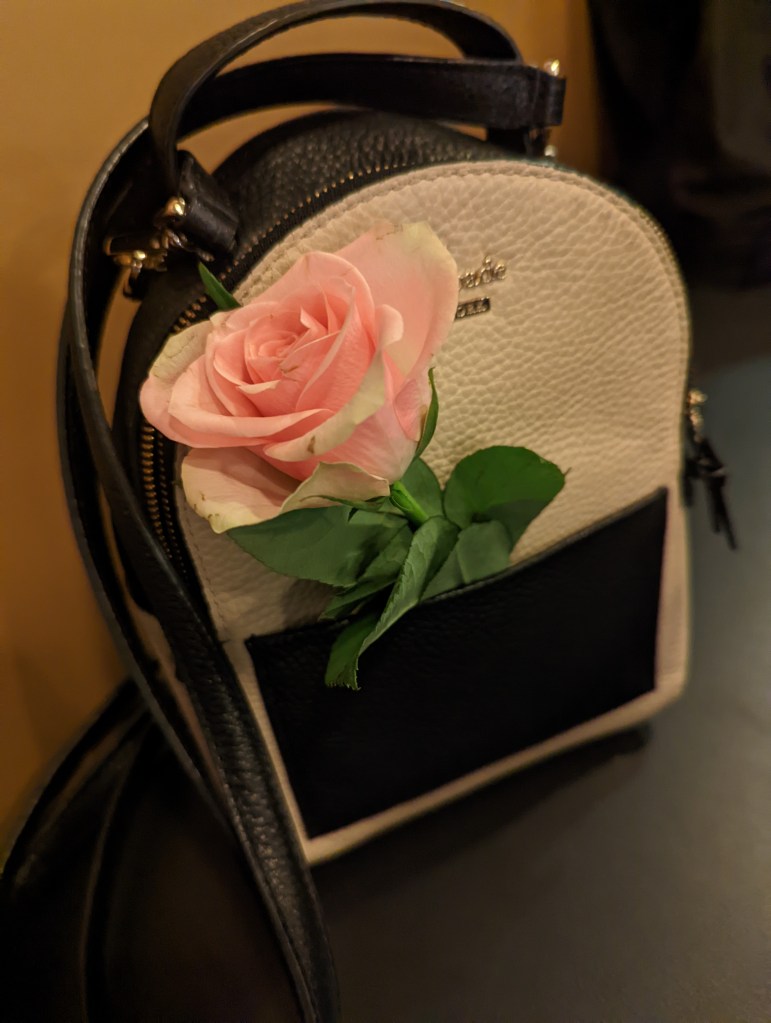
Cindy Lou has a simple Italian meal at Gusto’s in Paddington – lured by a rose
It was disappointing to see that a very pleasant Greek restaurant in London Street has closed. Around its empty space there were several Italian restaurants but we opted to return to a couple that had served us well in the past in Praed street. Perhaps that was a poor decision, as our favourite restaurant in Praed Street had also closed. Second best was indeed second best, despite the lure of the rose offered as we looked at the menu in the street. However, the service was friendly and efficient, and we enjoyed the occasion. For a first night in London it was pleasant to reminisce.
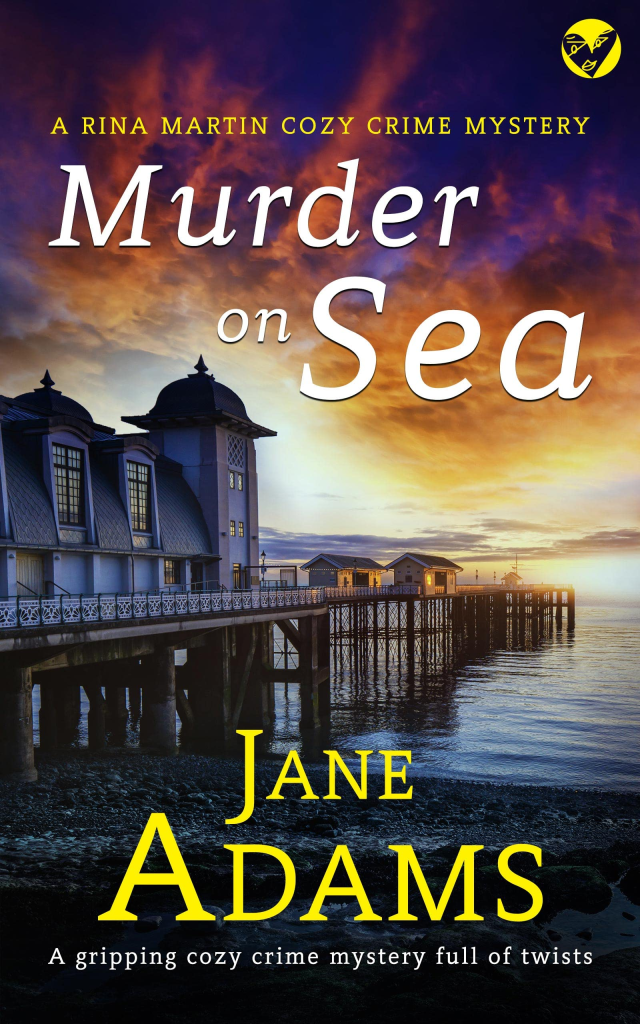
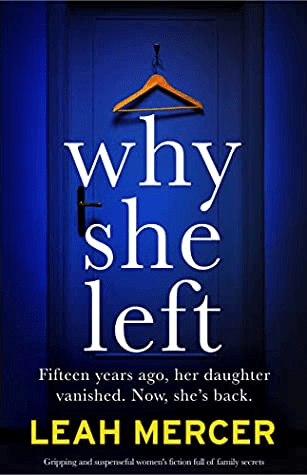
Two fiction books are reviewed this week, Murder on Sea, by Jane Adams, and Why She Left, by Leah Mercer. Both were sent to me by NetGalley as uncorrected proofs for review.
Jane Adams Murder On Sea Joffe Books 2021 (First published by Severn House Publishers 2007).
This is Book 1 of the Rina Martin Mysteries, and augers well for this ‘new’ (but republished from its earlier iteration in 2007) series written by Jane Adams. As well as Rina Martin, the series introduces Mac, Inspector McGregor, and the location in which the two unlikely collaborators solve crime, Frantham-on-Sea. Books: Reviews for complete review.
Leah Mercer Why She Left Bookoutre 2021.
Leah Mercer develops a sensitive family story around a searing public issue, in a well written, gripping story. The reason for Isobel’s departure from her mother’s beautiful home and the associated prestigious private school on Burlington Square is not revealed until well into the narrative. Her arrival with her teenage son, Isaac, years after she departed possibly provides a clue. However, regardless of an apparent resolution, there is far more to be unearthed in this story about a family with a commitment to the family heritage; family dysfunction associated with this commitment; affection for each other impacted by the legacy; and the family’s interaction with students, parents, and teachers at the school. Books: Reviews for the complete review.
Articles after Covid Report: First Two Weeks of Labor Government; Australian Letter, NYT, climate change policy; National Press Club address, Minister for the Environment and Water Tanya Plibersek; Bob McMullan, Trump may save the Democrat’s Senate bacon in November, with addendum; Cindy Lou at Courgette;Judith Durham; Olivia Newton-John.
Covid in Canberra after lockdown ends, and impact of new variants
As can be seen from previous weeks, the new variants have impacted in Canberra as well as elsewhere in Australia. More people are wearing masks in closed environments, despite not having to, which is a positive sign. Masks are mandatory in some situations, and in general the requirement to wear them on public transport is observed, although this could be better. It is interesting to live in an environment where the obligatory mantra, wallet, keys and kindle is joined by mask. Vaccinations have been introduced for children at risk aged 6 months to under 5 years. The Public health Emergency Declaration was extended on 8 August. This means that the Chief Medical Officer is allowed to take all necessary actions to reduce threats to public health from Covid 19.
3 August – 889 new cases recorded; 143 people in hospital; 2 in ICU.
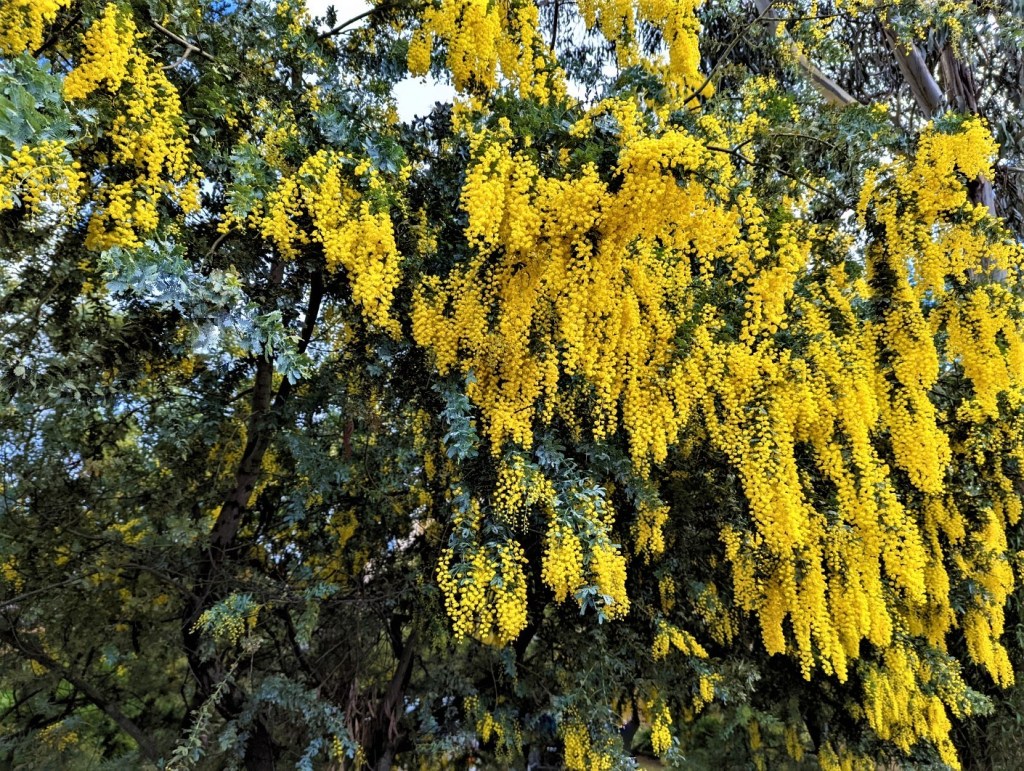
Wattle 5 August 2022 – Spring!
4 August – 641 cases recorded; 147 people in hospital; 4 people in ICU; 1 person ventilated.
5 August – 705 new cases recorded; 141 people in hospital; 2 people in ICU; 1 person ventilated.
6 August – 579 new cases recorded; 135 people in hospital; 2 people in ICU; 1 person ventilated.
7 August – 415 new cases were recorded; 140 people are in hospital; 1 person is ventilated.
8 August – 509 new cases were recorded; 144 people in hospital; 5 people in ICU; 1 person ventilated.
9 August – 498 new cases recorded; 146 people in hospital; 4 people in ICU; 3 people ventilated.
10 August – 556 new cases recorded; 138 people in hospital; 3 in ICU; 2 ventilated.
Over this period eleven lives were lost. One hundred and seven lives have been lost to Covid in Canberra since March 2020.
In the first two weeks of the Albanese Labor Government the following was accomplished:
The House passed first climate change bill for over a decade.
Aged Care legislation was passed to implement 17 of the Royal Commission recommendations.
The House introduced legislation to establish 10 days domestic violence leave.
The House outlined details for progressing Uluru Statement from the Heart.
The House introduced legislation to scrap the punitive cashless debit card.
Legislation to restore territory rights was passed.
The Senate consultations and decisions led to this headline: The climate wars are nearly over’: Labor, teals and Greens take a win on emissions as Liberals watch on‘, Brett Worthington, ABC.
And some analysis:
The Australian Letter New York Times
The Australia Letter is a weekly newsletter from our Australia bureau. This week’s issue is written by Damien Cave, the Australia bureau chief.
For as long as I’ve been in Australia, climate change policy has stymied governments, leading to division, inaction and embarrassment, most recently as the country became a global laggard at last year’s international climate conference in Copenhagen.
That now stands poised to change with the lower house of Parliament passing a bill this week that will finally put Australia on a path toward reducing carbon emissions by a significant amount — 43 percent from 2005 levels by 2030.
The bill is expected to pass the Senate next month, after the Labor government secured reluctant support from the Australian Greens, which had pushed for a higher target. And it is being hailed as the most significant piece of climate legislation in a decade, while also being criticized for not going far enough.
Both can be true, of course, and in my conversations this week with experts in both climate science and climate politics, I was struck by their expectation that the legislation would produce momentum and progress.
The first thing they noted: The target itself produces a framework for stability and stepped-up action; enshrining a 43 percent reduction in law gives businesses and local governments the confidence to invest in reducing carbon emissions without worrying that competitors eager to avoid such an expense will be rewarded later by another government that doesn’t think the changes are necessary.
A second element of the legislation that I heard a lot about was a mechanism for independent assessment and improvement of this first step.
As the Climate Council notes in its analysis of the legislation:
It hands authority back to an independent group of experts (the Climate Change Authority) to monitor Australia’s progress against the targets, and to help shape the move toward future targets, including what’s expected under the Paris Agreement for 2035.Under the new law, the Minister for Climate Change will be required to report back to Parliament each year on Australia’s progress toward the country’s targets.
What those two elements do is force Australia to continue the conversation, with scientific experts playing a lead role. It’s the kind of thing good governance experts often call for with contentious policy issues, and it helps counter what psychologists who study humanity’s response to risks of all kinds describe as the “single action bias.”
Elke Weber, a professor of psychology at Princeton University who I interviewed for my book (which has been published in Australia and will be out next year in the United States), described the concept as a major impediment to sustained action on big problems like climate change. The idea is that, in response to uncertain, frightening situations, humans tend to simplify their decision-making and rely on one action, without any further action — usually because the first one reduced their feeling of worry or vulnerability.
What makes the climate bill so interesting to me, as a student of risk, is that it builds into its structure a framework for further action, and a trigger that could force that action to continue and build over time. It sets repeated action and adjustment as the default.
Many other pieces of legislation do this too, in Australia and in other countries. The United States is also on the verge of passing landmark climate legislation that will help the country reach its goal of cutting emissions in half by 2030, largely with tax breaks and other incentives that will build momentum over time. But Australia, after years of politicized “climate wars,” seems to have found a model that acknowledges more will have to be done.
It is not a solution so much as the belated beginning of a major transition that the entire world has been slow to embark upon.
“This Climate Bill will not be enough to meet the Paris Agreement goals but it is a huge leap forward and opens a new era of cooperation and constructive policymaking,” said Richie Merzian, the climate and energy program director at the Australia Institute. “There is still a lot of work to go to reverse Australia’s role as the third largest exporter of fossil fuel, but there is hope and momentum that things are finally starting to change.”
National Press Club address, Minister for the Environment and Water Tanya Plibersek
19 July 2022
The Hon Tanya Plibersek MP Minister for the Environment and Water
*** CHECK AGAINST DELIVERY ***
Acknowledgments omitted.
SUBJECTS: 2021 State of the Environment Report
TANYA PLIBERSEK, MINISTER FOR THE ENVIRONMENT AND WATER: I want to begin by acknowledging the traditional owners of the land on which we meet today, the Ngunnawal and Ngambri people, and pay my respects to their Elders past and present.
First Nations peoples have the oldest continuing cultures on earth, and are the world’s most successful environmental custodians.
They have managed land and sea country for 65,000 years.
As Minister for the Environment and Water, I’m committed to learning from their remarkable example.
Thank you to the National Press Club for having me today.
It’s been six weeks since I started in this portfolio.
On top of the usual departmental briefings, I’ve used these six weeks to travel to some of the most remarkable parts of Australia…
…reminding me again how grateful I am to live in the most beautiful country on earth. And how thankful I am to the generations of activists and good governments who protected our unique natural and cultural heritage.
But there is another story here too.
A difficult, confronting, sometimes depressing story.
At the same time as seeing some of the most beautiful places on earth, I’ve been reading the data that tells me these places are under threat.
If we continue on the trajectory we are on, the precious places, landscapes, animals and plants that we think of when we think of home, may not be here for our kids and grandkids.
Today, as part of my statutory duty as Minister, I am publicly releasing the 2021 State of the Environment Report.
It’s one of the most important documents in environmental science.
Every five years, a group of independent experts, some of Australia’s most respected scientists (a number of whom are with us today), are given access to our best available tools.
They are told to show us the full national picture of the health of our environment.
Or as one of the authors put it, to help us ‘take a good hard look at ourselves’.
This report was delivered to government last year.
The previous Minister, Sussan Ley, received it before Christmas, but chose to keep it hidden – locked away until after the federal election.
When you read it, you’ll know why.
But while it’s a confronting read, Australians deserve the truth.
We deserve to know that Australia has lost more mammal species to extinction than any other continent.
We deserve to know that threatened communities have grown by 20 per cent in the past five years, with places literally burned into endangerment by catastrophic fires.
That the Murray Darling fell to its lowest water level on record in 2019.
And that for the first time, Australia now has more foreign plant species than native ones.
Individually, each of these revelations is dreadful.
But it’s only when you think about their cumulative impact that you begin to get the full picture of environmental decline.
It’s right there on page one of the report – ‘Overall, the state and trend of the environment in Australia are poor and deteriorating’ – with ‘abrupt changes in ecological systems being recorded in the past five years’.
And it’s downhill from there.
Since the last report, marine heatwaves have caused mass coral bleaching in the Great Barrier Reef.
Warming temperatures have reduced kelp beds along the southeast coast, as well as threatening reef habitats and the abalone and lobster industries they support.
At the same time, Australia has experienced a plague of marine plastics.
In Perth, scientists have found up to 60,000 pieces of plastic per square kilometre of water.
In Brisbane, they found between 40,000 and 80,000.
And at the top end, in the Torres Strait and Timor Sea, abandoned fishing gear has been killing marine animals on an industrial scale.
These underwater hurricanes of debris are known as ‘ghost nets’ – and they’re strangling up to 14,000 turtles a year.
Turtles which are listed as threatened.
Our waters are struggling – and so is the land.
As a result of erosion, deforestation, intensive agriculture and climate change, Australia’s soil is now generally in poor condition – and getting worse.
We are losing topsoil – letting it blow away without vegetation to protect it….
Making our soil less productive, less fertile, and less efficient at holding water.
Which means our agricultural output is lower than it could be.
Our land is more susceptible to drought.
And our soil’s ability to regenerate and support life is diminished.
Australia is one of the world’s deforestation hotspots. Between the year 2000 and 2017, Australia cleared over 7.7 million hectares of threatened species habitat across the country.
That’s an area bigger than Tasmania.
Much of this clearing occurred in small increments. More than 90 per cent of it was never assessed under our environmental laws.
When we destroy these habitats – and when we don’t restore them elsewhere – endangered creatures lose their homes.
And that has consequences.
In February this year, Koalas were officially moved from threatened to endangered in Queensland, New South Wales, and the ACT.
These drowsy creatures have grazed on Australian eucalyptus for over 25 million years.
And it’s only this year, of all years, that they became endangered.
Of course, this disturbing list is being made worse by climate change.
Global warming multiplies environmental pressure everywhere.
It heats our oceans.
It deepens drought.
It intensifies disease.
It destroys habitats.
And it worsens extreme weather events, which tilt the balance of ecosystems beyond recognition.
The bushfires of 2019 and 2020 are still being felt today.
Those bushfires were an ecological bomb, ripping through south-eastern Australia.
They killed or displaced up to three billion animals.
They burnt over 80 per cent of the Greater Blue Mountains area, almost 60 per cent of our Gondwana rainforests, and more than 40 per cent of the Stirling Range National Park.
And they tipped clouds of sediment and ash into our waterways, leading to mass marine death. That summer was terrifying for everyone who lived through it.
And if we don’t act, those awful red nights will become more common.
This is just a taste of what the report lays out.
And for six months, it sat on the previous Minister’s desk.
As Professor Emma Johnston told the Sydney Morning Herald in April:
‘We have put a huge amount of effort and hard yakka into this, and we really hope the report can be used for long term planning, immediate action, for changing our investments … but we can’t start that work until the report is released’.
I agree.
It’s well past time we get to work.
As we see from the State of the Environment Report, the previous government was no friend of the environment.
Too many urgent warnings were either ignored or kept secret.
But there were other failures too.
The former government made nice promises, but rarely bothered to deliver them.
For example, the previous government had a decade to fulfil the Murray Darling Basin Plan.
It’s a good plan. Labor made it. Labor delivered it.
And it saved the river system from dying in 2019.
But it’s yet to be fully implemented.
By the time the Morrison Government left office, they had only delivered two of the promised 450 gigalitres of environmental water.
And they had no plan to find the extra 448 gigalitres by 2024, when it’s due.
The former government promised $40 million for Indigenous water – of which they never delivered a drop.
The Morrison Government made a series of pledges on recycling.
Pledges the Labor Government broadly supports.
But I think most Australians would be shocked to know how far we are from meeting these targets – and that the former government had no real plan to reach them.
Again and again, the previous government behaved in a way that undermined public trust in environmental management.
They gave a private charity almost half a billion dollars, without tender or process, to guide our response to the crisis in the Great Barrier Reef.
It doesn’t matter how good an organisation is – no one should walk into the Prime Minister’s office and leave with hundreds of millions of dollars they never even asked for.
For nine years, the previous government oversaw a broken, barely regulated national water market.
As the ACCC found, it was market with no rules against insider trading.
With no requirements to keep proper records.
This led to widespread distrust in the system.
Worse than that, they inflicted wilful damage as well.
From Tony Abbott to Scott Morrison, from Barnaby Joyce to Matt Canavan…
…the Liberals and Nationals came to power with a mission to put the environment last, to repeal climate legislation and slash emissions reduction targets.
They cut funding to the Environment Department by 40 per cent. Which they thought was very clever, until they realised what it meant in practice.
Without proper funding, environmental decision times exploded.
According to a National Audit Office review in 2020, the average federal decision for a new project was 116 days behind schedule.
And of these decisions, around 80 per cent were either non-compliant or contained errors.
The previous government’s funding cuts held back business, they damaged the economy, and they undermined practical efforts to protect our environment.
In 2018, the former government cut the highly protected areas of Commonwealth Marine Parks in half – removing the largest area from conservation in Australian history.
The Liberals and Nationals spent less than $17 million of the $216 million they promised to upgrade Kakadu National Park’s infrastructure.
And in their final term, the Morrison Government’s relationship with the Traditional Owners of Kakadu broke down completely – to the point where a government review, co-chaired by Amanda Vanstone, called it ‘deplorable’ and ‘untenable’.
The previous government was told, loud and clear, that Australia’s environmental laws weren’t working.
But they did nothing to fix that.
Almost two years ago, the Morrison Government received an official review into the Environmental Protection and Biodiversity Conservation Act.
It was written by Graeme Samuel – and its message was as blunt as the State of the Environment Report.
To quote Professor Samuel:
‘The EPBC Act is outdated and requires fundamental reform’.
‘The EPBC Act is ineffective. It does not enable the Commonwealth to effectively protect environmental matters that are important for the nation. It is not fit to address current or future environmental challenges.
‘The resounding message that I heard through the Review is that Australians do not trust that the Act is delivering for the environment, for business or for the community’.
Professor Samuel’s work was thorough. But it wasn’t a revelation.
The federal government has been receiving the same messages for years now.
And the central theme, over and over again, is trust and integrity.
People don’t trust that the Commonwealth is protecting the environment.
They don’t trust the development application process to be smooth, on time, and without unnecessary duplication.
And frankly, that scepticism is justified.
Under the current laws, we don’t clearly define the environmental outcomes we’re trying to deliver.
When we make environmental decisions, we don’t ensure they’re being enforced in practice.
Even if we wanted to, we often don’t have the data or resources to do it properly.
And because no one trusts the system, these processes are often duplicated by state and federal governments.
Which delays projects, drives up business costs, and jeopardises investment.
At the same time our environment is not getting the protection it needs.
This is what Graeme Samuel told us.
There’s an almost universal consensus that change is needed.
Indeed, business and environmental groups very maturely put aside differences to back Professor Samuel’s recommendations.
But again, the Morrison Government chose to ignore that.
They tried to ram through a select few changes – and instead delivered nothing.
This is the situation I’m inheriting as Minister for the Environment and Water.
Years of warnings that were ignored or kept secret.
Promises made, but not delivered.
Dodgy behaviour, undermining public confidence.
Brutal funding cuts.
Wilful neglect.
Laws that don’t work to protect the environment, or smooth the way for sensible development.
All against the backdrop of accelerating environmental destruction.
It’s time to change that.
Australia’s environment is bad and getting worse, as this report shows.
And much of the destruction outlined in the State of the Environment report will take years to turn around.
Nevertheless, I’m optimistic about the steps we can take over the next three years.
Legislating strong action on climate change is a great start.
Australian scientists are world class.
We know how to restore landscapes, repair coral reefs, and recover threatened species.
We’ve got thousands of volunteers out there, every weekend, planting trees, collecting rubbish, and cleaning up their local creek – many of them through community Landcare groups.
Australians really care about the landscapes they live in, and about the precious places they will never visit, but want protected anyway.
They just need a government that cares as much as they do.
Which is why, in this term of government, I will be guided by three essential goals.
To protect, to restore, and to manage Australia’s environment.
We need to protect our environment and heritage for the future.
We need to restore environments that have already been damaged.
And we need to actively manage our landscapes, oceans and waterways, and the critical places we’ve vowed to protect – so they don’t become run down through neglect.
That’s our agenda.
To offer proper protection, we need to set clear national environmental standards – with explicit targets around what we value as a country, and what the law needs to protect.
This will require a fundamental reforming of our national environment laws – and empowering a new Environmental Protection Agency to enforce them.
We need trust and transparency.
Decisions need to be built on good data – to show the public how we’re tracking in real time; data that can be shared so we don’t keep collecting the same information again and again, but instead we build over time a useful, usable, rich picture of our environment.
We also need certainty and efficiency.
This will allow us to speed up most processes – so we can build new housing, construct renewable energy projects, and lay the roads that connect our communities.
Better environmental outcomes and faster, clearer decisions.
For too long, people have seen these goals as mutually exclusive. They’re not.
Good environmental law reform is also good economic reform.
That’s why by agreement with the Treasurer, the historic wellbeing budget will also include environmental indicators.
As the Treasurer recently said:
‘It is really important that we measure what matters in our economy, in addition to all of the traditional measures. Not instead of, but in addition to.’
Because this is not a conflict between jobs and the environment.
We’ve got to go beyond that thinking when we reform our environmental laws.
To help guide that change, I’m announcing that by the end of the year the Australian Government will formally respond to the Samuel Review.
We will then aim to develop new environmental legislation for 2023.
We will consult thoroughly on environmental standards.
But in the meantime, I’d like to see an immediate start on improving our environmental data and regional planning – establishing a shared view around what needs to be protected or restored, and areas where development can occur with minimal consequence.
I’m not naïve: I know improving our environmental laws is going to be challenging.
People will have different ideas of what national standards should look like.
And as Minister, I will make calls that some people disagree with.
But I’m determined to improve the system.
The truth is that everyone will have to give a bit to achieve real, lasting, national progress.
It is encouraging to know that groups with very different interests worked to find common ground during the Samuel Review.
Business, industry, environmentalists, scientists, traditional owners, farmers, unions, and your standard keen bushwalker like me, came to the table to see what progress they could make.
I want to work across the board to build on that good will.
Because ambition is important. But it’s not much good without achievement.
I understand that campaigns to stop individual projects will motivate and energise some people.
Others will want to focus on individual species, or a particularly beautiful place.
I know these campaigns can capture the public imagination.
But in my judgement – what our environment really needs is a changed system.
That’s the message from the Samuel review.
That’s the message from the State of the Environment Report.
Without structural reform, we’ll be resigning ourselves to another decade of failure; without the tools we need to arrest our decline.
We all want to pass on a healthy environment to our children and grandchildren.
That’s why I’m also very happy to announce that we will expand Australia’s national estate.
Our Government will set a national goal of protecting thirty percent of our land and thirty percent of our oceans by 2030.
We will explore the creation of new national parks and marine protected areas – including by progressing the East Antarctic Marine Protected Area.
This will be the latest chapter in a very proud Labor story.
Labor protected Kakadu, the Daintree, the Great Barrier Reef, Antarctica, and the Tasmanian World Heritage Area.
As Minister, I intend to add to that legacy.
The State of the Environment Report also makes it clear that we must do a better job at repairing environmental damage.
Too much clearing of habitat has already occurred.
Too many ecosystems and species are under threat.
We can’t just stop future destruction – although this is essential and the most cost effective way to address the environmental crisis – we also need to actively repair past damage.
The Australian Land Conservation Alliance estimates that we need to spend over $1 billion a year to restore and prevent further landscape degradation.
The scale of this challenge means that governments can’t do the job alone.
We need to work with industry and philanthropic partners – many of whom are already doing great work.
I want to look at ways to make these investments easier – to support land-based carbon projects that deliver biodiversity, improve drought resilience, and drive agricultural productivity.
And to ensure that we prioritise the most important areas for ecological restoration.
Better data, laws that focus on outcomes, and good regional planning will help protect and restore the places with the greatest carbon and biodiversity value.
We will also support investment in blue carbon projects – restoration of mangroves, tidal marshes, and sea grasses that provide habitat for marine life, support our fisheries, and protect our coast lines from rising tides and storms.
An Australian scientist has described these places as the ‘blue diamond’ of carbon storage.
And he’s right: these environments are precious – absorbing carbon at up to five times the rate of tropical rainforests and storing it for thousands of years.
The State of the Environment Report shows the urgent need to better manage our waste, and to actively manage the places we’ve vowed to protect.
These are areas of clear community interest.
Most people want to reduce their plastics footprint, they want to recycle the things they use, and they want government to help them do it as easily as possible.
I’m genuinely excited by our prospects here.
We can reduce pollution, increase recycling, and support local manufacturing at the same time.
For example – I recently visited the Samsara lab at the Australian National University, where researchers are using enzymes to break down plastics and infinitely remake new plastic.
I’ve seen the research UTS is doing in making plastics from algae.
It’s fascinating work – just a couple of the many innovations being trialed around the country.
I want to support these efforts to replace petrochemical products – while working with the states and territories to encourage a circular economy…
That means promoting recycling, reusing, and repairing as much as possible.
We know how important this issue is to our friends in the Pacific.
At the UN Oceans Conference last month, our Pacific family told me about the impact plastics are having on their health, their environment, and their livelihoods.
This is an area where Australia can form strong regional partnerships.
As I said to Pacific leaders, I want to see a plastics free Pacific in our lifetime.
Every Pacific leader I have spoken with is eager to work with Australia on this project – to share what we know with each other.
There is also the question of managing the land we’ve promised to protect. Here I see the environment and water portfolio going hand in hand with Labor’s reconciliation agenda.
First Nations Australians have managed this country for 65,000 years.
And they did it through changing seasons, shifting climates, and across radically different environments.
These systems of environmental knowledge have been passed down for thousands of generations. Any modern conservation program should incorporate them.
That’s why the Labor Government will double the number of Indigenous Rangers by the end of the decade to 3,800.
We will significantly boost funding for Indigenous Protected Areas.
We will deliver the $40 million of Indigenous water promised by the Morrison government in 2018, but never produced.
And we will make it easier for First Nations to protect their cultural heritage.
We’ve committed to introduce standalone cultural heritage legislation – which we will co-design with the First Nations Heritage Protection Alliance.
A healthy environment sits at the heart of our national legacy.
And it feeds our national soul.
Our sense of ourselves, and our health as a society is bound up with the health of our land and water.
Australians know how lucky we are to live in this country.
It’s the feeling we get whenever we come back from overseas.
You see it all with fresh eyes and fresh appreciation.
It’s the crystal blue sky – clearer than anywhere in the world.
It’s the glimmer and sparkle of Sydney Harbour.
It’s the long green stretches of national park, bordering our cities.
It’s the perfect ring of beaches that meet the sea.
Or the corrugated red ridges of central Australia.
And every time, the same feeling – the feeling of home stirring inside us.
That’s our natural heritage – and that’s what we’re committed to protecting.
In 2022, Australians voted for the environment.
They voted for action on climate change.
They voted for their children and their grandchildren and every generation of Australians who will follow us.
When you change the government – you change the country.
After a lost decade; after a decade of going backwards; we can’t waste another minute.
Thank you.
Trump may save the Democrat’s Senate bacon in November.
Bob McMullan
Bob McMullan
All the signs point to a disastrous result for the Democrats in the House of Representatives in the mid-terms in November.
Inflation, the unpopularity of the president and the usual mid-term set-back for the incumbent President’s party should combine to deliver a comfortable majority for the Republicans in the House. After all, the Democrats have only the slimmest of majorities to begin with.
The extent to which the reaction to the Supreme Court decision in overturning Roe vs Wade will change the electoral equation in the House is unknowable at this stage but may prove to be a mitigating factor in November. This may reduce the losses but it is very hard to see the Democrats holding on in the House.
However, the Senate may paint a different picture. In the state-wide races like Senate seats (and Governor’s races) candidates are more exposed and their merits count for more. And Trump has delivered some candidates of very doubtful quality which should give the Democrats a chance to hang on and perhaps even to make gains.
By way of background, the 100 member Senate is currently split 50/50 with the Vice president having a casting vote. In 2022 35 Senate seats are up for election. It would normally be only 34 but a Senator from Oklahoma is retiring early even though he is only 86!
Of the 35 seats in contest the Republicans hold 21 and the Democrats 14. This means that the continuing Senators are 36 Democrats and 29 Republicans. However, many of the Republican held seats up for election this year are rock solid Republican strongholds, including the special election in Oklahoma.
The influential Cook Report suggests as many as 16 of the 21 Republican seats can be considered safe. This is substantially correct, but there may be interesting issues to watch in four of the “safe” seats.
This would mean 12 certain extra seats, taking the Republicans to 41.
The other four usually safe seats are Iowa, Missouri, Utah and Alaska. In Iowa, the Senator seeking re-election for a six year term, Senator Grassley, will be 89 on election day and 95 at the end of the term he is seeking! Early polling was very strong for Grassley but since the Democrat primary in which they chose Michael Franken the most recent polling has seen the gap narrowing. It is difficult to see Grassley losing but it will be worth watching on the night.
In Missouri the problem the Republicans have is a potentially very controversial candidate. Eric Greitjens is a previous Governor who lost office as a result of a series of scandals. At the moment he is leading in the polls for the August 2 primary, although only narrowly. His potential candidature has mobilized senior Republicans in the state to support an Independent Republican. It would not be unprecedented for the Republicans to lose the Senate seat in Missouri due to the selection of an unacceptable candidate. Should Greitjens win the primary it will be another worth watching on the night.
In Utah the interest is generated by a strong Independent candidate, Evan McMullin. He has managed to persuade the Democrats not to run for the seat and as a consequence has an outside chance of beating the incumbent Republican, Mike Lee. Lee was an early critic of Trump but signed on to the “Big Lie” about the stolen election.
The Alaska Senate election is interesting because it is a contest between Lisa Murkowski, a Republican who voted to impeach Trump, and a Trump loyalist Kelly Tshibaka. The interesting question is, should Murkowski lose the primary will she still contest the election as an Independent or take advantage of new voting system in Alaska which will allow the top four candidates in the primary ballot to compete in a ranked choice election in November. I think Murkowski is most likely to win in November.
Should any of these potential Independents win they would not necessarily deprive the Republicans of a majority but they would create more opportunities for negotiation about legislation and appointments. Nevertheless, the wise thing to do is assume that the Republicans will win all four seats in one way or the other. This would take them to 45 seats.
The Democrats have 42 “safe seats” and four others they are likely to win: Illinois; Colorado; Connecticut and Washington state. If we assume that the Republicans are likely to win 45 seats and the Democrats 46, that leaves 9 to be fought over:
Arizona (D) Georgia (D) New Hampshire (D) Nevada (D) Pennsylvania(R) Wisconsin (R) North Carolina(R) Ohio (R) and Florida (R).
I intend to assess the prospects in each of these states and follow-up on them and any other developments of interest in the Senate race on a regular basis.
Arizona Trump’s support for Blake Masters as Republican candidate for the Arizona Senate seat appears to be a blessing for the Democrat incumbent Mark Kelly. The primary will be held on 2 August but polling suggests Masters is leading the internal Republican race by about 7%. However, he does not appear to be the strongest candidate for the general election. At this stage the polling suggests that Kelly is leading Masters by 9-10%. This would be a very difficult gap to close by November.
Georgia The situation here is similar. Herschel Walker, the Trump endorsed Senate candidate, staggers from one crisis to another. This does not mean he cannot win in what is still a slightly Republican state but it makes it harder for the Republicans than it otherwise would be. A recent poll had the Democrat incumbent Senator Raphael Warnock, ahead by 10%. This is an outlier and probably wrong. The RCP average of polls has Warnock ahead by 1-2%. Given the numerous vulnerabilities of Walker I think Warnock has a better than even chance of pulling off another unlikely victory.
New Hampshire The situation in New Hampshire is not clear. The Republican primary is not until September and there is no current sign that I have seen of a Trump-endorsed candidate in the field, The incumbent Democrat Senator, Maggie Hassan, is a former Governor and seems a strong candidate. She won very narrowly last time but should win this time unless national trends count too strongly against her. The lack of a Republican candidate means there in no useful polling data to serve as a guide to the likely outcome. Such current data as there is suggests Hassan is ahead of any of the Republican contenders by more than 4%, but this is likely to change once the candidate becomes clear.
Nevada The Republicans seem to have selected a reasonably good candidate in Nevada in Adam Laxalt to run against the incumbent Democrat Senator Catherine Cortez Masto. Recent polling suggests Cortez Masto has her nose in front but it is likely to be a close contest in November.
Pennsylvania Pennsylvania is another state where Trump’s influence in the Republican primary has opened the door for the Democrats to have a chance of making a gain in the Senate. Trump supported Dr Oz, because he always said nice things about him in his (Oz’s) TV programs! Oz is handicapped by the impression, probably true, that he actually comes from New Jersey, and the extreme positions he had to take up to win the Trump endorsement and then to win the primary. Early polling has the Democrat candidate, John Fetterman, ahead by between 4 and 9%. This would be a gain for the Democrats because the retiring Senator is a Republican. The key question is whether the national trends will be sufficient to enable Oz to close the gap.
Wisconsin The opportunity for the Democrats in Wisconsin is generated by the apparent weakness of the incumbent Republican Senator, Ron Johnson. His approval numbers are very low (37%) and he does not poll well against any of the Democrat alternative candidates. The Democrats will choose their candidate on August 9 and there does not appear to be a clear favorite. They all poll well enough against Johnson to suggest a close race in November. It is hard to believe that an incumbent Republican Senator could lose in the electoral climate in the USA in 2022, but if anyone can do it Ron Johnson can.
North Carolina The Senate contest in North Carolina is close at the moment between the Republican candidate Ted Budd and the Democrat Cheri Beasley. However, Budd has been consistently ahead by between 3 and 4%. Despite the narrow margin and some signs of improved prospects for the Democrats in recent national polls it is not clear what path to victory Ms. Beasley has. The incumbent Republican Senator is retiring.
Ohio Ohio is a state which is going steadily more Republican but in which the Democrats have an opportunity to make a Senate gain in 2022. With the retirement of popular Republican Senator Portman and the subsequent decision to choose a Trump backed candidate, JD Vance, the Democrat Tim Ryan is currently leading in some polls and is competitive in all of them. It would be a surprise if Ryan were to win in 2022 but it appears to be a realistic possibility.
Florida It is hard to see incumbent Republican senator, Marco Rubio, being beaten, Trump won Florida easily and Ron de Santis is running for re-election as Governor which should help the Republican turnout. However, intelligent observers suggest that it is a seat to watch and the Democrats have put up a strong candidate in Val Deemings. Current polling has Rubio ahead by at least 5% and up to 9%.
The Democrats have to win four of these nine states to maintain their 50/50 status which would enable them to continue to use the Vice-President’s casting vote. As they are currently leading in five of the states the evidence suggests that Donald Trump’s control of the Republican party has given the Democrats a realistic chance of maintaining Senate control from 2022-2024.
Addendum:
US Senate election update, Bob McMullan
This report is an addendum to the main report I published recently on the forthcoming mid-term Senate elections in the United States. In that report I concluded that the Republicans have a certain 41 seats together with four probable wins.
The situation in one of the probables has become clearer.
In Missouri the mainstream Republican leadership managed to defeat Eric Greitjens, the candidate who would have put their hold on this otherwise safe seat in jeopardy. This seat can now be taken out of consideration.
The other three, Iowa, Utah and Alaska remain likely Republican gains but still require watching over the remaining time.
In the other 9 seats which will be the centre of the campaign, the situation has, on balance, improved slightly for Democrats over the intervening period.
Arizona Now that Trump’s pick, Blake Masters, has won the primary the situation is a little clearer. The only poll since Masters’ selection has had the incumbent Democrat, Kelly, ahead by 5%. If this is sustained it indicates a narrowing of the gap, which would not be surprising as Republicans now have a clear candidate.
Georgia Raphael Warnock continues to lead Trumps pick, Herschel Walker, by a small but consistent margin across all the polls. On average his lead is approximately 3%.
New Hampshire No change.
Nevada No change
Pennsylvania John Fetterman continues to expand his advantage oner Dr Oz. On average it is now 10.7%.
North Carolina Cheri Beasley continues to narrow the gap to the Republican candidate, Ted Budd (who was Trump’s pick). She has been ahead in the last two polls and on average trails by only 0.3%.
Ohio The Democrat, Tim Ryan continues to lead JD Vance. The latest average is 3.9%, but he has been ahead in every recent poll, by as much as 10%.
Wisconsin The outline of this race is now clear. The primaries on Tuesday have chosen Republican incumbent, Ron Johnson and Democrat Lieutenant Governor, Mandela Barnes. There have been no polls since Tuesday of course, but the latest to pit these two against each other had Barnes ahead by 2%.
Florida This still looks strong for Marco Rubio, but the gap appears to be narrowing and the most recent poll had him in a tie with Val Deemings.
The recent legislative and national security successes for Joe Biden and the consequences of the FBI search warrant against Trump have not had time to influence any of these races.
It remains a surprisingly interesting contest.
Cindy Lou eats at Courgette
Courgette is always a delight, with its pleasant staff, wonderful food, warmthand even parking next door. The seating is comfortable, as well las being well spaced, even before Covid required social distancing. The atmosphere is quiet and conducive to conversation. Service is efficient, friendly and timely. We chose the Four Course Dinner Menu for $95.
The warm rolls and ash butter are a lovely start to a delicious meal. The meals are resplendent with variety so we did not order side dishes.
The savoury meals from the four course menu that we chosen at our table were the sword fish, mushrooms, beef cheek, salmon ceviche, chicken, eggplant, scallops, and courgette flower. The details are below:
Second Miso Glazed Eggplant, Spiced Cauliflower Beignet, Cauliflower Puree, Puffed Rice & Nori. Seared Hervey Bay Scallop, Fennel & Apple Puree, Green Beans, Basil Pesto & Fresh Almonds. Free Range Chicken Breast, Celeriac Puree, Beetroot, Confit Chicken Cigar & Truffle Jus.
Third Roasted King Brown Mushroom, Buffallo Mozzarella, Sweet Potato Smash, Baby Spinach & Balsamic Red Peppers. Aromatic Spiced Kingfish, Coconut Curried Potato, Asparagus & Finger Lime. Wagyu Beef Cheek, Paris Mash, Glazed Carrot, Carrot Puree, Hazelnuts & Café de Paris Sauce.
Although there were several desserts, we chose the raspberry tart with Baileys Ice-cream, and the Brulée. Both were delicious. There is a range of teas and coffees. The drink menu was very successful – a bottle of Cloudy Bay was there and we could not go past that!
Fourth Raspberry and White Chocolate Tart, Bailey’s and Hazelnut Ice Cream Fresh Raspberries, Lemon Balm. Bittersweet Chocolate Brulée, Cherry & Hazelnut Financier, Buffalo Yoghurt Sorbet & Sour Cherry Glaze.
‘National treasure’: Australia mourns Seekers’ legend Judith Durham, dead at 79
Judith Durham devoted her life to music and won a place in Australia’s heart.
Thank you, NetGalley, for the uncorrected proofs for The Times They Were a-Changin’ 1964, the Year the Sixties Arrived and the Battle Lines of Today Were Drawn, and The Second Wife and in exchange for honest reviews.
Robert S McElvaine The Times They Were a-Changin’ 1964, the Year the Sixties Arrived and the Battle Lines of Today Were Drawn Skyhorse Publishing, Arcade 2022.
This is a timely book, providing as it does, an excellent background to current political and social behaviour and events in 2020s America. McElvaine has chosen a raft of cultural, social and political events to develop his theme, that the ‘long year’ of 1964 began changes that laid the foundation for change but have also raised such challenges to long accepted bigotry and racism that there has been an immense ‘push back’ culminating in the election of former President Donald Trump, and the continuing big lie about the 2020 election of President Joe Biden. For the complete review see Books: Reviews
Miranda Rijks The Second Wife Inkubator Books 2022.
In my review of Miranda Rijks’ “What She Knew” I stated that it would not be the last of her novels that I would read. I cannot say the same of this one. It was a very disappointing read. Although it was well paced, with first person commentary from the two main characters, and a disturbing short piece from an initially unknown character, the plot floundered at times. Some incidents, although necessary to develop relationships, had no rational basis – there needed to be more attention given to how to achieve the former without undermining the reader’s credulity. The motivation for some of the perpetuator’s behaviour did not exist.
Articles after Covid in Canberra information: Voice to parliament – PM Anthony Albanese, Michelle Grattan, Insiders at Gama, Bridget Brennan, Patricia Karvelas; Remembering Pat Giles, AM; Archie Roach is mourned; Bernard Collaery – Labor action.
Covid in Canberra after Lockdown is lifted
Wattle emerging – always a welcome Canberra sight
28 July – 1,000 new cases recorded; 149 people in Hospital; 2 in ICU.
29 July – 1,007 new cases recorded; 147 people in hospital; 1 person in ICU.
30 July -719 new cases recorded; 152 people in hospital.
31 July – 556 new cases recorded; 163 people in hospital; 1 person in ICU.
1 August – 616 new cases recorded; 165 people in hospital; 2 people in ICU.
2 August – 754 new cases recorded; 158 people in hospital; 3 people in ICU.
3 August – 889 new cases recorded; 143 people in hospital; 2 people in ICU.
Nine lives have been lost in this period, bringing the total of lives lost to Covid in Canberra since march 2020 to 97.
PM Anthony Albanese at the Garma Festival
From: The Conversation – Michelle Grattan
Republished under Creative Commons Licence
Albanese releases draft wording for Indigenous ‘Voice to parliament’ referendum
Published: July 29, 2022 10.31pm AEST
Anthony Albanese will propose draft wording to insert into the constitution an Indigenous “Voice” to parliament when he addresses the Garma Festival in Arnhem Land on Saturday.
The Prime Minister is also releasing a draft of the question that would be put to the people at the referendum for the change.
The new provision in the constitution would have three sentences:
There shall be a body, to be called the Aboriginal and Torres Strait Islander Voice
The Aboriginal and Torres Strait Islander Voice may make representations to Parliament and the Executive government on matters relating to Aboriginal and Torres Strait Islander Peoples
The Parliament shall, subject to this Constitution, have power to make laws with respect to the composition, functions, powers and procedures of the Aboriginal and Torres Strait Islander Voice.
In his speech, released ahead of delivery, Albanese says this might not be the final form of words but it is the next step in the discussion.
His draft referendum question would ask: “Do you support an alteration to the Constitution that establishes an Aboriginal and Torres Strait Islander Voice?”
To pass, a referendum needs to win both an overall majority of votes as well as majorities in a majority of states. There have been 44 proposals for constitutional change put in 19 referendums with only eight changes passing.
Although Albanese has been anxious for the referendum to be held next year, he talks in his speech only of having it in the current parliamentary term.
“I believe the country is ready for this reform,” he says. “I believe there is room in Australian hearts for the [Uluru] Statement from the Heart.”
“We are seeking a momentous change – but it is also a very simple one.”
“It is not a matter of special treatment, or preferential power. It’s about consulting Aboriginal and Torres Strait Islander peoples on the decisions that affect you. This is simple courtesy, it is common decency.”
Albanese says that putting a Voice into the constitution “means a willingness to listen won’t depend on who is in government or who is prime minister”. Such a Voice “cannot be silenced”.
“The Voice will exist and endure outside of the ups and downs of election cycles and the weakness of short-term politics.
“It will be an unflinching source of advice and accountability.”
It would not be a “third chamber” but “a body with the perspective and the power and the platform to tell the government and the parliament the truth about what is working and what is not”.
Albanese says the “best way to seize the momentum” is to settle on the proposed referendum question as soon as possible.
“I ask all Australians of goodwill to engage on this,” Albanese says.
“Respectfully, purposefully we are seeking to secure support for the question and the associated provisions in time for a successful referendum, in this term of parliament.
“This is a reform I believe every Australian can embrace, from all walks of life, in every part of the country, from every faith and background and tradition.
“Because it speaks to values we all share and honour – fairness, respect, decency.”
Albanese says while there may be fear campaigns to counter, perhaps the greatest threat to success is indifference – the notion this is symbolism without practical benefit, or that advocating for a Voice is at the expense of expanding economic opportunity or improving conditions.
“Let us all understand: Australia does not have to choose between improving peoples’ lives and amending the constitution. We can do both – and we have to.”
Issues of life expectancy, incarceration, disease and other problems would get worse if “governments simply continue to insist they know better”.
The ABC’s Insiders, with David Speers, also travelled to Garma, where the program was conducted under blue skies and amongst the gum trees. Bridget Brennan, Stan Grant and Lorena Allam were on the panel. The PM was interviewed by David Speers, and the interview is well worth watching on iView.
The Prime Minister insists he’s willing to take a risk on a referendum, to ‘uplift our whole nation’
By Indigenous Affairs editor Bridget Brennan, Indigenous Affairs reporter Jedda Costa, and political reporter Dana Morse at Gulkala – 6h ago
Prime Minister Anthony Albanese wants Australians to consider a draft question — released by the government this weekend — asking whether the constitution should be changed to create an Indigenous Voice to Parliament.
He told ABC’s Insiders program that a referendum could be as powerful as the national apology to the Stolen Generations and the Mabo decision.
“This is an opportunity for us to demonstrate our maturity as a nation, to uplift our whole nation. And I’m very hopeful that we can do so,” he said.
“I recognise that it’s a risk, but if you don’t try then you have already not succeeded.”
A Voice to Parliament, created via a referendum, was the key recommendation of hundreds of Aboriginal people at Uluṟu in 2017.
There is now a push from the Opposition and the Greens for more detail on what role and function the body would have.
The Voice has been described as an advisory body that would permanently give frank and fearless advice to the federal parliament.
But the Prime Minister has suggested there will be limitations to the power a Voice would have, stamping out the claims from the previous government that it would become a “third chamber” of parliament.
“We’re a democratic nation, and parliaments, in the end, they’re the accountable body,” he said.
‘Use your voice and be heard’
The Prime Minister made his pledge at Garma, a cultural festival hosted by the Yothu Yindi Foundation in north-east Arnhem Land.
This year, there’s been a reunion of sorts, as clans come together for the celebration, for the first time since the pandemic began.
It’s been 17 years since Gumatj and Rirratjingu woman Yirrmala Mununggurritj was last at the Garma Festival.
Ms Mununggurritj says honouring the legacy of her late elders and amplifying the voices of women was her main priority.
“Now that my grandmother’s not with me anymore I’m just here living her legacy, continuing her work which means so much to me … I feel so close to her here,” she said.
She has been busy encouraging young women at the festival to have their say in policy-heavy discussions about topics that affect them.
“Shame is a big thing for Indigenous women and girls in my community, but I’m trying to teach them that it’s a good thing to speak up, use your voice and be heard,” she said.
She has also returned in time for a significant step forward on the path to constitutional recognition for Indigenous people, the announcement of a question that could be asked at a referendum on a Voice to Parliament.
After hearing snippets of the Prime Minister’s speech on Thursday, Ms Mununggurritj said she would like to see the government make an effort to make the language used throughout the referendum campaign more accessible for young people.
“I’ve got a little bit of an understanding of it [the referendum] but I’m still learning about my other culture in the English world, just like many others,” she said.
“They should make it more interesting, so that we can be more excited about it and want to actually learn about it.
“I think I heard him [Mr Albanese] talk about racism which is pretty important … because me as a young kid I grew up being racially discriminated against … I’m just glad that he came here [to Garma] to put us [Indigenous people] and these things on the map.”
Voice legislation won’t come before a referendum, PM says
For some, the announcement of a draft question for a referendum has brought a sense of relief that after years of delays, action is finally being taken on the Uluru Statement from the Heart.
But for others, it’s what the government hasn’t announced that is causing doubts.
The Prime Minister wants the question and proposed changes to the constitution to be clear and simple — but that comes at the cost of leaving it to the parliament to determine the composition, powers and function of the Voice.
“The legislation of the structure of the Voice won’t happen before the referendum,” Mr Albanese said.
“What some people are arguing for is having a debate about the consequences of a constitutional change, before you have any idea of whether the constitutional change should happen,” he said.
Mr Albanese said he did not want the debate leading up to the vote to suffer the same pitfalls as failed referendums.
“We were looking for all of the detail and saying well if you disagree … with one out of the 50 [clauses], but 49 are okay — vote no,” he said.
“We’re not doing that. We’re learning. We’re learning from history.
“It’s about giving people who haven’t had that sense of power over their own lives and controlling their own destiny.”
Related video: ‘Will the public believe you, prime minister?’ ‘Yes’
Posted Yesterday at 5:00am, updated Yesterday at 12:01pm
It is difficult to articulate the level of collective frustration and anxiety that has built up in Aboriginal and Torres Strait Islander Australia as government after government has kicked the can down the road — talking big but delivering little to empower First Australians in the Constitution.
Report after report, consultation after consultation, more talks, empty rhetoric, and policy paralysis has been the hallmark of Canberra. There’s been a cognitive dissonance — a lot of talk about the plight of the world’s oldest surviving culture but little, materially, to rectify it.
The last prime minister to come to the Garma Festival before Anthony Albanese’s arrival this weekend was Malcolm Turnbull, who broke hearts when he described a Voice to Parliament as a so-called “third chamber”. As a moderate Liberal prime minister, there was great hope that he would deliver.
There was also great hope that his successor, Scott Morrison, might have a change of heart — but that never came. He adopted rhetoric that sounded like something had changed; he wanted to do things “with” Indigenous people not “to” them. But he snubbed the most significant meeting of Black Australia, failing to show up to Garma and listen to Aboriginal voices on their existential angst about their culture, languages and law.
And it is existential. The Yolngu people worry about the maintenance of their culture, language and laws. Without a voice, they are worried that they will continue to go voiceless on their own country.
And so Indigenous leaders and communities have waited, enduring the pain of the pandemic and waiting — always waiting — to take their rightful place in the nation we call Australia. Their patience is unparalleled, their resilience remarkable.
A renewed hope
With Prime Minister Anthony Albanese’s attendance at Garma, a great sense of elation that maybe, perhaps, something might be about to change has taken hold.
Hope is a powerful feeling. Respect from the highest elected office in the land has been left wanting.
Albanese, in his speech on Saturday, talked of more than 200 years of broken promises and betrayals, failures and false starts.
We have heard over and over from those fresh to the Opposition benches that the referendum lacks “detail”. And so the Prime Minister came to Garma seeking to partly answer that criticism and build momentum for a cause generations in the making.
The starting point, he says, is a recommendation to add three sentences to the Constitution:
1. There shall be a body, to be called the Aboriginal and Torres Strait Islander Voice.
2. The Aboriginal and Torres Strait Islander Voice may make representations to Parliament and the Executive Government on matters relating to Aboriginal and Torres Strait Islander Peoples.
3. The Parliament shall, subject to this Constitution, have power to make laws with respect to the composition, functions, powers and procedures of the Aboriginal and Torres Strait Islander Voice.
Simple.
He argues we should consider asking our fellow Australians something as simple as in a referendum:
“Do you support an alteration to the Constitution that establishes an Aboriginal and Torres Strait Islander Voice?”
Prime Minister Anthony Albanese is the first PM since Malcolm Turnbull to attend Garma.(ABC News: Michael Franchi)
Patricia Giles AM Remembered
Today we remember Patricia Giles AM – a lifelong active and passionate advocate for community services, women’s rights, equality and justice.
Patricia Giles played an important role in founding the Perth branch of the Women’s Electoral Lobby in the early 70s. As a non-party political lobby group, they worked to create a society where women’s participation and potential are unrestricted, acknowledged and respected. She was also an executive member of the Health Education Council of Western Australia, the first woman to chair a committee on discrimination in employment and occupation, was on the first ACTU women’s committee, and argued before the WA Industrial Commission for maternity leave. Later as the President of the International Alliance of Women, Patricia Giles worked globally to advance women’s interests.
During her 12 years as an Australian Senator, she strongly supported the introduction of a refuge in her electorate, and therefore played a vital role in helping to get us up and running.
Throughout her life Patricia Giles always fought against inequality and discrimination in all its forms. We are proud to be named for her and always strive to reflect her commitment, her insight and her courage.
Over the past couple of days I have been reading online, often through tears, the great outpouring of grief and gratitude from our communities as we learned of the death of Archie Roach. I cannot hope to meet the eloquence of people like Paul Grabowsky or Paul Donoughue in their written articles about him, but Archie and Ruby held a special place in my life, both as incisive but gentle storytellers of the horrific treatment of their people and themselves, and as colleagues.
In 1993 I was recording an album, and, with some trepidation, asked Archie and Ruby if they would sing backing vocals on my song “Sacred Ground”, a song of recognition of the war white culture waged (and still wages) against our Aboriginal and Torres Strait Islander peoples, but which expresses the hope that “together we can walk this sacred ground”. They said yes.
During the afternoon Ruby and Archie duly laid down their backing vocals, but what I remember most about that day is the stories they told me about their life experiences. Ruby told me how she had been playing in the street when the so inaptly called “welfare people” came to her home, and they had asked her if she wanted to see a circus and have some sweets. She said she thought that sounded good, and had willingly gone with them, only to become one of the thousands of Aboriginal children ripped from their families’ care, later to be known as the Stolen Generations. I asked her then if she would mind if I wrote a song based on her story, but not mentioning her name, and from a white person’s perspective, and she agreed. It took me another 10 years or so to write “Stolen Gems”, but I see her face every time I sing it.
Archie told me of his first morning at his foster parents’ home when he got out of bed, made its sheets with perfect hospital corners ready for inspection and stood at its end, waiting to be called to breakfast. He described the sadness on his foster mother’s face when she came to see why he hadn’t come to breakfast and told him that he didn’t have to make his bed to have it inspected before being called to breakfast at this house because it was his home. He never forgot that kindness and always spoke of his foster parents with great affection, later writing a song for each of them.
Archie was a gentle, powerful, unflinching advocate for his people who taught us all about where we have come from and who we are as a nation, often in songs that challenge us about our own part in this nation’s development. We have lost the man, and I am so sad about that, but we have not lost his spirit, nor his influence. I last saw him perform at the National Folk Festival in April, and came out of that concert feeling so privileged to have seen him for what felt then to have been the last time, so frail and yet so incredibly powerful and incisive in his message. He is worth every one of the tears now being shed for his loss, and his voice will stay with me all my days.
Bernard Collaery – Alliance Against Political Prosecutions success
Everyone was demonstrating on behalf of Bernard Collaery
Success after Labor won the 2022 federal election
Bernard Collaery was charged in 2018 with helping his client, an ex-spy known only as Witness K, to reveal details of an alleged Australian spying operation in East Timor.(ABC News: Jerry Rickard)
ACT Supreme Court formally ends prosecution of Canberra lawyer Bernard Collaery
Posted Fri 8 Jul 2022 at 3:37pmFriday 8 Jul 2022 at 3:37pm, updated Fri 8 Jul 2022 at 3:38pmFriday 8 Jul 2022 at 3:38pm (edited here)
The prosecution of Canberra lawyer Bernard Collaery has now officially ended, with his legal team considering seeking costs for the case that has spanned four years.
Justice David Mossop vacated the Supreme Court matters, including the trial
Mr Collaery’s lawyers are considering whether to apply for costs
Timor-Leste’s President says his government will “leave behind” what happened with Australia
Mr Collaery was facing five charges, including that he conspired with an ex-spy and his former client, known as Witness K, to reveal details of an alleged spying operation in Timor-Leste during sensitive oil and gas treaty negotiations.
Although the trial had never officially begun, the case racked up millions of dollars in legal costs, as the government sought to prevent Mr Collaery’s team from getting access to classified information he wanted for his defence.
But while the legal battle has been extremely complicated and shrouded in secrecy thanks to then-attorney-general Christian Porter invoking the National Security Act, the dispute was simply over whether Mr Collaery could have an open jury trial, or a prosecution held largely in secret.
His lawyers said the case had involved 10 separate hearings in the ACT Supreme Court, with 13 judgements.
That is now all over.
‘It closes a bitter chapter in our 20-year relationship’: Timor-Leste President
Throughout the case, Mr Collaery’s support has been significant, with Timor-Leste President José Ramos-Horta and former leader Xanana Gusmão set to be called as witnesses, along with former Labor foreign minister Gareth Evans.
Speaking to the ABC, Mr Ramos-Horta said the decision to drop the charges against Mr Collaery was “wise”.
“I’m very pleased, so are other leaders, with the decision by the Australian government,” he said.
Key points:
“What happened in the past, on the part of Australia, with the bugging of our offices, the spying on our government … we leave behind.”
Mr Ramos-Horta said there should be no more action against the authorities who initiated the bugging.
“Let bygones be bygones,” he said.
“We are determined to move forward, to expand the relationship with Australia – a very important neighbour and friend to Timor-Leste.”
“It closes a bitter chapter in our 20-year relationship since Timor-Leste became independent.
Books reviewed this week include another about film, the topic of the two books reviewed last week. Dr No was sent to me by NetGalley, in exchange for an honest review, as was the novel reviewed this week.
James Chapman Dr. No The First James Bond FilmColumbia University Press, Wallflower Press Pub Date 08 Nov 2022.
When I saw Dr No available for review, I must admit that my reaction was personal, rather than an admiration for James Bond films. I saw Dr No at an Australia drive-in. By design or mistake I shall never know, my friend drove to Dr No instead of going to one where a romantic comedy or something of that ilk was playing. As I ate the drive-in fare, horrified at what I was seeing, I had no idea of the work that had brought this first James Bond film to the screen. This book has given me the opportunity to learn so much, not just about the filming of Dr No, but of the world in which a film is written, produced, and acted and directed, to arrive on the screen. It is an absolute hive of information, with some amusing stories; business and financial cases being described; analysis of script alternatives; decision making about actors, sets, and directors; reviews and analysis of the content of Dr No. Books: Reviews
Miranda Rijks What She Knew Inkubator Books, 2021
My first Miranda Rijks, and it shall not be my last. What She Knew is a satisfying read, with a title that resonates with the content, and a very smart combination of domestic drama and crime. The characters are believable, with no great potholes in their motivation and their representation. None made me wonder why they behaved as they did, each was devised to play his or her role with meticulous attention to the situation, event, or relationship.
Most importantly, the depiction of Stephanie whose marriage and the relationship between her and her husband, Oliver, is under the greatest scrutiny, delivers. The couple is first seen against a domestic background that firmly places each in a traditional role: Stephanie is attending to the children and will prepare a late supper for Oliver. Meanwhile, Oliver is going to be late as he is working. One job is associated with his profession, a professor in the History of Art Department of a university; the other is his pleasure, an online auction that is taking place in New York. Stephanie’s work is grounded in their home, with views over south London. Or so it seems.
Stephanie has a secret which she shares only with her mother. Stephanie’s attitude toward Oliver, her secret, her current role and past make for a complex interweaving of feelings and actions. What stands out is that with every episode of Stephanie’s reflection on her life her thoughts and behaviour never veer from what is feasible. Stephanie is not a character of whom one despairs, she is realistic about her past, present, and role in society. Her thoughtfulness for her husband, children and friends never grates, she is not a victim at any time in the novel, despite past traumas, reminders of these, and present dissatisfaction. Books: Reviews
Articles and comments after the Canberra Covid information – follow up to the Dr No review, James Bond film comments; Lawrence O’Donnell Followers Facebook comment on well behaved women; ‘Hermettes’ – women choosing to be alone; Cindy Lou breakfast and a dog bowl; women directors.
Covid in Canberra after lockdown ended and after the influx of new variants
21 July – 1,407 new cases reported; 165 people in hospital; 3 people in ICU.
22 July – 891 new cases reported; 152 people in hospital; 4 people in ICU.
23 July – 1,044 new cases recorded; 145 people in hospital; and 2 people in ICU.
24 July – 712 new cases recorded; 155 people in hospital; 1 person in ICU.
25 July -790 new cases recorded; 162 people in hospital; 1 person in ICU.
26 July – 949 new cases recorded; 151 people in hospital; 1 person in ICU.
27 July – 1,104 new cases recorded; 141 people in hospital; 1 person in ICU.
Vaccination records now included better figure for ‘winter doses’ with 42.7% of people over fifty having had four doses. People over sixteen who have had 3 doses is 77.2%. More people are wearing masks at indoor shopping centres and in shops. Four people died from Covid 19 over this week.
For those readers who are interested in James bond movies beyond the review above, the following short commentary on the films might be of interest.
Every James Bond Movie Ranked From Worst to Best (Including No Time to Die)
With the release of No Time to Die, it’s time to rank the James Bond films from worst to best, from Goldfinger to Skyfall, Thunderball to Spectre.
After a long delay James Bond is back in No Time to Die, so there’s no time like the present to rank his cinematic outings from worst to best. Through six Bond actors, 60 years and 25 movies, Ian Fleming’s “blunt instrument” has punched, quipped, and slept his way through a wide variety of adventures in one of the highest-grossing media franchises of all time. Blaring horns, smoking guns, and martinis (shaken, not stirred) have woven themselves into the fabric of cinematic iconography, with the promise “James Bond will return” a constant for multiple generations.
SCREENRANT VIDEO OF THE DAY
The character first appeared in Fleming’s 1953 novel, Casino Royale, which became a hot property for radio and television adaptations. Less than a decade and exactly nine Fleming novels later, Eon Productions (owned by Harry Saltzman and Albert R. “Cubby” Broccoli), acquired the rights to 007 and released the first film in the series, Dr. No. From the moment Sean Connery introduced himself as “Bond, James Bond,” a legend was born, and the Scottish actor would go on to reprise the role in five entries before launching the tradition of passing the torch to the next 007. George Lazenby, Roger Moore, Timothy Dalton, Pierce Brosnan, and Daniel Craig have all followed, each giving their own spin on the British secret agent. See the edited article at Further Commentary and Articles about Authors and Books*
An excellent contribution to the audience of Lawrence O’Donnell’s Last Word site on Facebook.
An interesting article appears below – but I wonder whether a fairly normal (in my opinion) desire to have space, and ‘alone’ time needs an organised approach? The article raises some interesting issues as well as provoking my query.
A secret society of ‘Hermettes’ is reclaiming and celebrating female aloneness ABC RN
Posted Mon 11 Jul 2022 at 5:00amMonday 11 Jul 2022 at 5:00am, updated Mon 11 Jul 2022 at 6:07amMonday 11 Jul 2022 at 6:07am
Risa Mickenberg and the Hermettes are alone and loving it.(Supplied: Risa Mickenberg)
Risa Mickenberg lives in a stylish New York City apartment, but she prefers to call the dwelling something else: Her “cave”.
Despite being in close proximity to around eight million other people, Ms Mickenberg shuns many social connections and relationships. Instead, she enjoys time in her cave or experiencing the world outside alone.
And she’s not the only one living like this. Ms Mickenberg is the founder of “Hermettes”, a secret society of like-minded women who are reclaiming and celebrating female aloneness.
“Female aloneness is such a taboo … [But] I think this lifestyle needs to be idealised,” she tells ABC RN’s Sunday Extra.
‘Nothing more precious’
For much of her life, Ms Mickenberg was very sociable. She’s an accomplished writer and director, working in film, TV, theatre and advertising.
Also on her CV: Being the lead singer of an eight-piece power pop band called Jesus H Christ and the Four Hornsmen of the Apocalypse (with songs including ‘Connecticut’s For F**king’).
But Ms Mickenberg’s outlook about the world and her place in it changed as she got older.
“I was afraid of being alone. I wanted to be married and I wanted to have children,” she says.
“[Then] I had a few different experiences where I realised how much I loved to be alone … These experiences made me realise that there was nothing more precious than the time I spent with myself.”
So Ms Mickenberg decided she’d become a hermit.
The hermit lifestyle, or living in total seclusion, stretches back thousands of years. It’s played a role in different religions, seen as a road to spiritual betterment. In more modern times, it’s been a way to leave the social and economic structures of a community.
“Hermits have always had a place in society [but] it’s usually a male ideal … [So] the idea was to feminise the word,” she says.
Ms Mickenberg says she “summoned a bunch of people who I thought were fellow Hermettes” and launched the group — or what she proudly sums up as a secret society of antisocial, deep thinkers. With that, the group went their separate ways and the Hermettes were born.
“I’ve [since] seen, there are so many women who really love being alone,” Ms Mickenberg says.
“Instead of it being a shameful or embarrassing thing, or a secret, I think it should be something that we really want to do.”
The life of a Hermette
Risa believes there’s much to be gained from experiencing the world alone.(Supplied: Edie Birkholz)
So what does the life of a Hermette involve?
The way Ms Mickenberg describes it, it’s not about entirely severing yourself from the rest of the world, but rather a choice to experience it alone, on your own terms.
Ms Mickenberg says the lifestyle can involve, “going into your shell and deciding how you really feel about things, what you really want, what you really want to say”.
When experiencing the outside world alone, “it actually makes you connect in a deeper way to other places … you find things, you run into things, when you’re not trying to continually connect to the same old four people [for example]”.
And Hermettes don’t have to be confined to one town or city.
“I think part of the Hermette lifestyle is travelling all over the world, and being alone in new places, because you connect with people and places differently when you travel alone.”
But it’s not all serious: Hermettes also get creative, even subversive, in their aloneness.
Wooden phones and an (occasional) magazine
Some Hermettes choose to be less reliant on certain technologies than the rest of the population.
A Hermette Wireless phone helps a user disconnect.(Supplied: Risa Mickenberg)
In this vein, Ms Mickenberg developed special Hermette mobile phones, which are described as “phone-shaped hunks of wood that get zero reception no matter where you are”.
According to material from (not-an-actual-telco) “Hermette Wireless”: “Your phone does not get Twitter, Facebook, Instagram or Parler. You won’t get texts, calls or emails. No meditation apps. No productivity apps. No apps at all. No podcasts. No maps. No games. No camera. Nothing.”
What, at first glance, seems totally useless, these wooden faux-phones are a symbol of the movement — a proud disconnection from the social networks many of us rely on.
And although it may sound like a contradiction, there’s a thriving Hermette network, connected through Ms Mickenberg’s Hermette Magazine.
It’s described as “a publication that only comes out when it feels like it”.
“I think magazines come out much too often. I don’t know what this [every] month thing is, or this weekly thing, or the daily thing … So why not publish a magazine
when you really feel like you have something to say?” Ms Mickenberg says.
Only a handful of issues have come out, with articles including “News for the modern recluse” and “Why the post office Is even more awesome than you think it is”.
Not just women
Since launching, the Hermettes have expanded beyond New York City and now have dozens of members all around the world.
While much of the group’s philosophy is centred around women’s experiences, Ms Mickenberg insists anyone can be a Hermette.
“People of all genders can be Hermettes,” she says, adding that even a family can adopt a Hermette lifestyle.
“It’s aloneness for people who may have felt a bigger obligation to connect with other people … [And] people who give their lives over to other people too easily — it’s even more important for them to treasure their aloneness.”
Ms Mickenberg hopes one day societies can become more accommodating of aloneness, for example, “having restaurants where everybody sits individually, even if you go there as a group”.
“You might meet other people,” she says.
“There are a lot of successful things that could happen in the world if we treat everybody as an individual,” she says.
And whether the Hermette lifestyle is for you or not, Ms Mickenberg says we could all benefit from rethinking aloneness.
“I think that [we can all] connect to our aloneness in a good way and know that people don’t need to be with each other all the time,” she says.
Cindy Lou breakfasts at Kopiku in O’connor
Kopiku is an interesting venue as the new owners began trading during the pandemic and eventual lockdown. They are still there , and thriving. Kopiku was the first successful iteration of this formerly very popular cafe, 39 Steps. As 39 Steps it had quite a bohemian atmosphere, dog drinking dishes, and the staff were unfailingly friendly. The food was excellent. Alas, with a couple of changes of ownership, the tables became emptier and emptier. Dislike of dogs and unfriendliness were the keys to these owners’ lack of success. And then, Kopiku arrived – and the tables were filled again, with people sighing with relief that a friendly atmosphere had returned (and the dog bowl). A welcome addition to the usual breakfast fare of eggs with extras, toast, cereal and pastries, has been the Indonesian food. Indonesian dishes are served at breakfast and lunch, and there are some dinner sessions (Thursday and Friday) as well. They are an excellent addition to the pizzas as a lunch or dinner meal, as well as breakfast.
Kopiku omelette and toast
Indonesian breakfast with tofu, rice, a delicious sauce, Asian greens, onion, sesame toast and a fresh salad garnish
8 Women Directors from Around the World You Should Be Watching
David Jenkins on Ava DuVernay, Isabel Sandoval, and More July, 21 2022.
If you type the words “Great Film Directors” into Google, you have to scroll past 45 portraits of male filmmakers before you read the first woman: Kathryn Bigelow. Many of the great books which survey the important film directors of our time are tethered to an old guard canon where it pays to be a man.
With Filmmakers on Film, we set out to disrupt the conventional thinking about who gets to make films and who should be celebrated for that fact—and the aim of this was not just in the name of enforced diversity, but to actually acknowledge the expanded richness of a film culture where work is being made by a mix of genders, and not just by people with white skin.
*
Vera Chytilová Born: 1929 / Nationality: Czech
The brilliant Czech filmmaker Věra Chytilová wore the description “abrasiveness” as a stylistic badge of honor, and she addressed her audience in a thrillingly confrontational manner.
Take, for example, her 1979 film Panelstory, which seeks to recreate the experience of life in a hideous Soviet housing conurbation, with camerawork that teeters just on the right side of the queasily voyeuristic, and shrill sound design that makes you want to bury your head in a pillow. And yet she taps into essential truths about the dynamics of community and the irritating aspect of close quarters living.The brilliant Czech filmmaker Věra Chytilová wore the description “abrasiveness” as a stylistic badge of honor, and she addressed her audience in a thrillingly confrontational manner.
The film she is best known for, however, is 1966’s Daisies, a non-narrative exploration into rebellion and political anarchism in which two young women casually reject the timeworn precepts of feminine politesse and proceed blithely to destroy everything and everyone around them.
Even though Chytilová worked with symbolism and allegory to articulate her strident political convictions, she was blackballed from making films in communist Czechoslovakia for perceived seditious activity, and she often found it hard to keep working. Yet this seam of abrasiveness is cut through with sincere passion and a tremendous eye for striking juxtapositions—both visual and thematic. Her outrageous revenge film Traps (1998) sets its male-genital-slashing agenda with scenes of piglets being neutered, while her more wistful and reflective debut feature, Something Different (1963), sets dueling tales of a modern ballet dancer and a harried housewife side by side to present the crushing toils of womanhood.
Joanna Hogg Born: 1960 / Nationality: British
Since its earliest days, the movie star has been a valuable marketing asset for those in the business of selling dreams. Yet seeing these faces over and over, being made aware of a person’s celebrity status, makes it more difficult for an audience member to fully suspend disbelief. British director Joanna Hogg has, across a small but impressive body of work, prized the thrill of the new and has cast her films against the grain of name recognition. What she omits when acknowledging the pleasure she gleans from bringing new souls to the screen is that her films are all deeply personal and self-reflective—filmmaking as a concave mirror that offers a lightly warped but always discernible impression of messy reality.British director Joanna Hogg has, across a small but impressive body of work, prized the thrill of the new and has cast her films against the grain of name recognition.
Her feature debut, 2007’s Unrelated, presents itself as a satire on the elegant slumming of upper-middle-class English dandies, but is slowly revealed to be a painful rumination on the psychological effects of the menopause, seen largely in the awkwardly flirtatious relationship between timorous 40-something Anna (Kathryn Worth) and braying posh boy Oakley (Tom Hiddleston, in his feature debut). It appears to be cinematic biography, though one fashioned from private impulses and interior reflection. The Souvenir (2019) is Hogg’s most openly autobiographical film, and in this instance she counteracts the rawness of the memories as they come to her by casting her first major movie star, Tilda Swinton—though it’s Swinton’s real-life daughter who is the film’s focal point and a proxy for the director herself.
Justine is the name of the 1990 debut short feature by filmmaker Cheryl Dunye, and it contains the thematic DNA for all of her work up to and including her feature breakout—1996’s The Watermelon Woman. Dunye’s radical film work explores Black sexuality, interracial relationships, depictions of sex and the insidious racism and class bias within lesbian social cliques. The director herself often appears on screen, usually addressing the camera and spinning a yarn that come across as an erotically inclined diary entry. Her tone oscillates between the casually flip and the perpetually irritated, and we often see comic recreations of her words. A little like Spike Lee, Dunye articulates weighty ideas but both leavens and empowers them with humor and an intuitive feel for Black subcultures.Dunye’s radical film work explores Black sexuality, interracial relationships, depictions of sex and the insidious racism and class bias within lesbian social cliques.
While 1993’s The Potluck and the Passion and 1995’s Greetings from Africa are both dating comedies that pack a considerable political punch, The Watermelon Woman is revelatory in how it places all of Dunye’s prior concerns in a historical context—in this case, the presence of a mysterious silent film actress who is credited as “Watermelon Woman” and with whom the director, played by Dunye, becomes fixated. Her search for this enigmatic screen presence runs parallel to her romance with a white woman, and the film concludes that Black people—in art and life—exist only to appease the fragile, do-gooding egos of their white counterparts.
María Onetto, star of Lucrecia Martel’s 2008 film The Headless Woman, plays Vero, a bourgeois housewife who, while driving along a country road, glances down at her mobile phone momentarily and feels something roll underneath her tires. Convincing herself it’s a dog, she carries on with the trivialities of family life. Yet the uncertainty of this moment—of why she rejected the impulse to find out exactly what happened, an impulse perhaps born of societal duty—weighs heavily on her. Aspects of her life unravel. The incident is illustrative of a moment of realization and possible regret. The film offers a moral quandary, but also places us there on the path of warped perception. Could this all just be a nightmare? Martel’s four feature films all zero in on protagonists who are largely blind to the world in which they are cocooned—suffering, exploitation, political corruption, religious zealotry, you name it.Martel’s four feature films all zero in on protagonists who are largely blind to the world in which they are cocooned.
From the elegantly slumming middle-class wastrels in 2001’s The Swamp, to a preening 18th-century government administrator desperate to save his own hide in 2018’s Zama, Martel’s films are woozy, quixotic, and disorientating. She lures us into a sensibility of experimentation but ends up articulating her thesis of innate human selfishness with daunting clarity.
Ava DuVernay Born: 1972 / Nationality: American
It’s hard to consider Ava DuVernay’s 2014 film Selma without thinking about the relentless thud of marching boots. It is the sound of an inexorable march towards progress, an unbreakable rhythm that cannot and will not be interrupted. Her film tells of a peaceful protest staged by Martin Luther King Jr. (David Oyelowo) in response to racially motivated violence and discrimination in the state of Alabama. A symbolic journey must be made between Selma and Montgomery, the sites of twin atrocities, and DuVernay stages this historical happening with a surface-level cool that barely masks the strident urgency of her all-too-prescient story.
As a filmmaker, DuVernay displays a selflessness that is fitting of Dr, King himself, in that, since the success of Selma, she has parlayed her considerable industry clout into amplifying an ethnically diverse range of voices through her ARRAY production and distribution outfit. Her abiding interest in America’s dismal history of institutionalized Black oppression surfaced again in the 2016 documentary 13th, which convincingly demonstrated how the prison industrial complex is an example of modern slavery, a practice supposedly outlawed by the 13th Amendment of the US Constitution.DuVernay is emblematic of the idea that every choice you make as a director is loaded with social relevance, even if you don’t mean it to be.
Even her intriguing 2018 children’s fantasy film, A Wrinkle in Time, challenged tired Hollywood notions of screen representation by being centered on a Black teenage girl traveling through a fluorescent fantasia in search of her lost father. DuVernay is emblematic of the idea that every choice you make as a director is loaded with social relevance, even if you don’t mean it to be.
Mia Hansen-Løve Born: 1981 / Nationality: French
Autobiography tends to fillet the most dramatically pertinent events from any given timeline and place them at the forefront of a narrative. French director Mia Hansen-Løve does things a little differently. She somehow manages to see through the episodic minutiae of life and visualize grand emotional arcs that pivot around a single transformative moment. The way in which she unselfconsciously presents and frames the notable incidents of her own life with such candor and peculiar detail is moving in and of itself. And she does so in a way that recognizes the malformed and often ill-timed nature of life’s high dramas, that personal histories can encompass the timespan of an existential awakening rather than just a bunch of interesting events.She somehow manages to see through the episodic minutiae of life and visualize grand emotional arcs that pivot around a single transformative moment.
Two of her greatest works concern characters jack-knifed out of a state of idle comfort. Goodbye First Love (2011) appears initially to be a star-crossed teenage romance, until it’s eventually revealed to be a film concerning the death of love and the slow grieving process that comes in the wake of that death.
Then there’s Eden (2014), which furtively charts the evolution of Euro house music in the 1990s as filtered through the life of the director’s own brother. He spent his early years as an aspiring DJ until he reached a point where continuing in the profession he loved became impossible. An epiphany ensues. On that note, all of Hansen-Løve’s philosophically rich films reflect on the affirmative or educational aspects of tragedy.
The cinema of Isabel Sandoval presents life as a compound of sensuality and crippling unease. She sculpts characters whose lives are dictated by the inexorable ebb and flow of political power structures. In 2019’s Lingua Franca, Sandoval plays Olivia, an undocumented trans immigrant living in Brooklyn who works as a caregiver. She enters into a sexual relationship with her client’s foolhardy son while doing her best to evade the authorities who seem, from every angle, to be closing in on her.
Sandoval’s cinema is pathfinding in its progressive depiction of trans characters, as they are more than the sum total of their sexual hang-ups and gender dysmorphia. Her films ask, how can we amply explore the sensuality of our souls and the nature of our identity when the walls are constantly closing in on us?
In her remarkable debut feature, Señorita (2011) which was made in the Philippines, she plays a trans escort who, by a twist of fate, suddenly finds herself in the parochial world of local politics. Again, her character passes back and forth between two bisecting worlds: one of sexual danger; another of paranoia and small-town government conspiracies.Sandoval’s cinema is pathfinding in its progressive depiction of trans characters, as they are more than the sum total of their sexual hang-ups and gender dysmorphia.
Perhaps her pièce de résistance as a filmmaker, however, is an audacious sex scene in Lingua Franca which holds the camera firmly on Olivia’s face as she experiences pleasure—according to Sandoval, an example of something elusive so far in the annals of cinema: the “trans female gaze.” The sequence also suggests something utopian about sexual desire—the communion of bodies as the only respite we have from the dismal world outside.
Jane Campion Born: 1954 / Nationality: New Zealander
In Jane Campion’s multi-award-winning 1993 feature The Piano, Holly Hunter’s mute waif conducts a series of erotic relationships with her husband, another man, her daughter, and the instrument referenced in the film’s title. The power of The Piano derives from the way the writer–director minutely calibrates (and differentiates) the emotional tenor of each relationship: through framing and performance, and also by ushering the dramatic contours of the landscape—a sodden beachside settlement in 19th-century New Zealand—into the heart of her tragic heroine. Indeed, bodies and landscapes are one and the same in this film: both are to be explored, sometimes with tenderness, sometimes with brutality.Campion’s films are notable for their rhapsodic artistry, as well as for the centering of female desire that, in its intensity, traverses the full spectrum of emotions.
Campion has long been interested in cautious, reticent women and how they navigate a terrain of suppressed sexual longing, interpersonal dysfunction, artistic fulfillment and professional fortitude. Her 1990 masterpiece An Angel at My Table chronicles the formative years of poet and author Janet Frame, rejecting a conventional narrative arc in favor of presenting life as a meandering stream of confusion and indignity. Meanwhile, 2009’s Bright Star details an intense love affair between the Romantic poet John Keats and his neighbor Fanny Brawne that withers before it has a chance to fully blossom. The relationship is scuppered—as it so often is—by the fragility of the human body. Campion’s films are notable for their rhapsodic artistry, as well as for the centering of female desire that, in its intensity, traverses the full spectrum of emotions.
Both books reviewed this week were provided to me by NetGalley in exchange for an honest review.
Daniel Talbot In Love With Movies Columbia University Press 2022
Daniel Talbot’s In Love With Movies is a delight, from the first chapters about the early years in independent theatres; though Those Who Made Me Laugh in Part 2; Part 3 which, in Unsung Film Pioneers, covers collectors, early distributors and exhibitors; part 4, Acquisitions is an engrossing wander through some of the films shown in Talbot’s theatres; Directors In My Life, enumerates those such as Yasujiro Ozu, Nagisa Oshima, Ousmane Sembene, Roberto Rossellini, Jean-Luc Gordar, Rainer Werner Fassbinder, Wim Wenders, and Werner Herzog; Parts 6, 7, 8 and 9 with ‘a memory project’, includes more directors, Criteria and Reflections; Portraits, including friends and legendary a film critic, in Part 10; followed by more on independent theatres in Upper West Side Cinemas; and an epilogue written by Toby Talbot who edited the book. There are excerpts from Dan Talbot’s Festival Notes, an interview between Talbot and Stanley Kauffmann, and an intriguingly titled, Dreams on My Screen. Books: Reviews
George Thomas Clark They Make Movies BooksGoSocial 2021
They Make Movies is a combination of fiction, real events, and interpretations of the protagonists’ attitude towards the films in which they appeared or directed. Some of the events are seemingly told by the subject of the chapter, others appear to be based on reality or the author’s interpretation, described as if they are addressed directly by the subject. The stories are told with humour and, at times, sharp impact. The process is clever, providing researched topics and events, with the aid of fictional devices. Authenticity is supported by the list of film sources, although there are no footnotes to disturb the flow of the account – or to clarify what material is accurate and what might be fictional. As exciting as this presentation could be, I found that I could not warm to the execution of this style in They Make Movies, although some of the observations are well made. Books: Reviews
The information which appears after the Canberra Covid report: masks for Covid 19; UK Tory leadership, Tom Watson; Trump and presidency – a startling admission; Bob McMullan – a thoughtful article on the US Senate mid term elections, first of a series; Democrats and fundraising; Cindy Lou has coffee in a paper cup.
Covid in Canberra since the end of lockdown
Parrots in a tree, seen from my balcony, on a Canberra winter’s day.
Vaccinations – 80.6% : 1 dose, ages 5 – 11; 69.4 % 2 doses, ages 5 – 11; 97.4 % 2 doses , aged 5+; 77.5% boosters, making 3 doses , aged 16+. The rules for boosters have recently changed, and pharmacy waiting times have increased as people take advantage of the availability of additional doses of vaccine for the expanded age groups. Fourth dose take up is not as yet being recorded.
14 July – New cases reported, 1,367; people in hospital, 137; people in ICU 5; people ventilated, 3.
15 July – New cases reported, 1,208; people in hospital, 135; people in ICU, 4; and 3 ventilated.
16 July – 1,104 new cases; 4 people in ICU; and 3 people ventilated. 17 July – 956 new cases; 167 people in hospital; 6 people in ICU; and 3 people ventilated. 18 July – 887 new cases; 171 people in hospital; 5 people in ICU; and 3 people ventilated. 19 July – 1,221 new cases; 170 people in hospital; 6 in ICU; and 3 ventilated. 20 July – 961 new cases; 160 people in hospital; 4 in ICU; and 2 ventilated.
I noticed that more people are wearing masks in shopping centres today. The photobelow looks even better.
I disappoint myself being glued to Twitter. Two and a half years after leaving Parliament, a Tory leadership race has reduced me to scrolling an iPhone for news a thousand times a day.
It looks like Penny Mordaunt is doing so well that her ministerial colleagues can’t afford to let her get on the ballot paper. As the current rules only allow Conservative party members a choice between two candidates, backroom deals will trade votes to squeeze her out. If I were Rishi Sunak, that’s what I’d be doing.
For election strategists, Penny Mordaunt is to Boris Johnson what Cillit Bang was to Mr Muscle. He sacked her from the Cabinet. She owes him little loyalty. Vote Penny? Bang, and the dirt is gone.
To voters, she’s a blank canvass. She can paint a fresh and new picture of conservative Britain. As she doesn’t have much of a record, she offers an unprecedented opportunity for the Conservatives to renew in office that it looks like they’re about to squander.
My former parliamentary colleagues in Labour will be praying for a Rishi Sunak/Liz Truss run-off this week.
* why the asterisk in the subject line?
The fresh new start argument also applies to Tom Tugendhat but looking at his numbers, he is doubtful to make the cut. It’s a pity because he is a brave and honourable man. **
**Tom Tugendhat (along with Kemi Badenoch) has now been eliminated, and the race has been reduced to three candidates, Penny Mordaunt, Rishi Sunak and Liz Truss.
What ?
And now for a thoughtful article about American politics! This is the first of a series about the mid-term elections.
Trump may save the Democrat’s Senate bacon in November.
Bob McMullan
Bob McMullan
All the signs point to a disastrous result for the Democrats in the House of Representatives in the mid-terms in November.
Inflation, the unpopularity of the president and the usual mid-term set-back for the incumbent President’s party should combine to deliver a comfortable majority for the Republicans in the House. After all, the Democrats have only the slimmest of majorities to begin with.
The extent to which the reaction to the Supreme Court decision in overturning Roe vs Wade will change the electoral equation in the House is unknowable at this stage but may prove to be a mitigating factor in November. This may reduce the losses but it is very hard to see the Democrats holding on in the House.
However, the Senate may paint a different picture. In the state-wide races like Senate seats (and Governor’s races) candidates are more exposed and their merits count for more. And Trump has delivered some candidates of very doubtful quality which should give the Democrats a chance to hang on and perhaps even to make gains.
By way of background, the 100 member Senate is currently split 50/50 with the Vice president having a casting vote. In 2022 35 Senate seats are up for election. It would normally be only 34 but a Senator from Oklahoma is retiring early even though he is only 86!
Of the 35 seats in contest the Republicans hold 21 and the Democrats 14. This means that the continuing Senators are 36 Democrats and 29 Republicans. However, many of the Republican held seats up for election this year are rock solid Republican strongholds, including the special election in Oklahoma.
The influential Cook Report suggests as many as 16 of the 21 Republican seats can be considered safe. This is substantially correct, but there may be interesting issues to watch in four of the “safe” seats.
This would mean 12 certain extra seats, taking the Republicans to 41.
The other four usually safe seats are Iowa, Missouri, Utah and Alaska. In Iowa, the Senator seeking re-election for a six year term, Senator Grassley, will be 89 on election day and 95 at the end of the term he is seeking! Early polling was very strong for Grassley but since the Democrat primary in which they chose Michael Franken the most recent polling has seen the gap narrowing. It is difficult to see Grassley losing but it will be worth watching on the night.
In Missouri the problem the Republicans have is a potentially very controversial candidate. Eric Greitjens is a previous Governor who lost office as a result of a series of scandals. At the moment he is leading in the polls for the August 2 primary, although only narrowly. His potential candidature has mobilized senior Republicans in the state to support an Independent Republican. It would not be unprecedented for the Republicans to lose the Senate seat in Missouri due to the selection of an unacceptable candidate. Should Greitjens win the primary it will be another worth watching on the night.
In Utah the interest is generated by a strong Independent candidate, Evan McMullin. He has managed to persuade the Democrats not to run for the seat and as a consequence has an outside chance of beating the incumbent Republican, Mike Lee. Lee was an early critic of Trump but signed on to the “Big Lie” about the stolen election.
The Alaska Senate election is interesting because it is a contest between Lisa Murkowski, a Republican who voted to impeach Trump, and a Trump loyalist Kelly Tshibaka. The interesting question is, should Murkowski lose the primary will she still contest the election as an Independent or take advantage of new voting system in Alaska which will allow the top four candidates in the primary ballot to compete in a ranked choice election in November. I think Murkowski is most likely to win in November.
Should any of these potential Independents win they would not necessarily deprive the Republicans of a majority but they would create more opportunities for negotiation about legislation and appointments. Nevertheless, the wise thing to do is assume that the Republicans will win all four seats in one way or the other. This would take them to 45 seats.
The Democrats have 42 “safe seats” and four others they are likely to win: Illinois; Colorado; Connecticut and Washington state. If we assume that the Republicans are likely to win 45 seats and the Democrats 46, that leaves 9 to be fought over:
Arizona (D) Georgia (D) New Hampshire (D) Nevada (D) Pennsylvania(R) Wisconsin (R) North Carolina(R) Ohio (R) and Florida (R).
I intend to assess the prospects in each of these states and follow-up on them and any other developments of interest in the Senate race on a regular basis.
Arizona Trump’s support for Blake Masters as Republican candidate for the Arizona Senate seat appears to be a blessing for the Democrat incumbent Mark Kelly. The primary will be held on 2 August but polling suggests Masters is leading the internal Republican race by about 7%. However, he does not appear to be the strongest candidate for the general election. At this stage the polling suggests that Kelly is leading Masters by 9-10%. This would be a very difficult gap to close by November.
Georgia The situation here is similar. Herschel Walker, the Trump endorsed Senate candidate, staggers from one crisis to another. This does not mean he cannot win in what is still a slightly Republican state but it makes it harder for the Republicans than it otherwise would be. A recent poll had the Democrat incumbent Senator Raphael Warnock, ahead by 10%. This is an outlier and probably wrong. The RCP average of polls has Warnock ahead by 1-2%. Given the numerous vulnerabilities of Walker I think Warnock has a better than even chance of pulling off another unlikely victory.
New Hampshire The situation in New Hampshire is not clear. The Republican primary is not until September and there is no current sign that I have seen of a Trump-endorsed candidate in the field, The incumbent Democrat Senator, Maggie Hassan, is a former Governor and seems a strong candidate. She won very narrowly last time but should win this time unless national trends count too strongly against her. The lack of a Republican candidate means there in no useful polling data to serve as a guide to the likely outcome. Such current data as there is suggests Hassan is ahead of any of the Republican contenders by more than 4%, but this is likely to change once the candidate becomes clear.
Nevada The Republicans seem to have selected a reasonably good candidate in Nevada in Adam Laxalt to run against the incumbent Democrat Senator Catherine Cortez Masto. Recent polling suggests Cortez Masto has her nose in front but it is likely to be a close contest in November.
Pennsylvania Pennsylvania is another state where Trump’s influence in the Republican primary has opened the door for the Democrats to have a chance of making a gain in the Senate. Trump supported Dr Oz, because he always said nice things about him in his (Oz’s) TV programs! Oz is handicapped by the impression, probably true, that he actually comes from New Jersey, and the extreme positions he had to take up to win the Trump endorsement and then to win the primary. Early polling has the Democrat candidate, John Fetterman, ahead by between 4 and 9%. This would be a gain for the Democrats because the retiring Senator is a Republican. The key question is whether the national trends will be sufficient to enable Oz to close the gap.
Wisconsin The opportunity for the Democrats in Wisconsin is generated by the apparent weakness of the incumbent Republican Senator, Ron Johnson. His approval numbers are very low (37%) and he does not poll well against any of the Democrat alternative candidates. The Democrats will choose their candidate on August 9 and there does not appear to be a clear favorite. They all poll well enough against Johnson to suggest a close race in November. It is hard to believe that an incumbent Republican Senator could lose in the electoral climate in the USA in 2022, but if anyone can do it Ron Johnson can.
North Carolina The Senate contest in North Carolina is close at the moment between the Republican candidate Ted Budd and the Democrat Cheri Beasley. However, Budd has been consistently ahead by between 3 and 4%. Despite the narrow margin and some signs of improved prospects for the Democrats in recent national polls it is not clear what path to victory Ms. Beasley has. The incumbent Republican Senator is retiring.
Ohio Ohio is a state which is going steadily more Republican but in which the Democrats have an opportunity to make a Senate gain in 2022. With the retirement of popular Republican Senator Portman and the subsequent decision to choose a Trump backed candidate, JD Vance, the Democrat Tim Ryan is currently leading in some polls and is competitive in all of them. It would be a surprise if Ryan were to win in 2022 but it appears to be a realistic possibility.
Florida It is hard to see incumbent Republican senator, Marco Rubio, being beaten, Trump won Florida easily and Ron de Santis is running for re-election as Governor which should help the Republican turnout. However, intelligent observers suggest that it is a seat to watch and the Democrats have put up a strong candidate in Val Deemings. Current polling has Rubio ahead by at least 5% and up to 9%.
The Democrats have to win four of these nine states to maintain their 50/50 status which would enable them to continue to use the Vice-President’s casting vote. As they are currently leading in five of the states the evidence suggests that Donald Trump’s control of the Republican party has given the Democrats a realistic chance of maintaining Senate control from 2022-2024.
Some good news for Democrats
Cindy Lou comments on a casual coffee and delicious bread
While I waited for my Indian take away (by the way, the advertised 10% deduction for pick up is not operating although advertised on the menu) I had a coffee and delicious savoury sweet bread close by.
Simple seating, trays and tongs for collecting your bread, pleasant coffee in a takeaway cup – a nice place to wait for your takeaway.
And certainly a great place to collect all sorts of delightful treats…