Dr Christopher Herbert Jane Austen’s Favourite Brother, Henry Pen & Sword | Pen & Sword History, May 2025.

Thank you, NetGalley, for providing me with this uncorrected proof for review.
Christoher Herbert’s history employs one of the most useful strategies when dealing with a subject for whom the material is sparse. In this case, there is an abundance of material about Jane Austen who has been the subject of so many biographies. However, Herbert does not rely solely on this, adroitly using his independent research and bolstering it with material that sets the context for events that are not recorded. He also uses the more conventional way of contributing to research when dealing with a writer – studying the author’s work for clues. In this case, both Jane and Henry Austen’s writing. This is a work of substance, accessible writing, a broad history of the time and social mores, and an intriguing insight into Henry and his family, including Jane for whom it becomes clear, Henry was indeed her favourite brother.
There are wonderfully comic passages – the discussion of studying at Oxford and Cambridge in the period was delightful. Less attractive is the recognition of the family’s slavery connections. However, these topics and a multitude of others, including reference to Austen’s novels, provide a picture of the father of these two affectionate siblings. Valuable information about the way in which the siblings were raised and educated and the ideas that permeated their lives, is also afforded though reference to Cassandra Leigh’s background. see Books Reviews 2026 for the complete review.
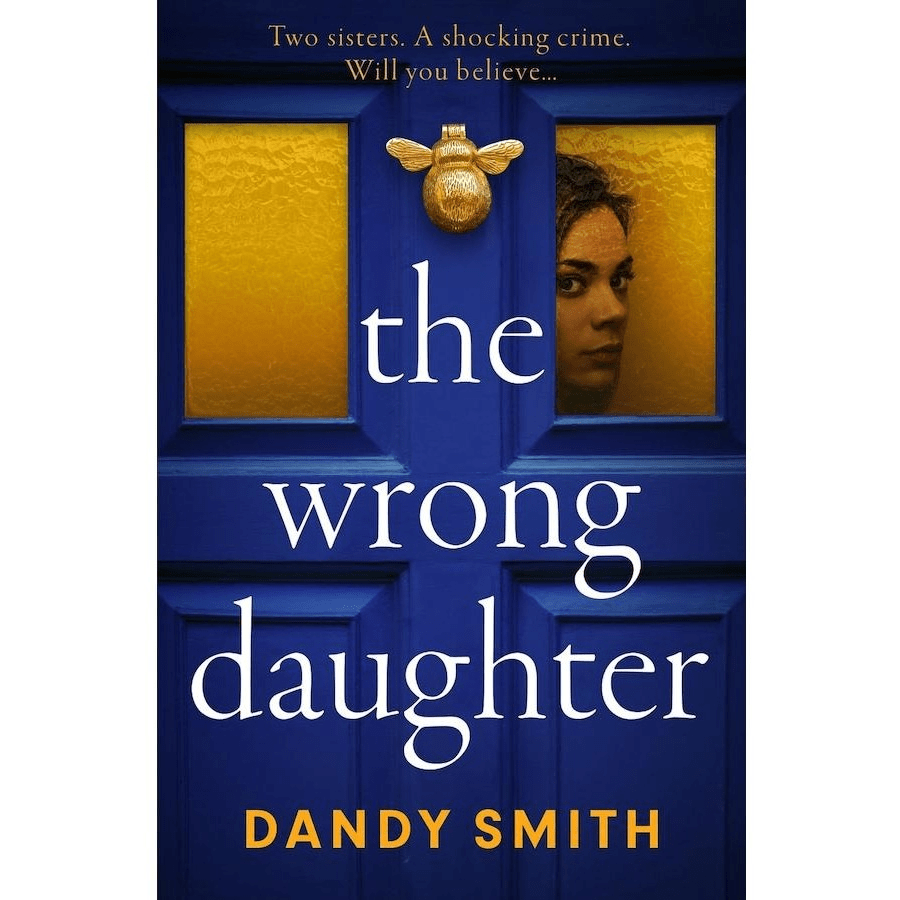
Dandy Smith The Wrong Daughter embla books, Bonnier Books UK, 2024.
The Wrong Daughter began well – a typical domestic thriller, with potential. The prologue introduces two sisters, ten and thirteen, who are home alone with money to order pizza for dinner. They live in a safe suburb, with the shops nearby and an enticing forest behind the house. Together they shop for their evening meal and eat it in a sun-drenched field on their way home from purchasing bread, ham, and cheese – the excursion far from the home delivered pizza their parents thought they should have. When they return home, the pyjama clad girls eat popcorn and watch television. A stranger watches from the forest.
Caitlin sees Olivia kidnapped, obeying her sign to remain silent. Fearful, she does not call the prominently displayed emergency numbers. As an adult Caitlin’s every action is to redeem this failing – to placate her parents she becomes a teacher rather than study art and travel. She even contemplates marriage. Despite her reluctance to commit to a date, and her prospective in laws dislike, she uses his name. This ploy is to hide her identity as the sister of a kidnapped teenager although it is years in the past. Alongside Caitlin’s story is that of Eleanor and her brother Heath, caught in a damaging relationship with each other and their uncle. See Books Reviews 2026 for the complete review.
Cindy Lou eats in Canberra and Goulburn before going overseas
Lunching with friends at Edgars is always a pleasant experience. The outdoors section is beautifully warmed in winter, or open to the sun on those bright sunny blue skied days with which Canberrans are familiar. On this occasion we had the chicken tacos and mushroom pizza. The chicken tacos are a delightful light lunch, although sometimes, as can be seen below, the generosity of the sauce is a bit much. The pizza was delicious.


These meals are at the outdoor area at the Blue Bird Cafe in Goulburn. Although we thought that the dumplings might be the delightful pierogies we enjoyed in Poland, they featured a curry flavour so really quite different. Again, there was delightful pizza, and the rest of the meal was a pumpkin soup served with sour dough, dumplings with a tomato chutney accompaniment, and a combination of these with sweet potato chips. The meals were very generous, and we felt that the cafe was a good find.
British Politics
The first hit was Thatcher
Tom Watson <tomwatsonofficial@substack.com> Unsubscribe
Forwarded this email? Subscribe here for more
Prime ministerial removals, the media beast and parliament.
The first full-scale removal of a Prime Minister as a national media spectacle was Margaret Thatcher in 1990. I remember it well. The members of Hull University Labour Club drank a heroic amount of lager in the John McCarthy Bar that day, watching history unfold. I remember one Tory student crying. It left me feeling slightly guilty for being euphoric.
It was cruel, obviously. But it was also mesmeric television. This was before I’m a Celebrity, before Who Wants to Be a Millionaire, before the nation learned to process emotional collapse by voting for someone to eat a kangaroo’s private parts.
I once asked a seasoned lobby journalist why they became so obsessed with prime ministerial scalpings. He replied, with the calm authority of a man describing a wine list in a Soho restaurant “We all got a taste of it in 1990 and we’ve been chasing the high ever since.”
This was before Twitter and TikTok, before the narcotic little reward system of social media made television look like a Church of England jumble sale, before every political rumour came with its own mini film crew, graphics package and man from a polling company pretending not to enjoy himself.
These days it’s much worse.Lobby journalists like to post social media clips of themselves outside Number 10, standing there in the rain as though democracy is a hostage situation and only their boom mic can catch the sound of machine gun fire inside Number 10.
Five hundred years ago, political journalists would have been the ones nearest the gallows at a Whitehall hanging, not out of cruelty, you understand, but they needed to make sure there was no pulse.
Churchill, Attlee and even Wilson would not have lasted ten minutes in the digital age. Churchill would have survived Hitler only to be destroyed by a breakfast clip involving Pol Roger and a dressing gown. Attlee would have been written off after a podcast appearance on ‘The Westminster Meat Grinder” in which he answered every question in five words and refused to describe his “leadership journey”. Wilson would have been finished by a TikTok explaining the pound in your pocket, while a producer shouted, “Great, but can we make devaluation more relatable to a younger demographic?”
You can hear the tremor in journalists’ voices whenever a Prime Minister starts to wobble. Nick Robinson’s voice climbed two semitones this week, and accelerated into that special Today programme register reserved for wars, resignations and arrests.
The House of Commons isn’t much better. In a crisis, Parliament moves onto MP time. MP time is not like normal time. Normal time has hours, lunch and perhaps a walk after tea. MP time is lived in minutes. Each minute contains a factoid, a WhatsApp, three rumours, a lobby journalist asking whether you are “hearing anything” and someone you barely know texting, “Where’s so and so?” as though the Labour Party is missing a child in a supermarket.Everyone gets involved because not being involved is the same as political death. If you are not in a WhatsApp group, you may as well be in a crypt. If you have not been asked to sign a letter, you are the undead. If you have not been quoted anonymously, even inaccurately, you begin to wonder whether you still exist.
When there is no new development, the lobby, fuelled by adrenaline, sleep deprivation and Pret coffee, starts to go a bit mad. Speculation hardens into analysis. Analysis curdles into “mood”. Mood becomes another graphic. The graphic foretells a constitutional crisis. MPs then feed this machine because they, too, need the little dopamine pellet of seeing their own unattributed thought appear on the Twitter account of someone from Sky News.
I know this because I have been there. I have fed the beast. I have been the beast’s sous-chef. I have diced the onions of intrigue and plated up the garnish of doom. Watching it now is anxiety-inducing.This week I have developed a quiet respect for the roughly 150 Labour MPs who have spent the last 72 hours doing precisely nothing. They have not resigned. They have not been promoted. They have not signed a letter demanding something, opposing something or urging a “process” towards something. They have put their heads down and done their jobs, an act so eccentric in modern politics it may soon require its own sub-genre in undergraduate political science classes.
Naturally, this will irritate everyone who has done something. The activists of the coup, counter-coup, pre-coup, soft-coup, non-coup and vibes-based-coup cannot understand why their colleagues refuse to perform. “Why won’t they move?” they ask, like disappointed generals watching a battalion of squares remain seated.And to every MP who has stayed off broadcast media, well done. If there were an award for remaining calm under fire, I would give it to you. Not at a ceremony, obviously. That would attract cameras and then you would have to go on Politics Live to explain why you accepted it.I have taken more interest than I should in the minute-by-minute tribulations of the poor Prime Minister this week. Most of it has been wall-to-wall hyperbole, of course. But one comment deserves to be placed in a glass case, lit from beneath and studied by future historians of political self-harm.
One Labour MP said on Times Radio that bond markets “will have to fall into line” with Andy Burnham’s policy agenda.
Hahahaha. No, really. Hahahaha. The bond markets, those notoriously obedient institutions, just waiting for a Labour MP to tell them to stop mucking about and behave. Somewhere in the City, a bond trader heard this, cancelled his Bloomberg terminal subscription and said, “Fair enough, a Labour MP has spoken. Pack it up, lads. Democratic socialism has priced the gilt curve.”
To all those campaign managers out there, if there is a campaign, and I am not saying there is, do not let anyone offering this argument within fifty feet of it. Not near the manifesto. Not near the launch. Not near the biscuits. Certainly not near a microphone. Put them in charge of something harmless, like the commemorative tote bags, and even then check the exchange rate.
And if a Treasury spad is reading this, I know there are not as many as there once were, please send everyone Paul Mason’s article on bond markets. Or, at the very least, a YouTube explainer called Why Money Sometimes Leaves The Country When Politicians Frighten It.
It’s only Wednesday and I’m exhausted. The beast is still being fed. And somewhere, deep inside the lobby psyche, 1990 is still playing. Thatcher walking out. Cameras flashing. Reporters’ hearts kicking against their ribs. Lager being spilled in Hull. The first hit. The original rush. They have been chasing it ever since.
If you are as concerned as I am about a small number of MPs saying dumb things in the next week, why not send them my newsletter for free. Or even better, share it with your friends and family.
LabourList <accounts@labourlist.org> Unsubscribenbox
 Friday 15th May 2026
Uncertainty, hope and risk.png) By James Tibbitts
By James Tibbitts
Labour’s longest week ends with more uncertainty about the Party’s future than it began with. Where do we go from here?
There is always the temptation in this job to believe that every week contains a year’s worth of drama. But even by Westminster’s standards, the last seven days have felt extraordinary for Labour. I have never known another time like it. And there may yet be more twists and turns before the weekend is over.Where are we, exactly?The details surrounding the potential Makerfield by-election are still being worked through following Josh Simons’ decision to stand down in order to facilitate Andy Burnham’s return to Westminster.
Burnham wants to stand. It is believed Keir Starmer is likely to let him. After days of speculation, the political reality appears to be shifting from “can he run?” to “does he win?”.
Wes Streeting kicked off yesterday with his resignation as Secretary of State for Health and Social Care. Yet his intervention was notable as much for what it was not as what it was.Streeting chose not to fire the starting gun on a direct leadership challenge himself, instead advocating a deeper, longer argument about Labour’s future, including a not-so-cryptic nod toward Burnham as a figure deserving to be in the discussion. Rather than pushing for Starmer’s quick departure, which was thought as we started this week would be his preference, Streeting’s resignation letter aligned himself with those arguing that Starmer now needs to set out a timetable for departure.
This matters because Labour members appear exhausted by uncertainty and unsure what comes next.
LabourList’s polling, conducted by Survation, suggests Streeting would lose in a straight head-to-head contest with Starmer. The same polling paints a very different picture if Burnham enters the frame: the Mayor of Greater Manchester would decisively outperform the Prime Minister among Labour members.
That alone explains much of the mood now settling over parts of the Party. After successive disappointments, from the shock loss in Runcorn to Reform, to the bruising contest in Gorton and Denton, compounded by difficult local and devolved election results last week, many Labour members have watched the political weather darken with increasing frustration. Add consistently poor national polling and Starmer’s low popularity ratings, and it is not difficult to understand why morale has dropped.
Hope is a hell of a drug. Many Labour members have been itching for a hit. Perhaps to the point it becomes difficult to think things through. Labour is and always will be bigger than any one individual. A change in leadership may or may not be the right thing to do. But, if Labour does not do the deeper work needed to turn things around, the existential crisis would be considerably darker than the situation we are currently in. That will need to be done by all of us – not simply one person – however talented and popular a politician. If Burnham does stand in Makerfield, he enters a particularly risky situation. His popularity is real, but no by-election can be treated as a formality, least of all in today’s volatile political environment. You certainly cannot take any voter or seat for granted in an age of five-party-politics. The election results last week showed that is where we seem to be.
Reform UK will certainly throw enormous energy into the contest. The symbolism alone would make it irresistible: a chance to confront Labour’s most talked-about potential successor to Starmer in a direct electoral test, with the advantage of the seat being in a strong Reform area. Yet Labour would not enter such a contest unmotivated either. If current membership sentiment is any guide, activists are likely to flood into Makerfield in huge numbers. Throughout last night several members made it clear to me they would travel to the North West to hit the doors and campaign for Burnham. The sense among many in the Party is increasingly clear: they are putting all their hopes in the Burnham basket.
Whether that proves wise remains as yet unknown. We should also remember that, however fascinating the drama may be for those of us watching Westminster’s theatre unfold, prolonged instability inside the government is not good for the country.
How can a governing party consumed by leadership speculation be expected to govern comfortably? Still, politics moves more according to momentum than logic. If Burnham wins Makerfield, perhaps the most significant “if”, it becomes increasingly difficult to imagine Starmer surviving as PM for very long afterward. But we are not there yet.
For now, Labour waits. Again. I’ll let you into a secret. If you’re (quite reasonably) wondering ‘How does this actually play out?’ I can assure you today, no one – not even the players themselves – knows the answer. What I am sure of, is as we find more information along the way, LabourList will be there to let you know. Stick with us. We’re at the start of a very long road.
American Politics
May 16, 2026
Heather Cox Richardson from Letters from an American <heathercoxrichardson@substack.com> Unsubscribe
Forwarded this email? Subscribe here for more
May 16, 2026Heather Cox Richardson May 17 READ IN APP
Seventy-two years ago tomorrow, on May 17, 1954, the Supreme Court unanimously decided Brown v. Board of Education of Topeka, Kansas. That landmark decision declared racial segregation in public schools unconstitutional because segregated schools denied Black children “the equal protection of the laws guaranteed by the Fourteenth Amendment.”
Three years after the Brown v. Board decision, in the face of massive resistance to desegregation in the South, President Dwight D. Eisenhower proposed the Civil Rights Act of 1957 to protect the right of Black Americans to vote, using the federal government to overrule the state laws that limited voter registration and kept Black voters from the polls. To prevent the passage of the first federal civil rights legislation since 1875, South Carolina senator Strom Thurmond launched the longest filibuster in U.S. history, speaking for 24 hours and 18 minutes.(Senator Cory Booker (D-NJ) broke Thurmond’s record on March 31 through April 1, 2025, speaking for 25 hours, 5 minutes, and 59 seconds, but his speech was not a filibuster.)Southern Democrats known as “Dixiecrats” managed to weaken the measure, but Senate majority leader Lyndon B. Johnson (D-TX) managed to wrestle the Civil Rights Act of 1957 through Congress, and Black Americans and their white allies began trying to register Black Americans to vote.
But the law proved too weak to force white registrars to allow Black voters onto the rolls, and by 1961, activists with the Student Nonviolent Coordinating Committee (SNCC, pronounced “snick”) were at work in Mississippi to promote voter registration. In 1964 they launched the “Freedom Summer,” bringing college students from northern schools to work together with Black people from Mississippi to educate and register Black voters.
Just as the project was getting underway, three organizers—James Chaney, from Mississippi, and Andrew Goodman and Michael Schwerner from New York—disappeared outside Philadelphia, Mississippi. Lyndon Johnson, president by then, used the popular rage over the three missing voting rights workers to pressure Congress into passing the Civil Rights Act of 1964, designed to try to hold back the white supremacists and to make it possible for Black Americans to register to vote. The measure passed, and on July 2, Johnson signed it into law.On August 4, investigators found the bodies of the three missing men. Ku Klux Klan members working with local law enforcement officers had murdered them and then buried the bodies in an earthen dam that was under construction.And still, white officials refused to accept the idea of Black voting. In Selma, Alabama, where the city’s voting rolls were 99% white even though Black Americans outnumbered white Americans among the 29,500 people who lived there, local Black organizers had launched a voter registration drive in 1963, but a judge stopped voter registration meetings by prohibiting public gatherings of more than two people.Selma voting rights activist Amelia Boynton invited the Reverend Dr. Martin Luther King Jr. to the city to draw national attention to its struggle, and he and other prominent Black leaders arrived in January 1965. For seven weeks, Black residents made a new push to register to vote. County sheriff James Clark arrested almost 2,000 of them on a variety of charges, including contempt of court and parading without a permit. A federal court ordered Clark not to interfere with orderly registration, so he forced Black applicants to stand in line for hours before taking a “literacy” test. Not a single person passed.
Then, on February 18, white police officers, including local police, sheriff’s deputies, and Alabama state troopers, beat and shot an unarmed man, 26-year-old Jimmie Lee Jackson, who was marching for voting rights at a demonstration in his hometown of Marion, Alabama, about 25 miles northwest of Selma. Jackson died eight days later, on February 26. Black leaders in Selma decided to defuse the community’s anger by planning a long march—54 miles—from Selma to the state capitol at Montgomery to draw attention to the murder and voter suppression.
On March 7, 1965, the marchers set out. As they crossed the Edmund Pettus Bridge, state troopers and other law enforcement officers met the unarmed marchers with billy clubs, bullwhips, and tear gas. They fractured the skull of young activist John Lewis and beat Amelia Boynton unconscious. A newspaper photograph of the 54-year-old Boynton, seemingly dead in the arms of another marcher, illustrated the depravity of those determined to stop Black voting.
On March 15, President Johnson addressed a nationally televised joint session of Congress to ask for the passage of a national voting rights act. “Their cause must be our cause too,” he said. “[A]ll of us…must overcome the crippling legacy of bigotry and injustice. And we shall overcome.” Two days later, he submitted to Congress proposed voting rights legislation.Under the protection of federal troops, the Selma marchers completed their trip to Montgomery on March 25. Their ranks had grown as they walked until they numbered about 25,000 people. That night, Viola Liuzzo, a 39-year-old mother of five who had arrived from Michigan to help after Bloody Sunday, was murdered by four Ku Klux Klan members who tailed her as she ferried demonstrators out of the city.
A bipartisan majority of Congress passed the Voting Rights Act by a vote of 77–19 in the Senate and 333–85 in the House. Dr. King and Mrs. Boynton were guests of honor as President Johnson signed the Voting Rights Act of 1965 on August 6. Recalling “the outrage of Selma,” Johnson said: “This right to vote is the basic right without which all others are meaningless. It gives people, people as individuals, control over their own destinies.”
And yet, on April 29, 2026, the Supreme Court gutted the protections for the Black-majority districts Congress provided for in the Voting Rights Act after years of weakening the law in other ways. In its wake, Republican-dominated southern state legislatures are rushing to redraw their district lines to dilute the votes of Black Democrats.
Today, thousands of Americans, including eighteen members of Congress, traveled to Selma and Mongomery to call Americans to action to protect voting rights. Pastor Kenneth Sharpton Glasgow told Joseph D. Bryant of Alabama news site AL, “This moment is bigger than Democrats or Republicans. This is about democracy itself. This is about whether Black communities, poor communities, rural communities, formerly incarcerated people, and marginalized voices will continue to have representation and political power in America.”
Speakers united around the theme that those trying to gerrymander their way into control of Congress in defiance of voters had reawakened a movement. “They think they can draw us out of power,” Representative Alexandria Ocasio-Cortez (D-NY) told an audience in Montgomery.“They do not know the sleeping giant that they just awakened. Because it is not a coincidence, and our whole country must understand, that it was not until voting rights were ratified in this country that we got the Great Society. Because when Black Americans have the right to vote and that vote is protected, our schools get funded. When voted rights are protected, healthcare gets expanded. When voted rights are protected, our country moves forward. And Montgomery, that’s what they’re actually afraid of. They’re afraid of us coming together. They’re afraid of us protecting one another.”—
Notes:https://www.eisenhowerlibrary.gov/research/online-documents/civil-rightAs-act-1957https://www.al.com/news/birmingham/2026/05/mass-mobilization-expected-in-selma-montgomery-this-weekend-after-supreme-court-decision.htmlhttps://www.al.com/news/birmingham/2026/05/church-buses-and-charter-buses-are-heading-to-selma-and-montgomery-for-a-reclamation-of-power.htmlhttps://www.booker.senate.gov/senator-bookers-marathon-speechBluesky:indivisible.org/post/3mlyzqeapbs2g
Australian Politics
Sydney Morning Herald Opinion May 17, 2026 — 5:04am
Fifty years ago, these men set out to defeat an insidious disease. A fortnight ago, they did

Hugh Taylor Ophthalmologist
May 17, 2026 — 5:04am
Last Christmas Eve, I received the best present ever. It was news that Australia had submitted a dossier to the World Health Organisation seeking confirmation of the elimination of trachoma – a bacterial eye infection that is the world’s leading infectious cause of preventable blindness – in the nation.
On April 29, WHO declared Australia had become the 30th country to eliminate trachoma as a public health problem. Until now, Australia had been the only developed nation that still had endemic rates of trachoma. And all those affected are Aboriginal or Torres Strait Islanders, largely as a result of repeated episodes of trachoma bacterial infection due to poor sanitation.
This milestone was reached almost 50 years to the day that I started work on trachoma. On a bit of a whim, I had asked Professor Fred Hollows if I could join him on his next trip to Bourke, in the NSW outback. Fred would travel there for a long weekend two or three times a year to provide free eye care and eye surgery for Aboriginal people.
It was 1976, and Fred was profoundly concerned about equity and the injustice of the desperate state of so many Aboriginal people and their communities.
I was surprised when a little later I received a call from Fred as he barked down the phone: “Taylor, I want you to be in Port Augusta, 19 May.
“I want you to spend two weeks working with me as we start up this new national program on Indigenous eye health.”
I didn’t know at the time that he and the College of Ophthalmologists were in talks with the Commonwealth government to set up the National Trachoma and Eye Health Program.
I’ve often said I was led astray by Fred Hollows at a tender age, and have been “a stray” ever since.
When I heard the news about WHO confirming trachoma’s elimination, I had a nip of scotch in memory of Fred and all the work we had done together with our teams.
Fred was always very supportive to me, a true mentor and teacher. He opened my eyes to the appalling state of Aboriginal health. He showed me how much more one could do by looking and thinking about what was happening in the community. There was no way I could influence the eye health of communities just by doing examinations one at a time.
He changed my life.
From 1976 to 1978, the trachoma program teams visited every Indigenous community in Australia. The work would start with Trevor (Buzza) Buzzacott, an Arabunna man. As the liaison officer, he would let communities know what the program was about. We would arrive and set up the examination area, sometimes in a clinic building, or under a shelter, or in an old army tent that we carried.
People would be registered, and checked. If they had a late stage of trachoma, we would arrange surgery, which gave us a chance to save their sight. If their vision was otherwise poor, they would be measured up for glasses. We would prescribe lenses and OPSM would deliver the glasses a few weeks later to the local clinic, at no cost.
After returning to the Eye and Ear Hospital in Melbourne for a few weeks later in August 1976, Fred called me up again, this time to lead a second team on a full-time basis to speed up the work of the program.
People who are blind are twice as likely to die as those who have good vision. They are eight times more likely to fall. So, blindness has a devastating impact. And Aboriginal people still have three times more blindness than Australia’s non-Indigenous population.
The first post-operative dressing and the removal of the eye pads was a time of excitement and joy – every single time we performed that surgery. Having blind people who can see again, you actually transform their lives. The astonishing lesson that one could assemble resources in such a remote area so that world-class eye surgery services could be provided still amazes me.
I stayed on as the assistant director of the program for a year or so. In the end, we examined more than 60,000 Aboriginal people across about 400 communities and nearly 40,000 others in rural and remote areas.
Despite this work, rates of trachoma changed little over the following years. In 2008, I set up the Indigenous Eye Health Unit so I could focus on mobilising resources to finally eliminate trachoma. Finally, the government committed to supporting and funding the WHO “SAFE” strategy: Surgery for the in-turned eyelashes caused by scarring; antibiotics for the infected communities; facial cleanliness, especially for young children; and environmental improvements. Most important of all was a community-driven change in habits. Trachoma requires 150 to 200 instances of reinfection to cause blindness, so cases can be minimised by keeping kids’ faces clean and stopping the spread of infection.
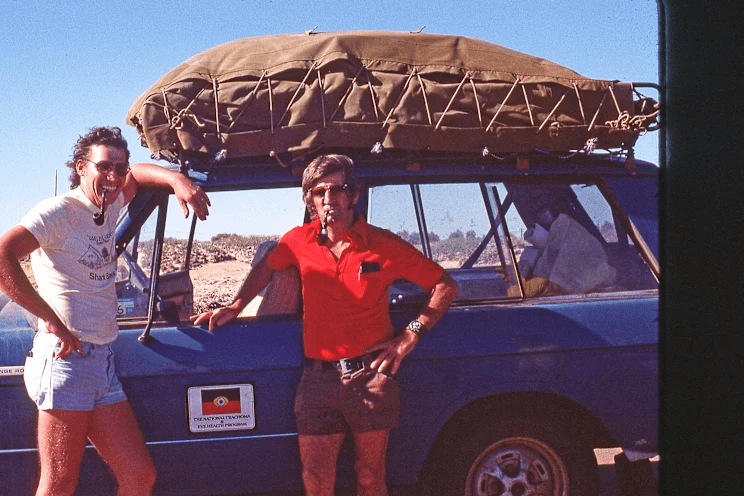
Hugh Taylor (left) and Fred Hollows set off in 1977.
Trachoma prevalence in Indigenous children aged five to nine in at-risk communities dropped from 14.9 per cent in 2009 to 1.5 per cent in 2024, closing a major health equity gap.
It was achieved after decades of community-led action, advocacy and philanthropy. Success was driven by Aboriginal Community Controlled Health Organisations, which provided culturally safe care and built trust, crucial for sustainable health improvements.
The elimination of trachoma in Australia underscores a powerful public health lesson: preventable diseases can be defeated through persistence and people-centric interventions.
As WHO director-general Dr Tedros Adhanom Ghebreyesus said on declaring this proud moment for eye health in Australia: “This success reflects sustained commitment, strong partnerships, and a focus on reaching populations most affected by health inequities.”
Thirty years ago, I founded the Centre for Eye Research Australia to translate research that can be applied in low- and middle-income communities around Australia and the world, where more eye care services are needed.
Like Fred showed me 50 years ago, bringing people together builds collective strength from individual expertise. And funding research is critical to continue driving that research with the right tools, to take those ideas from the lab out to the community to transform lives.
Just as we’ve done with trachoma.
It’s what well-funded eye research looks like, and what’s possible when people – governments, business, institutions and generous philanthropic supporters – choose to support it.
Hugh Taylor is a Melbourne laureate professor emeritus and founder of the Indigenous Eye Health Unit at Melbourne University and the founder of the Centre for Eye Research in Australia, which celebrates its 30th anniversary this year.
Below are some excerpts from Ms. Magazine which I receive regularly.
At 250: Whose America gets remembered? Whose gets erased?
Kathy Spillar, Ms. Magazine <info@msmagazine.com> Unsubscribe

MORE THAN A MAGAZINE, A MOVEMENT
As the U.S. prepares to mark its 250th birthday on July 4, 2026, questions loom over the celebration: Whose America gets remembered, whose gets erased—and how do we imagine and build a democracy that includes all of us? In the Summer issue of Ms., we revisit the nation’s founding through a feminist lens, reclaiming the stories too often left out of the official narrative: women who challenged the authors of the Declaration of Independence and later the U.S. Constitution for deliberately writing women out of America’s founding documents, Black women who resisted oppression from the start, Indigenous societies built around women-led governance, queer lives in revolutionary America, Asian women’s struggles for belonging and the long fight to make disability visible in our history. We also look back at 54 years of feminist reporting from the pages of Ms.—proof that the battles for bodily autonomy, equality and democracy did not begin yesterday—and forward to the bold new ideas that could shape a freer, fairer future for the next 250 years.
Get a year of Ms. for just $20—a 43% discount off our usual price—when you join today!
In this landmark issue, Ms. traces America’s feminist revolution in three parts:
America’s Founding Feminists: a sweeping collection of essays curated by Ms. contributing editor and scholar Janell Hobson reclaims America’s origin story by centering the women whose ideas, labor and resistance helped build—and continually rebuild—the nation.
Feminist Lessons from the Last 54 Years: Through selections from the Ms. archives, we revisit the reporting that has documented and driven the reconstruction of women’s history and the feminist movement for half a century.
Democracy’s Feminist Future: Visionaries including political strategist LaTosha Brown, workplace-justice advocate Inimai Chettiar, democracy defender Skye Perryman and Ms. contributing editor and scholar Carrie Baker offer bold proposals to secure political and social equality, economic justice—and a “more perfect union” that includes each one of us…
Join today to get the Summer issue delivered straight to your mailbox—and fuel another year of our reporting, rebelling and truth-telling. For equality, Kathy Spillar
Executive Editor. Ms. Magazine
1600 Wilson Boulevard
Suite 801
Arlington, VA 22209
United States

Author: Sarah Austin Senior Lecturer in Theatre, The University of Melbourne
Disclosure statement
Sarah Austin does not work for, consult, own shares in or receive funding from any company or organisation that would benefit from this article, and has disclosed no relevant affiliations beyond their academic appointment.
Young children are spending less and less time outdoors. Most Australian preschool children don’t play outside every day. This is despite research that suggests time spent in non-urban outdoor environments is linked to better physical and mental health, social competence, resilience and stronger learning outcomes.
Polyglot Theatre’s new work, Forest, is a direct response to these alarming statistics. Director Cat Sewell powerfully demonstrates the power of theatre to model new possibilities, transform thinking and to centre the rights and needs of children.
Amid the mossy floors and rustling, critter-filled trees of the Royal Botanic Gardens Cranbourne, the performance begins by carefully positioning children aged 4–10 and their families as “visitors” to this beautiful landscape.
They are invited to tread lightly in this special place, and to explore with all of their senses, which, they are reminded, they take with them everywhere they go.
In the middle of the forest, the audience is led through a constructed blue archway (described by a child at the performance I attended as the “magic waterfall archway”) to mark the beginning of the show.
Our mission is to share knowledge and inform decisions.
Finding and creating possibilities
Three skilled performers create pathways and opportunities for play-based exploration. Some children need little encouragement, picking up sticks and finding shapes and worlds and possibilities right away.
Others are more tentative, and gently mirror the performers as they make shapes of the trees with their bodies; examine the texture and colour of the ground up close; copy the performer’s raucous calls to test how far their voices will travel.

Delight unfolds. The children embrace the opportunity to explore, play and follow their curiosity. Simple theatrical objects are introduced to support their play and investigation, and to encourage parents to participate, too.
Children explore framing parts of the forest they find beautiful or compelling with simple wooden circles placed on trees or around wombat poo or tiny saplings on the ground. Mirrors are handed out and sunlight is bounced around the trees.
A rave party emerges as the audience create disco strobe lights with mirrors and the performers dance to electronic music from a Bluetooth speaker.
Suddenly everything goes quiet. Stillness descends and we are invited to listen. Wind whistles; birds sing. The performers slowly move toward tree trunks and beckon the children to join them. They press their ears to the trees to listen to the sounds the trees make. They lie on the forest floor to see what tiny worlds they can see up close. They run their hands along soft and spiky shrubs and rub sticks and leaves between their fingers.
The Forest is a tactile, sensory, immersive story wonderland. And unlike the moment when a show ends in a theatre and the world of the story disappears as you enter the foyer, the forest is still there, inviting you to connect and to return to its stories and possibilities at any time.
Supporting imagination
Building the muscle of imagination and creativity in young people is more important than ever before.
Theatre and performance for children and young people should be part of a holistic approach to some of the most pressing issues our society faces. Arts participation for children and young people leads to a range of positive impacts. It builds civic capacity, a strong sense of belonging and wellbeing, it supports social and emotional development, and can promote creative resilience.
It also engenders a sense of beauty and wonder and can critically challenge and provoke children in powerful ways.

And yet, our arts ecosystem for young people in this country is broken. We have seen a decline of arts education in the early years and in schools and tertiary settings. Since 2007, we have seen a steady reduction in federal funding to organisations who are dedicated to working with children and young people.
But the value of arts is beyond its health and education benefits. It’s value can’t always be measured – and instead happens in the small changes it can bring about in its audience, and the way it offers young people creative and cultural agency.
Forest is full of risk, ambition, creativity and challenge for both the artists, and for the audience. It resists any need to “educate” its audience. (We weren’t given lists of tree species or forest animals to find – although the garden has fantastic educational pamphlets for children to this end!) It knows its audience already had everything it needed to connect with this world it would enter and make sense of it.
Forest is a fantastic reminder of the power of theatre to re-frame and reposition the environments around us, to create new ways of seeing and thinking and doing, to encourage us to think differently.
All children around Australia should have access to these kind of experiences. To do so, we need to see radical change in how we value and invest in the arts and a new approach to seeing children as cultural agents and artists in their own right.
Forest, from Polyglot, is at the Royal Botanic Gardens Cranbourne, Victoria, until May 17.