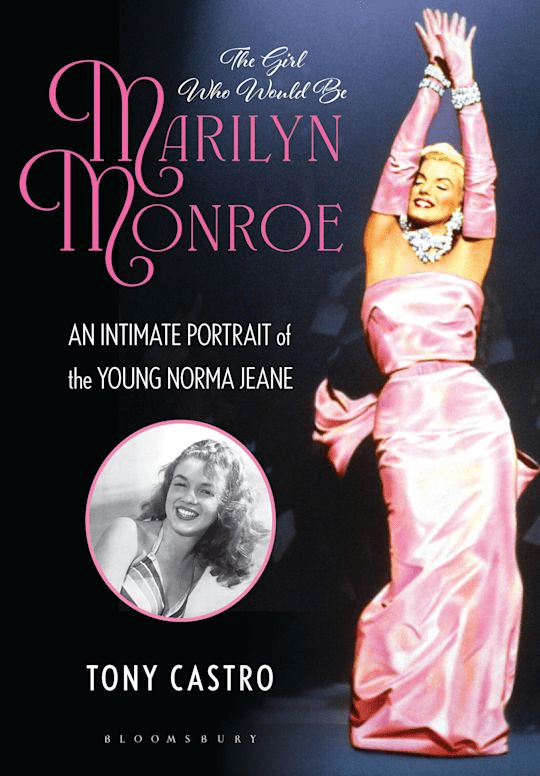
Tony Castro The Girl Who Would Be Marilyn Monroe, An Intimate Portrait of the Young Norma Jeane, Bloomsbury Press, September 2026.
Tony Castro’s concentration on Norma Jeane, rather than Marilyn Monroe, is a haunting reminder of a girl whose aspiration was never dimmed by her childhood, or young womanhood. It was written for the 100th anniversary of Marilyn Monroe’s birth. A birth and childhood that was at times the making of Marilyn Monroe, and at others the undermining of the luminescent woman she presented the world. Castro has taken his research and material from interviews with those who knew her, to work together the threads of the myth that was Marilyn, the upbringing she received at the hands of a loving but fragile mother and foster parents, and the girl she was, and perhaps in many ways remained. Marilyn Monroe arrives through the book, as a child and woman of indominable spirit, vulnerable, but strong, and fighting, fighting for herself and her life as she would have liked to live it.
Castro’s lyrical writing, combined with the sometimes sharp observations in the memories and commentary of others, enhances the theme of the book: Norma Jeane and Marilyn Monroe were no ordinary child or woman, both are given their due as a person who gathered herself together, rolling fears, loneliness and bereavement into a workable emotion on which to make her entry to the Hollywood world feasible.
Conversations with the entertainment writer James Bacon; actors, Frank Sinatra, Susan Strasberg, Mamie Van Doren and Eli Wallach, and ex-husband Joe DiMaggio, and raconteur Skip E. Lowe provide Castro with understandings about Monroe’s past. These recalls are through their eyes and need to be treated as such. However, they resonate.
Castro has written in a genuine and thoughtful way about Norma Jeane, quite often leading to repetition. However, rather than hindering his narrative, this identifies the events and ideas that were important to Norma Jeane and that impacted on her adult persona that he seeks to explain. One thought or event is often referred to through various perspectives, augmenting the importance of the idea or event to Marilyn, her friends, and though his understanding of her, Castro.
This is a book that begins with a reference to several figures of myth and memory, Cleopatra, Greta Garbo, and Princess Diana, seeing them, together with Marilyn Monroe as part of the way in which longing, desire and grief are understood. Castro’s insight into Norma Jeane, and the way in which he has made that accessible through this book is a major accomplishment.
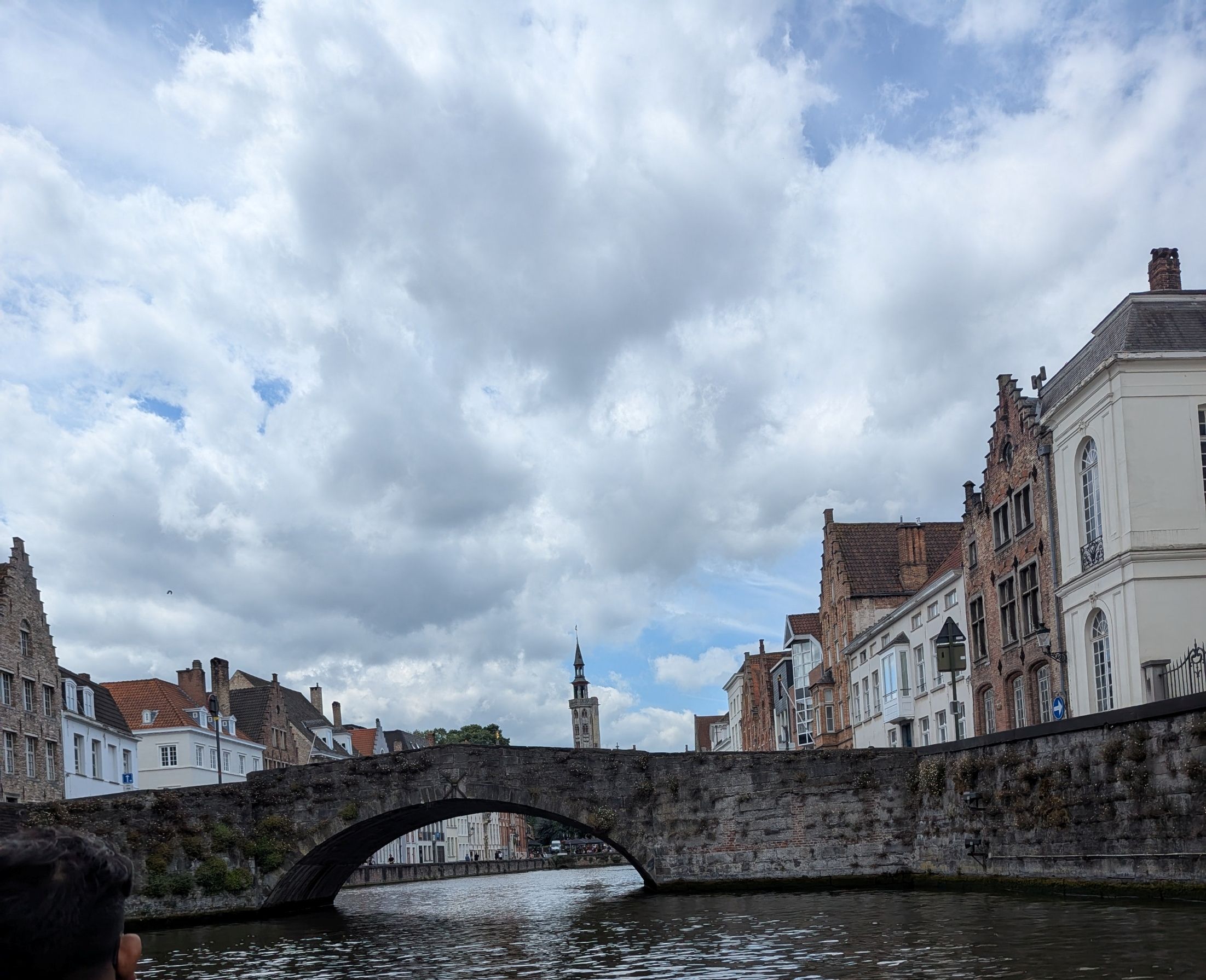
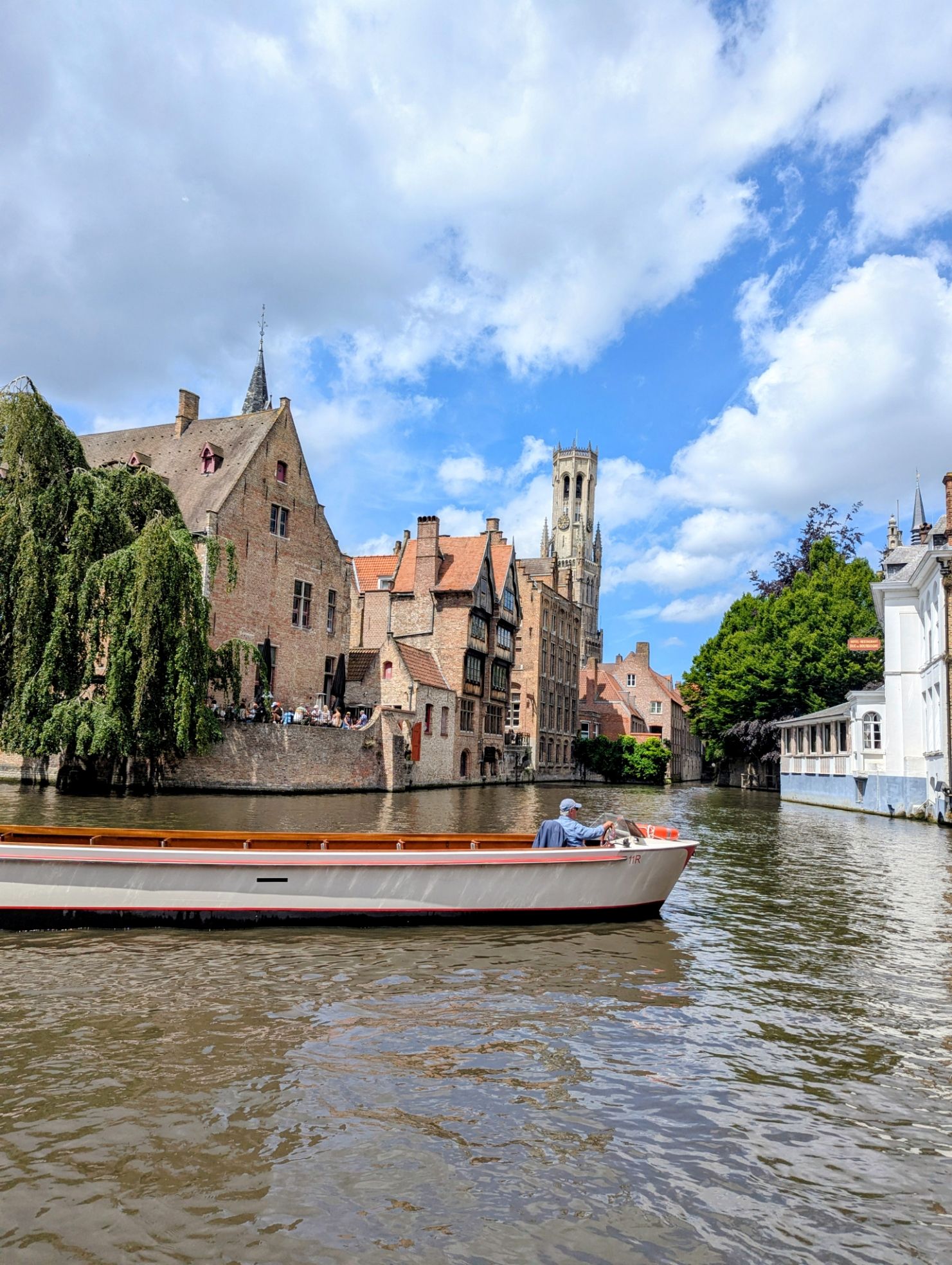
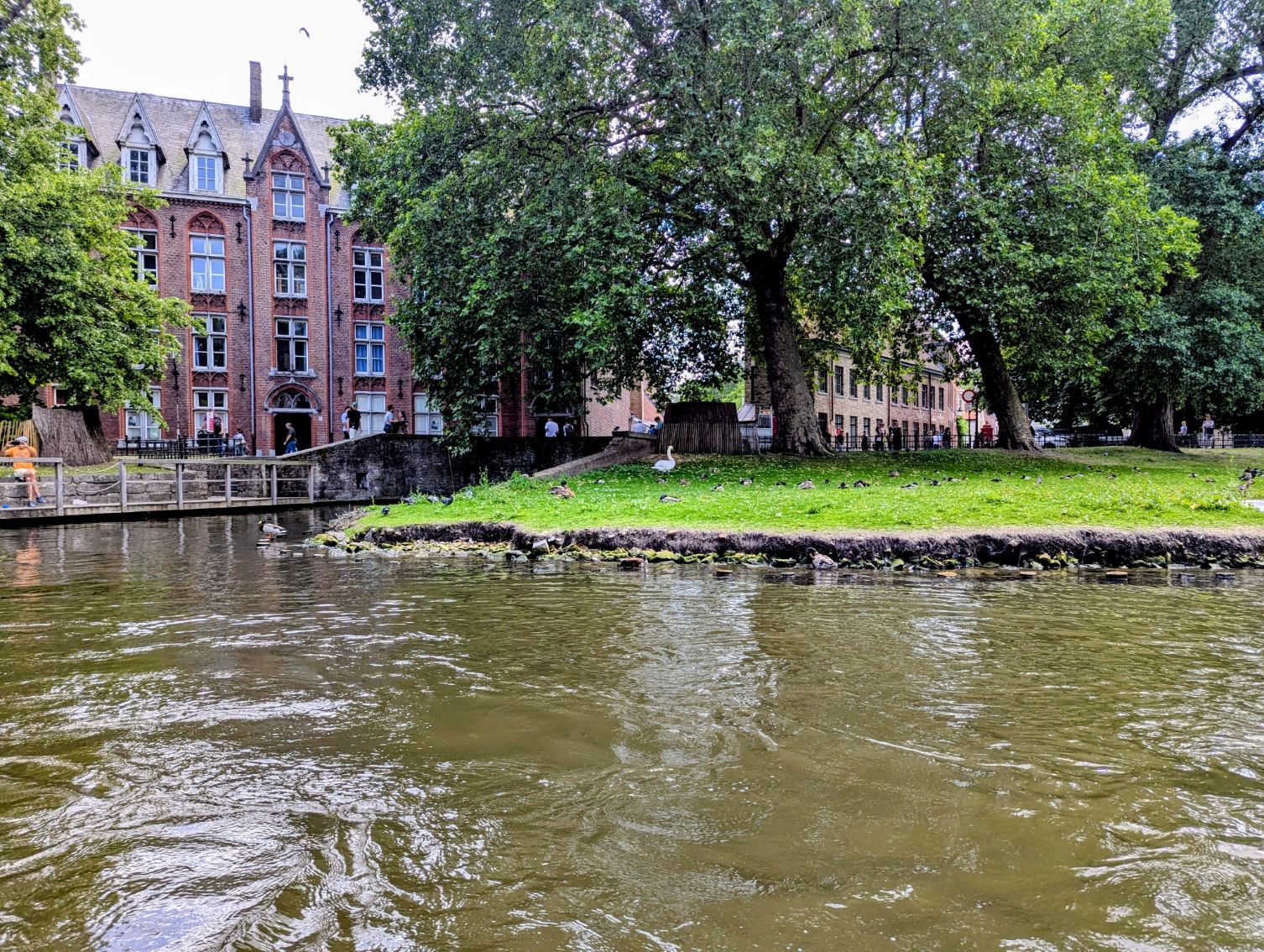
I am writing and posting this from overseas, so sometimes it will be late, and always it will be full of photos. After a week in the UK we decided upon a few days in Belgium. The Eurostar was late, the station crowded, the walk to our hotels less simple than we expected (or found the next day when luggage was not impeding our progress), but Brussels, Bruge and Ghent are worth it. Two days in Brussels will be covered next week, along with the four days we have spent in Ghent.
Day in Bruges

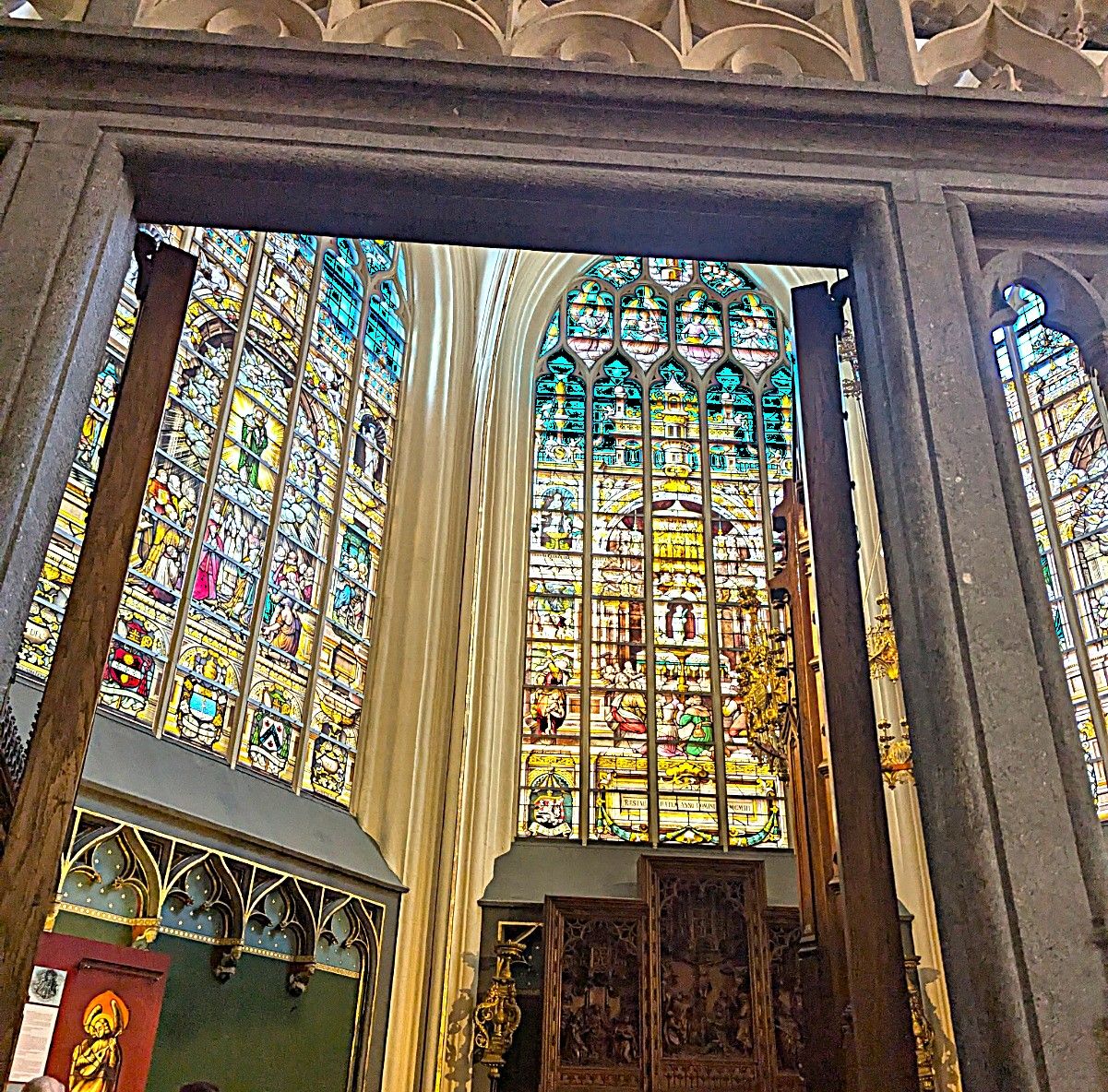
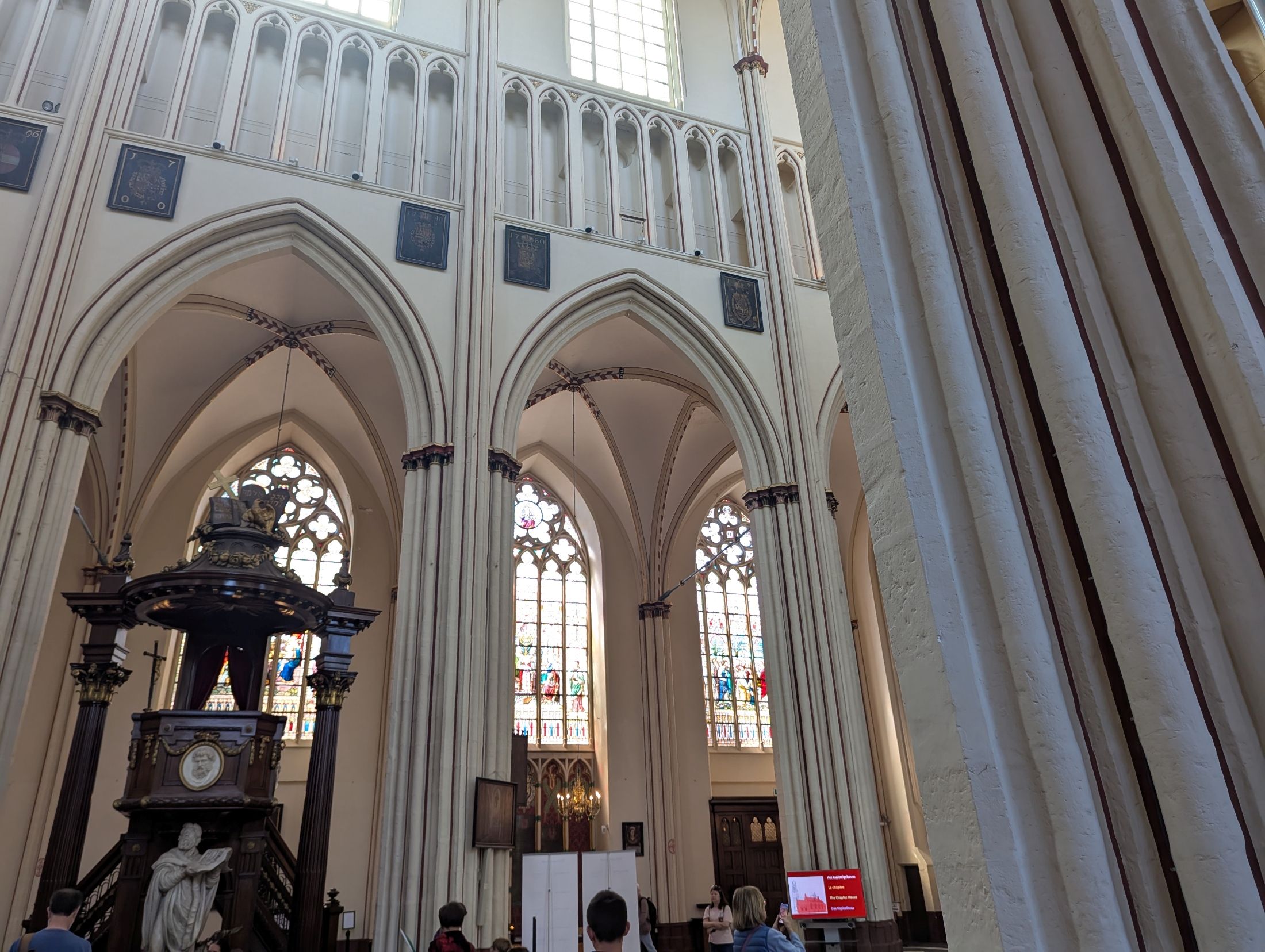




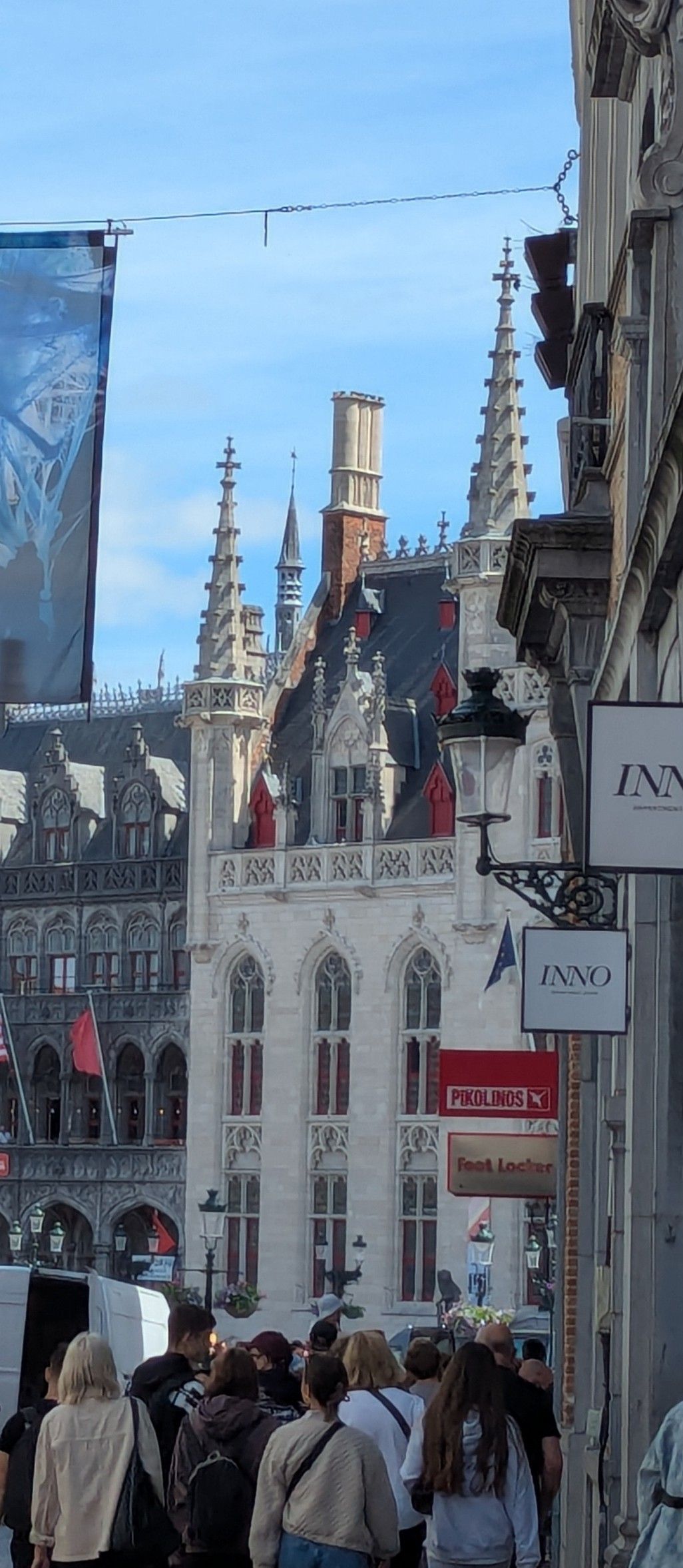
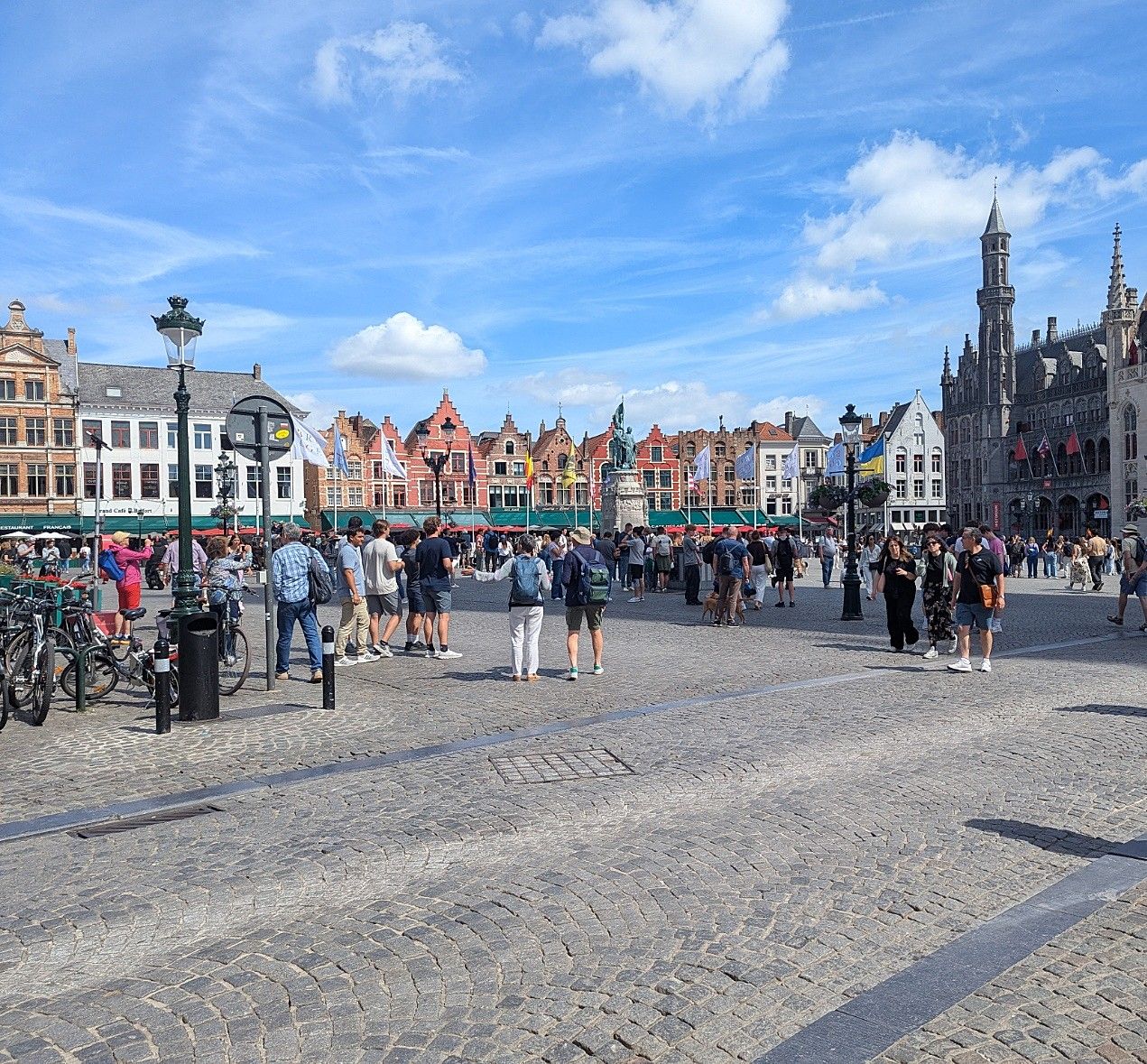
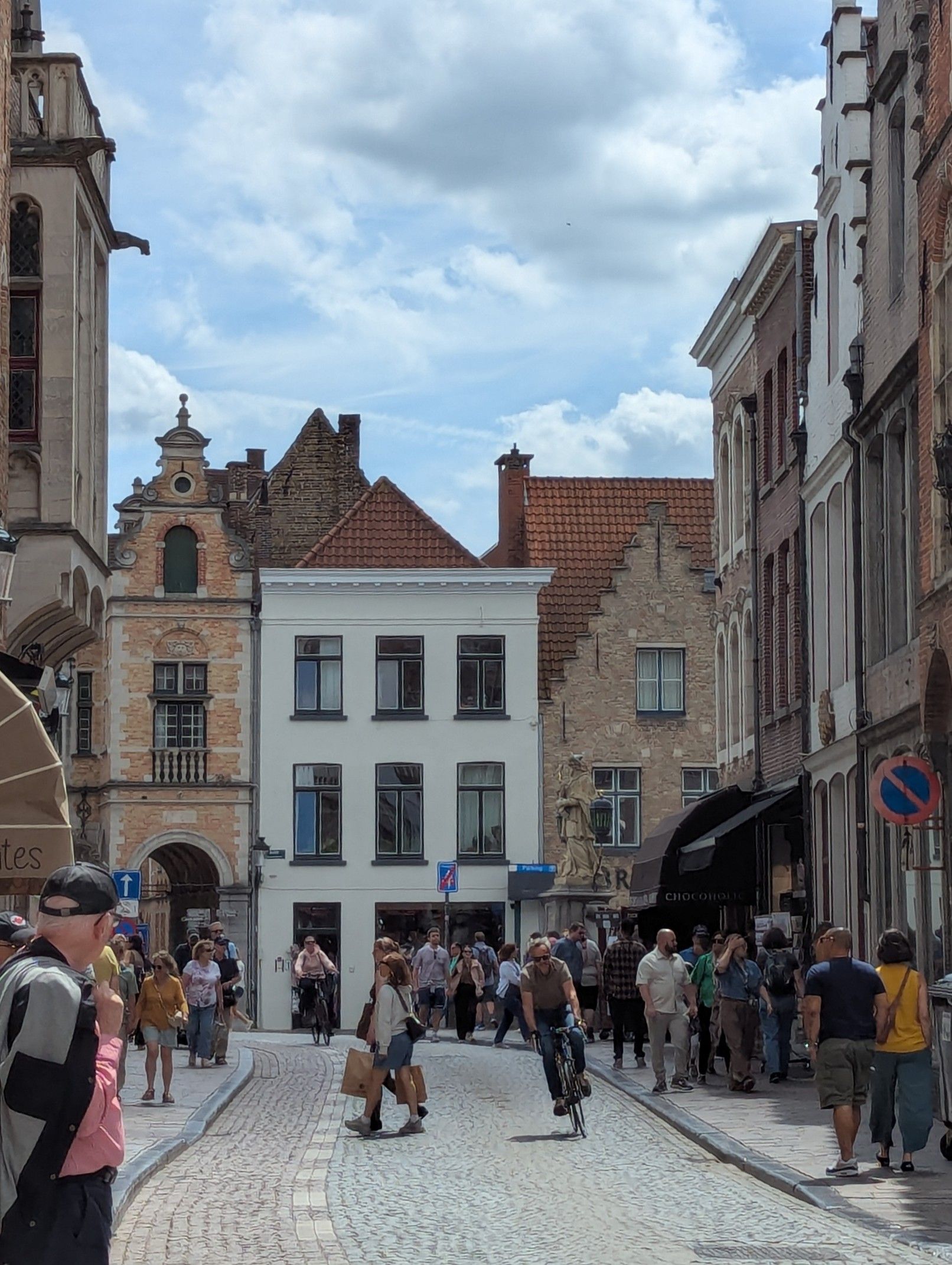
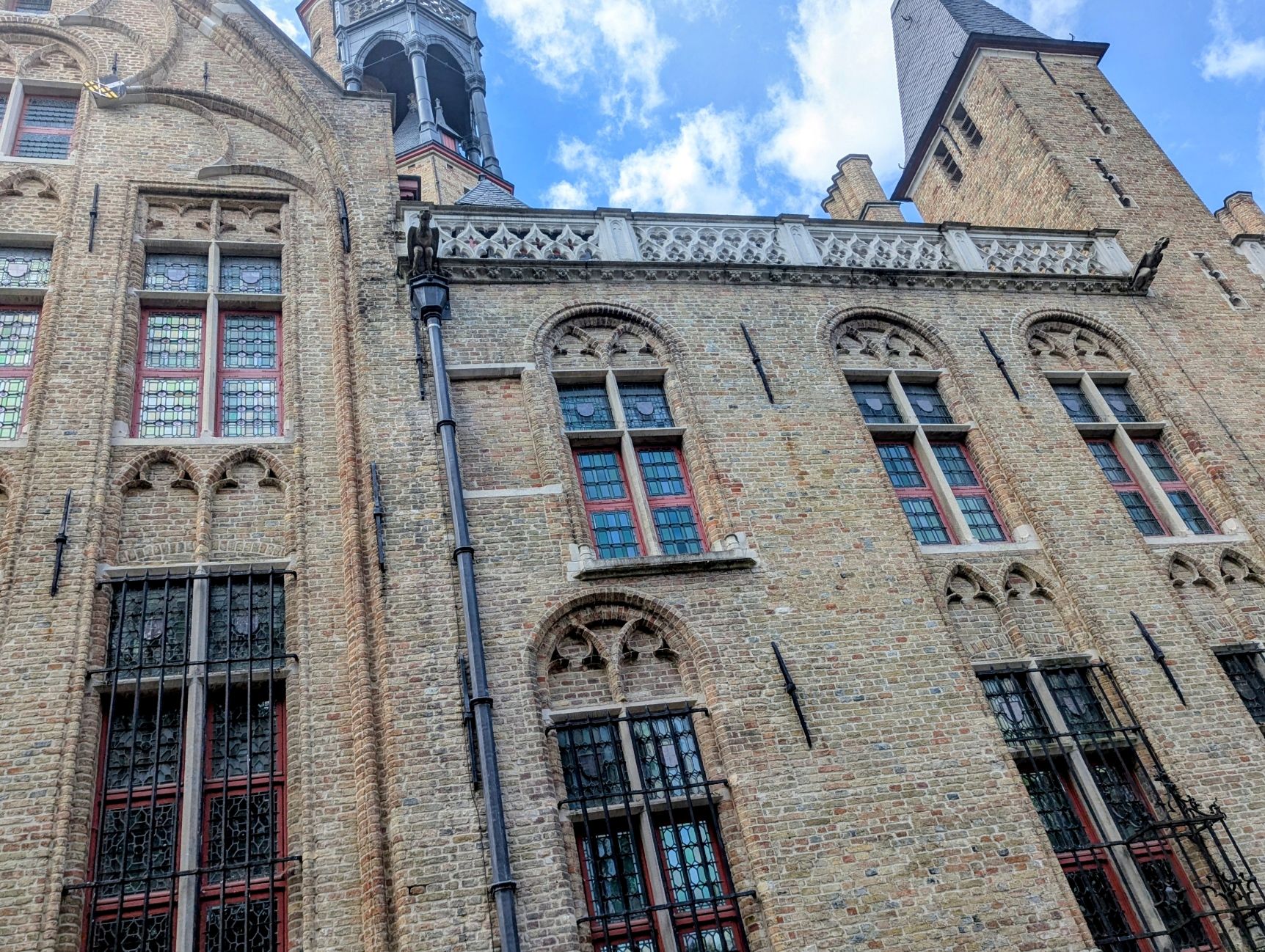
Bruges Streets Walk


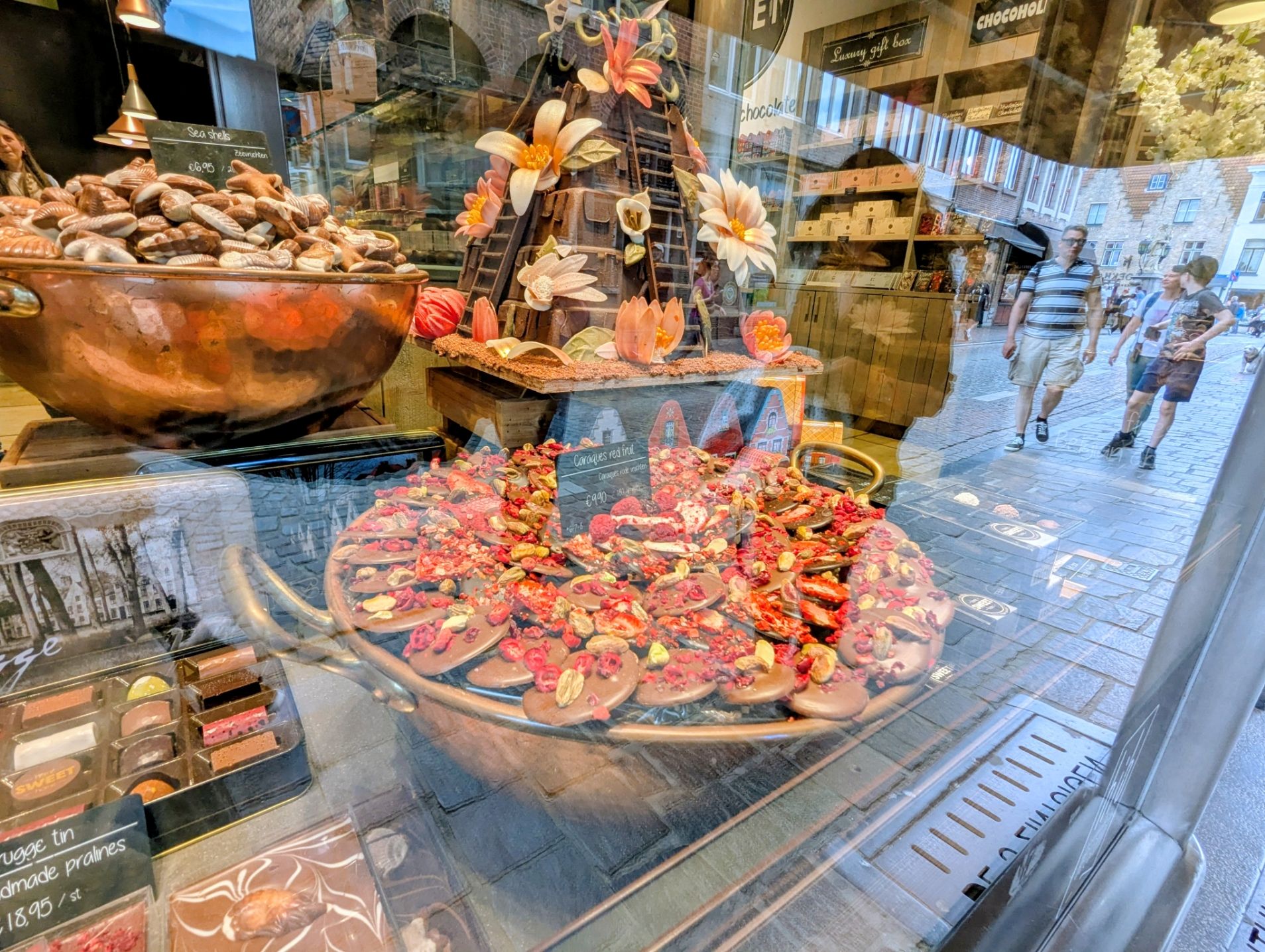
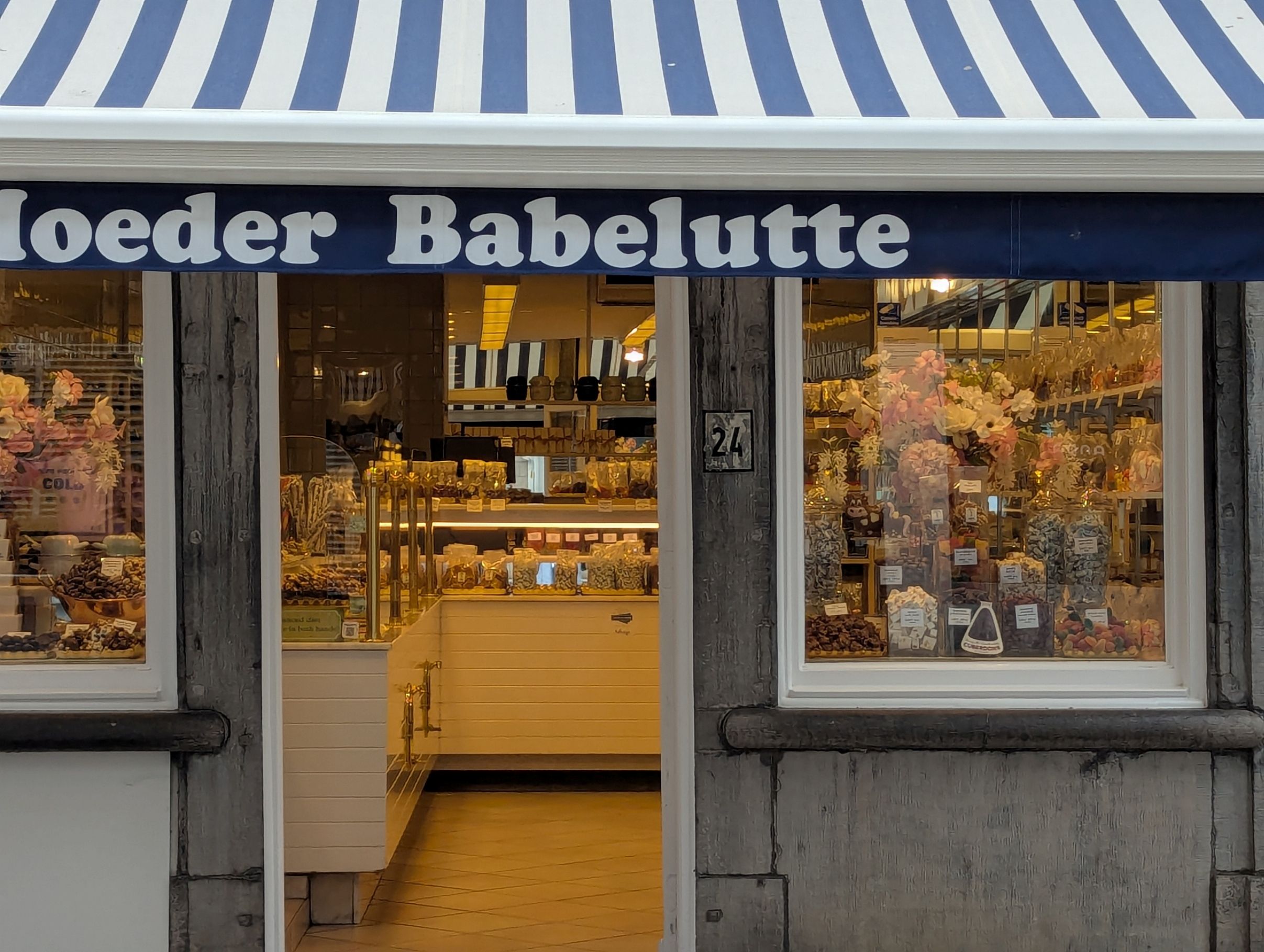



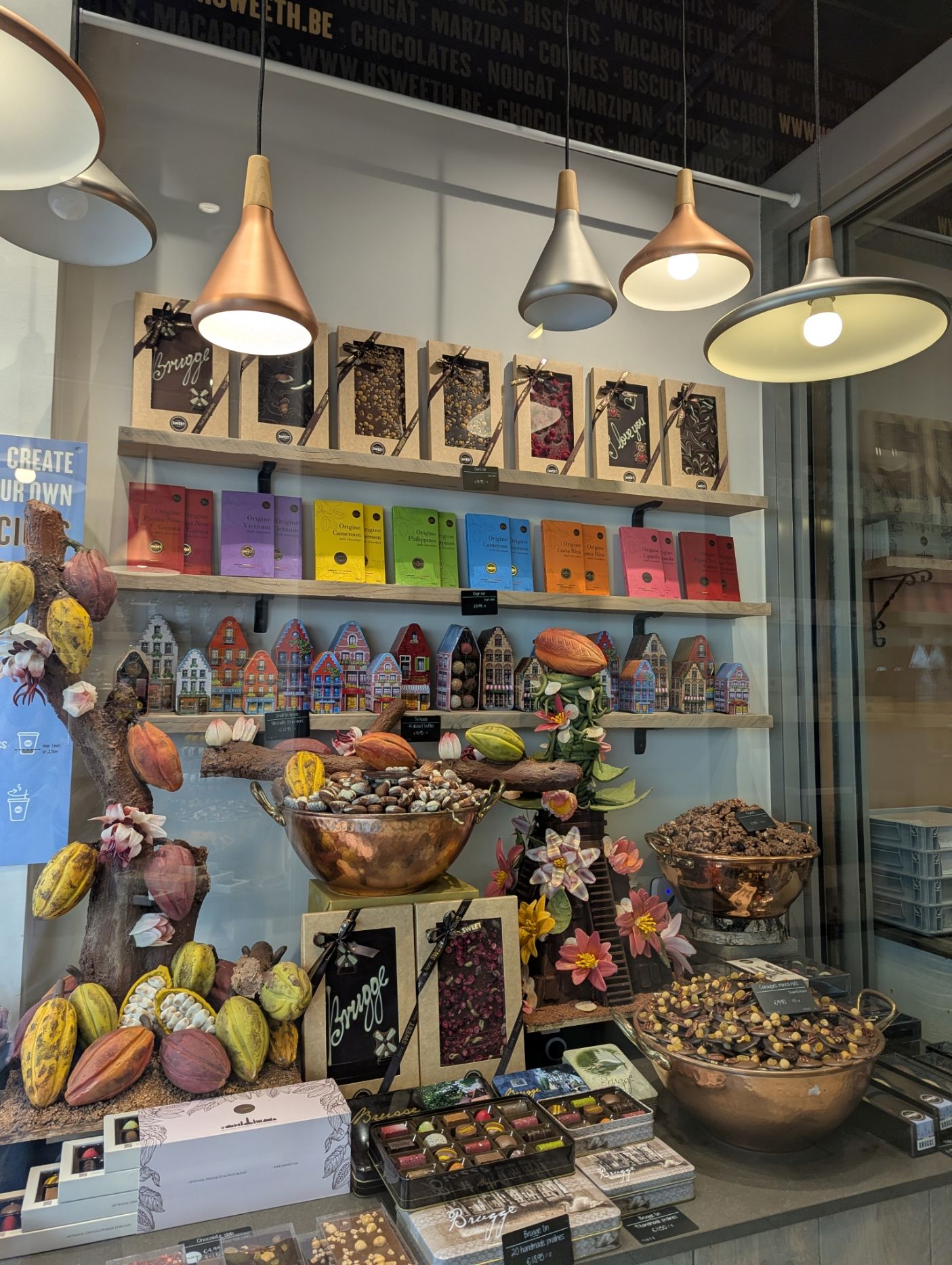
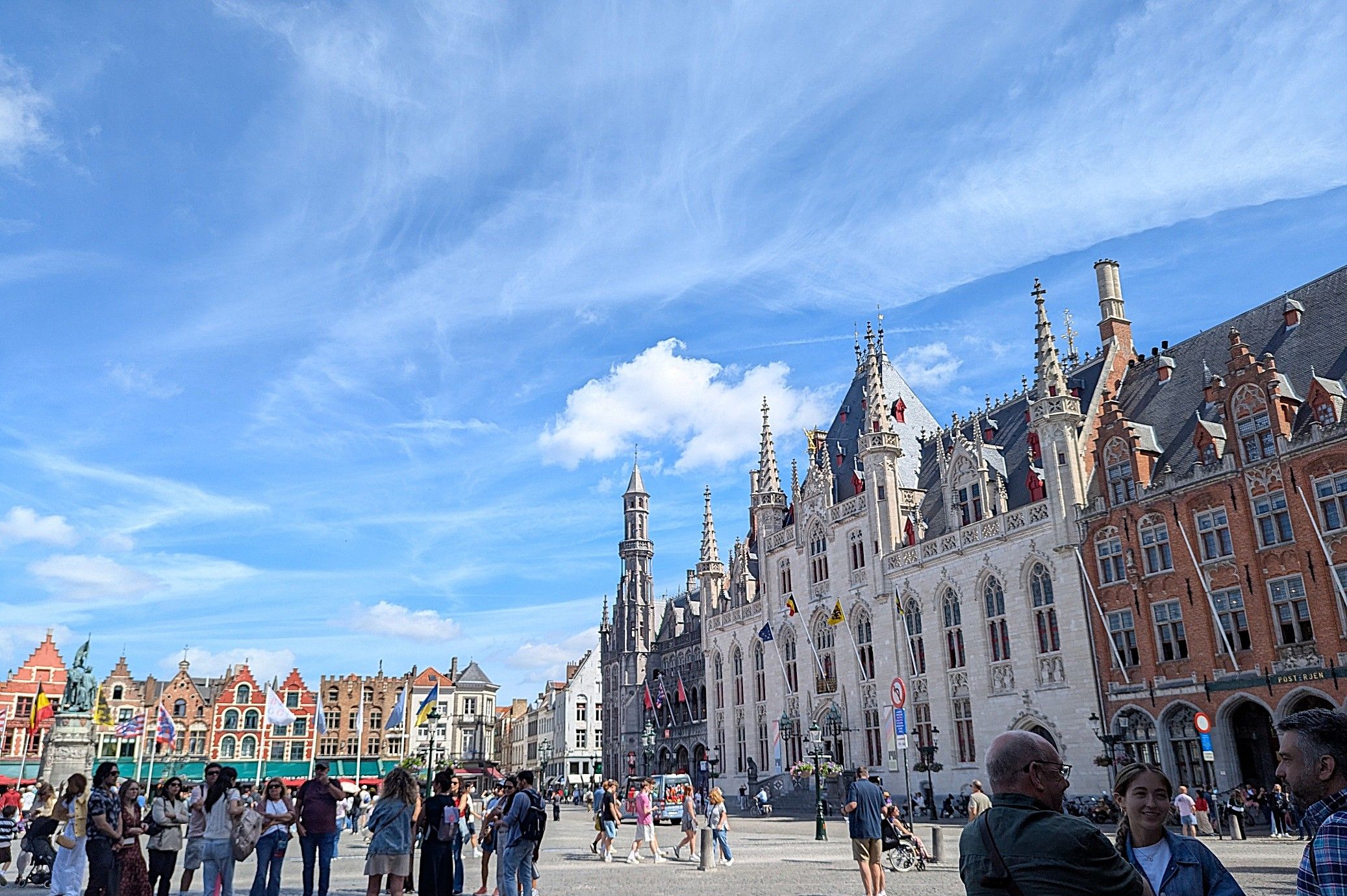

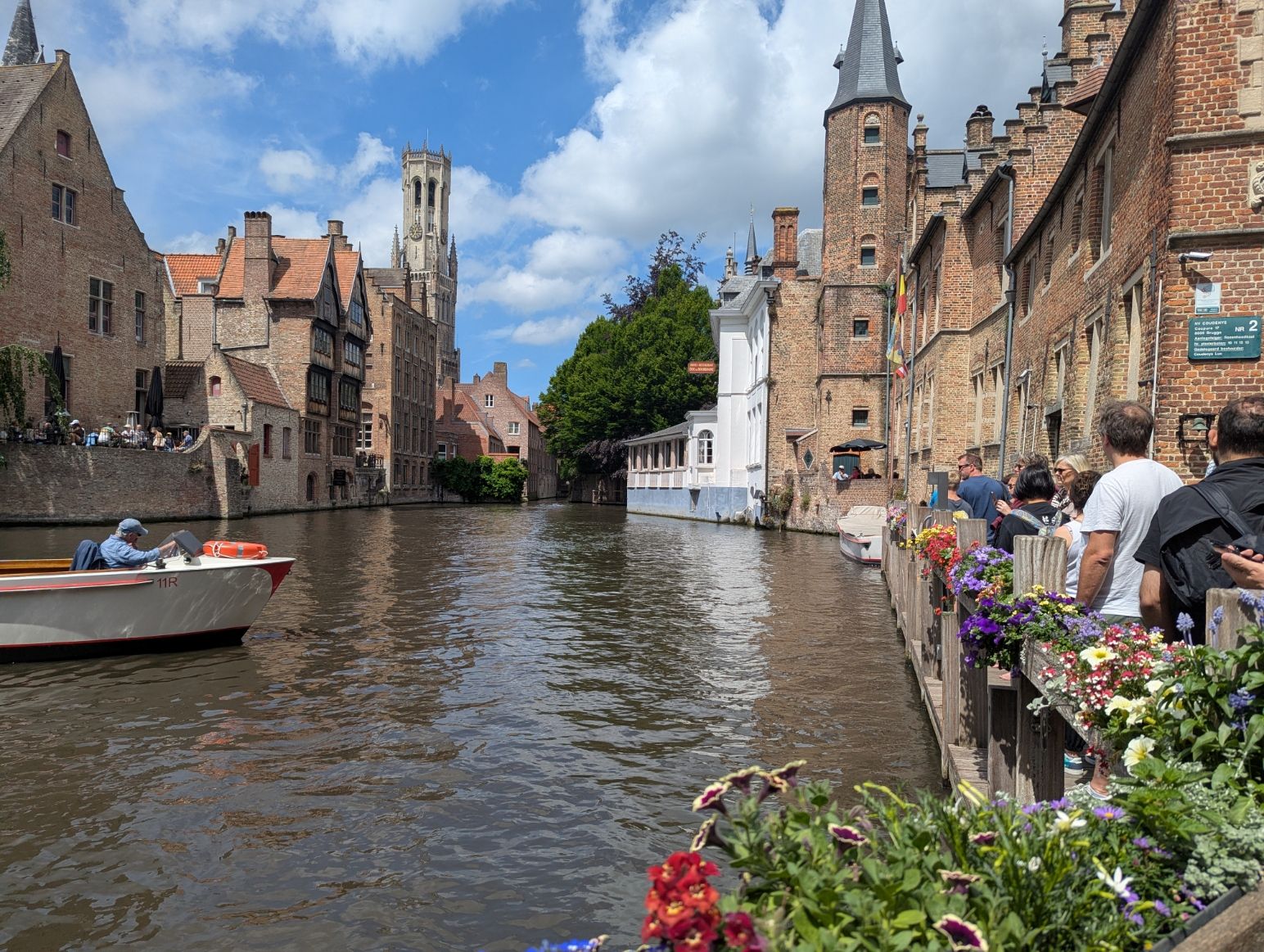
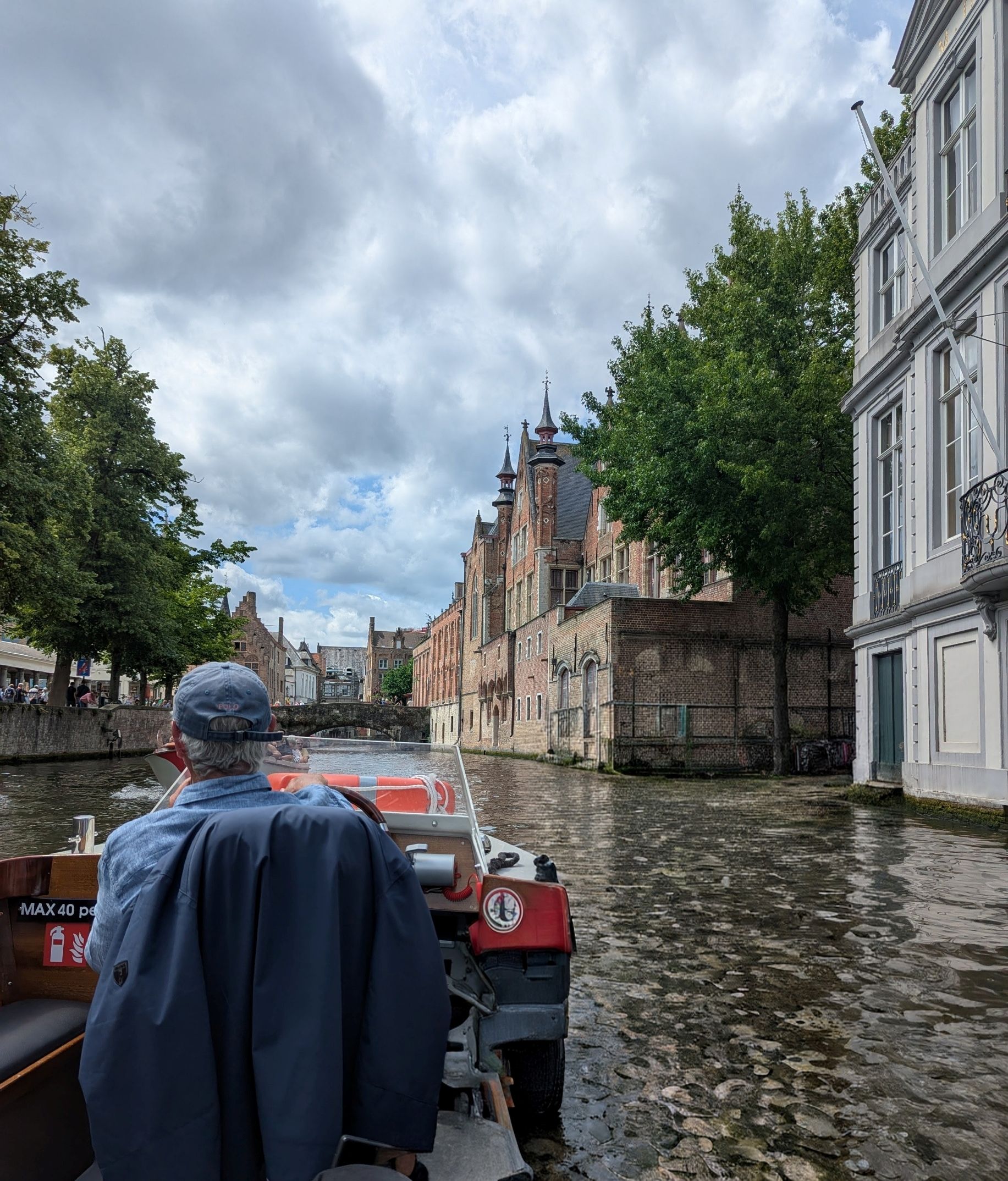
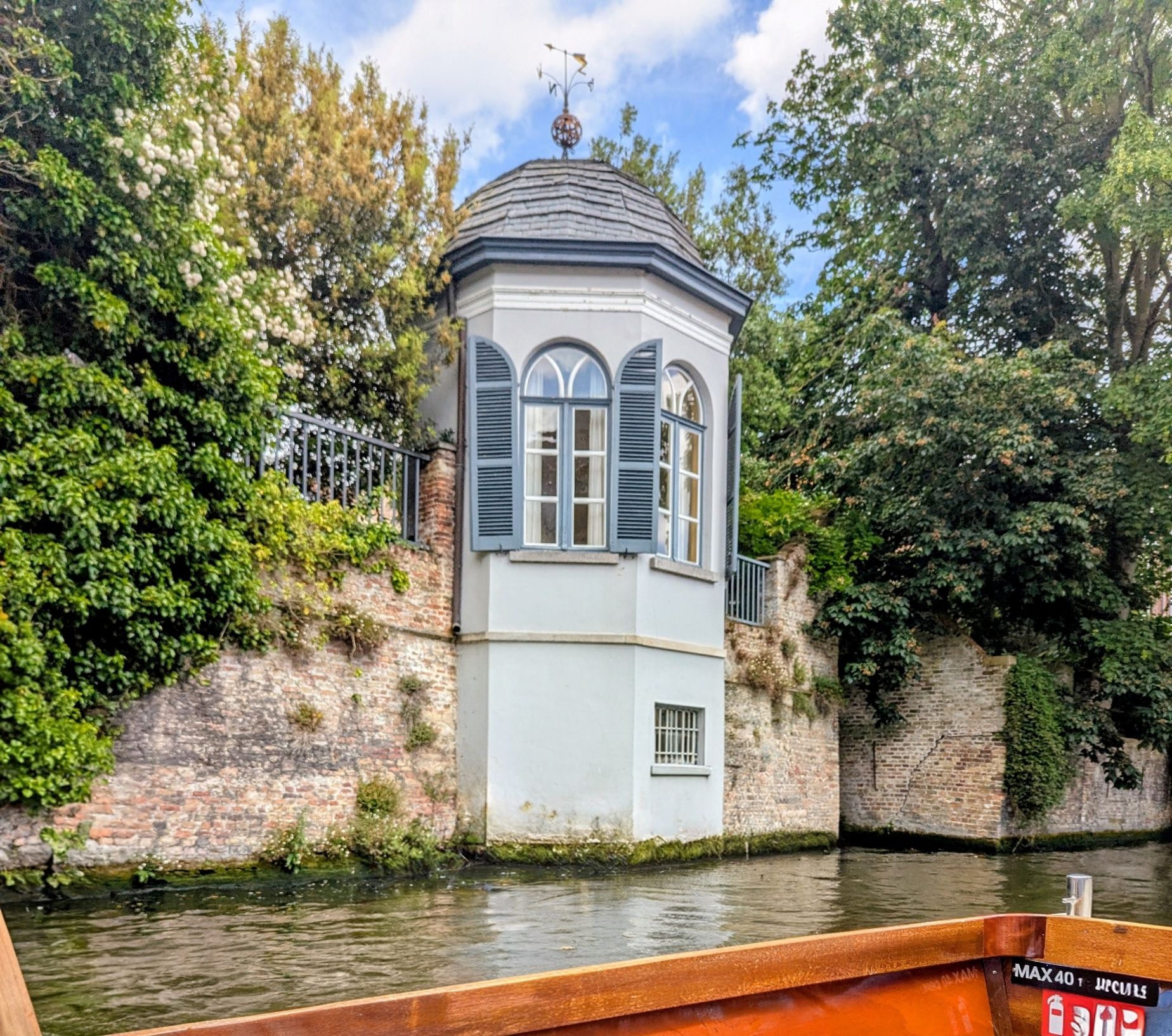
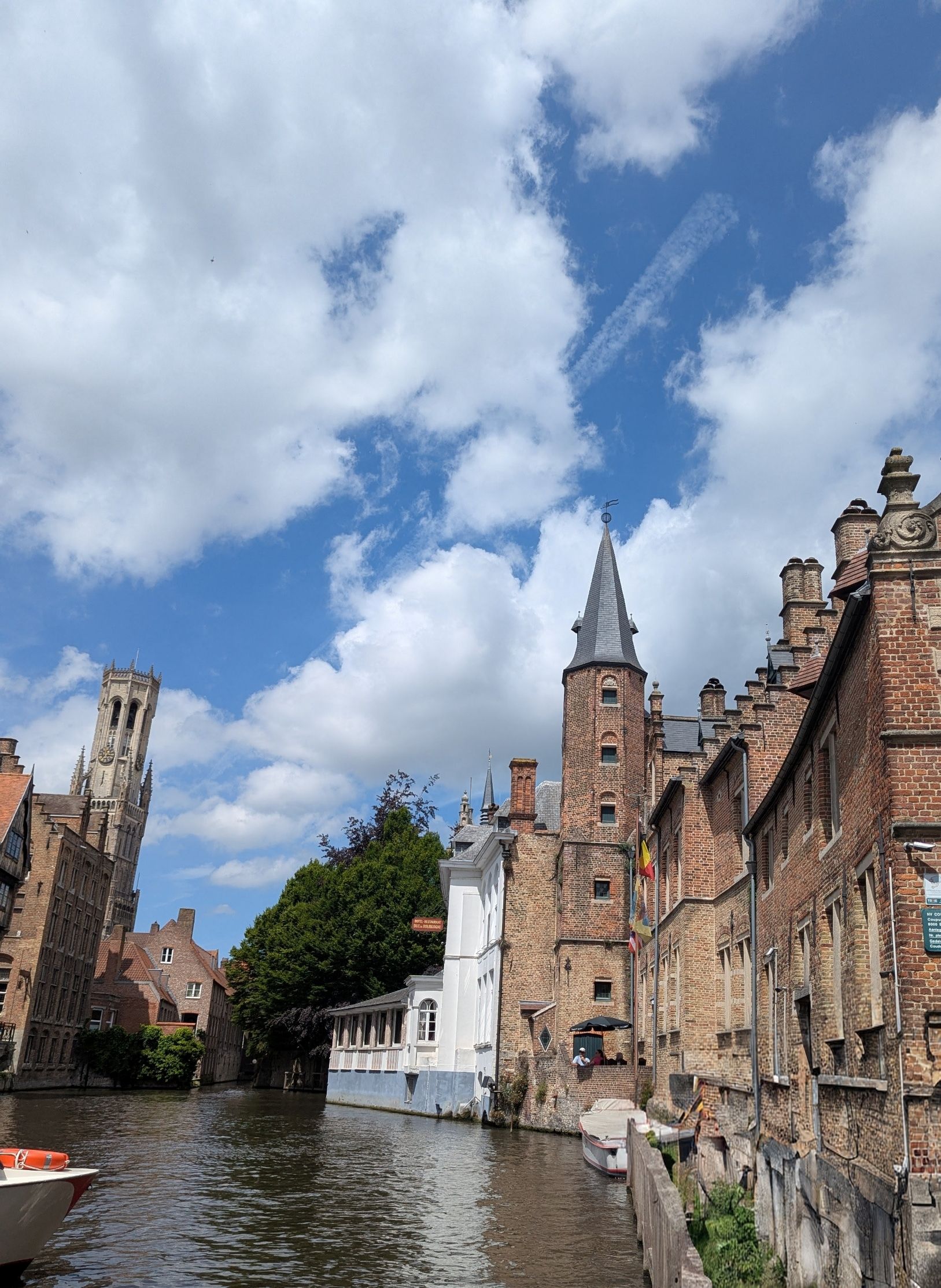
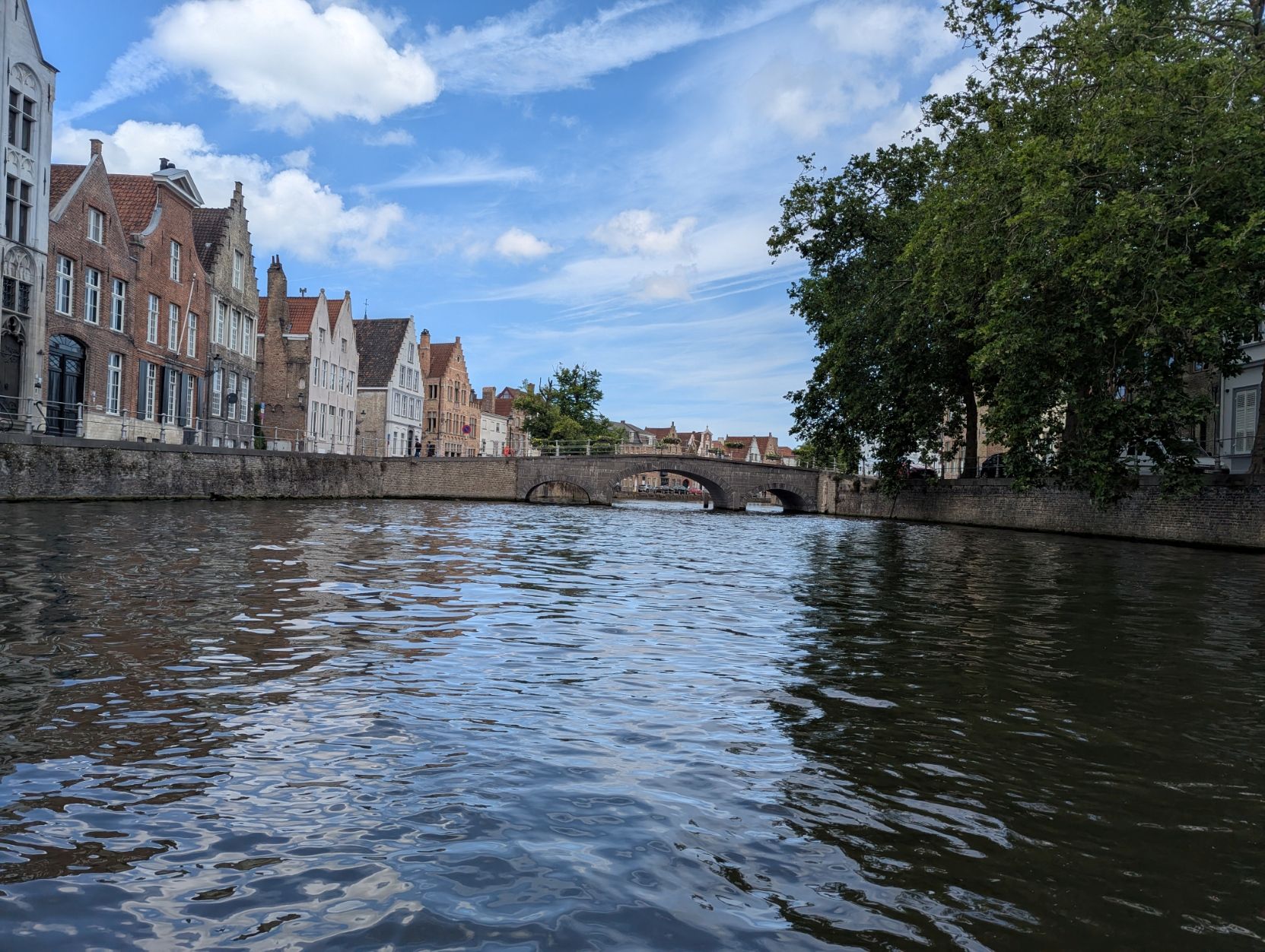
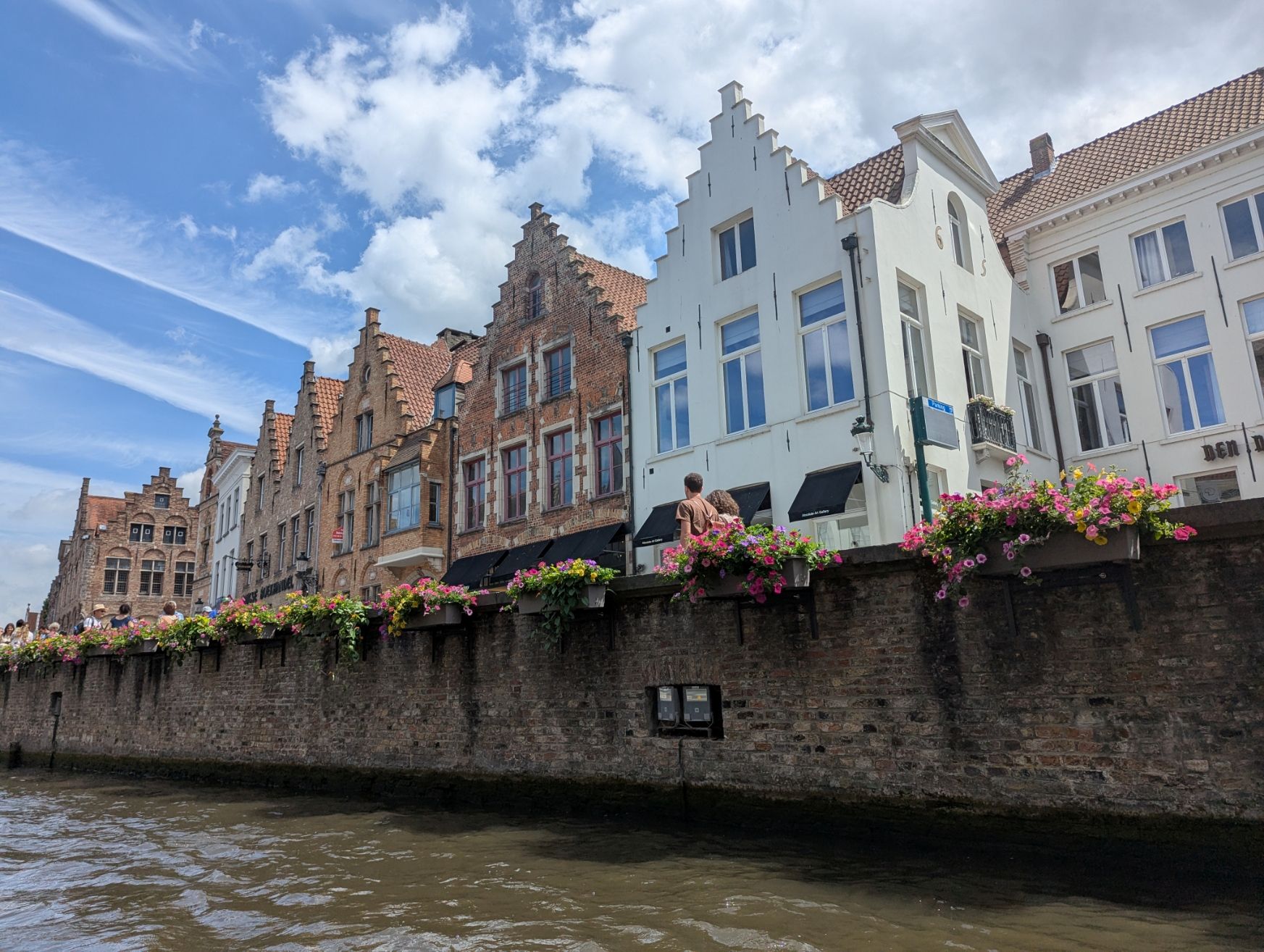
Bruges Boat Trip




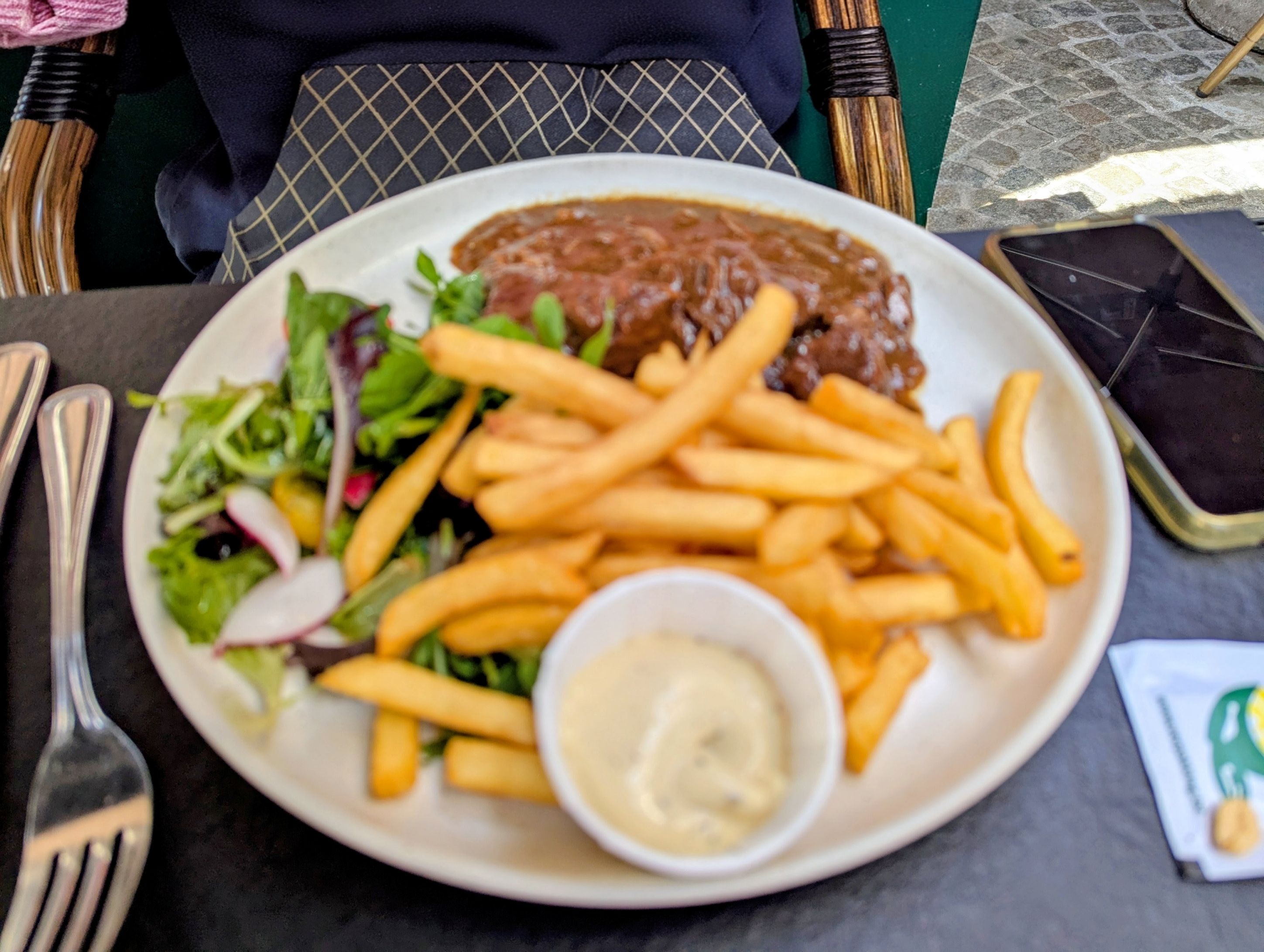
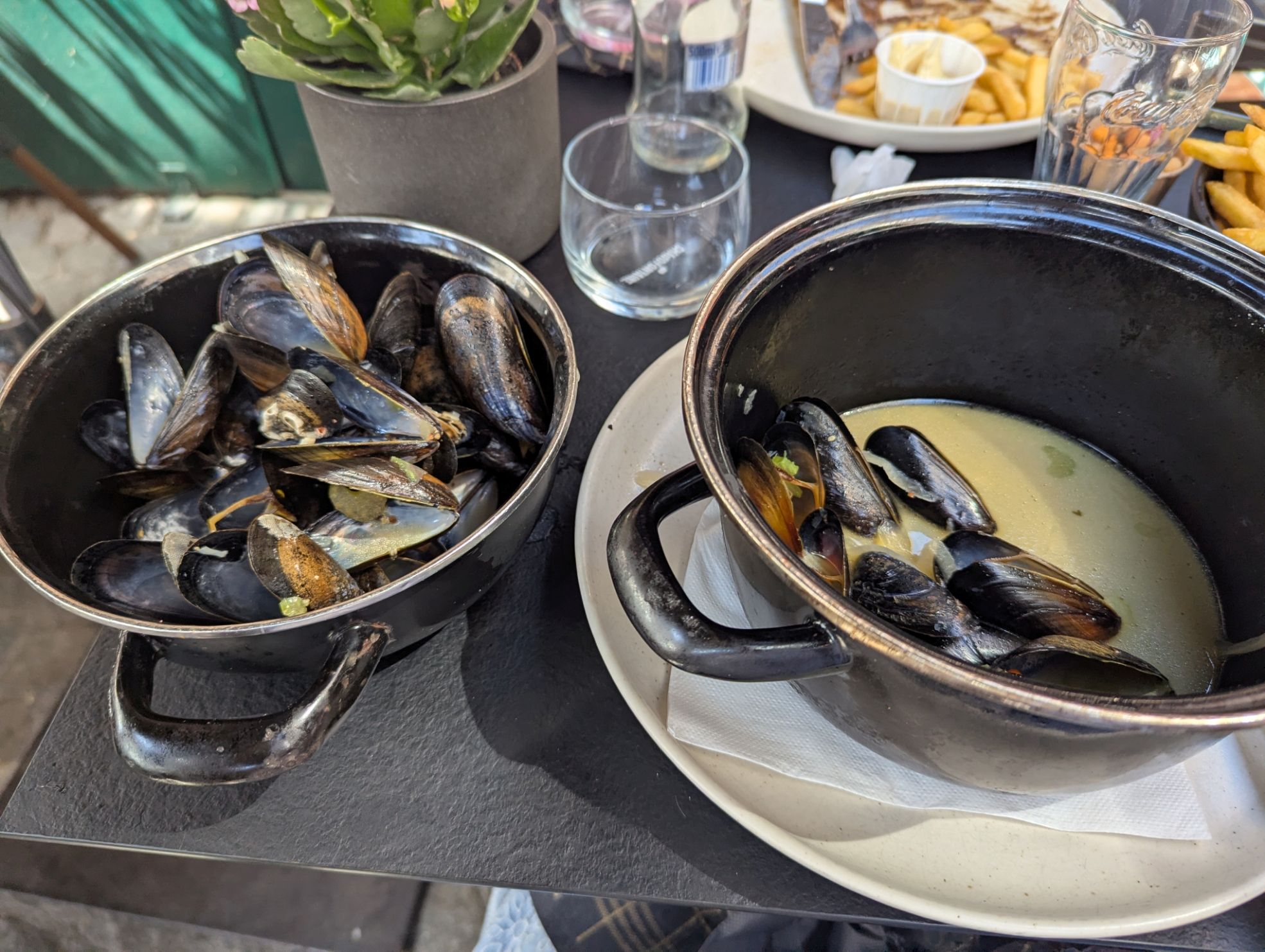
Belgian Stew and More Mussels
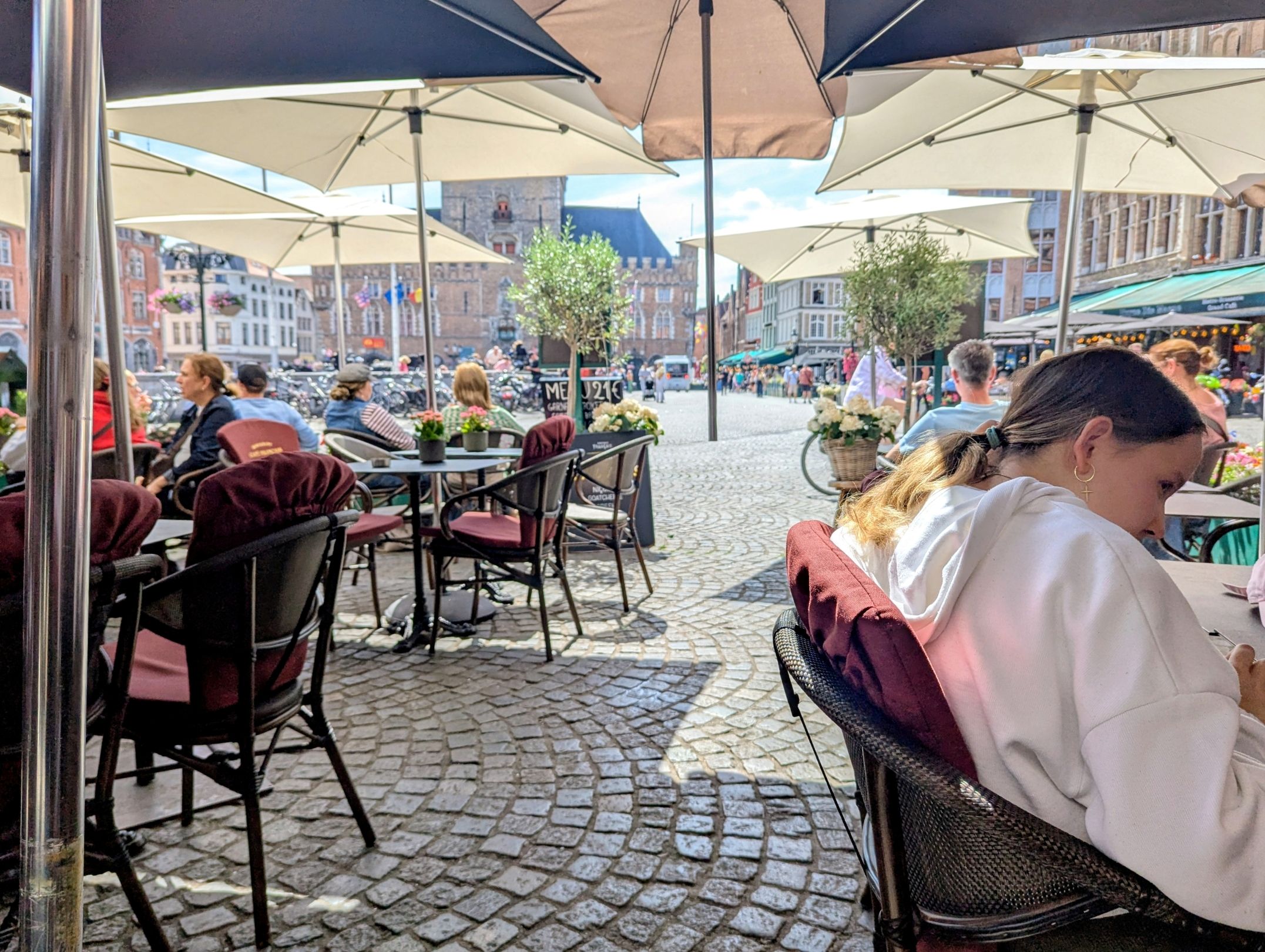
Even the small portions were so generous that there were plenty of chips remaining, and even some mussels. This was a lovely meal, in a pleasant environment, with good service. Probably a ‘tourist trap’ but I’ve found some great food and prices in them. The octopus in Greece stands out, and Cafe Francais similarly.

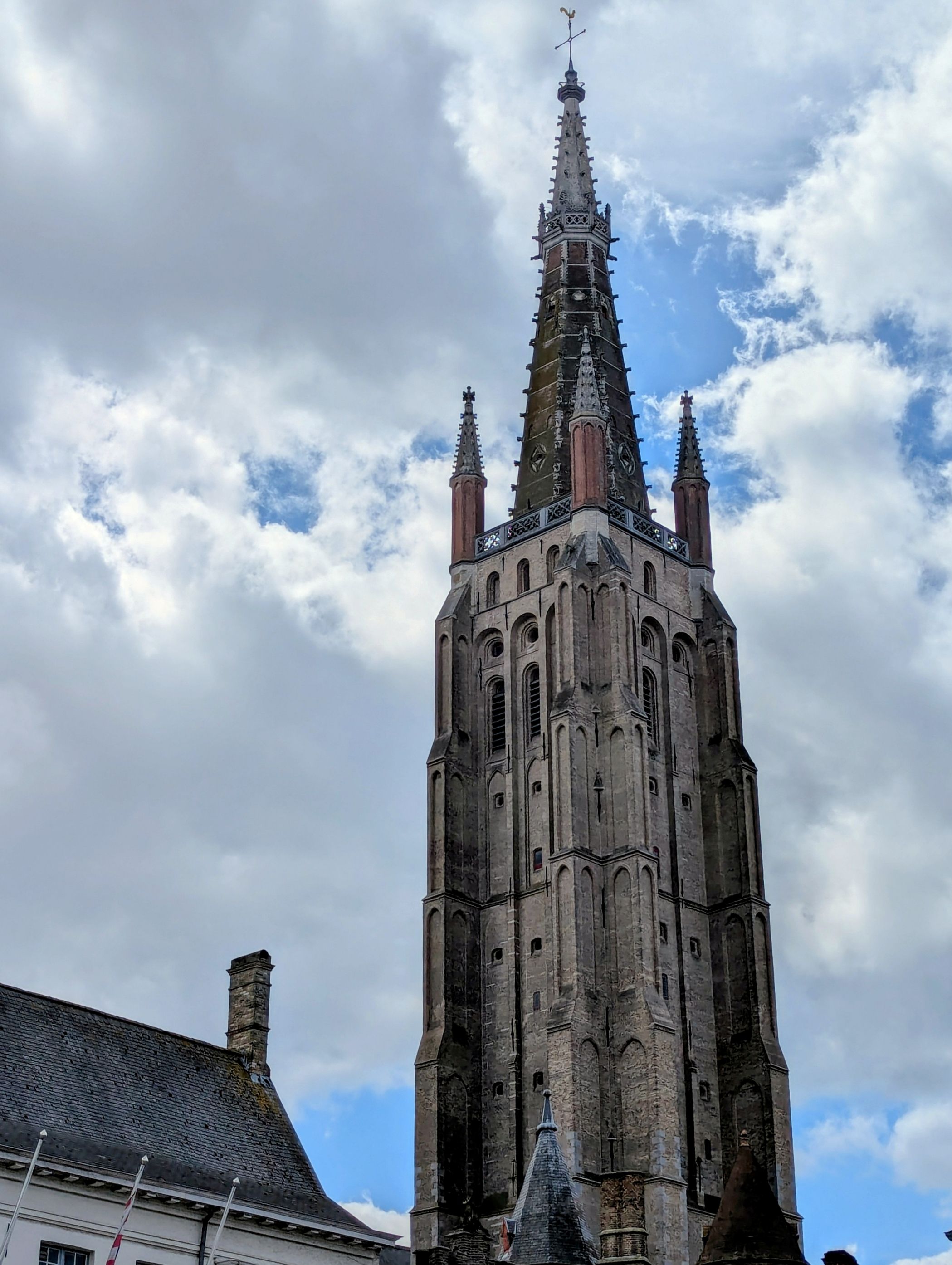
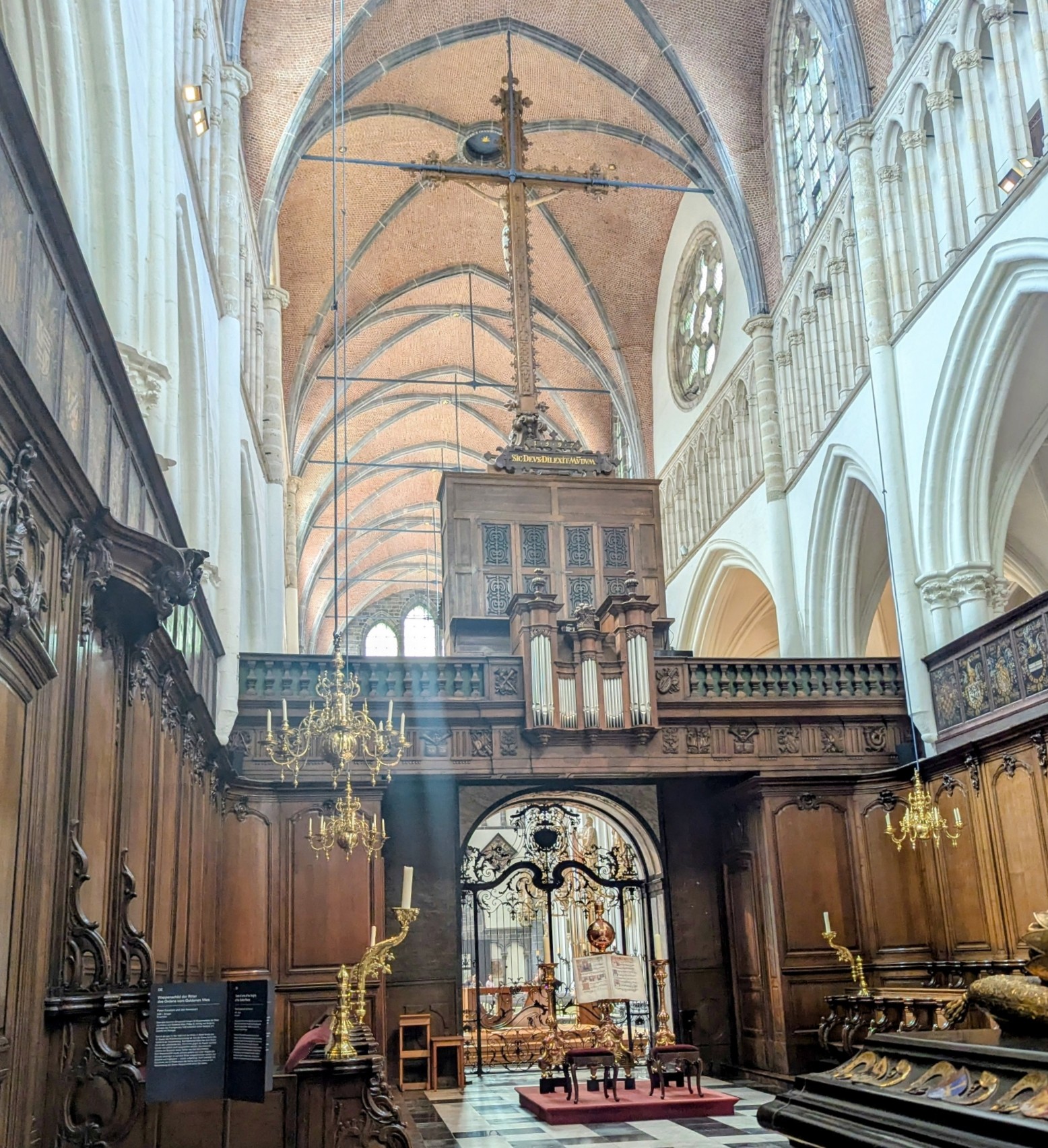
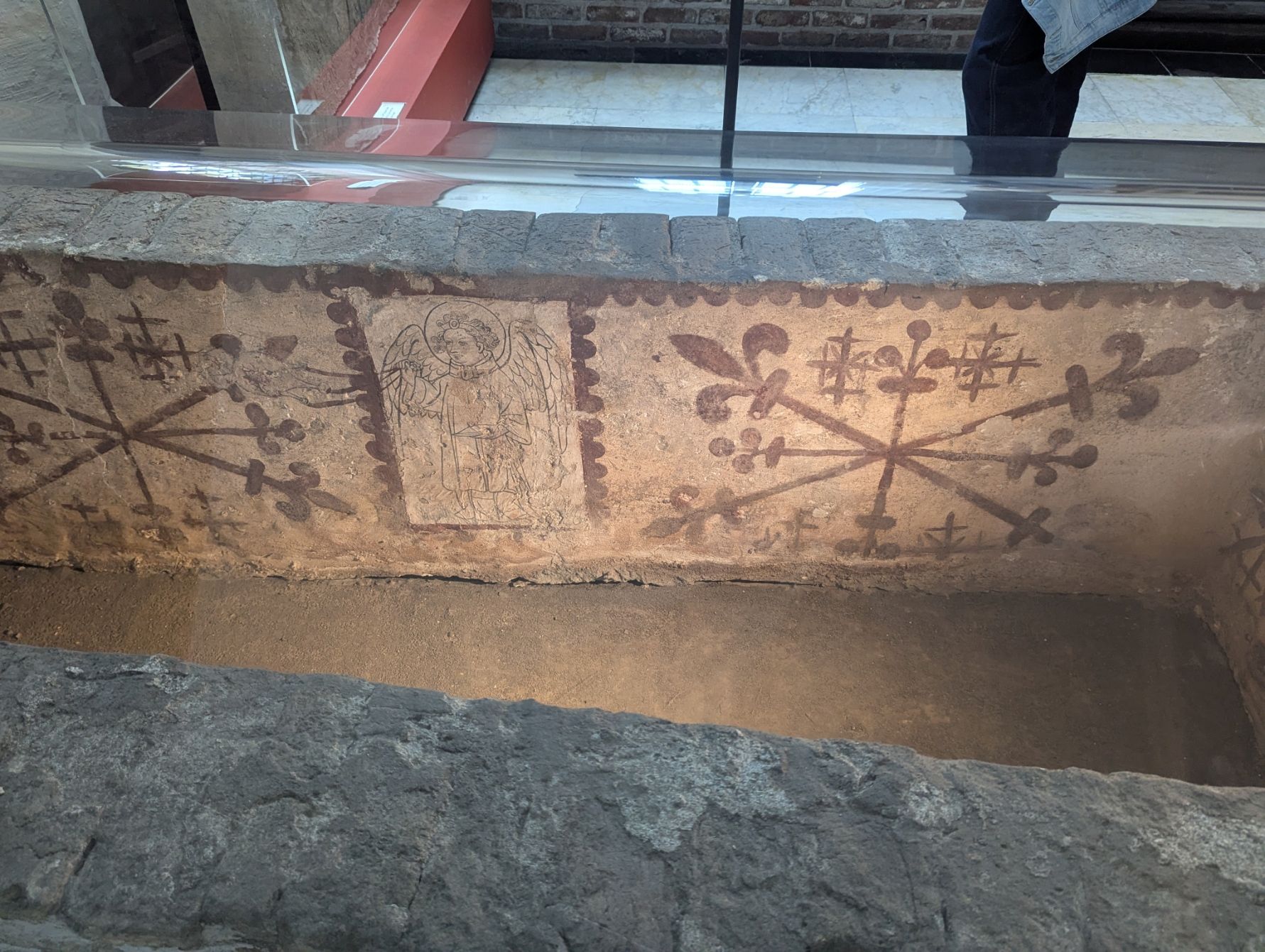
Church of Our Lady
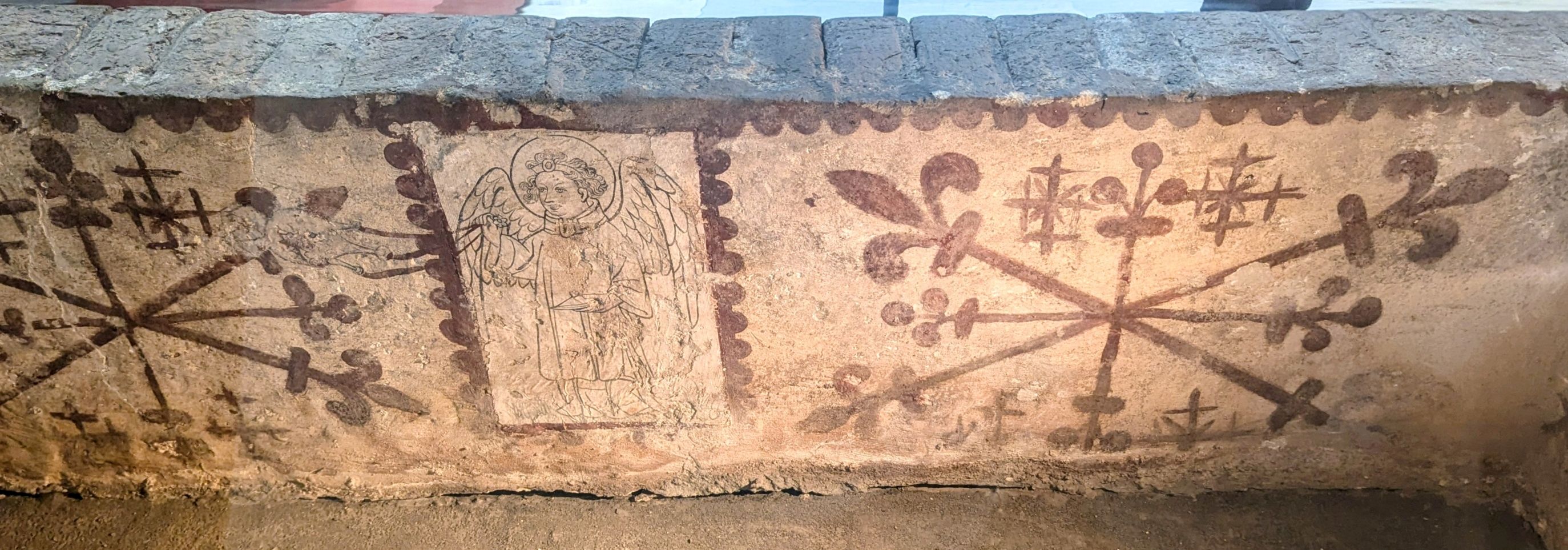
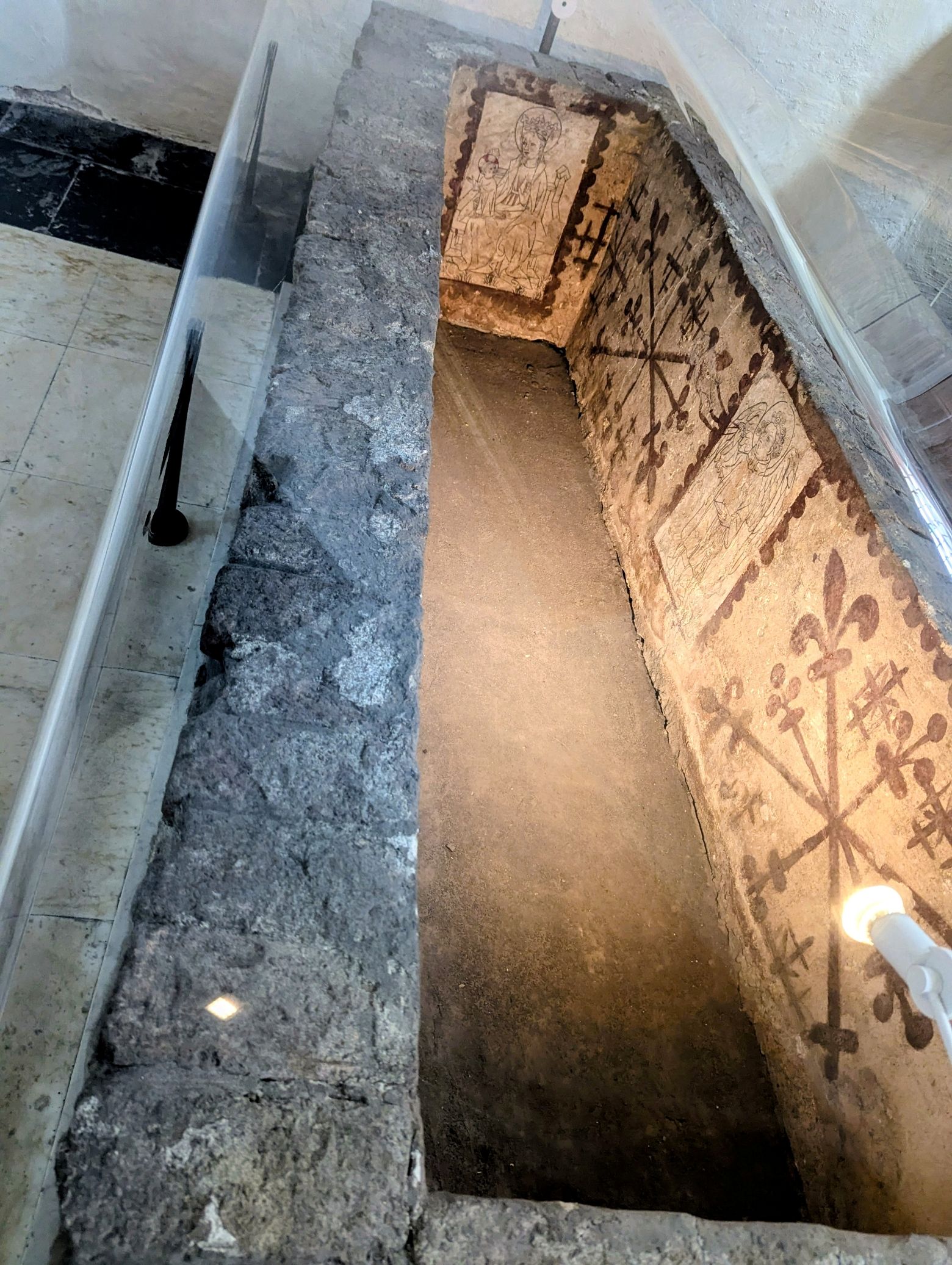
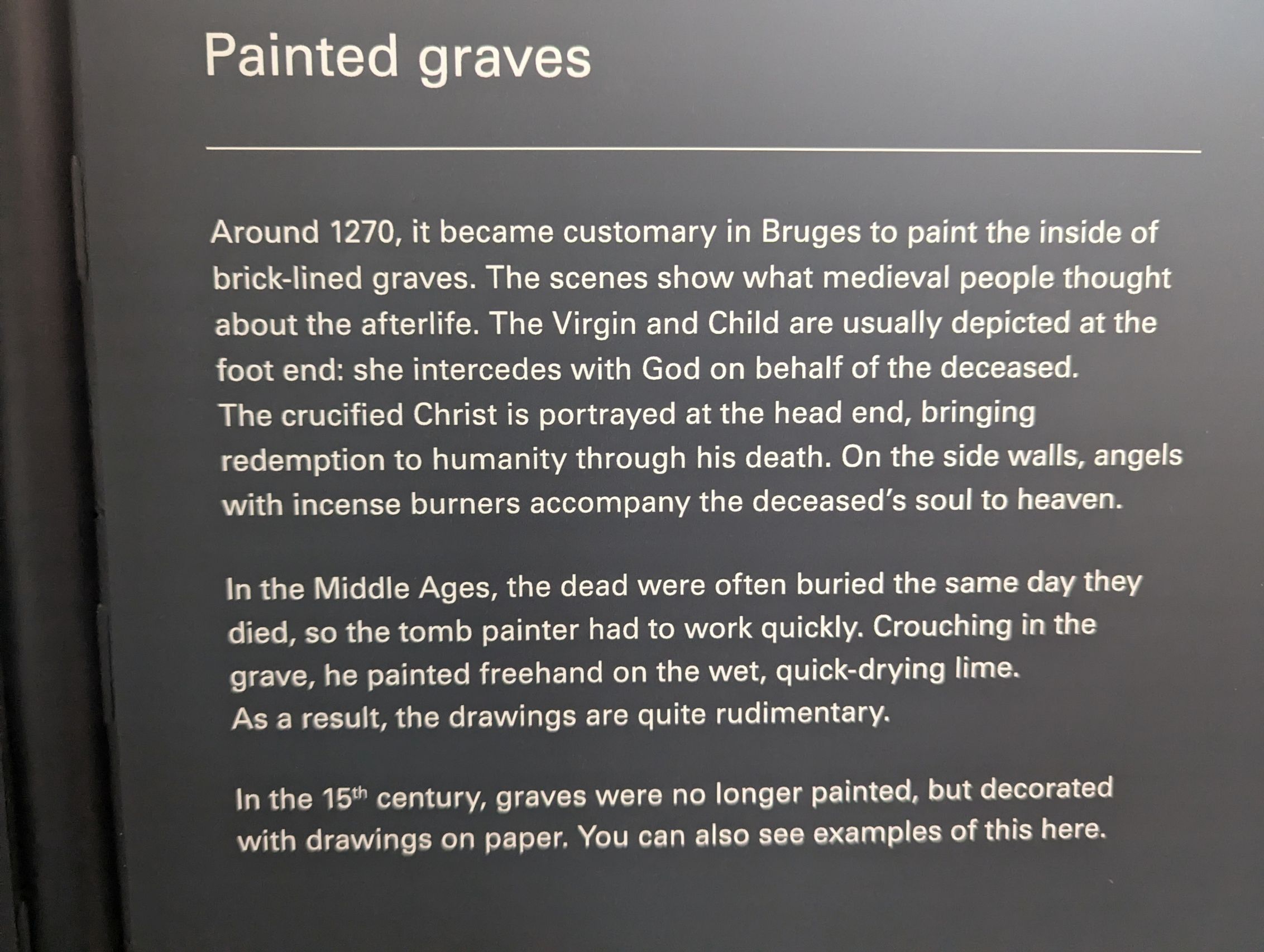
The Church of our Lady is part of the Musea Brugge, and is the site of Michelangelo’s Madonna of Bruges. The church and the painted graves are exhibited free.

Michelangelo’s Madonna of Bruges
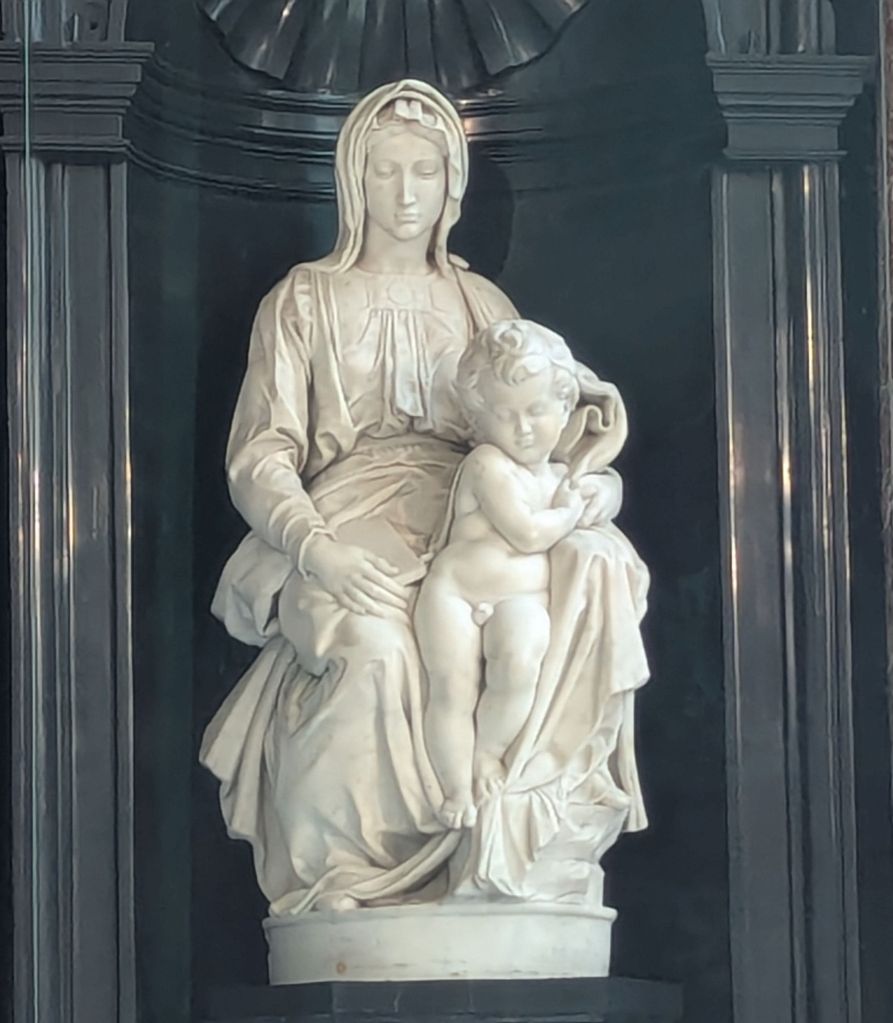

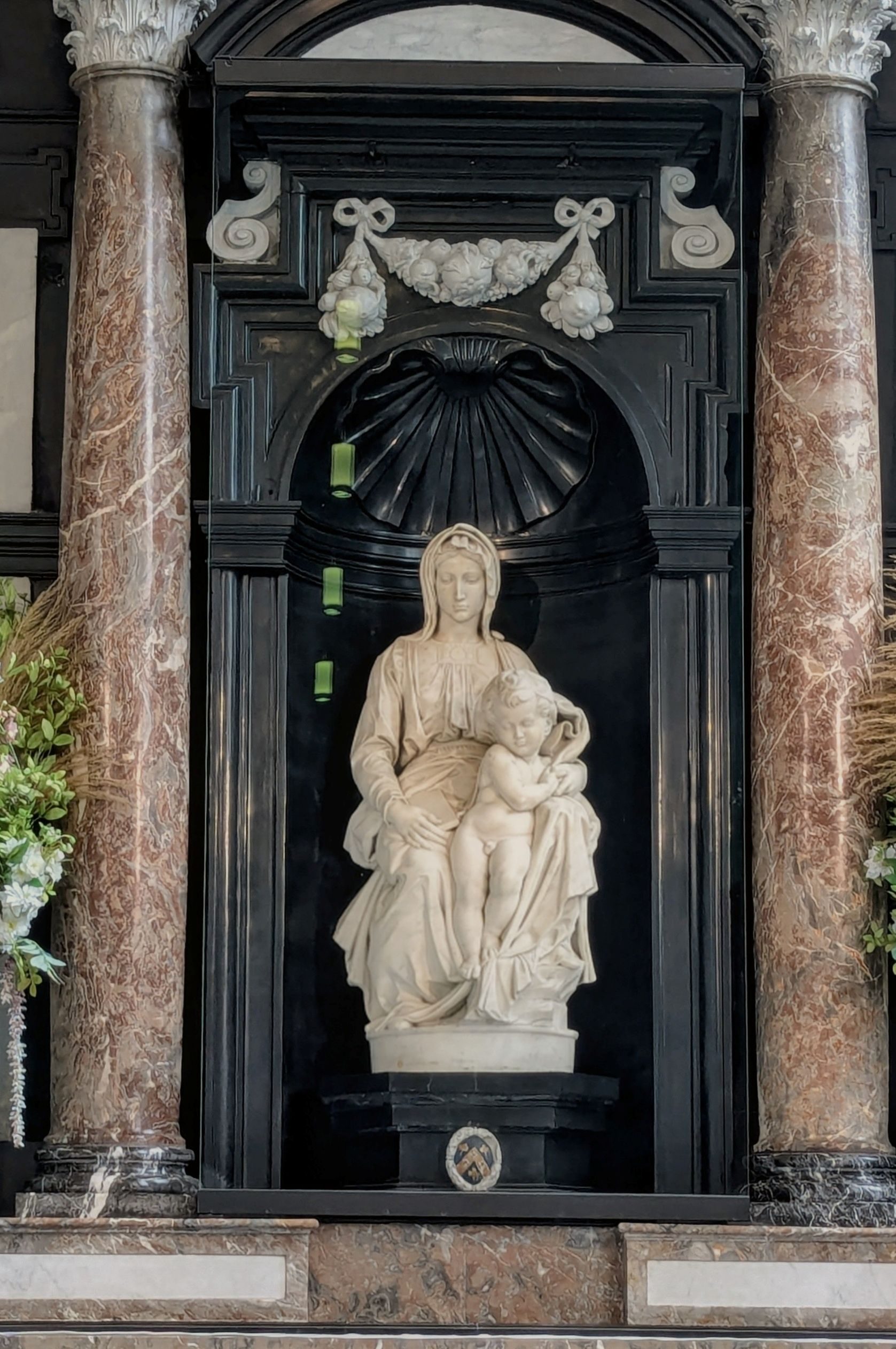
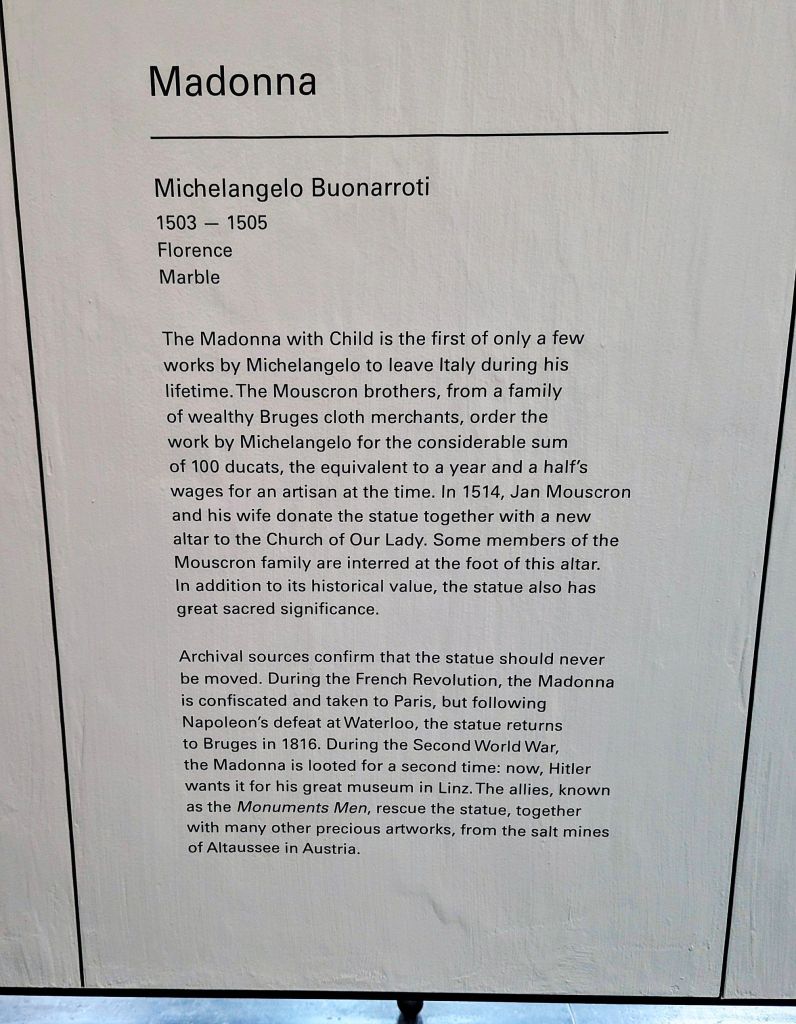
The Madonna of Bruges is a marble sculpture by Michelangelo of the Virgin and Child.
Michelangelo’s depiction of the Madonna and Child differs significantly from earlier representations of the same subject, which tended to feature a pious Virgin smiling down on an infant held in her arms. Instead, Jesus stands upright, almost unsupported, only loosely restrained by Mary’s left hand, and appears to be about to step away from his mother. Meanwhile, Mary does not cling to her son or even look at him, but gazes down and away. It is believed the work was originally intended for an altar piece. If this is so, then it would have been displayed facing slightly to the right and looking down. The early 16th-century sculpture also displays the High Renaissance Pyramid style frequently seen in the works of Leonardo da Vinci during the late 1400s.
Madonna and Child shares certain similarities with Michelangelo’s Pietà, which was completed shortly before – mainly, Mary’s flowing robe, and the movement of the drapery. The long, oval face of Mary is also reminiscent of the Pietà.
The work is also notable in that it was the first sculpture by Michelangelo to leave Italy during his lifetime. In 1504, it was bought by Giovanni and Alessandro Moscheroni (Mouscron) for 100 ducats. The Mouscron brothers were wealthy cloth merchants in Bruges,[1] then one of the leading commercial cities in Europe.
The sculpture was removed twice from Belgium after its initial arrival. The first was in 1794 after French Revolutionaries had conquered the Austrian Netherlands during the French Revolutionary Wars; the citizens of Bruges were ordered to ship it and several other valuable works of art to Paris. It was returned after Napoleon‘s final defeat at Waterloo in 1815.
The second removal was in 1944, during World War II, with the retreat of German soldiers, who smuggled the sculpture to Germany enveloped in mattresses in a Red Cross truck.[2] It was discovered a year later in Altaussee, Austria within a salt mine and again returned. It now sits in the Church of Our Lady in Bruges, Belgium. This is represented in the 2014 film The Monuments Men.
American Politics
June 1, 2026
Heather Cox Richardson from Letters from an American <heathercoxrichardson@substack.com> Unsubscribe
Forwarded this email? Subscribe here for more June 1, 2026Heather Cox Richardson Jun 2 READ IN APP
As we enter the summer months, we’re hitting the ground running. There is so much news today, I’m going to have to let some of it splash over into tomorrow to do it justice. For today, Iran and its role in the president’s deteriorating mental condition are going to take center stage.
Over the weekend, there were what I’m going to have to call the usual reports of an imminent agreement between the U.S. and Iran to end hostilities, with the usual outcome.
Last week the U.S. and Iran appeared to be making headway on a 60-day memorandum of understanding to continue the ceasefire and to establish a framework for further talks about Iran’s nuclear program. But President Donald J. Trump is caught between a rock and a hard place in these negotiations.His base demands that he look strong and accomplish what, after the initial strikes failed, he claimed to have started the war for: to make sure Iran doesn’t have the capacity to produce a nuclear weapon. He also needs to reopen the Strait of Hormuz—which was open before he began the strikes—and get oil flowing again from that region of the Middle East. Prices in the U.S. are rising, and the looming threat of oil reserves running out adds even more pressure to consumer prices.
And Congress returns to work tomorrow, raising the possibility that lawmakers will pass a war powers resolution requiring Trump to withdraw American forces from the region. House speaker Mike Johnson (R-LA) sent House members home a day early before the Memorial Day holiday out of concern such a measure would pass.
But Iran is in no hurry to throw Trump a lifeline. Their negotiators now maintain they have a right to control the Strait of Hormuz. They are demanding reparations for the damage inflicted in the country during the war, and they say they won’t negotiate over the nuclear program until there is a ceasefire.But these conditions are all problematic for Trump’s negotiators. Permitting Iran to control the strait is not just about oil; it’s about the principle of freedom of the seas set out after World War II. Global trade depends on that concept. The exchange of money is also a problem for Trump. He has spent much of his political life attacking the Joint Comprehensive Plan of Action that China, France, Germany, Russia, the U.K., the U.S., and the European Union negotiated with Iran during the Obama administration, claiming that former president Obama “gave” Iran $1.7 billion. In fact, the JCPOA simply permitted the release of Iranian assets frozen overseas by sanctions, but much of Trump’s base believes that Obama showed weakness by buying an agreement.
And then there is the nuclear issue.So what has tended to happen in negotiations is that the teams come up with a framework, details leak to the media, and Trump’s base hears that Trump has weakened on some of his maximalist demands. They complain, Trump then posts something false about the talks or incendiary about Iran, and the negotiations fall apart.And the cost of the war, in both lives and treasure, and the pressure on U.S. consumers and the economy continue to mount.
Last Friday, Trump and his advisors spent two hours discussing the latest round of negotiations in the Situation Room. According to Erika Solomon and Farnaz Fassihi of the New York Times, that agreement included the release of about $24 billion in frozen Iranian assets and a postwar “investment fund” to rebuild Iran, with one diplomat telling the journalists the number on the table was $300 billion. Talks about Iran’s nuclear program would be deferred.On Friday morning, Trump posted, once again, that the strait would be opened and that Iran must never have a nuclear weapon. But then he emerged from the Situation Room without the “final determination” on the agreement he had promised. On Saturday, Mohsen Rezaie, one of the advisors to Iran’s supreme leader, posted: “As predicted, the President of the United States is betraying diplomacy for the third time.”
Over the weekend, Trump’s social media account posted repeated attacks on Democrats and on the judges who have been deciding against him in legal cases. He posted long defenses of his alterations to monuments in Washington, D.C., and AI images of capital landmarks covered in trash and graffiti juxtaposed with ones gleaming and fresh, with captions that blame Democrats for the former and praise Trump for the latter.
His posts seemed designed primarily to reassure himself. By Saturday, so many of the musical acts his team had lined up to play at his Freedom 250 “Great American State Fair” from late June through the beginning of July had bailed that Trump posted that he was “thinking about bringing the Number One Attraction anywhere in the World, the man who gets much larger audiences than Elvis in his prime, and he does so without a guitar, the man who loves our Country more than anyone else, and the man who some say is the Greatest President in History (THE GOAT!), DONALD J. TRUMP, to take the place of these highly paid, Third Rate “Artists,” and give a major speech, rallying the Country forward like I have done ever since being President!” He continued: “Two years ago, the United States was DEAD. Now we have the “HOTTEST” Country anywhere in the World. I don’t want so-called “Artists” that get paid far too much money, who aren’t happy. I only want to be surrounded by Happy People, Smart People, Successful People, and People that know how to WIN. So, by copy of this TRUTH, I am ordering my Representatives to look at the feasibility of doing an AMERICA IS BACK Rally on Wednesday, Washington, D.C., same time, same location. Only Great Patriots invited—It will be a Wild and Beautiful Celebration of America! President DONALD J. TRUMP”
It was an odd echo of his December 19, 2020, tweet calling his base to Washington, D.C., in which he wrote: “Big protest in D.C. on January 6th. Be there, will be wild!”Odder still was what followed: image after image of Trump as a great leader. There were images of Trump alongside first president George Washington, one of them showing the two presidents riding horses together in colonial garb beside a racecar with TRUMP across the hood, the White House in the background, and the Space Shuttle overhead. In an AI image, Trump is dunking a basketball over an exhausted New York governor Kathy Hochul, a Democrat; in another image, he and Patriots football player Tom Brady stand talking, backlit, under a caption that reads “GOAT.”
There were pictures of Trump kissing the American flag; Mount Rushmore with Trump’s sculpture in line with those of George Washington, Thomas Jefferson, Theodore Roosevelt, and Abraham Lincoln (who looks somewhat alarmed); Trump apparently as a superhero admiral with armor on his chest that bears an American eagle; Trump standing near King Charles; Trump with China’s president Xi Jinping.
A series of AI images in the style of the 1950s Dick and Jane readers show a town parade festooned with flags and patriotic bunting, little girls laughing together at an old-fashioned town fair, and little boys in a suburb playing ball. All of the images read: “AMERICA IS BACK!” And in them, all of the people are white.He posted an image of a white family from that era standing beside a Cadillac Coupe DeVille parked on a suburban street, with the caption: “BILLIONS WERE SPENT TO CONVINCE YOU THIS IS EVIL.”
Then Trump’s account posted a series of images contrasting his vision of Biden’s America versus his own. In his images, Biden’s world was one of theft, illegal squatting, violence, and illegal immigration. The images of Trump’s “solutions” to these problems showed people imprisoned, arrested, and deported.
At 1:02 this morning, Trump posted: “Iran really wants to make a deal, and it will be a good one for the U.S.A. and those that are with us. But don’t the Dumocrats, and various seemingly unpatriotic Republicans, understand that it is MUCH tougher for me to properly do my job and negotiate, when political hacks keep negatively ‘chirping,’ at levels never seen before, over and over again, that I should move faster, or move slower, or go to war, or not go to war, or whatever. Just sit back and relax, it will all work out well in the end—It always does! President DJT”
A minute later, his account posted: “Has anyone ever seen a happy Dumocrat???”Then, later this morning, Iranian officials said they were suspending negotiations with the U.S. until Israel, which entered the war alongside the U.S., stops its strikes on Lebanon, strikes they say violate the ceasefire agreement. They warned they would close the Strait of Hormuz entirely—a few ships have been making the transit—and move against the Bab al-Mandab strait at the outlet of the Red Sea, as well. On CNBC, Trump told Eamon Javers that he doesn’t care if peace negotiations with Iran end. “I couldn’t care less,” he said. Negotiations were starting “to get very boring.”But oil prices jumped sharply with the announcement of the suspension and the threat to the Bab al-Mandab, and at 1:43 in the afternoon, Trump posted: “Talks are continuing, at a rapid pace, with the Islamic Republic of Iran.” At 5:47, he posted on social media that he had spoken with Prime Minister Benjamin Netanyahu of Israel and indirectly with Hezbollah, and that they both agreed to stop striking each other.
The Pentagon has been trying to control information coming out about its actions for months now, but that effort is now ramping up. This afternoon, Scott Nover of the Washington Post reported that the Pentagon has designated its press office as a classified space—a Sensitive Compartmented Information Facility, or SCIF—and even those journalists who have not had their press badges rescinded will require an appointment to talk to the press secretary.—
Notes:https://www.snopes.com/fact-check/trump-obama-iran-cash/https://www.politico.com/news/2026/05/29/trump-no-update-iran-deal-00943503https://www.cnn.com/2026/06/01/world/live-news/iran-trump-lebanon-war-news?post-id=cmpv0qep900003b6sh3u6kp9ihttps://armscontrolcenter.org/wp-content/uploads/2016/10/Fact-check-iran-deal-1.pdfhttps://www.ms.now/news/us-iran-exchange-strikes-testing-ceasefire-as-kuwait-dronehttps://www.cnbc.com/2026/06/01/trump-iran-war-negotiations-oil-israel-interview.htmlhttps://www.politico.com/newsletters/playbook-pm/2026/06/01/trump-i-dont-care-if-iran-talks-are-over-00944460https://www.nbcnews.com/business/energy/oil-prices-trump-iran-talks-collapse-rcna347869https://www.washingtonpost.com/national-security/2026/06/01/pentagon-bans-journalists-press-office-designating-it-classified-space/https://www.nytimes.com/live/2026/05/29/world/iran-war-us-trump-deal?smid=url-share#96858bf5-a1a8-5397-8020-9b85fba3e098https://www.nytimes.com/2026/06/01/us/politics/trump-iran-negotiations-boring.htmlX:ir_rezaee/status/2060634659646484743scottbudman/status/1604915748693909504HamidRezaAz/status/2061439791132996026Trump’s Truth:statuses/38975statuses/38874statuses/38883statuses/38884statuses/38888statuses/38887statuses/38902statuses/38903statuses/38907statuses/38905statuses/38919statuses/38918statuses/38917statuses/38915statuses/38920statuses/38921statuses/38922statuses/38923statuses/38931statuses/38929statuses/38938statuses/38937statuses/38974statuses/38977statuses/38979statuses/38872
British Politics
Tom Watson <tomwatsonofficial@substack.com> Unsubscribe Tue 2 Jun, 17:28 (11 hours ago)
Forwarded this email? Subscribe here for more
In a government short of calm authority, Jones is proving the value of a minister who can see the mission and the machinery.
Darren Jones is becoming one of the Government’s most useful ministers. This is not quite the same as becoming one of its best-known ministers. But it is surely better. In Westminster fame is often the consolation prize for people who are out of proper work.Jones is good on the media. He is good at the despatch box. He is also good at something rarer: remembering that policy consists not only of a soundbite on Radio 4 but of decisions, money, people, timetables, milestones and consequences.
He always sounds as though he has read the file, not skimmed it. His manner is calm and forensic. He does not arrive at the despatch box looking for his Martin Luther King moment. He takes the issue apart, identifies the working parts and tells the House which bit has failed.
This was useful today this week because the issue was Peter Mandelson.There are names in politics which do not just describe a person but summon a whole fantastical world. Peter Mandelson is one of them. To my generation he was not just a colleague, strategist, fixer, enemy or saviour. He was the one of the biggest planets in the solar system.Tony and Gordon may put it differently now, but New Labour had three red giants: Tony, Gordon and Peter.To mix metaphors wildly, Tony had the sunlit uplands; Gordon had the engine room; Peter had the wiring and the fuse box and secret buttons only he could press to illuminate or darken the stage.Darren Jones has the advantage of temporal distance. He was born in 1986, a year after I first met Peter. When Labour won in 1997 Darren was ten. While some of us were living through the New Labour psychodramas, he was engaged in matters such as maths homework, football stickers and what his mum was making for tea.
For Jones, Mandelson is history rather than intoxicated memory and scar tissue. No fascination. No buried grudge. These conditions made him the right minister for the big day.
In a previous media round Jones had already said the crucial point out loud: Peter Mandelson should never have been appointed. Yesterday he was dealing with the consequences of this flawed decision.There was a cold clarity in that. He did not try to make the appointment look less indefensible by placing it under the dim yellow light of process. Nor did he turn it into one of those solemn Westminster sermons in which everyone agrees that lessons must be learned. He jettisoned Peter with the brutal calm of a man cutting loose spoiled cargo before the ship hits the rocks.
He did not try to dazzle the House with indignation. Nor did he sink into the blancmange of officialese. He plainly explained the documents, the redactions, the police requests, the missing messages and the process still to come.
There is another clip I will put below because it shows the same quality under more enjoyable conditions. *Jones was answering an urgent question with the Prime Minister behind the eight ball and Kemi Badenoch leading the charge. The Opposition sensed danger to the Government and became overexcited. Jones began in a difficult chamber. The Labour benches wanted reassurance. The Conservatives wanted a scalp. The Prime Minister wanted it all to end. Then Jones changed the weather.
He did not do it by bellowing, Prescott style. He did it by finding the weak point in the Opposition’s case and pressing on it. He exposed the overreach. He made the attack look less like scrutiny and more like shallow opportunism. The Labour benches came alive behind him. It was a bravura performance precisely because it did not advertise itself as one. The best Commons performers are not always those who produce the finest phrases. They are those who understand the mood of the House and move it half a yard in the right direction. Jones did that.
His biography helps explain the steadiness. He was born at Southmead Hospital and grew up in Lawrence Weston, in the Bristol North West seat he now represents. His mum was a hospital administrator. His dad was a security guard. Money was tight. New Labour investment reached his community, including a ‘gifted and talented’ scheme that helped point him towards university. He became the first in his family to go. For the flat in the area he lives in, this was unusual.
Jones read human bioscience at Plymouth, worked for the NHS, trained as a solicitor and specialised in technology law, including energy and telecoms. He chaired the Business, Energy and Industrial Select Committee. He became Shadow Chief Secretary to the Treasury, then Chief Secretary to the Treasury, then Chief Secretary to the Prime Minister and Chancellor of the Duchy of Lancaster. This is a steep and fast climb. It does not feel accidental.
Like Andy Burnham and Wes Streeting, he comes from humble origins and talks about them without turning the violin up to eleven. He does not ask to be admired for where he started but to me, where you start matters in politics because it gives an indication of your tenacity.As Chief Secretary to the Treasury, he entered the department where Cabinet ministers’ dreams go to die and his first job was to administer the poison. Yet this Guardian interview on the spending review shows the wider Jones project. He was not just counting out the money or trapping ministers fingers in the till as he slammed it shut. He was trying to connect fiscal discipline to Labour purpose, with child poverty close to the centre of the argument.
This is the right sort of Labour politics. Not sentiment but method. The child who needs a better start in life is the moral end. The route is less stirring: spending envelopes, negotiations, reviews, departmental settlements, performance measures and the small dull gears by which government either works or does not. Jones sees the mission and uses the machinery.He’s quietly achieved something that several ministers over the decades have completely failed on: civil service pay reform, pushing through one of the biggest changes to senior civil service pay in decades, introducing performance-related pay for top officials. The easy version would have been a large speech attacking Whitehall and a private retreat before the unions arrived. Jones chose the harder route. He worked with the unions and the system to get the reform done.
This is his method. Reform without media drama. The Mandelson statement was not the of day any ambitious politician dreams of. No one enters public life hoping to explain redactions, missing messages and a former ambassador’s relationship with Jeffrey Epstein. But politics has a way of testing ministers not on centre stage but at the mop cupboard.
Jones did not make the Mandelson story disappear. No minister could. The documents are too awkward and the history too heavy. But he stopped the Government from digging a deeper hole than the one they have already dug.There is a brutal symmetry here too. A child whose life chances were widened by the social ambition of the New Labour years stood in the Commons and helped draw a line under one of New Labour’s great architects.
One generation built the ship. Another is trying to keep it off the reef.Westminster produces too many people who become famous before they become useful. Jones appears to be attempting the rarer route. He is becoming useful first.
I like the cut of his jib. **I’m going to write a few more pen portraits of MPs that catch my eye in the months ahead. If there are any politicians in particular you want me to take a look at, let me know in the comments and please share this with anyone you think will like it.
*Not included here.
**I like the cut of Tom’s jib. This thoughtful article, typical of Tom Watson’s newsletters.
Australian Politics
MARK RILEY: This Federal Budget isn’t as bad as the memes would have you believe

MARK RILEY: Budgets usually disappear from the public consciousness and the news cycle after a few days. Not this one.
In the modern era of Australian politics, Federal Budgets usually sink like a stone.
When they don’t, it is almost always because people are throwing stones.
Budgets are unveiled on a Tuesday night and by the following weekend the national conversation routinely moves on to other weighty matters, such as how a bunch of bouncy Bulgarian balladeers could possibly beat our Delta for the crystal microphone at Eurovision.
But that hasn’t happened with this one.
People are still talking about it.
And that isn’t good.
To misquote Oscar Wilde, the only thing worse for a Budget than not being talked about is being talked about.
Jim Chalmers and Anthony Albanese knew they would be spending a fair amount of political capital with what they believed was a necessary realignment of the tax system to address creeping imbalances against younger generations.
But they didn’t expect to be buying a multi-generational backlash over measures now widely perceived to be unfair and unnecessary.
Much of that backlash is based on inaccurate and unfair analysis of the real impact of the Budget measures.
And yet the Government is having immense difficulty convincing the electorate of that.
Why? Partly because voters don’t believe much of what governments say.
That used to be less true of this Government after it rose to power with an absolute commitment to keeping its word, even if doing so appeared like an act of self-harm.
Not any longer.
In breaking its promises on negative gearing and capital gains tax, it gambled that the electorate would accept that it was all for the greater good.
It hasn’t. At least, not so far.
The measures are being equally rejected and ridiculed.
Albanese is trying to laugh off the viral social media campaign mocking him as the effective partner of small businesses around the country.
But that voters actually believe the Government is muscling its way in on half the profits of hairdressers, bakers, plumbers and pilates teachers is far from funny.
The narrative that sticks with average Australians is one of a government that responds to aspiration and dedication with salivation and taxation.
That is not good.
And much of it is not true.
The blanket memes would have us believe that the tax rate for small businesses is going to rise from 30 per cent to 47 per cent.
It isn’t.
They also suggest the CGT changes mean they will lose 50 per cent of their capital gains to taxation when they eventually sell their businesses.
But that also is untrue.
Significant concessions will still apply to all small businesses, defined as those with aggregated annual turnovers below $2 million or with net assets below $6m.
Any small business that has been owned for 15 years or more will retain the most generous of concessions — a 100 per cent CGT exemption.
For those sold within 15 years, the capital gain is automatically reduced by 50 per cent or indexation — whichever is greater — through what’s called the Small Business Active Asset Reduction measure.
The remaining capital gain can be reduced by a further 50 per cent if it qualifies for what’s known as the “active asset reduction”, which applies to assets that were actively used in the conduct of the business.
In addition, the first $500,000 of capital gain is tax free if the individual is aged over 55 and for someone aged below 55 if they direct it into a superannuation fund.
And on top of all that, the entire capital gain can be deferred for up to two years before being taxed at all. That allows it to be reinvested in a new business venture in the meantime if so desired.
These are what we call facts.
They don’t fit in the limited space of an internet meme.
But they are important.
At present, the Government is exhibiting a very particular inability to make most people aware of them and to convince people that they are true.
And this Budget simply will not sink from the national conversation until the Government finds a way to make these facts sink in.
Mark Riley is the Seven Network’s political editor


Dear RobinThank you for the beautiful pictures and commentary
LikeLike
Thank you, Margaret. I love taking the photos. Some of the most enjoyable to take were on the Covid lockdown walks.
LikeLike