Zoe Fairbairns Bloodless Coup, Poems by Zoe Fairbairns Lost Souls Events, UK, 2026.
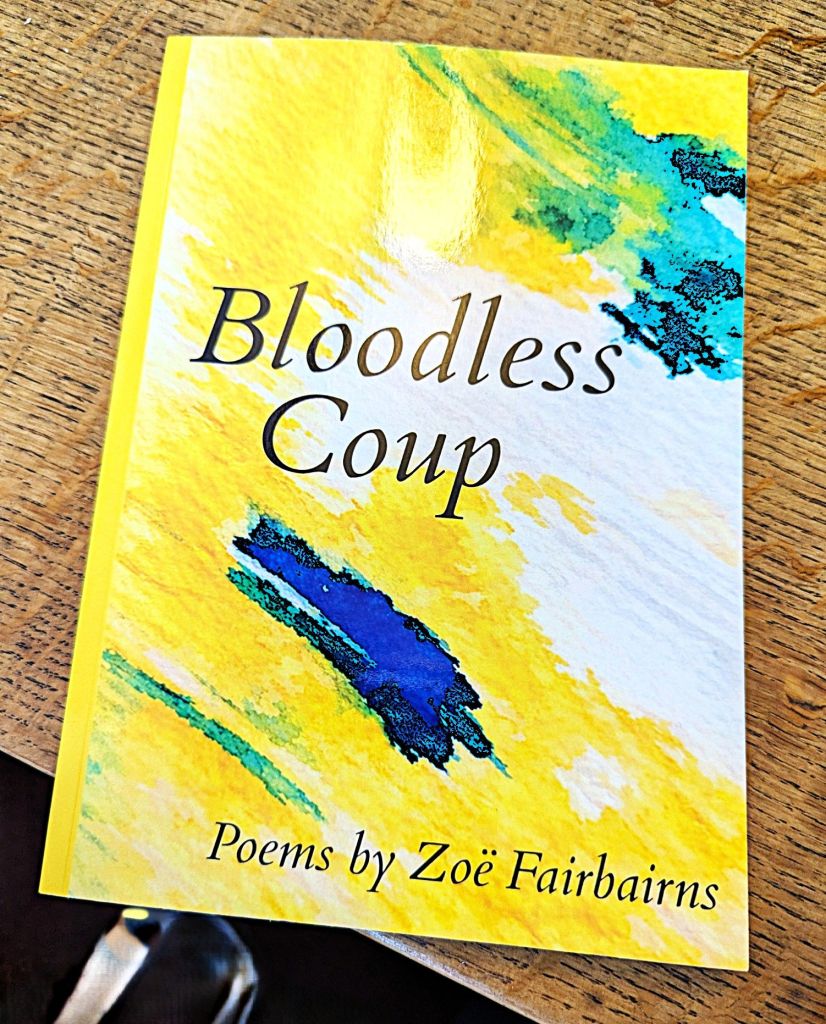
Bloodless Coup is Zoe Fairbairns’ new literary accomplishment. I read her novels, which she began publishing in the late 1970s with admiration and mixed pleasure and anguish. In these, Benefits, Stand We At Last, Daddy’s Girls, Here Today, Closing and Other Names Zoe’s passion for overthrowing the patriarchy led me into a literary landscape that made overwhelmingly clear the agonies to be suffered, and the strength needed, to accomplish her aim. What inspiring and engaging reads they made. Then her short stories in How Do You Pronounce Nulliparous? was a step, that although I prefer novels, was eminently successful. I read them with enthusiasm. Living in Australia, I had little knowledge of Zoe’s work for BBC Radio 4, and I have not seen her drama for the stage. Write Short Stories and Get them published, was yet another venture – non-fiction this time. However, lunching with Zoe recently she added to my pleasure in that by giving me Bloodless Coup.
This is a slim volume, published by the poetry group that Zoe Fairbairns has now joined. From her description, the Lost Souls Events is a thoroughly satisfying writers’ group, that not only publishes selected authors’ works, but provides sustenance to a broad range of writers in their production of such writing. Hopefully my scouring the menu while talking about the group has not led me into describing it wrongly. But, if so, our lunches are full of discussion, agreement and disagreement, about writing, politics, family, travel …and some detail could have been lost in the well-constructed seeming chaos.
Bloodless Coup embodies such debate in an eminently accessible form. Disturbing, enlightening, and fun at times, this is an anthology not to be missed. There are twenty-six poems, some long and others short, but all making me think – sometimes, as for our lunch discussions in agreement, at others in disagreement, but all the ideas are enlightening.
Zoe has been particularly kind to her friends and acquaintances in her poem, “My Disability”. Here she reflects upon the meaning of disability, and her belief that it does not apply to her. However, she has a ‘complication/Which causes consternation/Parts of my body keep quivering/And quaking and shivering’. And the comforting comment from her doctor, comforting not only to her but her friends – ‘It’s not a sign/That you’re about to drop down dead ‘…thank you Zoe, many more lunches together. Her references to other shakers and bobbers – Elvis, The Beatles, Taylor Swift, and children ‘shaking their sillies out’ are a joy to read and contemplate. Zoe’s last reference to Jesus calming the waves, as being unlikely to occur for her, is probably right. But what a remarkable calming impact this poem must have on her friends, and others in her position. Like Elvis? The Beatles? And Taylor Swift! How marvellous. Perhaps children not so much…
The other poems are political and personal too, but connected with Zoe Fairbairns’ beliefs rather than her being. They too, draw one into a world of thought, but one where action can redress the situation. And Fairbairns leaves us under no illusion that her demands require answers and action. In “Power”, she would give the royals ‘proper jobs’ overseen by Republicans; “Assisted Living” is a contemplation of the attempt to introduce Assisted Dying in the Parliament – the loss has consequences that she outlines with sensitivity – and a few rapiers; “Do or Diet” must be read, both for its humour and its horror: rewards and punishments, the understanding that ‘I’m detestable and gross’, and the solution – ‘have lettuce leaves plain yoghurt and black unsweetened tea.
We had a lunch of joyous plentitude, and not a blink of an eye or thought about being gross, thank goodness. I opened the book at intervals, just getting a feel for what I might find. It was worth the few seconds away from face-to-face debate. I was intrigued, and as soon as I got onto the tube back to the hotel, began reading in earnest. I remain intrigued, engaged, and thrilled that there will be more of Zoe Fairbairns’ writing available. Of course, this will not dissuade me from rereading the blemished copies of her novels on my shelf that are not available on kindle, or ignoring the signs on that useful object that tell me ‘Read’.
Bloodless Coup is a thoughtful volume, and I have read it with pleasure…and pain. It is a valuable read from a writer of note. Lost Souls Events is a publisher that deserves to be supported if this is an example of the fine work that is available thought their imprint.
Barbara Pym on stage at the Arcola
This was a wonderful event to be staged while I happened to be in London. I could hardly believe my luck.
Quartet in Autumn was ‘Adapted for the stage by Booker Prize-winning author Samantha Harvey (Orbital) from the beloved novel by Barbara Pym, this is a wryly humorous and poignant ode to ageing, friendship and the strange poetry of everyday life’ – so read the program leaflet.
Quartet in Autumn was short listed for the Booker Prize and marked the return to publication of Barbara Pym’s work after the hiatus attendant on the rejection of An Unsuitable Attachment (posthumous 1982).
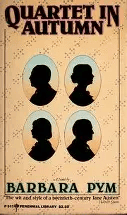
In The Reality Behind Barbara Pym’s Excellent Women: The Troublesome Woman Revealed I wrote the following about Quartet in Autumn:
Later, in writing Quarter in Autumn, Pym renounced her love of quotation, moving into a more modern and grimmer world in which quotations were replaced by arguments more appropriate to the topic and times. Ironically, one reviewer, amongst his criticism, found this a feature to celebrate with the comment, ‘One of the good things about Quartet in Autumn is that for once Barbara Pym’s characters don’t spend too much time casting about for appropriate literary quotations.‘ (New Statesman 23 September 1977).

Of note, considering my questioning the stage interpretation approach that associated Marcia’s decline with a religious fervour, I wrote: ‘In the later novels, social workers and the welfare system partially replaced the clergy and church charitable activities. This change is fully realised in Quartet in Autumn with the creation of Janice Brabner, a social worker utterly unconscious of her own fallibility. The rise of the ostensibly heroic surgeon, exemplified by Mr Strong in the same novel, is another replacement for clerical intercession. In Quartet in Autumn the clergy are demoted to a role with one of the bachelors who, in a further ironic gesture by Pym, is described as going on a ‘church crawl’ ‘(QA, 34). So, yes, I would have liked a stronger emphasis on Janice Brabner’s possibly kindly meant interference in Marcia’s life and her obsession with Mr Strong as the reasons for her decline, in the stage production.
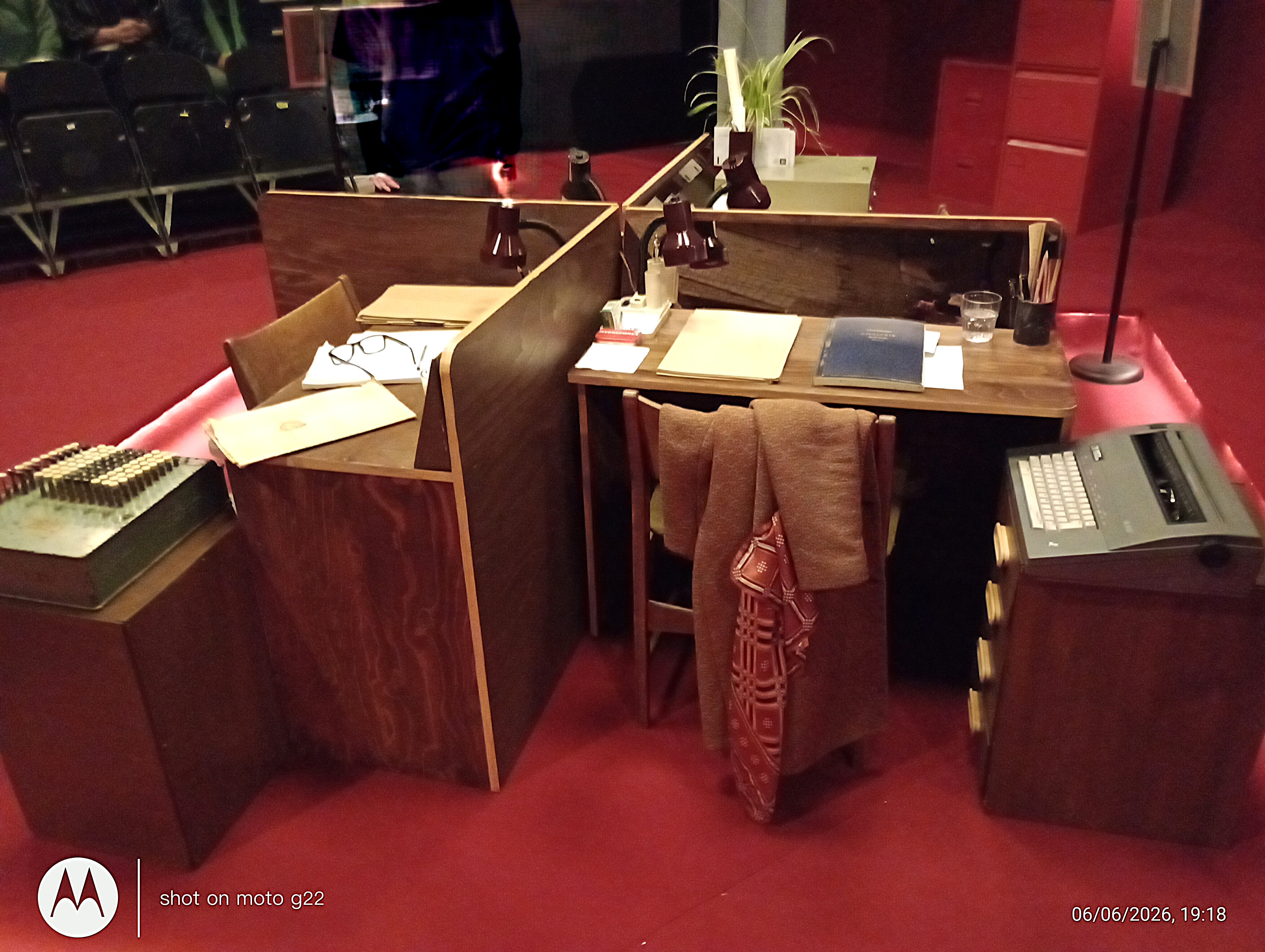
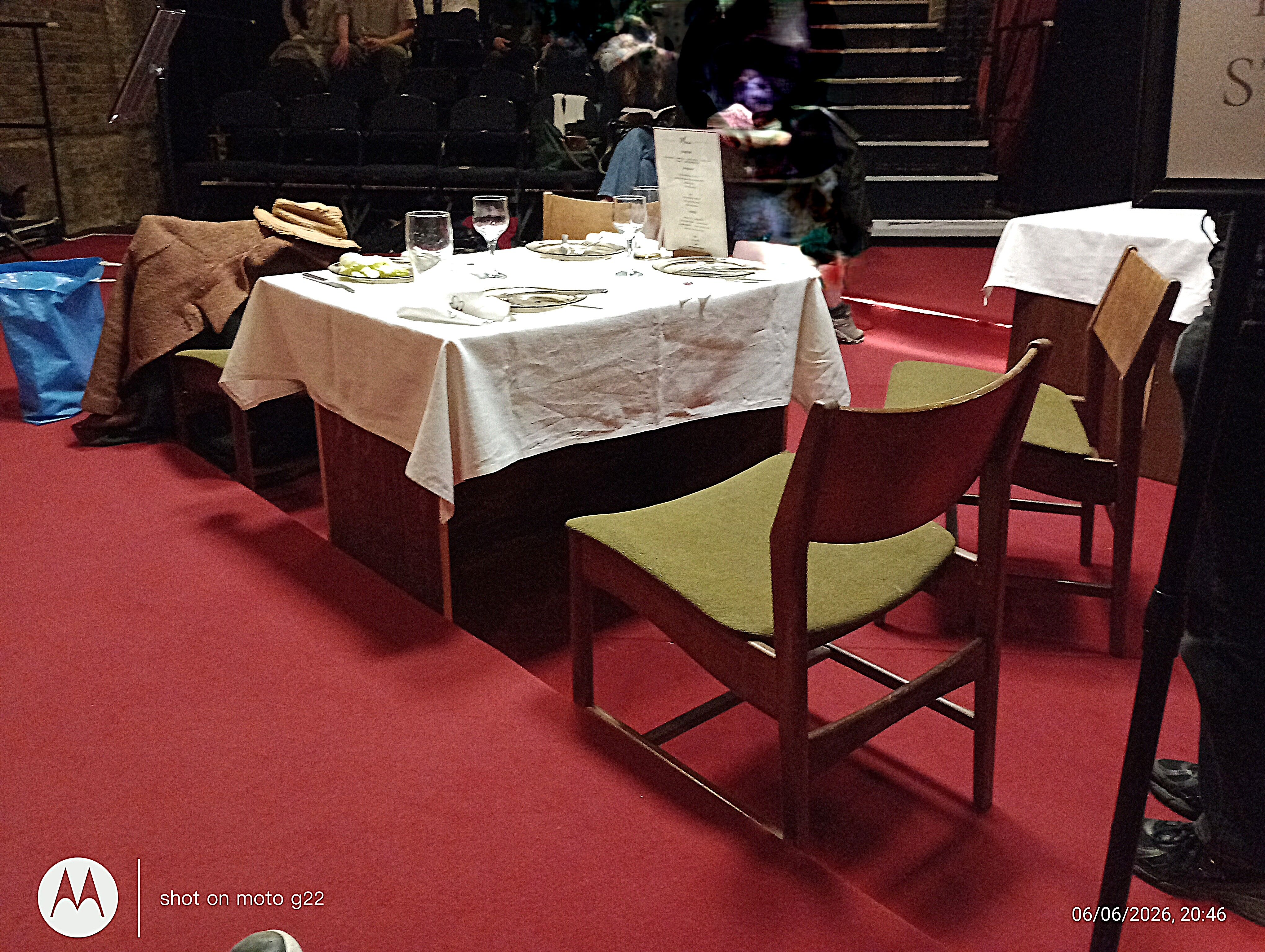
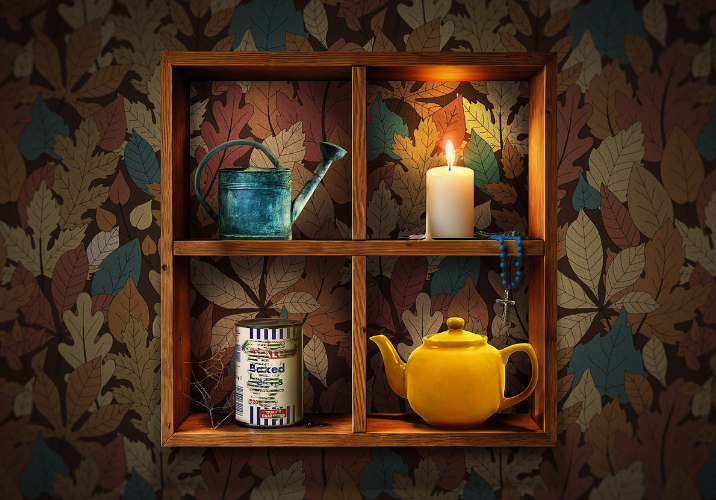
The sets were delightfully simple, as shown below: the office in which the four work, at indeterminate tasks, and the table at which they have a meal together after Letty and Marcia’s retirement. Note the blue garbage bag behind Marcia’s chair, into which she deftly disposes of her lettuce meal while the four talk. What I am unable to show is the comedy when the tins in Marcia’s cupboard are exposed. Of course, this is beautifully measured by the poignancy of her thrift, the actors moving beautifully between the two in their admiration, sorrow…and eventual clutching of tinned food for their own larders. I never cook with butter beans without remembering Marcia, Letty, Edwin and Norman, and wonderful Barbara Pym.
Australian Politics
Why Pauline Hanson’s biggest weakness is her newest voters
June 12, 2026
One Nation’s surge is easiest to read as anger. It is better read through a different lens – gathering the Australians who formed their sense of who they are in an offline world, where belonging was anchored where they grew up.
For the first time, a RedBridge and Accent Research poll for the Financial Review has One Nation leading the primary vote: 31 per cent to Labor’s 28, with the Coalition a distant third on 20. A year earlier the party polled 6.4 per cent at a federal election. The numbers are now familiar enough that the more useful question is no longer how big the surge is, but who is inside it, and why the door they walked through was already wide open.
The standard answer is cost of living and migration. Both are real. Neither explains the shape of the movement, because the people moving are not, for the most part, the people the grievance playbook entirely predicts.
And the answer matters, because the surge is not one movement but two, bolted together. There is an old cohort that came to Hanson on identity and a new one that came on grievance, and they do not want the same things. The seam between them, between the voters who are hers for a generation and the voters who are merely renting, is the whole story. It is what makes the surge look unstoppable today, and it is where the thing can be pulled apart tomorrow.
That is what this essay sets out to do. To split a bloc this size you first have to understand it: who the two cohorts are, what each one actually wants, and which of them is holding on by a thread rather than by conviction. So it works in that order. It diagnoses the old cohort and the new, shows why only one of them is truly Hanson’s, and then traces the seam between them to the point where the newest, softest layer of her vote can be prised away.
The voter surge began with
Start with the voter the surge began with, because the order has been misread. The founding One Nation voter of this cycle was not young and broke. He, and increasingly she, was older: a Baby Boomer or the senior edge of Gen X, Australian-born, who owned the home outright or was within sight of it. In the narrow, cash-flow sense this voter was not poor. The mortgage was gone. What had gone with it was a sense that the world they grew up in, and raised families in, had gone too: not replaced, but declined.
The paid-off home sits in a part of Australia that has been quietly stripped of institutions, industry and services. Since 2017 around 37 per cent of the country’s bank branches have closed, and in the space of three years more than 600 towns were left with no banking service at all. In the Riverina alone, 22 towns have lost their last bank, and Grenfell lost all four of the majors.
The hospital tells the same story. More than 130 rural birthing units have shut their doors, so an expectant mother now drives hours to deliver. There are about 437 full-time-equivalent doctors per 100,000 people in the big cities and roughly 264 in the very remote. Close to one in five remote Australians cannot see a local GP, around 60 per cent have no specialist within reach, and life expectancy runs up to seven years shorter than in the capitals.
And the people are leaving. The young go first, to the capitals for work and study, which has pushed the median age in the regions to 42 against 36 in the cities, with only about 30 per cent of residents outside the capitals now in the prime 20-to-44 band. Whole districts are contracting: wheatbelt towns like Northampton and Morawa shedding three and four per cent in a single year, the old mining centres of Broken Hill, Mount Isa and Port Augusta bleeding numbers, and in a growing list of places the deaths now outnumber the births.
This is the lived backdrop to the founding vote. The housing asset is real, but it is stranded in a town with no bank, no birthing suite, a temporary GP if one can be found, and a school enrolment list that reads like a mirror held up to a community losing its young. The grievance is not how much it costs to live in these towns. It is the sense that the country has been governed, for a long time, by politicians who only care about the big cities, whatever they claim otherwise. So it is no surprise that across the One Nation column the wrong-direction reading sits near 88 per cent, and about a third say, in effect, that they want the system pulled down and rebuilt. Some say, burn it all down.
After the initial surge came a younger cohort, and the most recent movement, especially after Bondi, was led by younger Gen X. These are not asset-secure retirees in a dying town. They are still paying the mortgage, still raising children, and over the past few years they have watched their disposable income fall. They are the sandwich generation, caught between dependent kids and ageing parents, and those parents are disproportionately poor, many of them wholly reliant on the pension. So the hollowing-out of services lands on this cohort from both sides at once. The GP with no appointments are a problem for such a family; the thinning of bulk-billing, aged care and specialist access is a problem for the parents they are trying to keep well. Picture a 49-year-old in an outer-suburban or regional seat: a decade still owing on the house, two teenagers at home, and an 80-year-old mother on the age pension in a town whose last bulk-billing GP retired and was never replaced. For this person, the cost-of-living squeeze and the care squeeze arrived at the same time. That is who moved late, and why.
The diagnosis: identity formed offline
One Nation appeals, in the main though not exclusively, to Australians who formed their identity in an offline world. People who came of age before the online network lived a life anchored in physical place. The reference group was the people within their street or court. Status was local. Information arrived through institutions that sat in the suburb or town, via the lounge room TV, the radio and a newspaper you could buy at the local Milk Bar. To speak to someone your own age on the other side of the world required a pen, paper, a stamp, and the patience to wait a fortnight for a reply. Distance was real, so place in part shaped identity more than today. You knew who you were partly by knowing where you were.
The cohort that came after did not build a self that way. The digital natives formed themselves in networked, portable space, where the reference group is global and chosen rather than local. Belonging travels with them. It is not soil-bound, so a politics that says defend our way of life, place, country, does not resonate as much. This is why One Nation skews older. But age is the proxy, not the mechanism. The real line runs along the boundary between an offline and an online childhood, and that boundary does not fall where you would expect.
That generational split is key, and it is the strongest evidence for the thesis. One Nation’s strongest generation is not the oldest. It is the last one to have had a childhood that was even partly offline. The oldest Millennials and Gen X remember landlines, street directories, and a sense of self, bound to a suburb. The youngest of Gen Z never knew it. The fault line between them is the fault line in the vote. It is also why I would resist collapsing this into a story about old people being angry.
Where they live
Geography follows the same logic, because a place-anchored identity is reinforced by staying in that place for a long time. The vote concentrates in outer metropolitan Australia, the peri-urban fringe, and the regions, among voters with long tenure and low mobility. Queensland is the deepest exposure, where the LNP’s collapse across the regions and outer Brisbane has left One Nation dominating in the polls, in places, as the de facto opposition: Logan, Ipswich, parts of Townsville and Mackay. Western Australia is the next front, through outer Perth and the Mandurah corridor. And the pattern shows up in microcosm wherever you zoom in. In the Nepean by-election the affluent coastal tip held firm for the Liberals, while the stressed bayside strip, Rosebud, Capel Sound, Tootgarook, Rye, recorded a heavy One Nation vote.
How the blocs moved and when
The surge was not one event. It was a sequence, and the order matters, because different voters left traditional politics for different reasons.
The climb began long before many even noticed. One Nation was already in double digits by the end of September 2025, the traditional base consolidating on cost of living and migration while the Coalition was obsessed about leadership challenges.
Hanson’s appearance at Mar-a-Lago for a CPAC address in early November sat on top of that climb rather than causing it. The honest reading is that it was a legitimacy event. It reframed a domestic protest vote as the local chapter of a global realignment and gave nativist conservatives a permission structure to move. It also carried a cost the polling hints at: in the more affluent, traditionally conservative pockets, the Trump association repels as much as it recruits. There is a Mar-a-Lago scent that puts a ceiling on the vote in precisely the professional-class areas the right needs to hold.
Figure 1 – One Nation primary vote, May 2025 to May 2026 A structural climb, ratified at Mar-a-Lago, then broken open after Bondi. The phase strip marks which bloc moved in each window.
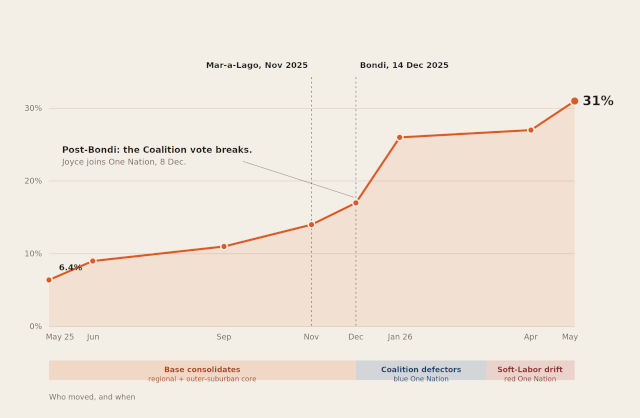
The catalyst that turned a significant vote into a leading one came on 14 December, at Bondi. The terrorist attack on a Hanukkah gathering, and the official response that followed, did the work no campaign could. The government’s language was judged, well beyond the One Nation base, as failing to meet the moment. Then the Coalition came across as playing politics with the tragedy, and in doing so vacated the ground it had been holding. That is the moment the first large wave moved: conservative Coalition voters, the blue One Nation cohort, walking out of a Liberal Party they no longer recognised as theirs. Barnaby Joyce also joining One Nation on 8 December gave the defection a face.
The most recent and still limited phase is different again. Through 2026, the cost-of-living grind now seems like a long term trend, triggering some soft Labor voters in the regions to drift. This is the red One Nation cohort, working people whose grandparents would not have given the One Nation a hearing. The movement out of Labor is smaller than the movement out of the Coalition, and it is concentrated in regional seats rather than the cities.
What the diagnosis implies
If the vote is anchored in a place-formed identity rather than in the world the iPhone made, two things follow.
The first is that it will not be bought off. A budget measure can ease a mortgage. It cannot return a voter to a country that feels like the one they grew up in, because that country was partly a function of being younger in a smaller, more legible world. The grievance is real, but at root it is not fiscal, which is why fiscal answers keep sailing past it.
The second is that the ceiling is generational, and hence it is now rising a lot more slowly than it did in the initial growth period. One Nation owns the offline-formed cohorts and is weak among the digital natives now joining the roll. The party’s task is to hold the offline-formed cohorts it has gathered, the Boomers and Gen X above all. The majors face the harder job: to speak to a voter whose sense of loss is about belonging, in a language that does not sound like the official language that voter has already decided cannot be trusted.
For now the contest, on current numbers, runs between Labor and One Nation, and the Coalition watches from the stands. The voter who put it there is not the angry regional man of the caricature. She is more likely to be older, secure on paper, and grieving a place that emptied out around her.
Where the One Nation bloc could come apart
If the bond is identity rather than policy, that is also where One Nation is most exposed. Its vote is not held together by an agreed policy platform – far from it. It is held together by a feeling that Hanson is one of us, and the blocs beneath that support are diverse and do not actually agree with one another. The founding base is culturally conservative and nativist. The newest arrivals, the younger Gen X and the ex-Labor movers who turned a strong vote into a leading one, are something else again: economic populists. They want wages to rise, services restored, and the powerful made to pay, and on social questions they are far more moderate than the label suggests.
On our reading, more than half of this cohort support access to abortion. They did not come to Hanson for some social-conservative revolution. They came because she was the only figure who seemed to be standing up for them, or who simply offered to turn a system they loathe on its head.
You do not break a coalition like this by attacking it head-on. You break it by making its two halves see each other clearly, and by forcing the figure who holds them together to choose between them. Industrial relations is the lever, because it is the issue on which the old cohort and the new are furthest apart and on which Hanson is most exposed. One Nation has a long record of siding with employers and the big end of town, voting against the wage floors, the bargaining rights and the penalty-rate protections the new economic-populist bloc relies on. For the founding base this barely registers; their bond with Hanson was never about a payslip. For the late movers it is close to the whole point.
Put that record under a light, attach a number to it, the rise they did not get, the cut they did wear, and the two cohorts are suddenly looking at different parties wearing the same name. Hanson cannot satisfy both. Hold the base and the donor class and she confirms to the new bloc that she stands with the bosses; lunge left to keep the new bloc and she dissolves the anti-politician authenticity that holds the old one, and starts to look like exactly the thing they fled.
The same fault runs through the rest of her positioning. Her embrace of Trump, gold to the nativist core as a badge of belonging to a global movement, reads to the economic populist as proof she has joined the billionaire politics she claims to fight. On abortion and the wider social agenda she sits well to the right of a new cohort that is, on these questions, relaxed or actively liberal. Each is a point where the thing that thrills the old bloc quietly unsettles the new.
None of this moves the founding base. Identity that deep does not turn on a policy platform, and it should not be the target. But it does not have to be. Any attempt to pull apart One Nation has to lead with a focus on the newest and softest layer, the late movers who arrived on grievance, security and cost of living rather than on tribe. The campaign that beats One Nation will not argue with the grievance, which is real and which these voters have already had validated by the result. It will do something narrower: it will make Hanson legible as a politician with positions, and show that on the things this cohort actually cares about – their wages, their parents’ care, their own freedoms – she is not on their side.
The day she stops being one of us and becomes one of them, the grievance detaches from her, and these voters are available again, most obviously to whichever major party is willing to hold the economic-populist, pro-services, socially moderate ground she only appeared to occupy.
That is the fault line and true weakness in the surge.
The views expressed in this article may or may not reflect those of Pearls and Irritations.
Kos Samaras
Kos Samaras is a director at RedBridge Group, a research and strategy firm specialising in public opinion, social trends, and behavioural insights. He works across industry, government, and media to help organisations understand community attitudes and navigate complex social and political environments.
American Politics
| Thom Hartmann – Raw America <rawstory+fridays-with-thom@substack.com> |
Forwarded this email? Subscribe here for more We must all become truth-tellers, whether our platform is radio, TV, Substack, social media, a local newspaper, or a protest sign raised in the town square…Thom Hartmann and Raw AmericaJun 5 |
I started in radio news as a teenage reporter at WITL-AM/FM in Lansing, Michigan, then the number one station in the capitol city. I began reporting from the Capitol and City Hall, and was writing and reading the morning newscasts within a year.
The station owner was a hardcore Goldwater Republican, our news director was a liberal but Libertarian-curious Democrat, and I was a long-haired anti-war hippie member of MSU SDS.
I did the news there for years, and nobody ever told me how to spin it or what to insert or delete. I knew that I couldn’t bias it to reflect my own opinions: the news — accurate, factual, honest information — was sacred.
It was also the cost of our broadcast license, and we all knew it. The widely misunderstood Fairness Doctrine’s main demand was that radio and TV stations “program in the public interest” and that was widely understood to mean straightforward, reliable, faithful-to-reality news at the top and bottom of every hour on radio and an hourlong news block in prime time on TV.
We did this — and embraced the Fairness Doctrine — because we knew it was part of the price of freedom, of democracy in our republic. When Thomas Jefferson said he’d rather live in a country with newspapers and no government than in one with a government but no newspapers, he wasn’t knocking government; he’d help create ours and was its president for 8 years. He was talking about the vital importance of an honest and free press.
Part of that honesty came from the competition; there were multiple stations in Lansing and most had an in-house news operation like ours, and the ones that didn’t ran the CBS or AP radio newscast twice an hour. Honesty and clarity were essential to get and maintain an audience, as well as hanging onto our license.
Reagan ended the Fairness Doctrine in 1987 and now Trump and his oligarch enablers are trying to bury the entire concept of honest, straightforward news.
Over the past year-and-a-half we’ve watched Brendan Carr, Trump’s hitman at the FCC, go to CPAC conferences and brag about how he’s going to assault stations that say things he and Trump dislike. He’s trying to intimidate ABC affiliates into muzzling Jimmy Kimmel — again. And he succeeded in taking down Stephen Colbert.
And a Trump-adjacent billionaire nepo-baby has acquired CBS and is systematically stripping it of its journalistic integrity, starting with the evening news and now gutting the nation’s number-one news magazine show, 60 Minutes.
Storied journalist and 60 Minutes reporter Scott Pelley isn’t taking it lying down, even though it’s a virtual certainty that he has the standard non-disparagement clause that most media operations now require for talent which forbid them to ever speak ill of their former employer should they leave for any reason. He’ll probably get sued for it, but he’s a man committed to the truth.
Trump, Ellison, Weiss, the billionaire owners of Sinclair, the billionaire Murdoch family’s Fox “News,” the 1,000+ billionaire-owned radio stations across the country, the billionaire-subsidized podcasters, and billionaire-owned social media sites like Facebook and X that have apparently been algorithmically slanted toward Trump’s neofascist movement are all following an ancient script.
Enjoying this column? Become a paying subscriber of Raw America. You’ll get members-only newsletters and live interviews, plus membership in a thriving liberal community. Join our people-powered movement!
British Politics
The Steely-eyed Messenger of Death Goes to the MoD
Tom Watson <tomwatsonofficial@substack.com> Unsubscribe
Forwarded this email? Subscribe here for more
Dan Jarvis has spent his career being cool under fire. He’ll need every bit of it to win a budget battle his predecessor just lost. Jun 12
The Parachute Regiment does not hand out sentimental nicknames. The one they gave Dan Jarvis was SEMOD: Steely-eyed Messenger of Death. Soldiers reserve that sort of dark tribute for officers who stay calm when everything around them is not. Yesterday evening, with his government reeling and his predecessor’s resignation letter still warm, Keir Starmer made SEMOD the Secretary of State for Defence.
Dan JarvisI first met Dan in 2011, when I was sent to Barnsley to talk to the team about the shape of his by-election. Making conversation, I asked him whether he had any hobbies. “I like the odd run,” he said. On prompting, it emerged that the odd run meant seven marathons in seven days, in a desert. The canvass teams soon learned what that understatement concealed. They would come back from doorknocking sessions complaining that they couldn’t keep up with him.
That is Jarvis in miniature. The flat Nottingham vowels, the mild manner, the instinct to undersell, and underneath it a capacity for endurance that borders on the supernatural.The biography is by now well known, though it bears repeating because so few politicians have one like it. A comprehensive school in Nottingham. International politics at Aberystwyth. Sandhurst at twenty-three. Fifteen years in the Parachute Regiment, with tours in Northern Ireland, Kosovo, Sierra Leone, Iraq and Afghanistan, and an MBE along the way. As a young captain in Kosovo he stood yards from General Sir Mike Jackson during the standoff at Pristina airport, listening as Jackson told the American General Wesley Clark he was “not going to start World War Three for you”.
Jarvis later called it “a very surreal moment in my life”. Jackson liked what he saw and made him his personal staff officer. By Helmand, Jarvis was commanding a company against the Taliban in night fighting of the kind most of his parliamentary colleagues have only read about.The harder story ran alongside the military one. His first wife Caroline was diagnosed with cancer while he was still serving. She died in 2010, at 43, leaving him with two young children. Months later, with a by-election Barnsley looming, Jarvis became the first soldier since the Second World War to resign his commission to fight it. He won and has held the seat and its successor ever since. His memoir of those years, Long Way Home, took him five years to write and won Best Memoir at the 2020 Parliamentary Book Awards. It is a book about grief written in the register of a soldier’s report: here are the facts, draw your own conclusions. It is all the more devastating for it.
Then came the long wait. From 2015 onwards, Jarvis was the leader Labour’s moderates kept almost drafting. He declined to stand against the post-Miliband field (Burnham, Cooper, Corbyn), saying his young family came first, and later admitted he regretted not thinking harder about it. His 2016 speech at Demos was the boldest thing he has said in public: “New Labour’s approach wasn’t enough. It didn’t get at the root causes.” He understood before most of his colleagues that globalisation had delivered cheap consumer goods and cheap labour in the same container. He flirted again in 2019 and again stood back. Instead he became the first Mayor of South Yorkshire, steering the region through Covid and the floods, then returned to the front line as security minister after the 2024 election. He has spent two years immersed in the threat picture: Iranian plots, Russian sabotage, the hard wiring of the national security state. Nobody arrives at the Ministry of Defence better prepared.
He arrives, though, over the body of a good man.John Healey deserves an honourable political obituary. The son of a Wakefield family who finished his pre-university education at one of the most prestigious private schools in the country before Cambridge, he came up through the disability rights movement and the TUC, where he was campaigns director. He has sat in the Commons since 1997, served Tony and Gordon as a well respected minister, shadowed defence for four years and then did the job itself with distinction: leading Europe’s support for Ukraine, delivering the Strategic Defence Review, securing the biggest forces pay rise in nearly twenty years. He was among the most capable ministers in this government. His resignation letter pulled no punches: “You have been unable, and the Treasury has been unwilling, to commit the resources that the nation needs to defend the country at this time of rising threats.” Fairness requires one caveat. The Defence Investment Plan had been delayed for the best part of a year on his watch, to the fury of industry and the dismay of allies, and there is a respectable argument that he should have forced the issue sooner. But a cabinet minister resigning over a point of principle is rare enough to command respect. He goes with his reputation enhanced.Which makes Jarvis’s task brutally clear. He inherits a settlement his predecessor judged a danger to the country: spending creeping from 2.6 per cent of GDP next year to 2.68 per cent by 2030, an extra £13.5 billion against the £28 billion the service chiefs say they need. The armed forces minister Al Carns, another decorated soldier, walked out alongside Healey. In resigning after John, Carns showed that however stellar military his career, his political judgement was poor. The causes he proclaimed in his resignation letter required him to be on the inside, not on a tour of the resignation interview circuit.
The defence community, from the chiefs to the supply chain, is distinctly irritated, and worse: it agrees with the Secretary of State who just resigned. Jarvis’s biggest challenge is convincing that community he can hustle up the defence budget across Whitehall, against a Treasury that has just faced down a defence secretary and won.My guess is that he can. Here is why. The single biggest question being put to the various candidates for the Labour leadership, despite there being no vacancy, is where do you stand on defence and the defence budget. Wes Streeting has gone to the backbenchers to build his platform. Andy Burnham circles with his. Every contender knows that credibility on national security is now the entry ticket to the contest, just as Jarvis himself argued back in 2019 when he said a Labour leader “had to be credible when it comes to the economy and when it comes to national security”. A prime minister fighting for his political life cannot afford to lose two defence secretaries over money in one parliament. Jarvis knows it. The Treasury knows it. That is leverage, and leverage is what Healey, for all his virtues, never quite had.There is a deeper shift underneath. For a decade the party’s centre of gravity ran through health, housing and the cost of living. It now runs through the defence of the realm. Politics has moved, at last, onto Dan Jarvis’s ground: the man with the medals, the comprehensive education and the marathon habit, who has waited fifteen years while lesser CVs overtook him in the queue.
The defence establishment is angry, the budget is short and the government is wounded. Cool under fire is no longer a line in his memoir. It is the job description. This is the coming of the Dan, and the question that has trailed him since Barnsley, whether there is more to him than the back story, is finally about to get its answer.
Several readers have asked that I continue to write pen portraits of my colleagues. I hope you like the latest and if you think others may like it, please share this newsletter with them.