Week beginning 31 May

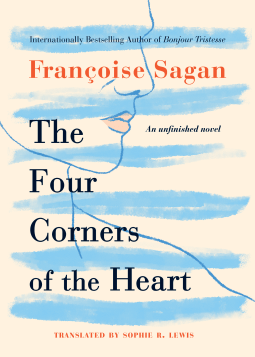
This week the second of the books in Kerry Wilkinson’s Whitecliff Bay series is reviewed. NetGalley provided me with the uncorrected proof.

Kerry Wilkinson The One Who Was Taken (A Whitecliff Bay Mystery Book 2) Bookouture 2023.

The One Who Was Taken continues this series in which more information about the appealing  main character, Millie,  is divulged. At the same time a mystery is solved, and the relationships with her journalist friend, and her former husband and their son, move forward. Ingrid, from The One Who Fell, reappears, maintaining Wilkinson’s commitment to strengthening the image of older people. While long term personal relationships are developed, Millie’s school days are revisited with a mystery and a community concern about housing to be resolved. Nothing happens at a fast pace. However, for me, this is part of the charm of this series. See Books: Reviews for the complete review.

After the Covid Update: Cindy Lou eats out in Melbourne; Grace A., guest reviewer, talks about eating at Sunda; Neryssa Asland reports on racist social media related to Q+A; Reconciliation Week; Heather Cox Richardson’s American Letter.

Covid update for Canberra

Total cases since March 2020 number 240,574, with the total number of lives lost over that time, 237. There were 996 new cases this week (26 May 2023), with 32 people with Covid hospitalised. Two are in ICU, with 1 ventilated. No lives have been lost this week.

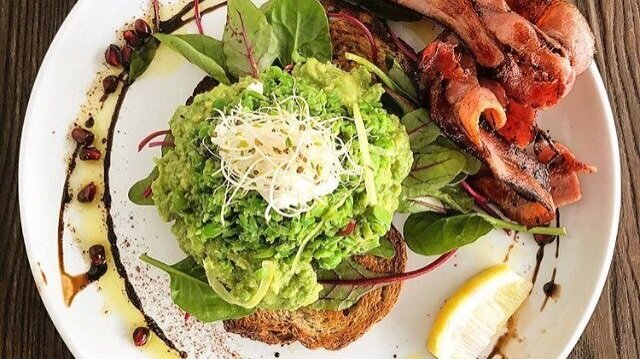
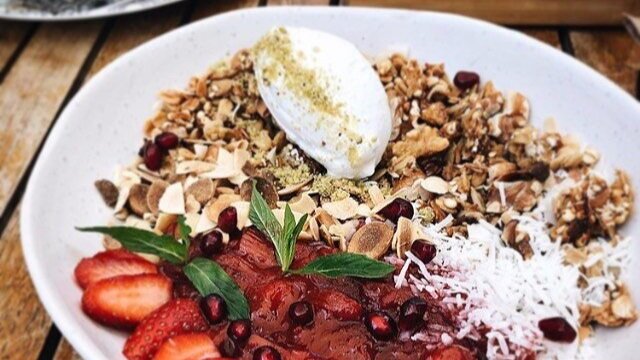
Cindy Lou continues eating out in Melbourne

Alytanya  

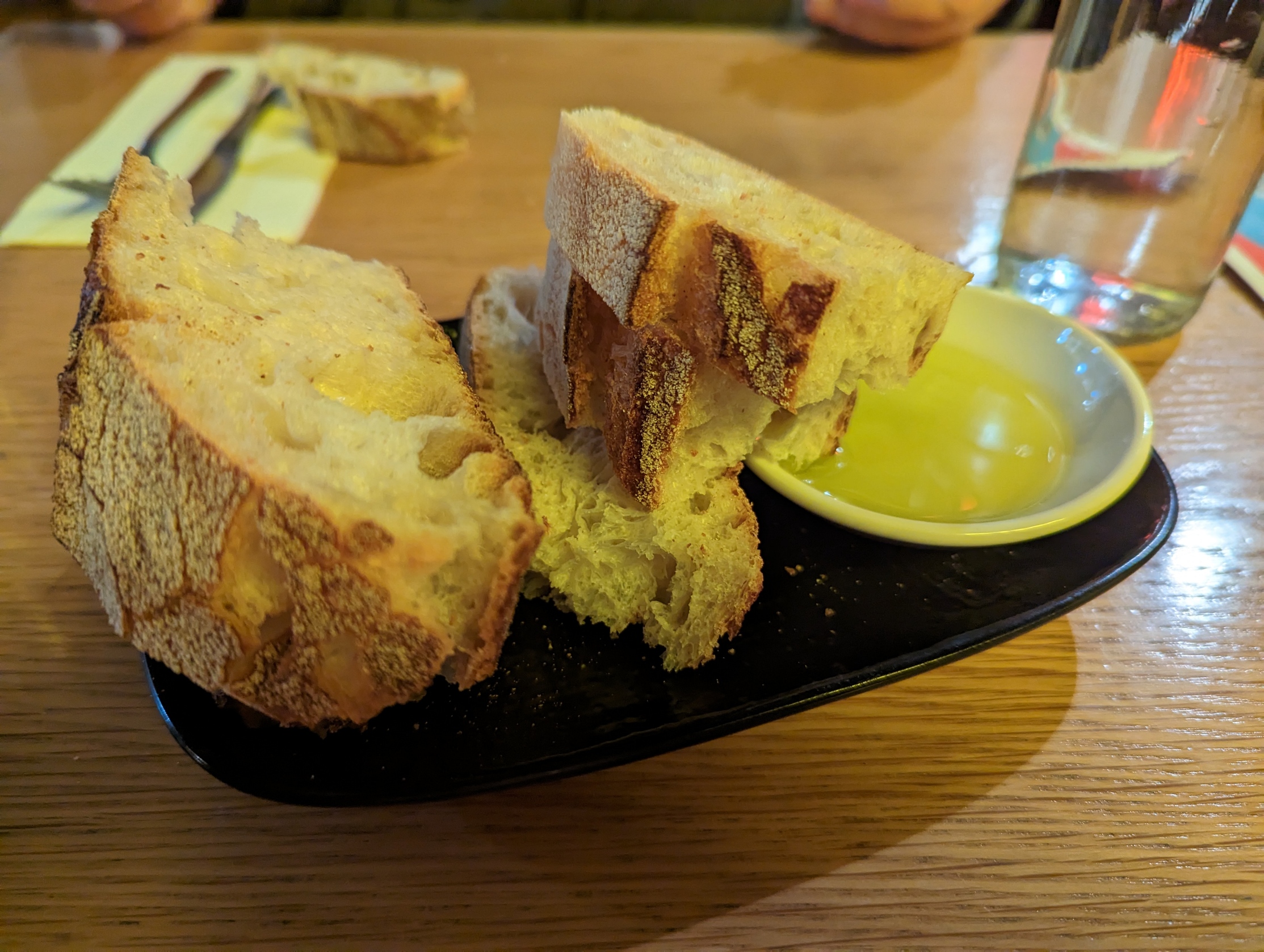
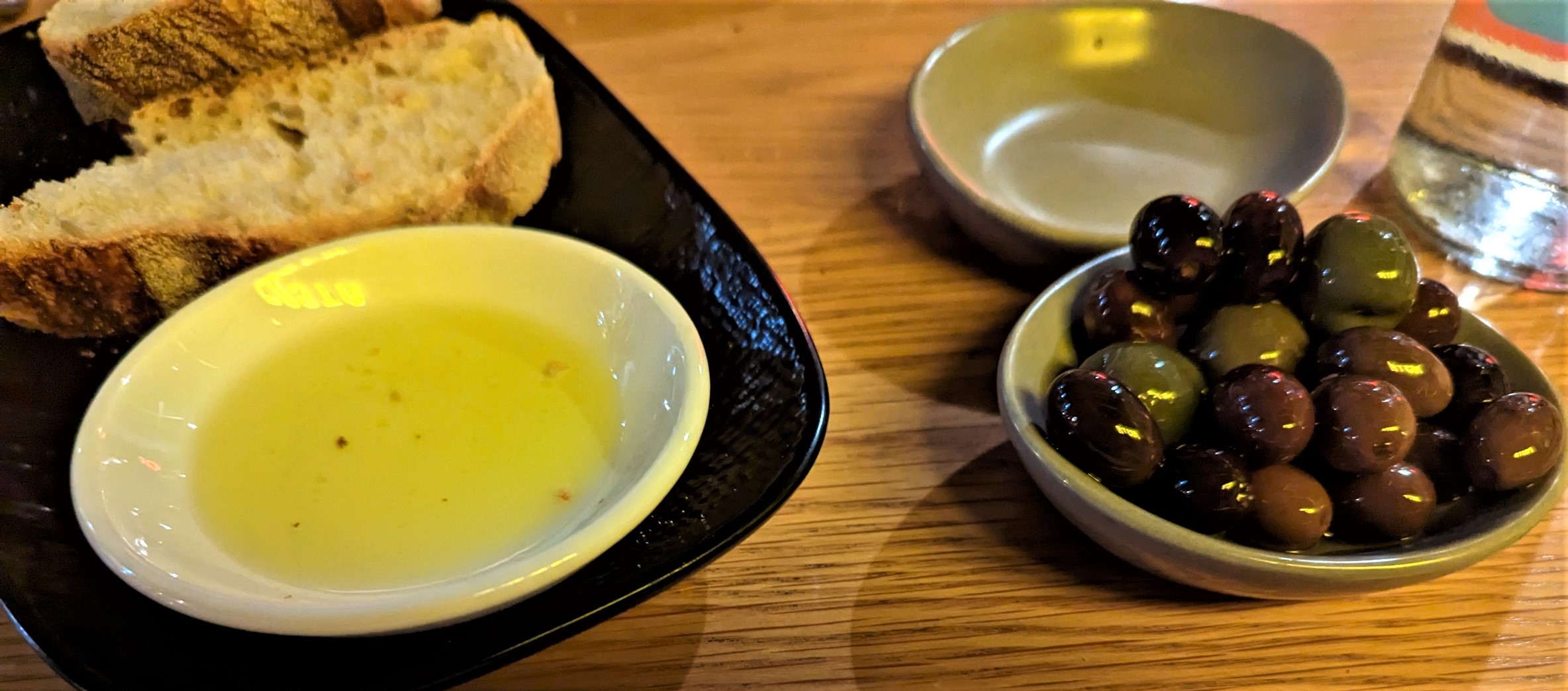
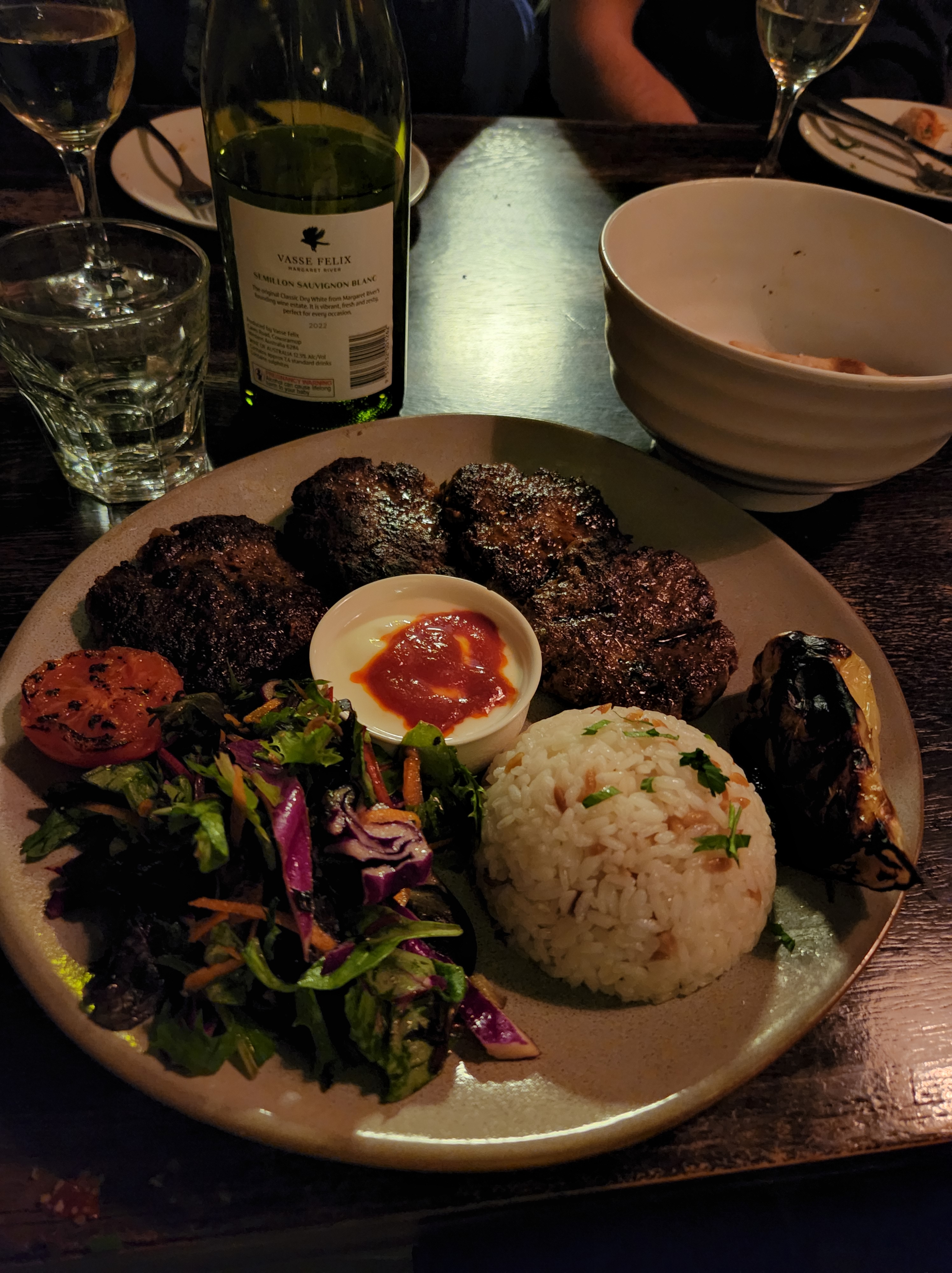
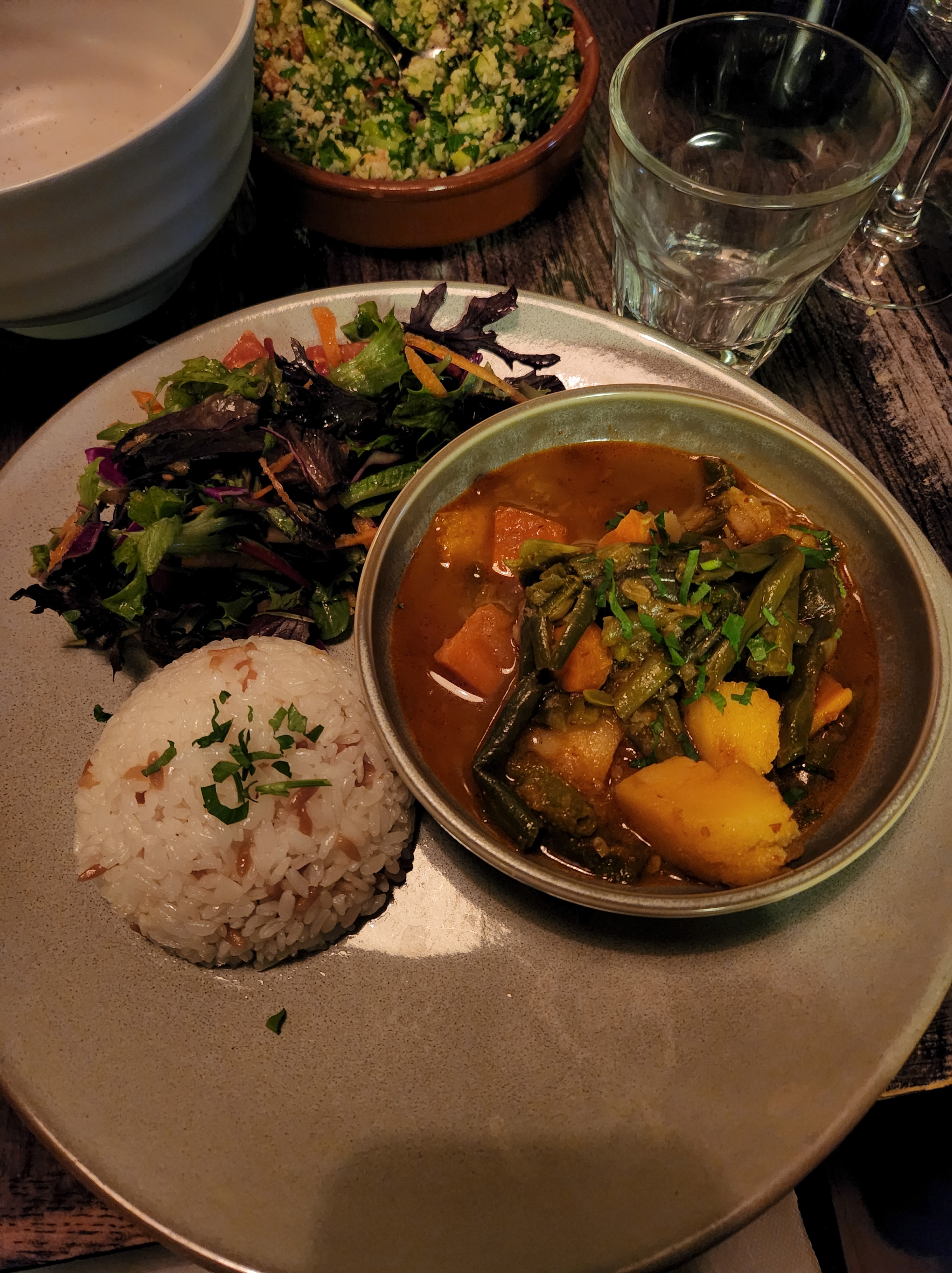
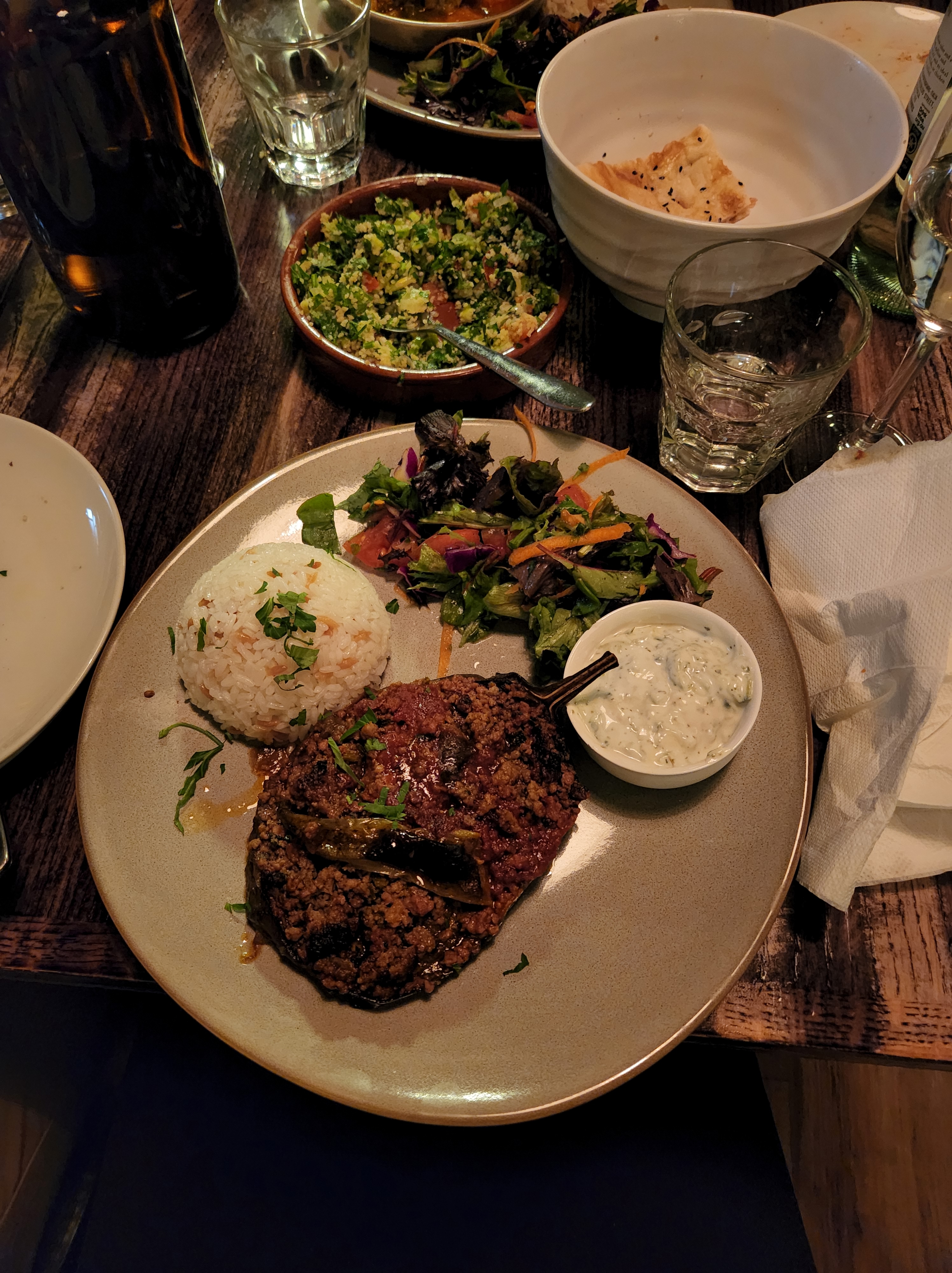
Melbourne friends suggested that this was a restaurant not to be missed if we wanted authentic Turkish food. I have to agree about the baba ghanoush in particular – it was the smokiest I have tasted since being in Turkey. The bread with the five dips with which we began was hot, crisp on the crust and chewy (in the best possible way) on the inside. A truly delightful beginning to a very good meal. The dishes were generous in size and flavorsome. My chicken skewers, not pictured, were beautifully moist and tender. The salad and rice, with a lovely pepper were excellent accompaniments.

The atmosphere was lively – and even more so when a charming belly dancer appeared. She made a delightful addition to what was already a very pleasant evening. She was sensitive to the crowd, encouraging some brave people to join her, and leaving the not so brave to quietly enjoy. One of our companions was amongst the former and was magnificent in her smilingly enthusiastic approach to the dancing. She was excellent, and we certainly did not tell her to keep her day job!

Unfortunately, the meals were so generous we were unable to have dessert. Next time we might see if it’s possible to share some of the main meals and be able to indulge in some baklava or Turkish delight.

Our first culinary experience was in the Pentridge Complex, where the Boot Factory was an excellent beginning to our six-person group eating in Melbourne. It is part of the Pentridge Complex, which includes the Adina Apartments, and a small shopping mall with two other coffee venues (one serving breakfasts and pastries, the other beautifully elegant pastries and cakes). The mall includes an art gallery (more on this next week) and a frieze telling the story of Pentridge Goal use to which the site has now been put. Sydney Road and the tram are close by, and the Coburg Station is a reasonable walk.

The Boot Factory

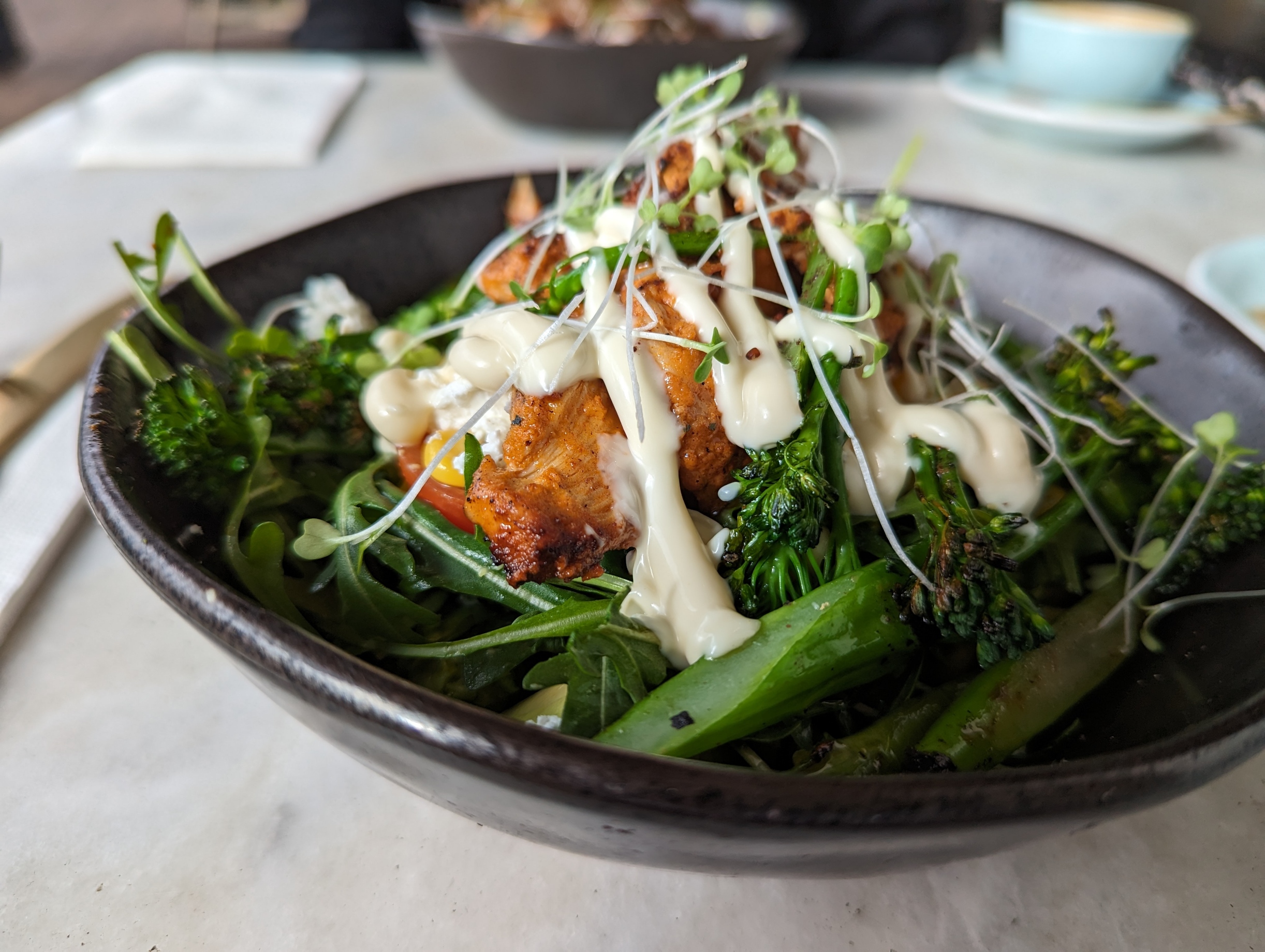
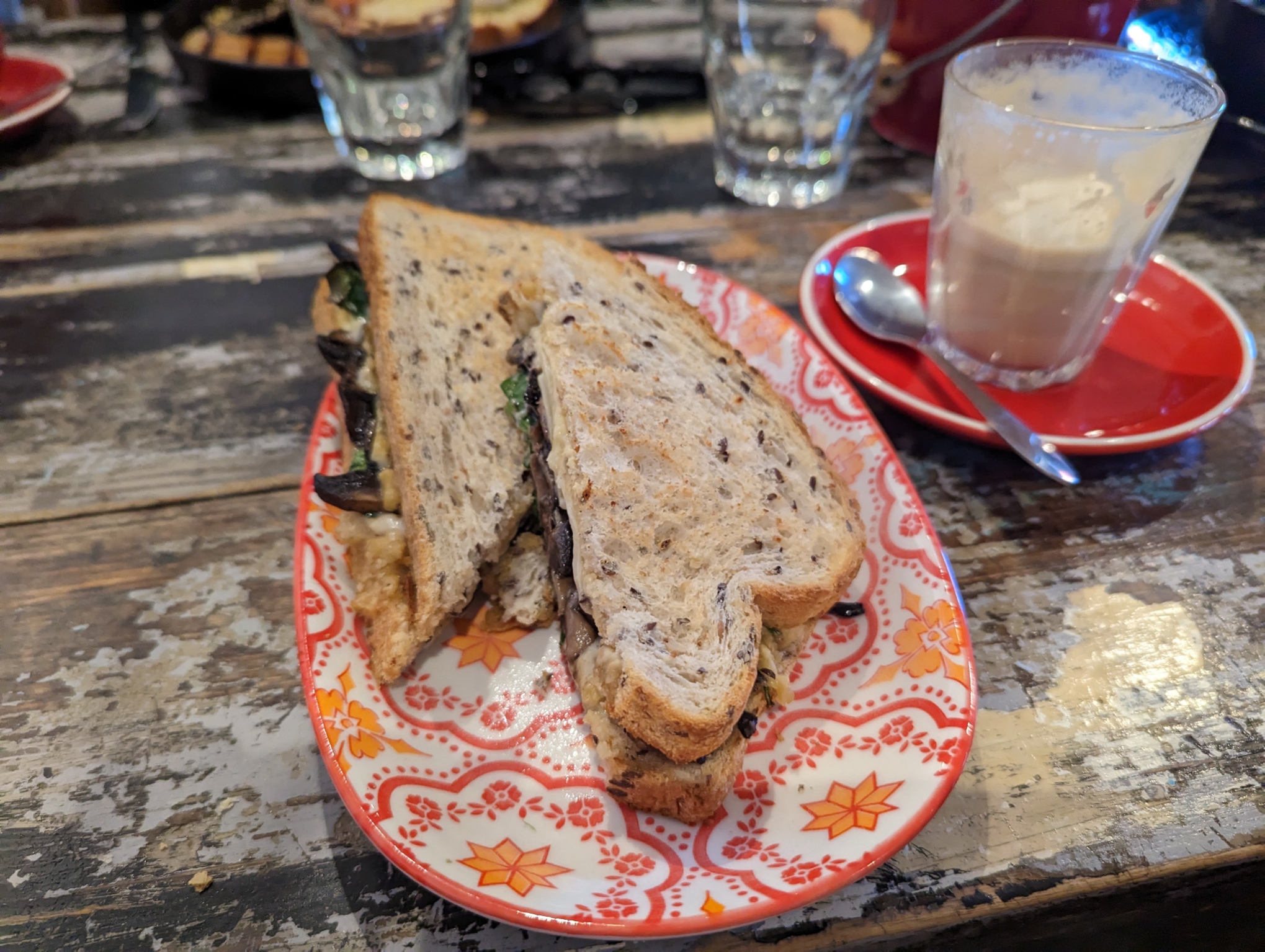
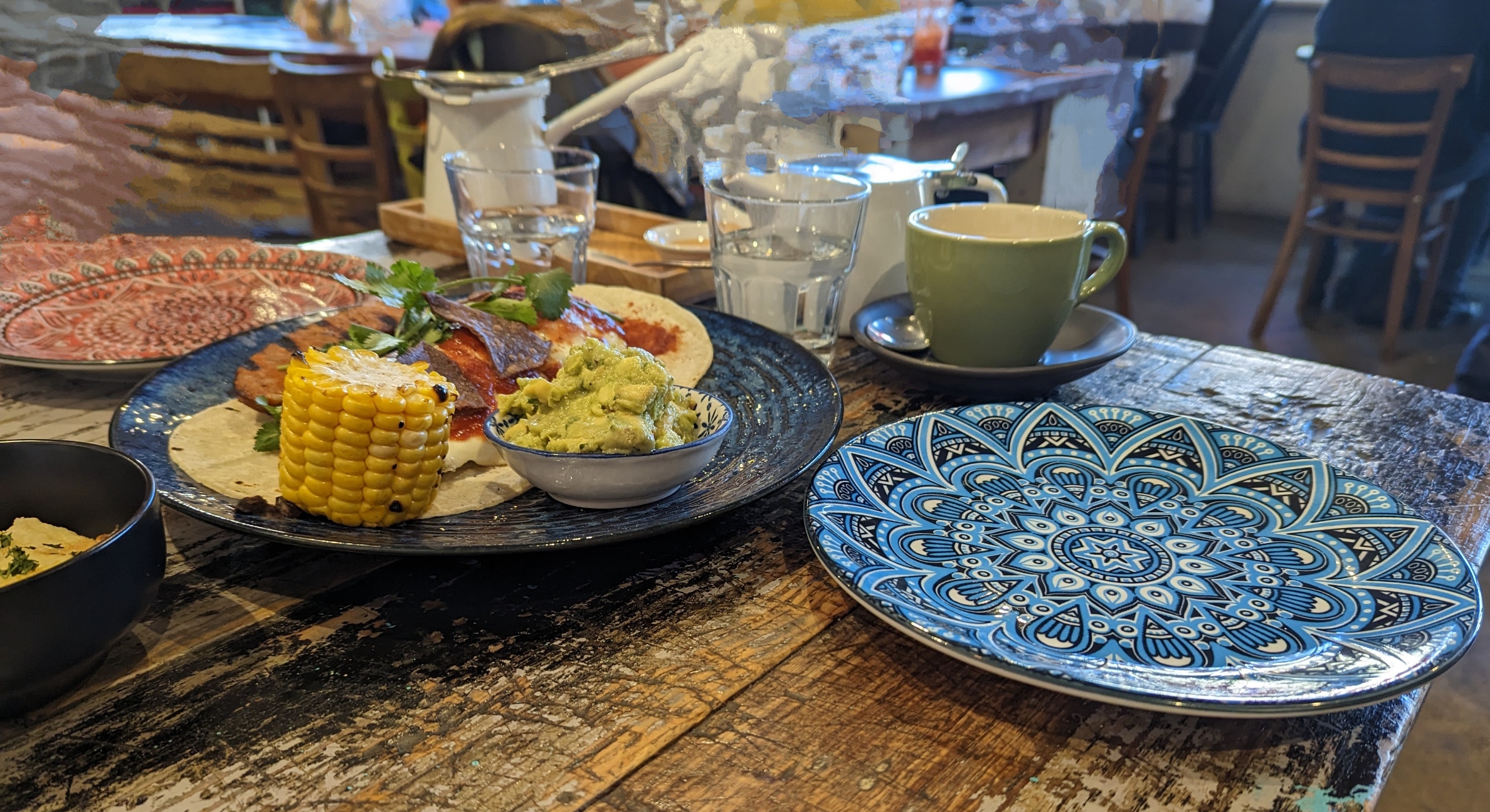
This is a lively eating place with a large and interesting menu. The coffee is good, the meals substantial, and the service competent and pleasant. The large breakfast and the Mexican inspired meals were the most interesting. However, the kale addition to poached eggs was a nice innovation, and my mushroom toastie resplendent with mushrooms.

Cobrick Cafe

This cafe has a cosy section entered through the mall, and a light and lovely section with huge glass windows which can be entered from outside. We enjoyed the later, with its sunny spots interspersed with a few raindrops. And why should we have expected anything different in Melbourne?

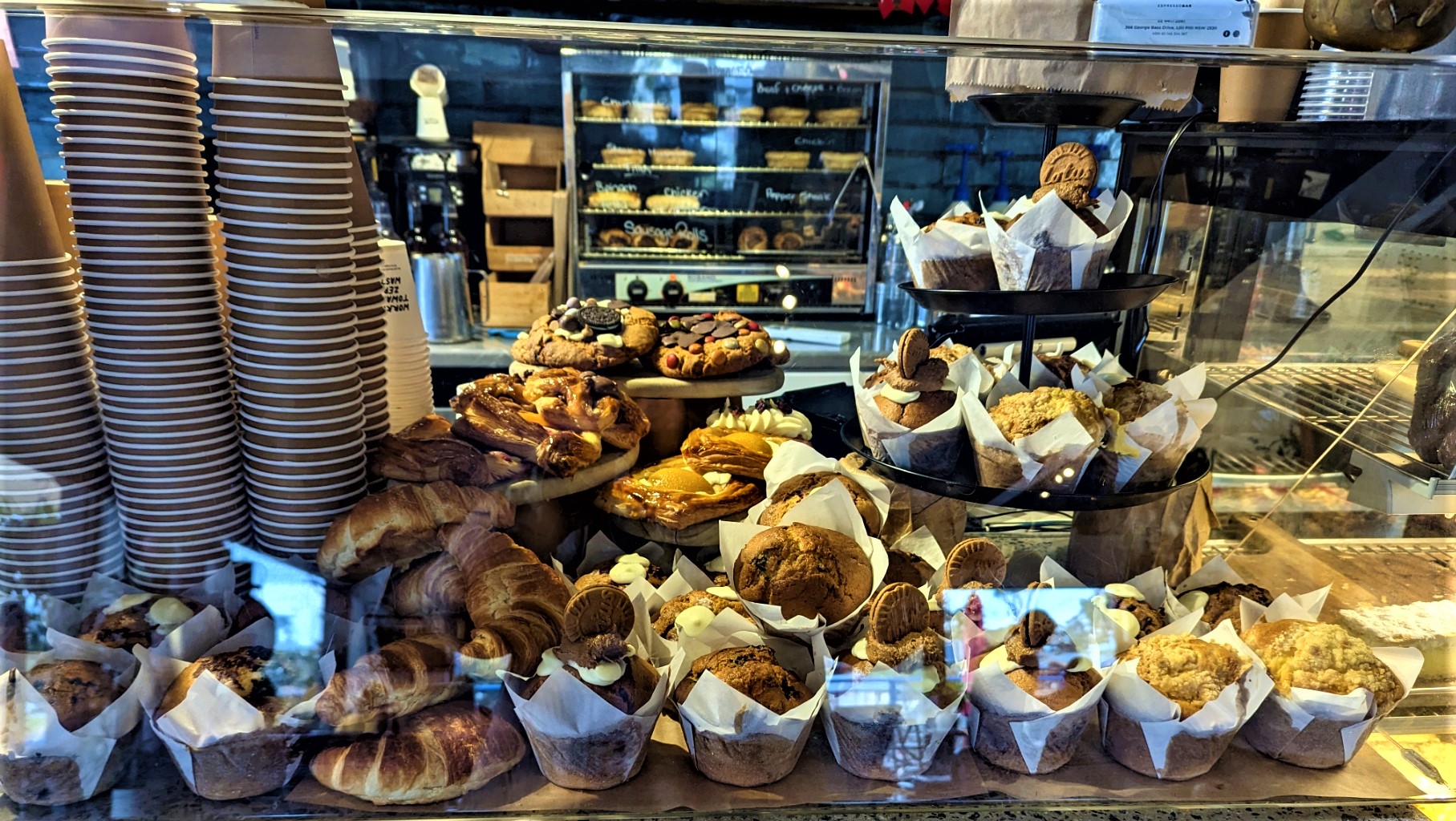
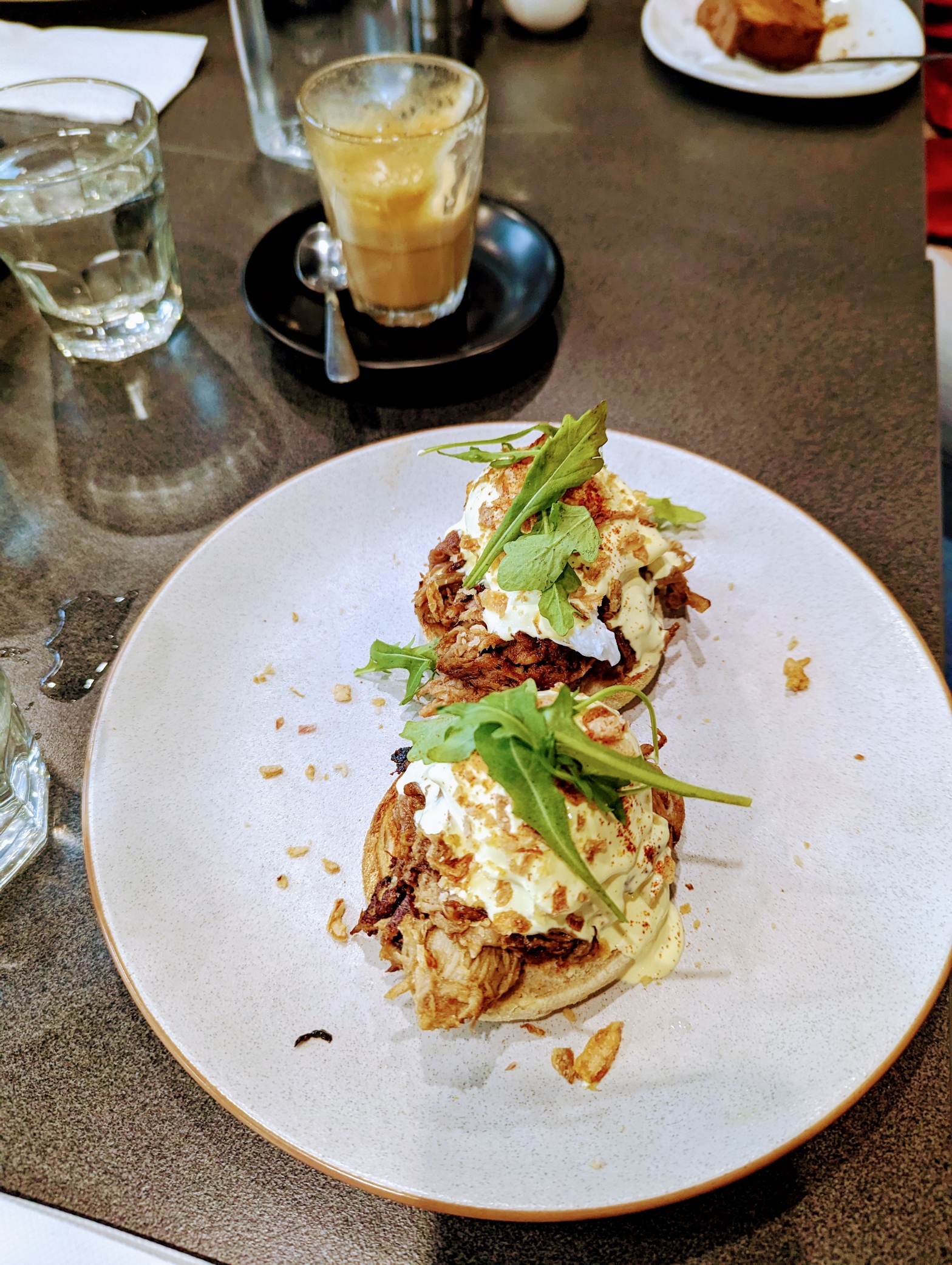
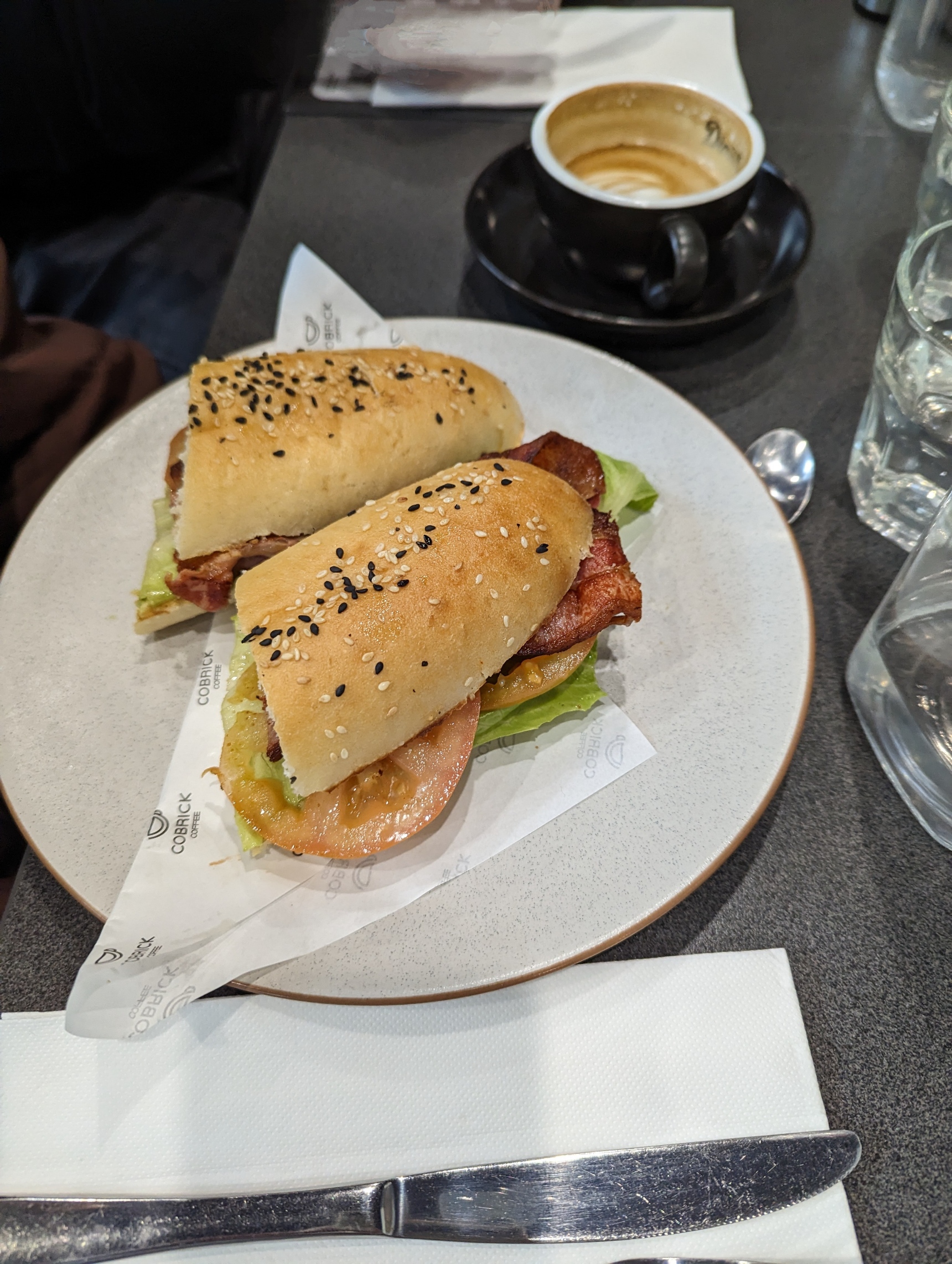
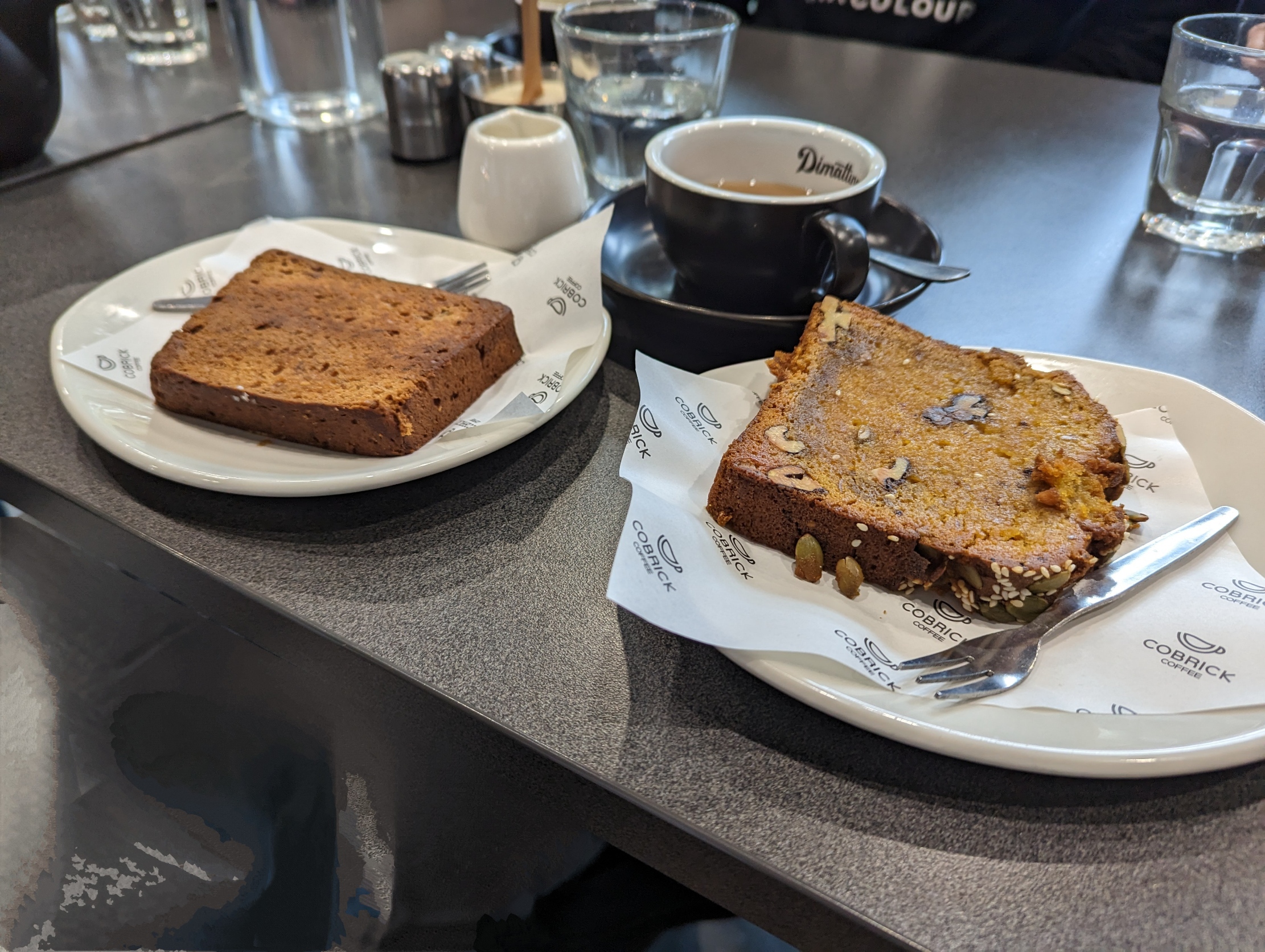
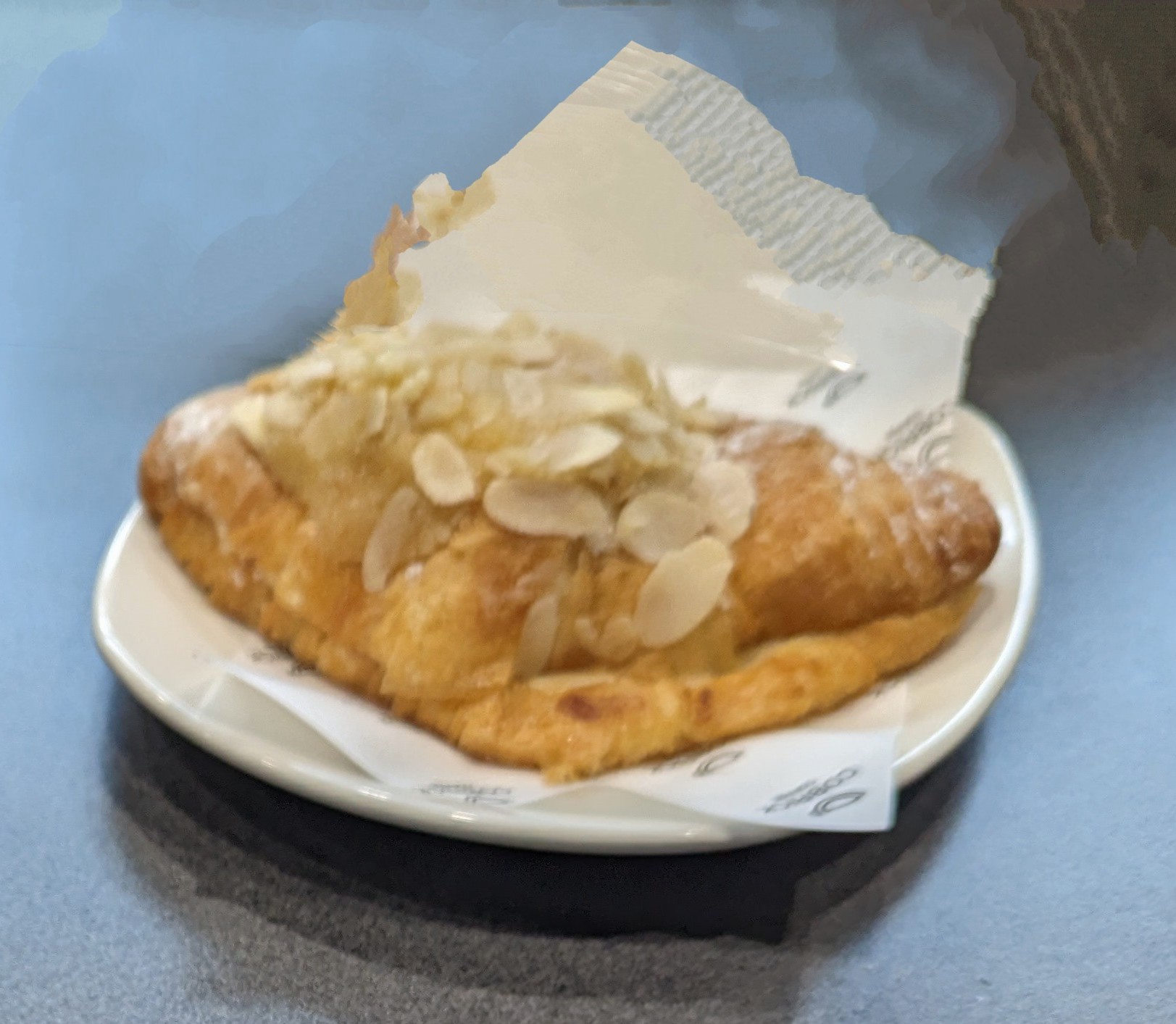
The food was substantial, and the service efficient. Although the range of pastries was limited to the usual almond croissants, banana bread, and pumpkin and walnut bread, they were very good indeed. The breakfast meals were nicely cooked and presented. They were beyond the usual cafe fare, with a tremendous breakfast bagel, and a lovely eggs benedict amongst the offerings.

Guest Reviewer at Sunda

Although I left Melbourne on Sunday some of our group remained. I was so pleased to have received the following about an excellent Melbourne restaurant, Sunda.

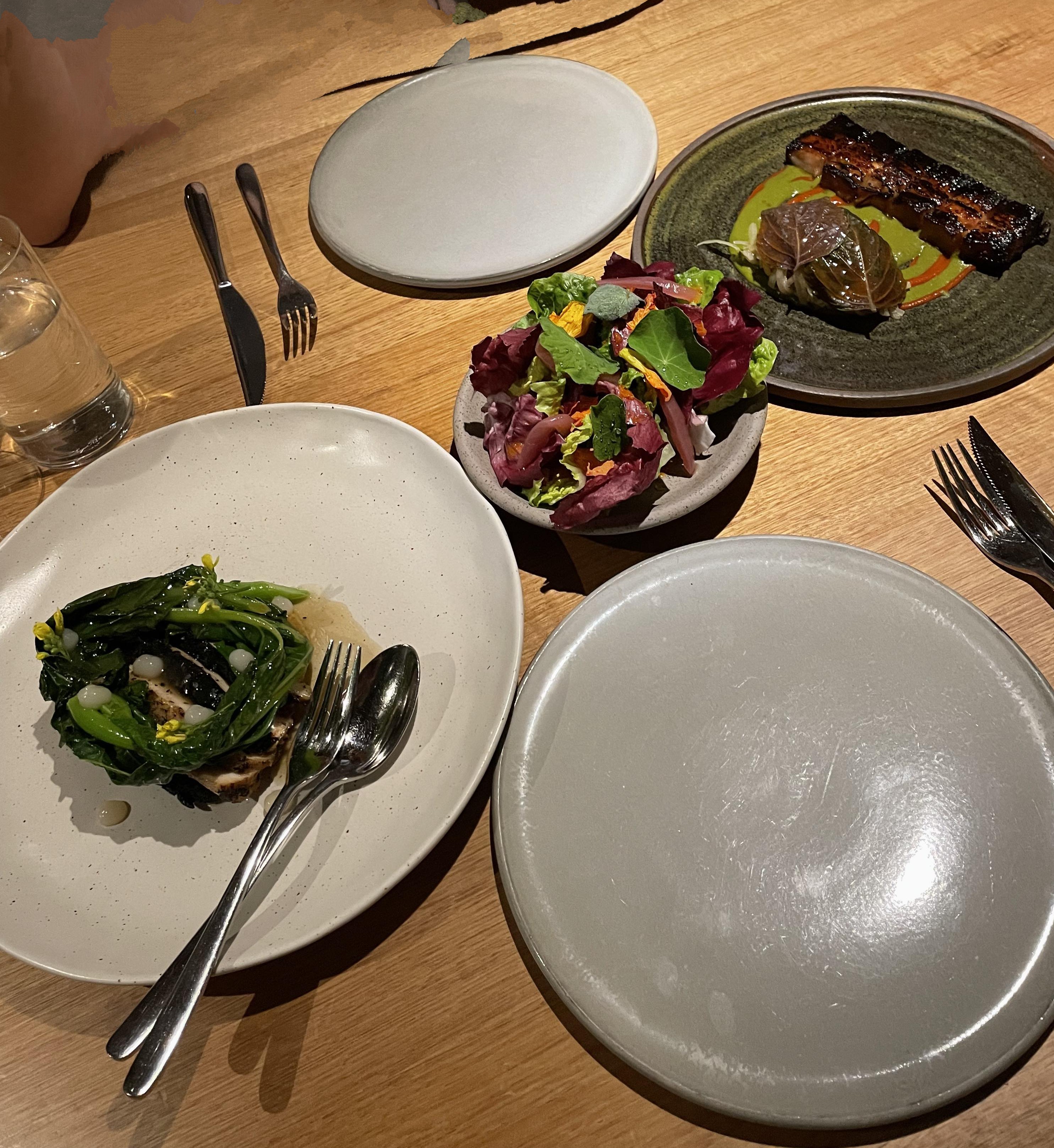
Grace A. says, ‘My friend and I agreed without any reservations that it is the best meal we’ve had together. We even had his vegemite dish!

It’s a curious surprising and delightful experience. Asian and native Australian ingredients aren’t a combination you would expect to work, but Sunda marries them together in a harmonious but equally fun way.

The venue was clearly brought together by ambition and passion for food – pared back in its industrial design, letting the food and service shine through.

The experience was all tied together by the knowledgeable and friendly staff. I cannot recommend Sunda enough!

I work on Q+A’s social media and I see racist abuse every day. You might be shocked by who’s writing it

By Neryssa Azlan

A woman in a black dress and a purple headscarf sitting with a laptop on her lap
Neryssa Azlan sifts through hundreds of comments on the Q+A social accounts each week. (Supplied)

For the past few years, I’ve worked as the social media producer for a high-profile show, one that has made headlines the past couple of weeks after our beloved presenter had to take a break.

During my time at Q+A, I can tell you one thing: If you’re surprised by the conversations about racism, then you might be part of the problem.

My role involves creating content and moderating the Q+A social media pages, and sometimes even ABC News.

Stan isn’t on social media, so his critics often come to our page to express their rage. 

Q+A encourages open debates and conversations, but the vile things I see on a regular basis are astounding.

On Monday I’ll present Q+A, then walk away

Although I try to shield myself from the racist abuse I’m frequently subjected to, the fact it is out there poisons the air I breathe. Now I have had enough – so on Monday night I will present Q+A, then walk away.

Stan Grant speaks about not being seen as a human being image

Read more

Politicians and public figures call out Twitter and call it a cesspool, but for the hundreds of vile comments that appear on Twitter, there are thousands more on Facebook and YouTube and other platforms.

You have the faceless trolls, but you also see profiles that use photos of their dogs or children making racist remarks on the colour of Stan’s skin; or accounts who post about “spreading kindness” and the like also spitting out bigoted takes when we have someone Indigenous or queer on the panel.

If you knew what some of your relatives and close friends are saying behind the comfort of their screens, you would be horrified.

ABC boss weighs in over Stan Grant exit
What does it mean to be anti-racist?

“Racism can have the kindest face,” writes Stan Grant in his book, The Queen is Dead, at one of the sections where he speaks about his experience as a Wiradjuri man growing up.

It is a lesson I already know, but it’s a constant reminder whenever I’m moderating these comments.

You could blame it on the anonymity that social media brings that allows people to express views that they would never be brave enough to utter in real life.

Or maybe the algorithms that keep people in their bubble, especially ones like Facebook where there’s hardly any accountability since it’s not so public-facing.

The truth is few people call out those they know,  because it is easier to hold strangers or organisations accountable.

A true ally of is someone who speaks up against injustice, even when the person they’re making uncomfortable is someone they know.

Sometimes the people who commit acts of racism are people you love — and isn’t it a true testimony of how much you care for a person when you support them to become better people instead of enabling or ignoring bad behaviour?

‘Casual racism’ is still racism

Some people have this idea that racism is a thing of the past because they don’t see the aggressive kinds of racism or segregation happening at the same scale.

But everyday racism (or “casual racism”) is the kind that isn’t overt. It can be hidden behind smiles and jokes, but it is still racism.

For me, personally, it comes in the form of the people speaking to me slowly, and then becoming surprised that I know English or that I’m articulate and outspoken despite the scarf around my head.

It’s the friends whose partners make and laugh at jokes about non-white people, or claim that their parents don’t like their partners because “our cultures are just too different” (when you know that they wouldn’t be as critical if their partners were “white”).

It is the editors and supervisors who reduce us to our identities and relegate us to  writing about our communities, while whispering in the background that “it’s not going to rate well”.

It’s having journos my age, mainly women of colour, sharing stories of their anguish because their own supervisors don’t take their ideas seriously and hide behind kind smiles and condescending words, or speak to them differently when there’s no one around.

This form of racism is just as insidious, in fact maybe even more so

People get defensive when their “harmless” words and actions are called out and hide behind good intentions and words like “political correctness”, “woke-ism” and “people can’t take a joke”.

If you’ve reacted this way before, ask yourself why that was your response.

Bigotry is more than just hurt feelings or name-calling. As a person with privilege, you might have your feelings hurt, but you’re still living in a power structure built with you in mind.

White privilege doesn’t mean that you never go through challenges. But even in those spaces of hardships, whether it’s in terms of socio-economics, gender, sexuality, disability, white people still hold power and have the loudest voices.

Is the media to blame?

In his last address on Q+A before he took a break, Stan Grant says that he’s part of the problem and that “too often, we [the media] are the poison in the bloodstream of our society”.

“We in the media must ask if we are truly honouring a world worth living in.”

It’s interesting to see how media organisations have responded following Stan’s break. They’ve ranged from promises and apologies, to rival media organisations blaming each other.

ABC boss says broadcaster will work with other media companies to end racist abuse of staff

ABC executives have indicated they want to work with other media platforms to try and tackle racist abuse of their staff.

David Anderson reacting to questions at Senate Estimates. He is a balding white man with blue eyes, wearing a blue suit.

Read more

It’s annoying to see journalists and media organisations cheapen Stan’s story by using it as an excuse to get clicks instead of taking this moment to reflect on themselves.

Part of reporting with impartiality is looking into the biases within ourselves and the spaces we operate in.

As members of the media, it is our duty to do that for the people we write for.

We can’t just shift the blame to social media platforms and their owners. It’s our responsibility too, whether we’re a public broadcaster or privately owned.

It is not enough to hire diverse faces when our voices are either silenced, or are only seen as valid when they echo the status quo.

Too often diverse journalists and talents are reduced to quotas to reach and show companies are progressing.

The conversation needs to be about not just accountability but also the current structures within the spaces we operate in.

The reality is that newsrooms still become less diverse the higher up you go. Editors and other decision makers are still mainly straight, male and white.

Five hands on a table belonging to people of different skin tones
Saying ‘I don’t see colour’ sounds positive, but it could risk people not acknowledging the existence of racism(Unsplash: Clay Banks)
Don’t lie, you do see colour

Whether you’re someone who claims to be anti-racist and “not see colour”, or an editor or someone in a position of power in media, we are all complicit.

We all come with our own biases, ones that are sometimes unconscious. That’s mirrored in the systems and institutions we operate in.

When we’re confronted with the experiences of First Nations’ people or non-white people in Australia, the conversation can turn ugly, partly because it’s riddled with guilt.

Guilt isn’t a pleasant feeling, but that doesn’t mean it can’t be constructive.

Talking about race doesn’t have to be divisive – in fact, it could be what brings us together to healing and justice.

And we can never achieve that if our fingers are pointed at everyone else but ourselves.

And the horrible irony…

Reconciliation Australia Logo

NATIONAL RECONCILIATION WEEK 2023

27 MAY TO 3 JUNE

Banner reading Be a Voice for Generations

Keep up the momentum for change: the theme for National Reconciliation Week 2023 is Be a Voice for Generations.

The theme  encourages all Australians to be a voice for reconciliation in tangible ways in our everyday lives – where we livework and socialise.

For the work of generations past, and the benefit of generations future, act today for a more just, equitable and reconciled country for all.

National Reconciliation Week – 27 May to 3 June – is a time for all Australians to learn about our shared histories, cultures, and achievements, and to explore how each of us can contribute to achieving reconciliation in Australia.

Heather Cox Richardson American Letter May 29, 2023

HEATHER COX RICHARDSON

Beginning in 1943, the War Department published a series of pamphlets for U.S. Army personnel in the European theater of World War II. Titled Army Talks, the series was designed “to help [the personnel] become better-informed men and women and therefore better soldiers.”

On March 24, 1945, the topic for the week was “FASCISM!”

“You are away from home, separated from your families, no longer at a civilian job or at school and many of you are risking your very lives,” the pamphlet explained, “because of a thing called fascism.” But, the publication asked, what is fascism? “Fascism is not the easiest thing to identify and analyze,” it said, “nor, once in power, is it easy to destroy. It is important for our future and that of the world that as many of us as possible understand the causes and practices of fascism, in order to combat it.”

Fascism, the U.S. government document explained, “is government by the few and for the few. The objective is seizure and control of the economic, political, social, and cultural life of the state.” “The people run democratic governments, but fascist governments run the people.”

“The basic principles of democracy stand in the way of their desires; hence—democracy must go! Anyone who is not a member of their inner gang has to do what he’s told. They permit no civil liberties, no equality before the law.” “Fascism treats women as mere breeders. ‘Children, kitchen, and the church,’ was the Nazi slogan for women,” the pamphlet said.

Fascists “make their own rules and change them when they choose…. They maintain themselves in power by use of force combined with propaganda based on primitive ideas of ‘blood’ and ‘race,’ by skillful manipulation of fear and hate, and by false promise of security. The propaganda glorifies war and insists it is smart and ‘realistic’ to be pitiless and violent.”

Fascists understood that “the fundamental principle of democracy—faith in the common sense of the common people—was the direct opposite of the fascist principle of rule by the elite few,” it explained, “[s]o they fought democracy…. They played political, religious, social, and economic groups against each other and seized power while these groups struggled.”

Americans should not be fooled into thinking that fascism could not come to America, the pamphlet warned; after all, “[w]e once laughed Hitler off as a harmless little clown with a funny mustache.” And indeed, the U.S. had experienced “sorry instances of mob sadism, lynchings, vigilantism, terror, and suppression of civil liberties. We have had our hooded gangs, Black Legions, Silver Shirts, and racial and religious bigots. All of them, in the name of Americanism, have used undemocratic methods and doctrines which…can be properly identified as ‘fascist.’”

The War Department thought it was important for Americans to understand the tactics fascists would use to take power in the United States. They would try to gain power “under the guise of ‘super-patriotism’ and ‘super-Americanism.’” And they would use three techniques:

First, they would pit religious, racial, and economic groups against one another to break down national unity. Part of that effort to divide and conquer would be a “well-planned ‘hate campaign’ against minority races, religions, and other groups.”

Second, they would deny any need for international cooperation, because that would fly in the face of their insistence that their supporters were better than everyone else. “In place of international cooperation, the fascists seek to substitute a perverted sort of ultra-nationalism which tells their people that they are the only people in the world who count. With this goes hatred and suspicion toward the people of all other nations.”

Third, fascists would insist that “the world has but two choices—either fascism or communism, and they label as ‘communists’ everyone who refuses to support them.”

It is “vitally important” to learn to spot native fascists, the government said, “even though they adopt names and slogans with popular appeal, drape themselves with the American flag, and attempt to carry out their program in the name of the democracy they are trying to destroy.”

The only way to stop the rise of fascism in the United States, the document said, “is by making our democracy work and by actively cooperating to preserve world peace and security.” In the midst of the insecurity of the modern world, the hatred at the root of fascism “fulfills a triple mission.” By dividing people, it weakens democracy. “By getting men to hate rather than to think,” it prevents them “from seeking the real cause and a democratic solution to the problem.” By falsely promising prosperity, it lures people to embrace its security.

“Fascism thrives on indifference and ignorance,” it warned. Freedom requires “being alert and on guard against the infringement not only of our own freedom but the freedom of every American. If we permit discrimination, prejudice, or hate to rob anyone of his democratic rights, our own freedom and all democracy is threatened.” And if “we want to make certain that fascism does not come to America, we must make certain that it does not thrive anywhere in the world.”

Seventy-eight years after the publication of “FASCISM!” with its program for recognizing that political system and stopping it from taking over the United States, President Joe Biden today at Arlington National Cemetery in Arlington, Virginia, honored those who gave their lives fighting to preserve democracy. “On this day, we come together again to reflect, to remember, but above all, to recommit to the future our fallen heroes fought for, …a future grounded in freedom, democracy, equality, tolerance, opportunity, and…justice.”

“[T]he truest memorial to their lives,” the president said, is to act “every day to ensure that our democracy endures, our Constitution endures, and the soul of our nation and our decency endures.”

Notes:

https://onlinebooks.library.upenn.edu/webbin/serial?id=armytalks

War Department, “Army Talk 64: FASCISM!” March 24, 1945, at https://archive.org/details/ArmyTalkOrientationFactSheet64-Fascism/mode/2up

“[T]he truest memorial to their lives,” the president said, is to act “every day to ensure that our democracy endures, our Constitution endures, and the soul of our nation and our decency endures.”

https://www.whitehouse.gov/briefing-room/speeches-remarks/2023/05/29/remarks-by-president-biden-at-the-155th-national-memorial-day-observance/

Week beginning 24 May 2023

Victoria Jenkins Happily Married Bookouture 2023.

Thank you NetGalley for providing me with the uncorrected proof for review.

Happily Married begins with a prologue which, as the book progresses, could apply to several of the characters and plots. Certainly, the reader is shown early in the novel that the married couple at the centre of the story, Natalie and Jake,  are far from happily married. They do not communicate, loving gestures are repudiated, their small daughter has had a health crisis, and their dairy farm and the associated ice cream parlour are in financial straits. There is some clever writing that ensures that the twist in part two of the book is unexpected, but plausible. See Books: Reviews for the complete review.

19 may 2023

There were 1005 new cases reported this week. People in hospital with covid number 53, with 4 in ICU. No-one is ventilated and no lives have been lost this week.

100 best Children’s Books According to the BBC

Philip Pullman, CS Lewis and Roald Dahl feature in top 10

Isabel Lewis

Where The Wild Things Are has been named the greatest children’s book of all time, according to a poll by the BBC.

Voted for by children’s authors, illustrators, editors, publishers, academics, librarians, writers and readers* from across the world, the top 100 were unveiled on Tuesday (23 May) afternoon.

Maurice Sendak’s 1963 adventure took the top spot in BBC Culture’s list, with Alice’s Adventures in WonderlandPippi LongstockingThe Little Prince and The Hobbit making up the top five.

Respondents were able to choose from more than 1000 different books, with each picking and ranking their 10 favourite children’s books. More than a fifth of respondents included Where The Wild Things Are in their top 10, with seven per cent choosing it as their top-ranked book.

Philip Pullman is the highest-ranked living author on the list, for his 1995 book Northern Lights from the His Dark Materials series.

The 76-year-old writer said: “I’m delighted to hear the result of this poll, it has taken me completely by surprise, and I’m not entirely sure I can find the words to respond to it.

“Children’s books are important because we still think about them when we’re grown up, because they have an effect on our way of seeing the world and our way of thinking about other people… That’s why they’re important to grown-ups as well as to children, and that’s why the best grown-up books are important, for the same sorts of reasons I think.”

You can find the full list below.

  1. Where the Wild Things Are (Maurice Sendak, 1963)
  2. Alice’s Adventures in Wonderland (Lewis Carroll, 1865)
  3. Pippi Longstocking (Astrid Lindgren, 1945)
  4. The Little Prince (Antoine de Saint-Exupéry, 1943)
  5. The Hobbit (JRR Tolkien, 1937)
  6. Northern Lights (Philip Pullman, 1995)
  7. The Lion, the Witch and the Wardrobe (CS Lewis, 1950)
  8. Winnie-the-Pooh (AA Milne and EH Shepard, 1926)
  9. Charlotte’s Web (EB White and Garth Williams, 1952)
  10. Matilda (Roald Dahl and Quentin Blake, 1988)
  11. Anne of Green Gables (LM Montgomery, 1908)
  12. Fairy Tales (Hans Christian Andersen, 1827)
  13. Harry Potter and the Philosopher’s Stone (JK Rowling, 1997)
  14. The Very Hungry Caterpillar (Eric Carle, 1969)
  15. The Dark is Rising (Susan Cooper, 1973)
  16. The Arrival (Shaun Tan, 2006)
  17. Little Women (Louisa May Alcott, 1868)
  18. Charlie and the Chocolate Factory (Roald Dahl, 1964)
  19. Heidi (Johanna Spyri, 1880)
  20. Goodnight Moon (Margaret Wise Brown and Clement Hurd, 1947)
  21. The Adventures of Pinocchio (Carlo Collodi, 1883)
  22. A Wizard of Earthsea (Ursula K Le Guin, 1968)
  23. Moominland Midwinter (Tove Jansson, 1957)
  24. I Want My Hat Back (Jon Klassen, 2011)
  25. The Secret Garden (Frances Hodgson Burnett, 1911)
  26. Duck, Death and the Tulip (Wolf Erlbruch, 2007)
  27. The Brothers Lionheart (Astrid Lindgren, 1973)
  28. Harry Potter and the Prisoner of Azkaban (JK Rowling, 1999)
  29. Brown Girl Dreaming (Jacqueline Woodson, 2014)
  30. The Three Robbers (Tomi Ungerer, 1961)
  31. The Snowy Day (Ezra Jack Keats, 1962)
  32. The Tiger Who Came to Tea (Judith Kerr, 1968)
  33. Howl’s Moving Castle (Diana Wynne Jones, 1986)
  34. A Wrinkle in Time (Madeleine L’Engle, 1962)
  35. Watership Down (Richard Adams, 1972)
  36. Tom’s Midnight Garden (Philippa Pearce, 1958)
  37. Grimm’s Fairy Tales (Brothers Grimm, 1812)
  38. The Tale of Peter Rabbit (Beatrix Potter, 1902)
  39. The Railway Children (Edith Nesbit, 1906)
  40. Noughts and Crosses (Malorie Blackman, 2001)
  41. The BFG (Roald Dahl and Quentin Blake, 1982)
  42. Rules of Summer (Shaun Tan, 2013)
  43. Momo (Michael Ende, 1973)
  44. The Story of Ferdinand (Munro Leaf and Robert Lawson, 1936)
  45. The Lord of the Rings (JRR Tolkien, 1954)
  46. The Owl Service (Alan Garner, 1967)
  47. Ronia, the Robber’s Daughter (Astrid Lindgren, 1981)
  48. The Neverending Story (Michael Ende, 1979)
  49. The Panchatantra (Anonymous / folk, -200)
  50. Treasure Island (Robert Louis Stevenson, 1883)
  51. Mary Poppins (PL Travers, 1934)
  52. Ballet Shoes (Noel Streafield, 1936)
  53. So Much! (Trish Cooke and Helen Oxenbury, 1994)
  54. We’re Going on a Bear Hunt (Michael Rosen and Helen Oxenbury, 1989)
  55. The Adventures of Cipollino (Gianni Rodari, 1951)
  56. The Giving Tree (Shel Silverstein, 1964)
  57. The Gruffalo (Julia Donaldson and Axel Scheffler, 1999)
  58. Julián Is a Mermaid (Jessica Love, 2018)
  59. Comet in Moominland (Tove Jansson, 1946)
  60. Finn Family Moomintroll (Tove Jansson, 1948)
  61. The Witches (Roald Dahl and Quentin Blake, 1983)
  62. A Bear Called Paddington (Michael Bond, 1958)
  63. The Wind in the Willows (Kenneth Grahame, 1908)
  64. Roll of Thunder, Hear My Cry (Mildred D Taylor, 1977)
  65. Karlsson-on-the-Roof (Astrid Lindgren, 1955)
  66. The Phantom Tollbooth (Norton Juster and Jules Feiffer, 1961)
  67. The Cat in the Hat (Dr Seuss, 1957)
  68. The Miraculous Journey of Edward Tulane (Kate DiCamillo and Bagram Ibatoulline, 2006)
  69. Peter and Wendy (JM Barrie, 1911)
  70. One Thousand and One Nights (Anonymous / folk)
  71. From the Mixed-Up Files of Mrs Basil E Frankweiler (EL Konigsburg, 1967)
  72. When Hitler Stole Pink Rabbit (Judith Kerr, 1971)
  73. Shum bola (G’afur G’ulоm, 1936)
  74. Ernest and Celestine (Gabrielle Vincent, 1981)
  75. A Kind of Spark (Elle McNicoll, 2020)
  76. Little Nicholas (René Goscinny and Jean-Jacques Sempé, 1959)
  77. Black Beauty (Anna Sewell, 1877)
  78. Daddy-Long-Legs (Jean Webster, 1912)
  79. No Kiss for Mother (Tomi Ungerer, 1973)
  80. My Family and Other Animals (Gerald Durrell, 1956)
  81. Jacob Have I Loved (Katherine Paterson, 1980)
  82. The Lorax (Dr Seuss, 1971)
  83. Fairy Tales/The Tales of Mother Goose (Charles Perrault, 1697)
  84. The Moomins and the Great Flood (Tove Jansson, 1945)
  85. The Wonderful Wizard of Oz (L Frank Baum, 1900)
  86. Just William (Richmal Crompton, 1922)
  87. The Twits (Roald Dahl and Quentin Blake, 1980)
  88. The Mouse and His Child (Russell Hoban, 1967)
  89. Out of My Mind (Sharon M Draper, 2010)
  90. Moominvalley in November (Tove Jansson, 1970)
  91. Little House in the Big Woods (Laura Ingalls Wilder, 1932)
  92. Danny the Champion of the World (Roald Dahl, 1975)
  93. The Snowman (Raymond Briggs, 1978)
  94. Wave (Suzy Lee, 2008)
  95. The Black Brothers (Lisa Tetzner, 1940)
  96. The Velveteen Rabbit (Margery Williams, 1921)
  97. The Bad Beginning (Lemony Snicket, 1999)
  98. The Graveyard Book (Neil Gaiman, 2008)
  99. American Born Chinese (Gene Luen Yang and Lark Pien, 2006)
  100. Haroun and the Sea of Stories (Salman Rushdie, 1990)

*I am left wondering if the ‘readers’ who contributed to this list were children. I would like to know that the people for whom the books are written were given the opportunity to express an opinion.

National Gallery of Australia

‘Tuesday’s federal budget has seen funding of $535 million allocated to secure and restore some of Australia’s cultural and historical institutions, many of which are located in Canberra.’

Jackson Pollock – Blue Poles

See story below.

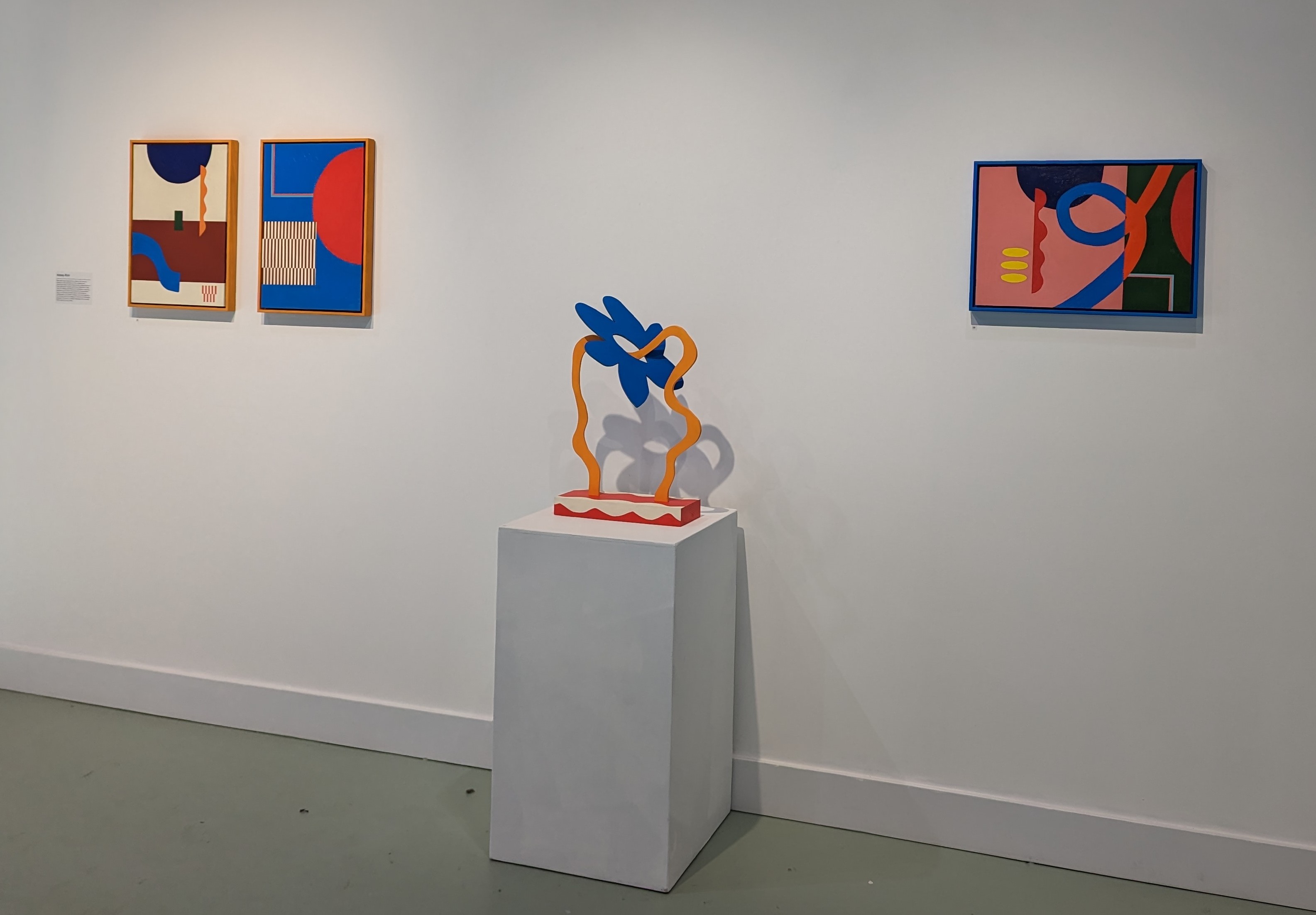
Various artworks to be enjoyed while walking through the galley.

Views from the National Australian Gallery

Blue poles shows why Australia must get serious about its arts spending

The Herald’s View January 30, 2023 — 5.00am

If proof was needed that spending public money on the arts can be a good investment, the once controversial purchase of Jackson Pollock’s Blue poles provides a great example.

When the National Gallery of Australia purchased the abstract expressionist painting for $1.3 million in 1973, the Philistine tabloid papers splashed headlines claiming the artist painted it while drunk.

Gough Whitlam visiting Blue poles, which was purchased by the National Gallery of Australia in 1973.
Gough Whitlam visiting Blue poles, which was purchased by the National Gallery of Australia in 1973.CREDIT:DAVID BARTHO.

Yet as Herald reporter Linda Morris reports today, the painting is now an unquestioned masterpiece and has increased in value to $500 million.

This bumper return should be on Arts Minister Tony Burke’s mind on Monday when he releases a long-awaited national cultural policy.

After a decade in which the Coalition ran the arts down and sometimes traduced them as the playground of left-wing cultural elites, Burke has a chance to spur a renaissance of sorts.

The new policy will be welcome, but he should also back it up with cash because, like Blue poles, the investment will be repaid in spades.

Some of the benefits, such as those to the tourist industry and from the cultural exports of film and music, are fairly clear. Others, such as their contribution to our national identity, our global soft power and domestic social cohesion, are harder to reduce to dollars and cents.

The NGA in Canberra provides a great example of the urgent need to spend more, but also of the challenges.

The NGA says it faces a financial crisis from July when it loses a short-term funding injection of $24.77 million. The National Library of Australia’s invaluable Trove digital collection is also facing the same deadline.

Without help, the NGA says it might have to resort to forced redundancies, the closure of the Canberra building two days a week and the possible reintroduction of entry fees.

National Gallery of Australia’s most valuable artworks.
Exclusive
Arts
Jackson Pollock’s controversial Blue poles valued at $500 million

Even those drastic measures will never cover the $265 million cost over the next 10 years to waterproof the 40-year-old building and bring it up to standard.

It is shameful that there is no money to fix the roof that protects Blue poles and other pieces in the NGA’s $6.9-billion collection.

Of course, the NGA cannot simply cry poor and take for granted continued public support. It is not clear why it failed to anticipate the financial problems and engineer a solution sooner. If the government provides long-term support it should be on the basis that the NGA presents a clear long-term plan.

When Gough Whitlam bought Blue poles, the NGA was trying to drag Australia’s conservative state-based art galleries into the world of modern art.

National Gallery of Australia faces $67 million black hole

Yet the NGA’s role is changing, and it must change to stay relevant. Rather than compete with the museums of Europe or the US, it must focus on building a collection that resonates here, such as the art of First Nations people, art created in Australia and in our region.

It must also distinguish itself from and co-ordinate better with state-based galleries such as the new Sydney Modern which have similar missions. Part of the answer is touring exhibitions that share its extraordinary collection with state, regional and international galleries, but they cost money.

The NGA has suggested in its submission to the national cultural policy consultation that school groups should receive the same financial support to visit the gallery as the War Memorial or the National Museum.

That should be a no-brainer. Sidney Nolan’s Ned Kelly series in the NGA offers a unique lesson about Australia’s identity.

Australians love the arts. But the federal government must provide the vision and the funding to institutions like the NGA so they can bring art to the people.

Bevan Shields sends an exclusive newsletter to subscribers each week. Sign up to receive his Note from the Editor.

Cindy Lou Eats Out in Melbourne

Bienvenue Chez Choukette

A splendid array of savoury and sweet eats is the hallmark of this coffee shop on Sydney Road Brunswick. The coffee is good, and made to order – a weak skinny latte was treated with the same respect as a coffee with the full complement of granules. Thank you, Choukette staff.

Mamasita

Having enjoyed – more than enjoyed – a meal here the last time I was in Melbourne I was thrilled to be able to visit this Mexican restaurant in Collins Street again. I have taken some photos from the website, as i was so busy eating that I forgot to take some of my own! The pumpkin was the only dish where I had my sits about me, and I wonder why, as it is certainly the star of the lunch time menu for me. The salad is also a great addition to the meal. We were also served a lovely guacamole and delicious (baked in house? it certainly seemed that this was so) corn chips.

The vegetarian tacos are delicious. As attested to by the results below.

Week Beginning 16 May 2023

The book this week is relevant to the E. Jean Carroll case against the former American president, and is a good read for people interested in the legal system, the way in which judges were appointed to the American Supreme Court, as well as the subject in general.

This week’s blog is very late because of technical problems. I apologise.

Leigh Gilmore The #MeToo Effect What Happens When We Believe Women Columbia University Press, 2023.

Thankyou NetGalley for providing me with this uncorrected proof for review.

Leigh Gilmore has written a clear and understandable argument, underpinned by thoughtful discussion, on the impact of Me Too and its relevance to all debate about sexual harassment and rape.

She gives value to survivors’ narratives that underpin the arguments to apply the law without the sexism apparent in its application to sexual harassment and rape. These stories are shown to have been instrumental in producing a social environment in which believing women, making their stories part of the authority on which law is based has propelled changes in which demands for sexual justice includes women’s right to be heard. Again, the thoughtfulness Gilmore applies to her assertions gives them a weighty impact – they must be heard, they cannot be easily dismissed. Speaking out is studied in depth, drawing attention to all the factors that prevent women from doing so and reiterating the importance of recognising a woman’s right to be heard. See Books: Reviews for the complete review.

Covid update for Canberra: At 12 May there were 870 new cases, with 36 hospitalised and 1 in ICU. Rat cases numbered 721. There were 3 deaths in this period. Vaccinations numbered 8,963, with 5,910 boosters. Recoveries numbered 828 in this period. The results of PCR tests are not available. These now require more than just going to get the test, possibly making them less likely to be undertaken unless the person has serious symptoms. The encouragement for people with symptoms to remain at home, social distance, and wear masks remains an important way of dealing with Covid in Canberra.

Cindy Lou has breakfast at Edgar’s, Ainslie

Edgar’s options were very nice indeed – creamy scrambled eggs on nicely buttered sourdough for one and a warm scone with jam and cream for the other. The latter would have been improved with thick rather than whipped cream. However, nothing was as deserving of the pained looks from Leah. She clearly disapproves of her home baked apple and peanut oat biscuits, and kibble! Even the froth from Edgar’s coffee was licked up half-heartedly with some remaining on the ground.

E. Jean Carroll

Leigh Gilmore suggests that the legal system will not help (but outlines very effectively how it can be changed to do so). E. Jean Carroll’s civil case demonstrates that in her case the law worked well. The following excerpts are an indication of some of the media responses to the trial and aftermath.

ISABEL FATTAL
Isabel Fattal

Isabel Fattal is a senior editor at The Atlantic.

Could last week’s verdict in E. Jean Carroll’s sexual-violence case affect Donald Trump’s standing with primary voters? I checked in with the Atlantic staff writer David Frum, who has been thinking for the past few weeks about what he calls “the X factors of the 2024 presidential race.” …

… week, David followed up on that essay by thinking through some of the unexpected “X factors” that could derail the “conventional wisdom” of Joe Biden being reelected. He reminds us that the 2016 election cycle was punctuated by two last-minute surprises—Trump’s Access Hollywood tape and FBI Director James Comey’s announcement that he was reopening an investigation into Hillary Clinton’s email practices. “One proved damaging; one did not,” David writes.

What are 2024’s possible X factors? Biden’s health could certainly be one, David notes. Only about a third of Americans are confident that Biden is up to the physical and mental tasks of the presidency, according to recent polling. And Trump, should he maintain his current position as the GOP front-runner, has X factors of his own—primarily legal ones. David writes:

Trump’s indictments have, thus far, generated a rally effect among his co-partisans, widening his lead over Florida Governor Ron DeSantis to 30 points in the month after … But the emphasis here is on thus far. More indictments may be coming … As president, Trump could rely on some political cover because the sheer number of allegations of wrongdoing got jumbled together, confused people, and often canceled one another out. Whether accumulating indictments will now cancel out in the same way is not so clear—even less so if they turn into accumulating convictions, followed by sentences.

After David wrote that article, a jury found Trump liable for sexually abusing and defaming the writer E. Jean Carroll. It would be fair to wonder if this verdict could be its own potential X factor for Trump’s candidacy; as David noted in his story, an April 2023 poll showed that a quarter of Republicans want a nominee who isn’t distracted by his personal legal issues, and although that isn’t a majority, Trump doesn’t start this presidential contest with a large margin to spare.  However, the New Hampshire audience for Trump’s CNN town hall following the Carroll verdict last week—which consisted of New Hampshire GOP and undecided voters—laughed and cheered at Trump’s performance, including his mockery of Carroll, suggesting that his base is still holding strong.

David is unconvinced that Trump’s primary-election supporters would necessarily be deterred by the Carroll verdict. “It’s a civil, not a criminal, action; Trump was found liable, not convicted,” David told me today. “But a jury finding of sexual abuse is now inscribed on the Trump record—and opponents can remind voters that another two dozen accusations never got their hearing in court. And still there’s more to come.”

Although David acknowledged that “we may never know” if the verdict will hurt Trump’s prospects in the primaries, he noted that this is largely because “Trump’s primary opponents are terrified to talk to voters about it.” As Trump’s legal battles continue to unfold, the general election may prove to be a different story.

“In 2016, we were talking about allegations against Trump,” David continued. “In 2020, he’d been impeached, but not removed. Now he’s indicted. He’s been found liable. Very possibly, by November 2024, he could be convicted and sentenced.” And with 18 months until Election Day, new X factors for any of the candidates could still surprise us.

Heather Cox Richardson

From HeatheIsabel Fattalr Cox Richardson’s Letters from an American May 10th 2023

…Trump was speaking at what CNN billed as a “Town Hall” in front of a crowd of Republicans and Republican-leaning Independents, but the event quickly turned into a Trump rally. Trump played to the audience, which laughed at his attacks on E. Jean Carroll and cheered on the constant stream of lies that are by now a set performance. He steamrolled journalist Kaitlan Collins, who tried but could not counter his stream of lies.  When he finished, the audience gave him a standing ovation. 

A CNN media personality told Daily Beast media reporter Justin Baragona, “It is so bad. I was cautiously optimistic despite the criticism. It is awful. It’s a Trump infomercial. We’re going to get crushed.” A senior Trump advisor told senior NBC News Capitol Hill correspondent Garrett Haake that the campaign team “is thrilled with how the night went.” The person called the event a “home run” and said “when the lefts melting down, we know it was a good day.”  

Maybe. But according to legal analyst Andrew Weissman, Trump’s embrace of the January 6 rioters and promise to pardon them if he’s reelected feeds a potential case against him. He made similarly revealing comments about his theft and retention of documents marked classified. It was that very kind of indiscretion that enabled Carroll’s lawyers to beat him in court…

A fantastic night at The Mousetrap (Commentary in a later blog).

By the time the play began, this section of the theatre was filled to capacity.

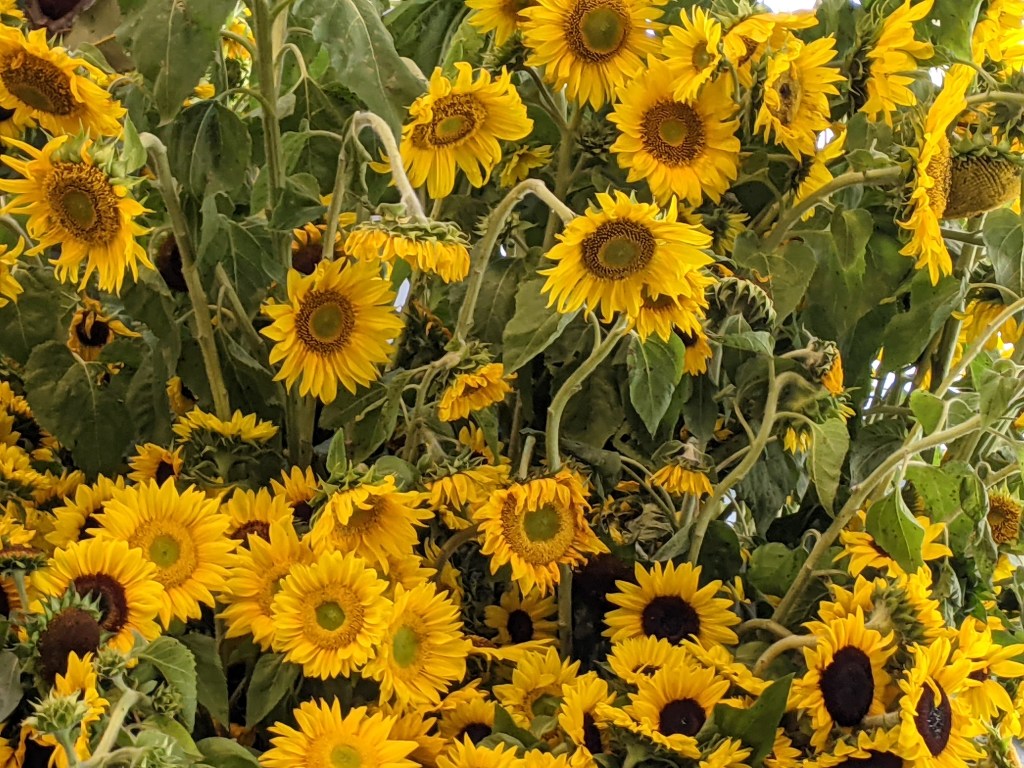
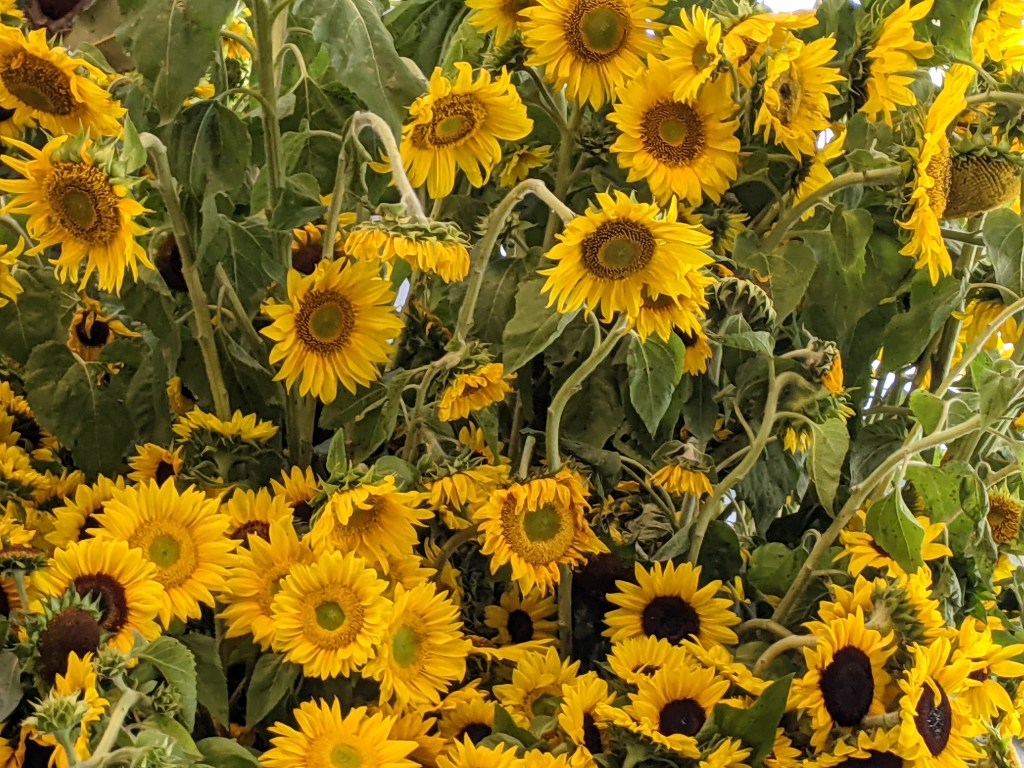
This image has an empty alt attribute; its file name is sunflowers-.jpg

Week beginning 16 May 2023

Leigh Gilmore The #MeToo Effect What Happens When We Believe Women Columbia University Press, 2023.

Thankyou NetGalley for providing me with this uncorrected proof for review.

Leigh Gilmore has written a clear and understandable argument, underpinned by thoughtful discussion, on the impact of Me Too and its relevance to all debate about sexual harassment and rape.

She gives value to survivors’ narratives that underpin the arguments to apply the law without the sexism apparent in its application to sexual harassment and rape. These stories are shown to have been instrumental in producing a social environment in which believing women, making their stories part of the authority on which law is based has propelled changes in which demands for sexual justice includes women’s right to be heard. Again, the thoughtfulness Gilmore applies to her assertions gives them a weighty impact – they must be heard, they cannot be easily dismissed. Speaking out is studied in depth, drawing attention to all the factors that prevent women from doing so and reiterating the importance of recognising a woman’s right to be heard. See Books: Reviews for the complete review.

Covid update for Canberra: At 12 May there were 870 new cases, with 36 hospitalised and 1 in ICU. Rat cases numbered 721. There were 3 deaths in this period. Vaccinations numbered 8,963, with 5,910 boosters. Recoveries numbered 828 in this period. The results of PCR tests are not available. These now require more than just going to get the test, possibly making them less likely to be undertaken unless the person has serious symptoms. The encouragement for people with symptoms to remain at home, social distance, and wear masks remains an important way of dealing with Covid in Canberra.

Cindy Lou has breakfast at Edgar’s, Ainslie

Edgar’s options were very nice indeed – creamy scrambled eggs on nicely buttered sourdough for one and a warm scone with jam and cream for the other. The latter would have been improved with thick rather than whipped cream. However, nothing was as deserving of the pained looks from Leah. She clearly disapproves of her home baked apple and peanut oat biscuits, and kibble! Even the froth from Edgar’s coffee was licked up half-heartedly with some remaining on the ground.

Leigh Gilmore suggests that the legal system will not help (but outlines very effectively how it can be changed to do so). E. Jean Carroll’s civil case demonstrates that in her case the law worked well. The following excerpts are an indication of some of the media responses to her case.

ISABEL FATTAL
Isabel Fattal

Isabel Fattal is a senior editor at The Atlantic.

Could last week’s verdict in E. Jean Carroll’s sexual-violence case affect Donald Trump’s standing with primary voters? I checked in with the Atlantic staff writer David Frum, who has been thinking for the past few weeks about what he calls “the X factors of the 2024 presidential race.” …

… week, David followed up on that essay by thinking through some of the unexpected “X factors” that could derail the “conventional wisdom” of Joe Biden being reelected. He reminds us that the 2016 election cycle was punctuated by two last-minute surprises—Trump’s Access Hollywood tape and FBI Director James Comey’s announcement that he was reopening an investigation into Hillary Clinton’s email practices. “One proved damaging; one did not,” David writes.

What are 2024’s possible X factors? Biden’s health could certainly be one, David notes. Only about a third of Americans are confident that Biden is up to the physical and mental tasks of the presidency, according to recent polling. And Trump, should he maintain his current position as the GOP front-runner, has X factors of his own—primarily legal ones. David writes:

Trump’s indictments have, thus far, generated a rally effect among his co-partisans, widening his lead over Florida Governor Ron DeSantis to 30 points in the month after … But the emphasis here is on thus far. More indictments may be coming … As president, Trump could rely on some political cover because the sheer number of allegations of wrongdoing got jumbled together, confused people, and often canceled one another out. Whether accumulating indictments will now cancel out in the same way is not so clear—even less so if they turn into accumulating convictions, followed by sentences.

After David wrote that article, a jury found Trump liable for sexually abusing and defaming the writer E. Jean Carroll. It would be fair to wonder if this verdict could be its own potential X factor for Trump’s candidacy; as David noted in his story, an April 2023 poll showed that a quarter of Republicans want a nominee who isn’t distracted by his personal legal issues, and although that isn’t a majority, Trump doesn’t start this presidential contest with a large margin to spare.  However, the New Hampshire audience for Trump’s CNN town hall following the Carroll verdict last week—which consisted of New Hampshire GOP and undecided voters—laughed and cheered at Trump’s performance, including his mockery of Carroll, suggesting that his base is still holding strong.

David is unconvinced that Trump’s primary-election supporters would necessarily be deterred by the Carroll verdict. “It’s a civil, not a criminal, action; Trump was found liable, not convicted,” David told me today. “But a jury finding of sexual abuse is now inscribed on the Trump record—and opponents can remind voters that another two dozen accusations never got their hearing in court. And still there’s more to come.”

Although David acknowledged that “we may never know” if the verdict will hurt Trump’s prospects in the primaries, he noted that this is largely because “Trump’s primary opponents are terrified to talk to voters about it.” As Trump’s legal battles continue to unfold, the general election may prove to be a different story.

“In 2016, we were talking about allegations against Trump,” David continued. “In 2020, he’d been impeached, but not removed. Now he’s indicted. He’s been found liable. Very possibly, by November 2024, he could be convicted and sentenced.” And with 18 months until Election Day, new X factors for any of the candidates could still surprise us.

Heather Cox Richardson

From Heathr Cox Richardson’s Letters from an American May 10th 2023

…Trump was speaking at what CNN billed as a “Town Hall” in front of a crowd of Republicans and Republican-leaning Independents, but the event quickly turned into a Trump rally. Trump played to the audience, which laughed at his attacks on E. Jean Carroll and cheered on the constant stream of lies that are by now a set performance. He steamrolled journalist Kaitlan Collins, who tried but could not counter his stream of lies.  When he finished, the audience gave him a standing ovation. 

A CNN media personality told Daily Beast media reporter Justin Baragona, “It is so bad. I was cautiously optimistic despite the criticism. It is awful. It’s a Trump infomercial. We’re going to get crushed.” A senior Trump advisor told senior NBC News Capitol Hill correspondent Garrett Haake that the campaign team “is thrilled with how the night went.” The person called the event a “home run” and said “when the lefts melting down, we know it was a good day.”  

Maybe. But according to legal analyst Andrew Weissman, Trump’s embrace of the January 6 rioters and promise to pardon them if he’s reelected feeds a potential case against him. He made similarly revealing comments about his theft and retention of documents marked classified. It was that very kind of indiscretion that enabled Carroll’s lawyers to beat him in court…

A fantastic night at The Mousetrap

robrjo's avatarRobin's Room

Ayeesha Inoon UntetheredHarlequin Australia, HQ (Fiction, Non Fiction, YA) & MIRA, 2023

Thank you, NetGalley and Harlequin Australia, for providing me with this uncorrected proof for review.

I am even more grateful to Ayesha Inoon for writing this book – it’s a story that remains long after reading, creating the emotion and some of the understanding that is so essential to gaining any insight of a life lived through two cultures. In my Goodreads review I gave Ayesha Inoon an additional half star in appreciation for her wonderful rendering of Australia’s capital city, Canberra. I have not fed swans at Lake Ginninderra but have felt guilty at turning on the heating before the Canberra designated date – after Anzac Day! The descriptions of the streets, quiet but then birdsongs filling the air, Floriade, shopping in Belconnen at the mall, and more bring alive an Australian city. And, before this…

View original post 1,746 more words

Week beginning 10 May 2023

Ayesha Inoon Untethered Harlequin Australia, HQ (Fiction, Non Fiction, YA) & MIRA, 2023 

Thank you, NetGalley and Harlequin Australia, for providing me with this uncorrected proof for review.

I am even more grateful to Ayesha Inoon for writing this book – it’s a story that remains long after reading, creating the emotion and some of the understanding that is so essential to gaining any insight of a life lived through two cultures. In my Goodreads review I gave Ayesha Inoon an additional half star in appreciation for her wonderful rendering of Australia’s capital city, Canberra. I have not fed swans at Lake Ginninderra but have felt guilty at turning on the heating before the Canberra designated date – after Anzac Day! The descriptions of the streets, quiet but then birdsongs filling the air, Floriade, shopping in Belconnen at the mall, and more bring alive an Australian city. And, before this, the life in Colombo is colourful, family oriented and more – a picture unknown to me until the descriptions permeated not only Zia’s life, but mine as I read.

Zia is an appealing and endearing character whose strength helps her make such a success of both lives. She arrives in Canberra with her and Rashid’s daughter, Farah, joining him in a new life. She has had to leave behind her the results of the first choices she has had to make before embarking on the journey from Sri Lanka. She has lost closeness with her large extended family of not only parents, parents in law, sibling and sister-in-law but other relatives, their friends, and her friends. Belongings are left. Memories bound up in these are a source of regret, and it will take time, effort, and acceptance to make new memories. Unfamiliar is the environment, her new home, and more seriously, Rashid. Close to her relationship with Rashid in importance and unfamiliarity is learning to be by herself, be responsible for Farah alone, learning the isolation of a new Australian life in contrast with the past. See complete review at Books: Reviews.

Covid Update

ACT summary on 5 May shows that there were 826 new cases, with 38 in hospital and 3 in ICU. One life was lost.

1

16–20 AUGUST The 2023 Canberra Writers Festival returns

FIND OUT MORE

THE CANBERRA WRITERS FESTIVAL RETURNS
16–20 AUGUST 2023

In the spirit of our passion for words and ideas, we are delighted to announce that the 2023 Canberra Writers Festival will be staged from Wednesday 16 August through to Sunday 20 August, with Artistic Director, Beejay Silcox at the helm.

As is the Canberra Writers Festival tradition, the driving theme is ‘Power Politics Passion’. It is a theme that begs big questions: What do we value? Whose stories are heard? How do we reckon with the past and imagine the future? It is our hope that CWF will provide a space to explore these questions, and to celebrate the heft and craft of Australian storytellers — a joyful collision of art-makers, big thinkers, big dreamers and readers.

Welcome to Canberra’s Biggest Book ClubThank you all for all the wonderful messages of support we received when we announced Beejay Silcox as our new Artistic Director.  Beejay is working at a cracking pace to create a magnificent festival for us, opening on August 16th this year.  


We are thrilled to announce her first initiative – Canberra’s Biggest Book Club – featuring one of the finest novels published in the last year, Bad Art Mother by Edwina Preston.  Shortlisted for both the Christina Stead Prize for Fiction and the Stella Prize, Bad Art Mother is redolent of the cultural life in 1960s Melbourne inhabited by luminaries such as Georges and Mirka Mora, John and Sunday Reed and the writers and artists in their orbit.

Good mothers are expected to be selfless. Artists are seen as selfish. So what does this mean for a mother with artistic ambitions? Enter: frustrated poet Veda Gray, who is offered a Faustian bargain when a wealthy childless couple, the Parishes, invite her to exchange her young son Owen for time to write. Bad Art Mother is inspired – to a degree – by the life of Australian poet Gwen Harwood who Preston describes as a mischievous, daring, hilarious, flawed, and brave writer.

Beejay chose Bad Art Mother because it is evocative, ambitious and rich with questions. “Who gets to be an art-maker? At what cost? Whose artistic voices are valued, and whose are lost? These questions are as relevant today as they were half a century ago. This novel defies easy answers – that’s why it’s so beguiling. Edwina Preston invites us – she dares us – to make up our own minds.” 

As part of Canberra’s Biggest Book Club, you and your reading buddies will have access to exclusive content including a reading guide and book club questions.  

Over the next three months we will send you updates on the novel, insights into its creation and naturally you will have priority booking for Canberra’s Big Book Club with Edwina Preston on August 19.  You can submit questions for the author in advance on behalf of yourself or your whole book club.  And we will give you a sneak peak at the full festival program to give you more time to plan what you want to see.

Both Preston’s novel and her life as a writer in contemporary Australia will provide rich fodder for a lively discussion. 

You have plenty of time to read the book, receive regular updates and then come along on Saturday 19th August for a Spoiler-tastic session with Preston and book clubbers across Canberra.  The Festival Team
Visit canberawritersfestival.com.au for more festival information.
Follow the Canberra Writers Festival on Facebook or Instagram.We acknowledge the Traditional Custodians of the ACT, the Ngunnawal people.
We acknowledge and respect their continuing culture and the contribution they make to the life of Canberra and this region.
Copyright © 2023 Canberra Writers Festival, All rights reserved.
You are receiving this email because you subscribed to our mailing list on our website.

Our mailing address is:
Canberra Writers Festival
GPO Box 2495
Canberra City ACT 2601
Australia

Two Responses to American gun violence

Joe Scarborough MSNBC

A combination of graphics and commentary made this special program from Joe Scarborough a telling contribution to debate – one in which Republicans and those who vote for them engage in only with superficial responses.

Heather Cox Richardson’s information might be widely known in America. However, it rarely overcomes the platitudes about gun violence and the Second Amendment which air after a shooting – oh, I forgot, the thoughts and prayers.

May 6, 2023 HEATHER COX RICHARDSON

For years now, after one massacre or another, I have written some version of the same article, explaining that the nation’s current gun free-for-all is not traditional but, rather, is a symptom of the takeover of our nation by a radical extremist minority. The idea that massacres are “the price of freedom,” as right-wing personality Bill O’Reilly said in 2017 after the Mandalay Bay massacre in Las Vegas, in which a gunman killed 60 people and wounded 411 others, is new, and it is about politics, not our history.

The Second Amendment to the Constitution, on which modern-day arguments for widespread gun ownership rest, is one simple sentence: “A well regulated militia, being necessary for the security of a free state, the right of the people to keep and bear arms, shall not be infringed.” There’s not a lot to go on about what the Framers meant, although in their day, to “bear arms” meant to be part of an organized militia.

As the Tennessee Supreme Court wrote in 1840, “A man in the pursuit of deer, elk, and buffaloes might carry his rifle every day for forty years, and yet it would never be said of him that he had borne arms; much less could it be said that a private citizen bears arms because he has a dirk or pistol concealed under his clothes, or a spear in a cane.”

Today’s insistence that the Second Amendment gives individuals a broad right to own guns comes from two places.

One is the establishment of the National Rifle Association in New York in 1871, in part to improve the marksmanship skills of American citizens who might be called on to fight in another war, and in part to promote in America the British sport of elite shooting, complete with hefty cash prizes in newly organized tournaments. Just a decade after the Civil War, veterans jumped at the chance to hone their former skills. Rifle clubs sprang up across the nation.

By the 1920s, rifle shooting was a popular American sport. “Riflemen” competed in the Olympics, in colleges, and in local, state, and national tournaments organized by the NRA. Being a good marksman was a source of pride, mentioned in public biographies, like being a good golfer. In 1925, when the secretary of the NRA apparently took money from ammunition and arms manufacturers, the organization tossed him out and sued him.

NRA officers insisted on the right of citizens to own rifles and handguns but worked hard to distinguish between law-abiding citizens who should have access to guns for hunting and target shooting and protection, and criminals and mentally ill people, who should not. In 1931, amid fears of bootlegger gangs, the NRA backed federal legislation to limit concealed weapons; prevent possession by criminals, the mentally ill and children; to require all dealers to be licensed; and to require background checks before delivery. It backed the 1934 National Firearms Act, and parts of the 1968 Gun Control Act, designed to stop what seemed to be America’s hurtle toward violence in that turbulent decade.

But in the mid-1970s a faction in the NRA forced the organization away from sports and toward opposing “gun control.” It formed a political action committee (PAC) in 1975, and two years later it elected an organization president who abandoned sporting culture and focused instead on “gun rights.”

This was the second thing that led us to where we are today: leaders of the NRA embraced the politics of Movement Conservatism, the political movement that rose to combat the business regulations and social welfare programs that both Democrats and Republicans embraced after World War II.

Movement Conservatives embraced the myth of the American cowboy as a white man standing against the “socialism” of the federal government as it sought to level the economic playing field between Black Americans and their white neighbors.

Leaders like Arizona Senator Barry Goldwater personified the American cowboy, with his cowboy hat and opposition to government regulation, while television Westerns showed good guys putting down bad guys without the interference of the government.

In 1972 the Republican platform had called for gun control to restrict the sale of “cheap handguns,” but in 1975, as he geared up to challenge President Gerald R. Ford for the 1976 presidential nomination, Movement Conservative hero Ronald Reagan took a stand against gun control. In 1980, the Republican platform opposed the federal registration of firearms, and the NRA endorsed a presidential candidate—Reagan—for the first time.

E. Jean Carroll – congratulations E. Jean. More next week, together with a review of The Me Too Effect by Leigh Gilmore.

Week beginning 3 May 2023

Kerry Wilkinson The One Who Fell (A Whitecliff Bay Mystery Book 1) Bookouture, April 2023.

Thank you, Net Galley, for providing me with this uncorrected proof for review.

The One Who Fell, the first in a series, is thoroughly enjoyable. The novels that follow are further evidence that I have found a new series to value. In The One Who Fell Kerry Wilkinson brings together an appealing group of characters, some gentle but effective social commentary, a mystery to be solved and an interesting location.  The first chapter is a delight – an introduction that has its comic moments, but then draws the reader into the serious nature of an interchange that impacts the main character’s life. Cheese has its moments, serious and funny along with its consumer, throughout the series. But here, it is while pursuing a choice amongst the many varieties that Millie Westlake is accosted with the question, ‘Did you kill your mum and dad?’ Books: Reviews – see for complete review.

After the Covid update: 10 Extraordinary Places around London; Tasmanian wilderness and film locations; Cindy Lou at Courgette.

Covid Update

On 28 April there were 626 new cases, with 37 people with Covid hospitalised, and 4 in ICU. There were 2 deaths due to Covid.

10 Extraordinary Places That You Won’t Believe Are In London* +

London is full of surprises, but nothing will shock you quite as much as the fact that these places are actually within the boundaries of the M25.

 GEORGIE HOOLE • 10 MARCH, 2023

a woman in a pink dress standing in front of BAPS Shri Swaminarayan Mandir temple in Neasden
Photo: @madamelena_

Our city isn’t all concrete and chaos. Believe it or not, we also have castles, caves and calm. Here are ten places that, rather astonishingly, are actually in London (featured image by @madamelena_). What a wonderful world.

10 places you won’t believe are in London

1. Kyoto Garden, Kensington
The lovely Kyoto Garden in Holland Park – a great spot for a first date in London
Photo: @shutterstock

The beautiful Kyoto Garden is an oasis of calm in the heart of Kensington’s Holland Park. Originally built to celebrate the 1992 Japan Festival in London, this garden is a thing of pure beauty. Who needs a plane ticket to Japan when this is so damn convincing?

You’ll get so lost in the pretty trees and Japanese features that you’ll forget you’re just a stone’s throw away from High Street KensingtonMore info here.

2. BAPS Shri Swaminarayan Mandir, Neasden
a view of the neasden temple on a sunny day from underneath the arch
Credit: BAPS

Sure, most people wouldn’t put Neasden on their London bucket list — but that’s where they’d be wrong. This north-west neighbourhood is actually home to one of the most breathtaking buildings in the city.

Shri Swaminarayan Mandir is a beautiful, traditional Hindu temple carved entirely out of stone. For a time, when it was first completed in the mid-90s, it was the largest Hindu temple outside of India. Read all about it here.

3. Eel Pie Island, Twickenham
eel pie island
Photo: @littlelollytravels

Eel Pie Island is a private island accessible only via footbridge, and it has many stories to tell. It was once a hub for jazz, blues and rock ‘n’ roll and many famous artists played within the ballroom at the legendary Eel Pie Island Hotel, including Pink FloydEric Clapton and The Who. In 1963, there was a period where you could come and see The Rolling Stones play at the Eel Pie Island Hotel every week. Read all about it here.

4. Painshill Park, Cobham
Crystal Grotto London
Photo: @buckyrockz

Painshill Park is a gorgeous, landscaped garden that dates back to the 1730s. It was in fact the life’s work of Charles Hamilton; a well-to-do member of the Irish aristocracy.

Inspired by his travels around Europe, Hamilton filled his garden with eccentric follies, Renaissance architecture and a beautiful grotto that you’d never guess was so close to the city. The grounds are well worth a visit, but note that the Crystal Grotto is only open at weekends. More info here.

5. Highgate Cemetery, Highgate
Photo: Nick Garrod

Highgate Cemetery is the resting place of 170,000 people, and that number is continuously growing. But the graveyard, somewhat surprisingly, is full of some impressive sights! In the West Cemetery, Victorian fascination with the Egyptians resulted in the stunning Egyptian Avenue, as well as numerous impressive tombs.

Meanwhile, the equally impressive Lebanon Circle has appeared in many a ‘gram over the years. Less beautiful, but a lot more spooky, are the subterranean Terrace Catacombs; enter if you dare. More info here.

6. St Dunstan-in-the-East, the City of London

First built nearly a thousand years ago, St-Dunstan-in-the-East is now a lovely, secret garden situated amongst the ruins of the former Church of St Dunstan. The church is a Grade I listed building that was severely damaged in the Blitz of 1941 but, instead of being rebuilt, the remains are now open to the public. More info here.

7. Hampstead Heath Pergola & Hill Gardens, Hampstead
Photo: @georgiehoole

Hampstead Pergola is the outcome of a very rich man’s dream to host extravagant summer parties. That man is Lord Leverhulme, who made his fortune selling soap. However, after his death, the Pergola suffered.

And, when the City of London took it under their wing in 1989, the place was nearly falling apart. They’re still in the process of resurrecting it, but it remains a beautiful spot for a wander. More info here.

8. Strawberry Hill House & Garden, Twickenham
strawberry hill house
@julies_explorations

I told you we had castles! (Don’t be fooled by ‘House’). This majestic building dates back to 1747 when Horace Walpole decided to purchase the empty Thames-side land and build his very own fairytale castle. As you would if you could, Walpole created a Gothic masterpiece, complete with battlements, towers and all. More info here.

9. Leighton House Museum, Kensington
Leighton House in Kensington
Image: Will Pryce

Deep in the heart of Kensington, you’ll find the incredible Leighton House Museum.

From the outside, you would never suspect that it’s actually a magnificent palace filled with breathtaking art. Lo and behold, the museum is crammed with brilliant paintings, sculptures and beautifully tiled rooms. More info here.

10. Crossness Pumping Station, Abbey Wood
the colourful Crossness Pumping Station in Abbey Wood
Photo: Peter Scrimshaw

Okay, I’m going to be honest here: this is a Victorian sewage system. But it’s not all sh*t. Known as the ‘Cathedral of Sewage’, Crossness Pumping Station first opened after The Great Stink of 1858, and it’s really rather beautiful. More info here.

* I have visited only two of these, despite living in London for over four years, and making many trips as a tourist. I visited Leighton House early in my stay in London and feel very ready to visit again. It was sumptuous, easily navigated (as long as you do not mind the stairs) and featured dark mysterious rooms as well as the well-lit entrance seen above. Strawberry Hill House and Garden, from recall, was at the end of a tube and bus ride – and well worth the effort. The featured gardens at Holland Park and Hampstead Heath are possibly not well signed as I have been to both Holland Park and Hampstead Heath and seen neither. They present a great option for my future visits to London. My review Victorian Obsession at Leighton House Leighton House Reviewed 26 February 2015 “Leighton house is always worth a visit and even more so with this sumptuous exhibition. At the same time as enjoying the exhibition I again delighted in the decorative rooms with elegant tiling, glorious fabrics and interesting furnishings. I now receive newsletters advising me of special exhibitions or night time viewings and have found it really worthwhile being on the mailing list.”

+ This is a wonderful site for information about London. However, I am not sure that the audience of this blog wants to know about the pubs that are open after 2am in London – another article in the series.

Tasmanian wilderness beckons filmmakers beyond the beaten track

The IF Team· Screen Tasmaniasponsored-content-1 ·April 26, 2023

The view approaching Horsetail Falls, set amongst the mountainous outskirts of Queenstown. Credit: Jess Bonde

Rugged beauty; a wild nature; a captivating coastline; a rich and storied history. Tasmania’s west coast presents as a remote and mostly untouched wilderness dotted with film-worthy towns and welcoming communities.

The road into Queenstown is bordered by rocky mountainscapes that are mostly devoid of vegetation.
Credit: Jason Charles Hill

Stretching from Arthur River in the north, south to Strahan and inland to the foot of Cradle Mountain, Tasmania’s west coast lends itself brilliantly to diverse film projects that seek an “off the beaten track” element.

Aptly dubbed Tasmania’s “western wilds”, this enchanting wilderness is within a few hours’ drive of Australia’s southernmost capital city of Hobart and offers all the essentials for on-location filming.

Bay of Fires filming in Zeehan’s main street.
Credit: Brook Rushton

With its ability to conjure a sense of isolation and remoteness, despite its accessibility to a capital city, the west coast offered the ideal setting for ITV Studios Australia’s reality series Alone Australia, which recently premiered on SBS Television.

But it’s the diversity of locations and the collaborative and welcoming attitude that makes Tasmania’s west coast a truly special filming destination. Other major production credits include reality program The Bridge Australia, drama series The Tailings, and the highly anticipated upcoming Archipelago Productions/FremantleMedia drama series Bay of Fires.

Bay of Fires filming on the Henty River, between Strahan and Zeehan.
Credit: Brook Rushton

The jewel in the west coast’s crown is Strahan, situated on the banks of Macquarie Harbour. The often-mirrored waters offer an idyllic lakeside setting, contrasting with the diverse landscapes that lay at the town’s doorstep.

Mirrored waterways can often be found along the Gordon River, which leads into Macquarie Harbour and the town of Strahan.
Credit: Tourism Australia

For a location shoot, Strahan offers a comfortable and convenient base, with ample accommodation and easy access to film-friendly location options ranging from the starkness of the Henty Sand Dunes that stand up to 30 metres above the beach at the mouth of the Henty River, to the deep greens of the mossy rainforests with spectacular towering waterfalls.

The Henty Sand Dunes, located just outside of Strahan, tower 30 metres above the beach.
Credit: Ollie Khedun and West Coast Council

Less than an hour’s drive inland from Strahan is Queenstown – a former mining town where Australian Rules footballers are “so hardcore they play on gravel”, as noted by Cate Blanchett on an episode of the Jimmy Kimmel Show earlier this year.

Queenstown has retained many links to its brutal yet fascinating history. Heritage buildings – including the Empire Hotel with its National Trust-listed Tasmanian blackwood staircase – line the main street of a town that was built solely for the purpose of mining the surrounding hillsides. The rugged slopes are predominantly stripped of vegetation as a result of this mining past, instead offering an other-worldly display of colours in a unique “moonscape” terrain with deep gullies and occasionally snow-capped peaks.

Queenstown has retained many links to its mining history.
Credit: Flow Mountain Bike

The emergence of Queenstown as an arts hub in more recent years has brought new life and a contrasting element to the town, with murals adorning shop walls and the presence of a renewed energy that is primed to inspire any filmmaker.

Australian drama series Bay of Fires, due to air on ABC later this year, filmed much of its content in Queenstown and Strahan, as well as the small historical mining town of Zeehan and in Hobart.

Marta Dusseldorp as Stella in Bay of Fires
Credit: Brook Rushton

Bay of Fires co-creator, actor and producer Marta Dusseldorp said her first sighting of the tiny town of Zeehan made a lasting impression.

“I was writing the series and I didn’t have the location yet. I knew I wanted a remote place that looked out of the way but I was warned not to go too remote because of the costs involved,” Dusseldorp said. “I heard about Zeehan and we went for a drive and hit the main street and we saw the place that was in my imagination. I thought ‘I can’t believe a place like this exists’.”

“We went to Queenstown, which I’d always been fascinated by, and it’s the most magical place; the cultural impact of the artists that are living there now. 

“I asked the council if I could base a series there and they asked what they could do to help. We were talking about bringing 100-150 cast and crew for 16 weeks in the dead of winter. There was this camaraderie (in the community), with people who just wanted to unlock the doors to this wonderful place.

“Then we went out to Strahan to get that other look that’s not landlocked. Even though we were there in the dead of winter, it was just so beautiful. Everything is close together and easy to get to. I can’t imagine (filming the series) in any other place – our lead character in our series is the west coast. Our show is basically a love letter to Tasmania.”

Bay of Fires utilised Queentown’s airstrip.
Credit: Brook Rushton

For screenwriter Caitlin Richardson, Tasmania’s west coast provided the perfect inspiration when penning the storyline for her 2021 SBS drama series The Tailings.

“The West Coast as the setting for The Tailings came about because it was where my parents started their careers as teachers,” Richardson explained. “They met in the tiny mining town of Savage River and went on to work in Queenstown and later Burnie. They have such fond memories of their years living and working on the west coast, primarily because of the strong sense of community there.

“I think, for this reason, I have always associated the West Coast with formative, coming of age experiences. Exploring a couple of transformational moments in the lives of two young women was a central focus in The Tailings, so I was interested in setting our story on the West Coast.”

Both Strahan and Queenstown are served by airports that allow for small fixed-wing aircraft and helicopter access. Hobart’s major commercial airport is located 260 kilometres from Queenstown.

A steam engine operates on the West Coast Wilderness Railway, giving a small glimpse into the region’s mining past.
Credit: Ollie Khedun and West Coast Council

The two primary townships of the West Coast are connected by a railway line through the dense temperate rainforest. Now existing only as a tourist attraction – with a scenic steam train journey operating daily – the railway was constructed in 1897 to transport minerals such as gold and copper to Strahan for export.

Mayor of West Coast Council Shane Pitt said the region had become popular with filmmakers seeking something a little different from their location choices.

“The West Coast has been busy, especially this past year, with many different filming projects being undertaken,” Mayor Pitt said. “The remoteness and uniqueness of this beautiful place we call home makes itself ideal for TV shows like the first ever Australian Alone and The Bridge.

Queenstown’s streetscape set against a mountain backdrop.
Credit: Rob Mulally

“Our spectacular roads are a match made in heaven for Subaru WRX ads and the gravel oval for AFL ads and photo shoots by some of the best in the sports photography business, such as Steve Waugh Photography. The diverse landscape lends itself to just about anything you can think of.

“Being involved in so many different filming projects has been a fantastic way to showcase our region, and West Coast Council is proud to work alongside production crews who are brave enough to travel just outside their comfort zone.”

The Tailings Tegan Stimson (Jas) with Director Stevie Cruz-Martin filming at Mountain Heights High School in Queenstown.
Credit: SBS/Good Lark Pty Ltd

Screen Tasmania is happy to connect interstate and international production teams with experienced local creatives and crew, and has programs in place to support film development and production within the state. For more information contact Screen Tasmania on 03 6165 5070 or email info@screen.tas.gov.au or visit www.screen.tas.gov.au.

Cindy Lou at Courgette

Courgette has gone into voluntary administration but is continuing to trade as usual and is encouraging customers to keep their reservations. Cindy Lou thought she would join other Canberrans in trying to keep this restaurant going – it would be a terrible loss. After all, if Cindy Lou cannot get to Aria in Sydney Courgette currently provides a Canberra alternative.

The restaurant was full by 7.00 pm except for one three-person table, so it seems that other Canberrans feel that the restaurant should be supported.

As usual, the food was delicious and the service pleasant and attentive. It seems that the wonderful ash butter is no longer available, and this is a huge disappointment. However, the whipped butter was successful with the warmed rolls (but I wish the ash butter would return!) The three-course menu for a set price ($95) is inventive and comprises meat, fish and vegetarian dishes- and three choices of dessert as well as a cheese platter.

The dishes below are the chicken breast, the beef, fish, and two different desserts.

Kingsolver, O’Farrell among Women’s Prize fiction finalists

By JILL LAWLESS April 26, 2023 GMT

LONDON (AP) — An Appalachian update on Charles Dickens and a tale told by a dolphin are among the six finalists announced Wednesday for the prestigious Women’s Prize for Fiction.

American writer Barbara Kingsolver’s “Demon Copperhead,” a reworking of “David Copperfield” set in modern-day Virginia, and U.K. novelist Laline Paull’s deep-sea drama “Pod” are among the contenders for the 30,000 pound ($37,000) award.

Kingsolver previously won the Women’s Prize in 2010 for “The Lacuna.” Britain’s Maggie O’Farrell, who won in 2020 for “Hamnet,” is a finalist again for Italian Renaissance tale “The Marriage Portrait.”

The finalists also include three debut novels: “Trespasses,” a love story by Irish writer Louise Kennedy that is set during Northern Ireland’s years of violence; “Fire Rush,” a dub reggae-drenched coming-of-age tale by Britain’s Jacqueline Crooks; and Sarajevo-set war saga “Black Butterflies” by Britain’s Priscilla Morris.

Broadcast journalist Louise Minchin, who is chairing the panel of judges, said the six finalists had an “amazing” imaginative scope.

“You’ve got 16th-century Florence, you’ve got the Indian Ocean told from the point of view of the creatures that live in it,” she said.

Minchin said that by giving personal voices to the opioid crisis in America, the siege of Sarajevo, late-1970s London riots and Northern Ireland’s conflict, other books on the list take readers behind the headlines in a way that is “very insightful and very moving.”

Founded in 1996, the prize is open to female English-language writers from any country. Previous winners include Zadie Smith, Tayari Jones and Susanna Clarke. Last year’s prize went to Canadian-American novelist Ruth Ozeki for “The Book of Form and Emptiness.”

The winner of the 2023 Women’s Prize will be unveiled June 14 at a ceremony in London.

Oh Dear… so I got it wrong?

See my review of Demon Copperhead in Books: Reviews December 7 2022.

Week beginning 26 April 2023

Publishing

I have begun this week’s blog with a great story about publishing from a Western Australian author, Gordon d’Venables. I referred to his new book, Hunted, last week. Star of the South, which, from what I recall of our discussion in January 2021 in Perth, is rather different from the earlier publications, will be published in 2024.

Writing & Publishing experience in brief

For a couple of years I had an idea circling in my head. I have always enjoyed writers who use words as their vehicle to convey a message. A subtext to the main plot. Understated, but artfully conveyed to the reader. That is what I hoped to achieve with my first book, The Medusa Image.

For me, fashioning those ideas into a book outline is an evolving process. Initially I simply wrote without preparing a format. Most importantly, I knew how I wanted to finish. When an idea flashed into my head, even unrelated to the current draft stage, I committed it to paper. Hunted was more structured. I wrote a lengthy synopsis and would often read it to keep on track.

It is a commonly held view that one must finish a draft before editing. I don’t subscribe to that notion. It’s a matter of preference. I edit each day. When I finish writing for the day I print my work and after a few hours to clear the mind, use the hard copy to hone or strengthen the scene. Before commencing the following day, I make the changes and re-read the work, usually out loud. It’s a slow process but for me it is easier to maintain the flow of the story.

When The Medusa Image manuscript was completed to my satisfaction my wife grabbed the red biro. She did a wonderful job at proofreading and gave excellent editorial advice. I received frank feedback: “What is this paragraph doing in this particular chapter? It’s out of place and doesn’t read well.” “What are you trying to achieve here?” “This sentence doesn’t make sense.” I’m challenged and appreciate that.

After completing another draft I had a trusted friend read the manuscript. Her feedback was also valuable.

I didn’t write The Medusa Image expecting it to be published. I simply wanted my thoughts to be committed to paper for family to read in the fullness of time. After the feedback I received I sent the manuscript to two publishers in England (where the story ended). As instructed, I submitted a synopsis and the first few chapters of the manuscript. The response came thus, “You are invited to submit your full manuscript for further consideration.” It wasn’t a commitment to publish. That came three months later with an apology for the length of time the process had taken. “We receive hundreds of new submissions every month and after considering every book’s literary merit and commercial viability we take a small percentage to the final review stage.”

To my surprise, both publishers offered a contract. My legal background caused me to examine the fine detail of the contracts. I preferred the offer from Pegasus Publishers on the basis I was only required to give them first right of refusal for my next two pieces of work as opposed to the other agreement demanding everything I write.

In the following twelve months I received two sets of proofs with ‘track changes’ activated for my consideration. I was provided with a Publication Guide, asked to submit photographs, complete a questionnaire about my background, and provide my thoughts on a cover design. Pegasus also provided bookmarks and flyers.

Fifteen months after providing the manuscript for consideration the book was released. Promotional information was added to the data base of Nielsen, Gardners, Ingram, Amazon, Legal deposit libraries and others. The Marketing Department sent press releases to national newspapers, radio stations, and magazines, hoping to gain an article or a review.

Acceptance of both Hunted (to be published on 27 April) and Star of the South (to be published early in 2024) only took a few weeks. For Hunted, the preparation for ultimate publication has taken about fifteen months. Editorial feedback from Pegasus has been embarrassingly positive. Good for the ego I suppose.

Gordon d’Venables

Kathy George Estella Harlequin Australia, HQ (Fiction),  2023.

Thank you, NetGalley and Harlequin Fiction, for providing me with this uncorrected proof for review.

Estella is yet another novel in which an author takes a secondary, or even the main character, from a classic and weaves a new story. As is so often the case, the female character has previously been posed against a male character who takes centre stage. In Estella, the female character takes that place, and we see her relationships with her adopted mother, a lawyer, the various men who attract her attention, and whose attention she attracts, from her perspective. In addition, Estella has some interests that are hers alone rather than associated with a love interest. At the same time, Estella is a romantic novel, both in its attention to Estella’s romantic interests, its resolution and its depiction of the landscape in which Estella grows to maturity…

…I have some reservations about the novel as, although it is well written, I did not find it exceptionally engaging.  See Books: Reviews for the complete review.

Weekly COVID-19 update as at 1:28pm AEDT, 21 Apr 2023 (from the ACT Report)

236,248 Total cases since March 2020.

581 New cases this week; 128 New PCR cases this week; 453 New RAT cases this week.

38 In hospital; 1 In ICU; 0 Ventilated; 1 Life lost this week.

231 Total lives lost since March 2020

Sadly, ACT Health has been notified of one COVID-19 related death during this reporting period; a man in his 80’s. ACT Health extends its sincere condolences to his family and friends at this difficult time.

Note: for the latest COVID-19 vaccination data in Australia and ACT, visit Department of Health – Vaccination numbers and statistics. View detailed report. Routine reporting provides an overview of the COVID-19 situation in the ACT.

Cindy Lou brunches in Canberra

Trevs at Dickson

Trevs at Dickson has an extensive breakfast /brunch menu, and I was glad to return to this pleasant eating spot on a sunny Canberra morning. The outdoor seating is benches and tables, four at a reasonable distance from each other. This was important as the dogs at three of the tables were far enough away from each other to offer only glances and superior looks as their owners gave them treats (or not). It was sunny so there was no need for heating – and it seems that this will not be offered later on, so it is worth taking advantage of the current pleasant weather to eat out at Trevs.

We chose the $25 option – three choices from seventeen delicious small meals and a small juice. Water is provided, and this and the menus arrived promptly. Each meal was excellent, and certainly the three were quite enough. The photos are probably self-explanatory, but here is the list|: granola, fruit and yoghurt; bocconcini and tomatoes on bruschetta; BELT slider; avocado and dukka; potato pancake with smoked salmon; and a corn fritter.

Bookplate at the National Library of Australia

A marvellous school holiday activity, Make your Own Boardgame, brought me to the National Library. I reviewed a book about making board games, Jesse Terrance Daniels’ Make Your Own Board Game in the blog, 26 May 2021, so was interested in the school holiday workshop. Attendance was impressive with a wide age range. Some parents and grandparents stayed, others ate at Bookplate, and others waited in a comfortable sitting area. According to one participant the presenters were fairly hands off. This fostered independent activities so that the board games that were produced were quite different. The presenters were diligent with handing out materials, fostering even greater creativity. Participants were able to return home with their board game, a dice and figures for playing their game. At the workshop they had notepads, protractors and rulers, a compass, a range of drawing implements -pencils, crayons and textas, and coloured paper.

The website provided access to relevant products so that participants could follow up with further board games.

Bookplate has a good menu, as well as a variety of sandwiches and cakes. The coffee was excellent, and the service pleasant and efficient. There is indoor and outdoor seating, both of which have special features. The Leonard French panels in Bookplate are wonderful, and outside Lake Burley Griffin makes a colourful panorama with the High Court of Australia and National Gallery of Australia in the distance.

President Joe Biden announces that he will run again

Announced on Morning Joe Tuesday morning with a video. It is worthwhile watching: the diversity is uplifting; Vice President, Kamala Harris, has a prominent role: and important themes are the fight for democracy, liberties and rights. He said “Let’s Finish The Job”.

Week beginning 19 April 2023

NetGalley provided me with the following uncorrected proofs for review. The first, The Women Who Wouldn’t Leave, is a good read. Unfortunately, the other two books are extremely disappointing. Miranda Rijks’ The Other Mother follows others I have read by this author. They have been fairly good beach reads, and for GoodReads I have rated them 3*. This time I was unable to do that, and this book is amongst the few I have allocated 2*. Valerie Keogh’s The Librarian has a very concerning section related to the rape of the main character. It sits badly with the efforts, herculean at times, that have been made to give women’s accounts credibility. So many novels deal with issues such as this astutely, it is disappointing to read what seems like a throwback to the past. People who have read my articles on Agatha Christie, in particular the ideas about rape in Nemesis, will be aware of the problems with such material in past novels.

Victoria Scott The Women Who Wouldn’t Leave Aria & Aries, 2023.

Once again Victoria Scott deftly combines sympathetic and appealing  characters, some heart-warming conclusions, and social commentary. Such a combination provides an enjoyable read, while raising questions that are worth pondering. The Women Who Wouldn’t Leave is a book that, while raising such questions, does not lose sight of the need to develop characters who are attractive at the same time as identifying their failures, and story lines that are absorbing.

The ‘women who wouldn’t leave’ are tenants on a council estate. Their homes become the focus of a fight between residents and the local council. A decision is to be made on whether the land should be sold to a real estate company which will demolish the council houses and substitute expensive housing. The women and their neighbours determine to bring the council to account, by ensuring that their arguments against the changes become part of the debate. At the same time as this political venture takes place, the personal changes that need to be made to ensure success, are pursued.  At the heart of both processes, the political endeavour and the personal, are Constance and Matilda. Both women have suffered, made egregious mistakes, and as a consequence are wounded. Their damaged lives impact on the people around them. See Books: Reviews for the complete review.

Miranda Rijks The Other Mother Inkubator Books, 2023.

The Other Mother is an awkward read, predominantly because while a child has been abducted, there is little sense of urgency about solving the crime. Rijks tells several women’s stories, including that of the mother of the missing child.  While these stories revolve around four year old Florrie and interactions with her parents, the police and friends, at times they detract from the enormity of the kidnap.

The two main characters are Nala, Florrie’s mother, and Jane, her friend and the woman who should have collected Florrie. In her interactions with her friends, husband and the police Nala’s feelings seem relatively unengaged with the horror of Florrie’s disappearance for several days. Jane, who has been impersonated by the kidnapper when she is late to collect Florrie, while  distressed, is also engrossed by her other responsibilities. Other characters’ stories are woven throughout and seem to vie with the main narrative for precedence. See Books: Reviews for the complete review.

Valerie Keogh The Librarian Boldwood Books 2023.

The librarian, Ava Warrington, works at the fictional Tate Modern Library, has a pleasant home with an alarm system, in the suburbs, loving parents in the country, a sister for whom she babysits, and a good friend Poppy, whom she met at university.  She also has a past that haunts her, and as the anniversary of that event nears, her fragile state of satisfaction with herself and her life, teeters. Her distress is augmented by sounds in her home, a dead bird on her back patio, meeting an overbearing man at a nearby bistro, and a disaster at work.

These are the elements of a psychological drama, and Keogh manages at times to achieve this. Ava is a people pleaser and makes efforts to deal with her inability to say no; she rebuffs the overbearing  man with determination; and she finds the courage to take on the detective role when her friend’s enthusiasm for yet another ‘love of her life’ leads to her possible disappearance.  See Books: Reviews for the complete review.

After the Covid update: Barbie – the film, some comments, Feminist films, London Library Bars, Cindy Lou, Publishing, featuring a new release – Hunted by Gordon d’Venables.

Covid Update, ACT to 14 April

There were 558 new cases, with 46 people with covid in hospital. One person is in ICU. There were no deaths recorded.

Barbie – the film, some comments

Also see the review of Doll in Week Beginning November 30, 2022, or on Good Reads.

The New Daily 10:00pm, Apr 14, 2023 Updated: , Louise Talbot , Entertainment Reporter.

Margot Robbie’s teasing quip about her Barbie movie inspires some unreal theories

On the surface, actress and screenwriter Greta Gerwig’s highly anticipated Barbie movie looks like a peaches-and-cream, pro-feminist, good vibe flick marketed to woke teenagers.

Dig a little deeper and discover the Hollywood mantra – that nothing is as it seems – or so Australian actress Margot Robbie teased in a recent interview ahead of the July 30 premiere.

“The first time I read the Barbie script, my reaction was, ‘Ah! This is so good. What a shame it will never see the light of day … because they are never going to let us make this movie’,” she told BAFTA (via Indiewire).

‘Can’t tell ya’

Grinning from ear to ear, she smugly says: “But they did!”

Then she made a ‘my lips are sealed’ gesture when asked to elaborate.

“Can’t tell ya,” Robbie said.

So if the script was so “good”, why did Gerwig’s live-action storyline get green-lit and what’s it about?

The doll was created by US businesswoman Ruth Handler and released by Mattel, Inc. in 1959, with the wholesome brand making billions of dollars over the decades with merchandise.

Barbie has appeared in 40 computer-animated films since 2001, “integrated into fairy tales, literary favourites, original stories, royal kingdoms, high-school classrooms, and … New York City”.

“These films, despite variances in animation quality that range from very good to near-uncanny CGI, have been wildly popular,” writes Collider, adding that a live-action has been in the works since 2009 with various writers and big-name stars.

Gerwig (White Noise, Little Women) is not giving anything away, except a few vague comments on a recent episode of Dua Lipa’s At Your Service podcast.

See Television and Film: Comments for the complete article.

Feminist films

As is usually the case with lists such as the one below there will be different films that people believe should be included – and that some should be excluded. See Books: Reviews 9 June 2022 for a review of Erin Brockovich’s book, Superman’s Not Coming, for further information about the content of Erin Brockovich.

The new classics: 10 of the best feminist films you need to watch in your lifetime

WORDS Elyssa Kostopoulos    PHOTOGRAPHY Pinterest    PUBLISHED Sun, 27 Jun 2021 – 9:14 am

best feminist films

There are simply some films out there that are undisputedly necessary watching. While our heart still hurts for the classics, we’ve begun working through a new watchlist that is equally as important. Following on from International Women’s Day earlier this week, we’re taking a moment to celebrate the momentous success and lives of real women whose tales have made it to the big screen. And for good reason. Below, we’ve rounded up 10 of the best feminist films you definitely have to watch.

On the Basis of Sex, 2018
best feminist films

Image credit: Pinterest

The formidable Ruth Bader Ginsburg is a major icon for team RUSSH. Naturally, the 2018 film On the Basis of Sex, which follows RBG in her early life and career is at the top of our list for best feminist films. The film follows the late Supreme Court Justice through the landmark case that would set a precedent for sex discrimination; confirming Ginsburg’s place as one of the most prolific gender rights lawyers of her generation.

Set throughout the 50s, 60s and 70s, Felicity Jones takes on the role of RBG; portraying a fiercely determined lawyer who with her husband, Marty, take on Moritz v. Commissioner, the first federal case to declare discrimination on the basis of sex unconstitutional.

See Television and Film: Comments for the complete article featuring Frida, Erin Brockavich, Suffragette, Hidden Figures, A Private War, Lady Sings the Blues, The Glorias, North Country and Confirmation.

London Library Bars

Some wonderful places to visit in London. I have been in the library at The Cinnamon Club where dessert was served to our group after a delicious meal.

9 Lovely Library Bars In London For Perfectly Cosy Drinks

London’s library bars make for a classy and cosy night. Here are some of the best literary-focused places for a drink or two.  SECRET LONDON • 22 MARCH, 2023

the interior of the scarfes library bar, showing a roaring fire in between bookshelves, with gorgeously opulent armchairs and sofas in front
Credit: Scarfe’s

Nothing screams sophistication like tucking into a good book with a dram in hand – so we’ve rounded up the best of London’s library bars for a classy and cosy night out. (Going out can now be classed as educational – you’re welcome).

1. Scarfes Bar, Holborn
the bar at scarfe's, which is dark and sexy with the library corner visible at the far end
Credit: Scarfe’s

Named after British caricaturist, Gerald Scarfe, this bar is filled with Scarfe’s own collection of amusing paintings – making it an educational trip for art fans. Cocktail names draw from contemporary events and pop culture figures, and bring the namesake artist’s caricatures off the wall and into your glass. You can be sure that you’re in good hands, too, given that their Arturo Burzio was recently crowned the ‘elit Vodka Martini Master 2022‘. Oh, and there’s books. Lots of them. To fill the shelves, an antique dealer from Portobello Market hand-selected over 1,000 antique tomes. Be still my beating heart!

Keep an eye out for their all-new menu, coming soon, to celebrate ten years of Scarfe’s!

2. Library Bar at The Lanesborough, Hyde Park Corner

The outstanding mixology, “liquid museum” of spirits, and warm, vibrant atmosphere make The Library Bar at The Lanesborough a popular choice with Knightsbridge and Belgravia’s locals, as well as hotel guests. While bartenders often hesitate to tamper with classic cocktails, the team at this library bar have re-imagined some old favourites with fantastic results. They also have their own house gin, The Lanesborough London Dry Gin, and an absolute plethora of spirits.

Throughout March they’re running a special pop-up in collaboration with “the world’s leading publisher of the highest quality illustrated books”, Rizzoli. They’ll be displaying their titles throughout the bar, with the chance to sip on special Rizzoli cocktails and even meet some of the featured authors! Find out more here.

3. Library Bar at The Ned, Bank
The Ned's champagne and martini library bar, with lush seating and one person working hard behind the bar
Credit: The Ned

This intimate library bar bills itself as a champagne and martini bar. Now that’s the kind of specialisation that can get behind! Hidden behind a jacquard curtain, the venue boasts a menu of thirty different Champagnes, a martini trolley, signature and vintage cocktails, and a healthy selection of vermouth. Create your own Martini using your choice of spirit and garnishes, and get cosy on a velvet sofa – you’ll feel oh-so suave.

4. Swans Bar at Maison Assouline, Piccadilly Circus

 196A Piccadilly, W1J 9EY. Closest station: Piccadilly Circus.

In the heart of Piccadilly and housed in the landmark building that was once a former bank, it would be rude not to have a drink or a spot of afternoon tea in what is considered to be one of the world’s most beautiful book stores. Have a sip, have a browse, and maybe even learn more about the drink in your hand.

 196A Piccadilly, W1J 9EY. Closest station: Piccadilly Circus.

5. The Cinnamon Club, Westminster
the interior of the Cinnamon Club, with an impressive wall of books circling the dining room
Credit: The Cinnamon Club

Once the reading room of the old Westminster Library, this Grade II listed building is now home to contemporary Indian restaurantThe Cinnamon Club. The beautiful restaurant has, however, honoured its history and retained its literary spirit in the book-filled walls. All food is complemented with carefully sourced wines, and their gin trolley offers an exceptionally curated collection of gins. A cocktail menu in both bars promises an exploration of tastes with signature famous cocktails. Eat, drink, and admire the history of literacy!

 30-32 Great Smith Street, SW1P 3BU. Closest station: St James’s Park or Westminster.

6. The Fable, Holborn
the book table at the fable, where piles of books ring the sofa around the table
Credit: The Fable

Inspired by the fantasy world of fairy tales and Aesop’s fables, The Fable (looking out onto Holborn Viaduct) offers tranquil calm in the heart of the city. From the leather bound books to the vintage typewriter, every detail tells a story. Whether you’re just popping in for a drink or sitting down for an evening meal, you’ll quickly spot the venue’s enchanting quirks. This (pictured ) is, of course, the best seat in the house.

 52 Holborn Viaduct, EC1A 2FD. Closest station: Farringdon or City Thameslink.

7. Electric House, Notting Hill
a look into the library area at electric house, with books behind the bar and plush armchairs and sofas dotted around
Credit: Electric House

Now, look, you are going to need to be a member to get in to the library at Electric House. But ask around, you’re sure to be have a friend who has a cousin who knows someone that can get you in. And given how gorgeous the space is, it’s worth the effort. The library also plays host to live music, complementing the library of not just books, but also vinyl records.

 191 Portobello Road, W11 2ED. Closest station: Ladbroke Grove

8. The Phene, Chelsea
the library room at the Phene with a small roaring fire and cosy sofas
Credit: The Phene

This iconic Chelsea pub dates its heritage back to the 1800s, and the three-floor clubhouse-style venue hides a whole host of rooms. It’s equally welcoming throughout the year, with a sunny beer garden for the summer and warm cosy rooms for the cooler months. They also boast “the comfiest chairs in all of Chelsea.” A bold claim. Care to put it to the test? Grab one of the antique books from the shelves (carefully, now!) and settle in.

9. Library Bar at the Bush Theatre, Shepherd’s Bush
people milling around in the Bush Theatre Library bar, enjoying drinks in the early evening
Credit: Philip Vile

During the day, the Bush Theatre’s Library Bar is a relaxing workspace and coffee hub. But by night, it serves up craft beers, bespoke cocktails and great wines. Whenever you choose to visit, there are always plentyyyyy of playtexts in the library, if you’re after a bit of inspiration. To read, or not to read — that is the question!

 7 Uxbridge Road, Shepherd’s Bush, W12 8LJ. Closest station: Shepherd’s Bush Market.

A far more simple venue than those in London as described above was visited by Cindy Lou recently.

Breakfast at Divine Cafe and Bar

Divine has an interesting menu, and one of the highlights is breakfast. With its indoor and outdoor seating, pleasant and efficient service and delicious meals, Divine Cafe and Bar is an excellent addition to the Jamieson Shopping Centre. The scrambled egg with grilled tomatoes is generous; the eggplant, red onion, olives and sundried tomatoes on toast is more exotic and as generous.

Publishing

This time my contribution to articles on publishing is small, but important. Gordon d’Venables has written his second book. Some readers will recall that I wrote about Gordon’s first book, in the blog some time ago. At that time, the second was in his mind, if not on the page. It was interesting to see how the publication of a first novel made him even more keen to get onto the next. I found this very instructive, as my reaction to completing a huge writing task was to try to find smaller ones that took much less effort. I wonder what other writers’ response is to finishing a book, major paper or thesis? To read more about Gordon’s first publication see Gordon d’Venables, Medusa Image, post for 20 January, 2021. Gordon will write about his publishing experience for the blog.

New Release – Hunted by Gordon d’Venables

Hunted will be released in a fortnight. More about it then.

Week beginning

Janet Malcolm Still Pictures On Photography and Memory Farrar, Straus and Giroux, 2023 


I appreciate NetGalley having provided this uncorrected proof for me to read and review. I am so glad that they approved my request.

Years ago Barbara Pym said of her novels:

I might use Christopher Isherwood’s phrase ‘I am a camera’ to describe the process by which the novelist records his impression of life. But the novelist’s camera is a selective one, picking and choosing, recording some things clearly, rejecting others altogether. And it is obvious that the camera of one novelist may record quite different things from that of another.

Janet Malcolm acknowledges that the same process has influenced her autobiography, that of a nonfiction writer, combining photographs and text. In both cases the reader is left with an exciting journey – that of the information on the page, and that of interpretation. Malcolm’s work is introduced by Ian Frazier, a friend of twelve years, who spoke with her shortly before she died. Anne Malcolm, her daughter, wrote the afterword. Both make important contributions to the text, without undermining Janet Malcolm’s own interpretation of her life, in this book, through photographs. These are a mixture of beautifully rendered pieces; reproductions which while poor, still tell a story; depictions of facets of Malcolm’s life; and photographs of others’ lives through which their story and glimpses of Malcolm’s, are woven. A short note about the author provides one story of this captivating author; Malcolm’s own text and choice of photographs tells another; yet another can be glimpsed at times through interpreting the photos; and most importantly, Malcolm abandoned her attempt to write a formal autobiography which she found unrewarding, and has used photos of events and people, from which she emerges in glimpses as well as with a full story. The whole is an engrossing read in short pieces associated with a photograph. See Books: Reviews for the complete review.

After the Covid update: The Voice (2 articles); Cindy Lou; Food on the Nullabor; Publishing – women writers’ popularity.

Covid Report to April 7 2023

Cases on 7 April 2023, in total is 235,113 with 550 new cases in the week to 7 April. People in hospital number 49, with 3 in ICU and 1 ventilated.

The Saturday Paper

Editorial
Plastic spiders

Peter Dutton knew before he called his colleagues to Canberra that he would oppose the Voice. The party room meeting was a stunt, like almost everything else in his career. Dutton is the ugly person who makes true the old joke about politics and show business.

There is nothing honest in Dutton’s concerns about the Voice. His argument folds over on itself like a napkin: the Voice will be ineffectual and it will do too much. It doesn’t matter that these positions are contradictory. His objection is not about logic. It is born of the simple fact that it is easier to throw a referendum than win an election. His success is the country’s loss.

Dutton lives on the fringe. He talks about cities with scepticism and contempt. The real Australia is somewhere further inland. Presumably the men out there wear big hats and say what they think, if they speak at all. Dutton calls these “our seats”. There are too few of them to win office but just enough to spoil progress.

In describing the Voice, Dutton continually refers to “city-based academics”. He claims they would hijack decision-making. The dog whistle has peculiar harmonics: it suggests that education makes an Indigenous leader less Black and reprises the false division of “urban Aboriginals”. The line also ignores the representative structure of the Voice: two members from each state, territory and the Torres Strait Islands; five more from remote communities; an additional member to represent Torres Strait Islanders on the mainland.

Of course, Dutton knows this but doesn’t care. His cynicism is boundless. He pretends he is worried about dividing the country and finds that his only solution is to divide the country.

Dutton doesn’t have the numbers – not yet – and so he pretends the numbers he does have count more. Steve from down the pub is more right because nobody asked him yet. This is how Dutton sustains his politics: he invents a miserable constituency and then pretends he is their champion.

Dutton is not a serious person. He doesn’t have policies or eyebrows. His term in parliament has produced enough shame for six lifetimes, but this latest decision will grant him the balance for a seventh.

Noel Pearson describes him as an undertaker. He says he has betrayed the country. He says he will have to dig a very big hole to bury Uluru.

Hopefully Pearson is right. Hopefully the country is wise to Dutton’s ghoul politics, to the creaking doors and plastic spiders of his rhetoric on the Voice. Hopefully it is plain to everyone that his small, fumbling objections are about only one thing: his hold on power in the cemetery of a once mighty party.

This article was first published in the print edition of The Saturday Paper on April 8, 2023 as “Plastic spiders”.

Leader of Young Liberals will consider supporting Indigenous Voice to Parliament, despite party stance

By Paul Johnson

Posted Yesterday at 12:49am, updated Yesterday at 6:12am

A woman in a black dress clutches her hands to her chest.
Anne Pattel-Gray gave an impassioned pro-Voice stance on Q+A.

Anne Pattel-Grey, the head of the School of Indigenous Studies at the University of Divinity, has told Q+A that the referendum on the Voice to Parliament is not political but rather a question that goes to the integrity of all Australians.

Key points:

  • The leader of the Young Liberals said he was open to voting ‘yes’ on the Indigenous Voice to Parliament
  • An Indigenous academic framed the Voice as a vote about the integrity of Australians
  • The panel also discussed the charges Donald Trump faces, and whether they will only embolden the former US president

Professor Pattel-Grey was responding to a question from Q+A host Stan Grant about what the referendum may bring.

“What Australia needs to be conscious of is that this is not a political agenda, this is a moral and ethical agenda and this will determine the integrity of Australia, because individually every person has a role to play,” Professor Pattel-Gray said.

“Whether they vote yes or whether they vote no is going to be to the individual’s question of integrity.”

Professor Pattel-Grey then called on Australians to look within as she painted a bleak picture for Indigenous Australians if the yes vote did not win.

“The Statement from the Heart is a statement from the heart,” she said.

“Our people laid their soul bare to you and made themselves vulnerable in extending the hand to this nation and asking you to recognise us and to give us a voice.

“This country has criminalised our children, they are highly incarcerated, we are even locking up 10-year-olds.

“What a shame to this country.

“And yet what you decide is going to determine our future.

“We shared with you our pain, but we also shared our hope, and if we don’t have that hope recognised, you are then damning us to hell, and you are going to kill a nation of people.”

The comments drew a strong response from federal president of the Young Liberals Dimitry Chugg-Palmer.

Mr Chugg-Palmer said he would consider voting for the Voice, despite the official position of the Liberal Party being to oppose the federal government’s model for an Indigenous Voice to Parliament.

“I really want to support the Voice,” Mr Chugg-Palmer said, before adding that he wanted to see more details made public.

“I think it is so important that we do have a respectful debate on this topic and we do work through the very important details that we need to see.

“We still haven’t seen legislation for what exactly the Voice is going to be.

“Raising those questions and raising those doubts is not a way of trying to frustrate or stop it, it is about being honest and so that we know what it is we are voting for when we walk into the ballot box.

“I want to see us reconcile with First Australians.

“I think it is the right thing to give them a say on decisions that affect them, that is a fundamentally Liberal principle.

“That’s why there are plenty of Liberals out there that will be supporting the referendum.”

Additional Liberal Party responses to Leader Peter Dutton’s support for the No Case:

Julian Leeson, formerly shadow attorney general, has resigned from the Coalition front bench because of the Liberal Party policy to support the Indigenous Voice to Parliament. Simon Birmingham, a Liberal front bencher, says he will not campaign against the Indigenous Voice to Parliament. Former Indigenous Australians Minister Ken Wyatt has resigned from the Liberal Party because of its policy on the Voice.

Cindy Lou enjoys a family lunch at Easter

The spread was amazing, but nothing beat these magnificent concoctions by my friend Carol. Usually, we enjoy our delicious meals at Black Fire. Their desserts are great fun, and delicious. Desserts at other restaurants Cindy Lou frequents also meet her exacting standard. But these? More please, Carol (and oh why did I eat so much of the brilliant spread provided in the first course?)

Food has changed on the Nullabor

Photos – special correspondent

I was impressed with the culinary changes that have taken place for people traversing the Nullabor. My own recent trip was on the Indian Pacific where three course meals were provided for lunch and dinner, after a substantial innovative breakfast menu. However, even the roadside cafes are now serving food such as chicken wraps and tacos for those who drive across from Perth to the East.

Breakfast at Kopiku

This is one of Cindy Lou’s favourite coffee haunts. The owners took over the cafe during Covid. They are a wonderful success story of a period that could have spelt disaster for them – perhaps their pleasant demeanour, efficient service, and all-round friendliness and willingness to please the customer have something to do with this. When this family took over the business all the former customers returned – commenting on how nice it was to see friendly faces behind the counter, whisking luscious meals to tables, and clearing up promptly when people left.

This morning, breakfast seemed a great idea. So, coffees and two egg meals – Smashed avocado with poached eggs, greens and toast and poached eggs on toast. The meals were generous, the toast well buttered and the eggs poached nicely. And, as usual, the coffees were just right.

There is indoor and outdoor seating. Associated with this venue is a pavement library where books can be donated or taken. I am gradually giving up some of my books – but this is a long drawn-out process, it is hard to see them go.

More on publishing

Women now dominate the book business. Why there and not other creative industries?

Greg Rosalsky, photographed for NPR, 2 August 2022, in New York, NY. Photo by Mamadi Doumbouya for NPR.

April 4, 20236:31 AM ET Greg Rosalsky

Mohamed Hassan/Pixabay

The Female Authorship Boom

Ever since she was a little girl, Jessie Gaynor has had a passion for books. Whether classic literature or YA fiction, she spent her youth devouring novels. She wouldn’t just read them. She would reread them, sometimes the same book over and over again.

“My mom used to say that my rereading of books worried her because she thought I wasn’t expanding my horizons enough,” Gaynor says. “And, later, in retrospect, she decided that what I was doing was learning the language of the books.”

In the sixth grade, Gaynor read Angela’s Ashes. She loved the book so much, she actually looked up the author in the phone book and called him to talk about it. She got his answering machine and didn’t talk to him, but she self-mockingly tells the story as an early example of her literary enthusiasm.

Gaynor carried this enthusiasm for books into adulthood. She’s now a Senior Editor at Literary Hub, an online publication that focuses on literary fiction and nonfiction. And, just recently, she’s become an author herself.

This June, publishing powerhouse Penguin Random House is set to publish Gaynor’s first novel, The Glow. It’s a dark comedy that centers on a struggling publicist named Jane Dorner who, in a desperate effort to save her job, tries to land a lucrative client: an enchanting wellness guru. “Jane decides that she will try to aggressively monetize this woman’s shtick,” Gaynor says.

Gaynor is part of a sea change in book publishing that has seen women surge ahead of men in almost every part of the industry in recent years. Once upon a time, women authored less than 10 percent of the new books published in the US each year. They now publish more than 50 percent of them. Not only that, the average female author sells more books than the average male author. In all this, the book market is an outlier when compared to many other creative realms, which continue to be overwhelmingly dominated by men.

These findings and others come from a new study by Joel Waldfogel, an economist at the University of Minnesota’s Carlson School of Management. Waldfogel crunches the numbers on the book market’s female revolution. And, in a recent interview, the economist helps us think through potential reasons why women trail men in many creative industries, but have had spectacular success in achieving — in fact, surpassing — parity with men in the US publishing business.

Author Jessie Gaynor

Ebru Yildiz/Jessie Gaynor

Female Authors Leap Ahead

Waldfogel got interested in studying female representation in creative industries after spending part of last year at the U.S. Copyright Office as a visiting scholar. The federal agency, which is part of the Library of Congress, is tasked with keeping records on copyrighted materials.

One of the first projects the Copyright Office had Waldfogel work on was a data analysis of the evolution of women in copyright authorship. Looking at the numbers, Waldfogel’s eyes opened wide when he realized that women have seen incredible progress in book authorship but continue to lag in other creative realms.

For example, while they have made inroads in recent years, women still accounted for less than 20 percent of movie directors and less than 10 percent of cinematographers in the top 250 films made in 2022. Likewise, when looking at the data on patents for new inventions, women make up only between 10 to 15 percent of inventors in the US in a typical year.

For a long time, the book market saw a similar disparity between men and women. Sure, some rockstar female authors come to mind from back in the day: Jane Austen, Mary Shelley, Emily Dickinson, Agatha Christie, Zora Neale Hurston — to name just a few prominent ones. But, Waldfogel says, between roughly 1800 and 1900, the share of female authors hovered around only 10 percent each year.

In the 20th century, female authorship began to slowly pick up. By the late 1960s, the annual percentage of female authors had grown to almost 20 percent.

Then, around 1970, female authorship really began to explode. “There was a sea change after 1970,” Waldfogel says.

The boom in female authorship

Joel Waldfogel/NBER

By 2020, Waldfogel finds, women were writing the majority of all new books, fiction and nonfiction, each year in the United States. And women weren’t just becoming more prolific than men by this point: they were also becoming more successful. Waldfogel analyzes data from a whole range of sources to come to this conclusion, including the Library of Congress, the U.S. Copyright Office, Amazon, and Goodreads. Waldfogel finds that the average female-authored book now sees greater sales, readership, and other metrics of engagement than the average book penned by a male author.

Why 1970?

The progress women have made in the book market can be seen as one small part of the broader feminist movement. Picking a single year as a clear turning point for any social movement can get pretty arbitrary. Dramatic social changes often proceed incrementally, not in one fell swoop. That said, if you were to pick one single year as an inflection point, 1970 is a pretty good one for the women’s movement, not just in book publishing, but in a whole range of social and economic pursuits.

Female participation in the overall US labor market seems to have really picked up steam after 1970 (although, to our point, you can clearly see the antecedents for this progress beforehand). Economists have offered various theories and evidence for why, after centuries of playing second fiddle in the labor market, American women made significant advances. The lasting effects of women entering the labor force as men fought overseas during WW2, the feminist movement, cultural change, and declining discrimination surely played important roles.

So did the increasing diffusion of labor and time-saving technologies, like electricity, plumbing, dishwashers, washing machines, vacuum cleaners, and microwaves, which changed the economic calculus for many families. Before households adopted widespread use of these technologies, domestic work was much more burdensome than it is now, requiring hours and hours of labor per day. The bulk of that work was done by women. As new technologies decreased that workload, various economic studies suggest, women were increasingly freed to pursue careers — including careers in publishing.

The birth control pill, which exploded in use during the 1960s, and increased abortion access in the 1970s, also helped free women to enter domains traditionally dominated by men, by giving more women greater choice over if or when to have children, and how many.

Intimately related to the pursuit of writing books, women began investing more and more in education around 1970. “If you look at the share of women who are going to college, it looks very similar to book publishing,” Waldfogel says.

It’s probably no coincidence that, by 2020, women weren’t only the majority of book authors, they had also become the majority of college graduates in the United States. Women also now represent around 70 percent of high school valedictorians every year.

But why has the book market seen so much more progress than other industries?

Despite progress over the last half century, however, women continue to lag behind men in many parts of the labor market, including many creative industries. Why are books different?

The answer matters not just for women, but for society at large. With women continuing to represent less than 15 percent of inventors in the US, to give one glaring example, Waldfogel worries that there are likely a whole bunch of “Lost Marie Curies” out there who could be helping us find cures for diseases or creating innovative, new technologies. But something seems to be holding them back. The reason why the book market has seen so much more progress might help us figure out how to replicate the success there in other domains.

However, lacking hard evidence, Waldfogel’s new study offers no rigorous explanation for why the book market revolutionized while others saw limited progress.

Waldfogel says his best guess for why women have seen so much progress in book publishing in the US, as opposed to other creative domains, has to do with the reality that the process of book-writing is typically a solo endeavor, in which the author has more power to choose when and how to do the work.

Maybe the fact that book writing is done mostly alone means there is less discrimination and fewer female-disadvantaging biases and social dynamics in the industry. Industries like movie production and scientific and technological inventing are dominated by gigantic corporate bureaucracies, which are intensely hierarchical. They also are more capital intensive. Maybe that opens the door to more sexism and a resistance to investing in historically underrepresented creators like women.

But American publishing, while seeing huge growth in self-publishing in recent years, also continues to be dominated by large corporations, like NewsCorp and Amazon. There is a twist, however, which is that individual publishing houses in the US — unlike film, TV and other creative production organizations — are largely dominated by women. In 2015, the publisher Lee & Low Books surveyed the staff at 34 US-based publishers and 8 review journals. They found that, while the industry is disproportionately white, it’s also disproportionately female. About 78 percent of staffers at all levels and 59 percent of executives in the publishing industry identified as women in the survey.

In her process of writing The Glow and getting to know the book publishing industry through her work at Literary Hub, Gaynor says, she’s seen this herself. “In my work, I encounter a lot more women who work in publishing, and I think it makes sense that women editors and women publicists are very happy to read books by other women and buy them,” she says.

The demand for books in the US is also disproportionately driven by women. Surveys over at least the last couple decades have consistently found that American women are more likely to read books than American men, especially when it comes to fiction.

Gaynor says some of the most famous channels in which books gain popularity in the US are run by women. She points to Oprah’s Book Club and Reese’s Book Club (which is helmed by Reese Witherspoon). “Even TikTok, with the popular BookTok videos, my sense is it’s mostly women — and BookTok is driving sales hugely right now,” Gaynor says.

Beyond the demographics of book readers and publishers, the social dynamics of the book writing business could be more favorable for women than other creative industries. For example, it is a generally solitary affair that lacks the office politics, practices and hierarchies that can still all too often leave women at a disadvantage.

“We hear a lot about women being socialized to not take the lead, not make a fuss,” Gaynor says. Other creative pursuits — like movie directing, for example — may reward self-confidence and assertiveness, traits that research suggests is more associated with men, on average. “I have a personality that is — I don’t know if I can blame this on my gender socialization — but I don’t like to feel like I’m bothering people. One of the great things about publishing a book is that you get an agent who bothers people on your behalf. Also, the solo part of writing a book is also very appealing because you just get to write the book and then put it in someone else’s hands. You have to advocate for yourself to a certain extent, but the work is not about being loud, which I know for some women, at least like me, that can be an uncomfortable thing.”

growing body of research in economics points to something more than personality traits and interests that separate men and women in the labor market. The Harvard economist Claudia Goldin has published influential research that suggests one central culprit behind gender inequality in the labor market: the reality that women continue to bear the overwhelming burden of caregiving responsibilities in many couples. As a result, Goldin finds, women, on average, show greater demand for “temporal flexibility.” That is, they put a greater premium on jobs that offer flexibility in their work schedule. These jobs tend to offer smaller paychecks, but they also allow more time and flexibility to spend on unpaid domestic work at home.

Gaynor is quick to point out that, for most authors — and for fiction authors, in particular — writing a book is a “really low-paying field.” That may dissuade more men, on average, from aspiring to pursue a writing career. “I know women are driven by a number of market forces, but I do feel like it seems possible that more women would be more willing to work in a low-paying field at first.”

At the same time, book writing, for the most part, offers the ultimate in temporal flexibility, to use Claudia Goldin’s terminology. You can write a book whenever — morning, afternoon, or night. That may be particularly attractive to some women, who are more likely to be saddled with domestic work. And it might put men and women on a more equal footing in the industry. Unlike being a corporate lawyer or executive or inventor, writing doesn’t place a large premium on being available to work at all hours, which entails a greater sacrifice of your family life.

Gaynor says she mostly wrote her book before having her kids, waking up early to write before starting work at her day job. After having her first child, she says, she did have to spend a significant amount of time addressing edits from her editor and finalizing her book. But, she says, her editing process “was facilitated by my husband doing more of the childcare in the mornings.”

Whatever the reasons for the boom in female authorship, Waldfogel says that readers of all kinds, not just women, are clearly benefiting from it. And so are we, with new books like The Glow, which will be on bookshelves on June 20.

Week beginning 5 April 2023

Suzanne Ferriss Lost in Translation Bloomsbury Academic, 2023.

Thank you NetGalley and Bloomsbury Academic for providing me with this uncorrected proof for review.

Lost in Translation is a BFI Film Classics publication aimed at ‘introd[ucing]. Interpret[ing] and celebrat[ing] landmarks of world cinema’. Suzanne Ferris has fulfilled this task in an engaging and through manner, the detailed information  she assembles giving the reader a valuable analysis of the film.

I particularly relished the attention given to the screen shots and have made it a mission to return to the film with this additional information at hand. Although the film can be appreciated without it, what a wealth of  understanding this analysis brings to a film that does not give the audience the ‘grander, fiercer – danger’ demanded by critic David Denby, but dares differently. Ferriss does not ignore another source of criticism, the treatment of Japan and Japanese people and culture – there is a comprehensive consideration of this feature in the last chapter which covers reception of the film.  This chapter was another which I found immensely worthwhile reflecting upon. See the complete review at Books: Reviews

After the Covid update: Historical by-election result in Aston; Bob McMullan – Election reflections; publishing – The Reality behind Barbara Pym’s Excellent Women The Troublesome Woman Revealed and other publishing possibilities; Wisconsin result; defendant Trump; funding for National Institutions; The Voice and the Liberal Party.

Covid update

To the 31st march there have been 526 new cases recorded. There are 21 people in hospital, with none in ICU, and none ventilated. There has been one life lost in this period. The total number of lives lost since March 2020 is 230.

Historical Result in Aston, Victoria

Labor win Aston by-election in historic upset

By AAP Newswire

Apr 1, 2023

Labor has declared its historic by-election win a ringing endorsement of the Albanese government, while federal Liberal leader Peter Dutton has promised to rebuild following the shock result for his party.

The ABC’s Antony Green called the election for the ALP’s Mary Doyle over the Liberals’ Roshena Campbell, with the win the first time in a century that a government has won a seat from the opposition in a by-election…

Aston by-election – complete with the sausage sizzle, the ‘democracy sausage’ and ‘crucial test’ television coverage.

Bob McMullan

ELECTION REFLECTIONS

There are some important lessons for the Liberal Party to learn from their recent series of election losses. There is no necessary law of political gravity which means that a party which has entered a losing sequence needs or will continue to do so. But if you keep making the same mistakes it is most likely that you will keep getting the same result.

In seeking to draw lessons from the recent results it is important to realise that while the NSW state election was not quite as bad as it appeared on the night the Aston by-election was even worse than the “extraordinary” reports on the night. Commentators, and particularly Liberal commentators including Peter Dutton, have claimed the loss of Alan Tudge’s personal vote as a mitigating factor in their disastrous loss. However, the data shows that Alan Tudge actually underperformed compared to the Liberal performance in adjacent seats by as much as 3%. Therefore, there was a soft 3% that should have been easy for the Liberals to pick up at a by-election and yet they went backwards by more than 6%.
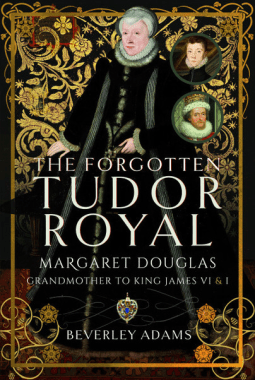
Much analysis will follow about appropriate Liberal responses to their current electoral plight. Some of these are policy matters and others are organizational. It is not appropriate for a life-long Labor man to offer opinions on such matters.

But there is one lesson I believe it would be in the Liberals interests and the national interest for the Liberals to learn.

They need to break out of the coalition with the Nationals!

I noticed Nikki Savva’s recent article in which she raised the possibility of the NSW Liberals dissolving the coalition in opposition. She also says the NSW Liberals believe the federal Liberals should do the same.

This would not be unique, it happens in WA, but it would be unusual. But it would also be very smart.

Anyone who takes a clear-eyed view of the political problems the Liberals face with young professional voters in urban areas, particularly young women, must accept that this problem is going to be impossible to solve while the Liberals are tied to the Nationals.

How will the Liberal candidate attempting to win back Warringah from the Teals, Brisbane from the Greens or Higgins from Labor be able to mount a credible case with Barnaby Joyce and Matt Canavan with their views about climate change and other issues as a potential part of any government those candidates would be seeking support to form.

This might not be the case in a decentralized state like Queensland, although I think it probably is, but in NSW, Victoria and federally it is a reality which has to be faced.

The coalition is a one-way street. All the benefits flow to the Nationals.

If the Nationals were a party to the right of the Liberals as the Greens are a party to the left of labor some form of political equilibrium might be established to the benefit of the liberals.

What are the Nationals going to do in response? Support the Labor Party? I don’t think so.

The recent NSW and federal elections saw the Nationals crowing that they held all their seats (although in fact in NSW they did not do so). This illustrates their priority, building up massive majorities and fighting off Independents in their safe seats, but showing no interest in helping the Liberals win their urban marginals.

For example, recent polling shows that young voters in WA support the Voice referendum 71/29 and yet the Nationals were quick out of the blocks to oppose the proposal, and it looks like they might lead the Liberals by the nose to do the same.

Furthermore, the Nationals are a declining force. As Australian population continues to grow in the major cities and sea-change trends weaken the Nationals’ hold on coastal seats their influence on electoral outcomes will inevitably continue to decline.

In addition, there is real political mileage for the Labor governments at all levels to pursue the question of the secret agreements between the Liberals and the Nationals in forming a coalition. This secrecy cannot survive in the 21st century and any attempt to do so will only weaken the Liberals further.

The idea of ditching the coalition in opposition makes good sense. If the Liberals have the courage to do it, they may find that it will be easier to ditch the “Skynews after dark” crowd and resist the religious fundamentalists infiltration of their party.

And then they may find that they don’t need a coalition to form a government in future. Confidence and Supply agreements with the Nationals would be enough.

It may seem strange that I am giving advice to the Liberals. I could say that as a democrat I want to see a stronger opposition.

The reality is I feel safe in providing this advice because I am so confident that the contemporary Liberal party is not capable of acting on such advice.

Celebrating a birthday and publication of my book about Barbara Pym: The Reality behind Barbara Pym’s Excellent Women The Troublesome Woman Revealed

Publishing this book has been a positive experience, although one entered with much trepidation. I was the happy recipient of an invitation to publish with Cambridge Scholars Publishing and the result was the book pictured above. I shall write about the experience in future blogs. It is one experience with publication, and I have nothing but praise and appreciation for the support I received, and, of course, the brilliant outcome.

However, while I was living in London, I attended a Guardian Seminar on the various types of publishing available to writers seeking publication. One talk was by Joanna Penn whose story was a great incentive to move beyond the trade publishers; another was by the representative of a trade publisher.

Joanna Penn

Joanna Penn spoke about her experience publishing through a trade publisher which resulted in a garage full of unsold books. She then turned to her experience publishing with Amazon Publishing which she found a more positive experience. She now teaches writing, publishing and marketing through presentations and published works.

She says, ” I’m an award-nominated, New York Times and USA Today bestselling author with 35+ books, with almost a million sold across 169 countries and 5 languages”.

But she also acknowledges mistakes which she discusses on her website, blog, and in pod casts as well as publications.

At the seminar we were presented with her Author Blueprint. The update is available through her site.

https://www.thecreativepenn.com

Wisconsin voters are deciding control of state Supreme Court in most consequential election of 2023

Congratulations Wisconsin voters – Judge Janet Protasiewicz won!

Story by Eric Bradner • 

“The race between Democratic-backed Milwaukee County Circuit Court Judge Janet Protasiewicz and Republican-backed former state Supreme Court Justice Daniel Kelly could both break a decadelong era of Republican dominance in one of the nation’s most important swing states and prove pivotal in the fight over the future of abortion access. It’s the most expensive state judicial race ever.”

Defendant Trump

Other American political news – Former President Trump was arraigned in the Manhattan Criminal Courthouse on 34 felony counts of falsifying business records. Legal experts on MSNBC have contributed to excellent debate on the charges and reactions to them. Republicans have supported the former president – as they did before the charges became clear.

Some excellent news on the Australian cultural scene

Funding lifeline thrown to cultural institutions

$535m has been allocated to arrest decline in infrastructure and service provision, but efficiency dividend to remain.

by Jason Blake on 5 April, 2023

Limelight

Nine major cultural and historical institutions in Australia will receive an extra $535.3m in federal government funding over the next four years.

The Australian National Maritime Museum, Bundanon Trust, Museum of Australian Democracy (Old Parliament House), National Archives of Australia, National Film and Sound Archive, National Gallery of Australia, National Library of Australia, National Museum of Australia and National Portrait Gallery of Australia will all benefit from this funding boost, according to the announcement ahead of next month’s budget.

The funding package includes a previously announced $33 million earmarked for the National Library’s digital archive Trove.

Museum of Australian Democracy, Old Parliament House, Canberra. Photo Flickr.

The government has flagged that the institutions will receive indexed funding beyond the four years, allowing institutions to meet their current financial obligations and invest for the future.

The government has pledged to establish “a clear line of sight” over future capital works and improvements to ensure the institutions do not fall into disrepair in the future. The efficiency dividend requirement, which was first imposed under the Hawke government in 1987 and requires Commonwealth entities to reduces budgets each year in anticipation of efficiencies being found, will remain.

Arts Minister Tony Burke criticised the former government for allowing major cultural institutions to fall into “a shocking state of disrepair”, adding that the extra funding would help them “back to where they should be – where the government delivers strong core funding and philanthropists take them to the next level.”

The Voice to Parliament

The Voice to parliament was a key recommendation of the Uluru Statement from the Heart, which was a 12-paragraph document written and endorsed by Aboriginal and Torres Strait Islander leaders in 2017 to change the Constitution to improve the representation of Indigenous Australians.

Liberal Party has decided not to support The Indigenous Voice to Parliament.