Week beginning 24 July 2024

Valerie Keogh The Mother Boldwood Books, June 2024.

Thank you, NetGalley, for providing me with this uncorrected proof for review.

Valerie Keogh has provided readers with yet another good read, with some twists and, in my opinion more importantly, an intelligent consideration of the qualities that are believed to make the perfect husband.  It is the way in which Keogh portrays this less than perfect wife, confronted with the perfect husband, that provides the tension that makes The Mother a book with which will probably resonate with readers who are mothers. After all, which of us is perfect?

The prologue introduces a murderer who contemplates the extremes of love and not loving. There is no indication of the sex of the murderer, which enhances the way in which each character is introduced and behaves throughout the narrative. Who is guilty? The perfect husband? The imperfect wife and mother? Is it one of the friends, patients, and neighbours introduced early in the novel? See Books: Reviews for the complete review.

New Democratic presidential nominee

We were just getting good sleep patterns in place, when I awoke, saw that Joe Biden was no longer going to run for the American presidency, and of course had to watch what MSNBC and CNN commentators were saying at 4.00 o’clock.

The following then appeared in my in email:

Heather Cox Richardson

Heather Cox Richardson from Letters from an American <heathercoxrichardson@substack.com>  July 21, 2024 HEATHER COX RICHARDSON

“My Fellow Americans,

“Over the past three and a half years, we have made great progress as a Nation.

“Today, America has the strongest economy in the world. We’ve made historic investments in rebuilding our Nation, in lowering prescription drug costs for seniors, and in expanding affordable health care to a record number of Americans. We’ve provided critically needed care to a million veterans exposed to toxic substances. Passed the first gun safety law in 30 years.

Appointed the first African American woman to the Supreme Court. And passed the most significant climate legislation in the history of the world. America has never been better positioned to lead than we are today.

“I know none of this could have been done without you, the American people. Together, we overcame a once in a century pandemic and the worst economic crisis since the Great Depression. We’ve protected and preserved our Democracy. And we’ve revitalized and strengthened our alliances around the world.

“It has been the greatest honor of my life to serve as your President. And while it has been my intention to seek reelection, I believe it is in the best interest of my party and the country for me to stand down and to focus solely on fulfilling my duties as President for the remainder of my term.

“I will speak to the Nation later this week in more detail about my decision.

“For now, let me express my deepest gratitude to all those who have worked so hard to see me reelected. I want to thank Vice President Kamala Harris for being an extraordinary partner in all this work. And let me express my heartfelt appreciation to the American people for the faith and trust you have placed in me.

“I believe today what I always have: that there is nothing America can’t do—when we do it together. We just have to remember we are the United States of America.”

With this letter, posted on X this afternoon, President Joe Biden announced he would not accept the Democratic nomination for president. So ended the storyline begun after the event on June 27, when Biden appeared unable to respond effectively to Trump’s verbal assaults. Since then, there has been a drumbeat of media stories and some demands from Democratic lawmakers and donors calling for Biden to step aside and refuse to run for a second term. Increasingly, that drumbeat imperiled his reelection, opening the way for Trump’s election to install a dictatorship of Christian nationalism.

In another post shortly after the first, Biden endorsed Vice President Kamala Harris for the presidential nomination, writing: “My fellow Democrats, I have decided not to accept the nomination and to focus all my energies on my duties as President for the remainder of my term. My very first decision as the party nominee in 2020 was to pick Kamala Harris as my Vice President. And it’s been the best decision I’ve made. Today I want to offer my full support and endorsement for Kamala to be the nominee of our party this year. Democrats—it’s time to come together and beat Trump. Let’s do this.”

Harris smoothly took the baton. “On behalf of the American people, I thank Joe Biden for his extraordinary leadership as President of the United States and for his decades of service to our country,” she wrote. “His remarkable legacy of accomplishment is unmatched in modern American history, surpassing the legacy of many Presidents who have served two terms in office.

“It is a profound honor to serve as his Vice President, and I am deeply grateful to the President, Dr. Biden, and the entire Biden family. I first came to know President Biden through his son Beau. We were friends from our days working together as Attorneys General of our home states. As we worked together, Beau would tell me stories about his Dad. The kind of father—and the kind of man—he was. And the qualities Beau revered in his father are the same qualities, the same values, I have seen every single day in Joe’s leadership as President: His honesty and integrity. His big heart and commitment to his faith and his family. And his love of our country and the American people.

“With this selfless and patriotic act, President Biden is doing what he has done throughout his life of service: putting the American people and our country above everything else.

“I am honored to have the President’s endorsement and my intention is to earn and win this nomination. Over the past year, I have traveled across the country, talking with Americans about the clear choice in this momentous election. And that is what I will continue to do in the days and weeks ahead. I will do everything in my power to unite the Democratic Party—and unite our nation—to defeat Donald Trump and his extreme Project 2025 agenda. 

“We have 107 days until Election Day. Together, we will fight. And together, we will win.”

Biden’s announcement ended the month of suspense under which the Democrats have lived, and in the hours since, they appear to be coalescing around Harris with enthusiasm. Those who might have challenged her nomination have stepped up to support her: California governor Gavin Newsom, Pennsylvania governor Josh Shapiro, North Carolina governor Roy Cooper, and Transportation Secretary Pete Buttigieg all backed Harris; Michigan governor Gretchen Whitmer said she does not intend to challenge Harris. By tonight, all of the state Democratic Party chairs were on board with Harris. Endorsements continued to pour in. 

So did money. Following Biden’s endorsement of Harris, donors contributed more than $46.7 million to Democratic races before 9:00 p.m., and major donors, who had paused donations to Biden, have said they will contribute to Harris’s campaign. The Biden-Harris team also managed the paperwork to transfer the $95 million in Biden’s campaign coffers to Harris because the money was raised for the ticket, rather than for Biden alone. 

But party rules say that Biden cannot pass his delegates to another candidate, so Harris will have to cement them on her own, as well as the superdelegates, a group of party leaders and former elected officials whose votes carry weight in the convention. As of 10 p.m. on Sunday, she had won 531 of the 1,986 delegates necessary to win the nomination. 

Biden’s decision has left the Republicans in deep trouble, and they are illustrating their dilemma with high-pitched anger that the ticket of their opponents has changed and by insisting that if Biden is not fit for another four-year term he must resign the presidency immediately. House speaker Mike Johnson (R-LA) has said he will sue to try to keep Biden in the race; Democratic election litigator Marc Elias responded that “if your lawyers are telling you that they can prevent the D[emocratic] N[ational] C[ommittee] from nominating its candidate of choice, they are idiots. I know a lot about that, since I beat them more than 60x in court after the 2020 election.”

Trump, meanwhile, has posted seven times about Biden since he dropped out of the race. He has ignored Harris. 

The Republicans’ anger reflects that fact that if Biden is off the ticket, they are in yet another pickle. Just last week, the Republicans nominated Donald Trump, who is 78, for president. Having made age their central complaint about Biden, they are now faced with having nominated the oldest candidate in U.S. history, who repeatedly fell asleep at his own nominating convention as well as his criminal trial, who often fumbles words, and who cannot seem to keep a coherent train of thought. Democrats immediately pounced on Trump with all the comments Republicans had been making about Biden. Republicans have already suggested that Trump will not debate Harris, a former prosecutor. 

With 39-year-old Ohio senator J.D. Vance now their vice presidential nominee, it will be tempting for Republicans to push Trump out of the presidential slot. But aside from the fury that would evoke from Trump loyalists, it would further alienate women from the Republican ticket. Republicans were already losing voters over their overturning of the Supreme Court’s 1973 Roe v. Wade decision that recognized the constitutional right to abortion, so many that Trump has recently tried to sound as if he is moderating his stance on abortion and to appeal to women in other ways. Just this weekend at a rally in Grand Rapids, Michigan, Trump appeared to be courting suburban women by promising to “stop the plunder, rape, slaughter and destruction of our American suburbs and cities” he implied had taken place under Biden. (In fact, violent crime has decreased significantly since 2020.)

Vance is an extremist who supports a national abortion ban, has said he does not believe in exceptions for rape or incest in abortion bans, and has praised women who stay in abusive marriages. 

Biden’s decision not to accept the Democratic presidential nomination has created yet another conspicuous contrast with Trump. Thanks for a job well done and praise for his statesmanship have been pouring out ever since Biden made his announcement—indeed, they have apparently convinced some people that he has stepped down from the job altogether, while in fact he will remain the president for another six months.

Among others, Secretary of Defense Lloyd Austin called Biden “an extraordinary guardian of America’s national security,” thanked him for his leadership and statesmanship, and called him “one of our great foreign-policy presidents.” President Lyndon B. Johnson’s daughters called him “a patriot without peer” and said, “we love you and thank you for your selfless service to all who love democracy, social justice and the rule of law.” 

For all the accolades, though, it is likely that the one the family-oriented president values most came from his son Hunter, whom the Republicans hammered for years as a proxy for his father.

“For my entire life, I’ve looked at my dad in awe,” the younger Biden wrote. “How could he suffer so much heartache and yet give so much of whatever remained of his heart to others? Not only in the policies he passed, but in the individual lives he’s touched…. That unconditional love has been his North Star as a President, and as a parent. He is unique in public life today in that there is no distance between Joe Biden the man and Joe Biden the public servant of the last 54 years. I’m so lucky every night I get to tell him I love him, and to thank him. I ask all Americans to join me tonight in doing the same.” 

In a time of dictators, Trump tried to overthrow the results of the 2020 presidential election and install himself in power against the wishes of the people. President Joe Biden voluntarily turned away from reelection in order to give the people a better shot at preserving our democracy. 

He demonstrated what it means to put the country first.

Notes:

https://www.theguardian.com/us-news/article/2024/jul/21/read-joe-biden-letter

https://www.theguardian.com/us-news/article/2024/jul/21/harris-biden-drops-out-letter

https://www.theguardian.com/us-news/article/2024/jun/27/trump-biden-cnn-presidential-debate-reaction-highlights

https://www.cnbc.com/2024/07/21/kamala-harris-fundraising-surge.html

https://www.politico.com/news/2024/07/21/kamala-harris-biden-campaign-funds-00170136

https://www.bloomberg.com/news/articles/2024-07-21/michigan-s-whitmer-said-to-stand-down-from-presidential-run

https://apnews.com/article/harris-biden-democratic-convention-2fb8b1bc88b99e919872e63efdd8c275

https://www.thedailybeast.com/democrats-mock-donald-trump-as-too-old-to-runlike-he-did-to-joe-biden

https://www.telegraph.co.uk/us/politics/2024/07/20/barack-obama-joe-biden-pelosi-latest-news-us-election/

‘Embrace her,’ Biden says as Harris gives her first speech as likely Democratic nominee

Travelling – London

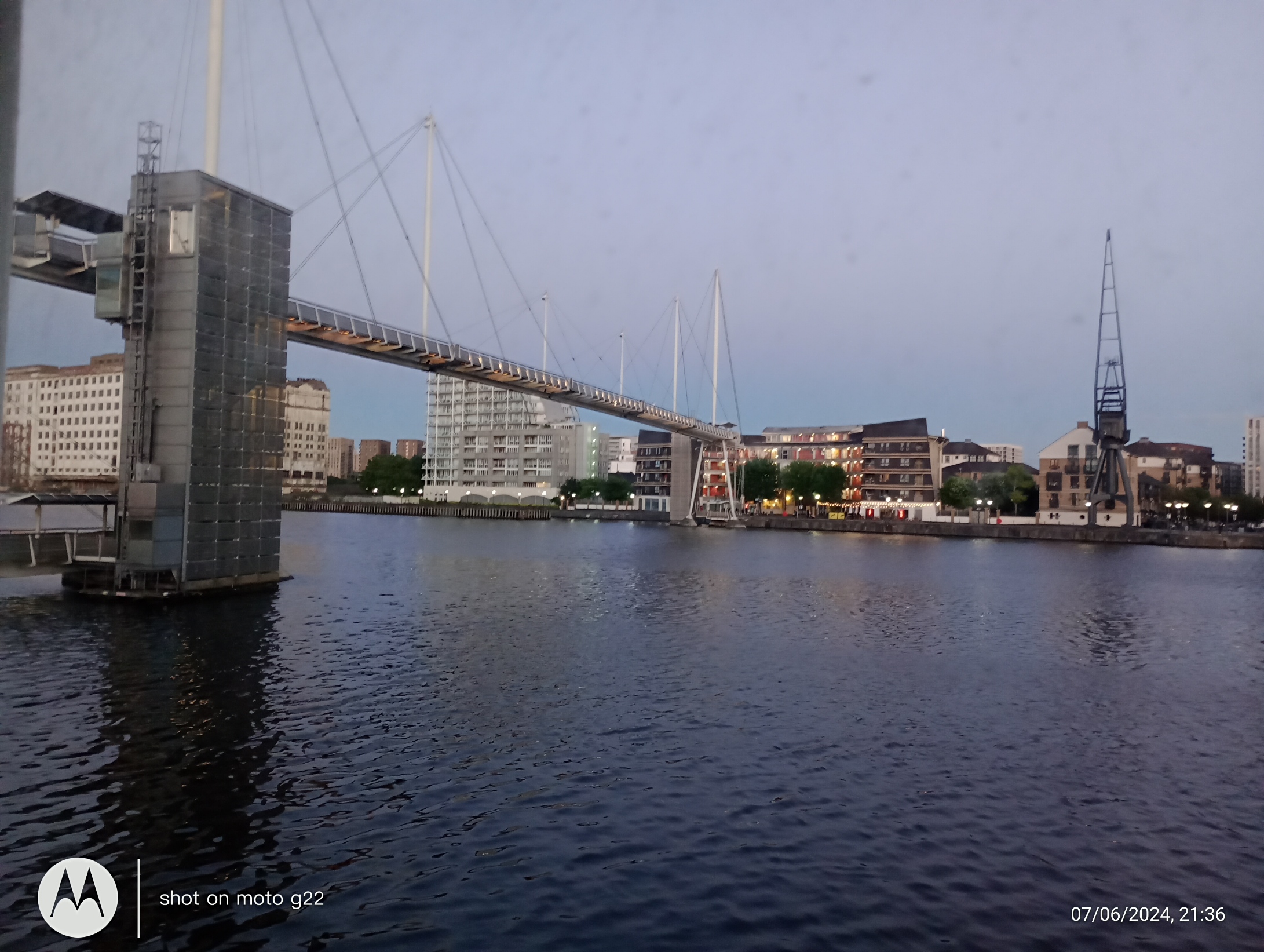
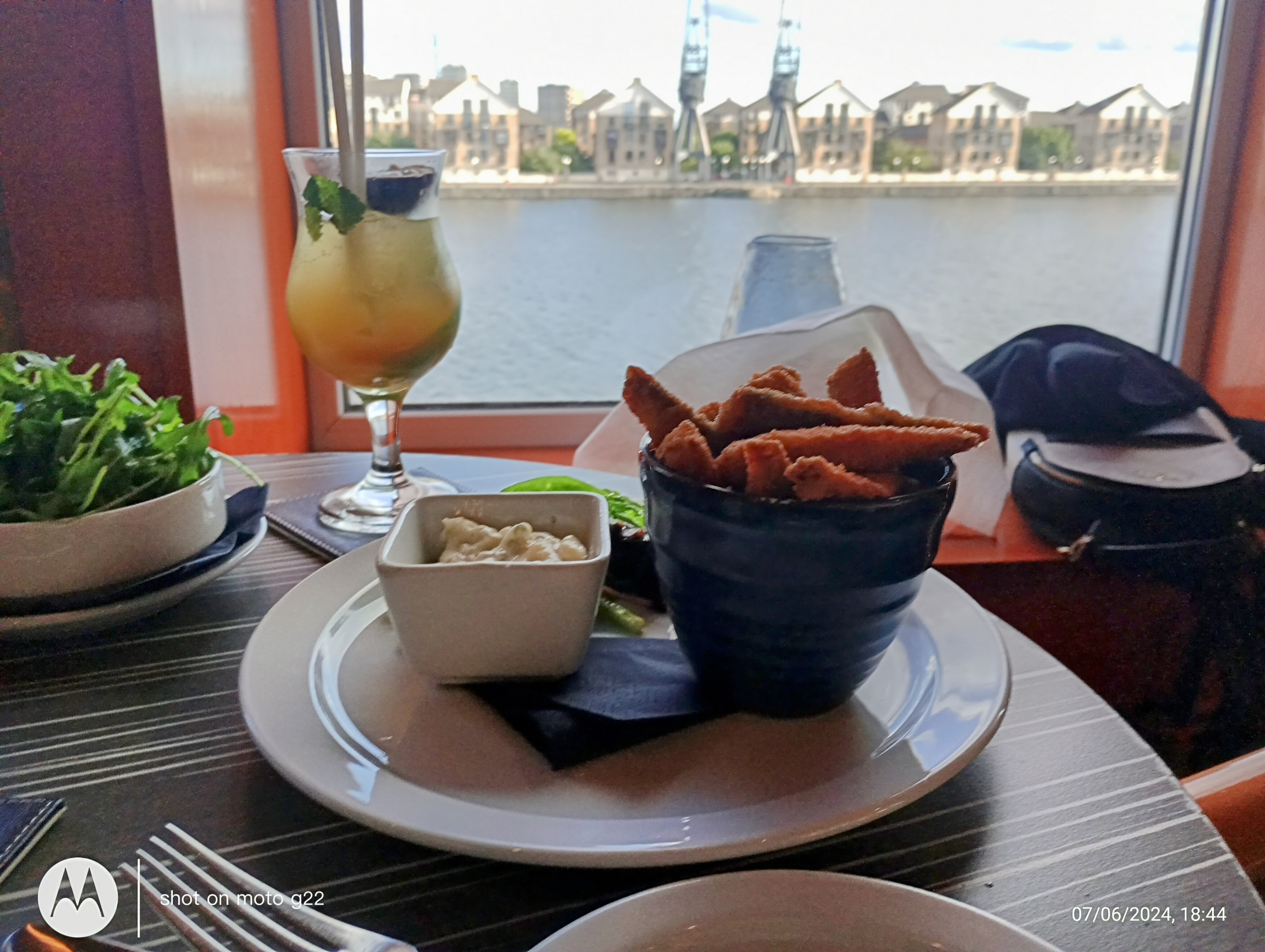
Although I am now home from my travels in the UK, my time in London after a couple of days in Wallingford, a market town not far from Oxford are worth recording. A superb yacht at Royal Victoria Dock was our home for two nights. This was a find on the Secret Escapes site that I could not resist. The yacht had been towed from Finland and is now stable at the dock. However, the illusion of being afloat is sustained as there are portholes through which we could see the water, and water surrounds the vessel. This is unlike some of the alternative dock hotels, where the building is built on to the dock and has no significant ship like features. The Sunborn was fun. Our ‘cabin’ was huge, with bedroom and sitting room areas, a small bathroom (very reminiscent of a cruise ship) and on the second ‘deck’ with a porthole. The area around the ship was pleasant enough with a range of eating places, and other hotels. The proximity to Customs House Station was excellent. This is on the Elizabeth line, therefore affording an easy trip from Heathrow to the yacht.

From the Royal Victoria Dock we took the train to Reading, and then a bus journey to Wallingford. The bus has improved immensely since I used to take it to Oxford and the Bodleian Library in the years I was researching there for what became The Reality behind Barbara Pym’s Excellent Women The Troublesome Woman Revealed.

I covered the archeological find near Wallingford in the last blog (17 July) and the connection between Wallingford and Agatha Christie in the blog of 13th September 2023. A statue is prominently displayed in a Wallingford park.

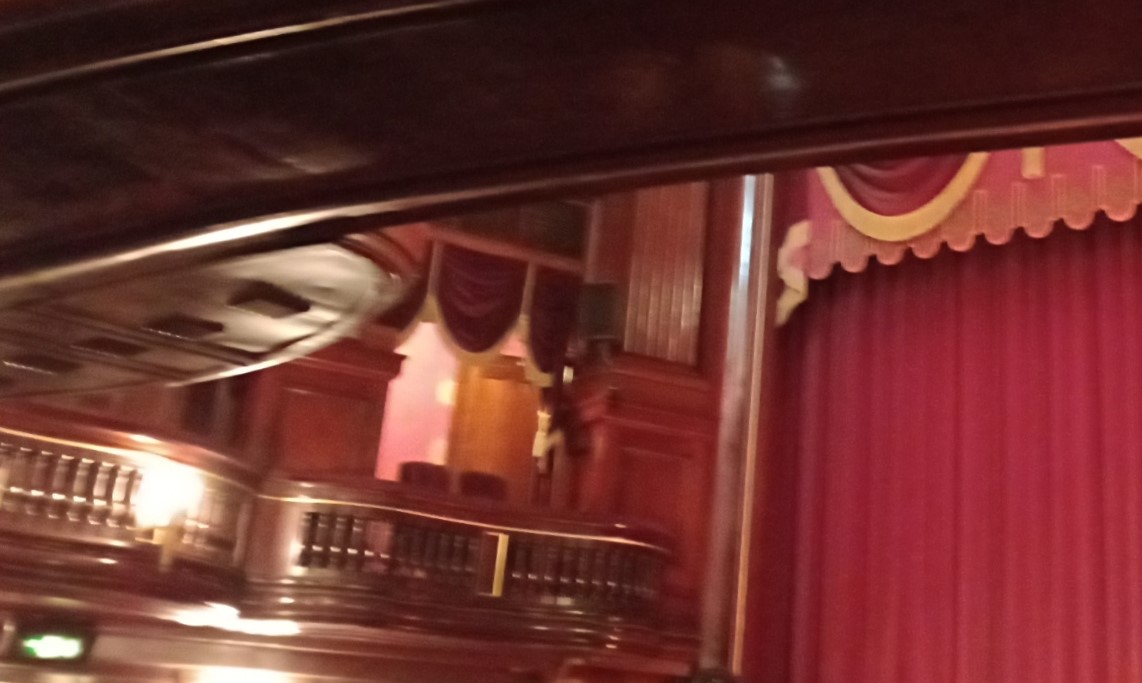
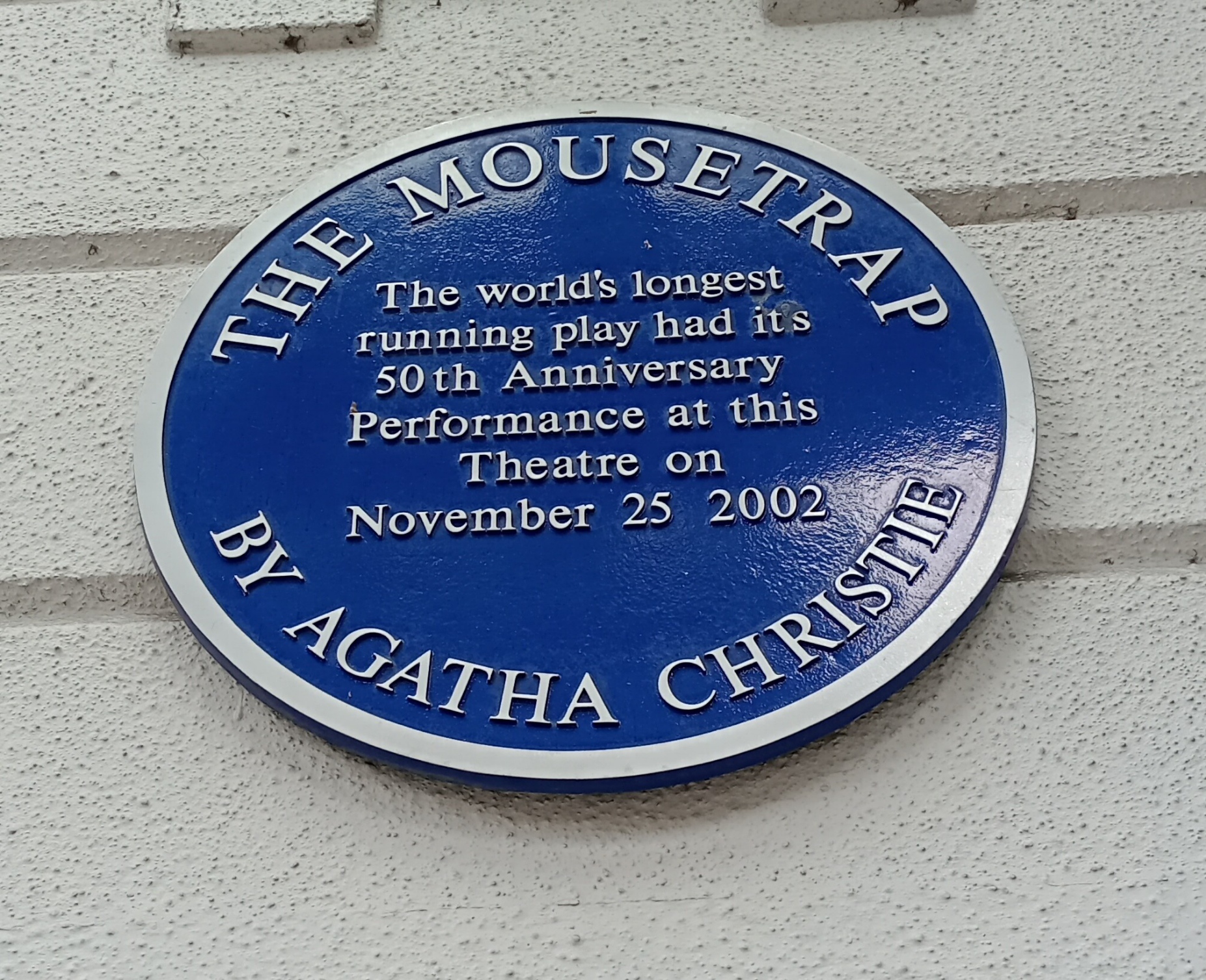
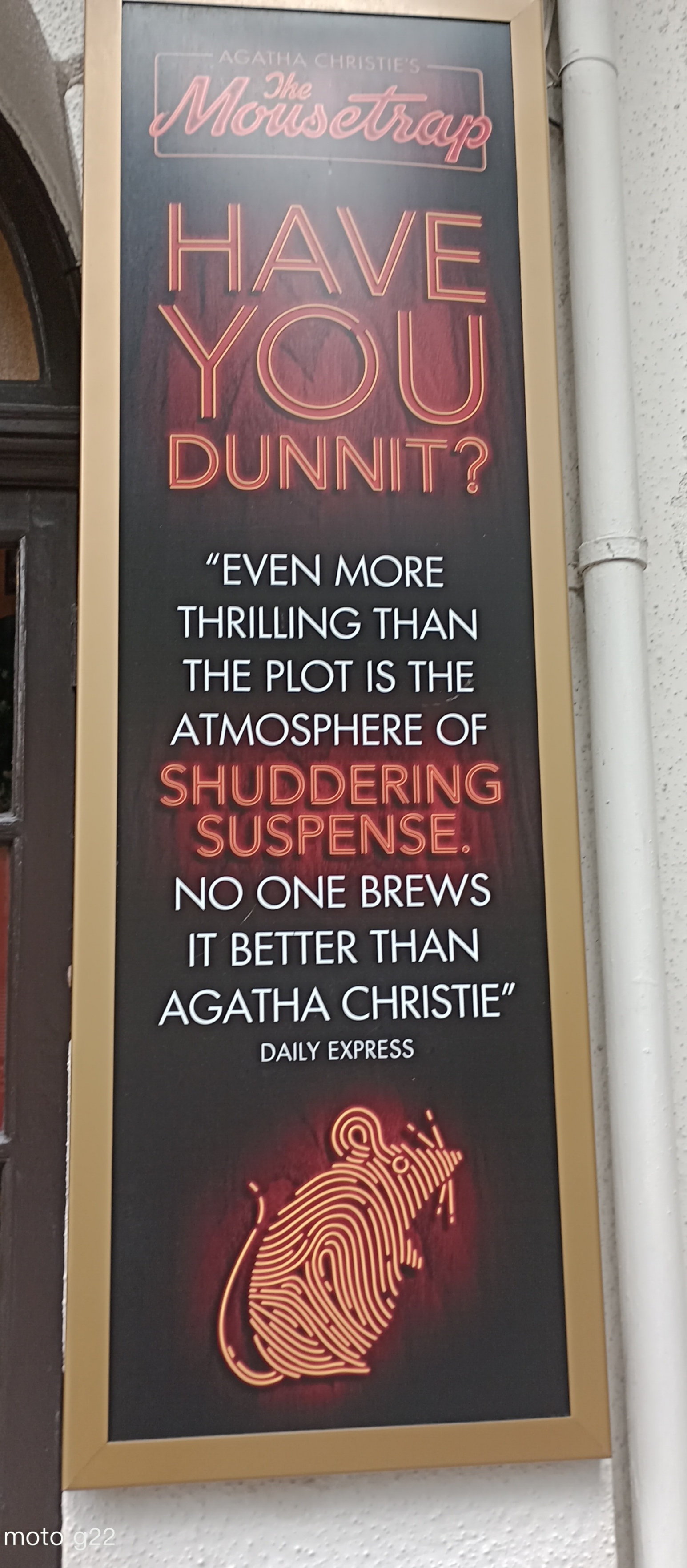
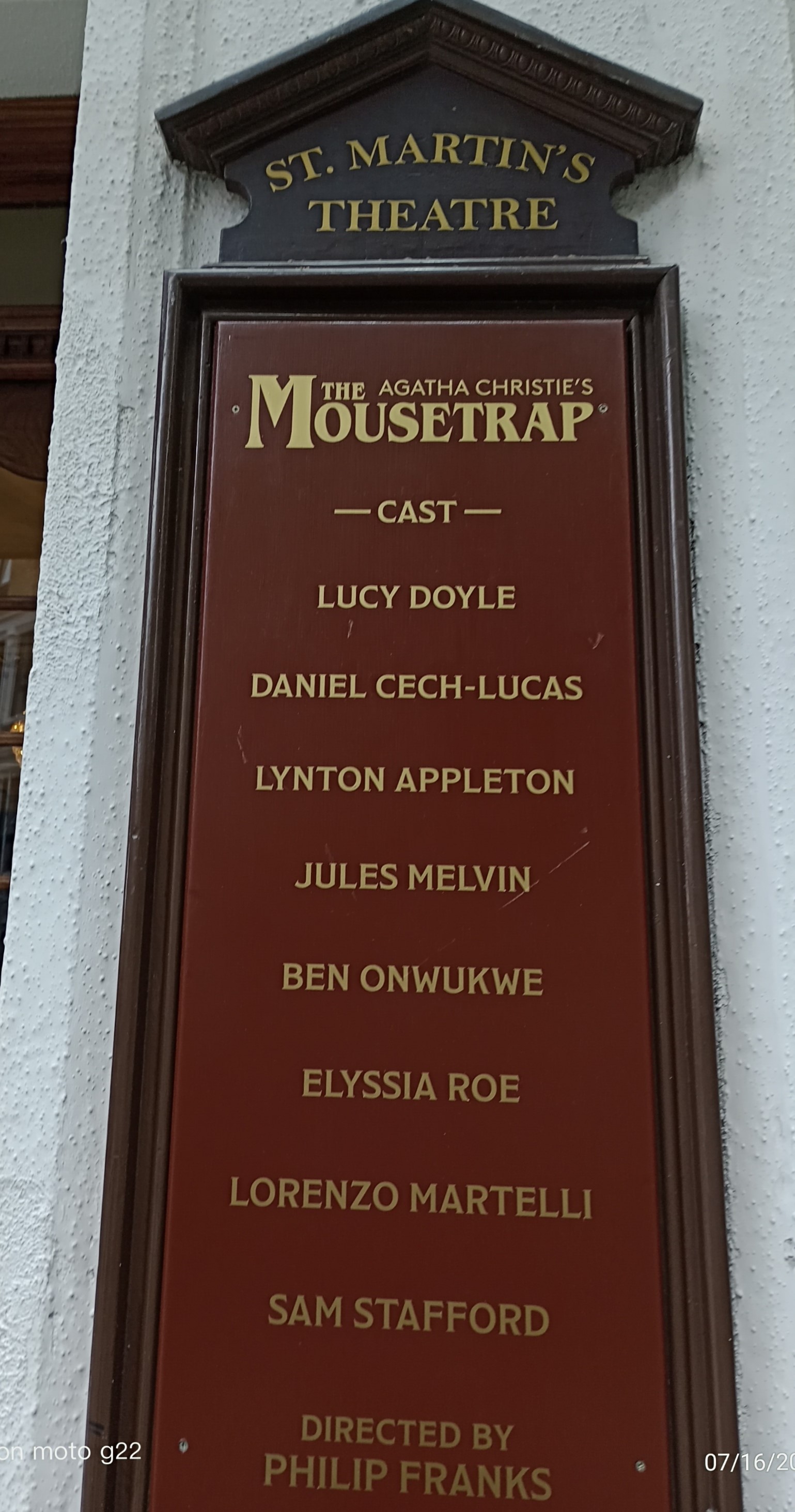
Upon returning to London, I followed up the past Wallingford experience with attending the famous Agatha Christie play.

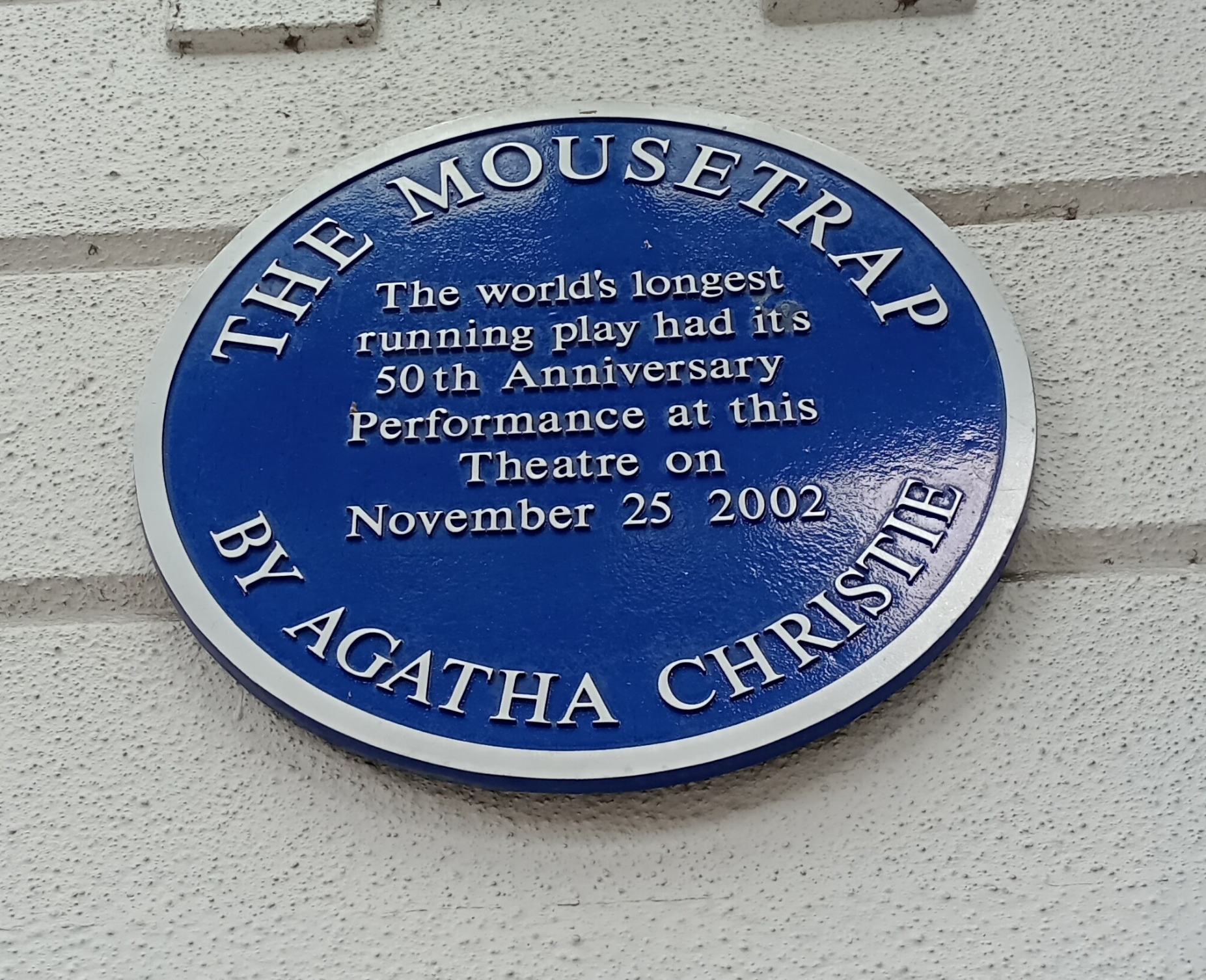
The Mousetrap

Having seen The Mousetrap in Canberra it seemed time to see it in the theatre in which it has played for seventy-two years. This was a great experience, particularly as the Canberra version measured up extremely well. For me, the first scenes were wonderfully developed in the latter, subtlety was not (in my opinion) a desirable feature of the interplay between the BBC news, the entrance of characters and their doffing of the suspicious garments – a light scarf, a dark coat and a dark soft hat. The striking action and timing in the Canberra version were excellent. On the other hand, the remainder of the play was reminiscent of hat I had seen locally, with the London ending perhaps a bit stronger. Both were so worthwhile seeing, and I was pleased to have at last gone to the historic event.

Wigmore Hall Recital

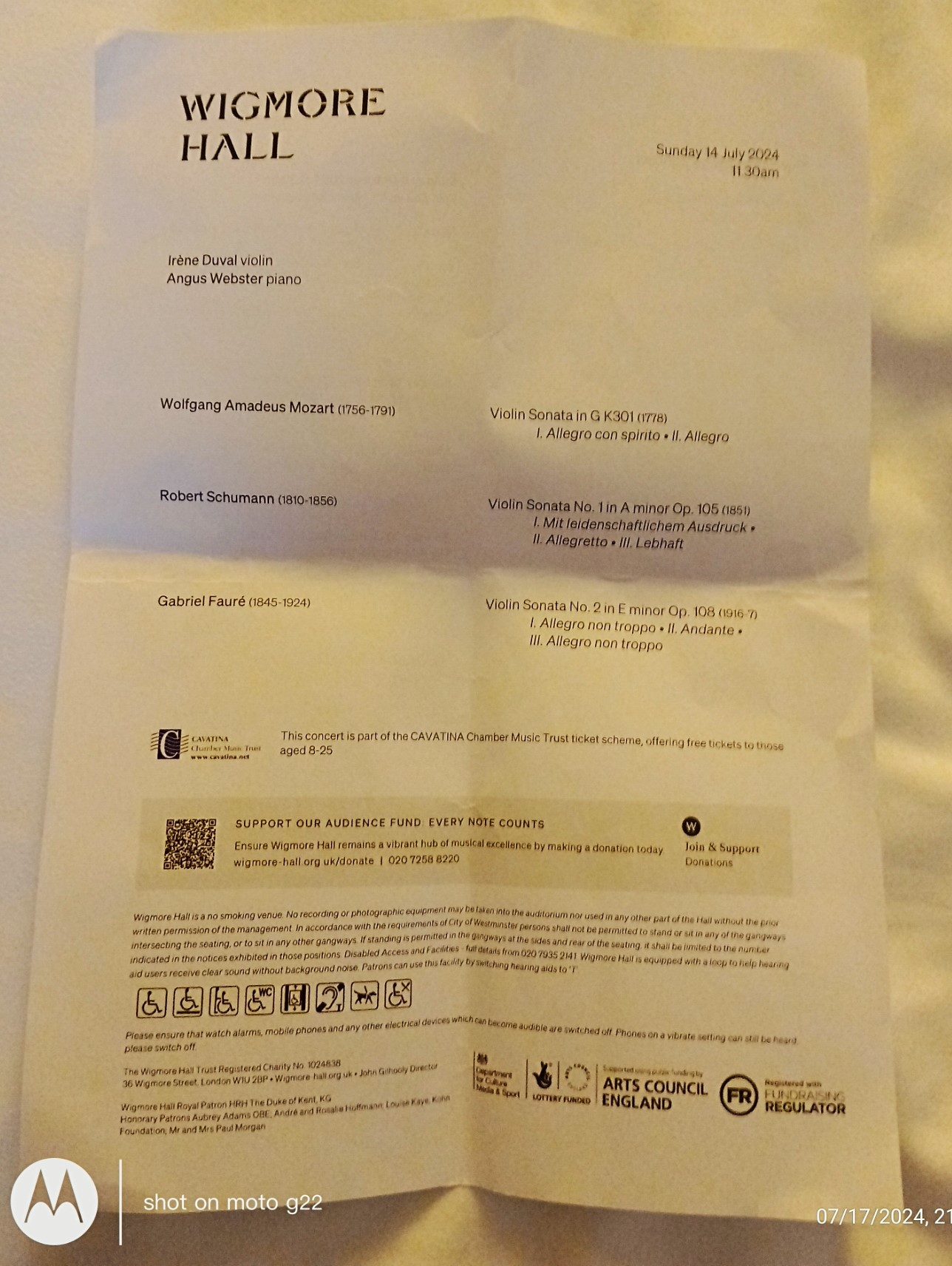
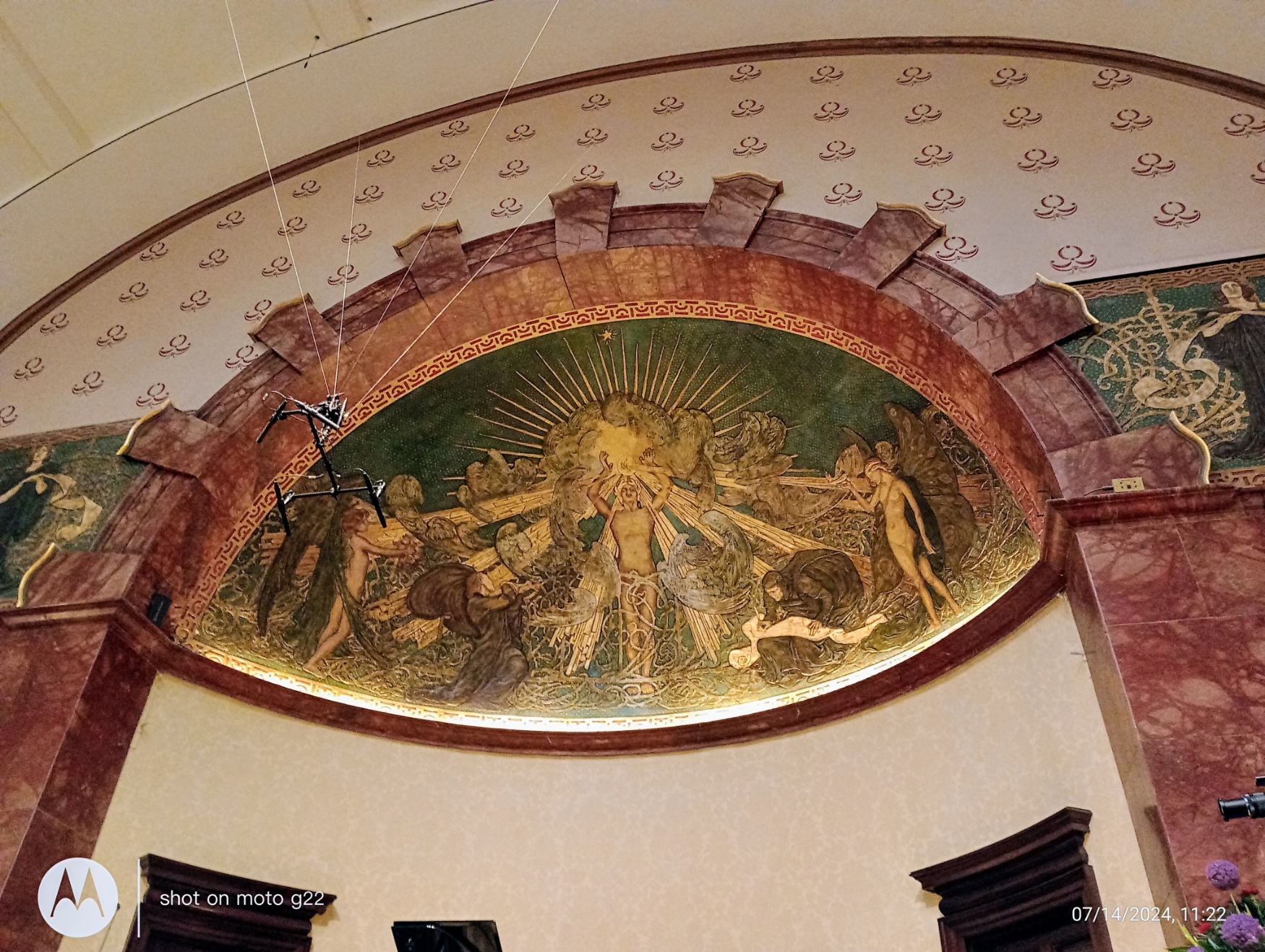
Sunday morning at a Wigmore Hall Recital is an important part of our London itinerary. It recalls the New Year Eve events that we attended there when we lived in London. Afterwards we used to go to Peral liang for dinner before watching the fireworks from our apartment (an occasional spark here and there only to be seen, too far from Hyde Park, alas).

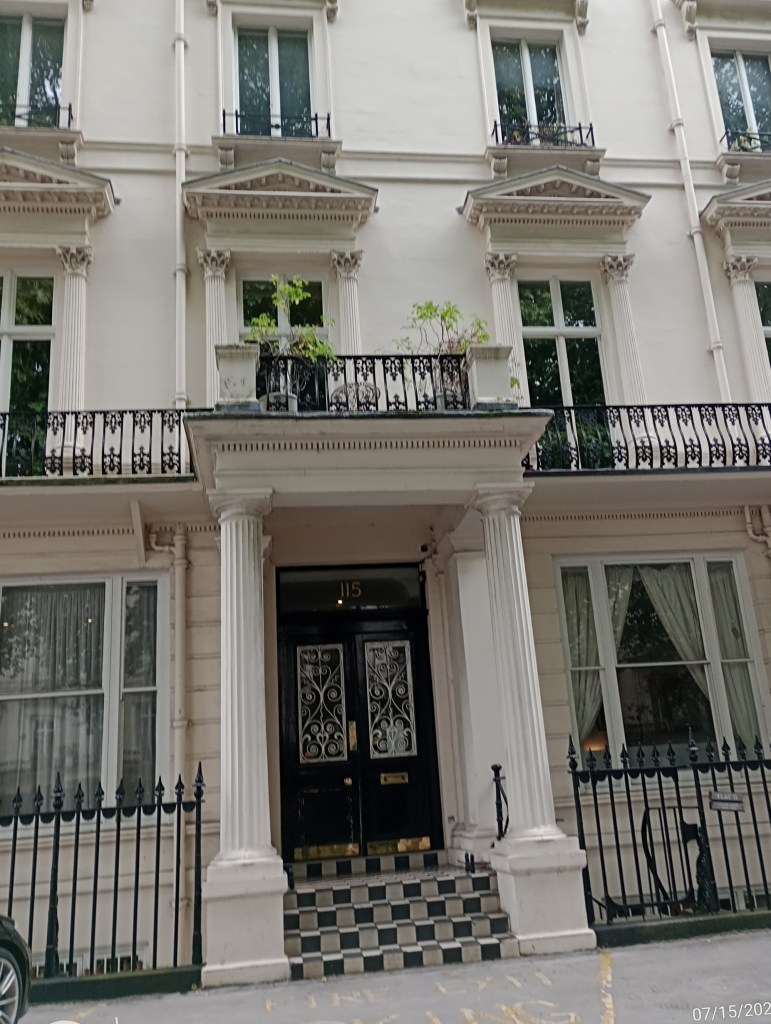
Some Paddington nostalgia

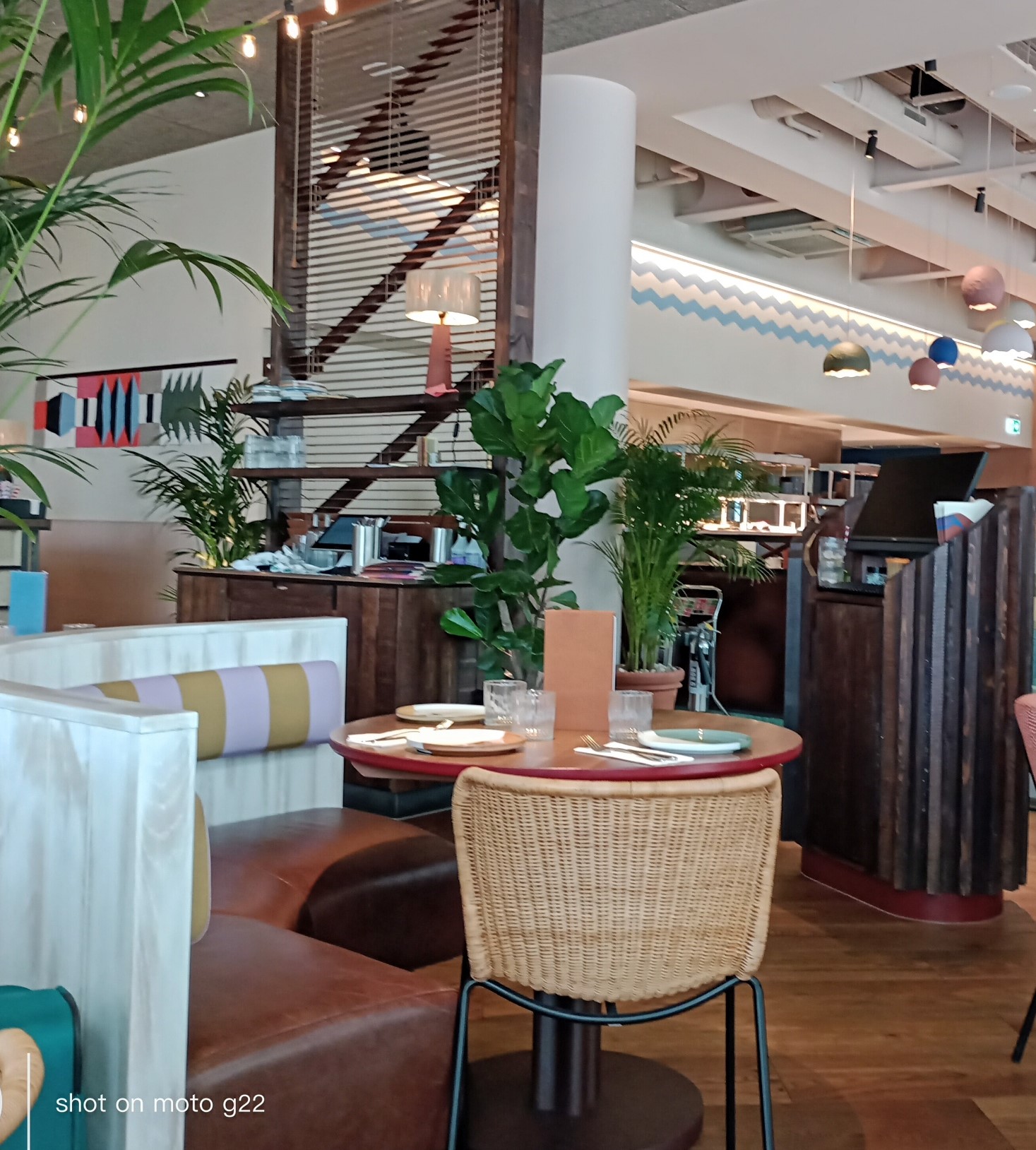
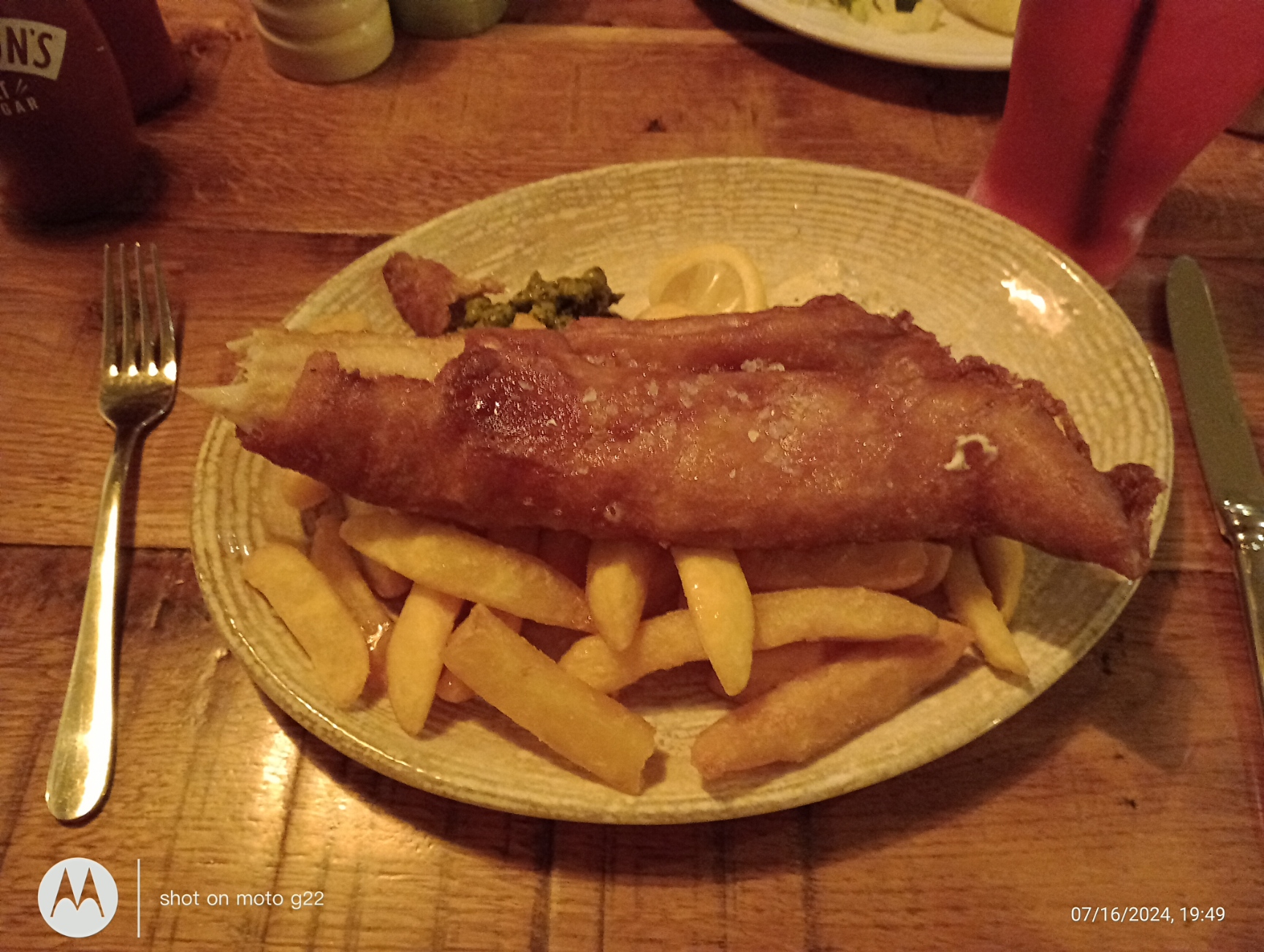
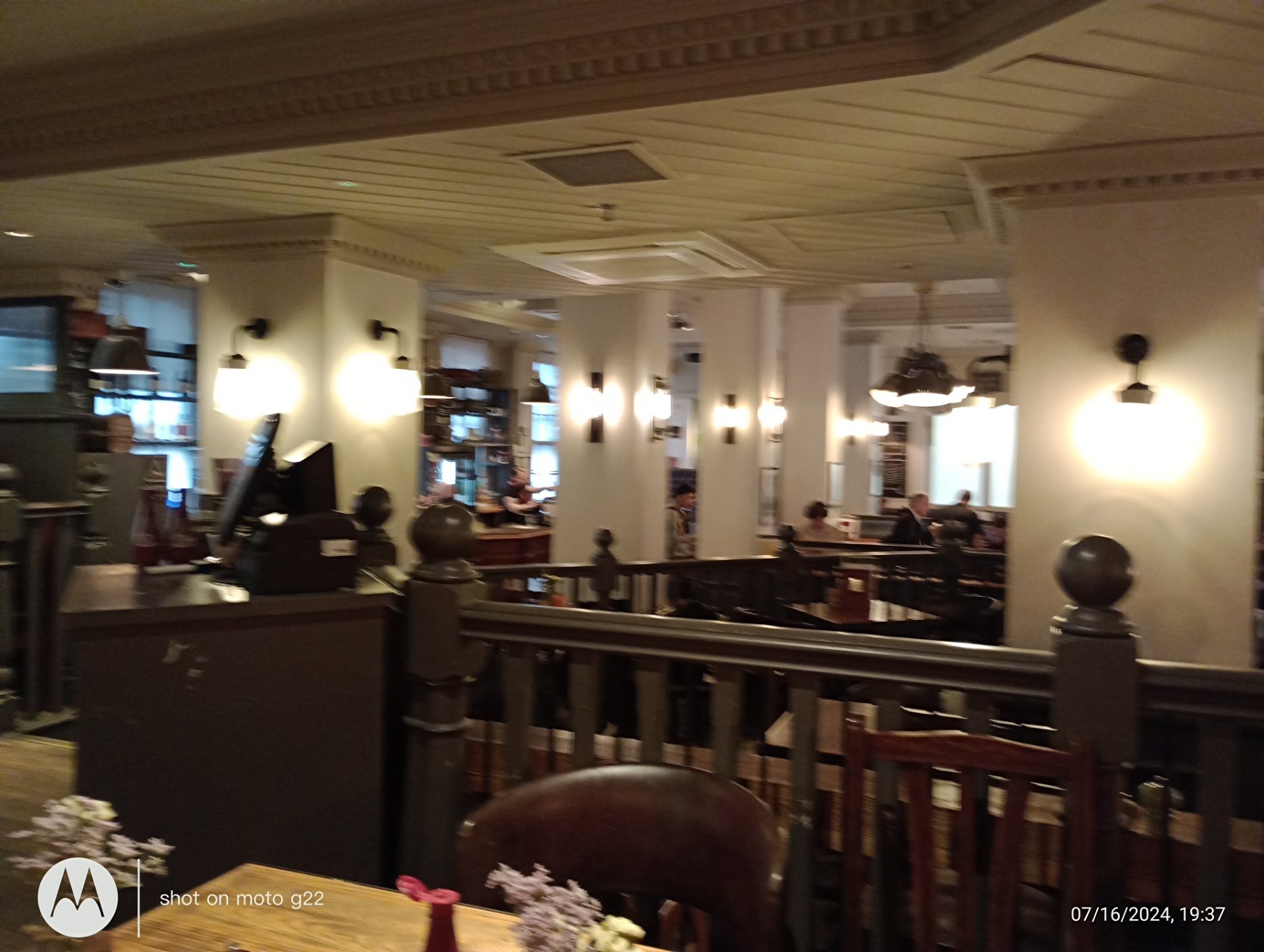
Cindy Lou enjoys a great variety of meals – Wallingford, Sunborn and during the last few days in London

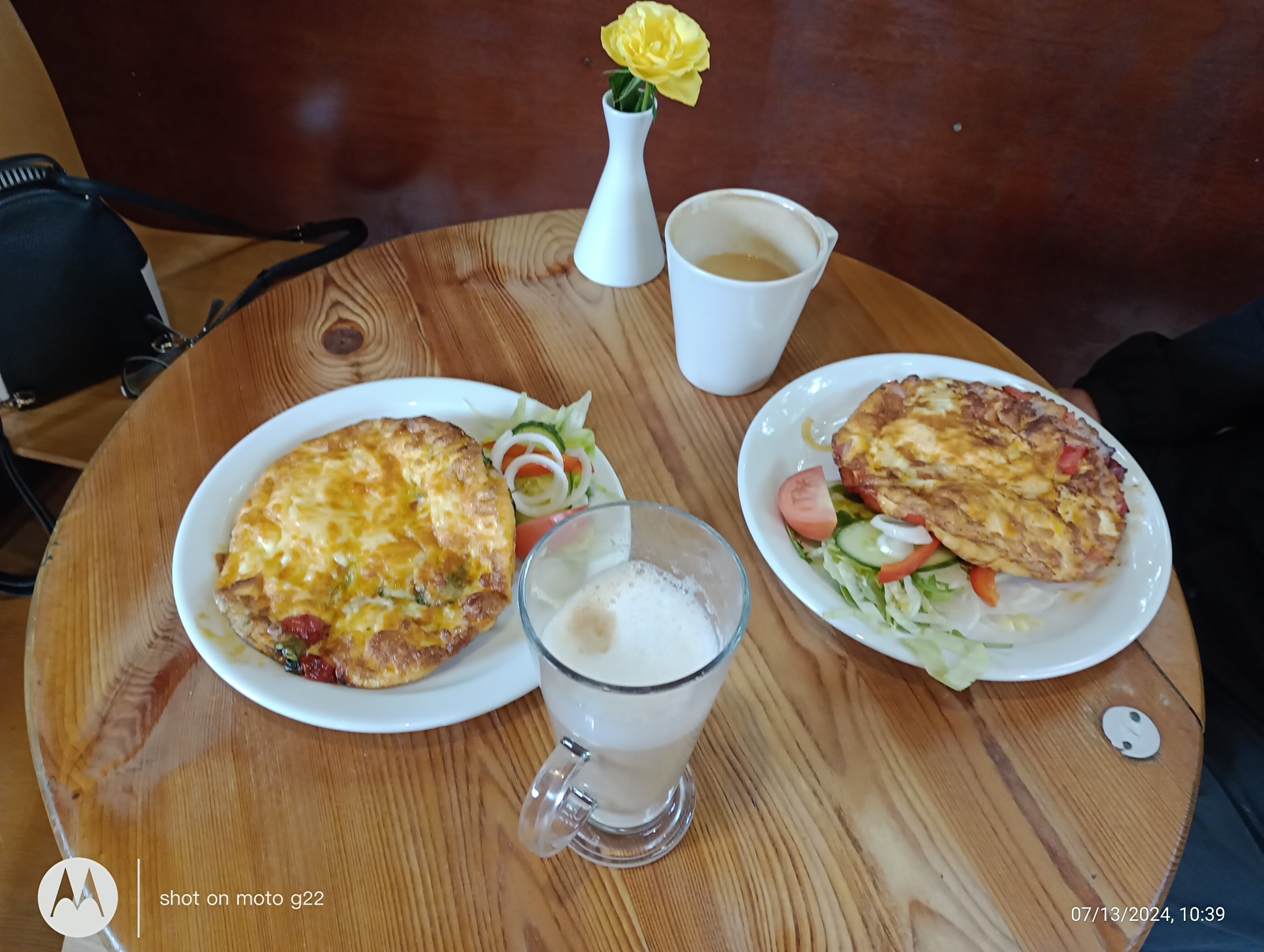
Cafe 900, an Italian Cafe, Wallingford

This cafe provides an excellent breakfast or morning/afternoon tea. We had breakfast there before going to friends for ‘elevenses’. The building is old, and the space rather small. The staff are pleasant and efficient, and somehow despite the size lovely meals are served, and tables and seats become available without any fluster. Italian is spoken, and classes are conducted in Wallingford.

From The Oxford Mail, Liam J. Kelly

900 Café, in St Mary’s Street, is run by husband and wife duo Andrea and Gabriel Matei, who wished to bring a taste of Italy to the town.

Andrea hails from Italy and Gabriel lived there for over ten years.

Gabriel said: “It’s all going really well. I’ve worked in this industry, in coffee shops and restaurants.

“We wanted to bring something new to this lovely town. It’s such a great community here in Wallingford.

“We have extra seating and a children’s play area upstairs too which we’re looking to improve further.”

The new venue replaces Ribizli Café, a vegan establishment which closed its doors just before Christmas last year after seven years in the town centre.

Sunborn bar and restaurant

Pearl Liang

This Chinese restaurant in Sheldon Square is always full, with lively chatter, and exotic dishes being delivered to nearby tables. Our choice from the menu is usually more prosaic than those around us, but we thoroughly enjoy the options we choose, as well as seeing the variety available on the menu and being served at the tables.

Jamie’s Catherine Street

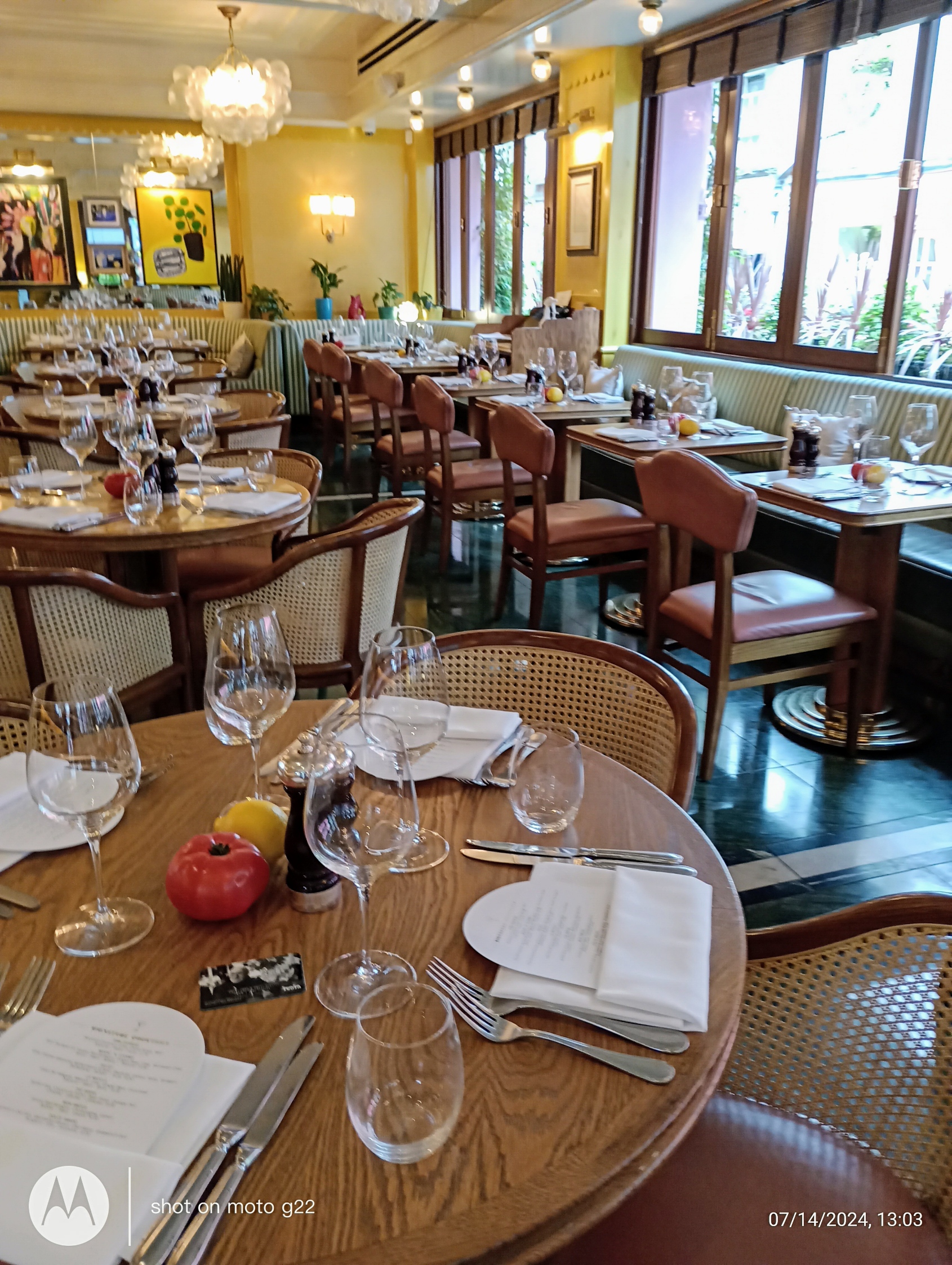
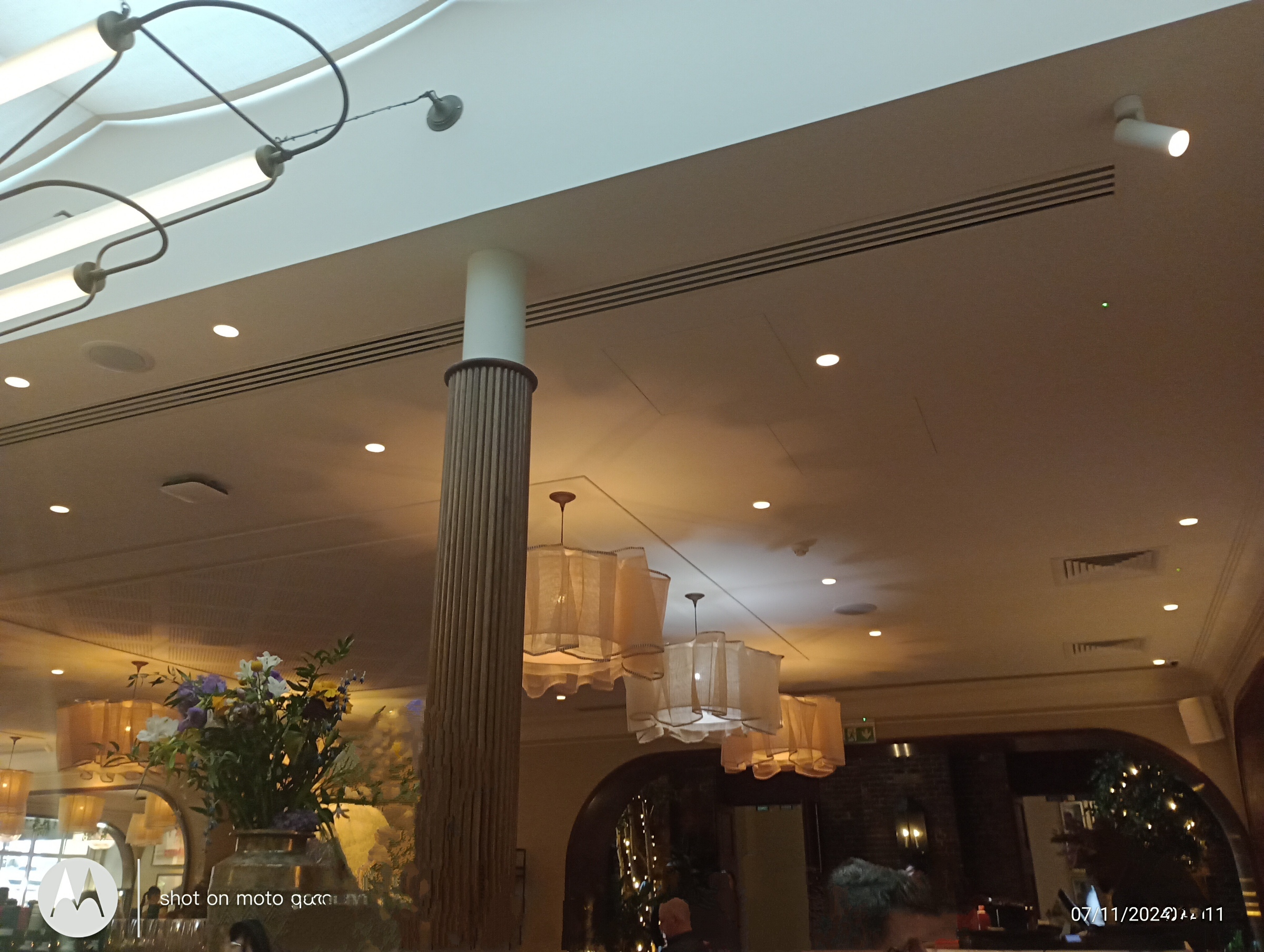
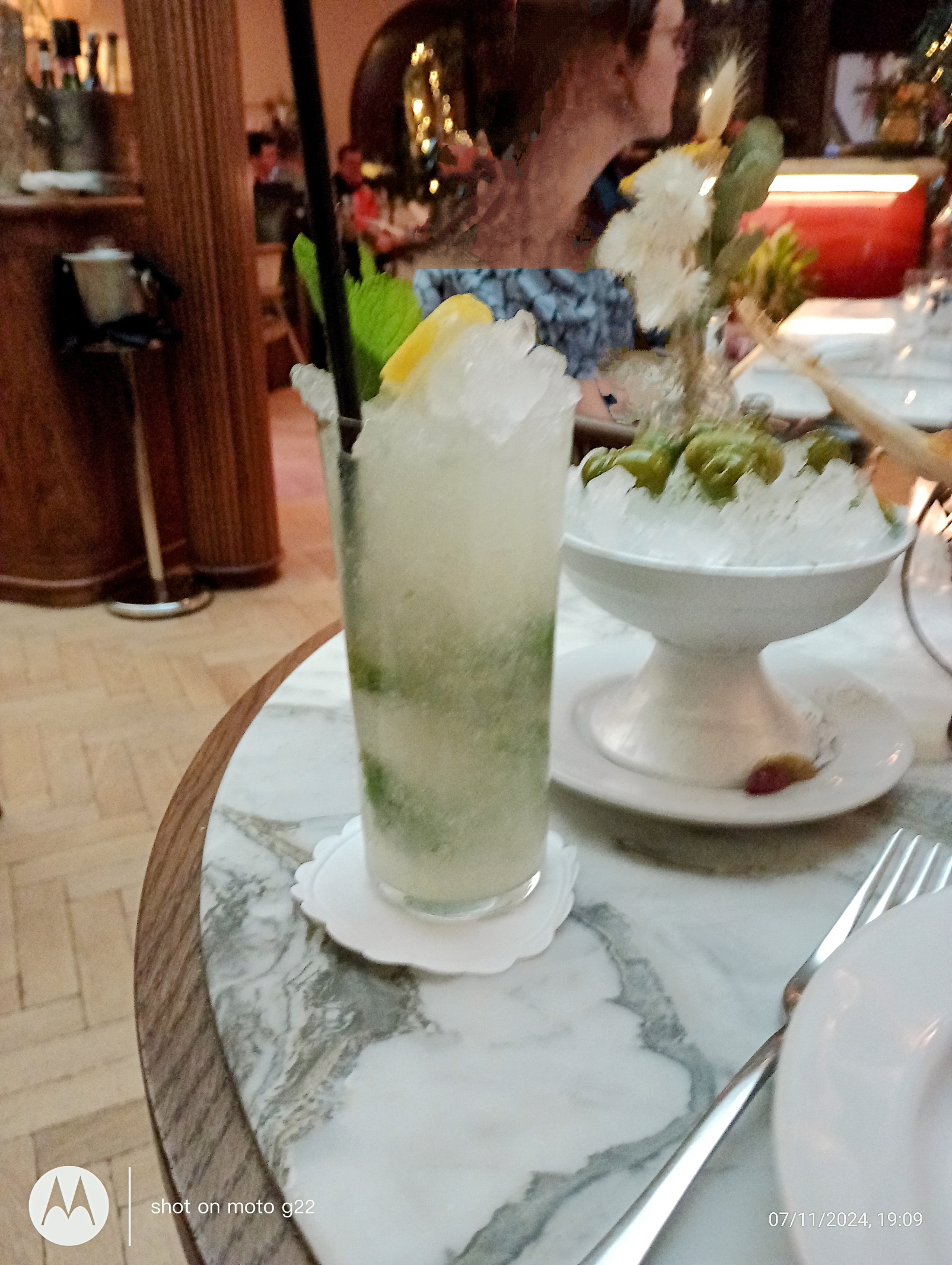
When Jamie Oliver appeared on Australian Master Chef, I decided that Jamie’s Catherine Street was a restaurant to visit. Speaking to one of the staff about his appearance in Australia and the way in which he treated the contestants Jamie Oliver’s decency toward all staff was confirmed. His Australian visit was recalled by the Australian wildflower arrangement.

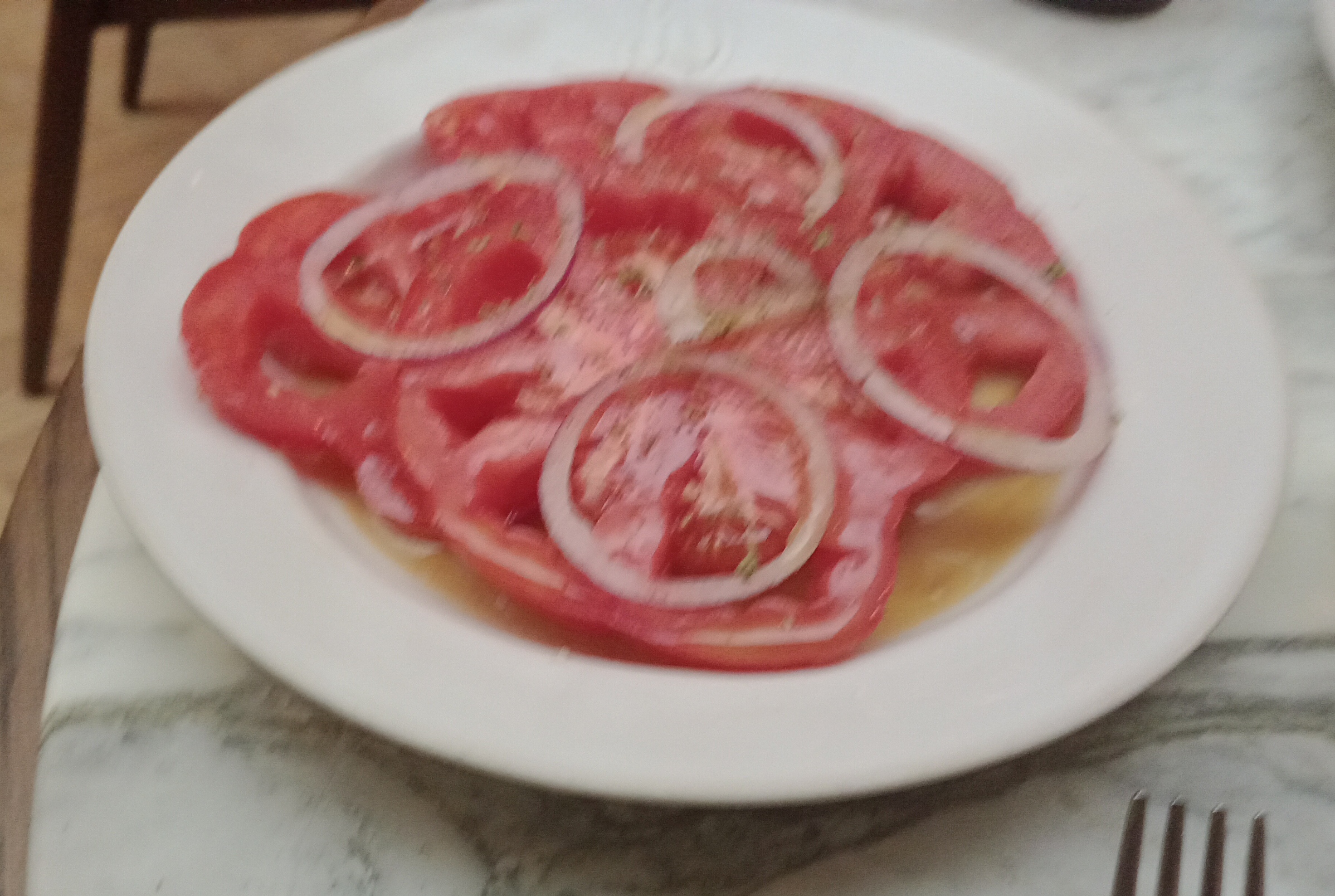
The menu choices we made included the olives that usually appear at Jamie’s restaurants; a breadbasket that includes a choice of crisp bread and grainy varieties; Trev’s Chicken (featured on Master Chef Australia); a prawn cocktail that combined the old favorite and a new twist; greens; heirloom tomato salad (really heirlooms); beef ragu and ice-creams. There were far more interesting desserts, but they were too substantial, and a good range of other attractive entrees and mains.

Caffe Concerto

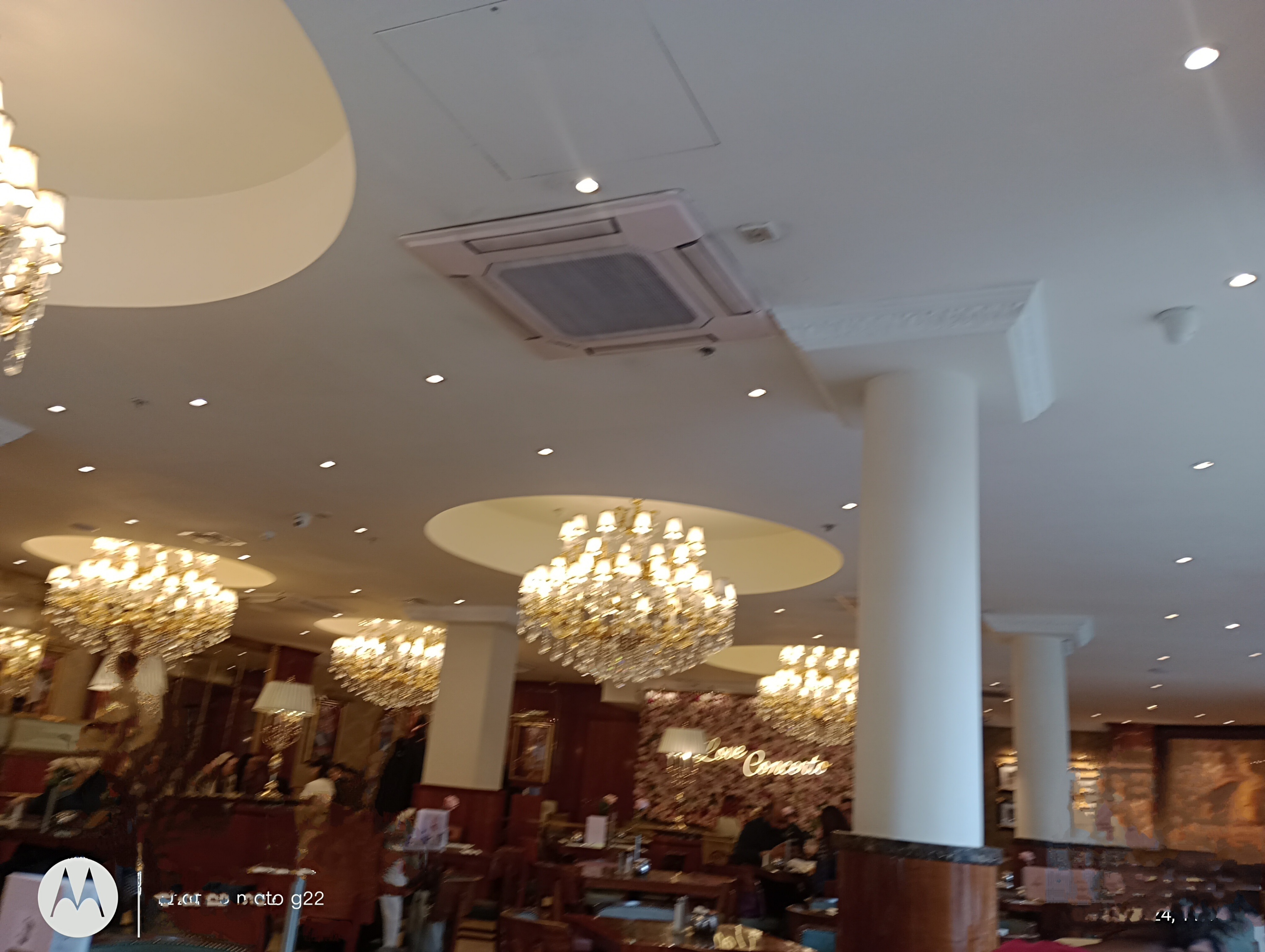
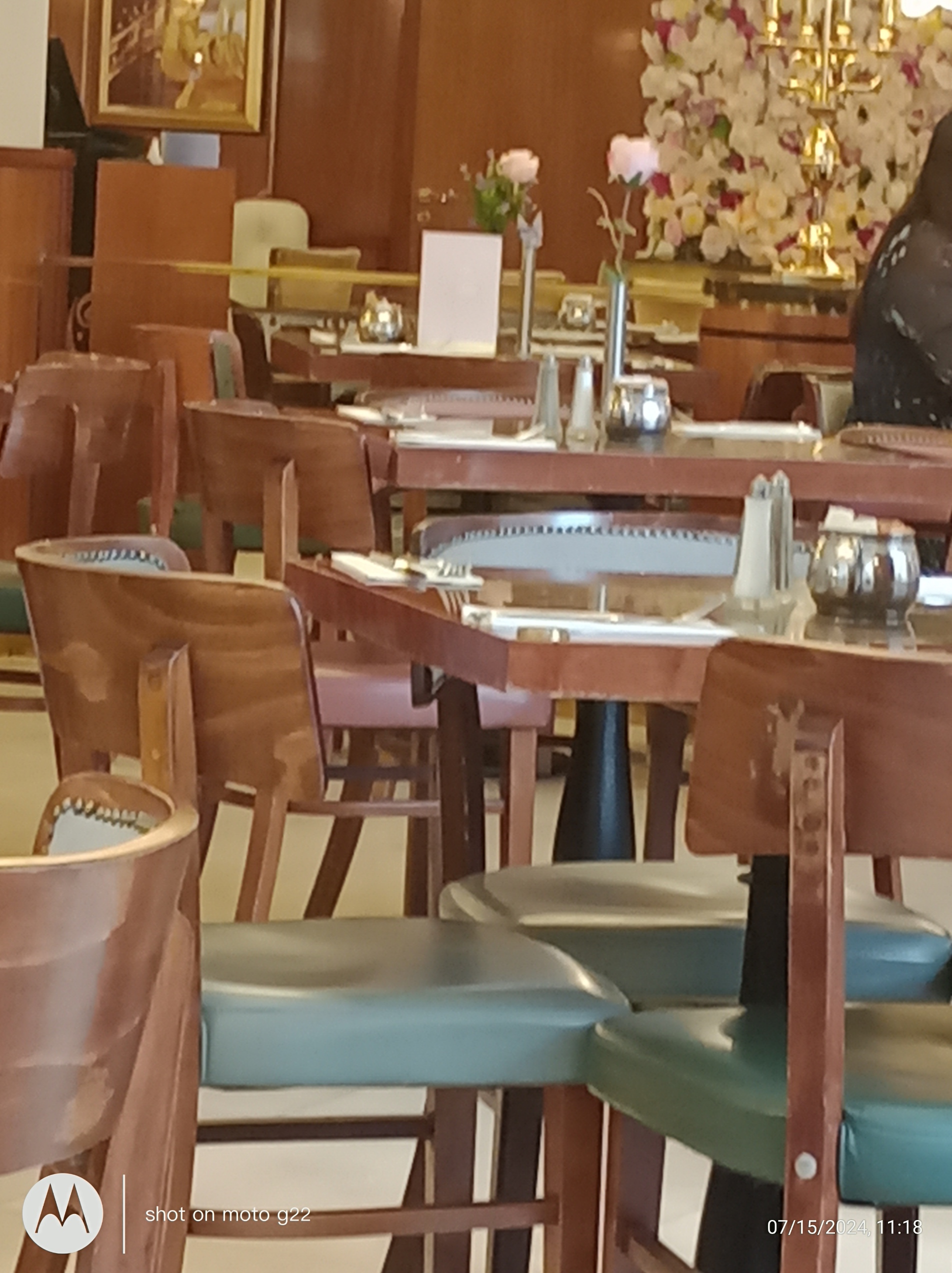
The cakes and coffee at Caffe Concerto are always fun. However, I found that the restaurant in SoHo was more efficient than the one in Kensington. Photos from both appear below – my palmier in the Kensington one is missing as it took so long to appear I ate it with too much gusto too promptly. My beautiful lemon meringue does appear below – the service here was excellent.

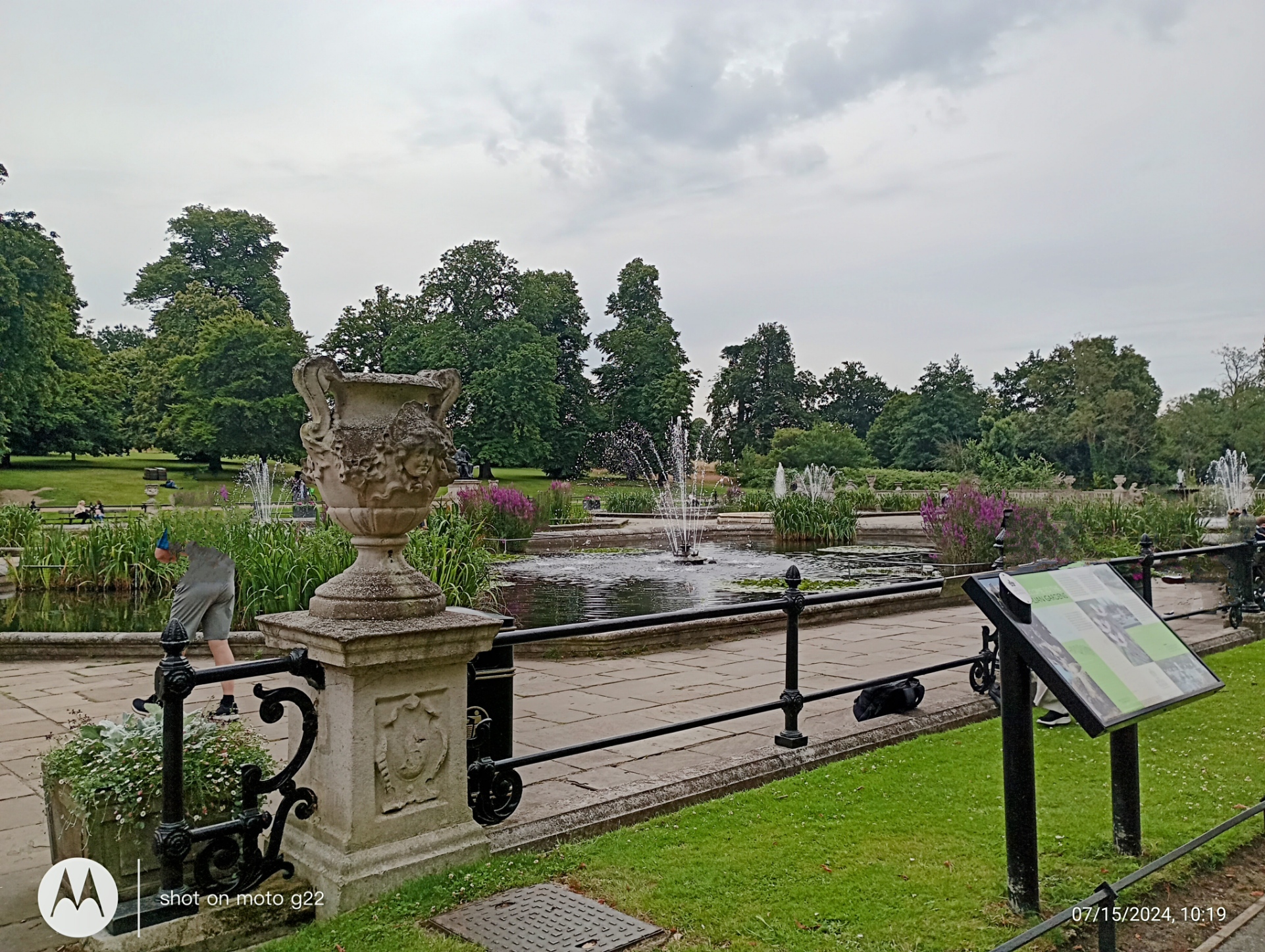
The Kensington visit was after a walk from Paddington, through Hyde Park and then to Kensington. Not so much excuse for SoHo – that visit was after seeing The Mousetrap.

Changi Airport and Terminal 3 Heathrow Airport

Before checking in to my flight from Singapore to London after a night in the Aerotel – a good experience- I ate at a Jamie Oliver Cafe. In Changi, the Big Smoke provided simple sustenance.

Jamie’s in Changi Airport

Vice President Kamala Harris makes her first speech since she was endorsed by President Joe Biden as the candidate for the presidency in 2024.

Week beginning 17 July 2024

Kristy Cambron The British Booksellers Thomas Nelson, April 2024.

Thank you, NetGalley, for providing me with this uncorrected proof for review. *

Kristy Cambron has used the way in which her characters  interacted during World Wars 1 and 2 to produce a fine historical novel based on solid research. An additional explanation of her reasons for choosing Coventry as her location, the research she undertook, and the fabrications she introduced for her fictional  purpose is excellent. There is also an informative list of sources  – a welcome addition to historical fiction. A useful glossary is at the front of the novel. Each chapter is dated so that the past (WW1) and present (WW2) chapters are clear. The prologue, set in 1908 provides the backdrop to the relationships explored in the succeeding chapters. The cello and books that Amos Darby saves for Lady Charlotte Tarrington on this occasion provide the theme for their relationship, despite their significantly different status – he a farmer’s son and she an heiress to a seemingly boundless property. See Books: Reviews for the complete review.

* The publishers wished to have the following noted:  “I received a complimentary copy of this book. Opinions expressed in this review are completely my own.”

Tom Watson – Leeds

Tom Watson’s newsletter provides some useful insights into this city. My experience was dedicated to eating, walking and art when I spent a few days there before visiting Cambridge (some of the highlights of which featured in my 10 July 2024 blog). Tom’s article was written on 18 May 2024, but it seemed more appropriate to read about his vision of Leeds in comparison with mine. Only the Leeds section of the newsletter has been used. For access to Tom Watson’s free newsletter (always an interesting read) see:

Tom Watson <tomwatsonofficial@substack.com>

Back on the treadmill, Brexit and diaries about nuclear warheads

When you hear “LA,” your mind jets off to the sunny shores and star-studded streets of Los Angeles. Well, I packed away my surfboard and held onto my flat cap because there’s a new LA – Leeds Area. Nestled in the heart of West Yorkshire, this LA dazzles with Hollywood’s glitz and deserves its place as the emerging cultural capital of the North.

As I approach a year of living in LA, here are six reasons I moved to my very own Northern Powerhouse—where the tea flows as freely as the banter and the welcome is warm as Yorkshire pudding right out of the oven.

Welcome to LA. It’s reet good.

  1. Scenic and Connected: Beyond the “pure, bracing ventilation” described by Emily Brontë, LA offers a vibrant lifestyle with easy access to three urban centres. You’re always within a 45-minute journey from Leeds and Manchester, and London is just a train ride away—at two hours and 17 minutes for under £40 on a good day. Whether commuting or returning from a night out, convenient Uber services ensure you’re never stranded. LA also has some of the best cycle routes in the UK, if you like that sort of thing.
  2. Cultural Hub: In 2025, Bradford will proudly wear the title of City of Culture. I can’t wait to see the city transform, with exciting new developments like the revamp of the beloved National Media Museum—a favourite of my children. For more details, visit Bradford 2025. And if you’ve not visited the Hepworth Wakefield, you really should.
  3. Architectural Marvel: Forget Venice, Halifax offers the neo-classical splendour of the Piece Hall. This architectural gem recently hosted Grammy-nominated music producer Erik “Blu2th” Griggs. He loved it so much he wanted to return. After finishing at the Sydney Opera House in May, Air plays this Halifax palace in June. Can’t wait. Find out more here – The Piece Hall.
  4. Exclusive Social Scene: The iconic Groucho Club is set to open its northern branch in LA at the Yorkshire Sculpture Park in 2026. Groucho Bretton promises to be a legendary social and cultural venue. I’ve already checked—it’s a £13 Uber ride from my home. If the Groucho doesn’t appeal, Leeds has excellent bars, and Manchester has fabulous pubs.
  5. Art in Nature: LA boasts the Yorkshire Sculpture Park, which spans 500 acres and features works from renowned artists like Henry Moore, Barbara Hepworth, and Ai Weiwei. It’s a cultural feast set in Yorkshire’s natural beauty.
  6. Vibrant Music Scene: LA’s music scene is thriving, with an incredible lineup of DJs and live music venues that energise a night out. Last month, for example, I started my evening in a Leeds Bar where this legendary DJ was playing and ended it with a live band at Hebden Trades Club.
What are the Downsides?

There are few, but there is one. I hesitate to mention the local pastime—moaning. I’m not talking your standard grumble over a cuppa. Up here, some (not all) residents have elevated complaining to an art form. You’ve got folks with a legitimate beef, and then there’s the others, turning whinging into the West Yorkshire Olympics.

I joined a few Facebook groups—Mirfield and Dewsbury Matters—run by someone called “Vulture Images.” This character could start a riot over a misplaced bin. If you’re considering moving to LA, avoid getting news from these drama dens.

On the political flip side, I had a chinwag with the boss of Hebden Trades Club, who spent a solid hour explaining why it’s an independent socialist club and why they’re not too keen on the “disappointing” Keir Starmer. By the time we called it a night, I was convinced Keir would win back the Red Wall only if the Hebden Head Honcho was disappointed with him.

Leeds and Skipton travel

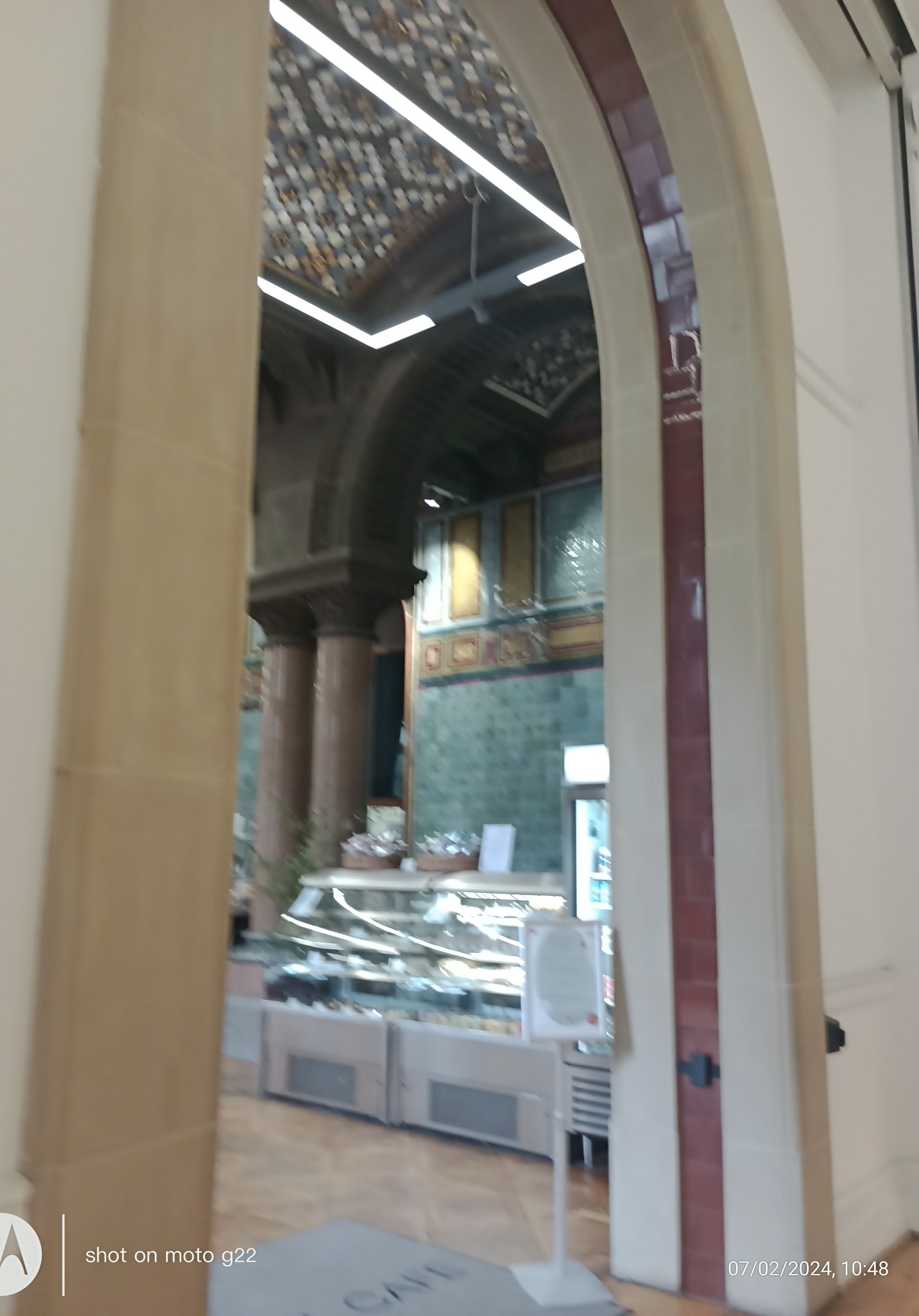
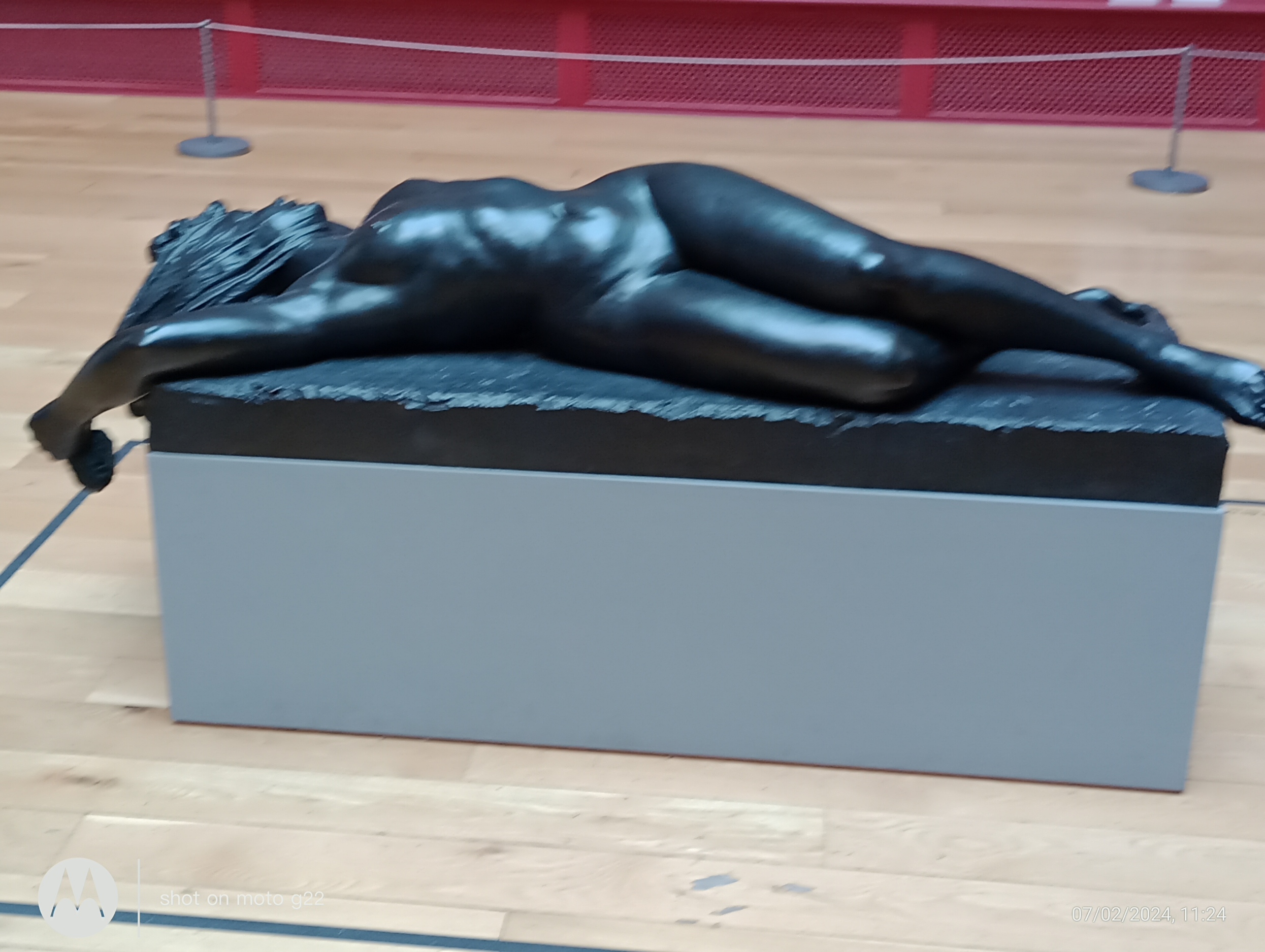
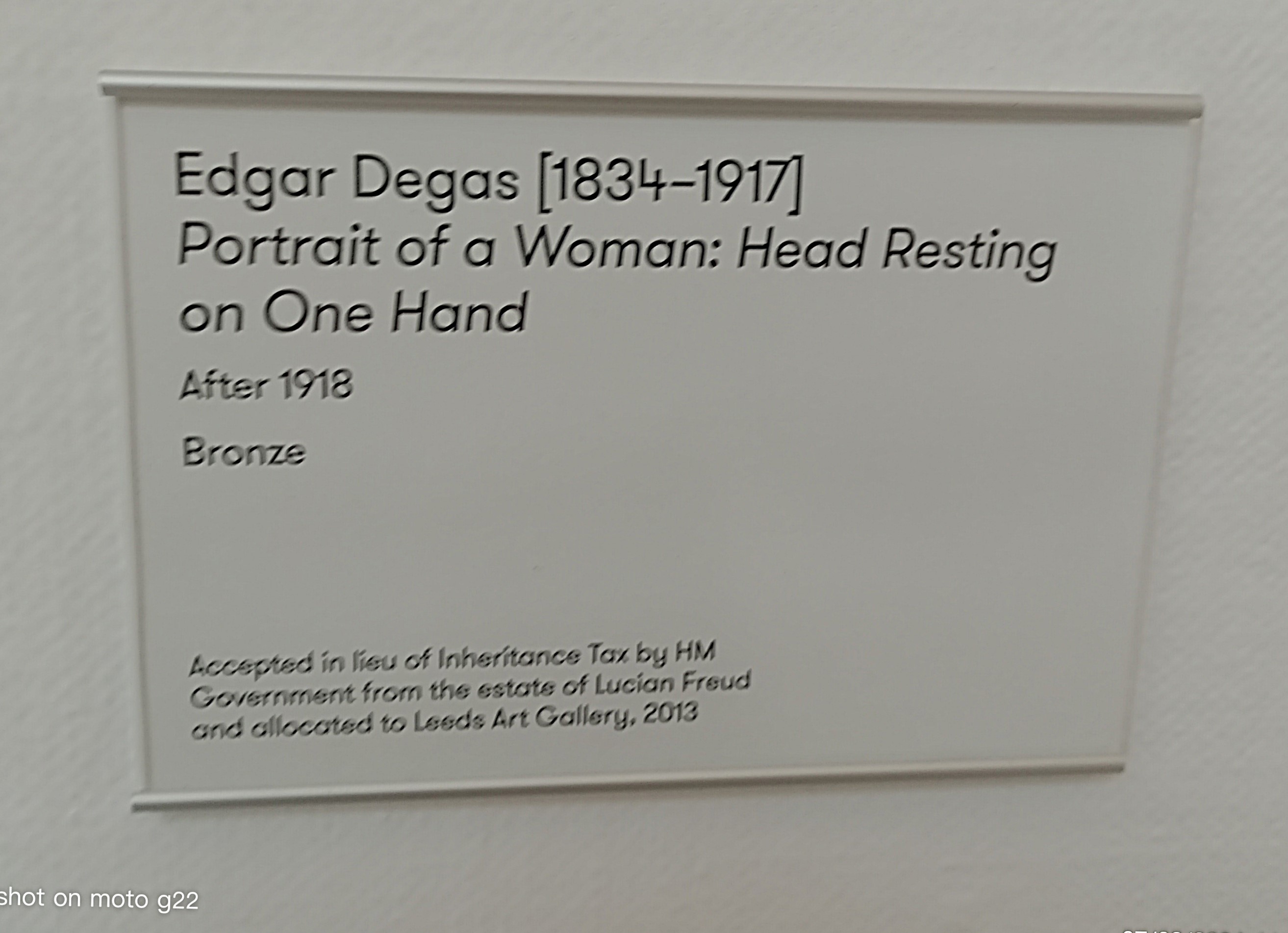
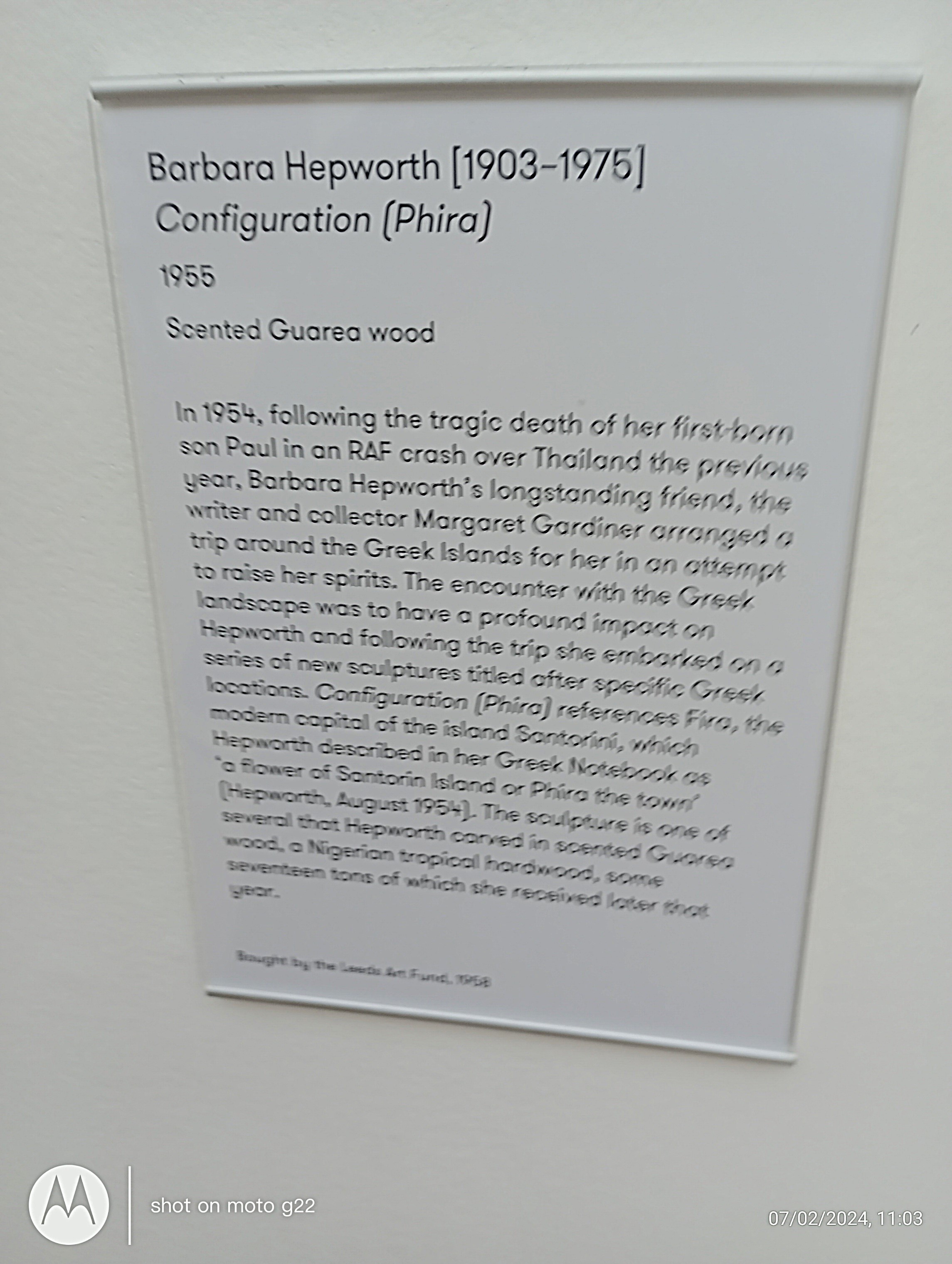
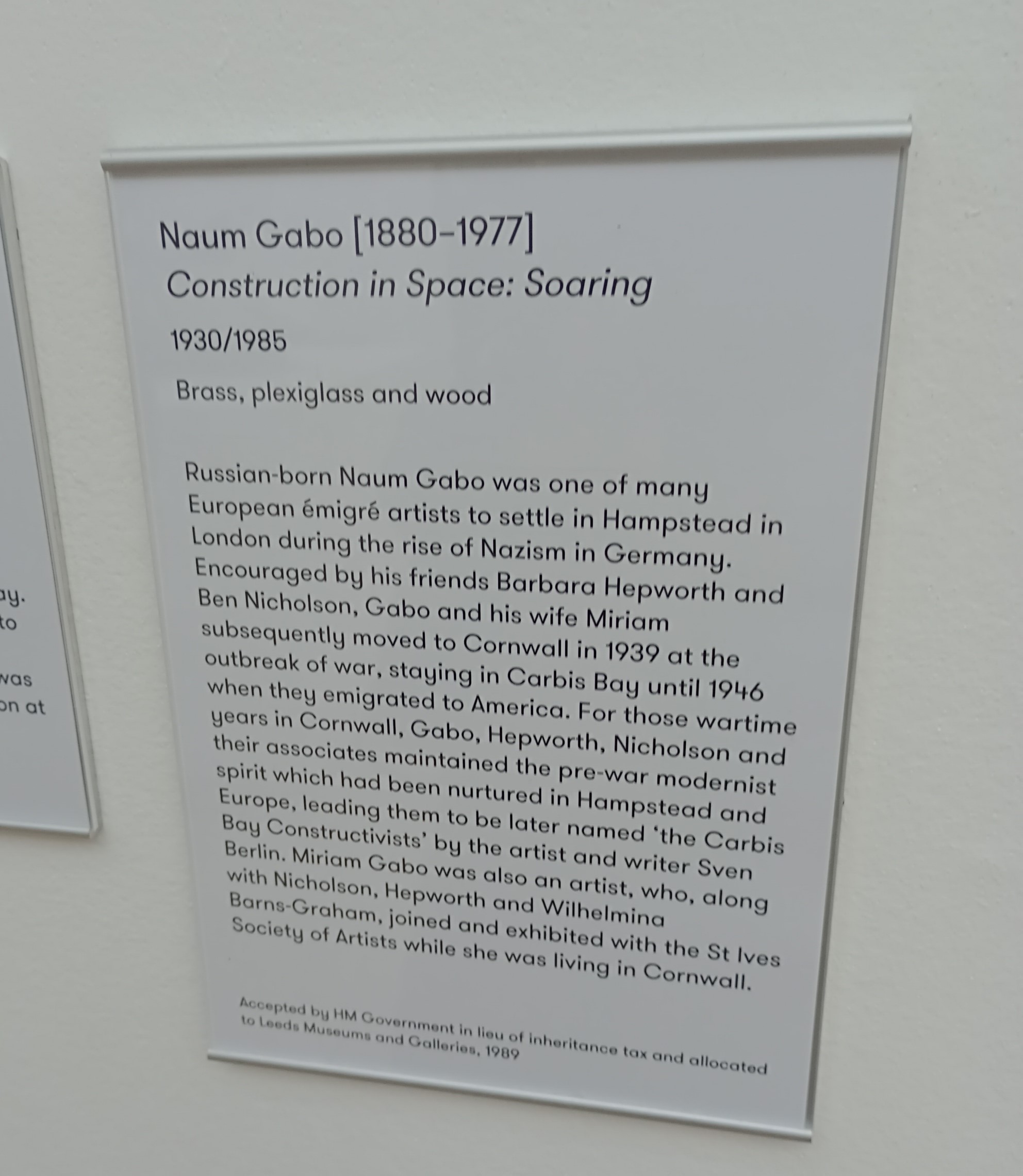
My visit to Leeds featured a train trip from Skipton (this town will also be featured in this week’s blog), an impressive hotel with a splendid restaurant, and, the reason for visiting Leeds, the Art Gallery. The latter is under refurbishment (on a previous visit it was closed) but there is enough to see, with interesting exhibitions in an elegant building. Like Tom Watson, politics was of interest to us, and the gallery included some excellent political material.

Leeds Art Gallery

The Veiled Venus: Khune Beverage and Ella Von Wrede

This was one of the first sculptures brought into the gallery’s collection when it was bought from the Exposition Universite Paris in 1900 and presented as an anonymous gift.

The Mercer Gallery, Harrogate

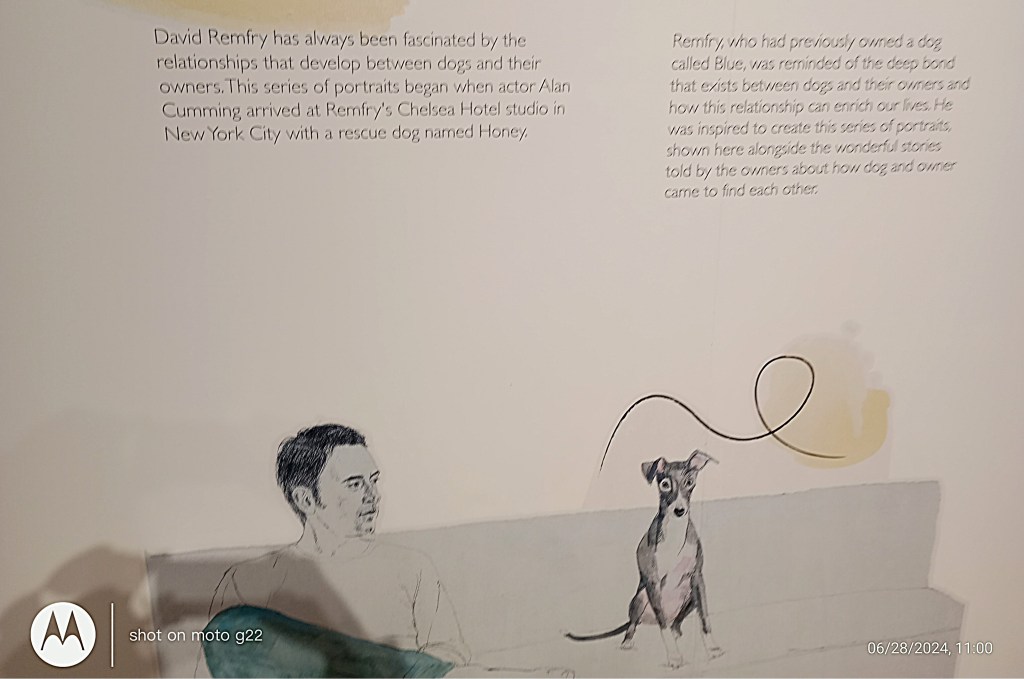
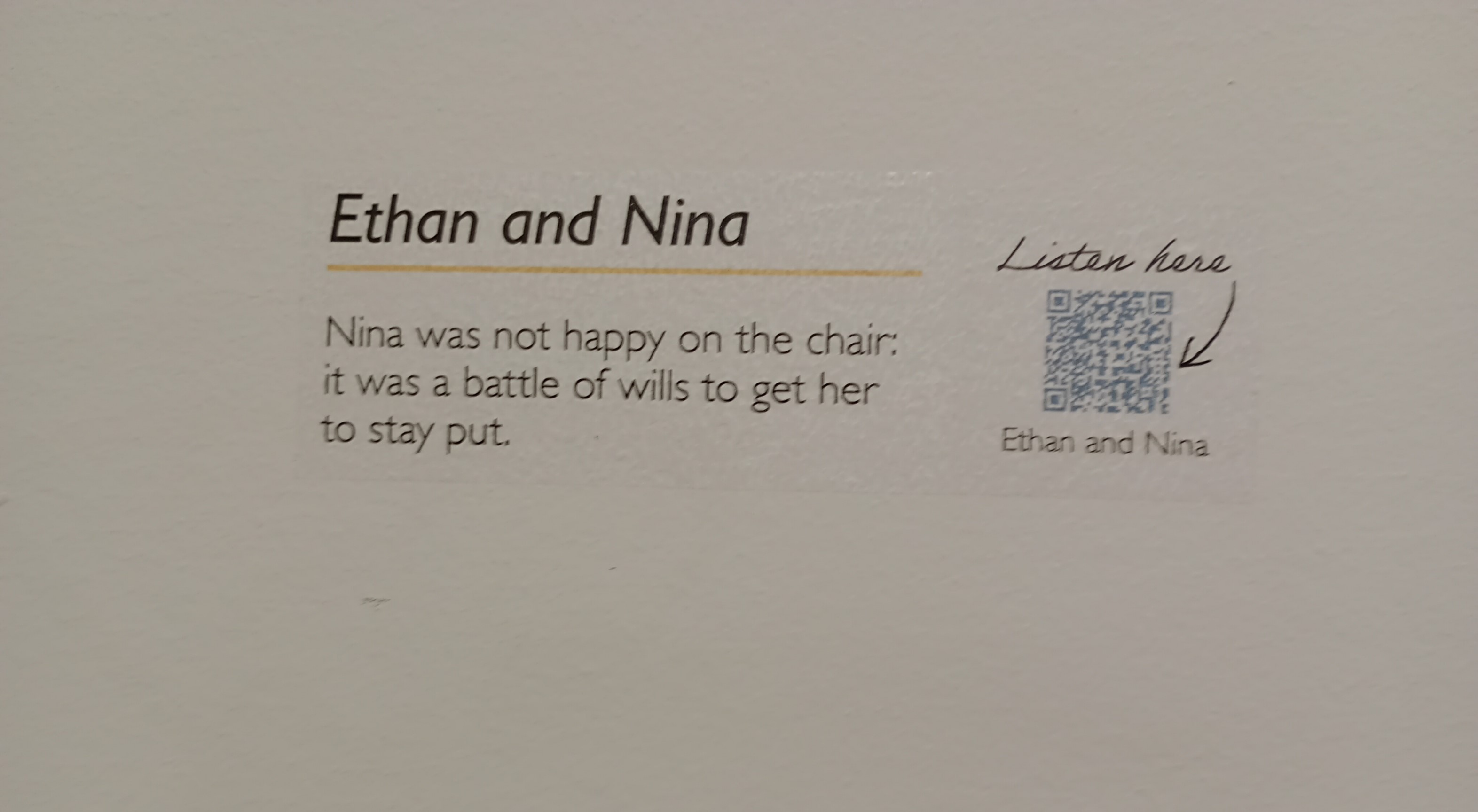
A different sort of art gallery was the small gallery on the walk from Harrogate central to the Old Swan Hotel. The Mercer Gallery, Swan Road, had a delightful exhibition that my friends will know I thoroughly enjoyed. We think the world of you depicts owners and their dogs. Oscar is special. Dogs were welcome while the exhibition was in progress.

Skipton Castle

Visiting Skipton Castle had been on our list. However, having read a description of it featuring cold empty rooms and military towers, it seemed more productive to look at it from afar, during a glorious walk around Skipton and the castle environs.

Barge on the Canal

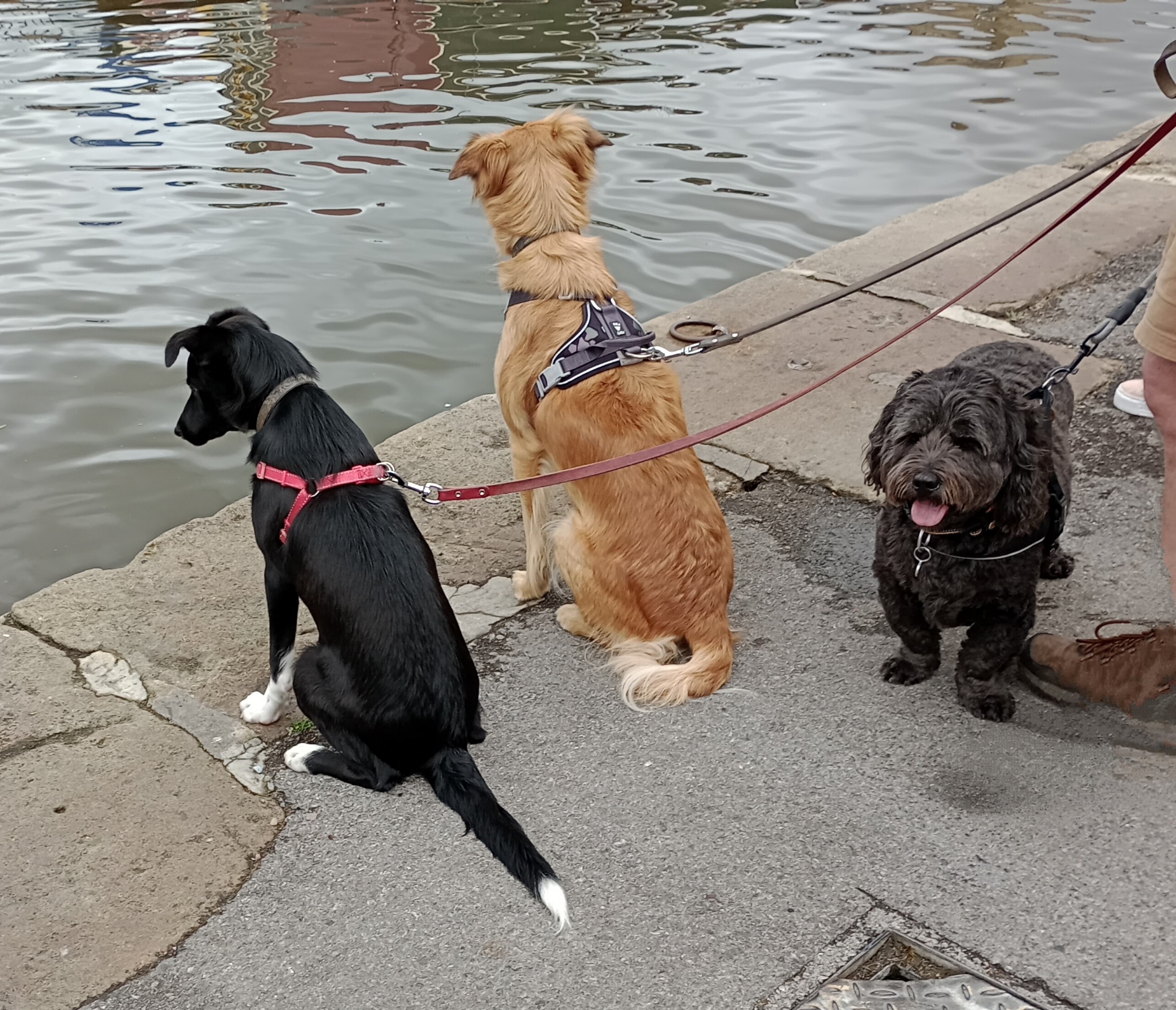
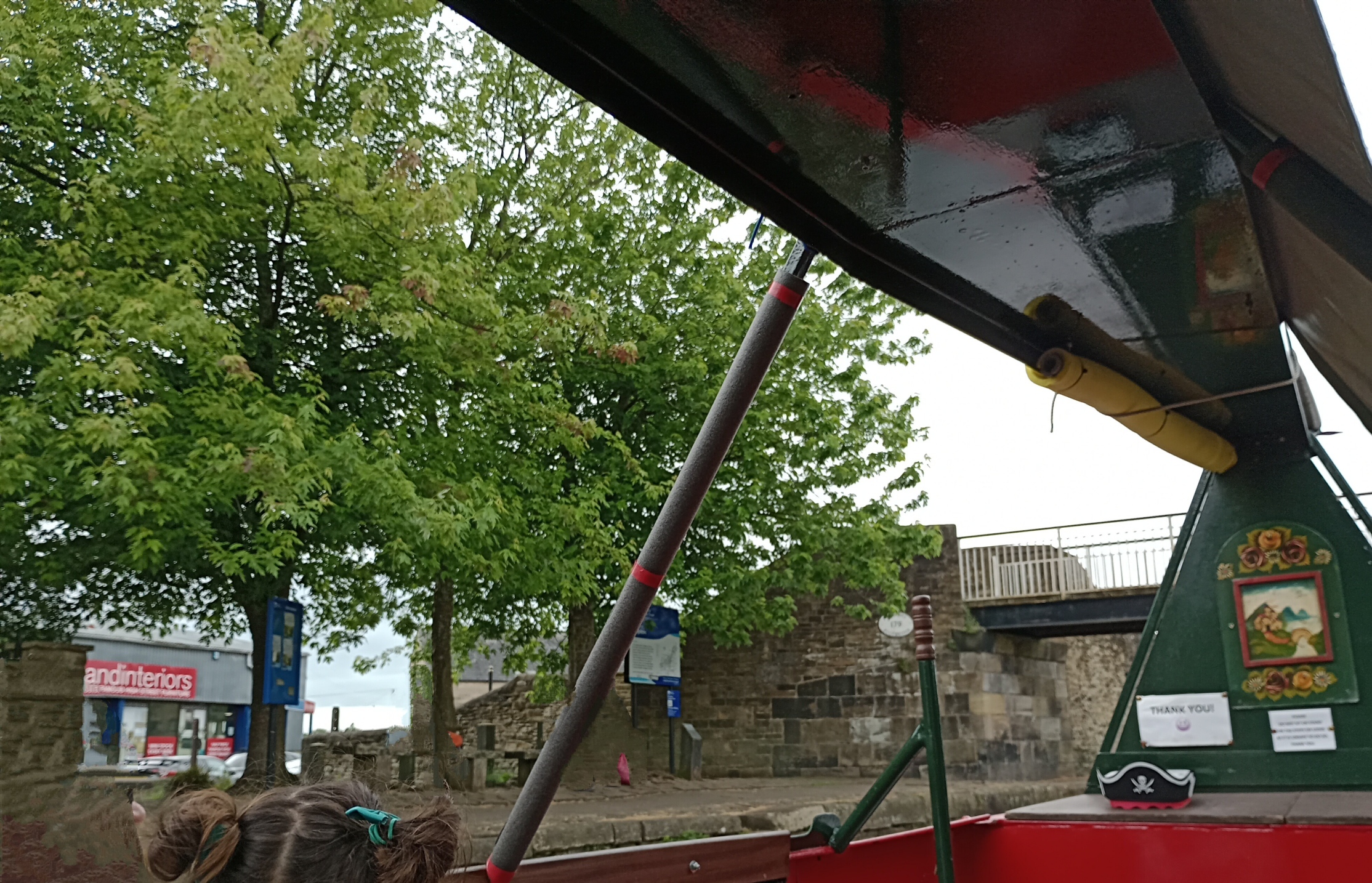
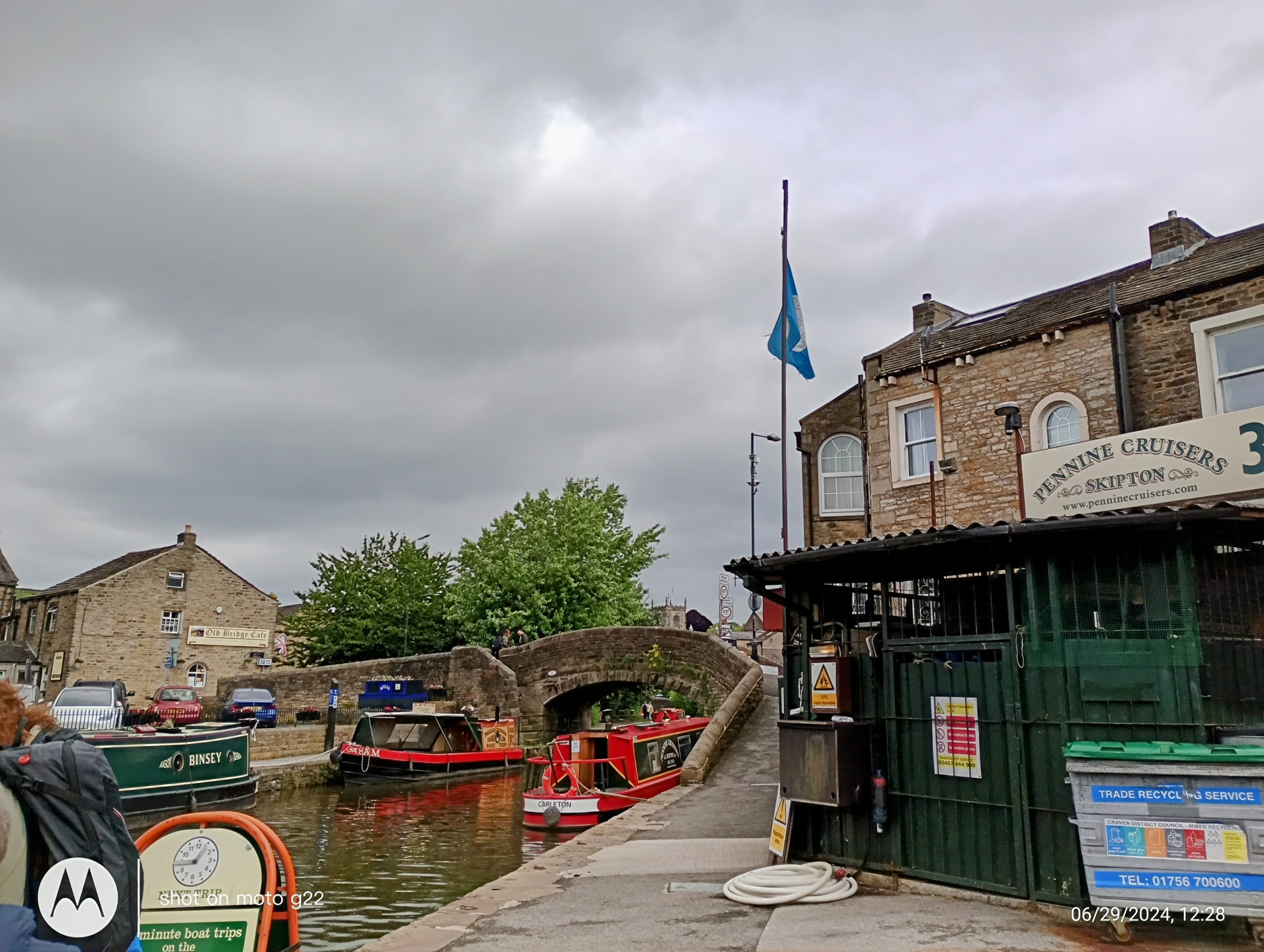
A barge down the canal that leads into the River Aire was also fun. We were accompanied by four dogs who were drawn reluctantly away from their perusal of the fat ducks and swans swimming nearby as we all waited for the barge. I have lost the photos of the ducks – they did not disappear.

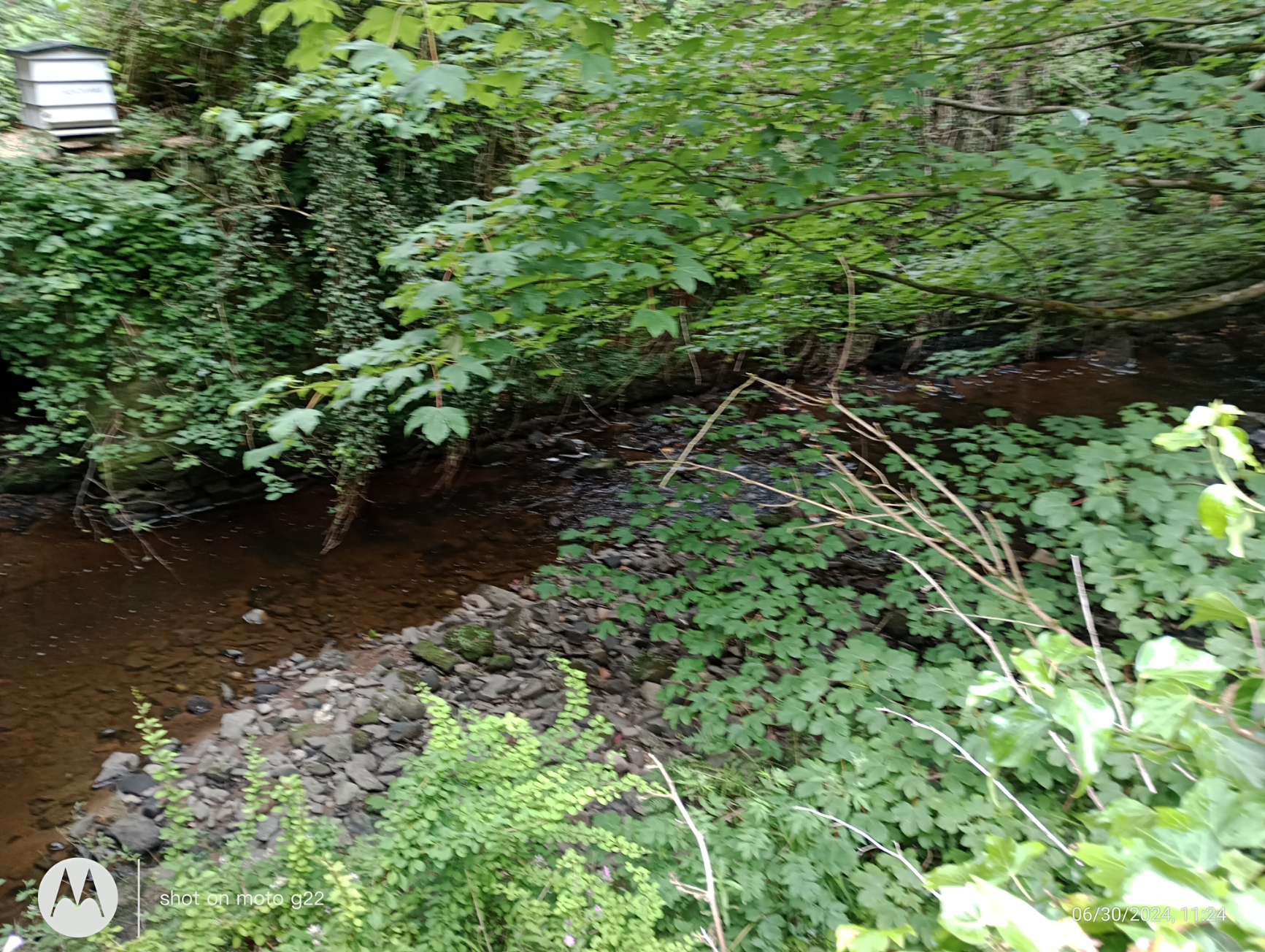
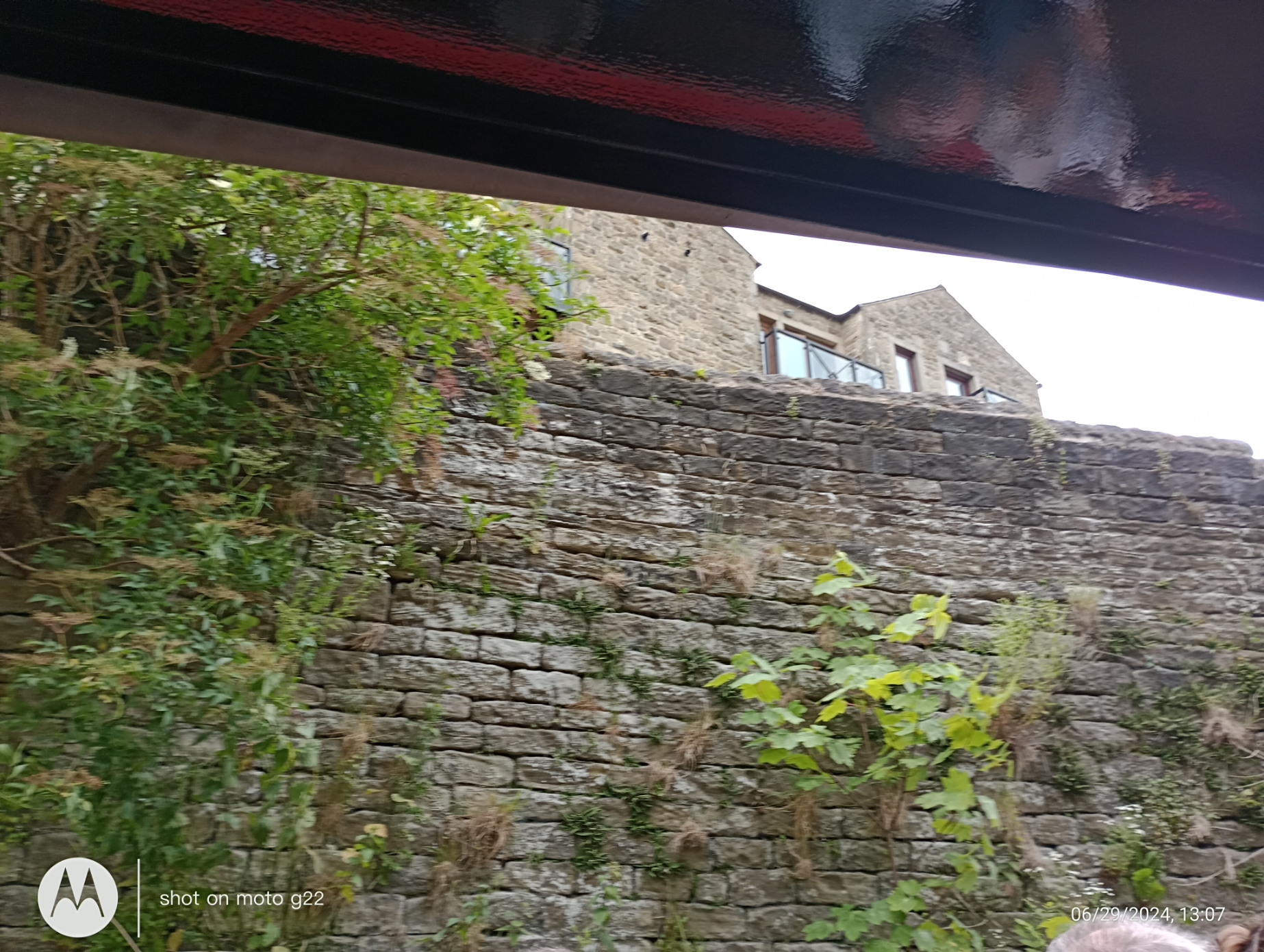
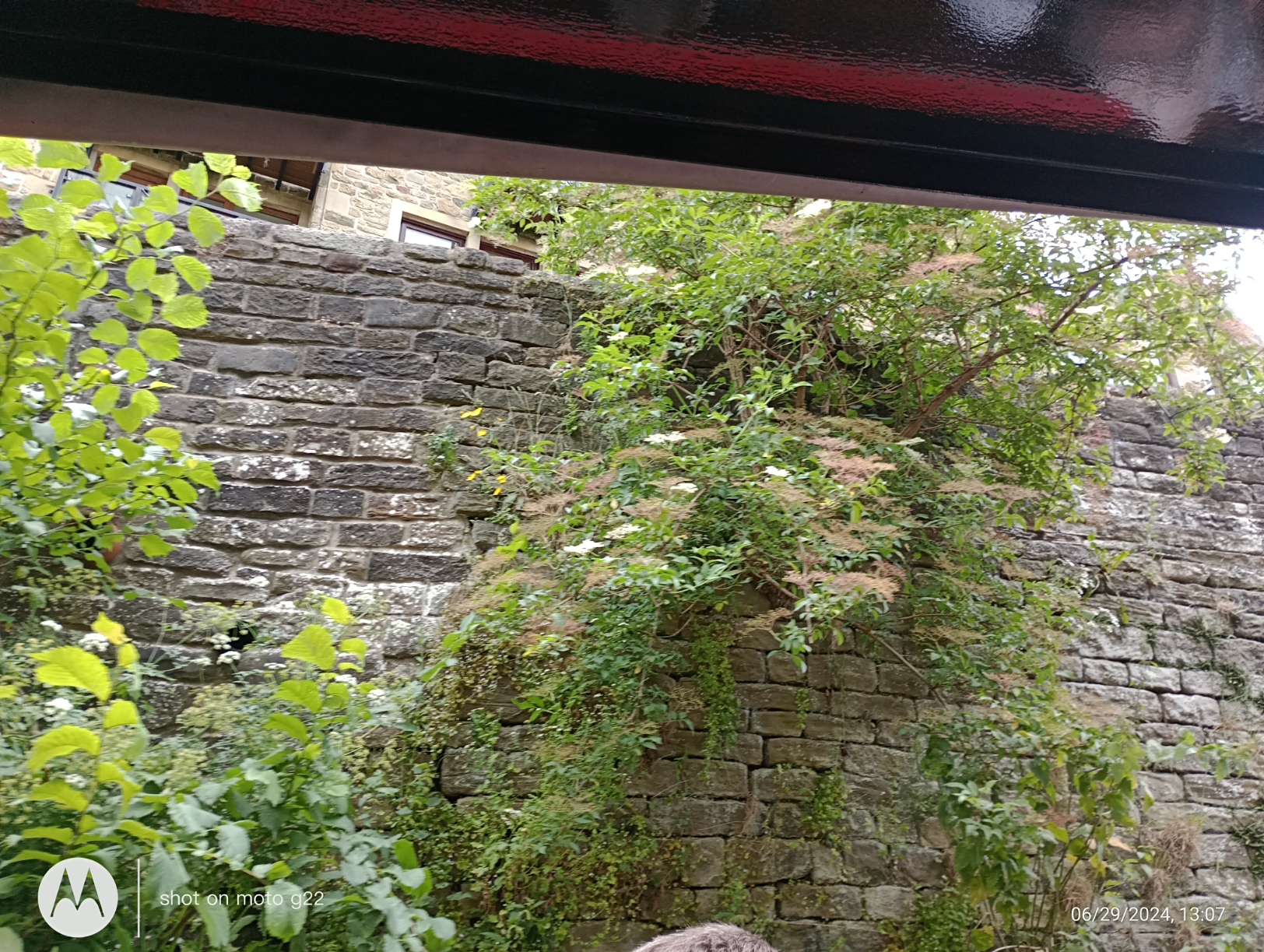
The barge provided a peaceful interlude with pleasant scenery. The dogs were still, having given up on receiving any more food than the kibble their owners gave them as we sailed. Dry stone walls (the first photos below) can be seen along the canal.

Cindy Lou eats in Harrogate, Leeds and Skipton

Jenny’s Tea Shop, Harrogate

I am aware that the tea shop that should be visited in Harrogate is Betty’s. However, the queue was so long we searched a little further and found Jenny’s. This is a delightful alternative, with its delicate flowery china, pretty table clothes, hot tea, and variety of pastries, scones and cakes.

The Old Swan, Harrogate

The Old Swan serves an excellent breakfast with a good range of continental breakfast items, and cooked breakfasts which include vegetarian, meat and fish. The dinner menu is not particularly innovative, although the entrees were reasonably inspiring. Certainly, they exceeded the offerings for the main courses. The cream tea served each afternoon in very pleasant surrounds was a disappointment. Pictured below are only the entrees and main courses from the dinner menu.

As well as the cream teas, sandwiches were served in the afternoon. Although not elegant, they were generous and delicious. Tuna and cucumber, and roast beef and mustard were good choices.

Rabbit Hole Coffee, Leeds

Set in an old arcade, with lovely architectural surrounds, Rabbit hole coffee makes a pleasant stop in the centre of the city. The service was really friendly and efficient, and the food delicious, although I think that my green soup probably doesn’t look particularly attractive! I had it with a half serve of toasted cheese sandwich. The eggplant, salad and meat offering looked delicious. It’s always fun to find a place such as this for a quick and easy meal, even if not tired and loaded down with shopping.

Dakota Hotel Restaurant, Leeds

The Dakota was a delight from the moment we walked in the door, to the wonderful meal we had in their restaurant. Millie, Mike and Jose provided excellent service in the restaurant. Such service was reflected in the unnamed staff who checked us in, stored our luggage, and farewelled us as we left to travel further.

The Dakota Restaurant menu is innovative, and if that was not enough, various chef’s treats arrive throughout the meal. The hot bread and delicious sauce was one of these.

Entrees: BURRATA, Beetroots, Pickled Shallots, Horseradish & Sourdough …TEMPURA ARGENTINIAN PRAWNS, Mango Salsa & Chilli Jam

Main courses: HALIBUT, Lobster, Garlic Pomme Puree & Lemon Butter Sauce… CORN-FED CHICKEN, Yorkshire Cheddar Dauphinoise, New Leeks & Lovage

Dessert: BERRIES & CREAM Elderflower & Meringue…HONEY CAKE
Toasted Almonds & Marzipan Ice Cream

Additional: Crispy cauliflower + chef’s treats.

Bottega Coffee Cafe, Leeds

This is a fabulous coffee shop in the square in which the Dakota is located. It was an excellent place to lunch before walking around Leeds while we waited for check-in (it was early, another Dakota treat).

The coffee shop encourages people to come in to have a coffee and use their laptops. In busy periods this is limited to 60 minutes – as the out of focus sign below states.

Skipton – elegance versus service offered at Caffe Capo

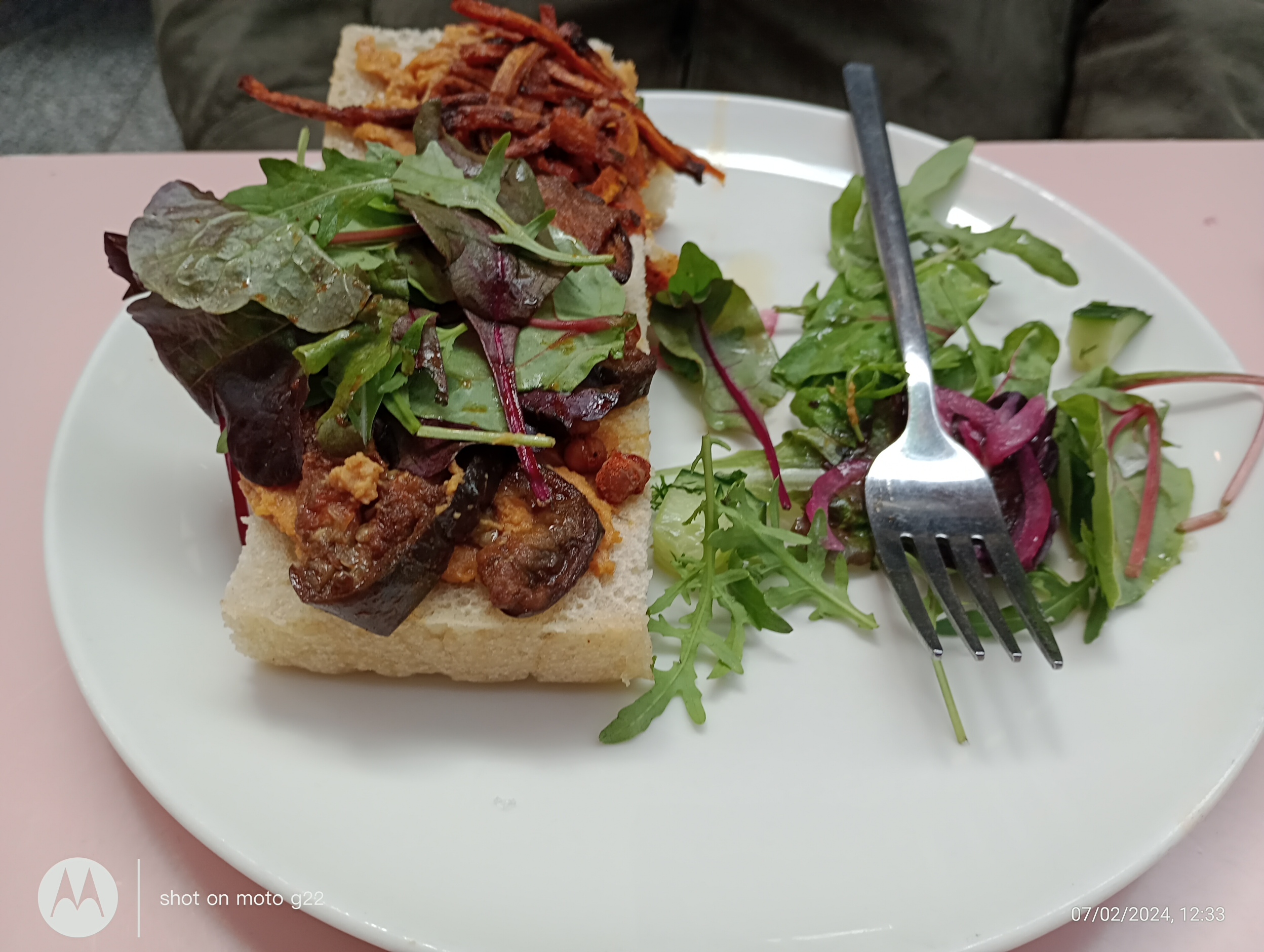
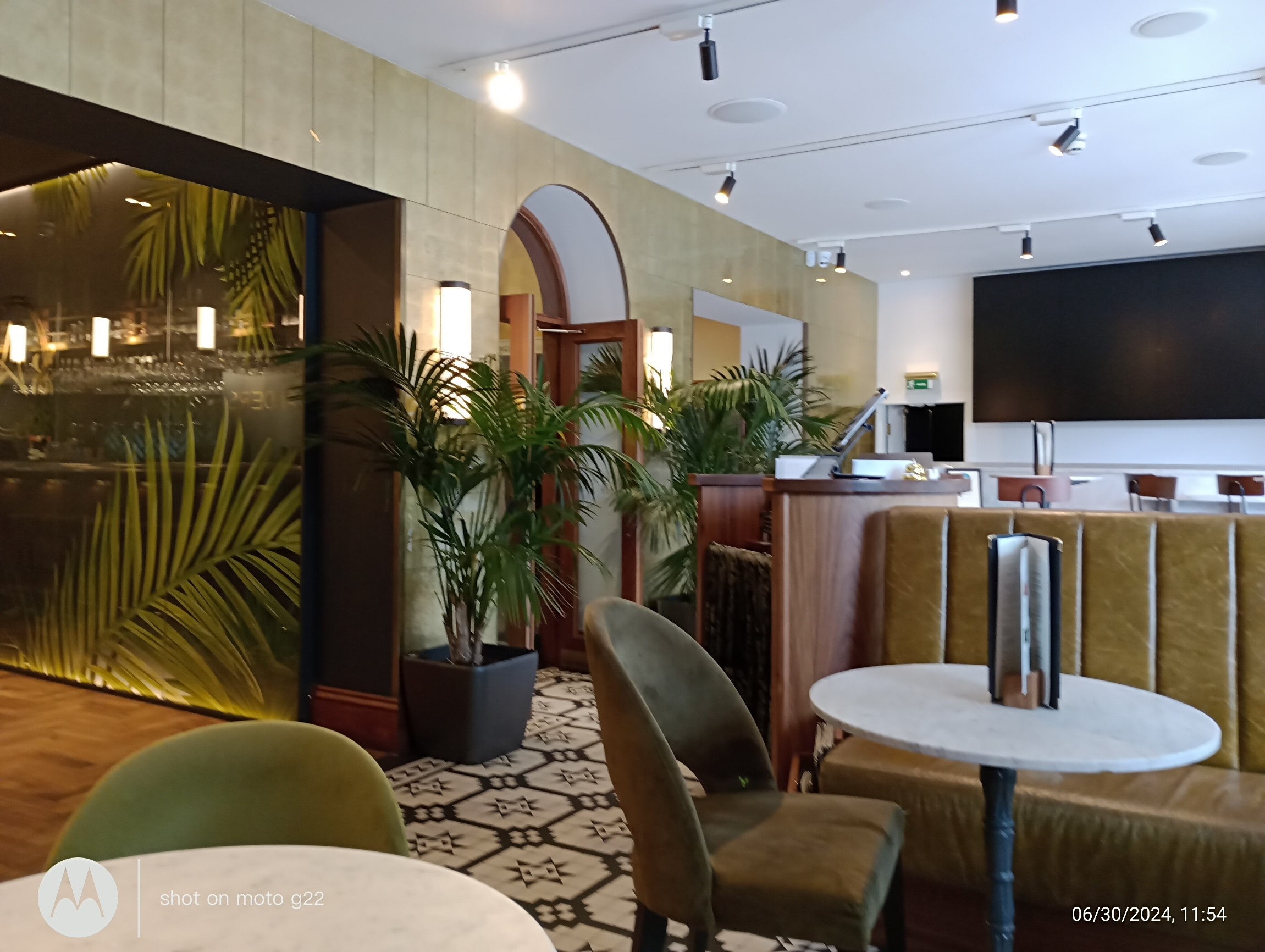
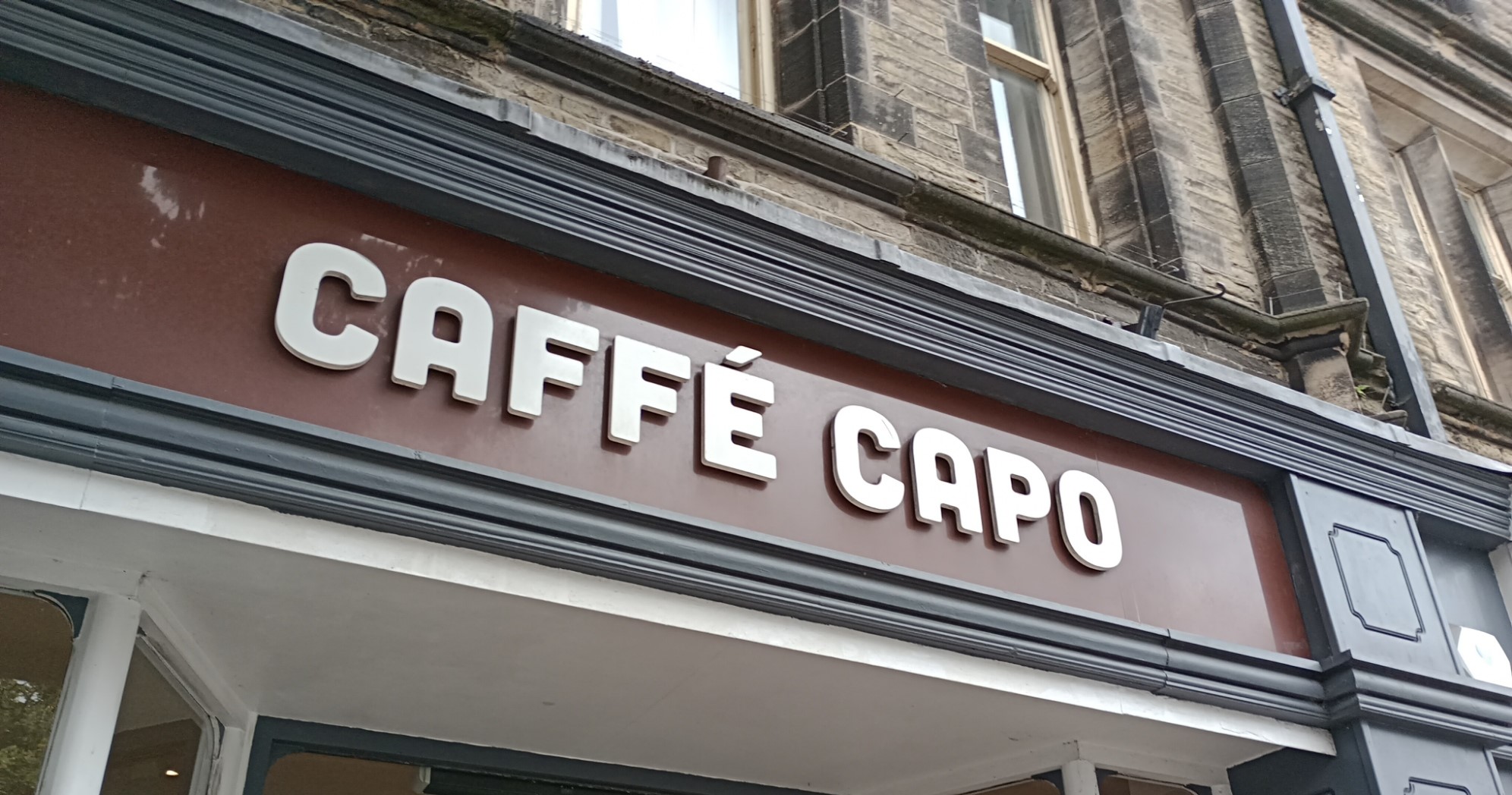
The elegance of the coffee shop at the top of Skipton high street attracted us – but where was the service? We sat, waited, other customers were also led to their elegant tables – and waited. So, we found a charming, but less elegant establishment with friendly efficient service, good coffee and another tempting treat. Later, Bizzie Lizzie served delicious fish and chips for my dinner.

Wallingford Discovery

I have been going to Wallingford for years, visiting friends, and eventually staying with them while researching in the Bodleian. On this occasion I stayed at The Coachman’s Arms, a pub with accommodation. The latter was very good, with a comfortable bed, large towels and a bathroom that worked well. it was in the main street, so a short walk to my friends, and a slightly longer one to the Wallingford Castle. I described the castle and added photographs in the blog about my last year’s visit there. My own stay in Wallingford was uneventful. However, I found the article below about a Roman remains find, between Wallingford and Didcot, and it might be somewhere to visit the next time I am there.

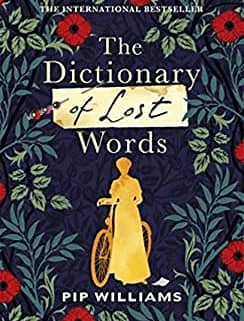
Another connection, not with the find, but recall of the Bodleian, is the book I am enjoying as a change from those I review for NetGalley. It has been on my kindle for a while, and I read Pip Smith’s The Bookbinder of Jericho first. Now, reading The Dictionary of Lost Words is a reminder of my own visits for research. Esme’s constant trips to the Bodleian, and even more fascinating, the promise she was compelled to make before gaining admittance, is a real treasure. The promise to treat the books with respect and not to smoke or set anything on fire is made today by any scholar who wants access.

Ancient Roman road discovered in village near Wallingford 17th July

By Charlotte Coles@charcolesjournoNews Reporter

A local history group recently teamed up with archaeologists and discovered a Roman road running through a village near Wallingford

The Brightwell cum Sotwell History Group teamed up with the Wallingford Historic and Archaeological Society for a dig at Brightwell School, in which they found a Roman road.

Brightwell cum Sotwell CofE Primary School is a small village school of just over 150 pupils.

The groups also found coins and broaches as well as a piece of Tesla Mosaic. 

Jason Debney, chair of the Brightwall Village History Group said: “We’ve always known there is a roman road through the village. It’s believed to be one of the first roads in England from 43AD which is the year the Romans invaded.

“It’s pretty special and quite good for a little village.”

The groups found the road to stretch under two of the school classrooms, the Red Lion pub, as well as a whole row of houses in the village of Brightwell-cum-Sotwell, located in between Wallingford and Didcot.

Lindsey Bedford, head of the Britwell Cum Sotwell History Group, led all of the digging on the day. 

Mr Debney added: “Thank you to Brightwell School.

“The children have really loved having the archaeologists in.

“The next big Brightwell dig is to try and find where Brightwell Castle was.”

Mr Debney said the next dig will take place over the winter and next summer. 

Cambridge Voting

Last week’s blog featured voting in the 2024 election in Cambridge. Labour won resoundingly overall. The member for Cambridge, Daniel Zeichner was returned, and newcomer, Sam Carling (the youngest person in the Parliament) won Cambridgeshire North West.

UK Voting

Taken from: Data journalism team, BBC News, Published 4 July 2024, Updated 6 July 2024

The Labour Party has won a landslide victory in the 2024 general election.

The party has taken 412 seats giving it a majority of 174.

It is the worst Conservative result in terms of seats in history, with the party on 121. The Liberal Democrats have their highest tally since 1923, taking 72 seats.

The SNP have nine seats. Reform UK have five and Plaid Cymru and the Green Party have four each.

Some 23 seats were won by other parties, all in Northern Ireland, and independent candidates.

Week beginning 10 July 2024

Laura Thompson Agatha Christie An English Mystery Headline Publishing Group, Hatchette, 2013. (First published 2007; Headline Paperback 2008; Hardcover published March 2018, Pegasus Books).

Laura Thompson’s Agatha Christie is an excellent accompaniment to reading John Curran’s The Secret Notebooks. I read them in close succession and found their perspective and perceptive commentary on Agatha Christie and her novels markedly enhanced my current re-reading of her work. While Curran’s work concentrates on Christie’s development of the novels and short stories, in Christie An English Mystery Thompson goes to the heart of her work: Christie’s life and character.


I particularly liked the way Thompson dealt with the 11 day’s disappearance. She used her imagination, based on her knowledge of Christie to develop the story. At the same time, we are taken carefully through the material and information that is available. This certainly puts to rest the idea that Christie’s disappearance was a public act. It was possibly an act that took no account of the media, police ineptitude, the haste to believe assertions which undermined a public figure (which Christie clearly thought did not apply to her) and that, as a well-known writer her life was not her own. As Thompson says, the idea that the media has only recently begun to attack public figures, taking their lives as if they are owned by the public is fallacious. Christie’s story
which is one of immense hurt and private agony – became a hook on which to pillory a woman of some fame. That she manages to deal with this as well as the loss of her beloved husband, Archie Christie, is a mark of her fortitude. Of course, she suffered the consequences all her life, ensuring that her second marriage remained intact. See Further Commentary and Articles arising from Books* and continued longer articles as noted in the blog for the remainder of this review and further material re Agatha Christie.

Jared Cade Agatha Christie and the Eleven Missing Days Scarab eBooks 2011.

Jared Cade’s interpretation of Agatha Christie’s eleven days’ disappearance is touted as the most likely description of the events leading up to the disappearance, its causes, and aftermath. He returns to Christie’s childhood as a part of the explanation, and this part of the book (which I received as a sample) is an intriguing read. However, the reviews are mixed, including some that are quite scathing, so I did not proceed with buying the complete text. It now appears to be unavailable on kindle.

Fictionalised accounts of the eleven days disappearance

I have two novels in which Agatha Christie features, and one in particular conjures wonderful images related to The Old Swan Hotel. A Talent for Murder by was written by Andrew Wilson while Christie was alive. When she asked him to defer publication for forty years he did so. It is still a good read, explaining Agatha Christie’s eleven-day disappearance as part of a murder plot – with her committing the murder! It is clever in that it weaves true events – most humorous Christie dancing in the hotel to “No We have No Bananas”, and a death that did occur at the time, and in circumstances that fit with plot.

Facebook comments on The Old Swan Hotel and Agatha Christie

When I saw this post from RR on Facebook a few months ago, I decided that it would be added to my coverage of my stay at The Old Swan Hotel (formerly the Harrogate Spa) in Harrogate. I was attracted to the dinner and posh afternoon tea package but was reminded of far more important connections when I read this post. Below are some of the details from that Facebook post:

In December 1926 the author Agatha Christie suddenly disappeared from her home. She was missing for a total of eleven days, during which the police conducted a major manhunt, and there was speculation that she had committed suicide. The disappearance even drew other crime writers Sir Arthur Conan Doyle and Dorothy L Sayers into the search, Conan Doyle’s interest in the occult prompting to take one of Christie’s gloves to a medium. After a period of about ten days (having checked into the Swan Hydropathic Hotel under the assumed name Mrs. Teresa Neele) she was recognised by one of the banjo players at the hotel. From Wikipedia, ‘Old Swan Hotel’ entry, which also has more information on the hotel itself. Daniel Stashower’s biography of Conan Doyle, ‘Teller of Tales’, has a chapter on his involvement in the search for Agatha Christie. 

When I stayed at the hotel in 2004 we were told that Agatha Christie was found playing billiards in the room where the conference I was attending was held.

And a further post:

…this is a nice hotel. I stayed there in 2004 when I attended a Tourism and Literature conference run by Sheffield Hallam University. It was the nicest conference I have ever been part of.

The Old Swan Hotel, Harrogate

At the entrance the original of the photo below is displayed. The Old Swan Hotel is indeed old, but not tired, with its painted bedrooms of a reasonable size and pleasant bathroom. The bed is comfortable. I doubt that there is much remaining from Agatha Christie’s stay, apart from the building with its large dining area, areas with comfortable seating and gardens.

In Cambridge I booked to attend the following exhibition:

A Celebration of 20th Century British Crime Fiction at Cambridge University Library

About The Exhibition

Cambridge University Library shines a spotlight on the UK’s most read, bought and borrowed genre: crime fiction. But of course, we didn’t need to tell Agatha Christie fans that… This free-to-visit exhibition celebrates some of the best books, classic and contemporary, that have captivated readers throughout the UK and beyond. Seize your chance to marvel at the Library’s remarkable collection of first editions, see rare manuscripts and curios from March 23rd to August 24th.

From Wilkie Collins to Charles Dickens, Arthur Conan Doyle to Agatha Christie, Ian Rankin to Val McDermid, award-winning crime writer Nicola Upson has curated a criminally good treat for visitors. Agatha Christie fans will get the chance to marvel at one of the author’s own typewriters, an original typescript for her final Poirot novel, Curtain, as well as notebooks and a Dictaphone which she used to plot her stories. Plus, there are almost 100 first edition crime classics in their original dust jackets from the library’s own collection, so you can rest assured that you’ll be coming away with a few new (or new to you) titles to add to your reading list.

I enjoyed being at the exhibition with friends and the information and photos appear below.

Crime Fiction at Cambridge University Library

For a donation of 5 or ten pounds the exhibition is a pleasant way of sourcing information about the crime books written in the UK. The exhibition largely comprises novels, and some items used by writers, an informative map of the of where writers lived and some the locations for their fiction.

From: The Spectator 9 June 2024, 5:30am

Agatha Christie and the truth about detective fiction’s Golden Age

Agatha Christie is the best known author of crime fiction’s Golden Age (Credit: Getty Images)

A hundred years ago, the Golden Age of detective fiction was taking off. In the years that followed, Agatha Christie, Dorothy L. Sayers, and their contemporaries wrote classics that still delight readers today. But the great crime books of the inter-war years – and the politics of the people who wrote them – have long been misunderstood.

There was no shortage of left-wing authors of Golden Age detective fiction

Critics routinely dismissed the stories as cosy, conservative, and conventional. Lavish TV and film adaptations reinforced the stereotype. The reality is that many fascinating writers of classic crime fiction were left-wing or even – like Bruce Hamilton (the godson of Sir Arthur Conan Doyle) and his better-known brother Patrick – Marxist. Their books reflected their politics in a variety of ways. 

Even the twentieth century’s leading historian of the genre, Julian Symons, fell into the trap of thinking otherwise. In his influential Bloody Murder, he argued that ‘Almost all the British writers of the twenties and thirties…were unquestionably right-wing.’ When he came up with that generalisation, Symons was a recovering Trotskyist. Perhaps that influenced his attitude. The truth is that he’s wrong. It’s certainly the case that Christie, Sayers, Anthony Berkeley (who founded the elitist Detection Club in 1930) and the excellent Henry Wade – in real life a baronet, Sir Henry Aubrey-Fletcher – were instinctive conservatives. Nevertheless, Symons airbrushed out of his version of a history a wide range of intriguing novelists with a left-wing political agenda.

Even the term ‘the Golden Age’ was coined, in 1939, by John Strachey during his Marxist phase prior to becoming a minister in Attlee’s Labour government. Strachey heaped praise on young detective writers such as Nicholas Blake (the poet Cecil Day-Lewis), who had recently published a superb mystery, The Beast Must Die. Day-Lewis was a Communist Party member, but that didn’t debar him from being elected to membership of the elitist Detection Club, founded by Anthony Berkeley in 1930, in which Christie and Sayers were leading lights. Their concern was literary merit, not politics or prejudice. 

When he attended Detection Club dinners in Soho, Day-Lewis found plenty of companions from the political left. The Club’s founder members included the economist G.D.H. Cole and his wife Margaret, stalwarts of the Fabian Society who wrote over twenty detective novels together, and Lord Gorell, who served in David Lloyd George’s government before switching to Labour. Elected two years before Day-Lewis, Ralph Woodthorpe was a Daily Herald journalist who excoriated Fascism in two of his detective novels as well as in newspaper columns.

Two prominent women in the Labour party made use of their political know-how when they turned to mystery writing after losing their seats in the Conservative landslide of 1931. Mary Agnes Hamilton wrote Murder in the House of Commons, while Ellen Wilkinson – ‘Red Ellen’, of Jarrow March fame – published a locked room mystery before returning to the political fray and serving as Attlee’s Minister of Education. The Division Bell Mystery is a pleasing debut but the book vanished from the shelves before resurfacing eighty years later in the British Library’s Crime Classics series – with a prefatory note by Rachel Reeves.

Ivy Low, wife of the Communist revolutionary Maxim Litvinov, spent the ‘Golden Age’ living in Stalin’s Russia. Moscow in the twenties supplied her with an evocative background for His Master’s Voice, published by Victor Gollancz, a radical who published scores of detective novels as well as founding the Left Book Club.  

Like Hamilton and Wilkinson, Ivy only wrote one mystery novel. Christopher St John Sprigg, the Marxist poet better known under his less posh writing name Christopher Caudwell, managed to dash off eight whodunits before being killed in Spain while fighting against Franco.  

After the First World War, detective novelists and their readers were intent on having fun after the horrors of the trenches and the nightmarish ‘Spanish flu’ pandemic. Authors concocted puzzles that challenged readers to try to solve the mystery before the great detective, but before the end of the twenties, astute writers like Sayers and Berkeley realised that the future lay in puzzles of character

As the world economy slumped and dictators flexed their muscles, detective novelists grappled with the burning question of the times: what should we do when we can’t trust the legal system to deliver justice? This theme underpins two Christie masterpieces, Murder on the Orient Express and And Then There Were None, and it also preoccupied her left-leaning colleagues in the Detection Club. Milward Kennedy, a senior figure in the International Labour Organisation, devoted a whole novel, Sic Transit Gloria, to exploring ‘justified murder’. 

Helen Simpson – whose attempt to become a Liberal MP was derailed by cancer – wrote Vantage Striker!, in which a populist politician turns out to be a closet Fascist who is dealt with ruthlessly by extra-legal means. Margaret Cole’s brother Raymond Postgate included an epigraph by Marx in his scathing jury trial novel, Verdict of Twelve.

Bruce Hamilton even wrote a novel about a homicidal dentist, Middle Class Murder, expressly designed to show the rottenness of the bourgeoisie. He followed this up with Traitor’s Way and The Brighton Murder Trial: Rex v. Rhodes, two anti-Fascist novels which failed spectacularly to anticipate Stalin’s pact of non-aggression with Hitler. Perhaps that sapped his morale, since he only managed one more crime novel over the next thirty years, while Postgate concentrated on democratising gourmet dining by founding The Good Food Guide.

So despite Symons’ claim, there was no shortage of left-wing authors of Golden Age detective fiction. But they lacked the staying power of Christie, Sayers, and their fellow conservatives. And, most important of all, their stories weren’t as enjoyable.

WRITTEN BY Martin Edwards

Martin Edwards is a crime writer. His latest book The Life of Crime: Detecting the History of Mysteries and their Creators is out now.

Liverpool

Liverpool is an interesting place to visit, even though following the Beatles is no longer a priority. We stayed opposite the Beatles Museum, and as we walked past were happy to hear “I Want to Hold Your Hand” without being tempted inside. There were plenty of memorials outside, a “Liverpool Eye,” and interesting sights while walking around the docks.

John Lennon

The wheel is not for me, but the coffee ‘not offer’ sounds great

Tate Modern

This time we went to Tate Modern – unfortunately under refurbishment. There was a limited display, but fun to see. I was impressed that even with the diminished space Tate Modern was able to mount a children’s area where they can become acclimatised to the gallery and art. The National Gallery of Australia needs to also give children some attention.

The Tate Modern London black cat was immortalised in Liverpool. She had lived at Tate Modern in London from a small stray to an old, revered inhabitant of the gallery.

Cambridge votes

The UK election was called so that the evening I was to give a talk about Barbara Pym, the venue, the Milton Road Library in Cambridge was being used for a far more important purpose. The library was being used as a polling booth and we accompanied a friend who was voting. It wasn’t particularly busy, and certainly had none of the vibrancy of an Australian polling place. Not a democracy sausage to be smelt, dogs to avoid or pat depending on your inclination, no sales to boost the school coffers…and no handing out of How to Vote cards. The person seen in the photo is a representative of a political party (all of whom are at the busier polling places) and is there to record who has voted.

The simple campaign headquarters was staffed by one person as Cambridge was rightly deemed as safe, and the usual campaigners went to Peterborough to win there. Labour won UK wide. A resounding success, and well deserved.

But I did miss the Australian election day buzz!

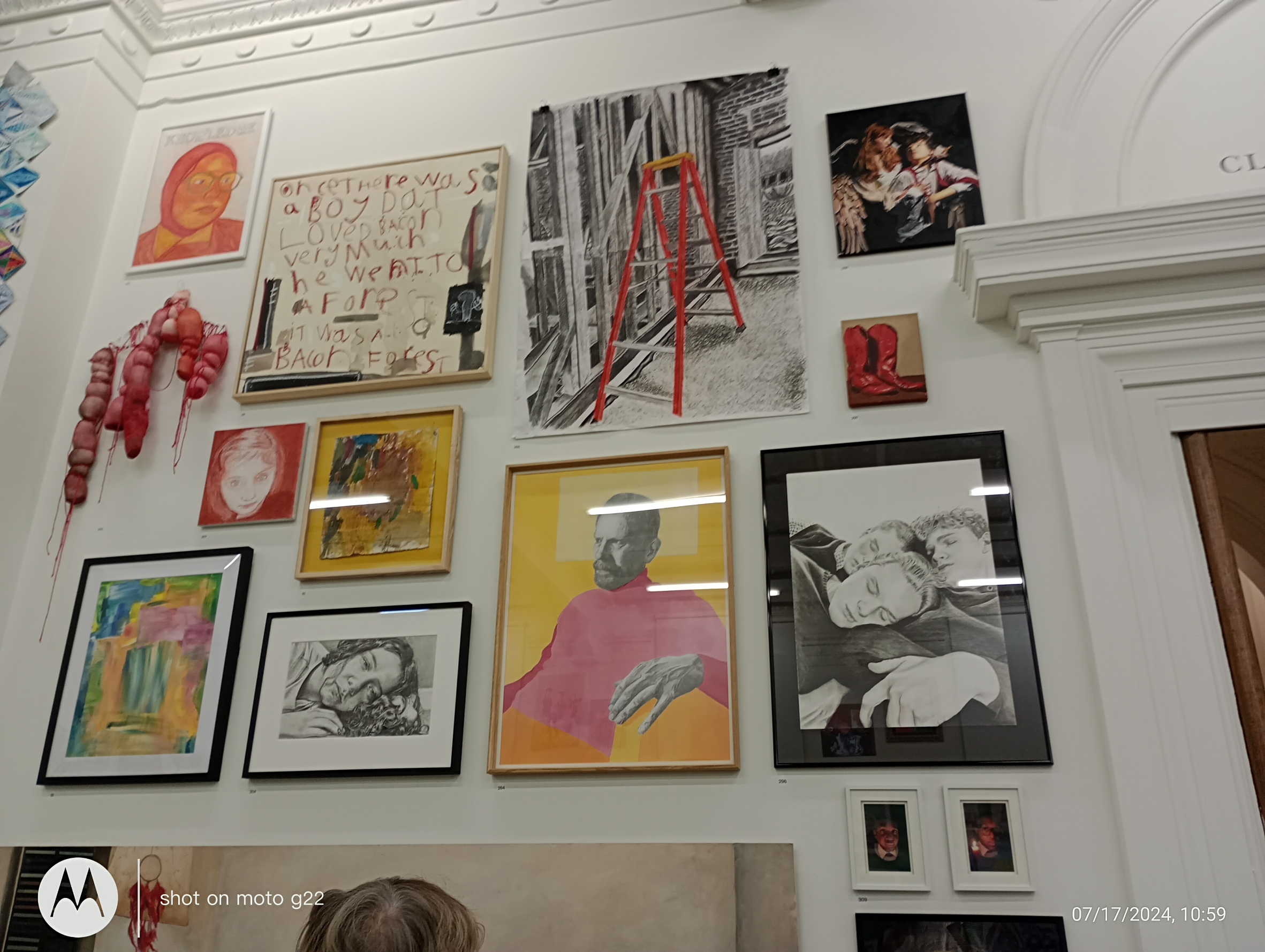
Community Art Project in Cambridge


Cindy Lou eats in Liverpool

A long search for a Chinese restaurant found it – closed, and it looked as though this had been the case for a long time. However, Google’s mistake led us to a casual dining place that was full, offered a variety of choices and was fun.

Duke Street Dining

The Real Greek

This chain has always been successful for us, and the one in Liverpool was no different. The menu is varied, the staff pleasant and efficient, and the food delicious.

Week beginning 3 July 2024

Maryann D’Agincourt, Glimpses of Gauguin, Portmay, January 2015.

Thank you, NetGalley, for providing me with this uncorrected copy for review.

This is an elusive narrative, but one that is worth while attempting to understand. I wonder if the clue to how Maryann D’Agincourt would like her novel read is in a paragraph in the text where one of her protagonists cannot understand the meaning in Chekov’s, The Huntsman. Her father, having replaced the book Jocelyn is reading with Chekov’s, reads to her. She pictures the events rather than trying to understand them.  Agincourt, in her turn, creates a myriad of pictures, including those in which her characters become a cinema audience. Gauguin’s “Where Do We Come From? What Are We? Where Are We Going” viewed as if it is a new experience for her, is pivotal in understanding where Jocelyn will lead us. Each phrase becomes the title of a section of the book.

As Jocelyn matures and marries the pictures evoked by D’Agincourt become less elusive, more active and explanatory through marriage, an affair and a holiday in which the couple acknowledge that seeing requires more than the binoculars available to them. Again, the role of the characters as an audience is raised, although with far less artistry than in the growing to adulthood part of Jocelyn’s life. However, this is replaced by a clearer development of the characters, Joycelyn’s husband, her mother and father, and the artist, Alex Martaine, who had such an impact on Jocelyn’s early life.

Martaine becomes a symbol for Jocelyn and her parents, at the same time the practicalities of being with each other, friends and partners pursuing careers and aspirations take centre place. With a return to the early recognition and articulation of the value of perception, visual and emotional, this alluring novel is complete. I find reading D’Agincourt’s work an experience to savour. The Marriage of the Smila-Hoffmans ( Portmay Press, LLC 2022) was a particular joy. Glimpses of Gaugin does not quite fulfil this promise but has been another journey amongst lyrical language and pictures and thoughtful characterisation.

Isabel Allende Lovers at the Museum Amazon Original Stories, April 2024.

Thank you, NetGalley, for providing me with this uncorrected proof for review.

The magical nature of this short journey into Isabelle Allende’s world recalled my treasured memories of  reading  House of the Spirits many years ago.

For interlopers, Bibina Aranda and Indar Zubieta, the Guggenheim Museum becomes magical; for the police inspector who must interview them after they are found, a new world opens up. For him it is a creaky awakening, but nevertheless an impact on his world encased in protocol, law and moral imperatives. The museum director and a psychic learn nothing. Bibina and Indar prosper from their magical encounter.  The press moves on to the other story that has accompanied the lovers’ tryst.

Images of a wedding dress that cannot be divested because of the meticulous buttoning, a naked man whose clothes offer no impediment, and a stiffly clad inspector vie with those of the Guggenheim as others see it, and as it is experienced by the lovers. There are delicious comic moments interwoven with the romantic story line, each offering a unique approach to love, institutions and interpretations.

Isabelle Allende’s short story is a pleasurable encounter with feelings and ideas.

Glasgow

We were pleased to find that our hotel was close to Nelson Mandela Place, named so because the former South African Consulate, also pictured below, was located there. Demonstrators met in front of the consulate, including our dinner companion at the Ubiquitous Chip on Sunday night, during Mandela’s imprisonment. The parking cone on the statue in front of the Art Gallery is part of the humour abundantly displayed around the streets of Glasgow. Inside the Museum of Modern Art is a more serious and cultural approach, although lots of fun also!

Glasgow Museum of Modern Art

Unfortunately, the depictions of The Angry Christ, below, are unsatisfactory. However, they give a sense of the art arising from the information accompanying them.

The Burrell Collection

Glasgow is the home of the Burrell Collection, and we were fortunate enough to be driven to this treasure trove several miles from Glasgow.

Cindy Lou eats in Glasgow

The Ubiquitous Chip

Named because it does not serve chips, The Ubiquitous Chip has an innovative menu, several venues (casual, and much less casual), and a pleasant ambience. On the evening we were there the service was slow, but the food was worth the wait.

Less glamorous ‘grub’ at Cafe Nero

These cream buns and coffee were delicious and justified after a long walk. Perhaps less justified than the ones on Rottnest Island in my youth.

Roma

Tremendous pizzas, but the salad was a bit sad. The mozzarella sticks with sauce and salad were excellent.

Heather Cox Richardson on the debate between President Joe Biden and former president, Donald Trump

Heather Cox Richardson from Letters from an American <heathercoxrichardson@substack.com> Unsubscribe28 Jun 2024, 18:53 (4 days ago)to me
June 27, 2024
Tonight was the first debate between President Joe Biden and presumptive Republican presidential nominee Donald Trump, and by far the most striking thing about the debate was the overwhelming focus among pundits immediately afterward about Biden’s appearance and soft, hoarse voice as he rattled off statistics and events.

Virtually unmentioned was the fact that Trump lied and rambled incoherently, ignored questions to say whatever he wanted; refused to acknowledge the events of January 6, 2021; and refused to commit to accepting the result of the 2024 presidential election, finally saying he would accept it only if it met his standards for fairness. 

Immediately after the debate, there were calls for Biden to drop out of the race, but aside from the fact that the only time a presidential candidate has ever done that—in 1968—it threw the race into utter confusion and the president’s party lost, Biden needed to demonstrate that his mental capacity is strong in order to push back on the Republicans’ insistence that he is incapable of being president. That, he did, thoroughly. Biden began with a weak start but hit his stride as the evening wore on. Indeed, he covered his bases too thoroughly, listing the many accomplishments of his administration in such a hurry that he was sometimes hard to understand. 

In contrast, Trump came out strong but faded and became less coherent over time. His entire performance was either lies or rambling non-sequiturs. He lied so incessantly throughout the evening that it took CNN fact-checker Daniel Dale almost three minutes, speaking quickly, to get through the list. Trump said that some Democratic states allow people to execute babies after they’re born and that every legal scholar wanted Roe v. Wade overturned—both fantastical lies. He said that the deficit is at its highest level ever and that the U.S. trade deficit is at its highest ever: both of those things happened during his administration. He lied that there were no terrorist attacks during his presidency; there were many. He said that Biden wants to quadruple people’s taxes—this is “pure fiction,” according to Dale—and lied that his tax cuts paid for themselves; they have, in fact, added trillions of dollars to the national debt. 

Dale went on: Trump lied that the U.S. has provided more aid to Ukraine than Europe has when it’s the other way around, and he was off by close to $100 billion when he named the amount the U.S. has provided to Ukraine. He was off by millions when he talked about how many migrants have crossed the border under Biden, and falsely claimed that some of Biden’s policies—like funding historically Black colleges and universities (HBCUs) and reducing the price of insulin to $35 a month—were his own accomplishments.

There is no point in going on, because virtually everything he said was a lie. As Jake Lahut of the Daily Beast recorded, he also was all over the map. “On January 6,” Trump said, “we had a great border.” To explain how he would combat opioid addiction, he veered off into talking points about immigration and said his administration “bought the best dog.” He boasted about acing a cognitive test and that he had just recently won two golf club tournaments without mentioning that they were at his own golf courses. “To do that, you have to be quite smart and you have to be able to hit the ball a long way,” he said. “I can do it.” 

As Lahut recorded, Trump said this: “Clean water and air. We had it. We had the H2O best numbers ever, and we were using all forms of energy during my 4 years. Best environmental numbers ever, they gave me the statistic [sic.] before I walked on stage actually.”

Trump also directly accused Biden of his own failings and claimed Biden’s own strengths, saying, for example, that Biden, who has enacted the most sweeping legislation of any president since at least Lyndon Johnson, couldn’t get anything done while he, who accomplished only tax cuts, was more effective. He responded to the calling out of his own criminal convictions by saying that Biden “could be a convicted felon,” and falsely stating: “This man is a criminal.” And, repeatedly, Trump called America a “failing nation” and described it as a hellscape.

It went on and on, and that was the point. This was not a debate. It was Trump using a technique that actually has a formal name, the Gish gallop, although I suspect he comes by it naturally. It’s a rhetorical technique in which someone throws out a fast string of lies, non-sequiturs, and specious arguments, so many that it is impossible to fact-check or rebut them in the amount of time it took to say them. Trying to figure out how to respond makes the opponent look confused, because they don’t know where to start grappling with the flood that has just hit them.

It is a form of gaslighting, and it is especially effective on someone with a stutter, as Biden has. It is similar to what Trump did to Biden during a debate in 2020. In that case, though, the lack of muting on the mics left Biden simply saying: “Will you shut up, man?” a comment that resonated with the audience. Giving Biden the enforced space to answer by killing the mic of the person not speaking tonight actually made the technique more effective.

There are ways to combat the Gish gallop—by calling it out for what it is, among other ways—but Biden retreated to trying to give the three pieces of evidence that established his own credentials on the point at hand. His command of those points was notable, but the difference between how he sounded at the debate and how he sounded on stage at a rally in Raleigh, North Carolina, just an hour afterward suggested that the technique worked on him. That’s not ideal, but as Monique Pressley put it, “The proof of Biden’s ability to run the country is the fact that he is running it. Successfully. Not a debate performance against a pathological lying sociopath.” 

A much bigger deal is what it says that the television media and pundits so completely bought into Trump’s performance. They appear to have accepted Trump’s framing of the event—that he is dominant—so fully that the fact Trump unleashed a flood of lies and non-sequiturs simply didn’t register. And, since the format established that the CNN journalists running the debate did not challenge anything either candidate said, and Dale’s fact-checking spot came long after the debate ended, the takeaway of the event was a focus on Biden’s age rather than on Trump’s inability to tell the truth or form a coherent thought. At the end of the evening, pundits were calling not for Trump—a man liable for sexual assault and business fraud, convicted of 34 felonies, under three other indictments, who lied pathologically—to step down, but for Biden to step down…because he looked and sounded old.

At 81, Biden is indeed old, but that does not distinguish him much from Trump, who is 78 and whose inability to answer a question should raise concerns about his mental acuity. About the effect of tonight’s events, former Republican operative Stuart Stevens warned: “Don’t day trade politics. It’s a sucker’s game. A guy from Queens out on bail bragged about overturning Roe v. Wade, said in public he didn’t have sex with a porn star, defended tax cuts for billionaires, defended Jan. 6th. and called America the worst country in the world. That guy isn’t going to win this race.”Trump will clearly have pleased his base tonight, but Stevens is right to urge people to take a longer view. It’s not clear whether Trump or Biden picked up or lost votes; different polls gave the win to each, and it’s far too early to know how that will shake out over time. Of far more lasting importance than this one night is the clear evidence that stage performance has trumped substance in political coverage in our era. Nine years after Trump launched his first campaign, the media continues to let him call the shots. 

—Notes:https://www.thedailybeast.com/all-the-crazy-things-trump-said-you-might-have-missed-in-biden-debatehttps://www.politico.com/news/2020/09/04/trump-biden-presidential-debate-prep-408651https://archive.is/JNu8Dhttps://www.nytimes.com/2024/06/27/us/politics/trump-revenge-biden-convicted-felon.htmlX:stuartpstevens/status/1806528635391631485ddale8/status/1806517477163061469MoniquePressley/status/1806527221881847898

From Secret London

A Giant Field of Sprawling Sunflowers Is Opening Next Month – And It’s Less Than an Hour from London

Much like myself; sunflowers really start to thrive in the month of August. And to celebrate these bright, beautiful blooms coming into season, Tulley’s Farm is – once again – throwing the ultimate summer festival. Glastonbury who, am I right?

Nothing says summer like a trip to a sunflower field – and this one is gorgeous, golden, and gloriously close to the capital city. What’s not to love? Slap on the factor 50 and get your railcard at the ready, folks – Tulley’s Sunflower Festival is very almost set to welcome visitors for another season of fun in the sun(flower field).

Tulley’s Sunflower Festival

Get in, Londoners – we’re going to a sunflower festival. Nestled away in the depths of the West Sussex countryside; Tulley’s Farm provides a breathtaking and blooming brilliant escape from the capital city each summer, in the form of their annual sunflower festival. On selected dates throughout August, visitors can frolic through a whopping twelve acres of sprawling sunflowers, soak up some sunshine, and inhale some actual fresh air for the first time in far too long. Sounds pretty idyllic, right?

Over 25 meticulously-crafted photo ops and selfie stations have been scattered amongst the sea of sunflowers, designed to perfectly capture your summery shenanigans. The blooms aren’t the only things that need to be kept fed and watered, and so – of course – the Tulley’s team have the refreshment side of things covered, too. The Potting Shed bar will be serving up a refreshing range of drinks, and Bentley’s BBQ Shack will be providing some sensational street food. Flawlessly tying together this bouquet of summery, sunflowery fun will be the live music taking place throughout the festival. Skip through the sunflowers, and then sit back and soak up the sounds of the acoustic music being played around you. The most immaculate of vibes, don’t you think?

How to get to Tulley’s Farm

The nearest train station to Tulley’s Sunflower Field is Three Bridges station. You can hop on direct, 35-minute train from London Bridge. The farm is then located a short taxi ride from the station (there are local cabs outside the station and Uber operates in the area, too). Three Bridges is not in an Oyster or contactless pay zone, so you’ll need to purchase a train ticket before you travel.

Tickets start from £8 per person and the next set of tickets go on sale on July 5 at 7am. Plan your visit and snap up some tickets before they sell out here.

Week beginning 26 June 2024

Kate Galley Old Girls Behaving Badly Boldwood Books, May 2024.

Thank you, NetGalley, for providing me with this uncorrected proof for review.

I was attracted to this book because, after reading criticisms that older women do not feature in many novels, Old Girls Behaving Badly suggested that in this case this is not justified. In addition, the title is reminiscent of the quote ‘Well behaved women rarely make history’, a favourite of mine.

Gina, who answers an advertisement for a person to be the companion for an elderly woman, is seventy-one.  Dorothy, the elderly woman whose daughter-in-law is concerned about her ability to care for herself, is in her eighties. Gina is markedly mentally agile, her education as an art historian and working as an art curator an important theme in the novel. Dorothy is less mentally alert in some contexts, but a vital thinking person. Gina is physically able, and Dorothy only marginally less so. For example, Gina while drives the quad bike during an activity as Dorothy’s carer, the latter is a willing participant and needs little assistance when mounting and alighting.

Gina and Dorothy embark on a week together as companion and employer, attending the run up to a family wedding. They are also working together to right a wrong that has, Dorothy believes, resulted in her widowhood. At the same time, Gina is experiencing the loss of her husband. However, in contrast with the loss of Dorothy’s beloved Philip, Gina has been left by her husband of forty years as he seeks ‘to find himself’ and divest himself of a wife he finds dull and unpalatable.

Kate Galley has indeed written older women into positive roles in a novel that combines comic with serious themes, some well-developed characters and a storyline that works to a satisfactory conclusion for both Gina and Dorothy.

Toby Manning Mixing Pop and Politics, A Marxist History of Popular Music Repeater, May 2024.

Thank you, NetGalley, for providing me with this uncorrected proof for review.

Toby Manning’s history of popular music, with its introductory references to a range of philosophers, is initially daunting to the non-philosopher. However, this is a treasure for the reader with a broad knowledge of philosophical understandings and philosophy. For other readers this somewhat dense early narrative can be easier to navigate through the later chapters’ attention to popular music from the early 1950s to now. It is in concentrating on this aspect in the chapters following the introduction that I became engrossed in the discussion and analysis of the music; the period in which it was written, produced and received; the political agendas to which it responded and its impact on the political environment. See Books: Reviews for the complete review.

After book reviews: The Conversation article about older women in fiction; reviews of Whenever You’re Ready – Trish Bolton and All The Words We Know by Bruce Nash; travel – Fishing village Berwick Upon Tweed; Jill Watson sculpture, Widows and Bairns; Kelso Abbey community project; St Andrews visit; trip to Pitlochry; from Pitlochry to St Andrews; Cindy Lou eats out at Fonab Castle, The Grange Inn, cafe.

Older characters have exercised the minds of writers and commentators, and examples are provided in this pertinent article by Carol Leferve, republished here under The Conversation’s generous Creative Commons policy.

‘I hope publishers will be brave’: older women are often erased in fiction – but in 2 new Australian novels they take centre stage

Carol Leferve

Visiting Research Fellow, Department of English and Creative Writing, University of Adelaide

Disclosure statement

Carol Lefevre does not work for, consult, own shares in or receive funding from any company or organisation that would benefit from this article, and has disclosed no relevant affiliations beyond their academic appointment.

Partners

University of Adelaide provides funding as a member of The Conversation AU.

Published: April 1, 2024 7.40am AEDT

If older women move through the world with a sense of being unseen, in the world of books, and especially in contemporary fiction, they have all but been erased. So pervasive is their absence, it is nearly possible to draw up a list of novels featuring older women as the main characters and plan to read them all.

Of those older women who do make it to the page, most will have been reduced to stereotypes: the demented, the eccentric, the quarrelsome, the devoted yet sidelined grandmother, the meddling mother-in-law, the faded beauty, the disappointed spinster.

Now at last, two novels by Australian authors feature older women as main characters.

Trish Bolton’s debut Whenever You’re Ready, offered up as a love letter to the lives of older women, is a novel with its heart in the right place. Bruce Nash’s All The Words We Know promises “wickedly funny” on its back cover, which – given its aged-care setting – is not impossible, but at first glance seems like a big ask.


Review: Whenever You’re Ready – Trish Bolton (Allen and Unwin), All The Words We Know – Bruce Nash (Allen and Unwin)


In her acknowledgements, Trish Bolton questions why so few books feature women in their 60s, 70s and beyond. If there is a single answer, it would seem to spring from a place of misogyny, combined with Western society’s deeply embedded ageism.

As far back as 1972, Susan Sontag identified the oppressive belief that men are enhanced by age, while women are progressively destroyed by it. “Competing for a job,” writes Sontag, “her chances often partly depend on being the ‘right age’, and if hers isn’t right, she will lie if she thinks she can get away with it.”

Novelist Trish Bolton questions why so few books feature women in their 60s, 70s and beyond. Sarah Walker/Allen & Unwin

Bolton’s character Alice Miller knows all about competing for jobs and lying about her age. As a 70-something ex-journalist, ex-model, ex-weather-girl on television, Alice, whose financial position is precarious, is living proof that the value placed on feminine beauty often crushes older women. Worse still, it can nudge them towards homelessness.

Alice is managing her downward slide with ingenuity and grace, when an unexpected death throws both her and her oldest friend Lizzie into a state of uncomprehending grief. In the aftermath of this loss, Lizzie, who has been nursing her own life-changing grief since the death of her young son Tom 30 years earlier, uncovers a decades-old secret that demolishes everything she believed she knew about her friendships, her family, and her marriage.


Lives of older women

Through the lives of the older women at the heart of this book, Bolton highlights the range of difficulties – social, financial, and political – that impact the lives of women as they age. Not the least of these is their own internalised ageism, as demonstrated by age-denying Alice.

Baby boomers, she thought with contempt They were so … well, old. Present company excepted. She was much more millennial in her outlook. And she could pass for a Gen Xer. Everyone said so.

A survivor of breast cancer, and of domestic violence, when Alice raises with her doctor the possibility of her breast implants causing cancer, he answers dismissively. “Given your age, there doesn’t seem much point in replacing them.”

Claire had been the friend who visited Alice almost every day following her double mastectomy. Perhaps a little unfairly, Alice remembers Lizzie had made an effort, but “she hadn’t long lost Tom, his death becoming a lifelong excuse for self-pity”.

With the death of her youngest child, a philandering husband, and her daughter Margot’s youthful addictions, Lizzie has not had the smoothest of lives. But at a boarding school her parents could never have afforded without her scholarship, she had been befriended by the “worldy and carefree” Claire, and they’d remained close, along with Alice, through the ups and downs of their lives. Now, their mutual trust and friendship is tested with the revelation of a long-held secret.

The grief in Whenever You’re Ready is all too believable – the loss of a child, the death of a friend, the end of a marriage, misunderstandings distancing a mother and daughter – yet at times it feels a little overwrought, as if characters can only express emotion through extravagant physical gestures:

Lizzie let Fred in, collapsing beside him on the rug. How long she lay there, she wasn’t sure.

By contrast, some of the most affecting scenes in the book are between Lizzie and her 95-year-old mother Joyce, who is in a nursing home following a stroke. Lizzie’s sadness at the conditions that prevail in the home is beautifully understated in quiet, sobering passages:

It always felt strange that life outside went on, thought Lizzie, after saying goodbye to her mother. There was so much sorrow within those four walls she wondered how it could possibly be contained, that it must surely seep out under doors, escape through an open window, any chink or gap, the sadness affecting passers-by, causing them to stop for a moment and think of those hidden from view.

Joyce’s roommate, Grace, has never had a visitor, Joyce tells Lizzie. “Not a one.” Like others before her, Grace will simply disappear in the night. “Here when I went to sleep, gone when I opened my eyes,” as Joyce says of Aggie, an earlier roommate.

When Joyce’s condition deteriorates, Lizzie insists on being the one to bathe her, to change her gown and see to her hair. “In her final hours, she wanted her mother to feel only the gentle touch of loving hands.”

Following on from writers like Liz Byrski, in The Woman Next Door (2016), and more recently Charlotte Wood, in The Weekend (2021), both of whom have risked casting older women in lead roles in their fiction, Trish Bolton has given older readers a rare opportunity to recognise aspects of their lived experience within the pages of a contemporary novel.

Whenever You’re Ready is a much-needed documenting of the very real difficulties experienced by older women. It never diminishes the characters by treating them as stereotypes, and not even 95-year-old Joyce is sacrificed to dementia.

Lizzie, Claire, and Alice are very much the women they have always been, only older. This novel makes them visible; it asserts their right, and the right of older women everywhere, to be respected, and to be seen as people still living lives that matter.


Plunged into dementia

Bruce Nash’s All The Words We Know plunges the reader headlong into the consciousness of dementia-affected Rose as she roams the corridors of an aged-care home with her walker.

The nursing home is a place where nothing is certain, and the lack of certainty generates a sense of threat. When Rose sees her friend lying on her back in the car park after having apparently fallen from a window to her death, she concludes the friend has been murdered, and that she herself is to be next.

The care home is peopled by The Angry Nurse, The Scare Manager, the nice boy who mops floors, the fellow who doesn’t live here. It is a world where even Rose herself is a woman “in her eighties”, rather than someone precisely placed in time.

The restrictive first-person narrative, and its relentless present tense, demands patience from the reader. It also cuts off almost all routes to other times and places in which we might have learned where and how Rose once lived.

Having been shown how life once was, we might have mourned its loss; as it is, there is a narrow pathway into the past through Rose’s flickering memory, but it is unreliable. Once again, it is peopled by indeterminate characters, such as “the older fellow”, and the man with no head, who we eventually learn was Rose’s first husband.

Writers like Fiona McFarlane (The Night Guest, 2013) and Thea Astley (Coda, 2012) have guided readers safely, even elegantly, through the challenging territory of dementia in fiction.

But they wisely chose the more fluid and forgiving third-person narrative viewpoint. In skilled hands, a close third-person viewpoint works like a first-person account: it’s a view that provides respite for the reader from the cyclical thought processes of the dementia-affected character and enables narrative shifts through time and space.


Word play and empathy

Nash’s novel is reminiscent of Astley’s Coda in, among other things, the pleasure their main characters take in word play. Coincidentally, both novels are described on their back covers as “wickedly funny”. Neither Nash’s Rose, nor Astley’s Kathleen, are in situations that are even remotely funny, so the wicked humour occupies the space between assumptions about what the women know, or remember, and what they actually do know and remember.

Like Kathleen, Rose loves words. Sometimes she genuinely gets them wrong, and sometimes it’s on purpose. Unfortunately, she has a habit of interpreting her mistakes, a task that would have been much better left to the reader. For example:

“Are you happy here?” asks the Angry Nurse, as if she’s wondering whether I’m using my incongruence pads. Incontinence pads.

A small group is gathered around her. All in their unicorns. Uniforms.

My walker and I ride in the thing, the revelator. Elevator.

Veteran British writer Penelope Lively has written (in her 2013 memoir Ammonites and Leaping Fish) that “fiction is perhaps mainly responsible for the standard perception of the old”, and “memorable and effective writing about old age is rare”.

All The Words We Know strives to generate empathy towards those doing it tough with dementia, and to change our perception of their situation. It certainly succeeds in tapping into the horror of lives lived behind locked doors, lives stripped of agency.

Some of the book’s most memorable moments take place in the cracks between Rose’s repetitive thought processes and the unfolding of the plot. Here is Rose in the dark:

All through the dark night I lie in my bed, facing up to things.

And contemplating time:

Time, in this place, is most unusual. That’s not true. In this place there is so much time, there’s nothing unusual about it whatsoever. There is no shortage of time here at all. At night, in this place, you live forever. Well, the night goes on forever, and being, to the best of my knowledge, alive, I go on with it.

On the monotony of daily life:

Nothing happens, and it keeps not happening, then doesn’t happen some more. It continues, and I continue with it.

Rose’s son is lying to her; he’s stealing her money. Her daughter, apparently lost for anything meaningful to say, fills her visits by moving Rose’s pot plants into the bath to be watered, and moving them back again. As characters, both son and daughter lack nuance by virtue of being pinned in Rose’s first-person narrative beam. Both seem unhappy, but the main thing about her son is that he has “the Power of Eternal”.

There are small, devastating moments that stab at one’s heart, as when Rose is in the dining room with the “fellow who doesn’t live here”, even though he actually does:

“I’m just visiting,” he says.
“Of course you are,” I say, and wait.
He looks around at everyone in their places at the dining tables, at the walkers and wheelchairs lined up against the wall. At the smiling sharks.
“I have a beautiful home,” he says. “With a white fence and a double lock-up garage.”

Real-life dilemmas

Both Trish Bolton and Bruce Nash have opened up an important space for older people as main characters in contemporary Australian fiction. I hope publishers will be brave and other novels by other writers will soon follow.

Whenever You’re Ready brings the real-life dilemmas of older women to the page, and from there, one hopes, the situations and social issues thrown up will trickle out through our culture, into the places where meaningful policy-making takes place.

While All The Words We Know might not be read by those suffering dementia, it will certainly have many readers who’ve suffered through the decline of ageing parents.

Its subtext is any one of us could become Rose, could suffer her sense of loneliness and be forced to self-soothe by conjuring a life out of the view from a particular window, or by indulging in word games.

Most of all, it shows that the ways we look after our old people are not sufficient to their needs, and that this – as the 2018 Royal Commission into Aged Care Quality and Safety concluded – is a cause for national shame.

Further travels around Berwick Upon Tweed included the villages around this area. Then we took the train from Reston to Leuchars to visit a friend living in St Andres. There is no train into St Andrews, so Leuchars is the station for that town.

Fishing village Berwick Upon Tweed

Eyemouth

Widows and Bairns Memorial Eyemouth

Created by Jill Watson and commissioned by The 125 Memorial Association, this latest sculpture commemorates the Eyemouth Widows and Bairns left behind by the great storm of October 14th 1881. Scotland suffered her worst fishing disaster, and the Berwickshire ports lost a total of 189 men, many within sight of their loved ones. The Euroclydon left 107 widows and 351 fatherless children in our coastal villages. 73 of these widows and 351 fatherless children were from Eyemouth. Research has uncovered that there were actually many more children, but they were not recorded with the Church of Scotland at the time.

Some of the children were offered places in a Quarrier’s Children’s Home but the local mothers refused, saying “We shall keep our bairns for our future of our ports”. It is because of this tenacity and determination of the womenfolk of the town, that Eyemouth continues to be a thriving community and proud of its heritage.

The severity of the tragedy was such that it gave an additional catalyst for the formation of the Royal National Mission to Deep Sea Fishermen and Queen Victoria was one of the first to place money into a Disaster Memorial Fund, to provide help for the stricken families.

Jill Watson Sculpture

Camouflaged egg

Found at Eyemouth. None was to be seen on the Farne Islands, the birds were far too wary of intruders and had then carefully hidden in burrows or nests.

Kelso Abbey Community Project

St Andrews

St Andrews as a university town interested me more than its reputation as a golfing city, so the photos are of the university, and, later as usual, dining out.

Various University of St Andrews buildings

Streetscape, gossip and castle

Trip to Pitlochry

Village and coffee on the way – Blairgowie

Fonab Castle stay in Pitlochry

Accommodation is in the castle or lodges – all spacious, well equipped and comfortable. The walks around the castle are wonderful, and there are views from most of the eating and entertainment areas. There are also several outdoor dining pods.

Villages and views from Pitlochry to St Andrews-Tay Forest Park, Aberfeldy, Kenmore and Kinross.

Cindy Lou eats at Fonab Castle followed by a very casual cafe pie and coffee on the way from Fonab Castle to St Andrews.

Light lunch at Fonab Castle

Three course dinner at Fonab Castle

Breakfast at Fonab Castle

This cafe had a large range of delicious looking items, sweet and savoury. However, paper bags and a napkin sufficed at the tables that were provided. The pies were excellent!

St Andrews again, and more eating out, this time at The Grange Inn which has been there since our friend was studying at St Andrews. It’s a worthwhile institution, serving some of the best meals we have encountered here.

On the way to Glasgow

Week beginning 19 June 2024.

In the 1950s, as Dictys 23 the prize I won in an Argonauts Club* competition was Enid Blyton’s Sea of Adventure. This was when I met Blyton’s appealing characters, Phillip and Dinah Mannering and Jack and Lucy Trent, Mrs Mannering, Bill Cunningham, and Kiki, the parrot. Most importantly for my travel plans in the future, Huffin and Puffin, the names the children gave the comical birds they befriended on Puffin Island, featured in the middle of their adventures.

Visiting the Farne Islands in 2024 was the outcome of my dream to see puffins in their natural inhabitant as did the children in The Sea of Adventure. Although many of the other birds the children saw on their adventure this book published in 1948, thrive on the islands, the puffins have been the real survivors. In a previous book I reviewed, **puffins had been a food source, a sad reflection on the earlier version of my reading. On the Farne Islands, a sanctuary has been established, and at the last count there were over 60,000 pairs of puffins. And, even better, the island on which they had been a food source, has been abandoned, leaving its name to the Australian coastal town of St Kilda to which some of the island inhabitants migrated.

Planning the trip encouraged me to reread Enid Blyton’s children’s novel – formulaic being but one of the criticisms of Blyton’s work. Yes, there are the problems literary critics have enunciated. However, I was impressed with the amount of description in this book, cleverly done so that child readers did not rebel, but continued reading. The pictures Blyton’s descriptions conjured up and the way the book introduced action without challenging the description was heartening. But does the book have merit?

I stopped worrying about this (having already reviewed a biography of Enid Blyton in which I discuss the merit or otherwise of her life and writing) *** as I boarded the boat to spend two and a half hours on the sea, passing various islands, and spending an hour on the bird sanctuary. The sky was grey, the sea heaving, rain imminent and a brisk breeze blowing. Worse was to come, it began hailing as we alighted from the boat onto the island! The Sea of Adventure also featured a storm, and some of the descriptions contrasting this with the peaceful beginning of the children’s adventure demonstrates the detailed writing that readers navigated throughout the book.

*The Argonauts Club

Compiled and edited using Wikipedia, the free encyclopedia, and Nostalgia Central.

The Argonauts Club was an Australian children’s radio program, first broadcast in 1933 on ABC Radio Melbourne… After a short hiatus the format was revived on 7 January 1941 as a segment of the ABC Children’s Session. Western Australia devised its own program as the two-hour time difference made this mor expedient It was one of the ABC’s most popular programs, running six days a week for 28 years until October 1969, when it was broadcast only on Sundays and was finally discontinued in 1972.

My sister and I were avid listeners and contributors. We also attended a session at the ABC where we are present in a photograph, mouths wide open with the cry of “Good rowing, Argonaunts”.

**Matthew Green Shadowlands A Journey Through Lost Britain.

***Nadia Cohen The Real Enid Blyton Pen & Sword, Pen & Sword History 30 Oct 2022. 

Thank you Net Galley and Pen & Sword for providing me with this uncorrected proof for review.

I was pleased to receive this book for review, even though I am reasonably familiar with the story of this prolific writer who won children’s, if not adults’, hearts with her amazing output. Mysteries to be solved by children; magical and imaginative adventures in a wishing chair or faraway tree; school sagas; reinterpretation of bible and classical stories; and a host of appealing and unappealing toy characters whose behaviour covers a wide gamut of naughtiness, moral strength and comic moments were a source of great reading for many children.

Nadia Cohen’s story of Blyton’s writing, covering so many examples of the fiction, is an engaging read.  It is here that one of the strengths of the biography lies. Too often the writer’s story seems to be told without much attention to the fiction written. Cohen deftly weaves the story of a writer with character flaws together with appealing insights into the work she produced. See Books: Reviews, 2 November 2022.

Seahouses

Seahouses is the coastal town from which we reached the Farne Islands. We boarded the train at Kings Cross Station soon after our arrival at Heathrow. Alighting at Berwick Upon Tweed we realised that the possibility of warm sunny days was a dream – it was cold and spattering with rain. The taxi service was invisible, but fortunately we had the number of a taxi driver who was able to organise a taxi from us to Seahouses.

There, we began our delightful three-night stay at Farne Island B&B – something I had begun arranging pre-covid in 2020. The email contact with Michael the proprietor served us well. He gave us advice about booking The Black Swan for dinner and relayed useful information about Billy Shields boat rips. We were well equipped, even though the weather was disappointing. Breakfast was excellent, the bed most comfortable, the bath was huge and served with very hot water, the towels large and the toiletries gorgeous. We had a balcony that on the few hours of sun was a joy to use.

Seahouses is a delightful town, with its friendly community, a multitude of dogs and, most importantly, access to the islands abounding with birds. There are pleasant walks, a range of good restaurants/coffee shops, a co-op that has amazing hours and even a charity shop. The Farne Island B&B was very good indeed, with its friendly well-informed host, delicious breakfasts, comfortable room with a balcony, excellent bed, and an amazing huge bath with very hot water, large towels, and beautiful toiletries it couldn’t have been better.

Islands Cruise with Landing

A badly chosen day – rain, hail, wind and high seas – but the trip couldn’t have been better. To see the puffins, as well as other birds, in their natural habitat was such a privilege. Photographs cannot really show the comic behaviour of the puffins, but some are close to conveying their antics. As Jack observed, ‘…they even take rabbit burrows for nesting places …it will be fun to see the puffins scuttling underground to their nests’. And, indeed, it was. One hovered for a while, observing us, and eventually courageously scuttled for its burrow, fish lined up in its beak.

The environment we encountered was different from being that described in The Sea of Adventure in ‘the northern seas, so wild and desolate…May up there – the sea so blue, the birds all soaring and gliding, the sea pinks out…’ They were on the northwest coast of Scotland, and we were on the northeast coast of England, but the birds observed in the story featured on the Farne Islands: puffins, terns, guillemots, cormorants, kittiwakes were mentioned on the cruises. The children were to be on a ‘blue-green sea, with all kinds of little enchanted islands…’ and as they travelled by train to their destination, they dreamed of ‘ Blue-green water, clear as crystal, enchanting little islands, big white clouds flying across an enormous blue sky, and birds, birds, birds…’ As they neared the coast ‘they were delighted to see the blue sea shining like a thin blue line in the distance’…eventually, aboard their boat, ‘the y sped fast over the blue water. It was a wonderful day, almost as hot as summer. The May sun shone down out of a sky flecked with tiny curly clouds, and little points of light danced on the waves…They …glided over the green waves, leaving a white wake behind them, like a long feathery tail’.

Night falls with ‘the sun [going down] in a great golden blaze, and the tiny curly clouds, turned a brilliant pink…over a sea that blazed pink and golden too…gradually the sea lost its blue, and became grey-green. The breeze felt cold…in the distance a dark lump loomed up – land!’ There are sparkling waters, translucent blue seas, birds gliding gracefully on the wind, diving and bobbing, choruses of different bird cries, shrill, gutteral, mournful and forlorn.

Like the photos below, there were birds everywhere, ‘On every ledge they stood or squatted, thousands of white gannets, myriads of the browner guillemots, and a mixture of other sea birds… Besides the birds that stood on the ledges, there were always others arriving and others leaving. That way and this the busy birds, with a chorus of excited cries.’ When the children ‘reached the top of the cliffs [they] were almost deafened by the cries and calls around them. Birds rose and fell in the air, glided and soared, weaving endless patterns in the blue sky.’

From the cliff top they saw the sea ‘so very, very far below, moving slowly in and out, with only a far off rumble to mark the breaking of the waves’.

Like those in Blyton’s story, ‘the colony of puffins was as good as a pantomime to watch. There were hundreds, thousands of birds there. Some stood about, watching, their crimson ringed eyes fixed seriously on their neighbours. Others walked about, rolling from side to side like a sailor. Some took off like small aeroplanes…’

These terns nest near the walking path and dive on anyone who comes close – however, they choose to nest there, rather than at a distance. Wear a hat!

Sunset Cruise

The sunset cruise started late as the original boat was delayed – how fortunate, insetad of the small open boat we were on a large boat with some cover. Although it did not rain as it had on our previous trip, it was certainly cold, and shelter was appreciated. The sun appeared for a few minutes, but by the time it was ready to set, the cloud cover hid this feature of the trip. However, to see the birds clamouring in such large numbers on the cliffs, sky and sea was such a treat.

Seals also live on the islands, remaining on the rocks until the tide gently pushes them into the ocean.

Buildings of note include the Lighthouse from where Grace Darling rowed the lifeboat to save survivors from Forfarshire in 1838 when it capsized, the church on the Island Sancturary which provided protection from the heavy downpours while we were on the island, as well as being an attractive site to visit, and an island farm building.

Cindylou eats in Seahouses

Farne Island B&B

Farne Island B&B breakfast was excellent. Fresh fruit, a large range of yoghurts and cereals, and a cooked breakfast with plenty of choice, tea, coffee and juices were served in a pleasant room by an attentive host. The photos of the cooked breakfast do not show the generous portions available – two of every item could be ordered, but that was too much for us! The smoked salmon was prepared locally, and very special.

Neptunes Fish and Chips

The sunset cruise on the evening we arrived from Heathrow was cancelled because of expected rain, not much was open, and the taxi driver recommended Neptune’s. Good food (although bread and butter was a different addition) and the coffee was not the best. However, the fish, chips, pie and mushy peas were traditional, and the service was delightful.

Insiemie Italian restaurant

Our rescheduled sunset cruise began late, so at 9.45 we were back on land in Seahouses, and hoping that a restaurant would be open, and still serving meals. We were fortunate to come upon Insiemie as we walked back to the Farne Island B&B. The staff were wonderful, welcoming us in, although they were very close to closing, the chef agreed to make us a meal, and we were encouraged to ignore the time and choose what we wanted (I had proposed that we order the easiest meal to prepare). Everything was hot, delicious, and served promptly, without making us feel hurried. The atmosphere was relaxed and friendly. My king prawns were huge, the rice nicely cooked and the sauce and garnish delicious. The tomato salad was generous, and the pasta dish was another success. The garlic bread, a thin crispy pizza base was a delight. With a glass of wine each, the meal was a resounding success, and somewhere I fully recommend.

The Black Swan

This was a recommendation from Michael at the B&B, and his support for this pleasant pub is valid. Although we found it hard to negotiate around the black pudding and haggis with many of the meals, my mussels were delicious, and my friend’s hamburger deserved a better name. The service was friendly and informative.

Leaving Seahouses was the end of a wonderful adventure but the start of our jaunt in Scotland. A cottage near Berwick upon Tweed made a delightful beginning to our time there.

Visit to Abbotsford House

Visiting the home of Sir Walter Scott on the banks of the Tweed has been the experience of millions – we joined them on a day where the sunshine eventually appeared between bouts of light rain. “There’s nothing so easy to invent as a tradition” is the quote that completes the Abbotsford information online. The house is full of artefacts and solid dark furnishings, perhaps for avid readers of Scott’s work, in keeping with those works. Amongst the many, two of us recalled Guy Mannering from school English classes – one reader from the UK, and the other from Australia.

Cindy Lou eats in Berwick upon Tweed and nearby fishing villages

Foxtons

Foxtons served us well when our friends’ favorite restaurant was not open on the Tuesday night we wanted to eat out. This is a casual pub, with pleasant staff, and a good menu. The desserts were particularly delicious – unfortunately they were huge but irresistible. We chose treacle tart with tablet and vanilla ice-cream, lemon parfait and a serve of vanilla ice-cream and sticky toffee pudding (ice-cream too). The main courses were also generous – haddock and chips, chicken supreme and haloumi skewers with salad.

Coffee in Eyemouth

Latte and tablet and… a large flat white (which is almost unheard of in the UK).

The Old School Cafe

Fish pots and salad with brown bread – what could be nicer than this mix of smoked Mackerel, prawns and salmon? A tomato and cheese quiche with salad for the non-fish eater.

Abbotsford Cafe

Salad, sandwich and soup – generous and delicious. Lovely service and splendid outlook. This is a nice stop before or after enjoying the house and gardens of Sir Walter Scott’s home.

Apologies for the lateness of this week’s blog, but holidaying takes up time. Next week the fishing village jaunts and my time in St Andrews will be the focus – hopefully on time.

Week beginning 12 June 2024

Paul Kahan Philadelphia University of Pennsylvania Press, October 2024.

Thank you, NetGalley, for providing me with this uncorrected proof for review.

Philadelphia is an immense narrative history, laying out a story that is engrossing, while so dense that initially it is difficult to decipher the themes that some readers will want to draw from the material. I am one such reader, and was not disappointed, although I needed to adopt an unfamiliar reading style. Rather than surge through the book, I found it useful to ensure that read a few chapters, reconcile the material into the thematic streams that are my preferred historical accounts and move forward. I am so pleased that I did, the narrative was so detailed, so informative, so enticing that from knowing little of this part of American history, Philadelphia became a known, thriving city of ethnic, religious, and racial diversity from the seventeenth century to modern times. In the introduction these are referred to as grand forces. Indeed, general  categorisation as ethnic, religious and racial, does not fully describe the life that Kahan gives to each. It is this life that makes Philadelphia a truly engaging history, one to which I shall return on many occasions.

The chapter headings – Philadelphia before 1681; The Founding of Philadelphia, 1681 – 1718; Franklin’s 1718 – 1765; The Revolutionary City, 1765 – 1800; Civil War and Reconstruction, 1854 – 1876; Corrupt and Contented, 1876 – 1901; Wars, Abroad and at Home, 1901 – 1945; The Golden Age? 1945 – 1976; Crisis…and Renaissance? Philadelphia Since 1976; and the conclusion, A symbol and a Place provide markers to the swathe of ideas and information that is covered in Philadelphia. In the introduction the way in which citizens’ dedication to using public space to encourage particular outcomes is referred as a theme Kaplan addresses throughout the book. To have this pointed out was useful and I would have liked more such pointers to deal with the mass of information. On the other hand, having so much detail provides the material for developing a thematic approach.

In his conclusion, Kahan refers to the continuing history being made in Philadelphia as he completes his narrative. He talks of his own history in Philadelphia, his familiarity with popular culture associated with the city, its historic sites and the changes that have taken place in his lifetime. It is Kaplan’s own willingness to be engrossed with the city, alongside his academic prowess and diligence that makes Philadelphia a book that, while I found challenging initially, one that I genuinely admire.  

In this blog: Heather Cox Richardson and Philadelphia campaign; Jocelynne Scutt, IN THE MASTER’S HOUSE – MALE VIOLENCE IS THE PROBLEM, DOES THE MASTER HAVE THE SOLUTION? and Even in the Best of Homes; Excerpts from Secret London; Tom Watson, Michael Mosely; Cindy Lou eats in Changi Airport

Heather Cox Richardson: Philadelphia, 29 May 2024 as part of the election campaign

President Joe Biden and Vice President Kamala Harris campaigned today in Philadelphia, Pennsylvania. They spoke at Girard College, a school where Black Americans make up most of the student body, where they emphasized the importance of Black voters to the Democratic coalition and the ways in which the administration’s actions have delivered on its promises to the Black community. 

“Because Black Americans voted, Kamala and I are President and Vice President of the United States,” Biden said. “That’s not hyperbole. Because you voted, Donald Trump is a defeated former president.”

Harris noted that Black Americans are 60% more likely than white Americans to be diagnosed with diabetes, and called out the administration’s capping of insulin at $35 a month, along with the provisions of the Inflation Reduction Act that permit Medicare to negotiate with pharmaceutical companies. She called out the administration’s relief of more than $165 billion in student loan debt for more than 5 million Americans, as well as the first major bipartisan gun safety law in 30 years. 

What has guided them, Harris said to applause, is the “fundamental belief” that “[w]e work for you, the American people, not the special interests, not the billionaires or the big corporations, but the people.” 

She contrasted their record with that of former president Trump, who tried to get rid of the Affordable Care Act that puts healthcare within reach for millions of Black Americans, proposed cuts to Social Security and Medicare, and handpicked Supreme Court justices who would overturn Roe v. Wade. “And as he intended, they did,” she said. “[T]oday, one in three women and more than half of Black women of reproductive age live in a state with an abortion ban.”

Then Biden took the stage to chants of “Four more years!” He added to Harris’s list of ways in which the administration has worked for racial equality: reconnecting the Black and brown and poor neighborhoods that were cut apart by highways in the 1960s and addressing the decades of disinvestment that happened as a consequence of the carving up of those neighborhoods (this cutting apart of neighborhoods is a really big deal in urban history, by the way); getting rid of the lead pipes that still contaminate water, especially in minority neighborhoods; making high-speed internet widely available and affordable; investing in historically Black colleges and universities; appointing more Black women to federal circuit courts than all other U.S. presidents combined. 

Under the Biden administration, he noted, Black unemployment is at a record low and Black small businesses are starting at the fastest rate in 30 years. The wealth gap between Black Americans and white Americans is the lowest it’s been in 20 years. “We’re opening more doors for economic opportunity, including access to capital, entrepreneurship, workforce training so you can build a life of financial freedom and create generational wealth…all while being the providers and leaders of your families and community,” the president said.

Biden drew a contrast between his administration and Trump, saying, “I’ve shown you who I am, and Trump has shown you who he is. And today, Donald Trump is pandering and peddling lies and stereotypes for your votes so he can win for himself, not for you.” “[W]e’re not going to let Donald Trump turn America into a place that doesn’t believe in honesty, decency, and treating people with respect,” he said, “and I’ll be damned if I’m going to let Donald Trump turn America into a place filled with anger and resentment and hate.” 

According to Myah Ward and Brakkton Booker of Politico, this was Biden’s fifth trip to the Philadelphia area and his seventh to Pennsylvania this year. As he tries to win the state in 2024, the campaign has opened 24 field offices and outspent Trump there by a ratio of more than 4 to 1.   

Harris and Biden’s appearance in Philadelphia looked pretty much like a normal day in a normal presidential campaign season…

Heather Cox Richardson from Letters from an American <heathercoxrichardson@substack.com>

IN THE MASTER’S HOUSE – MALE VIOLENCE IS THE PROBLEM, DOES THE MASTER HAVE THE SOLUTION?

Dr Jocelynne A. Scutt, Barrister & Human Rights Lawyer

Last century the feminist poet Audre Lord provocatively provided the answer:

For the master’s tools will never dismantle the master’s house. They may allow us temporarily to beat him at his own game, but they will never enable us to bring about genuine change.

It is therefore understandable that some workers or academics in the field of addressing men’s violence against women, particularly in the domestic sphere, express reservations about current government proposals for ending, or at least addressing, the epidemic of woman-killing and brutalisation of women as wives or ex-wives, partners or ex-partners, or even those targeted in ‘stranger’ attacks that are not random but programmed and planned.

Some women say that imprisoning rather than bailing men on violence against women charges won’t end the violence or risk to women, rather delaying or suspending it until, eventually, the man is (inevitably) released to resume his violent regime. Murder itself will be merely postponed.

Yes, of course that’s true. Permanent imprisonment does not follow even for crimes where the sentence is ‘for life’. ‘Life’ rarely means lifetime incarceration and crimes of violence against women are rarely met with a prison sentence of significant length or at all. And yes, it’s true, imprisonment won’t make men ‘nicer’ to the women whom they treat as property or even less than property, for what man would inflict violence upon his inanimate chattels when ‘the wife’ is there to be bashed.

Yet advocating against government action to ensure (as far as possible – which may well not be far enough) that men are not allowed out on bail automatically, or with little or no attention paid to the realities of violence against women is itself to ignore the necessary affirmation of women’s right not to live in fear of violence or death. It is notorious that women killed are killed by men on bail or by men against whom intervention orders have been issued. Letting men out on bail ignores this, as does issuing orders declaring that men should desist from beating their wives or stalking ex-partners or threatening them or engaging in any other of the myriad ways men exercise power over women.

Intervention orders bluntly convey that the status of a court is superior to the bodily or psychic integrity of a woman. No order will be issued unless a crime or more often crimes have already been committed by the man against the woman – and action at criminal law, not the civil law of an intervention order, should be the route. If any action is taken (and how often is it) when an order is breached, this is action for contempt of court, not action that recognises a crime against the woman.

As for imprisonment rather than granting bail? Well, yes. Prison is not a place designed to make violent men gentle, nor to make brutes into babies.  Yet does anyone seriously assert that men on violent robbery charges or offences labelled ‘terrorist’ should be granted bail? And what of March 2021 research by the NSW Bureau of Crime Statistics and Research showing bail most likely to be refused where defendants have multiple concurrent offences, multiple prior offences, or previous prison time? At least some of the men on violent robbery or terrorist charges, with multiple concurrent or prior offences will be wife beaters or will become so after their release. So should they be granted bail because of this risk to ‘their’ women? On that basis, the bail system may as well be abandoned altogether with no man denied bail whatever the crime. This might make some sort of logical sense, but it hardly addresses the bail system rationally nor the problem of criminal assault at home and other forms of domestic violence.

While we work on genuine change, upon which women have been working for centuries though memories are short and rarely is this recognised in these historically ignorant times, let’s support rather than undermine government efforts to at least acknowledge that women’s lives matter, that women’s safety must be pre-eminent. Refusing bail (even in the restrictive terms proposed – ‘serious’ ‘domestic violence’ offenders) is just one step designed to bring home to men that their violence is taken seriously, at least until the trial.  And that, of course, is another story.

Jas © May 2024

1983 Even in the best of homes

Even in the Best of Homes: Violence in the Family by Jocelynne Scutt, was a ground-breaking and influential book contributing to new and heightened awareness of the problem of violence in the family.

“The family has long been seen as a haven of help, comfort, affection and goodwill, shielded from a heartless world.  But too often, it is a façade concealing violence and abuse meted out by husbands to wives, and fathers (and sometimes mothers) to children.

Her study of Australian Families revealed the beating, rape and murder of wives, the bashing and sexual molestation of children – and the apathy of friends, family, doctors, police and the courts.  In any other situation, these acts of violence would be regarded as serious crimes, but because they occur within the family, usually in the privacy of the home, people are reluctant to ‘interfere’.  Jocelynne Scutt argued that the abuse will stop only when the laws to protect people are properly enforced, when women gain public and private autonomy, and when children are regarded as human beings, not property. (Source: Even in the Best of Homes: Violence in the Family)

Excerpts from Secret London

Kicking off on June 1, you can look forward to a typically excellent array of free artworks on display at the Southbank Centre; running all summer long. You Belong Here lets you amble along through the works of many artists, from the returning Appearing Rooms by Jeppe Hein to the new neon work of unity by Yinka Illori. Find out more about the free artwork this summer at the Southbank Centre here

Catch the London leg of the Independent Bookshop Week running through the city from June 15-22. You can expect a roster of shops hosting events with authors throughout the week to celebrate the written word throughout the summer in London. Pop down to one between reading-in-the-park sessions during the sun-soaked time of year. Read more about the events here

Plan a quick day trip out of London

people rowing, and being rowed, down the river under the clare bridge - one of the best day trips near London
Credit: Shutterstock – Photo by chrisdorney

Look – we all love it here, but the furiously fast-paced city life is enough to grind down even the most hardened of Londoners. There are plenty of beautiful locations out there primed for a day trip out of the city. You’ll feel better for seeing somewhere new, or a familiar favourite, and, shockingly, London (your overpriced flat, your beloved housemates, and your local haunts) will still be there waiting for you when you get back.

Get your inspiration for a day trip to plan out of London here.

If logic is anything to go by, June should deliver some pretty great days for us. Logic, however, doesn’t always apply when it comes to the weather – it’s been a stop-start affair in 2024 so far. But, I’d wager that we will get at least one sunny weekend in the month of June — and escaping to a hidden beach near the city for a day out is a near-perfect way to welcome the warm season. Escape the city buzz with a wander at West Wittering, a bounce across Botany Bay, and a meander around Mersea Island to guarantee a fresh batch of high-grade summer endorphins.

Read our guide to the hidden beaches near London here.

Anyone on the lookout for a wholesome end to the month should make a beeline over to Stoke Newington on June 29-30 for an event bringing 70 established ceramic artists from across Europe to one space. You’ll find pretty cups, painted sculptures and plentiful pottery scattered all around this colourful market. Find out more at their event page.

It’s your last chance to visit the stunning world of the Delight exhibition, which is due to show for the last time in June before leaving its Borough Yards location. Explore the history of Seoul through the multi-sensory exhibition with authentic tales from 60 residents, and marvel at the stories told through art and technology. Find out more and book your spot here.

Sing your heart out in the great outdoors

Bearpit Karaoke is making a return to Vauxhall Pleasure Gardens for a stack of dates this summer. If you’re feeling brave enough you can take to the mic at the event hosted by Joe Hatchiban for your take on a classic tune, guilty pleasure, or a new pop banger. Plus, once you’ve exhausted your vocal cords, you can sit back and enjoy some of the brilliant street food from the vendors as the next singer takes centre stage. It’s also completely free, though you’ll need to pre-register to book your spot with the microphone.  Bearpit Karaoke’s session this month is on June 8, and you can find out more or book your spot here.

Try an ice cream topped with… caviar?

What do you get when you mix classy with chilly? Why, it’s the caviar ice cream, of course! Why has no one thought of this before? Chin Chin will be offering this up as a reimaging of the classic 99 flake, alongside their new frozen hot chocolate ice cream bar. You might be curious to try both, but if not, you can always try another of Chin Chin’s decadent offerings. Read more about Chin Chin here.

Tunnel down below for an immersive reenactment of the Gunpower Plot in London

Gunpowder Plot VR Swing
Image: Gunpowder Plot

This truly unique experience is taking place at Tower Vaults, as the Gunpower Plot Experience invites you to take part in the exhilarating world of one of London’s most infamous of tales. Get those cloaks on and get ready for an hour and 40 minutes of drama and deceit. Once you’ve played out this piece of history with the help of live and virtual actors, you can relax with a drink at the themed bar. Find ou more and book your place here

Enjoy a soothing concert by candlelight

The interiors of Southwark Cathedral during a Candlelight concert
Candlelight at Southwark Cathedral.

Sway back and forth to the sounds of your favourite artist or movie soundtrack with a candlelight background this month. After a day in the sun, there’s no better way to end the day than with an enchanting concert that’s all lit up. There might even be a chance to get a taste of even more Taylor Swift music this month as the Eras Tour comes to town.

Candlelight: A Tribute to Taylor Swift at Southwark Cathedral (June 22)

Candlelight: A Tribute to Adele at St. Mary’s Church (June 29)

Candlelight: A Tribute to Ed Sheeran at St. Mary’s Church (June 29)

A life changer Tom Watson <tomwatsonofficial@substack.com> 

A Tribute to Dr Michael Mosley

In 2017, I found myself morbidly obese, grappling with type 2 diabetes, and staring down the barrel of an early demise. During this dark period, I encountered the transformative work of Dr Michael Mosley. Initially encountered through a Kindle, his writings on ultra-low-calorie diets were revelatory. I devoured his book and meticulously read every scientific paper he referenced in his footnotes, forwarding all this research to my GP, Dr Nazeer.

Dr Mosley’s writing stood out for its simplicity and clarity, presenting radical ideas grounded firmly in science. Amidst the public health debates dominated by orthodoxy and industry interests, he remained unassailable because he never strayed from empirical evidence. His approach not only challenged conventional wisdom but also provided a beacon of hope for many like myself.

I had the privilege of meeting Dr Mosley once, and he was exactly as I imagined: gentle, kind, and exceedingly generous. He endorsed my book, Downsizing, and his praise was heartfelt. He noted that my personal journey, extensively quoting his work, had the potential to help countless others. This endorsement was not just a professional courtesy but a testament to his genuine desire to support others.

Regrettably, my last exchange with him haunts me. He had invited me to London to be interviewed for a programme he was making. At the time, overwhelmed by a bereavement, I failed to respond. The guilt of this unacknowledged generosity weighs heavily on me, especially now that it is too late to apologise. This missed opportunity is a profound regret, a moment lost in the chaos of life that can never be reclaimed.

Dr Mosley was not just a public figure but a revered mentor to many who transformed their lives through his guidance. In our community, he was a trusted voice, a symbol of hope and scientific integrity. His passing feels like the loss of a close friend, a sentiment undoubtedly shared by thousands. Tributes have poured in from around the world, underscoring his impact. Many have shared stories of personal transformation inspired by his work.

Dr Mosley’s influence extended beyond his books. His Radio 4 series Just One Thing reached millions, offering simple, scientifically-backed health tips. His final social media post, poignantly shared just a day before his disappearance, encapsulated his life’s mission to improve public health with accessible advice. He wrote: “If time is tight, what’s the one thing that you should be doing to improve your health and wellbeing? In my Just One Thing series with @bbcradio4, I explore the surprisingly simple top tips that are scientifically proven to change your life”​

After my recent cancer treatment, I regained weight, but I’m on the path of shedding it again, albeit more slowly. Revisiting Dr Mosley’s Fast 800 Keto and The Fast Diet books, I hear his encouraging voice, gently urging me forward. His influence remains in my ongoing health journey.

God bless you, Michael. You are already deeply missed.

Cindy Lou eats in Singapore airport

I chose to eat at Jamie Oliver’s Deli where I could sit looking out, and in the sun. The coffee was good, but the banana and walnut muffin was disappointing.

The Aerotel, transit hotel, provides rooms with bathrooms, very comfortable beds, space, a kettle and teabags/coffee (but alas ‘creamer’) and a meal. There is a pool nearby. The Aerotel can be booked for up to 24 hours, starting when your plane arrives at Changi. The meal was reasonable, but the coffee I made was awful!

This is chicken with peanuts, tomato and cucumber, with saffron rice and a chili sauce.

Butterfly Garden Changi Airport

The garden is small, but a delight to visit. There was a variety of butterflies and attractive foliage, as well as information. l found this garden a calming environment, and plan to visit if I have the time, on future occasions. It is at Terminal 3, a short train ride from Terminal 1 where Qantas arrives.

Week beginning 5 June 2024

Zöe Wheddon Jane Austen: Daddy’s Girl, The Life and Influence of The Revd George Austen Pen & Sword Pen & Sword History, March 2024.

Thank you NetGalley and Pen & Sword for providing me with this uncorrected proof for review.

A significant part of Jane Austen’s life has been omitted in the concentration on her relationship with her sister Cassandra. Such attention has been successful in showing Jane as a woman influenced by her own female friendships and then reflecting them in her work. Jane Austen: Daddy’s Girl, The Life and Influence of the Revd  George Austen adds another important dimension to the influences on Austen’s writing, not only proving a detailed account of George Austen’s life from his early years but in the impact he had on Austen’s depiction of men, the social environment and moral imperatives with which her work is imbued, and the educational and inspirational environment in which she thrived.

Not only is this book a valuable addition to what is known about Austen and her writing, but it is a wonderful read. Packed with information it is, but a turgid recounting of events it is not. As is usual with the Pen & Sword style Zöe Weddon’s writing is extremely accessible. The book is entertaining to read and enhanced by frequent references to where Jane’s life and the influences upon it are reflected in her novels. Titles are in brackets and the text often elaborates on the connections she made between real life and fiction. See Books: Reviews for the complete review.

June Woolerton The Mysterious Death of Katherine Parr What Really Happened to Henry VIII’s Last Queen? Pen & Sword Pen & Sword History, March 2024.

Thank you, Net Galley and Pen & Sword, for providing me with this uncorrected proof for review.

June Woolerton begins her book with the dramatic events around the original uncovering of Katherine Parr’s coffin, its neglect over time, and the eventual burial that was worthy of a queen. For, indeed, Katherine Parr was a queen, even after her marriage to Thomas Seymour, as an outcome of Henry Vlll’s will, preserving this honour. It might be the power that she could possibly have exerted after Henry’s death, her departure from the court and new marriage that resulted in her death, hasty burial and the lack of publicity afforded her funeral. Woolerton attempts to unravel whether this was the case in a well-researched narrative that moves from these dramatic, almost gossipy speculations to the new marriage and birth of her daughter, and then returns to the past where Katherine has been an almost continuing presence in the Tudor courts,  as the child of a Lady in Waiting to Catherine of Aragon, to a Lady in Waiting herself. Two earlier marriages seem to have had little impact on Parr’s ability to wield her own power. Eventually, as Woolerton suggests, such power might have been her undoing. See Books: Reviews for the complete review.

After Covid in Canberra update: Guilty verdict for former president Trump; Tristan Snell – review of his book, Taking Down Trump; two Letters from an American, Heather Cox Richardson; Dying with Dignity.

Covid in Canberra Update 24th to 30th May 2024

There have been 252,920 cases since March 2020. New cases this week (PCR only) number 242, of whom 67 are in hospital. No cases are in ICU and there were none ventilated. There were 4 lives lost in this period, bringing the total number of lives lost to Covid in Canberra to 316. Case number reporting for influenza and RSV will commence on Friday, 7th June .


Guilty

It is worth repeating my review of Tristan Snell’s book which makes so clear the courage of the Jurors, Judge, witnesses for the prosecution and prosecution lawyers who made the above headline possible. Lawrence O’Donnell made his viewers feel that they were in the court as the 34 guilty verdicts were enunciated. A good show by Lawrence, and the following, although initially reviewed for my November 26, 2023 blog, is a good read in relation to this successful prosecution.

Tristan Snell, Taking Down Trump 12 Rules for Prosecuting Donald Trump by Someone Who Did It Successfully, Melville House Publishing Melville House, January 2024.

Thank you, NetGalley, for providing me with this uncorrected proof for review.

As I read the headlines about former president Donald Trump fulminating against the courts, the cases in the courts and the personnel involved, the impact it has on his followers and the death threats to judges and court officials I am pleased to be reading Tristan Snell’s optimistic approach to a similar situation in his book, Taking Down Trump.

Snell was the Assistant Attorney General for New York who prosecuted Donald Trump for defrauding Trump University students in 2018. He also refers to the limited egregiously limited success in an earlier case where systematic racial discrimination prevented Black Americans becoming tenants in apartments owned by Trump. Partial success won (although the students did win back most of their fees under the $25 million settlement made by Trump despite his protestations that he would not settle) is less than those who challenged him deserved. However, Snell’s account of the obstacles facing anyone encountering Donald Trump in an attempt to win a legal case is instructive – surmounting the challenges in the Trump playbook is not a given. It takes honesty, resilience, courage and knowledge of the law. Snell had all of these. The judges and officials now under fire from Trump are in this situation because they also have these qualities.

As Snell suggests, it is not unusual for the Trump to benefit from those in power, including from the role of donations in the success of those standing for office, filing his own countersuits and attacking witnesses and lawyers opposed to them…familiar? The twelve rules Snell proposes demonstrate the familiarity of this conduct, and other ways in which Trump outmanoeuvres the law, while stating clearly how to overcome such obstacles. The first rule is that the leadership in a case involving Trump must be determined and committed, from the top. In addition, political incentives in favour of intervention need to be tilted in favour of doing so. Part 11 covers the rules needed to ensure that the investigation proceeds. One chapter title that will be familiar to those who follow American politics, is ‘Trump is incapable of being quiet’. Part 111 offers advice about being public about the case, ensuring it is flawless; and advice to ignore the noise and Trump’s hostile reactions. In short, to achieve any modicum of success, those challenging Trump must maintain control over their counterreactions.

The Epilogue recognises the concerns expressed by observers, provides some information about the way in which current cases demonstrate an awareness of the Trump playbook and methods of dealing with this behaviour and also notes some of the mistakes Trump’s lawyers have made. Here the time taken to bring cases forward is dissected briefly – suggesting that delays have included prosecutors’ need to familiarise themselves with the Trump pattern of dealing with litigation.

This is an important book, offering as it does some optimism about the way in which the law might eventually treat such a powerful person. It is also easy to read. Partly this is because the information is so provocative, but also because of the way in which Snell makes his case – clearly and succinctly, while providing plenty of information for the non-legal reader to understand. Taking Down Trump is a timely book, and well worth reading.

Heather Cox Richardson Letters from an American<heathercoxrichardson@substack.com> 

Today felt as if there was a collective inward breath as people tried to figure out what yesterday’s jury verdict means for the upcoming 2024 election. The jury decided that former president Trump created fraudulent business records in order to illegally influence the 2016 election. As of yesterday, the presumptive Republican nominee for president of the United States of America is a convicted felon. 

Since the verdict, Trump and his supporters have worked very hard to spin the conviction as a good thing for his campaign, but those arguments sound like a desperate attempt to shape a narrative that is spinning out of their control. Newspapers all over the country bore the word “GUILTY” in their headlines today.

At stake for Trump is the Republican presidential nomination. Getting it would pave his way to the presidency, which offers him financial gain and the ability to short-circuit the federal prosecutions that observers say are even tighter cases than the state case in which a jury quickly and unanimously found him guilty yesterday. Not getting it leaves Trump and the MAGA supporters who helped him try to steal the 2020 presidential election at the mercy of the American justice system.  

After last night’s verdict, Trump went to the cameras and tried to establish that the nomination remains his, asserting that voters would vindicate him on November 5. But this morning, as he followed up last night’s comments, he did himself no favors. He billed the event as a “press conference,” but delivered what Michael Grynbaum of the New York Times described as “a rambling and misleading speech,” so full of grievance and unhinged that the networks except the Fox News Channel cut away from it as he attacked trial witnesses, called Judge Merchan “the devil,” and falsely accused President Joe Biden of pushing his prosecution. He took no questions from the press.

Today the Trump campaign told reporters it raised $34.8 million from small-dollar donors in the hours after the guilty verdict, but observers pointed out there was no reason to believe those numbers based on statements from Trump’s campaign. Meanwhile, Trump advisor Stephen Miller shouted on the Fox News Channel that every Republican secretary of state, state attorney general, donor, member of Congress must use their power “RIGHT NOW” to “beat these Communists!” 

The attempt of MAGA lawmakers to shape events in their favor seemed just as panicked. Representative Jim Banks (R-IN) posted on social media that “New York is a liberal sh*t hole,” and Jim Jordan (R-OH) today asked Manhattan district attorney Alvin Bragg, who brought the case against Trump, to testify before the House Judiciary’s Select Subcommittee on the Weaponization of the Federal Government about “politically motivated prosecutions of…President Donald Trump.” Representative Dan Goldman (D-NY) noted that Trump is a private citizen and Congress has no jurisdiction over the case, but that Jordan is using his congressional authority illegally to defend Trump. 

MAGA senators were even more strident. Republican senator Mike Lee of Utah melted down on X last night over the verdict, and today he led nine other Republican senators in a revolt against the federal government. Lee, J. D. Vance of Ohio, Tommy Tuberville of Alabama, Eric Schmitt of Missouri, Marsha Blackburn of Tennessee, Rick Scott of Florida, Roger Marshall of Kansas, Marco Rubio of Florida, Josh Hawley of Missouri, and Ron Johnson of Wisconsin issued a public letter saying they would no longer pass legislation, fund the government, or vote to confirm the administration’s appointees because, they said, “[t]he White House has made a mockery of the rule of law and fundamentally altered our politics in un-American ways. As a Senate Republican conference,” they said, although there were only 10 of them, “we are unwilling to aid and abet this White House in its project to tear this country apart.” 

It was an odd statement seemingly designed to use disinformation to convince voters to stick with them. Ten senators said they would not do the federal jobs they were elected to do because private citizen Trump was convicted in a state court by a jury of 12 people in New York, a jury that Trump’s lawyers had agreed to. The senators attacked the rule of law and the operation of the federal government in a demonstration of support for Trump. A number of the senators involved were key players in the attempt to overturn the 2020 presidential election. 

Awkwardly, considering the day’s news, a video from 2016 circulated today in which Trump insisted that Democratic presidential candidate Hillary Clinton, who he falsely insisted had committed crimes even as he was the one actually committing them, “shouldn’t be allowed to run.” If she were to win, Trump then said, “it would create an unprecedented constitutional crisis. In that situation, we could very well have a sitting president under felony indictment and, ultimately, a criminal trial. It would grind government to a halt.” 

Josh Marshall of Talking Points Memo put it correctly: this is not an “outpouring of rage and anger,” so much as “an overwhelming effort to match and muffle the earthquake of what happened yesterday afternoon with enough noise and choreography to keep everyone in Trump’s campaign and on the margins of it in line and on side.”

Still, there is more behind the MAGA support for Trump than fearful political messaging. Trump has been hailed as a savior by his supporters because he promises to smash through the laws and norms of American democracy to put them into power. There, they can assert their will over the rest of us, achieving the social and religious control they cannot achieve through democratic means because they cannot win the popular vote in a free and fair election. With Trump’s conviction within the legal system, his supporters are more determined than ever to destroy the rules that block them from imposing their will on the rest of us. 

Today the Federalist Society, which is now aligned with Victor Orbán’s Hungary, flew an upside-down U.S. flag as a signal of national distress. Their actions were in keeping with Russian president Vladimir Putin’s statement that Trump is being persecuted “for political reasons” and that the cases show “the rottenness of the American political system, which cannot pretend to teach others about democracy.”

Ryan J. Reilly of NBC News reported today on a spike in violent rhetoric on social media targeting New York judge Juan Merchan, who oversaw Trump’s Manhattan election interference trial, and District Attorney Bragg. Users of a fringe internet message board also shared what they claimed were the addresses of jurors. “Dox the Jurors. Dox them now,” one user wrote. Another wrote, “1,000,000 men (armed) need to go to [W]ashington and hang everyone. That’s the only solution.”

This attack on our democracy was the central message of a crucially important story from yesterday that got buried under the news of Trump’s conviction. In The New Republic, Ken Silverstein reported on a private WhatsApp group started last December by military contractor Erik Prince—founder of Blackwater and brother of Trump’s secretary of education, Betsy DeVos—and including about 650 wealthy and well-connected “right-wing government officials, intelligence operatives, arms traffickers, and journalists,” including Representative Ryan Zinke (R-MT), who served as Trump’s secretary of the interior. 

Called “Off Leash,” the group discussed, as Silverstein wrote, “the shortcomings of democracy that invariably resulted from extending the franchise to ordinary citizens, who are easily manipulated by Marxists and populists,” collapsing Gaza into a “fiery hell pit,” wiping out Iran, how Africa was a “sh*thole of a continent,” and ways to dominate the globe. Mostly, though, they discussed the danger of letting everyone vote. “There is only one path forward,” Zinke wrote. “Elect Trump.” Another member answered, “It’s Trump or Revolution” “You mean Trump AND Revolution,” wrote another. 

And yet the frantic MAGA spin on the verdict reveals that there is another way to interpret it. Americans who had lost faith that the justice system could ever hold a powerful man accountable as Trump’s lawyers managed to put off his many indictments see the verdict as a welcome sign that the system still works. 

“The American principle that no one is above the law was reaffirmed,” Biden said today. “Donald Trump was given every opportunity to defend himself. It was a state case, not a federal case. And it was heard by a jury of 12 citizens, 12 Americans, 12 people like you. Like millions of Americans who served on juries, this jury is chosen the same way every jury in America is chosen. It was a process that Donald Trump’s attorney was part of. The jury heard five weeks of evidence…. After careful deliberation, the jury reached a unanimous verdict. They found Donald Trump guilty on all 34 felony counts. Now he’ll be given the opportunity as he should to appeal that decision just like everyone else has that opportunity. That’s how the American system of justice works. And it’s reckless, it’s dangerous, and it’s irresponsible for anyone to say this was rigged just because they don’t like the verdict. Our justice system has endured for nearly 250 years and it literally is the cornerstone of America…. The justice system should be respected, and we should never allow anyone to tear it down. It’s as simple as that. That’s America. That’s who we are. And that’s who we will always be, God willing.”

Today the publisher of Dinesh D’Souza’s book and film 2000 Mules, which alleged voter fraud in the 2020 election, said it was pulling both the book and film from distribution and issued an apology to a Georgia man who sued for defamation after 2000 Mules accused him of voting illegally.  

MAGA Republicans confidently predicted yesterday that the stock market would crash if the jury found Trump guilty. Today the Dow Jones Industrial Average gained almost 600 points.

Notes:

https://www.nbcnews.com/politics/donald-trump/trump-supporters-try-doxx-jurors-post-violent-threats-conviction-rcna154882; https://www.nytimes.com/2024/05/31/business/media/cnn-nbc-trump-speech.html; https://www.npr.org/2024/05/31/g-s1-2298/publisher-of-2000-mules-election-conspiracy-theory-film-issues-apology; https://www.politico.eu/article/charges-against-donald-trump-are-politically-motivated-vladimir-putin-says-russia-us/; https://talkingpointsmemo.com/edblog/owhat-trump-requires/sharetoken/hnWkPTYknWwi; https://newrepublic.com/article/182008/erik-prince-secret-global-group-chat-off-leash; https://www.reuters.com/world/us/trump-supporters-call-riots-violent-retribution-after-verdict-2024-05-31/; X:; TomDreisbach/status/1796634041749271001 ; clearing_fog/status/1796688610345079191; carlquintanilla/status/1796673529364074902; jkarsh/status/1796607730767262128; RepDanGoldman/status/1796645275739537822; AccountableGOP/status/1796553224293589011; RonFilipkowski/status/1796500340239695948; Jim_Banks/status/1796293183430705353; greggnunziata/status/1796668421725139139; bidenhq/status/1796598389213159514; SenMikeLee/status/1796600766691672394; SenMikeLee/status/1796650441545073147; RonFilipkowski/status/1796723924882919627

Another Letter from an American, Heather Cox Richardson, (June 1, 2024) in which she looks at the history of another egregious period in the republican Party and the courage required to stand against this scourge. This is a great story of a woman who stood against Senator Joe McCarthy in the 1950s.

Heather Cox Richardson Letters from an American<heathercoxrichardson@substack.com> 

Today, as MAGA Republicans attack the rule of law and promise to prosecute their political enemies if they get back into power, it’s easy to forget that once upon a time, certain Republican politicians championed reason and compromise and took a stand against MAGAs’ predecessors. On June 1, 1950, Senator Margaret Chase Smith, a Republican from Maine, stood up against Republican Senator Joe McCarthy of Wisconsin and his supporters, who were undermining American democracy in a crusade against “communism.” 

Margaret Chase was born in Skowhegan in 1897, the oldest child of a barber and a waitress, and became a teacher and a reporter before she got into politics through her husband, Clyde Smith, who was a state legislator and newspaperman. Soon after they married in 1930, she was elected to the Maine Republican State Committee and served until 1936, when Maine voters elected Clyde to Congress.

Once in Washington, Margaret worked as her husband’s researcher, speechwriter, and press secretary. When Clyde died of a heart attack in April 1940, voters elected Margaret to finish his term, then reelected her to Congress in her own right. They did so three more times, always with more than sixty percent of the vote. In 1948, they elected her to the Senate with a 71% majority.

When she was elected to Congress, the U.S. was still getting used to the New Deal government that Democratic president Franklin Delano Roosevelt had ushered in first to combat the Great Depression and then to fight for victory in World War II. Smith’s party was divided between those who thought the new system was a proper adjustment to the modern world and those determined to destroy that new government. 

Those who wanted to slash the government back to the form it had taken in the 1920s, when businessmen ran it, had a problem. American voters liked the business regulation, basic social safety net, and infrastructure construction of the new system. To combat that popularity, the anti–New Deal Republicans insisted that the U.S. government was sliding toward communism. With the success of the People’s Liberation Army and the declaration of the People’s Republic of China in October 1949, Americans were willing to entertain the idea that communism was spreading across the globe and would soon take over the U.S.

Republican politicians eager to reclaim control of the government for the first time since 1933 fanned the flames of that fear. On February 9, 1950, during a speech to a group gathered in Wheeling, West Virginia, to celebrate Abraham Lincoln’s birthday, an undistinguished senator from Wisconsin named Joe McCarthy claimed that he had a list of 205 communists working for the State Department and that the Democrats refused to investigate these “traitors in the government.” 

The anti–New Deal faction of the party jumped on board. Sympathetic newspapers trumpeted McCarthy’s charges—which kept changing, and for which he never offered proof—and his colleagues cheered him on, while congress members from the Republican faction that had signed onto the liberal consensus kept their heads down to avoid becoming the target of his attacks.

All but one of them did, that is. Senator Smith recognized the damage McCarthy and his ilk were doing to the nation. She had seen the effects of his behavior up close in Maine, where the faction of the Republican Party that supported McCarthy had supported the state’s Ku Klux Klan. Clyde and Margaret Chase Smith had taken a stand against them. 

On June 1, 1950, only four months after McCarthy made his infamous speech in Wheeling, Smith stood up in the Senate to make a short speech.

She began: “I would like to speak briefly and simply about a serious national condition. It is a national feeling of fear and frustration that could result in national suicide and the end of everything that we Americans hold dear…. I speak as a Republican, I speak as a woman. I speak as a United States senator. I speak as an American.”

Referring to Senator McCarthy, who was sitting two rows behind her, Senator Smith condemned the leaders in her party who were destroying lives with wild accusations. “Those of us who shout the loudest about Americanism in making character assassinations are all too frequently those who, by our own words and acts, ignore some of the basic principles of Americanism,” she pointed out. Americans have the right to criticize, to hold unpopular beliefs, to protest, and to think for themselves. But attacks that cost people their reputations and jobs were stifling these basic American principles. “Freedom of speech is not what it used to be in America,” Senator Smith said. “It has been so abused by some that it is not exercised by others.”

Senator Smith wanted a Republican victory in the upcoming elections, she explained, but to replace President Harry Truman’s Democratic administration—for which she had plenty of harsh words—with a Republican regime “that lacks political integrity or intellectual honesty would prove equally disastrous to this nation.”

“I do not want to see the Republican party ride to political victory on the Four Horsemen of Calumny—Fear, Ignorance, Bigotry, and Smear.”

“I doubt if the Republican party could do so,” she added, “simply because I do not believe the American people will uphold any political party that puts political exploitation above national interest. Surely we Republicans are not that desperate for victory.” 

“I do not want to see the Republican party win that way,” she said. “While it might be a fleeting victory for the Republican party, it would be a more lasting defeat for the American people. Surely it would ultimately be suicide for the Republican party and the two-party system that has protected our American liberties from the dictatorship of a one-party system.”

“As an American, I condemn a Republican Fascist just as much as I condemn a Democrat Communist,” she said. “They are equally dangerous to you and me and to our country. As an American, I want to see our nation recapture the strength and unity it once had when we fought the enemy instead of ourselves.”

Smith presented a “Declaration of Conscience,” listing five principles she hoped her party would adopt. It ended with a warning: “It is high time that we all stopped being tools and victims of totalitarian techniques—techniques that, if continued here unchecked, will surely end what we have come to cherish as the American way of life.”

Six other Republican senators signed onto Senator Smith’s declaration.

There were two reactions to the speech within the party. McCarthy sneered at “Snow White and the Six Dwarves.” Other Republicans quietly applauded Smith’s courage but refused to show similar courage themselves with public support. In the short term, Senator Smith’s voice was largely ignored in the public arena and then, when the Korean War broke out, forgotten.

But she was right. Four years later, the Senate condemned McCarthy. And while Senator Smith was later awarded the Presidential Medal of Freedom, McCarthy has gone down in history as a disgrace to the Senate and to the United States of America.

Notes:

Today is a historic day for Canberra.

After a decades-long fight by countless passionate advocates, the ACT Legislative Assembly has passed laws to allow residents of the ACT to access voluntary assisted dying.

This means, at long last, ACT residents can choose to die with dignity.

In December 2022, the Federal Parliament removed the legislation that for too long had blocked territories from determining what was best for their community on this matter and today the people have spoken.

This milestone has only been reached following the many years of tireless work by community and political advocates including Go Gentle Australia, Dying with Dignity ACT, and Doctors for Assisted Dying Choice.

I was proud to work closely alongside my Labor colleagues, both here in Canberra and up in the Northern Territory, over several years to progress a private member’s bill through the Federal Parliament to advocate for the return of the ACT’s democratic rights.

Until this bill passed, ACT residents were second-class citizens with fewer democratic rights than those who lived just over the border in Queanbeyan or Yass.

We fought for the rights of Canberrans and today’s vote in the ACT legislative Assembly has showcased what we can deliver for our community when we work together.

Together, we as a community have worked tirelessly to allow the ACT Legislative Assembly to determine its own laws, ones that reflect the needs and wants of our community. Together we have advocated for the right to have our voices heard and today, we, together, have succeeded in allowing for the residents of the ACT to be awarded the same right to choose voluntary assisted dying, as other states across Australia have done.

No matter what your personal views may be about the issue of voluntary assisted dying, today marks an important day for the democratic rights of the people of the ACT.

This shows the difference that Labor Governments can make.

Katy Gallagher
Senator for the Australian Capital Territory

Week beginning 29 May 2024

Priscilla Masters The Quiet Woman Book 2 of A Florence Shaw Mystery,  Severn House,  July 2024.

Thank you, Net Galley, for providing me with this uncorrected proof for review.

The Quiet Woman is an intriguing murder mystery in so many aspects –characterisation, plotting, pace and writing style. Nurse Florence Shaw is a quiet woman, herself, although the title refers to the woman who attends her surgery, the occasions accumulating with no answers, her husband’s irritation and coldness readily apparent, and Florence Shaw’s concerns tumbling throughout her mind as she goes about her other activities.

Dates and times are appended to most chapters so that Florence Shaw’s days hour by hour are accounted for. She wakes, dresses, has breakfast and leaves for work. There she interacts with the receptionists, sees her patients and exchanges warm conversation with Jalissa who brings her lunchtime sandwich. Later she investigates her former husband’s activities with his new partner on the net, or meets friends, one of whom she interacts with increasing frequency. Will and Florence share both an interest in detection and the possibilities of a romance as they spend time getting to know each other better. See Books: Reviews.

Mimi Zieman, MD Tap Dancing on Everest A Young Doctor’s Unlikely Adventure Globe Pequot Falcon Guides, April 2024.

Thank you, NetGalley, for providing me with this uncorrected proof for review.

Mimi Zieman makes an enduring tribute to her family, those who are living, and that of her father who was the only member of his family to survive the holocaust. Her zest for living, packing several significant activities into a short time, her capacity for friendship and love is the underlying theme that resonates through her coming to grips with her faults (as she sees them), her femaleness and propensity to underplay her abilities and the demands, physical and mental she imposes on herself.

Throughout this book an endearing person emerges, in the large figure she sees as herself in the earlier years, to the woman who climbs Mt Everest as a team doctor during her medical studies. Mimi Zieman is strong, thoughtful and not without faults – an ideal figure to follow from her childhood to her married life as a doctor, wife and mother. Paramount is the Mt Everest excursion, but tapdancing has an engaging role too, and her romances round out a character who has the ability to capture the heart of her readers. See Books: Reviews.

CMAG SYMPOSIUM: Backyard Archaeology

This symposium was held on the 25th of May and demonstrates the work undertaken by CMAG. As I had been to the exhibition, featured in last week’s blog, I would have liked to have been able to attend. However, I was away and can only imagine how interesting it must have been. It was aimed at a general audience, and included case studies from the ACT region and a panel discussion on the idea of ‘backyard archaeology – everyone can do it!’ 

The presentations were aimed at raising awareness of archaeology, history, and horticulture in local contexts and of personal importance (as opposed to the grand and the best). They showed how backyard studies can reveal and inspire stories of everyday life through found and excavated objects and nurtured gardens. 

It was suggested that the Symposium would appeal to people interested in family history research and creating place history narratives.

The presenters were Steve Brown (Backyard Archaeology), Martin Rowney (Backyard: Bricks), Nicola Hayes (Backyard Bunker), Doug Williams (Backyard Dunny), and Anne Claoue-Long (Backyard Garden).

The Symposium was supported by the Canberra Museum + Gallery, University of Canberra ‘Everyday Heritage Project’, and Australian Archaeological Association. It was a National Archaeology Week event.

SYMPOSIUM: Backyard Archaeology

Cindy Lou eats out in Melbourne

Green Refectory, Brunswick

Green Refectory warranted two visits in the short time I was in Melbourne. The coffee is good, the variety of sweet and savoury, large and small, hot and cold delicacies is amazing, and the ones I chose were delicious.

Green Refectory has an excellent system to inform the waitpeople where you are in the process of ordering, waiting and being served. Service is prompt and friendly, the seating is comfortable enough, and although crowded it is possible to hold a conversation.

Joy, Coburg

Another marvellous find for breakfast! We had cooked meals on this occasion, and they were, one and all, delicious, generous and exciting. As can be seen below, we began eating before I could take photos of the food before its elegant presentation was spoilt. The coffees were excellent. There is a lovely atmosphere, with indoor and outdoor seating.

Ciao Mama, Brunswick

This is a pleasant enough pasta place, although its popularity makes it rather noisy. There is a choice of al dente pasta, types of pasta, and a variety of sauces. There is a good range of entrees. We enjoyed the huge green olives and warm bread with olive oil to start, and several different pastas. Unfortunately, the cannoli were not available for dessert, so we had to make do with ice-cream from the nearby ice-cream parlour.

Starbuck’s savoury pastries

A simple but pleasant start to a morning shop in Melbourne was a coffee and pastry at Starbucks. The savoury pastries – ricotta and spinach and bacon and cheese – were warmed and served promptly. I was able to ask the staff about the availability of a large flat white – something that Starbucks (and most other coffee shops in London) appear unable to accomplish. Australian baristas cam manage to make a very good one.

Bar Idda, Lygon Street

What a wonderful experience – food, staff, ambience and the company were a joy. As there was a large number of us, we had to have the set menu. However, we were able to make changes, and I did so. My request by email was answered promptly and a very satisfactory alternative was offered. When I had to increase the numbers, we were warned that the table was for 8 but if we were happy to squeeze in 10 could be accommodated. When we arrived the table and seating was excellent – I think that the staff had extended the table, even though that made it a little less easy for them to work around us. This friendliness and efficiency was the hallmark of an excellent night. The food was generous, varied and suited to fish eaters and non-fish eaters, meat eaters and non- meat eaters and vegetarians. Bar Idda is on my list of restaurants I must visit again.

Lui Boss, Korean, Brunswick

This is a cheerful restaurant, with a fairly extensive menu. To avoid the chili, I had the fried chicken – alas, the coleslaw accompaniment was smothered in sauce, which was such a pity, as unadorned it would have been fresh and crisp. The Hot Bap and Bolgogi Bap meals were a satisfying combination of meat, vegetables, noodles and a fried egg.

Australian TV drama ‘on the ropes’, ground-breaking study finds

Louise Talbot
May 28, 2024, updated May 28, 2024

Once upon a time in Australia, suburban lounge rooms were sacred ground for watching locally made dramas on free-to-air TV.

They featured our favourite stars delivering compelling and authentic Aussie storylines – a long-running home-grown TV drama or mini-series based on events in our nation’s history.

But an extensive study by Queensland University of Technology has found that Australian TV drama has nosedived in the past two decades. In fact, it’s “on the ropes”.

The four-year study found Australian television drama hours have plunged 55 per cent since their early 2000s peak – and the drama that is made is letting down the community thanks to “inadequate government policies”.

The days of families watching Australian TV drama at home has nosedived since the early 2000s. Photo: Getty

More investment, fewer returns

The study, titled Australian Television Drama’s Uncertain Future: How Cultural Policy is Failing Australians, found that although there has been an increase in federal government investment in TV drama, Australians are getting less back in return.

QUT researcher Professor Anna Potter said the failure of governments in dealing with the impact of digital technologies has led to a situation “in which corporate interests have been prioritised” over Australian culture and identity.

“Australians once enjoyed freely available, long-running series like Blue Heelers (Seven Network, 1994-2006), Water Rats (Nine Network, 1996-2001), and Offspring (Network Ten, 2010-17), as well as mini-series such as All the Rivers Run (Seven, 1983), The Dismissal (Ten, 1983), and Howzat! Kerry Packer’s War (Nine, 2012),” Potter said.

The reports says this is no longer the case and the Australian dramas we now see instead are increasingly not stories specific to our continent. See Television,Film and Popular Culture: Comments for the full article.

UK Election

Financial Review

This is one perspective on UK elections. Omitted are several features of UK elections that I observed while canvassing, standing outside polling booths, voting and celebrating Labour wins in Cambridge at Council and national level. In the introductory paragraph the writer mentions Labor and liberal staffers who have benefitted from experience in the British parties.

Although How to Vote cards are not part of the British electoral scene, the presence of party workers certainly is. This reflects one of the most important differences between the British and Australian systems. Compulsory voting means that the parties do not have to follow voters from canvassing them, deciding on who might be a voter for your party, ‘knocking up’ potential voters on election day, and providing the ‘scrum’ at the polling booths, checking whether potential voters have voted, keeping a record and arranging for those who have not voted to be followed up. Candidates visit polling booths in the same way that Australian candidates do. Political party representatives greet ‘their’ voters, exchange banter, and very happily take sustenance from party workers who bring around chocolates etc. The latter are necessary as it becomes darker and colder, and last-minute voters arrive. No, its certainly not the same as the Australian sausage sizzles, but voting day in the UK has a momentum of its own.

Proxy voting is a strange feature in some ways, but it is unlikely that a proxy voter would vote differently from the person for whom they proxy. In my experience, the Labour Party made the arrangements and trusted people would be proxy voters.

Canvassing every weekend, and sometimes during the week, snowing or not, is a distinct feature of the British electoral system. Voters are given the opportunity to talk to Party representatives, have their views heard and recorded, and hopefully (as far as the Party canvasser is concerned) give enough information about their preference. Many are keen to express their opinions and canvassing can be a delightful experience. I found it far easier to canvass in the UK than door knock in Australia! *

Five things about the UK election that would baffle Aussies

Politics in Australia and Britain look and feel similar. The big ideological cleavage between the major parties of right and left is comparable, and the two parliamentary systems are cut from the same cloth. There are plenty of Labor and Liberal staffers who have honed their craft inside the machine of their UK sister party.

This can lull Australian observers into assuming that everything in British politics works like it does at home. But similar does not mean identical.

In a first-past-the-post voting system, the parties don’t need to dish out how-to-vote cards, so there isn’t that familiar merry scrum between gate and door. Getty

There are a surprising number of ways in which a UK election differs markedly from an Australian one, requiring a distinct set of priorities, tactics and strategies. Here are the top five, in ascending order of importance (stay with us, the serious ones are at the bottom).

1. Voting is on a Thursday – and you don’t get the day off

What, no sausage sizzle? Can you even imagine that? No wonder turnout is so low (see no.4, below).

Actually, that’s not the only way British polling stations are less lively than their Aussie cousins. In a first-past-the-post voting system, the parties don’t need to dish out how-to-vote cards, so there isn’t that familiar merry scrum between gate and door. Although you may run into a novelty candidate, like the eccentric Count Binface, who stood in the London mayoral election wearing a bin on his head.

Because it’s a working day in Britain – except for the parents who have to stay home and look after the kids, because many schools are shut so they can be used as polling stations – voting goes on until 10pm.

The 10pm finish means the vote count doesn’t start until much later than in Australia. The process is speedier than in Australia because there aren’t any preferences to distribute. But in most seats, the tally goes on until the very wee hours, sometimes even past dawn.

The exception is a clutch of safe seats in the north-eastern English towns of Sunderland and Newcastle, which literally race to be the first to declare, and usually get there before midnight. Sunderland usually wins, but in 2019 Newcastle got its first result out in one hour and 27 minutes. It’s like a footballing rivalry, but so much more nerdy.

The bulk of results start coming in after 3am. Staying up on election night is a genuinely exhausting experience, requiring a lot of alcohol and snacks early on, and later coffee. With more snacks.

Pity the poor incoming prime minister, who has no time to catch up on sleep: on Friday he or she has to see the King, name a cabinet, and get on with it. They, and the political junkies who stay up with them, manage the whole thing on pure adrenaline. What a way to run a country.

2. Aussies can vote, and your neighbour can vote on your behalf

If Britain wasn’t such a venerable democracy, some of the rules would make you wonder if you’d stumbled into a banana republic.

A voter can be registered to vote at more than one address. So in theory someone could vote in one electorate, travel to another and vote there as well. This is not legal, but the prohibition is not particularly enforceable.

Another weird rule is that you can get someone else to cast your vote for you at the polling station. You apply for a proxy vote, then tell your proxy how you want him or her to fill in your ballot paper. You can’t really know if they voted as you directed them to.

A young girl running with a ballot box in Sunderland during the 2019 British election. AP

What’s more, in the past, someone could proxy for a whole batch of voters, which does feel like a gateway to stuffing the ballot boxes.

Now, though, a proxy can cast only two additional ballots, or four if two of the voters live overseas.

The British election is not, technically, a secret ballot. When you go to the polling station, as the clerk ticks you off the register, he or she writes your ballot paper number next to your name.

The ballot paper number also appears on the ballot paper itself. So it’s theoretically possible to determine how someone voted. There are rules designed to keep that register secret from anyone but a court. Still, when you’re in the polling station it does just feel a bit … disconcerting.

Britain also has quite liberal eligibility rules: a citizen of any Commonwealth country, including Australia, can vote. It is barely facetious to say that if you were to fly to Heathrow tomorrow, you’d still have time to register at a UK address and vote on July 4.

3. Yogic flying: what happens when parties can’t run TV ads

The parties have been banned from using television ads since the 1950s, to try and neuter the effect of money in the process and supposedly to improve the quality of debate.

This is the difference that, in times gone by, would most blow the minds of Australian political apparatchiks visiting Britain. How on earth could you fight an election campaign without TV ads?

In the past, the British got around this in quite eccentric ways. Each party was formally allocated a certain number of “official broadcasts”, which often aired just before the news. The broadcasts were often pretty boring.

Most viewers probably went off to make a cup of tea – unless it was the broadcast of the Natural Law Party, which memorably included demonstrations of yogic flying.

Another tactic was to drive a car around with a megaphone on top, shouting slogans through it. But the most important thing, in the absence of TV, was to try and get favourable newspaper coverage – hence Rupert Murdoch’s super-sized importance in British politics.

But social media has changed all that. And because of the TV restriction, British political parties have been at the global vanguard of digital campaign techniques and tactics. This will be one to watch in the 2024 election, especially as the permitted cap on digital ad spending has been significantly raised.

The shift to digital may also have thrown up a new loophole: TV channels are allowed to air party-political ads on their streaming services, and many might choose to do so.

4. Come out, come out wherever you are: voting isn’t compulsory

Turnout at the last British election in 2019 was 67 per cent. It has been as low as 59 per cent in 2001, and as high as 84 per cent in 1950.

This has an effect on political parties’ campaigning. Unlike Australia, they can’t just stand at the booth on election day and wait for people to turn up: they have to get their voters to the polling stations. So they have to know who their regular voters are.

The job of “getting out the vote”, which doesn’t even exist in Australian elections, is one of the parties’ most important campaign tasks. When party workers and candidates go door-knocking, their top objective isn’t to persuade people to vote for them (although that’s a bonus).

They are trying to work out, or reconfirm, where their prospective voters live – and then come knocking again on election day, to urge them to the polling station.

Non-compulsory voting has another effect on British elections. Old people are more likely to vote (and they are more likely to vote Conservative).

This skews the whole policy process towards the grey vote, which is one big reason why Britain’s pension system is more generous than the rest of its welfare system.

5. Voting with a blindfold on: the vagaries of first-past-the-post

First-past-the-post voting has the virtue of simplicity, but it makes election results more volatile and unpredictable. In Australia, for example, a Green candidate getting 10 per cent of the vote in an otherwise Labor seat would not change the result – the preferences would largely flow back to Labor.

But in Britain, a Green candidate taking 10 points off Labour could hand the seat to a Conservative, even if the Tory only scored 40 per cent of the vote or less. Voters get this, and it affects their behaviour. They are less likely to vote for a minor party.

One reason they might do so is that they’re really pissed off with their usual major party – which is what’s driving Conservative voters towards the Reform Party, even though this could cost the Tories seats.

The Conservatives have already released a digital ad to their supporters which reads “Starmer wants you to vote Reform”. The other option for the disgruntled, of course, is to stay home instead of voting at all.

People might also vote for a minor party if they think that party can win in their electorate. This is how the Liberal Democrats, a small centrist party, gain seats. They win spots on the local council first, then tell voters they can win the overlapping Commons seat. Their leaflets in target seats always include a graph, based on an opinion poll that sometimes feels a bit sketchy, showing that they are on for a top-two finish.

The system also leads to a phenomenon the Brits call “tactical voting”. Voters who want to oust, say, a Conservative, will try to gauge whether the Labour or the Lib Dem candidate is mostly likely to do it. Then they will vote for that party’s candidate, even if it’s not the one they’d normally most prefer. It’s like preferential voting, but you skip your no.1 candidate.

This is referred to as “lending your vote”. The trouble is, at individual seat level you can’t always be completely sure you’re getting that call right. And it has often made opinion polling more difficult, too. But it will be a big factor in this election, pretty much determining the size of the likely Tory defeat.

*I shall be in Cambridge on election day – this has positive and negative aspects. Unfortunately, Rishi has upstaged my proposed presentation on The Reality behind Barbara Pym’s Excellent Women The Troublesome Woman Revealed which was to take place on Thursday May 4 in Cambridge. On the other hand, it will be wonderful to be back in the throes of an election, an experience I revelled in while living in London and Cambridge for several years.

Tom Watson Newsletter

Starmer and Sunak: Two Generals fighting different battles
Thoughts from 50 years of election campaigning
Half a century of an obsession

It is now more than 50 years since I worked in a general election for Harold Wilson in February 1974. I remember every general election with clarity; weird I know. This general election is one of the strangest.

It’s not the gaffes, though I’ve never seen so many of them, it’s the fact that the two main parties seem to be skirmishing on different fronts. Yet we’re in a two party system. It’s a binary choice election. What on earth is going on?

Labour

Labour is reaching out the former supporters it lost in 2019, 2017, 2015 and 2010. It’s focusing on reassurance within its change message.

For what it’s worth, the first three doors I knocked in this general election were in Spen Valley for Kim Leadbeater. Door one was a first time Tory voter in 2019, now back to labour. Door two was a lifelong Tory, now come to labour. Door Three was a Lifelong Tory voter, now a don’t know and weighing up Labour and the Reform Party. These three door knocks are in no way scientific but if you extrapolate them over the entire United Kingdom it shows the Tories are in deep trouble.

Conservative

If Keir wants this to be a change election, Rishi needs it to be a choice election.

Sunak used his remaining agency to call a surprise election. It was the right thing to do because for the last 18 months, every decision has felt more like referendum on 14 years of, well, let’s face it, chaos. At least with an election, Sunak has a chance to put his case and ask voters to contrast it to Keir’s.

Yet here is Rishi Sunak’s problem: The Conservatives are only speaking to their elemental core of support which is fractured and considering shifting to the Reform Party, staying at home, or moving to the Lib Dems and Labour.

National Service

Tory spin doctors maintained three days of discussion on Sunak’s national service announcement, despite it being ridiculed by nearly every retired general in the UK. It’s led to 16 year olds joining Labour and knocking on doors to stop it (yup, I saw the evidence of this with my own eyes, yesterday).

Why is he doing it? National Service appeals to an older generation with memories of loved ones sharing nostalgic stories of a bygone age, when the country displayed imperial prowess and people knew their place. In other words: the Conservative Core Vote.

Sunak is rallying the heartlands, trying to hold the Tory family together. It’s perfectly logical given the poor standing in the polls but it’s not without cost.

Focussing on wavering older-voting shire residents in the heartlands has left Labour free to appeal to the Red Wall, the Blue Wall and Scotland with little challenge.

So, two leaders, two parties, two campaigns and thus far, very little direct engagement.

What do voters think?

They say you campaign in poetry and govern in prose. Not this year, I’m afraid. Labour is campaigning in prose and rightly so. They’re negotiating a difficult contract with millions of potential new supporters who want to read the small print of the offer.

For voters, this is a cost of living election. They’re not interested in how soggy Sunak gets or the fact that he can’t play football.

The swing voters in the general election are economically squeezed and worried about the future. The party that will win is the one that doesn’t bullshit them about how hard it will be to get the country back on its feet but reassures them they have a workable plan.


Reading

Speeches that changed the world.

These times are so grim, I keep thinking of Franklin D. Roosevelt. In the fractured world of 1933, where nations were embracing communism and fascism, FDR sought to unite his country with his inaguaral speech. In biblical language he described the ‘essential democracy’ that would put America back on its feet. I’d vote for a party leader that can speak like this:

“I am certain that my fellow Americans expect that on my induction into the Presidency I will address them with a candor and a decision which the present situation of our Nation impels. This is preeminently the time to speak the truth, the whole truth, frankly and boldly. Nor need we shrink from honestly facing conditions in our country today. This great Nation will endure as it has endured, will revive and will prosper. So, first of all, let me assert my firm belief that the only thing we have to fear is fear itself–nameless, unreasoning, unjustified terror which paralyzes needed efforts to convert retreat into advance. In every dark hour of our national life a leadership of frankness and vigor has met with that understanding and support of the people themselves which is essential to victory. I am convinced that you will again give that support to leadership in these critical days.

In such a spirit on my part and on yours we face our common difficulties. They concern, thank God, only material things. Values have shrunken to fantastic levels; taxes have risen; our ability to pay has fallen; government of all kinds is faced by serious curtailment of income; the means of exchange are frozen in the currents of trade; the withered leaves of industrial enterprise lie on every side; farmers find no markets for their produce; the savings of many years in thousands of families are gone.

More important, a host of unemployed citizens face the grim problem of existence, and an equally great number toil with little return. Only a foolish optimist can deny the dark realities of the moment.

Yet our distress comes from no failure of substance. We are stricken by no plague of locusts. Compared with the perils which our forefathers conquered because they believed and were not afraid, we have still much to be thankful for. Nature still offers her bounty and human efforts have multiplied it. Plenty is at our doorstep, but a generous use of it languishes in the very sight of the supply. Primarily this is because the rulers of the exchange of mankind’s goods have failed, through their own stubbornness and their own incompetence, have admitted their failure, and abdicated. Practices of the unscrupulous money changers stand indicted in the court of public opinion, rejected by the hearts and minds of men.

True they have tried, but their efforts have been cast in the pattern of an outworn tradition. Faced by failure of credit they have proposed only the lending of more money. Stripped of the lure of profit by which to induce our people to follow their false leadership, they have resorted to exhortations, pleading tearfully for restored confidence. They know only the rules of a generation of self-seekers. They have no vision, and when there is no vision the people perish.

The money changers have fled from their high seats in the temple of our civilization. We may now restore that temple to the ancient truths. The measure of the restoration lies in the extent to which we apply social values more noble than mere monetary profit.

Happiness lies not in the mere possession of money; it lies in the joy of achievement, in the thrill of creative effort. The joy and moral stimulation of work no longer must be forgotten in the mad chase of evanescent profits. These dark days will be worth all they cost us if they teach us that our true destiny is not to be ministered unto but to minister to ourselves and to our fellow men.

Recognition of the falsity of material wealth as the standard of success goes hand in hand with the abandonment of the false belief that public office and high political position are to be valued only by the standards of pride of place and personal profit; and there must be an end to a conduct in banking and in business which too often has given to a sacred trust the likeness of callous and selfish wrongdoing. Small wonder that confidence languishes, for it thrives only on honesty, on honor, on the sacredness of obligations, on faithful protection, on unselfish performance; without them it cannot live.

Restoration calls, however, not for changes in ethics alone. This Nation asks for action, and action now.”

Week beginning 22 May 2024

Hannah McGregor Clever Girl, Jurassic Park ECW Press, October 2024.

Thank you, NetGalley for providing me with this uncorrected proof for review.

Clever Girl, Jurassic Park is written in a style that I often find unappealing. However, I must acknowledge that I was so captivated by the perceptive commentary, the substantial research that underlies the challenging style and Hannah McGregor’s strong personality that emerges through the pages, that I thoroughly enjoyed my reading. McGregor combines her own experiences with the narratives that emerge from the Jurassic Park franchise. She concentrates on the first, Jurassic Park, with some comments (frequently negative) about the others that follow. With her perceptive feminist approach, this book makes an excellent contribution to academic feminist film ideas, as well as a thoughtful read for those who are not in academe. See Books: Reviews for the complete review.

Monica Porter A History of Europe in 12 Cafes Pen & Sword Pen & Sword History, April 2024.

Thank you, NetGalley and Pen & Sword for providing me with this uncorrected proof for review.

I found Monica Porter’s A History of Europe in 12 Cafes an enthralling read. With its wealth of historical information covering visual art, writing, biographical material, politics and war through the beautifully described cafes, European and American, conveyed through accessible language that almost belied the density of the content, this book is a treasure trove. A treasure for the coffee aficionado who would like to visit these cafes; for the lover of history whose appetite will be slaked by the detailed accounts of political intrigue, war time measures and attendant developments; and those whose access to the culture associated with the cafes will be at once both satisfied and also keen to read the material and visit the galleries that house the art described. So, upon finishing the book one is at once replete, and fighting an appetite that can only be assuaged by rereading, delving into the bibliography or visiting the sites – no mean feat as they include ten different countries, twelve coffee houses, and galleries. See Books: Reviews for the complete review.

Canberra Times Meet the Author

‘Frank Bongiorno will be in conversation with Jennifer Rayner on A Little History of the Australian Labor Party in which acclaimed historians Nick Dyrenfurth and Frank Bongiorno tell the story of the Australian Labor Party’s rich history of more than 130 years and examine its central role in modern Australia. This is a second, updated and expanded edition’ Canberra Times. This was a scintillating session with perceptive questions from Jennifer Rayner and wonderfully discursive responses from Frank Buongiorno.

I now have a hard copy of A Little History of the Australian Labor Party. The presentation question and answer session, and the vote of thanks, were excellent and have encouraged me to set aside some of my NetGalley kindle downloads and come to grips with the hard copy. I shall review A Little History of the Australian Labor Party in coming weeks.

Bob McMullan

Prominent American political commentator, Michael Steel, uses the colourful phrases “bedwetting” and “handwringing” to describe Democratic party supporters who tend to focus on the weaknesses of their position rather than their strengths.


Steel is interesting because he is a former Chair of the Republican National Committee who is now disillusioned with the Republicans in the age of Trump and has become a respected political commentator, particularly on MSNBC.


I’m quite sure he would say that there is too much “bedwetting” and “handwringing” amongst Labor supporters and media commentators.
There is a serious disconnect between the objective polling data and the commentary from some Labor supporters. Some reporting also does not align with the objective reality.


This is not the product of media bias. It is rather a fascination with the heat of the moment rather than the light generated by a knowledge of political and electoral history. The most recent polling averages from both the Poll Bludger and Kevin Bonham put Labor distinctly ahead. The Poll Bludger has the ALP on 50.9 to the coalition on 49.1. Bonham has the ALP at 51.0 while the coalition is at 49.0.

Having examined polling data for the last 40 years of Australian federal elections I cannot find an example of a government that was leading twelve months out and yet went on to lose!

Of course, just because something has never happened doesn’t mean it can’t happen. But it does suggest that it is not probable. There are some unique variables about the current situation. The size of the crossbench and the likelihood that it will remain at least equally large is one such factor. The corresponding decline in primary votes for the major parties is another.
But every election has its unique characteristics. It might be 9/11 and Tampa in 2001, Mark Latham in 2004 or Scott Morrison in 2022, but each one is distinct. And yet there is an overall pattern which needs to be understood: governments in front with twelve months to go are likely to win.

There are also some factors which tend to add volatility to the current political landscape. The conflict in Gaza and associated protests in Australia may change some voting intentions. High interest rates and the possibility that they will not fall before the election and slightly elevated inflation all suggest a potent political mix. There are also the ongoing immigration issues.
But these should already be factored into the current polling. There have certainly been occasions when governing parties lost significant support in the last twelve months of a term. In the lead up to the 2010 election internal Labor party strife caused a significant loss of votes, but the government was still returned.

There have also been big movements in favour of incumbents in the lead up to the election. In 2004 the Howard government looked extremely vulnerable twelve months out from the election, but in the end they won comfortably.
So, there is obviously potential for significant movement in the last twelve months of a term.

History suggests that it is unlikely to be sufficient to lead to the defeat of a government with a lead in the polls such as that currently enjoyed by the Albanese government. In fact, the average movement of both the primary vote and two party preferred vote over the twelve months leading to a federal election has been approximately 1% towards the government, averaged over the last ten federal elections. However, this disguises big swings in both directions over the years. For example, in 2001 the Liberal government primary vote increased by 7.1% over the twelve-month period
leading up to the election, while the Labor government primary vote in 2010 fell by 8% over the same period.


There is certainly no room for complacency within the ALP. Labor has a proven capacity to seize defeat from the jaws of victory. Likewise, there is no reason for the coalition to despair. However, at the moment the interesting thing about the current polling is its apparent stability. After making allowances for the inevitable statistical variation driven by sampling
the recent polls have been quite stable, revolving around a two-point Labor lead in two party preferred vote. Nothing is certain in life or politics.
However, history suggests that the prospects for a Labor victory next year are stronger than many commentators and worried supporters are currently suggesting.

Wage Rage for Equal Pay

Australia’s Long, Long Struggle

Jocelynne A. Scutt, Plagrave McMillan © 2024

Overview

Authors: Jocelynne A. Scutt

  • Contributes to the continuing legal and historical struggle for equal pay in Australia; Analyses and recounts campaigns, cases and debates; and Takes law, history and women’s and gender studies into consideration.
  • About this book
  • This book ​makes a major contribution to the continuing legal and historical struggle for equal pay in Australia, with international references, including Canada, the UK and US. It takes law, history and women’s and gender studies to analyse and recount campaigns, cases and debates. Industrial bodies federally and around Australia have grappled with this issue from the early-twentieth century onwards. This book traces the struggle through the decades, looking at women’s organisations activism and demands, union ‘pro’ and ‘against’ activity, and the ‘official’ approach in tribunals, boards and courts. 
  • Authors and Affiliations
  • Jocelynne A. Scutt, University of Buckingham, Buckingham, UK Jocelynne A. Scutt
  • About the author
  • Jocelynne Scutt is Senior Fellow at the University of Buckingham, UK. She published Women and The Magna Carta: A Treaty for Rights or Wrongs, Women, Law and Culture – Conformity, Contradiction and Conflict with Palgrave in 2016, and Beauty, Women’s Bodies and the Law – Performances in Plastic with Palgrave in2020.
  • See Further Commentary and Articles arising from Books* and continued longer articles as noted in the blog.

Cindy Lou eats at a Korean street stall

The O’Connor shops has a range of eating places that I have tried- Kopiku, Flatheads Fish Cafe, the Duxton and To Do. Today I went to the nearby street stall that provides a range of Korean meals. Nearby is a taco stall that I might try next time. However, it will have to be good to compete with the succulent, crispy chicken that I ate today – such a generous amount that the photo below shows what remained for another day!

There is pleasant seating in an attractive outdoor environment. A paper carry bag is provided for take away.

Gaslight at the Canberra Theatre

This was a rather mixed production. It certainly lacked the pace that might have improved a somewhat erratic script. At times, particularly in the early scenes, the negative impact of gaslighting was demonstrated, along with the capacity of a beloved person to inflict such pain on a person whose grip on reality becomes impaired under the assault. However, the seriousness of gaslighting was undermined because of the lack of subtlety in these scenes. Was it supposed to be a serious production? In later scenes, particularly in the first scenes of Act 2 it appeared that the tables were being turned, in some rather comic interplay between wife and husband. It was a pleasant enough evening, and I am pleased to be going to the Canberra Theatre and Playhouse more often.

Contrary to my response, this is what one reviewer made of it…

Stunning Gaslight is beauty magnified

Geraldine Hakewill and Toby Schmidt in Gaslight.

Theatre / Gaslight, adapted by Johnna Wright and Patty Jamieson. Directed by Lee Lewis for Queensland Theatre. At Canberra Theatre until May 19. Reviewed by ARNE FEALING.

It is a rare day you will attend a work of dramatic art that is so visually stunning, so carefully produced, and so precisely executed. This show is beauty magnified.

As soon as the curtains opened on this adaptation of Patrick Hamilton’s 1938 play Gaslight, it was obvious that what would follow would be a sumptuous experience.

An intense drama, each word was carefully timed, and vital to the unfolding of this psychological thriller. What is said is of utmost importance. Set inside quiet, yet foreboding splendour – the lighting and set design (Renée Mulder) worked a special illusionary magic to bring the audience into Gaslight’s private world. Working harmoniously and effectively with its sound design (Paul Charlier) both set and sound stage provided backdrop for the intense personal drama between Jack (Toby Schmitz) and Bella Manningham (Geraldine Hakewill).

Throughout, the highly realistic lighting design created astounding pallets. Stunningly real, the stage would become engulfed in the sunrise, as it softly streamed into the house.

The transition between day and night, a new day, and a new page in the softly unfolding world where Bella is going gently insane. But what is the cause of this unfolding torture? Much has been made of the connection between the modern use of the term gaslighting and its origins from this play, and the two films and various productions that followed. It has come to refer to the manipulation of a person by another in a similar way to Jack’s treatment of Bella.

A recent adaptation, the suspense and slow movement through its devastatingly clever plot are not lost. Bella is the key role, and Hakewill (Wanted, Ms Fisher’s Modern Murder Mysteries) is perfect in every sense. This drama turns around her. And it is up to her to find her way out.

As Jack, Schmitz (Boy Swallows Universe, Black Sails) executes his character arc with a calculated precision that belies the subplot underneath. An English gentleman of uncertain means, he succeeds in fooling the audience as much as he does his wife in the early potions of the play.

Prepare to be riveted and rocked.

There is a sense that everything about Gaslight was created to be as perfect as dramatically possible. It must be seen to be fully appreciated just how close this cast and crew have come to achieving that.

Research online is worthwhile if you are about to see this production. I was interested to see that one of the most important points in the story line was not well made in this production. I kept waiting for the information, as it was essential to the plot. Unlike the reviewer, I was not ‘riveted and rocked’ . I was bemused. Where I do join with him in wholehearted admiration is in relation to the set, and the impressive lighting. Not only did it move so well from day to night, but spot lighting changed the set by producing cleaver vignettes.

Brilliant & Bold

The discussion, featuring Jessica Williams, was streamed live on Facebook.

Some background:

WOMEN AND IMPRISONMENT … WOMEN IN PRISON THE UNITED NATIONS –

Women are imprisoned more rarely than men, yet when they are imprisoned, it is generally for offences for which men are never imprisoned – social security fraud, low-level drug use, offences associated with prostituted
women, shoplifting – low-level theft, receiving stolen goods …Yet some theories assert that far from being treated unfairly by the prison system, women are advantaged. One theory (Pollack) says that women escape
arrest, prosecution and imprisonment as they carry out their crimes through their male partners who are arrested, prosecuted and imprisoned in their place. Associated with this theorising is the contention that
women ‘get away with’ crimes because they are treated with chivalry by police, magistrates and judges. Some say that women are ‘to blame’ for men’s higher rates of imprisonment as single parent families (it is said)
generate criminality and as the majority of single parent families are headed by women it must be women’s inadequacy that drives the ‘broken home’ dynamic in male imprisonment. Another proposition is that women
avoid imprisonment as they are mothers and have dependent children, so courts take this into account, imposing alternative sanctions. Yet are these contentions realistic? Do they equate with the reality of women
in the world generally and in the criminal justice system in particular? Knowing that the vast majority of women in gaol are mothers with dependent children for whom they must find alternative care – or have their
children taken into care – counters one ‘theory’ at least.

Jessica Williams is an American-born woman who has lived in Australia for nearly 14 years. She currently lives in and is presenting from Victoria, Australia. Jess is a researcher and a political lobbyist, an author, and an advocate for women’s rights, animal rights, and for our environment. She recently presented on women in prison to the Criminology and Criminal Justice students at the University of Buckingham, England and is an experienced public speaker, particularly (though not only on women and crime and women’s incarceration.
.
Jesicca began by speaking about the case of a New South Wales (NSW) Corrective Services Officer who has been confirmed as having sexually assaulted at least 14 women prisoners. She also shared with us further examples of the ways in which women, children, and teenagers in Australia are routinely sexually and physically harmed and neglected by police and prisons officers.

Jessica Williams was ably supported by Jocelyne Scutt chairing and a host of articulate women who contributed questions and to the discussion. One issue that was raised that provoked discussion about whether Australia has implemented important related to imprisonment was The Mandela Rules. Details below:

The Mandela Rules: Minimum Prison Standards Must Be Implemented

Ensuring the dignity of detainees

The Nelson Mandela Rules are the revised version of the United Nations Standard Minimum Rules for the Treatment of Prisoners (SMRs). The original SMRs were first adopted by the UN Congress on Crime Prevention and Criminal Justice in 1955.

The rules were approved by the UN Economic and Social Council in 1957.

They set out the minimum standards as to how all prisoners should be treated, which is with respect and dignity. The SMRs also outline that no detainee should be subjected to “torture and other cruel, inhuman or degrading treatment or punishment.”

The second rule provides a basis for all others. It outlines that no inmate should be discriminated against on any grounds or status, including race, sex, religion, politics or national origin. And prison authorities must take into account the needs of all inmates, especially the most vulnerable.

In 2010, the UN General Assembly requested the Commission on Crime Prevention and Criminal Justice establish an expert group to revise the SMRs to reflect “recent advances in correctional science and best practices.”

The UN General Assembly adopted the revised SMRs on December 17 2015. They were dubbed the Mandela Rules to honour the legacy of the late South African president, who spent 27 years behind bars during his struggle for equality and human rights.

For every aspect of life on the inside

The Mandela rules aren’t legally binding. But they do set guidelines regarding a range of aspects of the prison environment. The very existence of the SMRs ensures that the protection of the human rights of prisoners, as well as all detainees, is an issue that is of concern for governments.

Minimum standards regarding prisoner hygiene, the provision of food, clothing and bedding, medical services, and discipline and punishment are all set out in the document. It also contains guiding principles regarding rehabilitation, education and post-release services.

And as you peruse the rules and recommendations outlined in the Mandela document, it becomes apparent that this nation’s prison system is failing to uphold the human rights of Australian inmates in several ways.

Overcrowding is a breach of standards

The rules 12 through to 17 outline the minimum standards of accommodation that inmates should be provided. If a prison contains individual cells, then these single rooms should only be occupied by one person at a time, as “it is not desirable to have two or more prisoners in one cell.”

Whereas, if dormitories are being used, then prisoners occupying that space should be carefully selected as suitable to associate with each other. Special consideration should be given to aspects of sleeping accommodation, such as “cubic content of air, minimum floor space… and ventilation.”

However, many Australian correctional facilities are bursting at the seams. In September last year, there were 41,262 adult prisoners in this country, which puts the nation’s prisoner population at an all-time high. The number of Australian inmates has been steadily increasing since the 1970s.

In 2016, inmates were being forced to share single cells at the Maryborough Correctional Centre in Queensland. One detainee would be forced to sleep on a mattress on the floor up close to the toilet. While at Victoria’s Dhurringile prison, shipping containers were being used as cells.

Prolonged isolation is torture

The Mandela Rules specifically state that the use of indefinite or prolonged solitary confinement should be prohibited. The document defines solitary confinement as up to 22 hours a day without meaningful human contact. And prolonged confinement is for more than 15 days.

The standards further outline that solitary confinement should only be used as a last resort. It should never be used on prisoners with disabilities if it will exacerbate their conditions. And the practice should be banned for women and children.

Australian prisons continue to use solitary confinement regularly, and this includes on women and children. And it was found that youths were being held in solitary confinement in the Don Dale facility for 17 days straight, for up to 23 hours a day.

“A form of sexual assault”

The rules also state that searches shouldn’t be used “to harass, intimidate or intrude unnecessarily upon a prisoner’s privacy.” And this is especially true of strip searches, which should be kept to a minimum, and only “undertaken if absolutely necessary.”

However, strip searches are still commonly used in Australian prisons. A recent Victorian Ombudsman investigation of Victoria’s main women’s prison – the Dame Phyllis Frost Centre – found that strip searches were regularly being used on detainees in the visiting section of the prison.

And this was despite the searches resulting in almost no contraband being discovered.

Victorian Ombudsman Deborah Glass said that the “humiliating, degrading and undignified practice” was of particular concern, as many women prisoners are victims of sexual abuse, and the strip searches can lead to further trauma.

Following the investigation, the Ombudsman made 19 recommendations to the Victorian Department of Justice and Regulation. The department agreed to all the recommendations, except for the one calling on the prison administration to stop the practice of routine strip searching.

For the benefit of all

As Ms Glass told Sydney Criminal Lawyers® last week, upholding the rights of prisoners is essential, as “how we treat prisoners is a mark of our civilisation, and preventing abuses in detention is simply the right thing to do.”

Not only is the protection of prisoner’s rights the humane way to proceed, but it also has flow on effects for the rest of the community, as the majority of inmates will eventually leave the prison system, and if they’ve been mistreated inside, this will impact on how they treat others on the outside.

Last updated on 18 Nov 2021

AUTHORS

PAUL GREGOIRE

Paul Gregoire is a Sydney-based journalist and writer. He’s the winner of the 2021 NSW Council for Civil Liberties Award For Excellence In Civil Liberties Journalism. Prior to Sydney Criminal Lawyers®, Paul wrote for VICE and was the news editor at Sydney’s City Hub.

Ugur Nedim

UGUR NEDIM

Ugur Nedim is an Accredited Criminal Law Specialist with 25 years of experience as a Criminal Defence Lawyer. He is the Principal of Sydney Criminal Lawyers®.